Dustin Fallon from Horror and Sons has returned to write this entry. He’s always been a big promoter of our site and has been instrumental when it comes to getting writers for this project. I’ve always had fun writing for his Halloween projects — I wrote about CHiPs this year — and love any time he comes to write for our site.
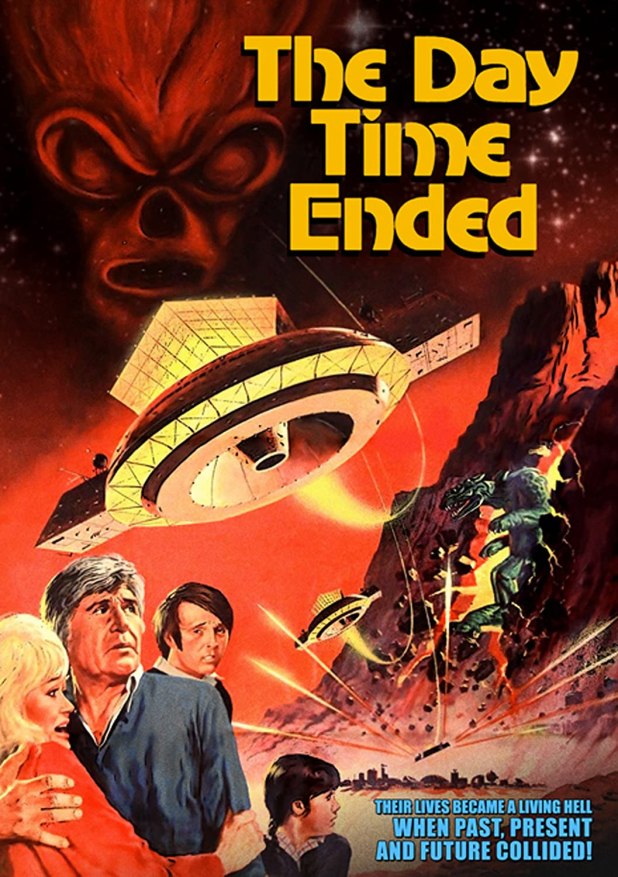
The Day Time Ended is a 1980 science fiction film released by Compass International Pictures. As I’m sure you know, Compass were also the distributor for John Carpenter’s Halloween in 1978, and producer Charles Band’s Tourist Trap in 1979. As I’m sure you also know, both of those films are much better remembered than this film, and for a multitude of good reasons.
Band would also serve as the producer of The Day Time Ended, with former stuntman John “Bud” Cardos (The Dark, Kingdom of the Spiders) taking directing duties. Fans of Band’s Empire Pictures and Full Moon Features presentations will undoubtedly notice quite a few regulars among the crew, such as David Schmoeller (director of Tourist Trap and Puppet Master) and Ted Nicolaou (Terrorvision, Subspecies series), as well as Oscar-winning make-up artist Ve Neill!
The Day Time Ended was seemingly produced to cash-in on the still lingering success of Star Wars in 1976, a wave of science fiction hysteria that allowed filmmakers and distributors of the time to drop any genre-related turd upon a presumably unsuspecting, yet still eager audience. If you were a young male during this era, chances are that the presence of spaceships, aliens, laser guns, and other intergalactic trappings was generally all it took to get your butt in the seat.
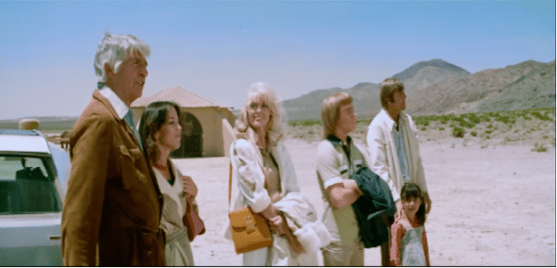
In The Day Time Ended, a young couple (played by Robert Mitchum’s son, Chris and Marcy Lafferty, who had previously appeared in Kingdom of the Spiders) and their daughter move to the middle of the desert in order to take up residence with the husband’s parents (or, at least I think they are his parents) and younger brother in their solar-powered home that looks far too small for all these people. The elder couple, played by Western star Jim Davis and Peyton Place‘s Dorothy Malone, have seemingly “dropped off the grid”, retreating from the modern world.
As we learn from a radio broadcast playing as the film opens, this move coincides with the occurrence of a triple-supernova. Almost immediately upon arriving at the desert home, the young child, Jenny, finds a strange, glowing structure while tending to a new pony that her grandfather has purchased. She runs off to tell her family, who find themselves distracted by the fact that the house appears to have been ransacked. The structure, about the same size as the horse, disappears before anyone else can see it. Once her family has left her side, believing the young child to be lost in childish fantasy, Jenny again finds the glowing structure, now no bigger than a large sugar cube or game die.
Other strange events begin to occur around little Jenny, but of course, no one takes any notice for an extended period of time. The grandparents soon witness two UFOs that fly over their heads as they walk the property, but think little of the incident other than being a little creeped out. Later that evening, when the family is in their beds, Jenny is visited by a tiny extraterrestrial creature. The mute creature jumps and spins around the room, but soon flees when another alien craft, also quite small, appears in Jenny’s bedroom. The grandmother also has an encounter with one of the small alien creatures.
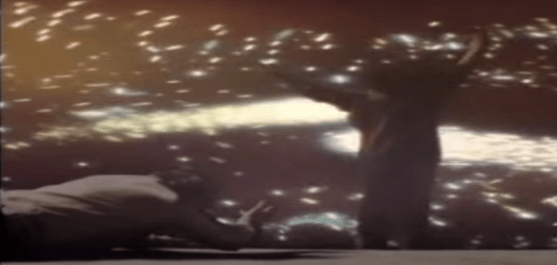
In time, more alien craft of varying size and shape converge upon the home. The family is unable to flee due to the car acting erratically, and any attempts to call in or out on the phone line are either cut short or garbled with static, thanks to “atmospheric interference”, an “electrical storm”, or whatever you choose to call the electromagnetic disturbance caused by all this alien activity.
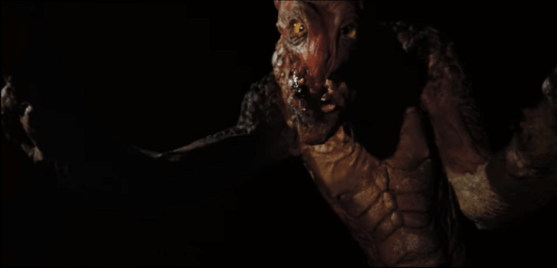
The Day Time Ended continues along with all sorts of extraterrestrial shenanigans occurring both within, as well as outside of, the home. Eventually, large monstrous creatures appear outside the house, further preventing any attempts at escape as they fight and maul each other to death. While these early examples of David Allen’s stop-motion work do show the early-stages of his abilities, they undeniably feel dated by today’s standards, and are far from “ideal” demonstrations of the talent that has made him a considerable legend by many and that earned him an Oscar nomination in later years for his work on 1985’s Young Sherlock Holmes. Overall, it’s still a fairly neat sight to behold by those of us still fascinated with cinematic monsters and aliens.
The film’s multiple effects are clearly on showcase here and are the obvious “star” of the film, covering up for (and at times, highlighting) the film’s thread thin and wildly incoherent plot. Sure, there’s some late-night, braindead entertainment to be found here if you aren’t looking for anything too deep or thought-consuming, but even the film’s veteran actors occasionally look bewildered and lost at times.
The Day Time Ended finally reaches its conclusion, only to become even more confusing. Drowning in visual nonsense, the finale presents endless questions with no clear answers given, other than what we interpret them to mean. Honestly, the whole thing just feels tacked on and more than a little rushed.
While I personally enjoy the stop-motion effects on display in The Day Time Ended, they are unfortunately an aspect of the film that many critics trashed upon its release, as well as in the years following. To further exemplify that just maybe I have no clue what I’m talking about, I personally felt that Lafferty wildly over-acted her way through her entire performance as “Beth”, the young mother. However, others clearly must have disagreed with my assessment as she was nominated for “Best Supporting Actress” at 1980’s 7th Annual Saturn Awards, losing to Alien‘s Veronica Cartwright. I can’t imagine there were many other viable competitors.
The Day Time Ended received a blu-ray release from Full Moon Features in early 2019. While the film, as well as Allen’s stop-motion effects, do benefit from a visual upgrade (well, the effects are debatable) thanks to the HD transfer, there’s really little to recommend here if you aren’t already an avid fan of Allen’s work or aren’t into watching painfully dull vintage sci-fi just for the sake of it.
DAY 18. RESURRECTIONISTS: Watch something that came out on one of the many reissue labels that we love like Arrow, Criterion, Bleeding Skull, Scream Factory, Indicator, Vinegar Syndrome, AGFA etc.
Vinegar Syndrome has a near-magic touch, finding movies that once gathered dust in the back racks of mom and pop video store horror departments and restoring them and doing their homework, getting the filmmakers to contribute and be interviewed so that the fullest picture of what they made can be finally displayed.
Deadline is a great example of what they do.
Writer Steven Lessey (Stephen Young, Soylent Green) is a horror writer who wants to be seen as an artist but is only known for his bloodier stories, such as The Executioners, a film in which children tie up their grandmothers and set them ablaze, or the shower scene bloodbath — quite literally — that opens the film or the gonzo psychic goat that forces a man to shred his own arms off or the appearance by Rough Trade as a band empowered by German scientists to make people explode via their bowels or the children clawing their way out of their mothers. His imagination is quite horrible in all the very greatest of ways and Deadline is at its best when these moments of insanity blast into the frame and by the very end, threaten to overwhelm reality.
While all that art against commerce war is going on inside his head, his marriage is falling apart and the horror of his writing intrudes into his children’s lives in a very shocking way. His agent responds by plying him with coke and women of loose morals, which leads to a brawl while watching his latest film that decimates the fanciest of houses before the drama leads to its foregone conclusion.
Deadline is a film that shocked me in parts and stayed with me way longer than I thought it would. It’s crazy seeing it in such high definition, as this is the kind of film that belongs marked with tracking issues. While he has worked mainly in television, I’ve heard that director Mario Azzopardi has also made a fact-based film called Savage Messiah which is the equal of this film.
This is everything you want from a horror film, whether you simply want an effects-based shocker or something that makes you think about the people who create the horror that helps you escape. Make it your own film. See it your own way.
I’ve had this movie for some time. Hell, I have a beta of this movie. But sometimes, I save Italian movies for when I need them most. Because for some reason, I worry that they are a finite source of escape from this world and I don’t want to use up all the water in my canteen as I stare out across that uncaring desert of reality.
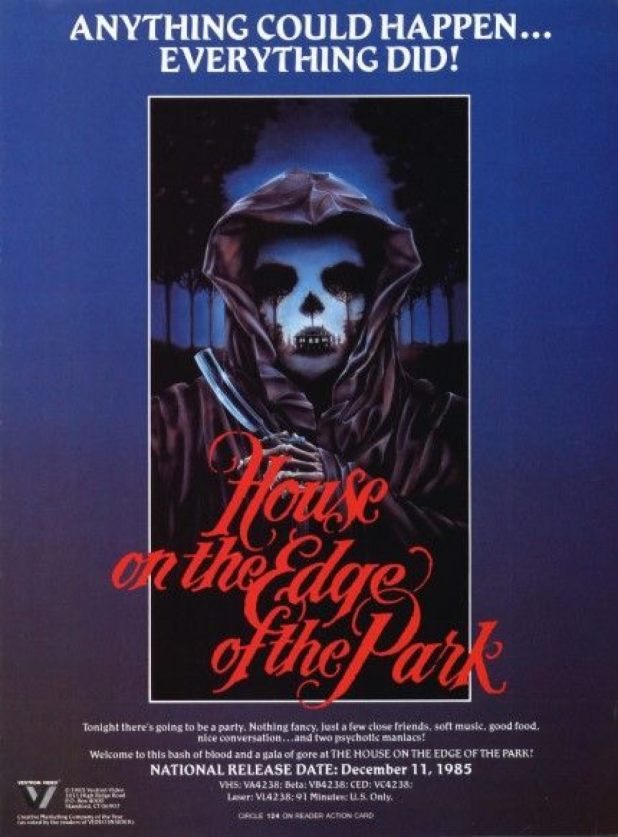
Have I ever gone off and told you how much I love Ruggero Deodato? Oh, yeah. I totally have. Well, here he’s remaking The Last House on the Left and going so far to just have David Hess play Krug all over again*, except this time he’s called Alex.
Deodato shot exteriors in New York City and interiors in Rome’s Incir De Paolis Studios. It starts with Alex pulling over a young woman who he soon assaults and murders. To make you feel even queasier about that scene, I’ll let you know that she’s played by his wife at the time, Karoline Mardeck.
After putting her locket into his trophy case, Alex and Ricky (Giovanni Lombardo Radice, City of the Living Dead, Stage Fright) are closing up the underground garage where they work when a Cadillac driven by Tom (Christian Borromeo, Tenebre) and Lisa (Annie Belle, Forever Emmanuelle, Absurd). After Ricky fixes their car, they invite the antagonists to a party. Alex walks to his locker and grabs a straight razor.
They arrive at the home of Gloria (Lorraine De Selle, Emanuelle in America) and the party begins, along with guests Glenda (Marie Claude Joseph, who was only in the one film) and Howard (Gabriele Di Giulio). Alex realizes quickly that he and his friend are only there to be made fun of, as the rich partygoers encourage Ricky to drink. Alex takes Lisa upstairs but she teases him to the point of blue balled madness. As he comes back to the party, he realizes they are cheating Ricky at poker, so he beats Howard into oblivion, throws him in a pool and relieves himself all over him.
It’s his party now.
Alex has his way with all of the women, one at a time, when he’s not slicing up the faces of the men. Gloria tries to seduce Ricky in the hopes of getting him on her side, but when they return to the rest of the party, Alex is slicing an innocent neighbor named Cindy (Brigitte Petronio, Emanuelle Around the World) into pieces. When Ricky tries to stop him, Alex turns the razor on his friend.
Tom grabs a gun and blasts Alex repeatedly, including a bullet directly to the groin. He falls into the pool and in an inverse of the way Howard was treated, the victim destroys his victimizer with a bullet to the head. As they go to call the police, Tom says that despite some mistakes, it worked out for the best. It turns out this Alex’s victim was his sister and this was all a ruse to kill him and get away with it. To make it even more upsetting, Tom mentions how exciting it must have been for her.
A section 1 Video Nasty, House on the Edge of the Park is not an easy watch. It’s a scummier version of Craven’s film, which may not seem to many like it is possible. I’m glad I waited so long to watch this, because it’s not a movie that will leave me quickly. Deodato makes a film that continually assaults not just the characters, but the audience, who remain spellbound by the performances.
* The filmmakers wanted Hess so much, supposedly they gave him half of the film’s rights.
Look, not every slasher has Tom Hanks in it. Actually, this would be the only one. So if you’re ready to see America’s favorite actor in a movie that is directly inspired by Halloween, then this would be your one and only chance to get it done.
This was Armand Mastroianni’s first movie, way before he’d start making TV movies. It’s all about young brides getting killed before they even make it to the altar, so at least it isn’t a holiday-centric slasher. That means that the film is free to explore all of the parts of the wedding, from the home of the bride to a dressmaker’s shop and, of course, the wedding chapel itself.
Our heroine is Amy Jensen (Caitlin O’Heaney, Savage Weekend), a bride-to-be who is in the crosshairs of whomever the killer ends up being. This movie takes the typical loose woman must die formula of the slasher to a ridiculous degree, as the main character is unsure of her fiancee while her best friend is having an affair and they all pay, along with nearly everyone else they come in contact with putting together this wedding.
Sure, the killer is Ray Carlton, a man left at the altar, but this movie decides to do the “it’s not over” ending as well, so when I say “whomever the killer ends up being,” I’m playing it coy.
While Mastroianni originally wanted to make a movie based on the urban legend “The Hook,” he sold the movie as containing a self-referential film-within-a-film. That would form the start of the movie, where a couple watching a horror movie are soon killed by the movie’s villain. If you’re saying. “Isn’t that exactly how Scream 2 begins?” Good news. You’re learning just how original those movies — which proclaimed to be the most original slashers in years — really were.
Hanks’ character was supposed to die, but everyone liked him so much, they kept him alive. See, even in his film debut, he was already everyone’s favorite.
What is it about Christmas that engenders just as many slashers as Halloween? Is it the ennui? The dread? The hatred of being forced to be nice and needing the release that only violence can deliver?
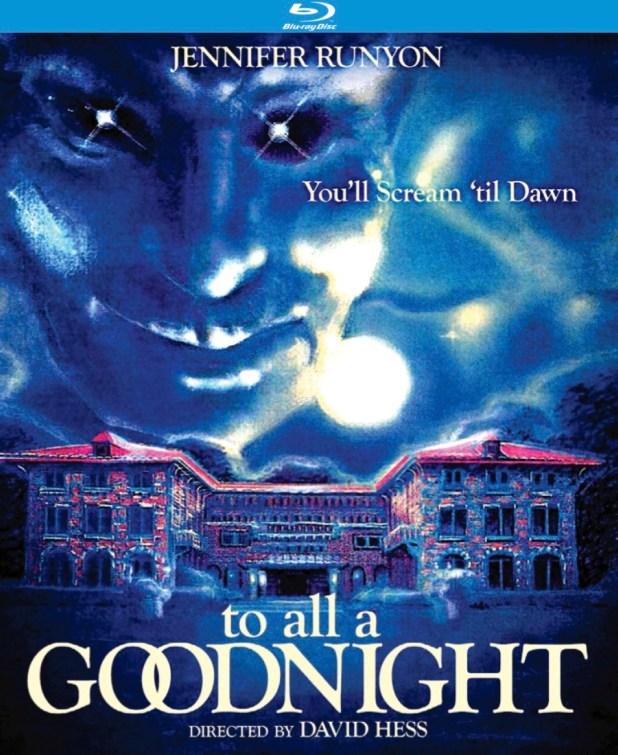
While this film borrows liberally from Black Christmas, it does have David Hess as a director, which was my primary reason for tracking it down. If you’re used to seeing him in films like Last House on the Left and the Italian remix House on the End of the Park, this is your opportunity to see what he would do on the other side of the lens.
Two years ago at the Calvin Finishing School For Girls, a student was killed when she was accidentally pushed over a balcony. Now, as the school empties for the holiday break, five of the girls decide to not go home and have a weekend alone with their boyfriends. But by the end of the first night, one of their classmates is dead.
The girls convince Nancy (Jennifer Runyon, who ended up in another seasonal slasher, Silent Night, Bloody Night 2: Revival) to drug their house mother so that they can all go to an airstrip and party with the guys outside their private plane. How rich are these dudes? This leads to, of course, more murder. And oh yeah — Deep Throat star Harry Reems as their pilot.
Unlike the aforementioned Black Christmas, the killer is revealed in this movie and it’s very Mrs. Vorhees. There’s a second twist as well to liven things up, as if things need any more color after the airplane itself is used to kill two of the teenagers.
This was written by Alex Rebar, who B&S About Movies’ eagle-eyed readers will spot as Steve West, The Incredible Melting Man. Kiva Laurence, who plays the housemother Mrs. Jensen, would go on to appear in the Americanized giallo Schizoidthe same year.
This film is incredibly dark and the VHS format did not help that at all. Today’s blu ray transfers have helped, but that fact has kept it from being included in the discussion of best slashers. It doesn’t belong there, but that doesn’t mean that it’s not worth watching.
“The gospel according to the Ayatollah Malcolm.” — Johnny Rotten
So agent provocateur and clandestine entrepreneur Malcolm McLaren owns a London fashion shop called Sex . . . eh, we don’t need to go that far back. . . . So co-founder/bassist/chief songwriter Glen Matlock is kicked out the Sex Pistols for “liking the Beatles. . . .” No, we don’t need to go that far back. . . .
When it came to the Sex Pistols, it was all about the marketing manipulation and McLaren the Machiavellian squeezed out every last drop of the group’s nihilistic sociopolitical ejaculate from their fourteen-month existence (November 1976 to January 1978). Regardless of their extensive discography that, by 1990, swelled to 20-plus albums, the group recorded only one actual studio album: the high-expectation and commercially-disappointing Never Mind the Bollocks, Here’s the Sex Pistols (1977). (The “flop” in the U.K. and Euro-markets was result of the album’s composition from the band’s already released 45-rpms and a “legal” 1977 bootleg album, Spunk.) And part of McLaren’s high-profile manipulations was to create a punk version of Richard Lester’s A Hard Day’s Night—with Johnny Rotten refusing to have anything to do with the project. The “project” was initially developed by—of all peoples—Russ Meyer, with snobby film critic Roger Ebert as the screenwriter, in tow—both who had a little experience in the rock ‘n’ roll genre with their “epic” about the rise and fall of the Carrie Nations, 1970’s Beyond the Valley of the Dolls . . . but Meyer also had lots of experience with large-breasted women (1965’s Motor Psycho and 1966’s Faster Pussycat! Kill! Kill!).
Yeah, this is going to work just fine. . . .
Well, it didn’t.
So, two-plus years later of false starts and stops with an array of people and footage shot here and there—which produced the Meyer-unfinished Who Killed Bambi?, British music video-artist, filmmaker, and ‘Pistols running mate Julien Temple (1989’s Earth Girls are Easy) got the Alan Sacks job of “doin’ a duBeat-eo” with the hours upon hours of narrative footage and concert clips of the Pistols during their heyday, along with surreal Kentucky Fried Movie-esque skits (that go beyond the funny into the silly . . . and the outright stupid).
Now, for those of you wondering: “What da frack does ‘Doin’ a duBeat-eo’ mean . . . and who is Alan Sacks . . . and what does this all have to do with the friggin’ Sex Pistols?” Well, impatient one, here’s your answer:
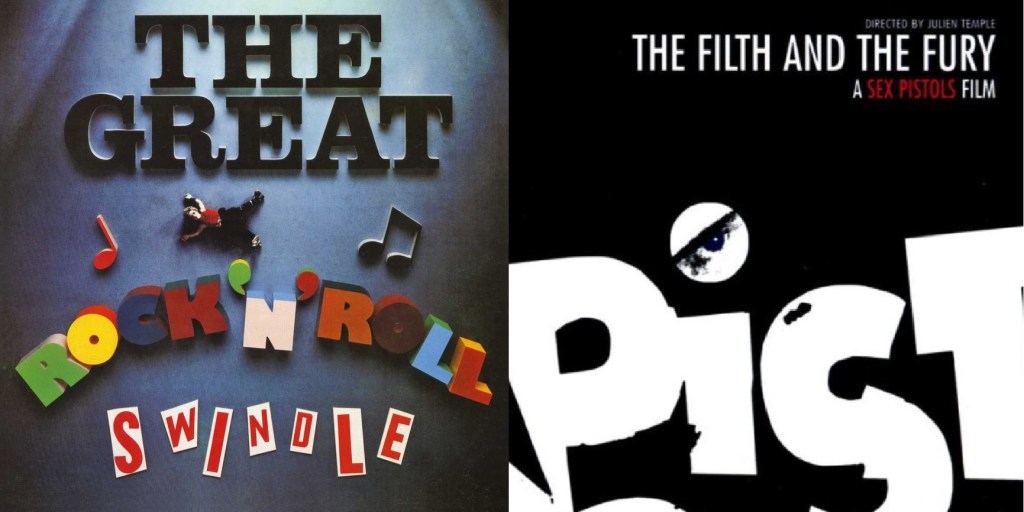
Alan Sacks came to fame as the creator of ’70 TV’s Welcome Back, Kotter; you know, that’s the show with the “Ooo! Ooo! Mr. Kotter!” pop culture catch phrase . . . the show that gave John Travolta his start. (He was most recently in the one-two punch bombs The Fanatic and Gotti.) And Alan Sacks got the job of taking the analogously dead pet-project of America’s Malcolm McLaren-doppelganger, record producer-songwriter Svengali Kim Fowley who, ironically ripping off McLaren’s idea, wanted to put his own “female” version of the ‘Pistols, the Runaways, into a “Beatlesesque” movie. (Remember: the ‘Pistols had “Anarchy in the U.K.” while the Runaways had “Cherry Bomb” as their signature tune.) Failed-developed as We’re All Crazy Now, Sacks got the Julien Temple-job of creating coherency out of chaos—and came up with duBeat-e-o, a film that has as much to do with the Runaways as The Great Rock ‘n’ Roll Swindle has to do with the Sex Pistols.
So, what did Temple come up with?
Well, he cut Who Killed Bambi? into the film. Sid Vicious—post-Sex Pistols—cut an album, Sid Sings (1979), and cut a video for that album’s centerpiece: a cover Elvis’s and Frank Sinatra’s signature tune, “My Way”—so Temple cut that into the film. (Warning: Sid pulls a gun and shoots into the audience.) And since Johnny Rotten wanted nothing to do with the project from the get-go, Temple opens the film with the snotty lead singer burned in effigy . . . and created an animated sequence that chronicles a beating the vocalist behind “God Save the Queen” took at the hands of Queen Mum-lovin’ thugs. And guitarist Steve Jones’s Rio de Janero visit with infamous British bank robber Ronnie Biggs is cut in. (Jones, ironically, along with Paul Cook and Glen Matlock, worked with Joan Jett on her self-titled solo debut, aka Bad Reputation.) And yeah, and Kurt Cobain Sid Vicious and Courtney Love Nancy Spungen, aka the punk rock John and Yoko, go through their own little psychodrama safety-pin voguing on screen. And, instead of Sex Pistols tunes: you get disco versions of Sex Pistols tunes by a group called the Black Arabs.
You can check out the track listings for each soundtrack on Discogs: Swindle and Fury.
. . . and the ‘swindle’ continues . . .
So Temple decided to commemorate the 20th anniversary of the film with a “sequel”. . . that cut TheGreat Rock ‘n’ Roll Swindle’s footage into the—admittedly—more coherent The Filth and the Fury (1990). And, if you’re keeping track . . . marks the third film chronicling punk’s most notorious band: the second was Alex Cox’s (Repo Man, Tombstone Rashomon) spunky, but not wholly historically accurate, Sid and Nancy (1986)—which Johnny Rotten also hated, natch.
With The Filth and the Fury—and without Malcolm McLaren’s marketing imperialism (. . . did you know he embarked on a “solo” career: with producer Trevor Horn, he assembled (McLaren never creates; he can’t. He thieves.) 1983’s Duck Soup)—Temple secured the full cooperation of Johnny Rotten, along with drummer Paul Cook, guitarist Steve Jones, and ex-bassist Glen Matlock, each who provide a new series of interviews, along with “new” interview footage of the late Sid Vicious not seen in Swindle. The interviews are well-executed: Temple peels Rotten-Lydon’s acidic layers and exposes his emotions over Sid’s decline and death. And there’s plenty of “new” footage, albeit, sometimes (most times) with grainy and out-of-sync sound, but kudos for Temple preserving those decrepit 16 mm and shot-on-videotape analog artifacts for the now, digital generations.
Temple was also able to circumcise McLaren’s cultural plundering of punk’s esthetics by showing us that punk rock wasn’t just about flogging the dead horse of Black Sabbath-inspired progressive rock and replenishing the wheezing lungs of rock ‘n’ roll. Punk was an artistic expression of the frustrations the British working class and unemployed (which include Rotten-Lydon’s contemporaries) against the stodgy and greedy British class system (a country where everyone’s on the dole, in poverty; meanwhile, Princess Di and Prince Charles have a huge matrimonial blowout). To that end, Temple also includes new footage of the protests, riots and unrest of the times (think of today’s Black Lives Matter movement and the upheaval in today’s Portland, Oregeon). So while Swindle was a “Swindle” to a point—which wasn’t Temple’s fault, he did a great job with whom and what he had to work with—Fury gets the facts straight and conveys the spirit of the times. So, as you watch both films as a double feature all these years later: you get Malcolm McLaren’s side . . . and the Sex Pistols side. And the twain shall never meet. Not even in the hands of Alex Cox.
The Great Rock ‘n Roll Music Trivia Swindle (you knew there was going to be a trivia sidebar): Before McLaren sunk his incisors into the Sex Pistols, he managed a down-and-out and ready-to-implode New York Dolls, which culminated with the 1975-recorded live, Euro-only album, Red Patent Leather (1984; which features new tunes not available on their two Mercury studio albums).
Also in Mal’s Svengali-stable was the burgeoning Adam and the Ants, who he subsequently “broke up” to provide musical backing for his own “Runaway” embodied in fifteen-year-old singer Annabella Lwin. Upon the eventual implosion of Bow Wow Wow (You do remember “I Want Candy,” right?)—as McLaren turned his Runaway into a singular-named solo artist, you know, like Madonna (not!)—guitarist Matthew Ashman formed Chiefs of Relief. And that band features another musician from the McLaren stables: Sex Pistols’ drummer Paul Cook (produced one eponymous debut album for Sire in 1988).
Prior to the Chiefs—and post-Sex Pistols (by the end of that band, only Steve Jones and Paul Cook were left to finish off a light smattering of tracks to close out that band’s career)—Jones and Cook formed the Professionals (with guitarist Ray McVeigh and bassist Paul Meyers). And, if you’re keeping track of your rock ‘n’ roll flicks, the “band” appeared—sans McVeigh and Meyers—with Paul Simonon of the Clash and British actor Ray Winston in their places, in Ladies and Gentleman, the Fabulous Stains.
Steve Jones’s solo career culminated with his forming a band around Iggy Pop, which recorded a couple of “comeback” albums for Detroit’s Jim Osterberg in the burgeoning years of the Year of our Lord Kurt Cobain. Johnny Rotten, as you know, reverted to his given name of Lydon and created the band Public Image, Ltd. with ex-Clash guitarist Keith Levene. Ex-Pistols’ bassist Glen Matlock formed the less-punk-more-Knacky new wave the Rich Kids with future Visage and Ultravox members Midge Ure and Rusty Egan, which scored a minor hit single with the title cut song from their lone album, 1983 Ghosts of Princes in Towers. Matlock eventually ended up in Concrete Bulletproof Invisible (an outgrowth of Doll by Doll that recorded one album for MCA Records) which released one pre-grunge album, Big Tears (1988).
Both films and their related soundtracks are easily available as DVDs and CDs, with the films as VODs and PPVs on multiple, international online platforms (hopefully, since these are “official trailers,” we won’t lose them to the black box of death!).
Update, August 2022: Our gratitude for the kindness and positive vibes from Aaron Hunter and his You Tube-based video blog on film (1.7 million followers and counting!), citing this review in his materials.
About the Author: You can learn more about the writings of R.D Francis on Facebook.He also writes forB&S About Movies.
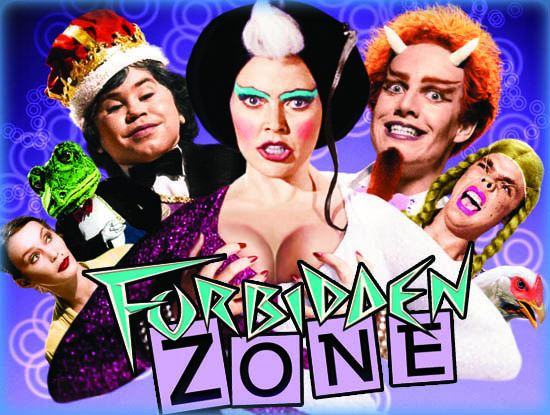
Somehow, Forbidden Zone was filmed in 1978 and 1979, but could really have come from any time after. It feels like a nuclear bomb that set off waves of influence well beyond and past its origination point. It was created by Danny Elfman and his childhood best friend, Matthew Bright, who would go on to make the two Freeway movies.
Based on the stage performances of the Los Angeles theater troupe The Mystic Knights of the Oingo Boingo, this is the kind of movie that everyone believed in, so much so that every SAG actor — including Hervé Villechaize, who even painted sets — gave their money back to keep the movie going (with the exception of Phil Gordon).
This was Elfman’s retirement from popular music to scoring films, as well as Oingo Boingo’s move from cabaret-style music to New Wave. It’s also astoundingly weird, even 40 years or more after it was made.
Richard Elfman, who started the Oingo Boingo troupe, directed this (he also made Shrunken Heads for Full Moon and used the pseudonym Aristide Sumatra to make the martial arts movie Streets of Rage). It’s literally an assault on all that anyone could hold dear, made in a time when rallying against values wasn’t crass or used to shove into people’s faces. It was a different time, I guess. That doesn’t excuse some of the worry that you’ll feel with seeing blackface, one of the few things that Elfman would take back, telling Dread Central, “From today’s perspective, if I could go back forty years, I certainly wouldn’t have included the brief blackface bits in Forbidden Zone. It was just one of hundreds of visual absurdities not at all important to the film and not worth its particular hot-button reaction. Although I have grown up in and around the African-American community (and have a racially diverse family), I don’t claim to know exactly what it is like to stand in a black person’s shoes and feel the effects of their particular oppression over the centuries.”
Man, how do I even explain this movie, one that starts with a Sixth Dimension hole inside a drug dealers’ house that leads to the kingdom of King Fausto (Villechaize) and Queen Doris (Susan Tyrrell)? I mean, for all the mindblowing things about this one, perhaps it isn’t even strange any longer to learn that Villechaize and Tyrrell had dated and warred throughout the making of this movie.
You get Warhol superstar Viva, a human frog, an apperance by Joe Spinell and Danny Elfman himself as Satan, all playing music from four decades or more before this movie was created. Marie-Pascale Elfman, who plays Susan B. “Frenchy” Hercules, also designed all of the sets and helped fund the movie by flipping houses with Richard, who was her husband at the time.
What started as black and white is now a colorized film that you can watch on Tubi. With it’s mixed of animation, song and dance, comedic violence and a willingness to offend in the most fun way possible, this is a movie worth setting aside time to view. Richard Elfman lost his house and all of his money making this happen, but after viewing it, I’m sure ypu’ll agree that it was all worth it.
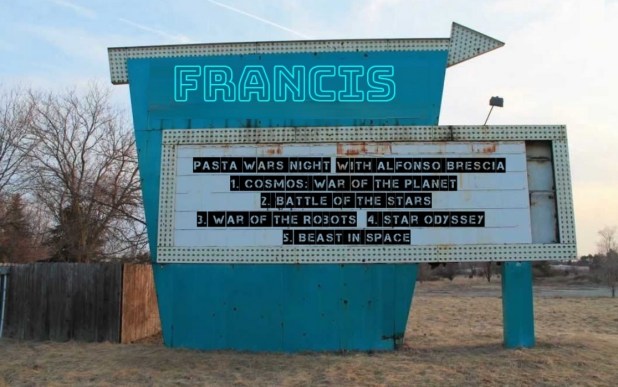
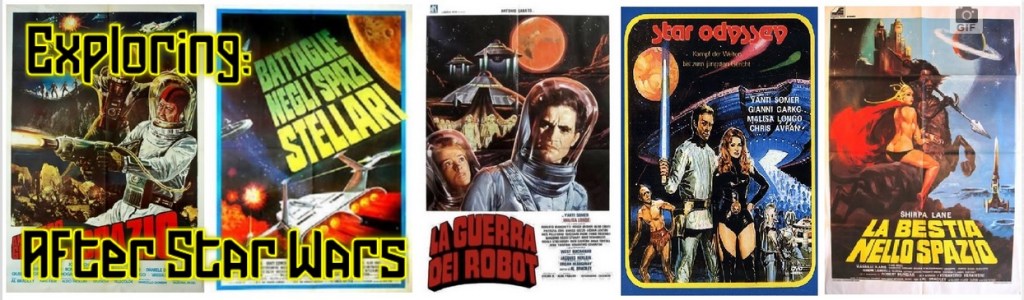
Editor’s Note: Due to their plot, costume, and SFX common denominator recycling, we are reviewing five films in this exploration of Alfonzo Brescia’s “Star Wars” films: Cosmos: War the the Planets, Battle of the Stars, War of the Robots, Star Odyssey, and Beast in Space—so, yes: it’s a five-in-one review. And we toss in a little backstory on Brescia as a bonus!
It all began with the 1964 sand n’ sandal flicks The Revolt of the Pretorians and The Magnificent Gladiator, along with an array of Poliziotteschi flicks. In between was an X-rated romp with 1969’s The Labyrinth of Sex and 1974’s seen-to-be-believed Super Stooges vs the Wonder Women. And it all pretty much ended when Uncle Al decided to take on George Lucas. We never saw him again on U.S. screens—big or small.
Be warned, young warrior: Uncle Al’s space romps make Glen “larceny” Larson’s Battlestar Galactica look like the Lucasian epic it wanted to be (and was not). Space: 1999 isn’t so dorky to you now, is it, space cowboy? Oh, but Uncle Al’s flicks are oh, so much more fun than the plastic-verse Star Wars dropping that is Buck Rogers in the 25th Century.
So, have you ever met two guys debating the content of Alfonso Brescia’s “Star Wars” rips? Welcome to mine and Sam’s world: a bizarro-universe where he mixes colorful, alcohol concoctions based on movies and we destroy our livers debating superfluous movie facts, much to the chagrin of poor Becca. Not even a Bill Van Ryn smack-on-the-side-of-the-head cures our Bresciamania.
Sam is of the critics who believe Uncle Al’s “Pasta Wars” is comprised of only four films: Cosmos: War of the Planets (aka Year Zero War in Space), Battle of the Stars, (aka Battle in Interstellar Space), War of the Robots (aka Reactor), and finally, Star Odyssey (aka Seven Gold Men in Space, Space Odyssey, Metallica and Captive Planet).
I’m on the side that there was actually five films in the series, which completed with 1980’s La Bestia nello Spazio, aka Beast in Space in English venacular, aka “Star Wars V,” aka “Porn Wars,” because, well . . . it’s a porn movie.
Four!
Five!
Four!
Five! Arrrgh! Let’s break ’em down! But first, this 2012 trailer remix for the best known of Uncle Al’s “Pasta Wars” flicks: Star Odyssey.
Many sci-fi connoisseurs believe Brescia’s “Star Wars” debut isn’t so much a rip-off of Star Wars: they opine it’s a homage to another Italian space epic, one that was produced amid all of those Antonio Margheriti-spaghetti space operas: Mario’s Bava’s Terrore nello Spazio, aka Terror in Space (known in American theatres as Planet of the Vampires; then in its U.S. TV syndication as Demon Planet).
On this point, Sam and I concure: Look at the costuming and alien-possession subplots of Bava’s and Brescia’s films for comparison. Adding to the celluloid confusion: Cosmos had similarly-influenced—if not the very same-recycled—costumes and sets as Margheriti’s films. In addition: Cosmos was also distributed as War of the Planets—which was the title of the 1966 second film of Margheriti’s Gamma One series.
Amid Cosmos’ self-recycled stock footage and shot-through-sheets-of-sepia-paper-and-cheese-cloth special effects, Cosmos also ineptly-lifted whole scenes from 2001: A Space Odyssey (an astronaut completes an upside-down communication device repair-in-space) and Barbarella (sex via touching a “blue orb of light” between beds). The “plot” for those who fell asleep: Our heroes journey to a planet where a green-skinned race is subjugated by an evil computer . . . and the Earth’s Italian “Hal 9000,” “The Wiz,” is possessed by the evil alien computer. . . .
Is this plotline picked up in the next movie? Nope. But all the sets, props, and costumes sure do redux.
Believe it or not, with everyone tricked into believing they were seeing another “Star Wars,” Cosmos: War of the Planets turned a profit in theatres (while I didn’t catch it at the local duplex, my coin was taken by Lou Cozzi’s Starcrash, Michael A. De Gaetano ’74-to ’80 reissue of UFO: Target Earth, Pietro Francisci’s ’66-to-’77 opus, Star Pilot, and George B. Lewis’s, aka Aldo Lado’s The Humanoid). Everyone in the U.S., pretty much, watched Cosmos on TV, as it aired forever during the ’80s on Friday and Saturday night and Saturday afternoon UHF-TV.
You can watch one of the many uploads on You Tube.
Movie 2:Battle of the Stars (1978)
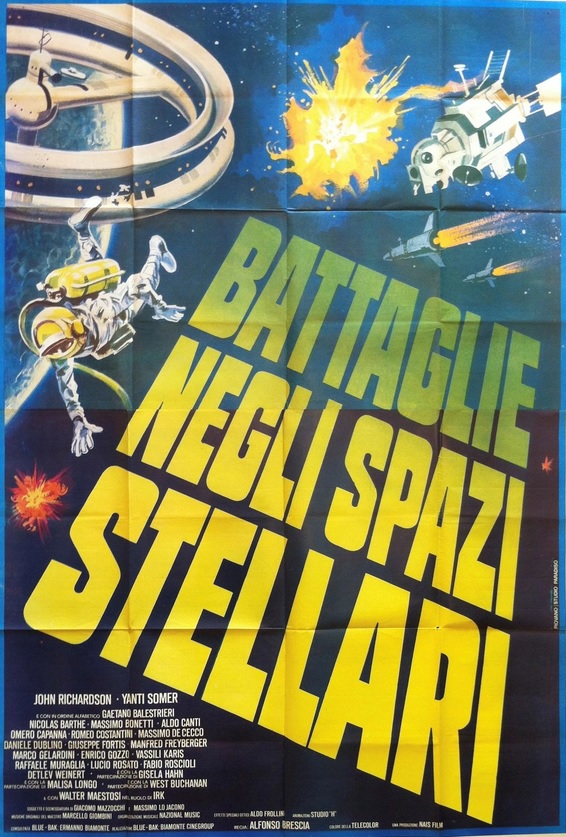
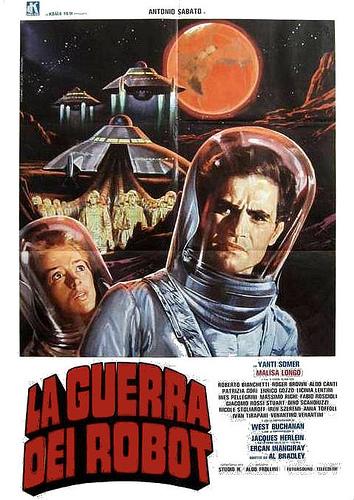
. . . And Uncle Al returned with his “Empire Strikes Back” in the form of Battaglie negli spazi stellar (aka Battle in Interstellar Space), but it was given a new U.S. title because it sounds suspiciously like “Battlestar Galactica.” And since that was Glen Larson’s cheap-jack Lucas rip, that makes this a Star Wars rip twice removed.
You never heard of it because Uncle Al’s “Star Wars II” suffered from poor theatrical distribution and a weak reissue via home video and TV syndication. Then, with all the alternate titling that plagues European films as they’re distributed to the international markets, spacesploitation buffs believed the almost-impossible-to-find Battle of the Stars was Cosmos—with a new title. It’s not helping when the main cast of familiar Italian actors Gianno Garko, Malisa Longo, Antonio Sabato, Yanti Somer, and John Richardson—with most of their supporting cast—appear in subsequent films as different characters (well, they’re the same, but with different names), adding to the continuity confusion.
Regardless, it’s not the same film.
Battle of the Stars is an entirely new film that cannibalizes Cosmos for stock footage—and all the costumes and sets return. As is the case with most “sequels” (Alien vs. Aliens and Mad Max vs. The Road Warrior being the exceptions to the rule), Battle is a just remake/reimage of Cosmos—with a little script tweak: Instead of Earthlings traveling to the planet-home of the evil computer, this time: the rogue planet (or was it an asteroid; don’t care) without-an-orbit-and-pissed-off-sentient-being running it comes to Earth (from the orbit of Ganymed, Jupiter’s moon) which . . . was the plot of Margheriti’s Battle of the Planets from his “Gamma One” series. Hey, er, uh . . . what happened to the ship with its computer, “The Wiz,” possessed by the alien computer in Cosmos? Is that cleared up in Part III? Nope, that plotline is done and gone. . .. .
Look, as someone who has seen Cosmos: War of the Planets a few times: there is no “sport fishing on Earth” scene and there’s no androgynous, platinum blonde 12-year-old alien decked out in a silver chain mail spacesuit helping the Earthlings with an ersatz Marksman-H training remote Jedi-ball. But there is in Battle of the Stars.
So, yeah, it’s the same effect shots, same sets, same actors, even the same situations (that 2001-inspired space station repair and that sentient alien computer set, for example, again) . . . but it’s a different film. It’s not up for debate: it’s two different films, space ace.
Notice the Gerry Anderson’s S.I.D sentient satellite from his TV series UFO, in the upper-right cornerof the one-sheet.
The snack bar is open . . .
Intermission with Jason of Star Command, Space Academy, and Ark II!
Yes, Jason of Star Command, Space Academy, and Ark II from CBS-TV are the far superior productions . . . and all of Uncle Al’s one-piece spandex suits and pull-over headpieces were back for a third sequel . . . with a society of gold-painted skin people pinch-hitting for the green folks from Cosmos.
Why?
On this point Sam and I agree: There’s no “artistic” meaning behind it. Uncle Al simply ran out of the five-gallon buckets of green grease paint and he found some gold paint in the stock room. Ah, but all of the stock SFX footage, costumes, and sets—and whole scenes lifted from the previous two films—are back.
The “plot,” such as it is: Gold Aryan robots with Dutch-boy haircuts are on the brink of extinction. And the solution is to kidnap a couple of Earth scientists to save their planet. So a crack team of space marines (see Aliens; which wasn’t made yet!) are sent in for a rescue.
What makes “Pasta Wars III” so utterly confusing: All of the same actors from the last two films come back—as different characters. So, it’s a “sequel” . . . then it’s not. Will the fourth film tie up the loose end regarding the possessed Wiz from part one. . . .
You can watch this one of the many uploads of War of the Robots on You Tube.
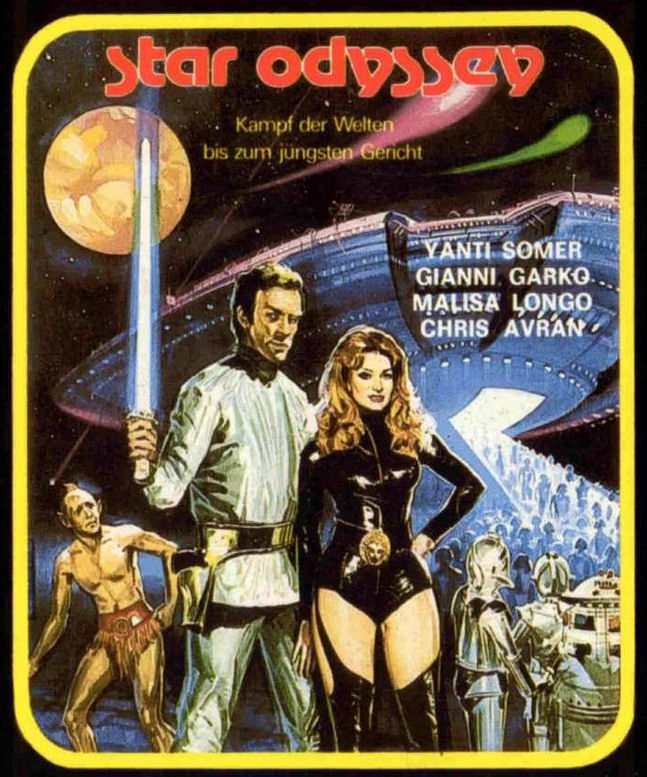
So . . . George Lucas was still in production with the second Star Wars movie, The Empire Strikes Back (1980)—and Brescia is already on his 4th sequel with 1979’s “The Gold Ayran Dutch Boy Robots” (as I like to call it) . . . but they really were back in Sette Uomini d’oro nello Spazi, aka Seven Gold Men in Space which, if you’re able to keep up with the alternate-titling of Italian films, became Star Odyssey for English-speaking audiences.
And you thought Roger Corman was the king of set, prop, and wardrobe recycling? Uncle Al’s recycling makes Glen Larson’s cheap n’ shameless footage, prop, and costume recycling from the Battlestar Galactica and Buck Rogers franchise-axis seem inspired.
The plot: In the year 2312 the Earth is referred to by evil aliens as “Sol 3.” “Darth Vader” is some guy in a (quite impressive) lizard skin mask (but it’s topped with a Farrah Fawcett-’70s feathered hair cut) that “buys” Earth in some inter-galactic auction to cultivate Earthlings as slaves to sell on the open market. And his army is the gold Dutch Boy robots . . . but didn’t we save them in War of the Robots? Welcome to the Brescia-verse. . . .
“Han Solo” is some guy in a shiny-silver Porsche racing jacket and a funky, disco-inspired spider web tee-shirt contracted for a The Magnificent Seven-inspired recruitment of a rescue team of rogues . . . thus ripping off Roger Corman’s Battle Beyond the Stars (and Corman ripped himself in the later productions of Space Raiders, Forbidden World, and Dead Space; yes, sets from Galaxy of Terror are in the mix amid all of those films, as well; he even lent them out to Fred Olin Ray for Star Slammer). Part of the “seven” are Uncle Al’s R2D2 and C3PO: a bickering male-female robot couple (the female has eyelashes and red lips) dealing with “sexual dysfunction” and “relationship issues.” And there’s a scrawny n’ skinny Han Solo-replicant acrobat who backflips and summersaults into battles—and makes a living fighting in boxing rings with Rock ’em Sock ’em Robots (know your ’70s toys). And what’s up with the “Luke Skywalker” of this space opera: Lt. Oliver ‘Hollywood’ Carrera? What’s with the obviously drawn-on mustache? Why is he hunching his back and arching his shoulders? Is it a parody of some Italian comedy actor we Americans don’t know about?
As result of Star Odyssey never playing in U.S. theatres or airing on U.S. UHF-TV in-syndication (at least not to mine and Sam’s recollections), the only way we watched this fourth “Pasta Wars” sequel was on numerous public domain DVD multi-packs. And regardless of the distributor, the “cut” of the film is always the same: somewhere along the way, the scissors were taken to the film and there’s several scenes out of sequence. Remember in Space Mutiny, when Lt. Lemont is dramatically killed off in a scene . . . and she shows up just fine in the very next scene? It’s like that, only it happens several times in Star Odyssey.
I keep promising myself that I’ll rip Star Odyssey and do a proper “fan cut” and put it back into its proper sequence in homage to Uncle Al. . . . Don’t hold you breath waiting for that You Tube upload.
You can watch Star Odyssey in all its continuity-screwed glory on You Tube.
Movie 5: Beast in Space (1980)
And now for the movie that’s come dangerously close to destroying a friendship. Alfonso Brescia’s oeuvre has that effect on people . . . well, just me and ‘ol Sam.
Anyway . . . remember the infamous, 1972 X-rated Flash Gordon porn-flick, Flesh Gordon (itself sequeled with Flesh Gordon Meets the Cosmic Cheerleaders)? Did you ever wonder if Reece and Ripley (and we know they did, off-script and off camera) “got it on” in Aliens? Ever ponder if Han threw Leia across the Dejarik Chess Table and undid her cinnabons?
Well, welcome to Porn Wars.
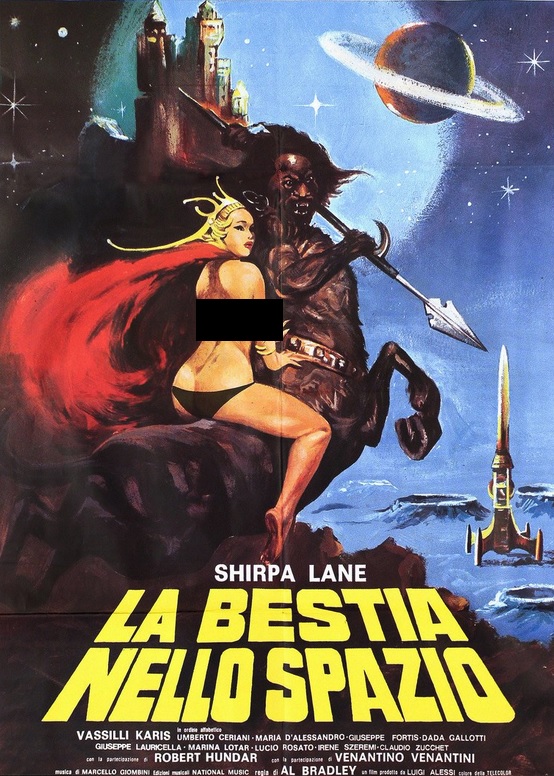
There’s George Lucas, killing the box office with The Empire Strikes Back, and Brescia responds with his “Star Wars V”: 1980’s La Bestia nello Spazio, aka Beast in Space. The interesting twist to this “sequel” is that it not only occurs in the same Brescia Pasta-verse (courtesy of footage, costumes, props, sets, and actors recycling) continued from Star Odyssey, it’s also a “sequel” to Walerian Borowcyk’s infamously popular, 1975 French erotic-horror/exploitation movie, La Bête, aka The Beast. The “connection” between both films: erotica-exploitation actress Sirpa Lane sports a pair of Brescia-space tights and headpiece.
So how did they come up with the title Beast in Space, you ask? As result of her erotic/exotic films—especially The Beast—Sirpa Lane was a major star (and marketed as the “next Brigitte Bardot”) in Europe and christened with the affectionate stage name by the Euro-press: “The Beast.” (We also reviewed her work Joe D’Amato’s Papaya: Love Goddess of the Cannibals, if you’re interested.)
Issued in “PG,” “R” and “X”-rated formats, the “plot” concerns the Earth’s search of the cosmos for a rare element: Antallum, the key ingredient for bomb construction to basically kill off everyone in the universe. But wait . . . Earth already possessed that wonder-metal to accomplish space travel in the first film . . . so is this a prequel?
Eh, that’s plot piffle in the Brescia-verse.
The real story: The crew is “horny,” with chauvinistic men and slutty women astronauts seducing each other on their way to the planet Lorigon to plunder the planet of its Antallum honey hole. Well, the planet’s sentient super-computer (not again!) isn’t having any of that nonsense. That’s his Antallum. So “Hal 9000” sidetracks the Earthlings . . . by inciting them to indulge in their deepest, darkest sexual desires. Oh, did we mention the gold Aryan Dutch Boy robots are back as well? And the well-hung minotaur from Lane’s sexual dreams is real and lives on Lorigon?
The English language upload is gone. All we have is this Spanish-language upload on You Tube for you to sample.
DVD Copies of Beast in Space
The fine folks at Severin (thanks, again for the Delirium pull-quote) discovered an obscure hardcore cut of the film: it adds a few minutes of unsimulated, aka real, grinding (from bodies doubles) and a nice and long (sorry) five minutes with The Beast’s monstrous penis—and his “climax.” That footage is said to have been shot after the fact and spliced-in; that cut was distributed throughout Europe.
As result of that discovery: Severin has two DVD versions in the market: An Unrated Version at 92 minutes and a XXX version at 91 minutes (the one with the body doubles footage). The footage variations are those hardcore shots of Onaf (Robert Hundar; 1977’s La bella e la bestia) raping Sondra (Sirpa Lane) and his penis in action, along with a sex scene between Capt. Larry Madison (Vassili Karis of 1979’s Giallo in Venice) and Sondra. The Unrated Version comes from the original film lab negative utilized for the Region 1 (North and Central America) DVD release by Severin, which they acquired from a Rome, Italy, bankruptcy auction. The XXX version was discovered in the basement of a condemned Bologna, Italy, porn theater.
Both Severin versions come with Bonus Features: The Unrated Version comes with a vignette from actor Venantino Venantini (Juan Cardoso in the film) who speaks at length about his career, working on Black Emmanuel (we’ve since reviewed Emmanuel IV because of its Cannon connection) and with Brescia. The XXX Version, again, offers the newer hardcore footage-inserts—along with a trailer.
While both versions are out-of-print and no longer available at Severin Films, used and aftermarket copies are available on Amazon and eBay; but emptor the caveats, ye buyer. You can get the technical rundown on the releases at DVDTalk. And if you’re a Brescia completists, like moi, you’ll get both for the collection.
So be it Star Odyssey or Beast in Space—or four or five films—Uncle Al’s “Pasta Wars” was over. After turning out his “Star Wars” films in a short four years, Brescia turned over the keys to the Millennium Falcon. But let’s cut Uncle Al a break: he was saddled with the cheapest budgets and pressure-shoot schedules that no filmmaker should endure in their careers.
Brescia continued to make non-science fiction films for the remainder of his career—14 more films for the next 15 years. At the time of his retirement in 1995, Brescia completed a career total of 51 films.
Most of Brescia’s post-1980 work was primarily restricted to Italy-only distribution. His career took a financially-positive turn in the late ‘80s with the worldwide-distributed Iron Warrior (1987; the third in the hugely successful, Ator Italian rip-off series of Conan the Barbarian) and Miami Cops (1989; violent Miami Vice-inspired buddy-cop flick starring Richard Roundtree). Sadly, even with the success of Iron Warrior and Miami Cops, Brescia was unable to secure distribution for his self-financed final film, the 1995 action-comedy, Club Vacanze.
Alfonso Brescia, the king of the Star Wars-inspired spaghetti-space opera died, ironically, in 2001.
And that’s the story behind tonight’s “Drive-In Friday” salute to Uncle Al.
Oh, yes! There are so many more post-Star Wars films to partake, young warrior.
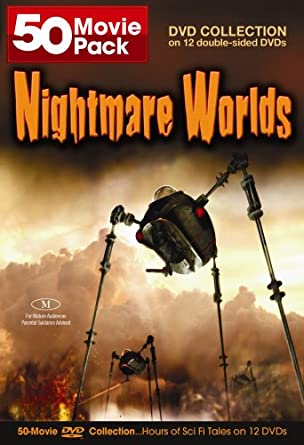
While Battle of the Stars and Beast In Space — to our knowledge — haven’t made a Mill Creek appearance, you can easily find Cosmos: War of the Planets (“Sci-Fi Classics”), War of the Robots (“Chilling Classics”), and Star Odyssey (“Nightmare Worlds”) on a variety of Mill Creek sets, these one in particular (clickable images for the full list of films).
About the Author: You can learn more about the writings of R.D Francis on Facebook. He also writes for B&S Movies.
Dick Lowry has worked in made-for-TV movies for some time, working on many projects with Kenny Rogers (The Gambler, The Coward of the County) and connected movies like In the Line of Duty and Jessie Stone, as well as the Project ALF TV movie reunion and Archie: To Riverdale and Back Again.
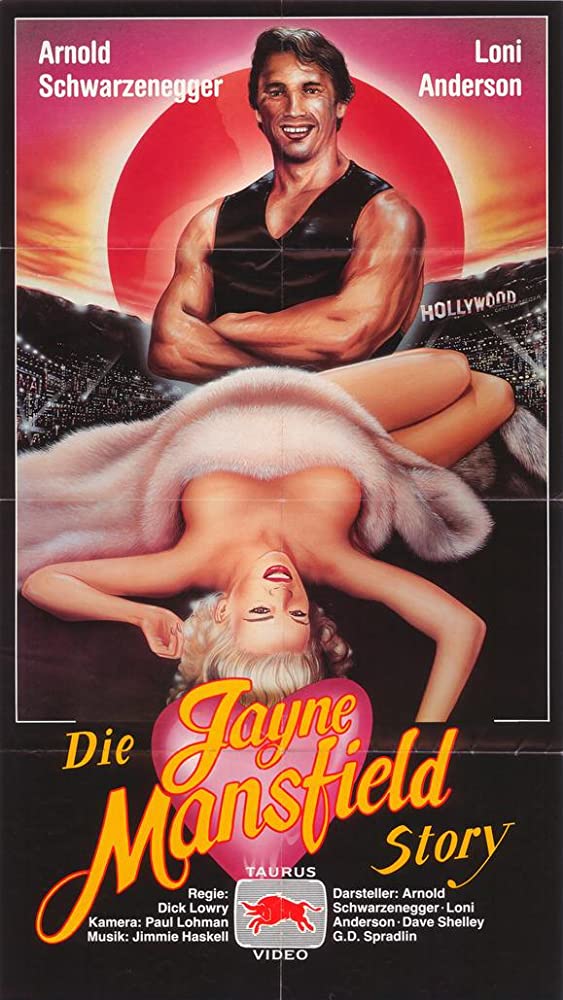
Based on the Martha Saxton book Jayne Mansfield and the American Fifties, this is — at best — a fictionalized accounting of her life. John Wilson’s book The Official Razzie Movie Guide as one of The 100 Most Enjoyably Bad Movies Ever Made.
Arnold Schwarzenegger — four years before The Terminator — plays Mansfield’s second husband Mickey Hargitay, who is telling a reporter the story of her life. Mansfield is played by Loni Anderson, who is perhaps the worst person — outside of bust line — to play her. She just seems wrong, from how she approaches the role to look. Maybe she identified with Jayne, seeing as how she started as a sex symbol and struggled to get her intelligence across. I’m not really sure, but it just doesn’t work.
Ray Buktenica plays her manager Bob Garrett. Buktenica was best known as Benny Goodwin, the rollerskateing toll-booth working boyfriend of Brenda Morgenstern on Rhoda. Also in the cast are Kathleen Lloyd (who memorbaly is killed by The Car as it flies through her kitched window) as Carol Sue Peters and G. D. Spradlin, who mostly plays cops in movies, as Gerald Conway.
Jayne Marie Mansfield is played by Laura Jacoby, who beyond being in Rad is also Scott Jacoby’s sister. The younger version of the character was played by Deirdre Hoffman, Anderson’s daughter.
If you look close enough, Lewis Arquette — the man whose loins gave the world Rosanna, Patricia, Alexis, Richmond and David — shows up as a publicity man.
There were no fact checkers in 1980. After all, how can you explain a movie that purports to tell the life story of Mansfield report that she was 36 when she died when the truth is that she was 34? Or that Jayne is shown making Las Vegas Hillbillys which is supposed to be a Western, which it is not, much less the fact that it was made two years after she and Mickey were actually divorced, yet they are married here? Shouldn’t that be The Sheriff of Fractured Jaw? And while we’re on the matter of facts, how great is it when Jayne is getting a new convertible sometime in the mid-1950’s, you can clearly see a 1980 Honda Civic roll by?
Much like how Jayne is dying to play the lead in The Jean Harlow Story, Valerie Perraine wanted this role. Surely she would have done better than imitating the worst vocal tics of Mansfield and none of the brains behind the glamour. Also, of all people to narrate this movie, Arnold in 1980 would not be the person I’d pick.
From the Editor’s Desk, March 2023: Once again, we were simply crossing off another obscurity from our to-do review list for our “Fast and Furious Week,” itself rife with Smokey and the Bandit ripoffs . . . and now, here we are in 2023 welcoming a restoration-reissue on March 23rd.
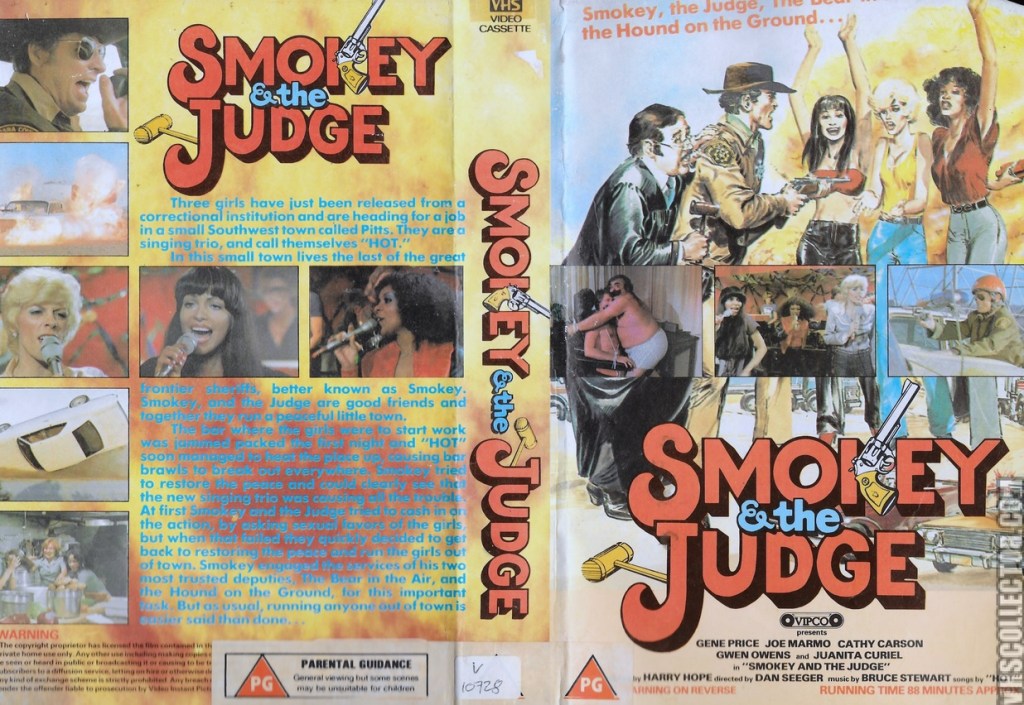
Dark Force Entertainment‘s latest “Retro Drive-In #19” features not only Smokey and the Judge, but double features with Alien Thunder, aka Dan Candy’s Law (1973). Smokey comes from an excellent CRI with all-new color correction. You can learn more about this amazing reissue from their Facebook post regarding the release.
Here’s what we had to say back in August 2020 about the film.
“Okay. Hold on just a minute, you smarmy, know-it-all pseudo movie critic. This is a ’70s hicksploitation Smokey and the Banditripoff has nothing to do with The Fast and the Furious and is definitely not a precursor. And, for god’s sake, don’t tie this back into Seinfeld, as that shite is getting on my nerves.”
“Hey, man. Don’t blame me. Blame Mason Heidger and Grant Pichla.”
“Who the frack are they?”
“The actor and director of the just-released indie time travel flick Making Time.”
“Oh, shite. This is another one of those off-the-rails, twisted non sequiturs and tangent-strewn reviews where you squeeze yourself over obscure actors and directors and you lose yourself in a morass of Six-Degrees babbling where you never tell us the plot of the movie.”
“Yeah, this is one of those “better go take a piss movies and make yourself a sandwich” reviews, bro.”
“Yeah, I’ll see you later. And find yourself an editor and a brevity-in-chief, bro.”
Caveat emptor: Not Hicksploitation. Discosploitation.
So . . . what am I rambling about with this escapee from the film vaults?
Like I said . . . I wrote up a review for Making Time, which stars Tori Titmas, and she wrote and stars in The Girls of Summer. And the director of Tori’s screenwriting debut is John D. Hancock, he of the ’70s drive-in “vampire” classic Let’s Scare Jessica to Death and the most unconventional Christmas movie you’ll ever see, Prancer. And Hancock’s cinematographer on Prancer and The Girls of Summer is . . . Misha Suslov, who lensed the cameras on Truckin’ Buddy McCoy, John Carpenter’s Black Moon Rising, and Mark L. Lester’s Public Enemies. And Suslov also eyepieced this redneck romp starring a cadaverous Rory Calhoun (who starred in Motel Hell that same year) in the Sheriff Buford T. Justice role.
So, you see. This review isn’t my fault. Send your complaints to Tori Titmas for hiring team Hancock-Suslov. For she is the one who unleashed this obscurity from the dust-bunnied, VHS shelves into the digital dustbins of B&S About Movies for you to enjoy. (And, of course, Mason and Grant are complicit in the film canister of worms thou opened.)
Hey, you may not care. But I do. And our Master of the Movie Themed Vodka-based Drinks, Sam, cares (last week’s movie drinks!). And not only do we get to talk about John D. Hancock and pay tribute to Misha Suslov in this review . . . but we can get our freak on over producer-director Harry Hope.
Oh, my Harry Hope! For only you could possibly think melding the waning disco-era with the CB radio-reinvented hicksploitation-era would make for a good movie. But what else would we expect from the man who unleashed the never-should-have-been-finished-or-released Doomsday Machine, you know, that 1971 sci-fi ditty that featured motorcycle helmet-clad astronauts blasting-off in cushy Lazy-Boy recliners? What else would you expect from the man who backed Al Adamson’s T&A romp Sunset Cove and his Jim Kelly-starring karate joint, Death Dimension. (See, there’s never a loss of movie obscurities to review! Sam, pencil them in.)
So, anywhoo . . . back in the days of polyester and mirror balls, ’60s R&B singer Gwen Owens reinvented herself as the front-woman of the Los Angeles-based disco band Hot with Cathy Carson and Juanita Curiel (the “gimmick” was that the band was multi-racial; Owens was African-American, Carson white, and Curiel hispanic) and scored a 1977 U.S Top 40 radio hit with “Angel in Your Arms.” (Learn more about Hot at souldisco.de).
Of course, in the mind of Harry Hope . . . a down-and-out one-hit wonder disco group is perfect fodder for a Harry Hope production. And the best part: this wasn’t intended as a parody of Smokey and the Bandit. (In fact, we think the redneck sheriff and judge buffoonery wasn’t a part of the original “script” and grafted in after-the-fact. “Hey, Smokies and CBs are hot right now, let’s make one of those movies,” decided the ever-mind changing producer.)
After the release of Hot’s self-titled breakthrough debut — and the then novelty of the group’s multi-racial make-up — expectations were high for their sophomore album, If That’s the Way You Want It . . . You Got It (1978). So their management decided a Beatlesesque movie would be a great way to promote the album. And they entrusted the project to Harry Hope. Obviously, no one on the Hot management team or in the Big Tree Records’ offices did their due diligence. Did anyone not see Doomsday Machine?
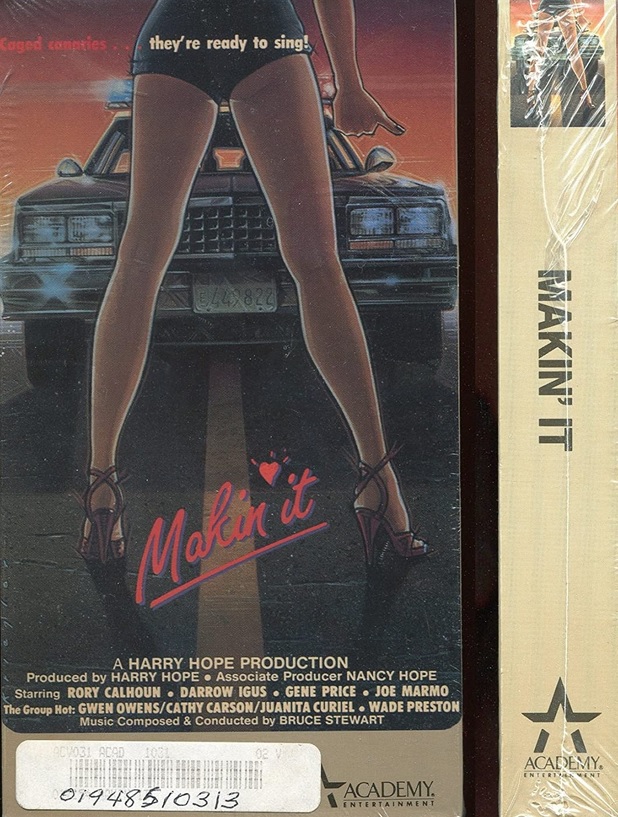
When first produced, the film was completed as We Can Be Stronger Together, so as to tie into the band’s upcoming third album. When the title of the album was shortened to Stronger Together (1980), so was the film’s title (the album sleeve features film promotional blurbs in its liner notes). And that 1980 album sold less than the second album. So title changes — to distance the film from the flop album — were afoot, with a reimaging as Running Hot and Making It! (which carried over for its VHS shelf live).
But with Smokey and the Bandit igniting its own cottage industry, the girls from Hot — who agreed to a movie tie-in to promote their album — found themselves in a CB-Smokey romp, Smokey and the Judge, to, you know, make you think Jerry Reed is going to show up singing “Eastbound and Down” — instead of a hot pants n’ hip swingin’ disco trio cooing in three-part harmonies. Truth is, for all its ripoffness, the two films that don’t get named-dropped when drive-in and home video aficionados revisit this this discoploitation romp are the two movies it’s really ripping off: the Saturday Night Fever-inspired, disco-musical comedy Thank God It’s Friday (1978) and the Earth, Wind & Fire-starring disco-musical That’s the Way of the World (1975; aka, Shining Star).
And why title the film Making It? Who knows. Perhaps the distributor decided to confuse us into thinking the film was based on David “American Werewolf In London” Naughton’s then pop hit, “Making It” — which was actually featured in Meatballs.
Courtesy of Amazon. . . Whoa, Whoa, Whoa!
“Okay, Harry. You got us into this mess. How are we going to graft a female disco group into a hicksplotation movie?”
“We’re going to rip off Roger Corman’s old women-in-prison flicks.”
“Are you sure? I mean, we’ve already ripped off so many other films already.”
For reals. Harry even took the kitchen sinks as musicians Gwen Owens and Cathy Carson meet while doing time in a women’s penitentiary and decided to form a singing group. Of course, as is the case with any women-in-prison flick, the girls are innocent, with Cathy set-up to take the fall for a jewel heist gone wrong (in a flashback sequence that looks like stock footage from another movie).
When the duo makes parole, they meet Morris Levy (Darrow Igus from Car Wash, The Fog, and lots of ’80s TV), a managerial bottom feeder who’s going to “make them stars.” And he gets them a talent show gig at an out-of-the-way Urban Cowboy-styled (another film pinched for inspiration) roadhouse in the hick town of Pitts. (The “pitts,” yuk yuk. That’s sum mighty fern movie sypherin’ there, Harry.) Of course, after singing their five songs in the film (i.e., the initial purpose of the film: to promote their music . . . and pad out the film’s short running time), they run afoul of the local Barney Fife-dufus in the form of Sheriff Cutler (Gene Price, an old Jim Nabors sidekick), he the lone minion of the always sex-starved, fatass Judge Maddox (Joe Marmo from Rappin’ and American Drive-In), who has his own honry-machinations for the girls. Car chases and crashes (i.e., the “Fast and (not so) Furious” part), ensues, which, because of all the singing, hardly happens.
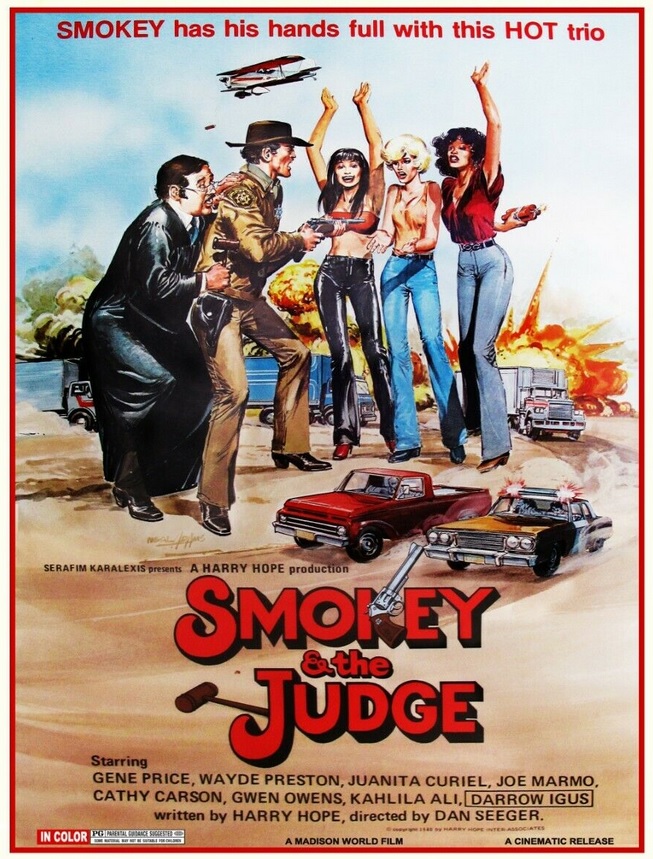
Now, you noticed that we didn’t mention Rory Calhoun in that stellar synopsis. That’s because you’ve been theatrical one-sheet duped: Rory-boy isn’t the Sheriff like we’ve been led to believe; he shows up for a cameo as a record executive who judges the contest in Pitts(ville), U.S.A.
Yeah. Use the F’in-word as a prefix to the word “mess” on this one. How much so? Hy Pyke (the creepy bus driver in Lemora, Mayor Daley in Dolemite, and Hack-O-Lantern) shemps-in-comic relief (see Sam Raimi’s films for what “shempin’” means) as the roadhouse’s bartender and a cheesy used car salesman. But you know what? You give me a movie with Rory, Hy, and Darrow, along with “Harry Hope” on the box, and I am renting the movie. You dig? (A dunny to subsequently dump it in.)
And so closes another off-the-rails rant at B&S About Movies, where we coddle the forgotten and obscure films of our drive-in, UHF, and VHS yesteryears — and the latest indie films. And to Misha Suslov: we tip our hats to you. Thanks for the VHS memories.
About the Author: You can learn more about the writings of R.D Francis on Facebook.He also writes forB&S About Movies.









 B&S About Movies
You must be logged in to post a comment.