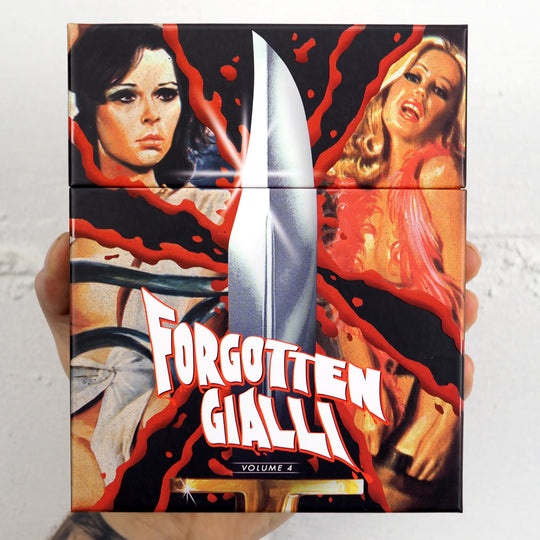
VINEGAR SYNDROME BLU RAY RELEASE: Forgotten Gialli: Volume Four

Arabella Black Angel (1989): Also known as Angel: Black Angel, this is one of the sleaziest giallo that I’ve come across. Seeing as how I’ve watched Play Motel, Strip Nude for Your KillerGiallo In Venice and own multiple copies of The New York Ripper, that’s saying something.

Director Stelvio Massi was the cinematographer or director of photography for plenty of great movies like The Case of the Bloody IrisSartana’s Here…Trade Your Pistol for a Coffin and Giovannona Long-Thigh. He knows how to make things look gorgeous, particularly in the way he shoots women, which comes in more than handy here.

Arabella is a woman obsessed with the carnal act. Sadly, her husband has been rendered impotent and confined to a wheelchair ever since he wrecked his car while she was dirty facetiming him (he was driving, because the opposite is impossible) on their wedding day. She’s filled his role with trips to brothels, including one that gets raided while she’s assaulted by a cop. She gets back at that officer by inviting him back to her place and while he’s yodeling in the valley, she bops him upside the head with a hammer. Her cucked husband, who has been watching all of this hammer smashed face action go down finally feels the blood flow down below, which means that he has to keep setting up his wife to kill off more and more people. He also finally gets back the urge to write and they start to fall in love again, but of course, he has to keep watching her make love to other people.

Also: lots of genital mutilation.

Ida Galli plays the mother-in-law. You’ll remember her from The Sweet Body of Deborah and Fulci’s The Psychic. Rena Niehaus, who is in the absolutely baffling strange film Damned In Venice, is also on hand.

The problem for our heroine is that everyone she makes loves to dies, including a cowboy who gets his member sliced clean off. The next day, as the cops are gathering evidence, one of them is so upset that he can’t stop eating his sandwich. The world of this movie is insane, because there’s a photo of that mutilated wang on the cover of the next day’s newspaper.

There’s also a scene in the Freak Boy Zone, a place where Arabelle cruises all the gay men and picks one to take home. This entire moment is absolutely insane, as the homosexual side of town feels like it came out of an Enzo G. Castellari post-apocalyptic movie.

This movie looks grubby, makes little to no sense and will offend pretty much everyone that watches it. That means that you’re definitely going to want to watch it.
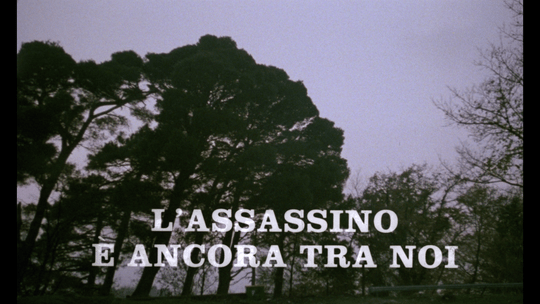
The Killer Is Still Among Us (1986): Also known as Florence! The Killer is Still Among Us and The Killer Has Returned, you have to admire the chutzpah — or the gall — of a film to have the disclaimer “This film was made as a warning to young people and with the hope that it will be of use to law enforcement to bring these ferocious killers to justice,” after you’ve just watched 83 minutes of a killer graphically mutilating women and their most intimate of parts, as if this were some bid to outdo Giallo  In Venice or The New York Ripper.

Based on the true story of the Florence serial killer “The Monster of Florence,” this was written by Ernesto Gastaldi (The Whip and the BodyAll the Colors of the DarkMy Name Is Nobody) and Giuliano Carnimeo (who directed four of the Sartana films under the alias Anthony Ascott, as well as The Case of the Bloody Iris, Exterminators of the Year 3000 and Ratman).

Directing this movie — and helping with the script — would be Camillio Teti, who produced The Dead Are Alive and Gualtiero Jacopetti and Franco Prosperi’s attempt at a non-mondo, the ironically named Mondo Candideo.

Much like a scene out of Maniac, a couple on lover’s lane is blown away mid-aardvark by a gloved killer. What separates the uomini from the ragazzi is that the killer then uses a knife and a tree branch to do things that made me turn my head from the screen for an extended period of time.

Christiana Marelli has been studying the killer in criminology class to the displeasure of her boyfriend, the cops and her teachers. This leads to her being stalked via phone and in person by the killer. Of course, seeing as how Alex, that formerly mentioned boyfriend, is never around during these killings, you can see why she starts thinking he could be Il Mostro.

The film moves from the giallo into the supernatural as our heroine attends a seance where the medium has a vision of the killer decimating a camping couple, soon developing the same wound that the victims just received.

What does Christina do? Run to the theater to see if Alex is there or not, proving that while he is waiting for her, he certainly could still be the killer. If I were her professor, I’d have given her a zero out of thirty.

After all this, she just sits down to watch a movie with him and it ends up being the same film we’ve just been watching. That’s either a huge cop out or just how you expect a giallo to end.

The Sister of Ursula (1978): After their father’s death, two gorgeous sisters – the sensitive Ursula (Barbara Magnolfi, Suspiria, Cut and Run) and promiscuous Dagmar (Stefania D’Amario, Zombie, Nightmare City) decide to escape to the seaside resort town Amalfi. Oh, if they only knew the madness that waited there!

The island is quite literally awash with the wrong guys, the wrong girls, the wrong couples and a killer who tears people apart with the biggest member this side of Incubus. Get ready for a movie that isn’t sure if it wants to be sexploitation or giallo but is ready to do everything that it can to entertain you.

Director and writer Enzo Milioni also was behind the Lucio Fulci presented Luna di Sangue. In this movie, he’s created a world of pleasure and murder, which at times exists side by side. It seems from the cut I’ve seen that there may have been even longer — and more explicit — lovemaking scenes.

So who is the killer? Dagmar’s new man Filipo (Marc Porel, The Psychic), who just might also be a drug smuggler? The hotel owner (Yvonne Harlow, who claimed to be the great-granddaughter of Jean Harlow)? Perhaps dad isn’t quite so dead? Or are the sisters both insane? After all, Dagmar is given to loving herself just feet away from her sister, who hates just about everyone she meets.

According to Milioni, Porel was a drug addict who had earned a bad reputation as an actor. Magnolfi got him hired for the film and he behaved for the entire shoot and ended up getting clean. Sadly, while shooting a commercial in Monaco, he relapsed and overdosed.
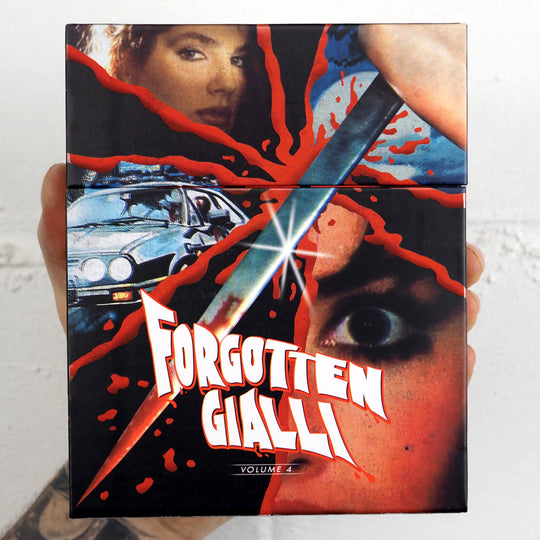
The fourth Forgotten Gialli set is packed with utter sleaze and I say that in the nicest of ways. Each movie is newly scanned and restored in 4K from its 35mm original camera negative, plus its packed with features like interviews with Enzo Milioni, a commentary track for The Killer Is Still Among Us by Rachel Nesbit and audio essays by Alexandra Heller-Nicholas as well as trailers and image galleries. Get it from Vinegar Syndrome.
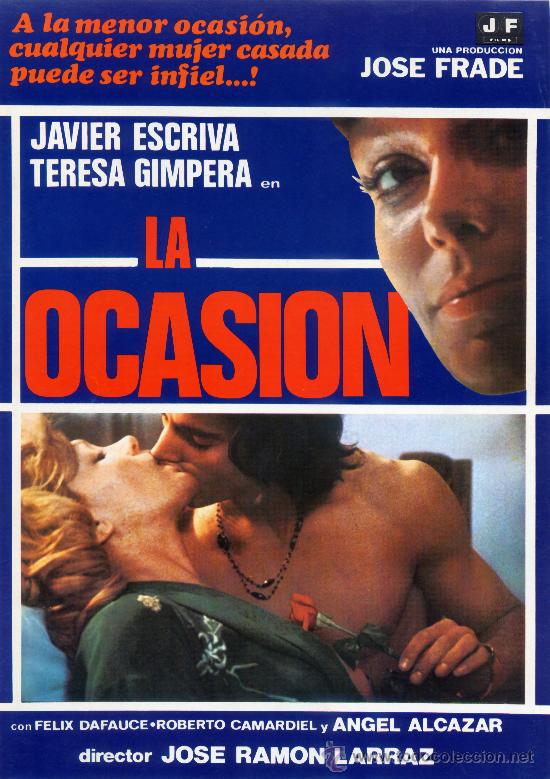
La ocasión (1978)

Pablo (Javier Escrivá) and and Anna (Teresa Gimpera, Lucky the Inscrutable, The People Who Own the Dark and quite literally Hannah Queen of the Vampires) have come back to their fancy beach home to discover that someone has broken in. That means that he decides to go all Straw Dogs on the hippies or at least calling the cops on them and getting everyone but one man — the leader of the group (Ángel Alcázar, Bearkiller from Adam and Eve vs. the Cannibals) — arrested.

He soon pays them a visit and takes what he wants from both of them. This being a movie by José Ramón Larraz, you can guess what he wants from the wife.

There’s an astounding scene where Gimpera slowly disrobes in front of an odd painting of the devil on the wall and man, you can tell when a scene in a movie wakes up Larraz.

This is from the era when hippies went from being the heroes of movies to being the villains. In The Occasion, they even live on a Spahn ranch-esque farm next door to the couple and their very presence drives Pablo to madness. Obviously, his wife is in no way all as upset by the intrusion into their lives; she’s even less disturbed by the intrusion in her bed.

La visita del vicio (1978)

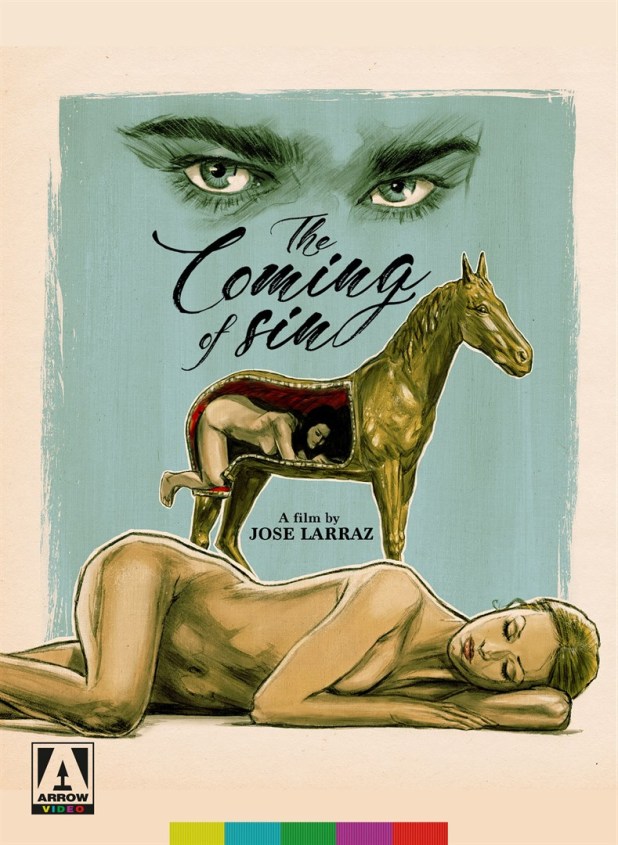
I think the strain of making a few softcore movies got to José Ramón Larraz. He was known somewhat for his haunted London series of films and the last few movies he made after returning to Spain were technically fine, but didn’t have the hint of berserk weirdness that he’d shown in England. And then he made The Coming of Sin.

Triana (Lidia Zuazo, using the name Lydia Stern; she only acted in one other movie, José Antonio Villalba’s Consultorio sexológico) is a quiet young girl consumed by her dreams, like one where she’s nude and running from a man on horseback. As the couple she works for is going on an extended vacation without her, she’s loaned to Lorna Western (Patricia Granada, billed as Patrice Grant), an artist who has created her own female-centric world that she remains in firm control of. It’s so powerful that men find themselves either upset by it or even unable to enter the grounds.

Of course, seeing as how this is a piece of Eurosleaze strangeness, the two women must have a relationship of a sapphic nature, but it feels earned and not just because we’re in a movie and these things need done to please the audience. Even when they leave the grounds for their date, it never seems strange or otherworldly, other than the fact that Lorna possesses an air of authority that challenges men.

But then Chico (Rafael Machado, billed as Ralph Margulis) invades their world and the two women find themselves upended by him. He’s charmed Triana away from her soulmate and now the dreams that the two women shared have been taken away and replaced by a woman who is willing to do whatever it takes to make her man succeed.

At one point, someone tells Triana, “Even though you’re one of us, you come from a dark corner.” It’s true — she’s another of Larraz’s haunted heroines, a woman who holds multitudes if those multitudes are most often expressed as a smoldering sensuality, an intense fantasy life and perhaps a propensity for violence. Instead of an English country manor in the midst of the fog, she’s just living in a rich woman’s world, a place created for her that once she gives in to the traditional roles society demands of her must be destroyed.

Is Triana a child of the devil, obsessed with fate and dreams filled with symbols? Is her future truly to include her bringing an end to someone she holds most dear? Is Chico even real of some kind of vampiric notion out to destroy the perfection of the world that Lorna has carefully constructed? And how does Larraz make a movie that thematically feels like it could have come from the cameras of Jess Franco but infused it with a dreamy logic that makes it more sumptuous and just plain hot?

Sure, characters shift motivations and it all gets rather talky at times, but a movie where a woman finds herself nude and trapped inside a gigantic gold horse is the kind of surreal madness that this oddball mind demands and Larraz finally figures out how to combine his horror style with the kind of S cinema that was the rage in a newly free Spain.

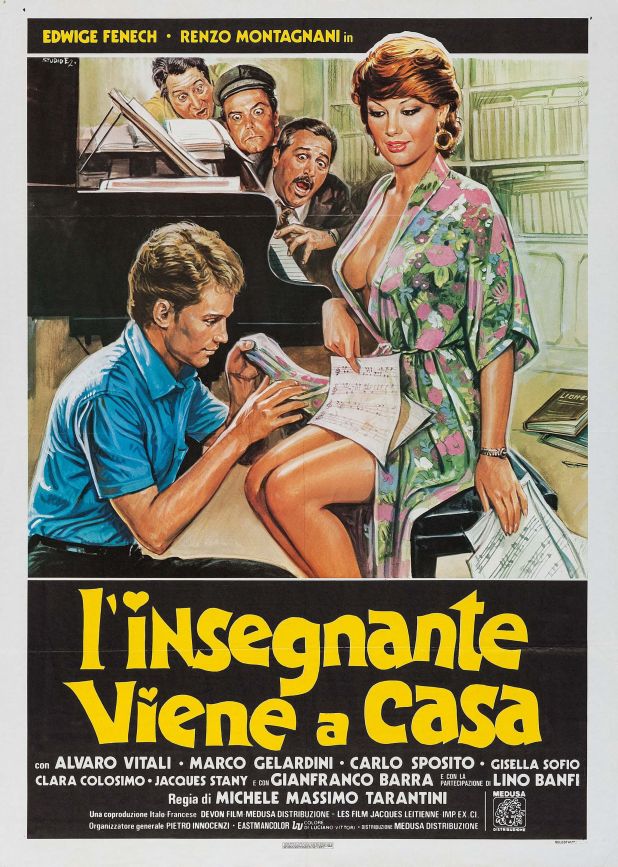
L’insegnante viene a casa (1978)

The Schoolteacher In the House is directed by Michele Massimo Tarantini, whose film La Liceale is a major success of the commedia sexy all’italiana genre. He also made Massacre In Dinosaur Valley and The Sword of the Barbarians.

I always find it amusing that Luciano Martino wrote the stories for these movies (the script is by Tarantini, Francesco Milizia, Marino Onorati and Jean Louis) and his wife at the time, Edwige Fenech, is the star. In the third L’insegnante movie, she again plans a different teacher — piano instructor Luisa De Dominicus — and finds herself dealing with the horrible world of men, like her boyfriend Ferdinando “Bonci” Marinott, a politician who lets her think he’s single.

All of the dirty old men that live in her apartment building think that the piano playing is just a cover for Luisa being a lady of the evening, so they drill a hole between her apartment and the bedroom of the landlord’s son Marcello Busatti. Marcello has an unrequited love for her, but if she’s in the world’s oldest profession, there’s no way he can bring her to his family.

Obviously, Fenech deserves so much better than this movie, but one hopes that she made some decent money from it.

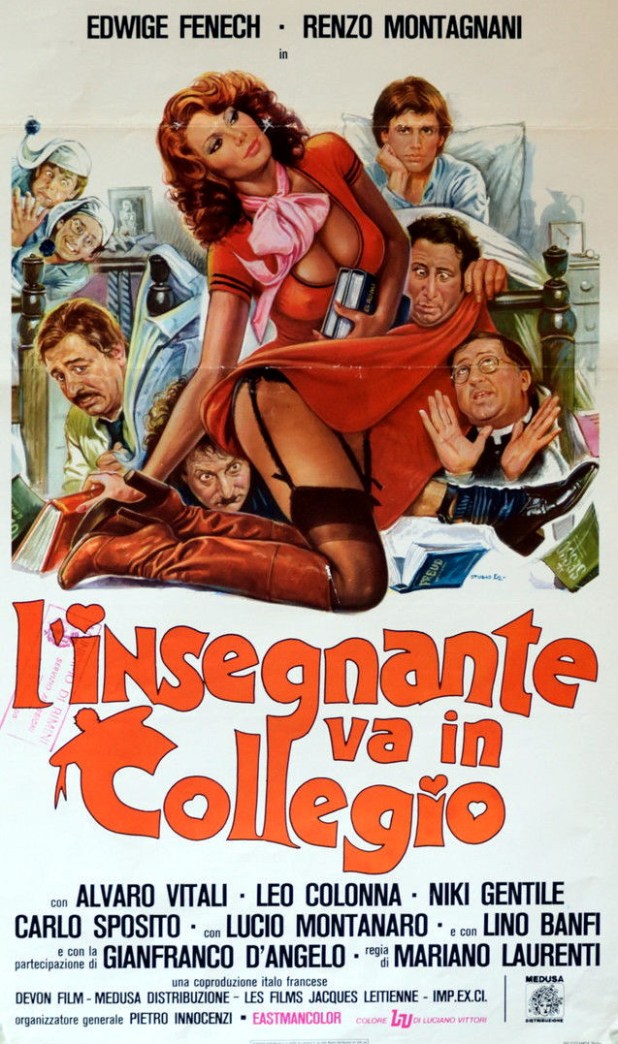
L’insegnante va in collegio (1978)

The Schoolteacher Goes to Boys’ High finds Edwige Fenech playing a different schoolteacher — Monica Sebastiani instead of Giovannona — but the idea is still the same. All Italian men are pent-up sticks of dynamite and Fenech is, as always, the glorious match.

Director Mariano Laurenti, who also wrote the story that screenwriters Franco Mercuri and Francesco Milizia worked from, made a whole bunch of these movies that have sexy often right in the name, if not the movie.

Everybody is even more repressed before Fenech arrives because this is an all-Catholic boy’s school, but isn’t Edwige the best argument for God?

Most of the first film’s cast returns, all as new characters. Also coming back? A big shower scene, slap happy fight scenes and more farts than Terrence Hill after a four day bean bender.

If all this movie did was make the poster that went with it, life worked out.

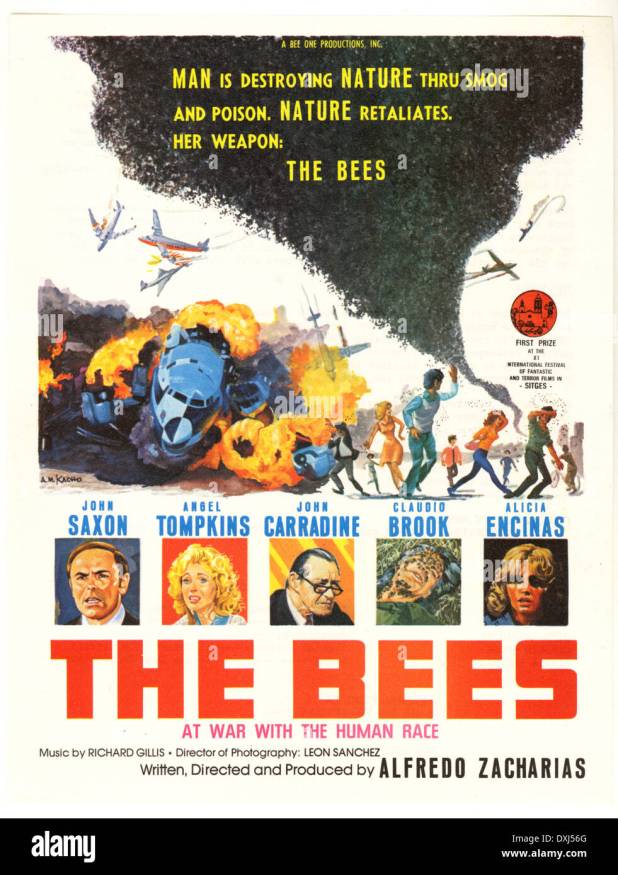
The Bees (1978)

Alfredo Zacarías made Demonoid and we should thank him for years for that. He also took advantage of the sheer terror that ensured when the Africanized honey bee was on its way to America. Originally used in Brazil to increase honey production, 26 swarms escaped quarantine in 1957 and spread throughout South America, incredibly defensive and angry bees that supposedly can chase a person for a mile. These bees have killed a thousand people with many of their victims being stung over and over again. Just imagine six-year-old me watching this on the news every single night as we were told again and again just how close these bees were to us and how doomed we all were.

I also blame the exploitation film industry who seized upon this and made so many killer bee movies, as they had all the news doing their advertising work for them. There was the 1974 TV movie Killer BeesThe Swarm and this movie, ads filled with just bee after bee and I’d watch when I was outside sure today was the day I’d be stung to death.

Jack Hill went uncredited on this as a writer, as he was supposed to direct it, but life didn’t work out that way. It’s the story of South American killer bees who haven’t just been smuggled into the country for experiments, but have also mutated into even smarter than your average bee and use that to kill humans.

It all happens when Dr. Miller (Claudio Brook) is trying to crossbreed the aggressive bees with a much calmer species so that more honey can be made. A local tries to break in and steal the bees, which leads to his angry family and friends burning down Miller’s house and the bees escaping. Meanwhile, Miller’s wife Sandra (Angel Tompkins) takes the queen to her uncle Dr. Sigmund Hummel (John Carradine, of course) and Dr. John Norman (John Saxon), who have the same goals as her husband, except there’s a honey spy ring trying to make more money off the bees and that means murder.

There’s a scene where Carradine falls to his doom and I won’t lie, I watched it nine times and with each rewatch I loved this movie even more. Also: John Saxon speaks to stock footage of the UN.


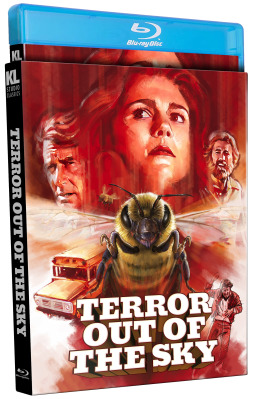
KINO LORBER BLU RAY RELEASE: Terror Out of the Sky (1978)

The Savage Bees was a big deal. I mean, Jeannie Devereaux (Gretchen Corbett) trapped in a VW Bug during Mardi Gras? Well, on December 26, 1978 CBS brought Jeannie back — now played by Tovah Feldshuh — put her in a love triangle with her boss David Martin (Efrem Zimbalist Jr.) and her kinda sorta boyfriend Nick Willis (Dan Haggerty), then has a bunch of bad bees get in with the good bees and before you know it, a softball game and a marching band are the targets of the swarm.

With dialogue like “Oh my God! His mouth. It’s full of bees!” and appearances by Lonny Chapman (Long John the tattoo artist in The Witch Who Came from the Sea), Ike Eisenmann from the Witch Mountain movies, Joe E. Tata before he owned the Peach Pit, Richard Herd (Schizoid), Charles Hallahan (The Thing) and Steve Franken (who also battles Ants! a year before), this is also the kind of movie with a National Bee Center ready to defend our country for the threat of killer bees.

You know, I read a review of this and the kid writing about it pish poshed the notion of killer bees. Well, I was there, every night when the news told us we were all going to get stung a thousand times and die. It’s easy to laugh about without living that life. I did. Bees were all we talked about. Also: quicksand.

Director Lee H. Katzin also made the bizarre and wonderful movies The Phynx and What Ever Happened to Aunt Alice? He also directed SavagesWorld Gone Wild and the pilot of Samurai, a show that would have had Joe Penny fighting crime as a sword-wielding vigilante.

Writer Guerdon Trueblood was a great cause of the week movie guy. I mean, the same talent did The Savage Bees, Ants! and Tarantulas: The Deadly Cargo. He moved on to airplane movies (SST: Death FlightTerror Out of the Sky) and also wrote Jaws 3-D and directed The Dandy Snatchers.

This being the 70s, the whole movie is more about a woman choosing between two horrible men than it is about bees. That said, there are some moments of fun, like the end when Zimbalist wears an anti-bee suit that is soon covered by millions of black and yellow striped monsters.

The new Kino Lorber blu ray release of Terror Out of the Sky has a new 2K master, commentary by film historian David Del Valle and filmmaker David DeCoteau (who made his own bug movie 1313: Giant Killer Bees) and trailers for the film. You can get it from Kino Lorber.

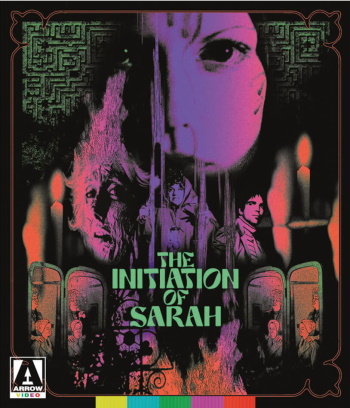
ARROW BLU RAY RELEASE: The Initiation of Sarah (1978)

EDITOR’S NOTE: This movie originally was on the site on April 1, 2018. Now, Arrow Video has a new release that we’re so in love with. Extras include brand new audio commentary by TV movie queen Amanda Reyes; Welcome to Hell Week: A Pledge’s Guide to the Initiation of Sarah, a brand new appreciation by film critic Stacie Ponder and queer horror programmer Anthony Hudson, co-hosts of the Gaylords of Darkness podcast; Cracks in the Sisterhood: Second Wave Feminism and The Initiation of Sarah, a brand new visual essay by film critic and historian Alexandra Heller-Nicholas; The Intimations of Sarah, a brand new interview with film critic Samantha McLaren looking at witchcraft, empowerment, TV movies and telekinetic shy girls post-Carrie; The Initiation of Tom, a brand new interview with Tom Holland on this his first film writing credit as well as an image gallery, a reversible sleeve featuring newly commissioned artwork by Luke Insect and a fully-illustrated collector’s booklet featuring new writing by Lindsay Hallam and Alexandra West. You can order this from MVD

Originally airing on February 6, 1978, this movie reminds me of a very important lesson: the occult was everywhere in the 1970s and it was ready to mess your life up.

The film opens with Sarah (Kay Lenz, House) who joins her stepsister Patty (Morgan Brittany, who was in Death Car on the Freeway and was Katherine Wentworth on Dallas, who was Bobby’s killer before the shower scene retcon) going to the beach. A young man forces himself on Patty and Sarah saves her with telekinesis.

The movie tries to set things up with Sarah as some ugly duckling, but in every other movie I’ve seen Kay Lenz in, she is portrayed as being attractive. That’s the only hollow note in this movie.

The girls go off to college, where they both plan on joining Alpha Nu Sigma. Their mother is even the head of the alumni committee, so it’s a big deal for her to get her biological daughter, Patty, in. For some reason, Patty is welcomed with open arms while Sarah is directed to join Phi Epsilon Delta.

All of the PED girls are rude and ill-tempered other than Mouse (Tisa Farrow, Zombi 2, Anthropophagus), a shy girl who everyone else is mean to. Mouse just wants to play her violin because otherwise, she gets nuts!

Jennifer (80’s sex symbol Morgan Fairchild), the head of ANS, forbids her sisterhood from fraternizing with the PED girls, which tears the sisters apart. Meanwhile, Sarah starts to fall for Paul (Tony Bill, Are You in the House Alone?) while staying wary of den mother Mrs. Hunter (Shelley Winters in an unhinged performance).

Even after she uses her powers to shove Jennifer into a fountain, Sarah doesn’t want to give in to her powers. But once the ANS girls retaliate and throw food and mud at her, she gives in to Mrs. Hunter’s call to hatred and gives in to an initiation ceremony.

That ceremony? It involves blowing off the evil girl’s dresses, permanently ruining Jennifer’s face and killing Mouse, but Sarah decides at the last second to kill both herself and Mrs. Hunter to stop the sacrifice. As the film ends, Patty joins PED and becomes friends with Mouse. They both mourn the loss of Sarah.

These are the kind of movies that made me glad that I went to art school and a downtown college instead of a real university. That said, I would not be eligible for a sorority, so I guess the point is moot.

This movie also has appearances by Michael Talbott (Freddy from Carrie), Robert Hayes (Airplane!), Deborah Ryan (Kiss Meets the Phantom of the Park), Talia Balsam (The Supernaturals) and Kathryn Grant (The Night the World Exploded).

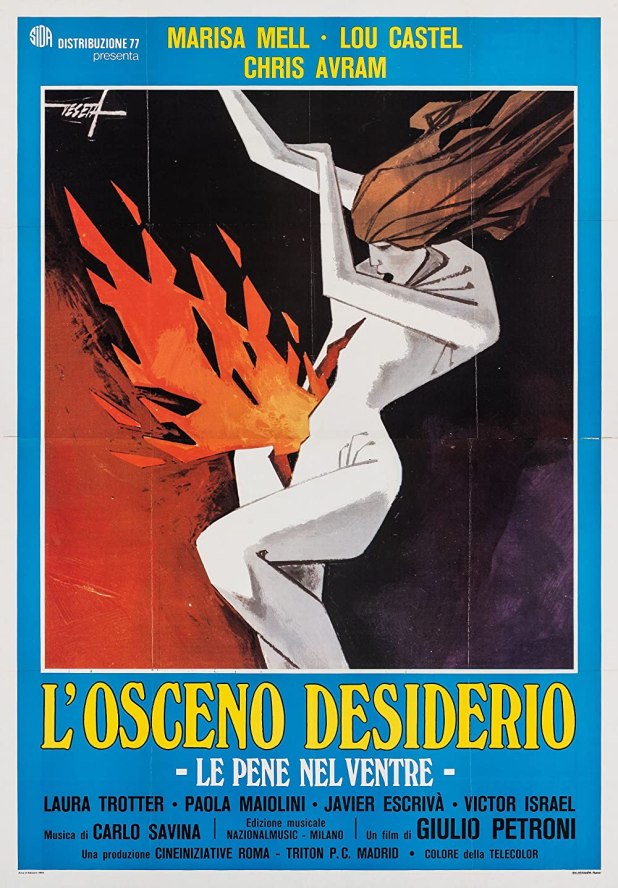
L’osceno desiderio(1978)

Obscene Desire is the story of Amanda (Marisa Mell, a goddess if there ever were one and someone who immediately changes any movie from maybe to definitely; my favorite of her films are MartaDanger: Diabolik and Perversion Story, a film in which she has one of the greatest outfits not only in the history of Italian film but perhaps all movies ever), an American woman ready to marry the rich Andrea (Chris Avram, Enter the Devil) and move into his huge mansion.

Within the walls of that gothic expanse lies something evil, something that has possessed Amanda’s soon-to-be husband to indulge in black magic and ritual murder. In fact, the only way that he can keep his soul from being taken by his domicile is to keep killing prostitutes.

This movie should teach you to never trust a gardener (Victor Israel) and that the Italian film industry would keep on making Rosemary’s Baby ripoffs ten years after that movie was unleashed. Or The Exorcist five years later. Or The Omen two years later.

Look, I’m a simple man. Marisa Mell with short dark hair, not unlike Mariska Hargitay, possessed by the devil and writhing on a bed and revealing that her tongue is superhumanly long. Do I even care that this movie has no real story and really goes nowhere?

No, not at all.

What were we talking about?

Laura Trotter (Dr. Anna Miller from Nightmare City) and Paola Maiolini (Cuginetta, amore mio!) are also in the cast for this film directed by Giulio Petroni (Death Rides a Horse) and written by Joaquín Domínguez and Piero Regnoli (the director of The Playgirls and the Vampire and writer of 117 movies including DemoniaVoices from BeyondBurial Ground and Patrick Still Lives).

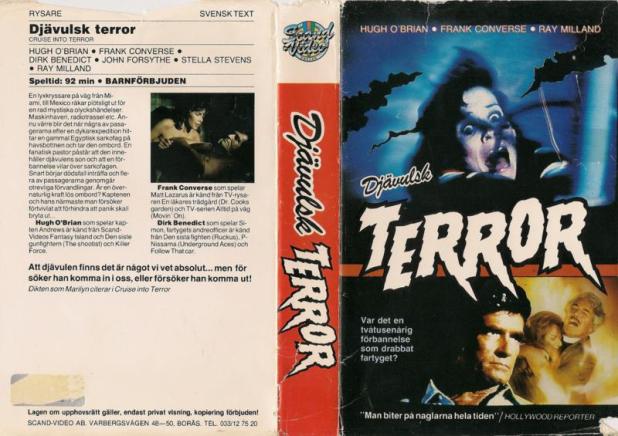
Cruise Into Terror (1978)

Originally airing on February 3, 1978 on ABC, this movie has quite the cast: Dirk Benedict (who would appear on the network’s Battlestar Galactica the same year), Frank Converse (who was also in 1981’s Rankin-Bass movie, which was distributed by Aquarius Releasing, The Bushido Blade opposite an all-star cast that included Sonny Chiba, James Earl Jones, Mako, Toshiro Mifune and Laura Gemser), John Forsythe (Dynasty), Christopher George (Enter the Ninja), Lynda Day George (Pieces), Lee Meriwether (The Catwoman after Earth Kitt), Ray Milland (X: The Man with the X-ray Eyes), Hugh O’Brian (Ten Little Indians), Stella Stevens (The Manitou)Roger E. Mosley (Magnum P.I.) and Marshall Thompson (First Man Into Space).

It has what you expect on a cruise to terror: a ship brings aboard a sunken Egyptian sarcophagus that contains the son of Satan. Directed by Bruce Kessler and written by Michael Braverman, who created the show Life Goes On, this movie has Milland as an archaeologist who believes the Egyptians discovered America and Forsythe playing a religious man with a wife he’s disengaging from, leaving her all alone as he struggles with his faith.

That said, it’s also a TV movie and has a coffin that breathes, so there’s that. It also has “Dies Irae” on the soundtrack two years before The Shining.