MILL CREEK DRIVE-IN CLASSICS: Night Train to Terror (1985)

EDITOR’S NOTE: You know, someone else was supposed to write this and didn’t send anything, but we all know that I was fated to write about Night Train to Terror right?

I first shared my thoughts on this film on October 19, 2018 and in Drive-In Asylum #14 which you can buy right here.

This version combines elements of past articles, as well as the full reviews of the films within the movie. My dream is that Vinegar Syndrome releases a box set of this movie — they put out the original blu ray — along with all of the complete films and interviews with the surviving cast and crew. I’d be overjoyed to contribute to this set if it ever happens. This movie continues to obsess me.

I’m planning on a tentative Night Train to Terror zine at some point. Let me know if you’d be interested in reading it or contributing.

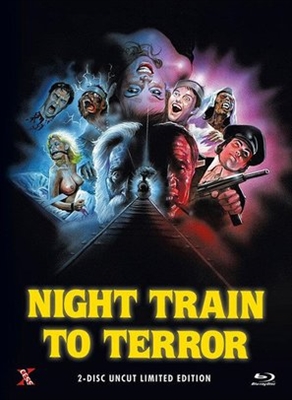
For better or worse, there’s never been another movie quite like Night Train to Terror. And how could there be? This isn’t just one movie — it’s three movies in one. None of these movies felt releasable on their own, so much like Spookies or Fright House, those three movies were all shoveled into one furnace, much like how coal powers the engine.

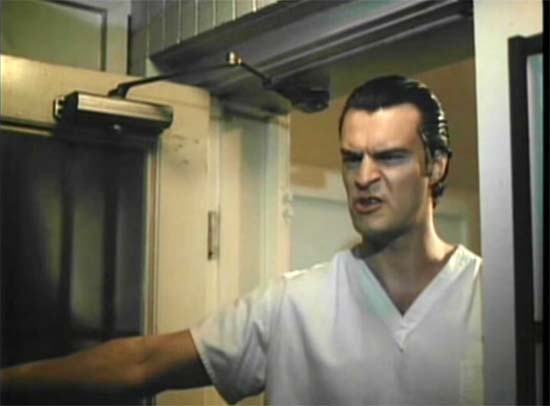
Unlike those films, which just jams the stories together, the stories here are linked by a framing sequence of a band that’s traveling through the night on, well, a night train to terror. All the while, God (Ferdy Mayne, last seen as Count von Krolock from The Fearless Vampire Killers, who felt this movie was so poor that he penned a letter to its director) and Satan (Tony Giorgio, who wasn’t just Bruno Tattaglia in The Godfather but the Playboy Club’s in-house gambling expert. He’s also the sheriff in another film that may possibly melt your mind, the Bigfoot-centric Cry Wilderness) are just a few cars down, debating whether or not the band will live to see their next destination. Meanwhile, the night porter makes faces at the camera years before single camera shows like The Office and Curb Your Enthusiasm made such mugging de rigueur.

Get to know the band. After all, you’re going to see them between each and every story as they repeat the chorus of the song over and over — and over — again. They only take breaks to ask if they can get some hamburgers and beer, only to learn that there’s no food on this train. And that some call it the Heavenly Express and some call it Satan’s Cannonball, but they do guarantee to deliver every passenger to its right “dest…tin…ation!” Obviously, neither of the things people call the train are as good as Night Train to Terror, but that’s a moot point.

To determine the fate of these breakdancing fools — seriously, being in a band with fifty people has to be the worst ever because you split the door money every which way — the Divine Creator and the First of the Fallen decide to watch three different stories, at least one of which was a totally unfinished movie. 
The Case of Harry BillingsJohn Phillip Law (an angel in Barbarella and forever in my heart Diabolik) has been manipulated into working for the spare body parts black market. You know how it goes, right? This story is packed with nonsensical jump cuts, unnecessary surgery, gratuitous nudity and Richard Moll, who wasn’t even there for most of the scenes, with a double playing most of his action scenes. You can tell because the second version of him has incredibly hairy arms. While this movie wasn’t finished before it was pulled into this film, it was later completed and released on VHS as Scream Your Head Off.

It was also released as Marilyn Alive Behind Bars nearly a decade later. Much like Terror, Sexo Y Brujeria, this movie was partially made years before and then finished a decade or more later. And you’ve seen it before. And the fact that this movie was actually finished makes me overjoyed beyond belief.

So even though this movie was already somewhat released twice — and shot twice, as there were nude and non-nude versions of some scenes — Carr decided to go back, grab Danger: Diabolik star John Philip Law despite the fact that he looks much older than he did in 1981 and make the movie that he always intended to film. For some reason, he also hired Francine York (Secret File: Hollywood) to play Marilyn Monroe. Or maybe she’s just a woman who has been driven mad and believes she’s Norma Jeane Mortenson.

In this longer version, Harry Billings was driving home with his new wife when he got sideswiped and she died, which leads to him sleeping barefoot on her grave. He tries to jump off a bridge on the very same road where this accident happened and gets brought to the asylum of Dr. Brewer and Otto (Richard Moll) to abduct women whose brains will be lobotomized. Some of this new movie is shot on video, some are from the original footage and it’s all strange because characters suddenly become a decade older or younger.

As messy as the chapter within Night Train to Terror is, the full-length story is even more deliriously insane, packed with continuity, time-lapse, sound quality, film to video and just plan weird errors. I also absolutely love that it exists and that it’s even stranger than I thought that it would be.

The Case of Gretta Connors: nice young girl used to work at the carnival. A man visits her booth and pays her to go out with him and before you know it, she’s a porn star. Again, that’s how life goes. 

One day, a college guy named Glen (Rick Barnes) sees the girl — Gretta — on a stag loop and falls in love, eventually finding her and starting a relationship, which leads her old Hollywood producer sugar daddy husband to bring him into a suicide club. This club has a baroness and a guy who looks and acts like Jimi Hendrix, all playing games like letting a giant claymation beetle fly around and sting one of them to death or lie in sleeping bags until a giant ball crushes one of them. Back to Jimi — he’s electrocuted as he yells song lyrics. 

Again, like the other stories in this film, there’s another long version of the film that has multiple titles: The Dark Side of Love, Carnival of Fools, Gretta or Death Wish Club.

The full film claims that it’s loosely based on Erskine Caldwell’s book Gretta, but this goes so many strange places that I really have no idea if that’s true.

Pre-med student Glen Marshall falls for Gretta (Meridith Haze, who is astounding in this movie and I wished she’d done more than just this role) the first time that he sees her in an adult film. However, she’s owned by George Youngmeyer, her Hollywood producer husband who bought her at the carnival.

The Bloody Pit of Horror believes that this character is pretty much writer Phillip Yordan, who may have never fallen out of love with Cat People actress Simone Simon and just treated the rest of his wives like Youngmeyer.

Now, if you’ll excuse us for a second and hold on to your valuables, the train is going to take a quick detour to explain Phillip Yordan.

Phillip Yordan is the listed writer on nearly a hundred movies, including DillingerDetective Story and Broken Lance, a movie he won the Best Original Story Oscar for, despite it being a remake of 1949’s House of Strangers and the fact that he allegedly didn’t write a single word of the actual script.

That’s correct. Some believe that many of the movies he wrote were actually a front for blacklisted writers, who still wanted to make films, giving Yordan all the credit and half the paycheck.

Yordan was literally a factory at one point, writing for nearly every studio even when he wasn’t supposed to because of pesky little things like contracts.

In the late 1950s, Yordan finally got caught. He mixed up two scripts, delivering a Fox script to Warner Brothers and vice versa. Seeing as how he had a deal at Fox, Darryl F. Zanuck threatened to get him blackballed at all the major studios. A few years later, his secretary would claim that she was the real writer of The Rise and Fall of Legs Diamond and things got so bad that Columbia demanded that he have an office on their lot where they could watch him write, guaranteeing that he was the author.

Despite these new rules and heightened surveillance, Yordan was still hustling scripts at other studios. He got caught again and forced to return his paycheck.

This time, he really was told you’ll never eat lunch in this town again.

Yordan then showed up in Spain, working for Samuel L. Bronston, using folks like Ray Bradbury, Ben Barzman, Arnaud D’Usseau, Julian Halevy and Bernard Gordon to write scripts. It’s pretty widely accepted that Gordon, not Yordan, wrote The Day of the Triffids, for example.

And yet…

By the mid 60s, Yordan was back in the good graces of Hollywood, a survivor working as a script doctor on movies like Horror Express — also a horror movie set on a train — and Psychomania. At the end of his life, he worked as an adjunct screenwriting instructor at San Diego State University and was writing scripts for movies like The UnholyMarilyn Alive and Behind Bars (which is also part of Night Train to Terror), Cataclysm (ditto), Cry Wilderness and this movie.

In an article by the FIlm Noir Foundation, “The Phillip Yordan Story,” there’s a very telling sentence: Yordan’s furtive 50-year history in Hollywood is reminiscent of the Hall of Mirrors denouement in The Lady from Shanghai.

Back to Death Wish Club, which was the full story, and goes even deeper.

In the movie, when Glen finally tracks down Gretta, she thinks that she’s a fish and as such won’t leave her bathtub. To solve the issue, Youngmeyer asks Glen to visit, make love to her in front of him and then he’s allowed to take her home. However, he warns her that she’s in the fourth dimension and never explains what that means.

Our protagonist gets more than he bargained for as Gretta turns out to be the kind of sexual dynamo that he’s only read about in the letters pages of men’s magazines. She’s only happy when a man is making love to her. Otherwise, she’s selling your TV set, bringing in a piano and parading in front of your mother naked. She’s a fantasy woman for Glen but removed from the fantasy male gaze of pornography she remains trapped within the role of the fantasy male gaze pornography object which is perfect in ten-minute onanistic blasts — pun intended — but potentially exhausting in real life.

Greta is also turned on by the adrenaline that comes from putting herself in near-death situations, along with a club of others who have survived death. This coterie has some real maniacs, including Federico Libuse, Contessa Pacelli and Prince Flubutu, who we are led to believe is Jimi Hendrix.

After surviving the deadly sting of a claymation Tanzanian winged beetle, Glen decides that no sex is worth all of this. He tries to get back with his normal former girl and back to his normal life but she tells him that there’s no way that he can ever be free from Gretta.

There’s a new problem, though. Gretta has overdosed and is dead. Youngmeyer proves it by taking Glen to her funeral. Lost, our kind of, sort of heroic figure makes his way back to the club where he first saw her playing piano and it turns out that Gretta is still there, but now she has become a he and is now the piano playing noir tough guy Charlie White. She hasn’t left the suicide club either, which means that Glen gets pulled into a contest where they must all survive a homemade electric chair as well as being forced at gunpoint to get in a sleeping bag and be in the path of a deadly multi-ton wrecking ball.

So can our protagonist get the man he’s in love with to become the woman he’s alternatively afraid of and sexually attracted to again? Will he have to break into her wedding The Graduate style and do some kung fu? Why is Gretta glad that Chopin is dead?

Death Wish Club is an astounding piece of moviemaking. It’s very David Lynch without trying to be, which is the best kind of film, a movie that’s near occult-level weird because the people making it were all very damaged or just had no clue how humanity behaves because they came here from a parallel planet where this is how men meet women. It is the very definition of monkeys in a room banging something out and finding nirvana.
Let’s discuss the other Yordan in this.

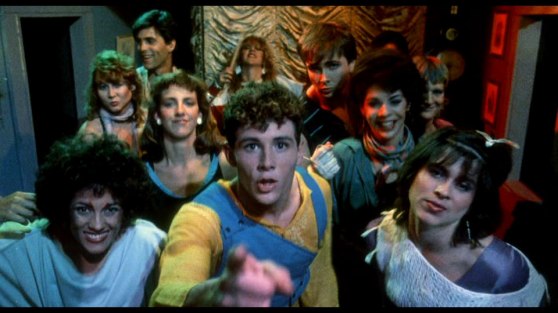
If you’ve seen this movie, you’ve seen the band that appears between each segment, singing the song “Everybody but You.” The main singer and breakdancer is Byron Yordan, son of Phillip. He also appeared in the Mormon film that most of this same crew made, Savage Journey, as Brigham Young’s second son.

Of the other band members and dancers, only Melanie Montilla (Breakin’ 2: Electric Boogaloo), Richard Sanford (a guest spot on Magnum P.I.), Dina Lee Russo (who sang “Let the Good Times Roll” on the soundtrack of the wrestling documentary Beyond the Mat), Angela Nicoletti (the ex-fiancee of Guns ‘n Roses rhythm guitarist Izzy Stradlin; she appears in the video for “Sweet Child O’Mine” and The Real McCoy, a documentary by Andy McCoy who was the lead guitarist of Hanoi Rocks) and Rick Arbuckle (who worked on the sound of plenty of cartoons like Rugrats and Rocko’s Modern Life).

What’s really amazing is that this song was written by Joe Turano, who just four years later was one of the singers for Disney’s The Little Mermaid.

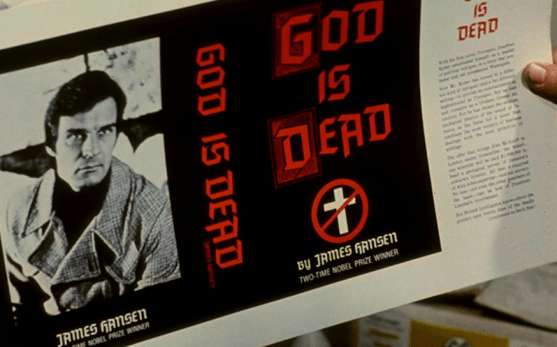
The Case of Claire Hansen: A surgeon battles a demon who was once a Nazi who is also in conflict with a Holocaust survivor who is best friends with Cameron Mitchell. Additionally, the surgeon is married to Richard Moll — back again with a constantly changing hairstyle and color — who inexplicably was awarded the Nobel Prize for writing a book that proves that God is dead.
This story has it all, as it has a swinging disco, a magical black man who calls out our heroine for America’s history of racism, more claymation scenes in the place of practical special effects because claymation was the CGI of the past, an ex-priest named Papini who has a 666 tattoo and as much of a 90-minute movie as you can fit into 30.

The full version is The Nightmare Never Ends (alternatively known as Cataclysm and Satan’s Supper). It’s a much larger story than what ends up in Night Train to Terror.

That previously mentioned Nobel Prize-winning author is James Hansen (Richard Moll, who is in this movie twice, as we said before, but also seemingly had a deal to be in nearly every oddball early 80s horror movie like HouseEvilspeakMetalstorm: The Destruction of Jared-SynThe Sword and the Sorcerer and The Dungeonmaster) and his devoutly Catholic wife is Claire (Faith Clift, who was the wife at the time of Yordan and whose career is made up of films he had something to do with, like Horror ExpressCaptain Apache, Savage Journey and Cry Wilderness). As the movie begins, they’ve just arrived in Vegas to celebrate his new book and to hopefully escape her nightmares.

Oh yeah — James won Nobel Prize for writing a book that proved that God is dead. Now, he’s planning a TV special to tell the whole story to the whole world. In short, he’s preaching the bad news!.

In Vegas, who puts Claire into a trance and we learn what the real problem is.

Nazis.

That’s right. Every night she dreams of a handsome young officer who kills a room full of other officers and an all-female string orchestra. After the show, Claire invites the magician to dinner after he tells her that a demon is after her. He never makes it — he is killed and a 666 tattoo is left on his scalp.

Meanwhile, Mr. Weiss (Marc Lawrence, another talent who was damaged by the blacklist instead of helped like Yordan; he also directed the incredible Pigs AKA The 13th Pig, Daddy’s Deadly Darling, Horror Farm, Daddy’s Girl, The Strange Exorcism of Lynn Hart, The Strange Love Exorcist and Roadside Torture Chamber) is an older gentleman who just so happens to have survived the Holocaust and suddenly sees the man who made his life hell at Auschwitz on a TV program about the New York Ballet.

That man is now the rich Olivier (Robert Bristol) and in case you didn’t put the two stories together, he’s the man inside Claire’s dream.

Weiss is a Nazi hunter, believe it or not, and he calls in his neighbor Lieutenant Stern (Cameron Mitchell, who has been in more movies than there have been movies, but let’s call out Blood and Black Lace as one of the best of his films). They go to the ballet and follow Olivier to his extravagant mansion, all the while Stern tries to convince the old man that this cannot be the man who tormented his childhood. Weiss grabs his Luger and goes to kill Olivier, but an unseen demon kills him and leaves a 666 on his body.

Oh yeah, there’s also a former priest named Papini (Maurice Grandmaison, who plays Brigham Young in Savage Journey and is, you knew it, also in Cry Wilderness) who is now homeless. He spends most of the movie trying to protect James and Claire, even telling her how to kill Olivier.

This is a movie that doesn’t miss any exploitation genre. You get Nazis, tough cops, disco and the occult and then Claire goes to visit a black spiritualist who unexpectedly goes off on a rant, pushing the film toward blaxploitation!

He nearly derails — sorry for the pun — the entire film by just how powerful his performance is, yelling at her: “I am a black man – a (N WORD) in your country. You are a rich woman, I’m sure you have many powerful friends…but they couldn’t help you! You had to seek the help of a (N WORD)!”

Meanwhile, Papini is killed by Ishtar, Olivier’s assistant who we have never seen before. This is the scene for the infamous foreign buyers as it’s the only nudity in the film and perhaps the main generator of blasphemy. This film is actually all blasphemy. If you’re in a metal band, you owe it to yourself to track it down and get samples.

Making this film even more deranged is the fact that nearly single actor in this film either reads their lines in monotone or screams them as loudly as possible — sometimes within the same sentence. The lone exceptions are Richard Moll, who is the best actor in here, and Mitchell, who is the gruffest cop of all time. Strangely enough, Moll used to date Lawrence’s daughter Toni, but when we asked her, she wasn’t sure if she had met the actor yet. I’d say probably not as this was only his second role.

Let me see if I can summarize the ending of this — after Oliver kills everyone else, Claire hits him with her car. She throws the body in the trunk and takes him to surgery, where she and her nephew’s girlfriend give him open heart surgery, complete with blood spraying and puking. Oh yeah, there’s also stabbing and slapping and screaming. And none of it works, because the bad guy wins!

But wait — does this prove that God is alive?

Well, he’s on the train still!

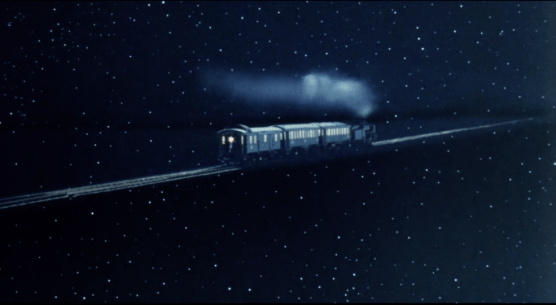
Are you ready to hear the song one more time? Wouldn’t you just love to see the band die in a giant train disaster? Good news — you have your wish granted. Except God has taken their souls up to heaven as we see an animated train choo-chooing up the clouds, where the nameless band will forever sing their song, driving cherubim and seraphim crazy for eternity.
To say Night Train to Terror is a strange movie is to say that I am sort of interested in the films of Joe D’Amato.

How can you not love a movie where Satan is credited as being portrayed by Lu Sifer and God by Himself? That said, if you decide to buy a ticket on this train, prepare to never escape the song that plays throughout. I sometimes go for a few days free of its power and then I start laughing about one of the lines in it, start to sing it and it goes on for hours.

It’s also a movie with no less than five directors:

John Carr had a career that was tied to Yordan. While he wrote the first movies that he directed, like the western The Talisman, The Star MakerBuster Ladd and Fugitive Lovers, he also made Death Wish Club, Marilyn Alive Behind Bars/Scream Your Head OffToo Bad About Jack and Dead Girls Don’t Tango — along with “The Case of Harry Billings” and “The Case of Gretta Connors” in this film.

Phillip Marshak, who directed the “The Case of Claire Hansen” segment, started in Hollywood as an assistant for Jerry Lewis and opened Georgie Girl, which was one of the first gay bars in Los Angeles. He also directed several adult films, such as Dracula SucksNight FlightSpace VirginsIntimate Lessons, the bi-sexual western The Savages and Blue Ice, a porn film in which a detective digs up an ancient book with the power to turn any woman into a nymphomaniac that’s wanted by Nazis who survived World War II. He also, of course, directed Cataclysm, which is where “Claire” came from.

Tom McGowan, also credited as a director of the “Claire” chapter, wrote the Russ Meyer movie Cherry, Harry & Raquel! and also directed Savage Journey.

Gregg G. Tallas is also credited for directing parts of “Claire” and is the only person in this production who can claim to be a graduate of Stanislavski’s famous Art Theatre in Moscow. He also directed the Eurospy movies Espionage in Tangiers and Assignment Skybolt.

Jay Schlossberg-Cohen directed the actual “Night Train” segment as well as another movie that you can almost see as a continuation of the same cast and crew from this movie.
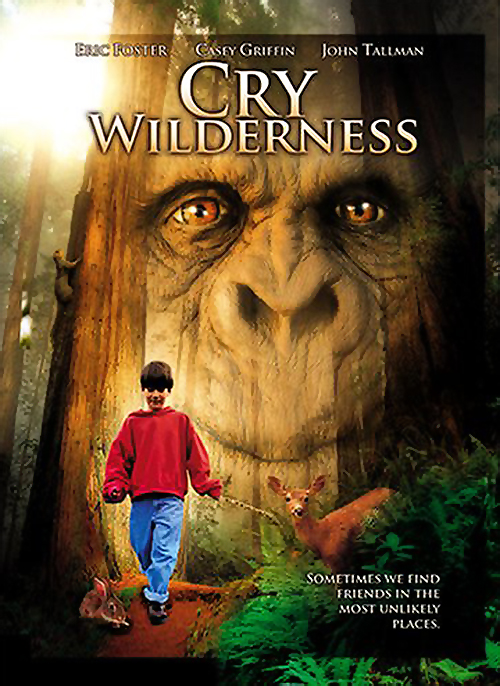
Cry WildernessA Bigfoot meets E.T. epic of pure maniacal weirdness, it was also written by Yordan and was directed by Schlossberg-Cohen. The origin of this movie is that Visto International Inc., a small theatrical motion picture production and distribution company, produced films in the early 80s magical era of cheaply made independent films.

After having some success with another Bigfoot movie in 1978 that made $4 million off a $150,000 budget (I can’t find any listing of what film that was, as Visto looks to have only made four movies), Visto hired Yordan to write a new bigfoot movie, but then asked him to cut out horror scenes and not have any violence, profanity or sex.

Yordan replied that this would make the movie be about nothing and they replied that that was exactly what they wanted.

It’s also what they got.

This is the kind of movie that demands that you be OK with the fact that Bigfoot can show up and visit young Paul Cooper and warn him that his father will die unless he leaves his fancy school behind and, well, cry wilderness.

It’s also a movie where seasoned outdoorsmen have no idea how to properly handle weapons, continually pointing them directly at people, planting the muzzle of rifles into dirt and even running with their fingers directly on the trigger.

There are also mystical Native Americans, a park ranger who never wears his uniform, raccoons who know how to knock on doors, a child who is obsessed with said raccoons to the point where he allows them to get in the kitchen sink and eat, a bad guy principal who is the worst Xerox of William Daniels ever, a school that’s cool with a student wearing a Bigfoot medallion as part of his uniform and moments where the film goes completely out of focus. Make those numerous moments.

Are you cool with seeing Bigfoot’s zipper? How much b roll footage is too much? And are you ready for earnest country rock and a movie that feels like it was made in 1978, not 1987?

How can you see these movies?

  • Night Train to TerrorTubi, Vinegar Syndrome (out of print)
  • Marilyn Alive Behind Bars: It was released on DVD but is out of print and not streaming
  • Scream Your Head Off: It was released on VHS but never DVD and is not streaming
  • Death Wish Club: Tubi, an extra on the Vinegar Syndrome Night Train to Terror blu ray
  • CataclysmThis shows up on Mill Creek box sets and you can find it on YouTube
  • Cry Wildnerness: Tubi, the Netflix MST3K riffed version or a double DVD with In Search of Bigfoot from Vinegar Syndrome

Just remember:

“Daddy’s in the dining room,
Sortin’ through the news.
Mama’s at the shopping mall,
Buyin’ new shoes.
Everybody’s got something to do,
Everybody but you.

Come on and dance with me, dance with me
Everybody’s got something to do,
Everybody but you.

Sister’s on the telephone,
Gossipin’ again.
Junior’s at the arcade,
Smokin’ with his friends.
Everybody’s got something to do,
Everybody but you.”

Thanks to Mike Justice for his help on this article.
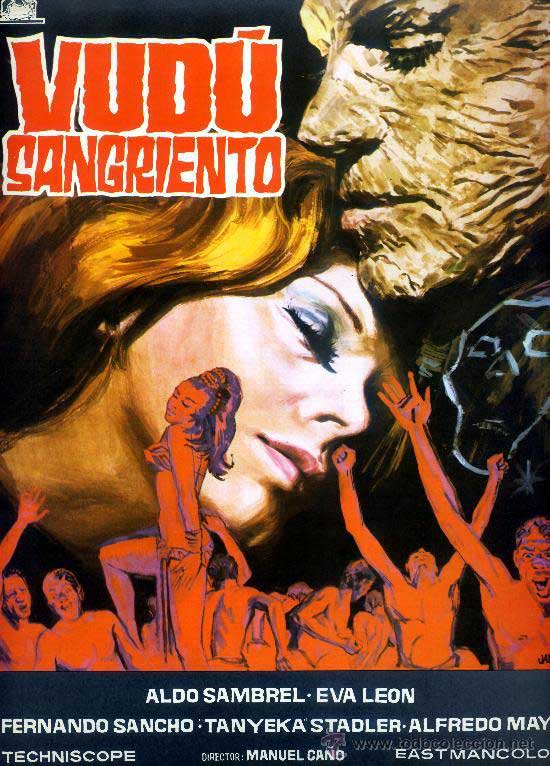
Mill Creek Drive-In Classics: Voodoo Black Exorcist (1974)

ABOUT THE AUTHOR: Lint Hatcher publishers the absolutely, well, wonderful Wonder Magazine. We’re excited to feature him on this site and his take on this pretty strange movie.

Directed by Manuel Caño (The Swamp of the Ravens), Voodoo Black Exorcist is one of those films that sends me hunting through half a dozen film guides — just to see if there was something I missed. It was filmed in Haiti, Jamaica, the Dominican Republic. Surely, authentic locales rendered this voodoo film at least slightly worthwhile. And with a name like Voodoo Black Exorcist… something interesting must have slipped past me. Right?

Of the several guides I have, only two bother to mention this 1974 Miami/Madrid co-production. In The Psychotronic Video Guide (follow-up to The Psychotronic Film Guide), Micheal Weldon makes the usual staccato observations as though the movie was projected onto a disco ball (which is, of course, why I read him). Weldon concludes, “This movie has lots of talk and flashbacks and a fire-eating belly dancer. In my favorite scene, the mummy man is seen in a mirror, slapping a dancer around. The cameraman is clearly seen in the mirror, too.” In Creature Features, John Stanley notes, “Rock-bottom editing, acting, writing by S. Monkada and dubbing will curse this mummy monster flick for another thousand years.”

Did you catch that detail? The careful reader might well declare. “A ‘mummy monster flick’? I thought this movie involved three things: Voodoo, Black, and Exorcist. Nothing in that title suggests sarcophagi.” 

Friend, that’s not the half of it. Although this film was originally titled Vudú sangriento, then alternately Black Exorcist, Black Voodoo Exorcist, Bloody Voodoo, The Vengeance of the Zombie, and Voodoo Black Exorcist, I can safely assert that in its entire one hour and twenty-eight minutes: (1) not a single exorcist appears, (2) none of the actors are black, and (3) there ain’t no zombie.

There is, however, a thousand year old mummy. And he exacts vengeance on his ancient persecutors. On a luxury cruise ship. While an extremely annoying socialite reads Tarot cards. Once the ship arrives in Port-au-Prince, an archeologist hopes to display the mummy on TV while he delivers a lecture about Haitian voodoo — which doesn’t involve mummies.

It gets confusing from there. 

On the shores of “ancient Nigeria,” a young woman, Kenya (Eva Leon in black body paint), swims to the dugout canoe of her lover, local high priest Gatanebo (sort of Egyptian seeming Aldo Sambrel). When they head ashore, Kenya’s irate husband challenges Gatanebo with a spear. Gatenebo refuses to fight, but ends up accidentally killing the guy anyhow. The lovers are subsequently executed by a jury of frenzied, topless voodoo dancers — who lop off Kenya’s head and use a gold ring to poison Gatenebo. (So, yes, there is some voodoo.)

The ancient Nigerians entomb Gatanebo, mummy style. Then, quite suddenly, stock footage of NASA’s space program informs us we have shifted to modern times. European archeologist Dr. Robert Kessling (Alfredo Mayo) tucks the sarcophagus in the cargo hold of a cruise ship headed for the Caribbean. A green-eyed black cat observes all this. Later, in the ship’s bar, Kessling and his secretary/lover Silvia (the reincarnated Kenya) hobnob with the Tarot-reading socialite and her husband as a fire-eating dancer performs to the beat of native drums. Kessling excitedly interprets the dance’s deeper meaning for his companions, verbalizing an incantation that revives thousand-year-old Gatanebo. The mummy smashes the green-eyed cat. (Message: this is not a “good” mummy.)

A side note: I’m with the anonymous writer at the The Bloody Pit of Horror blog who notes, “There’s lots of misinformation about this one on the web, particularly in regards to the cast. The Anglicized credits are at least partially to blame for that. Second-billed ‘star’ Tanyeka Stadler is usually listed as playing Kenya, but that’s not actually the case. Kenya is also played by León (in blackface!), the real female star here despite being billed sixth. If I had to venture a guess, I’d say Stadler (probably a fake name to begin with) is the large-breasted, drag-queen-looking fire dancer whose routines they keep showing over and over again.”

Once Gatanebo is revived, he begins noting physical similarities between several of the people on board and the ancient Nigerians who put him to death. Within the context of the narrative itself, it seems entirely possible Gatenebo is mistaken. Granted, Silvia keeps having flashbacks of Kenya embracing Gatanebo while a “Bali Hai” vocal wails. And, granted, the film brackets everything with an ominous voice-over insisting Gatanebo and Kenya are fated to connect, disconnect, and reconnect throughout eternity. However, this mystical reality doesn’t particularly affect the feel and drive of the film as a whole. In scene after scene, people simply go about their business with zero memory of their past lives — when suddenly they are attacked by a mummy.  

Along the way, a police inspector gets involved who is meant, I think, to exude false incompetence — a la Columbo — while actually reasoning his way to the killer. Perhaps the most interesting scene is when a security guard defends himself from the mummy with a high-power water hose. 

If you are interested in seeing Voodoo Black Exorcist, I suggest avoiding Mill Creek’s full screen presentation. As it is simply locked center screen, protagonists frequently disappear as they face one another. Both the Fawesome streaming channel and FilmDetective.TV have a widescreen version that is in remarkably good shape. 

Mill Creek Drive-In Classics: The Firing Line (1988)

It’s a Reb Brown joint. He gets kicked to second-lead and replaced by a helicopter. Gene obviously had something to do with it.

Look. It’s a foregone conclusion we’re watching a Jun Gallardo — who is doing his thing as Jim Goldman this time around — Philippines pastiche of a Stallone and Arnie joint. The fact that it stars an ex-TV Captain America and Gene Simmons’s ex-Playmate mate is icing on the Siopao.

As usual, well, not always: sometimes we are in Vietnam in these movies. This time, we are in the Philippine-doubling jungles of Central America where a U.S. military advisor becomes disillusioned by the brutality and corruption of the Central American government which hired him to straighten out the usual sociopolitical gambit. So Reb Brown, aka Mark Hardin, switches sides. When the government learns he sympathizes with the rebels: he’s jailed and tortured. With the help of an imprisoned hot blonde (cue Ms. Tweed), they break out and kick ass . . . and in Shannon’s case: bitch, screech and whine in a torture worse than any corrupt central American government can diabolically deploy.

The “more” meaning Reb Brown. At least Rutger Hauer wasn’t in a movie with Shannon — or Gene would have him box-bumped, too.

On the plus side: we are in a real and not plastic jungle. And there’s real military equipment. And real helicopters. But knowing our Philippine war flicks like we do: we know it’s all cut in from another film and probably one of Godfrey Ho’s, Teddy Page’s, or Cirio H. Santiago’s, let alone one of Mr. Goldman’s own films.

The DVDs of this are easily found in the bins at your local “everything is a dollar” emporium. The reality is that much was spent on the film: one dollar . . . with bad everything across all of the film disciplines. But Reb Brown (Yor Hunter from the Future) was washed up (in Hollywood, not our analog beating hearts) and the Italians weren’t calling . . . and thank god Shannon had Gene’s KISS spoils to live a decent life. Yeah, Shannon, “We’ve had enough of this sh*t,” too. But there’s always Reb tearin’ it up in Robowar.

It’s all part of Mill Creek’s “Drive-In Classic” that’s also available on You Tube.

About the Author: You can learn more about the writings of R.D Francis on Facebook. He also writes for B&S About Movies.

Mill Creek Drive-In Classics: Nabonga (1944)

More people have seen this rubbery, sound-studio shot jungle rot by way of Mill Creek box sets in the ’00s than through its UHF-TV broadcasts in the ’60s and ’70s. And boy, did the cheapjack studios of Republic (the biggest), Monogram, and the cheapest-of-the-cheap behind this Buster Crabbe-starrer, PRC, love crankin’ out their Tarzan-ripped exploits from the 1930s through the 1950s. (Eh, I am too lazy to research how many Chesterfield Pictures made.) While we’ve never done an “Exploring” feature on those jungle romps, we did, thanks to Mill Creek’s recycling, break down and review the similarly-themed, Terror in the Jungle (1968).

South of Egypt and west of Ethiopia in the Sudan (aka an L.A. sound studio).

Ray Gorman (Buster Crabbe) is a treasure hunter seeking a downed airplane in the jungles of Africa. While there, he learns one of the survivors, a young girl, has matured (Julie London; Jack Webb’s ex and retiring after a 126-episode run on NBC-TV’s Emergency! as Dixie McCall, R.N. from 1972 to 1978) to become the jungle’s feared, mountain dwelling “White Witch” — complete with a gorilla protector. Hot on Gorman’s trail is Carl Hurst (Barton MacLane, who seen better days in The Maltese Falcon and High Sierra with Humphrey Bogart, then became General Peterson on TV’s I Dream of Jeannie), who also wants the priceless jewels spoils inside that plane.

What “spoils,” you ask?

Well, you see that young girl’s father was an embezzler who, before being caught, escaped in said plane with her on board.

Amid the rubbery brush, there’s plenty of wildlife stock footage — some not native to Africa — and a man in a ratty gorilla suit. It’s easy to get through at a meager 71 minutes . . . once you slop through that 20-plus minutes of stock wildlife. So, with fast forwarding, it’s only 51 minutes for you to see Buster Crabbe in something other than Rocky Jones, I mean, Flash Gordon, I mean Buck Rogers. Wait he was both Flash and Buck. Was he in Beyond the Moon (1954)? No that was Rocky Jones. But Crabbe was Tarzan at one point, so Fred Olen Ray flew him down to Florida for few days to film The Alien Dead (1980). And that, believe it or not, was also a jungle flick — complete with alligators eating zombies . . . or zombies eating gators (it’s been so long). No really.

Speaking of ex-Tarzans: Allan Nixon, who played with the Washington Redskins and was an MGM contract player who almost became Tarzan: he ended up in the same rubbery jungles battling ratty guerillas amid the wild life stock footage in Untamed Mistress (1956). Is the Italian-imported Mill Creeker, Women of Devil’s Island (1962), a “jungle” pick? Eh, 19th century French navy, pirates, sand . . . well, there’s a little bit o’ swampy jungles in there as they pan for gold.

Oh, but poor ol’ Buster: You can check out of the loin cloth, but you can never leave the jungle. Hey, at least Tommy Lee Jones portrayed you, sort of, in The Comeback Trail (2021).

Do you need a few more Monogram and PRC-variety cheapies? We’ve done a few: Scared to Death (1947) with Bela Lugosi, one of my personal favorites, Flight to Mars (1951), and I Accuse My Parents (1944). See? We just don’t do “horror films” at B&S About Movies. We’re well-rounded lads. Not as smart as Fredo Corleone, but we get by.

Shannon Tweed and Buster Crabbe in one box set? Mill Creek, we love you!

You can check out the trailer and full film on You Tube. If it starts to suck, well, there’s always The Alien Dead, also on You Tube.

About the Author: You can learn more about the writings of R.D Francis on Facebook. He also writes for B&S About Movies.

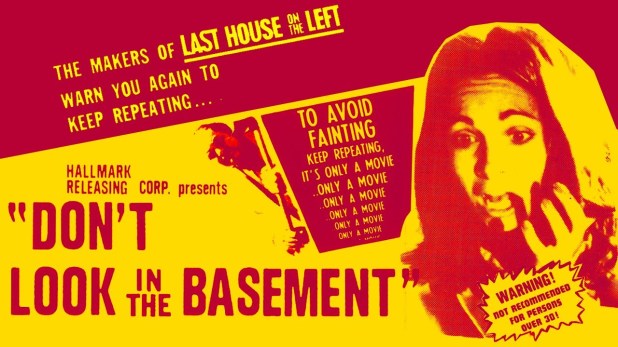
Mill Creek Drive-In Classics: Don’t Look in the Basement (1973)

ABOUT THE AUTHOR: Nick Vaught has worked in the entertainment industry for several years. Nick currently serves as an Associate Producer on the upcoming horror documentary In Search of Darkness: Part III. Nick also worked on the long-running CW series Supernatural. In 2019 he co-wrote the well-received episode “Don’t Go in the Woods.” In addition, Nick has written punch up jokes on multiple TV pilots and teamed with actor Jason Mewes to help write his biography.

No matter how much of a horror buff you think you are, no matter how many horror movies you think you’ve seen, there’s always a lot more out lurking in the shadows, or in this case the basement. I had never heard of Don’t Look in the Basement before signing up for this assignment. I chose it simply on its title alone. Why? For starters, it has a similar name of an episode of the show Supernatural I co-wrote called “Don’t Go in the Woods.” Beyond that, the title intrigued me because I was always scared of basements as a kid, well basements and attics. I think a lot of us are. They’re dark, dank, dirty; much like the worst corners of our brains where our most devious thoughts lurk. On top of that, they usually only have one way in or out, which makes those locations prime real estate for horror set pieces.

The movie’s set in a sanitarium in the middle of nowhere. The head doctor, “Dr. Stevens” (Michael Harvey), has an unusual way (isn’t that always the case) of dealing with his patients. He believes in letting his patients act out their realities in the hopes it will right them. Dr. Stevens also treats his patients like family; he doesn’t even lock their bedroom doors at night. 

This practice ultimately backfires when Dr. Stevens is working with a patient, “Judge Oliver W. Cameron” (Gene Ross), whose dialogue is mainly repeating his title over and over. Judge Cameron is chopping wood with an axe, which ends up in the back of Dr. Stevens. The head nurse, “Jane St. Claire” (Jessie Lee Fulton), is able to subdued Judge Cameron. This is however the last straw for Nurse St. Claire who herself was the subject of a violent attack from patient “Harriet” (Camilla Carr), who is obsessed with a plastic baby doll, that she believes is real. Harriet attacked Nurse St. Claire believing St. Claire was trying to steal the before mentioned baby. Harriet kills Nurse St. Claire by slamming her head in a suit case!

With Dr. Stevens and Nurse St. Claire dead, “Dr. Geraldine Masters” (Annabelle Weenick), is now the lone doctor. Soon after she takes over, she’s greeted by “Charlotte Beale” (Rosie Holotik), who informs Dr. Masters that Dr. Stevens hired her as a new nurse for the sanitorium last week. Dr. Masters had no knowledge of her hiring and is reluctant to uphold Dr. Stevens’ commitment. Finally, Dr. Masters relents and brings Nurse Beale on board. 

Nurse Beale soon meets the other patients: the brute of a man, “Sam” (Bill McGhee), who has the mentality of an eight-year-old after being lobotomized by Dr. Stephens, “Sgt. Jaffee” (Hugh Feagin), who suffers from PTSD after Vietnam, a nymphomaniac, “Allyson King” (Betty Chandler), a prankster, “Danny” (Jessie Kirby), who you know is crazy because of his loud and obnoxious laugh, and a couple others. 

As Nurse Beale gets to know the patients and watch Dr. Masters work, she begins to wonder if Dr. Masters isn’t a danger to the patients. Her suspicions are seemingly confirmed when it’s revealed that Dr. Masters is actually a patient and that Dr. Stevens let her pretend to be a doctor. But are the patients messing with Nurse Beale to get back at Dr. Masters? Who’s telling the truth? Who can be trusted? What’s in the damned basement? The truth perhaps, or a body or two? There’s a couple of fun turns that I won’t spoil for anyone who hasn’t seen the movie and wants to.

Don’t Look in the Basement was shot in 1972, on a shoe-string budget of $100,000 over twelve days. It came on the heels of The Last House on the Left and immediately gives off a similar feel. Written and directed by S.F. Brownrigg, who made a few decent horror films in the 70’s; Don’t Look in the Basement is dirty and grimy and has the look and feel of a documentary, just as a lot of horror movies of the era did. The movie is also infamous for ending up on the U.K.’s Video Nasties list.

The low budget movie actually benefits from the use of a single location. The staff and patients seemingly exist apart from the rest of the world, save for one outside character. The isolation raises the paranoia between the characters; not exactly knowing who or what information to trust, especially for Nurse Beale. 

The movie isn’t your traditional slasher fare. The violence is spread throughout the movie; it’s not one kill after another. And the majority of the gore is held back until the finale, when viewers are treated to a blood bath. The movie is more of a character study and the no-name actors do a very good job with their characters, especially Bill McGhee as the sympathetic, Sam. The characters are treated as humans with real ailments opposed to caricatures. 

Don’t Look in the Basement seems to have been buried by the countless other horror films in the 70’s, but it’s definitely worth a look. It’s sort of like if Session 9 was filmed in one small portion of the Danvers Mental Institute and we got to know the patients. This movie is a great reminder of why we used to be scared, and maybe still are, of the basement. 

MILL CREEK DRIVE-IN MOVIE CLASSICS: Don’t Look in the Basement (1973)

EDITOR’S NOTE: We first wrote about this movie on March 16, 2021. As a bonus, we even have a mixed drink recipe that we shared when this aired on our weekly Saturday night show.

We often refer to movies as “Brownriggian” when we watch films on Saturday nights all night with the Drive-In Asylum Double Feature on Facebook Live. There’s no better example of what this word means than S. F. Brownrigg’s 1973 shocker Don’t Look in the Basement AKA The Forgotten AKA Death Ward #13.

Dr. Stephens, the main doctor at Stephens Sanitarium has a theory that patients should be able to freely act out their insanities in the hopes that someday they will snap back to reality. You know, if I’ve learned one thing about asylum doctors from, well, Asylum and Alone in the Dark, it’s that they’re all just as insane as their charges.

Before one of the older nurses can retire, we have the Judge (Gene Ross) chopping the doctor with an axe and Harriet (Camilla Carr) smashing the nurse’s head inside a suitcase. So when Charlotte Beale (Rosie Holotik, the cover girl of the April 1972 Playboy, as well as appearances in Horror High and the ghostly hitchhiker in Encounter with the Unknown) shows up for a new job and things seem weird. Or Brownriggian. In short, everything feels off. Hallways and stairwells seem like passageways to other dimensions and sweaty horror lurks sleeping like some kind of Southern gothic force of dread and menace.

This is a place filled with human children, killer women obsessed with sex, an elderly woman who thinks that flowers are her kids, a military man who lost his platoon in Vietnam and more. Even the sane are driven mad just by being in their presence.

There are plenty of people who decry Brownrigg’s movies, but I’m certainly not one of them. They invite you to worlds that are not our own and seem to come from a dimension far from here. For that and the vacation to the psychotronic that they offer, we should celebrate them.

For an added treat, check out JH Rood’s journey to the set locations, which you can download from the Internet Archive.

Don’t Look in the Basement is available on Tubi.

BONUS: Here’s that drink we mentioned.

Sam’s Popsicle 

  • 1 oz. amaretto
  • 1 oz. orange juice
  • 1 1/2 oz. heavy cream or half and half
  1. Put everything in a shaker and do your thing until fully mixed.
  2. Pour over crushed ice in a cocktail glass. Enjoy!

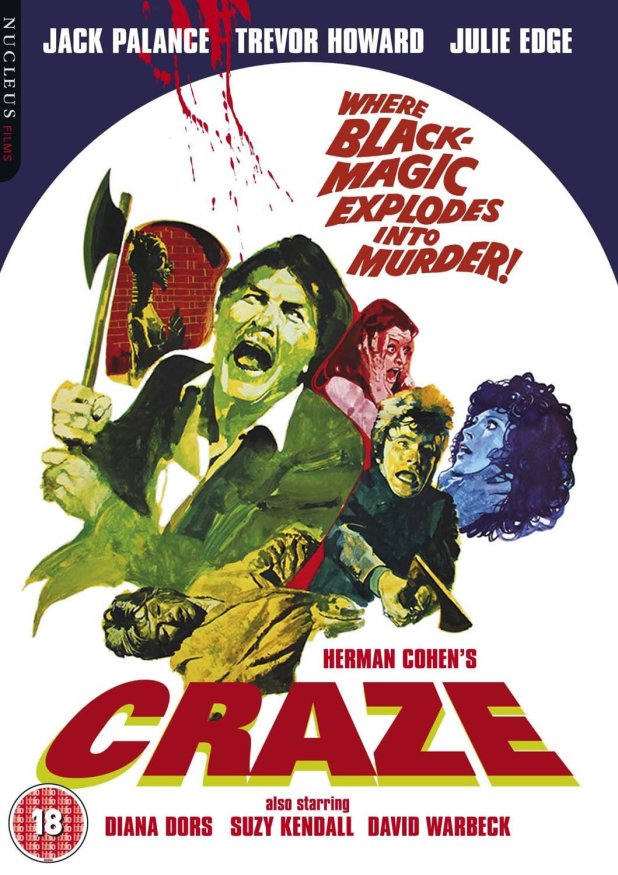
MILL CREEK DRIVE-IN MOVIE CLASSICS: Craze (1974)

EDITOR’S NOTE: We originally posted this on October 19, 2018. Now it’s come back for the grave for our Mill Creek month.

Thanks to his work on Amicus films, Freddie Francis will always get a pass. And Jack Palance has made some of the worst movies I’ve ever seen so much better. Therefore, I wanted to like Craze way more than I ended up enjoying it.

Palance stars as antique shop owner by day, cultist by night Neal Mottram. The film starts with him sacrificing a nude woman to the African god Chuku, whom he believes will reward him with both wealth and power. It’s movies like this that make being a devil worshipper seem rough and pointless. Every single turn, you have to hunt someone down, kill them, get an alibi and run from the cops. It’s a lot of work and when it’s over, you still lose your soul.

Diana Dors is in it and her life story is way more interesting than the film. She gained her first fame as a Monroe-esque blonde bombshell promoted by her first husband, Dennis Hamilton. After a career of sex comedies and Page 3-style modeling, it turned out that her husband was defrauding her. Still after that, she made further headlines by holding parties where she supplied hot young starlets and plenty of drugs to a large number of celebrities. The real stinger was that she had cameras all over the house to capture the action. The Archbishop of Canterbury even publically denounced her!

Supposedly, Dors left over 2 million pounds to her son in her will. It could be unlocked via a secret code in the possession of her third husband, actor Alan Lake, but he killed himself soon after she died from cancer. Despite the best efforts of codebreakers and even a TV special, the money has never been found.

Anyways — Craze. There are plenty of British starlets in this, too. Juli Ege from On Her Majesty’s Secret Service to name one. I chose to watch this because Suzy Kendall from Torso and The Bird with the Crystal Plumage was in it. And Marianna Stone from Whoever Slew Auntie Roo? shows up as well.

It’s not horrible, but it’s very slow. Palance is great — of course he is — but even he has a lot to contend with here. You can watch it for yourself on Amazon Prime and see what you think.

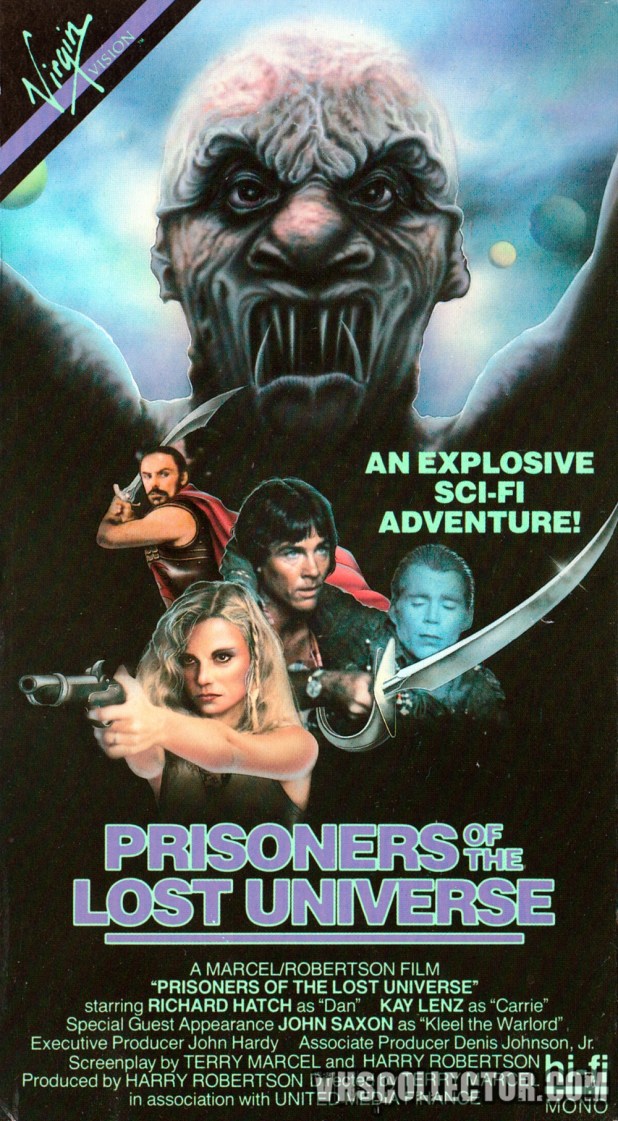
MILL CREEK DRIVE-IN MOVIE CLASSICS: Prisoners of the Lost Universe (1983)

EDITOR’S NOTE: We originally wrote about this movie on August 21, 2018. Now we’re bringing it back with some edits for Mill Creek Month.

Is there an actor that can save any movie for you? There is one for me: John Saxon. I have sat through many a piece of absolute shit only because Saxon shows up to be the hero of the day, even if he’s usually the villain.

TV reporter Carrie Madison (Kay Lenz, The Initiation of Sarah, House) is trying to meet with mad scientist Dr. Hartmann when she literally runs into Dan Roebuck’s (Richard Hatch, TV’s Battlestar Galactica) truck. Once they find the scientist, his machine causes them all to disappear to the parallel world of Vonya, which is populated by cavemen and the warlord Kleel (John Saxon, of course) who has plenty of Earth technology.

Director Terry Marcel also was behind the films Hawk the Slayer and Jane and the Lost City, so obviously sword, sorcery and science fiction was his bread and butter. Too bad that his bread and butter tastes so bad.

If you want to see John Saxon out act everyone around him — sadly I wish this were higher praise — and a ragtag group of aliens fight cavemen, I guess you should watch this. I can recommend several much better movies in this genre, though. That said, it’s free to watch on Tubi.

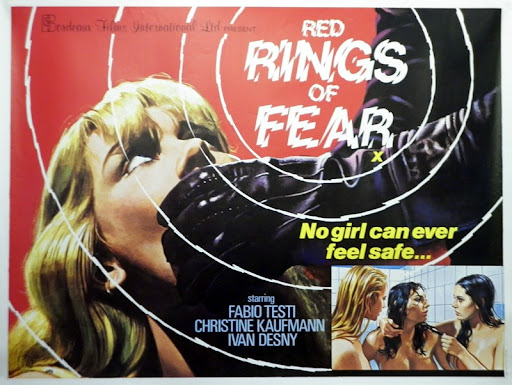
MILL CREEK DRIVE-IN MOVIE CLASSICS: Red Rings of Fear (1978)

EDITOR’S NOTE: We wrote about this movie during our giallo week on September 16, 2021. Check it out and please share your thoughts on this film in the comments.

This is the third entry in a loosely linked series of films that are known by the pretty much pervy title of the Schoolgirls in Peril trilogy. All of these movies have young girls shockingly be interested in sex and being murdered for it.

The series starts with Massimo Dallamano’s What Have You Done to Solange?, one of the best films in the giallo form, which he followed with What Have They Done to Your Daughters? Sadly, Dallamano would die before this movie was made, but he is credited for writing the screenplay.

When the body of a teenage girl is discovered wrapped in plastic twelve years before Laura Palmer, Inspector Gianni DiSalvo (Fabio Testi) finds himself investigating a clique of young women called The Inseparables” who attend a prestigious all-girls school and were friends with the victim.

One of their number is Fausta Avelli, who was also in Don’t Torture A DucklingThe Psychic and Phenomena. And Helga Line, who was in everything from So Sweet…Perverse and Nightmare Castle to The Vampires Night OrgyHorror Rises from the Tomb and Black Candles, is in this.

Most of this movie recycles the past two films, but man, the ending where the first killer casually kills himself and then there’s the reveal of the real person behind everything? That makes watching this all worthwhile.

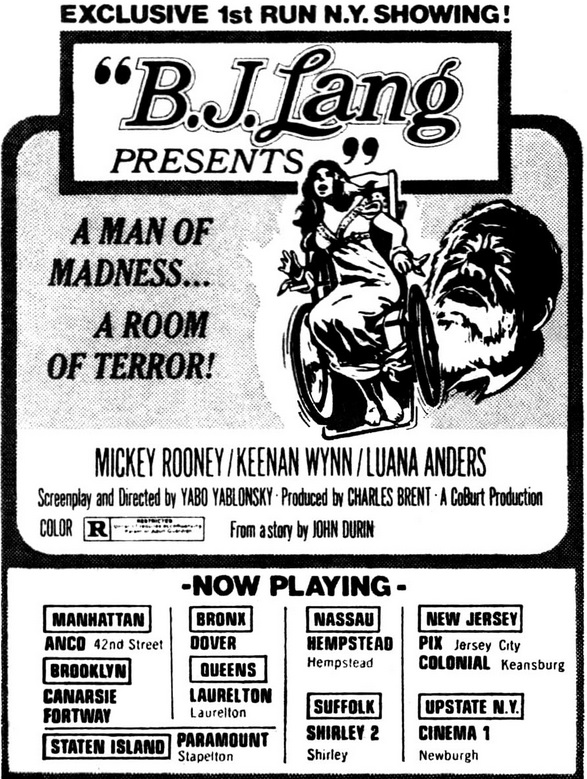
Mill Creek Drive-In Movie Classics: B.J Lang Presents, aka The Manipulator (1971)

Yeah, I know . . . Mickey Rooney was a big star in the 1930s and 1940s, and, for most, seeing him in an ersatz, horrified version of the noir classic Sunset Blvd. is considered a fall from grace, but I really like him here. His work as B.J Lang is as memorable to me as was his work as the mentally handicapped Bill Sackter in the CBS-TV movies Bill (1981) and Bill: On His Own (1983). Yeah, I know, this forgotten Rooney resume entry is on a Mill Creek box set, which leads the many to write off the movie as a “stinker” and that the Mick is slumming, and that we’ve seen it done better with Terrance Stamp and Samatha Eggar in The Collector (1965).

Chalk up my affections for the film as result of seeing it for the first time on my first solo drive-in excursion with a few friends on an undercard with Let’s Scare Jessica to Death (1971) . . . and for the life of me, I can’t remember the main feature. . . . Brainworm alert!

In the world of exploitation, you’ve heard the term “hagsploitation” mentioned to describe aging actresses, aka hags, regulated to finding work in horror films, holding on the last vestiges of their once glamorous, contract player-studio system careers.

And we’ve reviewed most, if not all of them.

Edith Atwater was just one of the many, ’40s starlets finding work in the hagploitation, aka psychobiddy, sub-genre: a genre where old, crusty women either terrorized “sinning” young women or are simply jealous of the girl’s youth, so they “gaslight” them into insanity. You know Edith Atwater, best, from Boris Karloff and Bela Lugosi’s The Body Snatcher (1945), which was her third feature film; she also appeared in Strait-Jacket (1964) with Joan Crawford — herself a “hag” actress with the likes of Berserk! and Trog. Edith then fell into a lot of TV work for the remainder of her career into the mid-’80s to pay the bills. In between, she did another hagster with Die Sister, Die! (1971).

In line behind Joan Crawford was Tallulah Bankhead with Die! Die! My Darling! (1965), studio starlet Veronica Lake, who took her final bow with Flesh Feast (1970), Wanda Hendrix closing out her career at the age of 44 with the Gothic, Civil War tale, the really fine The Oval Portrait (1972; another Mill Creek recycler), and ex-20th Century Fox studio-starlet Jeanne Crain attempted an early ’70s comeback with The Night God Screamed (1971).

So, if the women are packed in a “hagsploitation” crate . . . where does that leave the older, male actors, such as Mickey Rooney? Such a film is B.J Lang Presents — a film which falls under the “trollsplotation” tag* used to describe aging actors stuck in horror films — a film that found a new, video ’80s shelf live under the title, The Manipulator.

So, you’ve noticed the name of Luana Anders in the credits?

Yes, that means this Rooney tour de force also fits nicely into the hag-cycle of ’70s horror films. We first enjoyed Anders in the teensploitationer Reform School Girl (1957), but remember her best for the incessant UHF-TV replays of The Pit an the Pendulum (1961) and Dementia 13 (1963). By the late ’60s, with an A-List film career not coming to fruition, Anders, like many actors, transitioned to television, appearing in the likes of That Girl, The Andy Griffith Show, and Hawaii Five-O, just to name a few.

The writer and director behind the madness, as it were, is Yabo Yablonsky, in his debut in both fields. His is a name know you known courtesy of his Sly Stallone connection for writing the WW II soccer-war drama, Victory (1981). In between, Yabo gave us the forgotten TV films — which played as Euro-theatricals — Revenge for a Rape (1976) and Portrait of a Hitman (1979), courtesy of their starring then/still hot Mike Connors (then of TV’s Mannix fame) and Jack Palance (with Rod Steiger, Bo Svenson, Ann Turkel, and Richard Roundtree), respectively. Of course, martial arts junkies know Yabo best for giving Joe Lewis — one of only five men to beat Chuck Norris in the ring — his film debut in Jaguar Lives! (1979)**.

Okay, enough with the backstory. Let’s unpack this film . . . one where Mickey Rooney cuts loose in an amazing performance. (Yes, amazing. This is my review, after all.)

The plot is simple: Rooney is the once respected, Hollywood’s premiere makeup man, B.J Lang, who, ironically, aged out of the business and has been tossed aside by the glitzy-guady Grauman’s Chinese Theatre crowd. So he snaps and kidnaps an actress (Anders), holding her hostage in an abandoned prop house on a forgotten studio backlot to “star” as Roxanne to his Cyrano in his “movie” version of Cyrano De Bergerac — made of his own reality mixed with his hallucinations. To that end: Mick’s talking to mannequins and people who aren’t there, as he longs for the days — as did the off-her-nut Norma Desmond in Sunset Blvd. (1950) — when he had the ear of Cecil B. DeMille.

Yablonsky may be — as you can tell from his continued work as a writer (which included lots of uncredited “doctoring” work) — a decent writer, but he’s no director of distinction. Clearly, he’s influenced by the earliest splatters of Italian Giallo, here, (mixed with a soupçon of Phantom of the Opera; the 1925 version with Lon Chaney, Sr. or Claude Rains 1943 version, take your pick), hence the creepy mannequins — and more so as B.J Lang remembers the gold ol’ days of putting makeup on Marilyn Monroe: so he puts the makeup on himself and struts around like the actress — as an ersatz Norman Bates. Then there’s the zoomin’ n’ swooshin’ experimental camera movements, the shakes, the psycho color palate — and for a little ’60s acid tripping, lots of strobe lights. So, in the directing and cinematography departments, many opine there’s no class nor style. Uh, maybe they’re right: the proceedings are more of an attempt to copy Mario Bava than to bring anything unique to the lens. Name a camera trick. Yabo’s got it jammed in there, somewhere in the frames. As with his actors: he’s going for it and making an impression.

Hags n’ trolls in one box set! And Shannon Tweed. But no Gene.

In the end this is a Rooney and Andres joint (more so for Rooney) — with a slight cameo by Kennan Wynn as wino bum squatting in the theater (who Rooney subsequently ofts) — with the duo going at it with gusto, which, for me, makes it worth the watch.

This pretty much got (very) loosely remade-ripped (more effectively) as Fade to Black (1980) and that film, as with The Manipulator, also has more detractors than fans. You can watch a free-rip of The Manipulator on You Tube. Of course, it’s available on Mill Creek’s Drive-In Movie Classics 50-movie pack, which we are featuring all this month at B&S About Movies.

* You need more trollsploitation flicks with aged-out and down-and-out A-List actors reinventing themselves in a 70s horror film? Then look no further than Tony Curtis in The Manitou and BrainWaves (the latter also with Keir Dullea), Kirk Douglas in Holocaust 2000, Rock Hudson in Embryo, Fritz Weaver in Demon Seed.

** We’ve reviewed the films of two of Chuck’s other opponents: Tonny Tulleners in Scorpion (1986) and Ron Marchini, whose career we dedicated a week of reviews.

About the Author: You can learn more about the writings of R.D Francis on Facebook. He also writes for B&S About Movies.