EDITOR’S NOTE: This was on the site for the first time on May 23, 2020. The Babysitter was not produced by Cannon but was released on video by HBO/Cannon Video.
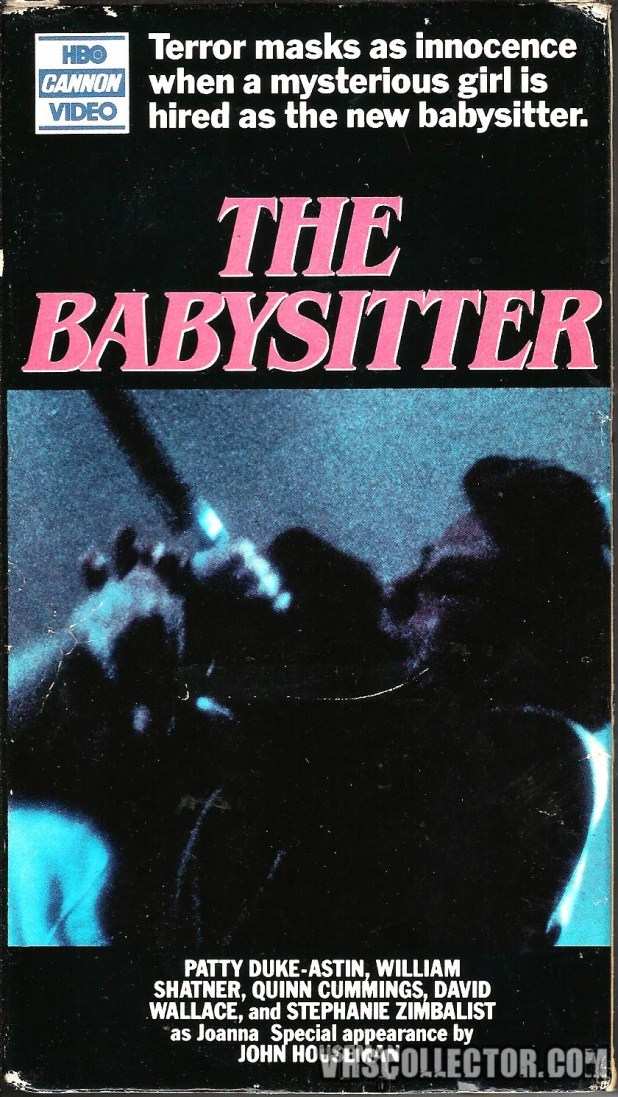
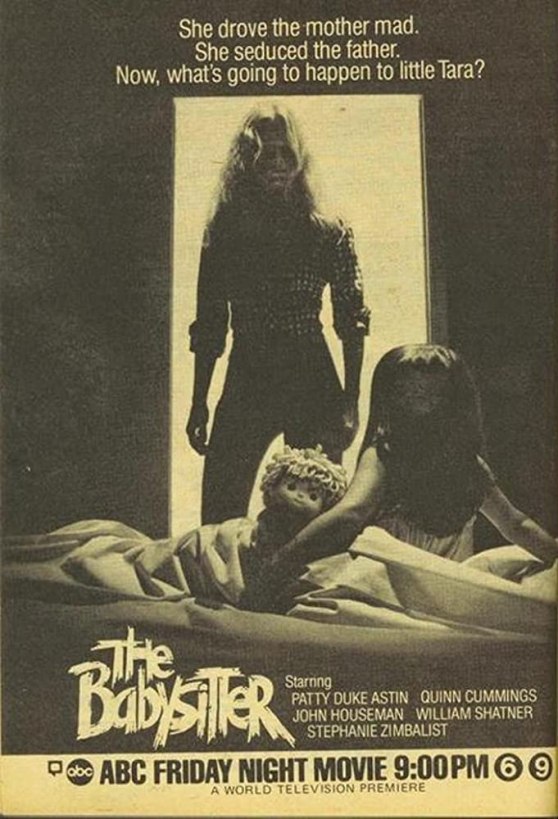
The ABC Friday Night Movie for November 28, 1980, The Babysitter was directed by Peter Medak, who was also in the chair for movies like The Changeling, Cry for the Strangers, Zorro the Gay Blade, Romeo Is Bleeding, Species II and The Ruling Class. What an amazing lineup of films to have on your resume and such a disparate list of movies.
Dr. Jeff Benedict and his wife Liz (TV movie supercouple William Shatner and Patty Duke) have moved from Seattle to Chicago. Between their daughter Tara (Quinn Cummings, The Goodbye Girl) and the demands of housework, Liz isn’t doing so well. That means they bring in a live-in nanny named Joanna Redwine (Stephanie Zimbalist, before Remington Steele) and that’s when things go to seed.
Before you can say movie of the week, Joanna has Liz drinking again and convinced that Jeff has a mistress. While that game is afoot, she’s also trying to convince Jeff that loading his clown into her cannon while wifey is passed out is beyond a good idea
This is when you fire the babysitter. That said — if they did, we would not have the next hour and change of this movie.
Before it’s over, the bodies of the last family Joanna killed — wrapped in plastic a half decade before Laura Palmer — have shown up, she’s wearing Patty Duke’s lingerie and served up a dinner of raw beef tongue. The family is lucky that they know John Houseman, who saves them all.
I have a weakness for both made for TV movies and ones where babysitters slowly drive a family insane. This movie is at the center of this magnificent cycle and must be experienced. These TV movies are exploitation films, with small budgets and insane stories, that scream at you the entire time they are on the screen.
Get ready for the adventures of the seaQuest DSV 4600, a deep submergence vehicle of the United Earth Oceans Organization (UEO). The UEO? Well, that group was created in 2018 — in the continuity of this show — after a battle within the Livingston Trench.
Designed by retired naval captain Nathan Bridger (Roy Scheider), the series begins as humanity finds itself out of natural resources and begins to mine the ocean floor. Several gold rush-style mining communities now exist within this unexplored territory and the seaQuest seeks to protect them from other countries and sometimes each other.
Bridger just wanted to stay retired, particularly after his son Robert died in a naval battle and he promised his dying wife that he would never go back to the sea. But you know…they keep bringing pulling him back.
This show debuted to great fanfare, with the first season’s plots all about oceanographic research, environmental issues, politics and the interpersonal relationships of the crew. By the end of the first season, low ratings led to a cliffhanger where Bridger sacrificed the ship to prevent an ecological disaster.
And that’s where things get weird.
When it was decided the show would come back, NBC and Universal moved production from Los Angeles to Orlando, which led Stephanie Beacham, who played Dr. Kristin Westphalen, to leave the show (all of the battles between the producers and network didn’t help either). It’s also why Stacy Haiduk (Lieutenant Commander Katherine Hitchcock) left, but Royce D. Applegate (Chief Manilow Crocker) and John D’Aquino (Lieutenant Benjamin Krieg ) were let go because NBC wanted a younger crew.
The original crew also had Lucas Wolenczak (Jonathan Brandis), Commander Jonathan Ford (Don Franklin), Lieutenant Tim O’Neill (Ted Raimi) and Sensor Chief Miguel Ortiz (Marco Sanchez). They’d be joined by the telepathic Dr. Wendy Smith (Rosalind Allen), weapons officer Lieutenant James Brody (Edward Kerr), genetically engineered gill-breathing Seaman Anthony Piccolo (Michael DeLuise), Lieutenant Lonnie Henderson (Kathy Evison) and Dagwood (Peter DeLuise), a GELF (genetically engineered life form) who served as the ship’s janitor.
Whereas season one often had serious science — and each episode ended with facts from oceanographer Dr. Bob Ballard, the technical advisor for the show, inspiration from Bridger and the man who actually discovered the wrecks of Titanic, Bismarck and Yorktown — other than finding an ancient spaceship, season two had a monster of the week feel to compete for better ratings. Demons, aliens, fire-breathing worms, the god Neptune, time travel, a prehistoric crocodile and so much more was, well, too much for Scheider to handle.
He referred to the new storylines, giving multiple interviews to the Orlando Sentinel where he said the show as “Saturday afternoon 4 o’clock junk for children. Just junk — old, tired, time-warp robot crap” and “…childish trash…I am very bitter about it. I feel betrayed… It’s not even good fantasy. I mean, Star Trek does this stuff much better than we can do it. To me the show is now 21 Jump Street meets Star Dreck.” That 21 Jump Street dig must have been directed at the DeLuise brothers, who were once on that show before joining the cast.
By the end of the second season, it seemed like the show would be canceled — yet again — so the final episode “Splashdown” has the crew being abducted by aliens, then fighting in a civil war that destroys the seaQuest — yet again! — and everyone dead.
And yet the third season happened!
Scheider requested to be released from his contract with NBC but was asked to appear in a few more episodes. Edwin Kerr asked to quit as well and was asked to stay long enough to die in season 3’s “SpinDrift,” while NBC’s scheduling — which contributed to low ratings as the series moved around all the time — caused the episode “Brainlock” to air with his character still alive.
Now, only Jonathan Brandis, Don Franklin and Ted Raimi stayed on, as if the show was a band playing ribfest with hardly any original members left (even Dr. Bob Ballard was gone). Now called seaQuest 2032, the crew arrived ten years back on Earth ten years later, Bridger retired and Michael Ironside came on as Captain Oliver Hudson. He immediately set some boundaries: “You won’t see me fighting any man-eating glowworms, rubber plants, 40-foot crocodiles and I don’t talk to Darwin.”
Oh yeah — Darwin was a talking dolphin voice by the man who is every talking animal, Frank Welker.
Elise Neal also joined the show as Lieutenant J.J. Fredericks as storylines moved more toward corporate greed running the world and political tension. Only 13 episodes aired before finally, the show was done for good.
There were model kits, trading cards, video games and even Playmates action figures (check out this article on seaQuest Vault), but the show always struggled to catch on with viewers, if they could find it.
Going back and watching this again in box set form, it’s fascinating to see how the show changes and struggles for direction in a condensed format. Week by week, it’s not as strange. When binged, it seems absolutely deranged. I’m glad in some way that I wasn’t in love with the show when it aired. It would have broken my heart.
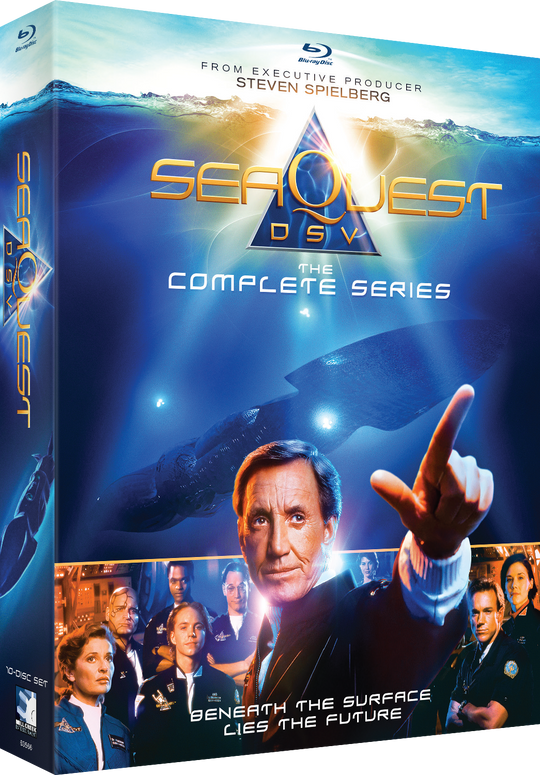
The Mill Creek blu ray box set of seaQuest DSV has every episode of the show, plus new interviews and featurettes with the series creator Rockne S. O’Bannon, as well as the directors and crew. Plus, you get several deleted scenes. Get it from Deep Discount.
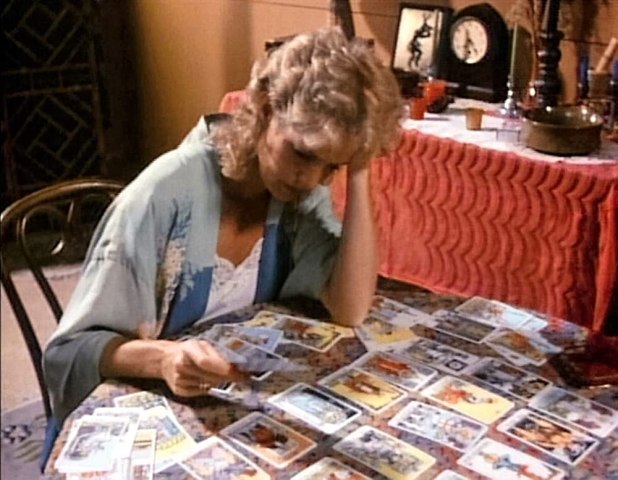
Carolina (Dorothy Lyman, Naomi from Mama’s Family) does Tarot card readings and is popular with her customers, as she always brings them the best of news. Once her competitor — Madame Marlena (Carmen Matthews) — switches out her deck, the fortune change to be filled with death. The cards can’t be destroyed, but can Carolina change her fortune?
The one good thing I can say is that this episode sticks to being horror and doesn’t veer into the silly side of the darkside. I’m such a grump, I realize, but the more jokey these episodes get, the cringier they become.
When wealthy Gordon Duvall (Peter Lawford) uses his private plane to get Danny, one of his workers (Michael McGreevey), to the hospital, pilot Stu (Sandy McPeak) gets lost and they have to land on what they think is an uncharted and isolated island. Too bad for the men — which include Mike (Steven Keats), Wendell (Clint Walker) and J.J. (Guich Koock) — that a crash of women and nuns years ago turned that into a place where Lizbeth (Jaime Lyn Bower) communicates with the spirit of the long-dead Sister Theresa.
With a tribe of women that includes Snow (Kathryn Daniels), Chocolate (Jayne Kennedy from Body and Soul!), Flower (Rosalind Chao), Bambi (Deborah Shelton, Sins of the Night) and Jo Jo (Susie Coelho, Breakin’ 2: Electric Boogaloo), the normal matriarchal society moments happen — “What is a kiss?” Snow asks one of the men — and Lizbeth agrees to let the men stay if they take care of the cannibalistic headhunters that live on the island.
I mean, yes, it’s cheesy, but how magical of a world did we once live in where this kind of stuff aired on TV with no warning? We were once better.
The Kino Lorber blu ray release of this made for TV movie has a new 2K master and commentary by Made for TV Mayhem‘s Amanda Reyes and Kindertrauma co-founder Lance Vaughn. You can get it directly from Kino Lorber.
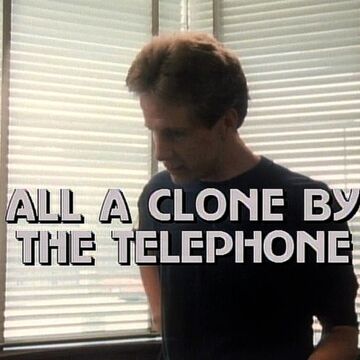
Yes, two Tales from the Darkside episodes in a row have now had a corny pun for a title, but at least this episode presents a truly horrific concept that today’s audience might not understand: TV screenwriter Leon (Harry Anderson) has his life taken from him by the voice of his answering machine.
One of eight episodes directed by Frank De Palma — he also worked on the spiritual sequel series Monsters — and written by Haskell Barkin (who wrote the other punnily titled “Djinn, No Chaser“), this episode starts with that strong premise and then works to a silly conclusion, one of the things outside of budget that holds this series back from being thought of in the same breath as The Twilight Zone or Night Gallery.
That said — this one does have Dick Miller in it, playing Leon’s agent. Marcie Barkin from Fade to Blackand Smokey and the Good Time Outlaws is also in this as Leon’s long-suffering partner.
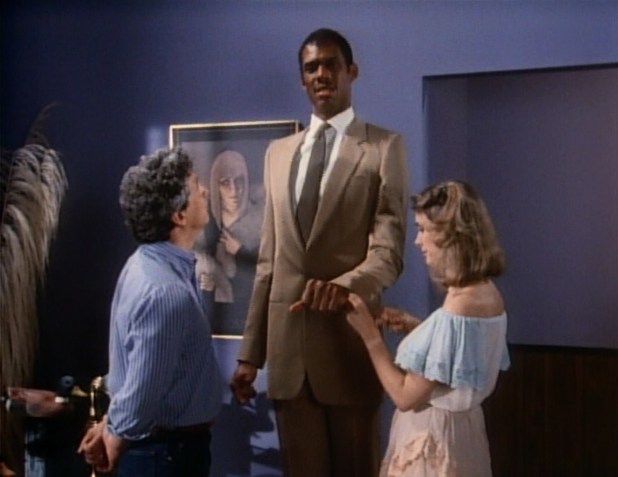
Based on a Harlan Ellison story, directed by Shelley Levinson and written by Haskell Barkin, this episode has Danny Squires (Charles Levin) in a lunatic wing explaining how his wife Connie (Coleen Camp) had bought an old lamp that brought a djinn (Kareem Abdul-Jabbar) into their lives. Nothing good has happened since that day.
Sadly, this episode is one of the sillier episodes and not in the best of ways. It’s wacky humor with a payoff that is an even bigger groaner. It’s as if all the issues of Danny in a straihtjacket don’t matter because of how easily everything comes together at the end.
Look, they can’t all be winners on Tales from the Darkside.
What’s worse than a death in the family? How about a death that won’t go away?
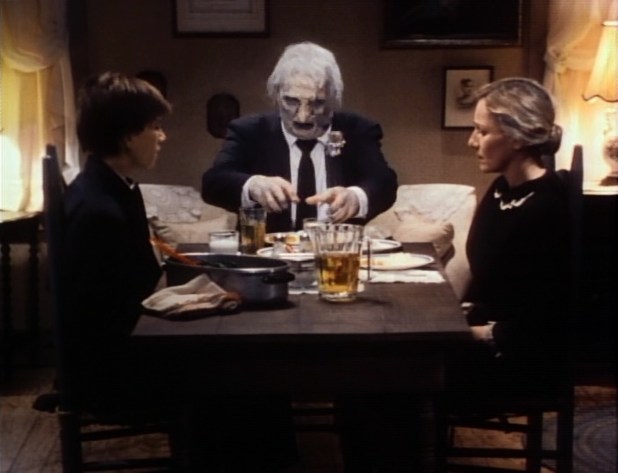
Jodie (Christian Slater!) and his mother (Barbara Eda-Young) were upset when Grandpa Titus (Eddie Bracken, Roy Walley from National Lampoon’s Vacation) died, but now that he’s up and about and rotting, well things are even more horrifying because the old man may be just too stubborn to stay dead. Not even Dr. Snodgrass (Bill McCutcheon, Droppo from Santa Claus Conquers the Martians) and Reverend Peabody (Brent Spiner) can convince him that he’s not living any longer.
Reverend Peabody tells Grandpa that once his body is in the grave, his soul will be free to go to Heaven. The old man replies that if Heaven is so great, the holy man should go there himself, which causes Peabody to condemn him.
It finally takes Jodie — and a pepper from a voodoo woman played by Tresa Hughes — to convince Grandpa that he’s not of this world any longer. It’s sad, but it takes love to say goodbye.
This episode was directed by Gerald Cotts and written by James Houghton from a Robert Bloch story. Slater would return for Tales from the Darkside: The Movie.
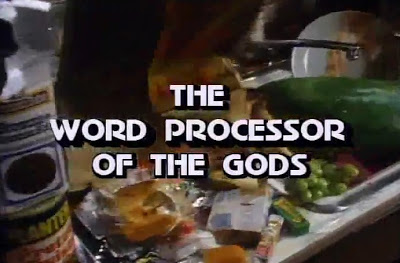
Based on the story by Stephen King and adapted by Michael McDowell (Beetlejuice, The Nightmare Before Christmas), this Michael Gornick-directed episode has Bruce Davison as Richard Hagstrom, a man who has just inherited an upgraded computer from his nephew Jonathan. This computer is quite unique, as it has the power to grant wishes.
Richard’s life is rough. He has no real love for his wife Lina or son Seth Robert. The love of his life, Belinda, is married to his brother Robert, an alcoholic. And I should say was married, as Robert has driven their car off a cliff and killed everyone, including Jonathan, one of the few people who Richard likes.
This is one of the better Tales from the Darkside stories, a near-perfect adaption of King’s story on a small budget. Somehow, Richard is able to take this gift and use it to find a happy ending, something that rarely — if ever — happens with wishes.
EDITOR’S NOTE: This was originally on the site on August 15, 2020. Happy birthday all week Arnold. You are loved, almost as much as Jayne.
Dick Lowry has worked in made-for-TV movies for some time, working on many projects with Kenny Rogers (The Gambler, The Coward of the County) and connected movies like In the Line of Duty and Jessie Stone, as well as the Project ALF TV movie reunion and Archie: To Riverdale and Back Again.
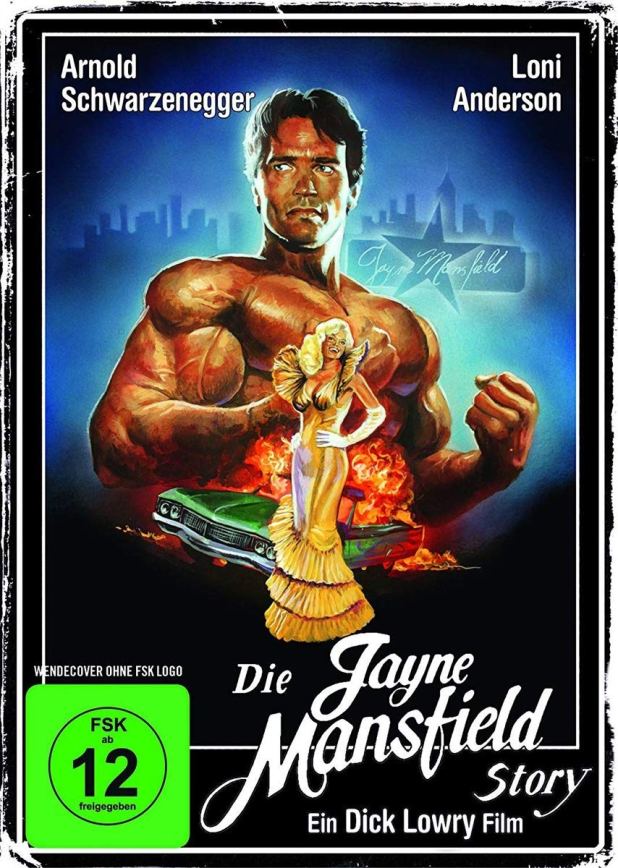
Based on the Martha Saxton book Jayne Mansfield and the American Fifties, this is — at best — a fictionalized accounting of her life. John Wilson’s book The Official Razzie Movie Guide as one of The 100 Most Enjoyably Bad Movies Ever Made.
Arnold Schwarzenegger — four years before The Terminator — plays Mansfield’s second husband Mickey Hargitay, who is telling a reporter the story of her life. Mansfield is played by Loni Anderson, who is perhaps the worst person — outside of bust line — to play her. She just seems wrong, from how she approaches the role to look. Maybe she identified with Jayne, seeing as how she started as a sex symbol and struggled to get her intelligence across. I’m not really sure, but it just doesn’t work.
Ray Buktenica plays her manager Bob Garrett. Buktenica was best known as Benny Goodwin, the rollerskating toll-booth working boyfriend of Brenda Morgenstern on Rhoda. Also in the cast are Kathleen Lloyd (who memorably is killed by The Car as it flies through her kitchen window) as Carol Sue Peters and G. D. Spradlin, who mostly plays cops in movies, as Gerald Conway.
Jayne Marie Mansfield is played by Laura Jacoby, who beyond being in Radis also Scott Jacoby’s sister. The younger version of the character was played by Deirdre Hoffman, Anderson’s daughter.
If you look close enough, Lewis Arquette — the man whose loins gave the world Rosanna, Patricia, Alexis, Richmond and David — shows up as a publicity man.
There were no fact checkers in 1980. After all, how can you explain a movie that purports to tell the life story of Mansfield report that she was 36 when she died when the truth is that she was 34? Or that Jayne is shown making Las Vegas Hillbillys which is supposed to be a Western, which it is not, much less the fact that it was made two years after she and Mickey were actually divorced, yet they are married here? Shouldn’t that be The Sheriff of Fractured Jaw? And while we’re on the matter of facts, how great is it when Jayne is getting a new convertible sometime in the mid-1950s, you can clearly see a 1980 Honda Civic roll by?
Much like how Jayne is dying to play the lead in The Jean Harlow Story, Valerie Perrine wanted this role. Surely she would have done better than imitating the worst vocal tics of Mansfield and none of the brains behind the glamour. Also, of all people to narrate this movie, Arnold in 1980 would not be the person I’d pick.
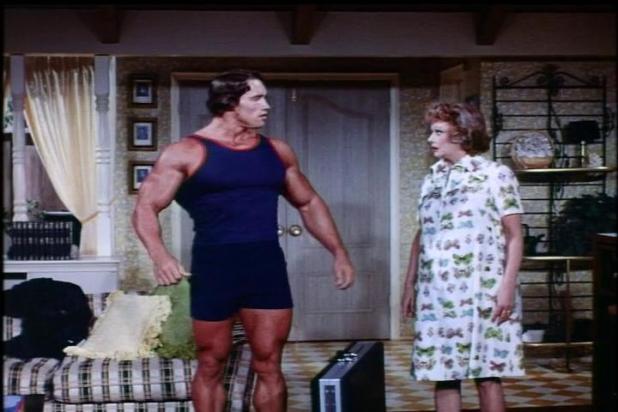
Norma and Malcolm Michaels (Lucille Ball and Art Carney) are a middle-aged married couple who seperate after years of arguing and their daughter’s new marriage. However, once they are single again, they miss the comfort they had with one another.
Directed by Jack Donahue (Babes In Toyland, sixty-nine episodes of Chico and the Man, Ball’s Her’s Lucy show as well as her Lucy Gets Lucky and Lucy Moves to NBC specials) and written by Arthur Julian (whose TV writing credits include shows like Hogan’s Heroes, Maude, Gimme A Break! and Amen) and Arnie Rosen (a writer on The Carol Burnett Show), this was one of Lucille Ball’s TV movie specials. It was the first time in decades that Ball didn’t play her sitcom Lucy character and even had streas of gray in her hair.
This is very much Lucy’s show, as her personal hairstylist Irma Kusely styled her wigs and she brought back Here’s Lucy (1968) propmaster Kenneth L. Westcott, costumer Renita Reachii, production manager William Magginetti and script supervisor Dorothy Aldworth.
Norma ends up going to Vegas with her friend Fay (Nanette Fabray) and their dates Ed (Don Porter) and Doug (Rhodes Reason) while Malcolm gets hooked up with younger women thanks to his friend Greg (Peter Marshall).
The real reason I watched this was to see Arnold Schwarzenegger between Hercules In New York and Pumping Iron. He’s much more comfortable speaking and has some decent comic timing. I’m certain playing off Lucy had to be intimidating, but Arnold is great. He’s also monstrous, as he’s bigger here than he would ever be in any of his movies.
In my quest to watch every Arnold movie, I will go anywhere. Even a made for TV live special.

 B&S About Movies
You must be logged in to post a comment.