Welcome to the Circle (2020)

The reviews on this feature film writing and directing debut by Disney wildlife documentarian David Fowler have been of the middling-to-hated variety. And I must admit that, after my first watch, I didn’t care for Welcome to the Circle either — and since I couldn’t find a positive in the film, I wasn’t going to write this review.
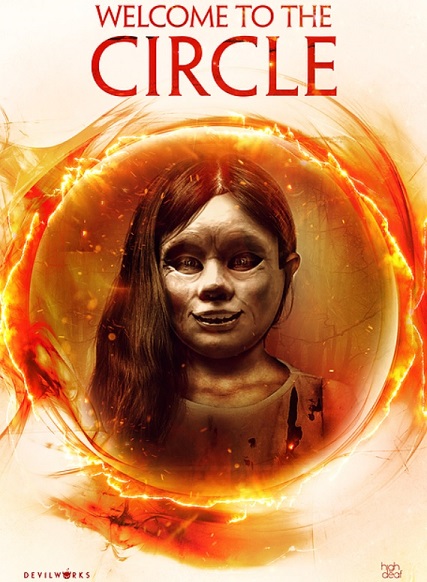
But obviously, there’s something happening here — or you wouldn’t be reading this — in the Don Coscarelli-mindfuck frames that I just couldn’t put my finger on my first go-around. For this film’s raison d’etre isn’t flying Chinese cuisinart harmony balls: it’s mannequins and masks and fucked up human-strung marionettes. And it wasn’t until Sam, our Mix Master General of the Movie-themed Drink Blender, rolled out another “Giallo Week” of even deeper Italian and Spanish obscurities*, and my sitting down for a two-day Nazisplotiation binge as I geared up for my review of Naomi Holwill’s everything-you-wanted-to-know-but-were-afraid-to-ask genre document Fascism on a Thread: The Strange Story of Nazisploitation Cinema, that the celluloid memory centers of my analog cortex streamed across the synapses in hallucinatory harmony.

There are just some movies that require a second run through the digital sprocket rollers. The FUBAR’d world of Welcome to the Circle is one of those films.
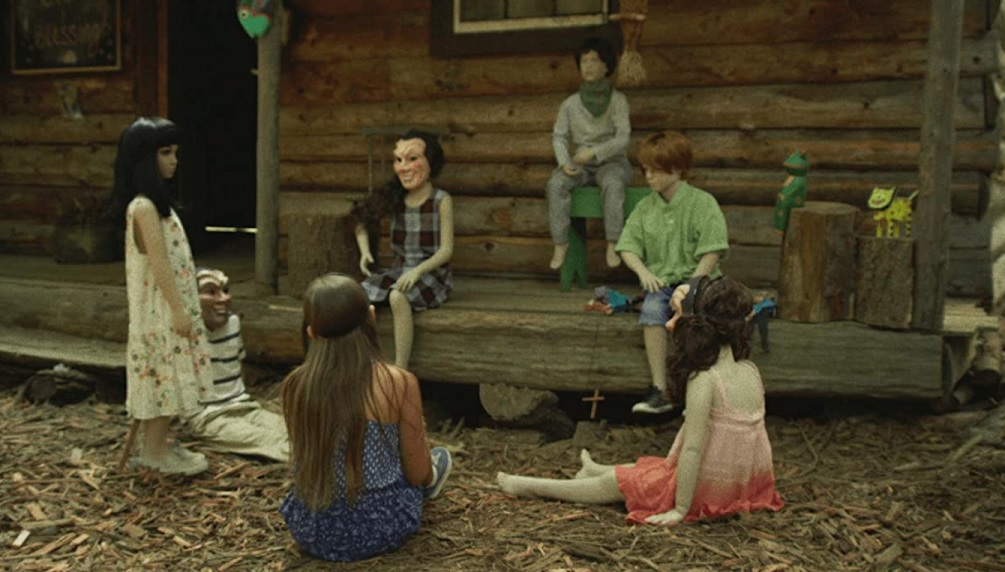
He’s a-pickin’ and I’m a-grinnin’: Just sum backwoods pseudogiallo fun with the kids.

Now Giallo and Nazisploitation films may not — at all — be at the ambiguity-open-to-your-interpretation roots of Fowler’s retro-madness, but somewhere along the line, between the feel-good Disney docs, he’s ingested his share of films from both genres and they somehow bled into his Final Draft QWERTY-ing.

We’ve got the mannequin and mask creepiness of Mario Bava’s Lisa and the Devil and Umberto Lenzi’s Spasmo. There’s Coscarelli’s they-don’t-make-any-sense surrealistic nightmares of the Phantasm franchise. There’s Bigas Luna’s snail-slithering corkscrews of Anguish. There’s the haunting of Herk Harvey’s Carnival of Souls with his mannequin-like souls in their undead waltz. There’s the twisted, pseudo-Nazi ideology that makes no sense to anyone but its we-can-do-whatever-we-want followers. Then there’s those narrative time jumps (which seems to annoy the streamer-critics the most) where you don’t know if the character’s insane, trapped in a dream, or the owls are hootin’ down at the Ambrose Bierce bridge of reincarnation sighs.

A cult victim has to learn to swim on their own: PseudoGiallo WTFs with masked mannequins and dirt scuba-diving.

As the film begins, we meet Greg, a father who takes Samantha, his young daughter, on a bonding camping trip; they’re subsequently attacked by a bear. However, amid the film’s unfurling ambiguity and surrealism, one questions if the bear attack was even real — and if the attack was, instead, in human form, since cults need children to nurture.

Greg comes to wake in the warming bosom of The Circle, a backwoods cult led by a Matthew, a white-suited Ron L. Hubbard-type that deals in philosophical, circular logic: reasoning that means nothing to know one but the cult’s members — whose numbers are dwindling.

And here’s where those mannequins and masks come in . . . and time starts a-jumpin’.

As Samatha’s assimilated into the cult, she’s obsessed with wearing a happy-face mask given to her by the cult’s flower-child rhetoric-spewing handmaidens Sky and Lotus Cloud. In fact, anytime someone is absorbed into the cult — by their own will or by force — they “personality” is replaced by a doppelganger mask. And as the cult numbers dwindle — by escape or death (we think) — they’re replaced by doppelganger mannequins that, (again, we think; keeping with the film’s circular mindfuckery), represents the lost, human soul . . . or the zombie-like autonomic nature of man . . . and your own mindfuck opinions, may vary.

Also pulled into the time loops and identity shifts is Grady, a professional cult deprogrammer hired by a husband and sister-in-law to abduct the cult’s third hippy-handmaiden, Rebekah.

Then there’s the right-back-where-you-started multi-dimensional travel and whacked-out hallucinations of the Tallman “Space Gate” variety that occur in the rural lair-shack of perpetually reincarnating Percy Stephens, an evil Baron Munchausen-styled world adventurer — (cursed to?) a lair that, you always end up where you left. As with Rudolf Enich Raspe’s literary hero, Percy’s a master sportsman, world-class deep sea navy diver, and world traveler (and master B.S. artist) whose life experiences led to his creation of The Circle, a supernatural cult with twisted moral standards. (Luckily, Percy wasn’t a product of Nazi Germany — but he did subjugate some African natives along the way, at least according to the creepy, morphing black and white wall photos hung around the compound, and per everyone’s Ringu-jittery mindbending flashbacks — or this backwoods camp would be a backwoods Nazi-prison farm with Sploitation-atrocities o’ plenty.)

Does young Samantha escape and is Rebekah rescued? Yep. But Rebekah’s got a shite-eating-grin on her face as Samantha fans the pages of the self-made book, “The Adventures of Percy Stephens.” So, will The Circle, continue?

All in all, I’m glad I gave Welcome to the Circle a well-deserved second watch. And it’s well worth your streaming it the first time. But hey, we’re the guys who loved The Invisible Mother, She’s Allergic to Cats, and Under the Silver Lake — that almost everybody else hated and didn’t see. So what do us film reviewing schlemiels and schlimazels of Hasenpfeffer Incorporated in the backwoods of Allegheny County know? We’d tell you that the Giallo cycle was misunderstood by mainstream Americana, with the genre’s mixtures of murder, the supernatural, Entomology, and junk sciences (and, in The Circle’s case: junk philosophy) wrongly critiqued as “style over substance” and “lacking in narrative logic.” And you’d say, “Poppycock.”

And that’s your loss, for you just missed out on a great introduction to a new voice in horror with this debut work from David Fowler.

After a making its streaming debut in October 2020 on various online platforms, Welcome to the Circle makes its January 2021 debut as a free-with-ads stream on Tubi. You can learn more about the film at Artsploitation Films and follow the film at its official Facebook page.

* In June of last year, we had our first, month-long Giallo blowout, which we recapped with our “Exploring: Giallo” featurette with review links to over 50 films. Yep, the blood runs Tallman-yellow in our veins. And there’s nothing like starting off a New Year with Giallos; you can catch up on our reviews with our three-part “Giallo Week Wrap Ups”: Recap 1, Recap 2. and Recap 3.

Disclaimer: We did not receive a review request from the director or a P.R firm. We discovered this film on our own and we truly enjoyed the film.

About the Author: You can learn more about the writings of R.D Francis on Facebook. He also writes for B&S About Movies and publish music reviews and short stories on Medium.

Fascism on a Thread: The Strange Story of Nazisploitation Cinema (2020)

Author’s Note: Due to the controversial subject matter of this film, please note this is a film review that addresses the creative art of filmmaking only. This review is not a political dissertation in support of or in contradiction of any sociopolitical belief system and is not intended to incense any reader regarding social or free speech/opinion issues. This review was written to expose a documentary film that attempts to help the viewer reach an understanding regarding the creative development of its subject-film genre.


Filmmaker Naomi Holwill is one of us. She’s a film dork at heart and, like most of us, isn’t content with just watching a film; her fascination runs deeper. She read all of the film books and watched all of the DVD supplements and listened to the commentary tracks, like us. She needed to know what made Spanish filmmaker Jorge Grau and Italian purveyors Luigi Cozzi, Lucio Fulci, and Sergio Martino tick. She wanted to know why the Emmanuelle franchise became a phenomenon.

And she became a filmmaker that is everywhere . . . and nowhere. She’s the dark lady of cinema.

If you’re a cult cinema aficionado of all things Spanish and Italian and horror and sci-fi — chances are you’ve watched more than several of her 150-plus feature-length documentaries and featurettes (as a producer, editor, and director) from her Scotland-based High Rising Productions that, since 2009, is responsible for producing a wide array of supplements for internationally-released Blu-ray and DVD reissues of most of your favorite films from the ’60s through the ’80s.

You want to know more about the influences of Norman Jewison’s Rollerball*? She’s gave us the feature-length documentary supplement From Rollerball to Rome (2020) (which needs its own, separate release). You want to know more about seventies sex symbol Me Me Lai, one of the very first British-Asian pin-ups? Naomi Holwill was the first filmmaker to tell Lai’s story with the acclaimed Me Me Lai Bites Back (2018). And the list goes on and on: Norman J. Warren’s directing career**, Cannibal films, Giallo films, Blaxsploitation, Roger Corman, Jack Hill, George Romero, Slashers, Italian Zombies, and Italian Exorcism films. Since 2009, Naomi Holwill, along with her High Rising partner Calum Waddell, have left no filmmaker, actor, director, or genre stone from our beloved Drive-In ’70s and VHS ’80s unturned.

It was only a matter of time until High Rising Productions — with Waddell as writer and Holwill as director — would tackle the taboo sub-genre of exploitation and sexploitation films (and women-in-prison flicks) known as Nazisploitation: films dealing with World War II-era Nazi’s — both men and women — behaving very, very badly in concentration camps; films churned out in quick succession in the 1970s upon the box-office success of Don Edmonds (Terror on Tour) Ilsa: She Wolf of the SS (1975) starring Dyanne Thorne (Point of Terror).

Courtesy of the documentary’s inclusion on The Beast in Heat, the Blu-ray serves Dyanne Thorne’s final on-camera appearance.

Severin Films contracted Rising High to produce Fascism on a Thread, a feature-length documentary on the genre for inclusion on its May 2019 Blu-ray edition of Paolo Solvay’s The Beast in Heat (aka La Bestia in Calore, aka SS Hell Camp). Included are interviews with genre stars Dyanne “Ilsa” Thorne and Malissa “Elsa” Longo, along with the genre filmmakers Mariano Caiano (Nazi Love Camp 27), Liliana Cavani (The Night Porter), Sergio Garrone (SS Experiment Love Camp, SS Camp 5: Women’s Hell), Bruno Mattei (Private House of the SS, Women’s Camp 119) and Rino Di Silvestro (Deported Women on the SS Special Section). Other filmmakers and films examined are Tinto Brass’s Salon Kitty, Last Orgy of the Third Reich by Cesare Canevari, Alain Payet’s Love Train for the SS, and the more serious and better-made (but the most grotesque-watch of them all), Salo, or the 120 Days of Sodom by Pier Paolo’s Pasolini.

Granted, most Nazisploitation films are admittedly more sensationalistic, but when it comes to Pasolini’s inclusion in the genre, you’re dealing with a film that isn’t using Nazism or Fascism as window dressing. Salo, the 120 Days of Sodom is a masterwork in the horrifying lessons of the absolute corruption of power in the same vein that Otakar Vavra’s Witchhammer (1970) controversially addressed the issue, a film that, itself, was bastardized with a quick succession of scandalous “Witch Trail” films, such as the West German-produced Mark of the Devil, aka Witches Tortured til They Bleed (1970), its sequel Mark of the Devil II, aka Witches Are Violated and Tortured to Death (1973), and the more reserved, Gothic-slanted AIP film that inspired the production of those films: Michael Reeves’s Witchfinder General, aka The Conqueror Worm (1968). Paul Naschy’s “theme” on the corruption of wealthy libertines, in his pseudo-zombie film, The People Who Own the Dark (1975), also has a connection to Pasolini’s art-horror film statement regarding Italy’s fascist state — and their complicity in the rise of Nazism.

While brutally squeamish — but not gratuitous: there’s a point to it all, really — Salo and these works are inspired by the infamous, power mad, pre-Nazisploitation exploits of the Marquis de Sade; which was the question asked by Naschy: “What if the Marquis de Sade existed in the nuclear, Cold War-era of the 1970s?” And that theme — which also adds a message about man’s obsession with beauty and youth — prevails in Fruit Chan’s nerve-inducing masterpiece, Dumplings (2004). These films may not be for the puritanical or faint of heart, but they are statements on how far one will steep into the Seven Deadly Sin for their own personal gain that need to be told. However, that message — and any sociopolitical connotations — is lost in most Nazisploitation films (the worst offenders being Lee Frost’s 1969 knockoff, Love Camp 7, and Garrone’s 1976 romp, SS Experiment Love Camp), so you’ve been forewarned.

When it comes to a quintessential encapsulation of the derided ’70s Drive-In genre that later became an ’80s VHS-based “video nasty” genre, Fascism on a Thread is it. If you’re a film dork that needs to know more and, as with our friend Mike “McBeardo” McPadden*˟, you’re on a quest to consume every Nazisploitation and Italian cannibal film ever made, Naomi Holwill’s directorial effort is a perfect introduction to exploring the genre as you wrap your head around “why” it ever existed in the first place.

After being offered on Amazon Prime as a separate-from-the-Blu stream from The Beast in Heat, you can now watch Fascism on a Thread for the first time as a free-with-ads stream courtesy of TubiTV. We’ve also since reviewed Naomi Holwill’s exploration of the Italian cannibal genre with Me Me Lai Bites Back (2021).

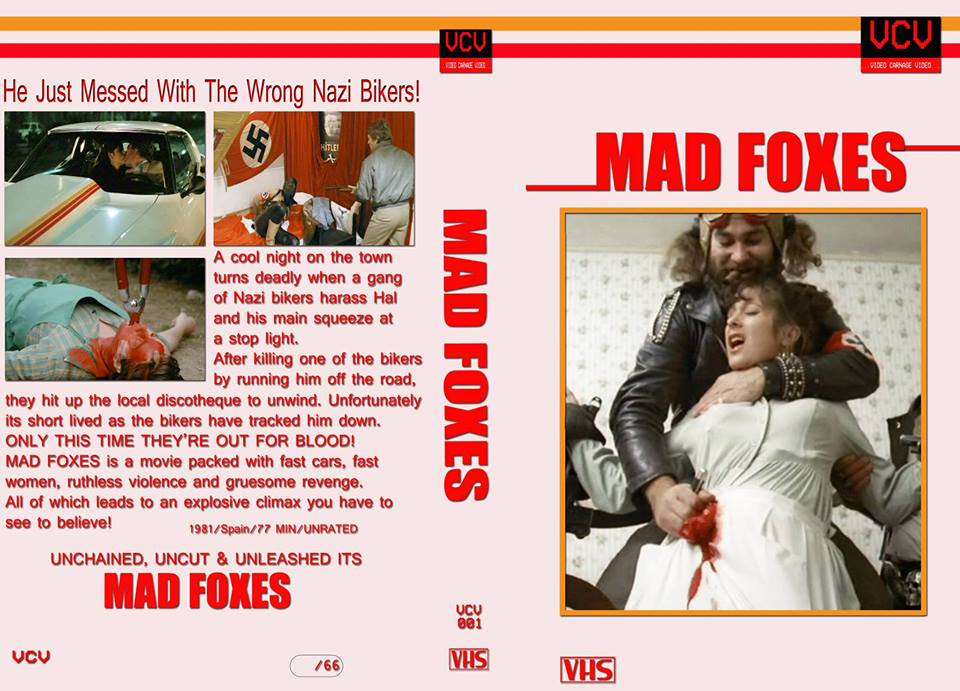
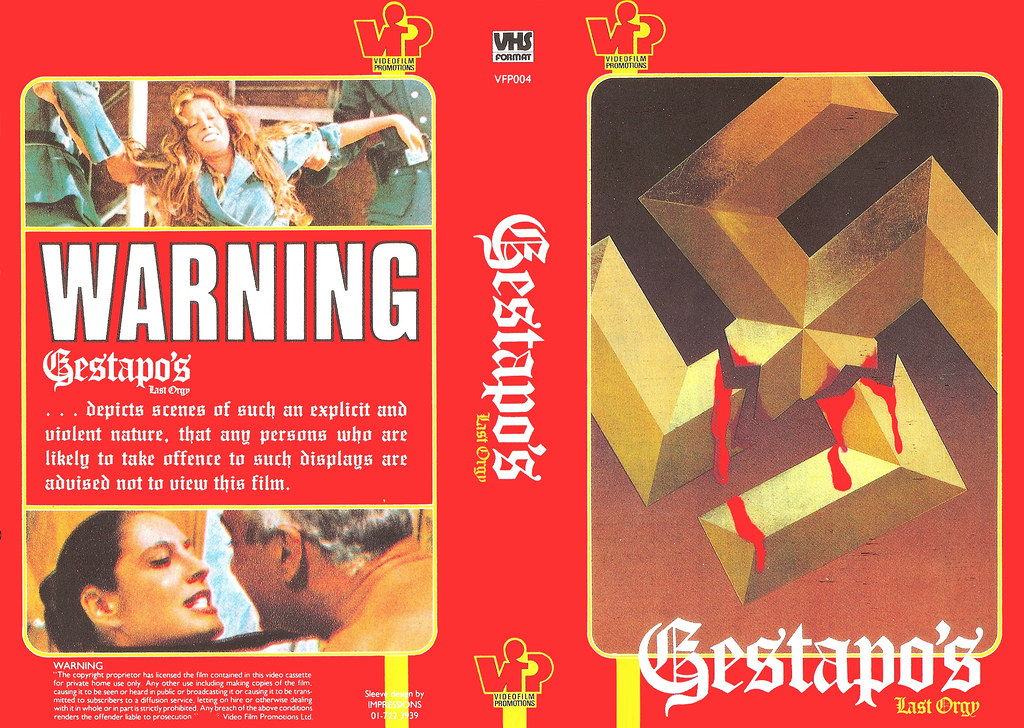
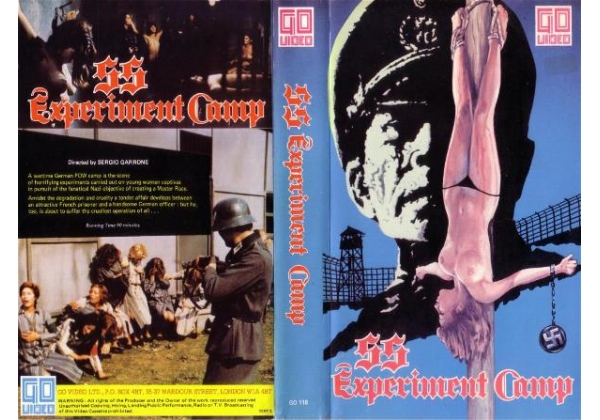
There’s also several fan-complied compilation lists to help you navigate through the genre’s films on the IMDb and Letterboxd. Other films of the genre we’ve reviewed are Achtung! The Desert Tigers (1977) and Gestapo’s Last Orgy (1977), along with the ’80s zombie variants of Shock Waves (1977), Gamma 693 (1981), and Zombie Lake (1981). Then there’s the rape-revenge inversion of Mad Foxes (1981). If you’re in a NaziZom binge-mood and want to see a few of the genre’s predecessors, you can check out They Saved Hitler’s Brain (1964) and its fellow Nazi scientist-cum-world-conquest villains in She Demons (1958), The Flesh Eaters (1964), and Flesh Feast (1970). To a lesser extent, there’s the Nazi we-never-see ghosts of Death Ship (1980).

Click through the images for the reviews.

* We did our own month-long examination of all of those post-apoc Rollerball offsprings with our two-part “Atomic Dustin” and our three-part “Fucked Up Futures” examinations — both features offer review links to over 100 films of every Italian and Philippine end-of-the-world romp you can imagine — and beyond.

** We’re reviewing Norman J. Warren‘s resume in June 2021.

*˟ We had the pleasure of interviewing Mike “McBeardo” McPadden in April 2019, upon the release of Teen Movie Hell: A Crucible of Coming-of-Age Comedies from Animal House to Zapped!, his latest filmpedia follow up to Heavy Metal Movies.

Disclaimer: We did not receive a review request from the director or a P.R firm. We discovered this film on our own and we truly enjoyed the film. And thanks for making this one of our most-successful posts with over 650-hits since January! We hope you enjoyed the film as much as we did!

About the Author: You can learn more about the writings of R.D Francis on Facebook. He also writes for B&S About Movies and publish music reviews and short stories on Medium.

ABC Afterschool Special: Blind Sunday (1976)

You’re a young acting hopeful, in the business since 1965, who has worked alongside Tommy Kirk and a young Ron Howard in Burt I. Gordon’s Village of the Giants, and alongside Bob Hope in Eight on the Lam. Then you hit pay dirt, the dream of every actor: a steady acting gig. You just booked a starring role as Jan Brady on TV’s The Brady Bunch . . . then Sherwood Schwartz — who made a bundle in TV syndication with all of his ’60s and ’70s series, but “legally” wasn’t obligated to share the bounty because there were no residuals clauses back in the day — decides he wants a cast of “all blonde girls.”

But as you mature into a young adult, you end up in — of all things — The Brotherhood of Satan, a movie we love so much in the B&S About Movies offices, we reviewed it three times. Then you’re cast as the female lead in one of the ’70s most iconic and influential horror films of all time: William Freidkin’s The Exorcist*. And one of the actresses that also auditioned and was seriously considered as Regan MacNeil was Anissa Jones — and you worked alongside Buffy on a couple of episodes of TV’s Family Affair. And your parents — as did Denise Nickerson’s, who portrayed Violet Beauregarde in Willy Wonka & the Chocolate Factory, and was in the running — made you drop out of the project because of the troubling, controversial subject matter.

Eventually Sherwood Schwartz tosses you a bone to work on the show he fired you from — over hair issues, mind you (there was no Clairol or wigs, Woody?) — with a guest-starring role as the homely-to-hot Molly Webber in “My Fair Opponent,” a 1972 episode of The Brady Bunch. And, at the mercy of channel surfing the retro-channels Cozi or Antenna TV, you can still be seen in the still-in-reruns Adam 12, Green Acres, and Emergency! — sans residuals, natch.

Actress Debi Storm as Molly in The Brady Bunch.

Meanwhile, Leigh McCloskey (later of Hamburger: The Motion Picture) is climbing his way up the network TV ladder with roles on The Streets of San Francisco (that’s sadly absent from reruns) and the miniseries ratings juggernaut that was Rich Man, Poor Man (1976; that starred Peter Strauss of The Jericho Mile), while on his way to star with the very actress that got Debi Storm’s job in The Brady Bunch — Eve Plumb — in another ’70s ratings juggernaut: Dawn: Portrait of a Teenage Runaway. Then, Leigh gets a leading man gig in the post-Exorcist marketplace with Dario Argento’s Inferno. (Do we need to mention that Karl Malden (Meteor) from Streets also worked for Dario in his early Giallo, Cat o’ Nine Tales?)

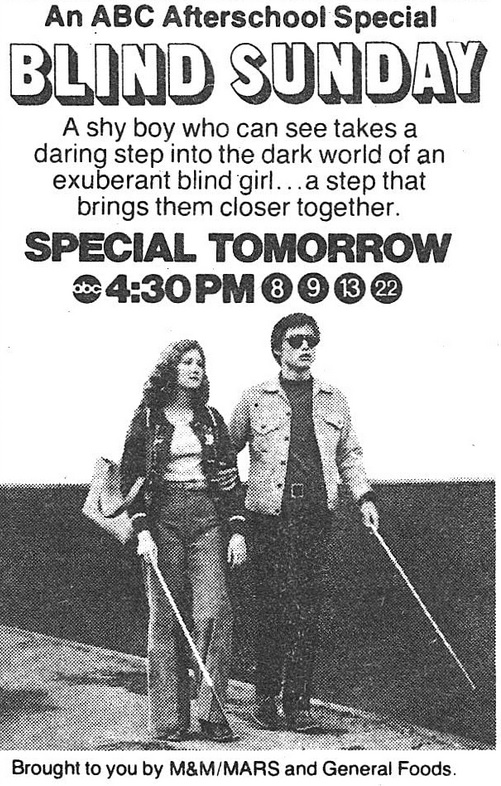
And the six degrees of Debi Storm stops here, since she did not work with Maestro Argento or Karl Malden, but it does bring us to this lost TV movie for the young adult crowd** starring Leigh McCloskey and Debi Storm. The poster says it all: In an effort to understand his blind girlfriend, a teenage boy decides to spend an entire Sunday blindfolded. It’s simple. It’s heartfelt. And a great lesson is learned. And teen love in the ’70s was a beautiful thing, indeed. And is that my teenage crush Cindy Eilbacher from The Death of Richie and Bad Ronald alongside a pre-L.A. Law Corbin Bernsen (The Dentist, Major League) as a lifeguard?

Director Larry Elikann, who did 18 ABC Afterschool Specials and 5 CBS Playhouses (that became Schoolbreak), also gave us a slew of network TV movies, including the The Big One: The Great Los Angeles Earthquake (1990). So if you’re in the market for a disaster flick starring ’80s TV mom Maggie Seaver and TV dad Jack Arnold, then that’s your movie.

I remember Blind Sunday — as with most of these young adult network TV movies (via reruns into the mid-80s) — as if it was yesterday (thanks to my McCloskey fandom*˟). But wouldn’t you know it: with all of the various network teen flicks uploaded, there’s not a copy of Blind Sunday to share. But we did find this nifty You Tube playlist of other ABC Afterschool Specials to enjoy. Ah, but get this! We also found a clip from 2014 of Debi singing at a Brady Bunch convention . . . and she’s BLONDE!

About the Author: You can learn more about the writings of R.D Francis on Facebook. He also writes for B&S About Movies and publish music reviews and short stories on Medium.


* Speaking of The Exorcist: We explore its everlasting influence with our “Exploring: Ten Possession Movies (and more) that Aren’t The Exorcist” featurette.

** Be sure to visit our reviews of these ’70s “Big Three” network daytime TV movies for young adults:

ABC Afterschool Special: The Amazing Cosmic Awareness of Duffy Moon
ABC Afterschool Special: Hewitt’s Just Different
CBS Schoolbreak Special: Portrait of a Teenage Shoplifter
NBC Special Treat: New York City to Far From Tampa Bay Blues

Then, when we got a little bit older, we watched “after dark” troubled-teen TV movies:

Angel Dusted
The Death of Richie
The Killing of Randy Webster
Police Story: A Chance to Live

*˟ No, I really am. Come on, you have to remember Leigh’s work in The Bermuda Depths, Fraternity Vacation, Just One of the Guys, Dirty Laundry, Cameron’s Closet, Double Revenge, and Lucky Stiffs.

The ’90s Alt-Rock We Miss MTV’s 120 Minutes Sidebar: If Eve Plumb didn’t get the job on the Brady Bunch . . . would this ’90s alt-rock band have called themselves Debi’s Storm? No, they didn’t do “Don’t Crash the Car Tonight” — that was another “female food” band, Mary’s Danish. No, they didn’t do “Love Crushing” — that was Fetchin’ Bones.

Airline Disasters TV Movie Round-Up

Here’s our round up of all the network TV, cable, and theatrical airline disaster movies of the ’70s — and beyond — that we’ve reviewed during this end of the year “TV Movie Week.”

The Doomsday Flight (1966)
Terror in the Sky (1971)
The Horror at 37,000 Feet (1973)
The Disappearance of Flight 412 (1974)
Murder of Flight 502 (1975)
Mayday at 40,000 (1976)
SST Death Flight (1977)
The Crash of Flight 401 (1978)
The Ghost of Flight 401 (1978)
Concorde Affaire ’79 (1979)
Flight 90: Disaster on the Potomac (1984)
Fire and Rain: The True Story of Flight 191 (1989)
Crash: The Mystery of Flight 1501 (1990)
The Tragedy of Flight 103 (1990)
Crash Landing: The Rescue of Flight 232 (1992)
Mercy Mission: The Rescue of Flight 771 (1993)
Skyjacked (1972)

Watch the Series: Airport
Airport (1970)
Airport 1975 (1974)
Airport ’77 (1977)
The Concorde . . . Airport ’79 (1979)

And the retro-flicks!
Exorcism at 60,000 Feet (2020)
Airline Sky Battle (2020)

About the Author: You can learn more about the writings of R.D Francis on Facebook. He also writes for B&S About Movies.

Skyjacked (1972)

Back in the pre-Internet and pre-cable analog days of the “Big Three” networks, it seemed as if it was a weekly occurrence, as we watch the nightly news on ABC, CBS, and NBC, that yet another airline skyjacking, aka hijacking, occurred. It was ’70s de rigueur for criminals to make buck or advance their political-personal causes. As a June 2013 Wired investigative article written by Brendan I. Koerner tells us, between 1961 and 1973, nearly 160 of hijacks occurred in American airspace.

As this week’s reviews of “airline disaster” TV movies has shown, the “Big Three” TV networks, along with cable channels like USA and HBO — as well as the film studios — knew plot fodder when they saw it. And when Universal discovered box office gold with Airport — and ignited the ’70s disaster movie genre — with their 1970 adaption of Arthur Hailey’s 1968 novel of the same name, you’d knew there be more of the same.

While Paramount Studios’ television division was first out of the gate with their 1971 CBS-TV broadcast movie Terror in the Sky (which is a cousin to Airport by way of Arthur Hailey’s airline-plotted tales), Metro-Goldwyn-Mayer Studios wasted no time getting into business with producer Walter Seltzer; Seltzer optioned David Harper’s late-’60s best-seller Hijacked and began working the material under the titles Hijacked and Airborne.

At the time, Seltzer made four movies with Charlton Heston: The War Lord (1965), Will Penny (1967), Number One (1969), and The Omega Man (1971), so Seltzer had his leading man. (The duo would also make Soylent Green and The Last Hard Men in 1973 and 1976, respectively.) For Heston’s leading lady-lead stewardess, Seltzer brought on three-time lifetime Golden Globe-nominee (also of The Neptune Factor and Jackson County Jail) Yvette Mimieux, who co-starred with Heston in Diamond Head (1962).

During a routine Global Airways Minneapolis-bound flight, a passenger (Susan Dey of The Partridge Family) discovers a lipsticked-scrawl bomb threat on a first-class bathroom mirror urging the flight divert to Anchorage, Alaska. A jazz cellist (ex-NFL’er Rosey Grier) believes his jittery military seatmate (James Brolin of The Amityville Horror) is responsible. The rest of the cast of passengers features Walter Pidgeon as a U.S. Senator and Mariette Hartley as a pregnant woman in crisis-induced labor (Earth II), along with Ken Swofford (Black Roses) and Claude Akins (General Aldo from Battle for the Planet of the Apes). And a suspenseful, Murphy’s Law-thriller mix of failed hijacker subduing, radio and radar snafus, fuel loss, near air collisions, and violation of Soviet airspace — as we say around the Allegheny wilds of B&S’ offices — ensues.

Say what you will about these old, ’70s airline disaster flicks, but Skyjacked cleaned up at the box office, becoming one of MGM’s biggest hits of 1972 alongside Shaft and Kansas City Bomber. And Heston knew a hit genre when he saw one: he jumped back in the cockpit for Airport 1975. And he stuck with the disaster-thriller genre with Earthquake (1974) and Two-Minute Warning (1976) — and they also cleaned up at the box office. Oh, and Chuck hit the cockpit for a one-more-third time with ABC-TV’s Crash Landing: The Rescue of Flight 232 (1992).

You can watch the trailer for Skyjacked and watch the film on You Tube HERE and HERE.

About the Author: You can learn more about the writings of R.D Francis on Facebook. He also writes for B&S About Movies.

Fire and Rain: The True Story of Flight 191 (1989)

When the “Big Three” over-the-air networks began expressing a disinterest in the TV movie business, the USA Network — in the early days before they were swallowed by the NBC-Universal behemoth and turned into an NBC series aftermarket shill — took the torch with aplomb.

Just look at that overseas theatrical one-sheet, if you don’t believe us. You’ve got the Hoff, along with Robert Guillaume, Charles Haid, Angie Dickinson, and Tom Bosley. And you get Lawrence Pressman, Dean Jones, and John Beck in the bargain. So, yeah, basically all of the familiar, dependable actors we know and love around here at B&S About Movies.

Based on Fire and Rain: A Tragedy in American Aviation, a novel by Jerome Greer Chandler, the film investigates — with the usual artistic licenses of events and composite characters — the tragic flight of Delta 191 at Dallas-Fort Worth International Airport in 1985.

Taking off from Fort Lauderdale, Florida, the flight crew (John Beck) is warned of a pending storm as it prepares to land in Texas. The crew jokes the plane will “get a wash” and decide to go ahead with a landing. Then, without warning, the storm slams the L-1001 into the ground a mile short of the runway. FAA agents Dean Jones and Angie Dickinson are dispatched to investigate the crash.

You can watch the full movie on You Tube.

About the Author: You can read the music and film reviews of R.D Francis on Medium and learn more about his work on Facebook. He also writes for B&S Movies.

Murder on Flight 502 (1975)

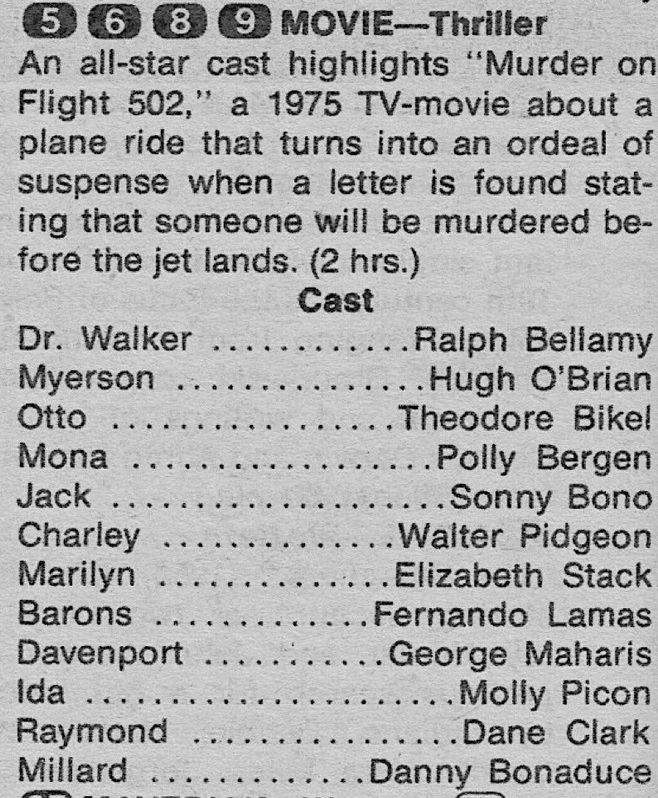
ABC-TV wasn’t letting those Airport (“Exploring: Airport, Watch the Series“) theatrical blockbusters slip by them without a TV movie knockoff, this one by the ’70s production dynamic duo of Leonard Goldberg and Aaron Spelling. Critics pounced on the film’s special effects, sets, and stock footage ineptitude on a low budget, but it cleaned up on the advertising front as it placed in the Top 10 shows during the week of November 21, 1975.

Courtesy of RetroNewsNow/Twitter

The DC-8 from The Doomsday Flight (reviewed this week) is out, as the industry had upgraded to the Boeing 747. This time, instead of bomb threats and ransom tomfoolery, this airline fest’s resident nutjob takes the serial killer route: he’s left behind a letter with the airport Head of Security proclaiming that a “series of murders” will occur of Flight 502.

As you can see, this is pure 1970s TV, courtesy of Robert Stack — who did a gunnysack load of TV movies back in the day, along with Spelling’s soon-to-be favorite blonde angel, Farrah Fawcett-Majors, and . . . Sonny Bono and Danny “Partridge” Bonaduce? Wow! And there’s Walter Pidgeon (The Neptune Factor)!

Courtesy of RetroNewsNow/Twitter

This one is quite easy to find on DVD — with Farrah to the forefront, of course, even though she’s a minor character (as a stewardess) amid the aeronautical chaos. Needless to say, the acting royalty of Robert Stack, Ralph Bellamy, Hugh O’Brian, and ‘ol Walter rise to the occasion and make it all work against the budget.

About the Author: You can read the music and film reviews of R.D Francis on Medium and learn more about his work on Facebook. He also writes for B&S Movies.

The Tragedy of Flight 103: The Inside Story (1990)

This time out, instead of a Big Three TV network or upper-tier cable network, HBO rebroadcast this ITV production that premiered in the United Kingdom on November 26, 1990 — then in the United States on December 9, 1990.

As with most of these TV movies, this was cross-marketed as a theatrical and TV film in numerous overseas markets courtesy of its all-star international cast headed by Ned Beatty, Peter Boyle, Vincent Gardenia, and Sean “Dr. Who” Pertwee. Keen eyes of the B&S About Movies variety will also notice Andrew Robinson and Micheal Wincott — both of too many TV series, theatrical and direct-to-video features to mention (okay, Robinson was in Hellraiser and Wincott was in The Crow).

Courtesy of Amazon

This one is the hardest of all of the airline disaster flicks we’ve watched this week, as it is based on the events that led up to — but little on the aftermath — the 1988 terrorist bombing of Pan Am Flight 103 from Frankfurt, Germany to Detroit, USA, over Lockerbie, Scotland.

With a total of 270 fatalities — 243 passengers and 16 crew, along with 11 Lockerbie residents in the Sherwood Crescent neighborhood where Flight 103 crashed — the incident was classified as the deadliest terrorist attack in the history of the United Kingdom.

You can watch this on You Tube HERE and HERE.

About the Author: You can read the music and film reviews of R.D Francis on Medium and learn more about his work on Facebook. He also writes for B&S Movies.

Mercy Mission: The Rescue of Flight 771 (1993)

NBC-TV is back with another airline disaster flick, this one directed by TV movie warhorse Roger Young. I’ll always remember Young for his debut tearjerker, Something for Joey, a highly-rated TV movie sports drama starring Marc Singer, that aired on CBS-TV in 1977. In the theatrical realms, Young directed the 1987 Micheal Keaton box-office bomb (less than $3 million in tickets against $20 million) The Squeeze. Then Keaton was cast as you know who.

So that takes care of the Batman minutiae to amaze your friends in the DC Universe. Now let’s unpack this flick.

Courtesy of Fly Leaping Terminal/Angelfire (Quantum Leap Fan Site)

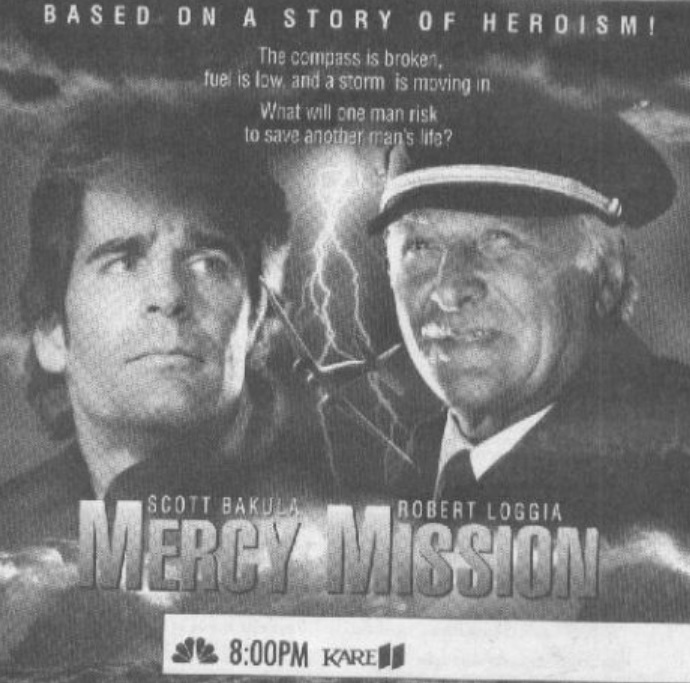
Yep. Thanks to Scott Bakula on the marquee, this TV movie made bank courtesy of its additional income as a successful overseas theatrical feature — known as Flight from Hell. And, yes. Like most other TV movie airline disasters, the special effects are mostly stock and not very special, and — according to airline buffs — the against-the-budget film is rife with technical flubs and details about the Australian airline industry. And even if this isn’t a good as most of the classic, Big Three network TV flicks of the ’70s, we have still have Scott Bakula and he never-ever-sucks-in-anything Robert Loggia selling the goods, so who cares about flubs and glitches?

Film on location in Australia, it tells of the real-life, 1978 rescue of a distressed Cessna pilot (Bakula), lost and low on fuel somewhere in the Tasman Sea between Oz and New Zealand. Loggia, as a commercial airline pilot on his last flight, leads the by-air search and rescue.

You can watch this on You Tube HERE and HERE.

About the Author: You can read the music and film reviews of R.D Francis on Medium and learn more about his work on Facebook. He also writes for B&S Movies.

Crash: The Mystery of Flight 1501 (1990)

Do you have a hankering for a flick starring an ex-Angel helmed by a director who gave us a 1977 Dracula adaptation starring Louis Jordan (Swamp Thing (1982) as the Count? Oh, and you may remember him for Shadey (1985), an ’80s rental favorite about a clairvoyant wanted by the Feds as result of his ability to impress his premonitions on photographic film.

Acclaimed British and BBC-TV director Philip Saville was hired by NBC-TV and given a cast headed by Jeffrey DeMunn (yes, who you currently know for his work on Billions and The Walking Dead) and Cheryl Ladd — and a plane load of you-don’t-know-their-name familiar TV series guest stars.

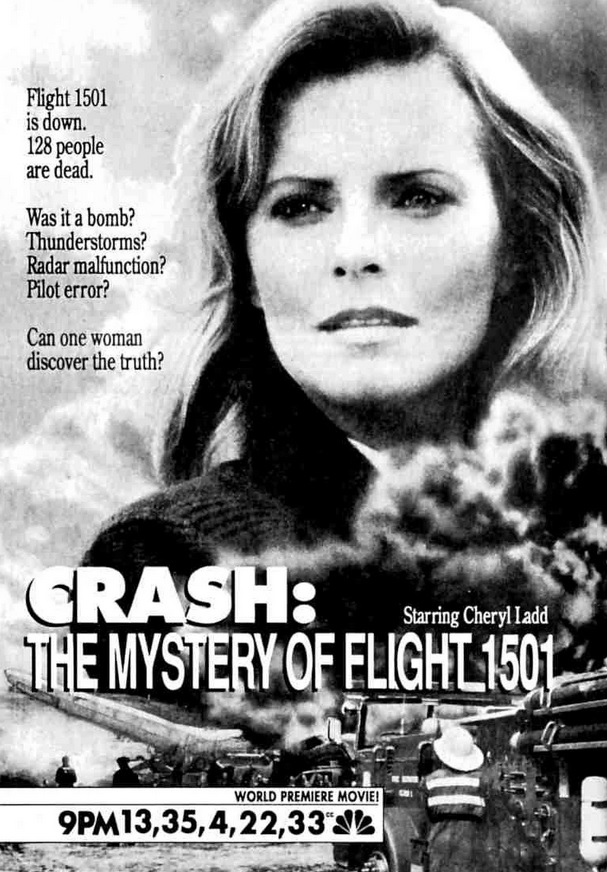
The hijack twist: Our disgruntled hijacker isn’t out for money. He wants to stop abortions and, to that end, he’ll save the children if he kills a U.S. Senator — with outspoken opinions on abortion — on the flight. The plan’s glitch: the Senator missed the flight. And when the bomb is discovered by Cheryl’s pilot husband, he decides to make an emergency landing — in a severe thunderstorm. As you can see from the TV ad below, the flight crashes and kills almost everyone on board. And Cheryl — who, despite ill feelings towards her husband for leaving her as result of her two miscarriages — fights to clear her husband’s name.

Courtesy of Made for TV Movie Fandom/Wiki — watch the trailer.

As with most airliner disasters of the TV Movie variety, the critics gave this telefilm a shrug as result of its overuse of mismatched, stock aerial footage. And don’t be duped by the DVD represses that proclaim the film is “based on true events.” It’s a complete work of fiction that later “became true” in 1996 when a Miami-based ValuJet DC-9 — like the one in the film — crashed in the Florida Everglades as result of an in-flight fire ignited by illegal, flammable cargo — similar to the plotting of the film.

You can watch the full movie on You Tube.

About the Author: You can read the music and film reviews of R.D Francis on Medium and learn more about his work on Facebook. He also writes for B&S Movies.