Editor’s Note: Sam loves this flick as much as I do, i.e., we crushed on Betsy Russell back in the VHS days, and he’ll give us another take on the film — later this month — as we unpack its inclusion on the Excellent Eighties set during this, our Mill Creek Month celebration.
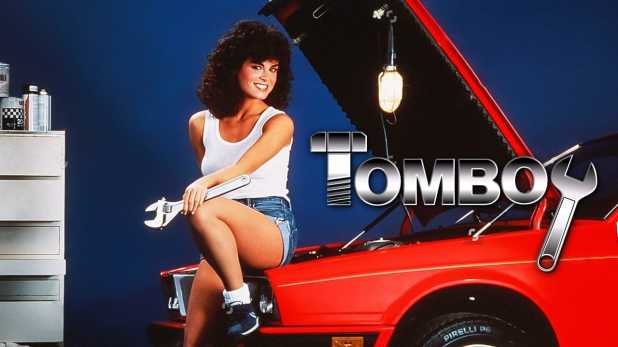
Betsy Russell was a teen dream in competition for our teen hearts alongside Deborah Foreman (Valley Girl, My Chauffeur). And with her curly mop of black hair — and that cap! — she was a tomboy after our hearts. After co-starring alongside Phoebe Cates (Fast Times at Ridgemont High) in Private School (1983), she earned her first starring role in the action-thriller Avenging Angel (1985), a role that she earned after Donna Wilkes (Blood Song) turned down reprising the Angel role over money.
You gotta admit, the bolt-n-wrench logo is pretty darn inventive.
Russell is perfectly cast as Tomasina “Tommy” Boyd, a strong-willed garage grease monkey with dreams to become a stock car driver. Daunted by Randy Starr (Gerard Christopher; went on to become Superboy in the 1989 to 1992 series of the same name), a sexy, chauvinistic fellow racer, she plans to beat him on the track and earn his respect — and love. All in all: Tomboy is a dumb film but a fun film, filled with sexism, bad n’ bouncy ’80s new wave tunes, and cheesy comedy — basically all the things we expect from our ’80s comedies of yesteryear. A flick about “female empowerment” certainly deserved better than a T&A Crown International take . . . but hey, us horndogs will power through since we have Kristi Summers (Savage Streets, Hell Comes to Frogtown) as Tommy’s friend, along with Cynthia Thompson (Cavegirl), and scream queen Michelle Bauer in the cast.
As with Deborah Foreman: Russell was poised for stardom, but never broke through. While on the set of Avenging Angel, an offer came across the desk for a role in Lawrence Kasdan’s box-office western smash Silverado (1985); Betsy turned down the part; it went to Rosanna Arquette. Leaving the business shortly after her role in the low-budget actioner Delta Heat (1992) with Anthony Edwards, Betsy came out of retirement to work in the Saw horror franchise (we’ve reviewed them all, search for them).
If you’ve read our Mill Creek reviews — or plowed through the box sets yourself — you know their box sets are primarily comprised from the Crown International Pictures’ catalog; a catalog that’s all over the place across every genre imaginable. Yeah, Crown loved the adolescent comedy-drama racket, in particular, and wanted some of that Fast Times and Risky Business, well, business, with the likes of films such as Coach, Hunk, Jocks, and My Chauffeur, and My Tutor just to name a few. And thanks to Mill Creek, we’ve watched and reviewed them all this month during our February Mill Creek blowout.
Director Herb Freed is someone known all too well in the B&S About Movies’ offices, with his work in the horror flicks Haunts, Beyond Evil, and Graduation Day. The Eric Douglas in the credits is, in fact, the less successful (and sadly) no-longer-with-us brother of Micheal and son of Kirk (Saturn 3).
You can relive the ’80s with Betsy in Avenging Angel, Out of Control (1985), and one of her later comeback films, Chain Letter (2010) on Tubi TV. Unfortunately, there’s no freebie uploads of Tomboy to enjoy online and it’s currently offline at Amazon Prime. But thanks to Mill Creek, there’s plenty of opportunities — at affordable prices — to get your own copy.
While Tomboy became an oft-run HBO favorite and VHS rental, Tomboy didn’t see a DVD reissue until 2006. Mill Creek eventually recycled the film on several box sets: Too Cool for School Collection (2009), which also features The Beach Girls, Cavegirl, Coach, Hunk, Jocks, Malibu Beach,My Chauffeur, The Pom Pom Girls, The Van, and Weekend Pass. In 2011, Tomboy was also released in two four-pack sets with a combination of those same films. And you can also pick it up as part of their 50-movie set B-Movie Blast and Excellent Eighties, both which we’ve unpacked this month. Need more enticement? Here’s the trailer.
A film that evokes William Fruet’s Funeral Home, along with Dan Curtis’s Burnt Offerings and Don Coscarelli’s Phantasm (via the old Dunsmuir House) gets a fast pass to the top of the streaming stack of films up for review in the B&S About Movies cubicle farm. Yeah, we’re all in on this feature film writing and directing debut by Mauro Iván Ojeda (who got his start with the short films La de Messi and La nueva biblia).
And no: this isn’t a remake the Fruet Canuxploiter. Remember, since that’s a Canadian film, its “polite” so as not to upset the video nasty police. And it’s not so much a funeral home in that movie as it is a haunted country inn that was once a funeral home — with supernatural unrest in its cellar. And while Fruet’s film holds a special place in our ’80s VHS hearts, Ojeda’s debut feature is easily the far superior film.
The U.S. one-sheet/lobby card.
Bernardo is an undertaker who goes through his birth-school-work-death existence like a figurative zombie. While his wife Estela pops pills to deal with her depression, his step-daughter Irina — still mourning the loss of her father — rebels with a teenager’s vigor, frustrated with her mother and stepfather’s surrender to exist in a home with ghosts. They’ve given up: she wants to live . . . with her grandmother, who might be a witch who hates her new daughter-in-law and, it seems, cursed the family; grandma’s disdain carries over to her son Bernardo for taking up with Estela, who had a “history” with her late husband.
While the acting from all quarters is top-notch, the call-out actor of this horror-import is the just-starting-out-in-the-business Camila Vaccarini, as Irina. She’s absolutely stellar in her feature film debut, with only a supporting role in the Argentinian film Paisaje (2018) and a starring role in the Disney Channel Latinoamérica series Bia on her resume. Here’s to hoping Tinseltown calls her up to the major studios, courtesy of Ojeda crafting her an industry calling-card role.
Original overseas one-sheet. Also known as The Undertaker’s Home in other markets.
While this Argentinean import (thankfully subtitled and not dubbed) is as well-shot as any box-office popular A24 (Midsommar) or Blumhouse (You Should Have Left) horror released into the mainstream American marketplace, Ojeda’s debut forgoes the gore and shock scares of those films, instead choosing to utilize set design, sound and shadows, along with (beautiful) cinematography and camera angles to convey the funeral home’s cold, insidious fear.
Unlike its major studio American horror brethren, The Funeral Home is not a film of gloss, but of the atmospherics we recall from our Amicus and Hammer Studios films of old. This is a film of metaphor, as we meet a family as decayed as the decrepit funeral home they reside in; this isn’t a family that’s living: they existing. This is a financially desperate, dysfunctional family of ironic, soul-filled vessels that are as empty and tortured as the (supernatural) spirits that haunt them. When you’re this miserable, shouldering sacks of your own ghosts and skeletons, who needs ghosts of the supernatural variety? Courtesy of the family’s new residence — as depicted in its U.S. artwork — we know this family deals with spirits of both the emotional and supernatural variety — as they come to discover the supernatural ones aren’t from the interred that have passed through their home’s mortuary over the years, but something much deeper that’s buried in their new home’s past.
Disclaimer: We were provided a screener by the film’s P.R firm. That has no bearing on our review.
About the Author: You can learn more about the writings of R.D Francis on Facebook.He also writes for B&S About Moviesand publishes short stories and music reviews on Medium.
“I’m here to teach basketball. Now if you’ve got something else on your minds. . . .” — Coach Rawlings, setting her students . . . straight (no pun intended, well, maybe)
Wow.
And double wow.
Do I remember the days when Cathy Lee Crosby was in competition for my wall space with Farrah Fawcett and the Dallas Cowboy Cheerleaders, next to my Runaways poster with a young Sandy West. And the days before James Cameron forever set our Micheal Biehn-memories in stone with Kyle Reese and Corporal Hicks. But here’s Mike, fresh from his first TV bows on the 1977 series James at 16 and Logan’s Run (as a Sandman!), in his first feature film role . . . and on his way to starring in the forgotten (rightfully) twin-cinema ditty that was Hog Wild (1980) — a film that I always confuse with Hot Dog: The Movie (both which need the B&S About Movies once over) that I, in turn, confuse with Hamburger: The Movie.
Why am I confusing Michael Biehn with David Naughton with Leigh McCloskey in first place? Oblivious, my analog cortex is suffering a systems failure . . . but not enough that I can’t remember that Micheal was Johnny Ringo in Tombstone alongside Val Kilmer, so I seem to be functioning well within all VHS parameters.
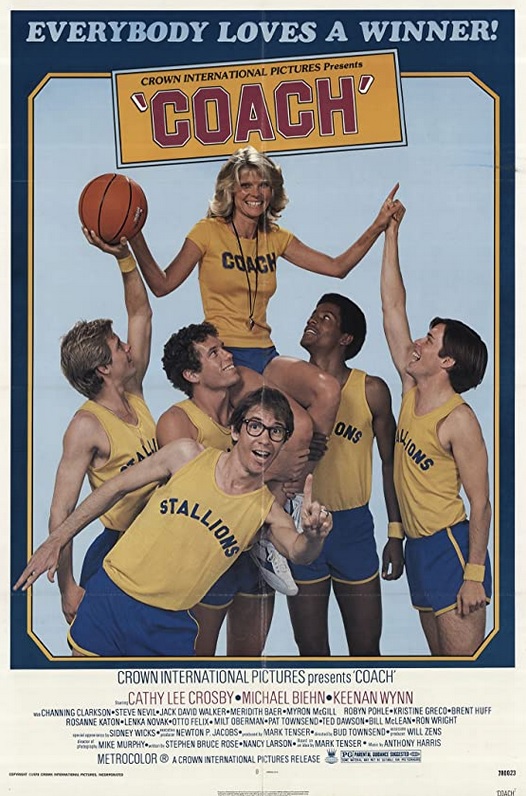
Geeze . . . the Stallions? Really? Here comes the dumb sex jokes.
In case you haven’t guess by the one-sheet: Coach is a ’70s teensploitation romp produced on a TV movie budget, but made for the drive-ins, by, you guessed it: Crown International Pictures. So, yes. There’s boobs. And there’s gags. And PG-rated sex crossing the R-rated borderline. But this high school isn’t the Delta House and the school’s student body wouldn’t make it into Faber College. Where’s Pee Wee and Ballbricker when you need ’em? Where’s the titillation? Cathy Lee looks great in those shorty gym shorts and white sneakers, but that’s it? I’ll need a bit more than Cathy Lee having an affair with Micheal Biehn’s high school basketball-star student.
So, Cathy Lee is an uber-sexy, natch, ex-Olympic medalist track star hired to coach a high school’s boy basketball team. But, oops! In that ol’ women-with-a-guy’s-name-or-feminine-name-that-can-be-male-truncated screenwriting trope (e.g., Samantha becomes Sam), gruffy ol’ principal Fenton “F.R” Granger, played by ubiquitously gruff actor Keenan Wynn (who made a career out of being ubiquitously gruffy, or crazy; see Laserblast), thought that Randy Rawlings was a man! (Of course, this is a Cathy Lee movie, so ol’ man Granger ain’t around much.) Anyway, he can’t fire her based on her femininity, so he plots to make sure the team loses their games so he can fire her on job performance grounds.
Oh, and B-movie actions fans, take note: Brent Huff, he of epic-beyond-epic Nine Deaths of the Ninja, Armed Response, and Strike Commando 2 is here, in his feature film debut as one of the students. By the way: Brent is still going strong: he’s got four films in post-production for 2021, but you can also see him in a support role as Officer Smitty in the pretty decent, ABC-TV cop procedural, The Rookie.
One of my all time favorite flicks — and one of Sam Elliot’s best, early performances, long before he was amazing us with his trademark, gruffy-scrappy roles in the likes of Road House — was the 1976 coming-of-age-drama, Lifeguard (do seek it out). In that film, Elliot is Rick: a thirty-something, California beach lifeguard who loves his life, but is cajoled by family and successful friends to “become an adult,” while he deals with forbidden love. I can’t help think that, if Paramount Pictures, as with Lifeguard, had backed Coach — instead of Crown International Pictures — Cathy Lee would have had herself an insightful, heartwarming dramatic role about a woman dealing with the same “endless summer” issues of Elliot’s lifeguard; a woman who faces her life’s question: The Olympics are over. Now what?
Instead, she ended up in a Crown-made teensploitation not-so-funny and not-so-titillating (dumb) comedy with no message and nary a plot.
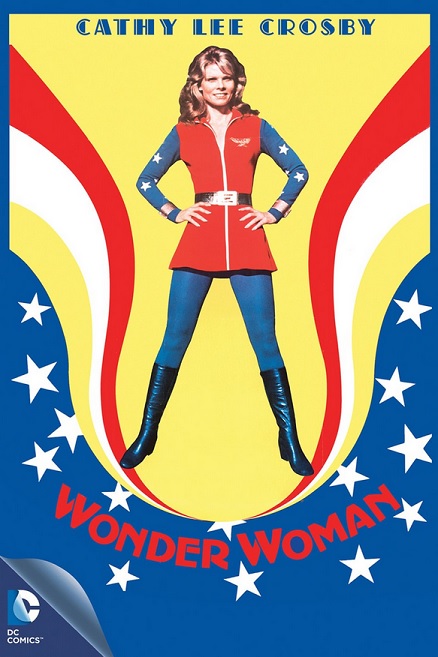
So it goes for TV’s first Wonder Woman — who then ended up in the John “Bud” Cardos disaster that is The Dark, which Roger Ebert (rightfully) referred to as a dumb and inept, maddeningly unsatisfactory thriller. Sam found The Dark as not riveting but entertaining. And I hated it. And Sam will probably hate Coach, which left me entertained but not riveted. But Coach could have been so much better. Like Goldie Hawn’s Wildcats similar better. And Cathy Lee Crosby certainly deserved better than that awful Network “Standards and Practices” costume. Yikes. If only Cathy Lee was in Lynda Carter’s wears!
No, Really! Back in 1974, and before Lynda Carter, Cathy was Wonder Woman for a Warner Bros.-backed ABC-TV movie.
You can watch Coach on You Tube and pick up a copy as part of Mill Creek’s B-Movie Blast 50-Film Pack. Oh, and speaking of Wonder Woman . . . ugh, did you see Wonder Woman 1984? Don’t. Go watch an old Jess Franco movie, instead.
About the Author: You can learn more about the writings of R.D Francis on Facebook.He also writes for B&S About Movies.
“The gravitation field is accelerating the meteor shower!” “We’ve lost the orbital shield!” “Invert the signal flow on the flux capacitor!” “Launch all deus ex machina techno-weapons!” — Techno-babble as only The Asylum can shuckster
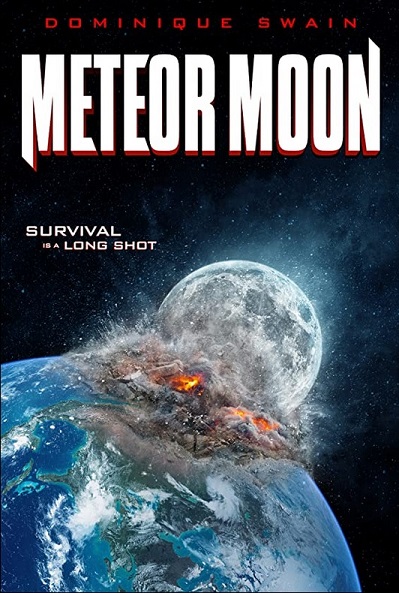
Truth: we weren’t going to review this film. But after reviewing the ludicrous fun of the recently-released Asteroid-a-Geddon and discovering the newly-released Meteor Moon on our cable system’s PPV channels, we figured we might as well polish off The Asylum’s Deep Impact-cum-Armageddon Earth-is-jeopardy-and-only-sexy n’ buff-scientists-can-save-us trifecta. In fact, this is the perfect film to review for our “Matriarchy in Space Week” as The Asylum-verse is saved by a woman.
Well, have you ever watched a PBS-TV episode of Nova? The brainiacs on those shows are always more Giorgio A. Tsoukalos unkempt-flabby than Gerald Butler GQ-ripped. But it’s not The Asylum’s fault. And it’s not first-time screenwriter Joe Roche’s or director Matthew Boda’s bad, either: they’re just a pair of struggling actor n’ crew dudes making a buck on The Asylum manufacturing line, hired to assemble a mockbuster following the Gerard Butler-disaster epic template cast forth in Geostorm (China’s The Wandering Earth is the better film) and Greenland (which actually isn’t that bad). Look, no one’s dropping $7.99 streaming fees to see Leonard Hoffstedder sucking back on inhalers, doubled over on zero-gravity toilets, battling both lactose-irritable bowls and meteors; meanwhile, below deck, at the controls of the Blackhole-deus ex machina Generator, Mission Specialist Howard “Fruit Loop” Wolowitz wants to screw Kate Watson’s cargo-camping hot pants-bottomed (What, no “Daisy Dukes” were available?) meteoricist: the Earth’s fate be damned. And no, Dr. Kothropali, Becca Buckalew isn’t interested in your whiny insecurities, either. Turn your telescope back to the stars, your perv.
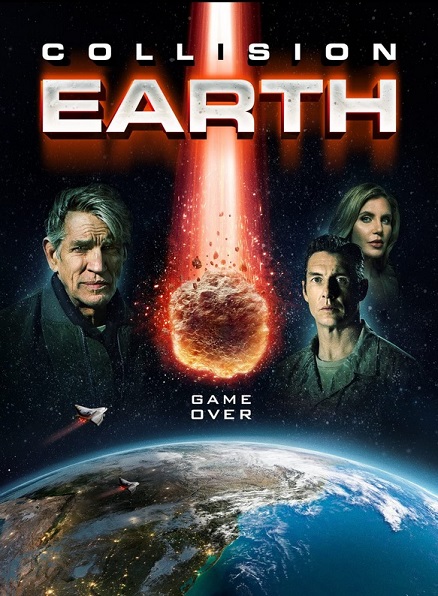
When The Asylum gives only the very best in SFX; Image courtesy of mkdltkrs/eBay.
So, if you’ve navigated the stars of The Asylum-verse, you know Collision Earth is one of those films that stars-a-bunch-of-first-time-actors-you-never-heard-of and _____________. In Meteor Moon, it was Dominique Swain in the stand-here-on-the-same-spot-on-this-set-for-the-whole-movie role to get a “name” on the box; this time it’s Eric Roberts (this time in military fatigues and back from Asteroid-a-Geddon) to bark orders and make all the other cardboard-hysterical, techno-babbling thespians look even worse than they really are at the craft. (Plot spoiler: It takes 30 minutes to achieve our Eric-ness; in another 30, Eric’s dead via his falling into a cavernous CGI-fire.)
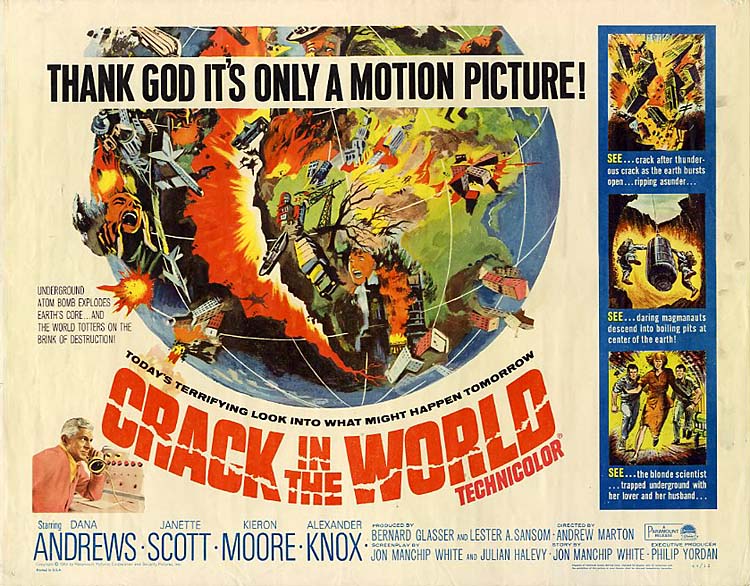
Before The Asylum: Where it all began . . . with Paramount’s 1965’s Crack in the World.
So, Collision Earth is another one of those movies where the Earth has clusters of nuclear warhead-armed satellites and phalanx after phalanx of perpetually launch-ready rockets — and we still can’t stop the wrath of Lucifer’s Hammer (the best-selling, award-winning 1977 novel by Larry Niven that started this unintentional mess in the first place). And, like Greenland, this Asylum-romp is just that: a fiction survival romp set on Earth with less Deep Impact-in-space shenanigans and more about how-do-the-bunkered-humans-cope-with-the-meteor-aftermath of the Panic in Year Zero! (1962) variety. When it comes to effects: Collision Earth is a budget-strained film void of in-camera effects traded out for After Effects-overlays of the Colorforms play-set variety.
Oh, and this is a film where our camping shorty-shorts n’ boots-and-ankle socks babe with a tummy tie-off on her flannel shirt hops into a Lockheed F-35 Lightning to electro-fry the meteor to oblivion. We’ll forgive that the actual jet CGI’d is a Boeing F-18 Super Hornet — and the cockpit isn’t accurate to either jet — because women in space rock our world.
You’ve seen better. But you’ve also seen a lot worst in The Asylum-verse . . . or any Roger Corman AIP-verse, for that matter. Hey, it’s better than Rocket Attack, U.S.A. and King Dinosaur, so there’s that going for it. And the women — sans the wardrobe snafus — are Bechdel test-strong, so double bonus, for this ain’t no Cat-Women of the Moon. Collision Earth is currently available as a PPV on U.S. cable systems and as a VOD on multiple streaming platforms.
About the Author: You can learn more about the writings of R.D Francis on Facebook. He also writes for B&S About Movies and publish music reviews and short stories on Medium.
“In 1948, the Secretary of Defense proposed that the United States build a space station as a military guardian of the sky.” — From the film, according to the words of James Forrestal, the First Secretary of Defense, under President Harry Truman
“Today, I’m thrilled to sign a new order taking the next step to create the United States Space Force.” — President Donald J. Trump, February 2019
Yep, that’s Hayden “Dr. Bellows” Rorke from I Dream of Jeannie.
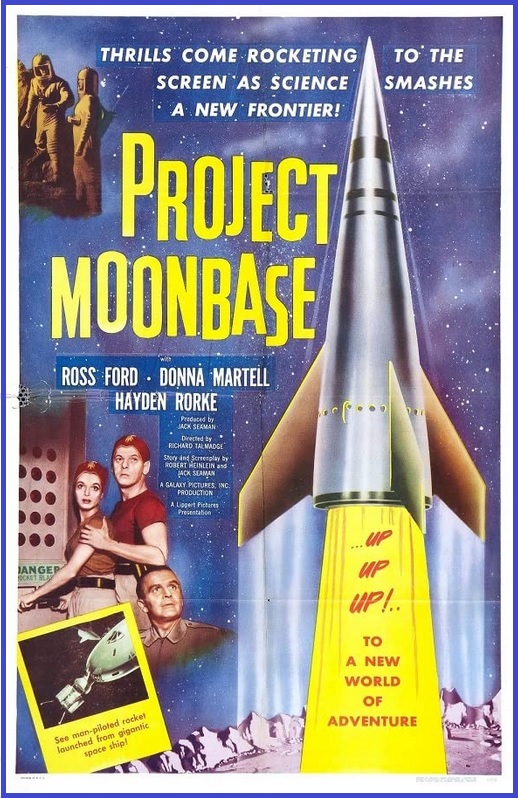
Robert A. Heinlein, the “dean of science fiction writers,” may have penned the short story and adapted-to-screenplay, and ex-Douglas Fairbanks stuntman-turned actor Richard Talmadge may have come to second-unit direct on the classics Casino Royale, How the West Was Won, and The Greatest Story Ever Told, but they’re either two of Hollywood’s most blatant sexists or producer (on his final film) Jack Seaman creatively-overruled the production. Or studio chief Robert Lippert — whose Lippert Pictures gave us the superior Rocketship X-M (1950) (that Hollywood has been trying to remake for years) — saw Heinlein’s future world of women running space stations and moon bases as poppycock. The Bechtel Test scene-failures of Generals threatening over-the-knee spankings to female officers, mansplaining spaceflight to a female gossip columnist (instead of Hedda Hopper, we get the offensive Polly Prattles . . . women “prattle,” ha-ha), and offhand commenting on Ms. Praddle’s wide girth, that “it costs the government $300-a-pound to send anything into space and everything must weigh under 150 pounds” must be heard to believed. And the insulted women just role their eyes and chuckle at the “jokes.”
Women in space as pilots is bad enough, but running the mission! Why . . THIS IS AN OUTRAGE!
Yeah, Dalton Trumbo didn’t write this . . . and Colonel Briteis is more Wilma Deering than Ripley. And when you see the Col. (called “a nice kid” as her last name is mispronounced as “bright eyes” by superiors) clad in those shorty-short camping cargos, tights, and ballet flats — and a space tee-shirt cut to accentuate the breasts — you’ll know what I mean by more “Deering than Ripley.” And dig those headpieces: is this where Alfonzo Brescia got his costuming ideas for his Italian “Pasta Wars” oeuvre? (Shameless plugging of our “Drive-In Friday: Pasta Wars with Alfonzo Brescia” featurette.)
So goes the future-history of 1970: a world where the era of #MeToo was not yet foretold; a future were the “Enemies of Freedom” plot their the moon base mission foil with an Ed Woodian oscillator, a short-wave radio, and an office intercom plopped on a wooden desk à la Plan Nine from Outer Space.
It helps when the U.S Air Force — who ran space before NASA — lends you their concept models.
“You need any help?” “Can I strap you in?” — Maj. Bill Moore exhibiting more chauvinistic chivalry to the female Colonel “Bright Eyes” ready to climb aboard and strap into the rocket
While Heinlein’s pen changes up the space opera tomfoolery from the usual intelligent-but-weak female Bechtel Test boondoggles of The Angry Red Planet, Gog, and King Dinosaur — by giving us a female U.S. President and moon base commander — the “women are equal” subtext is lost in space against all of the condescending male-nationalism. Oh, did we mention the orders for Maj. Bill Moore to propose marriage to Colonel Briteis — and be the first marriage on the moon — are preformed by our Madame President of the United States? And while that flip of the script gives Project Moonbase the distinction as the first onscreen portrayal of a female president, Madame is also a female president complicit in matrimonial servitude.
Ad astra per aspera, my dear galactic concubine. May your hardships and adversity, be light.
However, even with its sexist dialog faux pas and the MST3K ribbings, aside: Once we get into space, Project Moonbase is a fascinating watch, with those official U.S. Air Force models, along with split-screen photography of astronauts walking upside down in corridors and sitting in chairs on walls, and shuffling along in magnetic boots (more like Robin “The Boy Wonder” rejects) — all before Kubrick came up with the idea. And, if you’re a junk cinema fan, you’ll notice the set and costume similarities with the also-slagged Cat-Women of the Moon (also released in 1953; but a day apart from each other via different distributors). And bash that alien-women-rule-the-moon romp as you may, but, courtesy of decent against-the-budget set designs, its a not-as-bad-as your MST3K-led to believe.
You can watch Project Moonbase — unriffed — on You Tube.
About the Author: You can learn more about the writings of R.D Francis on Facebook.He also writes for B&S About Movies.
Science Fact: During the January 20 to 21, 2019, lunar eclipse, a meteorite did, in fact, smash into the Moon at 38,000 miles per hour and carved out a 50-meter crater.
Science Fiction: That same meteor — in The Asylum-verse — shifted the Moon off its axis and Earth’s gravity pulls the Moon into our planet. And don’t worry about the collision: the friction of the moon against Earth’s atmosphere will heat up the planet and burn all that we survey into ash. But man can stop it: we have that newfangled anti-matter spaceship that creates artificial black holes. Yes! We can correct the moon’s orbit. We have the technology . . . uh, oh! There’s earthquakes, and floods, and magnetic storms! Oh, my, Toto! Auntie Em! It’s a METEOR MOON!
So, in the grand design of the everything-and-the-kitchen sink-disaster-mockbuster Final Draft template from The Asylum: While this was probably put into production when the utterly, A-List abysmal Moonfall was announced: what we’ve got here are pinches from the studio’s own Asteroid-a-Geddon and Collision Earth — along with a dash of the recent A-Lister Greenland that’s mixed with a salt shake of the 1998 battle of the Earth-destroyed-by-asteroid-epics-that-just-keep-on-giving-in-the-Asylum-cubicle farm, Deep Impact vs. Armageddon, along with smidgens of the anti-matter junk science of (the craptastic-and-still-can’t-finish-it-after-three-attempts) Event Horizon* and the black hole babble of (the equally-shatty-and-never-finshed-it) Supernova*. And let’s not forget that scene-snip that was even improbable in its original form in Brian De Palma’s Mission to Mars (meh). But in their quest to always one-up themselves: Asylum pinches from their own The Fast and the Furious franchise rip off with Fast and Fierce: Death Race by putting a Ford Mustang into space, à la Universal Studios. Or was that Columbia Studios?
Whatever. Kudos to The Asylum producer-punkin’ Neal Mortiz before he could put Vin Diesel and Michelle Rodriquez into space. But what the hell, Universal, do it anyway: Chris “Ludacris” Bridges in a space suit roarin’ out of the ass end of space shuttle in an anti-matter injected-Mustang is a movie I’d pay to see.
Yeah. Fuck you, Moonfall. I’m all in with Meteor Moon!
Look. It’s easy to kick the dorky kid of the streaming-verse in the nuts, leave ’em wallowing in pain on the playground, and hit the 7-11 for a Cherry Slurpie and nuked Bean Burrito with a smile on your face for a bully-job well done. But we’re not cinematic bullies here at B&S About Movies. We’ve watched enough American International and Crown International sci-fi flicks and we are uber-hep to the ludicrous and outlandish, ridiculous inconsistencies of the retro-vibe The Asylum is selling with meteors crashing into moons and high-performance cars shatting out the back end of a United Space Force shuttle under the command of Col. Dominique Swain** spewin’ techno-babble like nobody’s business (and doin’ the Eric Roberts bit of standing/sitting in one room, natch).
Screenwriter Joe Roche — in his second credit after Collision Earth — does his research and the physics, while improbably, sounds accurate, and his actors “sell” the science with confidence, so I’ll certainly watch Roche’s future QWERTY escapades. And, while The Asylum loves to recycle actors, we have to call out that we did notice that Daniel O’Reilly from the studio’s equally ludicious-but-fun Airline Sky Battle is on board (and he was also in Collision Earth).
Look, don’t pick on the dork of the cinematic playground. Be a pal. Buy an extra Slurpie and burrito, sit down and hang out with the kid, and take a ride together on some crappy, CGI’d hard rocks and heavy metal and be a “Radar Rider.” You can watch Meteor Moon as a PPV-premiere across all U.S. cable television systems or stream it as a VOD on Vudu.
** All this week — from Sunday, January 24 to Saturday, January 30 — is our “Matriarchy in Space Week” celebrating women in space. Join us, won’t you?
Disclaimer: We weren’t provided with a screener nor received a review request from the producers or their P.R firm. We streamed the movie out of our own pocket and enjoyed the movie.
About the Author: You can learn more about the writings of R.D Francis on Facebook. He also writes for B&S About Movies and publish music reviews and short stories on Medium.
So, after stream-stumbling into Omar Jacobo’s enjoyable, Mexican-made horror FUBAR that is Blood Freaks, I began picking through distributor Rising Sun Media’s Facebook page — and this feature film debut from writer/director Eric Eichelberger caught my eye (and dislodged from its socket). And from what I can see, while GSZM was released to VOD streaming in 2018; it’s now offered as a new, free-with-ads stream on Tubi in 2021 (or at least the tail end of 2020): I should know, as I am constantly farming the Tubi platform for films to watch — especially new and off-the-reservation flicks — and this film never populated on my previous digital excavations. Ah, wait . . . the film, in fact, hit the festival circuit in 2018 and debuted on streaming platforms in October 2020. So there you go. Roll ’em, Dano!
Here’s the plot synopsis from the Rising Sun Media marketing department:
Four girls find themselves in a reform school run by an evil woman that joins forces with her equally demented scientist brother who creates a serum to turn attractive rocker guys into lobotomized slaves for his underground movie business. The scientist brother laces Girl Scout cookies with the serum while his sister offers full pardons to the girls to sell them. They are aware that they aren’t your average cookies and agree. The evil plan backfires and the rocker guys turn into flesh-eating zombies and terrorize the town. It’s up to the girls to clean up the mess and restore peace before it’s too late!
Now, with a synopsis like that, what’s not to watch? Plus, more drug-laced cookies and zombies, like in Blood Freaks? And reform school girls in girl scout uniforms. Lobotomized sex slaves. A scientist running an underground porn business. A zombified rock band. This sounds like a John Waters Pink Flamingos joint.
Of course, I’m all in. And it’s the latest film from the guy who rebooted Death Race back to its campy-beginnings with Death Race 2050! Oops, wait. That’s G.J. Echternkamp who wrote and directed that cheezy-campy-crazy fest. This cheezy-campy-crazy fest is the feature film debut by Eric Eichelberger. (Hey, I’m the guy, despite how much how I adore them both, perpetually confuses the German bombshellness and Swedish schwingness of Elke Sommer and Brit Elkland in reviews, so cut me a break!)
Eichelberger’s debut feature film (he’s worked primarily as a reality television editor; he was an art director on Stuart Gordon’s King of the Ants (2003), if that’s a film you’ve seen; I haven’t) is all about perspective: If you’re a 20-something digital streamer that never experienced the analog SOV-VHS ’80s (e.g, pick up a Don Dohler flick, watch films like Spine; or, in a horror perspective, Curse of the Blue Lights) and the celluloid La Brea tar pits’ ass jawbone-dislodging of ’70s grindhouse and exploitation flicks onto brick-and-mortar home video rental shelves (check out Bloodsucking Freaks), or woke up late-nites on Fridays and Saturdays to watch Cinemax’s “After Dark” programming blocks rife with sexed-up Basic Instinct-clones (Harry Tampa’s Fleshtone is an example) and X’d-up T&A comedies of the Porky’s variety (we did a “Drive-In Friday” tribute to those ’80s teen-sex comedies), then of course — you’ll hit your favorite streaming platform or review site and christen GSZM as the “worst movie you’ve ever seen.”
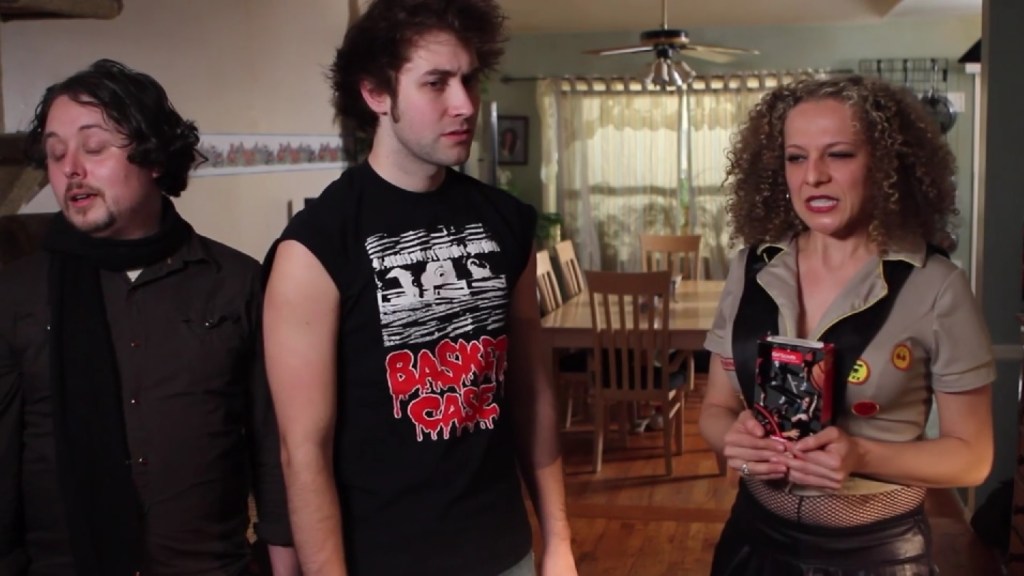
If the tee-shirt of Frank Henenlotter’s Basket Case doesn’t clue you in, all hope is lost.
Ha! Then ye digital reviewer, thou has never tossed back a sour ale of the Eddie Romero or Godfrey Ho variety, or noshed on Hard Rock Zombies (which is GSZM’s closest celluloid relative for this reviewer) and other (awful) ’80s heavy metal horror ditties of the Blood Tracks variety.
Eichelberger is one of us: he’s watched way to many Italian zombie movies (your poor mom!). He’s probably watched Lucio Fulci’s Zombie (1979) more than myself and Sam the Boss, combined. And it’s a foregone conclusion the ‘Eich also partakes of the zombie cheap-slop, such as Jess Franco’s Oasis of the Zombie (1981), Jean Rollin’s guacamole-smeared living-dead romp Zombie Lake (1981), and (ugh) Bruno Mattei’s Hell of the Living Dead (please, Bruno, just stop it already). Did the ‘Eich watch Wendy O. Williams in Reform School Girls (1986)? You bet he did.
All of those film come to play in the frames of GSZM. And like those films, this one is also strictly for adults only: it’s lewd, it’s lascivious, it’s gratuitous, and nudity is at forefront (and back!) for extended periods. (You’ve been warned.) However, unlike most of those films, which were not homages to anything other than cinematic ineptitude-by-low budget, Eichelberger’s debut, while admittedly production-bad with tragic thespin’, is supposed to be “bad” to mimic the bad films in which it’s tipping its hat. (And a couple truths: This is actually a well-shot film, void of any of that annoying, fish-eyed handheld lensing of the i-Phone variety cloggin’ up Amazon and Tubi. And that Eric Eichelberger is on his way to being the new David DeCoteau (who we worship at B&S, so know your Ellen Cabot, ye reader). And that the most experienced actors on board, leads Vance Clemente (makes me think he’s Crispin Clover’s brother) and Jessica Mazo, are actually quite skilled; here’s to hoping they move onto larger roles or nail a guest-starring network series gig. Oh, and adding to the meta: GSZM features the last ever screen performance fromthe late Bloodsucking Freaks director, Joel M. Reed, who we lost this past April.)
No, Girls Scout Zombie Massacre is not a 10-star film by any means. It’s also not a 1-star film, either, you IMDb’ing Amazon scamps. It’s also not Shaun of the Dead or Return of the Living Death nor Re-Animator or Severed Ties, either (and what films are, as they’re zombie-horror-comedy gold standards). GSZM is what it is: an intentionally bad, campy-comedy-horror movie — and it’s inherently preposterous to give Eichelberger’s film a bad review. Look, if you’ve sat through any Troma Team film (shite, don’t get Sam started on a Troma tear) and you’re into Charles Band’s direct to video oeuvres, with their soupçons of gore, a dashes of comedy, and smidgens of T&A, then there’s something for you to watch. The only thing that’s missing is Eddie Deezen (Beverly Hills Vamp) as our mad scientist and, along with Michelle Bauer, Linnea Quigley (The Good Things Devils Do), and Brinke Stevens co-starring, we’d have ourselves another USA’s Up All Night romp with back-to-back showings of Hollywood Chainsaw Hookers, Sorority Babes in the Slime-Bowl-O-Rama, and Nightmare Sisters.
The only downside to the film — IMO, so take it as you may — is that the film is a bit too long and would have been better served by a cut to a more first-time-director-streaming-friendly 80-minutes. But this is a self-financed and produced film with none of those “no, thou can not do that on film” pesky studio suits or distributors to rein it all in. But that’s par for the streaming course in the digital lawless wastelands of the 21st Century VOD-tundras. A couple reviewers mentioned a 70-minute running time, which would be one hour eleven minutes. So, we’re assuming, what we are able to currently free-stream on Tubi must be a “director’s cut,” because that cut runs 111-minutes, that is, a one hour fifty-one minute running time. But it’s the steaming verse, so we give the widest of wide berths to the new kids sailing the seven seas of the Amazon-fed oceans.
All in all: A job well done, Eric, we look forward to your next film; definitely make another one. And you’ve inspired us to watch — finally, the one Gordon film I haven’t watched — King of the Ants, on Tubi. Of course, the whole reason for this review is for you, dear B&S reader, to check out Ghoul Scout Zombie Massacre on Tubi courtesy of Rising Sun Media. You can learn more about the film on GSZM’s official website.
And be sure to check out our recent interview with director Eric Eichelberger.
Disclaimer: No, we do not know the filmmaker. And we didn’t receive a review request, either. We discovered this film on our own and genuinely enjoyed the film.
About the Author: You can read the music and film reviews of R.D Francis on Medium and learn more about his work on Facebook.
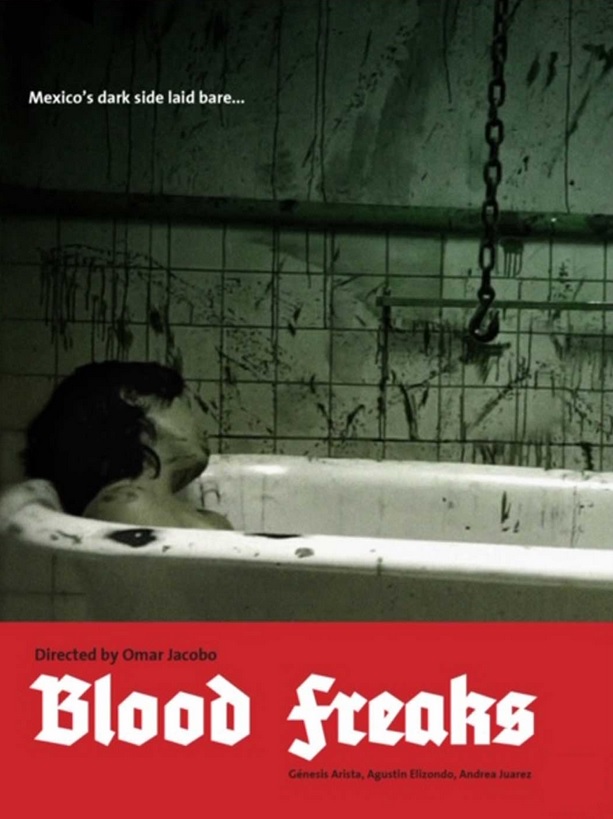
Upon discovering the streaming one-sheets for this experimental art-horror film on Tubi, I assumed I stumbled into a new Asian extreme horror film. Just look at the images for yourself: The first films the VHS centers of my celluloid cortex loaded was the J-Horror static of Takashi Miike’s Audition and Gozu, Bigas Luna’s narrative corkscrews of Anguish and Reborn, Fruit Chan’s testament to man’s sexual obsession with youth and beauty in Dumplings, and Alejandro Jodoroswky’s unholy trio of El Topo, Holy Mountain, and Santa Sangre. But, as I learned Blood Freaks was an arthouse-import from Mexico, I soon understood the one-of-kind voice behind the film is a student of the supernatural phantasmagoria of José Mojica Marins with his Coffin Joe romps At Midnight I’ll Take Your Soul and This Night I’ll Possess Your Corpse.
As Blood Freaks (aka La Puta Es Ciega, aka The Whore is Blind)—a homage to those forbidden, lurid clamshell and plastic-trayed Big-Box VHS/SOV bottom-of-the-barrel delights from our ‘80s youth—unspooled, I began to realize that writer and director Omar Jacobo is one of us: a freaky denizen who, when turning 18, delighted at being allowed to fan through the adult film section’s gigantic binders; who gleefully frolicked amid the horror-section shelves for the Fangoria-inept and the Famous Monsters-obscure. As one of the copy taglines for the film reads: “sleaze, gore, and more,” which is exactly what we wanted. We wanted mind-bending. We wanted backstreet scuzzy. We wanted our characters to be eclectic-crossed-with-freaky and a soupçon of crazy.
In the apartments of a low-rent Mexican walk-up, its misfit tenants are just that: They’re Andy Warhol perverse; they’re David Lynch oneiric; they’re John Waters hyperbolic. They’d fit right into the plotting of Flesh for Frankenstein, The Elephant Man, and Pink Flamingos: for I have no doubt that Omar Jacobo is a student of those films, and of the French New Wave impressionism of Claude Chabrol with La Femme infidel, Jean-Luc Godard with Breathless, and Francois Truffaut with The 400 Blows.
However, somewhere along the way, Jacobo’s celluloid schooling in the art of French-inspired subjectivity, ambiguity, and existentialism careened off the rails, drunkenly swaggering down a seedy, Mexican backstreet with a ratty, washed-out VHS rental of Bloodsucking Freaks in his hands—not realizing it wasn’t a product of the SOV ‘80s, but a low-rent and long-forgotten, inept drive-in homage to France’s Grand Guignol theater; a scuz-fest that sloshed the fecund streets of New York City’s grindhouse circuit in 1976, only for its asinine jawbone to be dislodged from the La Brea Celluloid Tar Pits onto home video store shelves for multiple-additional, muddy washouts from its perpetual rental-play. What was damaged to-the-point-of-blue-screen-of-death tape wasn’t artistic license: it was consumer-rabid wear-and-tear mistaken as artistic license.
Blood Freaks is a Dante’s Inferno of a retro-horror fantasy with a narrative structure created through an inventive use of music, camera work, and occasional still-image jump-cutting to imply movement through the dark underside of Mexico. It’s there that we meet the lives of the physically grotesque and spiritually sordid, violent tenants of a dingy apartment building: a blind, schoolgirl-clad lesbian prostitute who entices Janes/girlfriends (and if an unwanted John happens to attack her; well, just watch out for what she’s packing in the shaft of her cane) for her once overweight, cooking-obsessed Madam-girlfriend, and that Madam’s lesbian-dominatrix sister—and the “girlfriends” end up being her (temporary) submissives. Together, with the dominatrix’s male-dwarf partner (not forgetting Ralphus, the demented dwarf from Bloodsucking Freaks, and Jodorowsky’s dwarfs in his unholy trio), the sisters run a bathroom-based taxidermy and black market organ lab supplied with their girlfriend-subs. Their milkman-neighbor also has his kink: he’s a pornographer that tapes the sister’s sex-slave exploits to sell on the black market. Additional monies are made with the skins of the Janes: the dwarf treats the epidermal hides for use on his mannequin sculptures. Oh, as for the obsession with cooking: the ingredient-drugged foods are fed to the Janes who end up in the makeshift taxidermy-cum-art studio. Eventually, the sisters tire of their milkman-porn partner—and make him the bathlab’s newest specimen; he returns as an out-for-revenge zombie.
As the credits rolled on Blood Freaks—a surreal delight of incoherent symbolism, philosophy and weirdness just like Jodorowsky and Marins used to make—the feature film debut of writer-director Omar Jacobo shot on an $80,000 shoestring, I sighed; filled with the same adulation the first time I watched the opening 16-mm celluloid salvos of Robert Rodriquez with El Mariachi and Kevin Smith with Clerks. For Jacobo’s debut is a film of erudition: while a more commercial horror consumer, at first, may see “inept” filmmaking afoot with Jacobo’s arthouse-centric style, he is not part of the new, iPhone-shot digital ignorance proliferating the digital corners of Amazon Prime and Tubi, a net-realm where any John, Dick, or Jane—packing a handheld-device and a modicum of an idea—are (not) making movies.
At first glance, it’s easy to slag Jacobo’s homage to ’80s SOV horror (that analog genre of VHS-taped films, such as John Howard’s Spine and Christopher Lewis’s Blood Cult, which we hold in high regard amid the B&S About Movies cubicle farm) as an unfocused and incoherent, amateur film school project. (I worked as an actor on film school projects: I know incoherent amateurism: Jacobo is far from it.) Unlike many of those ‘80s Big Box SOV purveyors of old (we love you, Don Dohler, but still) and more so with the iPhone digitalmongers of the new, Jacobo comes to his chosen profession with a clear skillset. He, while in an admittedly unconventional way, understands the concepts of framing, shot composition, and editing. And he also understands (as does Jake Thomas with his absolutely stunning, just released film, Shedding) that dialog is the death of narrative; that images and an actor’s non-verbal language can carry a film. Jacobo also understands (as does Matthew Diebler and Jacob Gillman with their also recently-released and equally amazing The Invisible Mother) that film is a visual medium and that the devil—quite literally with Blood Freaks—is in the ambiguity-open-to-your-interpretation details: an enigma of pet chickens picking among the skins of peeled potatoes on the floor and five-minute dream-steria shots of a sordid, lesbian Madam making drug-filled meatballs and soups, a dwarf taxidermist who enjoys sculpting mannequins, and a dominatrix who specializes in baking jelly-centered drugged cookies.
Yeah, I love this movie, just in case if you’re wondering.
Then again, I ballyhooed from the rooftops for Michael Reich’s equally VHS-centric She’s Allergic to Cats, David Fowler’s modern psych-giallo Welcome to the Circle, and David Robert Mitchell’s ambiguity stunner Under the Silver Lake (well, Sam ballyhooed that one for the site) to deaf ear and blind eye; for I’m the guy who likes-everyone-hates the low-rent scuzziness of duBeat-e-o by Alan Sacks and Marc Sheffler. So what do I know? I’m just some guy writing film reviews in a cubicle farm somewhere in the backwaters of Allegheny County, where the vast majority of the world—as Sam, my boss, always points out—hates most of the films we love. And while that world flocks to Wonder Woman 1984 and fawns over Patty Jenkins, we, the B&S minions, flock to films like Blood Freaks and filmmakers like Omar Jacobo—who has the common sense to not use a timeline-skewed Cro-Mags shirt in his movie two years before the album it promotes was released.
And life couldn’t be any more sweeter for it: Blood Freaks is the type of film that makes me glad to wake up and write film reviews. You know, for the chicks. And for the fun. But mostly for the chicks.
You can learn more about Blood Freaks and Madre Foca! Producciones on Facebook. You can also visit distributor Rising Sun Media on Facebook and stream their catalog of Mexican-bred, full-length indie films on their Vimeo channel. After making a low-key, U.S.-streaming debut on Vimeo Online in May 2020, Blood Freaks is now widely available as of January 2021 as a free-with-ads stream on Tubi. The trailer is on You Tube.
Be sure to surf by B&S About Movies, daily—from Sunday, January 17 to Saturday, January 23—as we’ll feature the classics of Mexican action and horror cinema all this week.
Disclaimer: We did not receive a review request or screener from the film’s director, producer, or P.R firm. We discovered this film all on our own and truly enjoyed the movie.
About the Author: You can learn more about the writings of R.D Francis on Facebook. He also writes for B&S About Movies and publish music reviews and short stories on Medium.
“I don’t know why some people suffer through drought longer than others, but the rain always comes eventually. And when it does, the desperate, barren, thirsty earth quenches itself in a way that the lush, green earth could never imagine or understand. And I have to live in this tension because that is where the fire is.” — A bit of wisdom from Ed (William Russ)
The streaming verse is rife with first-time (mostly indie) writers and directors. And some are better than others. And this debut proves that Cindy Jansen is one of the some and not of the other. Remember when Patti Jenkins blew us away with the expertly crafted Monster, her 2003 writing and directing debut? And Jenkins’s debut was, while highly regarded, also consumer derided. And so is Jansen’s debut. But that derision has nothing to do with Jansen being a female filmmaker in a male-driven Hollywood. Film is (it should be) sexless-subjective and, regardless of a filmmaker’s Final Draft and Canon Red skills (which Jansen has in spades), some films resonate and some do not with the today’s streaming masses.
And if you want to guarantee — regardless of a filmmaker’s sex — derision from a mass audience: tell your story with a non-linear narrative: for flashbacks, hallucinations, time jumps, the metaphorical and analogies, and long-running narratives with multiple storylines crafted by an ensemble cast (and god forbid, voice overs of a character’s thoughts) will irradiate a streamer to the point of rehashing how much they hated Charlie Kaufman’s Adaptation and Eternal Sunshine of the Spotless Mind. And for as many people that enjoyed Bryan Singer’s The Usual Suspects and Quentin Tarantino’s Pulp Fiction and, most recently Once Upon a Time . . . In Hollywood, those (excellent, IMO) films have their detractors.
And so it goes. Where the film sprocket spins, no one knows.
When it comes to screenwriting, I’m of the Linda Aronson School of Non-Linear Storytelling — provided that formatting choice is not some esoteric, bells and whistles flight-of-fancy of the “look what I can do” variety and it services the character and the story (and in the case of Chasing the Rain, it does). (And why, can novels be non-linear and become best-sellers, but when a screenplay is non-linear, it’s a box office death knell? “It’s not ‘cinematic,'” they say.) At heart, man is a non-linear creature. Sure, as we objectively view the people around us, they’re moving forward, linearly. But when we consider the subjective side of man, internally rests his true essence. Man is a creature whose mental and emotional states are constantly multitasking. While you’re at your job, you’re flashing forward about your family responsibilities later that evening. While you’re with your family, you’re flashing forward about tomorrow’s job meeting or flashing back to the latest episode with that fellow, troublesome employee. Then there’s the sights, the aromas, the things people around us do or say that inspires one to reflect on a past moment. We daydream about the future-possible and the impossible. Then we snap back to the present. Non-linear is reality. Non-linear is real life. The external, objective adventures of John McClane and Martin Riggs, while surely entertaining, aren’t reality.
Thus, when a film like Chasing the Rain — with a non-linear and faith-based message to boot — flows down the digital pipeline, not everyone is jumpin’ aboard that gospel train to a cinematic transcendence. A film that addresses the concepts of freewill and ponders the philosophical: Are the world’s pains, one’s personal afflictions, and disease a test of faith sent by God or are those pains a jovial punishment sent by Lucifer to torture man?, isn’t floating the bag in everyone’s tea cup.
Well, I love my green tea. So pour it, Cindy.
Eric (Matt Lanter) is a soft-spoken and well-intentioned, yet spiritually-stumbling photographer on a volunteer mission project with a clean water organization assisting the citizens of an arid, poverty-stricken Kenyan village. When he returns to the States after his mission-of-good, he discovers he’s afflicted with a debilitating illness. Already fragile in accepting the good fortunes of his life, Eric’s life begins to unravel (again) as he questions why such suffering is bestowed upon some more than others.
We need not subscribe to Christianity or a belief system in any god to book ourselves a seat on the self-pitying, self-righteous freight train of pain to a spiritual Las Vegas where everyone is fearing and loathing; a city of sin where most are not blessed with baptismal waters of redemption, but with spiritually-destroying baptisms of fire. Chasing the Rain, regardless of its spiritual themes, is an authentic story concerned with how one copes in a dysfunctional family and with life-defining moments — be it the good, the bad, or the ugly. And when it comes to authenticity vs. hyper-reality in film, I always err to the side of quenching my celluloid thirsts from the pools of the authentic. Even when the waters go uncomfortably dark.
Sometimes, it’s all about that opening shot, yes, of a dung beetle: Come into being.
We’ve enjoy the work of Matt Lanter since the early 2000s courtesy of his work as Brody Mitchum on NBC-TV’s Heroes and as Liam Court on Fox-TV’s 90210. Lucasheads know Lanter as the voice of Anakin Skywalker in the Star Wars animated universe, as well as the animated voice of Aquaman in the DC-verse and a wide array of characters in the Spiderman-verse. William Russ has been on our TVs and silver screens since the late ’70s, but us youngins of the ’80s remember him best in his seven-year run as dad Alan Matthews on the sitcom Boy Meets World. The same goes for Cindy Pickett, who you may remember for her starring role as Dr. Carol Novino on NBC-TV’s hospital drama St. Elsewhere — and too many TV series and films to mention. I was also very pleased to see the matured, stellar child actor Hallee Hirsh — who totally creeped us out as Jenny Brandt, a pubescent-serial killer on TV’s Law and Order in “Killerz” (1999) — still in the business and effective as ever on-camera. If you were a fan (like moi) of NBC-TV’s E.R. or JAG, you’ll recognize Hirsh for her recurring roles on those series as Rachel Greene (Anthony Edwards was her dad!) and Mattie Johnson. It’s great to see these four, wonderful actors with starring roles in an expertly crafted to film to remind us why, anytime we see their name, we watch the film or TV episode. Their presence certainly served as my enticement to stream.
The real joy of the casting process for Chasing the Rain is that it allows for the (new) discovery of under-the-radar TV actor Eric Tiede as Stu, Eric’s best friend and roommate. Working his way through guest starring TV roles the last ten years on such top-rated network series as NCIS, Castle, and Major Crimes, Tiede brings an award-winning (or at the very least, a supporting actor nomination) nuance to a character that starts out as, what seems a selfish, throwaway party dude, only to transform into more than just a roommate. Tiede’s an actor’s actor that, as with his co-stars, is now an actor who, the next time I see his name on a project, I’ll stream it for his performance.
Speaking of streaming: When it comes to first time or unknown indie filmmakers, I’m of the belief that brevity is best; that, when it comes to a first time or more developed, but unknown filmmaker, their discovery is better served with a more commercially palpable 80-minute running time — and that even 90-minutes pushes a movie watcher’s willingness to dedicate their time to an unknown’s work. But hard media is dead and oh so ’90s; current media consumption is all about streaming, and so many indie filmmakers — sans studio backing with those pesky no-you-can’t-do-that executives holding the purse strings — have a tendency to be a bit weak in their abilities to step back and separate themselves from their work to make those hard, editing choices. However, with Cindy Jansen’s debut — courtesy of a well-reached and thought-provoking script, stellar cinematography from Lon Stratton (Standing the the Shadows of Motown), and solid acting from all quarters, this is a time where no streamer should have any apprehensions at this film’s one hour fifty three-minute running time. Chasing the Rain is one of those unique indie-streaming instances where every frame, every shot, is absolutely essential to the story and deserves to be on the screen.
Chasing the Rain is a beautiful, perfect industry calling card that leaves one wanting more from Cindy Jansen. Hopefully, the executive of Tinseltown will feel the same — and give her free reign to see her vision through.
You can keep abreast with the latest on Chasing the Rain courtesy of Indie Rights Films and at the film’s official Facebook page. You can learn more about the film and its creators courtesy of an extended interview conducted by Bonnie Laufer Krebs on her You Tube page. Courtesy of Shock Ya!, film journalist Karen Bernardello also discusses Cindy Jansen’s destiny in becoming a reluctant, first time director.
You can hit the big red streaming button for Chasing the Rain on Amazon Prime. As of February 2021, you can now enjoy Cindy Jansen’s debut film as a free with-ads stream on your favorite digital device on TubiTV.
About the Author: You can learn more about the writings of R.D Francis on Facebook.He also writes for B&S About Moviesand publishes short stories and music reviews on Medium.
Disclaimer: We did not receive a review request for this film. We discovered the trailer on social media, were intrigued by the film, and requested a screener. We truly enjoyed the film.
“The Christian community has kind of left the art world on the back burner. My vision would be them treating the art world, the film world, with the same sense of urgency as they’re treating, for instance, an overseas mission. . . . This is an emergency for our culture, to be able to influence our film, our arts, the American pop culture in this way [through Christianity].” — Director T Jara Morgan, in an interview with Life Site News
Ah, those ’90s-halcyon Miramax and Fox Searchlight days of driving to an outside-of-the-big-city six-plex with a screen or two dedicated foreign films. Films that you had to see that week — that Friday, in fact — before the manager, seeing the low box office, banished the celluloid from the silver screen, for the film never to be known beyond a few film dorks: like moi.
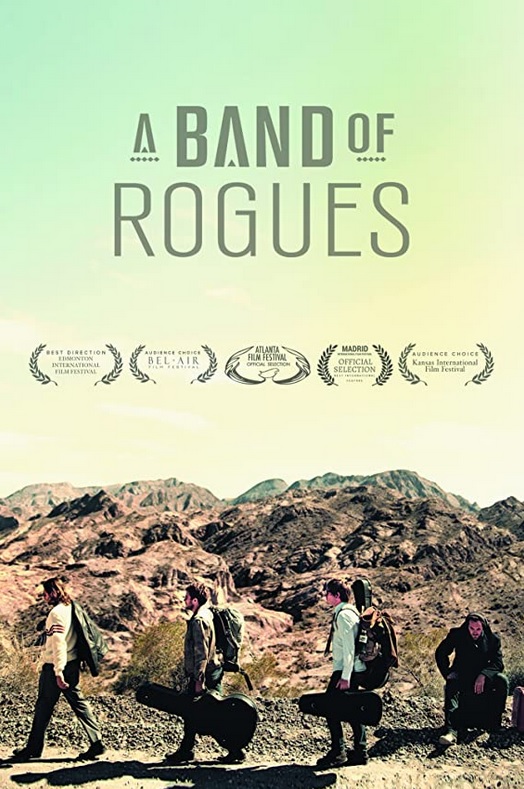
In the case of this feature film debut by writer-director T Jara Morgan, his Argentinian-shot, music-driven comedic adventure has bounced around the worldwide festival and indie circuit since 2012. And finally, thanks to the fine folks at Indie Rights Films (who always seem to be rescuing just the right films from celluloid obscurity to digital recognition), A Band of Rogues finally makes its well-deserved U.S. streaming and hard-media bow.
Hey, but wait second . . . all of these actors, as well as director T Jara Morgan, hail from Atlanta, Georgia, in the good ‘ol U.S.A. Uh, okay, so . . . then we’re reliving the ’90s-halcyon Miramax and Fox Searchlight days of driving to an outside-of-the-big-city six-plex with a screen or two dedicated to indie films. Films that you had to see that week — that Friday — before the film vanished from the silver screen.
In other words: Different film genre, but the same ol’ hard-road-to-mainstream-distribution travels for the non-Tinseltown film.
And the jailer man and sailor Sam, were searching everyone.
As a film academic and critic, I watch a lot of (new) films — and I end up not reviewing more that I review. Sadly, while I realize the writers and directors behind each and every film I watch have depleted their internal organs and inner essence into their digital images, there are just some films that I can’t get behind; there is no common good served by eviscerating the vision of a filmmaker: I ain’t Roger Ebert nor Rex Reed. I’m R.D Francis and R.D don’t play that.
But then . . . along comes A Band of Rogues: an obscure film on the run that deserves to be seen. Reviewing T Jara Morgan’s IMDb page, while he is still producing various video products for television and other outlets, he hasn’t made another feature in the ensuing nine years of the first festival appearance of A Band of Rogues. And that’s a shame. For a director to transition from two short films, to creating a film with an all-original soundtrack of songs (crafted by brother-producer Matthew D. Morgan and actor Luke Micheal Williams) tailored specifically to the character’s personalities and plotting of the film and — with a László Kovácian eye — expertly capture the Argentinean countryside to convey an analogy of the South American expanse to one’s spiritual freedom, is a film that deserves to be experienced.
As with his Christian message-based shorts that are worthy of investing your fifteen minutes, A Band of Rogues is a bit more quiet of a film; a not-so-heavy-handed, faith-based tale regarding the fate of one’s decisions, the importance of the guidance of friendship, and discovering your moral compass that a mass audience — both religious and non — can enjoy. No matter your belief system, man requires faith to survive. Faith has nothing to do with God. It has to do with man. Faith is what keeps us, keeping on. We all have to believe in an endgame to have purpose in our lives. And you can never have enough films pushing that message.
“Live a good life. For you. For me. For both of us.” — Gabriel Consisco
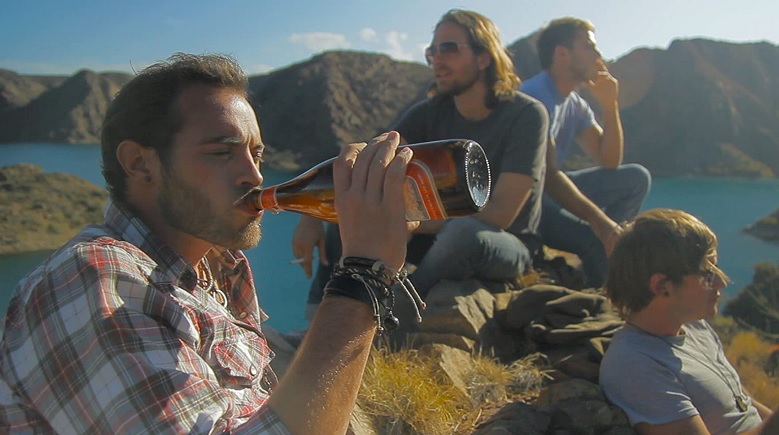
It’s always five o’clock somewhere, even in Argentina.
Our “rogues” are a trio of American indie musicians touring their latest album in Argentina — when they’re arrested for drug possession (pot, coke, prescription drugs) and property damage at their hotel. Unable to make financial restitution, and to escape deportation to the U.S. where they’d be locked up for their prior drug records, they accept sentencing to a rehab center for six weeks before their court date. But since these “Ugly Americans” can’t assimilate nor contribute to the rehab’s society, they’ll be kicked out and sent to prison by the end of their first week. So the band decides, with the help of Gabriel, a sympathetic, English-speaking native Argentinean (standout Italian-Argentine actor Leonardo Santaiti of the Divergent series), to shanghai an old kitchen-delivery truck and make a (causal) run for the Chilean border.
The most fascinating aspect of A Band of Rogues is, that unlike most indie films about an indie rock band’s adventures, the film’s music isn’t just plopped into the film willy-nilly: our wayward musician’s personal stories unfold as chapters analogous to one of the tracks on their album — a Beatlesesque acoustic album rife with ukuleles, mandolins, and upright basses, just like the indie ’90s used to make.
Dude, I really enjoyed this movie — and its music. It made me laugh. It made me smile. It made me contemplate. It made me remember my radio and band roadie days. A Band of Rogues is filmmaking at its finest brought to us from an exemplary contingent of filmmakers, actors and musicians who deserve bigger and better things in their respective careers. Remain encouraged, ye mighty band of analog and celluloid rogues. Keep that Tinseltown faith alive, my brothers, for we all walk a common road in our love of telling stories.
Courtesy of the You Tube page of Rocky Farm Studios, we discovered two of Morgan’s shorts: Volition(2008) and The Life of a Ditchdigger (2006). His third short is All the World is Crying Out (2007). You can learn more about T Jara Morgan’s work at his official website. You can keep up with the latest on A Band of Rogues courtesy of Indie Rights Films and at the film’s official Facebook page and website. You can stream the film on Amazon Prime or as a newly-debuted free with-ads stream on TubiTV, and enjoy the original soundtrack on Apple Tunes and Amazon Music.
About the Author: You can learn more about the writings of R.D Francis on Facebook.He also writes for B&S About Moviesand publishes short stories and music reviews on Medium.
Disclaimer: We did not receive a review request for this film. We discovered the trailer on social media, were intrigued by the film, and requested a screener. We truly enjoyed the film.










 B&S About Movies
You must be logged in to post a comment.