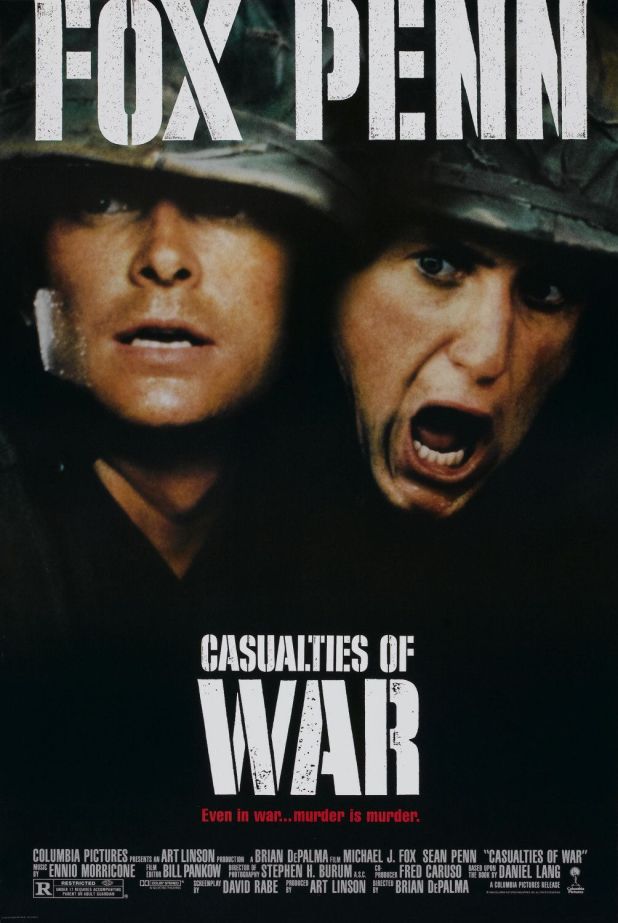
THE FILMS OF BRIAN DE PALMA: Casualties of War (1989)

Based primarily on an article written by Daniel Lang for The New Yorker about Hill 192 in Vietnam, which was later published as a book, this was directed by Brian De Palma and written by David Rabe. It was filmed in Thailand, including one scene shot on the same bridge as the one in The Bridge on the River Kwai.

Max Eriksson (Michael J. Fox) is home after Vietnam and remembers incidents throughout the film. There was the time that Sergeant Tony Meserve (Sean Penn) saved his life after he fell into a tunnel. The death of “Brownie” Brown (Erik King) and how that affected Meserve. And the time that Meserve, Corporal Thomas E. Clark (Don Patrick Harvey), Private First Class Antonio Diaz (John Leguizamo) and Private First Class Herbert Hatcher (John C. Reilly) kidnap a Vietnamese girl, Tran Thi Oanh (Thuy Thu Le), and repeatedly assault her while Eriksson is forced to stand watch. He attempts to free her but by the end, each man shoots her multiple times and throws her body off a bridge.

Eriksson realizes from Lieutenant Reilly (Ving Rhames) and Captain Hill (Dale Dye) that no one cares what the men did. But after meeting with a chaplain, an investigation happens with Meserve getting 10 years hard labor and a dishonorable discharge, Clark life in prison, and Hatcher and Diaz 15 and 8 years of hard labor. as Eriksoon wakes on a train from his dreams, he sees a young woman who looks exactly like Tran. She forgets his scarf and he runs after her. She smiles and thanks him as he gets some closure.

Quentin Tarantino told Samuel Blumenfeld, co-author of Brian De Palma: Conversations with Samuel Blumenfeld and Laurent Vachaud, how important this movie was to him: “It’s the greatest film about the Vietnam War. Apocalypse Now would be classified in another category as Coppola’s film goes beyond the war. De Palma adapts a very small news article, which must have occurred on several occasions in Vietnam or elsewhere. Elia Kazan had also been inspired by it for The Visitors. He had made an intimate film. De Palma treats that same news item in the epic, operatic style that was his signature since Obsession and Blow Out. Soldiers capture a young Vietnamese girl. Before her murder, every member of the unit, with the exception of one of them, tortures and rapes her. The cowardice associated with the forced courage of the character played by Michael J. Fox — who does not participate in the rape and denounces his friends — is very moving. Casualties of War presents the most traumatizing rape sequence in the history of cinema. It’s also one of the best performances from Sean Penn, terrifying as the sergeant squad leader.”

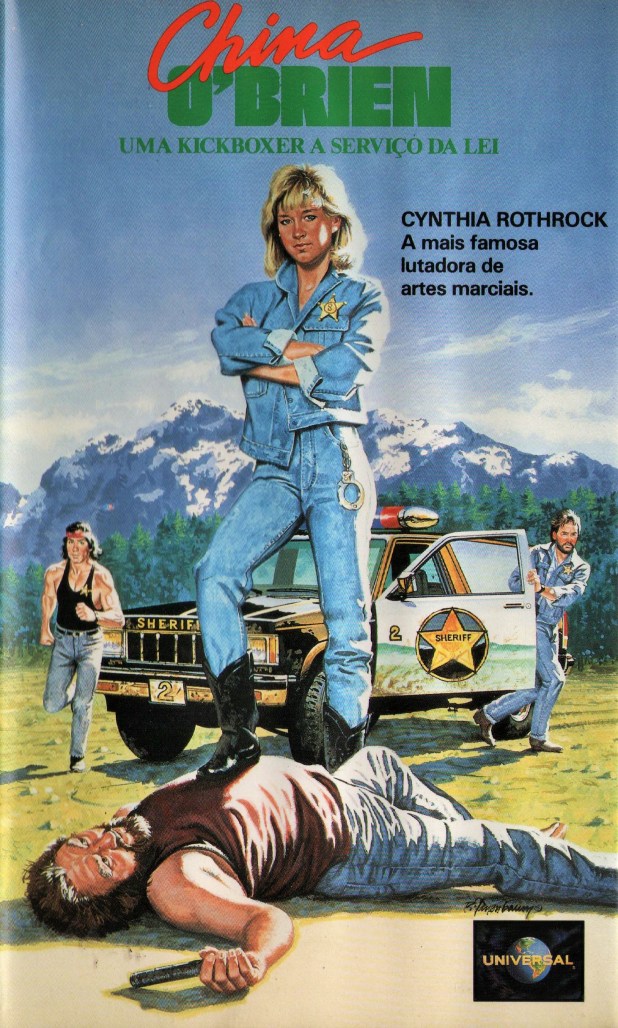
Junesploitation: China O’Brien (1990)

June 23: Junesploitation’s topic of the day — as suggested by F This Movie— is Cynthia Rothrock! We’re excited to tackle a different genre every day, so check back and see what’s next.

Robert Clouse worked with some of the greatest martial artists on film, from Bruce Lee to Jim Kelly, Robert Wall, Bolo Yeung, Jackie Chan and for this movie and its sequel, Cynthia Rothrock.

China O’Brien is a cop who teaches a martial arts class to her fellow officers. One of the class members challenges her to a fight in an alley that ends up involving several gangs and someone is killed. She resigns in disgrace and heads back home to Beaver Creek, Utah.

She learns that her father — and town sheriff — John (David Blackwell) is losing control of the town thanks to corruption in the force and a bought-off judge. But the real problem is Edwin Sommers (Steven Kerby), a crime boss who is taking over the town. He uses car bombs to kill the last two good cops, Ross Tyler (Chad Walker) and China’s dad.

Now, Marty Lickner (Patrick Adamson) looks to become the paid for law for Sommers, unless China follows the advice of her ex-boyfriend Matt Conroy (Richard Norton) and runs for sheriff herself. She wins  — they shot her parade scene during an actual town parade and the local newspaper reported that Rotchrock was actually running for sheriff —  and is nearly killed in a drive-by shooting, so she deputizes Matt and Native American biker Dakota (Keith Cook, who was Sub-Zero in Mortal Kombat Annihilation) to go after Sommers.

Golden Harvest worked to make Rothrock a star back home in the U.S. and cast her in this. It works but she doesn’t come off as fearsome as she did in her Hong Kong films. Most of the cast and crew returned for the sequel.

The song “Distant Storm” in this movie is by the band Tess Makes Good. That’s actually Tori Amos.

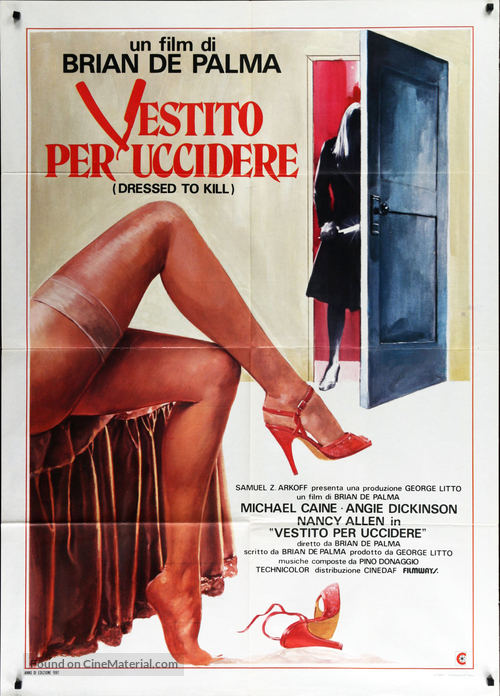
THE FILMS OF BRIAN DE PALMA: Dressed to Kill (1980)

EDITOR’S NOTE: This has been on the site a few times, but you can’t do a week of Brian De Palma movies and not have this as part of it.

Let’s get this out of the way: Brian De Palma, much like Giallo, was heavily influenced by Hitchcock. In fact, when an interviewer asked Hitchcock if he saw the film as an homage, he replied, “You mean fromage.” That said — Hitchcock died three months before the film was released, so that story could be apocryphal (it’s been said that the famous director made this comment to either a reporter or John Landis).

What is true is the interview that De Palma did after Dressed to Kill (Rolling Stone, October 16, 1980).  The director claimed, “My style is very different from Hitchcock’s. I am dealing with surrealistic, erotic imagery. Hitchcock never got into that too much. Psycho is basically about a heist. A girl steals money for her boyfriend so they can get married. Dressed to Kill is about a woman’s secret erotic life. If anything, Dressed to Kill has more of a Buñuel feeling.”

However, I’d argue that this film has more in common with Giallo than anything the “Master of Suspense” directly created. That’s because—to agree with DePalma above—this film does not exist in our reality. Much like Argento’s The Bird with the Crystal Plumage, it exists in its dream reality, where the way we perceive time can shift and change based on the storyteller’s whims.

Yet what of DePalma being dismissive of Argento in interviews, claiming that while he saw the director as having talent, he’d only seen one of his films? Or should we believe his ex-muse/wife Nancy Allen, who claims that when she told DePalma that she was auditioning for Argento’s Inferno, he said, “Oh, he’s goooood.”

Contrast that with this very simple fact (and spoilers ahead, for those of you who worry about that sort of thing, but face facts, this movie is 37 years old): DePalma rips off one of Hitchcock’s best tricks from Psycho: he kills his main character off early in the film, forcing us to suddenly choose who we see as the new lead, placing the killer several steps ahead of not just our protagonists, but the audience itself.

And yet there are so many other giallo staples within this film: fashion is at the forefront, with a fetishistic devotion to gloves, dresses, spiked high heels, and lingerie being displayed and removed and lying in piles all over an apartment or doctor’s office. This is the kind of film that makes you stop and notice an outfit, such as what Kate Miller (Angie Dickinson, Big Bad Mama, TV’s Police Woman) wears to the Metropolitan Museum of Art or the blue coat that Liz Blake (Nancy Allen, CarrieStrange Invaders) wears to meet Dr. Robert Elliot (Michael Caine, how could we pick any movie other than Jaws 4: The Revenge).

Then there are the music cues from Pino Donaggio, who also scored Don’t Look Now, Fulci’s The Black Cat, and Argento’s Do You Like Hitchcock? The film not only looks the part, but it has intense sound, too.

We also have characters trying to prove their innocence, investigating ahead of the police. Or the son of the murder victim who wants to discover why his mother really died. Or her doctor, who has an insane patient named Bobbi who has stolen his straight razor and demands that she give him more time than the rest of her patients. All of them could be the killer. Giallo gives us no assurances that just because we see someone as the protagonist, there’s no reason they couldn’t also be the antagonist.

Let’s toss in a little moral ambiguity here, too. Kate is a woman who is bored with her life. She’s raised a son and seen her marriage lose any hope of sexual frisson. Liz is a prostitute — no slut shaming here, she’s a strong businesswoman more than anything  — but she’s also a practiced liar, as a scene shows her deftly manipulating several people via phone to get the money she needs to buy stock based off an insider tip she receives from a client. Dr. Elliot is obviously attracted to Kate but claims that his marriage prevents him from having sex with her. Yet it seems like he has secrets beyond informing the police of the threats of his obviously unbalanced patient, Bobbi. And then there’s Peter, Kate’s son, who has no issues using his surveillance equipment to spy on the police or Liz. If this character seems the most sympathetic, remember that he is the closest to the heart of DePalma, whose mother once asked him to follow and record his father to prove that he was cheating on her.

Finally, we have the color palette of Bava’s takes on giallo mixed with extreme zooms, split screens and attention to the eyes of our characters. The blood cannot be redder.

The film opens with Kate in the shower. While the producers asked Dickinson to claim that it’s her body, it’s really Victoria Johnson (Grizzly) as a body double. Her husband comes into the shower to make love to her, but she finds it robotic and not the passion she feels she deserves. Directly after, she tells Dr. Elliot that she’s frustrated and attempts to seduce him, but he rejects her.

More depressed than before the appointment started, she heads to the Metropolitan Museum of Art. Despite being surrounded by inspiration, such as the statue of Diana by Saint-Guadens, West Interior by Alex Katz and Reclining Nude by Tom Palmore (a tip of the hat to the amazing I Talk You Bored blog for an insightful take on the film and the research as to what each work of art is), she absentmindedly writes entries in her schedule. Planning the holiday meal gets her through the mindlessness of her life, flowing penmanship reminding her to “pick up turkey” instead of slowing down and appreciating not just the artwork around her but the people. There’s a young couple in lust if not love. There’s a young family. And then, a man with dark glasses catches her eye before brazenly sitting down next to her.

We are used to male characters chasing after female characters who aren’t defined by anything other than being sex objects. Instead, we have Kate pursuing the man, making the first, second, and even third moves until we realize that she was just following the man’s breadcrumbs.

Of note here is that color plays an essential role in the scene, as do expected manners. Kate is a wife and mother. She is who society expects to have virtue, and she is clad in all white, but her intentions are anything but pure. She finally has what she wants—the thrilling sex life that she may have only read about in trashy paperbacks.

This scene is a master class in pacing and movement. Imagine, if you will, the words on the page: Kate follows a mystery man through the museum. And yet, those are just eight words. We get nearly nine minutes of wordless pursuit, yet it never grows dull.

Finally, Kate follows the man out of the museum, but she loses him until she looks up and sees her glove dangled from a taxi. But blink, and you miss death in the background as Bobbi blurs past the camera.

When we catch up with Kate, it’s hours for her but seconds for us because this movie is a dream universe. She wakes up in bed with a stranger. There’s a gorgeous camera move here as DePalma moves the camera backward, an inverse of how a lesser director would have treated this scene. Instead of showing the two lovers tumbling through the apartment and removing clothes at every turn, we see Kate reassembling herself to move from her fantasy world to reality and toward her real world, which will soon become a nightmare. The camera slides slowly backward as she gets dressed, remembering via split-screen and sly smile how she doesn’t even remember where her panties have gone. She’s still wearing white, but under it all, she’s bare, her garments lost in a strange man’s house. A man whose name she doesn’t even know.

So now, as she emerges from realizing her sexual fantasies, she feels that she must make sense of it. She wants to write a note to say goodbye but doesn’t want to overthink it. Maybe she doesn’t even want it to happen again. And then she learns more about the man. It starts with his name and then becomes more than she ever wished to find out: his health report shows that he has multiple STDs.

Kate leaves the apartment and makes her way to the elevator, where she tries to avoid anyone’s eyes. In the background, we see an ominous red light, ala Bava. Bobbi—death and punishment for sin—is coming.

The death scene — I hold fast to my claim that The New York Ripper is close to this film but made by a director who doesn’t have the sense to cut away from violence — DePalma stages his version of the shower scene. But more than Psycho, we’ve come to identify with Kate. She’s a woman fast approaching middle age who wants a thrill, and yet, she’s punished by disease and death. She didn’t deserve this, and her eyes pleaded not to the killer as much as they did to the camera. And to us.

Here’s where we have to wonder aloud about DePalma’s long-discussed misogyny. This film was protested by women’s groups, who stated in this leaflet that “FROM THE INSIDIOUS COMBINATION OF VIOLENCE AND SEXUALITY IN ITS PROMOTIONAL MATERIAL TO SCENE AFTER SCENE OF WOMEN RAPED, KILLED, OR NEARLY KILLED, DRESSED TO KILL IS A MASTER WORK OF MISOGYNY.” Is DePalma guilty of the slasher film trope of “you fuck, and you die?” Maybe. Perhaps if she had remembered her marriage, at best, she wouldn’t be here. At worst, she wouldn’t have forgotten her ring in the stranger’s apartment and would have survived.

The way I see it, the death of Kate allows us to make the transition from past protagonist to new heroine, as the doors open post-murder to reveal a grisly scene to Liz and her john. The older man runs while Liz reaches out to Kate, their eyes meeting and fingers nearly touching. Kate’s white purity has been decimated by the razor slashes of Bobbi, the killer. As their transference is almost complete, Liz notices Bobbi in the mirror. Remember that we’re in a dream state? Time completely stops here, so we get an extreme zoom of both the mirror and Liz’s face. She escapes just in time, grasping the murder weapon and standing in the hallway, blood on her hands as a woman screams in the background, figuring her for the killer.

At this point, the film switches its protagonist. Unlike the films of David Lynch, like Mulholland Drive, this transference is not a changed version of the main character, but her exact opposite. Kate wore white, was older, and had a marriage and child, yet she slowly came to feel like an object to the men in her life. Liz wore black, was young and single, but was wise to the games of sex and power. She isn’t manipulated, turning the tables on men by using their needs for personal gain. Kate may have seen sexual fantasy as her greatest need, but for Liz, it’s just a means to an end.

Kate and Liz are as different as can be. For example, Kate goes to the museum to find inspiration. Liz only sees art as commerce, and she spends plenty of time explaining to Peter how much money she could make by acquiring a painting.

Dr. Elliott discovers a message from Bobbi on his answering machine (these machines and the narrative devices they enable must seem quaint and perhaps even anachronistic to today’s moviegoers). Once, Bobbi was his patient, but he refused to sign the paperwork for their (as the pronoun hasn’t been defined, so I’ll use they/their) sex change. In fact, Dr. Elliot has gone so far as to convince Bobbi’s new doctor that they are a danger to herself and others.

The police, however, have arrested Liz, and Detective Marino (Dennis Franz, TV’s Hill Street Blues and NYPD Blue) doesn’t believe a word she has to say. There’s a great moment here where Liz goes from wide-eyed ingenue to knowing cynic in the face of Marino’s misogynistic tone. Meanwhile, Kate’s son Peter (Keith Gordon, Jaws 2Christine) uses his listening devices in the station to learn more about his mother’s death than the police are willing to let on.

He begins tracking Liz, obsessively noting the times that she comes and goes from her apartment. He’s doing the same to Elliot’s office. But he’s not the only one tracking people. Bobbi has been stalking Liz, including a sequence where our heroine goes from being chased by a gang of black men to talking with an unbelieving police officer to Peter saving her from Bobbi with a spray of mace.

Because Peter has seen Bobbi also emerging from Dr. Elliott’s office, so he joins forces with Liz to discover who she is. That means that Liz uses her chief weapon — sex — to distract the doctor long enough to discover Bobbi’s real name and information. We learn that Liz’s mental sex game is as strong as her physical attributes here — she says that she must be good to be paid as well as she is. She knows precisely the fantasy Dr. Elliott wants to hear. But perhaps she also knows the fantasy that the mainly male slasher/giallo viewer wants: the woman submitting to the killer holding the knife.

Peter watches outside in the rain when a tall blonde pulls him away. Has he been taken by Bobbi? No — Liz returns to have sex with Dr. Elliott; he has been replaced by the killer. Bobbi lifts the razor as Liz helplessly crosses her arms in front of her face for protection. But at the last minute, the blonde who grabbed Peter outside is revealed to be a police officer, as she shoots Bobbi through the glass. That shattered pane also breaks Bobbi’s illusion and mask, revealing that Dr. Elliott is the man under the makeup and clothes.

The killer is arrested and goes into an insane asylum; Dr. Levy explains that while the Bobbi side of his personality wanted to be free, the Dr. Elliott side would not allow them to become a true woman. Therefore, whenever a woman broke through and aroused the male side of the persona, the female side would emerge and kill the offending female.

Inside the mental asylum, a buxom nurse attends to the male patients. The room is bathed in blue light, a cool lighting scheme that echoes Mario Bava’s films. The movie has moved from a dream version of reality to a pure dream sequence. It intrigues me that Carrie and Dressed to Kill both start with a shower scene and end with a dream threat to the surviving secondary heroine.

Within the asylum, Dr. Elliott overcomes the nurse and slowly, methodically, folds her clothing over her nude form. As he begins to either dress in her clothes — or worse, molest her dead body — the camera slowly moves upward as we realize that there is a gallery of other patients all watching and screaming. This scene reminds me of the gallery of residents watching a doctor perform surgery, yet inverted (have you caught this theme yet?) and perverted.

Bobbi emerges once again, and because she is dead, she cannot be stopped. Liz is bare and helpless in the shower, and nothing can protect her from being slashed and sliced and murdered — except that none of this is real. She awakens, screaming in bed, and Peter rushes in to protect her. And for the first time in the film (again, thanks to I Talk You Bored for noticing), she is wearing white.

Many find this a hard movie to stomach due to its misogyny. I’ll see you that and tell you it’s a misanthropic film that presents all of humanity, male and female, negatively. The men in this film are actually treated the way women usually are in films, as either silent sex objects (Warren Lockman), sexless enemies (Kate’s husband), shrill harpies that need to be defeated (Detective Marino) or sexless best friends who provide the hero with the tools they need to save the day (Peter). Seriously, in another film, one would think Peter would have a sexual interest in Liz, but despite her double entendres and come-ons, he remains more concerned with schedules and numbers and evidence.

Bobbi, the combination of male and female, comes across as a puritan punisher of females who benefit from sex, either emotionally or monetarily. Or perhaps they are just destroying the sex objects that they know that the male side of their brain will never allow them to become. Interestingly, Bobbi’s voice doesn’t come from Michael Caine but from De Palma regular William Finley (The Phantom of Phantom of the Paradise).

What else makes this a giallo? The police seem either unwilling to help at best or ineffectual at worst until they tie things up neatly at the end. And the conclusion, when the hand emerges not from the doorway — but the medicine cabinet — to slash Liz echoes the more fantastic films in the genre, such as SuspiriaAll the Colors of the Dark and Stagefright, where reality just ceases to exist. At the end of all three films, the heroine has confronted the fantastic and may never be the same.

In the first, Suzy narrowly escapes from hell on earth and emerges laughing in the rain. Is she happy that she survived? Has she achieved a break from reality? Is she breaking the fourth wall and laughing at how insane the film has become, pleased that the torture is finally over?

In the final scene of All the Colors of the Dark, the fantasy world is all a ruse, yet our heroine, Jane, is now trapped in the dream world. She can tell what will happen before it does; she knows that her husband has both slept with and killed her sister, but he has saved her from a fate worse than death. Yet all she can do is shout, “I’m scared of not being myself anymore. Help me!”

In Stagefright, the final girl walks out of the scene and out of reality as she defeats the killer. She has transcended being an actress to removing herself from fiction.

In all these films, the characters are not unchanged by their experiences with the dream world. In Dressed to Kill, the final dream sequence renders Liz truly frightened for the first time in the film. It’s the only time we see her as vulnerable — even when faced with an entire gang of criminals on the subway, she retains her edge. As Peter reaches out to comfort her — the only sexless male in the film and not just a sublimated one like Dr. Elliott — she recoils from his touch before giving in to his protective embrace.

In the same way, the film changes us. It has thrilled us, made us think, or even made us angry. True cinema—true art, really—makes us confront what we find most uncomfortable. Sure, we can deride and decry many of this film’s choices, but the fact that I’ve devoted days of writing and over three thousand words to it speaks to its potency. Thanks for reading if you’ve made it this far.
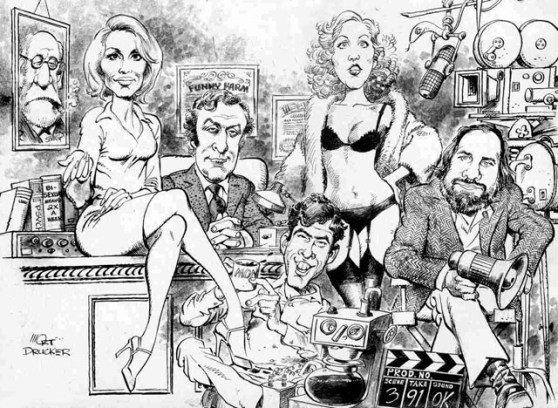
PS—I’ve often discussed—in person and on podcasts—that I experienced so many R-rated movies for the first time via Mad Magazine. I’m delighted I could find the Mort Drucker illustration for his skewering of Dressed to Kill.
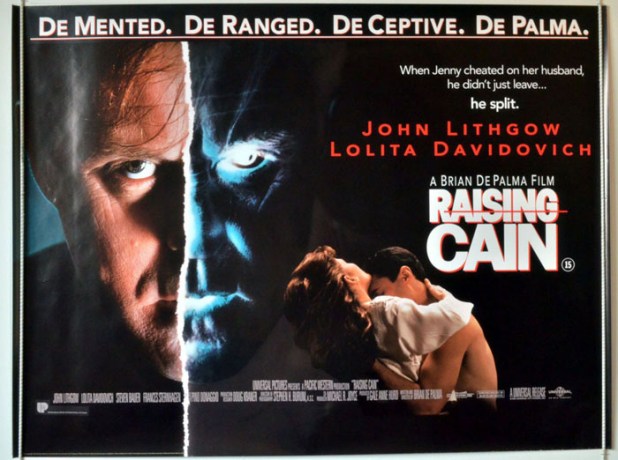
THE FILMS OF BRIAN DE PALMA: Raising Cain (1992)

EDITOR’S NOTE: This was originally on the site on September 9, 2021.

Brian DePalma didn’t want to go back to the thriller and felt like it was a step backward. Kind of like Argento going back to make Deep Red. I say this because for two guys who have been accused of being overly inspired by Hitchcock, this one feels like DePalma had a debt to pay to someone in Italy — particularly the one scene that reveals the killer that feels lifted from the end of Tenebre.

But hey — didn’t Argento get Jessica Harper for Suspiria after seeing Phantom of the Paradise?

Dr. Carter Nix (John Lithgow) may regard his daughter Amy as a science experiment and that rightfully upsets his wife Jenny (Lolita Davidovich), but perhaps she’d be more upset if she knew that inside her husband’s brain lived a whole bunch of other folks, like a young kid named Josh, a protective nanny named Margo and the violent Cain. And oh yeah — Cain is making Carter continue the experiments on children that ruined his father’s career.

His wife is also sleeping with someone else, a man named Jack (Stephen Bauer) and she’s planning on leaving, but Carter starts implicating Jack in his crimes and then tries to drown his wife. He’s also abducted his own child and claims that she is with his father, who has been dead for years.

That’s when we meet the woman who helped Carter’s father with his book, Raising Cain. She had no idea that the man was psychologically abusing his son so that he could study the personalities that emerged from the systematic manipulation that he put him through. And oh yeah — the man has faked his death and established a new identity in Norway where his son sends children to create more multiple personality disorders.

Anyways, this movie is pure silliness in all the best of ways, with Lithgow having an absolute blast, DePalma outright referencing scenes from more than one Hitchcock — Psycho is the easiest to spot — and an ending that isn’t an ending. I’m here for all of it.

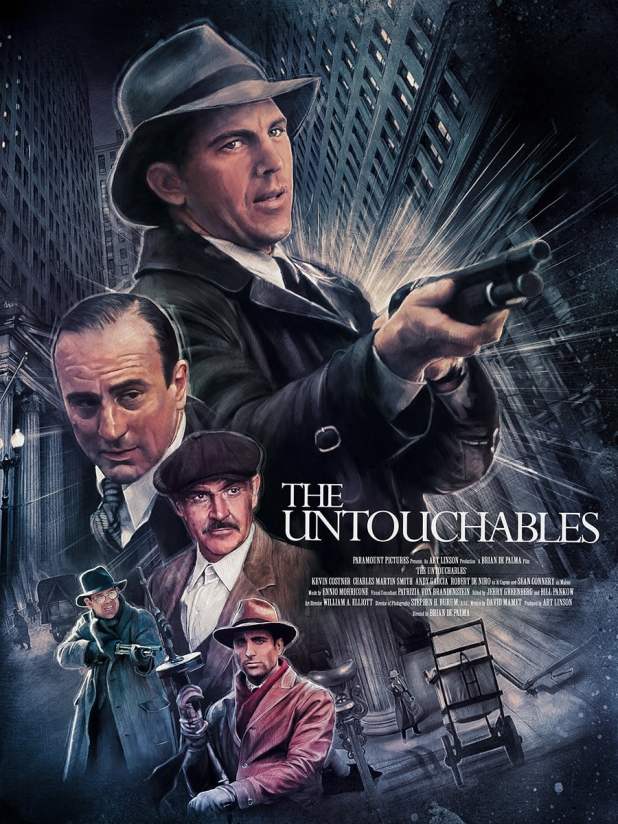
THE FILMS OF BRIAN DE PALMA: The Untouchables (1987)

Robert DeNiro* had not worked with Brian De Palma since Greetings and Hi Mom. That theme for taking forever to make something happen also is something that Ned Tanen knew all about.

He spent years trying to obtain the rights to Eliot Ness’s life story while working as an executive at Universal Pictures. After becoming head of motion picture productions at Paramount Pictures, which owned the film and television rights to Ness’s memoir The Untouchables, he hired Art Linson to begin producing a film adaptation.

Linson didn’t have any interest in remaking the TV series. Instead, he wanted to show the real world Ness and his career in Chicago. He hired playwright David Mamet to write the script, which other than a few changes for the sake of new locations, went unchanged. De Palma wouldn’t take much credit for what he did, telling The New York Times, “Being a writer myself, I don’t like to take credit for things I didn’t do. I didn’t develop this script. David used some of my ideas and he didn’t use some of them. I looked upon it more clinically, as a piece of material that has to be shaped, with certain scenes here or there. But as for the moral dimension, that’s more or less the conception of the script, and I just implemented it with my skills – which are well developed. It’s good to walk in somebody else’s shoes for a while. You get out of your own obsessions; you are in the service of somebody else’s vision, and that’s a great discipline for a director.”

While De Palma’s movie is based on historic events, most of the film is inaccurate. For example, there was no border raid, no shootouts at the train station or courthouse. Ness didn’t even have much to do with Capone’s conviction at the end of everything. Frank Nitti killed himself 12 years after the trial. And Capone ordered his men to not kill or harm Ness or any of his agents. Sure, he tried to bribe them. But he knew that any violence against him would only bring more government interest.

Movies don’t have to be real to be great.

Instead, let’s indulge in the world of this film, where Ness (Kevin Costner) and James Malone (Sean Connery) form their Untouchables with George Stone (Andy Garcia) and Oscar Wallace (Charles Martin Smith) to go up against Capone and his henchmen like the sinister Nitti (Billy Drago, incredible as always). Let’s thrill to De Palma restaging the Odessa Steps scene in Sergei Eisenstein’s Battleship Potemkin on the stairs of a train station. Let’s watch moments that have transcended just this movie and become part of the film language for everyone.

It really is astounding when you think of the highs and lows of De Palma. For all the attacks he received for his violent films and talk of misogyny, he made movies that have become iconic parts of our mythology.

*De Niro almost didn’t make the film. He was on Broadway at the time and his schedule wasn’t lining up. De Palma then had Bob Hoskins ready for the part. When it. all worked out, he mailed Hoskins a check for £20,000 with a “Thank You” note. Hoskins called the directed to ask him if there were any more films he didn’t want him to be in.

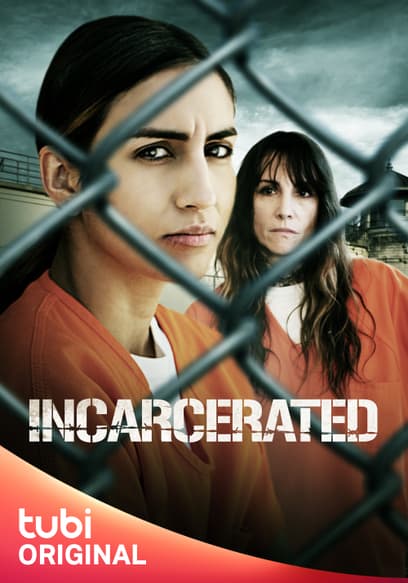
TUBI ORIGINAL: Incarcerated (2023)

Elena Cruz (Yesenia Ayala) has not had an easy life. As a child, her father Condor (Danny Pardo) was busted for stealing from his boss, Maeve (Heather McComb). She gave him pretty much Sophie’s choice.* After she slices his wife’s throat, she demands that he choose which child to kill, either his son Lucas or his daughter Elena. He yells that he chooses his son, so she shoots him in the face.

Years later, Elena gets arrested robbing a bodega all to go to prison, all to get close to Maeve before she’s pardoned for good behavior thanks to a corrupt system. Can she get in, get close and get revenge?


Directed by Steven R. Monroe (who has also made TeardropUnbornFirst Person Shooter and Harland Manor for Tubi, as well as the remake of I Spit On Your Grave) and written by Jordan Robinson (Trap HouseRequiem for a Scream), this has all of the women in prison puzzle pieces, like Feltcher the perverted guard (Jason Wiles), the older and wiser prisoner who helps our heroine named Trudy (Elizabeth Haley), the tough prisoner who our heroine battles (Rebekah Tripp), the gang that beats her in the shower, the tough prison lover of the villain (Jasmine Shanise) and the librarian who knows the system (Stephanie Maura Sanchez).

But if you’re expecting a titillating WIP movie, well, this isn’t it. It’s about how far someone will go for revenge, how far a father will go to be forgiven and how bad humanity can be. That said, it has one scene where the perverted prison guard gets what’s coming to him. If the movie kept up that level of roughness the whole time, it’d be so much better.

You can watch this on Tubi.

*Is that why Elena takes the name Sofia when she goes to jail?

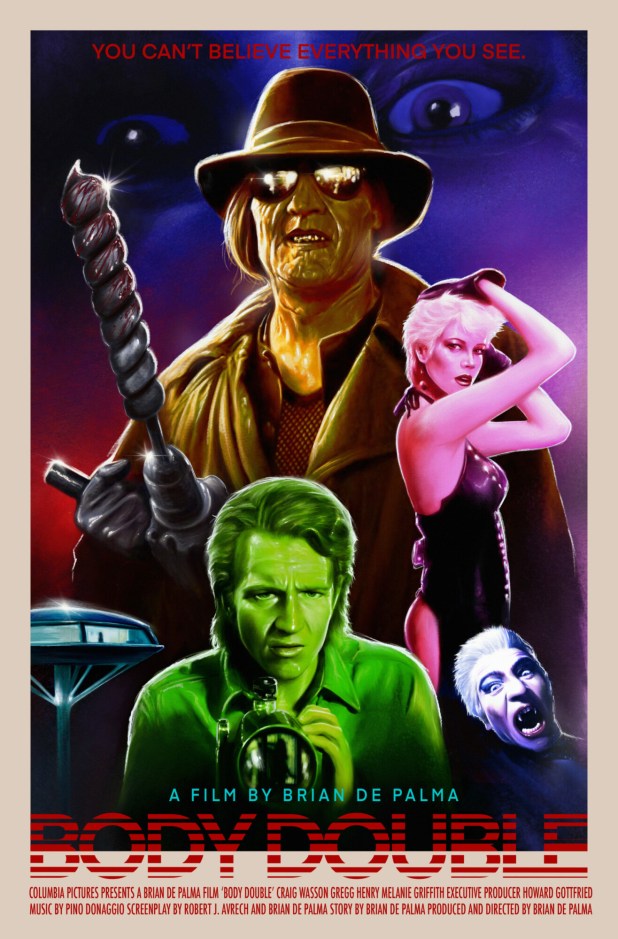
THE FILMS OF BRIAN DE PALMA: Body Double (1984)

EDITOR’S NOTE: This was originally on the site on .

“I do not do animal acts. I do not do S&M or any variations of that particular bent, no water sports either. I will not shave my pussy, no fistfucking and absolutely no coming in my face. I get $2000 a day and I do not work without a contract.”

I’ve said it before. Everything I find attractive in the opposite sex is Melanie Griffith: the toughness of Edith Johnson in Cherry 2000, the smarts of Tess McGill in Working Girl, the dangerous edge of Audrey Hankel in Something Wild and, well, Holly Body in this movie wearing a fringed jacket, smoking with short blonde hair? Have you seen my wife?

Wikipedia states that this is a “homage to the 1950s films of Alfred Hitchcock, specifically Rear WindowVertigo and Dial M for Murder,” but this is a giallo thanks to the main character being implicated in the murder, misdirection as to what the real crime is and who the killer may be, and the fact that murder and sex have come together most horrifyingly as a drill penetrates a woman and the floor beneath her, dripping hot blood all over the protagonist.

Jake Scully (Craig Wasson) has lost his home, his lover and his last role, all because of the childhood phobias that have made him claustrophobia — hey another giallo moment — yet after taking a method acting class, he’s found a place in the astounding home of actor Sam Bouchard (Gregg Henry), who before he leaves for Europe takes time to show him a woman — Gloria Revelle (Deborah Shelton, Miss USA 1970, who was also in Bloodtide) — who strips down every night for whoever watches her.

That home is the Chemosphere house which is also in Charlie’s Angels.

Obsessed by this woman, Jake starts following her and even watches her be attacked by a mystery man. That same “Indian” steals her purse as Jake follows her to a rendezvous at a hotel where she’s about to meet another man who stands her up. He gets her purse back before his phobia traps him in a tunnel. She helps him escape his fear. They embrace. They kiss. That night, the “Indian” returns and kills her with a gigantic drill as Jake fails to save her; a huge white dog has stopped him. When he calls the police, Detective Jim McLean (Guy Boyd) tells him that his need to watch and not involve the police earlier led to Gloria’s death.

Later that evening, unable to sleep, Jake notices a woman dancing on a cable channel whose movements are the same as his mystery woman. Those movies and those curves belong to Holly Body (Griffith), an adult star who he works his way into meeting and then frightens away, just in time for the “Indian,” who ends up being Alex Revelle, the husband of Gloria, but also Sam Bouchard, to knock out Holly, who he paid to dance for Jake so that he’d keep watching and see his wife get killed, giving him the alibi that he was in Europe and the “Indian” was the real killer.

That reveal is so giallo it should make the screen turn yellow.

Director Brian DePalma was recovering from dealing with the censors over Scarface and women’s groups after Dressed to Kill. Much like Argento, who made Tenebre his most violent film yet after similar criticism — they both also tend to answer yes to the question “Do you like Hitchcock?” — DePalma decided to go hard instead of giving up.

He told the Philadelphia Inquirer “If this one doesn’t get an X, nothing I ever do is going to. This is going to be the most erotic and surprising and thrilling movie I know how to make… I’m going to give them everything they hate and more of it than they’ve ever seen. They think Scarface was violent? They think my other movies were erotic? Wait until they see Body Double.”

Originally, DePalma was going to have Annette Haven play Holly, but the studio bristled at an actual hardcore actress being in their movie. She stayed on to consult and explain what the world of adult was like. DePalma also wanted Sylvia Kristel for the role of Gloria and man, if that happened, this movie would have been too much for 12 year old me.

DePalma ended up ending his three picture deal with Columbia after this movie, which nearly got an X rating, saying “The only people crazier than the people who criticize me for violence are the people at the studios. I can’t stand that sort of cowardice.” As for critics, Ebert loved it, Siskel hated it and said it was splatter and everyone kept saying he hated women. Years later, the director would explain to The Guardian, “Body Double was reviled when it came out. Reviled. It really hurt. I got slaughtered by the press right at the height of the women’s liberation movement… I thought it was completely unjustified. It was a suspense thriller, and I was always interested in finding new ways to kill people.”

So yeah. It bombed at the box office. But it has a great rental store scene, the twist from the coffin scene to the real fate that Jake finds himself in is astounding and even the way the credits come in is absolutely genius. Throw in the wild notion that this movie briefly becomes a Frankie Goes to Hollywood video — man, DePalma loves that spinning dance camera and that scene is such a wow, look, there’s Brink Stevens, Annette Haven, Cara Lott and Lindsay Freeman moment — and you have a movie that I’ve thought about since I first saw it as a teen. Watching it again as an old man, I see the sadness creep through the sin, the voyeur being when he starts watching and gets to actually making it.

Also: that same dance set was reused for Fright Night.

It’s funny because Argento and DePalma always get compared to one another. DePalma said in an interview “Actually the only film I’ve seen of Argento’s is The Bird with the Crystal Plumage. That is the only film of his I remember ever seeing. I know I get compared to him a lot, and people think I took this or that from there or here. But, I actually only remember ever seeing that one film of his. I’m not a student of giallo films at all. I know Martin Scorsese showed me some Mario Bava films back in like the 70s or something.”

Sure, alright. Maybe we should compare the shot for shot moments in Tenebre and Raising Cain

I digress.

Both are extremely talented and have dealt with the same criticism. Both made poorly advised movies late in their career. Both even married actresses from their films. Both used Pino Donaggio to compose their movies, Argento with Trauma and DePalma more than once.

They should just get together and have some wine and be friends.

Looking back at Body Double, I am astounded by how much DePalma got away with and how much art he still worked into this. It’s sleazy and hard to defend, but that just makes me enjoy it beyond what I should.

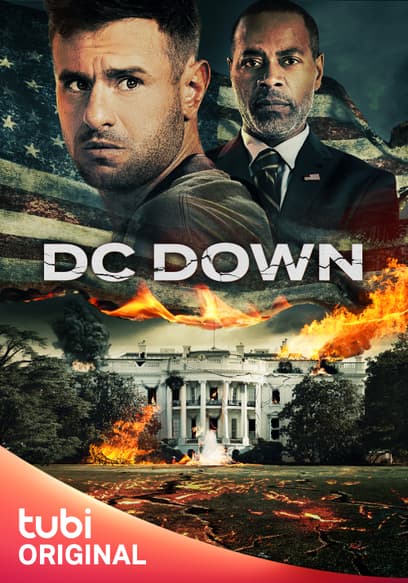
TUBI ORIGINAL: DC Down (2023)

Can there be an earthquake in Washington D.C.? Can it rock the entire center of our nation’s government and trap both President Powell (Sean Young, yes, Sean Young is the President) and Vice President Jameson (Daphne O’Neal) inside the White House? And in the midst of it all, will Speaker of the House Wilder (Eric Roberts) use the twenty-fifth amendment to take over the leadership of America and bring in The Virginia Lookout militia and their leader Beck (Geoff Meed, who also directed and wrote this) to help calm the populace? And will aftershocks keep blasting the capital? And can it all be stopped by combat engineer Lance Cushing (Jack Pearson) and his seismologist fiance Katherine (Kayla Fields)?

The answers are all yes and here I am, watching another Tubi original as the palaces burn.

You know, the CGI in this — The Asylum made it, so you know what you’re in for — is so strange. Even though the landmarks of Washington D.C. are destroyed, traffic keeps on going past. Well, have you been in the traffic in that city? That part is, I guess, somewhat true to life because it’s always congested all the time, no matter how much damage an earthquake can emit.

My favorite character in this was General Harris (Taylor Woodberry), whose suit doesn’t even get creased as he defends the free world and just so happens to have a search and rescue/combat engineer on his contacts list, much less one whose pregnant soon-to-be wife knows how to do dispersal theory to quite literally flood an earthquake and shut it down.

Geoff Meed is like a Tubi superstar, writing and acting in this, Butch vs. Sundance and Butch Cassidy and the Wild Bunch all within a month or less. He started his career in the Universal Studios Hollywood Tour, where he worked in the Wild West Stunt Show, The Adventures of Conan and The Miami Vice Action Spectacular. A 5th degree Black Belt Master in Kempo, a 3rd degree black belt in Hap Ki Do and also the owner of black belts in Tae Kwon Do and karate, Meed went into stunt work, which nearly ended his life in 2012. On the second day of shooting Shadow on the Mesa, he was thrown off his horse and trampled, which led to eight broken left ribs, a busted sternum, a lacerated liver and the need to insert three titanium plates to repair the damage done to his face. That became a workers’ comp lawsuit and he retired from stunt work — he’d need four more surgeries to repair all the damage — and Geoff moved to Texas to start his own fitness and martial arts studio. Four years later, he came back to Los Angeles and got back into stunt and acting work. It’s amazing that he was in two more Westerns after that accident.

You can watch this on Tubi.

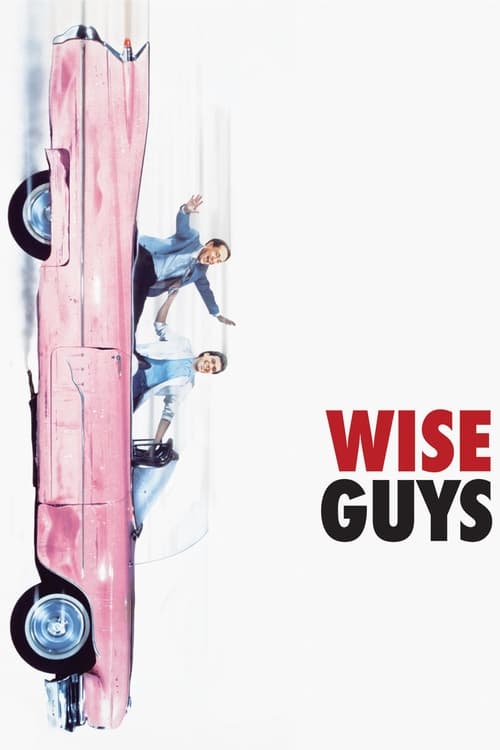
THE FILMS OF BRIAN DE PALMA: Wise Guys (1986)

Wise Guys may not have the visual excess that De Palma was once known for, but it does what so few of his past comedies did for me. It made me laugh. I watched this movie several times as a kid — blame Captain Lou Albano for being in it — but I always loved it, because Harry Valentini (Danny Devito) and Moe Dickstein (Joe Piscopo) may never rise to the head of Anthony Castelo’s (Dan Heyada) gang, it’s not always because they have a bad boss. The secret plan of the universe that Harry keeps following inevitably means that they are going to screw up any good luck that comes their way.

They may dream of opening deli, but for now, all they do are the worst of jobs: testing out bulletproof jackets, goldfish watching and starting the car to make sure it doesn’t explode. Then they get an actual assignment: go with Frank “The Fixer” Acavano (Albano) to the racetrack to make a bet. Harry thinks he can get in the boss’ good graces by switching his bet. Catelo’s horse wins $250,000. The boys didn’t bet on it. They’re tortured for an entire evening before they individually agree to kill one another. Neither can pull the trigger.

After seeing Harry’s cousin Marco (Ray Sharkey) get wasted, they freak out and steal Frank’s car and head down to Atlantic City, hoping that Harry’s Uncle Mike, who was once Castelo’s boss, can save them. Well, he’s dead. And now they probably will be by the end of the day, especially after they use Acavano’s credit cards to stay in a five star hotel owned by their old friend and now successful businessman Bobby DiLea (Harvey Keitel).

The twists and turns at the end of this are worthy of the biggest movies that De Palma made, as the two men — so often screw ups — must somehow get out of all this trouble and get away with it. Time has been kind to this, as years after I first saw it I just kept laughing.

Back when he was in the tag team The Sicilians with Tony Altamore, Lou Albano was warned by organized crime figures to cool the gimmick if he wanted to live. As an Italian American of great pride, this is where I remind you that there is no such proven Italian American crime family and we don’t mention any names for such organizations in print.

THE FILMS OF BRIAN DE PALMA: Scarface (1983)

There’s not much that I can add to the discussion on Scarface, but when you’re doing an entire week of the films of Brian De Palma, skipping it can’t happen.

Loosely based on the Armitage Trail novel and serving as a loose remake of the Paul Muni-starring film, Scarface came about when Al Pacino saw that 1930s gangster movie and thought it could be remade. While he and Sidney Lumet got as far as the idea that Tony Montana was a Cuban arriving in the United States during the Mariel boatlift, but artistic differences between the director and producer Martin Bregman meant that they couldn’t work together.

Lumet wanted a political movie that blamed Reagan for the influx of cocaine into the United States which wasn’t the movie Bergman wanted. He was replaced with Brian De Palma and Oliver Stone was picked to write it. He didn’t want to make a mob movie until he learned that it was to be set in Miami. He had to go to Paris to beat his cocaine addiction, as he felt he couldn’t write the movie while snorting lines.*

Speaking of Miami, this wasn’t even shot there. It’s LA. The Miami Tourist Board declined the request to film there as it feared that Scarface would deter tourism with its themes of drugs and gangsters.

Ah, Miami. In 1980, Cuban refugee and ex-convict Montana (Pacino) arrives there and soon emerges from a refugee camp alongside Manny Ray (Steven Bauer, the only Cuban in the main cast), Angel (Pepe Serna) and Chi-Chi (Angel Salazar). They get their green cards when they kill a former Cuban general for Frank Lopez (Robert Loggia), the drug lord of Miami. After that excitement, being dishwasher seems like a major step backward.

They start to work for Lopez and it nearly ends for Tony just as quickly as it started. Under orders of Lopez’s main henchman Omar Suarez (F. Murray Abraham), Columbian dealers screw them on the deal and kill Angel with a chainsaw while Tony is forced to watch. When Martin Scorsese watched this scene, he turned to Bauer and told him: “You guys are great, but be prepared, because they’re going to hate it in Hollywood… because it’s about them.”

He was right. Critics lost their minds and audiences walked out during this scene.

Manny and Chi-Chi save Tony and kill the Columbians, as the three get the money and the drugs back to their boss.

Given more power, Tony meets Alejandro Sosa (Paul Shenar), a Bolivian drug dealer who quickly figures out that Omar is a police informant. Tony makes a deal without Frank’s approval, but before long, Frank doesn’t matter. Tony has his empire, Frank’s woman Elvira (Michelle Pfeiffer) and a giant mansion that becomes a fortress.

But that can’t last. Tony has moments of actual conscience that doom him and moments of sheer insanity that damn him even further, finally winding up inside his gigantic palace doing a mountain of coke and battling wave after wave of crime soldiers before getting shot in the back, dying in a fountain that says, “The world is yours.”

As you can imagine, this movie barely made it into theaters with all the violence. It was given an X rating for excessive and cumulative violence and for language even after De Palma cut the movie three times. Universal would not release this with an X, which meant they couldn’t advertise the film, so an appeal board composed of twenty theater owners, studio executives and independent distributors voted that an R-rated cut would be released. De Palma claimed that the changes between his final cut and the R were unnoticeable. The MPAA demanded that only the R cut would play, so De Palma released the uncut print and didn’t tell anyone until months after the movie had been playing.

Beyond the music and pro wrestling — say hello to the bad guy Razor Ramon — that were inspired by this, so much of Grand Theft Auto was directly from this movie. It was paid back when two video games came out, Scarface: The World Is Yours — in which Tony somehow survives and gets his revenge on Sosa — while Scarface: Money. Power. Respect. was a prequel to the movie.

It seems like everyone has seen Scarface and probably has the poster and t-shirt. That said, it’s made by a master director and fills every moment of its running time with manic energy. Kind of like the cocaine it was based on.

*Powdered baby laxative was what people were snorting in this. Pacino did so many rails of the fake drug that his nasal passages were torn to bits.