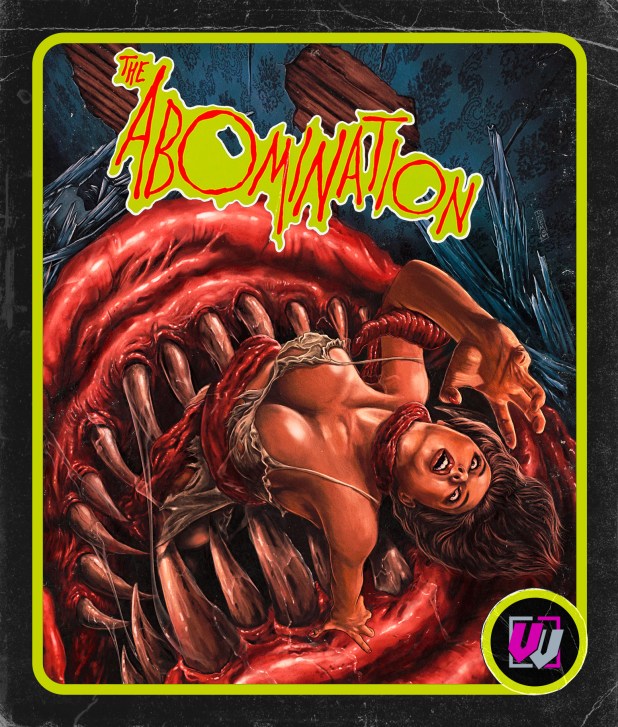
VISUAL VENGEANCE BLU RAY RELEASE: The Abomination (1986)

There is every other movie in the world and then there’s The Abomination.

No hype. This movie is absolutely brain destroying junk transmitted from some terrifying alternate timeline that I hope and pray never reaches our own. It’s a world where televangelist Brother Fogg can pray a tumor out of a woman, who vomits it out, and then that tumor crawls into her son who undergoes a transformation into a killing machine that feeds the many spores of the creature and pushes forward the end of all things.

This is also the kind of movie that starts with a blast forward of all the gore that you’re about to see in this movie and still not feel boring when that gore comes back. And man, that gore comes back and takes over the world of this movie, transforming protagonist Cory’s home into a panorama of teeth and blood and muscle and sinew and gristle and gore.

Man, what’s wrong with Texas? Or right? This movie feels like it wasn’t released and that it escaped like it should have been destroyed before it infected anyone’s brain but here it is, hiding in its low-fi menace out there waiting for people to watch it and wonder, “Why are people driving so much?” when they aren’t wretching from the endless parade of blood and viscera being literally thrown at the screen and the dubbed soundtrack which makes me love this movie even more, because when you put your budget into gigantic monsters that emerge from appliances and kitchen nooks, you don’t have the cash for synched sound.

Director and writer Bret McCormick also made parts of Tabloid and the films Time Tracers and Repligator. Even at this early stage, he’s showing off a real eye of how to use the budget and how to pretty much frighten you through the sheer strangeness of what he’s created.

This isn’t a perfect movie but perfection is an ideal that cannot exist. This is The Abomination.

I can’t even explain how excited I am about this release. Beyond the new producer-supervised SD master from original tape source — I’ve never seen this movie look better — there’s a limited edition slipcase by The Dude, 1 12-page mini-comic book, commentary with director Bret McCormick, Rob Hauschild and Matt Desiderio of Visual Vengeance, a second commentary with Tony Strauss of Weng’s Chop Magazine, interviews with McCormick, Blue Thompson, Victoria Chaney, The Abomination‘s original VHS distributor: Michael Jack Shoel, a locations tour, several reels of outtakes, raw footage and behind the scenes, an image gallery some of Bret’s Super 8 films, a trailer archive of his films, a 6-page book with an essay by Tony Strauss, a “Stick Your Own” VHS sticker set, a reversible sleeve with the original VHS artwork and more.

Honestly, I can’t think of another movie that will come out on physical media this year that I will care more about. This is everything. You can get it from MVD.

THE FILMS OF RENATO POLSELLI: Giochi erotici di una famiglia per bene (1975)

Erotic Games of a Good Family was directed by Francesco Degli Espinosa and this is the only movie he ever directed. His credits include writing the Laura Gemser movie Emmanuelle On Taboo IslandVengeance Is My Forgiveness and C’era una volta questo pazzo, pazzo, pazzo West. Strangely, he’s listed as the assistant director on his own film on IMDB for this movie.

It was written by Renato Polselli, which accounts for both the film’s psychological and prurient content.

Riccardo (Donald O’Brien) comes home early one night and finds his wife Elisa (Malisa Longo, Nude si muore) with her legs around another man. As the moralist husband barges in gun drawn, that man jumps out the window to escape. Riccardo tries to keep his morals about divorce and stays with his wife, but then decides to give her a sleeping pill in her whiskey, place her body in a sack and throw it down a hill. He’s overcome by anger when all he wants is love. This act drives him a bit insane, but it seems that all is healed when he and sex worker Eva (Erika Blanc, Kill, Baby…Kill!, A Dragonfly for Each CorpseThe Devil’s Nightmare) end up falling in love. Or lust. Yet he can’t stop seeing visions of his dead wife and in the middle of all that, he’s so far gone that he also starts trying to sleep with his niece Barbara (Maria D’Incoronato, Concorde Affaire ’79).

Of course, if you ever watched an Umberto Lenzi and Carroll Baker giallo, you know exactly what’s going on. Elisa and Eva are lovers, Elisa is still alive and yes, Eva and Barbara are also lovers. Everyone wants Riccardo’s sizeable fortune, so if they have to destroy him to get it, well, that’s a bonus.

Also known as Amoral Games and Thrilling Story, this is the kind of giallo that those who have seen many of the films in the form will probably enjoy. I mean, I know I did. It’s hilarious that the red-bearded man — spoiler that isn’t a spoiler, it’s Blanc, as if you could hide her rapturous beauty under a fake beard — keeps showing up, as does the dead wife. And I have a suspicion that Polselli directed just as much of this as Espinosa if that beyond extended lovemaking scene between O’Brien and Blanc is any evidence as well as the main plot idea that in the space of a few days, Riccardo goes from an ultra moral man to one who has killed his wife, pays for sex and is trying to sleep with a younger family member. Throw in some hallucinations and it’s very much his kind of movie.

I’m frankly shocked that this has never been released in the U.S. Maybe because there’s no dub — that I know of — but it certainly has the kind of feel and subject matter that gets people excited about giallo. The closing moments, when it all comes together, really pays everything off and nobody escapes unscathed.

It’s a simple detective story that’s pretty well told. What he told Jay Slater about the giallo fo Argento makes sense to me after watching this: “Argento doesn’t make real giallos. He takes five or six horrific elements and sticks them together with a very thin plot.”

This makes a good match for another Polselli-written giallo, Psychout for Murder.

THE FILMS OF RENATO POLSELLI: Psychout for Murder (1969)

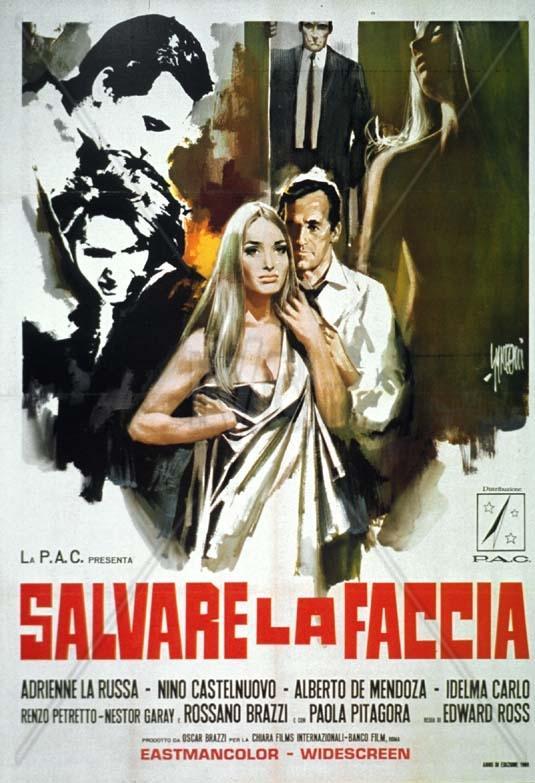
Salvare la faccia (Saving Face) is a giallo directed by Rossano Brazzi, who was once the actor who played Emile De Becque in South Pacific. His career started all the way back in the late 30s and saw him work back and forth between America and Italy. He was also in Frankenstein’s Castle of Freaks, Omen III: The Final Conflict and there’s even a moment where his adoring female fans tear his shirt off in Mondo Cane. He only directed two other movies — using the name Edward Ross — The Christmas That Almost Wasn’t and Criminal Affair, which he also starred in opposite Ann-Margaret and she tries everything to get in bed with him. It’s good work if you can get it, even if you need to direct and write it yourself.

He was also one of the writers for this movie, alongside Piero Regnoli (Voices from BeyondBurial Ground), Diana Crispo and Renato Polselli.

Brazzi plays a well-respected and quite wealthy manufacturer named Marco Brignoli (Rossano Brazzi). He’s having issues keeping his daughter Licia (Adrienne Larussa, who was the star of Fulci’s Mario (Nino Castelnuovo) sneak off to a house of ill repute where he takes some scandalous photos of her to blackmail her father. The cops then come in on a tip he called in, just as he guides her into the flashes of the paparazzi.

Completely upset about the scandalous activities of his unruly little daughter, father Brignoli sees only one way to clean up the publicly scratched appearance of his family to some extent: Licia must be publicly portrayed as mentally ill and for treatment of her “alleged” ailment be forcibly committed to a closed mental hospital. No sooner said than done, and only a few days later, the horrified nest defiler finds herself against her will in the closed ward of a psychiatric clinic, where she is then immediately given her currently registered place of residence for a longer period of time.

There’s only one way to do what the Italian title states. Licia must be seen as mentally ill and sent to a mental asylum. We see bursts of fast cuts, of her twirling around, the press conference, a car she was given and finally her in white trapped inside the asylum. Larussa is incredible in the role, at once a little girl and at others a calculating mad woman transformed — maybe, maybe not — by her time unjustly locked away.

A side note: Larussa was on Days of Our Lives for three years as well as the Bowie movie The Man Who Fell to Earth. And in the mid 80s, she was quickly both married and had an annulment from Steven Seagal when she found out that he was still married to his first wife.

Her character decides to find and unleash all the scandals of her family, like her father’s affair with Laura (Idelma Carlo), the wife of a politician (Nestor Garay) in the pocket of the industrialist. Or trying to steal Francesco (Alberto de Mendoza) away from her sister Giovanna (Paola Pitagora). She also uses Mario as part of her schemes, trailing a gun on him and informing him that because she’s insane, she can kill him at any time and get away with it. They use the Monsignor (Marcello Bonini Olas) that her father pays kickbacks to as the next part of the scheme. As the entire family prepares to watch a home movie of Marco leading his workers on a pilgrimage to Lordes, they instead watch him make love to Laura.

In order to keep everything quiet, Marco must agree to let Mario marry his daughter. But Licia is ahead of him as well, setting up his death to look like her father did it, seducing her brother in law — which sends her sister to her doom but not before screaming, “What’s your game? Don’t you realize you’re trying to destroy people who’re already dead? They’re all dead, Licia, only they don’t know it.” — and even learning about all of her dad’s biggest deals.

The family all pays for the way they treated Licia, as they have taken someone they only claimed was mentally ill and made her into the kind of black widow that populates the giallo, a woman driven by revenge and willing to do absolutely anything and destroy anyone.

So, when I say giallo, I don’t mean that this has black-gloved hands holding a straight razor. But the way it’s shot, the quick edits, every woman in long hair and mini-skirts, well, it’s definitely worth your time. I’m shocked that no one has taken this movie, cleaned it up and gotten a new cult intrigued by it. Larussa is also hypnotically captivating in it, owning every frame despite her young age and relative acting experience. It’s a shame she didn’t make more films in the genre (or more films at all, although she did a lot of TV work).

I’d be pleasantly surprised if this ends up on a future Vinegar Syndrome Forgotten Gialli set.

THE FILMS OF RENATO POLSELLI: Django Kills Softly (1967)

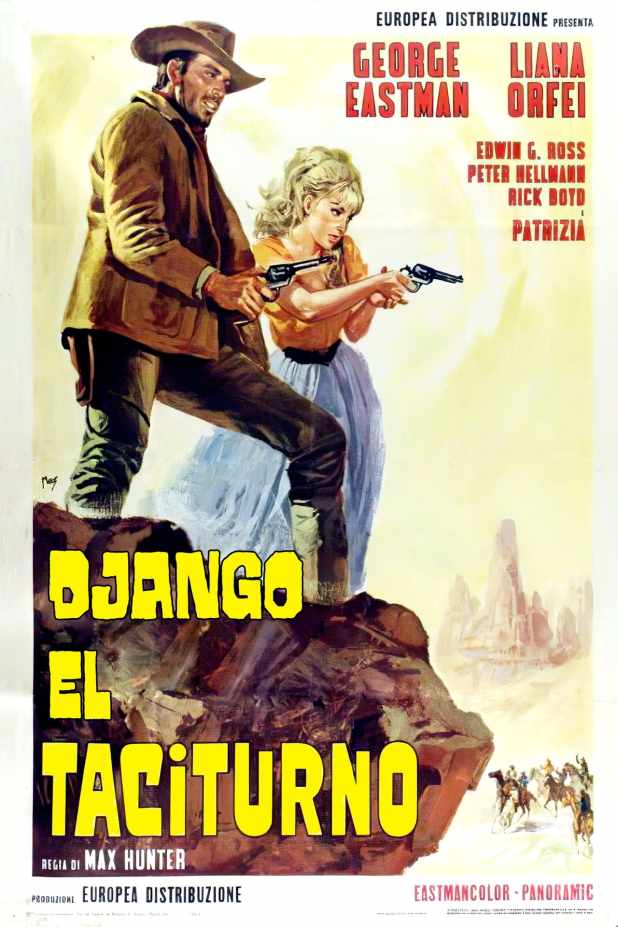
Bill il taciturn (Silent Bill) was directed by Max Hunter AKA Massimo Pupillo (Lady Morgan’s Vengeance, Bloody Pit of Horror, Terror-Creatures from the Grave) and had the traditional big team of Italian writers, including Lina Caterini (the editor of The Girl Who Knew Too Much and Blood and Black Lace), Paul Farjon, Marcello Malvestito (the editor of The Last Blood and Assassination In Rome), none of whom had much writing experience before or after this movie. They were joined by the person who came up with the story for this film, Leonide Preston, who is really Renato Polselli.

Yes, the same lunatic who made Delirio caldo and La verità secondo Satana.

It was retitled to Django Kills Silently or Django Kills Softly, as the original script had Bill (or Django for Americans) be the strong and silent type. He’s played by future baby eater George Eastman, who decided. to rewrite the script. This isn’t his first Western or even his first Django, as he was also in Django Shoots First (and he’s also in Django, Prepare a Coffin and W Django!).

According to the invaluable Spaghetti Western Database, “Eastman declared that director Pupillo had asked him to play the hero in the taciturn style of Clint Eastwood, but Eastman, who had studied the classics and was a screenwriter himself, thought this was a bad idea and made up his own lines, for the most part improvising them on the set. While the character was turned into a more talkative version of the taciturn Bill, the title wasn’t changed, causing a lot of confusion and leading to some oddly inadequate titles in other languages.”

This feels like a totally made up comment, as this movie was obviously made without live sound, so no one would have known what Bill or Django was saying anyway and it would need to be dubbed! In fact, he was dubbed by Tony La Penna.

Regardless, let’s discuss the film.

The movie starts with a massacre of an entire family. It’s brutal and seems like the kind of action that often happens in the Italian West. Bill/Django is visiting the border town of Santa Ana but the person he was to meet is already dead. He learns that the town is caught between Thompson (Luciano Rossi) and a bandit named El Santo (which yes, is a bit disconcerting seeing how many lucha movies I watch; he’s played by Domenico Maggio). That means that our hero is ready to pull a little A Fistful of Dollars/Yojimbo/Last Man Standing on the two and get ahead for himself.

He also teams up with a gunfighter named Miguel (Spartaco Conversi) and a mute man named Pedro (Antonio Toma). There’s also a woman to save, Linda (Liana Orfei, Mill of the Stone Women) and the normal torture that the Italian Western hero must endure.

It’s not the most Italian of Italian Westerns, feeling trapped in the pre-Leone days, but it’s fun seeing the gigantic Eastman try and play a hero.

WELL GO USA BLU RAY RELEASE: Bad City (2022)

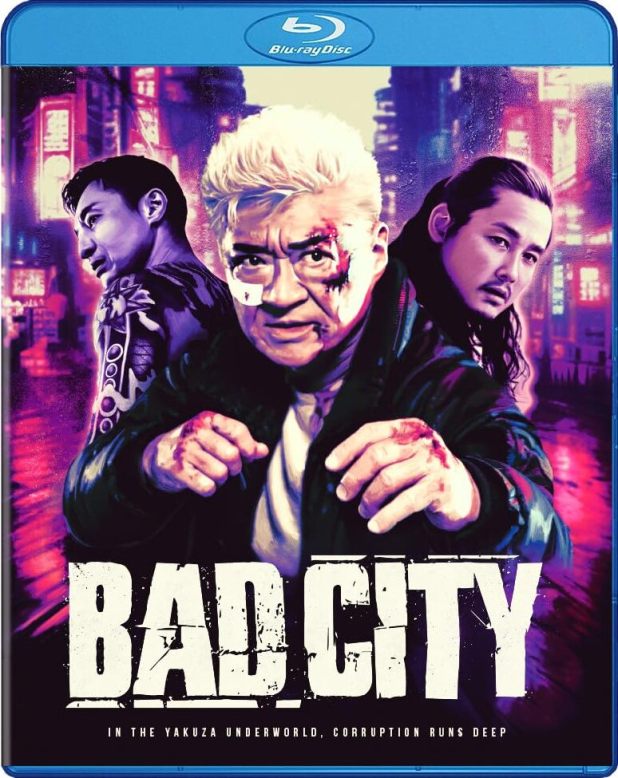
Kaiko City is plagued with poverty and crime. When a mass murder at a bathhouse occurs and yet local businessman Wataru Gojo (Lily Franky) is acquitted, the cops realize that traditional methods no longer apply.

Three members of the Violent Crimes Unit join a disgraced former police captain in jail for murder named Torada (Hitoshi Ozawa), to get evidence on Gojo, his dealings with the yakuza and even worse — his connection to South Korean organized crime and a yearning for a career in politics.

Hitoshi Ozawa is sixty years old but has made a career of playing roles just like this: hard men willing to do hard jobs no matter the cost. You may know him from Takeshi Miike’s Dead or Alive or may even go deep and know Japanese V-cinema. He’s the best part of this very good movie. And Tak Sakiguchi (Versus) is in this as a silent killer gunning for the police.

Directed by Kensuke Sonomura and written by Ozawa, this is a film filled with twists and turns but most importantly action. It also has so much of what works in Japanese crime cinema, that being the ever-twisted connection between cops and crime, with characters that have a foot in part of each world and yet pushed and pulled by concepts like duty and honor.

But this is all about the stunts and fights, too. Sonomura has made a career in stunts, from directing the action in movies like Baby AssassinsBlack Rat and The Machine Girl as well as directing Hydra. He’s also lent his fight choreography to video games including Devil May Cry 3Devil May Cry 4Metal Gear Rising: Revengeance and Resident Evil 3. He’s also choreographed the action scenes for some world-class directors including Mamoru Oshii, Yudai Yamaguchi, John Woo and Donnie Yen.

This movie is deliriously exciting. Make sure you catch it.

Bad City is available from Well Go USA.

SYNAPSE 4K UHD RELEASE: Tenebrae (1982)

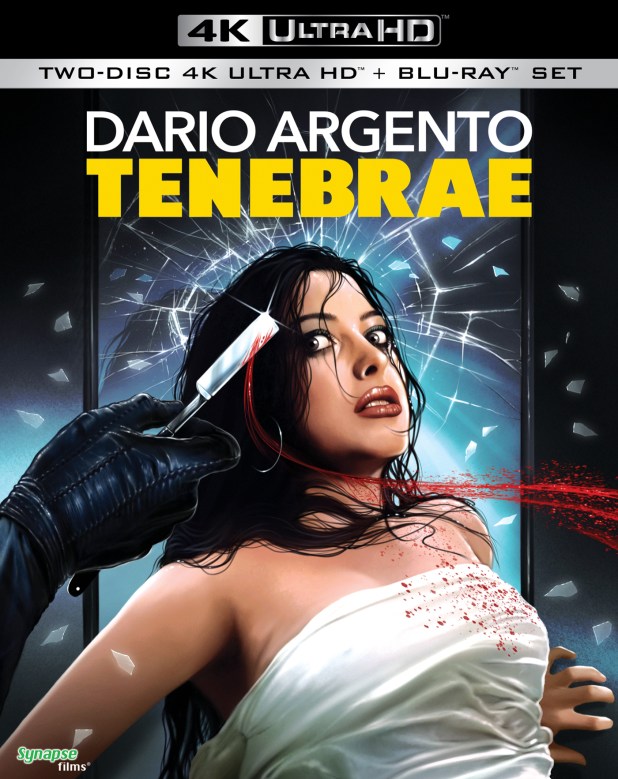
By 1982, Dario Argento had moved beyond the constraints of the giallo genre he had helped popularize and started to explore the supernatural with Suspiria and Inferno. According to the documentary Yellow Fever: The Rise and Fall of the Giallo — which is on the Synapse 4K — the failure of Inferno led to Argento being kindly asked — or demanded — by his producer to return to the giallo with his next film.

Tenebrae is the result and while on the surface it appears to be a return to form, the truth is that it’s perhaps one of the most multilayered and complicated films I’ve ever seen. And while I’ve always believed that Phenomena is Argento’s strangest film — a girl who can talk to bugs befriends a monkey to battle a cannibal child in a foreign country — I have learned that Tenebrae just might be even stranger.

To start, Argento intended for the film to be almost science fiction, taking place five years after a cataclysmic event, in a world where there are less fewer people and as a result, cities are less crowded and the survivors are richer. Argento claims that if you watch Tenebrae with this in mind, it’s very apparent. While he only hinted that the survivors wanted to forget some mystery event, in later interviews he claims that it takes place in an imaginary city where the people left behind try to forget a nuclear war.

In truth, this could be an attempt to explain why Argento decided to show an Italy that he never had in his films before. Whereas in the past he spent so much time showing the landmarks and crowded streets that make up The Eternal City, he would now move into a sleek futuristic look, a Rome that exists but that films had never shown its viewers before. This pushes this film away from past Argento giallo such as his animal trilogy and Deep Red, as well as the waves of imitators that he felt undermined and cheapened his work. There is no travelogue b-roll time wasters in this movie — the actual setting is there for a reason; stark, cold and alienating.

Argento had stated that he “dreamed an imaginary city in which the most amazing things happen,” so he turned to the EUR district of Rome, which was created for the 1942 World’s Fair, and intended by  Mussolini to celebrate two decades of fascism. Therefore, more than showing a Rome that most filmgoers have never seen, he is showing us a Rome that never was or will be; a world where so many have died, yet fascism never succumbed.

Instead of the neon color palette that he’s established in Suspiria or the Bava-influenced blues and reds that lesser lights would use in their giallo, production designer Giuseppe Bassan and Argento invented a clean, cool look; the houses and apartments look sparse and bleached out. When the blood begins to flow — and it does, perhaps more than in any film he’d create before or since — the crimson makes that endless whiteness look even bleaker.

Tenebrae may mean darkness or shadows in Latin, but Argento pushed for the film to be as bright as possible, without the shadowplay that made up much of his past work. In fact, unlike other giallo, much of the plot takes place in the daytime and one murder even takes place in broad daylight.

Again, I feel that this movie is one made of frustration. As Argento tried to escape the giallo box that he himself had made, he found himself pulled back into it in an attempt to have a success at the box office. In this, he finds himself split in two, the division between art and commerce.

As a result, the film is packed with duality. There are two killers: one who we know everything about and is initially heroic; another who we learn almost nothing about other than they are an evil killer. Plus, nearly everyone in this film has a mirror character and soon even everyday objects like phone booths and incidents like car crashes begin happening in pairs.

Peter Neal (Anthony Franciosa, Julie Darling) is set up from the beginning of the film as the traditional giallo hero: he is in a foreign place, deaths are happening all around him and he may be the inspiration or reason why they’re happening. He has more than one double in this film, but for most of it, his doppelganger is Detective Germani. The policeman is a writer himself and a fan of Neal’s work, claiming that he can never figure out who the killer is in his books. Their cat and mouse game seems to set up a final battle; that finale is quick and brutal.

This conversation between the two men sums up the linguistic battle they engage in throughout the film:

Peter Neal: I’ve been charged, I’ve tried building a plot the same way you have. I’ve tried to figure it out; but, I just have this hunch that something is missing, a tiny piece of the jigsaw. Somebody who should be dead is alive, or somebody who should be alive is already dead.

Detective Germani: Explain that.

Peter Neal: You know, there’s a sentence in a Conan Doyle book, “When you have eliminated the impossible, whatever remains, however improbable, must be the truth.”

This last sentence is of great interest to me when it comes to giallo. Normally, these films are not based upon Sir Arthur Conan Doyle, but instead, use Edgar Wallace as a touchpoint. They are also filled with red herrings and nonsensical endings where the impossible and improbable often becomes the final answer to the mystery.

Even the movie’s plot is split in half and mirrors itself. This next sentence gives away the narrative conceit of the film: the murders are solved in the first half, belonging to Christiano Berti (John Steiner, Shock), a TV critic who interviews Neal. The second murders are all Neal’s, who uses an axe instead of a straight razor, and his crimes are personal crimes of passion that aren’t filled with the sexual aggression of Berti’s; they are quick and to the point. Much of giallo is about long, complicated and ornate murder, as well as trying to identify the killer. As the film goes on, with the main killer revealed and the murders becoming less flashy, it’s as if Argento is commenting on the increasing brutality of the genre he helped midwife.

The movie itself starts with the book Tenebrae being burnt in a fireplace with this voiceover: “The impulse had become irresistible. There was only one answer to the fury that tortured him. And so he committed his first act of murder. He had broken the most deep-rooted taboo and found not guilt, not anxiety or fear, but freedom. Any humiliation which stood in his way could be swept aside by the simple act of annihilation: Murder.”

That’s when we meet Neal, an American in Rome, here to promote his latest work of violent horror, Tenebrae. This bit of metafiction is but the first bit of a film that fuses the real and fictional worlds. Joined by Anne (Fulci’s wife Daria Nicolodi) and agent Buller (John Saxon!), Neal begins his press tour.

Before he left, Neal’s fiancée Jane vandalized his suitcase. And moments prior to him landing in Rome, a shoplifter (Ania Pieroni, the babysitter from The House by the Cemetery) who stole his book has been murdered by a straight razor, with pages from said book — again, Tenebrae — stuffed into her mouth. Neal has received an anonymous letter proclaiming that he did the murder to cleanse the world of perversion.

Throughout the film, we see flashbacks of a man being tormented, such as a woman chasing down a young man and forcing him to fellate her high heel while other men hold him down. Later, we see the stereotypical giallo black gloved POV sequence of her being stabbed to death.

Next, one of Neal’s friends, Tilde and her lover Marion are stalked and killed. This sequence nearly breaks the film because nothing can truly see to follow it. In fact, the distributor begged Argento to cut the shot down because it was meaningless, but the director demanded that it remain. Using a Louma crane, the camera darts over and above the couple’s home in a several-minutes-long tracking shot. Any other director would film these murders with quick cuts between the victim and listener in the other room or perhaps employ a split-screen. Not Argento, who continually sends his camera spiraling into the night sky, high above Rome, across a maze of scaffolding; a shot that took three days to capture and lasts but two and a half minutes. In one endless take, the camera goes from rooftop to window, making a fortress of a home seem simple to break into; it’s as if Argento wanted to push the Steadicam open of Halloween to the most ridiculous of directorial masturbation. It’s quite simply breathtaking.

Maria, the daughter of Neal’s landlord, who is presented to us as a pure woman (much of giallo, to use Argento’s own words in Yellow Fever: The Rise and Fall of the Giallo, is split between the good girl and the bad woman), is killed when she discovers the killer’s lair. Neal mentions that Berti, the TV personality, seemed obsessed with him and his words echoed the letters from the killer. As Neal has now become the giallo hero, he must do his own investigation, taking his assistant Gianni (Christian Borromeo, Murder Rock) to spy on the man. They discover him burning photos that prove he is the killer.

As Gianni watches, Berti says, “I killed them all!” before an axe crashes into his skull. Whomever the second murderer is, the young man can’t recall. He finds his boss, Neal, knocked out on the front yard and they escape.

That night, Neal and Anne make love, the first time this has ever happened between the two. And the next morning, Neal leaves his agent’s office and discovers his fiancée Jane is secretly sleeping with someone he once considered his best friend.

Giermani asks Neal to visit Berti’s apartment, where they find that the dead man was obsessed with the writer, but don’t discover any of the burnt evidence. The idea that someone could become so obsessed with your work that they’d kill comes directly from Argento’s life. In Los Angeles in the wake of Suspiria‘s surprising international success, an obsessed fan called Argento’s room again and again. While those calls started off nicely enough, by the end, the fan began explaining how he wanted “to harm Argento in a way that reflected how much the director’s work had affected him” and that in the same way that the director had ruined his life, he wanted to ruin his. Argento hid out in Santa Monica, but the caller found him, so he finally went back to Italy. He claimed that the incident was “symptomatic of that city of broken dreams.”

Back to the real story — or the movie story — at hand: Neal decides to leave Rome. Jane receives a pair of red shoes, like the ones we’ve seen in the flashbacks. Bullmer is waiting for Jane in public before he is murdered in broad daylight. And then Neal’s plane leaves for Paris.

Gianni, however, is haunted by the fact that he can’t remember the crime. He returns to Berti’s apartment and it all comes flooding back to him. This moment of visual blindness — and eventually recovery — suggests that Gianni will be pivotal in the resolution of the film and become a hero; ala Sam in The Bird with the Crystal Plumage or Marcus in Deep Red. Not so in the world of Tenebrae, as he’s killed within moments.

Argento’s callbacks to his past films are not complete — Jane enters her apartment and walks past a sculpture, again directly and visually recalling The Bird with the Crystal Plumage. She’s called Anne and has a gun, so one assumes that she now knows that she’s not the only unfaithful one in her relationship. An axe shatters the scene and the window as Jane’s arm sprays blood everywhere, almost like some demented surrealist painting. This scene was the cause of numerous cuts with Italian censors and the uncut version still packs plenty of punch.

A quick note — for a movie where Argento was supposedly answering his critics that his work had become too violent and anti-female — the fact that he answers them with an inversion of even more gore and dead women is either the most metacomment of all time or he truly does not give a fuck.

Inspector Altieri enters and is also killed, revealing Neal as the murderer. Anne and Giermani arrive, just in time for Neal to testify to killing Berti and everyone afterward before he slits his own throat.

The flashbacks return and we realize they were Neal’s. While Argento never outright shows it in the film, the girl in the flashbacks was played by transgender actress Eva Robin’s (who got her name from Eva Kant from Danger: Diabolik and the author Harold Robbins), so this further adds to the mirrored theme, as one of Neal’s foremost sexual experiences was not just one of humiliation, but of sublimation and even the greatest heterosexual male fear, penetration. That repressed memory of his childhood sexual trauma and revenge, for some reason unlocked, restoked the bloodlust that he had kept in check for years.

As the detective returns inside, we’re gifted with one of Argento’s most arresting pieces of imagery: as Giermani studies the murder scene, his body contains the shape of Neal, who had faked his death. As he looks down and moves out of frame, the killer is revealed. In essence, the inverse doppelganger is revealed. Brian DePalma, a director who trods the same psychosexual violent domain as Argento, used –stole? — a similar shot in his 1992 film, Raising Cain.

Neal waits for Anne to return. When she opens the door, she knocks over the metal sculpture that referenced Argento’s past work and the sculpture impales the killer. This sequence was copied nearly shot for shot in Kenneth Branagh’s Dead Again, a movie just as influenced by Argento’s work, but also one that would receive much more critical praise.

Surrounded by unending horror, Anne simply screams into the rain, unable to stop. This is another meta moment that we can view on multiple levels:

A. Her character is reacting to the hopelessness of the film’s climax in the only way she has left.

B. Nicolodi, like the other Italians in the film, had little to no character to work with. Frustrated, she bonded with lead actor Franciosa over Tennessee Williams plays, leading to her husband Argento growing increasingly jealous as filming progressed (the couple would split three years later). Therefore, her screams are a genuine reaction to the hopelessness she was feeling for real and took the entire crew by surprise.

C. Asia Argento, the daughter of Dario and Nicolodi, has stated that this scene and her mother’s commitment to it, would prove to her that she should be an actress. As she matures in age, it’s notable that Argento’s films make a shift toward female protagonists (and even Asia in that lead role in his movies TraumaThe Stendhal SyndromeThe Phantom of the Opera and the final film in the Suspiria Three Mother’s cycle, The Mother of Tears).

I’ve written nearly three thousand words on this film and feel like I could type so many more. It strikes me on so many levels. According to the audio commentary on the Tenebrae 4K by Kim Newman and Alan Jones, one of Argento’s reoccurring theme is that art can kill. You can take this literally — certainly the sculpture at the end ends Neal’s life — or you can see how the darker art gets, the more it impacts the life of its creator (see Fulci’s Cat in the Brain and Craven’s New Nightmare for variations and mediations on this same theme).

Here, the critic Berti’s obsession with the creator Neal’s work compels him to kill in homage to the writer. Is this Argento’s metacommentary that critics — who have never been kind to his work — can only aspire to slavish devotion to his themes and no new creation of their own? That said, the artist isn’t presented as much worthier of a person. He believes that his violent acts of fiction and violent acts of reality are one and the same, all part of the same tapestry of unreality. When he’s finally confronted by what he’s done, all he can do is yell, “It was like a book … a book!”

The second event in Argento’s real life that informs this film comes from a Japanese tourist being shot dead in the lobby of the Beverly Hilton while the director stayed there. Combined with a drive-by shooting that he saw outside a local cinema — which has to feel like a killing outside of a church to a devotee like Argento — the sheer senselessness of murder in America was another reason that Dario left the country.

He would later remark, “To kill for nothing, that is the true horror of today … when that gesture has no meaning whatsoever it’s completely repugnant, and that’s the sort of atmosphere I wanted to put across in Tenebrae.”

I can see some of that, but for someone who has presented murder as works of art — perfect preplanned symphonies of mayhem — the stunning realization that real life death is ugly and imperfect must have punched Argento right in the metaphorical face.

The Synapse 4K UHD release of Tenebrae has so much to share with you. I’m reviewing the 4K UHD and blu ray combo pack. It has three different audio commentaries: Alan Jones and Kim Newman, Argento expert Thomas Rostock and Maitland McDonagh, author of Broken Mirrors/Broken Minds: The Dark Dreams of Dario Argento. It also has a feature-length documentary, Yellow Fever: The Rise and Fall of the Giallo, which I quoted from throughout this article.

It also has interviews — sometimes multiple ones for each participant — from John Steiner, Maitland McDonagh, Argento, Daria Nicolodim Eva Robins, cinematographer Luciano Tovoli, composer Claudio Simonetti and assistant director Lamberto Bava

Even more? There’s an archival introduction by Nicolodi, an international theatrical trailer, the Japanese Shadow trailer, the alternate opening credits, the Unsane end credits with Kim Wilde’s song “Take Me Tonight” and image galleries.

You can get Tenebrae from MVD. It has my highest recommendation.
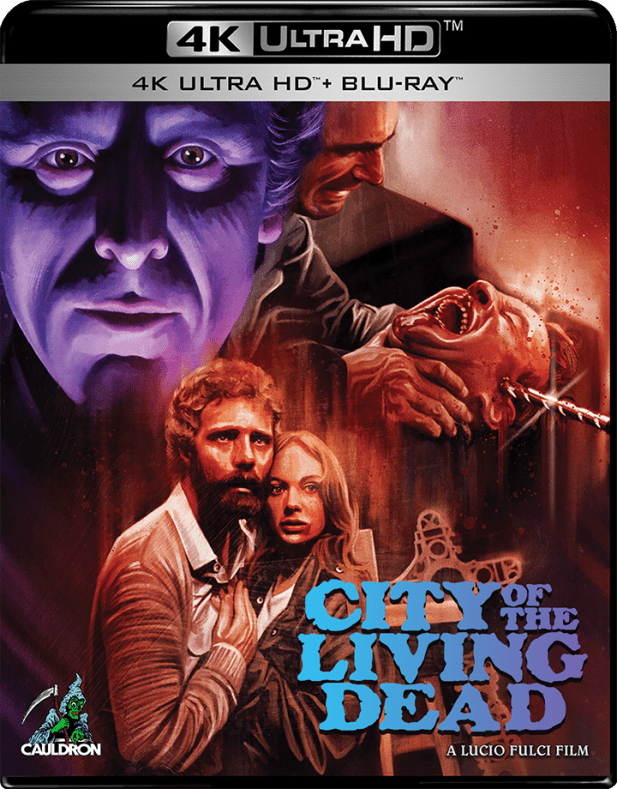
CALUDRON FILMS 4K UHD RELEASE: City of the Living Dead (1980)

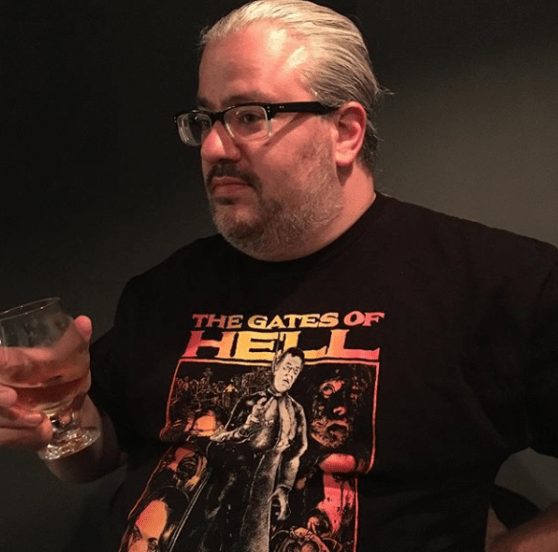
If you ever meet me in person, there’s a 90% chance I’ll be wearing a t-shirt of this movie. Therefore, I find it near impossible to be objective about this film. I love it too much. I can only share my adoration with you, dear reader.

Alternatively known as Paura Nella Città dei Morti Viventi (Fear in the City of the Walking Dead), Twilight of the DeadThe Gates of Hell and Ein Zombie hing am Glockenseil (A Zombie Hung on the Bell Rope), this is the first unofficial chapter in what has become known as Lucio Fulci’s Gates of Hell trilogy, along with The Beyond and The House by the Cemetery.

It all begins with a seance in the apartment of a medium, where Mary Woodhouse (Fulci heroine supreme Catriona MacColl, who appears in all three of the Gates of Hell movies) has a vision of Father Thomas as he commits suicide and opens the gates to the City of the Living Dead. That priest must be destroyed by All Saints Day or the dead will walk the Earth.

The images that she sees send her into a coma, which everyone else believes is her death. She’s buried as the police and journalist Peter Bell (Christopher George, Pieces) investigate her murder. As Peter visits her grave the next day, he hears her screams as the gravediggers discuss porn where a guy has sex so much that he dies (one of those guys is pornstar Michael Gaunt, who was in Barbara Broadcast and the other is an uncredited Perry Pirkanen from Cannibal Holocaust and Cannibal Ferox).

Peter uses a pickaxe (!) to smash his way into the grave, nearly killing her as he saves her life. This scene has been ripped off twice that I know of, once informing the scenes of the Bride in the coffin in Tarantino’s Kill Bill (also look for a scene that takes Rose’s tears of blood later in that movie) and in this year’s abysmal The Nun. Neither of these have the frightening power that Fulci pulls of in this scene or the painful closure at the end, where Mary screams and pants in the open air, her eyes filled with pure terror.

Once Mary recovers, she and Peter visit the medium who reveals the answers behind her visions. As that’s all going on, a weirdo kid named Bob (Anyone named Bob is a Fulci movie is one to be feared) finds a sex doll that somehow inflates itself before being scared off by a rotting fetus. And at Junie’s Lounge, a discussion of how weird Bob is leads to the mirror behind the bar shattering. As they say, strange things are afoot and this is just the start of Fulci’s descent into surrealism.

While all this is going on, psychologist Gerry (Carlo De Mejo, Manhattan Baby) is consulting Sandra (Janet Agren, Night of the SharksHands of Steel) about life and how she used to want to marry her father before he ran out on her family. Just then, his girlfriend Emily arrives and tells him that she’s on the way to try to help Bob. When she finds him, he’s crying on the floor and shoves her away, just as Father Thomas appears and smothers her to death with a hand full of maggots.

Obviously, if you think anything is going to make sense in this movie from here on out, you aren’t ready for this era Fulci. There are no filters left, just a demented Italian madman let loose in America with tons of fake blood, guts and film to burn.

One of my favorite scenes in the film is when Rose and Tommy (a young Michele Soavi ) are making out in his car and she thinks she hears a noise. It’s a total slasher moment that any other director would handle in a rote way. Instead, Fulci has the couple turn on the headlights and there is no joke or defusion of the tension. Instead, we see the priest hanging by the neck in front of them as Rose’s eyeballs bleed and she throws up her intestines (Daniela Doria is pretty much decimated by Fulci in every movie she did for him, including being knifed through the back of the head in the opening of The House by the Cemetery, has her chest and face sliced up brutally in The New York Ripper and asphyxiated in The Black Cat. I have no idea what he ever did to her, but you can read a great interview with her here. And yes, she did this scene by throwing up tripe and fake blood.). Then, Tommy’s head is ripped open.

Everyone suspects that Bob is behind the many disappearances in Dunwich, which totally isn’t going to keep Peter and Mary from heading there.

We’ve fully descended into Fulci world at this point. Bob is seeing visions of Father Thomas, a mortician gets bitten by a corpse when he tries to steal her jewelry, Emily’s zombie visits her little brother John-John, the same corpse that bit the mortician shows up in Sandra’s kitchen and broken glasses fly all over her house, spraying the room with blood. Meanwhile, Bob’s just trying to hide out and smoke a joint with Mr. Ross’s teenage daughter when the man comes in, nearly insane, and kills him with a drill press.

Yep. In any other movie, they’d tease death by drill or show you the moment before impact. Fulci revels in this scene and makes it last. Yes, that drill is going inside Bob’s head. And it’s coming out the other side, too.

Peter and Mary make their way to Dunwich, where they meet up with Gerry and Sandra. While they’re talking, a storm of maggots — oh that Fulci! — rains down on them. To top it off, Gerry gets a call that his dead girlfriend has risen from the grave and killed John-John’s parents. Sandra offers to take the kid to her apartment, but Emily is there and rips her scalp off before they save the boy just in time for a state of emergency to be declared.

Remember that bar at the beginning? Zombies invade it and kill everyone just as All Saints Day begins. Peter, Gerry and Mary (not Peter, Paul and Mary) go into the family tomb of Father Thomas, filled with skeletons, cobwebs and fog. Just to prove that this is 100% a Lucio Fulci film, Peter, who we’ve been led to believe is the main male hero, is killed when a zombie rips his brains out. Mary and Gerry battle Sandra and an army of zombies until they encounter the sinister priest, who makes Mary’s eyes bleed.

Before she can throw up her innards, Gerry stabs him with a cross and his guts fall out as he and the rest of the zombies go up in flames and become dust, with the Gates of Hell closed.

Mary and Gerry exit from the tomb to discover John-John and the police, but she soon screams as he comes near her and the film shatters to blackness. Wait — what just happened?

There are a ton of stories about the true ending of this movie. Some say John-John was supposed to be a zombie and the negative of the original recording was destroyed by a lab. I’ve also heard that the editor spilled coffee on the footage, forcing Fulci to improvise. And then some stories claim Fulci changed his mind about the end after the shooting was complete and just went with this. Interestingly, the Danish version of the film ends with a dark move across the graveyard and this text: “The soul that pines for eternity shall outspan death, you dweller of the twilight void come Dunwich.”

Trivia note: The movie Uncle Sam ends exactly the same way with the only exception being a title card that says, “For Lucio.”

Who knows how it ends! Who knows what the hell is going on for long stretches of this movie! It doesn’t matter! As Fulci would say, this is an absolute movie of images, a triumph of style (and gore) over substance.

The first time I saw this film was a third generation — or worse — dub on Hart Fischer’s American Horrors ROKU channel. As much as I love having 4K versions of things on blu ray, this is just about a movie made for the fuzzy quality of an old VHS tape. And yet here I am discussing the 4K release!

Obviously, this was written by Dardano Sacchetti, who was behind so many of Fulci’s scripts, like ZombiManhattan Baby and Conquest, as well as so many other awesome movies like Thunder and Demons.

This disc is filled with extras, including new audio commentary with film historian Samm Deighan, archival audio commentary with film historians Troy Howarth and Nathaniel Thompson — which is what I listened to on my first spin through this disc and as you can imagine from these talents, it’s absolutely packed with information, including the deep cut credits and the differences between the Italian and English dubs — as well as two other archival commentaries by actress Catriona MacColl moderated by Jay Slater and actor Giovanni Lombardo Radice moderated by Calum Waddell. There are also interviews with Massimo Antonello Geleng and Radice; Q&A sessions with Venantino Venantini and Ruggero Deodato, Carlo De Mejo, MacColl and Fabio Frizzi; a featurette on The Meat Munching Movies of Gino De Rossi and A Trip Through Bonaventure Cemetery; a Catriona Maccoll video intro from 2001; an image gallery; even more archival extras and surprises — as promised and I know there are Easter Eggs but I haven’t found any — all with a double-sided wrap with artwork by Matthew Therrien.

You can order City of the Living Dead from MVD or Cauldron Films.

TUBI ORIGINAL: The Siege (2023)

After being compromised during a mission gone wrong, an international assassin named Walker (Daniel Stisen) is sent to Reassignment Center 42. There, he’ll get a new identity and be able to erase any trace of his last job and even his past.

However, a ruthless team of operatives led by Keates (Samantha Schnitzler) storms the secure compound forcing Walker to team up with an elite hitwoman named Elda (Lauren Okadigbo) and her mysterious charge Juliet (Yennis Cheung).

Who will survive The Siege?

Directed by Brad Watson and written by Nicole Bartlett, this is a movie mostly cast with stunt performers, which means that it’s all action from literally the first few minutes. You’re not coming to a movie like this for emotional resonance. You want to see people fire guns, do ill-advised stunts and beat the stuffing out of one another. I’m happy to report that this movie delivers more of that than you’ll find in probably ten other movies.

If video stores still existed on the scale of the past, this is the kind of movie that people would rent and be really surprised how much they liked it. They’d say, “I watched this movie with this super muscular dude getting in all these fights, two women had a brutal brawl and man, some dude used pliers to take the teeth from all the people he killed. It was pretty awesome.”

It is pretty awesome.

You can watch The Siege on Tubi.

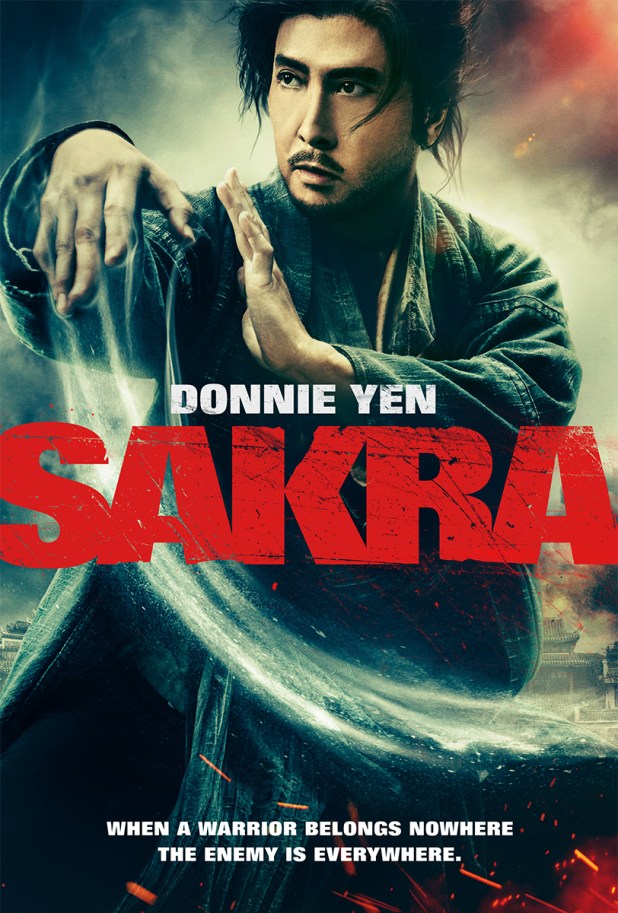
WELL GO USA BLU RAY RELEASE: Sakra (2023)

Based on the wuxia book Demi-Gods and Semi-Devils by Jin Yong, Sakra has action icon Donnie Yen returning to the director’s chair along with Kam Ka-wai and Cheng Wai-man for the first time in nearly two decades while also playing the lead role. Yen is Qiao Feng, the respected leader of a roving band of martial artists called the Beggars’ Sect. After he is framed for the murder of deputy chief Ma Dayuan, his parents and Xuanku, one of the sect’s elders, he is exiled, Qiao Feng decides to seek out where he came from and who the enemies are that have been trying to destroy him.

He escapes along with a servant named Azhu who is nearly killed. Qiao Feng takes her to be healed by doctor Xue Muhua and offers his life to save hers. He jumps into battle against his old sect and is nearly killed before someone destroys all of his attackers.

This leads to Qiao Feng learning who he is, his connection to Azhu, the quest to find the Leading Big Brother and so many more adventures. I liked how Qiao Feng is a man of honor, one willing to drink tea with his enemies before they battle and a man always seeking answers.

You can get this from Well Go USA.

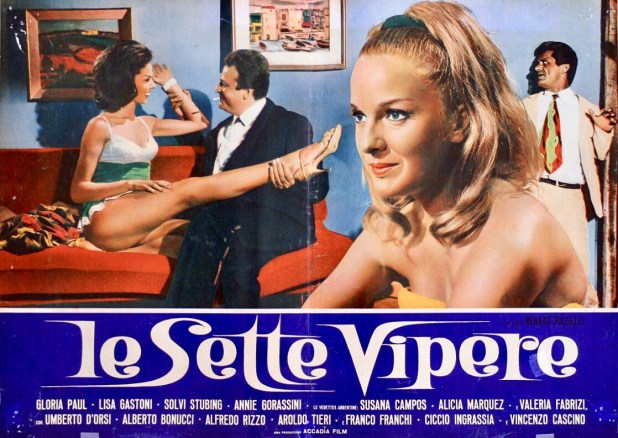
THE FILMS OF RENATO POLSELLI: Le sette vipere (Il marito latino) (1964)

It’s so strange to see a restrained Renato Polselli. But soon enough, he’d have literal insanity on the screen and we’d all be there for every moment. Until then, there’s this dramatic film in which a woman has her husband’s estate taken, him thrown out of their house and gets custody of their two children. The man flees to Italy with the children and fights for his rights, which is ahead of its time for 1964.

It was written by its star, Vincenzo Cascino, who also made 7 Golden Women Against Two 07, Le sette cinesi d’oro and produced Polselli’s The Sheriff Won’t Shoot. Polselli would often find himself working with actors who either wrote or produced their own films.

Cascino plays Lorenzo, an Argentinian industrialist married — and not happily — to Erika (Lisa Gastoni). Working with her lawyer Emilio Bernasconi (Umberto D’Orsi), she gets him in a sleazy takedown with another woman, seizes the estate and takes their children. For some reason, Lorenzo starts hearing voices in his head and, this being a Polselli movie, much of the film is given to jazz music parties with women dancing, including Solvi Stubing (Strip Nude for Your Killer), Annie Gorassini (Danger: Diabolik) and Gloria Paul (3 Supermen a Tokyo).

You can watch this on YouTube.