THE FILMS OF RENATO POLSELLI: The Sheriff Won’t Shoot (1965)

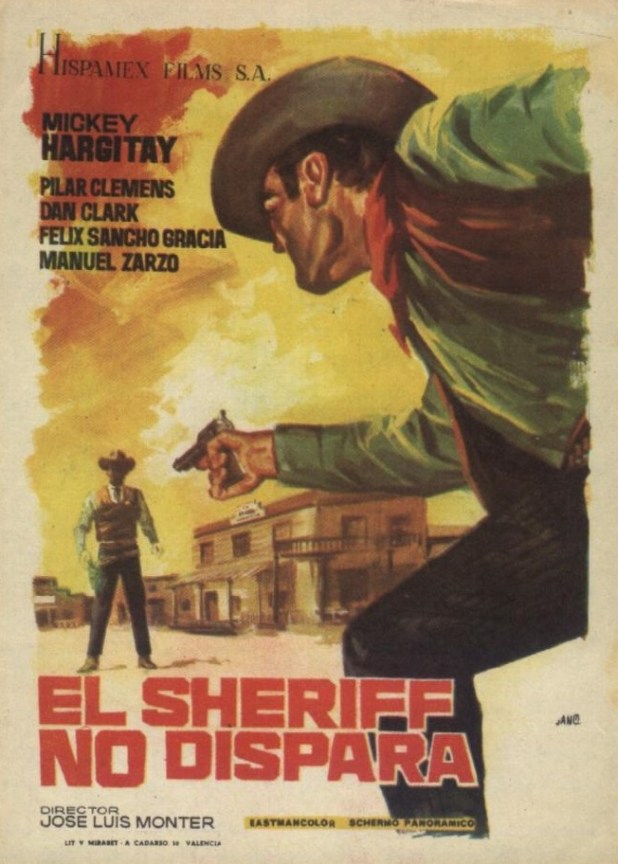
In the interview with Jay Slater that I have been referring to throughout my discussion of the films of Renato Polselli, this is mentioned as the director trying his hands at a Western: “Lo sceriffo che non spara tells of a muscular sheriff (played by Polselli regular Mickey Hargitay) who doesn’t need bullets to rid his town of villains — his brawn will suffice. Polselli is keen to point out that he directed the entire movie and it was not co-directed with Roberto Montero. Apparently, as the film was an Italian and Spanish co-production, the Spaniards asked if they could have one of their directors credited. The Spanish producers felt that it would make financial common sense if it was credited to an Italian and a Spaniard — therefore Montero’s name was plastered on the credits as co-director. Like most Italian directors who worked in the horror and western genres, Polselli discarded his own name and adopted a pseudonym. “I thought Ralph Brown sounded better to an American than Renato Polselli. Besides, they dislike Italian names — too much tongue-twisting for them! This is why us Italians used pseudonyms for all our Spaghetti Westerns. We did our best to fool them!”

Lo sceriffo che non spara was the first film Polselli made with Mickey “Mr. Universe’ Hargitay.” Polselli is eager to spill the beans on Hargitay. “When I came to direct Delirio caldo, the producer called me to say that an actor was wandering around Rome looking for work. I convinced the producer that Hargitay was my ideal choice and even fooled him into thinking he was an American. I remember one night I introduced Hargitay to the producer. As the producer thought Hargitay was American, he spoke in English and Hargitay had to apologize and say “I’m sorry, I don’t speak a word of English!” He was very strong, but hardly a bodybuilder like you see him in the films. He once boasted he could rip a Yellow Pages book in half — and he did!”

Jim Day (Dan Clark AKA Marco Mariani) was once the fastest gun in the Italian West until he accidentally shot his father. He’s hung up his guns and still his father-in-law makes him the sheriff of Richmond. Then, his brother Alanb (Hargitay) is in town, making shady deals with that very same father-in-law, who soon rips him and his gang off for $100,000 grand. Making things even worse is that Jim also takes up with his brother’s wife, Desiree Vermont (Aïché Nana AKA Nana Aslanoglu, a Turkish belly dancer who was also in Images In a ConventPorno MondoA…For Assassin and Due occhi per uccidere. Solvi Stubing also appears as the orphaned daughter of the last sheriff. She’s also in Strip Nude for Your KillerDeported Women of the SS Special Section and Special Agent Super Dragon.

Polselli used the name Lionel A. Prestol, while production manager Nello Vanin is Bruno Vani, who often served that job under Polselli. 

It’s a pretty basic Western with none of the insane touches that Polselli would later add to his filmmaking. But if we must be a completist, we must finish all the films, correct?

CANNON CANON CATCH-UP: Lone Wolf McQuade (1983)

EDITOR’S NOTE: Nothing gives me greater joy than when our site gets mentioned on my favorite podcast, The Cannon Canon. There are a few movies they’ve covered that I haven’t, so it’s time to fix that.

I have no idea why Lone Wolf McQuade hasn’t been on the site.

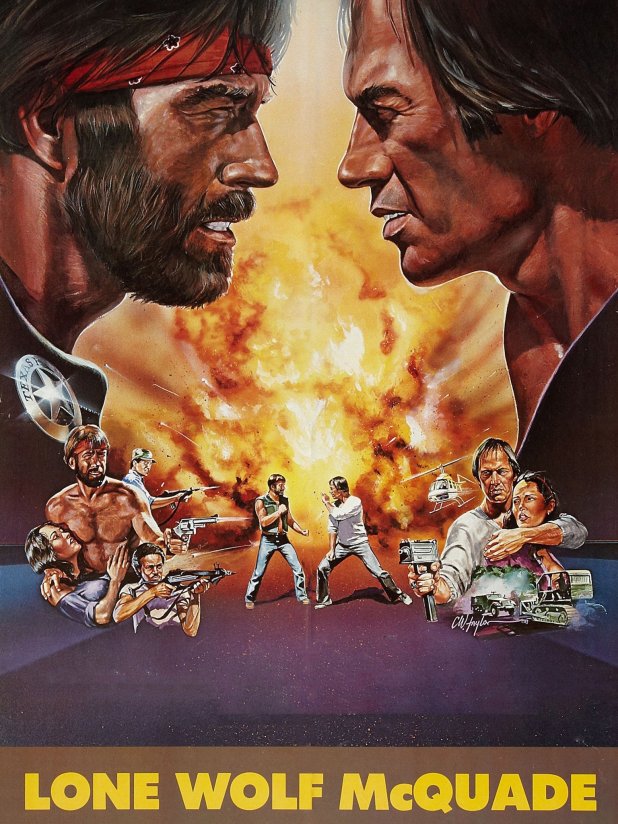
I mean, it pits Chuck Norris as McQuade — along with a pet wolf! — against Rawley Wilkes (David Carradine) and has a supporting cast of Dana Kimmell (Friday the 13th 3DSweet Sixteen) as McQuade’s daughter, Barbara Carrera as the love interest and Robert Beltran, Leon Isaac Kennedy, L.Q. Jones and R.G. Armstrong as fellow cops.

Directed by Steve Carver (The Arena, Steel), this had the director work with writer B.J. Nelson to “mess up” Norris’ on-screen image by having him grow a beard, drink beer and be in a Sergio Leone-inspired movie. Carradine is also a great for him; he told Psychotronic Magazine, “Chuck had a feeling when I was working with him, that he wanted to be a better actor. At one point, when we were working on the fight, I got close to him, and I said. This is really right man, puttin’ your face in the dirt.’ And he looked at me, you know, and he didn’t expect that from me. And we got to be buddies. For just that period. I don’t hang around with Chuck. Chuck mainly doesn’t like to work with co-stars. His movies are all solo movies.”

Carver had high marks for Norris and spoke of the difficulties of getting the trained martial artist to loosen up and act: If you block a scene with an athlete, if you ask an athlete to move from point A to B, or to pick up something, or do anything, he will do these movements mechanically. Which is not a bad thing, because with every rehearsal the movement becomes more fluid. Whereas a theatre actor will project their movements and their dialogue. It’s a stage to them. That’s the difference. Chuck was a little bit stiff in An Eye For An Eye. He became looser in Lone Wolf McQuade. After that he became better with every picture he did.”

It all worked, as Roger Ebert noted the Italian Western parts of the story and even gave this film three out of four stars. And how can you not love a movie where Chuck Norris uses a supercharged truck to break out of a makeshift grave?

Sadly, Carver and Norris would have a parting of the ways. Norris credits Lone Wolf McQuade as the inspiration for his hit television series Walker, Texas Ranger.  In fact, the pilor had to be rewritten because it was a Lone Wolf McQuade. This Orion Pictures film, much like the other Cannon Pictures movies that Norris worked on, are all owned by MGM. Left in the dust were Carver and his production partner Yoram Ben-Ami, who sued the producers of Walker, Texas Ranger for $500 million dollars. He would say years later that the lawsuit was where he and Chuck stopped being friends, as well as saying, “MGM and CBS had bigger and better and more lawyers than we did, all the way to the Supreme Court. We failed to convince the Supreme Court that there were similarities. Now, you and I and anybody else knows that there are similarities between Lone Wolf McQuade and Walker Texas Ranger.”

You can listen to The Cannon Canon episode of Lone Wolf McQuade here.

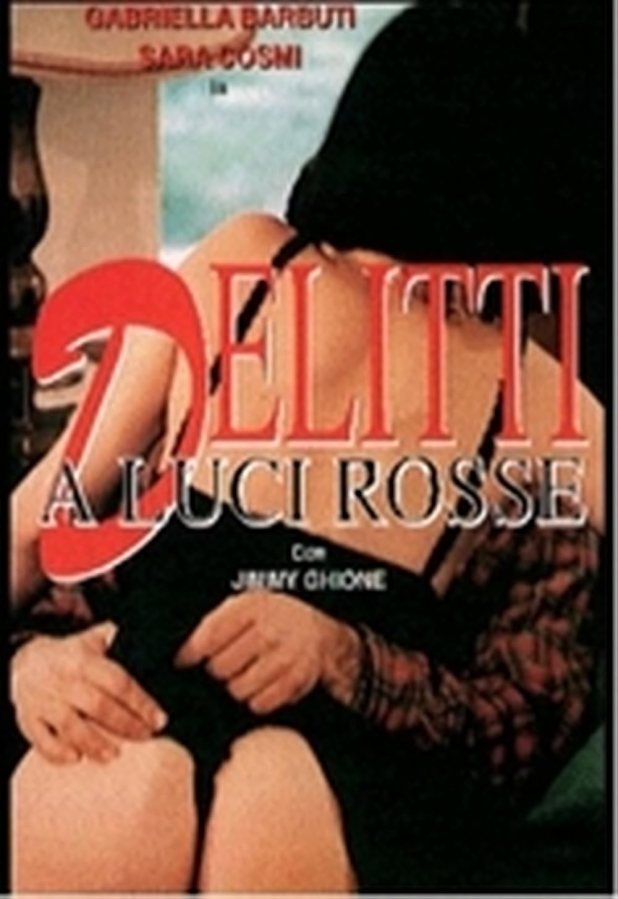
THE FILMS OF RENATO POLSELLI: Delitti a luce rossa (1996)

Directed by Pasquale Fanetti, who often worked as a cinematographer on movies like Lady Chatterley’s Passions 2: Julie’s Secret and Penombra, as well as directing Lady Emanuelle and 1990’s Top Model 2, which was written by Ernesto Gastaldi and Roberto Leoni while seemingly having nothing to do with the Joe D’Amato movies, Intimate Crimes has the traditional large Italian writing room, including Albert Barney, Pino Buricchi (who wrote The Red Monks to give you an idea of this film’s quality) and Gaetano Russo (the writer of Trhauma and director of Crazy Blood and Abisso Nero), as well as a late in his career Renato Polselli.

This comes in the time when the giallo has become the erotic thriller and when the sex part of the sex crimes is more important than the crime, so to speak. Yet at the heart of all erotic thrillers beats the yellow blood of Edgar Wallace-influenced murder mysteries and this is no different, even if the nudity is more abundant and some of the sex scenes seem downright painful. I mean, people do not couple in this way ever, their parts do not match or come together in this way and yet we have been instructed by not just Hollywood that everyone ruts together in such a stiff and natural way.

Gabriella Barbuti, who plays Claudia, is in Karate Warrior 6. Sometimes, the deeper you go into watching these movies, the more you realize that you are gaining arcane knowledge. However, unlike in magic or, let’s say, something that would be beneficial to humanity, you only have this knowledge for yourself. She’s also in P.O. Box Tinto Brass, a movie where women write letters to the famous dirty old man director and tell him their fantasies and the Sergio Martino-directed, Umberto Lenzi-written Craving Desire, speaking of giallo masters trying to remain relevant in the 90s. She looks exactly as you would expect an actress in a Tinto Brass movie to look and I mean that as the highest of compliments. Another actress he used was Sara Cosmi, who plays Valeria. She’s also in P.O. Box Tinto Brass.

Sadly, so much of this feels uninspired. I always think the men who made actual giallo would gaze out the window while making these and think wistful thoughts back to the late 60s or early 70s, when life was a bit younger, when it didn’t feel like work to get out of bed in the morning, when the cradle was closer than the grave. It’s for them that I watch these later efforts, as if to put a hand on their sleazy shoulders and say, “I will still be here for you, even if it is only metaphorically and through the tracking of ancient VHS posted digitally through pirated files.”

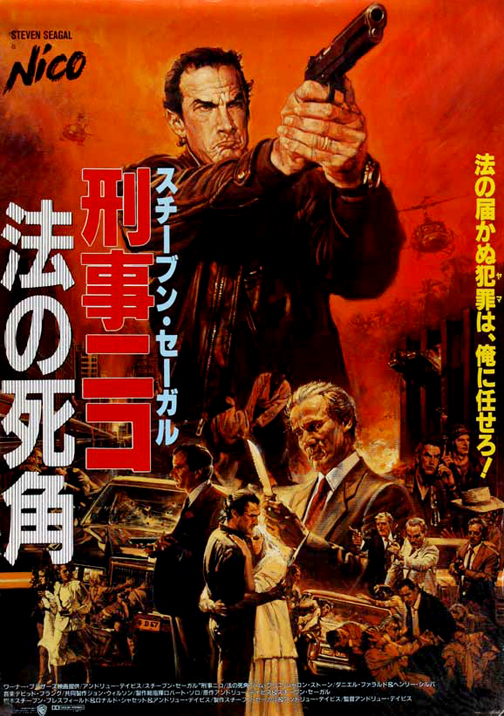
CANNON CANON CATCH-UP: Above The Law (1988)

EDITOR’S NOTE: Nothing gives me greater joy than when our site gets mentioned on my favorite podcast, The Cannon Canon. There are a few movies they’ve covered that I haven’t, so it’s time to fix that.

Steven Segal has barely been on our site and that’s for a reason.

I don’t get it.

I’ve known plenty of action movie lovers that were obsessed with him. I dated a girl who would always rent his movies when given the option. And yes, I am old, we rented video cassettes from a mom and pop store and made out while watching Steven Segal movies.

This is Segal’s first movie. Now, finding the exact facts about the man’s life is tricky, but here’s what I think is true. He was born in Lansing, Michigan to an Irish medical technician mother and Jewish math teacher father. I have no idea where the Italian and Asian mystic parts of him come from. Confounding me further is the fact that his grandparents were Russian Jewish immigrants with some Yakut and Buryat heritage.

Seagal is the Hulk Hogan of action movies and by that, I don’t mean he’s orange and on steroids. He has the same propensity for lying and his nontruths are easily proven wrong. Like how Seagal was a student of the founder of aikido, Morihei Ueshiba, yet Ueshiba died in 1969 when Seagal was 17 and Seagal didn’t move to Japan until the of 22, to allegedly avoid the draft by marrying a Japanese national named Miyako Fujitani.

Fujitani doesn’t mince words about her ex-husband. In an infamous article that got Spy Magazine sued, she said that the actor worked in her family’s aikido school and received his degree under dubious circumstances: The only reason Steven was awarded the black belt was because the judge, who was famous for his laziness, fell asleep during Steven’s presentation. The judge just gave him the black belt.” He told her “I never will betray you”, right before he took all her savings and moved back to America. She claims that she “scrimped and saved for years, even denying herself and her children necessities, to help pay his way home.”

Without seeking a divorce, Seagal went ahead and married Adrienne La Russa in 1984, followed by actress Kelly LeBrock. La Russa told Spy that she couldn’t say much, “Because I am afraid of Steven and his friends.”

That’s because for years, Seagal has claimed underworld and black ops ties. Seagal told People early in his career, “They saw my abilities, both with martial arts and with the language. You could say that I became an advisor to several CIA agents in the field, and through my friends in the CIA, I met many powerful people and did special works and favors.”

After opening a dojo with stuntman Craig Dunn in New Mexico, he also started the Aikido Ten Shin Dojo in Hollywood with his senior student Haruo Matsuoka. That’s where he trained Michael Ovitz, at the time the biggest agent in the business.

“Michael and I are very close–we love each other,” Seagal said. “I’m like a guru to him.”

As for Ovitz, it was claimed that he believed that he could make anyone a movie star.

Now, Above the Law is before all the blues records, the TV reality show that has him teaching cops, the horrifying SNL appearance, the lawsuits, the collusion with Russia — I have no idea how anyone can still be a fan of him. Actually, I totally do, because if anyone symbolizes the MAGA side of action movies — even more than Bronson or Norris — it’s Steven Seagal.  He can do interviews where he says that Vladimir Putin is “one of the great living world leaders,” teach cops how to shoot guns, be against athletes protesting before games and writing the novel The Way of the Shadow Wolves: The Deep State And The Hijacking Of America. Let’s go further. He’s been shown in photos with Philippine President Rodrigo Duterte, been referred to as the “brother” of Venezuelan President Nicolás Maduro and celebrated his birthday in Russian with pro-Kremlin friends as the invasion of Ukraine was happening.

Oh man, Steven Seagal.

I didn’t even mention that the double entendre — actually, it was just outright being a jerk — he made to a production assistant who he caught brushing her teeth.

Man, I don’t even want to talk about this movie.

I’ll try.

I mean, he’s prohibited from promoting bitcoin at this point. Or that he broke Sean Connery’s wrist on the set of Never Say Never Again. Or that he has been known for brutalizing stuntmen who appeared in movies with him.

Ah, OK. Let’s just get to the movie.

Sergeant Nico Toscani is exactly the person that Steven Seagal wants us to believe that he is. A tough Chicago vice cop who can trace his roots to Palermo, Sicily, he moved to Japan was a young man to study martial arts and was recruited by the CIA and assigned to covert operations on the Vietnamese-Cambodian border during the Vietnam War. He left the CIA when he refused to be part of torture, moved back to the U.S. and started being a cop.

Working with Detective Delores “Jacks” Jackson (Pam Grier) are on the trail of drug dealers and suddenly ordered off the case, as those scumbags are working with the very same CIA boss that caused Nico to leave the agency, Kurt Zagon (Henry Silva). Also, to make this even better, Seagal — sorry, Nico — is married to the gorgeous Sara (Sharon Stone) and when she’s threatened, he has to go…above the law.

At least they put together a great cast and crew for this movie. Director Andrew Davis would also direct The Final TerrorCode of SilenceUnder Siege and was the cinematographer on Private PartsMansion of the Doomed and the DP on Angel. He worked on the story of this movie with Seagal and then polished the script with Steven Pressfield (King Kong LivesFreejack) and Ronald Shusett, who has big league credits like AlienAliensTotal RecallPhobia and Dead & Buried.

Seagal looks and moves like no one else in movies. I don’t know, maybe Ovitz was right in that he could plug anyone into an action movie and make him a star. Since this movie, Seagal has been in around sixty movies. That’s pretty good staying power for just being anyone. And despite all his controversies, he made a film as recently as 2019’s Beyond the Law.

You can listen to The Cannon Canon episode of Above the Law here.

INTERVIEW WITH CRAIG ROGERS AND DENNIS BARTOK FROM DEAF CROCODILE

Deaf Crocodile was founded by two experienced arthouse veterans, Craig Rogers and Dennis Bartok, with nearly 30 years’ experience in specialized exhibition, programming, distribution and restoration services. Together, they bring an eclectic and passionate sensibility to their slate of films, collaborating with a network of like-minded curators and filmmakers from around the world.

They’re also one of my favorite physical media labels.

I didn’t want to keep all their amazing work to myself and hope that with this interview, I can get you excited about what they’re doing and buying — and most importantly, watching — the movies that they release.

B&S About Movies: How did you guys decide to start Deaf Crocodile? Did you work on past films?

Dennis Bartok: Craig and I worked together at two previous boutique distribution and restoration companies, Cinelicious Pics and Arbelos, where we licensed and he restored a number of films including Eiichi Yamamoto’s psychedelic animated witchcraft movie Belladonna of Sadness, Toshio Matsumoto’s transgender drama Funeral Parade of Roses, Leslie Stevens’ long-lost California noir Private Property, Bela Tarr’s Satantango, Dennis Hopper’s The Last Movie and others.

We launched Deaf Crocodile together three years ago to explore a wider range of films we love including animated movies like The Pied PiperDelta Space Mission, The Son of the Stars and Heroic Times, amazing lost DIY crime films like Sal Watts’ Solomon King and epic fantasies such as the three Aleksandr Ptushko films we’ve released (Ilya Muromets, Sampo and The Tale of Tsar Saltan).  We’re also great fans of new World Cinema and particularly independent filmmaking from South Asia and Iran…although not exclusively from those areas!

Craig Rogers: As Dennis said, we both worked together previously at Cinelicious Pics and were co-founders of Arbelos. I was working as the lead restoration artist for Cinelicious when Dennis came aboard to launch the distribution arm of the company. Prior to that I worked for over a decade at IMAX. We both have long histories of working in “the industry.”

An example of one of the films Deaf Crocodile has released, The Tale of Tsar Saltan.

B&S: What is the perfect release for your label?

Dennis:  I don’t think there’s a “perfect” release because Craig and I love so many different kinds of movies, and there’s honestly tens of thousands of films out there waiting to be rediscovered.  Most of our releases have a kind of arthouse / genre crossover vibe, and we really like movies that mix up different genres and styles of filmmaking like Jean-Louis Roy’s superspy / Cold War / sci-fi satire The Unknown Man of Shandigor and Karen Shakhnazarov’s surreal, Kafkaesque Zerograd. The Ptushko films seem to have really struck a chord with people — he’s been one of my favorite fantasy filmmakers for many years, and I organized a retrospective of his films in the early 2000s when I was programming for the American Cinematheque in L.A. So it’s great to be able to release beautiful blu ray editions of his films through Deaf Crocodile.

Craig: We do have a reputation of releasing films that no one has ever heard of before, but once folks see them, they love them. We’re very proud of the trust we’ve gained in the blu ray community and how many people “blind buy” our titles. That said, as much as we love bringing these lost and forgotten films to people, we don’t want to limit ourselves really in any way. A good film is a good film and if we find something we both love and it’s in need of a proper restoration and/or release that’s really the only bar for us.

B&S: Is it difficult to release non-genre or difficult material to boutique physical media buyers?

Dennis: I’d say most of our films are genre movies but in strange and surprising ways, like The Assassin of the Tsar starring Malcolm McDowell which is a sort of time-traveling psychodrama mystery about a mental patient convinced he killed two Russian czars.  We’ve been really fortunate that pretty much all of our blu ray releases so far have done well.

Craig: Genre stuff certainly has a built-in audience. The budgets and margins are so tight for small labels that risk reduction becomes somewhat imperative. That’s why you see so much genre product coming out of the boutique labels on disc. As I said before, we don’t want to limit the types of films we release, but there is definitely a reason you see so much genre material being released from all the boutique labels.

The Assassin of the Tsar, a recent Deaf Crocodile release.

B&S: What’s a dream project for you guys?

Dennis: The ones that we’re still working on!  Honestly, many of our releases take years and years to happen — probably two to five years on average.

Craig: A dream? I know there is a lot of film material in Prince’s vault in Minnesota. Restoring any of that material would most certainly qualify as a dream project.

B&S: What’s the hardest part of what you do?

Dennis: Being patient and persistent.  There are deals that seem to evaporate after many months of negotiations — then we’ll wait a while, and approach the rights holders again, and sometimes we get lucky and things fall into place.  But it takes a hell of a lot of patience!

Craig: No lie…lack of time. As a two-man operation we have to wear ALL the hats. Restoration is only a fraction of my day. With each new title we add to our catalog, that’s just more items added to the “to do” list. Long after the restoration work is done on a title there’s still so much more to do. Digital outlets all require different files, formats and artwork. Producing the trailers, blu ray extras, managing the Kickstarter projects, bookkeeping. It’s a lot. Also, being as small as we are, we need to keep active on social media. Podcasts, YouTube, Twitter, Facebook, Instagram — interviews like this. There’s sooo much great content being announced daily at this point – it’s a struggle to make our little brand heard. It’s a good thing we love it as much as we do. This is the definition of a passion project.

One of my favorite Deaf Crocodile releases, Prague Nights.

B&S: Other than your work, what’s one of your favorite physical media releases?

Dennis: That’s a tough question because Craig and I are both huge physical media fans and really admire the work of a lot of smaller and mainstream labels. A few that come to mind: Scream Factory’s Paul Naschy Collections I and II and Scorpion Releasing’s Assignment Terror. Vinegar Syndrome’s Santo vs. Dr. Death. Kino Lorber’s The Golem, Arrow’s Mill of the Stone Women. Universal’s Alfred Hitchcock – The Masterpiece Collection. Criterion Collection’s release of Franju’s Judex. Indicator’s set of Night of the Demon. The recent Kino Lorber Blu-rays of the Technicolor 1940s Maria Montez films like Cobra Woman, Ali Baba & the 40 Thieves and others are wonderful additions.

Craig: For me it’s really all about the movie. A terrific restoration and authored disc of any of my favorite films always makes me very happy. Bonus features and nice packaging are welcome gravy, but it’s all about the film itself for me. Off the top of my head…the recent Scorsese 4K discs (Raging Bull, After Hours and The Irishman), Arrow’s The Thing and Ronin, Second Sight’s The Changeling…I could go on all night.

B&S: Of all your releases which one best sums up the label?

Dennis: For me I’d say Sal Watts’ Solomon King because the film was lost for so many years, and it’s such an entertaining movie and a great time capsule of Black culture, music and fashion in Oakland in the early 1970s. It was something of a miracle that we were able to connect with Sal’s amazing wife and partner Belinda Burton Watts, and an equal miracle that we located the only known complete print of the film at UCLA Film & TV Archive who loaned it for the restoration. The restoration itself was even more of a miracle, restoring color and vibrancy to a badly faded and scratched print. The interview with Belinda on the disc where she talks for over two hours about her and Sal’s childhoods and lives and careers is just as important, maybe more important, than the film itself. So that’s one I’m incredibly proud of.

Craig: Hmmm…maybe our first? The Unknown Man of Shandigor. Completely unknown in the US before our release. GORGEOUS photography, high quality restoration and encoding. Insightful commentary, essay and interview. The film itself is a parody that’s played so straight it also works as a terrific spy/thriller of its own. I like that you don’t quite know what to make of it. I think that can be said of a number of our releases. It’s important to go into a film -hell life, without expectations. Accept and enjoy things for what they are. Putting your expectations on things too often leads to disappointment.
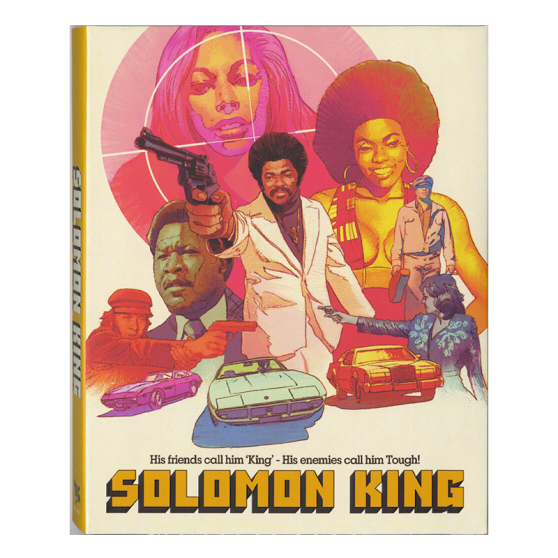
The amazing Solomon King.

B&S: What’s a country underserved and unseen for their films?

Dennis: There are too many to mention, but I’d dearly love to restore some rare and classic Bollywood films from the 1950s, 1960s and 1970s. Croatian cinema from that same period is also astonishing: filmmakers like Vatroslav Mimica and Krsto Papic really deserve to be rediscovered.

Craig: Too many to name. We’re doing our best to try and help with that problem though. If I’ve learned anything over the past decade it’s that there are far more amazing films than I ever could have imagined. Countless stories from countless voices. It’s really easy to go into the hobby of watching films and have blinders on. “Oh, I don’t watch black and white movies” or “I hate subtitles,” you’re only hurting yourself, closing yourself off from some absolutely astonishing films. Be a sponge…soak it ALL in. The more diversity of films you see, the more your overall enjoyment of cinema will grow. I guarantee it.

To find all of these amazing movies…

Learn more about Deaf Crocodile at their official site.

To keep incredible movies coming, the best thing you can do is order directly from them. Their online shop has all of their latest releases, including The Pied PiperHeroic TimesPrague Nights, Time of Roses, The Assassin of the TsarThe Son of the Stars, Solomon King, ZerogradSampoThe Time Bending Mysteries of Shahram MokriIlya MurometsDelta Space Mission and The Unknown Man of Shandigor

Thanks to Craig and Dennis for sharing their valuable time and for giving us such challenging and gorgeous films to discover.
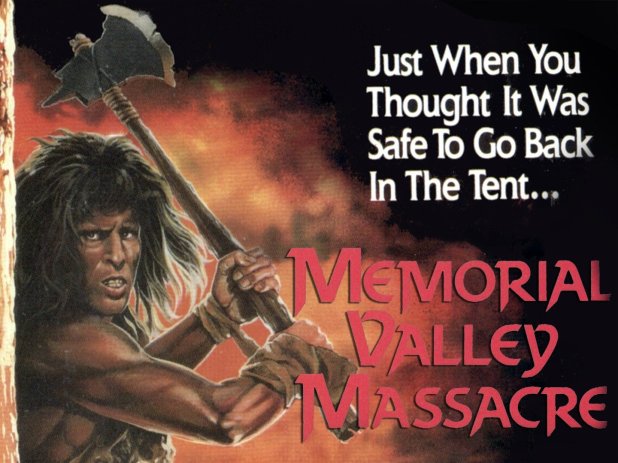
CHILLING CLASSICS MONTH: Memorial Valley Massacre (1989)

EDITOR’S NOTE: Thanks to Matthew Hale on Letterboxd, I’ve learned that there are alternate versions of this Mill Creek box set. For the sake of completeness and my obsessive compulsive disorder, here’s this missing movie.

Sometimes, the right movie comes along at just the right time. This would be that movie. Today would be that day.

Memorial Valley Massacre — also known as Valley of Death, also known as Son of Sleepaway Camp (complete with the music cues from Sleepaway Camp and hardcore penetration footage) — was released beyond the golden years of the slasher, but damn if it doesn’t make me just as happy as if it had been released between 1979 and 1982.

Evil land developer Allen Sangster (Cameron Mitchell!) has just broken ground on the Memorial Valley Campground and wants some teenagers to build it for him. Nothing happens at all for the first hour, with just one murder — that said, it’s the murder of an obese rich kid on a quad that I was hoping would die painfully and oh yes, he did — but by the end, all manner of slashtastic violence is unleashed.

Did I mention this movie has a cave boy? Yes, much like Encino Man but with death, this wolf child lives in the woods and doesn’t like all these rich folks knocking down his trees.

Beyond Mitchell, this is a junk film fan’s dream, with John Kerry (Dolemite), William Smith (Red DawnTerror in Beverly Hills, so many more) and Karen Russell (Hellbent). It’s directed by Robert Hughes, who would go on to make Zadar! Cow from HellHunter’s Blood and Lusty Liaisons II before directing episodes of Mighty Morphing Power Rangers.

Seriously, outside of Don’t Go Near the Park, this is probably my favorite prehistoric people in public lands killing people movie. That said, I only know two of movies of this genre and I love them both.

Order the Vinegar Syndrome reissue, which is packed with extras, including a 4K reconstruction of the film and interviews with actor John Kerry and director Robert C. Hughes. Or watch it on YouTube and be assaulted by its soundtrack, which seems way too chipper for the carnage that unspools over the last twenty minutes of running time!

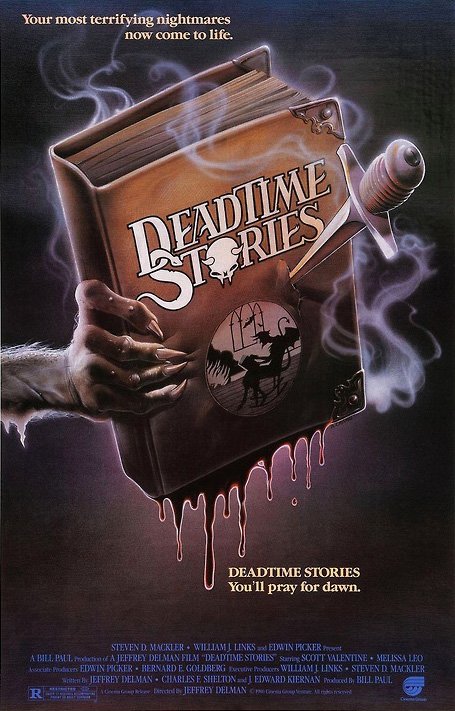
CHILLING CLASSICS MONTH: Deadtime Stories (1986)

EDITOR’S NOTE: Thanks to Matthew Hale on Letterboxd, I’ve learned that there are alternate versions of this Mill Creek box set. For the sake of completeness and my obsessive compulsive disorder, here’s this missing movie.

Directed by Jeffrey Delman from a script by Delman, J. Edward Kiernan and Charles F. Shelton, Deadtime Stories was originally called Freaky Fairy Tales. That makes sense, as two of the three stories are based on Little Red Riding Hood and Goldilocks.

Delman originally wanted to have the song “Li’l Red Riding Hood” by Sam the Sham and The Pharaohs to play over the opening credits, but was unable to use the song because the clearance rights were too expensive. You need to have a Striking Distance budget to get that. He also wanted “Surfin’ Bird” and “Walkin’ on the Rain,” but again, he had a small budget.

All of these stories are told by Uncle Mike (Michael Mesmer) — named for SNL and National Lampoon writer Michael O’Donoghue — who is trying to calm down his nephew with three horrifying stories. That story is very The Boy Who Cried Wolf. I have no idea why he would think that these fairy tales filled with gore would make a kid stop being wild, but I didn’t make this movie. In the first story, a fisherman’s son (Scott Valentine) is sold as a slave to two witches, while the second is about a prescription mix-up between a grandmother and the wolf who is after Red Riding Hood. Finally, Judith “Mama'”Baer (Melissa Leo), her husband Beresford “Papa” Baer (Kevin Hannon) and their son Wilmont “Baby” Baer (Timothy Rule go on the run and discover that Goldi Lox (Cathryn de Prume) is in their hideout.

It’s goofy but I enjoyed it. Then again, I always like anthology films.

THE FILMS OF RENATO POLSELLI: Torino centrale del vizio (1979)

Turin Headquarters of Vice also known as Lust* has Jones Brown listed as its director on some posters, but that’s a combination of Bruno Vani, who was a production manager on movies like Oscenità and Mania, and the man who made those movies, Renato Polselli. Vani also made several other films afterward, mostly adult films like Oh…Angelina!Angelina SuperpornoDyaneTeresa altri desideri (also with Polselli) and the mainstream Mia nipote Emilia and Ragazzi de’ borgata.

Actor Sandro Moretti is also credited with the screenplay.

Mirko (Raúl Martínez) and Helen (Rita Calderoni, who seems game for whatever Polselli had for her in many movies) are in love. He’s a journalist, she’s, well, we don’t know what she does. Maybe she dealt drugs. Maybes she was a sex worker. She does all she can to convince Mirko that she’s the wrong person for him, telling her that she was a lesbian, that she sold herself, that she was a criminal. Well, she’s everything to him and he won’t hear it. They get married and live happily ever after until one day she just disappears.

This sends Mirko into the dark side of Turin and Rome, as he gets too close to the organized crime that still has his beloved in its grip. Or maybe it’s all in Mirko’s head? Who can say. There is a fight scene at the end with a pitchfork and a rake, which feels right for Polselli, even if this movie doesn’t go as hard as his other films. I have a suspicion that the cut I’ve seen is missing inserts or rougher footage. There is some pretty rad Stelvio Cipriani blasting over all of this, which makes it all go down a lot smoother.

*It should not be confused with another 1979 movie also called Lust, Raniero Di Giovanbattista’s Libidine which has a scientist’s daughter fall in lust with his snake. It also has an awesome Stelvio Cipriani score.

VISUAL VENGEANCE BLU RAY RELEASE: Repligator (1998)

When I spoke to Bret McCormick (who made The Abomination, one of my favorite movies) about Repligator, he said “I was trying to match Roger Corman’s record of five films in one year: in my case it was Takedown, Time Tracers, Bio-Tech Warrior, Repligator and (finally) Rumble In the Streets.

I had challenged Keith Kjornes to write the script in a week. This is what he came up with. Keith was a very talented guy. A funny actor and solid writer. He did an interesting film years later — The Devil’s Tomb with Cuba Gooding Jr. and Ron Perlman.

I had absolutely nothing to do with the story other than accepting it. At the time I felt it poked fun at the military in the same way my favorite writer, Terry Southern, had done with Dr. Strangelove. The military, by and large, is headed up by guys who like to destroy things — guys who have society’s approval to be thugs. They take themselves very seriously and I think it’s a good idea to poke fun at them once in a while.

It’s a matter of record that I was eager to walk in Roger’s footsteps back then. This was my attempt to make five films in a single year and to shoot one in four days a la Little Shop of Horrors.”

Shot in 3 days on 35mm film at the Remington York Studio in Irving, Texas — with additional footage shot a year later on 16mm with Gunnar Hansen and Brinke Stevens at Aries Productions in Arlington, Texas to increase the run time — Repligator starts with Dr. Goodbody (Stevens) conducting an experiment of the Sexual Hologram Interface Terminal (S.H.I.T.) that allows her to see the fantasies of Private Libo (James Bock). We see a fantasy of his wife and her friend Buffy, as well as him getting to see Goodbody’s, well, good body. 

Pay attention. While you will see this same exact footage again later, this is the only time that Stevens appears in the movie.

After the opening, Colonel Sanders, Colonel Sergeant (Rocky Patterson (Doc in Nail Gun Massacre, R.O.T.O.R.and General Mills who have come to witness Dr. Oliver (Kjornes, the writer, writing himself into some exciting moments and proving that movies are awesome) and Dr. Kildare’s (Hansen) machine firsthand. Dr. Fields (Randy Clower, Fatal Justice, Bio-Tech Warrior, Time Tracerinvites himself along, hoping to witness an epic failure and gain Oliver’s funding.

If those names don’t clue you into the feel of this movie, Dr. Laurel Hardy’s (TJ Myers, a former Miss Lubbock Teen Texas USA) will.

The machine they get to check out is an organic digital replication double helix genetic coding scrambler on a 1680 wave link with the maximum thrust at about 40 gig. Yeah, I memorized that. It basically turns men into women. So Dr. Oliver adds his mind control and creates a weapon for the government that sends mind-controlled women after enemies. But when the women go back into the machine for a return trip, they turn into alligator women.

Did Jess Franco steal this for 2012’s Al Pereira vs. the Alligator Ladies?

Also: anyone killed by an alligator turns into a zombie. Sometimes a gay zombie. This movie is in no way concerned with offending anyone or everybody.

Repligator has some music that may seem familiar to you. Well, to me. After all, I watch way too many Andy Sidaris movies. The soundtrack was created by Ron Di Uulio, who wrote the song “Return To Savage Beach” and did the soundtracks for the Sidaris movies Day of the Warrior, The Dallas Connection and Enemy Gold as well as Mountaintop Motel Massacre and Honeymoon Horror.

A lot of the crew also worked on an industrial movie called Risky Business: Employee Violence in the Workplace that I really want to see, hoping that it captures the energy of this.

Repligator sounds and is ridiculous. But so what? The world is a dark and horrible place filled with apathy and soul-crushing failure. This is anything but. It’s a movie dedicated to entertaining you in the short time it had to get made and with the low budget it was given. You’ll remember it long after watching a movie that cost thousands of times what this did.

I’ll come clean — I love this movie and not just because I got to work on this release. Visual Vengeance gives you so much for such a great price. Repligator has a new director-supervised SD master from original master tapes inside a gorgeous limited edition slipcase. There are two commentaries — one from director Bret McCormick and Glen Coburn and the other from Bill Van Ryn of Drive-In Asylum and me — as well as a making of feature, an interview with Bret, a deleted opening scene and new interviews with Bret, Wynn Winberg, Brinke Stevens. Carl Merritt and Randy Clower. You also get the original VHS trailer, a folded mini-poster, “Stick Your Own” VHS stickers, a 2-sided insert and the most important part: X-Ray Specs that allow you to spot your own Repligator. Well, maybe. Anyways, you can get this from MVD.

THE FILMS OF RENATO POLSELLI: Io Ti Amo (1968)

The musicarello is an Italian subgenre which I haven’t explored yet. It features young singers in the main roles — like Gianni Morandi, Al Bano, Mal Ryder, Tony Renis, Adriano Celentano, Bobby Solo, Orietta Berti, Little Tony, and more — performing songs from their latest albums. They’re inspired by Elvis’ Jailhouse Rock and Love Me Tender.

Usually, they tell tender and chaste love stories.

That’s why you’d hire Antonio Margheriti (Alien from the Abyss, Cannibal Apocalypse) to direct and write this movie with Italo Fasan (So Sweet, So Dead) and one of the roughest of all Italian creatives, Renato Polselli.

That said, Italian exploitation directors and writers worked on all manner of movies before we knew them as the cult objects that we explore today. Lucio Fulci made the film that started the genre, Ragazzi del Juke-Box as well as a second example of the style, Howlers In the Dock. Bruno Corbucci made Questo pazzo, pazzo mondo della canzone, Ferdinando Baldi directed Rita of the West and even Ruggero Deodato made one, Donne… botte e bersaglieri.

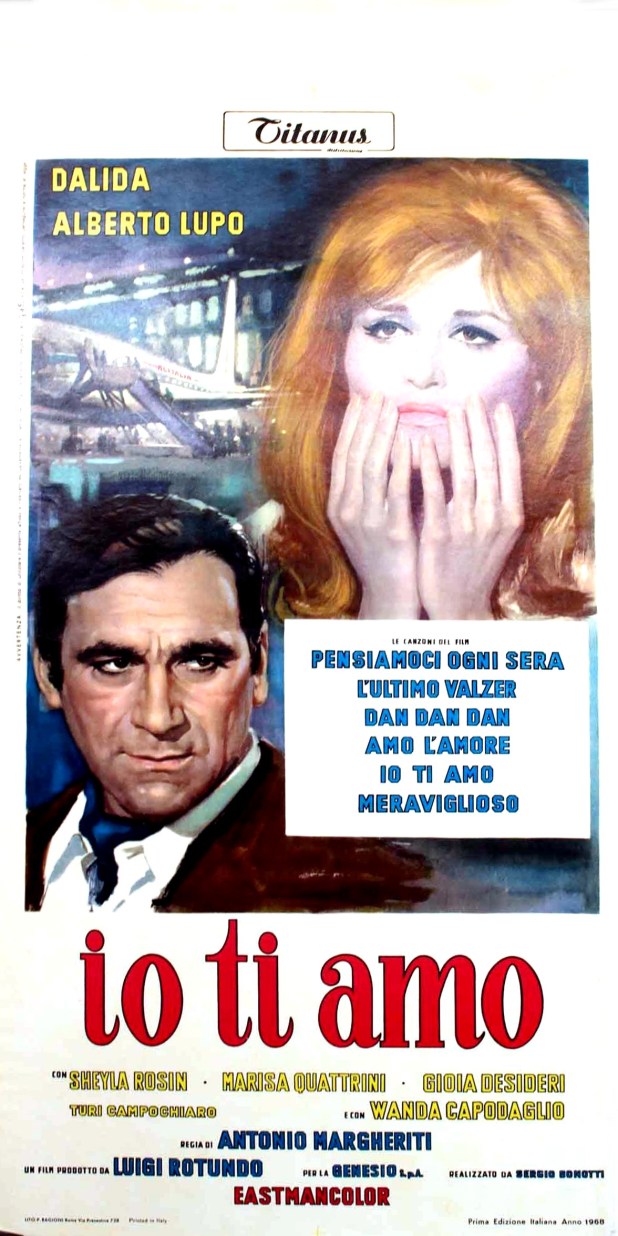
Prince Tancredi (Alberto Lupo) is an abstract artist who falls for an air hostess — “You’re so beautiful, you could be an air hostess in the 60s” — named Judy, played by Egyptian-born French but naturalized Italian singer Dalida, who was best remembered for her songs “Bambino,” “Le temps des fleurs,” “Darla dirladada,” “Salama ya salama” and “Paroles, paroles” which had a spoken word part by Alain Delon.

He asks her to pose for him and she accepts. But ah, he’s a modern artist and she has some negative on his work. He now questions himself and decides to be sincere and show his passion for her through his art. She decides to leave for a week but promises to see him again while he throws himself into the work. Yet she never comes back. And that’s when he learns that she died in a car accident on the day she decided to drive back to tell him that she was in love.

That’s how you know that Renato Polselli wrote this.

That said, Dalida had a pretty crazy life herself.

A year before this movie, after having a major hit with the song “El Cordobés” in Latin America, a record dedicated to a bullfighter she’d had an affair with named Manuel Benitez, and also had a hit with “Parlez moi de lui,” a song that Cher would re-record in 1972 as “The Wayof Love,” the second single on her Gypsies, Tramps and Thieves album. Dalida also started a secret relationship with avant-garde singer-songwriter Luigi Tenco. He wrote the song “Ciao amore, ciao” for their competing song at Sanremo Music Festival and both sang their own version. He was drunk and nervous, she got a standing ovation. They were both eliminated in the first round and when Dalida returned to her hotel, Tenco had killed himself in protest. Or maybe organized crime was invovled. Regardless, the next week, she appeared on TV and dedicated the song to Tenco, wearing the same dress she had on when she found his body.A few weeks later, she tried to kill herself and spent five days in a coma.

When she returned, she was dubbed Saint Dalida by the press. This film was a minor success and has her songs “Dan dan dan,” “L’ultimo valzer,” “Amo l’amore,” and “Pensiamoci ogni sera” performed by her during the story.

Dalida’s life is, again, forever sad. Her first husband Lucien Morisse, as well as her closer friend singer Mike Brant and her longest lover Richard Chanfray all killed themselves. In May of 1987, she followed them by overdosing on barbituates, leaving a note that said, “La vie m’est insupportable. Pardonnez-moi.” (“Life is unbearable for me. Forgive me.”)

She remains an icon in Europe. In 1988, the French newspaper Le Monde placed Dalida as second in personalities who had the greatest impact on French society, behind only Général de Gaulle. And when France selected the “Greatest Singer of the Century” in France, which was based on numbers of album and single sales, number of radio airplays and chart positions, Dalida placed third after Madonna and Céline Dion.

While reading of her made me sad, I’m still intensely fascinated by the fact that movies can bring me through so many paths, learning of people and times and lives that otherwise I would have never experienced.