CANNON CANON CATCH-UP: The Long Kiss Goodnight (1996)

The ups and downs of Renny Harlin’s career is pretty amazing and demands further investigation in the future. How does one recover from Cutthroat Island? As we brace for Harlin to make a return with a new The Strangers movie in 2024, this project needs to come to life.

Until then, The Long Kiss Goodnight.

Harlin and his leading lady, Geena David, were married from 1993 to 1998, but she filed for divorce shortly after her personal secretary, Tiffany Bowne, gave birth to Harlin’s first child, Luukas “Luke” Harlin in August 1997. As the time lines up, some of that affair was during the making of this film. I don’t know how that colors your enjoyment of this film.

It did well — but writer Shane Black wondering if it would have done better with a male lead — and some of that is because their past film, the previously mentioned Cutthroat Island, did so bad.

Davis has a fascinating career as well, She told Vulture in 2016, “Film roles really did start to dry up when I got into my 40s. If you look at IMDb, up until that age, I made roughly one film a year. In my entire 40s, I made one movie, Stuart Little. I was getting offers, but for nothing meaty or interesting like in my 30s. I’d been completely ruined and spoiled. I mean, I got to play a pirate captain! I got to do every type of role, even if the movie failed.” Yet where I’ve always admired her is that while she’s attractive, that hasn’t been the main reason why she’s been so remembered, starting back in Tootsie.

In this movie, she plays two sides of the female experience: amnesiac good girl schoolteacher Samantha Caine and unstoppable badass Charlene “Charly” Elizabeth Baltimore. She only fully engages in her real Charly self when she’s nearly drowned on a water wheel while completely nude, which seems like a subject drenched with some subtext. Regardless, she’s the capable one of team she forms with Samuel Jackson’s detective, Mitch Henessey. And yet at the end, she is comfortable enough to put that life behind her again — without amnesia leading her to follow that path — and become a partner to a man and a mother.

The real success of the film is that the people who made it loved what they did. It’s one of Jackson’s favorite films he was in to watch — he was killed in the original cut until an audience member loudly protested during an early test viewing — and Davis said, “I love that movie. My character might be my favorite role—it’s a close call between Thelma and that one. Anyway, that movie came out great and got some good reception, but it didn’t soar to heights, let’s say, perhaps as we wanted it to.” As for Harlin, it’s his favorite of his movies, saying, “…it’s just very simple. It’s a movie that had a really good screenplay, which meant that I was able to get really good actors. It’s always challenging to make a movie, but it sure makes it easier when you have a good screenplay like in that one. When you have characters that are complex, and you have good drama and have some humor and some good action, you kind of have all the ingredients. When you have that you don’t even need some crazy special effects — you just need to let the characters do their thing. It was a great experience.”

You can listen to The Cannon Canon episode of The Long Kiss Goodnight here.
DRIVE-IN MOVIE CLASSICS MONTH: Unsane (1982)

EDITOR’S NOTE: Thanks to Matthew Hale on Letterboxd, I’ve learned that there are alternate versions of this Mill Creek box set. For the sake of completeness and my obsessive compulsive disorder, here’s this missing movie.

The site just covered Tenebrae but this is the American version which appears on some copies of the Mill Creek Drive-In Movie Classics DVD box set.

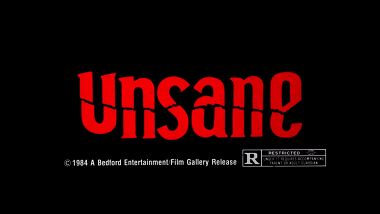
Unsane is the American title, which was thought to make more sense — and maybe be easier to pronounce, anyway — than Tenebrae.

Obviously, there’s a new title card that appears right when the book goes into the fire.

The pages from that book are also now in English, which looks to be filmed for this release.

Throughout, some shots are slightly longer, like when Elsa is shoplifting. However, the tracking shots in the American version as the camera goes over the house in that incredible scene are cut down. That’s just one of the many things that angered Argento.

Much of the gore is removed, such as the beach girl being knifed more than once and Jane’s death, which is really trimmed.

Another change that disturbed the director was the inclusion of “Take Me Tonight” by Kim Wilde over the closing credits.

Overall, the film has less dialogue and cleaner kills. You can find it on the Arrow and Synapse releases. It’s hard for us today to think that a celebrated director like Argento would have his film treated like this, but in 1982, the world was much different.

Sources

1. Movie Censorship: Tenebrae

MILL CREEK CHILLING CLASSICS MONTH: Virus (1980)

EDITOR’S NOTE: Thanks to Matthew Hale on Letterboxd, I’ve learned that there are alternate versions of this Mill Creek box set. For the sake of completeness and my obsessive compulsive disorder, here’s this missing movie.

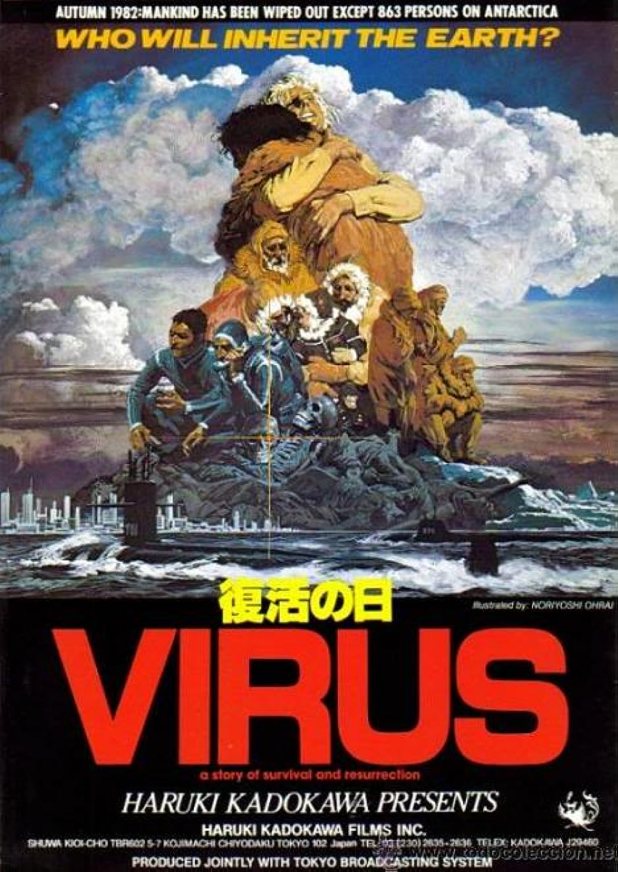
If you’re depressed and home alone with COVID-19, I advise you in no way should you watch the 1980 Japanese movie Fukkatsu no Hi (Day of Resurrection). Directed by Kinji Fukasaku (Battles Without Honor or Humanity, Message from Space, Battle Royale) and taken from the book by Sakyo Komatsu. Two of that writer’s other books, Japan Sinks and Sayonara Jupiter became the movies Submersion of Japan and Bye Bye Jupiter.

Fukasaku took a Japan that had already dealt with the loss of World War II and being the only country to ever be nuked — twice — and created post-apocalyptic disaster films that allowed them to see the rest of the world deal with terrors like they did. It’s exploitation but in some ways, it also had to feel cathartic.

As I sniffle on the couch today, the victim of a plague in its who knows how many mutations, I don’t feel all that good about watching a movie about how a plague destroys humanity.

In 1982, East German scientist Dr. Krause and a group of Americans exchange MM88, a deadly virus that amplifies any virus or bacteria that it meets. It had been stolen from the U.S. and as it is being returned, the place crashes and causes a pandemic called the Italian Flu. This in no way feels like our life for the past few years.

Seven months is all it takes for the world to end. As President Richardson (Glenn Ford) and Senator Barkley (Robert Vaughn) die, they realize that the only way America can live is to move its authority to the sub-zero Palmer Station in Antarctica, a place where the cold has kept the virus from infecting the scientists from many countries who live there.

In a few years, Palmer Station becomes a melting pot of sorts where women consensually sleep with as many men as possible to repopulate the Earth. The only problem is that the Automated Reaction System designed by General Garland (Henry Silva) is set to nuke anyone that attacks the U.S., even if it’s an earthquake, so their little hidden paradise is about to be blown into space. That said, it seems as if a cure for the virus has been found.

The women and children and several hundred of the men are sent to safety aboard an icebreaker while Dr. Yoshizumi (Masao Kusakari) and Major Carter (Bo Svenson) take a sub to shut down the ARS after taking the experimental vaccine. In Washington, D.C., Carter dies in the rubble of a bunker where the missile system is. Yoshizumi contacts the Nereid and tells them to try to save themselves. He does say that the vaccine seems to have worked, “If that still matters.” “At this point in time, life still matters,” the captain replies.

The bombs hit and this is where the movie has different versions. In America, the screen goes to black and then credits. But in Japan, well, they still have hope. Yoshizumi survives the blast and walks back to Antarctica, taking years to get there, but finding the survivors and true love. He then says, “Life is wonderful.”

As every disaster movie should, this has a huge cast. More than those we named, there’s also Sonny Chiba, Kensaku Morita, Toshiyuki Nagashima, George Kennedy as the leader of Palmer Station, Chuck Connors, Olivia Hussey, Isao Natsuyagi, Edward James Olmos, Stuart Gillard and more.

Producer Haruki Kadokawa was the heir to a publishing empire. He entered the film business in the mid 70s with some high-profile features and thought that this movie would break his company into the international film marketplace. That’s why so many American stars are in it and it was called Virus. It was a huge flop and only played limited dates before being sold directly to cable. It was the most expensive Japanese film at the time it was made (a record that Fukasaku may have already had with Message from Space).

My favorite part in the entire movie is when Japan is falling into sickness and naked people are still in a disco, dancing and throwing up. That’s how you do the end of it all. I would have loved another movie that has the four-year walk that Yoshizumi takes from America to Antarctica.

The director’s cut on Tubi is massive and comes in at two hours and thirty-six depressing minutes. Every moment, I wonder if my throat will close and this virus will end me, and then I remember that it’s supposedly weaker now and I’m on meds, but man, MM88 is rough.

If this is my epitaph, let it be known that it was Guns ‘n Roses that finally killed me.

You can watch this on Tubi.

What’s On Arrow Player In September?

September 1: Dan Martin Selects: The favorites of the special effects wizard behind Brandon Cronenberg’s Infinity Pool and Possessor, the Academy Award-winning The Banshees of Inisherin and British indies like Censor and In the Earth. On his Selects, Dan shared: “I’ve poured through the massive selection of fine titles on Arrow’s streaming service to select a collection of titles that I love. My tastes are very varied and I think that is well represented here, although I’ve tried to select things that I feel deserve a spotlight shone on them, things that are maybe less seen (although there’s a couple here people may consider obvious choices).” Titles include The Five Venoms, Giants and Toys and Hotel Poseidon.

Plus, you can dive into ARROW’s latest duo of Paul Joyce documentaries starting with The Curious Case of Inspector Clouseau, a documentary history of the Pink Panther series focusing on their star Peter Sellers and his relationship with director Blake Edwards. Next up is Kris Kristofferson: Pilgrim. His Life and Work. Kris Kristofferson’s appeal crosses generations and gender boundaries and this profile unfolds his life highlighting many of his now legendary songs many of which are performed especially for this program. This major production examines the extraordinary career and life of the actor, songwriter, performer and Country Music Hall Of Fame Inductee. The program includes interviews and excerpts from Kristofferson’s motion pictures.

September 8: Get into Trouble in Time: Traveling in time sounds like a great idea but it rarely works out for the best. Hop inside our ARROW time machine for a spin through a season of films full of adventures in the past and future, trying to dodge creating any paradoxes and attempting not to make the whole space-time continuum fold in on itself. We can’t promise we won’t destroy the fabric of the universe in the process – but it’ll be fun. Titles include Whatever This Is, The Navigator and Dead or Alive: Final.

September 15: ARROW invites subscribers to Eat the Rich. So with the rest of the world feeling the pinch, it’s time to fill your bellies with the 1% and Eat the Rich! Featuring films where the class war has a body count, and the well-off who try and knock off the common people sometimes rightly get their just desserts, Eat the Rich is a cathartic curated collection that chows down on the class barrier and munches away on the money monopolizers. Titles include Society, Audition and Double Face.

September 18: Ringu.

September 22: Head east with ARROW for Solid Metal Nightmares: The Films of Shinya Tsukamoto. Japanese director Shinya Tsukamoto is best known for his debut body horror-cyberpunk shot-to-the-arm Tetsuo: The Iron Man, but there is much more to this maverick director. Solid Metal Nightmares is a collection of Tsukamoto’s breathtaking films – all nightmarish portrayals of obsession and madness. Self-funding, writing, shooting and editing, as well as directing and appearing in his films, Tsukamoto is a true auteur, with singular, sometimes terrifying, transgressive visions, that he uncompromisingly brings to the screen in order to haunt, repel, seduce and inspire. Titles include Tokyo Fist, Tetsuo and Tetsuo II: Body Hammer.

September 25: The man who gave the world Gremlins, The ‘Burbs, The Howling, Small Soldiers and many more shares with audiences Joe Dante Selects. “ARROW kindly asked me to curate some films for you. It wasn’t an easy task. Their vast library is the most eclectic group of movies I’ve ever encountered. Nonetheless, I came up with some must-see choices I can really stand behind.” Titles include The Mighty Peking Man, Horror Express and Vampire Circus.

September 29: Get to know the cutting and acerbic work of a one-of-a-kind indie cult filmmaker in Dark and Sharp: The Jim Cummings Collection. Known for his uncomfortably awkward tragi-comic roles in films that he also wrote and directed, like Thunder Road and The Beta Test, Cummings has also written and directed a series of biting and unmissable short films featuring outsiders pushed to breaking point. As well as these shorts, Dark and Sharp also features an exclusive ARROW original introduction to his shorts that sees Jim as the great-great-grandson of the legendary and lethal pistoleer Sartana and his Selects. Titles include Us Funny, The Beta Test and The Robbery.

Also on this day: Julia and Macumba Sexual.

Head over to ARROW to start watching now. Subscriptions are available for $6.99 monthly or $69.99 yearly.

ARROW is available in the US, Canada, the UK and Ireland on the following Apps/devices: Roku (all Roku sticks, boxes, devices, etc), Apple TV & iOS devices, Samsung TVs, Android TV and mobile devices, Fire TV (all Amazon Fire TV Sticks, boxes, etc), and on all web browsers at https://www.arrow-player.com.

With a slickly designed and user-friendly interface, and an unparalleled roster of quality content from westerns to giallo to Asian cinema, trailers, Midnight Movies, filmmaker picks and much, much more, ARROW is the place to go for the very best in on-demand entertainment.

CANNON CANON CATCH-UP: The Nice Guys (2016)

EDITOR’S NOTE: Nothing gives me greater joy than when our site gets mentioned on my favorite podcast, The Cannon Canon. There are a few movies they’ve covered that I haven’t, so it’s time to fix that.

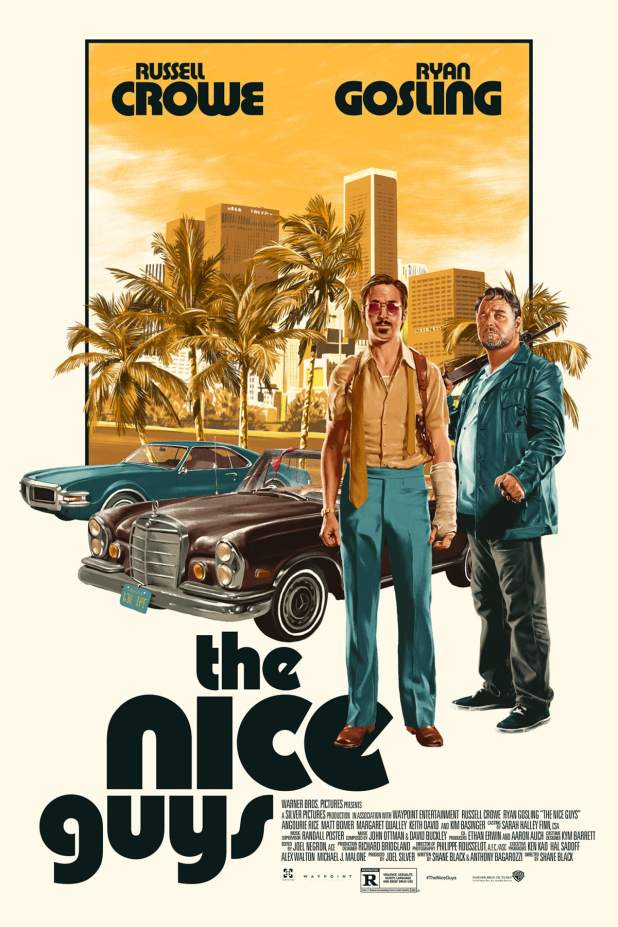
If the world was a better place — and it’s not, trust me — we’d have had more than one adventure of Jackson Healy and Holland March. Director and co-writer Shane Black said, “I think it’s a little premature to consider a sequel. I don’t believe in jinxes necessarily, but we really need people to see this one before we can even talk about that. We’re up against some stiff superhero competition and we just need people to, you know, maybe see Captain America six times, but not the seventh and see us instead.” Later, he’d say that the movie didn’t make enough but he’d love to make another one.

March (Ryan Gosling) is a private eye who is hired by adult film starlet Misty Mountains’ (Murielle Telio) aunt Mrs. Glenn (Lois Smith). Misty’s dead, but she’s seen her alive, which leads his case to Amelia Kuttner (Margaret Qualley), someone associated with Misty who has hired Healey (Russell Crowe) to scare off the detective. After they’re attacked, they learn that Amelia, her now-dead boyfriend Dean and Misty were working on a movie that combined pornography and investigative journalism. They’re soon hired by Amelia’s mother, a Justice Department official named Judith (Kim Basinger) and that’s when the twists and turns you expect of the noir kick in.

An attempt to bring back the era of Vanishing Point, co-writer Anthony Bagarozzi said that the name The Nice Guys aimed to be ironic and non-descriptive, as the two main characters were “literally the two worst people that we could think of and then trying to make that fun.” That said, “one breaks arms for a living and the other cons old ladies out of money.”

This movie is so 70s that they hired former Playboy centerfold photographer Arny Freytag to shoot the Misty Mountains photos. He shoots with a huge camera — an 8″ x 10″ view — which needs up to fifty flash heads. Instead of a digital shot with smaller flashes, this means that each light must be specially placed and targeted to illuminate a small area of the photo. He says that he uses each light as one of his brush strokes, illuminating each area as he incrementally builds the final image.

Speaking of sequels, you could see this as one for Russell Crowe. He’s always said that he wanted to play Bud White from L.A. Confidential again. In both movies, he’s a dumb brute who protects women and has to deal with the intelligence of Kim Basinger. They’re both set in L.A. and this is twenty years later, so it could be a spiritual sequel. He’s also said he’d love to make a sequel to The Nice Guys. I mean, they did get those business cards.

You can listen to The Cannon Canon episode of Nice Guys here.

CANNON CANON CATCH-UP: Rolling Thunder (1977)

EDITOR’S NOTE: Nothing gives me greater joy than when our site gets mentioned on my favorite podcast, The Cannon Canon. There are a few movies they’ve covered that I haven’t, so it’s time to fix that.

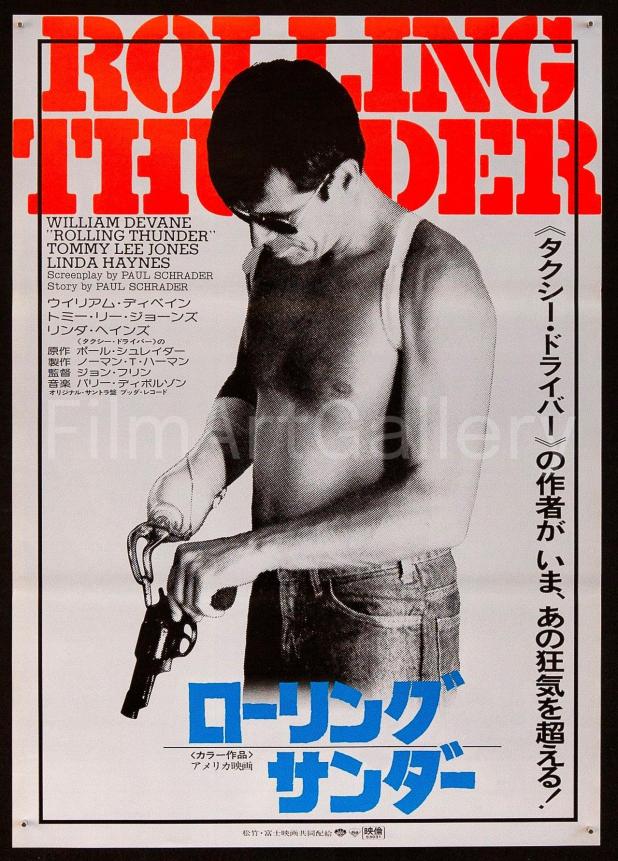
Directed by John Flynn from a screenplay by Paul Schrader and Heywood Gould, based on a story by Schrader, Rolling Thunder is the story of a man who should by all rights be dead. He might be, when you get down to it. U.S. Air Force Major Charles Rane (William Devane) has spent seven years as a POW in Vietnam. They throw a parade for him, but there’s no real joy for him back home in San Antonio. His wife Janet (Lisa Blake Richards) has moved on and who can blame her for needing a man? You can’t blame his son Mark for not looking at him as anything but a stranger. And you can’t fault the town itself for the strange way that they view him as some ghost or as an object, like Linda Forchet (Linda Haynes), the girl who wore his ID bracelet every day, sees him. There’s nothing in him to return affection or even emotion. All they can do is give him some piece of the American dream. A brand new Cadillac and 2,555 silver dollars, one for every day he was captured.

That’s when The Texan (James Best), Automatic Slim (Luke Askew), T-Bird (Charles Escamilla) and Melio (Pete Ortega) — the Acuña Boys — bust in, take those silver dollars and try to torture a man who has been tortured by the best. They mangle his hand in a garbage disposal and when his son tries to save his dad by bringing out those silver dollars, they just shoot him. Kill his wife, too.

Only one person may know how he feels. Master Sergeant Johnny Vohden (Tommy Lee Jones). They were in Hanoi together all that time. He’s so disconnected from this world that he’s signed up for another ten years in Airborne. So when Rane uses Linda to get intel, when he finds those boys, he doesn’t even need to be asked to be in on the revenge. It’s just what has to be done.

After a disastrous test screening — Devane said “the Mexicans set the theater on fire! They were really, really, really down on it,” Twentieth-Century Fox pretty much gave the film to American-International Pictures who made a lot of money off it.

Part of the reason why that test screening went so badly was that the hand in the garbage disposal was much worse in the original cut of the film. It was filmed with a lamb shank for the hand and when the scene played, writer Heywood Gould said, “One woman fainted, another person ran into the lobby and demanded his money back, and another guy was so freaked out, that he entered in his car in the parking lot, and crashed into another car.”

Rolling Thunder shows up in the work of Quentin Tarantino quite a bit. Beyond the company that he assembled to re-release movies — Rolling Thunder Pictures — the seven years reference in the Christopher Walken speech in Pulp Fiction is a direct reference to how long Rane was a prisoner. There’s an Acuña Boys cup in Jackie Brown, an actual Acuña Boys gang in the second Kill Bill and an ad for a fake restaurant in Grindhouse. Is it any accident that his acting teacher was James Best?

As you can imagine, Paul Schrader didn’t like the movie. He doesn’t like much. But I kind of love that about him, you know? In Schrader On Schrader, he says that he wrote the movie to criticize U.S. involvement in Vietnam as well as fascistic and racist attitudes in America. Rane was originally written as a white trash racist, with many similarities to Schrader’s more famous character Travis Bickle from Taxi Driver. In fact, Bickle was in the script in a cameo. Schrader claims that he wrote a film about fascism and the studio made a fascist film. There is a newspaper clipping about Rane — spelled incorrectly — at the end of Taxi Driver, so these movies are in the same cinematic universe, a term I know Schrader would attack me for using in connection with his art.

You can listen to The Cannon Canon episode of Rolling Thunder here.

CHILLING CLASSICS MONTH: Snake People (1971)

EDITOR’S NOTE: Thanks to Matthew Hale on Letterboxd, I’ve learned that there are alternate versions of this Mill Creek box set. For the sake of completeness and my obsessive compulsive disorder, here’s this missing movie.

Also known as Isle of the Snake People, the original title of this movie translates as Living Death. It was directed by Juan Ibanez, who also directed star Boris Karloff in The Incredible InvasionHouse of Evil and The Fear Chamber.

Karloff’s box office value led to these movies being financed by Columbia Pictures, which would then distribute them. Karloff received $100,000 per film, which is about $641,000 in today’s money. He rejected the scripts for all four movies, but agreed to make them when Jack Hill — yes, the maker of Spider Baby — rewrote the stories.

Filming was to take place in Mexico City, but Karloff’s emphysema (as well as the fact that he’d already lost a lung to cancer and had pneumonia in the other) would not allow him to work in the city’s altitude. He shot his scenes — with Hill directing — at the Dored Studios in Los Angeles, with additional scenes shot in Mexico with a Karloff stand-in named Jerry Petty.

Captain Labesch has arrived at a far-flung island to stop the voodoo rites being carried out by Damballah (Karloff). He’s warned by local rich white man Carl van Molder (also Karloff) to leave well enough alone. There’s a temperance subplot too, but who cares when Kalea the snake dancer is turning women into zombies that eat policemen?

She is played by Yolanda Montes, who used the stage name Tongolele and was known as The Queen of Tahitian Dances. A vedette in the Mexican cabaret, Tongolele is a potent mix of Swedish and Spanish who was born in Spokane, Washington and continues to be a star in Mexico to this day. She even released an album at one point. I have to say, she looks like she stepped straight out of 2020, with her shaved head and fierce makeup. She’s seriously volcanic, taking over the film from the moment she appears,

Human sacrifice. Dance numbers. Near-psychedelic images. Zombies. Well, as to that latter part of this movie, Night of the Living Dead came out in the years between when this movie was made and when it was released. By that point, this seemed dated. No matter. Watching it today, I was beyond entertained by it.

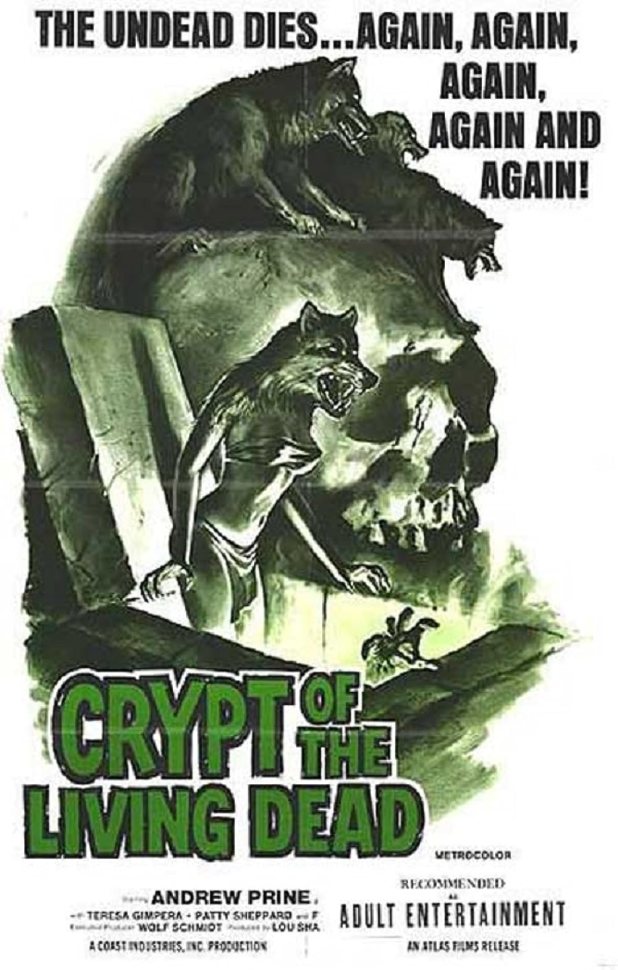
CHILLING CLASSICS MONTH: Crypt of the Living Dead (1973)

EDITOR’S NOTE: Thanks to Matthew Hale on Letterboxd, I’ve learned that there are alternate versions of this Mill Creek box set. For the sake of completeness and my obsessive compulsive disorder, here’s this missing movie.

Also known as La Tumba de la Isla Maldita (The Tomb of the Cursed Island); Young Hanna, Queen Of The Vampires; Crypt of the Living Dead and Vampire Woman, this Spanish film was originally directed by Julio Salvador with new footage added by Ray Denton (DeathmasterPsycho Killer). TV western-bred scribe Lou Shaw, who wrote The Bat People, tweaked the Spanish dialog for the less-gory U.S.-version.

Andrew Prine (Simon King of the Witches) stars as Chris Bolton, a man who has traveled with his sister Mary (Patty Shepherd, The Werewolf Versus the Vampire Woman) to attempt to remove his father’s body from where he died. It turns out that there was a heavy sarcophagus that he found inside a hidden tomb but now his body lies smashed under it. The townspeople refused to help, as inside that coffin lies Hannah (Teresa Gimpera, Lucky the Intrepid) and they don’t want her ever coming back.

The 70’s were filled with female vampires of all shapes and sizes, from the Hammer lesbian-tinged vampires of The Vampire Lovers, the Satanic Twins of Evil, Jean Rollins’ sexually starved bloodsuckers, Daughters of Darkness, the fairy tale world of Lemora, Lina Romay as Jess Franco’s Female Vampire and the future vampires of Thirst. Every one of these films makes me happy despite the darkness and gloom of these days.

You can watch this on Tubi.

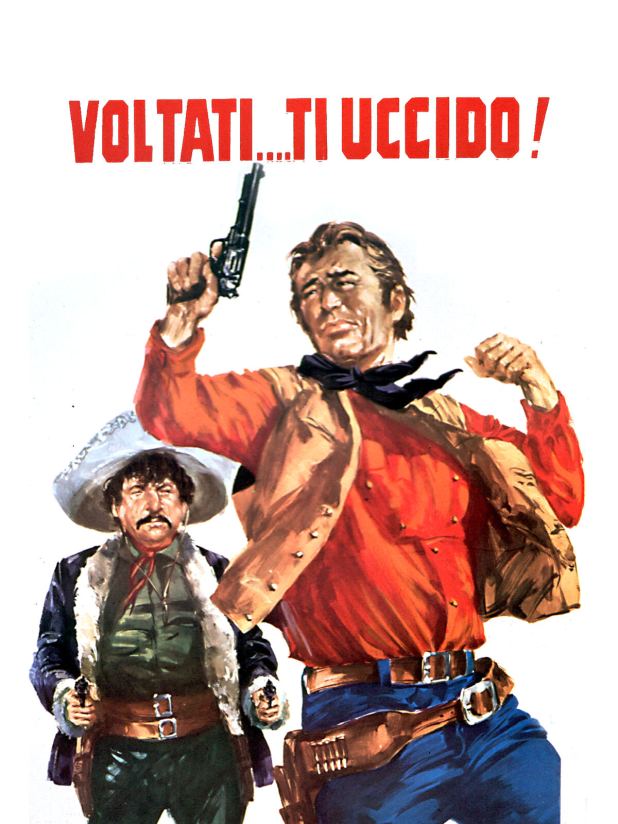
THE FILMS OF RENATO POLSELLI: Voltati… ti uccido (1967)

Voltati… ti uccido (Turn Around… I’ll Kill You) — also known as Winchester Bill and If One Is Born a Swine — was directed by Alfonso Brescia and written by María del Carmen Martínez Román (Crypt of the Vampire, Jess Franco’s Vampiresas 1930Django Kill… If You Live, Shoot!) and Renaro Polselli.

Ted Shaw (Conrado San Martín) owns most of the goldmines in town, other than just one, the mine of old Sam Wilton (Spartaco Conversi). Shaw sends bandits to take care of the elderly mine owner, but he didn’t count on him hiring Winchester Billy Walsh (Richard Wyler AKA Richard Stapley, The Girl from Rio, Dick Smart 2.007) to protect him. Then, Bill must fight Mexican outlaw El Bicho (Fernando Sancho, Return of the Blind Dead).  

He does have the help of several brothers who get tortured and buried up to their necks while the enemy army bears down on them. Luckily, good saves the day.

I’m always amazed at the longevity of Italian creatives. Brescia would go on to make movies in nearly every genre, often using the name Al Bradley. There’s the strange Ator sequel Iron Warrior, his run of Star Wars clones such as Star Odyssey (see this article for more on those movies), giallo (Ragazza tutta nuda assassinata nel parco, the late in the game Omicidio a luci blu with David Hess and 90s crush Florence Guérin), poliziotteschi (Napoli serenata calibro 9), mondo (Nel labirinto del sesso) and even the space, porn and ripoff hybrid The Beast In Space.

As for Polselli…well, I just spent an entire week on his movies.

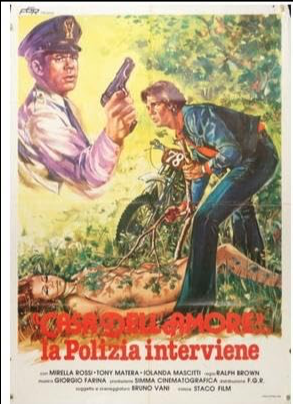
THE FILMS OF RENATO POLSELLI: Casa dell’amore… la polizia interviene (1978)

I’ve been trying to work my way through the non-horror films of Polselli and they’re fine, but I was missing something, Missing women standing wide-eyed and screaming, tree branches being used for the most nefarious of reasons and strange rituals happening for no reason at all. Thankfully — after much searching through some of the most nefarious of websites — I have found Casa dell’amore… la polizia intervene AKA House of Love… The Police Intervene.

My excitement was palpable just from the IMDB summary: “Three young hobby archeologists witness a Satanic ritual in a secluded villa. Instead of helping poor female victims they decide to secretly document the events.”

Hobby archaeologists! Satanic ritual! Secluded villa! This movie is my new plans for the day.

Directed by Polselli and written by long-time associate and often production manager Bruno Vani, this has Polselli using the name Ralph Brown and also having access to footage from the unfinished movie A Virgin for Satan by Alessandro Santini. That film was co-written by Vani and the ritual scenes in this film come from that film.

According to an article in Nocturno, this was called I torbidi misteri della sensualità (Obscure Mysteries of Sensuality) and was a reworking of another Polselli script for a movie called Tilt that was based on the Manson Family. In that script, a cult named The Children of Satan conducts an occult marriage ceremony with a nude bride covered with the blood of doves. What could have been…

Helm (Tony Matera, who is also in Torino centrale del vizio), Brigitte (Mirella Rossi, Oscenità, Confessioni segrete di un convento di clausura) and Charlotte (Iolanda Mascitti, Revelations of a Psychiatrist on the World of Sexual PerversionNude for Satan — how did Polselli not get in on that movie, what with Rita Calderoni as the star? — and the continuity person for Oscenità and script supervisor for Mania, which is incredible because who knew those movies had those roles?) are our three young hobby archaeologists who are looking for bones in the Italian countryside. Brigitte watches as two men overpower and kidnap a woman, which means that they now become twenty-something teen detectives.

Their search brings them to an old house on the edge of town where the elderly Claudia, her niece Elisabeth (Matilde Antonelli, No One Will Notice You’re Naked, Django’s girlfriend in the Brad Harris-starring, Roberto Mauri-directed Death Is Sweet from the Soldier of God) and Phillip live. Are you surprised to learn that these are the followers of Astoroph who sacrifice virgins in Black Masses? Well, the real shock is that instead of going to the police, our protagonists decide to do the investigation themselves and sell it to the press for big money. As for the cult, they plan on making Kathy Cunningham (Katia Cardinali, who is whipped to death in Delirio caldo by Rita Calderoni before she’s drowned in a bathtub and thrown from a window) their next sacrifice, as she has been willingly offered by her boyfriend Lawrence.

With around eleven minutes left in the movie, things start getting nutty, with robed figures chanting, a nude Elisabeth is leading the ritual and ah, man, the cops intervene, just like they promised in the title. There’s also a scene where two people fight with a chain and ladder as a weapon — what is, ECW? — before throwing hens at one another, followed by rocks being launched at a cultist who is then flattened by a bulldozer. There are also love scenes in the cut I’ve found that go to black, which I assume are where the hardcore inserts would find a home, and a skiing scene out of absolutely nowhere. I watched this as it should be watched: a seventh-generation VHS transferred to a porn site filled with pop-ups while sick or high with COVID-19 at 6 in the morning in the hours where it is late and not early.

This also has the thing that every Polselli movie needs: reaction shots of people bugging their eyes out. That’s what else these other movies have been missing. He must have given the direction, “Stand up and stare at the camera like someone is naked in public and no one knows what to do!”

Seriously, this movie has an extended scene of hens being thrown at people before someone’s head gets cut off with a bucket while our two leads run. Helm is straight up mounting this dude and it’s way intense, so upsetting that the girls just take off. Then they all chain themselves together while he and Brigitte laugh like lunatics while Charlotte looks afraid? What an ending?

What does it all mean? Who cares!

I also have to say, Pier Giorgio Farina turns in one strange soundtrack that is totally perfect for this movie. There are just electronic noises that drop in and out before going into synth runs and it’s like a super sparse affair that goes into church organs and I’m all about it.

It introduced me to his DISCOCROSS album, where he’s backed by Goblin.