Dario Donati directed this movie and Convent of Sinners, but come on, you should know by now exactly who he is.
This stars Tini Cansino in the lead and she’s just perfect for Joe, as she worked for years in Italy with a name that’s a direct reference — and she never would be all that forthcoming that she wasn’t really related from what I’ve read — to Rita Hayworth, whose real surname was Cansino. I mean, it’s still right there in her IMDB bio, claiming that her father was Rita Hayworth’s brother, he of the “Dancing Cansinos” fame.
Tini was known for a TV show called Drive-In and that was enough to get her the lead in a D’Amato sex comedy. And here we are, across the oceans of time and literal oceans and I’m trying to divine what this movie is all about. What lessons can we learn? Well, how about hard work, as in addition to his work under another name, D’Amato also edited and shot this under his most well-known false name.
The plot is supposedly about Carol neing an Italian centerfold model — well, Cansion was Greek but she posed for Play Men and that very issue is in this movie, which is as meta as someone bringing up 9 and 1/2 Weeks before D’Amato ripped it off — who now lives in New York City that comes home to take over her family’s old house. I mean, at least D’Amato came up with plots in his non-adult adult films.
If you watch this and say, “Well, that was a very safe teen sex comedy but I’d like to see Tini Cansino in a movie that might upset even the sensibilities of the deranged,” well then I can recommend Angel: Black Angelto you. Get ready.
Do you think that when Jack Palance bounded to the stage, ready to do one-arm pushups and accept his Best Supporting Oscar for City Slickers after being nominated for Sudden Far and Shane, that he had a flashback and said to himself, “I’m in the A list tonight, but man, how can it compare to being in a movie where Laura Gemser dances with snakes?”
Seriously, the man who would become a star again at the age of 73 has a wealth of roles in aberrant movies in his past, but playing Judas Carmichael in a Joe D’Amato movie may be the pinnacle. Or the pit.
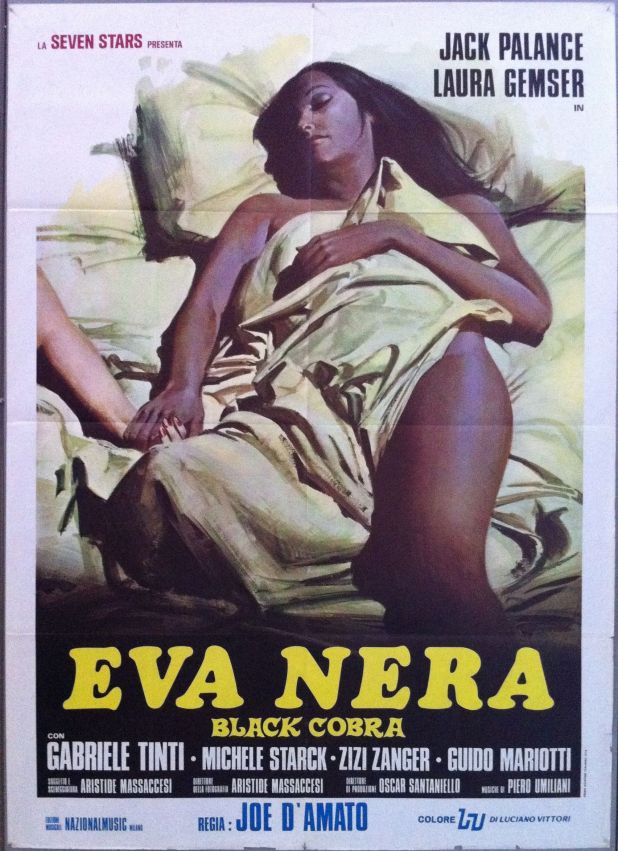
Gemser plays Eva, a snake dancer who obsesses Judas, because he has a snake collection at home — as you do — and he wants to show it to her. So she finally gives in and moves in with him while confining her horizontal dancing to the ladies — including Candy (Ziggy Zanger, who Gemser would go on to appear in Black Emanuelle, White Emanuelle with, along with Nieves Navarro, and just writing that sentence made me a little faint). Judas’ brother Jules (Gabriele Tinti) wants Candy all for himself, so he messes around with the snakes with her — which seems ill-advised — and she gets killed by a mamba. And then he doubles up and kills off Eva’s lover Gerri (Michele Starck, Forever Emmanuelle) and ends up taking Eva from his brother!
Of course, that’s not the end of matters. Eva’s more devious than she looks. And so is Judas. I mean, if your mom names you Judas any time in a year that doesn’t have BC in it, you’re not going to turn out all that great.
Bruno Mattei edited this movie — a fact that makes me love it so much more — and it was also called Emmanuelle And The Deadly Black Cobra, Hot Pants and finally and most awesomely Emmanuelle Goes Japanese, which makes no sense for a movie set in Hong Kong.
EDITOR’S NOTE: We originally talked about this somewhat of a sequel to Zombieback on January 8, 2020. You can get this from Vinegar Syndrome or watch it on Tubi. We featured this on our weekly video show, there’s even a cocktail to go with this movie after the words!
Fred Brown comes home from the Vietnam war, finds his wife in bed with a new lover, and goes wild, killing her and both of his parents. As he cleans off his knife, a falcon tears out his left eye and blinds him in the other before he says goodbye to the son he’s spared. Also: it’s the same house from The Beyond!
That’s just the beginning of this film, a movie that I can’t even begin to piece together. Most importantly, I question why Robert Vaughn would have signed on for it. Did he need money this badly?
But don’t get me wrong. This is a 1980’s Filmirage movie with controversy at the heart of who created it. That means that no matter what, I’m going to love it.
There are three different people who could have directed this movie.
Aristide Massaccesi, who you probably would know best as Joe D’Amoto. Most of the crew members believe that he was the director. In an interview in the book Spaghetti Nightmares, he said, “It seemed to me that the most sensible thing was to give the job of directing the dialogues to Michele Soavi’s assistant, Claudio Lattanzi, while I took care of the special effects scenes. In the end, I let Lattanzi sign as the director.” He was also the cinematographer of this movie under his alias Fred Sloniscko, Jr.
Claudio Lattanzi, who assisted Soavi on his documentary film Dario Argento’s World of Horror and was an assistant on his film Stage Fright. D’Amoto, who also produced the latter, offered Lattanzi a chance to direct Killing Birds when Soavi turned down the film as he was about to make The Church with Argento.
The controversy doesn’t stop there, as even who wrote this movie is under suspicion.
Over Christmas of 1986, Claudio Lattanzi wrote a story called Il Cancello Obsoleto about a record producer who invites a rock band to a deserted house to record a tune, without knowing that Nazi soldiers are buried there. This sounds like a combination of Sodoma’s Ghost — which wouldn’t come out until 1988 — and 1989’s Paganini Horror.
D’Amoto asked him to replace the rock band and the Nazis with killer birds, wanting to call the movie Talons. However, Claudio Fragasso and Rossella Drudi claim that the movie was based on their script Artigli, which means…Talons.
The truth is probably that D’Amoto didn’t want his name in too many places, so he just did what he always did — just about everything and either gave people credit or used one of his many names to cover the rest.
Anyways…
Twenty years later, a small group of college seniors, Steve Porter, Mary (Leslie Cumming, Witchery), Paul, Anne (Tara Wendel, who is also in Ghosthouse and Tenebre), Rob, Jennifer (Lin Gathright, who is also in D’Amoto’s Eleven Days, Eleven Nights, Part 2) and a local cop, Brian, are looking for the green billed woodpecker, a rare species which went extinct four years after this movie.
Fred Brown, that man who went wild on his family, gives them plenty of info and they use his old home as a base, but find nothing but a rotting corpse. But then all sorts of even stranger things — odder than a corpse in a truck — happen.
That’s when the kids start dying left and right, like a zombie beating Jennifer to death, Brian being burnt to death, Mary getting killed by a zombie, Rob getting choked by getting his necklace caught in a generator and another zombie getting Paul.
It turns out that Steve is Brown’s son from all those years ago and the dad tells them that the zombies only killed those who were afraid of them. Well, yeah. They’re zombies. Finally, he tells them to leave and we hear him scream. That’s the end!
Charitably, this film is a mess yet I loved nearly every single frame of it. It’s pointless and confusing and even its titles don’t line up, because it’s called Killing Birds–Zombi 5 in Italy and Zombie Flesheaters 4 in the UK.
God bless you, Joe D’Amoto.
BONUS: Here’s the drink!
Zombi Bird
.75 oz. Kraken
.75 oz. secondary rum of your choice
.5 oz. 99 Bananas
.5 oz. lime juice
1.5 oz. pineapple juice
1.5 oz. orange juice
1 tsp. grenadine
Dash of orange bitters
Maraschino cherry
Mint
Combine Kraken, rum, 99 bananas and juices in a shaker filled with ice.
Pour into a glass, then drip in bitters, cherry and finally grenadine to watch the color turn red. Garnish with mint.
Money obsessed mercenaries Sammy and Klaus are on a mission to escort the seriously ill prime minister of a South American country that has just been taken over by rebels. And by South America, I mean Louisiana. But no matter — the rebels are on their trail and our protagonists make their way to a hospital filled with three female nurses and a female doctor that they force to heal the prime minister, then they assault each of them in softcore non-sex sex scenes and — of course, it’s Italy — the women fall in love with the guys as if they had a meet cute.
Even a staunch D’Amato defender such as myself has a hard time saying there’s anything good in this one. Maybe Joe was getting tired, maybe he thought military sex romps were what was hot for ’91, maybe he’d made too many adult films by this point or maybe this was all he could do at this stage in his career. This is the kind of movie where nurses get worked up about their co-workers getting attacked by military men, so you know, it’s as scummy as his other films without the energy and art to make up for it.
The Joe D’Amato Emanuelle movies are absolutely lunatic. I mean that in the best of ways, because while they promise you skin, sin and sleaze — and they deliver — it often feels like it all comes at the price of you feeling like you’ll ever be clean again.
Written by Maria Pia Fusco, the daughter of a policeman who rebelled by writing movies like Bluebeardand five of the Black Emanuelle movies while also becoming a respected film writer for La Repubblica where she became one of the few journalists to have an in-depth exploration of Kubrick from a first-hand perspective, and Gianfranco Clerici, whose oeuvre is filled with some of Italy’s most notorious films such as The New York Ripper, Cannibal Holocaustand The House on the Edge of the Park.
After a meeting with United Nations diplomat Dr. Robertson (Ivan Rassimov!) in New York City, our heroine Emanuelle (the always wonderful Laura Gemser) is invited to India to write a report on Guru Shanti (George Eastman), a man who is teaching his followers to hold off their orgasms so that they may all experience the ultimate in le petit mort before the lovely journalist of our dreams basically ruins everyone.
This movie lives up to the title because Emanuelle and her friend Cora Norman (Karin Schubert, Hanna D. – La ragazza del Vondel Park‘s mother) really do travel the world and free women from bonds both literal and sexual, encouraging free love and never having the film preach to us about what they do.
I mean, you should also realize that this is a D’Amato movie where scenes of torture, assault and two different species of animals involved in the sex scenes because, well, Italy is the most insane of all countries, but you’d be like that too if the Vatican was directly inside your capital city. There’s a cut of this that has a banana scene that has nearly made me swear off this type of fruit, but these are the dangers of watching Italian sexploitation.
But it’s even odder because D’Amato makes us look away in the climactic beauty queen assault scene, our heroines unable to do anything but realize that when this is all over, they’re going to ruin the men who let this happen. I first saw this as a teenager in the early 90s. While most of the movies I saw back then haven’t held up, this movie has only improved with time.
Look, when it comes to Joe D’Amato, I’m going deep and that’s no pun.
Sasha Kramer (Roland Carey, whose career stretches back to peplum like Revolt of the Barbarians and the gothic horror of La bambola di Satana) and his wife Helen (Pauline Teutscher, whose career mainly was in adult film) are a middle-aged and childless couple. Things seem good for them, except that Helen is lonely, so she gets a job becoming Alain’s maid, but we all know that things are going to progress into them hooking up because of who directed this along with Claudio Bernabei, who was the assistant director on Like Rabid Dogsand wrote D’Amato’s films Death Smiles on a Murdererand Giubbe rosse.
It’s all a plot to have a child while Sasha also sleeps with the man who is cucking him’s mother, which is the kind of double negative cuck that makes the first cuck no longer count and only happens in Italian movies, right?
There’s literally nothing in this that’s all that erotic and it’s mainly a grimy looking story of searching for a connection. The name means Bitter Sex and it was made during the same year that D’Amato made thirteen other movies, including Absurd.
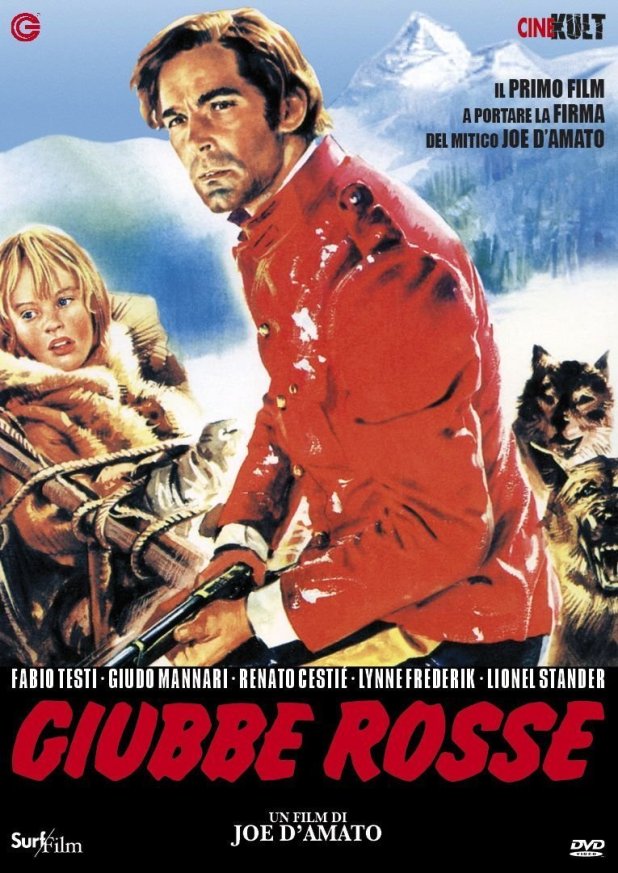
Red Coats was released internationally as Cormack of the Mounties, Killers of the Savage North, Red Coat and Royal Mounted Police and was part of a very short cycle of childrens’ adventure films that were made after the success of commercial success of Lucio Fulci’s White Fang, a film that was Aristide Massaccesi went to Canada to be the cinematographer on.
After shooting the sleigh ride for that film’s sequel — Challenge to White Fang — producer Ermanno Donati asked Massaccesi to stay and direct this movie for him. It would be the first time that the gifted cinematographer would use the pseudonym that so many of use for him to this day.
Joe D’Amato.
It tells the tale of Corporal Bill Cormack (Fabio Testi, Contraband), a Canadian mountie who met his wife Elizabeth (Lynne Frederick, who was also in Fulci’s Four of the Apocalypse with Testi) when he continually rescued her from her drunken husband Caribou.
Years pass and Elizabeth has died, but not before giving Bill a son, Jimmy (Renato Cestiè, who was Italy’s top child star of the 1970s, best remembered for palying neglected children who die by the end of the movie. Italy, you know?), who Caribou has kidnapped and, as Renato does best, young JImmy gets sick and is only saved because of the skills of Doctor Higgins (Lionel Stander, who was blacklisted after the Communist witch hunts in Hollywood for longer than just about anyone else; he was forced to go to act in small stage roles, act as a corporate spokesperson and even a stockbroker while he tried to get back into the movies. Other than voicing over the bizarre noir Blast of Silence, it took moving to London and then Rome for his acting career to make a comeback. He settled into a series of Italian Western roles, such as Once Upon a Time in the West, Beyond the Law and Boot Hill as well as showing up in Fulci’s The Eroticist. After working with Robert Wagner on an episode of To Catch a Thief — playing a lifelong friend named Max — he ended up getting the role that so many remember him for several years later as Max on Hart to Hart. Sorry for the digressing, but Stander’s refusal to back down and late career renaissance make him one of my favorite actors).
When asked which film was the best one he made in the mid 70s by the authors of Spaghetti Nightmares, D’Amato said “Undoubtedly, Giubbe Rosse, which also made a lot of money.” By all accounts, it didn’t.
This doesn’t often get discussed when people bring up D’Amato’s career, but it’s a well-made action film. Of course, when you have other movies where women have sexual congress with snakes, where men keep their wives hacked up bodies in the house and a man impales himself on a fence at the start of the movie, it’s understandable why this low key action yarn isn’t top of mind.
You have to hand it to Joe D’Amato. Most people would just make one ripoff of 9 and 1/2 Weeks. Instead, Joe stretches his series of three films out to 33 days, which is a little under 5 weeks or around half as much time as its inspiration and there’s some goofy logic to that.
Actually it’s seven movies I learned after writing this, so that means that Joe hit 77 days, or 11 more than the 66 days of 9 1/2 weeks, so the numerology all works out, right?
While Adrian Lyne had Sarah Kernochan, Zalman King and Patricia Louisianna Knop to write his screenplay, Joe makes due with the team of Rossella Drudi and Claudio Fragasso for the first film. And what a film it is.
Eleven Days, Eleven Nights (1988): Sarah Asproon (Jessica Moore AKA Luciana Ottaviani AKA Gilda Germano, who also appears in Sodoma’s Ghost, Convent of Sinners and Top Model) is writing a book about her last one hundred lovers, but she’s only had ninety-nine. Then she meets Michael on a boat and despite the fact that he’s about to get married (Mary Sellers plays his fiancee Helen and you’ve seen her in Stagefright, Ghosthouse and The Crawlers), she makes him agree that they will be lovers for — everybody yell out the title — eleven days and eleven nights.
There’s an actual budget to this film and it was shot in New Orleans, so it has an American feel, which is exactly what late 80s Italian movies were shooting for. There’s even a moment where the couple go see Stagefright in a theater and Michael falls asleep, waking up to Helen remarking, “What a beautiful film. So touching! So romantic!”
So yeah, this movie has a honey scene just like the film that inspired it, but I kind of like this one better. D’Amato is at his best when he’s shooting gorgeous women being gorgeous and Moore is, well, one of those reminders that there just might be a God somewhere. A reminder that there may not be is the acting by her co-star Joshua McDonald and the horrible ending where she tells him that he was just being used to be in her book but fell in love, so he bends her over, takes her roughly from behind and leaves her for his boring fiancee. For a film that spent most of its running time with a heroine in charge of her sexuality, this was massively upsetting.
The moral: Don’t look for Italian sexploitation movies to have good messages.
Eleven Days, Eleven Nights 2 (1991): D’Amato and Drudi reteamed for this sequel in name only, even though the character of Sarah comes back. Now she’s played by Kristine Rose and has been married and separated and given the new job of the executor of the estate of Lionel Durrington, one of her past lovers and the richest man in Louisiana.
Guess what? This is actually the third film in the series because Sarah was the lead character in Top Model, which is also listed in plenty of places as Eleven Days, Eleven Nights 2. Look — it wouldn’t be Italian movies if it wasn’t confusing.
There are four heirs and one after another, they all get with our heroine, who will determine which one is worthy of the money based on how good they are in bed, one supposes. Sonny is the only one with no interest in Sarah, even when she danced for him at a strip club, but that’s because his last girlfriend was abused in front of him by friend of the family Alfred, who is also trying to get the money.
Because Italian films really don’t care about how insane or twisted — actually, this is what they run toward not from — things get, Sarah disguises herself as Sonny’s old lover and goes to the impotence institute and gets a rise out of him.
By the end, she realizes that no one deserves the money, so she comes up with a plan. She’ll write a book about the family and its secrets while they split the $500 million with a mystery person. They quickly sign and yeah, the mystery guy is the man who was supposed to be dead and we have a happy ending. We also have Laura Gemser in the blink and you’ll miss it role of Sarah’s jogging publisher and Ruth Collins from Lurkers, Doom Asylum andPrime Evil show up.
For a movie about people getting naked, D’Amato has plenty of women in sweaters show up. I’m all for this.
Also: This has also been listed as The Web of Desire and Eleven Days, Eleven Nights Part 4 because Italian movies are wonderful and confusing.
Eleven Days, Eleven Nights 3 (1989): Also known as Pomeriggio caldo (Hot Afternoon), this film points to the genius that is D’Amato. Instead of just making a sexual thriller — trust me, it still has plenty of sex — he worked with writer David Resseguier — who has to be a pen name for someone — to create this downright weird story of heading to New Orleans and just fading into it.
Someone says, “This is a place that paralyzes you. You don’t fall in love with a person here, but rather you become grossly obsessed with the environment. It’s not like our world.”
That’s what this movie is about, as well as the fact that a young reporter has come to the French Quarter to write about Nora, a woman who just lost her husband to voodoo. He takes along his wife, who plays a game with him where he encourages men to try to bed her while having no real interest in her. This predictably backfires and she leaves him for a muscular voodoo man — I am not making this up — and he starts going insane realizing what he’s lost. And oh yeah — he also gets to bed Nora, which seems like a way better thing than pining for someone he never really cared about.
Every actor in this movie is horrible and wonderful, often within the same scene, and it has an odd pace and overall sadness that keeps it from being fully erotic, which is awesome when you think about it. The scenery is great and then Laura Gemser shows up just to dance at a voodoo ritual and all movies should have her show up and dance and then get back to the story. Every one of the Disney Star Wars movies would be incredible if the woman who is forever Black Emanuelle would show up and writhe in a sweaty frenzy and then wave goodbye.
Seriously, I fell in love with this movie, which is kind of like a sexier — well, is that movie even sexy? — The Beyondwith no house but a much more erotic bathtub scene.
Top Model (1988): Remember when I said there was another Eleven Days, Eleven Nights 2?
This time around, Sarah (Jessica Moore from the first movie) is still writing, but she’s gone undercover as a call girl, which was suggested by her publisher Dorothy (Laura Gemser). Using the name Gloria, she quickly becomes the top girl — some would say the top model — until someone figures out her secret and begins blackmailing her, which makes no sense as she’s already famous for a book where she slept with a hundred men.
She’s also got a crush on an IT guy named Cliff who thinks that he might be gay. I mean, if Jessica Moore is all over you and you need to question it, I’m not stepping on any LGBTQ landmines by saying that yes, you are gay. It’s fine, it’s a great choice and it’s probably what Cliff ends up choosing as the couple is divorced by the time the second part two in this series comes around.
But hey — how about that theme song?
To prove that America is the most puritanical country there is, there was an R-rated Top Model version made just for U.S. cable with still scenes replacing the lovemaking in motion and any reference to Cliff perhaps being gay cut from the film.
Eleven Days, Eleven Nights 5: Dirty Love (1988): I mean, this movie is totally Joe D’Amarto making Dirty Dancing and casting Jeff Stryker and Valentine Demy, who went from waitressing to lingerie model to D’Amato star while she was 17.
D’Amato also throws Fame and Flashdance into the ripoff magic blender and emerges with a movie that has the sex those movies were missing and so much more to spare. Demy plays Terry, who leaves behind a small town where her father wants to pick out her husband and doesn’t want her to dance, so Footloose too?
This movie packs in all the sleaze you imagine that a Joe D’Amato movie called Dirty Love should have. In a world where movies don’t live up to their names or posters, for the most part Joe outdid himself every time.
If you’re watching this and wondering, “Where have I seen Robert before?” He’s Aimee Mann’s jerk of a boyfriend in the ‘Til Tuesday video for “Voices Carry.”
Bonus points for Laura Gemser showing up as a masseuse (and the costume designer).
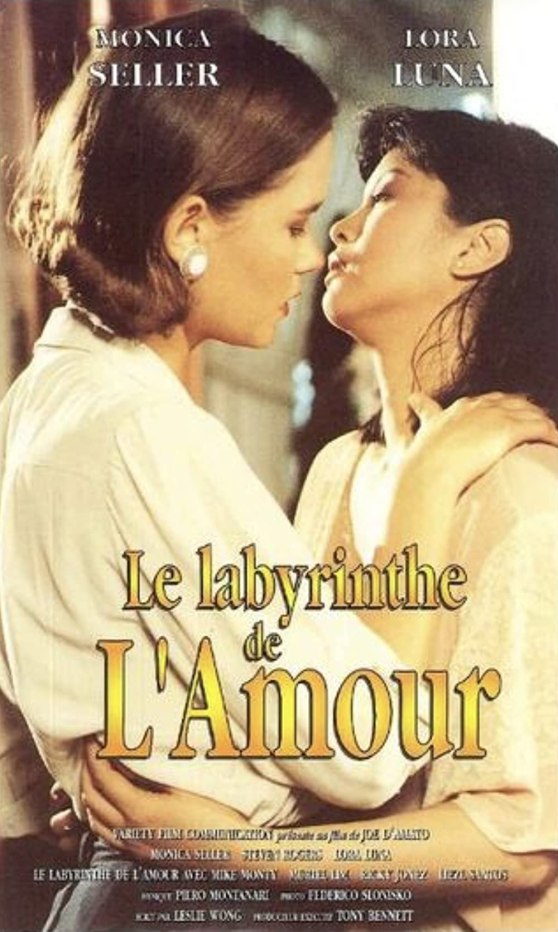
Eleven Days, Eleven Nights 6: The Labyrinth of Love (1993): Valerie (Monica Seller, Dangerous Attraction, Madness, Legittima Vendetta) travels to Saigon to work for a family that she soon seduces. I mean, the whole family. The matriarch. The widower. The grandfather. The gay college student? All of them.
I have no idea why a movie set in the 1930s is in the Eleven Days, Eleven Nights series, but you know, I tend to forgive Joe D’Amato all manner of things. Even when a movie is slow when it should be red hot eroticism, I say things like, “That’s a nice shot” or “I mean, Joe did make Buio Omega.”
Eleven Days, Eleven Nights 7: The House of Pleasure (1994): Lord Gregory Hutton (Nick Nicholson, who somehow was in both Apocalypse Now, Platoon, The Firebird Conspiracy, War Without End, SFX Retaliator, Born on the Fourth of July and Beyond the Call of Duty, which means he either made up his IMDB listing or man, he’s been in the highest of the war movie highs and the lowest of the low) goes to the Far East on his honeymoon with his wife Eleanore. They stay on a silk farm and Eleanore falls for Lin, the young man of the house (Marc Gosálve, who is also in D’Amato’s China and Sex and Chinese Kamasutra).
This is one of those movies like Emmanuelle where a young wife finds her sexuality while her husband watches, but this has the technology of 1994, which means video cameras. And hey — Joe went to Asia to shoot this (along wih Tales of Red Chamber, China and Sex, The Labyrinth of Love and Chinese Kamasutra), so there’s some production value.
For all the negativity heaped on the films of D’Amato, when he’s getting the opportunity to tell these simple stories and shoot beautiful women to some sexy sax, he always delivers. Are these movies essential watching? Or course not. Are they better than they should be? Definitely.
Thanks to Adrian on Letterboxd for transcribing the Eleven Days, Eleven Nights 3 quote above.
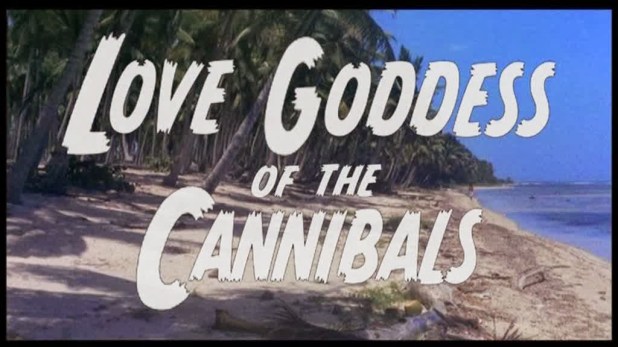
On a Caribbean island, a nuclear power plant is to about to be built despite the native population’s protests and their resistance under the guiance of Papaya (Melissa Chimenti). So how do you stop the nukes? You stea the engineers and kill them and sometimes eat them.
Meanwhile…
Sara (Sirpa Lane, who was referred to by Roger Vadim as the next Bardot, except Bardot was never in The Beast, Nazi Love Camp 27 or The Beast in Space) is at the same holiday on vacation and falls for Vincent (Maurice Poli, Hansel e Gretel), an engineer at the plant, except that means that they both get pulled into the shenanigans of Papaya and her cult and must become part of the Celebration of the Red Stone.
So yes, this movie doesn’t have much cannibalism, but it’s a sexploitation movie about how man destroys native habitats and should leave the ancient world alone lest it rise up with murder in its eyes. And loins. I mean, it’s still a movie by Joe D’Amato with plenty of horizontal dancing. Also: a cock fight — it’s an Italian movie — and Papaya literally eating a man’s dick.
All movies don’t have to be made by Joe D’Amato, but they should be.
Lucky Moore is really Carlo Croccolo, who acted in around 137 movies and made two of his own, this one and Gunman of One Hundred Crosses, and they’re both on the low end of the Italian Western but that doesn’t mean that we shouldn’t watch them, learn something and perhaps be entertained.
The main reason for me watching this is that the camera operator was a young — well, thirty-five — Aristide Massaccesi using his real name. The footage that he shot for this movie would find its way into a movie that he directed early in his career, Bounty Hunter In Trinity.
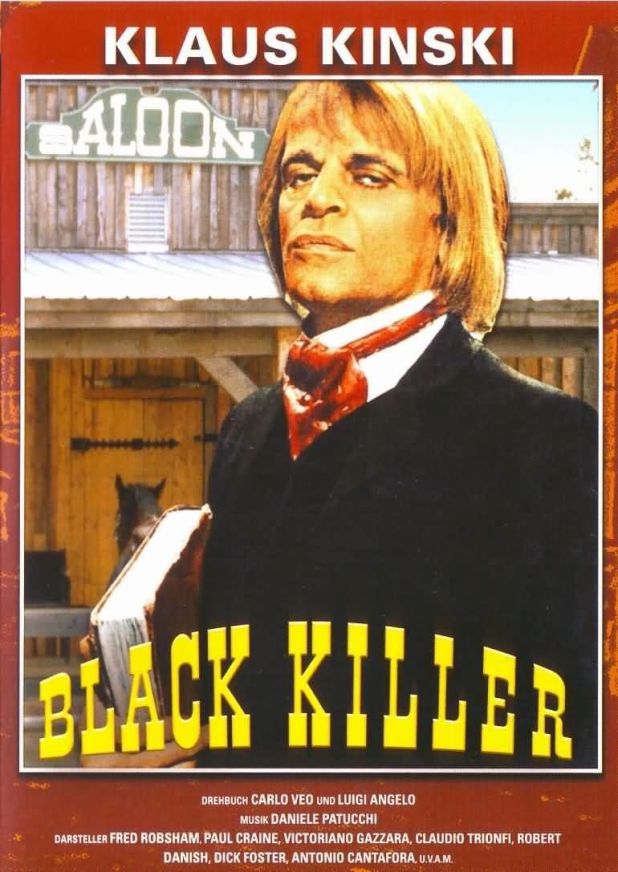
The O’Hara brothers run a small town in the west and despite the bounty on their heads, they’re working with Judge Wilson to make farmers sign his name to their land deeds and then kill they kill them and split the will. It seems like a great scam, but then Burt Collins comes to town and after a rigged game of cards, he kills two of the O’Hara’s men. On his way to escape from the town, he runs into the mysterious lawyer James Webb (yes, Klaus Kinski is on the side of the angels and I feel very strange about it). After killing three more gang members, Burt gets the job of sheriff instead of going to trial.
Meanwhile, the O’Haras are told that Burt is visiting his brother Peter, who lives in the wilderness with his Native American wife Sarah (Marina Malfatti, All the Colors of the Dark, The Night Evelyn Came Out of the Grave). They kill him, set the house on fire and — yes, an Italian movie — assault his wife but she lives. That’s their big mistake, because she’s probably the deadliest person in this movie, using a knife and firing explosive arrows (that become a major part of Bounty Hunter In Trinity) to kill just about everyone that’s done her wrong.
Look — Klaus Kinski is a lawyer who hides hundreds of his guns inside hollowed out law books and one assumes he goes from town to town in the west and finds situations where people of low morals need to be dealt with harshly while having no real morals himself. If we forget most of the rest of the movie — I’m also all for Malfatti killing those that so grossly wronged her and yes, that assault scene is really rough — and just think about a movie where Klaus tries cases, then opens a book, stares at someone and shoots them, your watch of this film is worth it.








 B&S About Movies
You must be logged in to post a comment.