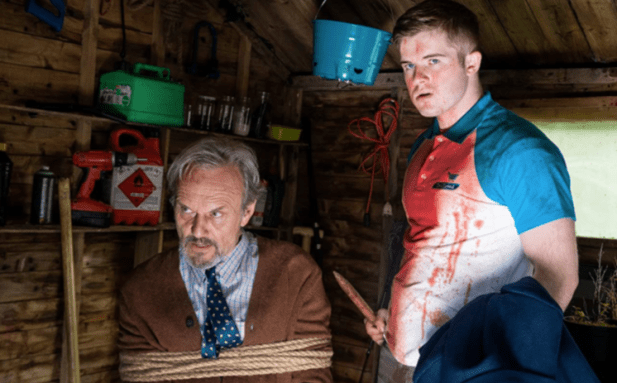
Matt’s older brother Deco turns up with a hangover one morning — like always — and when he’s let in, it turns out that he needs more than just some aspirin and sleep. His new fangs prove that he’s been attacked by the vampires that haunt Dublin, led by the ex-fiancee of Henry (Anthony Head, Giles of Buffy the Vampire Slayer), once just a trainspotting history lover, now a vampire killing cab driver.
Obviously taking its title from Let the Right One In, this is a comedy take on vampires filled with more gore than you’ll see in several undead movies.
Director Conor McMahon made Stitches a few years back. This is a big movie for the director and feels like exactly something Shudder would pick up, just like 2019’s Thirst. The film also boasts lush scenery — and some Dublin dives — including Ringsend, as well as the Bram Stoker Museum/Castle Dracula in Clontarf.
While it’s played for laughs here, the metaphor of drug addiction being like vampirism and you make the problem worse when you invite the person into your life — or the vampire inside your home — is a solid one. It may not contribute much new to vampiric lore — seeing Giles teach a young kid about sandlewood stakes is a nice touch — but it’s the kind of movie that is out to make you laugh, cheer and shout out loud.
Let the Wrong One In is playing Fantastic Fest this week. As soon as we discover where it’s steaming, we’ll update this post.
The “brain breaks free of the body” romp that is Mind Killer is an SOV’er that also crosses over into regional filmmaking — two video fringe genres that’s our kind of our jam (yeah, we have a lot of those) around the B&S About Movies’ cubicle farm. Local Denver filmmaker Micheal Krueger made two of them as a writer and director: the shot back-to-back Mind Killer and Night Vision (1987).
As a writer and producer, he made his third film: the rock band vs. werewolf flick — did he see Alice Cooper’s Monster Dog? — Lone Wolf (1988). In that same capacity, Krueger upped his game and shot in Panavision 35mm (but released in the same direct-to-video format as his previous three films), The Amityville Curse (1990). Sadly, the cinematic visions of Micheal Krueger’s mind ended at the age of 49 (of undisclosed causes) on August 27, 1990, in Denver, Colorado — where all of his films were produced and shot.
The copy on the VHS sleeve for Krueger’s first film proclaims it as “an intellectual horror film” — and that’s not just copywriter hornswogglin’. While obvious in its low-budget, the proceedings are far from the amateurism infecting most SOV’ers. Clocking in at a brisk 84 minutes (one hour twenty-four minutes), Micheal Krueger does his best with what he’s got to work with and takes the best of David Cronenberg’s Scanners (1987) and Ed Hunt’s (not released yet) The Brain (1988) — with a pinch of the classic (well, it is to the B&S crew) Fiend Without a Face (1958), and a little bit of Frank Henenlotter’s Basket Case (1982) and Brain Damage (1988) — and engages us with an introspective, but fun n’ sloppy romp. And the acting from the leads Joe McDonald and Christopher Wade (aka Wade Kelly) rises above the expected SOV thespin’ tedium norms.
Warren is a lonely library clerk addicted to self-help books and videos, particularly ones with advice on how to attract women — and he ineptly applies those teachings to the local singles bar scene with his even more awkward co-worker, Larry, and his buff roommate, Brad. Of course, Brad scores without books — and Warren creepily watches as he does — with the librarian he crushes (Shirley Ross, later of Night Vision).
Then, in the library bowels. Warren stumbles across a manuscript that he uses to develop psychic powers, which make him irresistible to women. Soon, his powers get out of control as his brain turns into a monster with a mind of its own — that bursts from his skull.
While this is more tightly edited — at 80 minutes — than the 100 minutes of Micheal Krueger’s follow up, Night Vision, as well as a bit more graphic-gooey than that latter film, the effects are cheesy-campy (but charming-to-inept amusing) and the thespin’ by most of the cast is from the stiff to the overwrought. The sound mix, in places, strains your ears deciphering the dialog. And, as with Night Visions, its all pretty uneventful until those last ten minutes — when our brain creature runs amuck, with slop and humor.
And does the ending remind you a bit of Re-Animator? Yes, and that’s not a bad thing.
The trailer and the conclusion of the film is on You Tube . . . fool me once, video embed elves!
And now for our second feature!
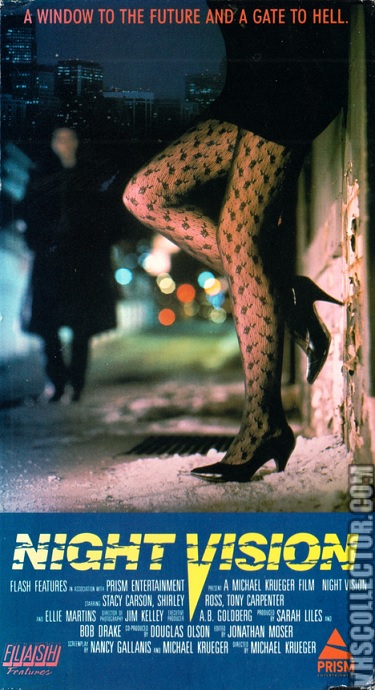
The copy on the VHS sleeve for Night Vision proclaims we will “tune into the nightmare channel and fast-forward into hell” . . . and that bit o’ copywritin’ hornswogglin’ sums up the ol’ haunted electronics plot we’ve enjoyed in the video ’80s with the likes of TerrorVision (1986; a cable satellite system), The Video Dead (1987; a portable TV set), and Remote Control (1988; possessed VHS tapes). Uh, okay. Yeah, yeah . . . and the vapid John Ritter-waster (he made so many; and you’re stuck with Pam Dawber, too) Stay Tuned (1992; a comedic, possessed cable TV hook up, or remote, or . . . I don’t care).
Unlike most SOV auteurs who vanished after one lone, in most cases, tragically inept film (that will still have its charms), Michael Krueger shows us he learned his celluloid lessons with Mind Killer. The production values on Night Vision are slicker and the acting from our leads of Stacy Carson and, as his girlfriend and fellow video store employee, Shirley Ross (from Mindkiller) are, again, above the SOV norms — but her constant gum chewing and smoking (and both at the same time) becomes annoying and ventures into a poor thespian choice (and gross); meanwhile, Carson is too old to play the naive teenager bit.
So, who’s haunted whom, here? Well, Andy Archer, a naive bumpkin from the Kansas cornfields heads into big city Denver — in lieu of his own state’s Wichita — to pursue a writing career. And the muse isn’t calling. Then he buys a stolen, portable TV and VCR from his new friend and local street hustler, Vinnie Sotto (a not bad Tony Carpenter). (Their friendship gives the film an M.C Escher meets a horror-slanted Midnight Cowboy vibe — with Carson as our naive Joe Buck and Carpenter’s Sotto as Ratzo Rizzo. There’s no evidence that was Krueger’s influence or intent, just my take on the material.)
Loaded into the VCR is a videocassette created by a group of electronic-worshiping Satanists (set up in the beginning of the film) — and the gadget — which plays back when it’s not plugged in; shocks you, pricks your finger, and oozes blood when it runs the tape (is it real or hallucination) — can also predict future murders. So our geeky Andy Archer writes short stories based on what’s on the tape — and finds success. Soon, those Satanic rituals and devil worshiping ceremonies on the tape — just as the box copy promises — fast forwards Andy into a Droste effect-type hell as murders sweep Denver — murders that Andy’s accused of, since he’s chronicled the murders in his stories and he appears on the tape as he commits the murders.
Sure, the proceedings plod along slowly, but the shots are professionally framed and the competently edited. But at one hour forty minutes, you can see an easy ten minutes trimmed. In addition, tighter writing could have easily paired Krueger’s Cronenbergian-cum-Lychian psychological thriller into a decent 80-minute film from the 100-minutes we’re watching. Again, it’s a competent effort and you’ve seen worse — far worse — from the SOV and 16mm canons. The oddity here is that Tubi offers Night Vision as an age-restricted sign-in, but there nothing here that’s the least SOV offensive-graphic (and doesn’t kick in until the last ten minutes).
A fan-created trailer and scene clip at the crappiest video store in Denver, is on You Tube . . . you’re not fooling me twice. . . .
You can watch Mind Killer on You Tube HERE and HERE, but the best upload is the free-with ads stream on Tubi. You can watch Night Vision on You Tube HERE, but there’s a better free-with-ads stream upload on Tubi. You can also learn more about both of these Micheal Krueger works, as well as all of the films produced in Colorado, at Colorado Film.com.
We’ve reviewed several Colorado-shot films, with Curse of the Blue Lights, The Jar, and Manchurian Avenger, and The Spirits of Jupiter. Other other, obscure Mile Highers we’d like to review, but there’s no copies to be had, are Savage Water (1979), Lansky’s Road (1985), and Back Street Jane (1989).
As always, our many thanks to Paul Zamarelli and his efforts to preserve the VHS artwork of these films. Visit him at VHS Collector.com and enjoy his reviews on his You Tube channel The Analog Archivist.
About the Author: You can read the music and film reviews of R.D Francis on Medium and learn more about his work on Facebook.
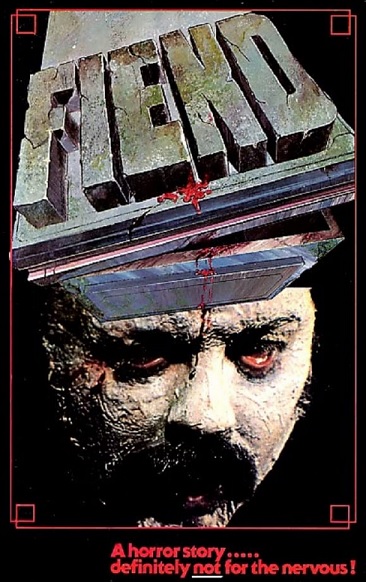
Unlike most SOVs (frack, I know it’s shot in 16mm), this second feature film by Don Dohler — his follow up to The Alien Factor (1978) — foregoes gore or excessive, lingering nudity to give us old school, drive-in creepy atmosphere of the Amicus and Hammer variety. Since Fiend was shot on 16 mm and blown up to 35 mm, it’s actually better classified as a “regional horror,”* as it received a limited drive-in theatrical run in the Northeastern U.S. in and around Baltimore, Maryland — before the rest of us discovered Fiend as a VHS release. But truth be told: If there was a letter after the 26th letter of the alphabet, this would be ___ – grade horror. It’s also a movie — as are all of Dohler’s work — with a lot of heart.
As is the case when shooting in film stock, in this case 16mm, no-budget guys are shooting on short ends and, with the cost of said film stock, are one-take charlies: so no retakes, reverses or coverage. It’s all very Ed Woodian, but not as wooden as an Ed Wood film. To that end: Is the acting painful in places. Yes. Are the effects chuckle-enduing. Do you want to jump into the film with a flashlight to see what the frack is going on. Yep. Is it one of Dohler’s best? Yes. The story is great and it’s only held back by its no-budget.
So, did you know that evil spirits “see” in a red optical effect? Okay, it’s a misty, red cloud. But did you know a “fiend” is more than just a Funk & Wagnalls dictionary entry: it’s a supernatural entity — again, a red misty thing (that looks like a bloated red worm or fat and fucked up two-tentacled octopus) — that absorbs evil during its timeless travels. So, our red-filtered lens effect drifts into a graveyard and reanimates the corpse of (violin; if you care) music teacher Eric Longfellow (Don Leifert; of Dohler’s The Galaxy Invader and Nightbeast).
Well, the Fiend needs to absorb the life of the living to continue its existence and needs a human vessel to harvest the life force of others. And also, so the vessel it possesses doesn’t rot away. Don’t ask where our spooky red cloud came from. Don’t ask why it picked poor Longfellow (perhaps he was the freshest corpse in the cemetery).
So, Longfellow digs himself out, well, there’s no “digging”; the Fiend just sort of “drifts-rises” out of the grave — since Longfellow is just a fleshy, transportation device for the Fiend. And taking its cues from George Romero’s Night of the Living Dead, we have a young couple in the cemetery (“They’re coming to get you, Barbara!”) for our zombie-fiend thing to feed on (and the queasy-sickly music here takes from Bach’s famed “Toccata and Fugue in D Minor BWV 565,” so cool).
And, with that, our Fiend moves to Kingsfield, Baltimore, where every day is a pleasant valley Sunday with kids on bikes and playing ball as dad mows the lawn . . . until the Fiend (now a bloated-set guy in a Walrus-mustache) comes to town and the dark storm cloud roll in. But life is pretty sunny for Longfellow: his house is fully furnished, he enjoys nice bottles of wine — and he even has Dorien, a cat. Yeah, you heard me right: the Fiend hates women, but love cats.
Like any vampire, or any vamp-chick jazzed-up on wasp juice (see your ’50s horror schlock), Fiend-Longfellow starts to rot, so he needs to suck up some spiritual juice to reverse the process. Of course, of the female persuasion. Of course, the snoopy neighbor (who rocks the mutton chops and plaid sports coats) who don’t take too kindly to da-dem dere newcumers (yep, the old “outsiders” trope of many horror films of old) — and hates Longfellow’s now seven-months of violin screeching — becomes obsessed with the strangulation murders plaguing rural Baltimore and thinks the quiet-weird violin guy, aka Longfellow, is the killer. Seriously, as stiff-as-cardboard liner-reader wife-Kender points out, in a roundabout way: Mr. Kender’s kind of a dick that itches to pick fights. The dude needs — deserves — to have his soul homo-sucked dry. And cool it with the faux-detective third degree on little kids. And berating your wife. If anything, ol’ man Kender is the real “fiend” of Baltimore. Someone red-optical effect his punk ass.
So, I am going over the razor’s edge of quality to say Fiend is the best of Don Dohler’s ’80s efforts?
As with Constantine S. Gochis’s (fantastic) The Redeemer, Fiend is so close: it’s almost there, to a John Carpenter Halloween-level, but misses the mark to be the next Bob Clark’s Deathdream (which Fiend reminds with its dead, rotting antagonist) or Alan Ormsby’s Deranged. Or Don Coscarelli’s so-awesome Phantasm. Why Dohler ditched the Hammer-Amicus creeps direction of Fiend to, essentially, remake The Alien Factor to a lesser-and-lesser effect with Nightbeast and The Galaxy Invader — then retire-vanish for a decade until bringing us Blood Massacre (1991), is an opportunity missed. Why? Because of Star Wars and Close Encounters of the Third Kind making aliens and sci-fi en vogue?
While it has its weakness — Don Leifert is actually very effective as the emotionless Fiend-Longfellow (but that cheesy ’70s mustache; yikes, only in the ’70s), and the decomposing face reanimation is equally effective on-the-cheap — all SOVs should be as well-written and shot as Fiend. (Unlike SOVs, Fiend received a drive-in and theatrical release.) Yes, I rank Fiend alongside Deathdream, Deranged, Halloween, Phantasm, and The Redeemer as one of those special, self-made nostalgic creep fests. As result of the Dohler lineage, Fiend is easily purchased on digital and hard media platforms in the online marketplace — and you can watch a free VHS rip of Fiend on You Tube.
* Sam discussed Fiend during our “Regional Horror” tribute week back in March. Look for it!
About the Author: You can learn more about the writings of R.D Francis on Facebook.He also writes for B&S About Movies.
Writer, director and actor Joel M. Reed wowed us on the ’80s home video fringes with his 1976 drive-in ditty Bloodsucking Freaks. Do read B&S bossman Sam Panico’s review, as he waxes nostalgic over the lost bricks-and-mortar era of video stores that afforded us, the jock-bullied, wee horror and metal lovin’ pups of its discovery — and of today’s feature film.
“Who is this whack job?” we pondered as we searched the video racks for other Joel M. Reed product.
Courtesy of the pulpy monster mags we got at the corner smoke shop or, if on a family excursion to the mall, Waldenbooks, we learned (Googling is no fun) Reed made his debut with two sexploitation flicks: Sex by Advertisement (1968) and Career Bed (1969). (Eh, buying online is no fun; mail-order catalogin’ from the back of monster rags for VHS-greys is the way to go.) Then Reed changed it up with an action flick — as only Joel M. Reed can make one — with a “Rambo” that has herpes (?) in Wit’s End, (1971). Of course, with Sly-Namexploitation in full swing in the ’80s, it was repacked as The G.I. Executioner.
So, this is the part of the film review and Reed career examination where we drop CBS-TV’s Everybody Loves Raymond into the discussion . . . because Marie Barone, aka Doris Roberts, stars . . . alongside Harve Presnell (Fargo, Saving Private Ryan; “Mr. Parker” in NBC-TV’s The Pretender) in Reed’s twist on the Amicus anthology format with Blood Bath (1975).
And that’s Joel M. Reed’s six-film career as a writer and director — a “tribute week” in one fell swoop of a review. Prior to his April 2020 passing, Reed appeared as himself (he has 15 other character-acting credits) in uber-fan Eric Eichelberger’s retro-SOV’er Ghoul Scout Zombie Massacre (2020).
Now, before we get into the movie at hand . . . let’s clear up the title confusion, as there are two movies with the title/alternate title of Gamma 693: First, there’s Joel M. Reed’s sixth and final film released onto video in 1981. Then there’s the other one starring Linda Blair and Troy Donahue from 1989 — which served as the lone directing credit by Jack A. Sunseri. Oh, you know Jack: he gave us the cheesy “puffbox” timewaster, The Dead Pit (1989) — that’s not to be confused with The Pit (1981). No, we’re talking about the one with the blinking zombie eyes on the VHS Box (You Tube clip of the box in action).
Now, I’ve personally never sought out The Chilling starring Linda and Troy. In fact, I don’t ever recall seeing it on the store shelves, even though it came out as a theatrical in 1989 and hit U.S. video shelves in 1992. It’s said The Chilling played on USA Network’s “Up All Night” and “Night Flight” weekend programming blocks, but not to my knowledge. Is Jack A. Sunseri’s flick a homage or loose faux-sequel to Reed’s film, we wonder. Alas, it’s an analogy quandary I shall delve into not, as The Chilling is so awful in its inept Return of the Living Dead (1985) ripoffery. Let’s just say Sunseri attempted to hornswoggle us Joel M. Reed freaks into renting a Sunseri boondoggle, and just leave it at that.
To add to the bad analog Intel: It is also said that Reed’s Gamma 693, aka Night of the Zombies, also carries the title alternate of The Chilling. Not only have the B&S worker bees not been able to locate any theatrical one-sheets with the Gamma 693 title, we were unable to locate any VHS or DVD reissue slipcovers with The Chilling title. So, let’s just say The Chilling alternate title is an Intel cut-n-paste snafu resulting from Sunseri’s film coping the Gamma 693 title at some point during its own video shelf life. And it wasn’t it enough to piggyback on Reed’s works; Sunseri swinehumped Wes Craven’s superior cryogenic horror, Chiller (1985), which starred Michael Beck (The Warriors, Battletruck) and Jill Schoelen (Thunder Alley) that aired as a first-run TV movie on the USA Network.
If you’re in a NaziZom* binge-mood: Other films you can check out are They Saved Hitler’s Brain (1964) and its fellow Nazi scientist-cum-world-conquest villains in She Demons (1958), The Flesh Eaters (1964), and Flesh Feast (1970). To a lesser extent, there’s the Nazi we-never-see ghosts of Death Ship (1980). Then there’s the later NaziZomsploitation sub-genres homages Outpost (2007), with its own sequels War of the Dead (2011) and Bunker of the Dead (2015; in a found footage format), and the Finland-made dark comedy of Dead Snow (2009), which has its own sequel-verse. No, while it’s cool: not Iron Sky (2012), for that has no zoms, but Nazi UFOs on the moon, even though the dark side of the moon is a cold bitch.
Now that you are a well-informed, frozen-Nazi zombie consuming streamer, on with today’s feature presentation.
Ah, the VHS slipcover art I remember, aka Gamma 693, aka Hell of the Living Dead.Don’t be fooled by the “X,” as this is not the least bit “video nasty.”
As with John Howard’s Spine — and Paul Norman’s Ice Cream Man and Tucker Johnson’s Blood Salvage — Reed’s flick is also a porn-connected produced horror flick — thus, the shot-on-video production values. It was shot in the Munich, Bavaria, Germany home and on the property of noted ’70s porn purveyor, Shaun Costello. (It had pick-ups done on the sly in the wooded environs of New York’s Central Park and a “Euro-looking area” of Greenwich Village.)
Now, come on. Don’t be shy and lie, because I’m not.
When I aged-into my behind-the-taboo-green-curtain years, I rented a VHS copy of Costello’s infamous Girl Scout Cookies (1976). So, yes . . . our 420-plus credits leading actor here, Jamie Gillis, is, in fact, a porn actor who occasionally moonlighted in low-budget “mainstream” flicks, but is best known for his work in Deep Throat II (1987). As if we forgot there was already an official Deep Throat Part II in 1974 to the 1972 film. See, even porn films do the alternate-title hornswoggle.
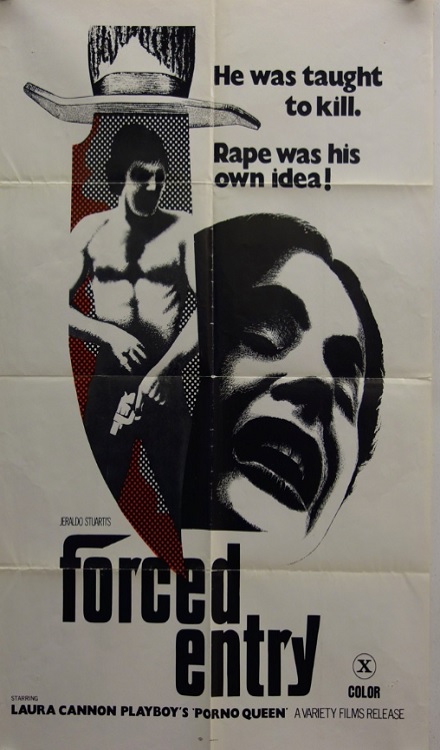
In addition to Girl Scout Cookies — and if you’re a ’70s proto-slasher fan — Shaun Costello, after achieving success with a series of adult film short, aka loops, made his feature film debut as a writer and director with the X-rated Forced Entry (1973). Remade in 1976 as The Last Victim — by Jim Sotos/Gary Graver; yep, both porn-connected — the film was marketed on the grindhouse and drive-in circuits until the early ’80s, courtesy of Tanya Roberts, later of Charlie’s Angels fame, starring.
When Dawn of the Dead (1978) inspired a Euro-zom craze that soon engulfed home video shelves, Reed’s NaziZomsploitation romp appeared on VHS in 1983 under its better known title: Night of the Zombies. If you were a fan of Eliva’s Mistress of the Dark syndicated movie blocks, you may have seen it on television under that title. Maybe you caught it — as did I — at your local twin cinema in 1981 as Hell of the Living Dead, which has nothing to do with the 1980 Bruno Mattei film of the same name. To add to the confusion: Reed’s zom-romp also carries the home video title of Night of the Zombies II, as an ersatz-sequel to Bruno Mattei’s film, which itself is also known as Night of the Zombies. Later ’90s DVD reissues carry the title of Night of the Zombies: Battalion of the Living Dead.
Just wow. That’s way to much market effort for a film that doesn’t deserve the lipstick-on-a-pig marketing effort.
Where’s Jean Rollin’s Zombie Lake (1981) and Jess Franco’s Oasis of the Zombies (1982) when we need ’em. Hell, where’s the Dana Andrews-starring frozen Nazi-heads flick The Frozen Dead (1966). I can’t believe I just said that. Yes, those three dopey zom romps — and Mattei’s for the matter — are far better than this Joel M. Reed mess that isn’t the least bit zombie goo-messy, it’ “twist ending” be damned. And, worst of all is that it takes us 40 minutes to get to the blue guacamole-smeared zombies — and that’s if you can see ’em through the worst night-photography ever committed to film.
Then there’s the government lamenting and spy-drivel pontificating — via stammering “actor” ad-lib. Then there’s the “set design” of government offices that don’t look like government office that look like the filmmakers guerilla-shot their way into a hotel conference room and got out before hotel security kicked them out: Pentagon and Fort Detrick, my ass. Then there’s the obvious, medical lab-borrowed skeletons — that are supposed to be what’s left of the zombies after melting — and the melting effects are questionable — that have a visible, linear mark across their caps. Remember Billy Eye Harper’s plastic-bone rotted remains in Rocktober Blood? Plastic skull is as plastic skull does, Forrest.
So, how did we get here: Upon the death of two scientists in the Bavarian Alps investigating the activities of a WW II U.S. Army Chemical Corps unit engaged top-secret chemical warfare with something called “Gamma 693,” the U.S. government sends Nick Monroe (our porn star Jamie Gillis), a not-James Bond CIA agent to investigate the deaths. During his investigation, Monroe learns of the rumors of a regiment of Nazi zombies roaming the countryside and uncovers a Nazi plot for world domination with an undead army. Without the chemical agent — designed as a healing agent for the war wounded — the Nazi ranks will age and decompose. So there’s only one thing left to do to stop the rot: eat human flesh. And since these are intelligent zoms: they tell their food that they don’t want to, but must.
Is there a creepy atmosphere? Is the plot a bit whacked? Is the soundtrack queasy-inducing? Sure. But it’s all too little too late. If only Eli Roth (re) made this, it would be so much better, for the story is there. So I’ll just take my VHS copy of Ken Weiderhorn’s Shock Waves to my movie room and call it a night.
If you’re a first-timer to Joel M. Reed’s Alpine snow-zoms, you may pass, as well. Then again, you may like it. Just as I enjoyed Weiderhorn’s Carribean aqua-zoms and others hate it. Everyone’s tolerance for B-movie cheapness and nostalgia miles for the past, may vary. Like Steel Town wrestler Shirley Doe says, “Films are funny that way.”
You can watch Reed’s contribution to the NaziZomsploitation genre on You Tube HERE (the Prism Video-version as Night of the Zombies II — with a trailer for Shock Waves!) and HERE (as Die Nacht Der Zombies).
The SOV format is pretty much made for horror anthologies. There’s a great story in here about a girl who watches a horror movie host all day long and tries to figure out how to murder her mother. This has more of a brain than you’d expect it to — I would assume that the feminine edge came from Melanie Johnson, who wrote this with Scott Aschbrenner and Alfred Ramirez. I mean, there’s still a story where a man kills his wife and puts her down the garbage disposal — he gets his, stay tuned — but it’s not the typical gore for the sake of gore that most SOV is all about.
There are also some great trailers for movies that never happened, like Bathroom Bullies, Pretty Girl Floyd, Missouri Mop Massacre, Nursing Home Revenge and Don’t Go Into the Kitchen.
There’s also a Satanic wraparound, which is always appreciated.
It’s not perfect, but this feels like the kind of movie that — were it on the shelf of one of the two rental stores in my hometown — I would have gone back and rented again and again. I mean, drunk drivers dealing with zombies is always something that I seem to enjoy in an anthology.
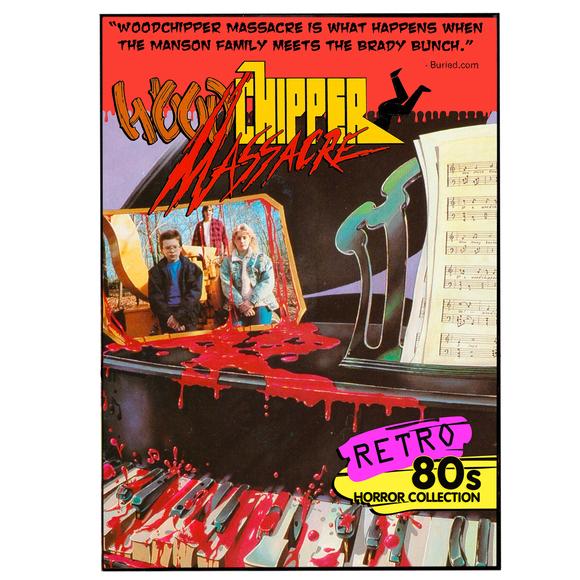
Jon McBride acted, wrote, directed, edited, and composed this movie for $400. I kind of wonder why he didn’t name it The Connecticut Woodchipper Massacre. That may be because it’s way closer to Don’t Tell Mom the Babysitter Is Dead, but that movie never had a kid accidentally stab his aunt with a Rambo knife that she wouldn’t let him have. Let me tell you, I wanted one of those knives too, so I completely get it.
I also completely get the worry of having the yard raked before your father gets home when you told him it’d be done. That said, again, I’ve never used my cousin as compost spread all over the yard. I guess I lived a pretty sheltered life.
This film was based on the 1986 Newtown, CT murder of Helle Crafts by her husband Richard, which also was where Fargo got the idea. I would guess that the Coen Brothers didn’t have to shoot all of their woodchipper scenes in one weekend because they only had money to rent it once.
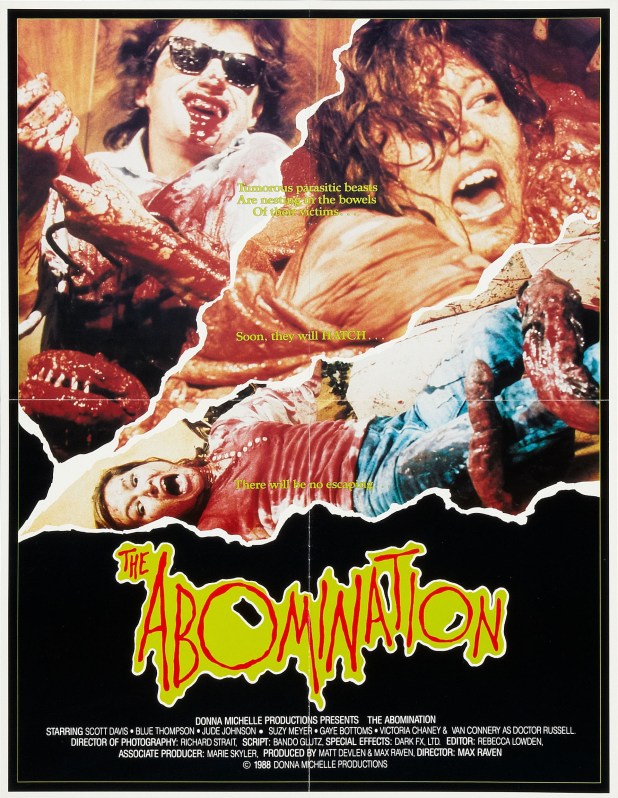
There is every other movie in the world and then there’s The Abomination.
No hype. This movie is absolutely brain destroying junk transmitted from some terrifying alternate timeline that I hope and pray never reaches our own. It’s a world where televangelist Brother Fogg can pray a tumor out of a woman, who vomits it out, and then that tumor crawls into her son who undergoes a transformation into a killing machine that feeds the many spores of the creature and pushes forward the end of all things.
This is also the kind of movie that starts with a blast forward of all the gore that you’re about to see in this movie and still not feel boring when that gore comes back. And man, that gore comes back and takes over the world of this movie, transforming protagonist Cory’s home into a panormama of teeths and blood and muscle and sinew and gristle and gore.
Man, what’s wrong with Texas? Or right? This movie feels like it wasn’t released and that it escaped, like it should have been destroyed before it infected anyone’s brain but here it is, hiding in its low-fi menace out there waiting for people to watch it and wonder, “Why are people driving so much?” when they aren’t wretching from the endless parade of blood and viscera being literally thrown at the screen and the dubbed soundtrack which makes me love this movie even more, because when you put your budget into gigantic monsters that emerge from appliances and kitchen nooks, you don’t have the cash for synched sound.
Director and writer Bret McCormick also made parts of Tabloid and the films Time Tracers and Repligator. Even at this early stage, he’s showing off a real eye of how to use the budget and how pretty much frighten you through the sheer strangeness of what he’s created.
This isn’t a perfect movie but perfection is an ideal that cannot exist. This is The Abomination.
A lot of people may wonder, what does the B and S in our site name stand for?
Eric Roberts.
Seriously, we’ve covered so many movies by today’s John Carradine that I feel like Mr. Roberts may as well be in my kitchen fixing himself up a bowl of Ghostbusters cereal.
So anyways, here’s this month’s bit of Eric, a movie in which…a pandemic has ravaged the Earth.
Oh man — do I want another pandemic movie despite most of my day job being dealing with it?
“It’s cool, Sam,” yelled Eric from upstairs. “You have any crackers for this hummus?”
So while I ponder the iron stomach of Eric Roberts, a man who can drink milk and hot pepper hummus at the same time, let us move to a place where not only famine and piracy are day-to-day affairs, but so are zombies.
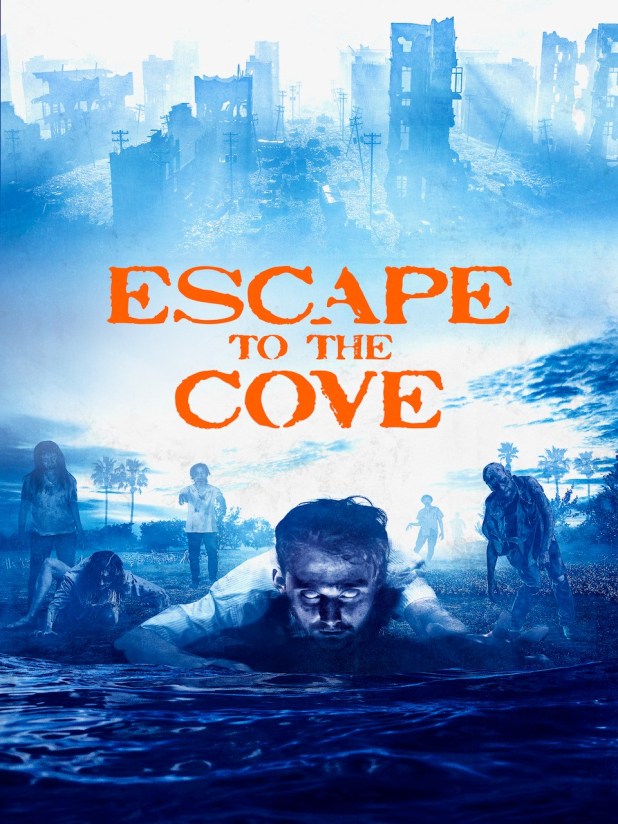
Produced, directed, written and featuring Robert Enriquez, this movie has a lot of talking before we get to the action, with Roberts showing up as a flashback and not in the main narrative. But man, that’s how the man likes to work. He’s in my pool right now recording audio for another movie about an answering machine that gets plugged in and realizes that all the other answering machines are no longer in use so it goes on a rampage.
The zombies in this are called Wanderers, though, which is a good term for them. So kudos on that part of the script. It’s a real challenge to make a zombie movie these days when it feels like absolutely everything has been done, so I have to give it to the filmmakers to include aquatic undead, which is a nice touch as well.
Escape to the Cove is now available however you watch movies online. You can learn more at the official Facebook page.
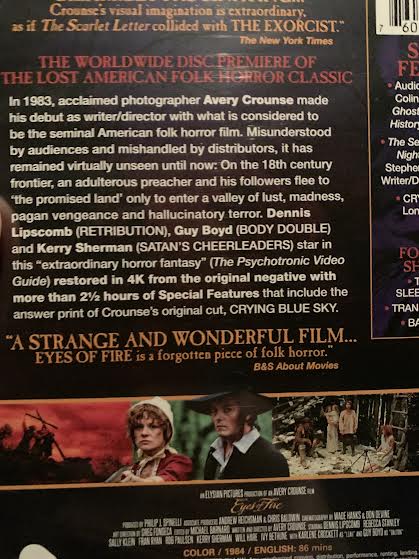
We’re also really excited that a movie we love so much has our review on the back cover!
Sam’s take:
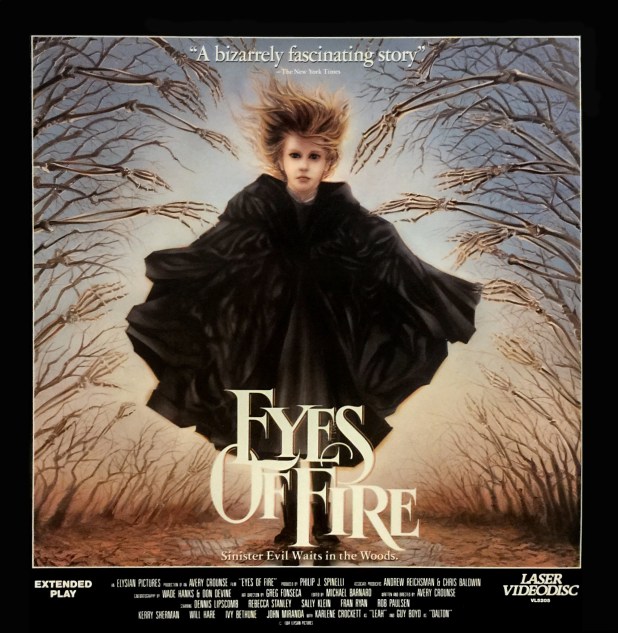
Released by Vestron Video in 1987, this forgotten folk horror—also known as Cry Blue Sky—is very similar to The Witch, minus any arthouse aspirations. Instead of a man whose pride casts his family out of their village, this movie is about a reverend accused of adultery and polygamy.
Reverend Will Smythe (Dennis Lipscomb, Under Siege) and his followers leave their town behind to live in a valley haunted by an ancient evil. A rugged woodsman, Marion Dalton (Guy Boyd, Body Double), is along for the ride because he has his eye on Smythe’s lusty wife, Eloise. Hijinks, as they say, ensue. And by hijinks, I mean whatever is in the woods begins to haunt and kill everyone.
Rob Paulsen, who plays Jewell Buchanan, would become a voice actor. Perhaps you’ve heard him as Raphael and Donatello, two of the Teenage Mutant Ninja Turtles, or Pinky from Pinky and the Brain. He’s also in the movies Stewardess School, Warlock and Body Double. He’s also the voice that says, “Cheers was filmed in front of a live audience.” In all, he’s been in 1,000+ commercials and been the voice of 250+ cartoon characters.
Director Avery Crounse started his career as a photographer and only made two other films: The Invisible Kid and Sister Island, which starred Karen Black.
R.D’s take:
Okay, so this is more demons than Satan. Well, it’s actually evil Native American spirits, but it’s a rare obscurity and that’s what B&S About Movies is all about.
Shot outside of St. Louis, Missouri, for under $3 million and theatrically known as (I think, the better titled) Cry Blue Sky, it was poorly edited, chopped down from its original 108-minute running time to 86-minutes and retitled for its home video and pay cable version (it ran on HBO).
To sum up the plot: If Eyes of Fire were made today, it would be known as Cowboys vs. Demons and programmed alongside the Aslyum-styled mockbuster “Cowboy vs.” knockoffs Cowboys Vs. Vampires (2010; aka Dead West) and Cowboys vs. Zombies (2014).
Oh, but this film is so much better than those films.
I was actually inspired to give Eyes of Fire, the directing debut by Avery Crounse, another watch after picking up (from the public library on a whim) a copy of the supernatural period horror film, The VVitch (2015), the commendable directorial debut of Robert Eggers.
Eyes of Fire tells the story of a wicked, polygamist preacher (is there any other kind) who runs the old west (circa 1750) town of Dalton’s Ferry. When the Reverend Will Smythe (Dennis Lipscomb) is called out for his adultery among his parishioners, he and his flock are subsequently banished. Of course, God tells the Reverend to make a new life in a valley foretold in Indian legends as the “Forest of Darkness,” a wooded area with souls trapped inside trees and running amok with “mud people.”
Before you know it, all hell breaks loose in the Promised Land, Blair Witch-style, as the settlers can’t seem to find their way out of the forest and they’re picked off one by one. It’s up to a rugged frontiersman, Marion Dalton (Guy Boyd), and a crazy, woods-dwelling witch who proclaims herself the “Queen of the Forest” (Karlene Crockett) to battle the marauding Indian spirits.
While Eyes of Fire is low-budget and under the radar, there’s no denying that it’s well made and features great cinematography, costuming and special effects (the tree-trapped spirits are excellent), along with solid acting from the cast of unknowns. Granted, some quarters may say it’s slow: if you watch the home video cut instead of the theatrical cut, it is a bit choppy and doesn’t make a whole lot of sense in places (it loses 22 minutes between its different cuts), but that only lends to its Phantasm-like foreboding. It’s certainly more entertaining than other films of its ilk*, such as Aramand Mastronianni’s (He Knows You’re Alone, Cameron’s Closet) The Supernaturals, which I remember as being very boring—and I ejected it from the VCR less than half way through, never to watch again.
It’s unfortunate that Crounse disappeared from the industry (maybe he went into commercial work?) after two more films: The Invisible Kid (1988) and Sister Island (1993), as he showed a lot of promise. I vaguely remember the former as a theatrical with Jay Underwood, who was “hot” at the time. I never heard of the latter—one of the many low-budget romps from the extensive resume of Karen Black (Burnt Offerings).
There are lots of familiar TV faces afoot: Guy Boyd (pick a late ‘70s/early ‘80s TV series) was a semi-regular on Remington Steele, a co-star on 2000’s Black Scorpion, and was in Brian DePalma’s Body Double—and he’s still active today. You can play “pick a TV show” with the late Dennis Lipscomb as well, with his starring roles in Cop Rock and Wiseguy, while Karlene Crockett was a regular on Quincy M.E and Dallas. Eyes of Fire was the only feature film appearance by Rob Paulsen, as he reverted into voice work and became Pinky from Pinky and the Brain (1995) and Yakko from Animanicas (1993). Keen eyes will pick up on Kerry Sherman, who made her debut in Greydon Clark’s Satan’s Cheerleaders (1977), and Fran Ryan, who’s been in everything from TV’s Gunsmoke to Bill Murray’s Stripes(1983).
* Night of Horror (1981) with more Confederate Civil War ghosts (one of those “the cover is better than the movie” flicks and a VHS-eject), Ghost Riders (1987) with western ghosts deep in the heart of Texas (well made, but boring; a VHS eject), and Stones of Death (1988) with aborigine ghosts (Aussie Indians) going “Poltergeist” (better made, but ho-hum familiar). Honorable mention: William Grefe’s (Mako: Jaws of Death) awful but fun drive-in nostalgia romp Death Curse of Tartu(1966) with its burial ground Indians.
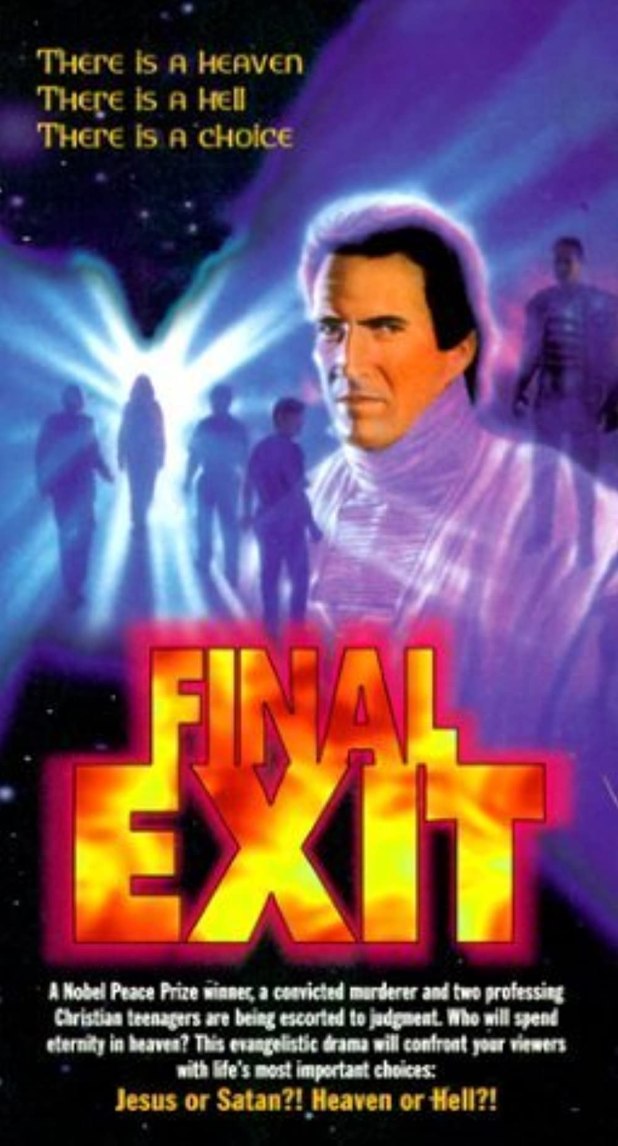
Stop me if you’ve heard this on before. A Nobel Peace Prize winner, a convicted murderer and two professing Christian teenagers meet St. Peter at the Pearly Gates and, well, make a movie. Final Exit is an “evangelistic drama will confront your viewers with life’s most important choices: Jesus or Satan? Heaven or Hell?”
Oh man, yeah. This is why I watch movies.
As a kid, I repeatedly encounter Jack Chick tracts that, if anything, pushed me away from the path that Mr. Chick wanted me on. This Was Your Life is a really good overall view of the world of Chick: a man has led an ordinary life full of sin, wasted what God gave him and is thrown into Hell and he’ll never get out. Variations on this theme appear, telling us that even the clergy — especially Catholics — can still go to Hell. Reading so many of these so often as a kid led to the man that I am today.
In case you haven’t been amazed by what the Christian side of the world endorses these days, this movie will set you straight. Of course, the serial killer will go to Heaven because he made a very specific prayer the night before he was executed and he would have never found Heaven without the death penalty. The Nobel prize winner did amazing, wonderful, astounding things in his life and ended war and saved lives, but he was selfish and did it all for himself and not God, so he’s going to burn.
And then the movie reminds you that even though this man stopped some wars, there will still be more wars. Also, one of the serial killer’s victims is innocent, but never found God, so they show her being removed from Hell for just a moment before pushing her back in.
Writer/director Danny Carrales has made a ton of movies like this, moving up from SOV quality to actual films. His latest one, 2018’s Beyond the Darkness — and you just know that I love that he used the name of a Joe D’Amato movie — has lighsaber-looking things on the cover, which means I need to track it down and do a full deep dive. And oh yeah, Carrales is also a professor at Jerry Falwell’s Liberty University.
Some people ask me, “How did our country get like this?” We always were. It just used to be tracts, SOV videos and the 700 Club wasn’t watched by everyone and shared like social media. It’s someone’s POV, no matter how much you disagree with it. And you know, no matter what you do, you’re going to Hell.




 B&S About Movies
You must be logged in to post a comment.