Asylum of Satan (1972) and Three on a Meathook (1972)

Editor’s Note: In addition to reviewing the films: at the end of the reviews, we’ll also explore the music in each.

In April 2023, Red Rocket Media bring Three on a Meathook to Tubi under their “First Time on Tubi” feature. While they have not yet uploaded a stream of Asylum of Satan, there are five other William Girdler films mentioned within this review to enjoy on the platform. Make a day of it!


Who is William Girdler?

Prior to his death in a helicopter crash in Manila, Philippines, in January 1978, while scouting locations for his next film project (a Star Wars response known as The Overlords), writer-director William Girdler was a driven, prolific filmmaker who shot nine features in six years between 1972 to 1978. His final film was the Tony Curtis-starring The Manitou (1978). His debut was the shot-in Louisville, Kentucky, Asylum of Satan — his response to Rosemary’s Baby (1968; we’ve reviewed the ’76 sequel). Asylum’s plot deals with the head of a mental hospital who sidelines as a Satanic priest. Then, with some trust fund cash in hand, Girdler created his most infamous, second film that earned its notoriety courtesy of its later ’80s VHS shelf life: Three on a Meathook. That film, a Halloween proto-slasher, deals with a character based on the infamous Ed Gein; Gein also served, if you’re keeping track of such things, as the inspiration for Alfred Hitchcock’s PsychoDeranged, and The Texas Chainsaw Massacre .

Asylum and Meathook impressed producer Samuel Z. Arkoff, so he hired Girdler to direct pictures for American International Pictures. Those three projects were in the Blaxploitation genre: The Zebra Killer (1973) starring Austin Stoker (John Carpenter’s Assault on Precinct 13), the ever-amazing Abby (1974) with William H. Marshall (Blacula), and the Quentin Tarantino favorite, Sheba, Baby (1975).

Girdler’s next film, after his Blaxploitation cycle, was a ripoff of the major-studio and more successful James Caan-starrer, The Killer Elite (1975). Known as Project: Kill (1976), the film served as one of the few non-comedy films of Leslie Neilsen (The Patriot). Girdler then followed with his most financially successful film — which was another ripoff, this time, of Jawsonly with a man-eating bear, known as Grizzly (1976). Christopher George returned from that film for its loose, man-verses-nature sequel, Day of the Animals (1977) — which also starred Leslie Neilsen from Project: Kill. Girdler’s final film was his most expensive production — and the best-looking production of his career: a truly original piece based on a best-selling book, The Manitou, even though it was a cash-in on The Omen.

Asylum of Satan: The Review

Not so infamous . . . and forgotten.

Girdler produced Asylum of Satan for around $50,000 . . . yet, as a testament to his cinematic skills, it looks more expensive: the basement bowels of the Satanic chapel under the “hospital” is surely a wonder of costuming and lighting; so, yeah, we’ll forgive the papier-mâché head of the Devil when he appears.

Lucina Martin (San Francisco-born Carla Borelli, later of Billy Jack Goes to Washington and O.C. and Stiggs) is a nurse assigned to the titled abode where she soon learns she’ll be taking part in a Black Mass — which has Michael Aquino, the man who wrote the rituals in The Satanic Bible to ensure the accuracy of it all. Except that, well, you know: LaVey and Temple of Set Satanists do not kidnap and kill. But, hey, this is Hollywood. And it is the type of Satanic movie your less-informed, ignorant self — drunk on a wealth of UHF-TV era Hammer and Amicus films — would make: complete with naked, bound up girls on altars, which makes this movie such a fun, retro-watch.

You can watch Asylum of Satan on YouTube and here’s the trailer.

Three on a Meathook: The Review

The infamous ’80s rental . . . that wasn’t as graphic as we were lead to believe.

So, under budget and with film stock left over Asylum of Satan, William Girdler made his next film, Three on a Meathook. Once again filming in and the surrounding areas of Girdler’s home town, our faux Ed Gein slashing up the town is Billy Townsend (a not-too-bad James Carroll Pickett): he’s one of those “nice guys” who helps four girls on a country lake vacation when their car breaks down. Oh, yes: Billy has skeletons of the figurative and literal variety with a little Vietnam bad vibes piled on — along with a dedicated father (Charles Kissinger, also of Girdler’s Asylum of Satan, AbbySheba, Baby, Grizzly, and The Manitou) who will protect his son at any cost.

This is, of course, a Drive-In Asylum magazine’s Bill Van Ryn film: the kind of ’70s Drive-In’er where “nothing happens” (Norman J. Warren’s Prey, Lee Madden’s Night Creature, John Hayes’s End of the World, and Bill Rebane’s Invasion from Inner Earth, in no particular order, are oft mentioned) to the point where our slasher stops by a movie theater to watch Dustin Hoffman in The Graduate, then he’s off to a bar to have a suds and listen to live music. (Don’t stick your saliva fingers in the bar’s communal nuts bowl, Billy T. Dump ’em on a cocktail napkin.)

Girdler’s freshman and sophomore films proved he knew how to make movies on a budget: he also wrote and arranged the music for the songs in both films. The songs are performed by his hometown friend, Eddie “Eddie D” Dempley: his Blues Express are heard in Asylum; his later band, American Xpress, also appear in Meathook.

You can watch Three on Meathook on You Tube. Here’s the trailer. And here’s Eli Roth chiming in on the film’s “grindhouse” notoriety. Eli’s right: the bigger VHS box meant the movie would suck, but that made us want to watch it more!

Nick Jolley: The Music

The actor’s handwritten, autographed resume from the archive of Theatre World and Screen World, a comprehensive record of American stage and film since 1945/Image courtesy of History for Sale.

The song “Red Light Lady,” heard during the opening credits of Asylum of Satan, was written and arranged by William Girdler and sung by leading man Nick Jolley. The background musicians are unknown and may or may not be the Blues Express. A Broadway actor and singer, Jolley was born on February 17, 1948, in Hindsboro, Illinois. His lone film acting role was playing the plaid jacket and checkered pant hero of Chris Duncan in Asylum.

Jolley, most notably, worked as an understudy and onstage performer in the Broadway theater revivals of Oklahoma! (as Chord Elam, December 13, 1979 – August 24, 1980; New York Times review) and The Pirates of Penzance (January 8, 1981 – November 28, 1982). He also acted and sang in many TV commercials and traveling dinner theater productions. You can hear Jolley sing “The Farmer and The Cowman” on the Oklahoma! Cast Album issued by RCA Records. His other stage musical credits included Kiss Me, Kate (1974), A Little Night Music (1976), The Music Man (1978), The Brooklyn Bridge (1983; review), Up in Central Park (1984), and South Pacific (1985).

Nick Jolley died at the age of 48 on February 8, 1997 (Obituary).

Eddie Dempley: The Music

Edward “Eddie D” Dempley and the Blues Express do not appear in but performed the instrumental “The Satan Spectrum Theme” during the end credits of Asylum of Satan. The song was written and arranged by William Girdler (that’s Eddie, in the white tux holding the microphone, second from left in the video still, below).

Born on August 23, 1943, Dempley passed away on July 28, 2011, after a three-year cancer battle. Born in Oldham County, Kentucky, he excelled on the saxophone as a member of the Van Dells and Eddie D (Eddy Dee, Eddy D) and the Blues Express. The band, credited as the American Xpress, also recorded the vocal pieces “You Gotta Be Free,” “We’re All Insane,” and an untitled, end credit instrumental that we’ll call “Love Theme from Three on a Meathook,” for Three on a Meathook.

Even though the band changed monikers from the Blues Express to American Xpress between the two films, it’s the same line up of Bill Longale, Mikk Mastin, Dave Goode, Waldo Weathers, Don Powell (drummer), Maury Bechtel, and Edward “Eddie D” Dempley. (We’ve since heard from Don Powell, who left a kind message in February 2022 on our previous, October 2020 “Slasher Month” review of Meathook.)

Eddie started out with bassist Richard Basin in the Successions, as a singer, in 1964 in Middletown, Kentucky. The band secured the house gig at Bells Country Club off of Poplar Level Road from 1965 to 1967. Another popular club Eddie D played as a house band gig was the Doo Drop Inn on Story Avenue in Louisville in the mid 1980s. During this period he recorded and released on the regional Dunbar label, “Fanny Mae b/w The Same Old Guy (Who Still Loves You).” Another of Eddie’s lost recordings is the Dunbar Records’ 45-rpm Eddie Dee and the Blues Express with “Let´s Go Steady” b/w” Make It Happen.” During this period, the band was also known as Eddie D and the Country Connection. All of his bands also appeared numerous times at the beloved Colonial Gardens and Office Lounge.

Around 1979, Eddie played with Jim Wilson, along with Jim Baugher, David Marasco, George Ashmore, Rod Wurtle, and Rob Brown when the band was called Eddie D and Energy. That version of the band played at the Fern Valley Holiday Inn, Big Moes, and the Old Churchill Inn, and Harold’s Club; the last, which way out down yonder on the ol’ Dixie Hwy.

You can visit Eddie at Legacy.com and Dignity Memorial.

Asylum of Satan: “Satan Spectum Theme”

Music from Three on a Meat Hook

Image credits:

— Theatrical one-sheets courtesy of the IMDb.

— Images of Nick Jolley and American Xpress capped from their respective William Girdler films.

— The black and white image of the Blues Express in the Meathook video are courtesy of the Dempley Family Archives. The Archive also provided this review’s biography materials. We also thank Paul Povesis, Caroline R, Richard Bolin, and Jim Wilson for their blog and video comment insights. Our thanks to each for allowing us to preserve their loved one’s career.

— Nick Jolley bio information courtesy of Woody Anders/IMDb, History for Sale, and Ovrtur. Thank you for allowing its use to honor Nick’s life and career.

A special thanks to those who reached out in kindness to this writer, as we close out 2022, with their pleasure in reading this review, as well as sharing their additional memories of Eddie Dempley and Nick Jolley. Yes, sometimes social media can work in the positive, so it’s a feel-good day! The same happened just the other day with reviews for The Survivalist and about a month or so back with The Spirits of Jupiter.

About the Author: You can learn more about the writings of R.D Francis on Facebook. He also writes for B&S About Movies.
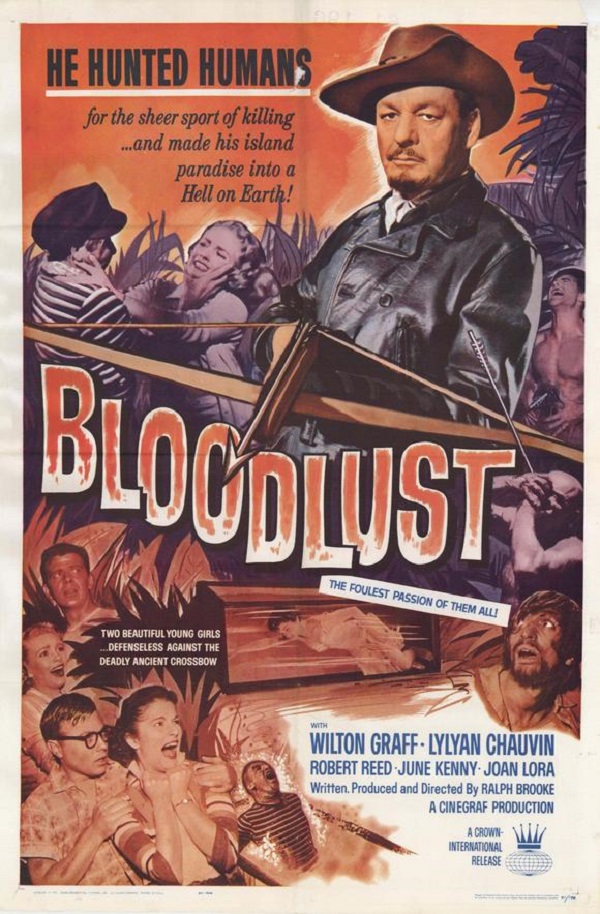
Bloodlust! (1961)

Man, don’t ever do what Betty, Johnny, Jeanne and Pete do in this movie. They go on a vacation together and when their ship’s captain gets too drunk to navigate, they head off to a jungle island to have some fun. Have we learned nothing from, well, every movie ever?

Johnny (why yes that is Robert Reed) falls into a pit right away and is saved by Dr. Albert Balleau and his servants. Like every rich white man who moves to an island hell to conduct experiments — just asked the cucked great men of Blood Island — Dr. Balleau is dealing with his wife Sandra (Lilyan Chauvin, whose acting credits are all over the place in respected movies like The Other Side of Midnight and the junk we love like Silent Night, Deadly Night and playing Van Damme’s mom in Universal Soldier) loving it up with houseguest Dean Gerard (Walter Brooke, the man who said the word plastics in The Graduate).

As our four protagonists wander around the home of the doctor, they find a woman floating in an aquarium and a vat of acid big enough to kill people in. That’s when our villain comes on out and announces why he does what he does. No, he didn’t see The Most Dangerous Game so many times that he decided to cosplay it. He was a sniper in the war and his dislike of killing became a lust for blood. He proves that by showing off his trophies, which now has his wife and her lover on display.

Can you believe that Pete was played by Eugene Persson, who went on to co-produce and co-create You’re a Good Man, Charlie Brown?

This movie was made in 1959, but didn’t play theaters until 1961, when it was the double feature with The Devil’s Hand. Both movies were sold to TV in 1963 by Westhamtpon Features, a division of Desilu, along with First Spaceship on VenusVaran the Unbelievable and Secret File: Hollywood.

This is a horrible movie. But as we all know I love the worst films.

Jane and the Lost City (1987)

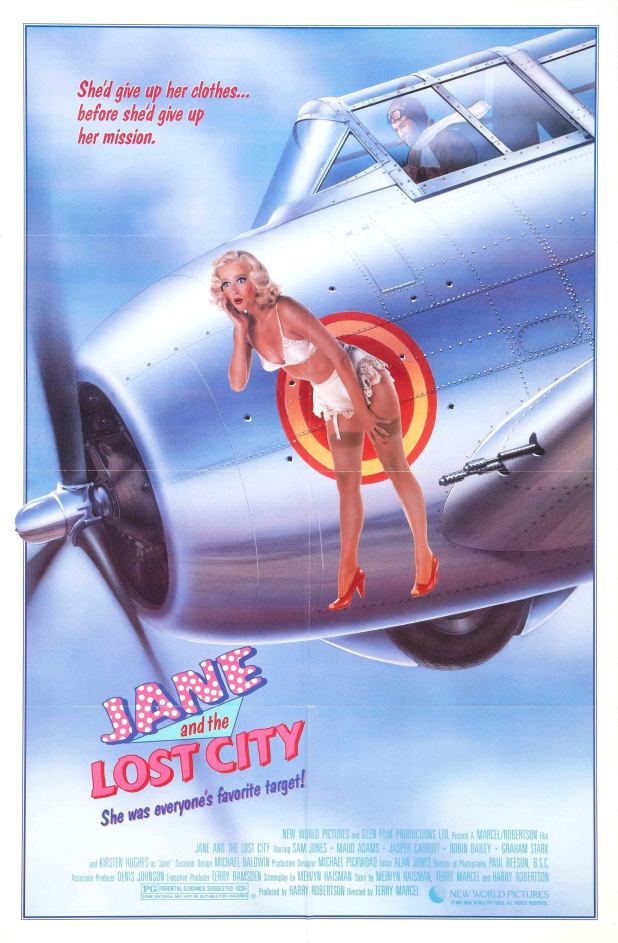
Based on Norman Pett’s Jane, which ran in The Daily Mirror from December 5, 1932 to October 10, 1959. Jane is pretty much an adventurer, but she loses her clothes nearly every time she goes into action, which I guess is a very male gaze way of making her a heroine.

British Prime Minister Winston Churchill sends Jane (Kristen Hughes) and the Colonel on a mission to prevent the diamonds of the fabled Lost City from falling into the hands of Germany. As they make their way to Africa, they meet Jungle Jack Buck (Sam J. Jones, playing yet another comic strip style hero after getting to be Flash Gordon and The Spirit) and battle the evil Lola Pagola (Maud Adams) and her soldiers Heinrich, Herman and Hans (all played by Jasper Carrott).

This was directed by Terry Marcel, who also made Hawk the Slayer and Prisoners of the Lost Universe. It’s a good try, but trust me, it’s no Gwendoline.

You can watch this on Tubi.

Une fée… pas comme les autres (1956)

Imagine a movie in which every single actor is an animal with all of the voices being done in post-production. Just sit back and let this wash over you, as Chassidou the cat loses the town’s magic wand to the evil monkey known as Black Genie.

Black Genie takes Barbara the duck hostage, so Saturnin the duck and Chassidou ride a balloon to the Land of the Doves to attempt to discover how to defeat the wizard.

This played in the U.S. as The Secret of Animal Island. It had to decimate minds, because I’ve watched it so many times and it continually amuses and enthralls me while making me wonder just how did this get filmed and how hard was it to make?

Director Jean Tourane also made a Saturnin TV series and another movie with the heroic duck that’s called Saturnin et le Vaca-Vaca.

Do you want to see a fox shampoo a chicken? A frog do a motorcycle stunt? A rabbit smoke a cigarette? Of course you do.

You can watch this on YouTube.

Tomb of Terror (2004)

Sure, we have a Full Moon Week coming up, but there are definitely two different ideas behind what the studio is. Are they the America Filmirage, making low budget horror that looks decent and is way better than the money spent would suggest? Or are they the studio that knocks out inferior sequel after sequel, direct to streaming digital video junk and endless repacks of the same movie?

They can be both!

“Ascent from Hell” is really 1994’s Dark Angel: The Ascent, in which Veronica Iscariot (Angela Featherstone, Linda from The Wedding Singer) gets sick of tormenting sinners in Hell and decides to punish the wicked on Earth. But hey — she falls in love with a doctor named Max Barris who tends to her injuries. This was directed by Linda Hassani, whose last movie was Bunker of Blood: Chapter 5: Psycho Sideshow: Demon Freaks.

“Infinite Evil” may be familiar as the Full Moon adaption of H.P. Lovecraft’s The Lurking Fear. That 1994 released was written and directed by C. Courtney Joyner, who directed Trancers III and wrote From a Whisper to a ScreamDoctor MordridClass of 1999Prison and Total Excess: How Carolco Changed Hollywood. It’s all about Leffert’s Corners, a place that has been plagued by unearthly beings for decades. It’s basically abandoned except for a few hearty souls like a priest and now John Martense, who is in town to put his family’s estate in order. We all know what happens to people who come to claim inheritances in horror movies. Jon Finch, who was also in Frenzy and Murder on the Nile, clashed with the director and refused to even listen to him say cut. Ironically, the worries that David Hemmings would do the same led to Finch being cast.

“Evil Never Dies” is re-cut from 1998’s Talisman, in Theriel the Black Angel is summoned from his resting place to usher in the end of the world by killing seven different people. He decides that two teens will help him, but they just may save us all. This is yet another of the many, many David DeCoteau films that I have been lured into watching. His goal was a “male version of Suspiria.” I leave it up to you to decide if he was successful, but I don’t remember the scene in Argento’s film where dudes in their tighty whities made one another do push-ups and watched from bunk beds.

I really should make a list of good Full Moon versus bad Full Moon, but who can say which is which? In the case of remixed ones like this, it gets even harder. But just imagine: how can you take a 90-minute movie, jam it into 30 and then hope to have any narrative sense? And they didn’t just do this once. They do it all the time, like some content engine that does not care at all about quality.

You can watch this on Tubi.

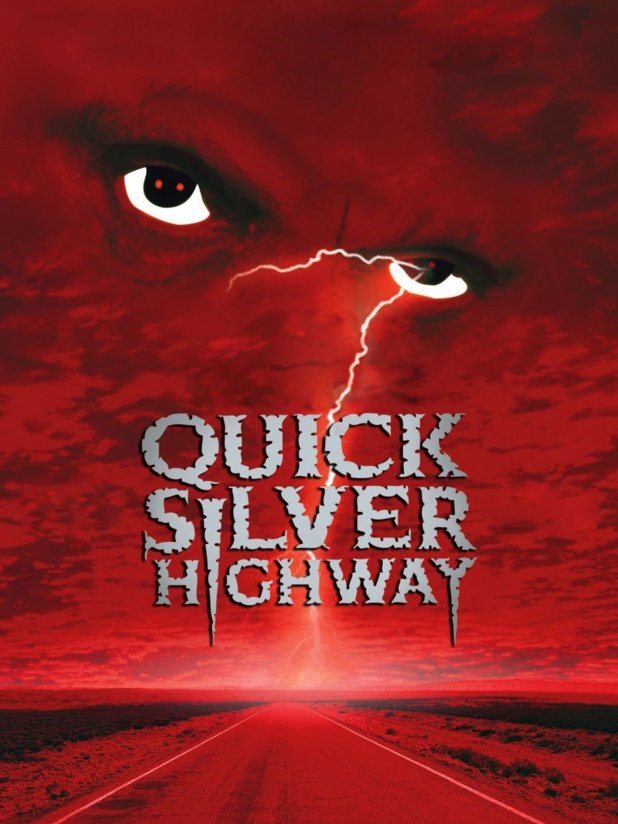
Quicksilver Highway (1997)

It was a smart idea to take a story by Stephen King — “Chattery Teeth” — and Clive Barker — “The Body Politic” — and turn it into a portanteau. Oddly, the whole idea came about because of agents.

Creative Artists Agency met with Garris about writing the pilot script for a John McTiernan-directed horror series that would have the same actors every week and a storyteller named Aaron Quicksilver — played here by Christopher Lloyd — introduce each story.

After writing a pilot script based on “Chattery Teeth,” Garris pitched the series to Fox, who wanted a two-hour movie, which brought in the Barker story. McTiernan then left the project, with Garris taking over.

In the film King-penned tale — the home video flips the order — Quicksilver meets a hitchhiking couple who are newly married and tells them the story of a man who grabbed some poorly made novelty teeth at a gas station, teeth that somehow become alive and devoted to protecting his life. Then, a pickpocket learns the Barker story, all about a world in which our hands become their own people and rebel against the people they are attached to.

Matt Frewer being in both stories really helps. He’s the kind of actor who improves every role he touches. And Garris is able to turn this material into a gripping film; it helps that he was friends with both authors, as they had cameos in his film Sleepwalkers and Garris also directed the original The StandThe Shining TV movie, Riding the Bullet Desparation and Bag of Bones.

Xiao Hun Yu (1979)

Return of the Dead is a Shaw Brothers horror anthology in which three patients in a mental hospital — hey it worked for Asylum — tell their stories.

In the first story, a family who owns a bean curd farm get an amulet with three monkeys that can give any wish. Yes, The Monkey’s Paw works in every langauge. In the second story, a dead woman comes back from her watery grave to lure her lover into the world of the dead. In the final tale, a young rickshaw driver gives a ride to a beautiful woman who looks exactly like a rich woman who has recently died after a night of pleasure with her new husband. She pays for the trip with her pearl necklace. The next time he gives her a ride, she tells him of a casino where he can become rich. He only has to sell his rickshaw. Once her does — and becomes rich — the police arrest him for taking the necklace from the grave of the deceased woman. And the money he won? It’s all fake.

Director Li Han Hsiang made plenty of soft core films for Shaw Brothers, often in the form of supernatural anthology horror like this movie and The Ghost Story. This was the third movie he made in 1979 and he would make up to five in a busy year. Unlike later movies from this studio, this is light on gore but heavy on nudity, almost an erotic ghost story.

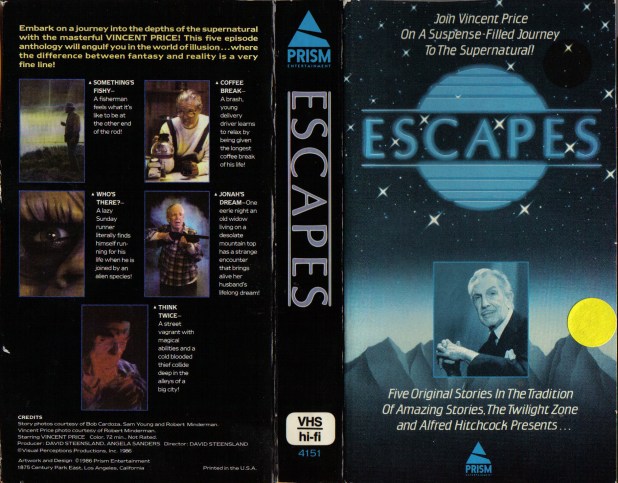
Escapes (1986)

This shot on video anthology film was chopped up and played in between shows on the Sci-Fi Network, when that was a thing before SyFy. So if one of these stories sounds familiar to you, that could be why.

Vincent Price plays the mailman and host of these stories, as a man opens a package and puts in the video tape that has all of these horrific little tales on them. From a fisherman getting his just desserts to bad directions, werecats chasing a larger man through the woods, alien crash landings, a bridge haunted by hobgoblins, magic crystals, frightening dreams and the horror of living in the city, this movie is all over the place yet not every frightening or well-made.

Writer/producer/director David Steensland only made this one and done film, but at least he had the sense to hire Price for a single day

Intervision put this out on a double DVD with Dark Harvest. It’s out of print, however.

Troublesome Night 3 (1998)

I have OCD really bad, I think. I mean, why else would you write about forty horror anthology films in one week? Here’s where it really kicks in: there are twenty Troublesome Night movies and I will never rest until I see every one of them. I will be a ghost, like in these films, forever blundering around the world until I see the final films in the series. And then, they will reboot it.

In the third Troublesome Night, a mortuary connects the stories. In the first, a mortician (Allen Ting, who was in the first two movies in this series) is ruined by the death of his favorite singer, so he takes her place in the coffin when her face is too damaged to allow for an open casket. Then he disappears because Hong Kong horror is weird.

The second tale revolves around a mother (Law Lan, who started acting in 1939 and is still performing) who has killed herself and the mortuary workers who keep getting more money out of her daughter (Christine Ng, Crime Story) for her funeral. Of course, they must pay the price.

Finally, the last story gets as dark as I’ve seen this series go, as a mortician commits suicide when her boyfriend leaves her because her job upsets him. Her ghost haunts him right into death.

Now my ectoplasmic form must depart to seek out Troublesome Night 4.

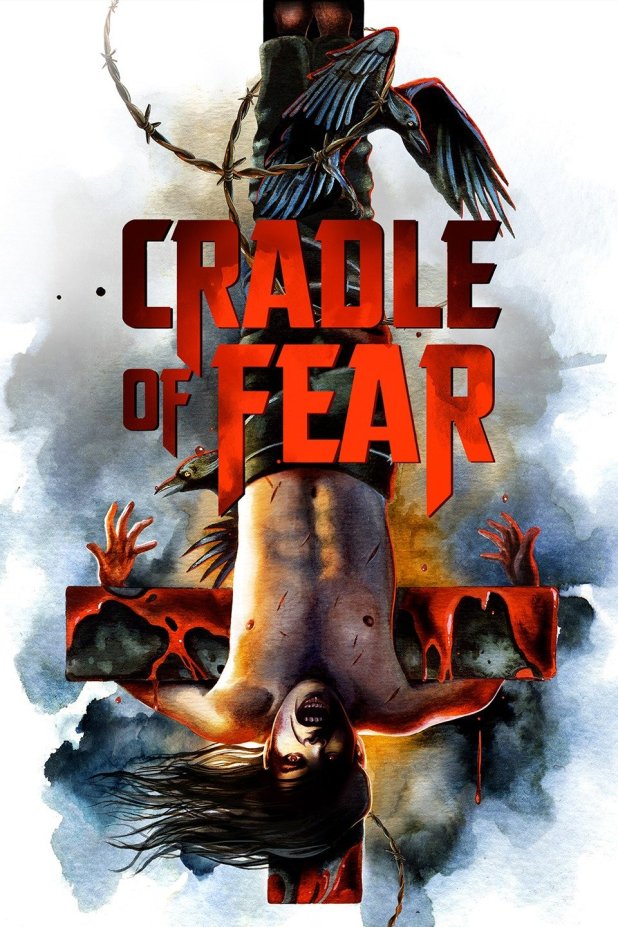
Cradle of Fear (2001)

Do you like and/or know who Cradle of Filth is? Then you may/may not care about this movie, which features nearly everyone from the band’s Midian era lineup, as well as placing leader Dani Filth into a role that connects all of the stories.

It was written and directed by Alex Chandon, who had directed the band’s videos for “No Time to Cry” and “Her Ghost in the Fog.”

Things start with The Man (Filth) being attacked by two muggers before he turns things around and kills both of them. The stories are a mixed bag — that’s putting it lightly — generally involving goth-looking girls dying horribly, like a girl who sleeps with The Man and has a monster rip its way out of her womb and kill one of her friends.

Everything and every story is the fault of Kemper, the son of a Satanist who has been using his occult abilities to abduct and kill children while even now continuing his rampage through his son — The Man — from a mental ward.

There’s an amputee who can’t have sex with his wife until he kills his friend and takes his leg. Then his wife dies in a car crash and he kills himself. When the police arrive, The Man kills them both. That’s the whole story of that segment, which feels like an excuse to show amputee sex and the gore of a woman who has gone through a car window.

The cop who is trying to get to Kemper keeps hitting dead ends and even his son is caught up in this, growing obsessed with internet snuff chatrooms and ended up killed in one. He finally makes his way to the sanitarium, but even after he shoots The Man in the head, tentacles emerge from the wounds to end the movie.

You can see the Amicus influence in this, but it’s kinda like a Cradle of Filth song: long, overblown and yet still fun in parts. Your mileage, as they always say, may vary.