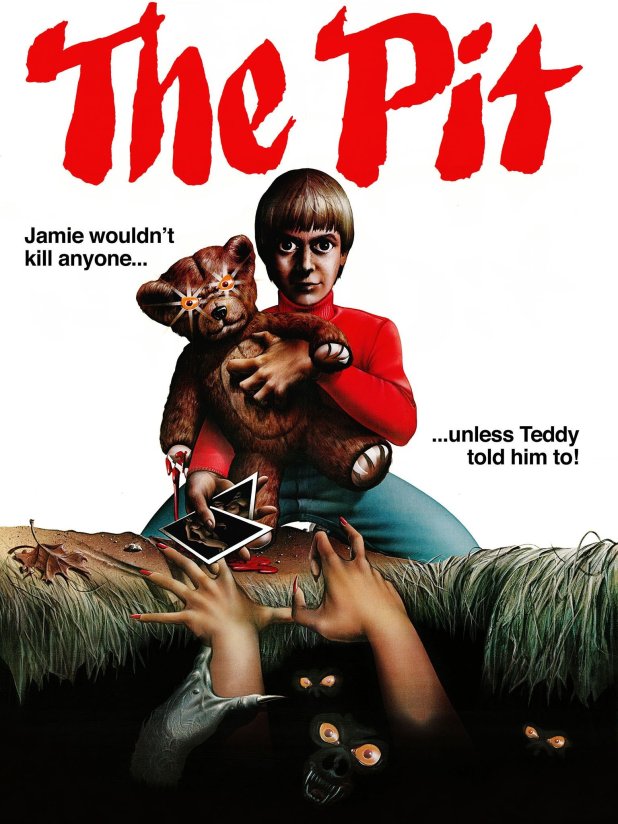
The Pit (1981)

I have no idea what mania exists within Beaver Dam, Wisconsin, but that’s where this movie comes from and man, you know how people say that movies feel like transmissions from another dimension? They only think they know what they’re talking about and really wish that they had seen this movie.

Everybody in town hates Jamie Benjamin. The kids in school, other kids who don’t go to school with him, eben old ladies, everyone he meets either makes fun of him or abuses him. His only friend is Teddy, his stuffed bear, which may be sort of strange, as he’s twelve. And yeah, he’s starting to get into girls thanks to puberty, including his babysitter, who he soon takes to show one more secret.

You see, Jamie has a pit in the woods filled with Trogs that he feeds with raw meat. Teddy suggests feeding everyone who treats him badly to these monsters and Jamie agrees, but then Sandy gets knocked into the pit and gets devoured. A bitter Jamie allows the Trogs to escape and they attack the town before a militia kills them and he’s sent to live with his grandparents.

Is puberty a pit filled with hairy beasts that love to destroy human beings? This film believes that. It’s also a movie that has no interest in the thing you call real life. I mean, the original script definitely felt that way, as the Trogs were only in the mind of Jamie and not real.

This is the only movie Lew Lehman ever directed. He did write several films — Phobia — and for the Police Surgeon series, a TV show he also was worked on as the music supervisor. His wife wouldn’t allow him to shoot the nude scenes, so the story goes that the screenwriter shot them instead. The only shot involving nudity that Lehman was allowed to film was the skinny dipping scene and only because the actress was his daughter Jennifer, adding one more bit of weirdness to an odd movie.

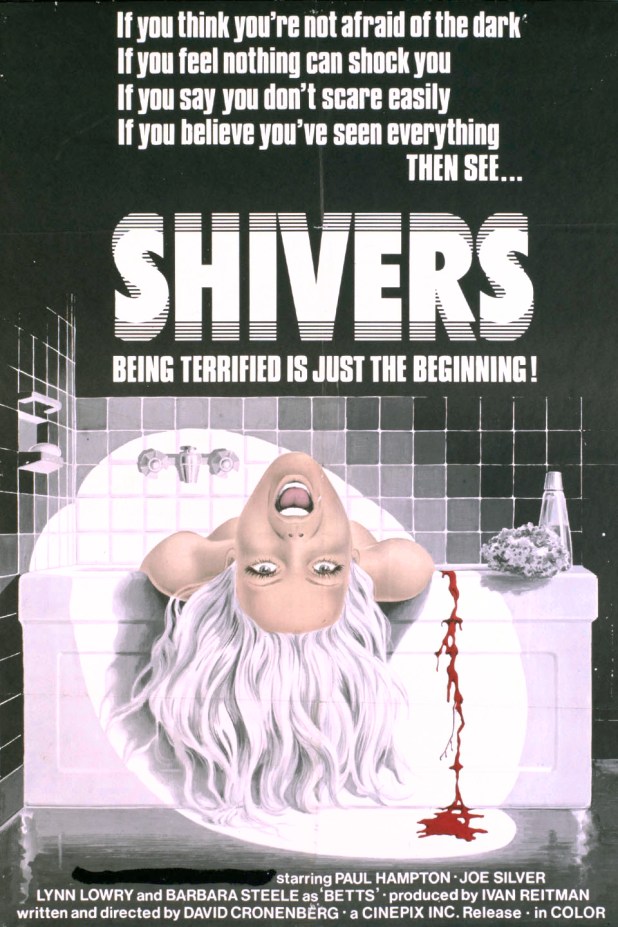
Shivers (1975)

Also known as Orgy of the Blood Parasites (written title), The Parasite Murders (it was filmed under that name), They Came from Within and Frissons, the themes of David Cronenberg third film — debated in Canadian Parliament at the time of its release due to its blend of sex and violence — are still beyond relevant today.

The initial reviews were so brutally against this movie that one high-profile hit piece by Robert Fulford (writing as “Marshall Delaney” for the magazine Saturday Night) didn’t just hurt the director’s chances of getting funding. It got him kicked out of his apartment thanks to a moral cause. owing to his landlord’s inclusion of a “morality clause” in the lease.

Starliner Towers — actually Tourelle-Sur-Rive, a 1962 apartment building designed by Mies van der Rohe, who was on the same level as Frank Lloyd Wright — is where Dr. Emil Hobbes and Dr. Rollo Linsky have been working on a project that has a parasite that can take over the function of a human organ. Why are they working on something like this?

Hobbs had the belief that modern humans had become over-intellectual and estranged from their primal impulse, so he created “a combination of aphrodisiac and venereal disease that will, hopefully, turn the world into one beautiful mindless orgy” and reassert humanity’s true sexually aggressive instincts.

Hobbes has killed a young woman named Annabelle by cutting open her stomach and pouring acid into it and then killing himself, which is like taking a page right out of the works of Herschell Gordon Lewis. Whatever they made, it’s giving people stomach convulsions and making them throw up bloody parasites which they go on to infect others like an STD.

Before long, everyone in the building — including Lynn Lowrey and Barbara Steele — is infected. Unlike zombies, these creatures retain their intelligence on some level and just want to have violent sex.

Cronenberg hasn’t been shy about the fact that other movies have ripped off his film: “I have to say that some of my images like this [parasite] ended up in things like Alien, which was more popular than any of the films I’ve ever made. But the writer of Alien has definitely seen these movies, Dan O’Bannon. The idea of parasites that burst out of your body and uses a fluid and leaps on your face, that’s all in Shivers.” He said the same thing in 2015, nearly doubling down by stating: “…Alien, for example, which totally ripped off things from my movie Shivers…”

Dan O’Bannon rip something off? Hmm.

You can watch this on Tubi.

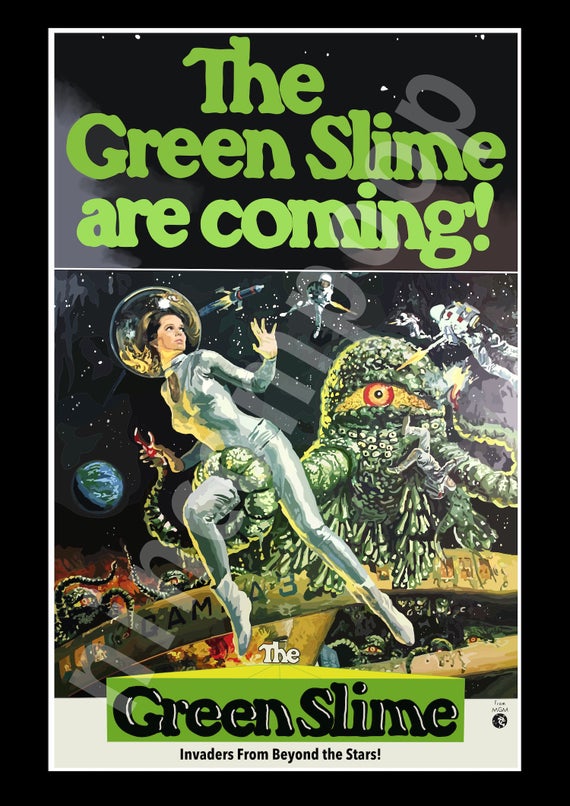
The Green Slime (1968)

ABOUT THE AUTHOR: When Frederick Burdsall isn’t at work or watching movies while covered in cats, you can find Fred in the front seat of Knoebels’ Phoenix. 

Way back when in a faraway place I like to refer to as “The Sixties” (It existed kids, trust me) my local movie theater would frequently show a Saturday Matinee geared to kids and it was here I was introduced to the wonders of Roger Corman, Vincent Price and numerous monsters that still thrill me today but there was one in particular that really got my 9-year-old juices going.

A few weeks before, the theater was showing a little film called The Mad Monster Party and as always, I was parked in a seat halfway up the aisle with my popcorn enjoying the spectacle. When the dust settled and it was time to go I was handed a clip-on button as I exited that simply said “The Green Slime are Coming”. Slimy and Green, huh? Yes, please.

Well, my friends, an entire freakin’ month went by before I saw it on the marquee…The Green Slime are here Saturday at noon. Setting a new record getting home I rushed into the house and did the most horrible thing I have ever done in my life…I VOLUNTEERED to do chores because the Green Slime are here Saturday and I have to be there. The things we do for our passions. Let’s take a look at this brilliant piece of monster movie fun.

An asteroid is on a collision course and it falls on Jack Rankin (Robert Horton from Wagon Train) to rush off to Gamma 3 to blast it out of the sky. The base is run by Vince Elliott (Richard Jaeckel, one of my mom’s favorite actors) who at one time was a close friend but they clashed over Lisa Benson (Luciana Paluzzi, who played Fiona Volpe in the Bond film Thunderball) who conveniently is one of the doctors on the base. There is quite a bit of macho posturing before he is welcomed aboard.

Upon reaching the asteroid they encounter a greenish ooze which puts a damper on their project and forces them to hoof it back to the ship unaware that Dr. Halverson has some on the leg of his spacesuit. As the suits are decontaminated, it causes the slime to mutate and grow into a one-eyed, tentacled monstrosity that kills with electricity. ( I REALLY need a Green Slime Pop Vinyl figure…someone get on that.) 

Nothing they do seems to harm it and if it bleeds, the blood becomes another monster….how do you kill it? After an attack on the infirmary, they decide to lure them to Block C and try to, at least, contain them but Dr. Halverson has all his research in there and the creatures are soon loose again. Deciding to evacuate, the doors won’t open because there are creatures all over the outside of the ship now and Elliott leads a team out to do battle in a last ditch effort to save their lives. How does it all turn out…Watch and enjoy The Green Slime and find out.

Directed by Kinji Fukasaku of Battle Royale, Tora! Tora! Tora! and the fantastic yakuza film Graveyard of Honor fame.

I can’t deny that there are times that I watch a favorite from my childhood and can’t believe how incredibly bad it really was…this is NOT one of them. I still get tears in my eyes when that psychedelic theme song by Richard Delvy starts up and I turn into a 9-year-old all over again and revel in the campiness of it all. I have a love for this movie that rivals the kind of love you have for family and friends and I hope I always will…..By the way…I STILL have the button.

As always, I’ll see you in the front seat of the Phoenix.

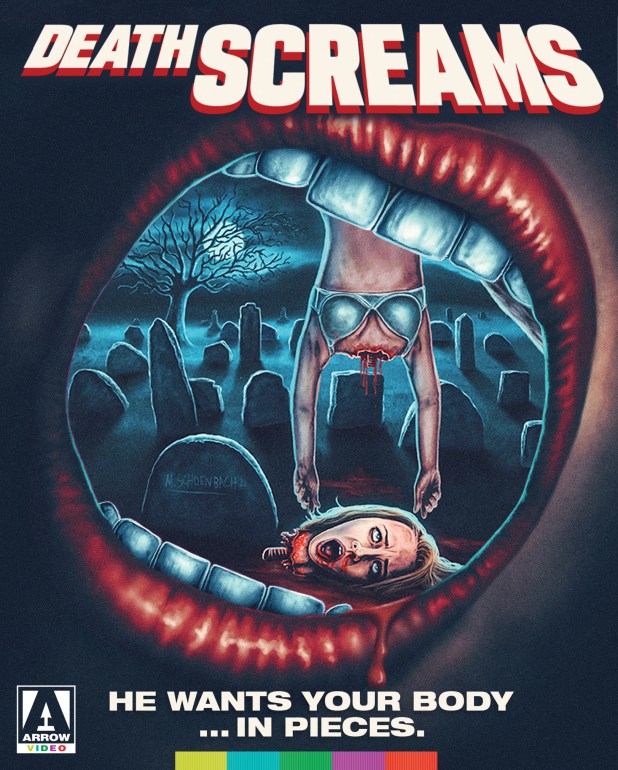
Death Screams (1982)

David Nelson broke out of his family’s show The Adventures of Ozzie and Harriet in the movie The Big Circus, in which he was a disturbed man who may be a murderer. He also directed a few episodes of the aforementioned TV show, as well as its spinoff Ozzie’s Girl, the Linda Evans movie Childish Things (co-directed with her husband at the time John Derek), and kept acting, showing up in movies like High School U.S.A. and Cry-Baby.

It might surprise some people therefore, when one of the Nelson kids ended up making a slasher.

During the last night of the carnival, the local kids decide to sleep down at the river, despite a bunch of murders just a few nights before. That killer — carrying a machete and a need to work out his past pain by killing everyone that he or she can — has followed everyone back to their campground and wants to make sure that no one leaves alive.

Waitress Lily Carpenter is played by Susan Kiger, a three-time Playboy cover girl (March 1977, November 1977 and April 1978) and January 1977 Playmate of the Year. She was also in plenty of great exploitation and horror movies throughout the 70s and 80s like H.O.T.S.Angels Revenge, SevenThe Happy Hooked Goes to HollywoodGalaxina and The Return. Several of the actors in this also appeared in Tales from the Third Dimension, like Helene Tryon (Edna Sharpe in this, the evil grandma in that 3D anthology) and William Hicks (who was a cop in this and is in “The Guardians” chapter of Tales) and a few were in other North Carolina movies like A Day of Judgement and Rottweiler 3-D (AKA Dogs of Hell).

This may seem slow, but stick with it. Nearly every kill is in the last fifteen minutes, as all manner of insanity goes does, like two decapitations, hands chopped off at the wrists, a throat-slashing and even someone chopped in half in a moment that had to have inspired Michele Soavi when he made one of the best slashers with the dumbest cops ever, Stagefright. Do not gather in an abandoned house by the cemetery and tell urban legends with twenty-something teens or you will die.

If you’re wondering, how good is this movie? It has the same cinematographer as Carnival Magic, Darrell Cathcart, who also worked on Trucker’s Woman and Final Exam. Speaking of that other slasher, it also shares several crew members with this movie, including editor John A. O’Connor, makeup artist Barbara Galloway, production manager Mike Allen, assistant director Dawn Easterling,  second unit director Charles Reynolds and stuntman Jere Beery. There’s also plenty of crossover with Savage Streets, as most of this film’s producers made that movie.

From that, you should see the pedigree of this. It’s junk, but great junk, the kind we checked off our slasher rental list in the 80s. Here’s to regional slashers! And for those looking for both full frontal female — and male — nudity you get some of that as well. Sure, the killer can teleport and do a lot of things in not so much time while not being terribly interesting when you discover who he or she is, but you know, it’s better than any slasher that will come out after you read this.

The music in this is bombastic and feels like it belongs to a way bigger and more expensive movie, too. It’s by Dee Barton, who also did the music for Play Misty for Me, Every Which Way But Loose, Thunderbolt and Lightfoot, High Plains Drifter and, there it is again, Tales of the Third Dimension.

The Arrow Video blu ray of Death Sceams features a brand new 2K restoration from the only existing 35mm print, as well as two commentary tracks, one by producer Charles Ison and special effects artist Worth Keeter moderated by filmmaker Phil Smoot Brand, as well as another commentary by The Hysteria Continues. There’s also a new making of documentary, radio and TV commercials, two versions of the screenplay and the alternate VHS House of Death opening titles. You can get this from MVD. Here’s to Arrow releasing more underseen slashers!

Death Screams will also be a future selection on the ARROW player. Head over to ARROW to start your 30 day free trial (subscriptions are available for $4.99 monthly or $49.99 yearly). ARROW is available in the US, Canada and the UK on the following Apps/devices: Roku (all Roku sticks, boxes, devices, etc), Apple TV & iOS devices, Android TV and mobile devices , Fire TV (all Amazon Fire TV Sticks, boxes, etc), and on all web browsers at https://www.arrow-player.com.
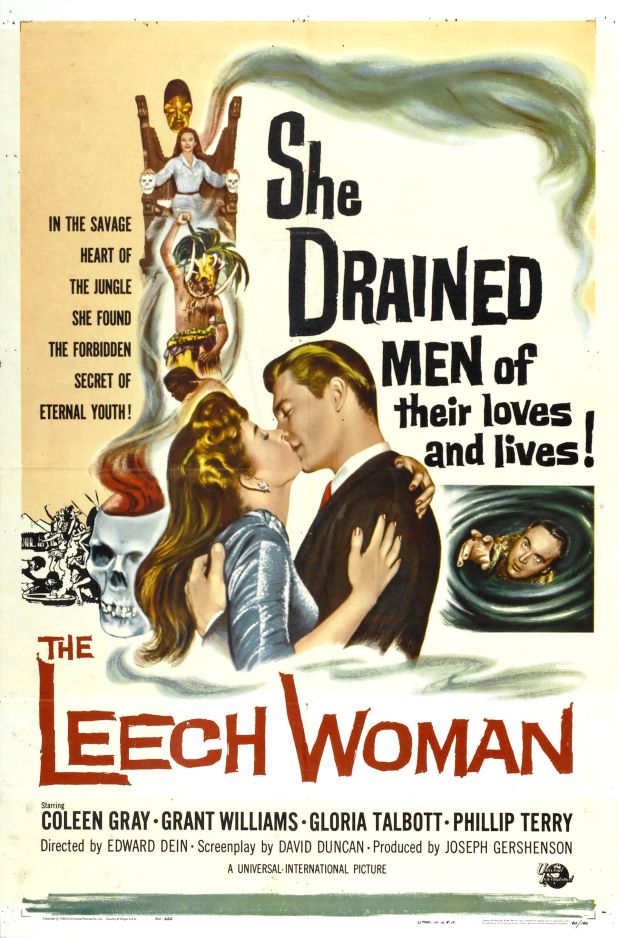
The Leech Woman (1960)

A few years before Mondo Cane would popularize the use of tribal footage, The Leech Woman takes scenes of African wildlife and tribal dances from the 1954 adventure movie Tanganyika to spice up its tale of a middle aged woman becoming young again by, well, becoming a leech woman.

It starts off promising — a mysterious old woman named Malla (Estelle Hemsley, who was an early African-American star) claims to have been brought to America as a slave nearly 140 years ago and wants to be beauitiful and young for one more night, but only in her home country of Africa. To pay for the trip, she promises to teach endocrinologist Dr. Paul Talbot the secret of how she has stayed alive for so many years.

Dr. Paul is the kind of jerk given to saying things like “Old women give me the creeps.” Too bad that he’s married to a woman ten years older than him. But after a trip to Africa, in which he witnesses a ritual in which a man is killed and his pineal gland secretions harvested and mixed with orchid pollen.

His wife turns the tables and kills off Dr. Paul, using his glands to become young again — yet gets older every time it wears off — murdering people under the secret identity of her niece Terry Hart. She falls for a lawyer and tries to use the glands of his girlfriend, but it doesn’t work, so she does what we all would: throws herself to a window, leaving behind a husk.

Director Edward Dein also made Curse of the Undead. This movie was made so that Universal-International would have a movie to play with Hammer’s Brides of Blood. That movie is magic. This perhaps not so much.

TUBI ORIGINALS: Swim (2021) and Shark Season (2020)

It was only a matter of time before the groovy retro-folks at Asylum poured the remote “slasher” cabin genre into the endless flood of CGI shark flicks. Now, for most streamers, that fact would be a “nuff said,” and they’d hit the big red streaming button on another film: not me.

The director behind this Cape Fear-inspired sharkster (with actually pretty decent CGI sharks in place of Robert Mitchum, or Robert De Niro, for the remake fans) is the prolific workhorse that is Jared Cohen, already in a 45-films deep career in just over 20 years with titles across the Asylum and Lifetime “damsel” spectrums. I also think Cohn did a fantastic job with the budget-conscious, yet effective, Lynyrd Skynyrd rock biography, Street Survivors. The same applies to his pretty cool, just-released damsel-in-action streamer, Stalker in the House, starring Scout Taylor-Compton (Abducted).

“We’re gonna need a bigger house.”

An additional enticement is my recognizing former ’80s teen actor Andy Lauer in the cast . . . playing a grandfather! Being a huge Highway to Heaven fan, I can tell you, without looking it up, that Andy appeared in the “The Source,” a 1989 episode concerned with high school newspaper intrigue. Since then, he’s worked as a guest star on a wide array of TV series and feature films, as well as directing. Courtesy of our Fred Olin Ray obsessions at B&S, we’ve seen Lauer in the Hallmark X-Mas flick, A Christmas Princess.

On the youthful end: when you can’t get the ubiquitously experienced and always reliable shark thespian Ian Ziering: call-in another former TV child actor in the form of Joey Lawrence, who’s always on-point as the resourceful, put-upon dad for the Asylum and Lifetime shingles (and he was really good as Aaron Wright during the 2017 to 2019 season of TV’s Hawaii Five-O).

Don’t waste your time arguing with kids lining up to be a cold lunch.

“Go upstairs, kids. I’m gonna fuck up a shark!”
— Mama Brody ain’t got nuthin’ on Mama Samson

So goes this man vs. nature romp for the Syfy Channel crowd, but, since we’ve got that in-the-moment funny line o’ profanity (nicely played by TV’s General Hospital‘s Jennifer Field), we’re over-the-top content platform exclusive-streaming with Fox’s Tubi channel, where F-bombs can drop.

So, it’s time for the Samson family’s yearly coastal vacation . . . when a freak storm traps Field’s mom with her plucky granddad (Andy Lauer, taking to the water tank like a champ) and her (thankfully, not angst-obnoxious) teens. As the waters rise, the first, then second floor of the beach rental, floods, with a hungry shark — say, instead of a gaggle of Romero zoms — swimming in seige through the house. Meanwhile, Lawrence’s dad is our ersatz Roy Scheider: he planned to meet up with the fam at the house, but now, in the eye of the storm, he fights mother nature to get to his family, as they find themselves trapped on the roof.

The experienced, but largely unknown cast (the young Daniel Grogan as the teen son is good, here) are solid in what looks like a tough, waterlogged shoot. Jared Cohn delivers his usual goods, with everything obviously shot on sound stages and in water tanks — yet it looks like it was shot, Kevin Reynolds Waterworld-style, on location. The computer waters spliced with the real waters are seemless, the shark, is, again, one of the best computer-jaws I’ve seen of late, and the computer blood, for once, has weight (could it have been practical, in camera?). In addition, the nighttime cinematography is sharp (half the film is at night, but not too dark than we can’t see what’s happening), as is the editing.

If you’ve spent any amount of time slopping around the B&S About Movies confluence, you know we love our shark flicks* on this end of the ol’ Allegheny. So, we consider ourselves “experts,” as it were. Maybe my being partial to all things Jared Cohn skews my critical radar . . . but when it comes to low-budget shark retreads, Cohn delivers the goods.

You can stream Swim as a Tubi premiere exclusive**.

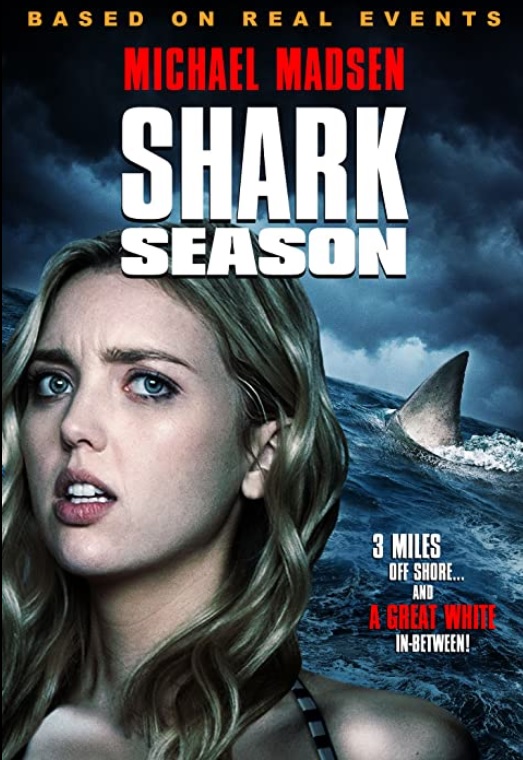
Shark Season

Hey, what’s this? Jared Cohn did a shark flick in 2020 with Michael Madsen?

Well, really starring Paige McGarvin, but she wasn’t in a Tarantino flick, was she?

Currently steaming as a pay-per-view on Amazon Prime and You Tube, Shark Season concerns a great white stalking three kayakers trapped on a remote island — in danger of flooding to a freak high tide. So, yeah, like Swim? A little bit, a little bit. (Know your De Niro lines, chum.)

As with the cast in Swim: my hit-the-big-red streaming button enticement is Michael Madsen buoying an unknown cast of buff n’ beach bod twenty-somethings playing younger. The Madsen caveat, however: we’re dealing with an Eric Roberts-name-on-the-box role with Micheal not frolicking in the water kicking Selachimorpha ass: he’s on cellphone at a table at a beach house, talking his daughter through the danger.

Sure, the model here is the survival horror that is 2016’s The Shallows starring Blake Lively, and none of the femme fatales, here, are on that thespian level. Juliana Destefano (of the really fun Asteriod-a-Geddon; we had a ball with Meteor Moon, as well) and Paige McGarvin may be new to the streaming-verse but each come with a half-a-decade experience, so I won’t let the Madsen bait-n-switch ruffle me to the point of dumpin’ the hate on their performances — which seems to be the case in the streaming reviews on Amazon and the IMDb that I read.

Again, Jared Cohn’s in the Asylum against-the-budget verse and, as with Swim, the cinematography and editing is solid, but, uh, the CGI is a little bit weaker this time (a little bit, a little bit). The acting’s just fine in my book, so I am sure we’ll see more of Destefano and McGarvin damseling it up on Lifetime and romancing in the Lifetime X-Mas snows, soon than later. Hey, someone has to be a cheerleader or stalked patient, right? They’re up to the thespin’ challenge.

* In the middle of July, we rolled out a “Shark Weak” of reviews. During the earliest days of the site, we also rolled out a “Bastard Son of Jaws Week” and “Exploring: Ten Jaws Ripoffs” featurette. Yeah, that’s a lot of digital chum to swallow, but you can do it! Click those hyperlinks! Uh, oh. No we didn’t. We just did. Check out our review of Wild Eye Studios’ newly-released Jurassic Shark 2: Aquapocalypse, which gets a stream based on poster and title, alone.

** Beginning in 2024, inspired by Tubi’s expansion in providing original programming, the B&S About Movies staff has taken on the task of watching all of them! You can visit those review under the “Tubi Exclusive” and “Tubi Originals” tags and discover some great watches.

Here’s some more of the films we’ve discovered on the Tubi platform. Enter the titles into the search box to populate those reviews.

Join us for our ongoing, weekly “Ten Tubi Picks” as we descend the digital rabbit hole, discovering films.

Disclaimer: We did not receive a review request or screeners for either of these films. We streamed them ourselves because, well, cataloging all of these fun shark flicks is our jam. And if we didn’t dig these two films, we wouldn’t have reviewed them. Got it? Besides, we dig Jared Cohn’s work. He hasn’t streamed us wrong so far!

About the Author: You can learn more about the writings of R.D Francis on Facebook. He also writes for B&S About Movies.

The Little Dragons (1979)

The Good: Regardless of their names not appearing on the respective theatrical one sheets, The Little Dragons — as far as I am concerned — stars Joe Spinell (Gazzo from Rocky, Count Zarth Arn from Starcrash, Spider in Sorcerer, Frank Zito from Maniac, and Vinny from The Last Horror Film and, going deep: CBS Schoolbreak Special: Portrait of a Teenaged Shoplifter) and John Davis Chandler (whose career we overview in our review of one of his all-too-few leading roles, Drag Racer). Oh, and we have lovably gruffy everywhere-everyman character Charles Lane , who was a regular on 50’s TV’s Dennis the Menace and was in the box office classics The Music Man and It’s a Wonderful Life, and It’s a Mad, Mad, Mad, Mad World.

The Bad: While this predates The Karate Kid by five years and is clearly not a ripoff, shame on the producers for re-releasing this on the duplex and drive-in circuit in 1984 to cash in . . . and leading everyone to believe it was a rip off.

And the Ugly (not in appearance, but career): Multiple Prime Time Emmy and Golden Globe nominee Ann Soutern is in this. How (career) hot was Ann? She had an eight-year consecutive run on CBS-TV with the comedy series Private Secretary and The Ann Southern Show. Luckily, Ann course-corrected with her final film, The Whales of August, starring alongside acting Dames Bette Davis and Lillian Gish, and Vincent Price, in which she earned her only Oscar nomination for “Best Supporting Actress.” (Whales is the film that resulted in Bette Davis passing on the lead role in Bigas Luna’s horror masterpiece, Anguish.)

The Wild and Willing: This took four screenwriters to concoct? The film we’re reviewing was the final draft? Based on four screenwriters and the pure awfulness adrift on screen, this was, most likely, being rewritten as cameras were rolling on the set. We’ll guess that Harvey Applebaum and Louis G. Altee (both who vanished from the business, and who the digital QWERTY warriors at the IMDb credit-list first) are the principals, with TV scribe Rudolph Borchert (in his only theatrical credit) taking a pass at it, and then, Alan Orsmby offering a doctoring assist. Now Borchert is a name you know, well, if you were an uber fan (moi) of CBS-TV’s Kolchak: The Night Stalker, as well as The Rockford Files, and CHiPs. And do we really have to tell you that Orsmby gave you Children Shouldn’t Play with Dead Things and Deranged? We just did.

And the Innocent: While we, the digital content managers and uber fans of all things drive-in at B&S About Movies realize all careers must start somewhere, it saddens us to know that this is a hair-growing-out-of-that-weird-mole blemish of Curtis Hanson’s directing career. While we haven’t reviewed the films (at least not yet), we hold Hanson in high regard amid the B&S cubicle farm, as he gave us his screenwriting debut with The Dunwich Horror (1970) (needs a remake), and followed up with the scuzzy Sweet Kill (1972), his directing debut (anything starring Tab Hunter is an instant heart emoji), and the even scuzzier-messy breast fest that is Evil Town (1977) (aka, God Damn Dr. Shagetz revamped). And while there was no post-Little Dragon redemption to be found in his directing the leading man debut of Tom Cruise in the-too-late-to-the-teensploitation-game with Losin’ It (1983) (our resident comedy purveyor, Robert Freese, needs to hit that one), Hanson eventually hit an A-List stride in the early-90s with The Bedroom Window, Bad Influence, The Hand That Rocks the Cradle, The River Wild, and L.A Confidential (for which he received an Oscar). He even made Eminem look competent in 8 Mile.

And the Shameful: Tony Bill, who produced this. The ex-Come Blow Your Horn actor Tony Bill with Frank Sinatra, who made his producing bones with the runaway hit The Sting starring Paul Newman; who made his directing bones with My Bodyguard starring Chris Makepeace (of The Last Chase); he who produced the incredible senior-citizens-as-bank-robbers romp Going in Style with George Burns and Art Carney. What happened, Tony? Did you not attend the dailies? And who decided to have the kids swear up a storm?

Oh, Joe, Joe, Joe. You deserve better than Outhouse slapstick and having your ass kicked by potty-mouthed brats. . . .

Yep. You Tube pulled the clip, argh!

So, what in the hell were they thinking? I’ll take a guess: “Hey, that movie The Bad News Bears did really well at the box office. Let’s do that, only let’s make them karate kids! And they’ll save a kidnapped girl from redneck kidnappers!”

Okay, sounds cute.

But then the kids had to have trash mouths. And engage in toilet humor. And the kidnapping is more graphic than it has to be. And a cute, harmless dog is stressed out. And they’re both threatened with death. In fact, Joe threatens — with his booted foot — to press back on a kid’s shoulder . . . and snap his neck.

Comedy. You just gotta believe.

If you made it through the clip above (in sans of a trailer), then you noticed these kids not only kick (and do way too many, unnecessary “hiiiii-yahs”), they drop S-bombs and other niceties all over the place. Remember how, after watching the Bugs Bunny and Roadrunner-inspired videos by Twister Sister, you figured they’re just a harmless, fun, party-metal band? Wrong. When parents took their kids to TS concerts, they were aghast at Dee Snider’s inability to speak a complete sentence without an S.F.M or M.F. or F-bomb. And The Little Dragons is the celluloid equivalent of a Twisted Sister concert. Parents took their kids to see this kiddie karate komedy and were shocked to hear these Karategi-attired tweens spewing S.H and S-bombs two and three at a clip. Of course, not many parents were shocked and embarrassed that they took their kids because, courtesy of bad reviews and worse word of mouth, no one saw The Little Dragons — not pre-or-post Karate Kid. But, when it hit video shelves via Family Home Entertainment in the 80s, the company had the good sense to market it as a children’s title — which was its original intent — and delete the swearing (and taking it out didn’t help, because, in a bit of Asian karate flick irony: the dubbing/dialog edits don’t match the lips).

Now, if I recall, while the The Bad News Bears kids were a bit saucy, the film didn’t have children being kidnapped by slobbering goons who stuff the family dog in burlap sack. And when the kidnapping-for-ransom fails, they’re going to dump the kid and the dog down a hole inside a cave. Yes. This is supposed to be funny. Not even Spinell and Chandler, with their years of thespin’ skills, can make this work.

Comedy. You just gotta believe.

Just wow, Curtis. As actress Nora Gaye’s actress-character in duBeat-e-o asked Ray Sharkey’s duBeat-e-o: “You made this?” (Since we mentioned Curtis Hanson’s and Alan Ormsby’s early horror beginnings: Marc Sheffler, who starred in Wes Craven’s The Last House on the Left, wrote duBeat-e-o.)

The Little Dragons is apparently coveted in Australia, as it stars beloved TV and film child actor and musician Sally Boyden as the young kidnap victim, Carol Forbinger. As with Rick Springfield before her (he was a huge deal down under — and a highly-regarded guitarist — with his band, Zoot), Boyden came to America to get a singing career off the ground, and, like Springfield, took up acting to pay the bills. She made her first American TV appearance as a recurring friend of the kids on The Waltons and Lassie: A New Beginning. Meanwhile, back down under, before making her U.S. film debut in The Little Dragons, she was the lead in two, hit teen comedies: Barnaby and Me (a talking Koala!) and Dead Man’s Float (teens foil drug smugglers), and a series, Come Midnight Monday. And that was that: no more American TV series or films for Sally Boyden. (And after being a kidnap victim stuffed in a burlap sack with a dog by two redneck (implied) child-killers, can you blame her?) These days, Sally is a 50-something music teacher London, after her fruitful career recording several albums and touring the world with Duran Duran. (She reflects on her life in this 2015 interview; you can listen to music from her two albums on You Tube.)

Tiger Beat! 16! Leif Garrett! Shawn Cassidy! Donnie and Marie Osmond!

If you must have The Little Dragons in your collection, Mill Creek makes it available as part of their Martial Arts 50-Film Pack under its post-Karate Kid repack title of Karate Kids, USA. (We haven’t reviewed that set, yet, but I am sure we will, right Sam?) We can’t attest as to the digitized quality of the Mill Creek reissue, but any grey-market DVDs we’ve seen of it — under either title — are a hazy, VHS washout mess. You can watch The Little Dragons for free — don’t you dare pay a dime for it — on You Tube — as I assure you, there are infinitely 49 better movies to be enjoyed.

About the Author: You can learn more about the writings of R.D Francis on Facebook. He also writes for B&S About Movies.

Round Trip to Heaven (1992)

“Shake it up, Shake it up, baby.”
— Ric Ocasek of the Cars

“Heaven Really Is That Hot, Huh?”
— Courtesy of the Saban Entertainment copywriting department

“Starring Zach Gallifan and Corey Feldman of Gremlins!”
— Prism Entertainment’s copywriting hornswoggle

Time to break out the B&S About Movies cocktail shaker! Let’s see what libations are on the shelf . . . let’s pour some Corey Feldman and vermouth-some Zach Galligan, and then toothpick-some Ray Sharkey . . . serve it on a Julie McCullough (ex-Playboy model to TV’s Growing Pains) coaster.

Ack! Pffffff! Pttts. Ffttt.

Who’s the bartender on this . . . well, it’s none other than Alan Roberts, he of the Ron Marchini-starring Karate Cop! But wait a minute . . . Alan Roberts also directed the late ’70s soft-porn, aka adult-drama/adult-comedy, aka my younger-self settling in for a Showtime late-night Friday of viewing, that are Young Lady Chatterley and The Happy Hooker Goes to Hollywood.

Hey, don’t judge, the Happy Hooker starred Adam West! I was curious to see what Batman was up to! Honest! (Yeah, right!)

Now what I want to know is this: Adam West worked with Ron Marchini on Omega Cop. But when Ron hired Alan Roberts to direct Karate Cop, Adam West was replaced in the sequel by David Carradine. Is there a tale of Roberts-West bad blood with Happy Hooker we don’t know about in this backstory? Especially after West later worked with Marchini — his long-time friend — on Return Fire?

And in this case: we need the backstory because the backstory is better than the movie in most cases — especially in the case of Round Trip to Heaven. Well, here’s this backstory tidbit: the writer on this is Shuki Levy, who wrote three-years’ worth of Mighty Morphin Power Rangers episodes. And that’s important to note because, like the Power Rangers, this was made by Saban Entertainment. Their co-producer: Prism Entertainment, who’s responsible for 50 percent of the ’80s video swag on the B&S About Movies servers. And here’s more backstory: this is a bad ’80s teen comedy that, thanks to the DVD-based home video market, kept being made into the ’90s — just one, non-titillating and gratuitous T&A bore fest after another. (We pay tribute to those very comedies with our “Drive-In Friday: ’80s Teen Sex Comedy Night” and “Drive-In Friday: Slobs vs. Snobs Comedy Night” featurettes.)

Watch the trailer on You Tube — If it is still there?

Feldman is a long ways away from Stand By Me and The Lost Boys, and he’s barely squeaking by with License to Drive. After that, the toilet flushin’ began, with Rock ‘n’ Roll High School Forever (I threw that 4-for-a-buck-used-tape into the trash after not even finishing it) and the Hell’s VCR library entry, Meatballs 4.

And Galligan? He gets a squeaker-by with Waxwork — only because it starred David Warner and featured superfluous John Rhys-Davies, because we always watch movies with superfluous John Rhys-Davies. Then the toilet flushin’ began, with the utterly awful, post-apoc’er Rising Storm because, well, anything with Wayne Crawford is usually (the presence of June Chadwick of Forbidden World not withstanding), utterly awful. (Ugh, Crawford was in Francis Schaeffer’s Headhunter; you know ol’ Frank from the apoc-turd that is Wired to Kill.)

Oh, you’re thinking of Dream a Little Dream with the two Coreys of Feldman and Haim. Oops, not this movie. But oh, man, that friggin’ movie. Not even the presence of Piper Laurie, Jason Robards, Alex Rocco, and Harry Dean Stanton — and Susan Blakely (fantastically game in My Mom’s a Werewolf) in her role as Cherry Diamond — can save that ’80s mess. I still don’t know how and why John Ford Coley (of ’70s popsters England Dan and John Ford Coley) and Mickey Thomas from Jefferson Starship ended up in their “dream” of a film role.

Oh so, the plot to Round Trip to Heaven! Yes. Surprise! There is one.

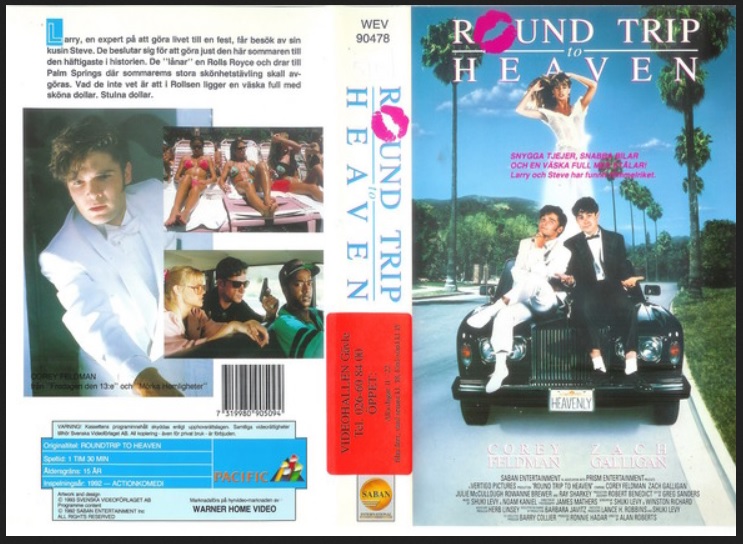
Larry (Corey Feldman) works at a garage and moonlights as Boingo the Clown to make the rent. Along with his best buddy, his cousin Steve (Zach Galligan), they decide to borrow a Rolls Royce from the garage to check out the babes at a Palm Springs beauty pageant. Little do they know that the car’s owner (Ray Sharkey, duBeat-e-o) has a suitcase of counterfeit drug money stashed in the trunk: the chase is on. Along for the ride is Lucille, their unnoticed, mousey goody-girl next door friend (McCullough).

Reach for the Charmin (copy of Kirk Cameron’s Saving Christmas) yourself over on Tubi. But seriously, isn’t this trailer enough?

And seriously: What a “double douche,” right, Wade Garrett?

“Yep, Cameron, because of his Christianity obsession, got Julie McCullough fired from a starring role on a network series, tainted her reputation and tanked her budding career.”

That’s right, Wade. And the Kirkster deserves to be dissed in this review — and stuck in shitty bible-bangin’ movies. So much for Kirk’s little ol’ hypocritically, backstabbing round trip to heaven. Judge not lest ye be judge, Mr. Cameron.

Ironically, if Kirk didn’t turn to the bright side, he’d probably have ended up in Ray Sharkey’s Rolls — or a movie just like it — thespin’ it up.

About the Author: R.D Francis posts his writings on Facebook. He also writes for B&S Movies.

The Unearthly (1957)

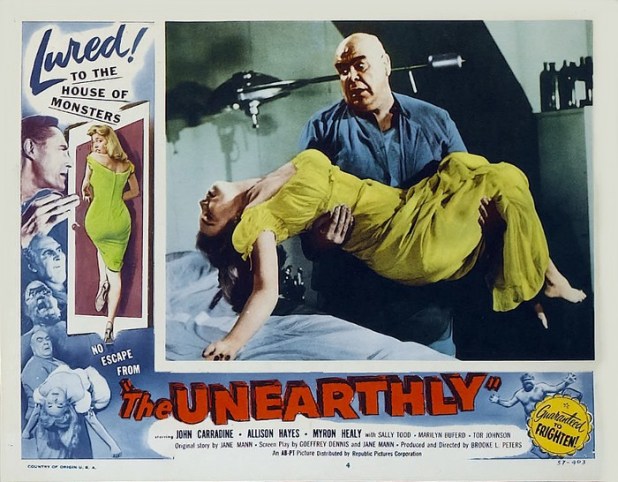
Dr. Charles Conway (John Carradine) is experimenting with artificial glands to make people live longer, working with Lobo (Tor Johnson) and his assistant Dr. Sharon Gilchrist (Marilyn Buferd, a former Miss California). Those that get these glands think they’re getting one surgery and get shuffled off for something else.

One of those patients is Grace Thomas (Allsion Hayes, Attack of the Fifty Foot Woman; she died as a result of nutritional supplements, specifically a calcium supplement that had abnormal levels of lead), who is suffering from depression which means that she’s due for some surgery that will help John Carradine live eternally.

Originally called The House of Monsters, this was filmed over approximately five days and is the third movie in which Johnson played Lobo (Bride of the Monster and Night of the Ghoul would be the others).

Director Boris Petroff, using the name Brooke Peters, also directed Anatomy of a Psycho. I’ve heard that the writer of this movie, Jane Mann, was Petroff’s wife. I’ve also heard that its a pen name for Ed Wood.

Speed (1994)

ABOUT THE AUTHOR: Jim LaMotta is one of Pittsburgh’s premiere wrestling announcers, as well as a great writer. This article originally appeared on Steel City Underground. You can follow Jim on Twitter.

The write-ups I did for the site previously usually had a specific theme to them, and it was often a film I watched with my dad in my earlier years. The “Mr. Braddock” classics, movies usually taped off of HBO before digital cable brought so much content on-demand, were a collection of old school movies that I would watch with him. These late-night screenings included A Bronx Tale, Cool Hand Luke, The Hustler, or a myriad of other movies from a previous era. I’d sit on the couch with a snack and a can of Coca-Cola, while my dad was in his recliner chair with fancy chocolate that I don’t know how to pronounce the name of and a freshly-brewed cup of coffee. Aside from the fact that he worked the night shift for years before he retired, I still don’t know why he drinks coffee at midnight.

On the flip side, the film I’m going to discuss now is more because of random chance as I found it shown on one of the various HBO channels on a semi-regular basis during recent insomnia.

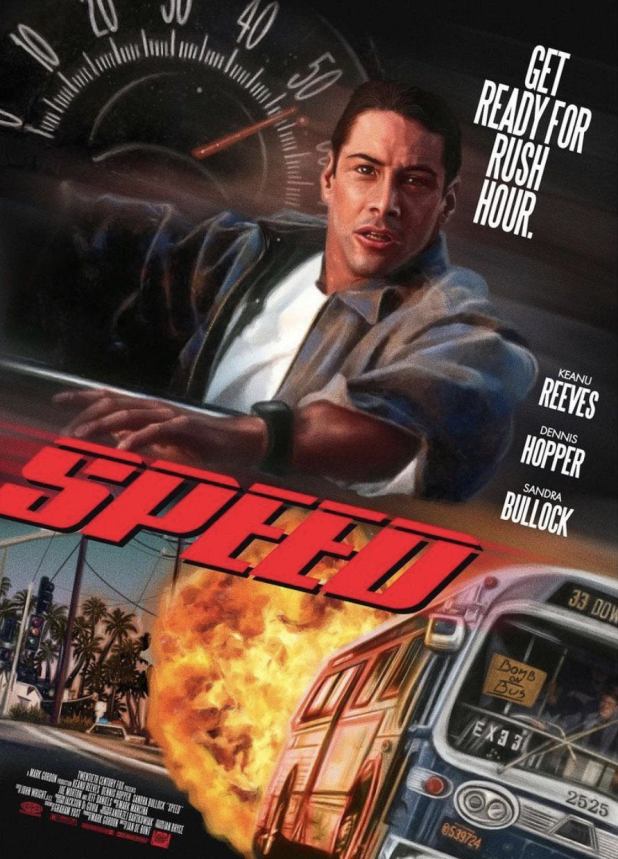
Speed, the 1994 blockbuster that raked in big bucks at the box office, follows an officer’s pursuit of a bus that was armed with a bomb that would activate after the bus goes above 50 MPH and then explode if it drops below 50 MPH, but how could the narrative of the film be told within just the parameters of the bus?

That was a task for Canadian screenwriter, Graham Yost, who was inspired with the concept based on the 1985 film Runaway Train. Yost, who has an accomplished list of work on his resume within the action genre, also wrote Broken Arrow after the success of Speed, as well as TV projects in more recent years. Yost was paired with Jan De Bont, who made his directorial debut with Speed, and the duo originally pitched the script to Paramount Pictures. De Bont had experience with action flicks, working on numerous projects such as Die Hard, The Hunt For Red October, and an installment of the Lethal Weapon franchise. Initially, it looked like the film would be picked up by Paramount, but the company eventually declined before Twentieth Century Fox green-lit the movie for production in the latter half of 1993.

Aside from a clever screenplay, in retrospect you can see why the movie was such a success, as it brought an all-star cast to the table, even if the majority of their resumes wouldn’t play out until after its release. Yost’s fellow Canadian, Keanu Reeves was cast as the main protagonist, and Speed provides an interesting snapshot of his career. Perhaps, it was because his first hit film was Bill & Ted’s Excellent Adventure, where  Reeves’ played a dim-witted character, but his delivery of dialogue through the first half of his career was wooden, and there are instances of that in Speed. Still, it’s intriguing to see how he evolved as an actor with the roles in The Matrix, a franchise that spanned a trilogy, and John Wick, a film series that will have its fourth installment next year.

The opening scenes of the film create a sense of suspense that is a theme throughout it, as office workers, seemingly caught up in the rat race of life, jam themselves into an elevator to get away from the stress of work as quickly as possible. In what should’ve been a cramped, but quick ride to the ground floor, the passengers end up trapped when Dennis Hopper’s Howard Payne, a disgruntled former member of the bomb squad, blows up the steel cables that lower the elevator. Intent on vengeance because he was shuffled into retirement after an explosion on the job disfigured his hand, Payne demanded $3 million in cash or he would detonate the emergency brake, sending the elevator crashing down two dozen floors. Hooper, an acting legend that had over five decades in the industry, played the psychopathic Payne perfectly. Payne was crazy, but calculating and that’s what made him so dangerous. He wasn’t a lunatic with an axe, but rather a snake that would patiently wait for the right opportunity to strike, adding another layer of suspense to the film. Maybe Hopper drew on prior life experience for the mindset of this role, as his early career was plagued with serious drug use, and included a bizarre story about his involvement with dynamite during a stunt show. He went to rehab shortly afterwards and eventually continued his legendary career.

Howard Payne, being the maniac that he was, disguised himself as a maintenance man in the freight elevators so that he could listen in for any potential rescue attempts. Reeves’ character, Jack Traven is an ambitious cop that takes the lead on even dangerous situations in the name of what’s right, another trait of a worthy protagonist. Traven is joined by his older and wiser partner, Harry Temple, played by Jeff Daniels. It seems like Daniels’ work in Speed is sometimes unintentionally overlooked because the comedy hit, Dumb and Dumber was released the same year. Obviously, Daniels work alongside Jim Carrey is completely on the other end of the spectrum of the role of a character on the bomb squad so the audience might not realize the depth of Daniels’ role as Temple until it’s reexamined. In many ways, Harry is the word of caution that keeps Traven safe in environments where there’s not much room for error, a dynamic that would be relevant later in the film. Jack and Harry bought some time when they used nearby construction equipment on the roof of the building to attempt to secure the elevator in case the negotiators couldn’t put together the ransom within the time they have left. The heroes didn’t know that Payne could listen in and he detonated the safety lines. The elevator dangles perilously, and the swat team just barely rescues the passengers before the elevator drops to the ground floor. Everyone is saved, but Jack knows something is up and wants to investigate the freight elevators. They find Payne, who is armed with a shotgun and another bomb strapped to his chest. At one point, he takes Harry hostage. Temple tells his pal to “shoot the hostage,” the answer to a hypothetical scenario they causally reviewed earlier when they inspected the building. Traven puts a bullet in Temple’s leg, sending him to the floor, but removing the human shield that protected the villain. With a maniacal laugh, Payne walks through a door and seconds later, an explosion launches Jack into the other side of the wall.

A few weeks later, Harry and Jack are among the offices that are awarded medals of honor for their bravery. Harry, who will be regulated to desk duty because of his injuries, respectfully limps across the stage with a cane to accept the honor. Just when it seems like victory is declared for the good guys, the viewers see someone watching the broadcast of the ceremony on television, clapping with one of their hands mangled. Payne, who the police assumed took his own life with the blast during his attempted escape with Harry hostage, seemed amused that he went under the radar. Unaware that the villain was not only watching, but planning his next move, the police force goes to a bar after the ceremony to celebrate. Joe Morton plays Lt. Mac, who joined his co-workers at the bar, but the joyous occasion is interrupted when Harry explains to Jack how close there were to being killed. Jack emphasized the victory, but with a tone of concern and sincerity, Harry says, “I’m not always going to be there to back you up, guts will get you so far and then it will get you killed” With Temple on desk duty with no idea when or if he will be back in the field again, he expressed concern for his friend. Harry stumbles away drunk, but the evening is considered a success.

The next morning, we find Jack at a local shop getting breakfast and greeting those there. Everyone knows each other and that’s what makes the next plot twist slightly more impactful. As Jack says “see ya later, Bob” before the bus driver goes back to his usual route, he goes to get into his car, narrowly missing the blast as the bus explodes, killing everyone on it. As the flames burst into the sky, a nearby pay phone (remember those?) rings, and Traven is stunned when he hears the voice of the sinister Payne on the line. The bomber informs him of the bus that will be armed when he goes above 50 MPH and detonate if it goes under 50 MPH. The next few scenes provide a tense cat-and-mouse scenario where Traven tried to alert the bus driver on the freeway before it reaches 50 and then the objective instantly switches to tell the driver to stay above 50 MPH. The music throughout these scenes emphasizes the suspense and danger. The music selection was effective, as it won an Academy Award for best sound and best sound editing.

Traven finds his way on by leaping from a moving car and informs the bus driver to stay above 50 before he tries to calmly tell the passengers he’s a cop. One of the riders of the bus thinks Jack is there to arrest him and aims a gun at the officer. When a fellow passenger attempts to help wrestle away the firearm, the bus driver is accidentally shot in the scuffle. Sandra Bullock’s Anne jumped into the driver seat and also the role of one of the main characters, steering the runaway bus back into the middle of the lane on the highway. Ironically, Anne informs Jack that the reason she rode the bus was because her license was temporarily suspended for speeding.

How the narrative takes place with a bus as the main setting was the primary challenge of the film, something that Yost decided to solve with brief, but often cutaways to others within the story. For example, Harry, still a little hungover from the night before, answers Jack’s call at his desk when his partner informs him that the bomber is still alive. While Jack tries to handle the situation on the bus, specifically trying to tell Anne the best way to navigate through traffic, Harry was tasked with trying to find out exactly who the bomber is. Plus, Lt. Mac joins in as a police escort finds the location of the bus and attempts to look for a safe place for the bus to go that would keep it above 50 MPH. Being mindful of his ultimate goal, Howard Payne calls the police and gets the number for the cell phone Jack has with him to set in motion negotiations for a payoff. Traven gets permission from the eccentric bomb to unload the injured driver, but Payne warns against anything else. As the driver is transferred across a panel connected to a police truck, a terrified passenger tries to leave as well. With news helicopters following the incident, Payne sees this and detonates a small bomb under the steps of the bus, sending the woman under the wheels. It was a direct warning that Payne is willing to lose the chance at the money if he has to blow up the bus.

Thankfully, Lt. Mac guides Jack and Anne toward an empty freeway so that traffic won’t be a hurdle. At the same time, Harry makes progress with the search for the identity of the bomber, wondering if the police files are worth a look because the bomber is so proficient with explosives. Jack had a chance to look under the access panel of the bus to get a look at the bomb and was shocked to see the amount of C4 attached to the bus with a gold watch as a timer. As usual, Harry was an advisor for Jack as they were on the phone to discuss the details of the bomb. Temple was able to tell Traven exactly what not to do to set off the explosive, another example of Harry as the word of caution in the film. The shots of Harry at his desk and Traven on the bus not only provide some visual variety, but again emphasize their team effort.

Of course an empty highway wasn’t going to be the solution to the problem, and the police saw that a section of the road was unfinished so the bus would have to make the jump. Scale models were used for some sequences in the film, including some of the elevator shaft shots, but the bus did actually make a jump, even if it wasn’t over an actual gap. If you watch the famous jump scene, the top of the vehicle actually goes out of frame because the production crew didn’t expect the bus to get the height. Anne was able to land the bus, keeping it above 50 and the passengers survived. After the jump, Jack sees quite literally a sign of hope when he realizes they are near the airport and the bus turns toward an empty air strip. The news helicopters couldn’t fly around the airport so it gave the police so room to attempt to disarm the bomb. Running out of time and options, Jack makes a deal with Payne over the phone to allow him to get off the bus temporarily to meet with negotiators. Payne agreed to a brief exit, but assures Traven there are eyes on him, which Jack assumes is another reference to the news choppers. Jack’s actual objective is to try to disarm the bomb, and he uses a sliding board attached to a tow truck to make his way under the bus while it’s still moving on the air strip. Harry is shown frantically flipping through files before he answers the phone to consult with Traven to disarm the explosive. The bomb is wired to explode if it’s tampered with, but thankfully, just as Jack realizes there isn’t a way to get the bomb off the vehicle, Temple gets the news that the bomber is Howard Payne, and the watch on the bomb was Payne’s retirement gift from the police force after his hand was injured. Harry tells his pal to get back to the bus and the swat team would find Payne at his home. Harry, refusing to stay behind, quickly limps out of the office with the rest of the team. As the swat team surrounds the house, Harry quietly makes his way inside, and they carefully look for Payne. As Harry goes into the living room, a smoke alarm beeps, and Harry knows the house was rigged to explode if anyone entered. The house blows up, killing Temple and members of the swat team.

Jack receives a call and expects to hear good news from Harry, but instead it’s Payne to tell Traven that his friend is dead. Always ambitious, Jack finally snaps, violently smashing the dashboard of the bus before he swears vengeance against the bomber. Anne comforts Jack and assures him that they can make it through it. As Traven finally calms down, he realizes that Payne can see the bus and notices the security camera above Anne, which is what the bomber meant when he said their were eyes on Traven. Payne has a feed from the camera to his hideout to keep track of any rescue attempts. Traven gives the information to Lt. Mac, who resourcefully gets a news crew to intercept the signal and record a minute of generic footage so that Payne won’t have access to a live feed of the bus.

Finally, the police can shuffle the passengers onto an airport shuttle bus. Jack and Anne secure the steering wheel and use an access panel to slide to safety, with Jack clutching her to protect her during the slide into traffic cones. The bus dropped below 50 MPH and exploded as it hit an empty airplane.

The day is saved, right?

Not exactly, and Payne was still unaware that he didn’t have a live feed of the bus so he didn’t know it blew up. He contacted police again to inquire about the ransom. A sting is set up with the money placed in a trash can at a corner in the city. Before he goes to collect the cash, Payne notices that his feed isn’t live and improvises to collect the cash. As Anne is getting checked by paramedics, she unknowingly talks to Payne, who is dressed up in his old uniform so he blends into the crowd of officers. Jack, watching from a stake-out position, knows something is wrong and runs toward the trash can to discover that Payne already took the ransom money. Traven tracks the bomb toward the subway system and realizes that he took Anne hostage with a bomb strapped to her. Payne takes Anne on the subway and demands Traven stay behind. Jack eventually jumps onto the top of the subway car to try to rescue Anne. Payne handcuffs her to a subway pole and reveals that he will use the explosion from the bomb strapped to her as a distraction so he can escape with the cash. When Payne hears Jack on the roof, he opens the bag of money and a dye pack sprays ink all over the cash, ruining Payne’s chance to spend it. Furious that his plan to collect the cash is ruined, Payne runs with a gun to confront Traven on the roof of the subway car. A struggle ensues and eventually, the hero pushes Payne’s head into a signal light, beheading the villain. Jack finds Anne and disarms the bomb strapped to her, but doesn’t have the key to uncuff her from the pole. The subway track isn’t finished so Traven decides to speed it up, another sense of irony, and shields Anne again. The train car crashes onto the street, but Jack and Anne are fine. They look, embrace and kiss as the crowd that gathered after the crash applauses the nice moment.

Speed brought in $350 million at the box office with a $30 million budget so it was a major success. That said, the film itself doesn’t really have anything complex or profound, and it didn’t need to contain any of that to be successful. If anything, speed underscores that a simple, well-told story with a talented cast can be very effective. There are simple elements of action, drama, suspense, and a love story that make the film work on a number of levels. Speed wasn’t Casablanca or Gone with the Wind, but it effectively used simple storytelling to be very successful at the box office.