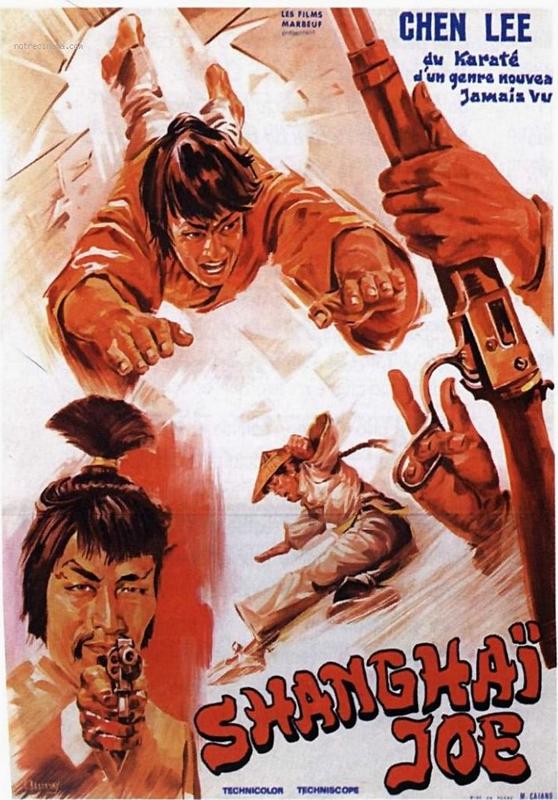
The Fighting Fists of Shanghai Joe (1973)

According to the Spaghetti Western Database, lead actor Chen Lee may have been a Japanese karate instructor, but according to director Mario Caiano (Eye In the Labyrinth), he worked in a laundry, not in a dojo, and was picked because he looked like a young Dustin Hoffman. Some think his real name was Mioshini Hayakawa, which is Japanese, not Chinese. That said, if that being racist — not knowing the difference between two countries nearly 1,900 miles away from one another — then this movie is not for you.

Seriously, nearly every race gets denigrated in this movie audibly and physically. Luckily, Shanghai Joe ends up killing every single offender.

Also — the Bruno Nicolai music — recycled from Have a Good Funeral, My Friend… Sartana Will Pay — is so good you’ll want to stick around for the whole movie.

Shanghai — or Chin Hao — has come to this country and instead of finding whatever it is he’s looking for — he has tattoos much like Kwai Chang Caine — he’s found that aforementioned racism and a love interest in Cristina (Carla Romanelli, Fenomenal and the Treasure of TutankamenThe Lonely Lady).

Our hero’s skills as a fighting man make their way to cattle rancher Stanley Spencer (Piero Lulli, Kill, Baby…Kill!), who is really enslaving Mexicans to do his work. That means that the bad guys decide to kill him, but none of them can get it done.

Spencer ends up hiring four different killers, much like video game bosses, to do his work for him. There’s Tricky the Gambler (Giacomo Rossi Stuart, The Night Evelyn Came Out of the Grave), Pedro the Cannibal (Robert Hundar, Sabata), Buryin’ Sam (Gordon Mitchell, who improvised and sang the song “Chin-Chin Chinaman” while carrying a shovel to try to kill Shanghai) and Scalper Jack (an astonishing Klaus Kinski, who is obsessed with hair and you genuinely fear for the life of Romanelli in their scene).

Finally, Mikuja, the only person who has the same martial arts technique and tattoo as our hero, is hired to kill him. Their battle may not be a fight on the order of a Shaw Brothers technical battle, but it’s still fun.

This movie is incredibly strange, because every time I thought it was going to be normal, it would go from slapstick to our hero plucking out a bad guy’s eye and blood spraying all over the place. It’s closer to a horror film set in the West with martial arts than a straight-up Italian Western, but it’s better for that difference.

Totally recommended.

You can watch this on Amazon Prime and Tubi.
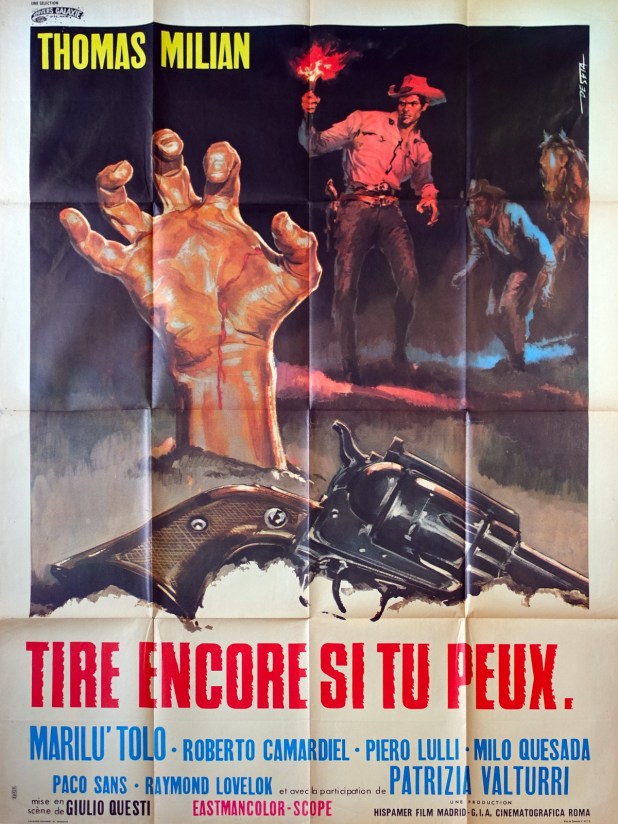
Django Kill… If You Live, Shoot! (1967)

Django Kill…If You Live, Shoot! is unlike any Italian Western that you’ve ever seen, somehow being all at once a Western, a splatter movie and some surrealism too. If you’re going in expecting the normal themes of a loner at war with an uncaring world, sure there’s some of that. There’s also way more than you could ever expect.

There’s a reason for that. It’s written and directed by Giulio Questi, whose films are never normal, from his script for The Possessed to the positively deranged Death Laid an Egg and Arcana, which pretty much ruined his directing career and kept him out of movies for almost a decade until he made some TV movies in the early 1980s, a place that allowed him to keep making films until as late as 2011, three years before his death.

Man, I don’t know where to even begin with this one.

Two medicine men discover a man known only as The Stranger (Tomas Milian, Don’t Torture A Duckling) who remembers attacking a Wells Fargo wagon and splitting the gold with his partner Oaks (Piero Lulli, the sheriff in My Name Is Nobody) before getting shot in the back. The Native Americans tell our protagonist that they have melted down what is left of the gold into bullets and that they want to follow him on a hunt to what they call The Unhappy Place.

The Unhappy Place ends up being a town full of maniacs who lynch Oaks’ gang. The villain barricades himself in a saloon before The Stranger finds him and wounds him before the townspeople tear him apart to get to the gold bullets. Meanwhile, as a shocked Stanger and the medicine men try to bury what’s left of the gang, the townspeople argue over what’s left of the gold.

Foremost amongst the weirdness in this town is the homosexual rancher with a hate-filled parrot Sorrow (Roberto Camardiel, Arizona Colt), who will kill anyone in his way to get the treasure. His men even crucify our hero and torture him with vampire bats (!) and scalp one of the medicine men.

What can you say about a movie where people desire gold so much that it ends up melting them while an entire town watches before our hero rides away alone, followed by children using string to distort their faces?

This is a baffling, fascinating entry in the world of the Italian Western, one that would be great even without the Django title. It’s also the movie debut of Ray Lovelock, who plays the doomed Evan.I haven’t even gotten to the psychedelic editing yet!

This is one of the strangest and yet most gorgeous Italian Westerns I’ve seen. A definite recommendation.

You can watch this on YouTube.

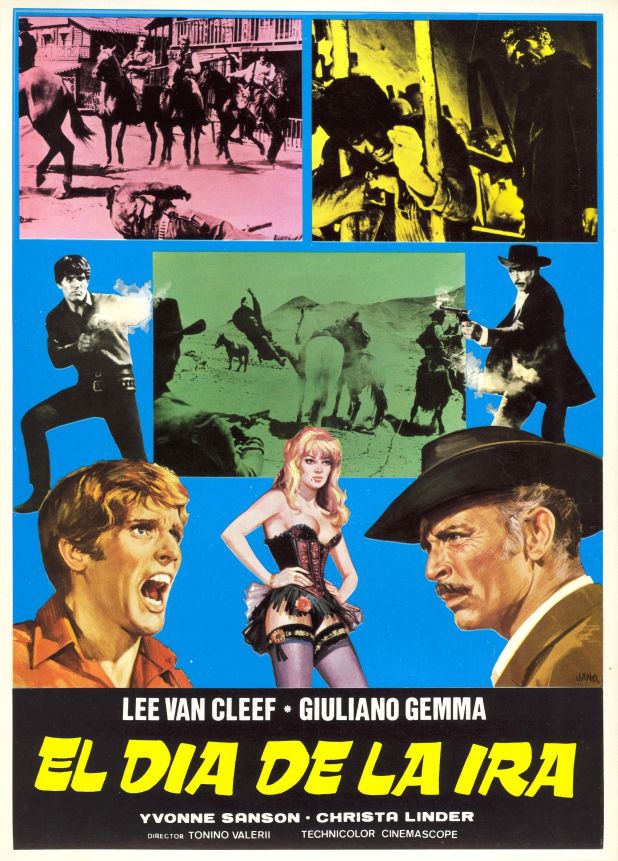
Day of Anger (1967)

We already discussed Tonino Valerii’s My Name Is Nobody early this week. He also made this film with Lee Van Cleef, a face that Western audiences associate with the Italian Western.

Here, he plays Frank Talby, an aging gunfighter who starts to teach the rules of the life to Scott Mary (Giuliano Gemma, who will always be known as Ringo). However, the life of constant death may not be the right life for Scott, as Murph tries to teach him. The end of this movie is sobering; there is no real triumph in the death that he unleashes.

Come for the Western action; stay for the story and the Riz Ortolani score (you can hear some of it in Django Unchained). This film is an interesting counterpoint to Valerii’s later Nobody. It also features Al Mulock (who died in spectacular fashion in Leone’s The Good, The Bad and The Ugly; when he killed himself by diving out of his hotel window in full costume while making Once Upon a Time In the West, Leone famously yelled, “Get the costume, we need the costume.”) and German actress Christa Linder, who was in Fulci’s Dracula in the Provinces.

You can watch this movie on YouTube.

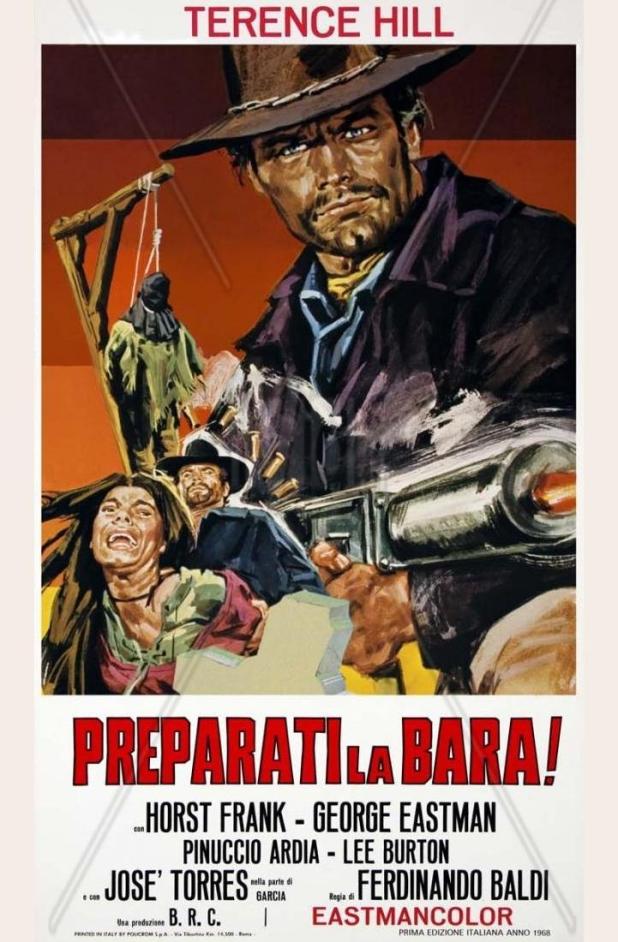
Django, Prepare a Coffin (1968)

Ferdinando Baldi is a decent Italian Western director. I enjoyed what he did with Tony Anthony across several movies, including the wild 3D movies Comin’ At Ya! and Treasure of the Four Crowns. Here, he’s throwing his hat into the Django ring to make another movie that kind of, sort of has something to do with the seminal Western hero.

That said, this is a semi-official, legitimate follow-up, as it was originally intended to star Franco Nero and it was co-written by Django co-writer Franco Rossett.

Django is wounded while his wife is killed as the gold transport that he has been hired to watch over is assaulted by David Barry (Horst Frank, The Cat o’ Nine Tails), a man who he thought was his friend.

Our hero has a great plan by pretending to be dead and becoming the hangman of the town. He saves all of the victims of Barry and organizes them as a gang of dead men, but Garcia, one of the first men he saved, screws it all up when he kills Django’s army of bad guys and goes for the gold himself.

Even when Django is lured to the graveyard where his empty grave is and forced to dig it back up so Barry and his men can kill him, I thought that this was it. Then I forgot what was inside Django’s coffin — that machine gun.

Eagle-eyed B&S About Movies readers will have already spotted George Eastman in this film, his third Django movie that he made within the first two years of his acting career.

Following the success of the Bud Spencer and Terence Hill films in the mid 70’s, this was re-released with a comedic soundtrack. And in France, it was redubbed as a Trinity film. I have no idea how they made this funny, because it’s a pretty dark film.

If you listen to the soundtrack and wonder, “Where have I heard this before?” that’s because the song “Last Man Standing” was sampled by Danger Mouse for the Gnarls Barkley song “Crazy.”

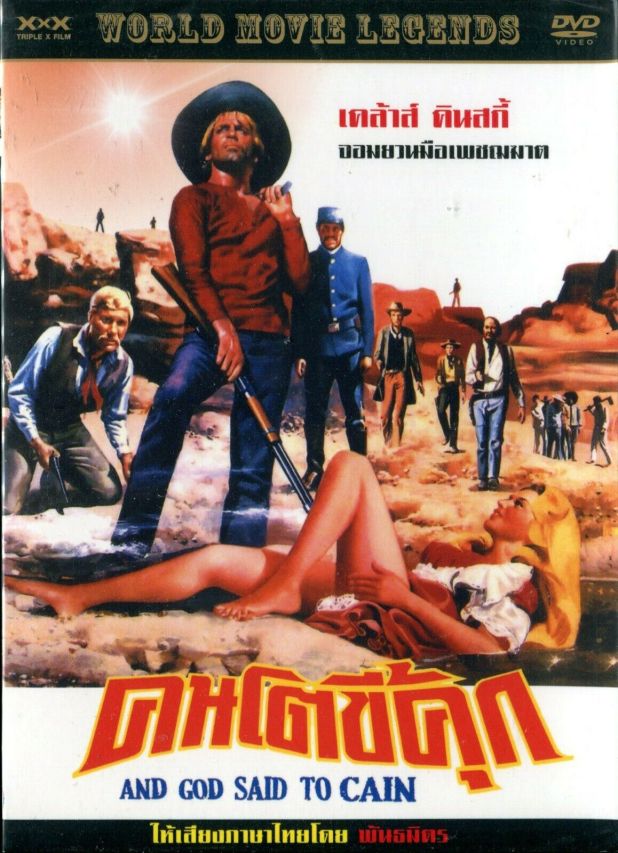
And God Said to Cain (1970)

Gary Hamilton (Klaus Kinski!) is released from ten years of hard labor with a pardon for a crime he didn’t commit, so he does what any insane character played by Kinski would do. He sets out to kill everyone who ever did him wrong.

This movie comes from director Antonio Margheriti, who we all know from films like War of the PlanetsDeath Rage and oh yes, there it is, Yor Hunter from the Future.

Kinski wants Acombar, his former friend who set him up, dead. He has to go through the man’s son (Antonio Cantafora, Baron Blood) to do it, as well as the Acombar’s wife Maria, who was once his lover. He’s helped by the people of the town who hate his enemy, as well as his knowledge of the Native American burial grounds.

This is less Western than horror film, with Kinski’s character nearly a ghost, continually followed by gusts of winds and tolling bells as he returns to get his bloody vengeance.

While there are similarities to another Margheriti film Vengeance, this is very nearly a remake of Salvatore Rosso’s A Stranger in Paso Bravo, which was made just a year before. This one, however, is unafraid to let the gruesome side of violence be seen.

The original story for both was written by Eduardo Manzanos Brochero, but the screenwriter for this was Giovanni Addessi, who also produced the movie.

You can watch this on Tubi, but I’d like to warn you that the quality of the print is pretty bad.

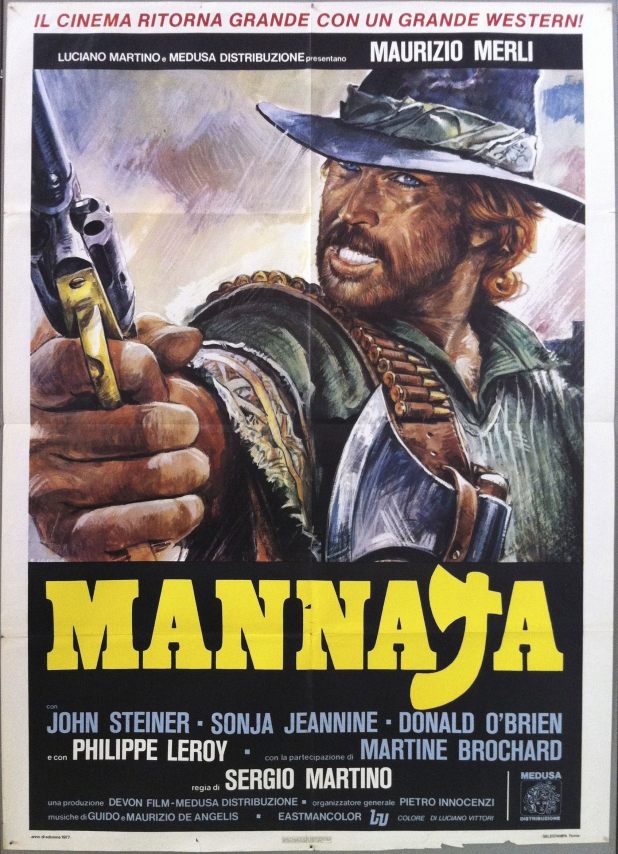
Mannaja (1977)

Also known as A Man Called Blade, this late in the game Italian Western was directed by one of B&S About Movies’ favorite directors, Sergio Martino. Yes, we tend to discuss him pretty frequently here, but look — the guy made Torso, Your Vice Is a Locked Room and Only I Have the KeyThe Strange Vice of Mrs. Wardh, All the Colors of the Dark, 2019: After the Fall of New YorkHands of Steel and many more.

I’ve been really looking forward to this film and it did not disappoint.

Maurizio Merli (Violent Rome) stars as Blade, a bounty hunter who favors a tomahawk as his weapon. After all, Mannaja means hatchet. I have no idea why they didn’t just call him that instead of Blade. Anyhow, our hero comes to the mining town of Suttonville with Burt Craven (Donald O’Brien) as his captive, but he just wants to kill mining boss Ed McGowan, who he blames for the death of his father.

However, when he meets the man, he’s in a wheelchair and “not worth it.” However, he will take the man’s money and decides to rescue the man’s daughter from Theo Voller (John Steiner), who is really working with her to take over the mine. They kill a prostitute who is in love with Blade right in front of him and bury him up to his neck in the desert, leaving pins in his eyes to force them open, blinding him. He’s rescued by Craven, even after he took that man’s hand. Now, that vengeance that Blade has always been looking for will finally be his.

This movie stands out — not just for its prog soundtrack (which sounds a lot like the music in Keoma) by Guido & Maurizio De Angelis (Oliver Onions!) — but for the foggy ending and the sheer weirdness of the proceedings. It doesn’t feel like any other Italian Western you’ve seen and credit is due to Martino.

Someday when we can travel, I want to drink at Saloon Brew in Brazil. They feature a different Italian Western star on every one of their bottles. A good cold Mannaja would be perfect right now.

Speaking of that theme song, let me share the lyrics with you: “You’re alone. A solitary man. And when the sun goes down, your memories back around with you and your heart is breaking down. This here was your father’s land. Nothing bad, you can’t pretend. You love justice and you love peace. When the time will come to kill, to destroy who loves to kill and your hand will stop the axe and your conscience will be satisfied. Yes. You’re a good man, no one will put you down. Your feel is right, down worry man. Keep going, you know the way. That’s the right way. Keep going. You’re alone. A solitary man.”

I loved every single second of this. If only all movies could make me this happy. Also, this has more fog than The Fog but less than Conquest, because no more can ever have that much fog.

You can watch this on Tubi.

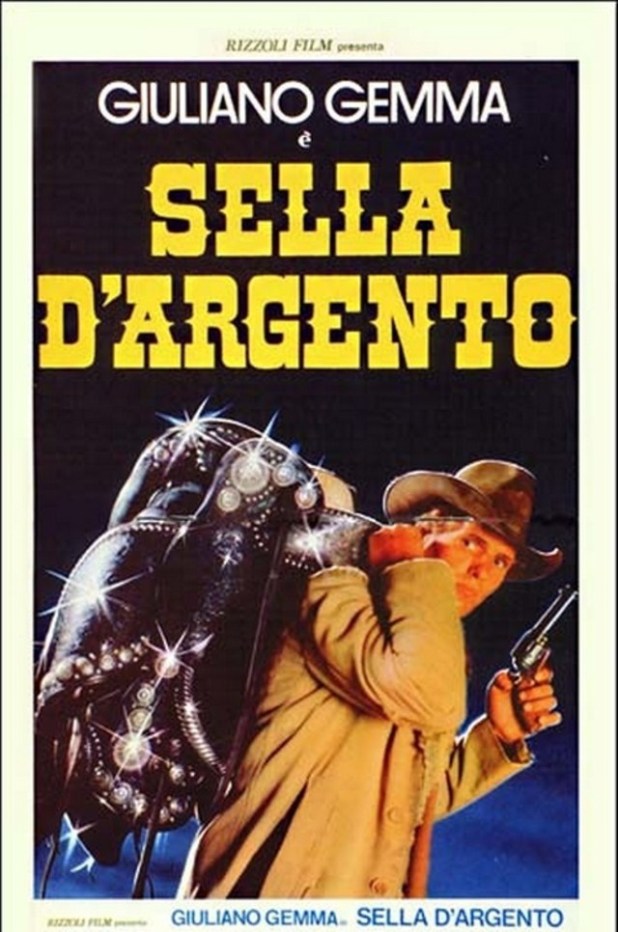
Silver Saddle (1978)

Silver Saddle, also known as The Man in the Silver Saddle and They Died With Their Boots On, marks the end of an era in several ways. It’s the last of three Westerns that Lucio Fulci would direct (the others are Massacre Time and The Four of the Apocalypse), as well as one of the last Italian Westerns of the so-called “Spaghetti Western” period. Only China 9, Liberty 37, La Ciudad Maldita and Zanna Bianca e il Grande Kid played theaters after.

NOTE: I challenge this fact, which was in the Silver Saddle Wikipedia entry, as you could consider Fulci’s Zanna Bianca (White Fang) and Il Ritorno di Zanna Bianca (Challenge to White Fang) to be Western films, despite them not necessarily fitting the themes of the Italian version of the genre.

This is also the final western role for Giuliano Gemma, who broke out after acting in 1965’s A Pistol for Ringo. Here, he plays Roy Blood, a bounty hunter eternally seeking the man who murdered his father.

Silver Saddle begins with the moment that put Roy on the trail of Richard Barrett, a landowner whose henchman kills the young boy’s father. Barely a man, Roy picks up a gun, kills the man and takes his horse, silver saddle and all.

Decades later and he’s grown into a fearsome killer himself, followed by an old man named Two-Strike Snake (Geoffrey Lewis) who tells the tale of Roy Blood while picking the pockets of the men he’s shot along the way.

Blood takes a contract to kill a man named Barrett and discovers that instead, it is the young son of his enemy, who has died before he can get revenge. He saves Thomas Barrett Jr. from several other killers, but leaves the boy in the wilderness. However, he will soon learn that the son of his enemy will become the closest thing he will get to recapturing his lost childhood.

Speaking of all that change…

Fulci made this movie in between 1977’s The Psychic, where he explored the giallo once more in the waning years of that cycle and 1979’s Zombi 2, a movie which would take his career further than perhaps it had ever been before.

Gemma, who played Arizona Colt and the aforementioned Ringo, would appear in crime films, in Argento’s late model giallo masterpiece Tenebre and even appear in a very late Italian western, 1985’s comic book-inspired Tex and the Lord of the Deep.

Despite this being made at the very end of the “spaghetti” days, there are plenty of faces you’ll recognize from these sun drenched films, like Ettore Manni (Johnny Oro, I Am Sartana Your Angel of Death and Django and Sartana Are Coming… It’s the End), Aldo Sambrell (For a Few Dollars More), Lewis (My Name Is Nobody) and Donald O’Brien (Keoma).

Fulci would work with several of his regular collaborators, such as cinematographer Sergio Salvati, editor Ornella Micheli and composer Fabio Frizzi. It was written by Adriano Bolzoni (A Fistful of DollarsYour Vice Is a Locked Room and Only I Have the KeyThe Humanoid). and

And what of the future?

Cinzia Monreale had only been in a few movies before this. She would go on to be memorably cast as Emily in Fulci’s The Beyond and in the dual roles of Anna and Elena in Joe D’Amato’s Beyond the Darkness.

Licinia Lentini made this her first major film role and would also be part of a movie that would herald the short return of the Italian Western nearly a decade later, the finally authorized sequel Django Strikes Again.

You can watch this on Amazon Prime or Tubi.

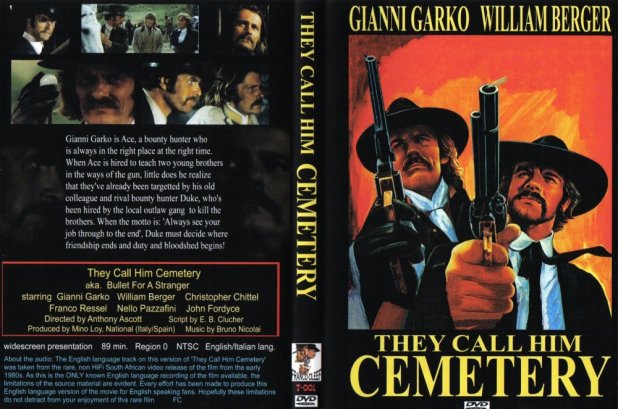
They Call Him Cemetery (1971)

Alternatively known as His Pistols Smoked… They Call Him Cemetery and A Bullet for a Stranger, this 1971 Italian Western was directed by Giuliano Carnimeo, who often used the pseudonym Anthony Ascott. He has quite the cowboy movie list to his credits, including Sartana the Gravedigger; Have a Good Funeral, My Friend… Sartana Will Pay; I Am Sartana, Trade Your Guns for a CoffinThe Moment To KillFind A Place to DieThey Call Me Hallelujah and His Name Was Holy Ghost as well as the movies The Case of the Bloody IrisExterminators of the Year 3000 and Ratman.

John (Chris Chittell, The Wild Geese and the long-running UK soap opera  Emmerdale) and George McIntire have run into some trouble with a gang. They have no way of surviving until a mysterious stranger named Cemetery (Gianni Garko, Sartana himself!) rolls into town to help them against the baddies, who then hire his nemesis Ace (William Berger).

If you listen to the Bruno Nicolai theme and it sounds familiar, that’s because it was used in the game Red Dead Revolver.

You can watch this movie on YouTube.


Hell Bent (1918)

When he was still using the name Jack Ford, the famous Western director made this Cheyenne Harry film with Harry Carey. Carey would play this same character for over two decades, starting with 1916’s A Knight of the Range up to 1936’s Aces Wild. This period also includes the film Straight Shooting, Ford’s first feature film.

Cheyenne Harry has ended up in the town of Rawhide after running from the law after a poker game turns into a gun battle. While there, dance hall girl Bess is kidnapped by a gang leader named Beau Ross and taken to his desert camp. Why would the dastardly Beau steal away a woman caring for her sick mother? Well, he is a Western movie bad guy, right?

Ford was able to capture some incredible scenery for this film which looks stunning now that this film has been restored.

Much like the aforementioned Straight Shooting that Kino Lorber has also released, this is a film worth having for your historical collection. You can get the blu ray directly from Kino Lorber. It features an audio interview. with John Ford by Joseph McBride (who also provides audio commentary), a new 4K restoration from Universal Pictures with music by Zachary Marsh and a video essay by film critic Tag Gallagher.

DISCLAIMER: We were sent this film by Kino Lorber and appreciate it. However, that has no bearing on our review.

Don’t Wait, Django… Shoot! (1967)

Anyone upset about the continuity issues of the Halloween movies should sit down and watch some Italian Westerns, where characters may or may not be the same actor or even the same character from film to film.

Django is the best example, with two official films (DjangoDjango Strikes Again), a remake (Django Unchained) and nearly forty unofficial movies, including this one. Of these films, experts believe that only Django, Prepare a Coffin is a semi-official, legitimate sequel, as it was originally intended to star Nero.

In this film, Django Foster comes home to find his father dead and the family’s fortune stolen. The role is played by Sean Todd, but come on. We all know that that Americanized stage name can only be Ivan Rassimov. His sister Rada is also in this film as is Ignazio Spalla from the Sabata series.

This film was directed by Edoardo Mulargia, who would go on one day to make the movies Orinoco: Prigioniere del sesso, which was re-edited and released in the U.S. as the Linda Blair-starring Savage Island.

Mulargia would also make Cjamango with Rassimov and Mickey Hargitay, as well as W Django! and Shango with Anthony Steffen. Obviously, he really liked Django or at least the money that came from making people think his movies were actual sequels.

You can watch this on Amazon Prime.