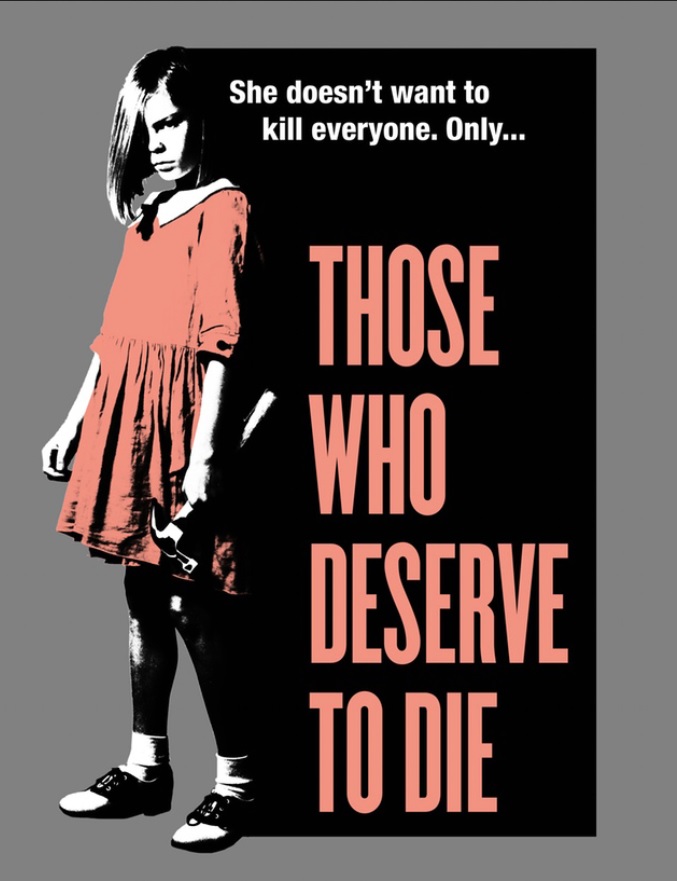
Those Who Deserve To Die (2020)

A series of gruesome (neo-Giallo-styled) murders occur in a serene Southern town (modern, yet “gothic”; a community where people roam the streets in a Carpenteresque-Spielbergian innocence as folks gather at the community center—and put the ol’ Shakespearian finger to the lips regarding the village’s “past”) committed by a cape and cowled figure accompanied by a young girl (Alice Lewis): the “shape” serves as her “murder weapon.” Thrust into the horror is Jonathan Wyndham (Joe Sykes), an injured war veteran returning to college. Sexual tensions ensue with Margaret Merrill, a county social worker whose mother is a State Supreme Court Judge (Lynn Lowry). Margaret’s life faces grave danger as she discovers Jonathan’s connection to the murders and that the bloodshed is somehow seeded in her own mother’s political corruption.

The familiar, welcomed horror mainstays of John Sykes (V/H/S) and Lynn Lowry (George Romero’s The Crazies, David Cronenberg’s Shivers*, and Paul Schrader’s Cat People**) star in this revenge thriller that also serves as the screen debut of Atlanta-based teen-cosplay model Alice Lewis; you may know her digital oeuvre through the social media-based “Malice of Alice” portfolio where, in conjunction with her mother-photographer Kelly Lewis, they recreate famous pop culture icons (e.g., Mathilda Lando from Leon: The Professional, David Bowie’s Ziggy Stardust persona, Hit-Girl from Kick Ass, Taylor Swift).
J. Sheridan Le Fanu’s iconic and influential lesbian vampire tale, “Carmilla,”*˟ from his short story collection In a Glass Darkly, returned to the streamingverse in 2014 with Bret Wood’s adaptation, The Unwanted. Wood now returns to the streamingverse with another novella adaptation: this time it is Thomas De Quincey’s The Avenger (spoiler alert: read the public domain Wikisource version here). And if you know your Giallo trivia: Dario Argento used De Quincey’s Suspiria, the short story “Levana and Our Ladies of Sorrow” in particular, as an inspiration for his “Three Mothers” trilogy of films: Suspiria, Inferno and The Mother of Tears. And, to that end: Wood splatters a ’70s Giallo stain on Those Who Deserve to Die.

Everything de rigueur in our Gialli of old and attendu in our yellow-syndromed Gialli of new spatters across Wood’s fantastique palate: style over ambiguous substance, eccentric characters of the ulterior and outright evil variety; each slopping their own baskets of red herrings, oozing colors, oddball lighting, enraptured set design—all of the symptoms cataloged by our cherished medical maestros Argento and Bava.

Yeah, you know all about us horror-loving lads frocking about the wilds of Allegheny County: we love our Giallo around here. In fact, we recently did a week-long tribute the genre, which we recapped and reviewed with our “Exploring: Giallo” round-up. And to that end: Bret Wood is the latest of the new crop of Young Turks (most recently; Matthew Diebler and Jacob Gillman’s The Invisible Mother and Marc Cartwright’s We Die Alone)—overflowing with skill, class and style—keeping the Giallo genre alive for a new generation—and birthing a new genre: Neo-Giallo, or what I like to call “Giallo Impressionism.”

And Bret Wood’s neoism is impressive. So strap on the popcorn bucket, hit the big red streaming button (Amazon Prime/Google Play) and let the rivers ooze yellow. As of August 18 you can also pick up Blus and DVDs: both contain Bonus Features of deleted scenes, along with the promotional vignette “Malice of Alice: a Mother/Daughter Portrait” and Security, a 2007 short film by Bret Wood. You can learn more at Kino Lorber and on their Facebook page, along with the film’s official Facebook page. You can also read these Atlanta Journal-Constitution interviews with Bret Wood and Alice Lewis to learn more about their respective careers.

Disclaimer: We were provided a screener by the film’s P.R firm. That has no bearing on our review.

About the Author: You can learn more about the works of R.D Francis on Facebook. He also writes for B&S About Movies and publishes on Medium.


* While we haven’t got around to reviewing Cronenberg’s Shivers (Uh, Sam? And how is my Robert Clouse Gymkata dare coming along?), we did review Cronenberg’s “big engine” movie, Fast Company, as part of our week-long tribute to The Fast and the Furious film franchise. You can read all of those reviews with our “Savage Cinema (and “Fast and Furious Week”) Recap!” and “Exploring: The Clones of the Fast & Furious” round ups of the week.

** We’re reviewing Cat People as part of our “Werewolf Week” running Sunday, September 23 to Saturday, September 29.

*˟ We’re reviewing And Die of Pleasure, Roger Vadim’s 1960 adaptation of “Carmilla,” as part of our upcoming “Vampire Week” running Sunday, September 6 to Saturday, September 12.
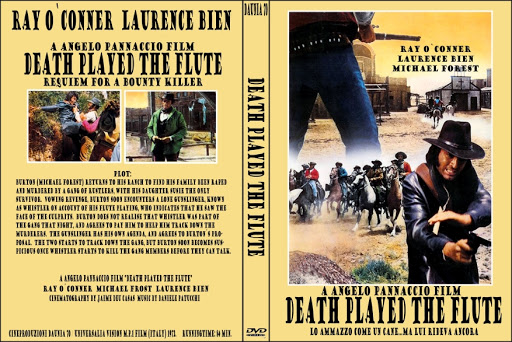
Death Played the Flute (1972)

ABOUT THE AUTHOR: Mark Rochester is a librarian. Mad about movies and books and film soundtracks. His favorite film is The Private Life of Sherlock Holmes. This is his first article for our site and I hope it’s not the last.
 
Angelo Pannacciò’s 1972 Death Played the Flute,  aka Requiem For a Bounty Killer,  is not an easy film to find, unless you are ok with Greek subtitles that get in the way of the poor quality picture.  Is it worth searching for, as I did recently?  No, not really.  It is certainly not one of the better Spaghetti Westerns, but it does have its moments – most notably the scenes in which the baddies are shot, knifed or, as in one scene, killed by a dart fired by the flute of our titular anti-hero, Kimble (played by Giuseppe Cardillo). Plot wise the movie leans towards the superb revenge westerns Death Rides a Horse (1967) and, particularly with regards to the ending, Cemetery Without Crosses (1969).
 
The film opens with Burton (the rugged Michael Forest, a regular in early 60’s Roger Corman features) returning to his ranch to find his family have been raped and murdered by a gang of cattle rustlers, with his daughter Suzy (Pannacciò favourite Susanna Levi) the only survivor. Vowing revenge, Burton soon encounters a mysterious bounty hunter, known as Kimble, (or Whistler to his friends, on account of his flute playing), who says that he knows who the culprits are. Burton, not realising that Whistler was part of the gang that killed his family, pays him $1000 to help him track down the murderers. From the grim, poorly shot/lit rape scene, that is repeated in flashback later in the movie, to the moment when Whistler unmercifully slits the throat of one of his bounty, the tone of this film is very dark with almost the only light relief coming from the Spaghetti Western regular – the elderly coffin maker rubbing his hands at more dead arriving at his door. Mixing with the wind whistling through the dry-looking, barren Sicilian hills is the superb soundtrack from Daniel Pattuchi, who also scored Pannacciò’s sleazy Sex of the Witch (1973).  This score, however is much more reminiscent of his score for Lenzi’s Man from Deep River from 1972.
 
A beautiful main theme runs through the score, broken up by strange atonal, guttural, cat-like screeching sound effects that give the film a disturbing undercurrent that matches the twisted character of Whistler, around whom the film revolves.  Half Indian, with long black sideburns, he could almost pass, on a very dark night, for Presley in Charro –  but he is certainly no Teddy Bear – he is a sadistic killer with a nervous twitch and childlike, neurotic giggle who indulges regularly in some sort of kinky sex (though what exactly it is we unfortunately don’t get to find out) with a prostitute who asks him “Why do you always want to do it like this?”  This guy has issues. But it is the bad in him that makes him an interesting character, particularly when teamed up with the more virtuous Burton. We know that at some point Whistler’s secret will out, and wonder if the bond developed between the two men during their adventures will save them from one another.
 
Points of interest – 1.  Pannacciò’s 1979 soft-core sex flick Porno Erotic Western, is reputedly made up of scenes from a number of westerns, including Death Played the Flute.  I did manage to find said Porno Erotic Western on a dodgy website, and, purely for research purposes of course, sat through it, but could not recognize anything from Death Played the Flute at all.  Nor did I spot Peplum and Spaghetti Western favourite Gordon Mitchell, who is supposed to be in the film.   2.  Ann Collin, singer of the fabulous title song from His Name Was King (1971) provides the vocals for Death Played the Flute with a song ‘A Man is Made to Love’, which unfortunately does not really fit the film at all, or the end scene over which it plays.
 
You can watch this on You Tube.

They Call Me Hallelujah (1971)

Whether you know it as Guns for Dollars, Deep WestHeads I Kill You, Tails You’re Dead! They Call Me Hallalujah or the title we chose, this Giuliano Carnimeo-directed (The Case of the Bloody Iris, the Sartana films) movie is a comedic take on the Italian Western that is worth a look.

Interestingly enough, Giuliano started his directing career on a movie we covered last week, the Jayne Mansfield-starring Panic Button, working alongside George Sherman.

1860’s Mexico serves as the stage and jewels are the McGuffin as General Ramirez (Robert Camardiel, Sorrow from Django Kill… If You Live, Shoot!) wants them to finance his revolution, Hallelujah (George Hilton!) wants the money for getting them and all manner of others want them, including a nun (Agata Flori) and a Russian nobleman named Grand Duke Alexey Wissayolovich Kropotki (Charles Southwood, who was Sabbath opposite Hilton in Sartana’s Here… Trade Your Pistol for a Coffin) and various bandits and bad men.

Most of the fun here is the interplay between Hallelujah and Kropotki, as well as the main double crosses to see who gets the baubles that everyone is willing to kill and die over.

If you’re looking for a serious Western, this isn’t it. It has sewing machine/machine gun and bazooka/ukelele combo weapons, Russian dancing and corkscrews being used to remove bullets. This is a film more influenced by the Trinity films and Eurospy world than Leone, so if you can handle that, by all means, enjoy! I sure did.

You can watch this on Tubi.

Django the Bastard (1969)

Sergio Garrone made plenty of interesting films, like the George Eastman-starring Western Terrible Day of the Big Gundown, some gothic horrors with Kinski like Lover of the Monster and The Hand That Feeds the Dead and three different Django ripoffs, including A Noose for DjangoKill Django… Kill First and this movie.

This movie is more supernatural than Western, with this version of Django (Anthony Steffen, The Night Evelyn Came Out of Her Grave) a bloody avenger much like Kinski’s character in And God Said to Cain (which I coincidentally watched on the very same day).

Said to have influenced High Plains Drifter, this Django was killed by three Confederate officers who betrayed their own men. He’s dug his way out of the grave and out of the Great Beyond to plant crosses for them before he’s even killed them. Nothing will stop him — I mean, if death couldn’t, what hope do mortal men with their guns?

At the end of the film, the wife of his main villains (played by Rada Rassimov, the sister of steely-eyed giallo king Ivan) says that they have enough money now to live rich and happily ever after. Django replies that he won’t live forever and literally fades away, like the ghost he is. According to this article, she says, “What a lot of dollars, they’ll be enough for a life!” The answer? “I already had a life.” And again — he disappears.

The best part of the Django-named films is when you come across one that’s even better than you expected. This would be one of them.

You can watch this on Tubi.

Vengeance Is a Dish Best Served Cold (1971)

Pasquale Squitieri may have started in the Italian Westerns, but he eventually moved into crime dramas and working often with Franco Nero. Probably his best-known films are l prefetto di ferro and Corleone.

This movie stars Leonard Mann, who was often cast because he resembled Nero. He’s also in The HumanoidNight SchoolWeapons of Death and Death Steps in the Dark.

He’s up against two absolute maniacs — Ivan Rassimov and Klaus Kinski, making this instantly a movie that I screamed in glee at the screen at every time this twosome appeared.

Bridger has blamed Native Americans for his father’s death, but once he saves a young girl named Tune (Elizabeth Eversfield, who only has this movie on her IMDB page), he starts to learn that perhaps he was wrong to feel such hate.

This movie is also known as Death’s DealerVengeance Trail and — perhaps ones of the best titles ever — Three Amens for Satan.

You can watch this on Amazon Prime.

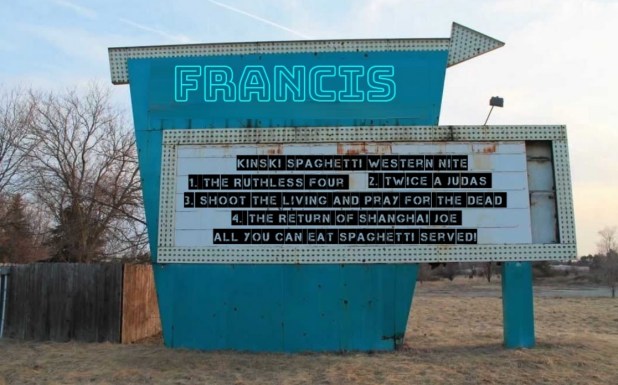
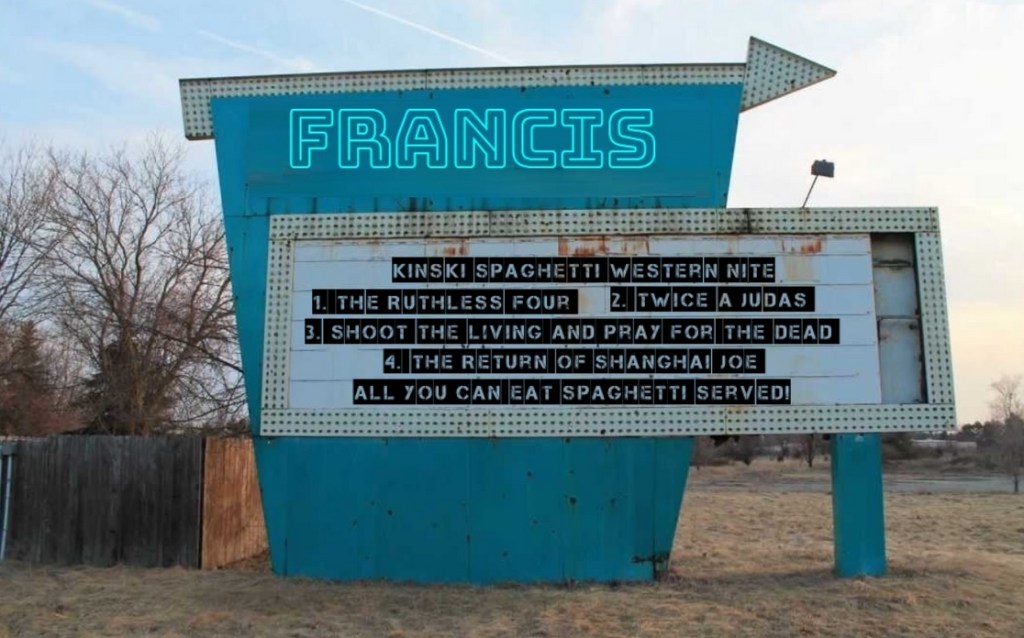
Drive-In Friday: Kinski Spaghetti Westerns

March 2022 Announcement: Severin Films has released a Blu-ray of Nosferatu in Venice — scanned in 2k from the original negative — which serves as the unofficial sequel to Werner Herzog’s Nosferatu. In addition to cast and crew interviews, the Blu also features the 80-minute documentary, Creation is Violent – Anecdotes From Kinski’s Final Years.

Severin has since released the documentary as an independent stream on the free-with-ads Tubi service.


So Sam came up with a “Spaghetti Westerns Week” (running from Sunday, August 16 to Saturday, August 22) . . . and me, with my Klaus Kinski-mania . . . well, it’s time for another “Drive-In Friday” salute to Klaus as we follow up our June “Drive In-Friday” tribute to the five-film oeuvre of Kinski with Werner Herzog.

Yes, we’ll supply the Parmesan.

Klaus made his first jump into the Western-pasta pot in 1965 as Juan Wild, the hunchback member of El Indio’s (Gian Maria Volonte) in Sergio Leone’s For a Few Dollars More. Kinski then appeared in A Bullet for the General (1967; also starring Gian Maria Volonte), and Man, Pride & Vengeance (1967; starring Franco Nero).

As with Kinski’s oeuvre in other genres: I’ve seen some of Kinski’s westerns (the ones featured tonight), but not all of them (and probably never will), but seen most of them courtesy of the long since gone VHS grey market purveyor VSOM: Video Search of Miami, which excelled in making overseas films available in the U.S.

When it comes to these films, in terms of quality in cinematography . . . well, each try but none succeed in exceeding — or even matching — Sergio Leone’s filmmaking style displayed in the Dollars Trilogy of A Fistful of Dollars (1964), For a Few Dollars More (1965), and The Good, the Bad and the Ugly (1966). So, if you know those Clint Eastwood-starring films, well, there’s really not much critical analysis to be had with Klaus Kinski’s inversion of the genre. Just know you’re getting serviceable copies of Clint’s films and if you’re a Kinski fan — such as myself — you’ll want to spend your time watching them. All others will probably pass because, if you’ve seen one spaghetti western, you’ve seen ’em all. Between the one-sheets, my gibber-jabber about the films, and the trailers, you’ll figure it all out. The main goal, here, is to make you aware of and guide you through Mr. Kinski’s “spaghetti years” before he became a go-to actor for Werner Herzog.

Alrighty then! Let’s pop those RC Colas and ride, meho! The riches of the lands South of the Border await us!

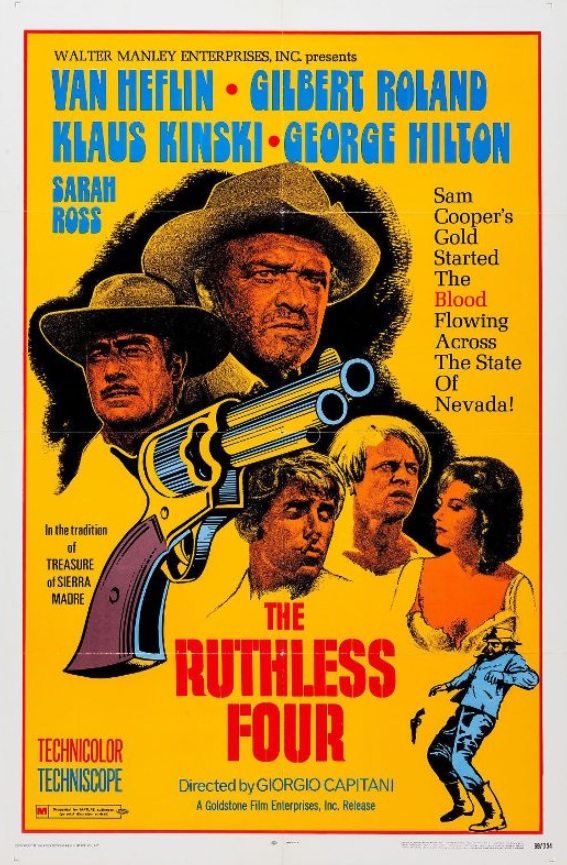
Movie 1: The Ruthless Four (1968)

Known in its homeland as Ognuno per sé (aka, Everyone for Himself) — and in West Germany as Das Gold von Sam Cooper (aka, The Gold from Sam Cooper) — Kinski co-stars with Best Supporting Actor Oscar winner Van Heflin (1942’s Johnny Eager), who wowed then little tykes (like myself) roasting under the black & white’s cathode ray glow of Pittsburgh’s WIIC Channel 11 with his roles in the iconic westerns Shane (1953), 3:10 to Yuma (1957), and Gunman’s Walk (1958).

By the turn of the ’60s, Heflin’s star — along with his Gunman’s Walk co-star, Tab Hunter (1988’s Grotesque with Linda Blair) — had fallen, but there was a huge market for American actors in Italian cinema. So Heflin made his first film there, Tempest (1959) and, along with Tab, was billed under Gary Cooper and Rita Hayworth in They Came to Cordura (1959).

The title — and alternate titles — of this one pretty much says it all: Four men embark on a suicide mission for a fortune in gold from a mine owned by Nevada prospector Sam Cooper (Van Heflin). Always the heavy, Kinski is one of the greedy four, Brent the Blonde, a faux-preacher with blood on his hands . . . and one more body means nothing to him.

Up next for Kinski: 1968’s If You Meet Sartana . . . Pray for Your Death. He also worked on the sequel, I Am Sartana, Your Angel of Death (1969). (Sartana was, of course, Gianni Garko, that ‘ol space scoundrel Dirk Laramie from Star Odyssey.)

You can watch The Ruthless Four on You Tube. There’s also a stream on TubiTV.

Movie 2: They Were Called Graveyard, aka Twice a Judas (1968)

Antonio Sabato (Escape from the Bronx and War of the Robots) stars in this film noir-inspired Spaghetti Western as Luke Barrett, a cowboy who regains consciousness with bullet-grazed head wound in the middle of the desert . . . next to a dead man — and a lone rifle with the word “Dingus” carved in its stock. Sabato gathers clues along the way to discover that a hired gunman is out to get him . . . and that he himself was a gun hired to kill Dingus. Yep: You guessed it: Kinski is Dingus and he’s out for blood.

Kinski also worked on Sergio Corbucci’s pasta-western, The Great Silence in the same year.

You can watch They Were Called Graveyard on You Tube.

Intermission . . .

. . . and, back to the show!

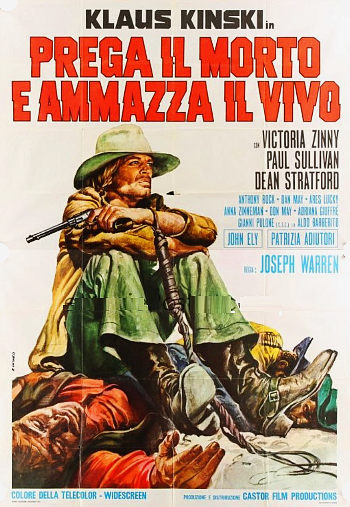
Movie 3: Shoot the Living and Pray for the Dead (1971)

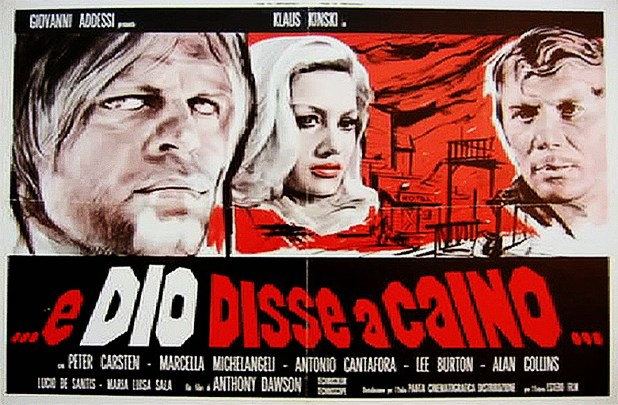
After working with Antonio Margheriti (1966’s Lightning Bolt) on the western And God Said to Cain (1970), Klaus Kinski received top-billing in this desert noir that Quentin Tarantino* ranked as his 16th personal “Top 20 favorite Spaghetti Westerns.”

Kinksi stars as Dan Hogan, an ex-Ku Klux Klan member leading a gang of bank robbers on the run with $100,000 in gold bars. Hogan’s dark past comes back to haunt him in the form of John Webb (Paolo Casella, who also co-starred with Kinski in the 1970 western, The Beast, and the next film on tonight’s program: 1975’s The Return of Shanghai Joe), a stranger who killed the gang’s guide into Mexico and wants half of their gold for safe passage. And all of their blood. So he really wants all of the gold.

Klaus also starred in the westerns Adios Compañeros, Black Killer, Coffin Full of Dollars, His Name was King, and Vengeance Is a Dish Served Cold that same year. Next up for Kinski: 1972’s A Noose is Waiting for You Trinity.

You can watch Shoot the Living and Pray for the Dying on You Tube.

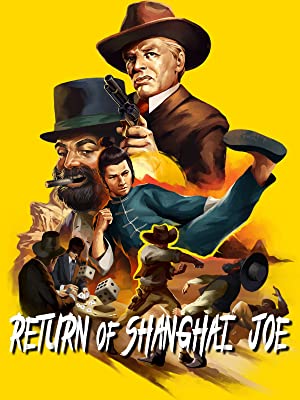
Movie 4: The Return of Shanghai Joe (1975)

The film noir-influence of Kinski’s previous pasta-westerns takes a turn into the then hot Kung-Fu genre — courtesy of Japanese-born martial artist Chen Lee (aka, Cheen Lie, playing a Chinese man here). As result of its martial arts plot, this also appeared on several ’70s Drive-In double and triple-bills, alongside more traditional Asian-action imports, as The Dragon Strikes Back (to trick you into thinking you’re seeing a Bruce Lee movie).

In the first film, 1973’s (My Name is) Shanghai Joe (aka, The Fighting Fists Of Shanghai Joe), Kinski was Scalper Jack. In the sequel, Kinski is his usual, sinister self as new character, Pat Barnes: a town boss whose stranglehold over a dusty, desert town runs afoul of Shanghai Joe (actually an uncover U.S. Federal Marshal), who’s assisted by a smooth-talking traveling medicine show man he saved from Barnes’s bully boys.

And, with that, Kinksi was off to the giallo weirdness that is Footprints on the Moon.

You can watch Kinksi in The Return of Shanghai Joe — his last Spaghetti Western — on You Tube. The Fightning Fists of Shanghai Joe is on TubiTV.

The Kinski Westerns Completist Department: We found free-with-ads streams on TubiTV of And God Said to Cain, Black Killer, A Bullet for the General, His Name was King, I Am Sartana, Your Angel of Death, and If You Meet Sartana, Pray for Your Death. If you have a Vudu account, there’s a free-with-ads stream of Man, Pride and Vengeance.

If you like to review before you buy: Check out Sam’s pre-Spaghetti Week reviews of I Am Santana, Your Angel of Death and If You Meet Santana, Prey for Your Death.

* Back in July 2019, we had a “Quentin Tarantino Week” of reviews to celebrate the release of Once Upon a Time in Hollywood. Be sure to visit our “Exploring: The 8 Films of Quentin Tarantino’s Rolling Thunder Pictures” featurette that includes the links to all of our week’s reviews and examinations of the films that influenced Quentin’s work.

We’ve reviewed a LOT of Kinski’s films — and we run ’em all down with our second drive-in feature spotlighting his career. Check ’em out!

Herzog vs. Kinski! DING DING!

About the Author: You can learn more about the writings of R.D Francis on Facebook. He also writes for B&S About Movies.

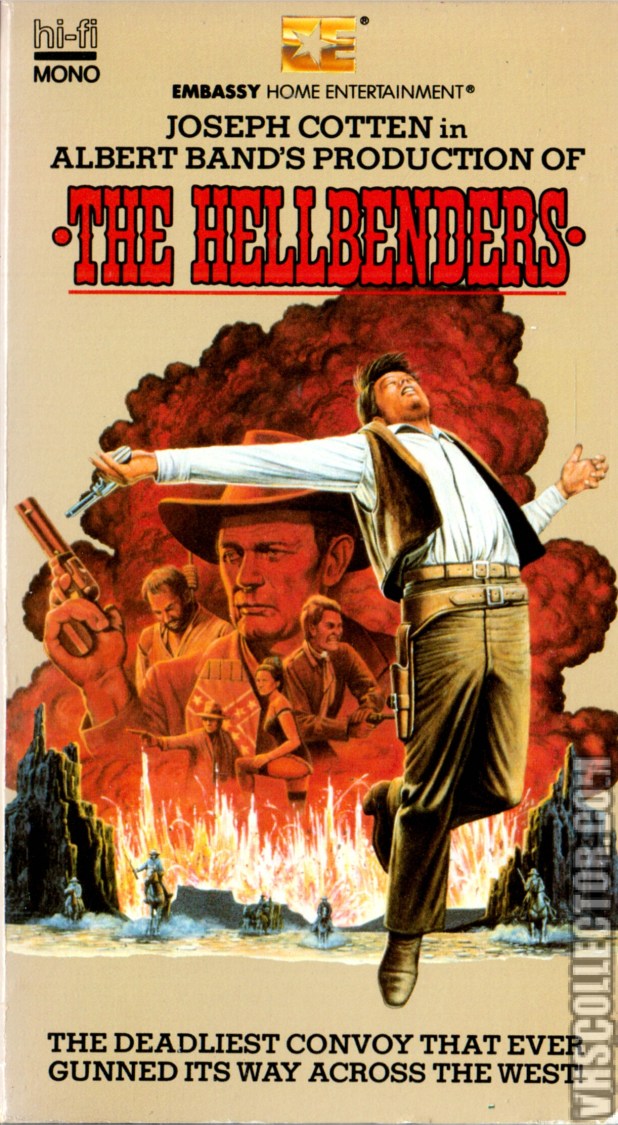
The Hellbenders (1967)

Colonel Jonas (Joseph Cotten) has led the Hellbenders through the Civil War and he refuses to give in at the end of the battles. He takes his sons Ben, Nat and Jeff on a continuing campaign of massacres, killing Union soldiers as they move money and placing their treasure inside a coffin.

Even the love and devotion of Clare (Norma Bengell) is not enough for Jonas, who wants more power, more destruction and well, just more.

There’s a fabulous score by Ennio Morricone — that goes without saying — and Sergio Corbucci’s direction, which guides another Italian Western that is all about darkness and despair. Cotten is one of my favorite actors of all time. Even in a small picture, he makes something wonderful. This is no small picture.

You can watch this movie on Daily Motion.

ANOTHER TAKE ON: And God Said to Cain (1970)

ABOUT THE AUTHOR: Phil Bailey is a long time photographer and film writer, who doesn’t actually hate everything, but has no fear of being a contrarian.  Follow at Twitter at @stroke_midnight or on Facebook at https://www.facebook.com/philbaileyphoto

Like so many of his contemporaries in Italian cinema, Antonio Margheriti worked in numerous film genres including science fiction, peplum, and spy adventures, but he is mostly fondly remembered as one of the greats of creating atmospheric gothic horror movies. Castle of Blood, The Long Hair of Death and The Virgin of Nuremberg are some of the horrors directed by Margheriti who was frequently Americanized as Anthony Dawson.  And God Said to Cain was not the director’s only Euro-Western but it is his best-known thanks in no small part to its star Klaus Kinski and the unusual gothic atmosphere Margheriti surrounds his simple tale of revenge.

The film opens in a rock quarry where a number of prisoners swelter in the blazing sun turning large rocks into small ones  One of the prisoners, Gary Hamilton has just been granted clemency and wastes no time in returning home with a new rifle and a thirst for revenge against the men who framed him and stole his house, gold, and even his wife.  After a few brief expository scenes, the film gets down to business.  Hamilton sends word to Acombar (Peter Carsten) that he is coming for him. To complicate matters Acombar’s son has just arrived home and a storm is moving in.  During this storm, Hamilton moves through the town taking out Acombar’s men.  The sandstorm, howling winds, and constant clang of the church bell creates a huge amount of tension in Acombar and his men, as well as members of the audience.  

The film is obviously made on a minuscule budget with Margheriti using the storm set-piece as an excuse to hide all the townspeople not vital to the plot.  Margheriti knows what he has to work with and uses it to full advantage. It doesn’t hurt to have Klaus Kinski’s chiseled features and deep blue eyes who was most likely part of the package to secure financing and distribution as “Italian” movies were rarely solely funded with just Italian Lira and several countries would pool resources to make these films which is why you have a German star, making an Italian western, in Spain.  Margheriti leans heavily on his horror director’s bag of tricks to keep a plot of one-man murder spree going without side plots, characterization, or much in the way of dialogue.  As the film unfolds Kinski becomes increasingly spectral, utilizing his surroundings including the aforementioned church bell as a weapon in the film’s most memorable scene. Margheriti’s taste for the gothic also shines in numerous touches that would be right at home in any of Margheriti’s standard gothic horrors, most notably the gorgeous mirrored parlor set complete with candelabra adorned grand piano.  Any cult film fan knows where the final showdown is going to take place once they see all those mirrors.   The often spectral figure of Klaus Kinski weaving effortlessly through light and shadow, including through catacomb-like tunnels beneath the town.  In these tunnels, Kinski and Margheriti evoke the spirit of Lon Chaney’s Phantom of the Opera more than a standard cowboy hero/anti-hero as he dispatches all who stand in his way of a showdown with the man who wronged him.   

The mix of horror and western in And God Said to Cain is not going to be to everyone’s taste as neither genre is fully satisfied, but in a sea of forgettable copycat Euro-Westerns, and hell this one is nothing original in the plot and is essentially a remake of Salvatore Rosso’s A Stranger in Paso Bravo, but Margheriti brings his own weirdness to the film giving it lift over the endless disposable films being cranked out of the Italian studios before they abandoned the old west and went all-in on gialli in the wake of Dario Argento’s The Bird with the Crystal Plumage.

Shoot the Living and Pray for the Dead (1971)

This movie has so many titles — Pray to Kill and Return Alive, To Kill a Jackal and Renegade Gun — but I went with the one closest to the original Italian title (Prega il Morto e Ammazza il Vivo).

It’s directed by Giuseppe Vari, who brings something artistic to every movie beyond just straight exploitation. As Joseph Warren, he made the giallo Who Killed the Prosecutor and Why? He also a very early zombie movie, 1963’s peblum War of the Zombies, as well as Urban Warriors and Sister Emanuelle, in which Laura “Black Emanuelle” Gemser renounces her sexual sins and becomes a nun until a spoiled rich girl (Mónica Zanchi) reawakens her lust just in time for an escaped murderer (Gabriele Tinti, husband to Gemser) to hide out amongst the nuns. Whew!

Dan Hogan (Klaus Kinski) and his gang have made off with $10,000 from a stagecoach and are due to meet at a saloon on the Mexican border. As the men wait for his girlfriend to bring their money to them, they encounter John Webb, who has killed the man who was to be their guide to Mexico. He asks for half the money to take them, but in truth, he’s wanted to pay back Hogan for years.

Writer Adriano Bolzoni (A Fistful of DollarsMinnesota ClayThe Mercenary, Your Vice Is a Locked Room and Only I Have the Key) infused this movie with a film noir edge, with Kinski’s character making his first appearance is similar to Edward G. Robinson’s first appearance in Key Largo.

Seeing as how this is number sixteen on Quentin Tarantino’s top twenty Italian Westerns of all-time list, it’s not a stretch to say that this movie directly inspired The Hateful Eight.

You can watch this on YouTube.

Don’t forget! We did a Klaus Kinski spaghetti westerns blowout for a “Drive-In Friday” featurette that runs down the mad German’s entire shoot ’em up resume. Join us, won’t you? We give full reviews — with a different insight to Shoot the Living — and new reviews to The Ruthless Four and Twice a Judas.

The Return of Shanghai Joe (1975)

Bitto Albertini directed one of my favorite Eurospy films, Goldface, The Fantastic Superman, as well as both Black Emanuelle and Yellow Emanuelle. Here, he has a new actor as Shanghai Joe — Cheen Lee instead of Chen Lee — and has brought back Klaus Kinski in a new role as land baron Pat Barnes.

Honestly, Kinski is the only reason to watch this, as he lords over every scene and makes it his. This film sticks more to comedy than the strange all over the place insanity of the first movie, which makes this disappointing.

There’s also a bad Bud Spencer ripoff snake oil salesman. So yeah. I barely made it through this. I’m going to warn you now, the theme song from this will get stuck in your head and damage your will to live.

You can watch this on Amazon Prime.

Drive-In Friday Kinski

Don’t forget! We did a Klaus Kinski spaghetti westerns blowout for a “Drive-In Friday” featurette that runs down the mad German’s entire shoot ’em up resume. Join us, won’t you? We give full reviews — with a different insight to The Return of Shanghai Joe — and new reviews to The Ruthless Four and Twice a Judas.