There are some days when I wake up and don’t want to do anything but watch the films of Cirio Santiago. Seeing as how he produced 64 films and directed 105, so either I need to not do anything like work for awhile or just be content in the fact that I will always have a new film from him to enjoy.
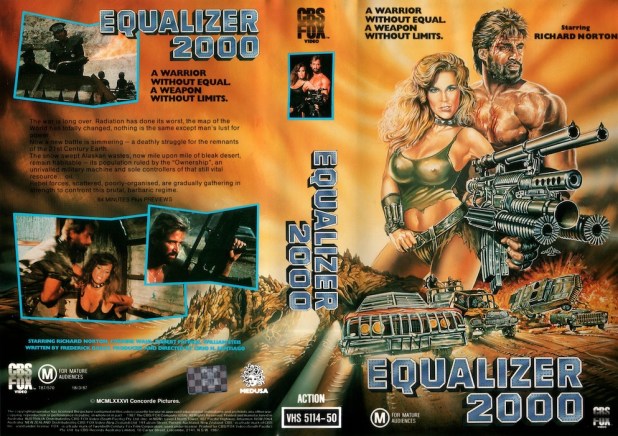
Cirio made a ton of post-apocalyptic films. This is but one of them, all about a gun that can change the balance of power. It’s called — you guessed it — the Equalizer 2000. It’s no Blastfighter, but what is?
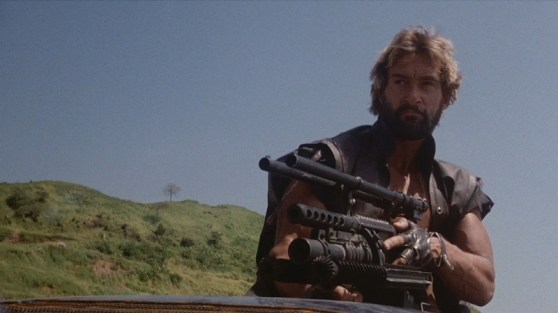
Three groups of people — Ownership, the Rebels, and the Mountain People — are battling for the control of the future after the bomb. Slade (Richard Norton, who played himself in Abba: The Movie, which I now must hunt for, and the Prime Imperator in Mad Max: Fury Road) was once one of the Ownership, but when his dad is killed, he goes off on his own. That leads to him making the titular gun along with Karen (Corinne Alphen — yes, she was once Corinne Wahl — the June 1978 and August 1981 Penthouse Pet of the Month and 1982 Pet of the Year; she’s now a professional Tarot card reader). That brings them into conflict with Deke (Robert Patrick!).
According to the absolutely astounding Internet Movie Firearms Database, the Equalizer is “based on a Colt Model 653 carbine (most likely Colt/Elisco Tools Model 653P, Philippine license-manufactured version), fitted with an M203 grenade launcher, a pair of overhead shotgun barrels and a pair of bottom mounted missile launchers. The launchers doesn’t produce muzzle flash when firing, and the hissing sound is akin to a compressed air blast.”
At the end of the movie, the Equalizer is destroyed and hot, wet manly tears burned down my face. But I wasn’t crying. I just had some radioactive sand in my eyes.
On the Code Red Blu-ay release of this movie, writer and actor Frederick Bailey says that he was inspired by Anthony Mann’s Winchester 73 as he wrote this film. You can grab that from Kino Lorber or watch this for free on Tubi and Amazon Prime.
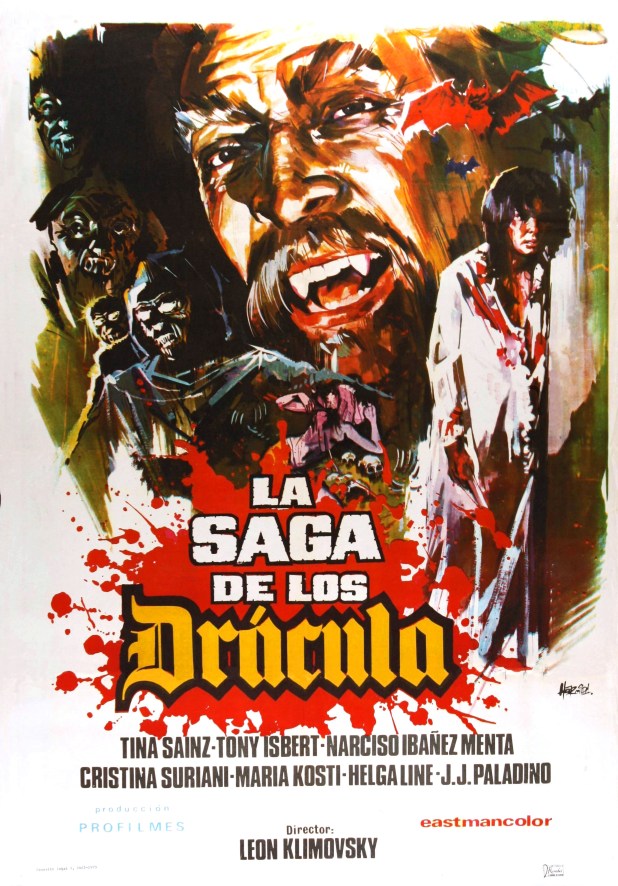
The problem with being Count Dracula is that your family line will eventually have to deal with in-breeding, which means that your lone male heir is a one-eyed, furry-faced boy Oh yeah — and your daughters may appear to be highly cultured musicians by day, but by night, they seduce any man — or woman — in their path, even priests. Actually, if Leon Klimovsky’s La Saga de los Draculas taught me anything, it’s that I don’t want to be Count Dracula.
If you’ve encountered any Spanish vampire films, you know that for every moment of sheer surrealist glee or breast baring blood blasting scene, you have to deal with long stretches where not much happens. Then again, we kind of specialize in movies where not much happens until the insane end of the film around here.
Berta is the long-lost relative of the Dracula clan who has returned home to the family castle, where all hopes of a male heir are pinned upon her. By the end of the film, she’s full-on bonkers, dispatching her cheating husband who has already consorted with all of her nubile relatives, then wipes them all out while they sleep in their coffins with an axe. Of course, that’s never worked on vampires before, but this film also features blood drinkers walking around in broad daylight.
By the end, she’s delivered her own baby and lied to the Count, who doesn’t struggle when she attacks him. That said, her blood gets all over the baby, who eagerly laps it up, ensuring that the Dracula bloodline will go on.
The print that played at the Drive-In Super Monster Rama was afflicted with a nasty case of vinegar syndrome, meaning that it would run for ten minutes and then fall apart, with credits that weren’t even worth running. That didn’t matter at all — by 2:30 AM I had ingested several strong ciders, some moonshine, some blazing hot slices of Buffalo chicken pizza and perhaps some other things that we can’t legally discuss. As the windows of our car fogged up and my wife slept by my side, I was pulled into the family dalliances of the Draculas.
It has everything you want from a European 1970’s vampire film: Helga Line leading an attractive cast of female blood suckers, some fine gore and even some cinematography that approaches art, mixed with — you guessed it — long stretches where people just talk and listen to some Bach. It’s certainly unlike any vampire film I’ve seen before. That — and the environment in which I watched it for the first time — added to my enjoyment.
If you’re going to tour Europe on a bus, stopping in quaint small towns, check and double check your inventory. There’s a pretty good chance that at least one of those tiny and charming hamlets and burgs will be replete with the undead. Bring crosses and garlic accordingly.
To think that my high school teachers said I’d learn absolutely nothing from watching horror movies!
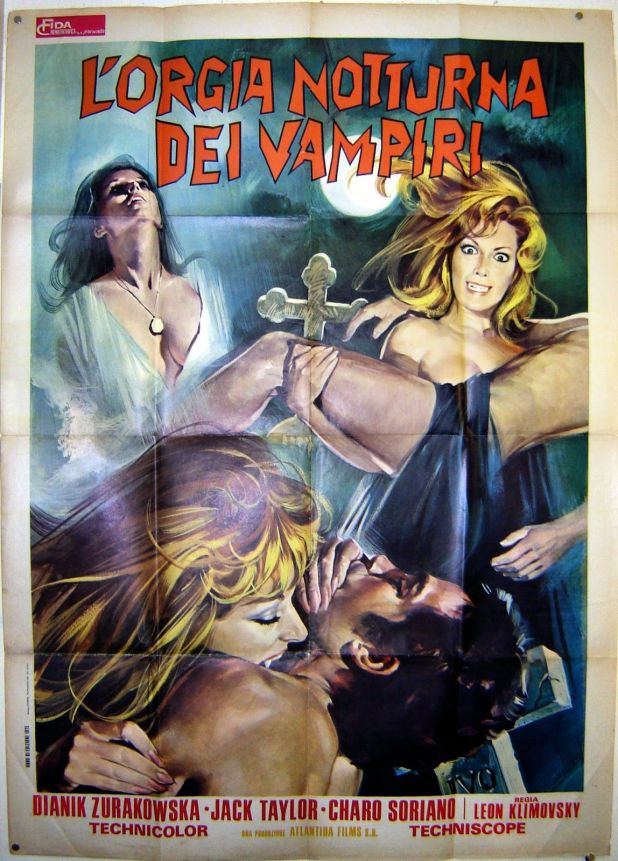
The villagers of Tolnia can’t be found on any map. That’s probably just as well, as it’s lorded over by a Countess (Helga Line, Nightmare Castle, Horror Express) who is served by mute villagers who may or may not be zombies. They’re definitely cannibals, but nice ones, because they’ll cut off their own limbs to feed you. Oh yeah — there’s also a ghost boy wandering about.
Of course, like most Spanish horror made under the reign of Generalissimo Francisco Franco — who is still dead — scenes were shot in nude and non-nude variants. But for a movie entitled The Vampire’s Night Orgy, there is little to no orgy-ing happening.
If you live a stressful life, however, let me give you some advice. There is quite nothing like ingesting your favorite vices and being half-awake through four Eurohorror films of carrying quality in the middle of the night at a drive-in. It’s as close to lucid dreaming as some of us may ever get and it totally reaffirmed my love of life. I didn’t even get a hangover!
Inhalator II, Mazathoth and Wolf-Rami are Nightsatan, doomed to wander the nuclear-irradiated fjords of Eastern Finland in the year 2034. Calling themselves Nightsatan, these synthesizer warriors work musical rituals in order to maintain what is left of their sanity in the face of the endtimes.
Seriously, whoever made this movie is inside my head. Imagine Warriors of the Wastelandinfused with the music of Goblin or John Carpenter, then turned into an art project.
Our boys — or whatever they are — in Nightsatan end up saving a fierce warrior woman twice from a musical tyrant and her android son. Along the way, there’s plenty of synth, cannibalism, nudity and gore.
How can one even explain Nightsatan themselves? Coming from Turku, Finland, they’re at the forefront of the post-apocalyptic laser metal genre. You can learn more about the band at their official site. You can also buy the soundtrack here.
Everything they do is inspired by Italian post-apocalyptic movies. I have no idea why I am not in this band as their lead singer. That should tell you how I feel about this movie — it’s completely and utterly awesome. Recently, I shared with someone that I was sad that I feel like I’ve seen every great post-apocalyptic film and will never have a first-time viewing experience again. Nightsatan and the Loops of Doom happily proved me wrong.
You can watch the full film right here, but a warning. It’s totally Not Safe for Work.
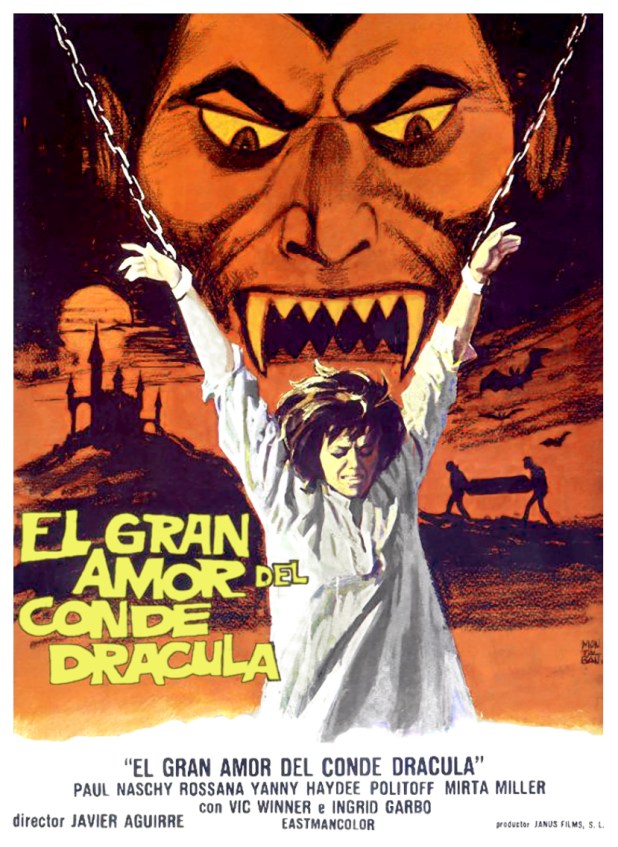
Call it El Gran Amor del Conde Dracula. Call it Cemetery Girls. Or Dracula’s Great Love — the title I saw the film under — or Dracula’s Virgin Lovers or The Great Love of Count Dracula. Whatever title you prefer, you’re about to savor a nonsensical odyssey through Spanish vampire madness, a world where someone can fall down the steps for what seems like hours, all women dress like Disney princesses and a girl can step on a beartrap and only get a small scratch.
We start in an old sanitorium, deep in the Carpathian Mountains as two delivery men arrive with a large, heavy man-shaped crate. Of course, you know that that crate has Doctor Wendell Marlow (Naschy) inside it. But right now, this scene is all about these movers casing the joint and trying to steal something, only for one to get hit with an axe and the other to get his throat ripped out and sent tumbling over and over and well, over.
Then, a stagecoach with four women — Karen, Marlene, Senta and Elke — breaks down and forces the girls to stay at Marlowe’s mansion.sanitorium. One by one, the girls are bitten and become part of Dracula’s army of the undead, all with the goal of the head vamp resurrecting his daughter Radna and convincing a virgin — hi Karen — to love him forever before he sacrifices her.
By the end, Dracula has tired of this lifestyle and decides to kill all of his brides with sunlight. Then, he realizes that he loves Karen and can’t use her to further his monstrous aims, so he kills himself with a stake.
If you’re a fan of female vampires being female vampires — which mostly means them licking blood off of one another and whipping — then Naschy has exactly what you’re craving here. There was a Spanish version of the film that has the actresses remaining modest, while international cuts of the film feature abundant full monty shots of the brides. And there’s also fifteen minutes of footage that no one can locate that supposedly goes even further!
If you want to see the best possible version of this film, Vinegar Syndrome has a blu ray that features the European unclothed cut of the film, as well as a never-released audio commentary track with Naschy and director Javier Aguirre.
Paul Naschy’s real name was Jacinto Molina, but when German film distributors demanded he have a name that sounded like something native to their country, he took the name Paul from Pope Paul IV and Naschy from a Hungarian athlete.
Naschy had been inspired to make a horror movie since working on the movie Agonizing In Crime a year earlier. Despite several filmmakers trying to dissuade him from making such a film, he persevered and this film would become the first in a long line of werewolf films that would make Naschy famous all over the world.
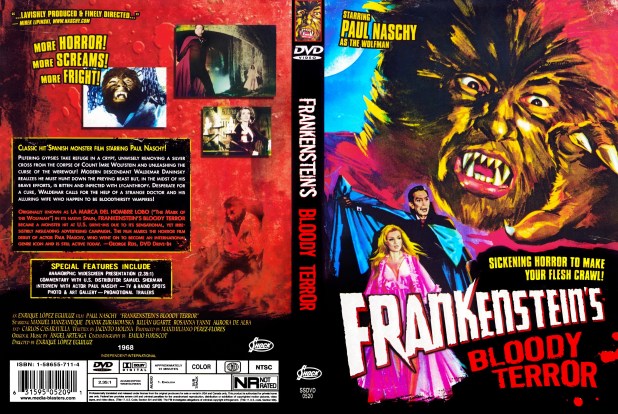
Originally known as La Marca del Hombre Lobo (The Mark of the Wolfman), this movie is also known as Hell’s Creatures: Dracula and the Werewolf, The Nights of Satan and as the title I saw it run as at the Drive-In Super Monster Rama, Frankenstein’s Bloody Terror. But wait…isn’t this a werewolf movie? Read on, friends. Read on.
The film’s American distributor, Independent-International Pictures, had a big problem on their hands. While they also distributed films like All the Colors of the Dark (renamed They’re Coming to Get You! in an attempt to get audiences to think it had something to do with Night of the Living Dead), Satan’s Sadists, Blue Eyes of the Broken Doll and others, now they needed a second Frankenstein movie and they needed it in a hurry.
That’s because producer Sam Sherman already had 400 theaters lined up for the Al Adamson film Dracula vs. Frankenstein and had promised those grindhouses and drive-ins a Frank-centric double feature.
That’s why this movie begins with an animated opening sequence that explains that the cursed Frankenstein family has had all manner of issues in their history, but this film will discuss one branch of the family tree that has been cursed with lycanthropy and changed their surname to Wolfstein.
La Marca del Hombre Lobo was originally filmed in Jan Jacobsen’s Hi-Fi Stereo 70 3-D format. This led Sherman to hire Linwood Dunn to craft what were reportedly gorgeous 35mm prints that needed to be projected through high-end lenses. The producer even set up a star-studded Hollywood premiere that went to pieces when inferior acrylic lenses were used to show the film. This story feels apocryphal, as I can’t see A-listers showing up to celebrate a Paul Naschy movie. But man — if it did happen, how amazing is life?
The hijinks begin when a gypsy couple gets trashed and spends the night in the Wolfstein castle. Their shenanigans lead to the silver cross being removed from the body of Imre Wolfstein, who rises from the dead to kill them and go wild in a nearby village (by going wild, he attacks a few people).
When a hunting party goes to stop what they believe are wolf attacks, Count Waldemar Daninsky (Naschy) is attacked and receives the titular mark of the werewolf. Prayer and friendship aren’t enough to stop his curse, so he turns to two experts, Dr. Janos and Wandessa de Mikhelov.
They turn out to be Satanic vampires and revive Imre, then hold Waldemar’s lover Janice and best friend Rudolph in thrall. They seem to be more swingers than vampires, mutually supporting one another’s open marriage and need to dominate more docile partners. I’m kidding — they’re totally vampires. But really, come on. They’re swingers.
At the end, the two werewolves battle, with Waldemar winning, leading to him killing the vampires and being shot by a silver bullet fired by Janice. It really doesn’t pay to be a werewolf, you know?
Naschy would follow this film with 1968’s film Las Noches del Hombre Lobo. That movie is even stranger than this one because even today, no one is sure that it even exists. Wait…what?
It’s true. Even though many refer to it as the second of Naschy’s twelve Waldemar Daninsky movies, no one has ever seen this movie. Not even Naschy himself, although he claims that his script was filmed in Paris by director Rene Govar — who has no other known credits. Govar died in a career accident a week after the film was sent to the lab, where it was never paid for and destroyed. Naschy also claimed that he worked with actors Peter Beaumont and Monique Brainville, but no one knows if they existed either.
Supposedly, the film was about a professor who learns that one of his students suffers from lycanthropy, so he uses that student as a method of revenge on his enemies. That also sounds a lot like a later Naschy film, 1970’s La Furia del Hombre Lobo (The Fury of the Wolfman).
Most Naschy experts feel like he brought up this film early in his career to pad his resume and make it seem like he was working in foreign markets so that he could appear to be a bigger actor than he was. Nevertheless, it’s a strange footnote in his career.
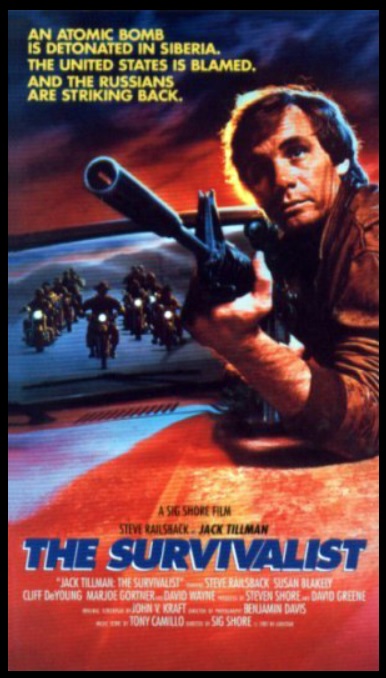
In the Survival Zone . . . death is a way of life.
Indeed, Mr. Tagline writer. Indeed.
Times were tough for ex-Star Trek and Stanley Kubrick actors . . . so bad that Gary Lockwood (1962’s The Magic Sword and 1977’s Smokey and the Bandit rip, Bad Georgia Road) traveled to South Africa (doubling for the “arid landscapes of 1988 Texas”) to star in a boring, post-nuke talk-fest pastiche of Death Wish and Mad Max. (And that “pitch” is really pushing the filmmaking meaning of the word in this pseudo-western romp.)
As with Def Con 4 and Battletruck, Survival Zone’s post-apoc ambitions sorely suffer from its lack of budget. So there’s no footage of devastated cities. No landscapes of burnt out buildings. No radiation-poisoned zombies. No futuristic hardware or soldiers. No Plisskens, Trashs, or Strykers for heroes. No desperately needed George Eastman-styled villains (Warriors of the Wasteland). There’s not even a Paco Querak to class up the nuclear mayhem.
What we do get is lots of talking and talking . . . and talking . . . with an annoying mix of American and South African accents (in Texas?) spouting dialog as they bitch about kite tails and how the world ended. What we do get are “pockets of low radiation levels” that allows Gary’s family—a hard-ass wife, a bitchy-whiny daughter (who suddenly changes from shorts to jeans while riding a horse), a bratty young son (who vanishes from the film without explanation), and a cantankerous uncle (all who make the stupidest of stupid decisions and you have no sympathy for)—to happily farm their homestead in peace. Then the post-apoc shite hits the fan when a band of marauding Indians—in the form of the apoc genre’s requisite leather-clad punk rock-biker rapists—lay siege. How “bad-ass” are these guys? The lead bad guy has the word “Bigman” emblazoned on his jacket and has a severed doll head fixed to the top of his motorcycle helmet.
Whooo. I’m so scared, Bigman. Let Ankar Moor throw your ass into the Deathsport arena and see how you do. You’d piss out your leather chaps playing Battle Ball in Ground Rules, dickwad.
So if you absolutely must be a post-apocalypse completest and watch every last piece of VHS flotsam and jetsam in Snake Plissken’s wake, then proceed at your own peril . . . it’s on You Tube. You’ve been warned, my fellow apoc-rats: For when it comes to our low-budget, post-nuked rip-off future, stay the hell out of South Africa and head for the Philippines, then Italy, then Australia, in that order.
Director Percival Rubens punched out 12 films in his not-so-illustrious career and gained minor video-store street cred with the popular (and now very, very rare and sought after) VHS rental and Cameron Mitchell starrer, The Demon. If you’re a horror buff completest, then check out that amalgamated mess of a film where John Carpenter’s Halloween meets A Nightmare on Elm Street.
Actor Don Opper (Black Moon Rising, Critters franchise) and director Aaron Lipstadt (prolific; too many U.S TV series to mention), the writing and directing team that brought us the very clever and entertaining Alien/Star Wars knockoff Android (1982; starring Klaus Kinski*) returned with this not so clever and entertaining post-apocalypse knock off set “15 years from now.” So, considering its year of release, it seems we’re in the year of 1999, across the continent from where Snake Plissken is dealing with Commander Hauk and hookin’ up with Season Hubley in a Chock Full o’ Nuts coffee shop.
As is the case with most-low budget apoc flicks, this means the “future” of City Limits pretty much looks like our present, except for a few techno-accoutrements to make it seem this is “the future.” And while that approach works to great success in films such as Kamikaze ’89 (1982) and Fahrenheit 451 (1967), City Limits lacks those films’ narrative focus to hold an apoc-rat’s interest.
You guessed it: As with the geographical alerts for post-apocalyptic films made in Canada and South Africa (Survival 1990, Survival Zone), this is a warning to proceed with caution with this U.S knock off of an apoc-flick . . . that’s a knock of the Italian pasta-flicks . . . that are knock offs of John Carpenter’s Escape from New York.
In this “universe” a plague has killed off most of the world’s adult population (I know that’s a plot device I’ve seen before, but I am too lazy to research those films, but I do remember Michael J. Pollard and Kim Darby starred in a ‘60s Star Trek episode with that plot) that leaves Los Angeles in the hands of two teenage biker gangs . . . who raided an Italian clothing designer’s ratty-apoc Broadway collection of costumes, complete with Skeletor-like motorcycle helmets. Can the Italian apoc-gangs the Riders and the Tigers kick their ass? Put it this way: The City Limits dweebs would be running around in pissy-pants if the rag-wearing and whitefaced Scavengers and the roller skating-metal hockey stick swinging Zombies showed up.
As with the Enzo G. Castellari apoc-universe set up in 1990: The Bronx Warriors and Escape from the Bronx, the ubiquitous “evil” corporation has moved into Los Angeles to restore civilization. The man to accomplish this goal is . . . teen idol-actor Robbie Benson (?) who, in the grand tradition of an ‘80s Adam West film (Zombie Nightmare and Omega Cop) does this from a one-room set, behind a run-of-the-mill wooden desk in an office with wood paneling . . . which is great if you’re a manager of a Walmart — not going into a post-apoc battle to restore civilization. Is Benson’s retail retaliation enough to inspire the gangs to unionize and fight back? You bet.
Considering this is a U.S production with a solid roster of U.S actors (John Stockwell of Christine, the apoc-drivel Radioactive Dreams, My Science Project; John Diehl of TV’s Miami Vice), along with a bigger budget and slicker production values than the Italian pasta-romps it aspires to be . . . there’s no Fred Williamson, Henry Silva, or Vic Morrow thespin’ against an endless barrage of fights and explosions and deaths by impalement, shotgun or, most importantly — flamethrowers. Yeah, John Stockwell is a great actor (and has become a successful director in his own right), but a movie in the apoc-genre needs a Mark Gregory discovered in a Rome shoe store, or ex-drug running merchant sailors like Michael Sopkiw running through the rubble and kicking the silver jump-suited minions of Henry Silva’s “Disinfestations Squads” to make it all work.
City Limits is a fond VHS memory of the ‘80s and it’s not a total waste of time, but it’s just that it could be so much better. You can watch it on You Tube, although the MST3K version on TubiTv makes for the more entertaining watch.
Tom Servo . . . Crooooow!
*Click through the images to check out our two Klaus Kinski tributes!
About the Author: You can read the music and film reviews of R.D Francis on Medium and learn more about his work on Facebook. He also writes for B&S Movies.
Scott Beck and Bryan Woods co-produced and wrote A Quiet Placebefore this film, which follows the framework of past movies like Hell Fest and The Funhouse, movies where haunted houses and sideshows house real killers. Eli Roth is the producer of this film, if that helps or hinders your decision to watch this.
With nothing to do on Halloween, a group of friends decide to enter an “extreme” haunted house that promises to feed on their darkest fears. The beginning of this feels a lot like Channel Zero: No End House, with each of their biggest worries dramatically coming to life.
Quickly, the group of young adults learn that some of the monsters inside this house are absolutely real. Either Beck or Woods has a major phobia of stepping on a nail, as that same horrific image from their past film happens twice in this one, along with plenty of other carnage.
Lead actress Katie Stevens also starred in the movie Polaroid which was lost in the disolution of Miramax. She was also an American Idol finalist. Her best friend, Bailey, is also played by a singer, Lauryn McClain of the pop act McClain. The Devil masked character is played by Damian Maffei, who was the leader of the Strangers in the second film in that series, The Strangers: Prey at Night.
While I really come down hard on most modern horror, this movie isn’t all that bad. There are some nice set pieces and plenty of jump scares. It’s not the best film you’ll see all year, but it’s a cut above the majority of the dreck that studios like Blumhouse are passing off as scary films this year.
Haunt is available on demand now. You can also get official shirts from Fright Rags.
About the Author: Paul Andolina is back to share a sports-related end of the world movie with us. If you like his stuff, check out his site Wrestling with Film.
I’ve never been super into sports as entertainment but I have recently got into football. Not liking sports, however, has not stopped me from liking movies with made up sports in them. In fact The Blood of Heroes is my absolute favorite sports movies and if you count movies that are centered around professional wrestling I have seen quite a few.
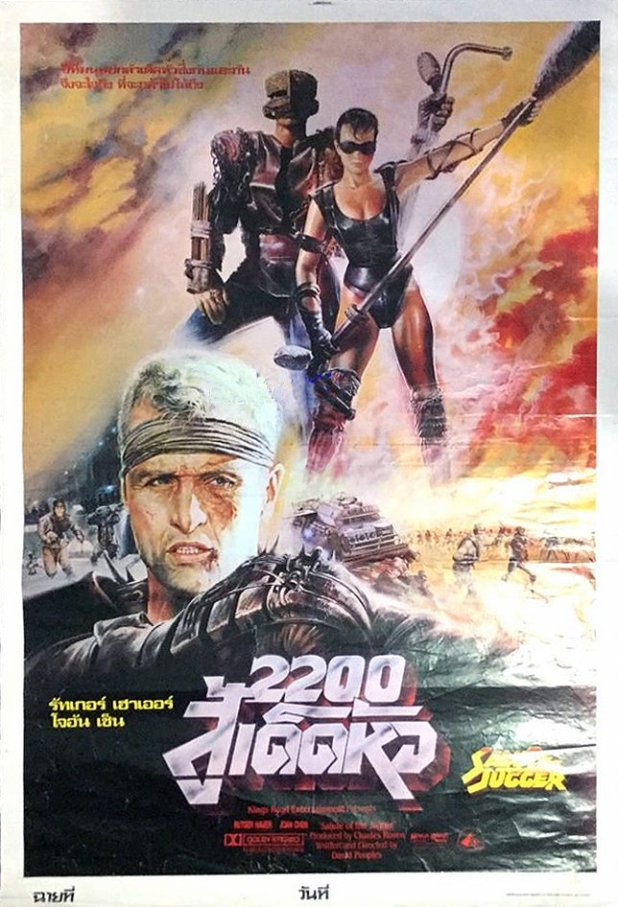
The Blood of Heroes, or as it is known internationally as The Salute of the Jugger, is a post-apocalyptic film about a fictional sport that incorporates placing a dog skull on a pole, weapons, and hard hitting action. It was released in 1989 and it stars the late Rutger Hauer, Joan Chen, a young Vincent D’Onofrio and Hugh Keays-Byrne who not only played Toe Cutter in Mad Max but also Immortan Joe in Fury Road.
I cannot explain the movie very well despite seeing it twice within the past 24 hours. There are two cuts: a shorter R-rated cut that was released in the states and a 13-minute longer version that saw play internationally. On the Bluray I own — which is a region A copy from Japan — there are both versions. The R-rated cut is a remastered version and it is the most beautiful version of the film I have ever seen visually. The colors are nice and the picture is so much clearer than the copies I remember renting constantly. I prefer the longer cut because I feel the ending makes a bit more sense than the one we are given in the rated cut.
Sallow (Rutger Hauer) is a slash for a traveling band of juggers who go from dog town to dog town entertaining their denizens of dirty, desolate citizens. Juggers are treated very well in these towns and eat well and drink well despite their surroundings. Kidda (Joan Chen) is a young lady who wishes to play the game and she gets her chance when the local team looses their qwik (the player who wrestles for the dog skull and races through the field to place it on the stake) after a particularly brutal round of the game.
She royally messes up Sallow’s qwik Dog Boy to the point where he cannot even stand. Kidda takes his place and the crew continues to travel town to town until they decide to get the attention of the league in the Nine Cities, an underground dwelling full of the richest most powerful folks in the wasteland. Sallow used to play for the league until he disgraced some lady by being in a public relationship with her.
I don’t know what else to say about this film other than I think everyone should watch it at least once. It is such an unique film in the post-apocalyptic genre since it focuses so heavily on something other than daily survival in a wasteland. The movie can be streamed on Amazon Prime but the cut presented isn’t the best; however it is worth watching still. If you can track down a region 4 DVD copy for cheap enough, it is worth a pick up. But if you are willing to splurge, the Japanese blu-ray is an amazing piece to own.







 B&S About Movies
You must be logged in to post a comment.