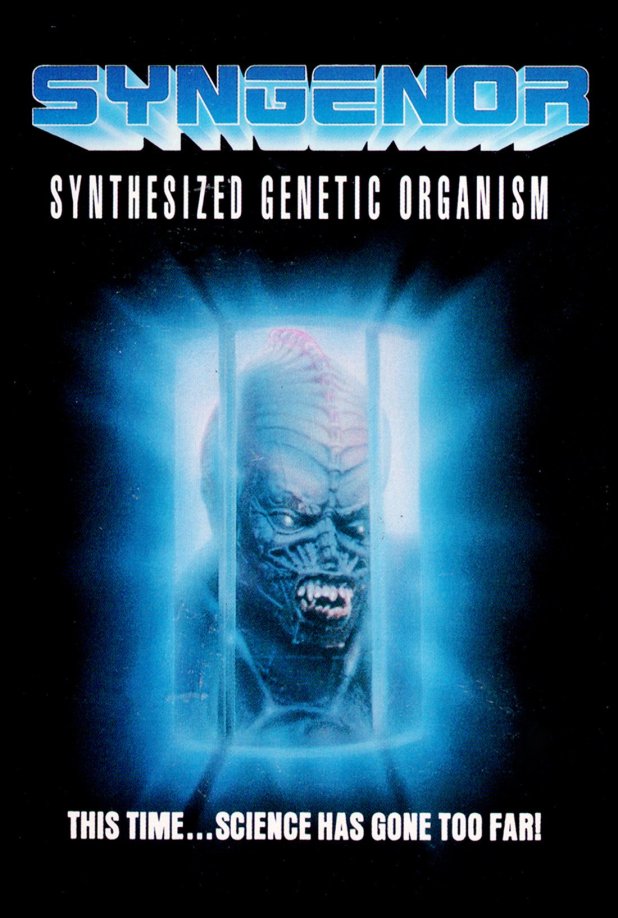
Remember Scared to Death? That monster suit movie may not have moved many folks, but producer Jack F. Murphy loved the creature in it so much he wanted to make another movie about it. Original director William Malone had moved on — some sources say he was making Creature, but that was in 1985 — so George Elanjian Jr. (who had had a career in reality TV before there was reality TV, directing That’s Incredible!, Candid Camera and Real Stories of the Highway Patrol) came on board.
Charitably, this movie is a mess, but it’s anchored by Re-Animator bad guy David Gale who absolutely takes huge bites out of the scenery every single time he shows up.
Norton Cyberdyne builds high-tech military technology and their latest superweapon is Syngenor (SYNthesized GENetic ORganism), a Giger-ish creature made for deployment in the Middle East. These scientists are so smart that they made an unkillable creature that can continually lay eggs and reproduce, making more invincible slimy monsters.
Their headquarters is really Los Angeles’ Ambassador Hotel and the lab is just a kitchen with sheets all over everything. And one of the two writers of this movie, Brent V. Friedman, would go on to also create the scripts for Hollywood Hot Tubs 2: Educating Crystal and Mortal Kombat Annihilation. If you think the latter is bad, you should see where he got started.
I have no idea why Vinegar Syndrome hasn’t released this yet. You haven’t lived until you see Gale get on his knees to suck off a female employee’s finger or kill all of his employees while wearing a bunny mask. This is his movie, so don’t you ever forget it.
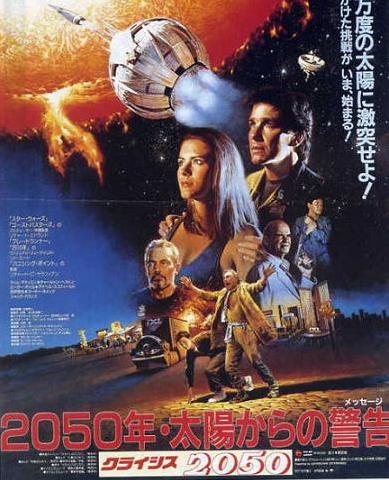
How did Solar Crisis — which cost $50 million dollars — disappear from the cultural zeitgeist?
This was not a small movie. While credited to Alan Smithee, the director is truly Richard C. Sarafian, who made Vanishing Point and Lolly-Madonna XXX. The cast includes Tim Matheson, Peter Boyle, Jack Palance, Michael Berryman, Paul Williams — as a talking bomb! — and Charleton Heston. It had a crew that included Russell Carpenter, the cinematographer of Titanic, and Syd Mead (Blade Runner) as production designer.
Hell, one of the investors was Nippon Steel, announced that they would be opening a theme park of the movie.
Thirty years later, no one remembers this movie.
The story could be some of the reason. Steve Kelso (Matheson) — the son of Admiral “Skeet” Kelso (Heston) and father of Mike (Corin Nemec) — plans on dropping a sentient bomb named Freddy — yes, just like Dark Star — with the voice of Paul Williams onto the sun to stop a solar flare and inspire Danny Boyle.
At the same time, Arnold Teague (Boyle) believes that there’s money to be made and tries to stop the mission. There’s also Mike trying to get to his dad, helped byJack Palance, who as always makes the absolute most out of a role.
The filmmakers went so far as to hire scientist Richard J. Terrile — a Voyager scientist who discovered several moons of Saturn, Uranus and Neptune — served as a technical advisor for the film. When he tried to tell them that sending a spaceship into the sun just wasn’t scientific, he was told to try to figure ot how to make it plausible.
I have no idea how anyone thought that an American film version of Takeshi Kawata’s novel Crisis: Year 2050 was going to make money off a budget that big, but blockbusters are a weird business. When the film didn’t do well in Japan, the producers reshot scenes for America and Sarafian took his name off the movie. Additional scenes were directed by Arthur Marks, who also was behind Bonnie’s Kids, Detroit 9000, Linda Lovelace for Presidentand J.D.’s Revenge.
There’s also a scene where Charlton Heston shouts at Tim Matheson, “Hold it, dammit! You tell me you love me before you leave this room!” That makes up for this multi-million dollar bomb looking no better than a direct-to-video release and lodges this magnificent failure directly into my head and heart.
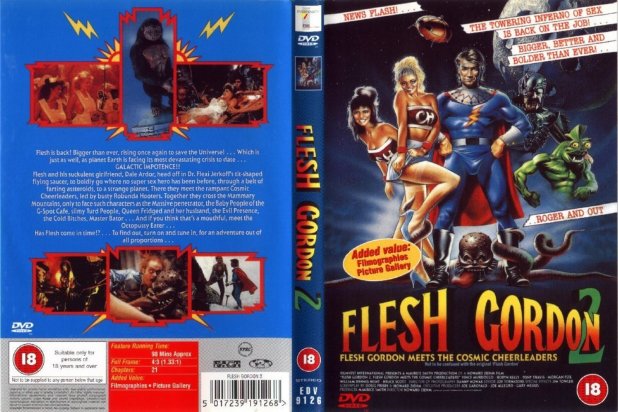
I really kind of love the original Flesh Gordon, but the 1990 sequel — with only William Dennis Hunt returning from the original cast — is scatological and insipid, which are usually two things I like. Yet by the end of the movie, I felt like I was constantly looking to see how much time was left.
Flesh (Canadian kickboxer Vince Murdocco) is kidnapped by a group of cheerleaders — hey, the title tells the truth! — from the Strange Planet. During a basketball game, their men were made impotent by the Evil Presence, who is coming to Earth to take Flesh’s penis for his own.
Director Howard Ziehm came back to make this one, but the second time is not charming.
Former Miss World Canada and Playboy Playmate of the Month for December 1990 Morgan Fox plays Robunda Hooters, which should explain the level of humor in this movie. I’ve said that Flesh Gordon felt like Mad Magazine. Well, this one is barely Crazy or National Lampoon in its last sad years.
It does have Melissa Mounds as Bazonga Bomber, which is really the only time this movie has ever made me giggle.
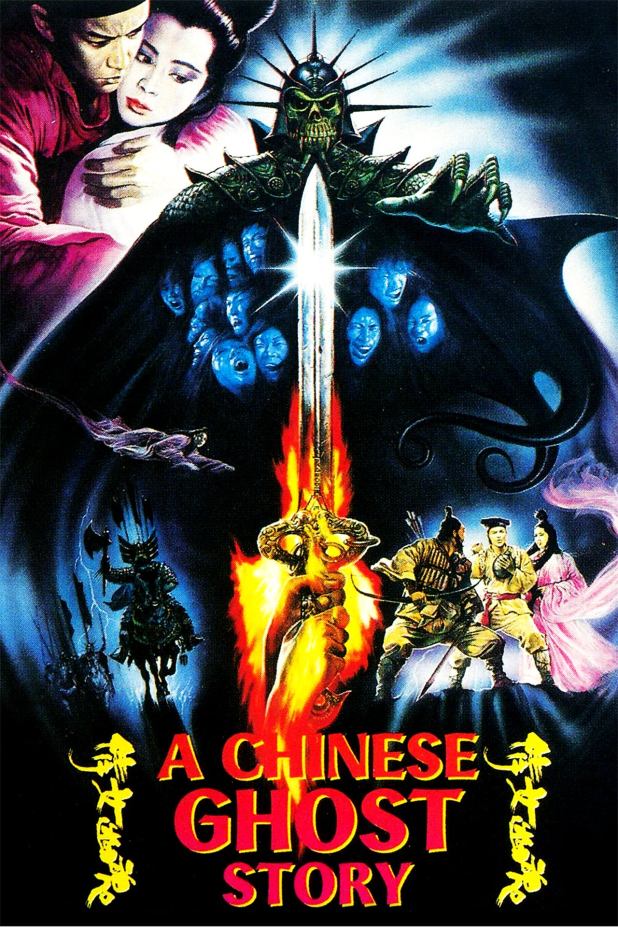
Based on a short story about Nie Xiaoqian from Qing dynasty writer Pu Songling’s Strange Stories from a Chinese Studio and inspired by the 1960 Shaw Brothers movie The Enchanting Shadow, A Chinee Ghost Story inspired more than just two sequels, an animated film, a television series and a 2011 remake. It also created an entire genre of folklore ghost stories.
Its director, Ching Siu-tung, studied in the Eastern Drama Academy and trained in Northern Style Kung Fu for seven years. His father, Ching Gong, was a Shaw Brothers director. While producer Tsui Hark got most of the credit for these films, Siu-tung has done well for himself, also directing The Swordsman series of movies and choreographing House of Flying Daggers and Shaolin Soccer.
In the first film, tax collector Ning Choi-san (Leslie Cheung) fails at his job and must sleep in a deserted temple. There, he falls in love with Nip Siu-sin (Joey Wong), yet discovers in the morning that she is a ghost forever enslaved to a tree demoness. When Ning tries to save her and fails, her soul goes to the underworld.
This film is a gorgeous meditation on unrequited love. Even with the help of Taoist priest Yin Chik-ha (Wu Ma), the best our hero can do is secure a better afterlife for his one true love.
1990’s A Chinese Ghost Story II starts with Ning and Yin parting ways, with Ning heading back to his hometown that has been overrun with cannibals. After being jailed and condemned to die, an ancient scholar reveals that he has dug an escape tunnel. He gives Ning a book and a pendant, then shows him the way to freedom.
In this film, Ning joins with Autumn (Jacky Cheung) and the rebel sisters Windy (Joy Wong) and Moon (Michelle Reis) to battle a demon that has taken over a mansion. And by demon, a mean a gigantic centipede that requires fighters to separate the souls from their bodies to defeat it.
Recently, Apple pulled the theme song of this movie from the Apple Music Store, as it features a reference to the masscre at Tiananmen Square Massacre:
“The youth are angry, and heaven and earth are shedding tears,
How did the rivers and mountains become a sea of blood?
How did the road to home become the road to ruin?”
Why would Apple pull a song that rightfully condemns China for their role in killing protesters? Well, you know how money works.
1991’s A Chinese Ghost Story III brings back the tree demon from the first film, a creature that is destined to return in a hundred years. This film is also about Monk Shi Fang (Tony Leung Chiu-Wai) and Swordsman Yin (Jacky Cheung), named after the original Taoist. The tree demon also has a ghost in its thrall, Lotus (Joey Wong).
This is the kind of movie where towers rise to block out all the sun on Earth and Shi Fang’s body is coated in his own golden blood, which allows him to channel the power of the Buddha to bring the sun back. Basically, things get nuts.
If you fall in love with these movies, remember that there was a cartoon and a 2011 remake to keep you watching.
ABOUT THE AUTHOR: Herbert P. Caine is the pseudonym of a frustrated academic and genre movie fan in Pennsylvania. You can read his blog at https://imaginaryuniverseshpc.blogspot.com.
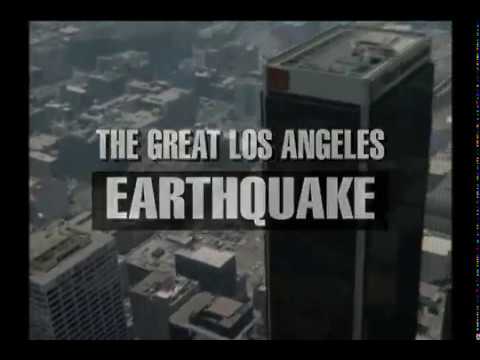
The Great Los Angeles Earthquake is essentially a TV miniseries version of the 1974 disaster movie Earthquake. It makes no attempt to hide this fact, as within the first ten minutes of the movie, we see a clip of the Universal Studios Theme Park ride based off the original movie. Both films use the same sets, according to Wikipedia. The film also starts the same way, with ominous music playing over a helicopter shot of the Los Angeles skyline. The theme music is a weak imitation of John Williams’s original disaster movie score, much as the movie is a weak imitation of the original theatrical release.
The Great Los Angeles Earthquake has the default plot for this genre: an intrepid seismologist, played by Joanna Kerns, has discovered a foolproof method of predicting earthquakes, and all the indications are that Los Angeles is about to be hit with a massive earthquake. However, her attempts to warn the populace are hindered by the machinations of a sleazy real estate developer, played by Robert Ginty from The Exterminator and The Paper Chase, who fears her predictions will cause housing prices to crash. Will she be able to warn the population in time?
One of the main problems facing this disaster film is that it is overloaded with too many supporting characters and subplots and not enough disaster. The earthquake only happens nearly two-thirds of the way through the film. In the meantime, we are treated to a variety of unnecessary and not particularly interesting sub-plots, ranging from the tense relationship between our hero’s sister and her mother to a plot to assassinate a South African trade minister who might become the country’s first black prime minister. The filmmakers would have been better off cutting one or two sub-plots to focus more on the destruction of the city.
However, this issue is mitigated by the quality of the supporting cast. Although Kerns and the other leads are not especially impressive, the supporting players include a number of talented character actors. Robert Ginty is suitably unctuous as the film’s antagonist, playing a more subtle version of Donald Trump. (The film even lampshades this, referring to the character as a wannabe “Donald Trump of the West Coast.”) Richard Herd is also good in a small role as Kerns’s superior at the U.S. Geological Survey, conveying authority and trustworthiness despite having little character development. Ed Begley Jr. does well as Kerns’s subordinate who leaks the story to the press. (Be warned, though: although Begley is prominently featured on the film’s cover, he is only in the film for 10-15 minutes.) Ultimately, the cast stand out is Richard Masur (Clark from The Thing), who plays a sleazy, hard-driving reporter whose efforts to exploit Kern’s warnings for ratings only succeed in making things worse. The reporter goes through a decent character arc as he confronts the destruction wrecked by the earthquake, with Masur conveying his emotional breakdown. Although none of these performers manage to surpass the awesomeness of Marjoe Gortner in Earthquake, they make the film worth watching.
The Great Los Angeles Earthquake also boasts impressive special effects for a TV movie. The film’s practical effects are far more convincing than the cheap CGI that too many televised disaster movies now resort to, with sets that actually shake and collapse and the actors interacting with actual flames. The way the disaster is shot is also effective, conveying the disorientation and chaos such a massive earthquake would actually cause. After the quake, the city looks dark and foreboding as it is engulfed with fire and smoke darkens the sky. Moreover, the last hour of the film is suitably downbeat as people struggle to find their friends and relatives amid the carnage.
Perhaps the most disturbing aspect of the film is how it illustrates the incapacitation of emergency and rescue services in the face of an 8.1 earthquake. Police, fire fighters, and EMS are hindered by the scale of the destruction and the blocking of roads and highways. This unsettles on a far deeper level than any special effect. In a better film, this could be used to show the total breakdown of society in the face of catastrophe, as in the beginning of the original Dawn of the Dead where we see the uselessness of the Emergency Broadcast System in the face of the zombie outbreak. Scenes like this hold real-world resonance, especially in the wake of the pandemic. When I first saw a late-night broadcast of this movie as a kid on the Million Dollar Movie, these elements disturbed me, but now they are arguably the most effective aspects of the film.
The Great Los Angeles Earthquake can be found on YouTube here.
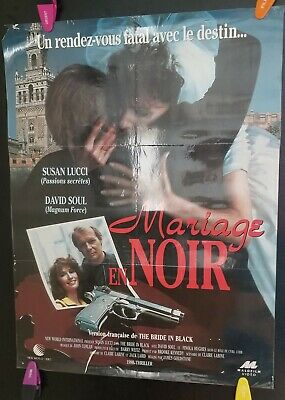
You know, I never watched soap operas, but Susan Lucci knew how to make a TV movie. Yeah, she may have been nominated for an Emmy every year for All My Children, but she made some awesome stuff like Invitation to Hell, Haunted by Her Pastand Lady Mobster.
Yet this tale of Lucci’s Italian shopgirl falling for David Soul and watching him get gunned down on her wedding day before following his past life has a twist that I feel that only I could appreciate. It was made in Pittsburgh!
It also has Reginald VelJohnson as a boxer who teaches Lucci how to take care of herself, Finola Hughes as an old flame of Soul’s and Tony Todd. Tony Todd in a TV movie!
Director James Goldstein also made Rollercoaster, Jigsaw and Cry Panic. Either fate has made me watch these movies for the reason that they are connected by this director or I just watch way too many movies. Perhaps both.
This also has Ronald V. Garcia as cinematographer. He was the director of The Toy Box and shot Fire Walk with Me.
This was written by soap scribe Claire Labine and Jack Laird, the man who wrote all the silly parts of Night Gallery. But yeah — at one point, Lucci was in the City of Champions, making a movie where she undergoes the journey of introspection that comes from having one’s life violently destroyed before one’s eyes. I can only imagine that she went to Images to dance after filming wrapped.
The ’80s were the comeback decade, for both William Shatner and Lee Majors returned to our small screens with T.J Hooker (1982 – 1986) and The Fall Guy (1981 – 1986)*, respectively. And both were shows good ol’ dad and I could enjoy together. And we were both equally perturbed when they were simultaneously cancelled.
Now you would think, with a second hit TV series, that Lee would have been back in mainstream Hollywood’s good graces and return to his stalled theatrical career from the early ’80s. But it seemed the contractual dust-up during the last year of The Six Million Dollar Man back in 1977 wasn’t forgotten. There’s two sides to the story: Majors either caught a case of the Tinseltown Flu to force Universal into accepting his Fawcett-Majors Productions as a series co-producer or he held out for a pay raise. Either way, the executive suites in la-la land don’t take kindly to their actors pulling a creative coup.
So after saddling up in the late ’80s as Mountain Dan alongside Dolly Parton (with Henry “The Fonz” Winkler directing!) in A Smoky Mountain Christmas and two Six Million Dollar Man-Bionic Woman telefilms, Majors made it back to the big screen . . . well, it was only a matter of time until Menahem Golan and Yoram Globus wrangled Lee Majors into one of their deadbeat, direct-to-video productions.
Granted, we love Cannon Films around the B&S About Movies offices, for their imprint was ’80s VHS-rental de rigueur, with all of the Death Wish sequels and Chuck Norris flicks, such as Invasion U.S.A. and The Delta Force series. And all of the Ninja-suffixed films. And all of our beloved Micheal Dudikoff flicks. In fact, by 1986, Cannon reached a production milestone of distributing 43 films in one year, as the studio broke away from their usual direct-to-videoesque potboilers to big-budgeted theatrical features such as (the less than stellar) Lifeforceand Masters of the Universe, (and the cheesily awesome) Cobraand Over the Top.
Sadly, by the time the Israeli cousins of the celluloid frontiers roped the services of Lee Majors, Cannon was in financial and creative ruins . . . and four years away from its inevitable demise. So, instead of putting Majors in a halfway decent flick sidekickin’ with Chuck Norris in something like Firewalker or slipping him into Roy Scheider’s role in (a pretty decent Elmore Leonard film adaptation) 52 Pick Up, our ex-Bionic stunt man ended up in Keaton’s Cop.
You know, the48 HoursLethal Weapon buddy-cop rip-off film that paired Lee Majors with Don Rickles. Yes. You heard me right. Mr. Warmth from all of those The Johnny Carson Show reruns on Antenna TV. The guy who did all of those goofy “beach party” movies with Frankie and Annette back in the ’60s. The guy who you’ve seen many a-cable-replay times as casino manager Billy Sherbet in Martin Scorsese’s Casino. But the younger kiddies ’round these wilds of Allegheny country probably remember Don Rickles best as the acidic Mr. Potato Head in Toy Story. Oh, and if you’re a horror hound like most of B&S’s readers: Don was Manny Bergman in the (pretty cool) mobster-vamp hybrid Innocent Blood by John Landis.
But here’s ol’ Don . . . twenty-years later, following up his last big screen role in 1970’s Kelly Heroes with Clint Eastwood, in the Danny Glover role as Jake Barber: the aged detective sidekick paired with Mike Gable, a burnt-out, on-the-edge veteran cop with a penchant for throwing suspects out windows — and losing partners, via death. Oh, and speaking of Cobra . . . guess who their boss is . . . hey, it’s Art LaFleur rippin’ through a Xerox redux of his role from that Stallone flick. (Plot spoiler: we lose Don early in the movie, natch, and he’s not funny here; he plays it straight, as he did in Innocent Blood and Casino.) Oh, and speaking of Cobra, again: Remember the big “character development” scene when Marion Cobretti cut off a slice of three-day-old pizza with a pair of scissors? Well, Keaton’s Cop has one: Mike Gable brushes his teeth with beer. (Remember when Brian “Boz” Bosworth mixed that “health drink” in a blender during the “establishing scene” in Stone Cold (1991) and we wondered, “how can he drink that” . . . and it ended up being gruel for his bet iguana? Hey, all of these action flicks needed one of those “character development” moments, natch.)
So, I see you noticed the name of Abe Vigoda on the box. Yes, he from those endless AMC and TNT reruns of The Godfather and those old Barney Miller episodes you’ve Antenna TV-channel grazed as you surfed the couch after a long Saturday night of partying. Eh, maybe you remember Abe in The Cannonball Run II, The Stuff, or the oddest Christmas flick of them all, Prancer.
Anyway, Ol’ Abe is Louis Keaton, an aged-out mobster living his days incognito in a Galveston, Texas, nursing home. When Gable is dispatched to the nursing home to investigate a shooting, he comes to discover the intended target was Keaton and the shooter was a mob hitman. And since Barber and Vigoda go “way back,” Barber convinces the guff n’ grizzled Gable to take part of the action-comedy-romance (with a home nurse that is way too young for him) that ensues.
Truth be told: Even though this a pinch-o-rama rip off, Majors is solid here, the comedy is funny (both of the sometimes-intentional and non-intentional variety), and it’s nice to see a then 69-year-old Abe Vigoda digging in his heels and getting banged around with film’s promoted “hard-edged action.” But still. Lee Majors deserved better. Way better. Like the very similar Martin Brest-directed and Robert DeNiro-starring Midnight Run from 1988-better (which Majors’s old bosses, Universal, backed). But that’s how the dice in Hollywood roll across the green felts of fate.
No freebie streams? What the hell, You Tube uploaders? What gives, ye executives at Tubi TV? Ah, but we found a rental-stream on Amazon Prime. Keaton’s Cop has never been officially reissued on DVD, so watch out for those bogus-cum-defective grey market rips out there, kiddies.
About the Author: You can learn more about the writings of R.D Francis on Facebook. He also writes for B&S About Movies.
* Stock footage alert: Action scenes from our “Fast and Furious Week II” review of Flash and the Firecat ended up in The Fall Guy (the clip is included in the review).
Wow! Finally! Yeeeees! When Blender Master Sam stirred up an “Ancient Future” theme week, I jumped with glee! Finally, a reason to review one of my favorite home video rentals that oft-played on HBO. It was the first movie that my analog cortex correlated to “ancient futures,” aka “future history,” if you will, when Sam published this month’s schedule. Eh, yeah, it has a some post-apoc stank on it from our last week’s “Post-Apoc Week,” but since this has a lot of pre-Matrix tech tomfoolery, we’re reviewing it this week.
As with the Sam Raimi The Evil Dead precursor Equinox (1970), and, in a sci-fi vein, John Carpenter’s Dark Star (1974), Circuitry Man got its start as a UCLA student film by Steven Loy and his brother, Robert. IRS Media, the home video arm of IRS Records, backed the expansion of the project into a feature-length film. The burgeoning cyberpunk effort was successful enough on the retail rental circuit that it inspired one of the earliest direct-to-video sequels (eh, still cool, but not as good), Circuitry Man II, aka Plughead Rewired: Circuitry Man II (1994), in which Vernon Wells, Jim Metzler, and Dennis Christopher return from the first film. Both films are highly recommended as a great, first time doorway into ’80s VHS-era sci-fi (but always one over two, for me). (Remember how Escape from New York always rules over Escape from L.A., and it’s always Phantasm the original over II? Yeah, it’s like that. Sometimes, we don’t want the ball to come back.)
Of course, the major studios put out the likes of the similar cyberpunk-cum-tech noirs Hardware (the very cool debut feature by South African writer-director Richard Stanley) and Total Recall (eh, Dick’s book We Can Remember It for You Wholesale is better) that same year, but neither are quite as distinctive and fun. To that end, and considering Total Recall, there’s a definite Phillip K. Dick-vibe with the Loy brothers against-the-budget post-apoc world forced, by pollution, to live in underground in parking garage-like bunker-environs. Lori (Dana Wheeler-Nicholson), a female body guard, is pressed into service by a drug smuggler for a major microchip deal; when the exchange goes bad, Lori’s on the lam, aided by Danner (a really great Jim Metzler), a pleasure android (read: male prostitute). Together, they’re now “drug smugglers” of virtual reality computer chips, chased from Los Angeles to New York City and aided by a fellow fringe-denizen, Leech (an also great Dennis Christopher). Not only are they pursued by the police, but by gangsters, led by the villainous, VR narcotic-addicted Plughead (an incredible Vernon Wells . . . yes, Wez from post-apoc influencer, The Road Warrior*).
I love to plug!
Released five years before Kathryn Bigelow and James Cameron’s not-so-memorable tale of black market VR smuggling with Strange Days (1995), Circuitry Man, as far as direct-to-video movies go at the height of the VHS tape market, is right up there alongside Charles Band’s Trancers in the imagination-against-the-budget sweepstakes. And the Loy brothers were smart to forgo the cheezy, low-budget computer graphics and just sticking to the noirish caper. (Ugh, remember how great Christopher Walken was, but how awful the big screen, dream-VR romp Brainstorm (1980) was for that very reason?) Another plus: the genre switching of the roles, with a woman as the noir-spiraling P.I (if you will) and making her sidekick the male “prostitute” who helps the jammed-up detective. And, as I rewatch Circuitry Man all these years later (on VHS, natch), the Windows 3.1 software is a lot of fun . . . dated, but fun to watch. At least our reluctant protagonists aren’t running around with “mission critical,” ’80s-era Kmart Kraco (or Radio Shack’s Realistic) audio cassette tapes in 1997, à la Snake Plissken. (Truth: As cool as Escape from New York always will be; the cassette tape bit still sucks; so, a major ball drop there, John. Couldn’t you make-up a some faux-techo doo-dad?)
Circuity Man is definitely — in terms of low-budget indie sci-fi’ers that began their life as student film, such as Dark Star and George Lucas’s space opera precursor, THX-1138 — required viewing and worthy of an entry in any sci-fi fan’s home video library. How, and why, Carpenter and Lucas (and Raimi) hit such career highs from such similar beginnings, but the Loy brothers dissipated into the analog snows after Circuitry Man II, is crime against cinema. I, for one, would have loved to have seen what they would have come up with courtesy of a major studio’s backing.
If you search “Circuitry Man” on You Tube, you’ll find many-a-fan favorite clips uploaded. While there’s no streams — freebie or official — online for Circuitry Man II, you can stream the original Circuitry Man at Amazon Prime and Vudu. We found the You Tube trailers (get ’em while they’re still there, if they are . . .) for Part 1 and Part 2.
Be sure to look for our review of the “ancient future” of Brainstorm, this week. And check our interview with Vernon Wells!
About the Author: You can read the music and film reviews of R.D Francis on Medium and learn more about his work on Facebook. He also writes for B&S Movies.
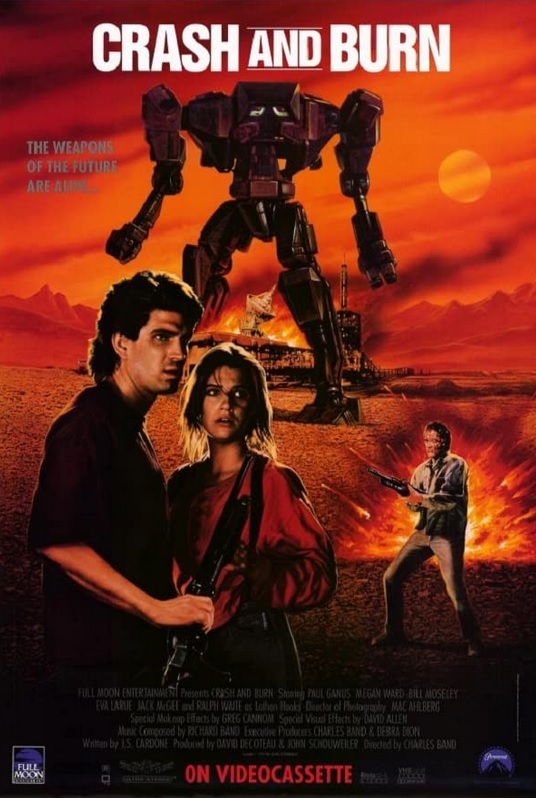
This sequel-but-its-not-a-sequel to Robot Jox — marketed in the overseas markets as Robot Jox 2: Crash and Burn — unlike its predecessor, foregone a U.S. theatrical release and went straight-to-video. As with Roger Corman creating Forbidden World and Space Raiders for the sole purpose of not so much to tell a compelling story, but to maximize his $5 million dollar investment in Battle Beyond the Starsby recycling that dopey Star Wars cash-in’s sets and special effects, Crash and Burn recycles the impressive Dave Allen and Ron Cobb stop-motion animated robots from Robot Jox. Just don’t hit the big red streaming button with the expectations of another anime-mech battle of the robots: at its core, Crash and Burn slaps a sci-fi coat of paint on the plot of Friday the 13th, with that film’s supernatural, woodsy killer, replaced by a James Cameron-inspired, unstoppable, synthetic desert killer.
Why is the tagline “The Weapons of the Future are Alive” in grey-against-red: you can’t read it. Why not go with a black typeset-against-orange?
To make sense of this new, its-not-a-sequel Band-verse: Let’s assume that the post-fifty years-after-the-nuclear war new order created by the two, new world superpowers from the Robot Jox timeline — the Common Market and the Confederation — suffered an economic collapse. That, coupled with the world ravaged by the greenhouse effect and an out-of-control sun creating “Thermal Storms,” allowed for the rise of the powerful Unicom Corporation controlling the world’s marketplace. Blaming the economic instability and collapse on the world’s technological dependency, Unicom banned all human usage of computers and robots. (In this new-verse, the mech-robots were develop for mining operations.)
While we have a pinch of The Terminator here, you’ll also notice an Orwellian pinch of the influential, “ancient future” novel, 1984, with scattered pockets of citizenry operating the “Independent Liberty Union,” a loose resistance movement in authoritarian opposition. One of the last free-speech strongholds against the corporate rule is a battered, over-the-air Public Access television station housed in an abandoned industrial facility, operated by Union sympathizer Lathan Hooks (Ralph Waite of TV’s The Waltons), a one time media executive who moonlights as a revolutionary. And, in a pinch from Alien — if you remember that the Weyland-Yutani Corporation infiltrated the Nostromo’s human crew with a cyborg to harvest alien eggs — Unicom manages to plant Quinn (a great Bill Mosley of Dead Air), a Sythnoid-cyborg operative (he’s the station’s Chief Engineer) among the station’s staff to kill Hooks and shutdown the station.
Keep your eyes open for the great work by a familiar cast of characters actors: John David Chandler of Drag Racer is a scruffy-creepy gas station owner; ubiquitous TV and film character actor Jack McGee (Brad Pitt’s Moneyball) is a slobbering talk show host; Megan Ward of Encino Man is Waite’s granddaughter and studio engineer; a perfectly-stoic-for-the-role Paul Ganus is very good in an early role (and one of his few leading-man roles) as Tyson Keen, a Unicom fuel courier who takes up the with TV station-based rebels after his departure is waylaid by a thermal storm.
For a Charles Band production-edict patched together by producer David DeCoteau (Sorority Babes in the Slimeball Bowl-O-Rama) with a script by J.S Cardone (The Slayer, Outside Ozona), the production quality is high (courtesy of Band’s inventive repurposing of a rusted processing plant that reminds of Ravagerssimilar against-the-budget architectural redeployment). In addition, the acting on all quarters is solid, Band’s direction is tight and suspenseful, and Cardone crafted an interesting “ancient future” by way of convincing techno-speak and a well-fleshed sociopolitical backstory for a nicely-layered twist to its Alien-cum-Terminator-cum-Friday the 13th plotting. And while the Dave Allen 120-foot robot we came for doesn’t show up until the last throes of the third act, Cardone and Band earn bonus points for — instead of putting the words “July 2030” on the screen to advance the plot, they made a sensible, creative choice to have John Davis Chandler’s character swat a fly that lands on a dated calendar. And, instead of a text scroll or voiceovers (the bane of my screenwriting existence), they have Ganus’s Unicom courier watch Waite’s newscast on a television in the gas station to get us up-to-speed as to “the future” of Crash and Burn. (And since this is all in the Full Moon family: Ted Nicolaou, the director of the studio’s Bad Channels, The Dungeonmaster, Subspecies, TerrorVision and The Dungeonmaster, serves as the editor, here.)
All in all, Crash and Burn isn’t a bad Full Moon flick; it’s one that rates right up there with their vampire variant Subspecies as one of the studio’s best. Well, okay the sci-fi’ers Arena and, especially, the space westerns Oblivion and its even better sequel, Oblivion 2: Backlash, are pretty cool shots from the Full Moon canons, too.
There’s a couple alternatives to owning your own copy of Crash and Burn. Of course, used VHS tapes are bountiful in the online marketplace, with the first DVD version released in 2000 by Full Moon. Then, under the “Charles Band DVD Collection” box set, it was reissued in 2006 with other Full Moon titles. The most recent reissue is a 2011 double-feature DVD with the third, loose sequel, Robot Wars.
You can enjoy Crash and Burn as a free with-ads-stream on Tubi. And look for our reviews of Robot Jox and Robot Wars, this week.
About the Author: You can learn more about the writings of R.D Francis on Facebook.He also writes for B&S About Movies.
We love David A. Prior around here. Of course, you know that already, as we drop his name a lot around the digitized pages of B&S About Movies. And we like to kid David A. Prior a lot around here, too. But it’s out of respect. Which is why, even though Sam the Boss already took a crack at Future Force and Future Zone during our past post-apoc excursions, we’re reviewing them both with a second, fresh take, for this new apoc week.
In the coming months, we’re rolling out a week-long tribute to ’80s SOV films, and David A. Prior is on the list with his infamous film debut, Sledgehammer (1983), which starred his bodybuilding and ex-Chippendale’s dancing brother, Ted. And from that humble, shot-on-video beginning, David A. came to incorporate AIP — Action International Pictures — with David Winters and Peter Yuval. Winters’s own humble beginnings began with Thrashin’; after being overruled on a casting decision (Josh Brolin instead of Johnny Depp; we reviewed Brolin’s Jonah Hex, by the way), Winters vowed to make movies on his own, without studio interference. Then he gave us Space Mutiny . . . so, maybe it pays to have studio interference.
Ah, but we’re here to praise the ’90s-VHS resume of David A. Prior, a resume that would require two tribute weeks to review the joint Prior brothers’ resume. What we have reviewed is the spa ‘n blades romp Killer Workout and the Filipino actioners Firehead, The Final Sanction, and Silencer. Then there’s his female Rambo ramblings with Relentless Justice. And while Prior didn’t direct them, his Action International Pictures, which later rebranded as West Side Studios after David Winters bought out his partners, also gave us the holiday horror Elves, the apoc-slop of Phoenix the Warrior, and the exploitation zombie mess Zombie Death House.
Mr. Prior dipped his toes in the post-apoc pool again — and Brigette Nielsen in tow — with Hostile Environment, aka Watership Warrior (1999), concerned with the ol’ rebels and tainted water supply gag. We’re wondering if Dave A. brought back the flyin’ robot forearm we’ll soon discuss? We wanted to review it this week because, well, another David A. Prior flick on the site is a good thing — really. Sadly, there’s no online streams — or trailer, not even clips — for us to review and share with you.
The Reviews
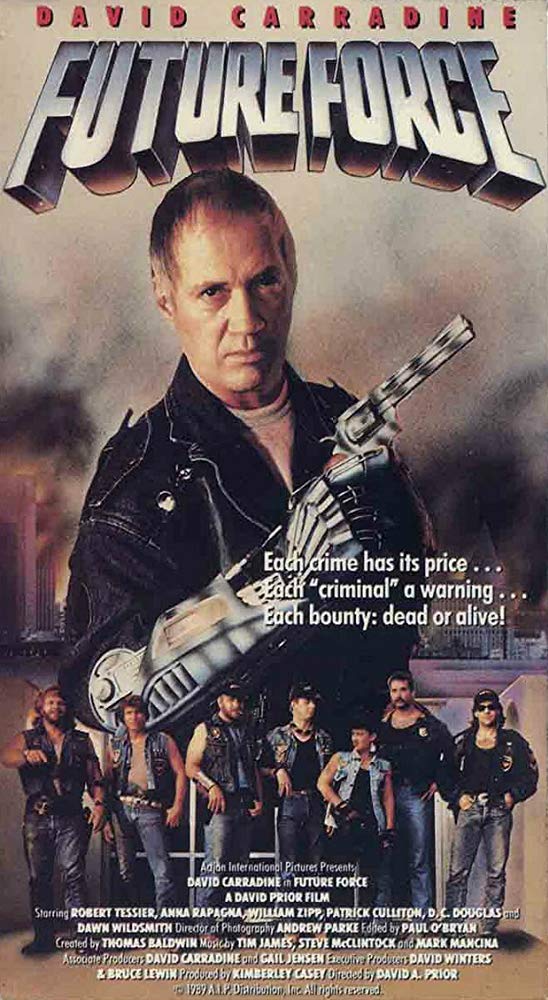
And that brings us to the Mad Maxian one-two punch of the post-apoc adventures of John Tucker — he of the flying, remote controlled robot arm-cum-glove. Seriously. John can either slip on the glove to kick apoc-ass . . . or use a remote control on his belt to fly said robo-glove out of its toolbox home to zip around and punch out the bad guys. Oh, and it can shoot lasers and take out an errant helicopter. So there’s that.
Anyway — one year earlier, in the far-flung year of 2020 — things haven’t got so bad to be Mad Maxian, but bad enough to be Robocopian. But, since this is a low-budget apocalypse, the world of John Tucker is just down the street from the also not-the-Main Force Patrol apoc-shenanigans of Ron Marchini’s John Travis in Omega Cop (1990) and Karate Cop (1991). (And, to add to the confusion, David Carradine cameos in Karate Cop.) And since we don’t have the budget for full-blown Robocopbody armor or Road Warrior body leathers, our cops wear sleeveless denim vests with “Special Police” and “COPS” patches on their chest.
And if it all sounds like the same movie . . . it probably is. And none of it — regardless of the vests — is very heavy metal.
You’ve got the right to rock alongside Ron Keel, Mr. Carradine. Flash those horns, Mr. Marchini.
This time, our merry band of law officers are a civilian bounty hunter-based organization known as C.O.P.S, aka Civilian Operated Police Systems. Our intrepid John Tucker (David Carradine) is a bitter, washed up drunk roamin’ the mean streets of Los Angeles who’s more interested in dispatching justice — like Judge Dredd — than collecting bounties in his pocket. Of course, as in Robocop, the police force is corrupt and a reporter — a female reporter, natch — has the proof. (So, yeah, we’re pinchin’ Stallone’s Cobra, too.) And now the C.O.P.S are out to stop the duo from exposing the corruption. Oh, and Tucker’s only ally is Billy (the 260-plus credits strong D.C Douglas; six new films in production), a computer genius with a spiffy wheelchair. Oh, and the chief baddy that gets his ass robo-gloved kicked is Robert Tessier from Burt Reynolds’s The Longest Yard — but since this is B&S: The Glory Stompers, The Velvet Vampire, and Chief Thor in Starcrash, just to name a few of Robert’s B-Movie delights.
So, we’ve ripped off Mad Max and mixed it with Robocop. And tossed in some Cobra and Ron Keel. What’s left to rip: The Terminator . . . or more like Charles Band’s Trancers— didn’t that have time travel and see an overseas release as Future Cop? — since there’s no way this movie can afford a James Cameron cyborg, well, at least not a borg that extends beyond the right forearm. And John Tucker ain’t no Jack Deth. And neither is a Snake Plissken. But Plissken was packing a 1998-era, mission-critical Kraco audio cassette tape and a laser-sighted revolver. And Tucker has a robo-arm. So who is kicking whose ass around Los Angeles: David A. Prior, for at least he came up with a techno-trinket and didn’t have Tucker packing Carpenter’s “future” audio cassettes.
Anyway, this time, the C.O.P.S will stop John Tucker . . . so they think. Tucker’s son, Billy (Ted Prior) — and not the same Billy from Future Force — travels back in time to 1990 to stop his dad’s murder. Oh, and save Tucker’s wife — and Billy’s mom — from kidnappers. And that’s pretty much it. The glove kicks ass. There’s explosions. Turned over cars. Oh, and requisite baddie soldier-cop Charles Napier (best known in the mainstream, celluloid throes as CIA officer Marshall Murdock in Rambo: First Blood Part II) and Jackson Bostwick, the original Captain Marvel from the ’70s Saturday morning TV series Shazam!, beef up the cast (well, this is a step up from the Gold Key Entertainment-verse with Killing at Outpost Zeta and Escape from DS-3, after all, right Jackson? Uh, is it?).
So, which is better and which is worse? Opinions vary. Can you make it through both and figure it out for yourself? Well, what do you expect from a law enforcement agency that spends their money on a fleet of un-Mad Maxian Jeep Cherokees with remote control doors — then blows their remaining operational budget on robo-gloves that flash an “OK” and Devil’s Horn” signs after its remote ass-kickings?
Exactly.
For no one thought to rent the repurposed Death Race 2000 Calamity Jane from Claudio Fragasso used in Interzone or Scorpion’s bubble-topped Camaro from Enzo G. Castellari’s Warriors of the Wasteland. And speaking of Trancers and cars . . . Band’s future cop romp repurposed the Spinner from Bladerunner, which was also repurposed in Solar Crisis (1990) and Soldier (1998). Come on, Mr. Prior, a fleet of Jeep Cherokees will save our future? Could you be more cheapjack? Okay, so don’t rent out the Spinner. Could you have at least attempted a flashy, MFP-styled paint job on the jeeps? And . . . hey . . . wait a sec . . . are those the same Jeep Cherokees from the earlier adventures of John Travis in Omega Cop(y) and Karate Cop(y)?
Where to Watch
You’ve got four chances to tough out the John Tucker-verse: Tubi offers the RiffTrax’s versions of Future Force and Future Zone. If you’re a purist — like moi — you can watch the un-riffed VHS rips on You Tube for Future Force and Future Zone. And no, while David Carradine stars in the similarly-titled Crime Zone, that’s a whole other zone unto itself — courtesy of Roger Corman’s Concorde Productions. The same goes for Carradine’s brush with Cirio H. Santiago in Kill Zone from 1993.
And since we mentioned Ron Keel and are in a musical mood: The resident damsel-in-distress in Future Zone, aka Ms. and Ma Tucker, is Gail Jensen, aka, Ms. David Carradine. The Carradines married in Rome in 1988 during the filming of the Italian-British co-production of the Terence Young-directed sports drama, Run for Your Life, aka, Marathon. Now, if the name Terence Young is familiar to you spy flick junkies . . . yes, Young is the director behind the early Bond classics Dr. No (1962), From Russia with Love (1963), and Thunderball(1965). (We could do a theme week on Young’s resume; we haven’t reviewed many of his films, but we did take a look at his box office bomb, Inchon.)
Anyway, back to Gail Jensen.
While Jensen acted (she made her debut in a 1974 episode of TV’s popular cop-procedural, McCloud, and had a support role in the ’80s slasher Don’t Answer the Phone) and helped co-produce David’s later films, she was primary known as a musician and songwriter. Her credits include the songs “Walk the Floor” and “Hello Heartbreak” — both sung by David — and “History Hall” and “Shot Full of You Love” — both sung by Gail — for Larry Cohen’s Maniac Cop. Her biggest success as a songwriter was the Lee Majors-sung “Unknown Stuntman,” which she co-wrote with Glen Larson and Dave Somerville (Larson were both members of — but not at the same time — The Four Preps; Somerville went onto greater fame with the ’50s vocal quartet, The Diamonds). Jensen also wrote the 1977 single “Prairie Dog Blues” for McCloud actor Dennis Weaver. (You can also check out David Carradine’s songwriting and singing with “Divining Rod” featured in Roadside Prophets.)
Unfortunately, when you Google Gail Jensen to learn more about her music career, all links lead to her disclosure of David Carradine’s kinky sex proclivities, which led to his death. For the curiosity seekers of the dark side of Hollywood, you can learn more about the legal fallout of David’s — and eventually Gail’s — deaths via the IMDb’s news section on Gail Jensen (and that page with the press links has now been wiped; you’re on your own with Google).
Personally, I much rather know more about Gail’s music career — which Hollywood seems to have swept under the rug.
About the Author: You can learn more about the writings of R.D Francis on Facebook.He also writes for B&S About Movies.











 B&S About Movies
You must be logged in to post a comment.