Years of the Beast (1981)

“A fast-moving, feature-length, dramatic film that portrays the events in the book of Revelation.”
— The IMDb’s wishful-thinking copy writing department

If you read our reviews on the quartet of Russell Doughten and Donald W. Thompson’s PreMillenialist Dispensationalism flicks (that began with A Thief in the Night), you know how much we enjoy those biblical post-apoc romps. The same can’t be said for this lone directing effort by actor D. Paul Thomas (bit roles in films like The Hanoi Hilton and Inside Edge, TV series such as L.A. Law and Beverly Hills 90210) that’s based on a novel by Leon Chambers, scripted by family film purveyor Daniel L. Quick (Cry from the Mountain, Mountain Lady).

Nothing in the frames of this overly-talky, proselytizing pablum quantifies it as a “fast moving” or “dramatic” film. I’m not sure what movie those ecclesiastical reviewers were watching, as this lesson in snail racing is a butterless slice of burnt white toast washed down with a cold cup of coffee.

That’s not to say the film, despite its budget, is not ambitious in its efforts. But it’s that “effort” over the budget that usually scuttles films of the post-apoc ilk (see your favorite guilty Italian, Spanish, or Philippine ’80s apoc pleasure*). Years of the Beast wants to emulate PBS-TV’s later, secular-insightful nuclear war drama Testament, as well as ABC-TV’s The Day After, NBC-TV’s Special Bulletin (all 1983), and the BBC’s Threads (1984). Hollywood was into the “Life after a Nuclear Attack” craze (see 1977’s Damnation Alley; itself after a post-apoc novel), after all, so why not a Christian-take on the theme? But those films (sans Damnation Alley, which went the goofy kaiju-scorpions route) effectively examined the hopelessness and outright nightmare of life after a nuclear strike. The “dread” of those films is not to be found in these frames, since we are stuck with politics and bible-banging in the frames. (But at least we’re spared the flashback sermon inserts and preaching via “Tribulation Maps” to forward the plot.)

As the film begins — and if this film was as exciting as the above book cover, looks — the Beast, aka the Antichist, has risen and driven his heel into the backs of the world — a world where paper money is now worthless; a world besieged by every manner of natural disaster, government corruption, and oppression. And the Beast has all the answers. And the Rapture: Christian propaganda.

Of course, we experience none of this in-camera: we learn about it from a whiny, dry-as-toast, out-of-work college professor (and way too many, screeching portable radios) and his domineering wife, as they head out to her father’s small-town ranch to avoid receiving the dreaded Mark of the Beast (or was it to escape the quakes in the big city; don’t care). And just in time, as we get (the most, and only, impressive moment of the film) an against-the-budget nuclear destruction of Seattle (not stock news footage, but shot-on-the-extremely-cheap on the streets of Seattle).

While we cut back to the Antichirst enforcing his rule from The Vatican (curse you Catholics, for you are not true “Christians”), our once kindly, small town Sheriff is now drunk with power and in-touch with his true inner fascist to assure the new order is enforced. Oh, and the Antichrist: As foretold in the pages of Revelation, he receives a mortal head wound; his “spiritual advisor,” clad in a crab amulet (representing the cyclical nature of life), goes into full-on, ’70s B-movie Satanic candlemass mode, replete red robes, red mood lighting, and song chants to reanimate the imperious leader (the only other interesting set piece of the film).

So, with the Antichrist’s rise to power complete, now the Sheriff is really off his nut, as he is now bestowed the authority to round up the downtrodden for the “Universal Census” to receive their Marks. And with that, the chase is on, with our dopey professor assisted by a clan of woodsy, Christian freedom fighters; warriors for Christ who enjoy putting rifle barrels to a person’s head to force them denounce Jesus — as a test. Which begs the question: If the gun-threatened person said, “Praise the Prime Minister!” would the Christian soldiers carrying the cross of Jesus break the Fifth Commandment and murder those who chose the mark?

Boy, oh boy. Christians sure to love killing the non-believers under threat of rifle barrels and guillotines. So goes the par for the course in Christploitation apoc romps. And with that opening title card (see below), how can you not be converted to the new, paranoid way of thinking!

As the frames unfurled, I was taken back to my views of the shot-on-video Canadian snooze-fest that is Survival 1990 (1985), with its endless scenes of “walking and talking” and the penniless, post-apoc talking-and-talking ambitions of the secular, Gary Lockwood-starring Survival Zone (1983). In fact, it’s exactly those two films — only with a Biblical lesson tacked on. Another fact: This is the Steve Railsback and Marjoe Gortner starring The Survivalist (1987) — although Years of the Beast was made first.

In The Survivalist (which at least had a (very) small cast of extras rioting in the streets), Marjoe Gortner is a slobbering National Guardsman who, drunk with the freedom of newly-granted post-apocalypse enforcement powers, becomes obsessed with bringing Railsback to justice. In the frames of Years of the Beast, we have the same slobbering idiot — only in the form of a small town sheriff — who takes the universal Telex from the Antichrist a bit too literally, as he starts flashing his badge to loot homes of food and supplies (no hoarding allowed, but since he’s accepted the Mark, he’s allowed to hoard) and running-gunning down people in the street for stealing a can of dog food. (He’d probably rape, too, like Gortner, but this is a Christian flick, after all.) And when our fair college professor refuses to comply with the law, well, our good ol’ boy Sheriff McKifer has a new meaning in life, sans all other responsibilities to the new world order: Get Professor Steven Miles, no matter the cost: he will take the Mark. (The “cost” is that God strikes down McKifer with a powerful, deus ex machina blast of sun that raises boils on his flesh, then God pushes him off a cliff.)

Unlike most of the low-budget, post-apoc Christian films we’ve reviewed, such as the (superior) films of Donald W. Thompson, we at least have a cast of trained, secular thespians. You see the instantly recognizable character actor faces of Macon McCalman (Smokey and the Bandit and Dead & Buried are two of his many), TV stalwart Jerry Houser (who got his start in The Summer of ’42, then became Marsha’s hubby in The Brady Bunch reboots), his wife, played by Sarah Rush (Corporal Rigel from Battlestar Galactica: TOS), and James Blendick (Chris Farley’s Tommy Boy), and Jon Locke (way back to ’50s TV westerns). Heading the cast, in his first leading role, is Gary Bayer (Starflight One: The Plane That Couldn’t Land, Psycho III, and lots of TV series). And that’s the not-bad, Anthony Quinn’s daughter Valentina Quinn (an all too-short film career) as the Sheriff’s 2nd (who he eventually kills, but doesn’t rape, because this isn’t a secular apoc-flick, which always has superfluous rapes). Each of the actors are on-point and serviceable enough in their roles, but what they have to work with isn’t there.

Look, I know this film’s message is well-intentioned, but it’s a tedious lesson in bad everything — and it felt like it took a year to watch. The lesson, by the way, I’ve learned from revisiting and refreshing myself with a week of Christploitation apoc flicks is that the prophetic apocalypse will brought on by:

  1. Russia and/or Cuba
  2. China
  3. Catholics, ruling from the new world capitol of The Vatican
  4. Israel and the Jewish Nation, for not believing in Jesus Christ
  5. The United Nations, from the new, world seat of New York City

And that all peoples in categories 1 – 4 are unequivocally damned to hell. And so it goes. . . .

You can feel the spirit move you — or not — with uploads of the full film on You Tube or Tubi. You can sample the trailer on You Tube.

* We examine many of those post-Mad Max/Escape from New York flicks with our two-part “Atomic Dustbin” round-ups during our all-apocalypse month blowout.

A special thanks to Paul at VHS Collector.com for the clean images.

About the Author: You can read the music and film reviews of R.D Francis on Medium and learn more about his work on Facebook.
MILL CREEK DRIVE-IN MOVIE CLASSICS: Prisoners of the Lost Universe (1983)

EDITOR’S NOTE: We originally wrote about this movie on August 21, 2018. Now we’re bringing it back with some edits for Mill Creek Month.

Is there an actor that can save any movie for you? There is one for me: John Saxon. I have sat through many a piece of absolute shit only because Saxon shows up to be the hero of the day, even if he’s usually the villain.

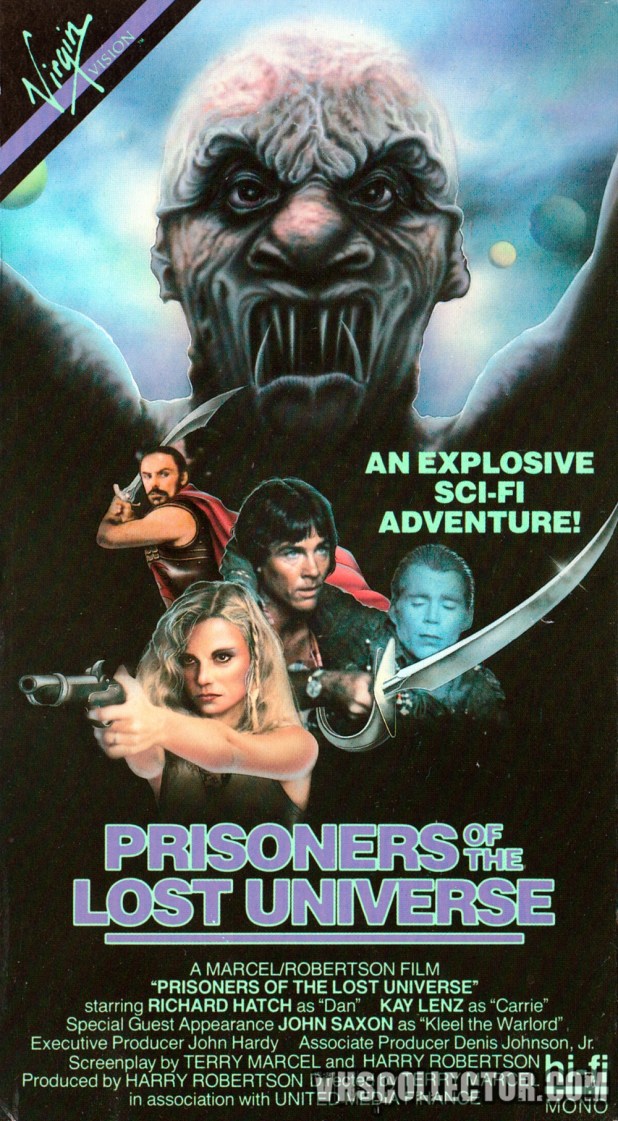
TV reporter Carrie Madison (Kay Lenz, The Initiation of Sarah, House) is trying to meet with mad scientist Dr. Hartmann when she literally runs into Dan Roebuck’s (Richard Hatch, TV’s Battlestar Galactica) truck. Once they find the scientist, his machine causes them all to disappear to the parallel world of Vonya, which is populated by cavemen and the warlord Kleel (John Saxon, of course) who has plenty of Earth technology.

Director Terry Marcel also was behind the films Hawk the Slayer and Jane and the Lost City, so obviously sword, sorcery and science fiction was his bread and butter. Too bad that his bread and butter tastes so bad.

If you want to see John Saxon out act everyone around him — sadly I wish this were higher praise — and a ragtag group of aliens fight cavemen, I guess you should watch this. I can recommend several much better movies in this genre, though. That said, it’s free to watch on Tubi.

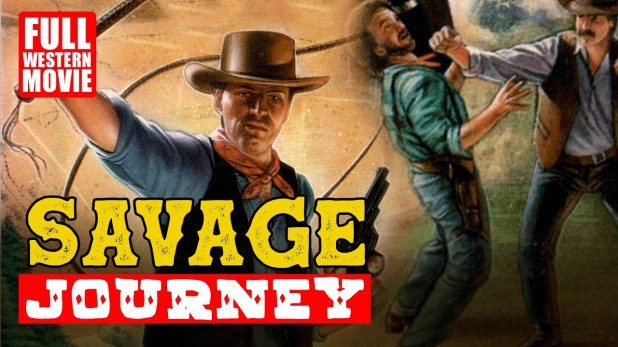
MILL CREEK DRIVE-IN MOVIE CLASSICS: Savage Journey (1983)

EDITOR’S NOTE: This Night Train to Terror connected movie was part of another Mill Creek set, The Excellent Eighties. We reviewed this on February 27, 2021 but why not read it again?

This movie made this entire month worth it.

That’s because it unlocks another part of the saga that is my fascination with the utterly strange and mysterious Night Train to Terror, a movie that I have written about more than once.

While this movie is listed on IMDB as a 1983 made for TV movie, the truth is that this movie was originally released six years earlier as Brigham. I love this comment on the movie from Mormon Literature and Creative Arts, which stated that the film came about as David Yeaman wanted to “create a film billed as authentic and sympathetic to the LDS view. Top Hollywood brass was involved, primarily Oscar-winning screenwriter Philip Yordan, and the LDS public grew excited to finally see themselves depicted accurately on screen.”

Oh man. Let’s take a break from this quote just to remind everyone who Phillip Yordan was. In The Phillip Yordan Story, a Hollywood urban legend is just part of his legend. It was claimed that Yordan hired someone else to go through law school for him so that he could get a degree without doing the work.

While Yordan is the listed writer on nearly a hundred movies, including DillingerDetective Story and Broken Lance*, the jury is out on what films he actually wrote. Some believe that many of the movies he wrote were actually a front for blacklisted writers, who still wanted to make films, giving Yordan all the credit and half the paycheck.

In the late 1950s, Yordan finally got caught. He mixed up two scripts, delivering a Fox script to Warner Brothers and vice versa. Seeing as how he was under contract at Fox, Darryl F. Zanuck threatened to get him blackballed at all the major studios. A few years later, his secretary would claim that she was the real writer of The Rise and Fall of Legs Diamond and things got so bad that Columbia demanded that he have an office on their lot where they could watch him write, guaranteeing that he was the author. Despite this new contract, he was still hustling scripts at other studios and was fired and forced to return his paycheck. This time, he really was told you’ll never eat lunch in this town again.

Yordan then showed up in Spain, working for Samuel L. Bronston, using folks like Ray Bradbury, Ben Barzman Arnaud D’Usseau, Julian Halevy and Bernard Gordon, who really wrote The Day of the Triffids, not Yordan.

By the mid 60s, he was back in Hollywood, a survivor of everything from being blackballed to going bankrupt, working as a script doctor on movies like Horror Express — also a horror movie set on a train — and Psychomania.

At the end of his life, he worked as an adjunct screenwriting instructor at San Diego State University and was writing scripts for movies like The UnholyMarilyn Alive and Behind Bars (which is also part of Night Train to Terror), Cataclysm (ditto), Cry Wilderness and this movie.

Back to our friends at Mormon Literature and Creative Arts, who wrote that “Unfortunatley, when released, Brigham proved a critical fiasco. It was criticized for poor acting, incomprehensible chronology, sensationalized violence, incredibly poor casting, lack of dramatic focus, and even for recycling wagon train footage from earlier films like Brigham Young itself. The film was quickly withdrawn, reedited, and re-released early the following, billed as The New Brigham. Similar attempts at repackaging continued as it was apparently again revamped and christened Savage Journey a few years later (perhaps to parallel the 1983 handcart film Perilous Journey). Despite this, Brigham remained a critical flop, and modern Mormons, if they remember it all, do so with humor or derision.”

Yes, this was a movie that Yordan made specifically for the Mormon Chuch and along the way, he brought director Tom McGowan, who — yes, you got it — also directed Cataclysm, and Richard Moll, who would star in that film and Marilyn Behind Bars. Seeing as how both movies are segments in Night Train, it gets really disconcerting watching Moll have hair, not have hair and be played by a double with astoundingly hairy arms.

Other actors who appear in both films include Maurice Grandmaison, who plays Brigham Young himself and Papini, the homeless Catholic priest who attempts to help the heroine Claire Hansen; Stephen Cracroft, Phineas in this one and a first AD on Night Train; Lou Edwards, Brother Becker in Mormon times and a production manager on Night Train; Faith Clift, who was Claire Rudley in this movie and appears as Claire Hansen in Night Train (she was also Yordan’s wife, showing up in his movies Captain ApacheHorror Express and Cry Wilderness); an uncredited Marc Lawrence (yes, the very same man who made Pigs and appears in Night Train as Abraham Weiss) and most importantly, Yordan’s son Byron, who is the song and dance man doomed to die on Satan’s Cannonball, but not before he sings “dance with me, dance with me” more times than you can count.

I’m astounded that this film exists. Actually, I’m so into the fact that Yordan did, a flimflam man who claimed to have never read a newspaper before the age of fifty, yet somehow was a lawyer who became an Oscar-winning writer, a producer and the connection between so many movies that are just plain strange.

So how’s the movie?

Moll, who used the named Charles Moll for this film, sums up Savage Journey best in the movie The Work and the Story, saying “All independent films suck, all Mormon films suck, and, ergo, an independent Mormon film must royally suck.”

*A movie he won an Best Original Story Oscar for, despite it being a remake of 1949’s House of Strangers and the fact that he probably didn’t write a single word of the actual script.

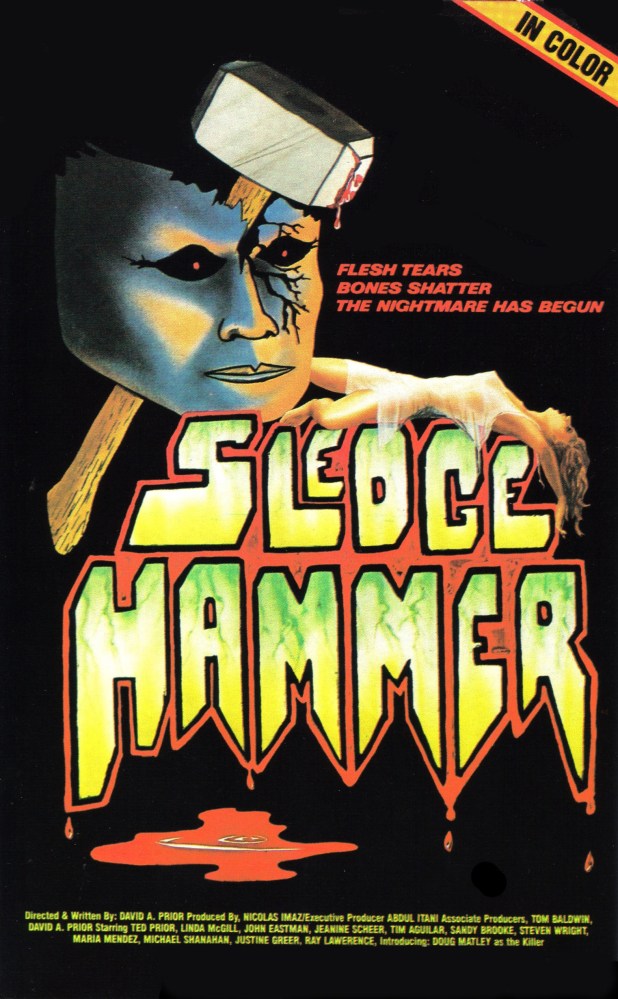
SLASHER MONTH: Sledgehammer (1983)

You know, David A. Prior has beaten me so many times, I wonder why I even come back. I just know I’m going to get hurt again and just look at the art for this movie, the worst video box I’ve ever seen, a cover so poor that it’s stopped me from watching this numerous times.

Yet here I am.

So ten years or so ago, this little kid got locked in the closet while his mom and her lover planned to run away but then someone came in and sledgehammered them both, which seems to be a very crossfit way to kill someone.

So yeah, a seance by a bunch of horny kids brings the little boy back in the form of an enormous man with a clear mask that can somehow only be defeated by its own sledgehammer, which feels incredibly stupid.

But you know, at some point, all the bad acting and thirtysomething teenagers and food fights give way to mind-numbing murders and that’s what I’m here for, the catharsis that for some reason comes from movies shot in the woods outside a suburban development or, in this movie’s example, the director’s apartment. Everybody came to have fun and make something bloody and they ended up getting this onto the shelves of video stores across the country and that makes me happier than I can explain to you.

Man, if you love slow motion, let me tell you, they made this movie for you.

2021 Scarecrow Psychotronic Challenge Day 9: Ogroff (1983)

9. SYMPATHY FOR THE DEVIL: One with a misunderstood freak/mutant/abomination etc.

Written, directed by and starring Norbert Moutier (as N. G. Mount), a man who loved horror, Ogroff somehow has Jess Franco-star Howard Vernon show up in it. That’s some feat, as this is as grimy and low end as a shot on video French slasher gets.

I mean, how great is it that Moutier owned a video store and published zines and was like, “I’m going to make something for people to rent from my store.” That means that for half the movie, Ogroff has a metal mask, rubber boots and a jaunty cap. And when you’re not admiring that outfit, you’re just watching him kill. And kill. And kill again.

After he battles a lumberjack with a chainsaw, he falls for a girl and the zombies that live under Ogroff’s house to emerge and Vernon to show up as a vampire priest who wants the girl for his own. Look, Orgoff isn’t going back to onanistic pleasure after getting to make sweet love.

But these are just words and the truth is describing what this movie feels like is like explaining what the color brown looks like to a blind man. It kind of washes over you in its drone haze and creates the perfect mood. Now, that mood comes at the price of watching someone’s legs get chainsawed off, but there must be sacrifices.

The best art has no idea that it is art.


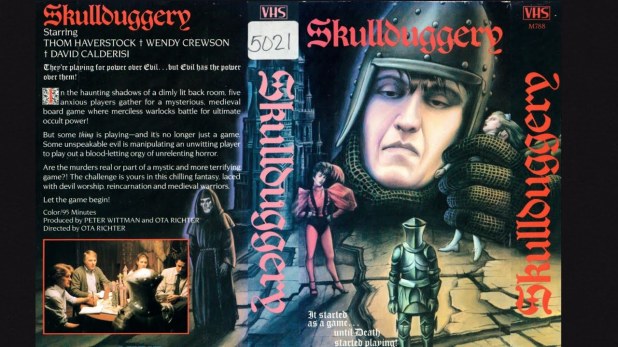
SLASHER MONTH: Skullduggery (1983)

Coming at the center of the Venn diagram for the slasher boom and the Satanic Panic*, Skullduggery is straight out of Canada and straight up nuts and I wonder, why is no one going crazy about this movie?

Oh yeah — it’s also about community college theater.

There’s a group of D&D players who all work together at a costume store, which is kind of the life I wanted to live in 1983. The newcomer, Adam, comes from a long line of warlocks who have been cursed by Satan, a fact that a magician reminds him of this very fact while he’s working at the theater, sending him on a bloody spree of mayhem.

His first kill is very Bloodsucking Freaks, as he watches a girl in a talent show and imagines a snake is killing her. She dies exactly like he imagined but no one sees it happen. There’s also a baffling scene where Adam chases a girl with a sickle while a man in a red sequined Liberace-style suit tickles the ivories in a graveyard. And a kill where Adam is inside a bunny suit.

Satan has commanded Adam to kill everyone else in the group, but when he’s cornered by the cops at a costume party hosted by a man named Dr. Evil, he disappears and leaves only a puppet behind. This should freak out the group and put a stop to their antics, but they decide to keep playing and have a suit of armor in Adam’s chair. Smart move — the suit comes to life and kills the Dungeon Master, revealing that it’s Dr. Evil — who is really Satan — inside the suit.

There’s also a lot of Adam and Eve symbolism throughout as well as an opening that takes place in the Dark Ages and the same stupid energy as Night Train to Terror and that’s the kind of drug we look for around these parts.  Every single person in this movie is a maniac and I love them all. It has more magic tricks than Terror Train! There’s even a disco theme song!

Director Ota Richter only made one other movie, Oklahoma Smugglers, a film about a bodyguard school and destroying a casino. Producer and writer Peter Wittman was also the director of two other equally ridiculous films, Ellie and Play Dead, the second Yvonne De Carlo movie where she can command dogs**.

You can watch this on Tubi.

*It was originally made in 1979, so it was in the slasher boom and ahead of the Satanic Panic, but got released in 1983. It also has Wendy Crewson, who is in the best-known D&D warning movie of all time, Mazes & Monsters.

**The other is Satan’s Cheerleaders.

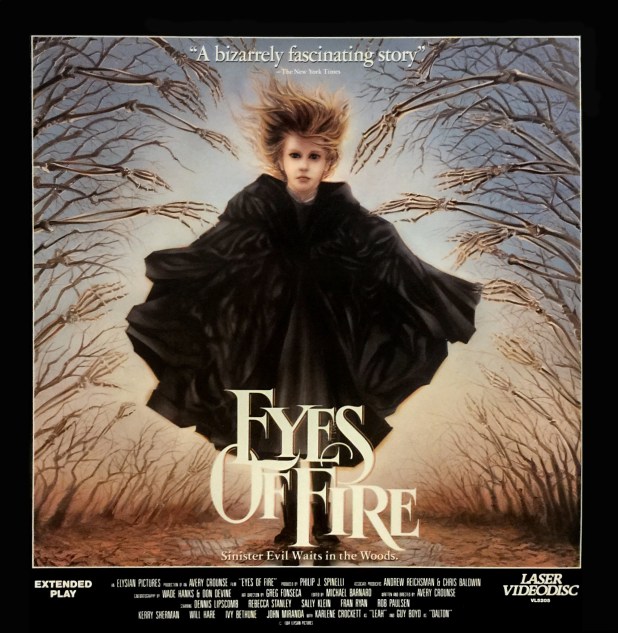
FANTASTIC FEST: Eyes of Fire (1983)

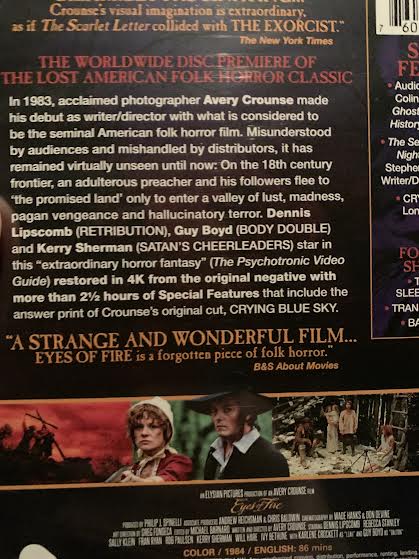
EDITOR’S NOTE: We originally covered this film on January 26, 2020 and returned for another look later that day. It’s been a film never released on DVD and a much sought-after release, but with the release of the documentary Woodlands Dark and Days Bewitched: A History of Folk Horror, Severin has put together a new 4K release of this seminal American folk horror release. It’s about time!

We’re also really excited that a movie we love so much has our review on the back cover!

Sam’s take:

Released by Vestron Video in 1987, this forgotten folk horror—also known as Cry Blue Sky—is very similar to The Witch, minus any arthouse aspirations. Instead of a man whose pride casts his family out of their village, this movie is about a reverend accused of adultery and polygamy.

Reverend Will Smythe (Dennis Lipscomb, Under Siege) and his followers leave their town behind to live in a valley haunted by an ancient evil. A rugged woodsman, Marion Dalton (Guy Boyd, Body Double), is along for the ride because he has his eye on Smythe’s lusty wife, Eloise. Hijinks, as they say, ensue. And by hijinks, I mean whatever is in the woods begins to haunt and kill everyone.

Rob Paulsen, who plays Jewell Buchanan, would become a voice actor. Perhaps you’ve heard him as Raphael and Donatello, two of the Teenage Mutant Ninja Turtles, or Pinky from Pinky and the Brain. He’s also in the movies Stewardess SchoolWarlock and Body Double. He’s also the voice that says, “Cheers was filmed in front of a live audience.” In all, he’s been in 1,000+ commercials and been the voice of 250+ cartoon characters.

Director Avery Crounse started his career as a photographer and only made two other films: The Invisible Kid and Sister Island, which starred Karen Black.

R.D’s take:

Okay, so this is more demons than Satan. Well, it’s actually evil Native American spirits, but it’s a rare obscurity and that’s what B&S About Movies is all about.

Shot outside of St. Louis, Missouri, for under $3 million and theatrically known as (I think, the better titled) Cry Blue Sky, it was poorly edited, chopped down from its original 108-minute running time to 86-minutes and retitled for its home video and pay cable version (it ran on HBO).

To sum up the plot: If Eyes of Fire were made today, it would be known as Cowboys vs. Demons and programmed alongside the Aslyum-styled mockbuster “Cowboy vs.” knockoffs Cowboys Vs. Vampires (2010; aka Dead West) and Cowboys vs. Zombies (2014).

Oh, but this film is so much better than those films.

I was actually inspired to give Eyes of Fire, the directing debut by Avery Crounse, another watch after picking up (from the public library on a whim) a copy of the supernatural period horror film, The VVitch (2015), the commendable directorial debut of Robert Eggers.

Eyes of Fire tells the story of a wicked, polygamist preacher (is there any other kind) who runs the old west (circa 1750) town of Dalton’s Ferry. When the Reverend Will Smythe (Dennis Lipscomb) is called out for his adultery among his parishioners, he and his flock are subsequently banished. Of course, God tells the Reverend to make a new life in a valley foretold in Indian legends as the “Forest of Darkness,” a wooded area with souls trapped inside trees and running amok with “mud people.”

Before you know it, all hell breaks loose in the Promised Land, Blair Witch-style, as the settlers can’t seem to find their way out of the forest and they’re picked off one by one. It’s up to a rugged frontiersman, Marion Dalton (Guy Boyd), and a crazy, woods-dwelling witch who proclaims herself the “Queen of the Forest” (Karlene Crockett) to battle the marauding Indian spirits.

While Eyes of Fire is low-budget and under the radar, there’s no denying that it’s well made and features great cinematography, costuming and special effects (the tree-trapped spirits are excellent), along with solid acting from the cast of unknowns. Granted, some quarters may say it’s slow: if you watch the home video cut instead of the theatrical cut, it is a bit choppy and doesn’t make a whole lot of sense in places (it loses 22 minutes between its different cuts), but that only lends to its Phantasm-like foreboding. It’s certainly more entertaining than other films of its ilk*, such as Aramand Mastronianni’s (He Knows You’re Alone, Cameron’s Closet) The Supernaturals, which I remember as being very boring—and I ejected it from the VCR less than half way through, never to watch again.

It’s unfortunate that Crounse disappeared from the industry (maybe he went into commercial work?) after two more films: The Invisible Kid (1988) and Sister Island (1993), as he showed a lot of promise. I vaguely remember the former as a theatrical with Jay Underwood, who was “hot” at the time. I never heard of the latter—one of the many low-budget romps from the extensive resume of Karen Black (Burnt Offerings).

There are lots of familiar TV faces afoot: Guy Boyd (pick a late ‘70s/early ‘80s TV series) was a semi-regular on Remington Steele, a co-star on 2000’s Black Scorpion, and was in Brian DePalma’s Body Double—and he’s still active today. You can play “pick a TV show” with the late Dennis Lipscomb as well, with his starring roles in Cop Rock and Wiseguy, while Karlene Crockett was a regular on Quincy M.E and Dallas. Eyes of Fire was the only feature film appearance by Rob Paulsen, as he reverted into voice work and became Pinky from Pinky and the Brain (1995) and Yakko from Animanicas (1993). Keen eyes will pick up on Kerry Sherman, who made her debut in Greydon Clark’s Satan’s Cheerleaders (1977), and Fran Ryan, who’s been in everything from TV’s Gunsmoke to Bill Murray’s Stripes(1983).

* Night of Horror (1981) with more Confederate Civil War ghosts (one of those “the cover is better than the movie” flicks and a VHS-eject), Ghost Riders (1987) with western ghosts deep in the heart of Texas (well made, but boring; a VHS eject), and Stones of Death (1988) with aborigine ghosts (Aussie Indians) going “Poltergeist” (better made, but ho-hum familiar). Honorable mention: William Grefe’s (Mako: Jaws of Death) awful but fun drive-in nostalgia romp Death Curse of Tartu (1966) with its burial ground Indians.

G.B.H (1983) and G.B.H 2: Lethal Impact (1991)

“Bleeding women. No wonder there are so many queers.”
— Steve “the Mancunian” Donovan

I’ll forever program this British-made ’80s SOV’er (titled with and without the periods) alongside the American-made Spine as result their analogous porn roots. It’s even possible that the porn-backed production of G.B.H influenced the later, 1984-begun and 1986-released production of Spine. Produced, written, and directed by John Howard and Justin Simonds, the horror/slasher-based Spine came together with financing from porn purveyors 4-Play Video, Inc. and producers Xeon, Ltd., who created the SS “Sterling Silver” Video imprint for the sole purpose of distributing Spine — and other planned horror flicks that were, sadly, never made — without the nasty porn aftertaste.

Ah, the ol’ big-box, paper-thin sleeve slid under the ol’ plastic cover. Sweet VHS delights.

Meanwhile, over in England, pornographer David Grant jumped on the stag film bandwagon along the yellow brick road to the “Golden Age of Porn” halcyon days initiated by Gerard Damiano’s box office bonanza known as Deep Throat (1972). Grant’s first film — Love Variations (1969) — masqueraded as a “sex education” film. So successful, Grant’s first film lead to his porn-pire expanding to include the incorporation of a chain of adult cinemas — the first being The Pigalle (named after the rue Pigalle section of Paris where Oscar Méténier’s famed horror-based Grand Guignol theatre was located) — and a film distribution company, Oppidan (read: Oedipus complex) — to distribute, not only foreign sex film acquisitions, but his own feature-length “sex comedies,” such as Girls Come First, The Office Party, and Under the Bed. He rose through the Golden Age-ranks to rake in the green with Snow White and the Seven Perverts (1973) and Pussy Talk (1975). Using a British taxation loophole, his films became wildly known for their inclusion as the undercard on numerous drive-in and grindhouse theater double bills. He also came to distribute the films of others — and break box office records — such as his 1977 reissue of Emmanuelle (1974).

Then the home video market exploded and grinded the grindhouse circuit into dust: it was time to break into the VHS-based marketplace. His new company, World Video 2000, started with the production and distribution of “soft sex” films in 1981. And it was a racket, to say the least. You may recall our Mill Creek “Pure Terror” box set review of Night Fright (1967) and its later home video title of E.T.N – The Extra Terrestrial Nastie (1983). Well, that’s was all Grant’s idea — to capitalize on the fact that Steven Spielberg’s E.T the Extra Terrestrial had not yet been released in the U.K. on home video.

As we say here often at B&S About Movies: the lawsuits from Universal, ensued.

Marketing: David Grant style.

Then — prior to GBH earning an entry on the U.K.’s Section 3 “video nasty” list, Grant’s World Video 2000 ended up on the Section 1 list with their “mainstream” follow up to their Spielberg boondoggle, Nightmares in a Damaged Brain, aka Nightmare. Again, more legal troubles, ensued (insert your “eye roll,” here). Only, this time, instead of just a pesky ol’ cease and desist lawsuit, he was imprisoned in the U.K. for distributing the film.

And, with that, Grant’s attempts to “go legit/mainstream” with the World of Video 2000 imprint was over: the company — and his parent company, April Electronics — were liquidated. Upon his release and those legal issues resolved, Grant issued one more film: Who Bears Sins (1987), which, if you know your Al Adamson schlock, was a piecemeal effort made from clips of Grant’s previous productions: Girls Come First, You’re Driving Me Crazy, Pink Orgasm, Miss Deep Fantasy, and A Woman’s Best Friend. Some of his other, 24 box office hits — which he either produced, wrote, or directed during the ’70s “porn chic” era — were the notable Au Pair Girls (1972), Secrets of a Door-to-Door Salesman (1973), The Over-Amorous Artist (1974), and The Great McGonagall (1974). Grant’s 50-plus distributed titles — in addition to the usual porn titles — included legit-mainstream films you’ve seen: Last House on the Left (1974), Ilsa, She Wolf of the SS (1975), Cathy’s Curse (1977), John Water’s Desperate Living (1977), John Carpenter and Dan O’Bannon’s Dark Star (1978), and the Peter Cushing-starring Nazi-Zom’er, Shock Waves (1978).

Retiring to the Turkish island of Cyprus — then being kicked out of that country for an array of alleged, questionable social and relationship issues — he returned to England, only to end up in a hot mess of (more) love triangles and violence, (unproven) drug-distribution accusations, as well as being suspected of — but never charged — with producing child pornography. So the fact that Grant was allegedly murdered — but never proven — as result of a “contract killing” in 1991, really doesn’t come as much of a shock.

If there was ever a life that deserves a hard cover biography or dramatic film, it’s the life of David Grant. (And yes, I have seen most of Grant’s notable adult titles listed this article. (More so than Twemlow’s!) That doesn’t make me weird. It just means I am SOV-VHS inquisitive.)

So, anyway . . . back to GBH . . . one and two.

At least there’s a bio on Cliff’s works. It’s a great read . . . and out of print and harder to find than his movies.

“When they put teeth in your mouth they ruined a good arse.”
— Steve “the Mancunian” Donovan

The Reviews

So, you’ll notice Grant took it upon himself to name-drop The Long Good Friday, a critically acclaimed 1980 British gangster film starring Bob Hoskins and Helen Mirren that appears at #19 on the BFI – British Film Institute’s “Top 100 British Films.”

Grant — no pun intended — had a set of them, and then some.

Shot-on-Video with amateur actors — and like Spine before it — GBH is shaky across all of its respective disciplines as it tells its definitely, more brutal story than its mainstream, runyonesque inspiration (but fails). The man issuing the Jason Vorhees-without-the-mask grievous bodily arm is Steve Donovan, aka “The Mancunian” (a native or resident of Manchester/played by writer/director Cliff Twemlow): a gangster released from prison hired as a bouncer-body guard to stand down the brutal Keller (Jerry Harris), nightclub-owning mobster hellbent on controlling the city’s criminal enterprises — local gangster Murray in particular, who becomes Donovan’s new boss.

GBH is everything you expect in an SOV: it’s scuzzy, it’s brutal, it’s sexually gratuitous and stupidly lurid. After watching, you’ll know where Jim Van Bebber found his inspiration for this Death Wish-inspired street violence in his overly brutal SOV’er, Deadbeat at Dawn (1988). Van Bebber’s film may be — slightly — better made, but GBH, for moi, is still the more gritty, brutal of the pair. And it has all of the car chases and beat downs, and heartless brutal kills, white Bond-ish sportcoats splattered in blood, and strippers. And Donovan, like a low-budget Schwarzenegger, simply will not stop until no one is left standing.

Played by Cliff Twemlow — in the only notable film of his eleven-film acting career — he wrote eight films, including GBH (which is co-directed with David Kent-Watson). Known primarily as a music composer, his mostly notable film scores are Deathdream (1974) and Dawn of the Dead (1978), along with the long-running British TV series, Crown Court. His other, hard-to-find written/directed films (with David Kent-Watson) are his debut, Tuxedo Warrior (1982), The Ibiza Connection (1984), Predator: The Queitus (1988), Firestar (1991), and The Eye of Satan (1992). If you Google around, you’ll find uploaded clips and beat-to-hell VHS tapes for most of them (I’ve seen Firestar and Eye of Satan, but not the others).

“The booze tastes almost as bad as you look, Keller.”
— Steve “the Mancunian” Donovan

The elusive sequel.

In 1991 Cliff Twemlow and Jerry Harris returned as Donovan and Keller in a sequel: Lethal Impact, aka GBH 2: Lethal Impact, aka GBH 2: Beyond Vengeance, which was also written and directed by Twemlow. Sadly, Lethal Impact, as did the rest of his SOV resume of action and horror films, did not live up to the infamy of the original. But Lethal Impact is even more of everything than the first film, with Donovan cutting a swath across Manchester as a low-budget Paul Kersey to avenge the forced-into-porn death of his schoolgirl niece.

Courtesy of You Tube uploader VoicesInMyHead (Wow, what a page!), you can watch GBH and GBH 2: Lethal Impact in all their static-shimmering and low-rez hummin’ glory. And we found the trailers for GBH and GBH 2.

About the Author: You can learn more about the writings of R.D Francis on Facebook. He also writes for B&S About Movies.

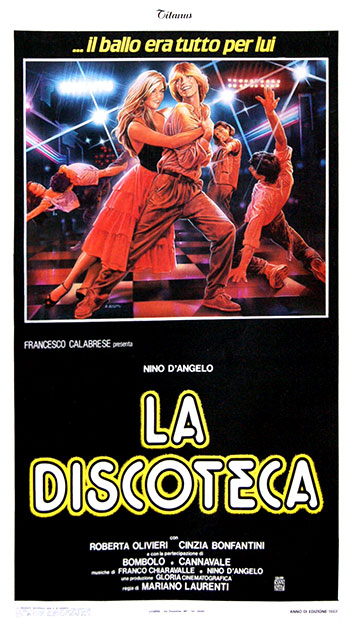
La Discoteca (1983)

Yes, this movie came out six years after Saturday Night Fever. Well, you know, disco didn’t die everywhere. It only died in the places where straight white people thought it was.

Also: Yes, I totally watched this because the poster is amazing.

Mariano Laurenti also directed The Inconsolable Widow Thanks All Those Who Consoled Her, a movie that I’ve told is such an ineffectual commedia sexy all’italiana that even the goddess Edwige cannot save it. He also made another Fenech film, Beautiful Antonia, First a Nun Then a Demon, which is the kind of title that makes me hunt down a movie.

This was written by Piero Regnoli, who is not made for normal films and is much better suited to scripted aberrant madness like Maciste in King Solomon’s Mines — how did Cannon not remake this genre mashup? — as well as Cry of a ProstituteA Black Ribbon for Deborah (with Gig Young, Bradford Dillman and Marina Malfatti trying to look like she’s been reading All of Them Witches), Like Rabid DogsPatrick Still LivesNightmare City and Gunan, King of the Barbarians. All of these movies would be better choices for you or you could just stare at this poster and listen to some Chic or Giorgio Moroder and have a much better evening.

If you liked Laurenti’s Un jeans e una maglietta but wanted it to be a disco movie with someone who looks like a German leader of ill standing running a hotel, well, this is for you. I mean, the dude’s name is Ghitler. That’s an example of the level of hilarity we’re dealing with here.

Nino D’Angelo, who stars in this, also sang a few songs, including one called “My Song.” He’s also obviously dance doubled by someone much shorter than he is. I mean, he needed extra money so he went to the Swiss Alps to make pizza and gets mad when people call him pizza. He is certainly not setting the floor of 2001 Odyssey ablaze any time soon.

Laurenti and D’Angelo also teamed for Uno scugnizzo a New YorkPop corn and chipsFotoromanzo and Attenti a noi due. Now that I have written this sentence, my need to complete things means that I must now endure all of these.

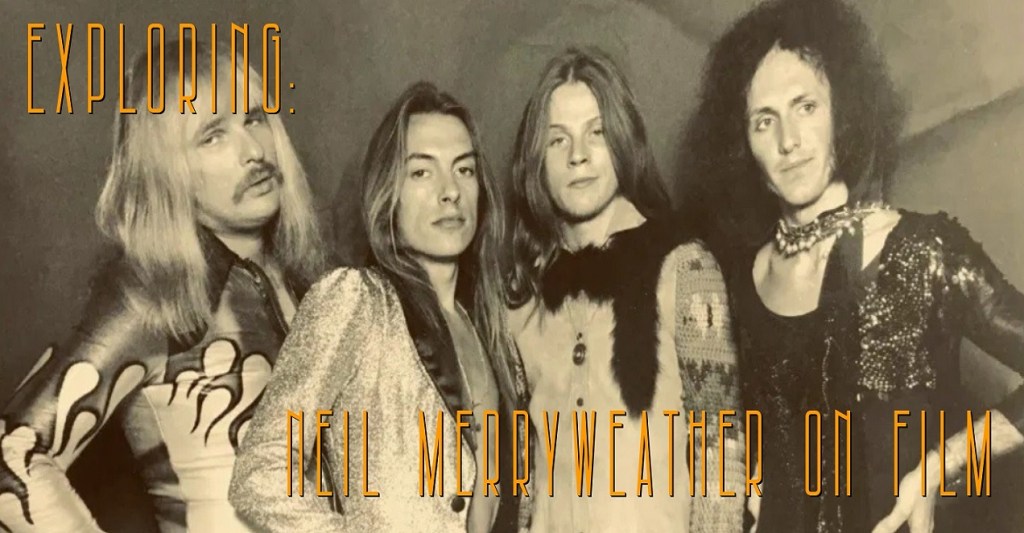
Exploring: Neil Merryweather on Film

Neil Merryweather, left, James Newton Howard, right, with the Space Rangers/Neil Merryweather Facebook.

Canadian rock singer, bass player and songwriter Neil Merryweather, born on December 27, 1945, recorded and performed with musicians including Steve Miller, Dave Mason, Lita Ford, Billy Joel, and Rick James.

He passed away on March 29, 2021, in Las Vegas, Nevada, after a short battle with cancer.


Neil Merryweather, influenced by David Bowie with his Ziggy Stardust and the Spiders from Mars project, achieved his low-selling, yet critically acclaimed creative peak of seventies excess with two heavy-psych space-rock albums from his Space Rangers project, released in 1974 and 1975.

Devotees of early-seventies glam-rock and proto-metal obscurities may note the similarities in artwork and sound on the Space Rangers to that of the later, John Entwistle-fronted rock opera of the Flash Fearless vs. the Zorg Women (October 1975) project featuring Detroiter Alice Cooper; the album itself inspired by Bowie’s Ziggy persona.

A Canadian singer and bassist, Neil Merryweather got his professional start with the Just Us, which released 1965’s “I Don’t Love You b/w I Can Tell” on Quality Records (the label had a major Canadian and U.S. chart hit with “Shakin’ All Over” from the Guess Who). Merryweather eventually joined Rick James (later known for his 1981 disco-funk smash, “Superfreak”) in the Mynah Birds (which featured Neil Young and Bruce Palmer, who had already left for Buffalo Springfield) and recorded the August 1967 single, “It’s My Time,” at Detroit’s Motown Studios. Upon the departure of Rick James, Merryweather kept the Mynah Birds active with fellow Canadian Bruce Cockburn (later known to U.S. radio and video audiences for the singles “Wondering Where the Lions Are” from 1980 and 1984’s “If I Had a Rocket Launcher”; Neil and Cockburn also played together in Flying Circus).

Neil’s bandmate in Mama Lion — and its harder-edge version, known as Heavy Cruiser, sans Lynn Carey — keyboardist James Newton Howard, became a go-to Hollywood soundtrack producer. You’re heard his work since the early ’80s — most notably with Wyatt Earp, Batman Begins, The Dark Knight, I Am Legend, and Red Sparrow.

Merryweather then established Mama Lion with lead vocalist Lynn Carey and signed with Ripp’s Family Productions (also the home to Billy Joel). After issuing two Janis Joplin-inspired, psychedelic-blues n’ soul efforts with Preserve Wildlife and Give It Everything I’ve Got (both 1972), Mama Lion — sans Carey — became the harder, blues-rocking Heavy Cruiser. Their critically acclaimed, two album stint with Heavy Cruiser and Lucky Dog (1972) attracted the attention of a more industry-reputable managerial suitor, Shep Gordon (he also attempted to sign Iggy Pop; he lost to Danny Sugerman). Gordon wanted to sign and book Heavy Cruiser as Alice Cooper’s opening act. Sadly, Artie Ripp and Shep Gordon didn’t get along, and the Gordon-Cooper deal soured. Along the way, Merryweather was offered — and turned down — the bassist spot in Crosby, Stills, Nash & Young.

After assisting Billy Joel in the studio on an early demo of “Piano Man,” which led to Joel signing with Columbia Records, Merryweather devised the glam-inspired, proto-metal Space Rangers project around the then high-tech Chamberlin keyboard, also electronically augmenting the band with a then-groundbreaking use of Octivators and Echoplexes. Initially recording with Capitol, Merryweather issued Space Rangers (1974), then Kryptonite (1975), on Mercury.

Billy Joel, with Neil Merryweather and Heavy Cruiser (Rhys Clark and Alan Hurtz) jamming on “Heart of Gold.”

After losing Iggy Pop and Merryweather, Gordon signed Detroit guitarist Dick Wagner, formerly of the Frost, with his new endeavor, Ursa Major, which featured Billy Joel in its embryonic stages.

Ursa Major became Cooper’s opening act and Wagner wrote “Only Women Bleed.”

Tim McGovern, the drummer in Mama Lion and the Space Rangers, would find success as a guitarist. Starting with the L.A new-wave band the Pop, and then with the Motels, McGovern found MTV success with “Belly of the Whale,” as the frontman for the Burning Sensations. They placed their cover of Jonathan Richman and the Modern Lovers’ “Pablo Picasso” on the punk-influenced soundtrack for 1984’s Repo Man.

Merryweather, sensing the changing times, adopted a pop-rock, new-wave sound with Eyes, a Holland-based band featuring ex-members of the Nina Hagen Band* and Herman Brood’s Wild Romance*, which released Radical Genes on RCA Records. However, Merryweather returned to his heavy-metal roots — inventively streamlining and glamming the “old sound” for a wider, commercial appeal — as the manager, bassist, and chief songwriter for the solo career of ex-Runaway Lita Ford on her progenitive hair-metal debut, Out for Blood.

Leaving the industry after the Ford project, but not leaving his creative side behind, Merryweather forged a career as an award-winning painter, sculpture, and photographer and worked in the creative department for the City of Los Angeles Department of Public Works. As the calendar flipped to the 21st century, Merryweather returned to the music business, composing music for teen-oriented television shows and, with ex-Space Rangers Mike Willis and Jamie Herndon, made plans to enter the studio for a new, third Space Rangers album. His other music projects — formed with ex-Space Ranger Jamie Herndon and ex-Lita Ford drummer Dusty Watson were known as Hundred Watt Head and The La La Land Blues Band.

His last project, prior to his passing, was a third album with Janne Stark, formerly the guitarist with Swedish New Wave of British Heavy Metal upstarts Overdrive, which released the classic hard rock albums Metal Attack (1983) and Swords And Axes (1984). You can learn more about the Merryweather Stark band — and their albums Carved in Rock (2018) and Rock Solid (2020) — at their official Facebook page. You may leave condolences at Neil Merryweather’s personal Facebook page, which will continued to be managed by his survivors.

Neill completing one of his many artworks/courtesy of Neil Merryweather Facebook.

And, with that, let’s roll the films — and TV series — of Neil Merryweather!


The Seven Minutes (1971)

Leave it to Russ Meyer — of Beyond the Valley of the Dolls fame — to be the only filmmaker to realize the soundtrack potential of the musical scope that is Neil Merryweather. And the potential behind the well-researched, sexually-charged novels of screenwriter Irving Wallace (his early ’60s books, published by Simon & Schuster — The Chapman Report, The Prize, The Man, and 1976’s The R Document — were all adapted, as was The Seven Minutes, by others).

While Russ Meyer’s name immediately says “sex,” the film carries a deeper meaning on the effects of pornography and its relationship to issues regarding freedom of speech: it’s also a meta-movie: about a book, The Seven Minutes, purported as the “most obscene piece of pornography ever written.” A district attorney on the political fast track for a senatorial seat uses the book’s erotic infamy to indict a college student for a brutal rape and murder, as well as the book store owner who sold the book to the student.

Typical of a Meyer film, while it lacks his usual “tits and ass” (demanded by the studio), the casting is B&S About Movies-crazed: In addition to Meyer’s wife and 20th Century Fox Studios’ contract player Edy Williams, the cast features Yvonne De Carlo, John Carradine (the last decent film he was in), the always-welcomed Charles Napier, a self-playing Wolfman Jack, and in another early role, Tom Selleck (Daughters of Satan).

As for Neil Merrryweather: “Midnight Tricks,” from his pre-Mama Lion joint album with Lynn Carey — Vacuum Cleaner (1971) by the concern Merryweather & Carey — appears in the film. (Neil’s works with Heavy Cruiser and Mama Lion were distributed by the Paramount Studios-imprint, Family Productions.)

The duo’s relationship with Meyer goes back to the smut-auteur recruiting Lynn Carey for the Stu Phillips-produced soundtrack to Beyond the Valley of the Dolls (Battlestar Galactica ’78 is one of his many); Lynn sings (“Find It” and “Once I Had You”) for that film’s character in the faux band, The Carrie Nations, along with Barbara “Sandi” Robison. While Lynn’s voice appears in the film, for legal reasons, she does not appear on the subsequent, original soundtrack album.

As a child actress, Lynn appeared in the ’60s series The Man from U.N.C.L.E and Lassie; in the early ’80s, she had a stint on the U.S. daytime drama, Days of Our Lives. She made her lone film appearances in Lord Love a Duck (1966; with Roddy McDowall) and How Sweet It Is! (1968; with James Gardner). Lynn’s attempt at moving into ’80s AOR (think ’80s glam-bent Heart) led to her songs appearing in I Married a Centerfold (1984), Challenge of a Lifetime (1985), Radioactive Dreams (1985) (“All Talk” appears in the film, but on the soundtrack), Hollywood Harry (1985), and Combat High (1986).

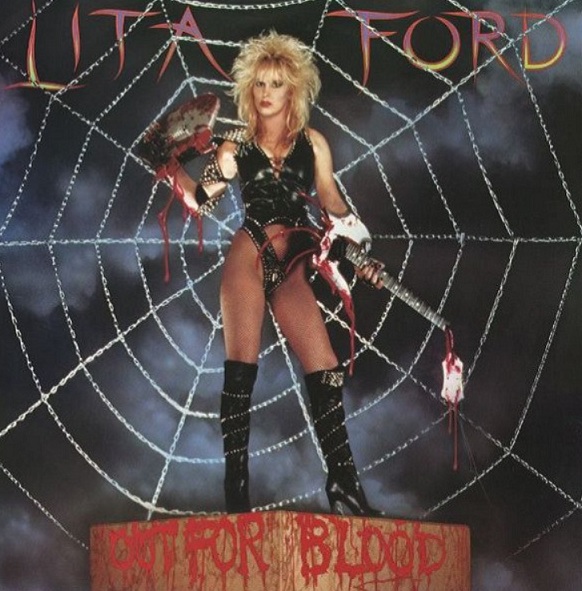
Lita Ford: Out for Blood (1983)

By the mid-70s, Neil resided in the Netherlands, where, through Chrysalis Records in London, he set up an imprint, Clear, in cooperation with the Dutch company, Dureco. While developing new acts out of Chrysalis’ studios in Miami and Los Angeles, he released his 12th album, his three-years later follow up to Kryponite (1975) by the Space Rangers, with the solo album, Differences (1978). He then formed the more timely, new-wave outfit Eyes, which released their lone album, Radical Genes.

Then, with new wave and punk on the downward stroke and glam metal on the rise: a new musical adventure called forth. . . .

You know the story: Lita Ford was a member of the Runaways (duBeat-e-o). Joan Jett was fed up with Cherrie Currie (The Rosebud Beach Hotel) as the frontwoman. Currie was tired of being pushed on back burner. Joan wanted to take the band in a punk vein (which she did: with members of the Clash and the Sex Pistols, which morphed into her solo debut, Bad Reputation). Lita wanted to take the band in a metal direction, which Joan hated.

So, Neil, as he did with Lynn Carey, first with the Vacuum Cleaner duo project, and their two albums with Mama Lion, found a new muse for his next musical direction: a creative detour that returned to his ’70s hard-rock roots first explored in the bands Heavy Cruiser and the Space Rangers.

As the mastermind behind a new, full-metal Lita, Neil served as her manager and producer (Billy Joel’s ex-Svengali, Artie Ripp, co-produced). In addition to playing bass — his career instrument of choice — Neil wrote four of the albums nine cuts: the album’s title cut song (posted above), “Ready, Willing and Able,” “Die for Me Only (Black Widow),” and “On the Run.” If you know Neil’s artistic side: he designed all of his own albums covers, costumes, and stage shows throughout his career: Out for Blood for blood was no exception: he constructed the chain-web, the cover, and the band’s outfits; he also designed the MTV video single.

Sadly, his partnership with Lita Ford was short-lived. The experience was such that Neil retired from the business to work as a graphic artist — his second biggest love — for government agencies in Los Angeles and Las Vegas. He went on to win numerous awards for his paintings and multi-media pieces.

Ash vs. Evil Dead (2016)

What can we say about this Equinox (1970) inspired franchise from Sam Raimi that hasn’t already been said? Well, we finally worked up the courage to say something about the film that started it all, Evil Dead (1981) — at least Sam “the Bossman” Pacino did — of the highly-influential “Midnight Movie” splatter fest.

As for the series, itself: we touched base with the Bruce Campbell-starring series as part of our “Lee Majors Week” tribute blowout — as Lee appeared as Brock Williams, Ash’s pop, in the second and third seasons of Starz’s Ash vs. Evil Dead.

As for the Neil Merryweather connection: “Star Rider,” from the Space Rangers’ 1975 second and final album, Kyrponite, appears in “Home”; the first episode of the series’ second season, it served as the introduction to Lee’s character.


So, wraps up our exploration of Neil’s all-too-brief connection to film.

This feature’s intro-obituary originally appeared in the Medium pages of R.D. Francis: “Neil Merryweather: Rock’s Rock ‘n’ Roll Space Ranger, Dies.” Portions also appeared in the article “Other Musical Phantoms: Neil Merryweather and Jim Gustafson. Who? (Then You Don’t Know William Kyle Eidson II or Lori Lieberman, Either).”

You can discover and listen to Neil’s catalog on his official You Tube page. There are also numerous uploads of his albums by his many, worldwide fans.


We previously explored the soundtrack work of the late Eddie Van Halen — as well as his lone acting gig — with our “Exploring: Eddie Van Halen” on Film” feature.

* We reviewed Nina Hagen and Herman Brood’s dual-acting roles in the film Cha-Cha (1979).

About the Author: You can learn more about the writings of R.D Francis on Facebook. He also writes for B&S About Movies and publish music reviews and short stories on Medium.