APRIL MOVIE THON DAY 22: Café Flesh (1982)

The story of X may have been three years early, but the video revolution — driven, as all technology is, by sex — changed the world of pornography, moving it from the fleshpots of 42nd Street and dirty book stores into suburban living rooms. In 1982, there was still the glimmer of hope that the Golden Age of Porn — that starts with Bill Osco’s Mona and ends sometime around 1984 or so with The Dark Brothers’ 1984 mind-twisting New Wave Hookers — would find new life, better budgets and a more appreciative audience.

Yet videotape would open up adult for everyone and by the 90s, few films had a storyline, instead given to gonzo explorations of “can you top this” madness with few exceptions, such as the output of John Stagliano (who may have popularized gonzo, but could also create a coherent and interesting narrative film like Buda), the glossy Michael Ninn glamour movies, Andrew Blake’s Night Trips, Phillip Mond’s Zazel, John Leslie’s Chameleons and Curse of the Cat Woman, the aforementioned Dark Brothers and ridiculous parodies of existing films.

Yet in 1982, a movie could be made that transcends its adult origins and uses them to make you as the viewer complicit in the action on screen.

Stephen Sayadian only made seven adult films (this film, as well as two sequels to Nightdreams, two Untamed Cowgirls of the Wild West and two Party Doll-a-Go-Go films which take the staccato editing and weird dialogue to its absurd limit on sets that had to cost absolutely nothing yet with a cast of all-stars such as Raven, Madison Stone, Patricia Kennedy, Bionca, Jeanna Fine, Nikki Wilde and Tianna Collins and yes, I wrote that from memory) as well as the somewhat spiritual sequel — or at least next steo — to this movie, the mainstream — yet still delightfully insane — Dr. Caligari. A veteran of advertising and design — he worked on the posters for The Fog, The Funhouse, Ms. 45 and Dressed To Kill which took inspiration from the iconic The Graduate poser — Sayadian used the alter ego of Rinse Dream to make his films, much as Gregory Dark would adopt a new name for his porn changing efforts.

The script — yes, adult movies can have a script — was written by Herbert W. Day, who is really Pittsburgh native Jerry Stahl, the son of a coal miner who later became Pennsylvania attorney general and a federal judge. He found that he had a talent for writing short stories, was the humor editor for Hustler and also discovered a love of hardcore drugs. To fuel that, he started writing for TV shows like MoonlightingTwin PeaksThirtysomethingNorthern Exposure and, perhaps most intriguingly, ALF. He’s also written ten episodes of CSI which have been the most aberrant examples of that show to middle America, which is wild as he introduced viewers of the grandparent network CBS to furries, infantilism, a measured story about transgendered people and introduced Lady Heather, the potential bad girl love interest of lead Gil Grissom, who was played by Return of the Living Dead III star Melinda Clarke. His autobiographical novel Permanent Midnight was a success and made into a movie starring Ben Stiller.

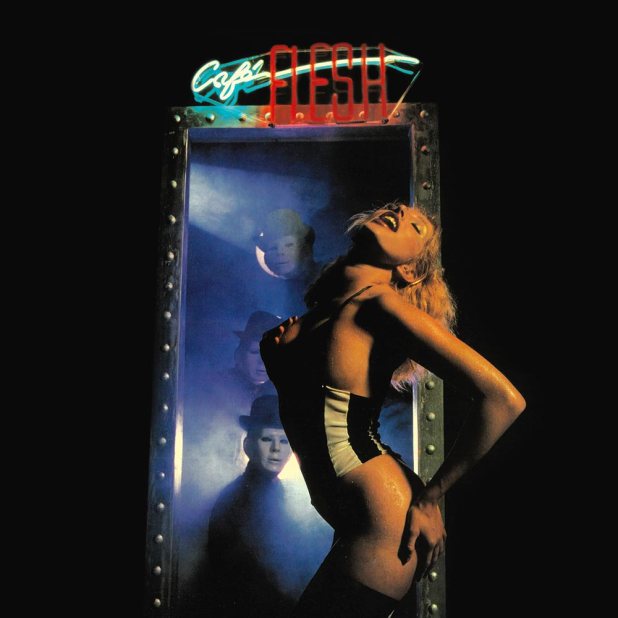
Years after a nuclear war, nearly every survivor is a Negative, often shambling zombie-like humans who become vomitous if they attempt to copulate. To attempt any hope at remembering what human contact was like, they come to Café Flesh, a place where Positives make love while they watch, often engaging in surrealist scenes that defy the ability of the viewer to become titillated.

That’s the point. Where the goal of nearly all pornography is to get the viewer off, Cafe Flésh casts you as a Negative, stuck at home with no one next to you, as far from true warmth and, well, flesh as the puking crowd — Richard Beltzer is one of them — gathered to watch and watch and watch.

It also feels like the vaudevillian stage of the men’s club gone to Hell, as Max Melodramatic (Andy Nichols, who also played the doctor in Nightdreams) introduces live sex acts with people dressed as rats or milkmen surrounded by men dressed as demonic babies. Even the typical jerk-off scenario of a female oil tycoon lies with a gigantic pencil while her secretary repeatedly intones, “Do you want me to type a memo?”

Is the film making light of the fact that male performers had often become interchangeable, their faces are obscured for most of the movie?

Angel (Marie Sharp) came from Wyoming, where they found that she was Positive and she’s been forced into the slavery of the club, performing with each man that they bring on stage. However, one of the audience members, Lana (Michele Bauer, using her Pia Snow name here before she would go on to appear in so many horror movies like DemonwarpEvil ToonsSorority Babes in the Slimeball Bowl-O-Rama and Jess Franco’s Lust for Frankenstein and Mari-Cookie and the Killer Tarantula In Eigtht Legs to Love You) has been keeping have Positive diagnosis a secret as she doesn’t want to hurt her boyfriend Nick. Yet as she watches the famous Positive Johnny Rico (Kevin James, who speaking of nuclear war is also in the porn parody Dr. Strange Sex) — someone liked Robert Heinlein — go through his motions with Angel,  her frustrations take hold and she takes the stage.

Screen Slate has an amazing article that details the music of this movie, which Sayadian describes as “…like an Elmer Bernstein score from the ’50s, only played with the most modern synthesizers available at the time. I thought: old vibe, new technology.” There’s a lot to learn about composer Mitchell Froom — and the rest of the film’s creators — at that site.

By the way — Sayadian didn’t direct Rockwell’s “Someone’s Watching Me” video. That would be  Francis Delia, who directed Nightdreams as F.X. Pope. Seeing as how Stahl and Sayadian wrote that movie, I can see how some may make the mistake. Delia was a producer on this film as well as the director of photography.

Café Flesh isn’t for someone who is looking to get off. I can’t even imagine those that were confronted by it in adult theaters, as it punches you in the face with its AIDS allegory while daring you to find a single erotic thing in it. Strangely enough, I’d always heard that an R-rated edit was made so that mainstream audiences would see it at midnight shows, but Sayadian stated — in the above linked Screen Slate piece — that the movie was an “R-rated movie, funded by X-rated people” and that he was forced to add the sex scenes by the money men behind the budget.

He said, “I got financing from three guys — two were hardcore producers and one was a Harvard business grad who somehow got lost in the porno world.” After adding in the adult scenes, he told Froom, “I want you to extend some of these pieces because we may have to put porn in there. And all I can say is, I want the music to be as disturbing as possible. I don’t want it to be hot or sexy or anything like that.”

That said, the moans of joy that came from this movie show up in a place that many have heard them, White Zombie’s Blade Runner quoting — “Yeah I am the nexus one I want more life” — “More Human than Human.”
APRIL MOVIE THON DAY 9: Blade Runner (1982)

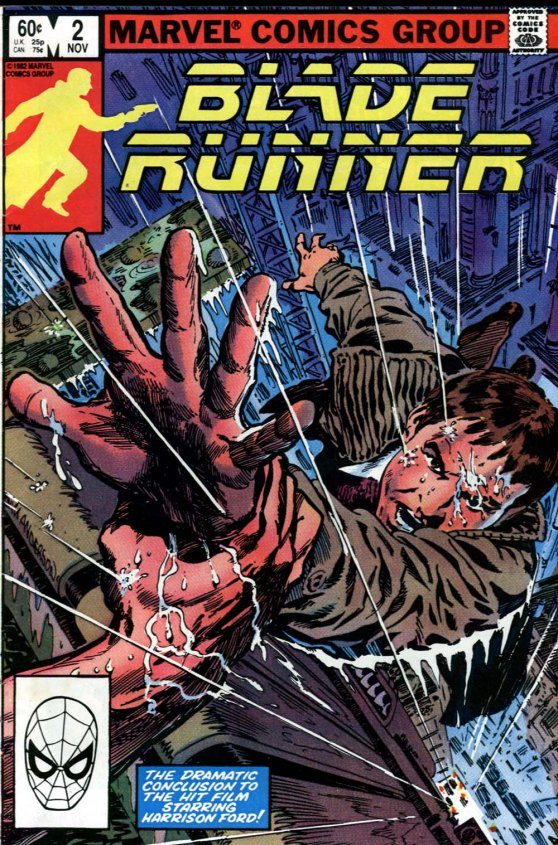
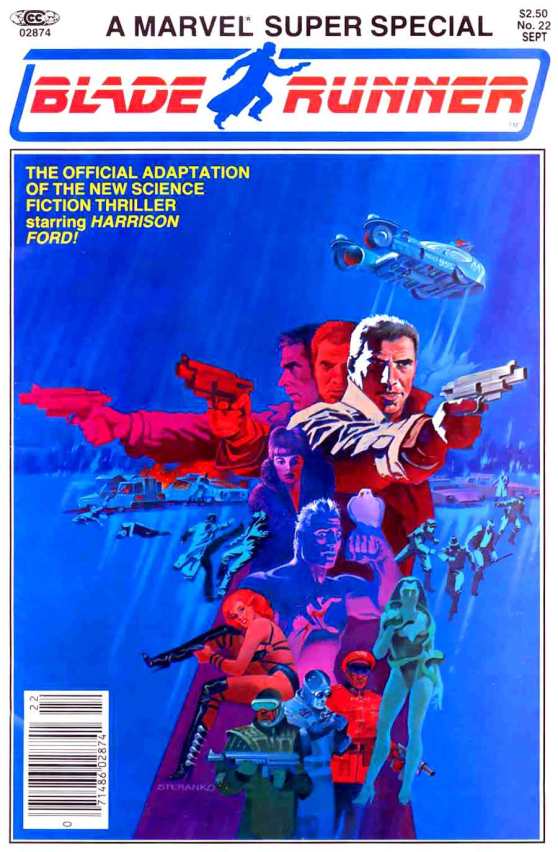
I was ten years old when Blade Runner came out and it played theaters so briefly in my small hometown that I never got the chance to see it. Also, ten year olds didn’t get to see R rated films in 1982. So my first experience was reading the Archie Goodwin/Al Williamson Marvel Comics adaption, a book of which I literally read until the cover came off.

I must have read this issue a thousand times.

Steranko cover!

I also asked my uncle, a librarian, for a copy of Philip K. DIck’s Do Androids Dream of Electronic Sheep? Perhaps a ten-year-old was not yet ready for the complexity of Phillip K. Dick, but he never dumbed it down for me.

The first time I finally saw Blade Runner on HBO it was after a year of reading about the film in Starlog, obsessing over the comic book and the source novel, so my experience was so alien to anyone else that saw it in theaters in 1982.

For a movie seen as a failure — it made $41.6 million on a $30 million budget, so I have no idea how that is failure — this is a movie that literally changed the world and has grown to become our world.

And yet, this is a movie that has seven different versions thanks to all of the changes from studio executives. Even the voiceover, which was added by them, has star Harrison Ford reading the words as if he has no interest, perhaps hoping if they were bad they’d never be used.

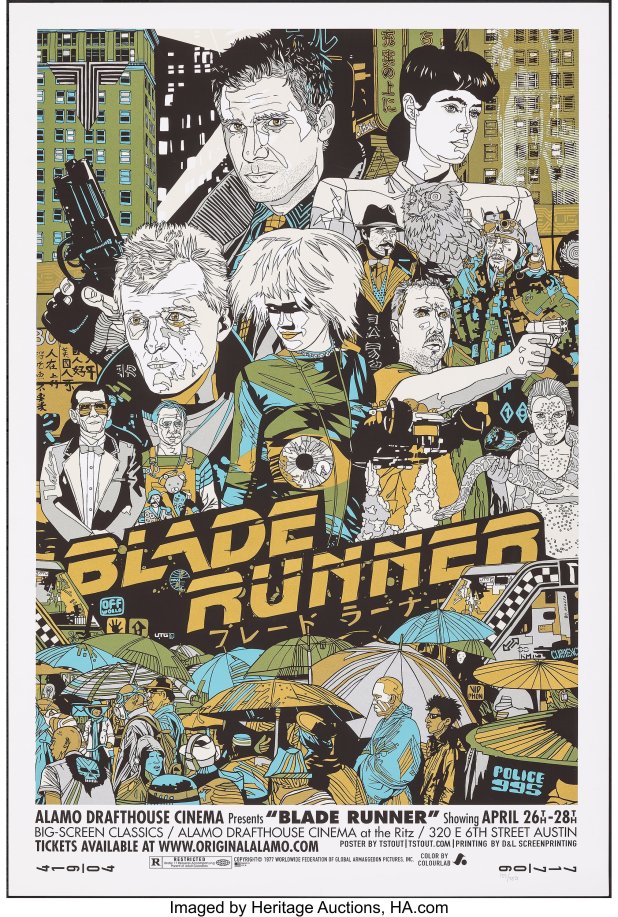
The blade runner is former police officer Rick Deckard (Ford), who is charged by Gaff (Edward James Olmos) and Bryant (M. Emmet Walsh) with doing what he does best: hunting down robotic humanoids and retiring them. Now, he must stop four Nexus-6 replicants: Leon  Kowalski (Brion James), Zhora Salome (Joanna Cassidy), Pris (Daryl Hannah) and Roy Batty (Rutger Hauer).

Yet within this film noir story set in a neon-filled future straight out of a Moebius drawing, the real tale is about whether Rick and his lover Rachael (Sean Young) are humans or machines themselves. In fact, of all the characters, Batty is the most human of them all, a character of both deep menace and surprising tender thoughts.

Blade Runner arises from pain. Ridley Scott had left Dune and lost his brother in short order and wanted something to take his mind off life. Dick had no idea it was even being made, but his initial distrust was saved somewhat when he saw the script revisions and special effects footage. Ford and Scott also fought throughout.

Neither can agree if Deckard is human or replicant, even if they’ve made up.

I think about Blade Runner a lot. I think about Pris flipping across the room, how her face paint looks, how deadly these killing machines are with such grace. I think of Rutger Hauer ad-libbing “All those moments will be lost in time…like tears in rain” and caressing the dove. I remember the spinner police car and Deckard’s car that I had as a kid and played with constantly. And I wonder, does Gaff leave the silver unicorn after not killing Rachael as him telling Deckard to pursue his dream or is Deckard’s dream of the unicorn just one progammed into him?

Most of all, I’m so thankful for this movie because without it, I may not be so fascinated by Philip K. Dick, a person who I quote or reference every day. My uncle knew what he was doing.

MILL CREEK BLU RAY RELEASE: Magnum PI (1980-1988)

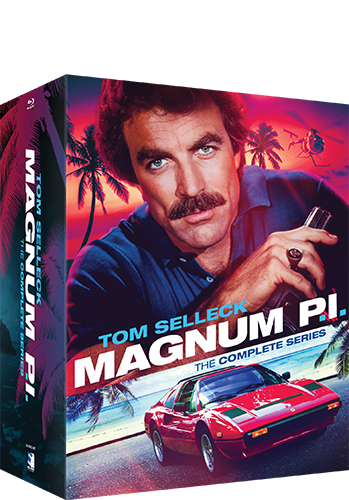
Magnum P.I. was a constant in my life through a tumultuous time, starting when I was just 8 and ending when I was 16, seeing me through the most chaotic years of young life. Thomas Sullivan Magnum IV’s (Tom Selleck) adventures in Hawaii were a center, a Thursday night oasis — Wednesday from series 7 onward — that always knew would be there.

Magnum lives in the guest house of an opulent 200-acre beachfront estate known as Robin’s Nest. At some point, he provided services for its owner, world-famous novelist Robin Masters (voiced by Orson Welles for all but the final time when Red Crandell spoke for the character) and he’s been allowed full run of the estate and use of the author’s Ferrari 308 GTB/GTS in exchange for some nebulous security detail. In between, he takes on cases that rarely pay and often put his life in danger.

His archnemisis is Jonathan Quayle Higgins III (John Hillerman). Like Magnum, he’s also ex-army, but he’s by the book while our hero is laid back. He’s in charge of Robin’s estate, patrolling it with his twin Doberman, Zeus and Apollo. The relationship grows and changes as the series progresses, going from antagonistic to near friendship by the close, as well as the suspicion that Higgins is Robin Masters.

Magnum has a near-perfect storytelling engine as it has the perfect setting (all manner of people come to Hawaii for vacation or to escape), the perfect characters (Magnum can be just as much a film noir hero as he can be a military man or a romantic leading man; he’s a comedic figure without losing his coolness) and the perfect job (being a detective is a reliable TV profession for this reason). Add in his friends Theodore “T.C.” Calvin (Roger E. Mosley) — whose Island Hoppers helicopter can take Magnum anywhere — and Orville Wilbur Richard “Rick” Wright (Larry Manetti), whose King Kamehameha Club can be the origin for all manner of intrigue — and you can see why this series ran for so many years.

While T.C. and Rick are former Marines and Magnum is a former Navy SEAL — all served in Vietnam — none of them are shell-shocked zombies. They’re normal human beings who deal with their war experiences in their own way, which was a refreshing change for audiences — especially veterans — when the show started.

Magnum was such a big show that even other big shows crossed over with it, establishing a CBS detective show universe. In the episode “Ki’is Don’t Lie,” Magnum works with Simon & Simon to recover a cursed artifact, a mystery which had its conclusion in their show with the episode “Emeralds Are Not a Girl’s Best Friend.” Yet most famously, in “Novel Connection,” novelist Jessica Fletcher came to Hawaii — along with Jessica Walter and Dorothy Loudon — and then solved the case on her show, Murder, She Wrote, in the episode “Magnum on Ice.”

Speaking of guest stars, all manner of genre favorites appeared on this show, including Jenny Agutter, Talia Balsam, Ernest Borgnine, Candy Clark, Samantha Eggar, Robert Forster, Pat Hingle, Mako, Patrick Macness, Cameron Mitchell, Vic Morrow, John Saxon and many more.

Another reason why this show is so beloved is due to Selleck. He told producers, “I’m tired of playing what I look like.” His suggestion? He remembered having fun with James Garner on The Rockford Files and suggested making Magnum more of blue collar guy. This made him more identifiable with men, not just women.

One of the things that struck me as I caught up on the series was that the theme is different at the start! The original theme was written by Ian Freebairn-Smith and only lasted eleven episodes before being replaced with the iconic Mike Post and Pete Carpenter song that I hum all of the time.

At the end of the seventh season, Magnum died in a shoot out. I can’t even explain how upset everyone was. The letters page in TV Guide was aghast. Imagine if Twitter existed in the late 80s! Luckily, he came back for one shorter season.

Series creator Donald P. Bellisario — who created this show with Glen A. Larson — was born in North Charleroi, PA. I can probably see his house from mine. After fifteen years in advertising, he went to Hollywood, where he worked on the series Black Sheep Squadron and Battlestar Galactica before creating series like Tales of the Golden MonkeyAirwolfQuantum LeapJAG and NCIS. He was joined by writers like Richard Yalem (who made Delirium), Reuben A. Leder (A*P*E*Badlands 2005), Jay Huguely (Jason Goes to Hell), Andrew Schneider (the “Stop Susan Williams” and “Ther Secret Empire” chapters of Cliffhangers!), Stephen A. Miller (My Bloody Valentine), J. Miyoko Hensley (who wrote the Remo Williams: The Prophecy pilot) and even notorious celebrity fixer and detective Anthony Pellicano, as well as directors like David Hemmings (yes, from Deep Red), John Llewellyn Moxey, Jackie Cooper and Robert Loggia, amongst so many others.

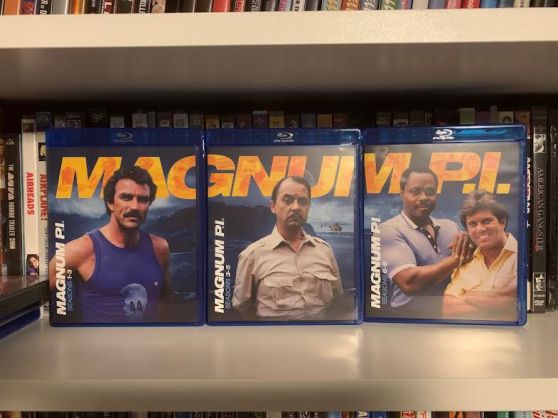
The Mill Creek blu ray box set of Magnum P.I. has all 158 episodes of the show, as well as new interviews with composer Mike Post, writer/producer Chris Abbott, author C. Courtney Joyner on the sixty year career of director Virgil Vogel and actress/writer Deborah Pratt (who was the voice of the narrator and Ziggy on Quantum Leap). Plus, you also get two Tom Selleck guest star roles on The Rockford Files, featurettes on The Great 80’s TV Flashback and Inside the Ultimate Crime Crossover (Magnum P.I. and Murder, She Wrote) and audio commentary on three season 8 episodes.

Much like how Magnum was a calming part of my young life, having this set on my shelf during these turbulent times is just as warm of a feeling. Get this set and let the 80s wash over you like the beaches of Waikiki.

You can get this set from Deep Discount.

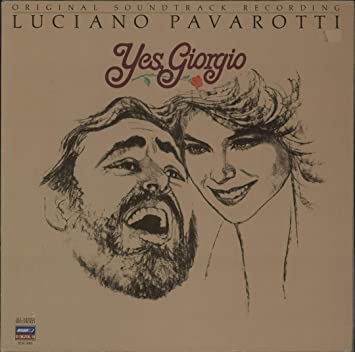
APRIL MOVIE THON DAY 3: Yes, Giorgio (1982)

MGM announced they had signed a deal with Lucio Pavarotti to star in this movie and he responded by saying, “I have done a lot of television and think I have the experience to do a movie. I will put myself in the hands of those making this but hopefully my sense of humor will come through.”

Producer Peter Fetterman said, “I just knew that someone had to make a movie with Pavarotti. He’s got so much charisma. A talent like his appears only once in every generation.”

Executive producer Herbert Breslin chimed in with, “We’re not going to skimp on it. We’ll spend whatever it takes to make a movie right for Mr. Pavarotti.”

The result?

$2.3 million back on a $19 million budget, but based on this Newsweek article, the estimated loss was $45.9 million. Pretty steep for a movie made because Gladys Begelman, wife of David Begelman, the COO and president of MGM at that time, was an opera lover.

But it was Pavarotti’s debut in the movies!

He plays world-famous Italian tenor opera singer Giorgio Fini — hmm, a stretch — who has mental issues preventing him from singing at the Met. That’s when his business manager Henry Pollack (Eddie Albert, I’m so sorry) introduces him to throat specialist Pamela Taylor (Kathryn Harrold from The Sender) who he refuses to see because why could a woman be a doctor?

It gets better. Or worse. Because the entire movie is him pursuing her, even though he has a wife and kids, and tells her it will mean nothing and yet, she falls for this sexist man with talent and still gets hurt, but it’s a comedy.

Franklin J. Schaffner made Planet of the ApesPatton and The Boys from Brazil. He deserved better. Or maybe he deserves the blame because this movie is pure pain. Or perhaps it’s the script by Norman Steinberg, who also wrote Blazing Saddles, Johnny Dangerously and Wise Guys. Or could it be Anne Piper, who wrote the book this was based on?

Nah, I think we know who was at fault.

Pavarotti refused to work more than 12 hours a day and would do no work after 8PM. He would only be filmed in angles that made him look smaller, just one of the many demands that led the crew to call the movie No, Luciano.

This movie starts with “This story is dedicated to lovers everywhere.”

I hate you, lovers.

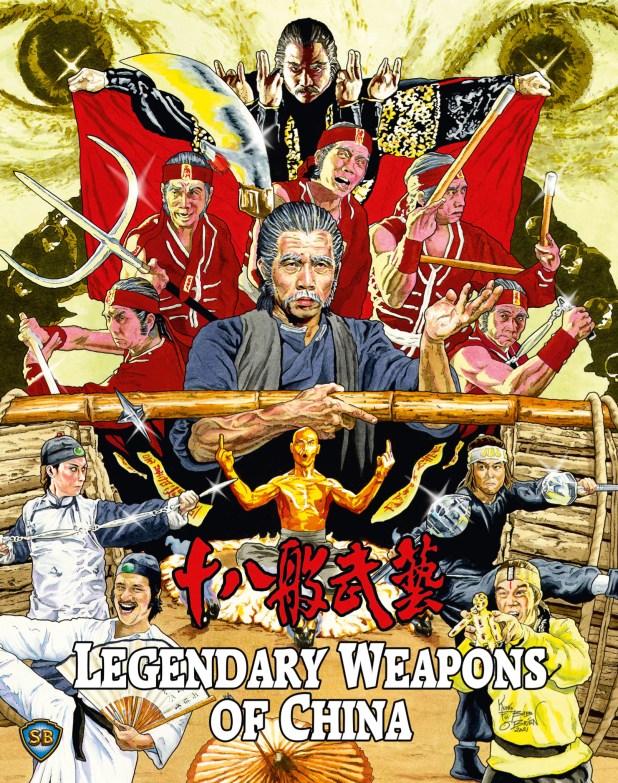
88 FILMS BlU RAY RELEASE: Legendary Weapons of China (1982)

Written, directed and starring Lau Kar-leung (Executioners From Shaolin, Drunken Master IIReturn to the 36th Chamber), Legendary Weapons of China has eighteen different weapons, including the rope dart, double tiger hook swords, double hammers, a battle axe, the snake halberd, Kwan Dao, twin broadswords, the double-edged sword, a Chinese spear, the three-section chain whip, double daggers, double crutches, a monk’s spade, a staff, the tiger fork, a rattan shield, the single butterfly sword and the three-section staff.

Having been defeated by the gunpowder and bullets of the West during the Boxer Rebellion, multiple Chinese fight schools are trying to learn how martial arts can defeat guns. However,  Lei Kung refuses to allow any more of his students to die trying to use their fighting skills to block bullets. In retaliation, the rival schools brand him a traitor and send their greatest fighters to kill him.

The foremost of them is Master Li Lin-ying who has hired Lei Ying, Tieh Hau and Ti Tan (Gordon Liu!) to get the job done. But if you’re expecting a straight martial arts film, this one has voodoo martial artists controlling other fighters and no small dose of the supernatural.

It also has long segments of comedy which have led many to disike it. I had no issues with it, as this is a big movie filled with big ideas that tries to break a lot of the mold of the form. Also, I’m always amazed at what gets cut in the UK, as every scene of throwing stars and nunchaku was eliminated there (which helpful reader Scott Napier pointed out to me is four countries and not just England: Scotland, England, Wales and Northern Ireland).

This is worth it just for the final battle in which all of the legendary weapons are used in combat by a master so wise in their handling that he doesn’t even need to defeat his opponent to win the fight.

The 88 Films blu ray release of Legendary Weapons of China features a high definition 1080p version of the film with English and Cantonese (with newly translated English subtitles) dialogue. It also has two audio commentaries, one with Asian cinema experts Mike Leeder and Arne Venema, as well as one with Frank Djeng. There are also interviews with David West, Gordon Liu and Titus Ho, the original trailer and gorgeous slipcase art by Robert “Kung Fu Bob” O’Brien with a poster and booklet. You can get this from MVD and Diaboik DVD.

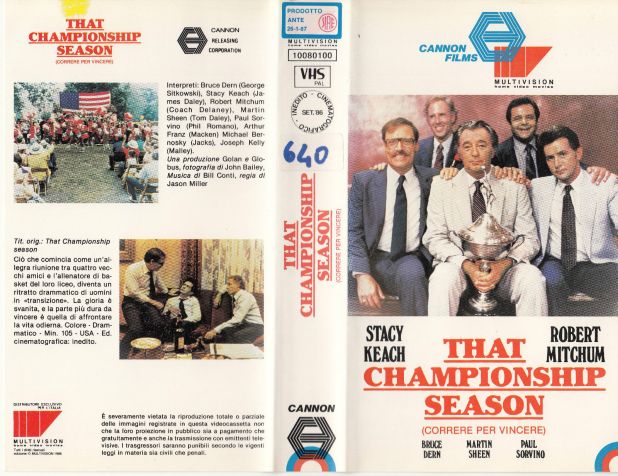
CANNON MONTH: That Championship Season (1982)

It has been 25 years since the 1957 Fillmore High School basketball team won the Pennsylvania state championship. For some of the players, this has been a moment that has dominated everything that has happened in their lives ever since.

George Sitkowski (Bruce Derk) is the mayor of Scranton and fighting to stay in office, while James Daley (Stacy Keach) is a school principal struggling to provide for his family as his brother Tom (Martin Sheen) is headed for rock bottom. Phil Romano (Paul Sorvino, who originated the role in the play) may be the most successful of the team, but will betray anything and anyone. Their coach, played by Robert Mitchum, still sees them as teenage boys, not men much closer to the close of their lives.

From the bigotry and cruelty of the coach* to the fact that the star player refuses to attends these reunions, the team soon realizes just how hollow it all is.

Starting as an off-Broadway in 1972. this moved to Broadway and played for 844 performances before Cannon produced the film, working with creator Jason Miller — yes, from The Exorcist — to make this in Scranton, a place he grew up in. In 1999, Sorvino directed an update for Showtime in which he played Mitchum’s role and cast Vincent D’Onofrio, Gary Sinise, Tony Shalhoub and Terry Kinney in the roles of the team.

While this movie failed to make money, it did legitimize Cannon as a real studio.

*Speaking of issues of bigotry and cruelty, Mitchum was accused of anti-Semitism and Holocaust denial after he gave an interview to Esquire. According to this article from the Jewish Telegraphic Agency, when “…Mitchum was asked about the slaughter of six million Jews, the actor replied, “So the Jews say,” He added. “I don’t know. People dispute that.””

In a letter to the JTA’s Hollywood columnist Herbert Luft, Mitchum said that early in his meeting with the interviewer, he recited a racist speech delivered by Coach Delaney, which was “mistakenly believed to be my own. From that point on, he approached me as the character in the script and in playing the devil’s advocate in a prankish attempt to string him along we compounded a tragedy of errors.”

Then, at the premiere of the movie, he assaulted a female reporter and threw a basketball from the movie at a Time photographer, smashing the camera into her face, knocking out two of her teeth and losing his salary from this movie to pay her for the damages.

You can learn more about That Championship Season in Austin Trunick’s The Cannon Film Guide Volume 1: 1980-1984.

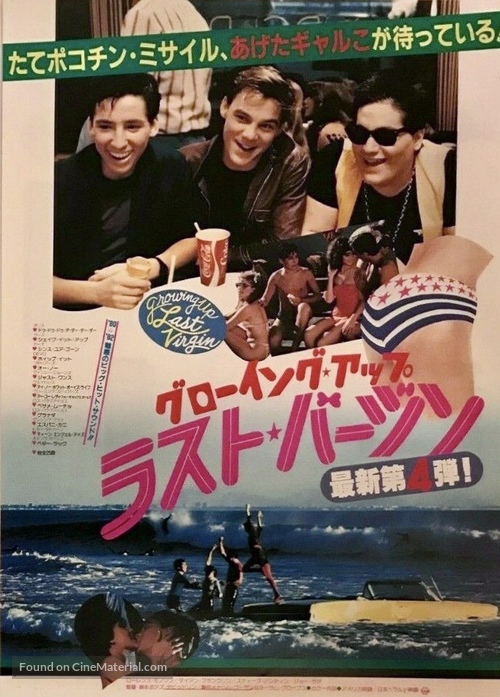
CANNON MONTH: The Last American Virgin (1982)

EDITOR’S NOTE: No movie shows just how Cannon’s view of America and America itself are so different than this movie. I love it for that while being destroyed by it every time I watch it. If you haven’t seen it, skip this, watch the film and come back. We originally had this on the site on June 12, 2021.

This movie is a destructive force that still leaves hurt feelings decades after it’s been viewed. Sure, it’s a remake of director Boaz Davidson’s Lemon Popsicle and that movie ends the same way, but that movie came back with plenty of sequels. Once The Last American Virgin drops its bomb on you, it lets you watch everything burn and then that’s it. There’s no happiness, no hope, just the song “Just Once” and the destruction of the film’s hero in a way that there’s no coming back from.

When a movie has a title like Lemon Popsicle, you don’t know what to expect. It’s a foreign movie released in 1978 that could be about anything. But when the title is The Last American Virgin and the movie comes out in the middle of the teen sex comedy craze, you don’t expect things to go this way.

Gary (Lawrence Monsoon, Friday the 13th: The Final Chapter) is a pizza delivery boy with two friends, the cool ladies man Rick (Steve Antin, Jessie in the “Jessie’s Girl” video) and David (Joe Rubbo). Most of their hijinks revolve around trying to have sex, like telling girls they have cocaine — it’s really Sweet’n Low — or sleeping with a prostitute or Carmello, a Spanish woman who Gary meets while delivering pizza. Everyone gets their turn except for Gary, who is the titular character.

Yet he has better plans for his first time. He’s in love with Karen (Diane Franklin!), but she’s in love with Rick, who plans on sleeping with her once and dumping her. He does exactly that, getting her pregnant. She turns to Gary, who sells almost everything he owns and borrows money to pay for her abortion, then nurses her during the lowest moment in her life. They share a kiss and she invites him to her 18th birthday party.

That’s when the pain hits hard.

This film takes what Lemon Popsicle did on its soundtrack and transports it to the 80s, which is an incredibly smart move. The music is vital to this film’s success, featuring heavy hitters like The Cars, Devo, The Police, Journey, REO Speedwagon, U2, Blondie and the Human League. I mean, how do you think Bono felt when he saw this and his song “I Will Follow,” which is about his mom who died when he was only 14, is used over an abortion montage?

So much of this movie is very Cannon Films and that’s also the joy of it. It also leaves me with so many questions. Why does Gary bring Karen a bag of oranges when she’s lying in the hospital? Why would they make this seem like a teen movie and give it that ending, when if it was a date movie it’s filled with way too much raunchy sex? And how about the fact that the actors who played Gary and Rick, who come to blows in the movie over the girl who got between their friendship, have come out? How does Gary not realize that Karen’s friend Rose, who he gets set up with, is geeky hot (maybe this makes more sense in 2021 than 1982)? And how did cinematographer Adam Greenberg (who also filmed Terminator 210 to MidnightNear Dark and many more) feel about recreating so many of the same shots that he’d made in Lemon Popsicle?

Director Davidson also made Hospital MassacreSalsa and American Cyborg: Steel Warrior, movies that would not even hint at the art that he would make with this movie. If you’ve ever seen the poster for this and laughed it off as a simple teen comedy, I want you to take a chance on this movie. But be prepared for the final moments.

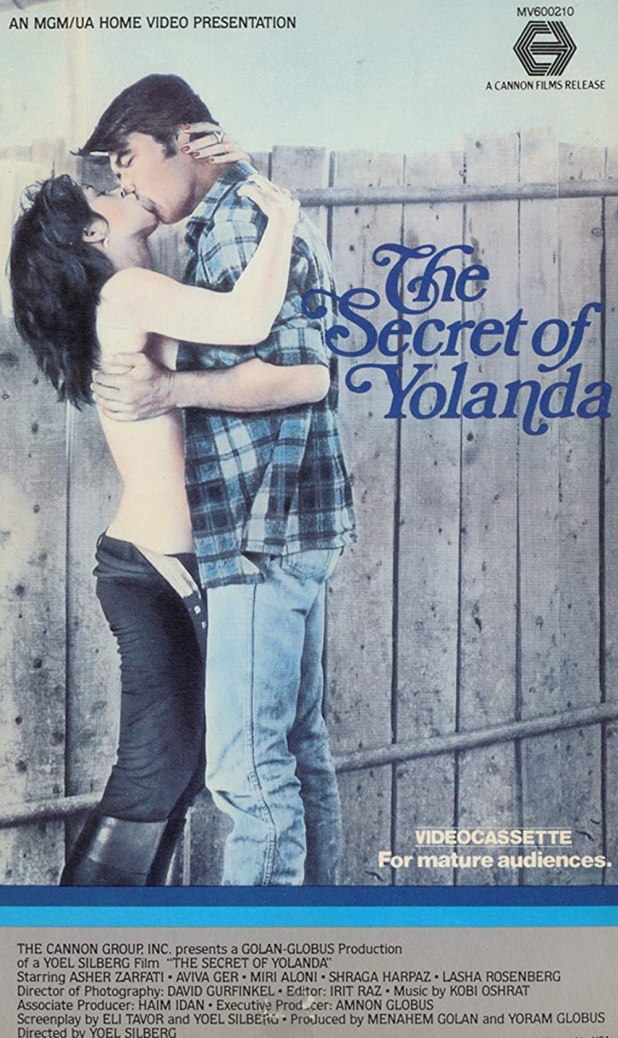
CANNON MONTH: The Secret of Yolanda (1982)

I’ll be honest: I can’t find this movie anywhere. But in my quest to cover every Cannon movie, I feel like it’s important to share an overview.

Directed by Joel Silberg, who would direct LambadaBreakin’ and Rappin’ for Cannon, as well as the pro wrestling movie Bad Guys, from a script by Ei Tavor, who wrote Lemon PopsicleGoing SteadyHot BubblegumPrivate PopsicleSalsa and Lemon Popsicle: The Party Goes On, this is the tale of a gorgeous deaf-mute who has both her riding instructor and her guardian in love with her.

Yes, it has sex on a horse, and yes, I only know about this movie because of Austin Trunick’s perfect book, The Cannon Film Guide: Volume I, 1980–1984.

If you have a copy, I’d love to see this. But after reading what Austin saw, I may not be fully invested in my need to see this.

CANNON MONTH: Boy Takes Girl (1982)

When two doctors from Tel Aviv join Doctors Without Borders, they end up going to Thailand and leaving their ten-year-old daughter Aya behind in a kibbutz (a communal settlement where all wealth is held in common and profits are reinvested) where the kids live together by age, not gender, meaning that she must go from being an only child to suddenly being surrounded by boys who even shower with her.

Made in Israel by director and writer Michal Bat-Adam, this is an early Cannon release by Menahem Golan and Yoram Globus as they started to figure out what their new American studio was going to be.

Honestly, if you told me that I’d be watching a movie that has a fight between kids over a stamp collection, I would tell you that you were crazy. But if you said, well, it’s a Cannon movie, then I’d say, “Well, put it on.” I’m a completist. Movies are drugs. This one didn’t get me high, but I smoked it down to the filter and burned my finger to find out if it would.

You can watch this on Tubi.

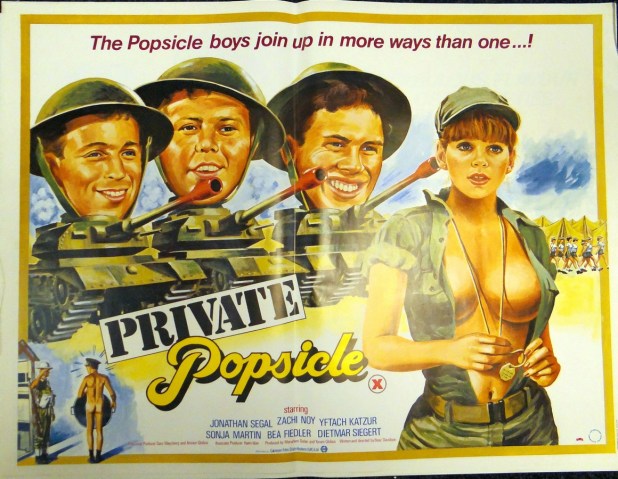
CANNON MONTH: Private Popsicle (1982)

After Lemon PopsicleGoing Steady and Hot Bubblegum, but before Baby LoveUp Your Anchor, Young Love: Lemon Popsicle 7 Summertime Blues and Lemon Popsicle: The Party Goes On and this movie’s side sequel Private Manuevers,  what else was there to do but to join the Israeli army? That’s what Bobby, Benji and Hughie are up to next. I mean, there is a mandatory draft, so it only makes sense, except that this army allows them to cosplay Some Like It Hot.

These movies are like the Dickie Goodman of teen sex comedies, in that in one scene, you get more needledrops than an Edgar Wright film fest. Just look at the first scene, in which the boys all take turns with a local loose woman — and somehow, this happens in every Lemon Popsicle movie — while Pat Ballard sings “Mr. Sandman” the cucked husband sleeps, only to wake up and chase Hughie to “Charlie Brown” by The Coasters before the boys run to the notes of Bill Hayley and the Comets doing “See You Later, Alligator.*” Yes, just like a Dickie Goodman answer record, but in picture form.

The Sergeant Major is their new end boss and his dubbing makes the lowest grade Italian western feel like a boutique Criterion reissue. I honestly can’t believe that this played in the United States and also am even more incredulous that it took me so long to see it.

If you’re upset by trans humor, homosexual humor, military humor, sex humor, teenage humor…actually, just don’t watch this. You’re just not going to like it. I’d say for Cannon completists only, but come on, that Cannon dragon must be chased.

*Thanks to The Unknown Movies for pointing this out.