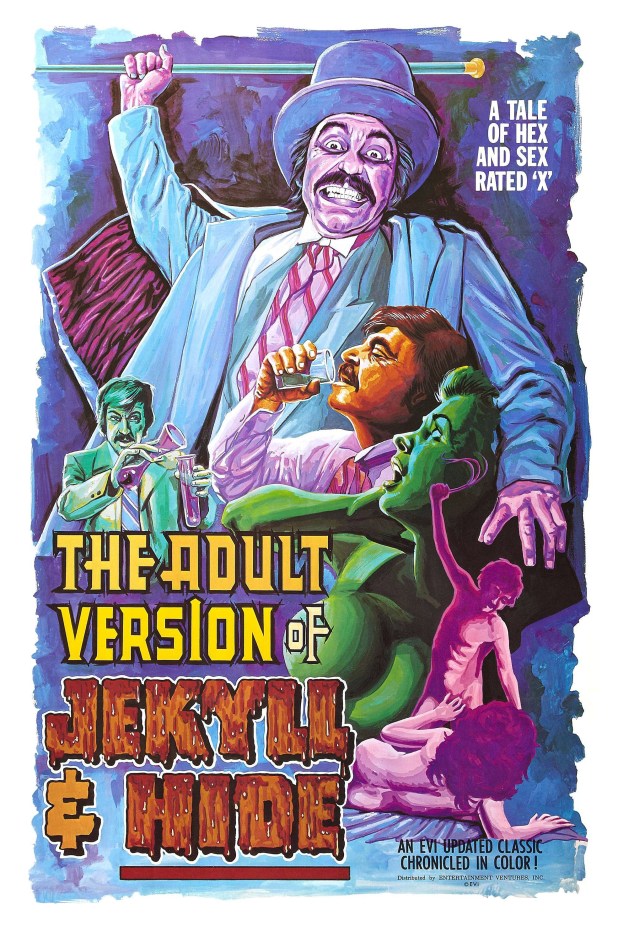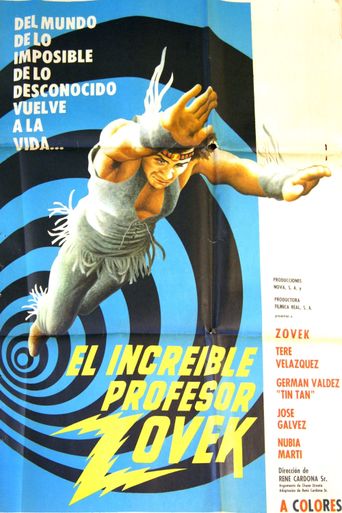
UNSUNG HORRORS HORROR GIVES BACK 2025: The Adult Version of Jekyll & Hide (1972)

Each October, the Unsung Horrors podcast does a month of themed movies. This year, they will once again be setting up a fundraiser to benefit Best Friends, which works to save the lives of cats and dogs across America, giving pets second chances and providing them with happy homes.

Today’s theme: Birth year (1972)

Dr. Chris Leeder (John Barnum, using the name James Buddliner; he was also in Sex In the ComicsA Touch of SwedenFrankie and Johnny…Were Lovers and Angie Baby) has already killed someone to get his hands on Dr. Jekyll’s ancient notebook. Why? The formula that  “makes people appear as they really are.”

This could be a warning, but Dr. Leeder doesn’t care. He mixes up a potion for himself and turns into Miss Hide.

That’s right, he is now a she, played by Jane Tsentas, star of more than fifty disreputable movies like Blood SabbathLittle CigarsEvil Come Evil Go and The Jekyll and Hyde Portfolio.

Directed by Lee Raymond (Blackie in She Freak) and written by Robert Birch (whose only other IMDB credit is playing trumpet on an A&E Civil War TV movie), this also has Laurie Rose as the doctor’s nurse and wife, Linda York (she’s also in Auditions) as a sex worker who gets beaten by Dr. Hyde in the past, Linda McDowell and most of all, Rene Bond, who is some kind of vision created by a mad doctor in a lab. I refuse to believe she was a real person.

David F. Friedman produced it, so you know that means quality, if what you mean by quality is non-stop sex and violence. I mean, I do.

You can watch this on CultPix.

VINEGAR SYNDROME BOX SET RELEASE: Bloodstained Italy

From Vinegar Syndrome: “Italian horror in the 1960s and 70s went through several popular tonal and thematic phases. From Gothic thrillers in the early to mid-1960s, psychedelia and monster mayhem in the late 1960s and early 1970s, and, of course, all manner of gialli and other assorted murder thrillers. But what of those films that offer a form of narrative bait and switch, luring the viewer in with the pretense of one genre while slowly revealing themselves to be something else entirely? Presented here are a trio of 70s Italian horror features which play with, combine, subvert, and surprise with their genre leanings, all newly and exclusively restored from their 35mm original negatives and all presented on English-friendly home video for the very first time, from Vinegar Syndrome.”

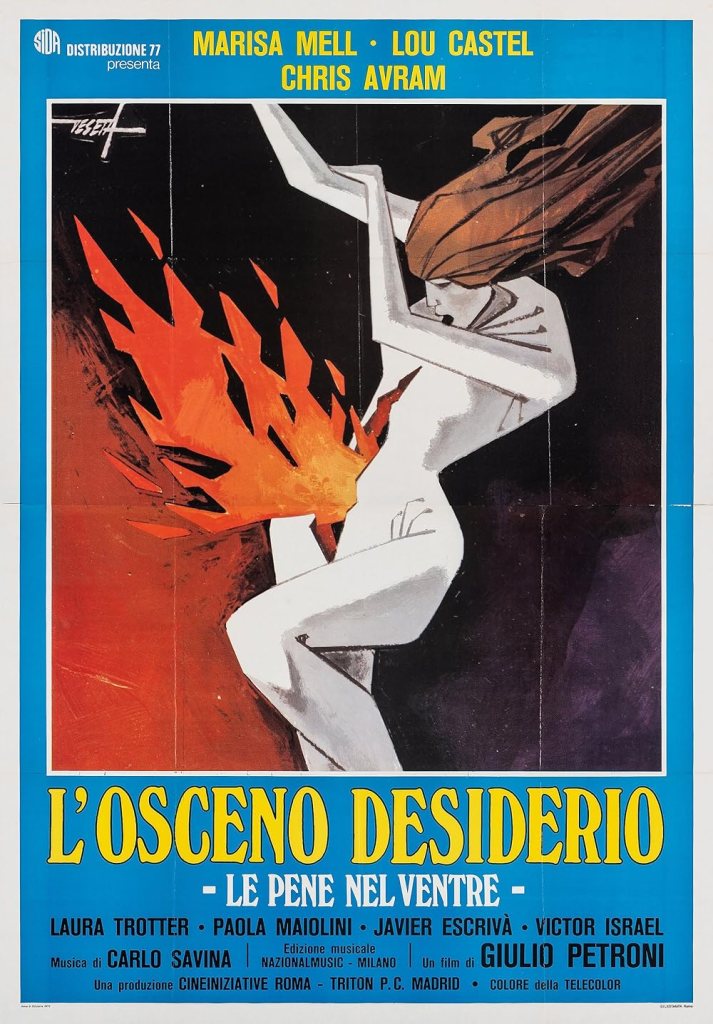
Obscene Desire (L’osceno desiderio) (1978): Obscene Desire is the story of Amanda (Marisa Mell, a goddess if there ever were one and someone who immediately changes any movie from maybe to definitely; my favorite of her films are MartaDanger: Diabolik and Perversion Story, a movie in which she has one of the most fabulous outfits not only in the history of Italian film but perhaps all movies ever), an American woman ready to marry the rich Andrea (Chris Avram, Enter the Devil) and move into his vast mansion.

Within the walls of that gothic expanse lies something evil, something that has possessed Amanda’s soon-to-be husband to indulge in black magic and ritual murder. In fact, the only way that he can keep his soul from being taken by his domicile is to keep killing prostitutes.

This movie should teach you to never trust a gardener (Victor Israel) and that the Italian film industry would keep on making Rosemary’s Baby rip-offs ten years after that movie was unleashed. Or The Exorcist five years later. Or The Omen two years later.

Look, I’m a simple man. Marisa Mell, with short, dark hair, looking not unlike Mariska Hargitay, is possessed by the devil and writhes on a bed, revealing that her tongue is superhumanly long. Do I even care that this movie has no real story and really goes nowhere?

No, not at all.

What were we talking about?

Laura Trotter (Dr. Anna Miller from Nightmare City) and Paola Maiolini (Cuginetta, amore mio!) are also in the cast for this film directed by Giulio Petroni (Death Rides a Horse) and written by Joaquín Domínguez and Piero Regnoli (the director of The Playgirls and the Vampire and writer of 117 movies including DemoniaVoices from BeyondBurial Ground and Patrick Still Lives).

Extras on the Vinegar Syndrome release include a commentary track with film historians Eugenio Ercolani and Troy Howarth, interviews with director/writer Giulio Petroni, daughter of Giulio Petroni and script supervisor Silvia Petroni, grandson of Giulio Petroni and film historian Eugenio Ercolani, censorship expert Alessio Di Rocco and director Pupi Avati, as well as alternate and extended scenes from the Spanish version and the original Italian trailer.

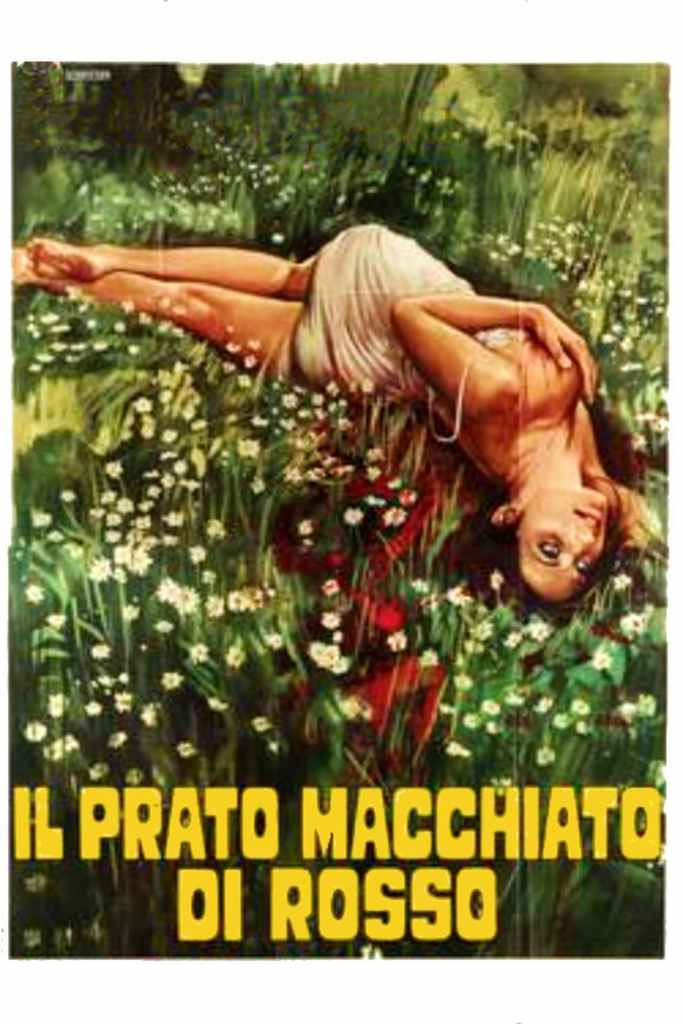
The Bloodstained Lawn (Il prato macchiato di rosso) (1973): The Red-Stained Lawn, also known as The Bloodstained Lawn, was initially titled Vampiro 2000 and combines science fiction, Gothic horror, and giallo genres in a wacky package with a bloodsucking robotic twist.

The film takes place in Emilia-Romagna, Italy. There, a United Nations Educational, Scientific and Cultural Organization agent finds a bottle of wine containing blood. How could this happen to such a well-known vintage from Michelino Croci? What if the winery is a front for a blood smuggling scheme? And how would blood stay good in bottles? So many mysteries!

Dr. Antonio Genovese (Enzo Tarascio), his wife Nina (Marina Malfatti, All the Colors of the DarkThe Red Queen Kills Seven TimesSeven Blood-Stained Orchids) and her brother Alfiero (Claudio Biava) look for people with no ties — hippies, drifters, prostitutes and literally gypsies, tramps and thieves — to lure to an all expenses paid getaway at their castle. Folks like freewheeling musician Max (George Willing, Who Saw Her Die?) and his lover (Daniela Caroli), who have accepted an invitation to spend some time in the Genovese estate, along with the alcoholic tramp (Lucio Dalla, who would become a major singing star in the 80s), a gypsy (Barbara Marzano, The Bloodsucker Leads the Dance) and a sex worker (Dominique Boschero, Argoman the Fantastic Superman).

The bloodsucking machine is literally right out in the open, treated like a piece of pop art. You have to admire that level of out in the open when it comes to an Italian film killer. You also have to love that the killers have a shower that sprays wine, and this doesn’t bother Max or his never-named girlfriend, nor does the hall of mirrors bedroom seem strange to anyone else. There’s also a curtain between rooms that resembles female anatomy, and even more so, a scene taken right out of The Laughing Woman.

Director and writer Riccardo Ghione made only four movies: this one, a documentary called Il Limbo, the hippy drama A cuore freddo, and La rivoluzione sessuale, a film in which seven men and seven women perform an experiment inspired by the sexual orgone energy theories of Wilhelm Reich. If that was crazy enough, it was co-written by Dario Argento. He would go on to write several other films, including the Joe D’Amato film Delizia.

I love that this movie stands on the line between arthouse and grindhouse, with every decision it makes leaning away from the artistic and toward the prurient and bloody. Sure, there’s a message about how the rich subjugate the lower classes, but it’s also a film where Malfatti gives speeches about Wagner and how meaningless her victims are, all. At the same time, a gigantic cartoony machine literally sucks young blood.

Extras on the Vinegar Syndrome release include commentary by Rachael Nisbet and interviews with film historian Enzo Latronico and filmmaker/film historian Luca Rea.

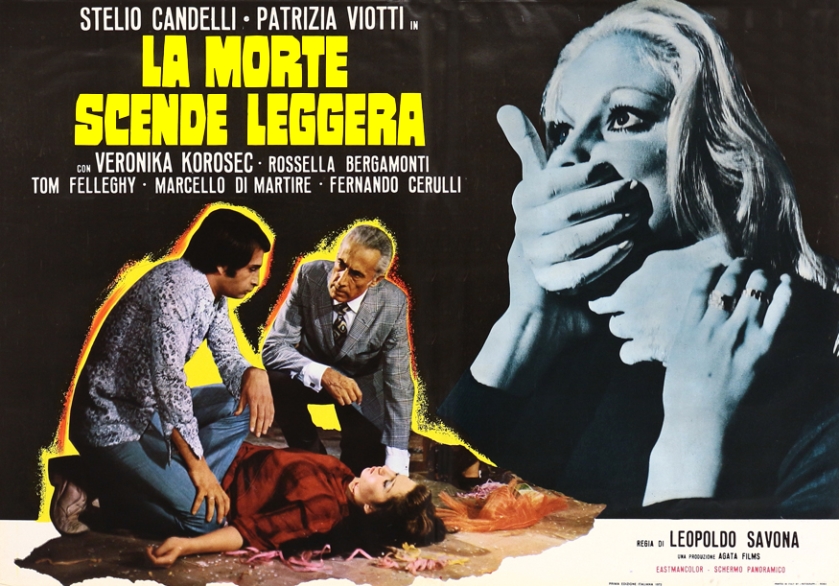
Death Falls Lightly (La morte scende leggera) (1972): Death Falls Lightly begins when Georgio Darica (Stello Candelli) comes home from a crime-related business trip only to find that his wife has been killed. So his lawyer suggests that he grab his girlfriend, Liz (Patrizia Viotti, Amuck) and head off to a hotel. Still, when he gets there, the owner (Antonio Anelli) has also killed his wife, so he asks him to help bury her, but then George remembers that the hotel was abandoned. So is he going insane? Are these people real? Did he actually kill his wife?

The next part of this movie gets absolutely ridiculous in the best of ways, as people appear, get murdered and come back to life. At the same time, someone commits suicide on a Satanic altar, invisible killers attack George, prog rock blasts, and a monkey shows up out of nowhere. It also features the most ridiculous of all giallo police, which is saying something. There’s a very low bar for giallo cops, and these ones may be the worst.

Director Leopoldo Savona also made Byleth: The Demon of Incest the same year I was born, which probably means something.

Extras on the Vinegar Syndrome release include commentary with film historians Eugenio Ercolani and Troy Howarth, interviews with actor Alessandro Perrella and filmmaker/film historian Luca Rea, and a then and now location featurette.

This 3-disc region-free Blu-ray set features all the movies newly scanned and restored in 2K from their 35mm original negatives, along with newly translated English subtitles and reversible sleeve artwork. You can get it from Vinegar Syndrome.

WEIRD WEDNESDAY: The Daredevil (1972)

Daredevil — there’s the title! — Paul Tunney (George Montgomery) gets blamed for another stunt driver’s death and finds himself making a living by running drugs and dealing with some kind of bad mojo put on him by that driver’s sister, Carol (Gay Perkins).  Oh yeah — he’s also making sweet love to his one-armed mechanic Huck’s (Bill Kelly) wife Julie (Terry Moore) because, look, Paul’s a jerk. He deserves everything that happened to him.

Montgomery went from a stuntman at Republic to leading man status at 20th Centiry Fox, taking over roles meant for Tyrone Power and Henry Fonda during the war before he was drafted into working for the U.S. Army Air Forces First Motion Picture Unit, appearing in documentaries and training films. As his leading man status waned, he appeared in movies like Hallucination GenerationSatan’s Harvest (which he directed) and Django the Condemned.

Moore was married five times but has claimed that she was with Howard Hughes from 1949 to 1976. She’s been acting since 1940 — and has two movies coming soon, according to IMDB — and starred in Mighty Joe Young, as well as appearing in HellholeBeverly Hills Brats and many more films. She was even on the cover of Playboy in August 1984 at the age of 55.

By 1972, however, they were both in movies like The Daredevil.

Director Robert W. Stringer was usually a composer for movies, and this is his only directing credit. Writer Robert Walsh also scripted Smokey and the Good Time Outlaws. They made a movie that combines the rednecksploitation that drive-ins were looking for with the downer ending that was of the time. It’s not great, but it’s perfect for a second drive-in feature; a make-out and barely watch the movie movie, if you will.

You can watch this on the Cave of Forgotten Films.

MILL CREEK BLU-RAY BOX SET: Bewitched The Complete Series

Bewitched aired throughout the most tumultuous time in modern history — hyperbole, that could also be today, but true, as rehearsals for this show’s first episode were on the day Kennedy was shot and the episode “I Confess” was interuppted by Martin Luther King Jr.’s death — from September 17, 1964, to March 25, 1972. The #2 show in the country for its first season and remaining in the top ten until its fifth season, it presents a sanitized and fictional world that at the time may have seemed contrary and fake to the simmering 60s, but today feels like the balm I need and an escape.

Within the home on 1164 Morning Glory Circle, Samantha (Elizabeth Montgomery) and Darrin Stephens (Dick York, later Dick Sargent) have just had a whirlwind romance and ended up as husband and wife. At some point, she had to tell him that she was a witch, a fact that he disapproved of, and that she should be a normal housewife instead of using her powers. Yet she often must solve their problems — usually caused by her family, such as her mother Endora (Agnes Moorehead) — with a twitch of her nose.

Creator Sol Saks was inspired by I Married a Witch and Bell, Book and Candle, which luckily were owned by Columbia, the same studio that owned Screen Gems, which produced this show. You could use either of those movies as a prologue for this, which starts in media res — I like that I can use such a highbrow term to talk of sitcoms — with our loving couple already settling into the suburbs.

Author Walter Metz claims in his book Bewitched that the first episode, narrated by José Ferrer, is about “the occult destabilization of the conformist life of an upwardly mobile advertising man.” As someone who has spent most of his life in marketing, maybe I should look deeply into the TV I watched as a child. Bewitched was there all the time in my life, wallpaper that I perhaps never considered.

Head writer Danny Arnold, who led the show for its first season, considered the show about a mixed marriage. Gradually, as director and producer William Asher (also Montgomery’s husband at the time) took more control of the show, the magical elements became more prevalent. What I also find intriguing is that with the length of this show’s run, it had to deal with the deaths of its actors and York’s increasing back issues, which finally forced him to leave the show and another Dick, Dick Sargent, stepping in as Darren, a fact that we were to just accept.

That long run, the end of Montgomery and Asher’s marriage and slipping ratings led to the end of the show, despite ABC saying they would do two more seasons. Instead, Asher produced The Paul Lynde Show, using the sets and much of the supporting cast of this show. He also produced Temperatures Rising, which was the last show on his ABC contract, which ended in 1974.

Feminist Betty Friedan’s two-part essay “Television and the Feminine Mystique” for TV Guide asked why so many sitcoms presented insecure women as the heads of households. None of this has changed much, as the majority of sitcoms typically feature attractive women and funny but large husbands, a theme created by The Honeymooners, and the battles between spouses. I always think of I Dream of Jeannie, a show where a powerful magical being is subservient to, well, a jerk. At least on Bewitched, Samantha is a powerful, in-control woman with a mother who critiques the housewife paradigm.

Plus, unlike so many other couples on TV at the time, they slept in the same bed.

Bewitched‘s influence stretched beyond the movie remake. The show has had local versions in Japan, Russia, India, Argentina and the UK, while daughter Tabitha had a spin-off. There was even a Flintstones crossover episode!

Plus, WandaVision takes its central conceit — a witch hiding in the suburbs — from this show. And Dr. Bombay was on Passions!

This is the kind of show that has always been — and will always be — in our lives. Despite my dislike of Darren’s wedding vows of no magic, there’s still, well, some magic in this show. Just look at how late in its run it went on location to Salem for a multi-episode arc, something unthought of in other sitcoms.

You can watch this just for the show itself, to see the differences between the two Darrens and when Dick York had to film episodes in special chairs because of his back pain, when the show did tricks like have Montgomery (using the name Pandora Spocks) playing Samantha’s cousin Serena to do episodes without York or just imagine that the world was changing outside. Yet, magic and laughter were always there on the show, throughout the lives, divorces and deaths of its principals and supporting cast.

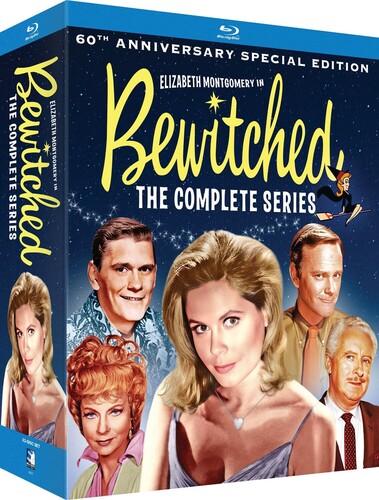
The Mill Creek box set is an excellent, high-quality way to just sit back, twitch your nose and get away from it all. This 22-disc set has everything you’d want on Bewitched, including extras like Bewitched: Behind the Magic, an all-new documentary about the making of Bewitched, featuring special guest appearances by actor David Mandel (Adam Stephens), Steve Olim (who worked in the make-up department at Columbia), Bewitched historian Herbie J Pilato, film and television historian Robert S. Ray, Bewitched guest star Eric Scott (later of The Waltons) and Chris York, son of D. York (the first Darrin). There are also sixteen new episodic audio commentaries, moderated by Herbie J Pilato that include behind-the-scenes conversations with Peter Ackerman (son of Bewitched executive producer Harry Ackerman), David Mandel, Bewitched guest star Janee Michelle (from “Sisters at Heart”), Steve Olim, Robert S. Ray, former child TV actors and Bewitched guest stars Ricky Powell (The Smith Family), Eric Scott (The Waltons), and Johnny Whitaker (Family Affair and Sigmund and the Sea Monsters) and Chris York (son of D. York). There’s also an exclusive 36-page booklet featuring pieces by Bewitched historian Herbie J. Pilato, as well as an episode guide. You can order it from Deep Discount.

WEIRD WEDNESDAY: The Cheerleaders (1972)

Stephanie Fondue, who stars in this as Jeannie, had an even more incredible real name. Enid Finnbogason. She was in Hollywood from Winnipeg, got hit up at lunch to try out for this movie and got it. She’d never been a cheerleader. She was twenty. Also: A nude model, so disrobing during the audition was no big whoop.

In the film, Amarosa High School is a high-stakes place where lives depend on football games. Along with Jeannie, Bonnie (Jovita Bush), Debbie (Brandy Woods) and head cheerleader Claudia (Denise Dillaway, who eventually did the makeup for 2000s reality specials Exposed! Pro Wrestling’s Greatest Secrets and Breaking the Magician’s Code: Magic’s Biggest Secrets, as well as the VHS release of Party Games for Adults Only, the girls try to help the men win. Except that Claudia is catty and is trying to get Jeannie deflowered by the end of the season. It’s a backward teen sex comedy bet.

But hey, everyone goes to see I Drink Your Blood at one point. So there’s that.

Director and co-writer Paul Glicker also directed Running Scared (starring Ken Wahl) and adult films Parlor Games and Hot Circuit. Other writers included Richard Lerner, Tad Richards, and Ace Baandige, a pseudonym for someone who claimed to have been a Presidential scriptwriter named David. David Gergen seems too clean for this, David Shipley is too young and David Frum was 11 when this came out. I am looking at Presidential writers and comparing them to someone who made a sex film.

Speaking of sex films, Suzie is played by Sandy Evans, but that’s Clair Dia, who was in Lucifer’s Women and 3 A.M. — the only porn with an Orson Welles-edited scene — and directed Screwples and The Health Spa. Patty, played by Kim Stanton, who is also known as Kimberly Hyde, appeared in The Young Nurses and Candy Stripe Nurses. There were a lot of nurse movies. There are even sequels to this one: The Swinging Cheerleaders, Revenge of the Cheerleaders and Cheerleaders’ Wild Weekend.

The coach is Patrick Weight, who was in so many 70s and 80s scumbag movies. Track of the Moon Beast, the handsy truck driver in Gradation Day, Mr. Peterbilt in Beneath the Valley of the Ultravixens, a gardener in Young Lady Chatterley, the stepfather in Wicked Wicked…his career was something.

You can watch this on Tubi.

CBS LATE MOVIE: Visions of Death (1972)

EDITOR’S NOTE: Visions of Death was on the CBS Late Movie on September 15, 1976 and October 27, 1977.

Telly Savalas plays Lt. Phil Keegan, a cop before Kojak, and he’s dealing with the visions of Prof. Mark Lowell (Monte Markham), who can see the future. He tells the police that someone is about to plant a bomb, which makes him the prime suspect.

Directed by Lee H. Katjin (Death Ray 2000) and written by Paul Playdon, one wonders if a young Steve King watched this and thought, “Hey, that idea of a psychic being able to touch people and see their future seems pretty neat.” Except that Mark is a professor and Johnny in The Dead Zone was a teacher and…yeah.

They also brought in a real-life psychic — cold reader, more like it — James Van Pragh.  Barb Anderson, Eve Whitfield from Ironside, is also in this.

You can watch this on YouTube.

CBS LATE MOVIE: The Thing With Two Heads (1972)

EDITOR’S NOTE: The Thing With Two Heads was on the CBS Late Movie on August 30, 1974.

Dr. Maxwell Kirshner (Ray Milland) knows that he’s dying but that’s why he’s getting his team of surgeons to do head transplants with gorillas, He’s running out of time and Dr. Philip Desmond (Roger Perry) has hired a black doctor — Dr. Phillip Desmond (Don Marshall) — and Kirshner shows off that he’s totally racist.

The plan has been to have criminals on death row to think they’re going to the chair and instead give their bodies up to be used by Desmond. Imagine his surprise when his death comes faster than he expected and he ends up having his head transplanted onto the same body of innocent man Jack Moss (Rosey Grier). Imagine Jack’s wife Lila’s (Chelsea Brown) surprise when he shows up with an old white man ‘s head on his shoulders.

Coming out a year after The Incredible 2-Headed Transplant, this has a man punching his other head in the face and an old racist’s severed head hooked up to a heart and lung machine. So there’s that.

Directed by Lee Frost (House On Bare MountainMondo BizarroWitchcraft ’70A Climax of Blue Power), this was written by Frost (the only guy I know that can make The Black Gestapo and a major studio movie like Race With the Devil), James Gordon White (who also wrote The Incredible 2-Headed Transplant, so he got paid twice for this idea) and Wes Bishop.

I’d say there’s no other movie like this, but there is.

CBS LATE MOVIE: Hound of the Baskervilles (1972)

EDITOR’S NOTE: Hound of the Baskervilles was on the CBS Late Movie on Septeber 25, 1974 and December 14, 1976.

Director Barry Crain wasn’t just a TV director. He was also a bridge champion, an ACBL Grand Life Master that won so many points that whoever gets the most points in a year wins a title named for him.

Writer Robert E. Thompson was writing for TV as early as 1956. He also wrote the script for They Shoot Horses, Don’t They?

Using old horror movie sets, this film had Stewart Granger as Sherlock Holmes and Bernard Fox as Dr. Watson. As for the Sir Hugo Baskerville, William Shatner is ready to be Shatner.

This was intended to be part of a revolving door series of literary detectives, as they also made The Adventures of Nick Carter starring Robert Conrad and A Very Missing Person with Eve Arden as Hildegarde Withers. Ratings and reviews were not kind.

The real mystery? On July 5, 1985, Crane was “found bludgeoned shortly before 3 P.M. in the garage of his luxury town home in Studio City.” He had been attacked with a large ceramic statue and strangled with a telephone cord before being found naked and covered in bedsheets. It took 34 years for the killer to be found, as a fingerprint led to Edwin Jerry Hiatt pleading guilty to voluntary manslaughter in 2019, saying “Anything’s possible back then. I was big into drugs.”

You can watch this on YouTube.

CBS LATE MOVIE: Night of Terror (1972)

EDITOR’S NOTE: Night of Terror was on the CBS Late Movie on September 15, 1975 and August 3, 1977.

Linda Daniel (a super young Donna Mills, years before she was a star on Knots Landing and had her own eye makeup video, The Eyes Have It) is in the crosshairs of Brian (Chuck Connors), a killer who wants something that Manning (John Karlen) has but has no idea what it is. So instead, he’s coming after Linda and her roommate Celeste (Catherine Burns). He causes a car accident that kills Celeste — spoiler — and puts Linda in a wheelcahir and that’s still not enough.

Capt. Caleb Sark (Martin Balsam) puts her up in a beach safehouse, but if we know anything about killers after Wait Until Dark, we understand that there’s no stopping Brian from getting what he wants.

Director Jeannot Szwarc started his career on episodes of Ironside, It Takes a Thief and Alias Smith and Jones. His career would expand into TV movies and finally theatrical features like BugJaws 2Supergirl and Santa Claus: The Movie. He kept directing all the way to 2019, at the age of 82, working on episodes of Gray’s AnatomyCastle and Bones. This was written by TV vet Cliff Gould and shot by Howard Schwartz, who won an Emmy for his work. He was the director of photography on shows like Cliffhangers!The Incredible Hulk TV movie and theatrical releases including Futureworld and Batman: The Movie.

Shout out to Night Killer star Peter Hooten and Agnes Moorehead for showing up as Bronsky!

You can watch this on YouTube.
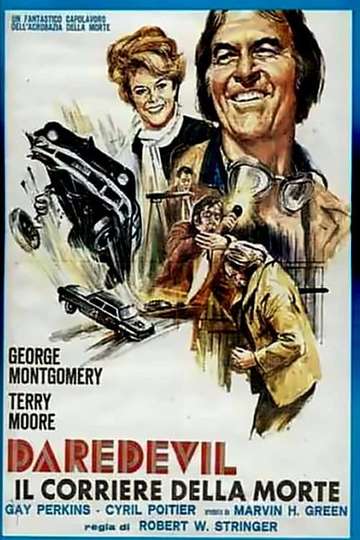
CBS LATE MOVIE: Dr. Phibes Rises Again (1972)

EDITOR’S NOTE: Dr. Phibes Rises Again was on the CBS Late Movie on January 31, 1975 and January 2, 1976.

The fact that this movie exists gives me hope. There are moments when life gets me down, when I wonder about my place in this world and if humanity is essentially horrible. Then I remember that great films like this exist and it makes me feel a lot better. You should do the same thing if you ever find yourself in an existential crisis.

Dr. Phibes is back, three years after he lay down in the darkness next to the corpse of his beloved wife. Now, however, he has learned that the secret of eternal life, held by a centuries-old man, is in Egypt. I don’t care why he’s back. I’d watch Dr. Phibes go grocery shopping!

Dr. Anton Phibes (Vincent Price) has been in suspended animation in a sarcophagus alongside his wife Victoria Regina Phibes (Caroline Munro). When the moon aligns with the planets in a way not seen for two millennia, he returns, summoning the silent Vulnavia (thus confirming to me, at least, that she’s really one of his robots as she died in the last film; furthermore, she’s played by Valli Kemp, who took over for the pregnant Virginia North) to his side.

Phibes plans on taking his wife’s body with him to Egypt, where the River of Life promises her resurrection. As he emerges from his tomb, his house has been demolished and the safe that contained the map to the river lies empty. That’s because the map has been stolen by Darius Biederbeck, a man who is hundreds of years old thanks to a special elixir. He may also be every bit Phibes’ equal.

Darius is played by Robert Quarry, who American International Pictures was grooming to be Price’s replacement. There were tensions between the two on set, including a moment where Quarry was singing in his dressing room and challenged Price by saying, “You didn’t know I could sing, did you?” Ever the wit, Vincent Price replied, “Well, I knew you couldn’t act.” Quarry would have already played Count Yorga in two films for AIP and would go on to appear in The Deathmaster, where he played the hippie vampire Khorda; however, the AIP style had already fallen out of fashion. He’s also in numerous Fred Olen Ray films, such as Evil Toons, where he provides the uncredited voice of the demon.

Biederbeck wants eternal life for himself and his lover Diana (Fiona Lewis, Tintorera…Tiger Shark). Phibes and Vulnavia are on his trail, immediately entering his home, murdering his butler and stealing back the map. Everyone connected with Biederbeck comes to an ill end — Phibes places one inside a giant bottle and throws him overboard. That murder brings Inspector Trout back on the case, as he instantly recognizes that only one man could do something like that.

The rest of the film’s murders are based on Egyptian mythology versus Biblical plagues. Hawks and scorpions, rather than his weapons, along with gusts of wind and bursts of sand. Phibes has also brought an army of clockwork men with him the desert to do his bidding.

Phibes finally exchanges Diana’s life for the key to the River of Life. As he floats the coffin containing his wife down the water, he beckons Vulnavia to join them. As his lover tries to comfort him, Biederbeck begs Phibes to take him with them. He begins to rapidly age and dies as Phibes loudly sings “Over the Rainbow,” which might be the best ending of any movie ever made.

There were plans for many more of these films, and the fact that they were never made saddens me to this day. I’ve heard that a third film would Phibes fighting Nazis. I’ve also heard that it’d be about the key to Olympus. Or Phibes is Dr. Vesalius’ son. Or Victoria Phibes herself coming back, just as sinister as her husband. There have been titles thrown around like Phibes Resurrectus, The Seven Fates of Dr. Phibes and The Brides of Dr. Phibes. There was even a thought of Count Yorga facing off with Dr. Phibes, a fact which delights me to no end.

There was also a pitch for a TV series and what appeared to be an animated version, with Jack Kirby himself providing the pitch artwork.

Other ideas included Dr. Phibes in the Holy LandThe Son of Dr. Phibes (which would have pitted the doctor and his son against ecological terrorists), Phibes Resurrectus (which would have David Carradine as Phibes battling against Paul Williams, Orson Welles, Roddy McDowall, John Carradine and Donald Pleasence. The mind boggles at the thought, let me tell you!), a 1981 Dr. Phibes film where the WormwooInstitutete would have destroyed his wife’s body and then their strange members, including transvestite twins obsessed with economics and nuclear weaponry, fail to match wits with Phibes) And finally, Phibes was almost a role for Peter Sellers in a Pink Panther film where he’d also play Clouseau and Fu Manchu. You can learn more about these at the Vincent Price Exhibit site.

There was also a story in 2013 that Johnny Depp was going to star in a Tim Burton directed remake. That obviously Burton-directed film fits into the same Satanic themes as the original. However, you can add in a few new wrinkles. One of the Eleven Satanic Rules of the Earth states, “When walking in open territory, bother no one. If someone bothers you, ask him to stop. If he does not stop, destroy him.” All Phibes wished to do was take his wife to Egypt and bring her back to life. Once Biederbeck stole from him, his fate was sealed.