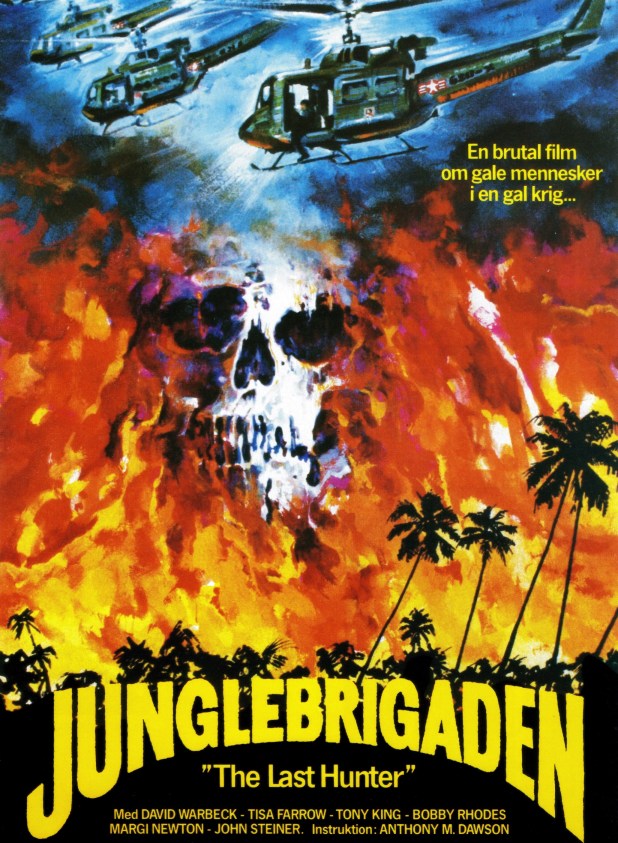
The Last Hunter (1980)

The Italian exploitation industry is one of the joys of my life because just when it feels like you’re running out of films from one genre, you find another one to fall in love with, often with many of the same directors, writers and actors. Can’t find any new poliziotteschi you love? Get back into giallo. Nothing in peplum for you? Dive into post-apocalyptic or Westerns or commedia sexy all’italiana.

Or how about a war movie, much less one influenced by what’s been happening in Hollywood, like The Deer Hunter and Apocalypse Now?

Antonio Margheriti (AKA Anthony Dawson) started his directing career making science fiction films like Space-Men and Battle of the Worlds before moving on to what was hot next. Peplum, with The Golden Arrow, The Fall of Rome and Giants of Rome made over the next three years. If there’s a genre, Margheriti worked in it, like horror (Castle of Blood, The Long Hair of Death, The Virgin of Nuremberg, The Unnaturals), Eurospy (Bob Fleming… Mission Casablanca, Operazione Goldman), Western (Take a Hard RideAnd God Said to Cain), more science fiction (Wild, Wild Planet; War of the Planets, Alien from the Abyss), giallo (The Young, the Evil and the SavageSeven Deaths in the Cat’s Eye), comic books (Mr. SuperinvisibleYor Hunter from the Future), cannibals (Cannibal Apocalypse) and even Raiders of the Lost Ark remake remix ripoffs (Hunters of the Golden CobraThe Ark of the Sun God).

If you could shoot it, Margheriti did it. He was quick, he was cheap and often, he’s pretty incredible. Not always, but more often than not.

And this is one of his war pictures.

Saigon isn’t a fun time to be alive for an American soldier. Captain Henry Morris (David Warbeck) is introduced in this film when he watches his friend shoot another soldier in a brother and then turn the gun on himself. After that, Captain Henry is given a mission. Fly into Cambodia and shut down a radicalized radio station broadcasting Viet Cong messages. He’ll have nearly no help other than a few soldiers. And after years at war, does he even care anymore?

The soldiers under his command include Sgt. George Washington (Tony King) and Carlos (Bobby Rhodes). They barely make it into the jungle when traps shred one of the men nearly in half and later, water snakes emerge and make a meal of another. Italian wartime isn’t pretty. That’s why this movie is on Section 3 of the video nasties list.

As the men make their way through the jungles of the Philippines, they’re joined by a photojournalist named Jane Foster, played by Tisa Farrow. Remember what I said earlier about finding people across genre? Ms. Farrow showed up in just a few Italian movies, but all are memorable and each is in its own genre: slasher (Antropophagus), zombies (Zombi), this war film and one that crosses into both giallo and the poliziotteschi (Strange Shadows In an Empty Room).

There are also some crazy moments along the way, including Major William Cash (John Steiner) having a secret cave base that has a full bar staffed by Luciano Pigozzi, as well as an array of porn mags and working pinball machines. Cash’s favorite music is the sound of gunfire and he barely stops his men from assaulting Foster when she tries to get a beer. His quick thinking is to send one of them across enemy lines to steal a coconut from a tree while being shot at.

There’s a reason for scenes like that. According to the documentary Margheriti and The Last Hunter, the man known in America as Anthony Dawson didn’t want to make a political film for or against the Vietnam War. He just wanted to make a movie that was 100% behind one thing: being entertaining.

In Italy, this was released as Cacciatore 2, as The Deer Hunter was called Il Cacciatore. The only thing this movie has in common with its inspiration is Vietnam and it’s more of a ripoff of Apocalypse Now as it was shot in the exact same locations and dealt with the same issues that Coppola dealt with except with a much, much smaller budget.

Throughout the movie, Morris keeps thinking back to New York City and that girl back home, who is played by Margie Newton (Aphrodite from The Adventures of Hercules, the painted-up Lia Rousseau from Mattei’s Hell of the Living Dead). As they get closer to that anti-American radio tower and the voice of the Tokyo Rose-style woman telling the U.S. soldiers just to lie down their arms as we hear easy listening tunes and Viet Cong kill the drugged out and hazed American boys, we come to realize that this love waiting at home and the one Morris has to kill are one and the same, which is an astounding coincidence but says a lot about the end of U.S. innocence in the 1970s.

Over the score by Franco Micalizzi, whose song “The Puzzle” will be familiar to fans of Curb Your Enthusiasm, we get a great ending, as Morris gets Foster on the last helicopter out of Hell and just kneels as the napalm starts to rain down, a visual similar to Platoon six years before that movie would be made.
School of Fear (1989)

Directed by Lamberto Bava and written by Dardano Sacchetti (nearly every Italian movie that you love), Roberto Gandus (MacabreMadhouse) and Giorgio Stegani (Cannibal Holocaust), School of Fear is part of the second series of TV movies that Bava was hired to make.

Known as Alta Tensione (High Tension), the other movies in this series are The Prince of TerrorThe Man Who Didn’t Want to Die and Eyewitness. For TV movies, they have decent production values and allow Bava to explore some rather mature themes.

If you have children, let me remind you to never allow them to attend European educational facilities like the Swiss Richard Wagner Academy for Girls, the Tanz Akademie or the Giacomo Stuz private school. I mean, a child drowns at the beginning of this and that’s moments into this movie.

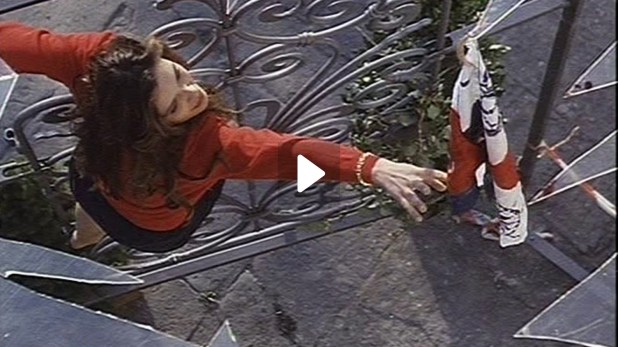
Diana Berti (Alessandra Acciai) arrives at the school and instantly runs into problems. There’s a deformed child in the shadows, her skirts are too short for the school’s leader (Dario Nicolodi) and oh yeah, she has past traumas that the school keeps bringing to the fore. You know what isn’t helping? The last teacher in her role died by going through a plate glass window and they’re never fixed all that broken glass.

The real problem, as always, is the children. They play some secret game that the last teacher — the one who took a header through a closed window — was already worried about after she learned just how frightening that it can be from one of her students.

This game takes them into the abandoned parts of the school, places that are haunting for adults much less little ones. These kids, however, are borderline monsters, able to hack into video signals, showing an image of her impaled on the front gate just like the last teacher and using Diana’s past sexual assault to remind her that no one will ever believe her when she tries to expose how horrible they behave.

They’re right.

The children are from the upper crust, the school has too good of a reputation and after all, look how sweet these young men and women are as they sing in the choir. Surely they couldn’t have done all this. Even her police inspector love interest, Mark Anselmi (Jean Hebert), thinks she’s being ridiculous about it all.

This movie is absolutely wild, as it has a classroom of kids tear to pieces the morality and art of Pier Paolo Pasolini while a child who looks like a dwarf in a red jacket runs wild on the grounds.

I have no idea why neither of Bava’s sets of TV movies are available in better quality in the U.S. Here’s hoping with Vinegar Syndrome releasing A Blade In the Dark that they go deeper into the movies that he made as his career took him to the small screen.

You can watch this on YouTube.

Tiger Joe (1982)

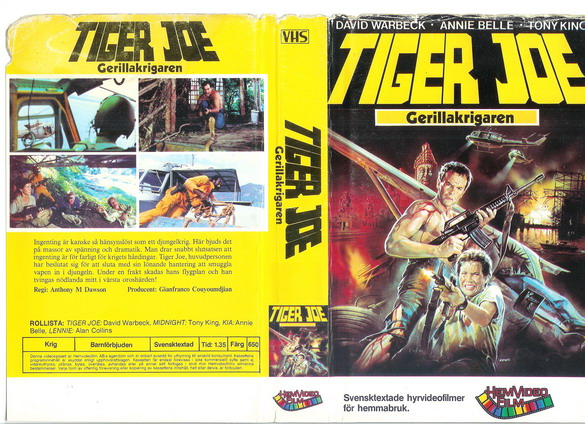
Known as Fuga dall’arcipelago maledetto (Escape from the Cursed Archipelago) in Italy, this Antonio Margheriti-directed and Tito Capri-written film stars David Warbeck as Tiger Joe, a former US Army Special Forces Vietnam Veteran who works with “Midnight” Washington (Tony King, Atlantis Interceptors) and Lenny (Luciano Pigozzi) to airlift all sorts of cargo but mostly guns.

When he gets shot down, he joins up with Kia (Annie Belle, who started her acting career appearing in Jean Rollin’s Lips of Blood and Bacchanales Sexuelles; she’s in so many movies by directors and personalities I’m obsessed with: Deodato’s House On the Edge of the Park, D’Amato’s Absurd and L’alcova, the supposed Emmanuelle Arsan-directed Forever Emmanuelle, Marco Antonio Andolfi’s Cross of the Seven Jewels and the Cannon film Nana) and her companion Datu (Abadeza) to get out of the jungle alive.

This has a lot of cast, crew and shots from the much better The Last Hunter, but I just love Antonio Margheriti. He brings something extra to every movie. Sadly, cinematographer Riccardo Pallottini lost his life in a plane crash while filming the final shot of the film.

May I never ever get tired of seeing bamboo huts in the Philippines blow up. If you want more Margherti in the jungle, check out Tornado: The Last Blood, Code Name: Wild Geese, The Last Hunter, Commando Leopard, The Commander, Indio and Indio 2: The Revolt.

LIBERATION HALL BLU RAY RELEASE: Project Alf (1996)

On March 24, 1990, NBC aired the final episode of Alf.

The main character on the show was, well, ALF (Alien Life Form). No one used his real name, Gordon Shumway. He came from the exploded world of Melmac to Earth, smashing into the garage of the suburban middle-class Tanner family who are made up of Willie (Max Wright), Kate (Anne Schedeen), Lynn (Andrea Elson), Brian (Benji Gregory), cat Lucky and later baby Eric.

ALF was such a big deal that there were stuffed toys at Burger King and a cartoon series, which was infamous for one episode supposedly having a subliminal message.

For four seasons, the family dealt with the completely rude and often hilarious being and kept him safe from the Alien Task Force. And Alf also made plenty of friends, including Willie’s brother Neal (Jim J. Bullock), a psychologist named Larry (Bill Daily) and Jody (Andrea Covell), a blind woman who falls in love with him.

ALF was incredibly difficult to make, so much so that in a People article in 2000, everyone admitted that people were constantly freaking out on the set. Max Wright hated every minute of it, losing most of the laugh lines to a puppet. He supposedly even physically attacked ALF once. That said, in the same article, he was more open-minded about the show, saying “It doesn’t matter what I felt or what the days were like, ALF brought people a lot of joy.”

Yet after the final episode, “Consider Me Gone,” Anne Schedeen said that after the final take, “there was one take and Max walked off the set, went to his dressing room, got his bags, went to his car and disappeared… There were no goodbyes.”

I always wondered why the show ended, but now that I know more, I feel for the cast. Schedeen also reported that “It’s astonishing that ALF really was wonderful and that word never got out what a mess our set really was.”

One example is her TV daughter Andrea Elson. After suffering from bulimia during the show, she admitted that if the show went one more year, everyone would have really lost their minds.

That said, ALF was in tenth place in season 2 and never went below 39th place. The kind of ratings it got back then would be a huge success today. By season 4, NBC was on the bubble, so the show did a cliffhanger. Then they got a verbal commitment from NBC. But then the show never came back.

Imagine being a child when the true worry of the show finally came true. ALF was taken by the government to be dissected after he missed aliens from New Melmac coming to rescue him. It said “To be continued,” but it never was. NBC executive Brandon Tartikoff would years later tell puppeteer Fusco “It was a big mistake that we canceled your show, because you guys had at least one or two more seasons left.”

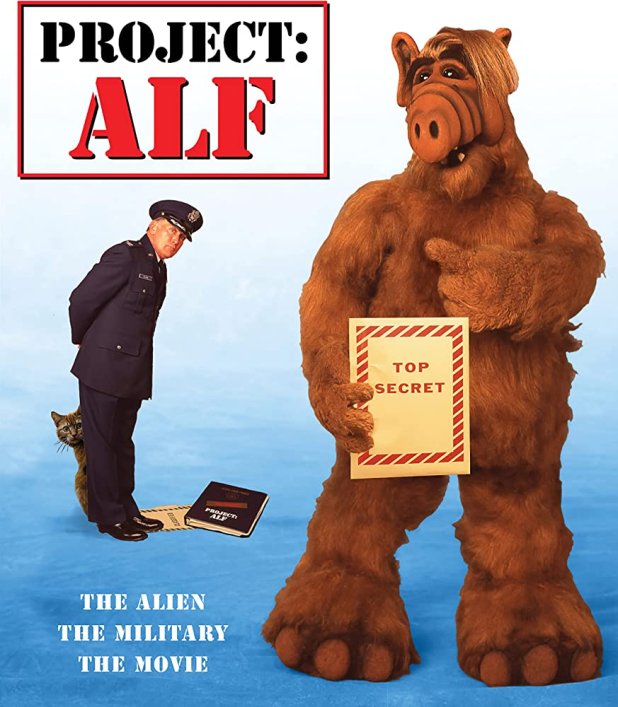
ABC would finally resolve the cliffhanger six years later with Project:ALF.

Project: Alf is one strange movie. On one hand, it has plenty of the humor of the original show. But it comes off as gallows humor, as ALF is detained at Edmonds Air Force Base and constantly being threatened by Colonel Gilbert Milfoil (Martin Sheen). He’s finally had enough and plans to incinerate the creature, despite how beloved he is by the base. Of course, ALF has taken advantage of everyone, creating a black market out of a hangar and continually winning money playing poker.

As for the Tanner family, they used the Witness Protection Program to go to Iceland.

Two of the scientists, Major Melissa Hill (Jensen Daggett, Friday the 13th Part VIII: Jason Takes Manhattan) and Captain Rick Mullican (William O’Leary, who was on Home Improvement playing the husband of his co-star Daggett) kidnap ALF and take him on the run where he meets Ray Walston — once My Favorite Martian — as a motel clerk and goes to the Kitty Kat Lounge, which he thinks is a buffet but ends up being filled with exotic dancers.

He finally ends up in the orbit of Dexter Moyers (Miguel Ferrer), who was nearly one of the men on the moon ad has now been discredited by the government. He’s going on a Piers Morgan-esque show where he will publicly show ALF to the world but Minfoil wants to exterminate Gordon Shumway before that can happen.

There’s a wild cast in this. Beyond Sheen and Ferrer, there’s John Schuck, Ed Begley, Jr., Charlie Robinson (Mac from Night Court), Beverly Archer (who was Mrs. Byrd on the original show), Ahmet Zappa and even a robot that seems to be set up to be the Higgins for ALF if this ever became a series.

The movie was directed by Dick Lowry (Smokey and the Bandit Part 3Archie: To Riverdale and Back AgainIn the Line of Duty: The F.B.I. MurdersThe GamblerThe Jayne Mansfield Story) and written by Tom Patchett, who was one of the creators of ALF along with Paul Fusco, who returns to play ALF. Patchett also created the shows Buffalo Bill and The Tony Randall Show, as well as writing Up the AcademyThe Great Muppet Caper and Muppets Take Manhattan.

I really enjoyed this, as it brought back happy memories from my late teen years. I think you’ll feel the same way.

Project Alf is now available on blu ray from Liberation Hall, who have been releasing some interesting TV movies lately. It has a photo gallery, a trailer and an interview with creator Paul Fusco. You can get it from MVD.

ARROW BOX SET RELEASE: Enter the Video Store – Empire of Screams: The Dungeonmaster (1984)

EDITOR’S NOTE: This was first on the site on . It’s back as it’s now part of the Enter the Video Store — Empire of Screams box set, which has three different versions of the film via seamless branching: the US theatrical version (The Dungeonmaster), the pre-release version and the international version (Ragewar) plus extras like new audio commentary with star Jeffrey Byron, moderated by film critics Matty Budrewicz and Dave Wain from The Schlock Pit, a new interview with Byron, trailers and an image gallery. You can get this set from MVD.

Let’s face it. I love portmanteau movies. From Tales from the Crypt to AsylumThe House that Dripped Blood and The Monster Club, a good part of our DVD collection is devoted to these films (mostly of the Amicus variety). 1984’s The Dungeonmaster attempts to be both a narrative and portmanteau all at the same time — to sometimes uneven results.

Also known as Ragewar: The Challenges of Excalibrate and Digital Knights, this Charles Band-produced effort (Puppet Master, Subspecies, Re-Animator) is made up of seven different segments, all connected by the battle between Paul Bradford (Jeffrey Byron, Metalstorm: The Destruction of Jared-Syn) and Mestema (Richard Moll, who played Bull from TV’s Night Court, as well as The Sword and the SorcererHouseWicked Stepmother and more). Again, it’s a film that struggles to find a tone — it wants to be Tron as much as it wants to be a filmed version of a Dungeons & Dragons campaign.

Paul may not be able to balance a checkbook, but he loves to jog and he’s great at fixing computers. In fact, the dude is so good, he has 2017 iPhone tech that tracks his jogging. If you watch the film today, you’ll be like, “Yeah, so what.” But keep in mind, this is a 33-year-old movie.

At some point, Paul did a neural net experiment that allows him to talk to X-CaliBR, his female personal computer. This is the only futuristic tech in this world, so I guess we all have to accept that people’s brains can be wired to their CPUs.

Paul keeps having dreams where he is making love to a beautiful woman. The more knowledgeable of you out there will realize that this scene doesn’t have much to do with the rest of the movie. It was probably to secure foreign distribution with the amount of flesh on display.

Paul lives with his girlfriend Gwen live together, but she’s super jealous of how close he is to his computer. None of that has anything else to do with what happens next — the sorcerer Mestema — who has spent thousands of years looking for a worthy opponent — kidnaps both of them.

What follows are the portmanteau segments, where Paul and his laser wristband must travel through different dimensions and time to battle Mestema and win back Gwen.

PART 1: ICE GALLERY

Ever seen Waxwork? It seems like everyone working on this may have. That said — the visuals are pretty nice here, with various monsters and killers throughout history all frozen inside a giant cave. Why is Albert Einstein there? Is it a comment on his role in the nuclear bomb? No one ever really explains that — this is a movie that you either damn for being stupid or fill in the narrative gaps yourself.

PART 2: DEMONS OF THE DEAD

I originally learned of this film from the Alamo Drafthouse’s Trailer War compilation. This scene is prominently featured in the trailer, with Fulci-like zombies being dispatched with laser beams. It is, as I am often heard to yell, “Fucking awesome.” It’s written and directed by John Carl Buechler, who was Jack Cracker in the first two Hatchet movies.

PART 3: HEAVY METAL

In this segment, directed by Charles Band, our heroes battle 80s metal kings W.A.S.P. If you love Blackie Lawless, well, this is the movie for you, as he is front and center and menacing Gwen. Sadly, Chris Holmes does not appear with his mother in this scene.

PART 4: STONE CANYON GIANT

Stop motion style fun here, with a giant canyon monster blocking Paul from progress. This segment was written and directed by Dave Allen, who got his start with Equinox and worked on a huge variety of films from Flesh Gordon, Laserblast and The Howling to *batteries not includedWillow, the Puppet Master series, Honey, I Shrunk the Kids and so much more. Sadly, he died from cancer in 1999.

In a strange moment of Wiki research, I learned that Allen used to be married to a woman named Donita Woodruff. She learned that Allen had an ex-girlfriend named Valerie Taylor, which led to a fight between the two women. Woodruff suspected that Taylor had a criminal past and found enough evidence to get the police to arrest her in 1996 for a 1979 South Carolina murder. Taylor pleaded self-defense and served two years, while Allen and Woodruff would divorce two years later. There’s even a book about it — Deadly Masquerade: A True Story of Illicit Passion, Buried Secrets, and Murder.

Check this out — “Donita, a young, single mother of two lives in the day-to-day confinement of a small town in rural Oklahoma. Hungering for a second chance and the bustle of the big city, she decides to move her family back home to Los Angeles. Still hurting from previous romantic relationships, Donita is hesitant to start anything new; anything until she meets Academy Award nominee David Allen—successful, handsome and charming. The two are quickly swept up in a whirlwind romance. Life seems too good to be true but even wedding bells can’t hide the secrets her new husband has. Suddenly, Donita and her children are caught in a Deadly Masquerade, a world of vicious lies and double lives, where nothing is as it appears.

Mysterious phone calls, a questionable ex-lover, an unsolved murder, all begin to unravel in Donita Woodruff’s true-life account, Deadly Masquerade. When the perfect man reveals a sordid, double life, she is forced into a series of stunning revelations. Now, she only has one choice—to take matters into her own hands.”

Seriously — they should have just film this book NOW. Because I just learned that Valerie Taylor used to be a man. And that’s why Woodruff was so freaked out! AGAIN –Wikipedia will lead you down some crazy wormholes.

PART 5 – SLASHER

All of a sudden, the film becomes a cross between Quantum Leap and a horror movie. It’s written by lead actor Jeffrey Byron and directed by Steven Ford (the son of former U.S. President Gerald Ford — fuck, this movie has a veritable rogue’s gallery of backstories). Paul has to escape from the police to rescue Glen from a serial killer.

PART 6 – CAVE BEAST

A cave beast blocks the way and Paul must fight his way past it. Look — not all of The Dungeonmaster has to be complicated.

PART 7 – DESERT PURSUIT

Mad Max style racing across the desert that seems to end with our characters dying in a head-on collision in a sequence written and directed by Ted Nicolaou (Bad ChannelsTerrorVision). In case you’re wondering, yes, these are the same vehicles from Metalstorm: The Destruction of Jared-Syn.

Finally, Paul challenges Mestema to a one on one battle, which ends when Paul throws the sorcerer into a pit of lava. At this point, Gwen decides that X-CaliBR8 isn’t so bad and that she can finally marry Paul.

Like any portmanteau, there are some good and bad parts in equal measure. Richard Moll is awesome in this, just chewing scenery and blasting out some insane dialogue. The zombie scene is good, as is the giant. But your life won’t change watching this film. If you’re looking for something to put on as a soundtrack to a party or some great visuals, it’s certainly good for that.

PS – A sequel segment was filmed for the anthology Pulse Pounders and only shown once, but since Empire Pictures closed, no one is sure as to when it will be released. Moll and Byron came back for this sequel — which I’d love to see.

Pulse Ponders was to be another portmanteau with three stories: The Evil ClergymanTrancers: City of Lost Angels and The Dungeonmaster II: A Sorcerer’s Nightmare. Some of it has come out, so here’s to the full release!

Giovannona Long-Thigh (1973)

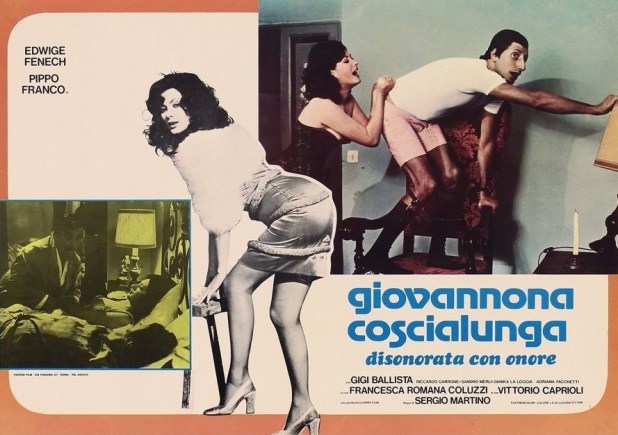
Edwige Fenech — who was only just a giallo queen but a star of commedia sexy all’italiana movies — and Pippo Franco had been a success in 1972 in Mariano Laurenti’s Quel gran pezzo dell’Ubalda tutta nuda e tutta calda which was released around the world as Ubalda, All Naked and Warm.

Franco is Ragionier Mario Albertini who has been asked by his boss Commendatore La Noce (Gigi Ballista) to find him a fake wife so that he can get the philandering judge who closed the cheese factory to get in a scandal and reverse his decision. Albertini hires Giovannona “Cocò” Coscialunga (Fenech), a prostitute who looks pure but has the filthiest of mouths.

Directed by Sergio Martino, this was written by Franco Mercuri, Francesco Milizia and Carlo Veo from a story by Tito Carpi and Sergio’s brother Luciano, who was married to Fenech for a time. The cinematographer was Stelvio Massi, who went on to direct Arabella the Black Angel and Convoy Busters.

Italian sex comedies don’t always translate all that well, especially because so many of them are fifty years old. But you know, you get to look at Edwige Fenech for the entire movie. It can’t be that bad.

Eyewitness (1989)

Elisa (Barbara Cupisti) and Karl (Giuseppe Pianviti) are in a department store at closing time, waiting until no one is watching so that she can steal a shirt. She’s stuck there alone as Karl runs out to get their car and while the store is closed, she sees a secretary get killed by her manager (Alessio Orano)

Or, well, she doesn’t.

Because Elisa is blind.

Directed by Lambero Bava with a script by Giorgio Stegani and Massimo De Rita, this is a made for TV giallo in which police commissioner Marra (Stefano Davanzati) investigates the suspects, which includes the secretary’s lover (Francesco Casale), as well as Elisa and Karl. At the same time, the manager thinks that Elisa knows who he is because he believes that she can sense him.

There are moments here — when it isn’t trying to be Wait Until Dark — when the film aspires toward the giallo of the past. I love the idea of a rehabilitation center for people with disabilities that tries to get them to expand their abilities. And of course the manager tracks down Elisa in the hopes of killing her in a scene that has echoes of Tenebre and “Blind Alleys” from Tales from the Crypt mixed with some incredible POV shots and great editing.

Unlike most giallo, we know the killer from the beginning. But that’s fine. The tension here comes from how close the killer gets to our heroine. And yes, as always, the cops are the absolute worst. Defund the giallo police, I always say.

Flavia the Heretic (1974)

Florinda Bolkan excels at the role of a woman losing her mind. She’s a force of nature in A Lizard in a Woman’s Skin and Footprints on the Moon, two films that are placed in the giallo genre but that are centered around her and her fragmented psyche.

She plays Flavia, a young girl who watched her father — who loudly complains that he didn’t have a son but instead a daughter, a curse as he says — cut a man’s head off his shoulders. He locks her up in a convent where she’s abused by the other nuns. Things get worse when she tries to escape. But when she meets Ahmed (Anthony Higgins), the Muslim warrior who has taken over the city, she decides to get her horrific revenge on her former sisters.

This being an Italian movie, there’s an actual horse castration and a naked man climbing inside the hung and torn-apart body of a dead cow as well as a fake nipple slicing that’s pretty stomach upsetting. The real nausea comes from the fact that nearly every man in this movie is the worst person ever. And then Flavia gets skinned alive and we learn, well, that humanity is uniformly terrible.

Director Gianfranco Mingozzi was the second unit director on La Dolce Vita, so this is a bit artier than you may be expecting. It’s still repellant, however. And women have never had a fair shake but hopefully they don’t have to go through all this for much longer to get what’s only right.

Junesploitation: Dragon Blood (1982)

June 12: Junesploitation’s topic of the day — as suggested by F This Movie— is Westerns! We’re excited to tackle a different genre every day, so check back and see what’s next.

John Liu’s first kung fu lessons came from his grandfather but the flexible kicks that he became famous for were from his lessons with “Flash Legs” Tan Tao Liang, who put him through a rigorous training regime — Drunken Master-style pain like resting each foot on two piles of bricks — to improve his skills.

He started off as an actor in several Hong Kong movies — Secret RivalsThe Invincible ArmorSnuff Bottle Connection — before directing and writing four quite baffling movies: Zen Kwan Do Strikes ParisMade In China (AKA Ninja In the Claws of the CIA) and the unfinished — until 2021 — New York Ninja. Years later — and after his acting career ended — Liu developed Zen Kwan Do, which he claimed was popular in France

Man, those four movies.

Man, this movie.

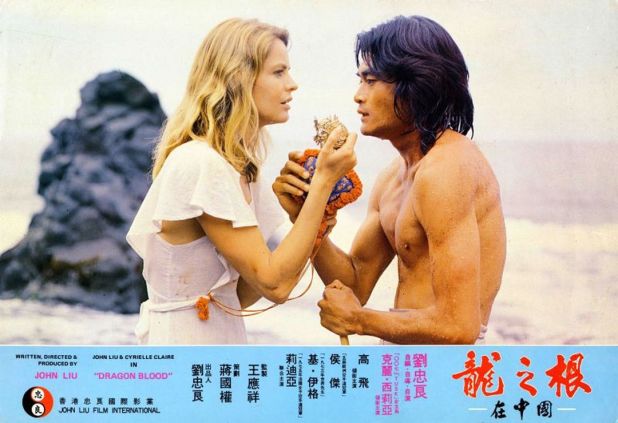
As always, John Liu plays John Liu, except this time he’s in 1886 Mexico. He’s the son of the best fighter in China, a man who was given two gold dragons by the Emperor to prove just how talented he was. Those dragons, however, were a curse. He had to fight anyone who came his way. His last challenger, however, just wanted to fight him for honor. But during that fight, John’s father gets jumped and killed. With his last words, he makes the honorable martial artist the guardian of his son and of one of the dragons.

After his guardian is killed — fighters kept showing up and one finally killed him — John takes all the fighting skills he has known, the gold dragons and himself to the New World, where he wants to protect the Chinese who are fighting racism and the slavery of working on building railroads.

That sounds like a movie that makes a fair amount of sense.

Well, this is a John Liu movie.

Once he arrives in Mexico, he battles a gang of outlaws. They overcome him with their guns and push his face into a blazing campfire. Now blind as a result of his pride, he gives up. The woman he once saved — Paulette  (Cyrielle Clair, Sword of the Valiant and another major film I’ll get into in a minute) — trains him with a series of tests, like a mobile that makes sounds, a cactus he must defeat with his feet and even being able to catch knives blind that she throws at him with no warning. There’s another scene where she throws a series of eggs at him and while blindfolded, he knocks every one out of the air before they touch him.

There are enemies in wait. There’s a killer (Phillip Ko Fei) sent by the Chinese government. There’s a karate fighter (Roger Paschy) who is the guardian of a large chubby child who may never learn martial arts. There’s a scene where the kid nearly wipes himself out with nunchucks.

Paulette and John alternate training with arguing, including one time when she goes to town without telling him for two days and leaves him alone. When she returns, he asks why she didn’t leave a note. She tells him he couldn’t read it anyway. A pause and he yells, “Because I’m blind!”

This has a lot of messages in it. There are Chinese people being mistreated. There’s pride. There are the dragons, which are the symbols of the Chinese bloodline and the endless bloodshed. Most of all, while John is the best fighter of all time, he doesn’t want to fight.

But the end, man. The end. John gets shot by the mayor of the town — after winning his greatest fight — who was trying to kill Paulette. Then she’s killed by a female assassin who is killed by the chubby kid and as John Liu sits on the beach and discusses death. And we end up with that goofball kid and dead bodies everywhere.

Back to Cyrielle Clair. The credit for her in this movie literally says “Star of Tusk.” I was wondering, at the scene where John cuts open a cactus to drink while struggling to survive the desert if this movie was suddenly becoming El Topo. I mean, I get it. I’m obsessed with Alejandro Jodorowsky and see him in so many movies. But when the credits of a film — inside the film itself — call out the fact that one of the few actors in it starred in Jodorowsky’s comeback picture, well…there are no coincidences, right?

I adore this movie and not just for how weird it is. It’s a Western Kung Fu Zaitochi that’s assistant directed by Godfrey Ho. Of course I’m going to enjoy it. But I really love it because it uses the same TV sports highlight theme throughout.

ARROW BOX SET RELEASE: Enter the Video Store – Empire of Screams: Robot Jox (1990)

EDITOR’S NOTE: You can read another review of this movie here.

I can’t even tell you how excited I was about Robot Jox in 1990. It seemed like it was in every issue of Starlog and I kept wondering, when would one of the video stores in my hometown get it? It seemed like a live action Transformers movie and according to director Stuart Gordon, that was the idea: “While there have been animated cartoons based on these giant robots, no one has ever attempted a live-action feature about them. It struck me that it was a natural fantasy for the big screen–and a terrific opportunity to take advantage of the special effects that are available today.”

Gordon worked with special effects artist David W. Allen to create test footage for the investors for this movie and that ended up becoming the opening title sequence. Initially budgeted at $7 million — it grew to $10 million — Robot Jox was the most expensive film Empire Pictures production.

Science fiction author Joe Haldeman wrote the story with Gordon but the two battled throughout. The writer wanted a serious movie about embattled soldiers and the director wanted a Cold War movie with big special effects. Even the title was debated, as Haldeman wanted The Mechanics and Gordon wanted Robojox.

Haldeman wrote that Gordon later recognized that the author was “writing a movie for adults that children can enjoy” while Gordon had been “directing a movie for children that adults can enjoy.”

Despite those issues and Empire’s bankruptcy causing delays, I still fondly remember this film, as when I finally got to see it, I really enjoyed it. Obviously, Guillermo del Toro did, as the way the robots are controlled and how the pilots are trained are so close to his Pacific Rim.

Only the American Market and the Russian Confederation have survived fifty years after a nuclear war. They decide all conflicts by having giant robots battle as robot jox control them. Alexander (Paul Koslo) is the villain and has murdered his last nine opponents thanks to a spy giving him special weak points. But now he comes up against another fighter who is at his tenth match — when robot jox can retire — Achilles (Gary Graham). Their battle will be for the rights to Alaska and there’s plenty of pressure.

Achilles trains while studying with robot designer Doc Matsumoto (Danny Kamekona, Sato from The Karate Kid Part II) and strategist Tex Conway (Michael Alldredge), the only robot jox to win all ten of his fights. There’s also an entire training center where new genetically engineered robot jox like Athena (Anne-Marie Johnson) are training to replace Achilles.

During the battle, Alexander goes wild and fires a weapon into the audience. Alexander tries to stop it but his mech crashes into the stands, killing three hundred or more of the fans. Shaken by this, he refuses to come back and fight again when the match is ruled a draw.

All sorts of chicanery ensures and Athena drugs Achilles, who comes back for that one big fight, and she gets decimated by Alexander. That leads to a second battle between Alexander and Achilles, who comes back. It even ends up in a one on one fistfight and after all the horror that the Russian pilot has visited on, well, the entire cast of this movie, they bump fists to show sportsmanship.

This was followed by Robot Wars and footage — Full Moon is big on recycling — is also in Crash and Burn.

In the world of Robot Jox, you never say “Good luck.” You say, “Crash and burn.”

I just want 15 year old me to know that in the future, I own this movie and we can watch it any time that we want.

Robot Jox is part of the Enter the Video Store — Empire of Screams box set. Extras include two archive audio commentaries (one with director Stuart Gordon and a second with associate effects director Paul Gentry, mechanical effects artist Mark Rappaport and stop-motion animator Paul Jessell), new interviews with Gary Graham and Anne-Marie Johnson as well as a new appreciation of stop motion animator David Allen, an archival interview with actor Paul Koslo, the original sales sheet and production notes, a trailer and image galleries, including behind-the-scenes stills courtesy of associate effects director Paul Gentry. You can get this set from MVD.