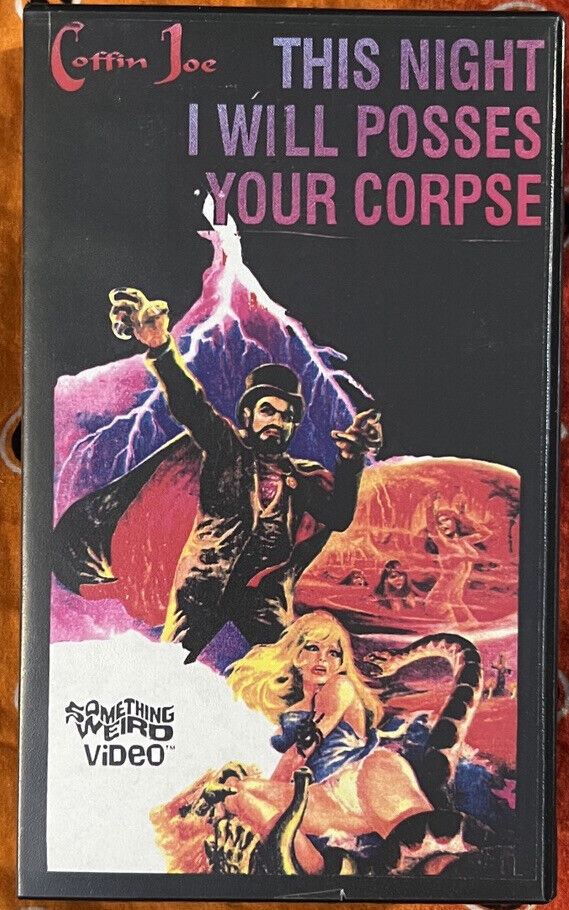
The Sizzlin’ Something Weird Summer Challenge 2024: This Night I’ll Possess Your Corpse (1967)

69 EsSINtial SWV Titles (September 15 – 21): Klon, who came up with this list, said “This isn’t the 69 BEST SWV movies, it isn’t my 69 FAVORITE SWV movies, my goal was to highlight 69 of the MOST SWV movies.” You can see the whole list here, including some of the ones I’ve already posted.

Four years later, Coffin Joe has returned from the end of At Midnight I’ll Take Your Soul and has recovered from shock, blindness and being accused of a series of murders. Now it’s time to get back to finding his perfect woman and continue his blood.

Together with a hunchbacked assistant named Brono, he kidnaps six gorgeous women and puts them all through a horrific series of tasks to determine who will bear his child. Only Marcia doesn’t scream in the face of the madness Coffin Joe puts them through, so only she can be the one. Yet even though he takes her to his bed — and kills the other five with snakes — she refuses him. He releases her, claiming he knows that she will never tell anyone what she has seen.

That’s when he meets the Colonel’s daughter, Laura, who actually returns his affection. The military man and his son try to break off their union, but Coffin Joe acts as only as he can to such an offense: he has Bruno kill Laura’s brother and blames the colonel’s henchman Truncador.

Yet now comes the dark night for the man who has no soul, as he goes to Hell after learning that one of his six brides was pregnant when he killed her. Dooming her child, he wanders the technicolor nightmare that is the abyss and comes upon Satan himself, who is also Coffin Joe. Our world’s version renounces his ways in light of this revelation.

Coffin Joe resists all the killers the colonel and his men send after him and finally impregnates Laura, just as Marcia kills herself by drinking arsenic. Yet before she dies, she tells the townsfolk of Coffin Joe’s crimes and they form a lynch mob just as he must decide who will survive, his bride or the baby, as the pregnancy has complications. Together they agree that the child must live, but fate is cruel and both Laura and Joe’s scion die. Destroyed by this, he is no match for the lynch mob that arrives, shooting him in the cemetery where he drowns in the same pond where he drowned so many of his victims.

At the point of death, a priest offers to hear Joe’s confession. He accepts God as his Savior and drowns as the skeletons of his victims claim him.

Brazilian censors forced filmmaker — and the human avatar of Coffin Joe — Jose Mojica Marins to recut and redub the end of this movie. That’s why the strange ending of salvation is in here. It enraged Jose Mojica Marins and put a curse on his career, or so he felt, to the point that he could never finish his planned trilogy of three Coffin Joe movies. It took until 2005 and filmmakers who grew up as his fans before Embodiment of Evil closed out the story and showed how Coffin Joe survived.

In The Wizard of Oz, a better world is in color instead of black and white. In This Night I’ll Possess Your Corpse, Hell itself is the only place to get the full color gel Mario Bava treatment and that says something about the nihilistic worldview of its creator and his creation. I grew up in a small town too, Coffin Joe, but I wasn’t brave enough to grow out my fingernail to absurd lengths, go on and on about my superiority and make out with a woman while throwing snakes at others. I can only watch you and see how it could have been.

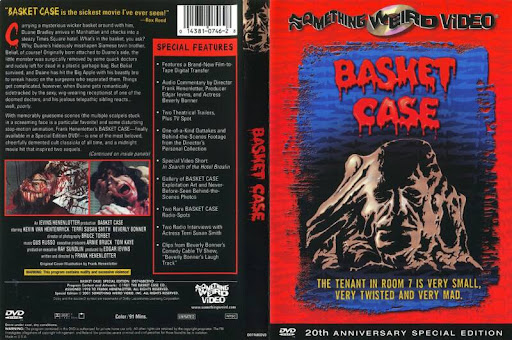
The Sizzlin’ Something Weird Summer Challenge 2024: Basket Case (1982)

69 EsSINtial SWV Titles (September 15 – 21): Klon, who came up with this list, said “This isn’t the 69 BEST SWV movies, it isn’t my 69 FAVORITE SWV movies, my goal was to highlight 69 of the MOST SWV movies.” You can see the whole list here, including some of the ones I’ve already posted.

Frank Henenlotter is an instrumental figure in grindhouse and exploitation film lore. In addition to rescuing many low-budget sexploitation and exploitation films from being destroyed, he made three Basket Case movies and Brain Damage. This is one of the few movies that upsets Becca so much that she refuses to watch it.

Duane Bradley arrives in the grimiest and scummiest New York City with a locked wire basket that contains his formerly conjoined twin, Belial. They were separated against their will and Belial has always resented it, pushing his brother to get revenge on the doctor who cut them apart.

Our hero — well, such as it is — falls in love with a nurse named Sharon, but Belial tries to rape her, can’t perform and kills her instead. Is it any more frightening if I tell you that Belial is basically a rubber glove on Henelotter’s hand? Duane attacks his brother and they fall out of the apartment to their death.

Don’t worry — the brothers survived to make it to the sequel, as well as another film after that where Belial got a powered exo-skeleton. The brothers also show up in the subway in Henenlotter’s Brain Damage.

Critic Rex Reed’s was quoted on the poster for this movie, saying “This is the sickest movie ever made!” He had heard how gross the film was and sought it out. As he left the theater, someone asked him what he thought. He didn’t realize that that person was Henenlotter and as a result, he was furious that he was being used to promote this movie.

The bar scenes were shot in The Hellfire Club, an S&M bar in Manhattan. The crew had to hide all the sex toys and swing, but left behind the buzz saw that killed the boys’ father as a gift. That very same crew was so offended by Sharon’s death scene that they all walked out rather than continue filming it.

The Sizzlin’ Something Weird Summer Challenge 2024: Blood Feast (1963)

69 EsSINtial SWV Titles (September 15 – 21): Klon, who came up with this list, said “This isn’t the 69 BEST SWV movies, it isn’t my 69 FAVORITE SWV movies, my goal was to highlight 69 of the MOST SWV movies.” You can see the whole list here, including some of the ones I’ve already posted.

I’m proud to say that Herschell Gordon Lewis was born in the same town as me, Pittsburgh, PA. He was lured from a career as an educator into being a radio station manager and then, well, advertising got him. I can relate. I’ve spent the better part of 25 years doing the same. But then Lewis got smart. He learned how to make money.

He began making movies with David F. Friedman, starting with Living Venus. Their nudie cuties would be innocent today, but showed way more skin than mainstream films. These weren’t high art. They were made to turn a profit and they sure did, from movies like Boin-n-g! and The Adventures of Lucky Pierre to the world’s first — and probably only — nudist camp musical, Goldilocks and the Three Bares.

Once nudie movies got boring, Lewis needed another tactic. He found it. Oh wow, did he find it. Gore. Blood everywhere, guts all over the screen and no limits to the depravity that he’d fester on drive-in screens nationwide. It all started with Blood Feast.

This is a pretty simple film: Faud Ramses wants to make sacrifices to the Egyptian goddess Ishtar to resurrect her, so he kills beautiful young socialites when he’s not catering their coming out parties. He’s also wiping out anyone who requests a copy of his book, Ancient Weird Religious Rites.

Shot in Miami, Florida — where life is cheap! — in just four days for just $24,000, Blood Feast used all local ingredients for the gore, except for a sheep’s tongue that came from Tampa Bay. Friedman was a genius at publicity, helping the film succeed, giving out vomit bags at screenings and even applying to get an injunction against his own movie in Sarasota so that it couldn’t be shown.

Lewis and Friedman didn’t stray too far from their sexy roots, bringing in June 1963 Playmate of the Month Connie Mason to star in the film. She would come back for Lewis’ even more astounding Two Thousand Maniacs!

As for Lewis, he left filmmaking in the 1970’s, served some jail time for fraud and then began copywriting his way to even greater success, a second — maybe even third or fourth career — later in life. He wrote and published over twenty books, including The Businessman’s Guide to Advertising and Sales PromotionDirect Mail Copy That Sells! and The Advertising Age Handbook of Advertising. His books were all over the place at my first agency job and I was shocked to discover that the author of these books — one of the godfathers of direct mail and eblasts — was also the American godfather of gore. Sometimes. life makes sense.

In 2016, Arrow Video released a huge box set of his films and the man whose work was often in grimy drive-ins and Something Weird video cassettes finally began to be appreciated as an auteur. Funny, as he was the man who said, “I see filmmaking as a business and pity anyone who regards it as an art form.”

You know those movies that they warn you about and tell you that they’ll warp your mind and make you a maniac, how you’ll never be the same again? This is that movie. You should probably watch it right now.

Can’t make it this weekend? Blood Feast is available on Tubi or on Shudder with and without commentary from Joe Bob Briggs.

CANNON MONTH 3: The Twilight People (1972)

EDITOR’S NOTE: As the journey through Cannon continues, this week we’re exploring the films of 21st Century Film Corporation, which would be the company that Menahem Golan would take over after Cannon. Formed by Tom Ward and Art Schweitzer in 1971 (or 1976, there are some disputed expert opinions), 21st Century had a great logo and released some wild stuff.

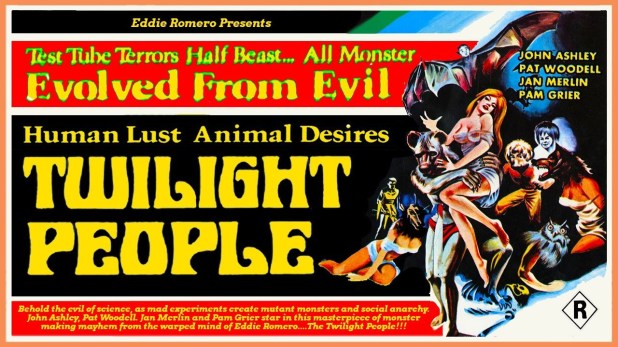
Turns out The Island of Dr. Moreau is the next one over from Blood Island. This Filipino-lensed production was directed by the always dependable Eddie Romero and stars the equally trustworthy John Ashley. It’s everything you want it to be — trashy, goofy, transcendent.

Matt Farrell (Ashley) is kidnapped by Neva Gordon (Pat Woodell, The Roommates) and Steinman and taken to an island where her father Dr. Gordon is making a super race of animals and humans. He wants Farrell to be his next hybrid, but his daughter falls for him and they decide to let all the animal people — including Pam Grier as Ayesa the Panther Woman and a truly insane looking bat person named Darmo — escape.

Didn’t Eddie Romero already make this movie and call it Terror Is A Man? Ah, quit being a know-it-all and just enjoy. I wish there were more visits to Blood Island.

Usually, Lawrence Woolner would make movies with Roger Corman, but when they ended their partnership — this was originally made as a New World movie — he took Twilight People to his new distribution company, Dimension Pictures, who released this in 1972. It was part of the movies that 21st Century acquired when they bought that company.

You can watch this on Tubi.

CANNON MONTH 3: Werewolf Woman (1976)

EDITOR’S NOTE: As the journey through Cannon continues, this week we’re exploring the films of 21st Century Film Corporation, which would be the company that Menahem Golan would take over after Cannon. Formed by Tom Ward and Art Schweitzer in 1971 (or 1976, there are some disputed expert opinions), 21st Century had a great logo and released some wild stuff.

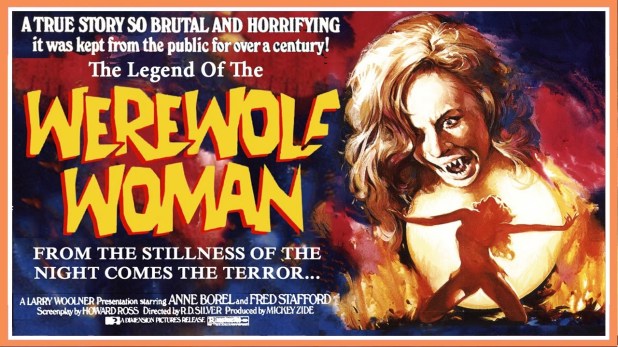
A section 3 video nasty, this movie was made by Rino Di Silvestro, who claimed that he wanted to make a serious werewolf movie. We should take the director of Deported Women of the SS Special Section at his word, I guess.

Daniella Neseri (Annik Borel, Weekend with the Babysitter, Truck TurnerBlood Orgy of the She-Devils) was assaulted when she was just a child, which has made her emotionally and sexually stunted and unable to have any relationships with men. Then she learns that she comes from a lineage of werewolf women, at which point she begins to have very involved dreams about being a wolf woman that manifest themselves when she gets all bothered watching her sister Elena (Dagmar Lassander, The House by the CemeteryHatchet for the Honeymoon) making sweet love to her man, so she responds by killing the dude, then throwing his body off a cliff because that’s how they did therapy in 1976.

Found near the body, Daniella is institutionalized before breaking away and continuing her murder spree before she finds love and respect — after killing a potential rapist — in the arms of Luca (Howard Ross, whose real name is Renato Rossini, and whose career stretched through nearly every genre of Italian exploitation, from Hercules Against the Mongols and The Man Called Noon to MartaNaked Girl Killed in the Park and The Pyjama Girl Case to The New York Ripper and Warriors of the Year 2072).

Of course, this is an Italian horror movie and there’s no way that Luca and the werewolf woman can be happy just making love on the beach. Three men break in and assault her before killing him, so she hunts them all down before the cops arrest her. To ensure that no one learns any lessons, she’s institutionalized and dies, then her dad kills herself, then her sister, who has lost everything, just lives whatever life is left after all this.

Man, I don’t know if they knew what they had with this movie, a film that shows the institutions of men failing women on every level, including the male-directed movie that tells this story. That said, a movie where a woman equates sexual desire to being a werewolf and also she maybe is a werewolf and the knowledge that I’ve spent more time considering the psychosexual implications of this movie than the people who made it? That’s why I keep writing about films like this.

Also known as Daughter of a Werewolf, Naked Werewolf Woman, She-Wolf, Terror of the She-Wolf and Legend of the Wolf Woman, this film is something else. 21st Century, like many companies, released this.

CANNON MONTH 3: Vampire Hookers (1978)

EDITOR’S NOTE: As the journey through Cannon continues, this week we’re exploring the films of 21st Century Film Corporation, which would be the company that Menahem Golan would take over after Cannon. Formed by Tom Ward and Art Schweitzer in 1971 (or 1976, there are some disputed expert opinions), 21st Century had a great logo and released some wild stuff.

Cemetery GirlsVampire Hookers of HorrorNight of the Bloodsuckers, Sensuous Vampires and Twice Bitten. Whatever name we give this co-production of the Philippines and the United States — directed by the infamous Cirio H. Santiago — we can all appreciate that John Carradine plays the vampire Richmond Reed, who has hired a gang of women to draw in new blood for his veins.

Suzy (Lenka Novak, who made her first living as a nude model in Europe, appeared in Mayfair and had a brief career in films like Moonshine County Express and as one of the naked women in “Catholic High School Girls in Trouble” in The Kentucky Fried Movie), Cherish (Karen Stride, Three-Way Weekend) and Marcy (Katie Dolan, one and done with this movie) are the girls and yeah, you can see that Richmond Reed is a man with a great plan.

Vampire Hookers was written by Howard R. Cohen, who may have only lived 56 years on this planet, but still found the time and energy to be a party joke editor for Playboy, write books and also write Unholy RollersStryker and episodes of The Care Bears and Rainbow Brite, as well as direct Saturday the 14thSaturday the 14th Strikes Back and Deathstalker IV: Match of Titans.

Sure, the movie isn’t great, but it did teach me that John Carradine’s real name is Richmond Reed Carradine.

Thanks to Temple of Schlock, I can tell you that this was originally released by Caprican Three in 1978 as Vampire Hookers and then again in 1979 as Vampire Graveyard. It was re-released by Saturn International in 1981 as The Sensuous Vampires and also has the named Vampire Hookers of HorrorLadies of the NightTwice Bitten and Night of the Bloodsuckers. 21st Century re-released it too.

CANNON MONTH 3: The Sin of Adam and Eve (1969)

EDITOR’S NOTE: As the journey through Cannon continues, this week we’re exploring the films of 21st Century Film Corporation, which would be the company that Menahem Golan would take over after Cannon. Formed by Tom Ward and Art Schweitzer in 1971 (or 1976, there are some disputed expert opinions), 21st Century had a great logo and released some wild stuff.

Miguel Zacarías is the same Michel Zacharias that executive produced Demonoid and The Bees, but before that he directed fifty-five films and wrote fifty-one. He directed and wrote this film and must have really enjoyed bringing religious films to the screen, because he also directed Jesus: Nuestro Senor, Jesus: el Nino Dios and Jesus, Maria Y Jose.

Yet this movie was sold in America by New World and that was probably because for most of the movie, Jorge Rivero (billed as George Rivers; you may know him as Mace from Fulci’s Conquest or from the Santo movies he co-starred in like Operation 67 and El tesoro de Moctezuma or the movie Fist Fighter and Fist Fighter 2 where he played the amazingly named C.J. Thunderbird) and Kandy (sold in America as Candy Wilson; she only appeared in one other film, Si vous n’aimez pas ça, n’en dégoûtez pas les autres, which translates as If You Don’t Like It, Don’t Disgust Others) are naked for the entire movie. Other than Kandy’s long hair spirit gummed to her chest and strategically placed scenery to keep one from seeing full frontal, this movie doesn’t skimp on the naked time, but then again, Rivero and Kandy have nearly perfect bodies.

This movie is set inside what 1969 thought the Garden of Eden looked like and after that apple gets bit into, well, it also turns into the best stock footage available as well as animal madness and this being Mexico, one can imagine that the ASPCA was nowhere near the set of this movie. There’s also a moment when giant flaming wooden daggers literally rain down, keeping Adam and Eve from finding one another until the end, when they have found loincloths and I’ve never been more upset about original sin.

Supposedly, Kandy was an American tourist lured into being in this movie. Can a Biblical film be sleazy? God bless you, Mexico.

This was originally released in the U.S. by New World Pictures in 1971, then picked up by Dimension Pictures in 1972. 21st Century got it when they bought Dimension’s films.

ARROW VIDEO UHD RELEASE: Torso (1973)

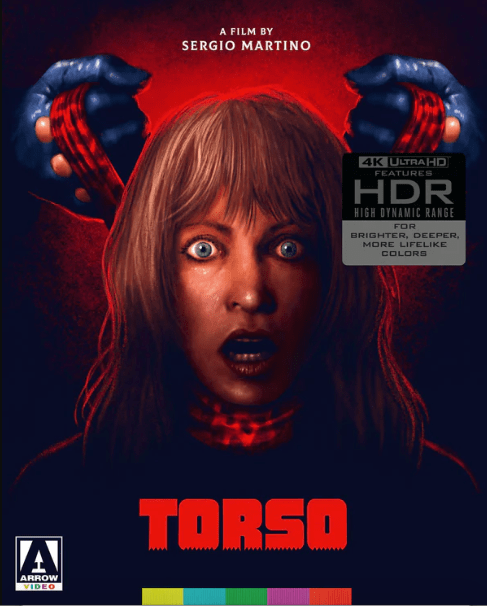
Torso is such a simple title. I’d rather call this film by its Italian name: I Corpi Presentano Tracce di Violenza Carnale, or The Bodies Bear Traces of Carnal Violence. Either way, it was directed by Sergio Martino and features none of the cast that he had come to use in his past films like George Hilton, Ivan Rassimov or Edwige Fenech.

It does, however, star British actress Suzy Kendall, who played the lead role of Julia in Dario Argento’s seminal The Bird with the Crystal Plumage. She’s so associated with giallo that she appeared as the main character’s mother in 2012’s ode to the genre, Berberian Sound Studio.

This is a film that wastes no time being strange. Or salacious. A photographer is shooting a soft focus lovemaking session between three women amongst creepy, eyeless baby dolls. By the time we register what is happening, we’re now in a classroom, where swooping pans and zooms refer us to the main cast of the film as we overhear a lecture and later a discussion about Pietro Perugino’s painting of Saint Sebastian. Did he believe in God? Or was he just trying to sell sentimentality? Could an atheist find himself able to translate religion to those with faith?

We cut to a couple making out in a car as a figure stalks them through the eye of the camera, making us complicit in the act of the killer. Quick cuts reveal the white-masked face of this maniac. The man runs after him while the girl doesn’t even care that they had a voyeur watching. As she waits for him to return to the car, but grows impatient. The headlights of the car cast her shadow large across the columns of a bridge. And their light is quickly extinguished by black-gloved hands. The camerawork here is really striking, keeping us watching for the killer, as we’re no longer behind his eyes. His attack is swift and ruthless, juxtaposed against the images of fingers penetrating the eyes of a doll.

The art professor (John Richardson, Black Sunday, The Church) and Jane (Kendall) meet by chance at a church where she challenges him to change his views on Perugino. As she returns from their somewhat romantic afternoon, Jane spies her friend Carol arguing in the car with a man who she believes is married.

Meanwhile, ladies of the evening walk the street, ending up with Stefano, a student who has been stalking Julie. He has trouble performing and the prostitute he’s with tells him that all the men with hang-ups always come her way. That said — even if he’s queer, he better pay the money. He flips out and attacks her, but she makes her escape.

We’re then taken to a hippy party that looks like it’s taking place inside Edward Lionheart’s Theater of Blood. There’s weed, there are acoustic guitars, there are bongos, there are dudes with neckerchiefs, there are motorcycles. Truly, there’s something for everyone. But after leading on two men, Carol just walks out into the mud. They try and chase her, but she makes her escape into the foggy night. We hear her footsteps through the swamp as she walks, exhausted and covered in mud. What better time for our white-masked killer to return? We see glimpses of him through the fog and then he is gone. Whereas in past films Martino ignored the murder scenes instead of story, here the violence is extended, placing the killer and his actions in full view. After killing the girl, he rubs mud all over her body before stabbing her eyes — again intercut with the baby doll imagery. Her blood leaks into the mud as the score dies down.

This scene really feels like what the first two Friday the 13th movies were trying to achieve, but of course several years before they were made.

A police detective is in front of the art class, showing images not of art, but of the crime scene. A piece of cloth has been found under the fingernails of one of the murdered students, Flo. And that same scarf was found on Carol’s body. It’s their duty to report seeing anyone who wore this scarf to the police, who want to cooperate with the students who normally riot and throw rocks at them.

Two of the men in the class — Peter and George — were the last two people to be seen with Carol, the ones who she turned down at the party. Meanwhile, Stefano continues to stalk Jane. The music in this film is so forward-leaning — tones play when the killer shows or during moments of tension.

A man calls Daniela and tells her that if she ever tells where she saw the red and black scarf, she’s dead. Fearing for her life, she tells her uncle, who lends his country home to her and her friends so that they can get away from the city while the killer is at large.

Oh yeah — I forgot the pervy scarf salesman, who the police are leaning on. Right after talking to the police inspector, he calls someone and asks for money to buy his silence. Whoever it is, they bought the scarf from him and wouldn’t want anyone else to know. They’ll also get out of town and head to the country. Coincidence? I think not!

Stefano is all over Dani, telling her that he needs her. She wants nothing to do with him. When she stares at him, she remembers seeing him wear the red scarf. She escapes — slamming the door in his face. She tells Jane that she remembers seeing him wear the scarf — and never again — the day Flo died. The whole time, the creepy uncle is watching the two girls. Jane offers to speak to Stefano, then meet the girls at the vacation home.

The street vendor is flush with cash, creeping along in the dark. A car starts to follow him. We see the black-gloved hands again as the car hits its victim again and again, bright red gore pouring all over the screen.

Jane goes to speak to Stefano, finding only strange baby dolls and letters to Dani asking her to love him and remember the promise that she made as a little girl. Jane is surprised by Stefano’s grandmother, who tells her that he left town.

The other girls are asleep on the train as someone watches them. A strange man enters their train car and sits down.

The camerawork in this movie feels as predatory as the perverts and killers that exist within it. Speaking of pervs, when the girls arrive in the countryside, the local men pretty much lose their minds, particularly over Ursula (Carla Brait, the man wrestling dancer from The Case of the Bloody Iris). She and Katia make out as a peeping tom watches, only for the killer to show up and off the leering man. There’s an amazing scene of the killer dumping the pervert into a well, shot underwater and staring upward as the body falls toward the lens.

Man, every man in this movie is scum. They’re either frightened boys or perverts wanting one chance to knock up a woman or scarred from past sexual encounters. None of them are positive, as even the uncle who gives Dani the villa seems way too interested in her. Every man is a predator at worst and a leering pervert at best.

Jane hurts her ankle when she gets overly excited about breakfast. A doctor arrives — the mysterious man from the train — and he gives her a pill, which knocks her out.

The girls go sunbathing while Jane recovers. Dani thinks she sees Stefano — complete with the red scarf — watching them. They return home and drink champagne, which Jane uses to wash down her sleeping pills.

A few minutes later, the door rings. It’s Stefano — the girls all scream — but he’s dead — the girls scream again — and the killer is behind him, holding the red scarf — now scream even louder! Instead of showing us the murders, Martino switches form, cutting to a ringing bell and Stefano being buried.

Jane wakes up, asking where her breakfast is. She’s obviously slept late as a result of the pills. She walks around the apartment, looking for Dani, Ursula and Katia, only to find a mess. Tossed chairs, bottles of beer and every single one of her friends murdered. Suzy Kendall is amazing in this scene, caught between fear and nausea. Unlike so many wooden giallo performances, she’s actually believable.

She hides as the killer comes back, forced to stay quiet and watch as he saws her friends into pieces. Even the ordinary world routine of the milkman arriving cannot stop the butchering of her friends, with her trapped just feet away.

This final act is completely unexpected, as up until now, the film had played by the rules of the giallo, the large number of victims versus a large number of red herrings.

In fact, this film is so packed with red herrings, even the cast had no idea who the killer was. Martino wouldn’t tell them who it was, so each of the actresses had her own theory as to who the killer was. And in the original script, the killer survived.

Now, instead of that traditional giallo structure as I mentioned above, it is the last survivor — a near prototype for the final girl — against a killer. Throw in that Julie can’t move well due to her leg and Martino has set up quite the suspenseful coda.

Trapped in the house, Julie tries to signal with a mirror, using Morse code. But it totally misses the heroic doctor’s sight. He places a call, but it doesn’t seem like it’s to Julie. She looks out the window and sees the killer coming back.

It turns out that the killer was the professor, who saw a childhood friend die trying to reach for a doll. He compares the other kills to dolls, with only Julie as a flesh and blood person. Everyone else was a bitch or played games with him or blackmailed him. He hacked Ursula and Katia to pieces like dolls as a result. Dani saw him. Carol may have seen him. And he killed Stefano when he saw him in the village. Death, he says, is the best keeper of secrets and then he sees Julie as a doll and tries to hang her. She’s saved at the last second by the doctor.

They battle into a farmhouse, across the yard and to a similar rock where we saw the younger professor watch his friend die. We hear a screen and have no idea who has been killed — but luckily for Jane, the doctor survives.  He discusses whether fate or providence had kept him in town, where he could save her. Perhaps it was written in the stars. Julie replies that Franz, the professor, would have been a realist and called it a necessity. Franz is dead and the dreamers live on.

The more times that I’ve watched this film, the more that I appreciate it and how it flips the genre conventions on their head and moves toward more of a slasher, with many of the giallo elements feeling tacked on somewhat to stay within the expected pieces of the form. A real clue that it’s really a slasher? The killings are more important than who the killer is.

Who are we to doubt the movie that Carlo Ponti brought us after Dr. Zhivago?

The Arrow Video 4K UHD release of Torso has a new 4K restoration by Arrow Films from the original camera negative. It has audio commentary by Kat Ellinger, author of All the Colours of Sergio Martino; interviews with Sergio Martino, Luc Merenda, Ernesto Gastaldi, Federica Martino and Mikel J. Koven, author of La Dolce Morte: Vernacular Cinema and the Italian Giallo Film. There’s also footage of the 2017 Abertoir International Horror Festival Q&A with Sergio Martino, alternate opening and closing credits from the US release, Italian and English theatrical trailers, a reversible sleeve featuring original and newly commissioned artwork by Adam Rabalais and an illustrated collector’s booklet featuring writing on the film by Adrian Smith and Howard Hughes. You can get it from MVD.
ARROW VIDEO UHD AND BLU RAY RELEASE: Friday the 13th (2009)

Marcus Nispel directed the remake of The Texas Chainsaw Massacre in 2003, so why shouldn’t he get a shot at Jason? This film is more than just a remake of the first film. It’s really a bit of the first four all in one, which is an interesting way to start a new version of the series.

We watch Jason (Caleb Guss as a kid, Derek Mears as an adult) as he watches his mother (Nana Visitor, voiced by Kathleen Garrett) get killed by a camp counselor. Thirty years later, he kills every single teen — Wade (Jonathan Sadowski), Richie (Ben Feldman), Amanda (America Olivo, also in the remake of Maniac) and Mike (Nick Mennell, Bob in the Rob Zombie remake of Halloween) — who has comes to Crystal Lake looking for marijuana, except for Whitney (Amanda Righetti), who reminds him of his mother.

Weeks later, some rich kids — Trent (Travis Van Winkle), Jenna (Danielle Panabaker), Chelsea (Willa Ford), Bree (Julianna Guill), Chewie (Aaron Yoo), Nolan (Ryan Hansen) and Lawrence (Arlen Escarpeta) — come to stay at a fancy cabin. They’re all fodder, too. Only Clay (Jared Padalecki), Whitney’s brother, can save her. Finally, Whitney acts like Jason’s mother and stabs him, but he comes back at the end, rising from the lake.

This is a slick, CGI animated take on the Jason mythos. Writers Mark Swift and Damian Shannon also wrote Freddy vs. Jason and they have some decent ideas. No matter what, this had to be a hard movie to make, as there will be people that hate it no matter what. I’m more into the Savini school of gore, so there’s a lot of this that didn’t work for me. It’s not a horrible film by any means. It does look gorgeous, as this had a major horror cinematographer — Daniel Pearl from Texas Chainsaw Massacre — filming the movie. And while it did well at the box office — $92.7 million at the box office on a budget of $19 million — it was the end of the series. There are so many reasons for that, but it’s been too long since there’s a new film.

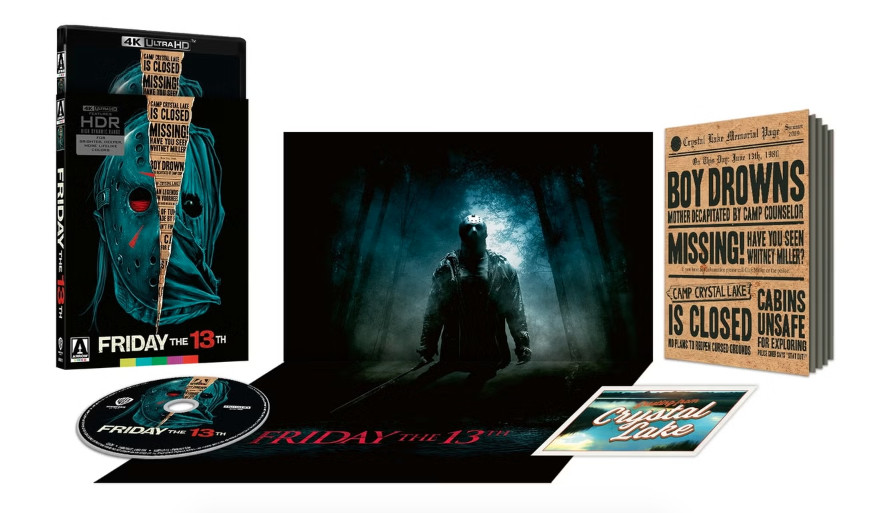
The package for this Arrow 4K UHD and blu ray is amazing. It has a double-sided foldout poster featuring original and newly commissioned artwork by Gary Pullin, a limited edition Greetings from Crystal Lake postcard, an illustrated collector’s booklet featuring new writing on the film by Matt Konopka and Alexandra West, a reversible sleeve featuring original and newly commissioned artwork by Gary Pullin. On the discs, you’ll discover both the theatrical and killer cuts of the movie with two new commentary tracks for the theatrical cut, one by director Marcus Nispel and another by  writers Mark Swift and Damian Shannon; an interview with cinematographer Daniel Pearl; A Killer New Beginning, an exclusive video essay about why horror fans shouldn’t fear remakes, what 2009’s Friday the 13th remake gets right, and why the film serves as a perfect template for future franchise remakes by film critic Matt Donato; terror trivia; archival features; deleted scenes; the original teaser, trailer and TV commercials; a press kit and an image gallery. The Killer version has audio commentary by film critics Alexandra Heller-Nicholas and Josh Nelson.

You can get this from MVD.

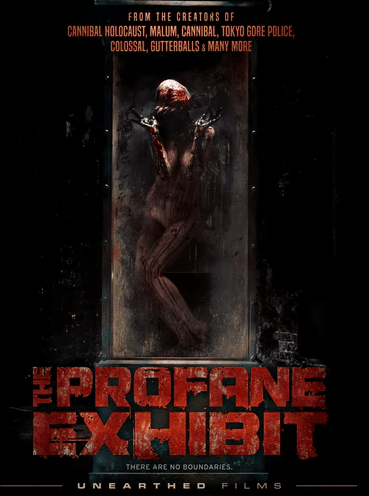
UNEARTHED FILMS BLU RAY RELEASE: The Profane Exhibit (2013)

This film started when producer Amanda L. Manuel approached director Michael Todd Schneider to direct her first short film, which is the chapter “Manna” in this movie. Manuel had other story concepts and brought on other directors, including a few who did not appear in the final movie like Richard Stanley (who supposedly was never part of this), Andrey Iskanov (whose segment was complete but needed new sound and some new footage which was too expensive to go to Russia for) and José Mojica Marins (who left the project).

After years of this movie getting press, it finally debuted in August of 2022. There were screenings of some parts of it and the reports were that the film was no good. Yet nine years later, here it finally is.

The film begins in a Paris nightclub that houses a secret society and The Room of Souls, a private gathering place for the world’s richest and most evil people. Madame Sabatier allows each of them to tell a story and attempt to impress one another.

The first segment is “Mother May I,” directed by Anthony DiBlasi, has Sister Sylvia abusing the girls in her halfway house for sins both real and imaginary.

Yoshihiro Nishimura (Meatball MachineKyûketsu Shôjo tai Shôjo Furanken) brings the next movement, which is entitled “The Hell-Chef” and is a quick cut artistic tale of two young Japanese women eviscerating and devouring a man. It’s quick, to the point and well-made, even if there’s no rhyme or reason, which is the point one figures.

The third chapter is “Basement,” directed by Uwe Boll. This is based on the Josef Fritzl case, which was also made into a documentary, Monster: The Josef Fritzl Story. It’s short and well-made, shockingly among the best of the entire film. That said, if you want to watch Clint Howard have sex with his character’s daughter, well…this movie may just be for you.

It’s followed by the part I was most excited about, “Bridge,” directed by Ruggero Deodato. Sadly, it’s only three minutes long and just when it seems like it has some steam, it quickly ends.

Marian Dora, which is a pseudonym for an anonymous German creative, contributes “Mors in Tabula,” which is the same title as another Dora short. This one has a boy being operated on while his father helps the surgeon in a sequence that shows plenty of surgical nightmares over an Aryan rally soundtrack. There’s no real story, just shocks, which is pretty much the Grand Guignol feel of this entire enterprise.

“Tophet Quorom” is directed by Sergio Stivaletti (Italian special effects master and the director of The Wax Mask). It’s pretty wild and is has some incredible gore, like a jaw being ripped off, a practical werewolf transformation and an infant sacrifice. Now, as you can see from that description, this tale of a woman looking for the missing twin baby she’s just given birth to might not be for everyone — again, a running theme.

Ryan Nicholson (GutterballsHanger) seems like the perfect person to be part of this and his segment “Goodwife,” in which a woman learns her husband is a killer and joins him in his depravity, might be the limit for some people. There’s no humor in this, just shock upon shock, the kind of madness that seems like someone working out more than just a horror film if it wasn’t so well shot. Apply liberally every trigger warning ever.

I loved Nacho Vigalondo’s Timecrimes, so I was excited for his segment “Sins of the Fathers.” A son has recreated the room he grew up in to place his elderly father into the same mindset he was in while the man abused him. It’s an intriguing idea that could make up its own film.

“Manna,” directed by Michael Todd Schneider goes from BDSM club to that most unimaginable — and impossible of fetishes, vore. That means that someone gets off from being consumed and what follows is a man being treated like he’s the Old Country Buffet for an entire room of latex clad women who break him down and make a meal of him.

“Amouche Bouche” is directed by Jeremy Kasten (The Attic Expeditions) and shows more human meat being prepared and eaten, which seems like how this movie should finish.

This is a movie made for extreme horror fans featuring some of their favorite directors. As such, people who think Hollywood horror is disgusting should probably stay home or keep this out of their streaming device. For those of a sicker bent — and I say that lovingly but also you never get to play with my dog — this is for you.

The Unearthed Films blu ray of The Profane Exhibit is filled with extras, such as an audio commentary by director Michael Todd Schneider, producer Amanda Manuel and Ultra Violent Magazine‘s Art Ettinger; interviews with Jeremy Kasten, Uwe Boll, Amanda Manuel and Michael Todd Schneider; a mini-documentary Ten Years Later by Marion Dora; Awakened Manna, footage from the world premiere, a gallery and trailers. You can get this from MVD.