Alternately known as Saturn 1999, Space 2100, Space: 1999 Moonbase Alpha, and Space 1999: 1 in various overseas markets for its TV syndication and foreign theatrical distribution, Destination Moonbase Alpha is the Star Wars-inspired feature-film created from the 1976-1977 second season, two-part story arc of Space: 1999: “The Bringers of Wonder” (Ep. 18 and 19, but Ep. 42 and 43 overall).
Space: 1999, of course, was the last in a long line of science-fiction series produced by Gerry and Sylvia Anderson, beginning in the early ‘60s with their marionette-led children’s programs, most notably, Thunderbirds, as well as their first live-action series, UFO—itself turned into a theatrical film: Invasion: UFO. Space: 1999, of course, was the last in a long line of science-fiction series produced by Gerry and Sylvia Anderson, beginning in the early ‘60s with their marionette-led children’s programs, most notably, Thunderbirds, as well as their first live-action series, UFO—itself turned into a theatrical film: Invasion: UFO.
The production design and plotting of Space: 1999 owes it debt to UFO, as the tale of the Moon being blast out-of-orbit was originally planned for the second season of UFO, which was to be known as UFO: 1999. The improved look of Space: 1999 over UFO came courtesy of the program’s special effects supervisor, Brian Johnson, who worked on Stanley Kubrick’s 2001: A Space Odyssey and, eventually, Star Wars.
As with the positive, post-Star Wars overseas theatrical reception to The Starlostand Invasion: UFO, the 1978 theatrical version of Space: 1999 was a rousing success. Encouraged, three more movies were created out of the two seasons’ 48 episodes, which aired from April 1973 to February 1975, then January 1976 to December 1976.
The second sequel, Alien Attack—also known as Space: 1999 Alien Attack, and Space: 1999 II—consisted of the first season’s episodes Ep. 1: “Breakaway” and Ep. 4: “War Games.” The next film, Journey through the Black Sun—alternately known as Black Sun: The Death Planet Intervenes and Space 1999 III, was cut from Ep.3: “Collision Course” and Ep. 10: “Black Sun.” The fourth and final film, Cosmic Princess, which concentrated on the second season’s introduction of its Mr. Spock-inspired character, the metamorph Maya (Catherine Schell), and the James T. Kirk-like Tony Verdeschi (Tony Anholt), was cut from “The Metamorph” (Ep. 1/25 overall) and “Space Warp” (Ep. 14/38 overall).
In 2012, the American arm of the British production company ITV announced a reboot of the series to be called Space: 2099. In August of last year, Brian Johnson announced the reboot was still on track.
For those of you who can’t wait for the reboot, you can watch an incredible, China-produced variation of the themes introduced in Space: 1999, with China’s third highest-grossing film of all time, the year’s eighth highest-grossing film worldwide, and the second highest-grossing non-English film to date: 2018’s The Wandering Earth.
As result of another one of our “Space Weeks” (March 2021), Sam the Bossman takes a deeper look at Cosmic Princess.
Star Wars: Episode IX – The Rise of Skywalker is currently in theatres and was released theatrically on December 20 in the United States.
About the Author: You can read the music and film criticisms of R.D Francis on Medium and learn more about his work on Facebook. He also writes for B&S Movies.
A long time ago on a Canadian TV set (and a few U.S ones) far, far away . . . lost somewhere in a galaxy between Star Trek and Star Wars. . . .
Over 400 years ago, upon the destruction of Earth, humanity launched Earthship Ark, a 50 miles wide by 200 miles long, multi-generational starship consisting of a community of biospheres—each containing a different Earth society. Then, in the year 2790, before the Earth’s orphans could reach their new world at a distant star, an accident sends the ship off course and seals off the biospheres . . . and the survivors are unaware of the others . . . and that they are on a spaceship. . . .
(And if this all sounds a lot like 2008’s Pandorum and 2016’s Passengers, it probably is.)
Robert Kline, a 20th Century Fox television producer, wanted to capture some Star Trek thunder, which was breaking ratings records during its initial, early ‘70s syndicated run. So he approached sci-if scribe Harlan Ellison, who wrote one of Star Trek’s best-remembered episodes, “The City on the Edge of Forever.”
The initial concept of The Starlost—which bears striking resemblances to the “lost moon base” concept of the later, British-produced Space: 1999—was an eight-episode television mini-series to be co-produced with the BBC. When the British broadcaster rejected the pitch, and with no American network keen on the idea, the show’s budget was revamped as a low-budget indie production for syndication. The Canadian CTV network, along with 50 NBC affiliates, bought the idea, which was now expanded to an eighteen-episode arc. And they bought the idea, in part, courtesy of the star power of noted Canadian actor Keir Dullea, from 2001: A Space Odyssey. (The series also featured later Battlestar Galactica actors Lloyd Bochner and John Colicos, along with Barry Morse from Space: 1999.)
So what could go wrong? Everything that Murphy’s Law and Catch-22 had to offer.
In addition to securing Ellison (who we all know for his infamous lawsuit regarding the “similarities” to James Cameron’s The Terminator to Ellison’s The Outer Limits episodes “The Soldier” and “Demon with a Glass Hand”), six-time Hugo Award winner and Analog Magazine editor Ben Bova was hired as the show’s science advisor.
As with screenwriter Martin Amis expressing his dissatisfaction with the changes to Saturn 3 in the pages of his acclaimed 1984 novel, Money: A Suicide Note, Ben Bova expressed his dissatisfaction in the 1975 novel, The Starcrossed, which depicts a noted scientist’s dealings as a science advisor for an awful science fiction television series.
Harlan Ellison, in turn, penned a lengthy diatribe-forward to the novelization of his original pilot script, Phoenix Without Ashes, by Edward Bryant, a script which was revamped (“dumbed down” according to Ellison) as “Voyage of Discovery.”
Then problems arose with the special effects headed by Douglas Trumbull (2001: A Space Odyssey and Silent Running), which resulted in addition budgetary cuts.
So, when you have three of science fiction’s top disciplinarians—Harlan Ellison, Ben Bova and Douglas Trumbull—turn on you, you know you have problems. And Keir Dullea, who’s had his share of career clinkers—and wasn’t shy in expressing his disdain for his past projects, such as the sci-fi Jesus romp, The Next One, and the Futureworld rip-off, Welcome to Blood City—wasn’t a happy camper, either.
And, with that, 20th Century Fox Television saw the writing on the wall and cancelled The Starlost after 16 episodes—and shelved the never-filmed episodes “The Gods That Died” and “People in the Dark.”
Then, somebody by the name of George Lucas came along with a crazy idea of updating Flash Gordon with Douglas Trumbull’s special effects wizardry from 2001: A Space Odyssey. . . .
So, with a renewed interest in science fiction properties, the studio pulled the mothballed The Starlost for rebroadcast in 1978. Then, in the throes of the cable television boom with “Superstations” hungry for product, 20th Century Fox stitched together several episodes into five TV movies, which played as foreign theatrical features, in 1980.
Those feature-length films were:
The Starlost: The Beginning The first feature created from episodes 1, 2, and 3: “Voyage of Discovery,” “Lazarus from the Mist,” and “The Goddess Calabra.”
The Starlost: The Deception The second feature created from episodes 9 and 10: “Gallery of Fear” and “Mr. Smith of Manchester.”
The Starlost: The Invasion The third feature created from episodes 11 and 12: “Astro-Medics” and “The Implant People.”
The Starlost: The Return The fourth film created from episodes 4 and 14: “The Pisces” and “Farthing’s Comet.”
The Starlost: The Alien Oro The fifth film created from episodes 7 and 13: “The Alien Oro” and “Return of Oro.”
The remaining of the 16 episodes not utilized in the films was: Ep. 5: “Children of Methuselah”; Ep. 6: “And Only Man Is Vile”: Ep. 8: “Circuit of Death”; and Ep. 15 and 16: “The Beehive” and “Space Precinct.”
During the video store boom of the ‘80s, all 16 episodes were released in a VHS boxed set, while the five feature-length films were released to DVD—each individually, and as a box-set. In 2008 VCI Entertainment reissued the full series to DVD. Early this year, Roku began replaying the episodes.
In the end, a project that was hoped to build on the syndicated enthusiasm for Star Trek, earned not the respect of that show, but appears on critical lists with “The Worst Science Fiction Shows of All Time,” which include Irwin Allen’s Lost in Space and the plastic Star Wars knockoff, Buck Rogers in the 25th Century.
You can watch various scenes and full episodes on the official, You Tube Starlost TV portal.
* * *
Star Wars: Episode IX – The Rise of Skywalker is currently in theatres, released theatrically on December 20 in the United States. Click through with “Before Star Wars, “Exploring: After Star Wars,” and “Star Wars Droppings” to see all of our reviews for the week to celebrate the release. And there’s MORE with our feature . . .
About the Author: You can read the music and film criticisms of R.D Francis on Medium and learn more about his work on Facebook. He also writes for B&S Movies.
David DeCoteau made The Wrong Cruise for Lifetime, which also stars Vivica A. Fox, and that movie uses the exact same establishing shot of a cruise ship as this movie. Welcome to the world of DeCoteau, where stock footage and ADR rules the day.
This is the second combo of Fox and DeCoteau that I’ve watched this holiday season. Obviously, I’ve made an advent calendar for myself filled with feces.
NOTE: The actress and director have worked together way more times than I thought was possible, including The Wrong Roommate. Sadly, I fear my OCD means that I’m going to be watching all of them.
When Pam Stevenson’s (Fox) best friend Becky (Jessica Morris, who has been in DeCoteau’s The Wrong Man, The Wrong Mommy and The Wrong Teacher, as well as A Mermaid for Christmas) takes her on a Christmas cruise — see, the title pays off — the aspiring novelist somehow finds the love of her life onboard.
That said, the ship they board is the Queen Mary, which hasn’t sailed for years, and all of the film’s locations look like banquet rooms at some hotel.
Kristoff St. John — who was on The Young and the Restless with Fox — died this year and this was one of his last films. Thanks to his IMDB page, I learned a fact that I would never have found out otherwise: he was childhood friends with both Soleil Moon Frye and her brother Meeno Peluce. I never realized that these two 80’s stars — Punky Brewster and Jeffrey Jones from Voyagers! — were related.
This movie also has Rib Hillis (he used to be on Extreme Makeover: Home Edition), Cristine Prosperi (Imogen Moreno from Degrassi: The Next Generation), Corin Nemec (the titular Parker Lewis from Parker Lewis Can’t Lose) and Reatha Grey (whose acting career started all the way back in the blacksploitation movie Welcome Home Brother Charles).
This Ion television TV movie lacks the sheer insanity of the director’s other films, so my hopes of talking cats and holiday puppies were dashed. Instead, two older people found love on a holiday island. Then again, if I want to watch more DeCoteau seasonal fare, there’s also Christmas Matchmakers (also with Fox), Carole’s Christmas, My Christmas Grandpa (again, with Fox), A Royal Christmas Ball and Runaway Christmas Bride.
Also known as A Christmas Puppy, this is yet another movie yawned forth from the hellscape of movies that are made by David DeCoteau. If you watched A Talking Cat!?! and were like, hey — I’d like him to make a Christmas movie, well, you already have Santa’s Summer House. But then if you want more, what kind of monster are you?
This is the first of DeCoteau’s Christmas movies, set in the same mansion where his homoerotic 1313 movie series is set.
Riley is charged with giving the Christmas Spirit to a family, so he does some breaking and entering and all manner of shenanigans ensue. There’s also a Christmas Spirit who wears a toga like she’s Vanna White in Goddess of Love who throws fortune cookies at Riley whenever he needs help.
Alexandra Paul — yes, the virgin Connie Swail from Dragnet — is in this, as is Maureen McCormick — yes, Marcia Brady — and Judy Landers — yes, Ms. Xenobia from Dr. Alien — as the voice of Chompie the dog.
While this movie was originally called A Christmas Puppy, the dog doesn’t show up until the end and really doesn’t have much to do with the film. That’s probably why the title was changed, because I could see lots of kids being sat down in front of this as a babysitter over the holidays and their poor soft skulls having to contend with the pure ridiculousness that is a David DeCoteau movie.
You can watch this for free on Amazon Prime. May the Lord be merciful to your soul.
Author Note: This review was previously posted on September 28, 2019, as part of our September Post-Apocalypse Month. You can catch up with all of those reviews by visiting our Atomic Dustbin recap. We’re bringing it back to pay tribute to the work of George Lucas.
Okay. Let’s get this out of the way: This is the movie were you video fringe horndogs lose it over Mariette Hartley (as Lyra-A) in a two-piece bikini sporting two belly buttons (a dual circulatory system with two hearts) as a (network censored) “dominatrix” who breeds men for an oppressive, feminist regime.
Gulp.
Yes. Mariette Hartley: We’re talking Zarabeth in the Star Trek: TOS episode “All Our Yesterdays” where she cracked Spock’s emotionless Vulcan shell. She mixed it up with Gary Lockwood as Lisa Karger in Earth II (another failed TV movie pilot-to-series). She tempted Charlton Heston as Harriet Stevens in Skyjacked. She gave Dr. David Bruce Banner butterflies as Dr. Carolyn Fields in The Incredible Hulk. Yes. Mariette Hartley, with a resume of too many popular TV series to mention, all the way out to Fox TV’s 2018 hit series 9-1-1 as Patricia Clark.
Just one look at Mariette in Genesis II and you’ll forget all about the über-cool Sub-Shuttle that we all came for (and not a bogus CGI model . . . but a non-operational, full-sized prop pulled on a long-cable by an off-camera semi-truck) that pulls into a carved-out-of-the mountain sub-station (which Elon Musk has since pinched for his next millionaire-toy project). Oh, and did you notice the sterile, ultramodern-styled city looks suspiciously like the city in Conquest of the Planet of the Apes (20th Century Fox’s “Century City”)? And did you notice how many times the Sub-Shuttle footage was recycled in ‘70s sci-fi television?
Anyway . . . times were hard for ex-Star Trek creators.
In 1974, after the go-to-series failure with Genesis II, Gene Roddenberry developed another TV movie/series pilot with The Questor Tapes (1974). A thinly veiled reworking of the Gary Seven character and plot from the Star Trek: TOS episode “Assignment: Earth,” it was intended as a vehicle for Leonard Nemoy’s return to weekly television. The end product starred Robert Reed-doppelganger Robert Foxworth (1979’s Prophecy) who portrayed an android with incomplete memory tapes — in a pseudo The Fugitive storyline — searching for its creator and purpose (that also sounds like V’ger from Star Trek: TMP).
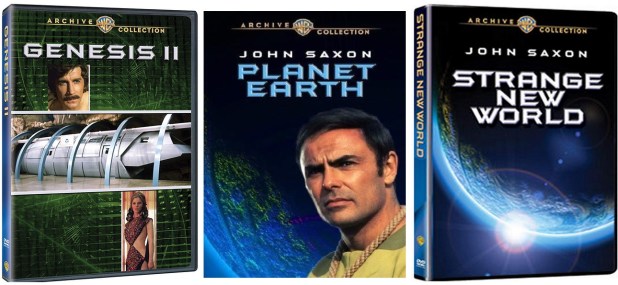
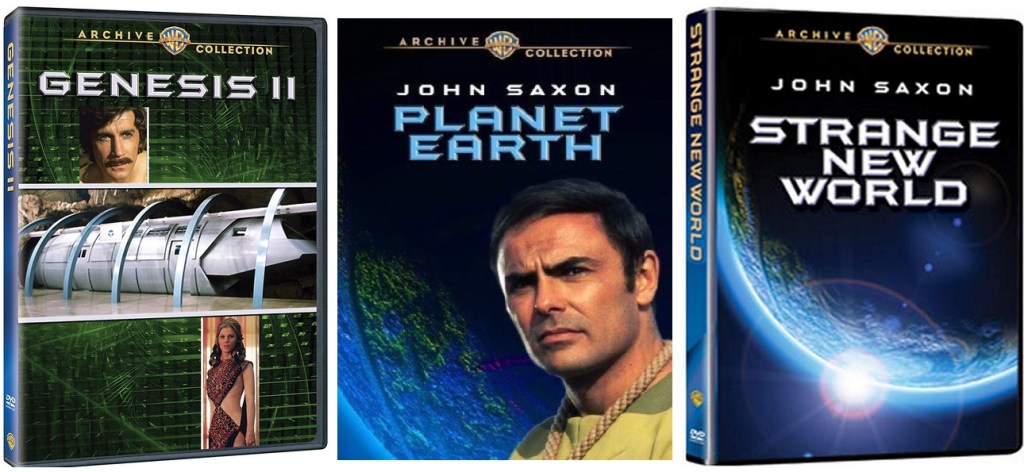
Then, after the additional go-to-series failures of the Genesis II reboots Planet Earth and Strange New World produced in the wake of The Questor Tapes, Roddenberry tried again — by jumping on the ‘70s “occult detective” sub-genre with 1977’s Spectre — by reworking another Star Trek element: the contemptuous friendship between Spock and Dr. Leonard McCoy, itself a homage to the relationship between Sherlock Holmes and Dr. Watson. Spectre starred Robert Culp (The Gladiator) as William Sebastian, a criminologist and occult expert assisted by Gig Young (1978’s Game of Death with Bruce Lee) as Dr. Hamilton.
Genesis II stars Alex Cord (who also journeyed into a “fucked up future” in Chosen Survivors) in the “future world” of 1979 as NASA scientist Dylan Hunt. Of course, he opens the post-apocalyptic proceedings with that all-too-familiar apocalypse (or psychological horror) cliché: “My name is Dylan Hunt. My story begins the day on which I died.” So goes the story a “20th Century Boy” (T Rex, anyone?) thrown forward in time by a suspended-animation earthquake-accident that damages his New Mexico/Carlsbad Caverns-housed “Project Ganymede” system for astronauts on long-duration spaceflights.
And we flash forward to the year 2133.
An archeological team of PAX (Latin for “peace”) descendants from the NASA personnel that lived-worked-were trapped in the Carlsbad installation when World War III (aka “The Great Conflict” because, well, the docile hoards of all post-apoc futures never seem to be able to preserve or retain a basic semblance of American history) broke out, discover Hunt’s buried chamber. And while they can’t seem to “remember” World War III, the PAX are smart enough to construct a subterranean rapid transit system utilizing a magnetic levitation rail operated inside a “vactrain-tunnel network” that spans the globe and saves the masses from air transportation attacks.
Anyway, here’s where Mariette Hartley comes in.
Lyra-A oversees the all-female totalitarian regime known as the mutated (natch) Tyranians that rule the lands once known as Arizona and New Mexico. In addition to their increased physical abilities, you can always spot a Tyran by their nifty, dual navels — that they seem to love to show off. (Schwing! Thank you, Gene!) Not that the wussy PAX-rats would do anything when they spot a Tyran: they let themselves be enslaved.
Lyra-A, in a grand alien fashion of the Star Trek variety, is enraptured by Roddenberry’s “Buck Rogers” and wants to harness Hunt’s knowledge of (among other things) nuclear power systems to fix the Tyranians’ dead power plant. But apoc-bitch Lyra-A double crossed him: it’s a ploy to reactivate a nuclear missile system to destroy the PAX. As a result, Hunt goes into Moses-mode (see the apoc-romps No Blade of Grass, Ravagers) and leads a revolt of the enslaved, sabotages the nuclear device, and destroys the reactor.
Sound pretty cool, right?
Airing to high ratings in March 1973 and encouraged by the network brass, Roddenberry worked up a 20-episode first season on the adventures of Alex Cord’s post-nuc Moses. Then CBS-TV dropped the bomb: they passed over Genesis II and gave the timeslot to another competing post-apoc series: the short-lived and low-rated Planet of the Apes.
Those mothballed Genesis II episodes featured recycled ideas from Star Trek: TOS and fueled the later Star Trek movies — with stories about suspended animation soldiers from the past (“Khan!!!”), a London ruled by King Charles X; NASA “evolved” computers and equipment left on Jupiter’s Ganymede returning to Earth in search of their “God” (“The Changeling” and the annoying Persis Khambatta-V’ger non-sense from Star Trek: TMP); men turned into breeders and domesticated pets (reworked for the second pilot, Planet Earth); the ol’ catapulted-through-a-time-continuum back to 1975 gaffe (“Tomorrow and the Stars,” an episode from Star Trek: Phase II, the proposed-failed post-Star Wars reboot), and a creepy priesthood who enslaves the masses via electricity used as a “God” (“Return of the Archons” from ST: TOS).
The reason the network passed on Genesis II: The series was “too philosophical” and Alex Cord’s portrayal was “too dark and brooding.” They wanted another handsome and charmingly arrogant Captain James T. Kirk. So Roddenberry and Warner Bros. rebooted Dylan Hunt into an action-driven and conflict seeking Kirk-like character embodied by John Saxon.
Cue for Planet Earth.
Now Dylan was one of three cryogenically-frozen astronauts who return to Earth to reestablish the PAX organization that sent them into space. And while we lost Mariette Hartley, we gained the equally fetching Diana Muldaur (again, from Cord’s Chosen Survivors), who rules the Amazonian, male-enslaving “Confederacy of Ruth,” along with cherished character actors Bill McKinney (Deliverance, Cannonball) and Gerritt Graham (Phantom of the Paradise, Used Cars) as “impotent males” in recurring roles.
This time, instead of CBS, ABC aired the Warner Bros. produced program in April 1974.
The network passed.
Cue a Strange New World.
To creative and legal reasons lost to the test of time, Warner Bros., who now owned the intellectual rights, reworked the premise a third time as Strange New World (pinching the title from Star Trek’s opening monologue) — sans Roddenberry’s involvement — dumped the PAX and Tyranians, and retained John Saxon as the same Kirk-like character, now known as Captain Anthony Vico, who returns from a suspended animation space trip with two other astronauts (as in Planet of the Apes TV series that screwed Genesis II in the first place).
The movie aired in July 1975.
The network passed.
And with that, between Roddenberry’s vision, and the failure of the Planet of the Apes TV series (episodes were cut into overseas theatrical and telefilms), the small screen’s attempt to jump on the major Hollywood studios’ post-apocalyptic bandwagon was over. Thus, us wee lads and lassies gathered around the TV on Saturday mornings and settled for Filmation’s Ark II, whose 15 episodes (it seems it had more episode and was on much longer), aired in 1976, then reran in 1977, then again in 1978. And that kiddie-apoc series stopped production because the network “wanted Star Wars” (and not a TV knockoff of 1977’s Damnation Alley). So Ark II was reworked and repurposed (the same “universe,” so to speak) as Space Academy and Jason of Star Command (Sid Haig, rules!).
There was also another, similar attempt at the Genesis II concept with, ironically, another Star Trek: TOS alum: Glenn Corbett (warp-drive creator Zefram Cochrane in 1967’s “Metamorphosis”). As with Roddenberry’s The Questor Tapes, The Stranger (1973) was another failed TV movie-to-series sci-fi twist on the ‘60s runaway TV hit, The Fugitive. This time, instead of returning to a post-apocalyptic society, our astronaut (Hey, Sam . . . he’s named “Stryker”!) returns to a totalitarian “twin” Earth run by the “The Perfect Order.” (And if it all sounds a bit like 1969’s Journey to the Far Side of the Sun byGerry and Sylvia Anderson of the fellow-failed, post-Star Trek series UFO and Space: 1999 . . . then it probably is: both series were movie-rebooted in the post-Star Wars universe as the telefilm/foreigner theatricals Invasion: UFO and Destination Moonbase Alpha, respectively.)
But wait . . . all was not lost with Genesis II.
Roddenberry’s widow, Majel Barrett (Nurse Christine Chapel in Star Trek: TOS and Lwaxana Troi on Star Trek: TNG and DSN) produced one of Roddenberry’s old pre/post-Star Trek dystopian-apocalyptic concepts, Andromeda (itself recycling from Genesis II and Planet Earth), a Canadian series that ran from 2000 to 2005 and aired in syndication on U.S television.
VHS rips ofGenesis II and Strange New Worldcan be enjoyed for free on You Tube, while Vudu has official, affordable streams of Genesis II and Planet Earth. For whatever “legal” reasons, no streaming platform offers Strange New World. However, copies of all three are widely available on DVD courtesy of Warner Home Video’s Warner Archive Collection.
Star Wars: Episode IX – The Rise of Skywalker is currently in theaters and was released theatrically on December 20 in the United States.
About the Author: You can read the music and film reviews of R.D Francis on Medium and learn more about his work on Facebook. He also writes for B&S Movies.
“In the year 1987, at the John F. Kennedy Space Center, NASA launched the last of America’s deep space probes. The payload, perched on the nosecone of the NASA rocket, was a one-man exploration vessel: Ranger 3. Aboard this compact starship, a lone astronaut, Captain William “Buck” Rogers, was to experience cosmic forces beyond all comprehension: an awesome brush with death. In the blink of an eye, his life-support systems were frozen by temperatures beyond imagination. Ranger 3 was blown out of its planned trajectory into an orbit a thousand times more vast, an orbit which was to return the ship full circle to its point of origin, its mother Earth, not in five months…but in 500 years.
For 500 years, Buck Rogers drifted through a world in which reality and fantasy merged into a timeless dream.”
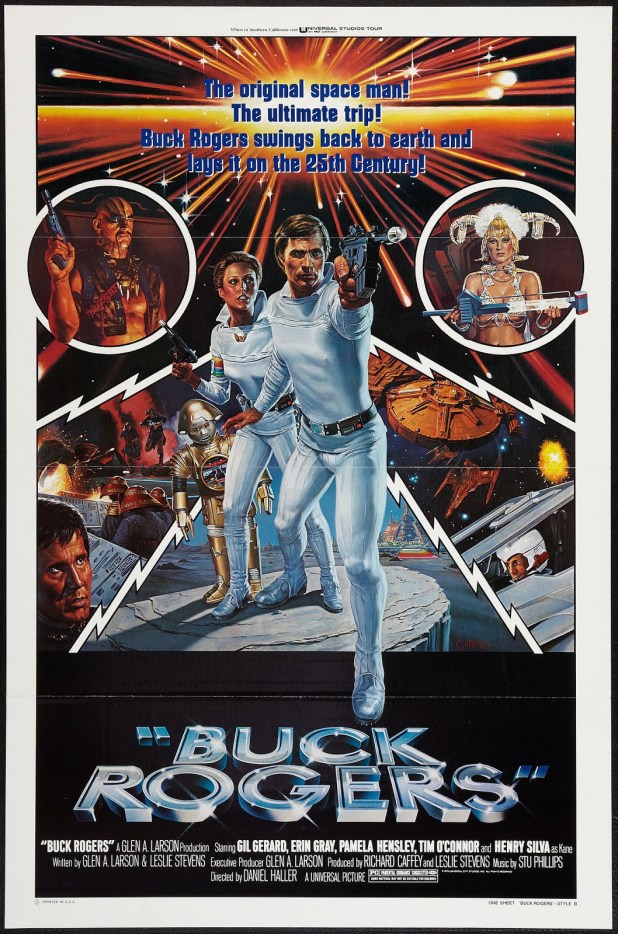
It’s strange to call Buck Rogers in the 25th Century a ripoff of Star Wars when the concept behind it predates Lucas’ film by at least five decades. That said, without the tale of Jedis, Universal would have never green lit Buck Rogers for television. Glen A. Larson, who had a production deal with the studio, was in charge.
The original goal was a series of TV movies, but Larson’s other Star Wars-ian project Battlestar Galactica was supposed to work the same way, but then had been released theatrically overseas and in the U.S. So Universal decided to release this movie in theaters on March 30, 1979, with NBC airing a weekly series as of September 20, 1979, which started with a slightly modified version of this feature.
As the pilot and two-part first episode for the series, called “Awakening,” this movie features Gil Gerard — who was married to Connie Sellecca at the time (making them a power couple back in the days of Battle of the Network Stars; then there was Lee Majors and Farrah Fawcett as the other “power couple”) — as Buck, who has slept through the last 504 years and awakens in a brave new world (with recycled props, costumes and effects from Battlestar Galactica. In fact, even the ships on this show were brought back from Galactica, as the Earth Starfighter was originally designed by Ralph McQuarrie as a Colonial Viper).
Speaking of recycling, the inside of the Draconian flagship was used for the setting of the Motley Crue video “Looks That Kill.”
But I digress.
Buck soon learns that civilization on Earth was rebuilt following a devastating nuclear war — making this kinda sorta a post-apoc movie — that occurred on November 22, 1987, and is now under the protection of the Earth Defense Directorate.
Buck is helped by Colonel Wilma Deering (Erin Gray, who was all over 80’s TV) and a robot named Twiki who basically only says “budda budda budda” and was played by Felix Silla and voiced by Mel Blanc (who also voiced Daffy Duck as Duck Dodgers). Buck also meets Dr. Theopolis (Eric Server), a computer in the shape of a golden smiley face. Theo was a member of Earth’s “computer council” and one of the planet’s scientific leaders.
The villain of this piece was Princess Ardala (Pamela Hensley, who was C.J. Parsons on Matt Houston) and her henchman Killer Kane (Henry Silva in the movie, Michael Ansara on the series and hey, are those guys brothers?) and a henchman named Tigerman who dies in the movie but came back for TV.
The actual series was packed with guest stars who comprise so many of the people that we love: Peter Graves (Mission Impossible), Jamie Lee Curtis (Halloween), Markie Post (TV’s Night Court), Dorothy Stratten (Galaxina), Leigh McCloskey (Inferno), Richard Moll (every 80’s movie ever made), Jerry Orbach (Law and Order), Gary Coleman (pretty much the kid of the 80’s), Jack Palance (so many movies but let’s say Welcome to Blood City), Sam Jaffe, Sid Haig (take your pick of amazing movies here), Vera Miles (Psycho), original Flash Gordon and Buck Rogers star Buster Crabbe, and a litany of Batman guest-stars like Cesar Romero, Frank Gorshin, Roddy McDowall and Julie Newmar.
I have fonder memories of this in my head as we didn’t have all that much science fiction on TV until Star Wars. However, the second season takes a definite turn, as Buck gets a whole new mission on the Searcher, a ship with the Latin motto “Per ardua ad astra” (“through adversity to the stars” or “through work to the stars”). Their goal was to seek out the lost tribes of humanity, or you know, the exact same mission as Battlestar Galactica.
Supposedly, despite the series decent direst season ratings, Gerard was displeased with its light, tongue-in-cheek tone, and frequently fought with producers. He told Starlog that he hoped the series would be canceled after the first season.
Admiral Efram Asimov, Dr. Goodfellow (Wilfrid Hyde-White from My Fair Lady) and a robot named Crichton joined the crew, along with a hawk-person named, well, Hawk (Thom Christopher, who is also in Deathstalker III and Wizards of the Lost Kingdom).
Now, the formerly funny show became as pastiche of Star Trek, with Hawk as Spock, Buck as Kirk and Wilma as Uhura, completely with a more feminine uniform that showed off her legs. Every episode was serious business, with evolution, ecology, racism, pollution, war, nuclear power, identity, the self and religion the order of the day, as well as the idea that Hawk’s people were from Easter Island and even an episode about satyrs.
Thanks to a combination of an actor’s strike and dwindling ratings, the second season went on ice after just 11 episodes.
You can tell the passage of time on the show by how brown Erin Gray’s hair is, as well as how bulging Gerard’s waistline becomes. He was warned by producer Bruce Lansbury about feasting on the company’s never closing craft service buffet to no avail. The producer asked costumer Al Lehman to slim him down via wardrobe, leading to Lehman’s nickname for the actor: the white polish sausage.
I kind of love the theme song for this movie. It’s so bad — nearly a sub-Bond theme than a science fiction ode or something closer to Maureen McGovern’s “Can You Read My Mind?” from Superman.
“Far beyond this world I’ve known, far beyond my time What kind of world am I going to find? Will it be real or just all in my mind? What am I, who am I, what will I be? Where am I going and what will I see?”
Update: On November 24, 2020, the fine folks at Kino Lorber re-released the theatrical version of Buck Rogers to Blu and DVD in an extras-loaded, 2K transfer. They’re also offering the full TV series on Blu, also complete with new interviews and commentary tracks. You can learn more about Kino Lorber’s complete roster of films at their official website and Facebook, and watch the related film trailers on You Tube.
This is a big week for Star Wars fans, courtesy of the nationwide premiere of Star Wars: Episode IX – The Rise of Skywalker and with Alden Ehrenreich from Solo: A Star Wars Story cast in the lead as John the Savage in Universal Studios’ third adaptation of Aldous Huxley’s 1932 dystopian novel.
Set to premiere in 2020, the Universal co-production with Steven Spielberg’s Amblin Television, unlike Universal’s first two TV movie productions, is being produced as a weekly series. Initially developed for NBC-TV’s SyFy Channel imprint in 2015, the production moved to NBC’s USA Network division. As of September 2019, the currently in-production series is slated to air on the conglomerate’s recently launched online streaming service, Peacock.
Their second, previous version released in 1998 as an 87-minute telefilm starring Peter Gallagher (While You Were Sleeping, NBC-TV’s Law and Order: SVU) and Leonard Nimoy (Star Trek, Baffled!) was derided by critics and sci-fi fans as being “bland” and “boring” and inferior to the 1980 version. The poor reviews are attributed to its script being a greatly abridged version that was “loosely based” on Huxley’s concepts and not a straight adaptation of the novel. (In another Star Wars twist: the 1998 version also starred mainstay U.S Television actor Kristoffer Tabori as John the Savage, who later provided voice work on several Star Wars video games. Under his directorial name, K. T. Donaldson, Tabori helmed the SyFy Channel’s “mockbuster” of Cowboys vs. Aliens: 2009’s High Plains Invaders.)
In the wake of the Star Wars-inspired sci-fi revival sweeping the film and television industries, NBC-TV took another swing of the light saber with their first version of Huxley’s novel that aired on March 7, 1980—a mere three months after their British-produced adaptation of Ray Bradbury’s The Martian Chronicles aired in January.
Keep in mind that Universal—the studio that brought you ABC-TV’s Battlestar Galactica and NBC-TV’s Buck Rogers in the 25th Century—backed this adaptation, so don’t expect a big-budget Blade Runner (1982) dystopia. While BNW ‘80 captures the spirit of Huxley’s novel and maintains its dark, pessimistic tone, and runs long enough to go deeply into the book’s themes, plot and dialog (unlike BNW ’98), it’s undone by its low-budgeted sets and costumes. Thus, you feel like you’re watching a two-part episode of arc of NBC-TV’s cartoonish Buck Rogers in the 25th Century—the same problem that plagued The Martian Chronicles.
Since this was a TV project, NBC stuck with what they knew and hired Pittsburgh-born actor Burt Brinckerhoff, better known for his extensive TV directing resume, which included multiple Emmy Awards for the 1977 to 1982 dramatic series, Lou Grant. The scribe hired to wrangle Huxley’s 300 page-plus sociopolitical lesson into a three-hour film was Doran William Cannon, who penned the original scripts for the the “so bad it’s good” psychedelic all-star comedy Skidoo (1968) and the equally experimental oddball, Brewster McCloud (1970).
Set 600 years in the future, Keir Dullea (2001: A Space Odyssey and the early-‘70s Canadian TV series, and eventual film series, The Starlost) heads the cast as Thomas Grahmbell, the “Director of Hatcheries” who genetically engineers civilians for a well-ordered society. To assure everyone maintains the status quo, citizens are required to ingest mood-controlling drugs, have “sex without love,” and real-life pregnancies are banned. The dissidents to this humanless new order are the free-thinking poet Heimholtz Watson (Dick Anthony Williams; the Blaxploitation classics The Mack and Slaughter’s Big Rip-Off), the bookish oddball Bernard Marx (Bud Cort from Brewster McCloud and the equally quirky favorite, 1970’s Harold and Maude), an old-world “primitive” John the Savage (Kristoffer Tabori), and Linda Lysenko (Julie Cobb; Star Trek: TOS “By Any Other Name” and TV’s Charles In Charge)—who becomes a criminal of the state for having a natural child birth.
Originally intended to air as a two-part, four hour mini-series (including commercials), at the last minute NBC ordered a series of cuts to pare down the film into a one night, three-hour movie, which means a half-hour of continuity-losing logic was excised from the film. However, when it premiered in the U.K on the BBC later that year, it ran in its original, full-length two-part format. So keep those two versions in mind if you decide to purchase a copy for your home library (you’ll want the BBC version). And caveat emptor those grey-market DVD-Rs with laser-printed covers flooding the online marketplace.
So, are the critics and fans right? Is Brave New World ’98 inferior to the 1980 version? You can watch the full NBC-TV 1980 version on You Tube and let us know what you think here on the site or over on our Facebook page.
And save us the aisle seat on Friday. May the Force be with you!
Star Wars: Episode IX – The Rise of Skywalker will be released theatrically on December 20 in the United States.
About the Author: You can read the music and film reviews of R.D Francis on Medium and learn more about his work on Facebook. He also writes for B&S Movies.
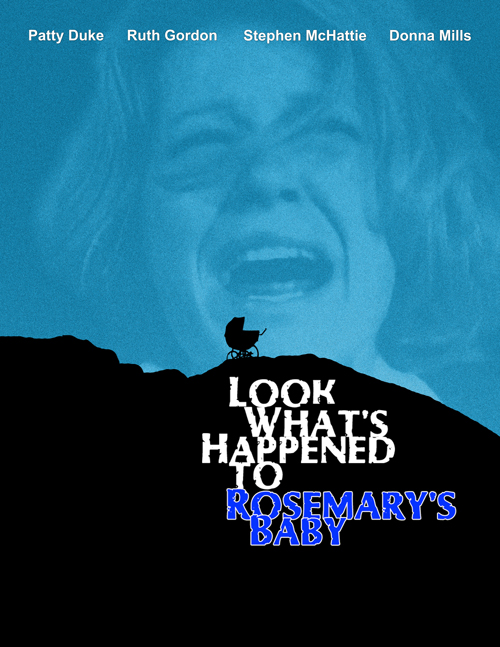
When audiences turned in to the ABC Friday Night Movie on October 29, 1976, they got to see the sequel to one of the biggest horror films ever. However, what they ended up watching had little to nothing to do with its inspiration, 1968’s Rosemary’s Baby, or the Ira Levin-written sequel Son of Rosemary.
The only actor to return from the orginal is Ruth Gordon as Minnie Castevet and we all know that you can’t trust the combination of Old Hollywood and Satan.
Sam O’Steen, an editor on the first movie, directed this sequel. He also directed a ton of amazing films, such as Cool Hand Luke, The Graduate, Chinatown, Straight Time, Silkwood and Working Girl. He also edited perhaps the scummiest and most Italian horror movie to ever emerge from a major American studio, Amityville II: The Possession.
The movie breaks its story down into three different books.
The Book of Rosemary: A coven prepares for a ritual only to learn that Adrian, the son of Rosemary (Patty Duke, who was considered for the original movie, taking over for Mia Farrow) is missing from his room and hiding in a synagogue. Sure, the coven can hurt the rabbis, but because they’re in a house of God, everyone is safe.
The next morning, Guy (George Maharis from Route 66 taking over for John Cassavetes, which is the dictionary definition of several steps down) gets a call from Roman Castevet (Ray Milland taking over for Sidney Blackmer, so at least Old Hollywood stays in the picture) and asks him to keep an eye out for his wife and child. Roman could really care less, because he’s a big Hollywood star now.
While Rosemary calls him, Adrian is bullied by some kids and goes full on Daimon Hellstrom on them. Luckily, a prostitute named Marjean (Tina Louise!) saves them, but you know that she has to be a fallen woman in league with Satan. She calls a possessed bus to pick up Rosemary and drive her away from her son. Now, he belongs to the coven.
The Book of Adrian: Twenty years later, Adrian is living with his Aunt Marjean in a casino and acting up. He’s played by Stephen McHattie (Hollis “Night Owl” Mason from the Watchmen movie) and he loves speeding, drinking, fighting and getting into trouble with his pal Peter (David Huffman, F.I.S.T.). As he arrives at his 21st birthday, Roman and Minnie arrive and drug him, getting him ready for his ascension to be the Antichrist, which pretty much involves him possessing a bunch of people who just want to disco dance and standing by while his father kills his best friend. Oh yeah — Broderick Crawford plays the local sheriff, which means that even more Old Hollywood is here in the service of Old Scratch.
The Book of Andrew: The coven has allowed Adrian to take the murder charge as he wakes up in a hospital. Donna Mills plays a nurse named Ellen who helps him escape. This is probably the second-best thing Ms. Mills has ever done. The first? Her epic self-help VHS tape, The Eyes Have It.
Of course, Ellen is really the granddaughter of Roman and Minnie. Even as they lose Adrian as he runs away after his father hits Ellen with his car — of course she survives — they already have the next generation of the devil all locked up. Why this happens and why we sat through this entire film is the kind of mystery that I’ve made this site for. After all, I’ve watched this epic made for TV turkey so many times that I’m embarrassed to divulge the true number.
Here’s a mixed drink to go with this movie.
Chocolate Mouse Martini
1.5 oz. Baileys Irish Cream
1.5 oz. Kaluha
1 oz. vodka
1 oz. creme de cacao
2 oz. milk
Chocolate syrup
Chocolate shavings
Pour chocolate syrup on a plate, then dip rim of glass into it. You can also drizzle chocolate syrup into the glass.
Shake alcohol and milk in a shaker with ice for twenty seconds, then pour into glass. Top with chocolate shavings.
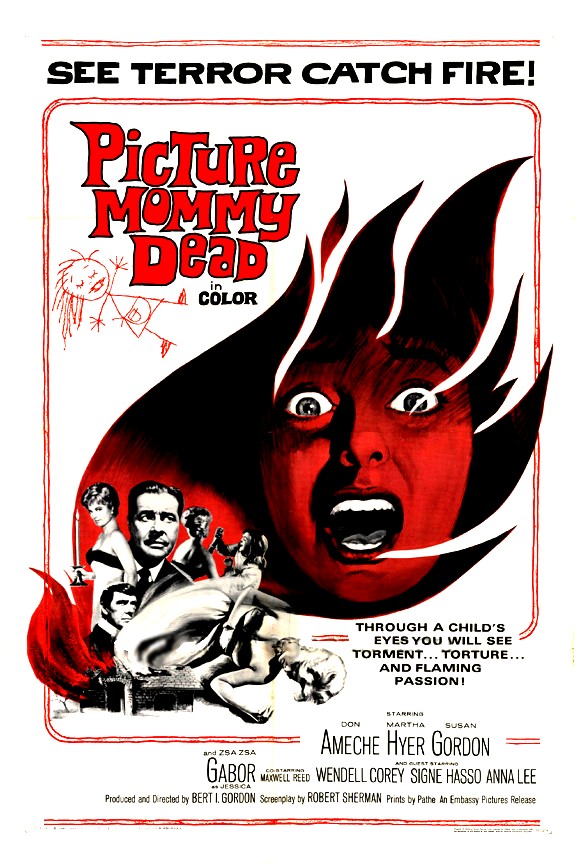
Bert I. Gordon was known as “Mister B.I.G.” which was a reference to both to his initials and to his preference for directing movies with giant-sized monsters and people like The Amazing Colossal Man, War of the Colossal Beast and Attack of the Puppet People.
His daughter Susan Gordon appears in this movie as well. This was her last film role, as she also was in four of Gordon’s other films: the aforementioned Attack of the Puppet People, The Boy and the Pirates and Tormented.
In this film, which originally aired on December 3, 1969 on ABC, Susan plays Susan Shelley, who believes that her father Edward (Don Ameche!) killed her mother Jessica (Zsa Zsa Gabor!). After three years in a convent, she’s reunited with her father and his new wife, her former governess Francene (Martha Hyer, The House of 1,000 Dolls).
Soon, she’s being gaslit by visions of her mother set ablaze and pushed toward insanity, all so that the rest of the family can inherit mommy’s money.
Maxwell Reed is made up with scars to portray Anthony, the caretaker who tried to save Jessica. He was the first wife of Joan Collins in real life and she’d later accuse him of drugging her and taking advantage of it on their very first date.
Wendell Corey (The Astro-Zombies) also shows up as an attorney and Signe Hasso, who was once promoted as the next Garbo, plays a nun.
Hedy Lamarr was originally cast in ty Zsa Zsa Gabor’s role, but she was fired when she was arrested at a Los Angeles department store for shoplifting an $86 pair of slippers. Gene Tierney was originally going to play Francene Shelley but dropped out, as did Merle Oberon.
It was filmed in the legendary Greystone Mansion, which has been host to plenty of films, such as Batman and Robin, The Big Lebowski, Death Becomes Her, Flowers in the Attic, Phantom of the Paradise and The Witches of Eastwick. The home was unfurnished, but Gordon was able to get all of the furnishings from newspaper tycoon William Randolph Hearst’s New York City apartment to fill it.
This is an interesting little TV movie, with no real people to root for, but plenty of great fashions and colors. It’s almost like a little American giallo, except you know, Burt I. Gordon is no Mario Bava. That said, it’s a fun little escape.
Born in Argentina, the British director John Llewellyn Moxey directed so many films that have ended up on our radar, like The City of the Dead (Horror Hotel) to The House That Would Not Die, Circus of Fear, The Night Stalker, Home for the Holidays, Nightmare In Badham County, Where Have All the People Gone? and so many more.
In this effort, he’s working from a Jimmy Sangster script. Sangster is also a talent who has created more films than you realize, including The Curse of Frankenstein and Horror of Dracula for Hammer and Whoever Slew Auntie Roo?, The Legacy, Scream, Pretty Peggy and tons of 1970’s American TV.
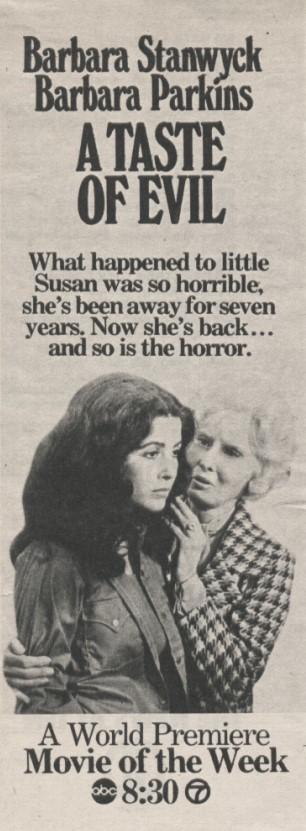
Susan Wilcox (Barbara Perkins, Asylum, Valley of the Dolls, The Mephisto Waltz) was assaulted when she was just 13, during a family party. Her rich family sent her away to Switzerland, as she was so upset that she couldn’t speak. Now, years later, she’s back home, where her mother (Barbara Stanwyck) has married another man, Harold Jennings (William Windom, Dr. Seth from Murder, She Wrote).
Soon, she returns to the woods and the cabin where she was attacked as a child and feels like someone — maybe Harold — has followed her. Now, she keeps seeing him outside her window and finds his dead body in her bathtub. Her mother thinks that perhaps she should go back to Switzerland, while only the family friend John (Arthur O’Connell, Wicked Wicked) and Dr. Michael Lomas (Roddy McDowall) able to offer any aid.
This movie gets dark quick. One night, Susan is chased through the woods by the dead man and runs into her old cabin, discovering a rifle. As the man who may have attacked her as a child enters, she shoots him, killing Harold. That’s when the truth emerges — her mother has always hated her, as she took attention away from her marriage. And it turns out that old family friend John? Yeah, he’s the guy who attacked her back when she was 13.
That’s not the end of the story. There are still plenty of twists and turns, all in a compact 73 minutes,
Producer Aaron Spelling thought A Taste of Evil was similar to another Sangster’s film, Scream of Fear. The writer admitted that it was the same story, just updated to America. It also owes a debt to Les Diaboliques.
As always, I wish that more TV movies were available on streaming or DVD. I can find them via the grey market, but I’d really like to have these sitting on my shelf.





 B&S About Movies
You must be logged in to post a comment.