Day 20 Sunday Dinner:
From eating scenes to full on foodie fodder
Mike Nichols, who dominated early ‘70s cinema with the box office hits The Graduate (1967) and Catch-22 (1970), and received multiple award nods for Silkwood (1983) and Working Girl (1988), decided to make a comedy, a sci-fi comedy—a 2001: A Not-So-Funny Space Comedythat needed Leslie Nielson. Written and produced by the timely-hysterical Garry Shandling, What Planet Are You From? was a $60 million bomb with a worldwide theatrical gross of less than $15,000. Guess who didn’t write or produce another film, ever again?
The same can’t be said for Madeleine Olnek, an extremely talented, independent American film director, producer, screenwriter, and playwright with 24 plays and three feature films to her credit. Critics universally describe her work as “madcap comedies with absurdist leanings.”
That rule applies to this, her fifth film, and her first feature-film overall, which effectively utilizes its parody of ‘50s sci-fi films—Ed Wood’s in particular—to address the up and downs of lesbian culture.
Three lesbian space aliens come to Earth to have their
hearts broken in order to save their planet’s ozone layer—that’s being depleted
by “too much emotion.” Zoinx, one of the aliens, falls in love with the
greeting-card store employed Jane, who begins a romance with the alien—who looks
(just not-so-pointy headed) and sounds like Dan Aykroyd and Jane Curtain’s
SNL’s Coneheads—and makes “love” by rubbing noses, as is Zoinx’s custom. When
the Men in Black show up, Jane needs to decide: stay on earth and be
miserable—where she’s alienated—or go to a planet where she’ll be the “alien,”
but be happy?
As with the Coneheads, who bypass the Earth’s vast cuisine
and cultural eats for a steady diet of beer and potato chips “for survival” (with
the occasional “Bass-o-Matic’d”
or “Bat-o-Matic’d” fish
or Chiroptera shakes), jokes are abound by the new, strange foods Earth has to
offer, such as alcohol, coffee, and desserts—instead of the need of sex or
chomping down on human flesh, as is the case with most-otherworldly aliens.
Hey, at least Commander Balok admits to his love of alcoholic beverages and isn’t ashamed of his bald head. You know he ain’t wearing no Wookie toupee on his dome when the Fesarius makes the Kessel Run back to the “First Federation.”
So raise your Tranya and toast this film. I hope you relish
it as much as I.
Madeleine Olnek’s latest and second feature film, Wild Nights with Emily (Wikipedia), is a biographical comedy based on the life of poet Emily Dickenson starring Saturday Night Live alumna Molly Shannon. You can learn more about the multiple award-winning film—90% “Certified Fresh” by Rotten Tomatoes—at the film’s official website.
About the Author:You can read the music and film reviews of R.D Francis on Medium and learn about his work on Facebook. He also writes for B&S Movies.
Day 20 Sunday Dinner: From eating scenes to full on foodie fodder
Author’s Note: You’ll be able to watch the full films of Ed and his Death Mother’s cool ‘n quirky cousins: Bartleby, Ed and Rubin, Trees Lounge, and Twister for free, and Ghost World for a fee. (Links to follow in the article.) And there is eating in all of them—especially Steve Buscemi driving an ice cream truck in Trees Lounge and Edna and Rebecca in Ghost World slinging popcorn and coffee, respectively. So there you go! And now, on with the eats, I mean, show!
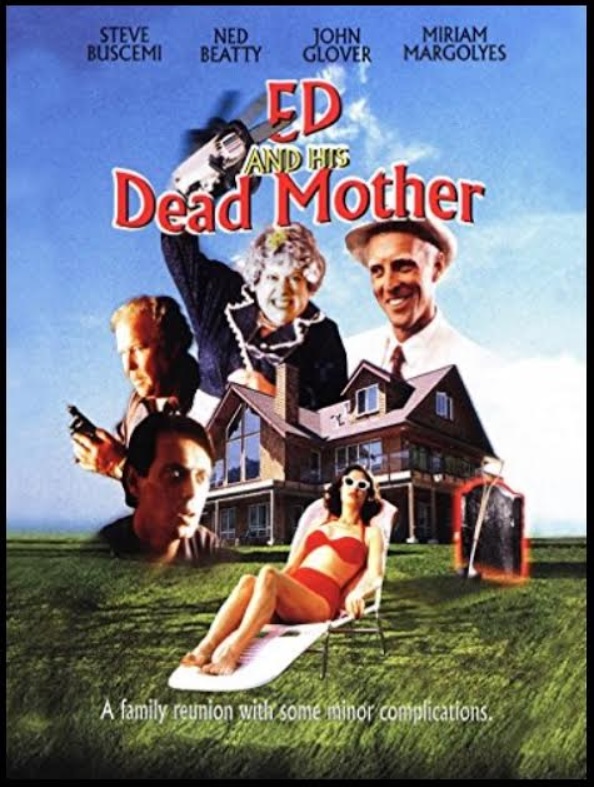
The only thing missing from Ed and His Dead Mother is Crispin Glover.
When I look at this film’s cover, I can’t help but think of Twister (1989; full film/You Tube), featuring Crispin’s flaky, new wave rocker, Howdy, crooning in an echo chamber with a phase-connected guitar about how pretty his baby is and how mean his daddy is.
When I watch Ed and his Dead Mother, I can’t help but think of my equally quirky favorite, Ed and Rubin (1991; You Tube/full movie), with Crispin’s Rubin Farr and Howard Hessman’s Ed Tuttle frolicking about like Howdy’s distant cousins, wallowing in a henpecked loneliness, just down the street from Steve Buscemi’s Ed Chilton. And Mr. Chilton, probably, at one time, lived in the same neighborhood of another one of my favorite, quirky loves: the Steve Buscemi-starring and directed Trees Lounge (full movie/TubiTV).
“This movie sucks,” they say. “Come on, you have to hate this movie,” they tell me. In the words of Crispin’s Bartleby, in the awesome Jonathan Parker-version of Herman Melville’s short-fiction piece, “Bartleby, the Scrivener: A Story of Wall Street” (Bartleby, 2001; full movie/You Tube), I say to them: “I would prefer not to.” That’s probably why I have no friends and write all day long. They’s nothing like a steely resolve in your movie preferences to drive away the sane people.
However, I didn’t say I wanted Crispin instead of: I want him in addition to Steve Buscemi. Do I really have to rattle off Steve’s credits for you: Escape from L.A., Fargo, Reservoir Dogs . . . but I will mention his Ed Chilton’s long-lost brother, Seymour, which you might have missed, from another one of my off-beat loves, Ghost World (2001; rental/Vudu).
So I think that little bit of insight to my VHS shelf will give you either fair warning to run—or leave your chops watering with bug-juicy anticipation for this Jonathan Wacks directed, chunky-chunk of weirdness. Hey, Jonathan is the dude who directed the Beatles’ George Harrison-produced Pow Wow Highway (1989) and produced the Monkees’ Michael Nesmith’s Repo Man. He directed porno-shock rockers GWAR (alongside Ethan Hawke from Reality Bites) in Mystery Date (1991). The dude ran, as Vice President of Production, the Samuel Goldwyn Company (of MGM fame). While he only did four feature films: they were awesome, unique original films and I love them all. I wished Jonathan Wacks stayed behind the camera and stayed out the executive suite. I wished fate would have had my own acting endeavors cross his path. I’d love to act in one of his movies. A gig as an under five/day player trading chops with Crispin and Buscemi in some crazy-ass road movie based on the writings of Hunter S. Thompson is in my thespian wheelhouse. I’d even take a part in a sequel to Ice Cream Man (see my Day 20: Option 4 review) just to work with Clint Howard.
“Dude, what the hell does this have to do with the ‘Day 20 Scarecrow Challenge’ regarding movies about or featuring food? While you were yacking about your man-love for Crispin Glover and Steve Buscemi, I went to the IMDB and it says Steve’s character doesn’t even run a restaurant: he owns and operates a hardware store. So, what’s he eating: sandpaper and paint chip sandwiches?”
Well, he’s not eating anything. But his dear, dead mom loves her bugs.
Lost somewhere between the cannibal-comedy shenanigans of Paul Bartel’s Eating Raoul (1982) and Peter Jackson’s gooey zombie-comedy Dead Alive (1993), only not as clumsy as Eating Raoul and not as icky as Dead Alive, lies the cockroach crunch of Ed and his Dead Mother, with its comedic questions on how we deal with death.
Ed lives with his perpetual telescope-peering pervert uncle Benny (Ned Beatty of Deliverance, 1972). Ned’s living the life, now that his domineering nag-of-a-sister, Mabel (omnipresent character actress Miriam Margolyes), is dead; Ed is still moping about it a year later. That makes Ed easy prey for a smarmy, super slick salesman in the form of the white-haired and white-suit clad A.J Pattle (ubiquitous TV and film villain John Glover; Gremlins 2: The New Batch, In the Mouth of Madness) from the Happy People Corporation of Webster City, Iowa. His product: he sells reanimation services (to the recently-insurance loaded loved ones of the dead).
Ed lays down the $1000 bucks—and Pattle shows up at the door step with Mabel. Of course, since this is all an elaborate insurance swindle, the reanimation “runs out.” Now Pattle pitches HPC’s “reanimation kit” (a shrink-wrapped metal tin) for $349.99.
And what’s inside: cockroaches. Why: “Life my, boy. Life,” exclaims Pattle. “But only give her two a day. No more, no less. You don’t want to give her too much ‘life’ at one time. It screws up the reanimation process.” Naturally, Ed and Benny soon realize the now profanity-spewing Mable is not the woman she used to be. Of course, as with any Pandora’s Box: Once it’s opened—and you don’t follow the instructions—and, in this case, if you overdose on “life,” you become a crazed killer. And you develop a taste for dogs and cats and become addicted to lawnmower death—of the furry creatures, not the band.
And that sultry babe teasing Benny through the telescope, the one that Ed would never have shot with, makes a play for Ed. And why not? She’s the Happy People Corporation’s femme fatale secret weapon to bilk Ed of his mother’s inheritance. Creepy Uncle Benny’s into it for the vicarious ride and listens to Ed’s total failure in sealing the deal and suggests, “Maybe I can hide in the kitchen and scream out positions to you in case you get stuck on what to do next.”
And what should you do next? Pop the Orville Redenbacher, throw in a DiGiorno’s, pop a Dos Equis and watch Ed and his Dead Mother for free on TubiTv.
About the Author:You can read the music and film reviews of R.D Francis on Medium and learn about his work on Facebook.
DAY 20. SUNDAY DINNER: From exceptional eating scenes to full on foodie fodder. Come hungry!
After a viewing of this movie at a very young age, I decided that I’d never have chaffing dishes in my house. That may never come true just because I doubt I’ll ever have the money to spend on such luxurious accoutrements, but also because the moment where Baby Jane Hudson (Bette Davis) serves her sister Blanche (Joan Crawford) her parakeet — and later a rat — on a silver platter, I was put off on silver serviceware for the rest of my days. This is not a meal fit for Ms. Crawford!
Robert Aldrich had the idea of bringing together two of America’s most enduring screen icons in one film where they’d bring their long-rumored rivalry to the story of two sisters who had been used up by show business.
Baby Jane was once a vaudeville star who held her family under her thumb, using her stardom to get whatever she wanted. That all changed once movies took over and she couldn’t adapt, so by 1935, her sister Blanche is the toast of Tinseltown while she’s a shell of her former self, her movies seen as failures. One night at a party, an accident leaves Blanche paralyzed from the waist down and it’s all blamed on a drunken Jane.
Flash to three decades later, as residuals from Blanche’s films are enough to keep the sisters in house and home, as the two former stars live in the shadows of their past glories. Jane has become a raging alcoholic, trapping her wheelchair-bound sister within their home, denying her even basic sustenance — hence the pet and vermin meal scenes described above.
Although Jane has gone far into middle age, she still wears the pancake make-up and outfits of her Baby past. She’s hired Edwin Flagg (Victor Buono) to play piano for her, preparing an entirely new show to take on the road. And to get there, she’s using her sister’s money.
Only madness and murder can follow, as well as the revelation that Blanche isn’t the innocent victim that she aspires to be. Both sisters have been forced into roles that they’ve played way beyond typecasting. As both sisters find themselves on a beach, with Blanche dehydrated and near-death, Jane’s plaintively sad question “You mean all this time we could have been friends?” cuts through this film, which ends before giving any resolution to the fate of either character.
Whatever Happened to Baby Jane? was a cultural force, changing Hollywood so that older actresses didn’t have to fade into the role of the matron. It’d be followed by other so-called psycho-biddy films like Aldrich’s follow-up Hush…Hush, Sweet Charlotte, as well as movies that also asked questions like What Ever Happened to Aunt Alice?, What’s the Matter with Helen? and Whoever Slew Auntie Roo?
The feud between the two actresses — which began years before this movie and would extend to their deaths — is so legendary that books and even an entire FX series was created to document it. From allegations that Crawford backed out of a publicity tour because she didn’t want to share the stage with Davis to Crawford accepting Anne Bancroft’s Best Actress statue for The Miracle Worker in a successful attempt to overshadow her enemy, this war was just like the movie — only 100% reality.
I mean — this is the movie where Bette Davis installed a free Coca-Cola machine on the set for the cast and crew for the sole reason of drawing the ire of Crawford, who was on the board of Pepsi.
There are also plenty of personal touches by both actresses. Davis did all of her own makeup, saying “What I had in mind no professional makeup man would have dared to put on me. I felt Jane never washed her face, just added another layer of makeup each day.” And Crawford, who was an avid collector of Margaret Keane’s “sad eyes” paintings, made sure that the paintings appear in next door neighbor Mrs. Bates’ house, inclduing the famous Big Eyes piece.
While Ingrid Bergman, Susan Hayward, Rita Hayworth, Katharine Hepburn, Jennifer Jones and Ginger Rogers were all rumored for Baby Jane and Tallulah Bankhead, Claudette Colbert, Olivia de Havilland and Marlene Dietrich were all in the running to play Blanche, only Davis and Crawford’s maniac energy — and downright hatred of one another — could make this film work as well as it does.
I truly believe that is Ms. Davis could have served Ms. Crawford a rat on a fancy tray, she would have done so. This is a film I’ve returned to time and time again, even if I’ve made sure to never eat a meal that has a silver cover on it.
DAY 19. VIDEO STORE DAY: This is the big one. Watch something physically rented or bought from a video store. If you live in a place that is unfortunate enough not to have one of thee archival treasures then watch a movie with a video store scene in it at least. #vivaphysicalmedia
I grew up in a small town about an hour north of Pittsburgh. Despite being a dying mill town of around 8,000 people, we still had three unique video stores to serve our movie needs — although eventually even the Uni-Mart and 7-11 would expand to have movies (the only ones I can remember getting from either are Death Bed and Gotcha!).
College Hill Video was a satellite store of the larger location in Beaver Falls, located on three spinner racks in a Giant Eagle grocery store. Their horror section was mostly new releases, nearly all mainstream.
Hollywood Video offered more video game rentals but didn’t have much selection. I can barely remember ever renting a movie there.
But Prime Time Video?
I haunted the horror section there, alternatively afraid of the lurid clamshell foreign horror and obsessed by their contents. They promised such foul delights! And of all the VHS boxes there, one cover promised the absolute bottom of the barrel. Somehow, in a small town where you had to verbally ask for adult films after looking through a gigantic binder of their covers, the forced embarrassment keeping you from every seeing something that filthy, this piece of sheer exploitation junk somehow ended up in my 16-year-old hands.
There’s really only one mom and pop rental place left that I can think of in Pittsburgh — Jack’s Discount Videos in Millvale — and three Family Videos which are located well out of the city in Moon Township, Lower Burrell and Greensburgh. Outside of Redboxes, we are sadly out of luck. So I’ve gone back to my childhood to look back at a movie I probably shouldn’t have been watching.
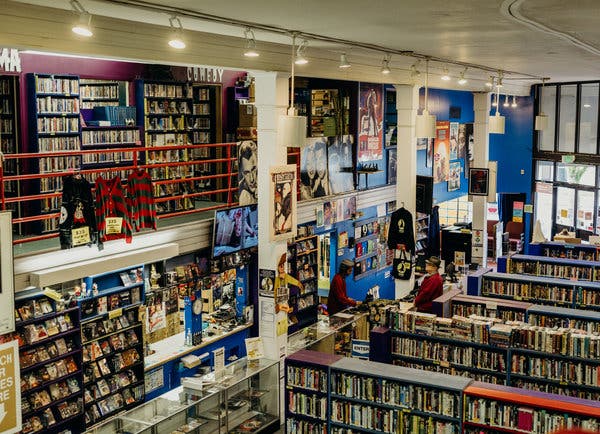
This is not the video store of my youth, only my dreams. Scarecrow Video in Seattle.
Bloodsucking Freaks is the kind of movie that — if it wasn’t so ineptly made — would make you think that anyone who watched it more than once certainly a maniac. And maybe I was back at that age, obsessed with Fangoria and heavy metal and trying to always find something heavier, louder and grosser.
Well, I found it.
This movie became the torture test for anyone that wanted to watch movies with my friends. We became fascinated with it, taking its villains into our roke playing games, drawing photos of the gore scenes and endlessly discussing how a movie like this could have ever been made.
We didn’t know that it ripped off Herschell Gordon Lewis.
We didn’t know that it was junk.
All we knew was that we had to watch it again.
While it was shot under the title Sardu: Master of the Screaming Virgins, it was retitled The Incredible Torture Show during its original run through grindhouses and drive-ins. By the time it made its way to the mom and pop video stores, it’d been purchased by Troma and retitled Bloodsucking Freaks.
We didn’t have an internet to teach us what this movie was about or spoilers to warn us of the content we were about to be barraged with. We just had ourselves.
What unspooled was a movie all about Master Sardu (Seamus O’Brien, a one and done actor who died shortly after making this movie, a victim of a burglar’s knife), who runs a Grand Guignol-style theatre with Ralphus, his demented little person. He’s played by Luis De Jesus, who was famous in Times Square for a loop he’d shot entitled The Anal Dwarf.
Yeah look — if you’re going to get offended easily, perhaps skip to our next review.
This is the kind of actor who just randomly would decide to gather all the other principals and stage an orgy. While he continued to act in adult films until the 1980’s — he’s Mr. Big in Let My Puppets Come, which Vinegar Syndrome just re-released, as well as appearing in movies like Fantasex Island, where he played Pu-Pu in an obvious send-up of Herve Villechaize’s famous role as Tattoo — he also tried to break into the mainstream, playing in Under the Rainbow and as an Ewok in Return of the Jedi. Yet in the very next year after he appeared in a Teddy Ruxpin video, he was back in adult before dying two years later.
Basically, just like Wizard of Gore, Sardu and Ralphus torture people for real on stage in front of an audience that thinks that what they are seeing is art. Then, they sell their victims into slavery.
The film unfolds in a loose collection of scenes, such as the two wiping out theater critic Creasy Silo — based on critic Clive Barnes — who made the mistake of giving them a bad review. I kind of love that the same actor who plays Creasy, Alan Dellay, also shows up as a judge in one of the junkiest mainstream films of all time, the utterly reprehensible — and fully awesome — Amityville II: The Possession.
Then, our evil duo abducts the ballerina Natasha Di Natalie and seek to break her will. She was played by Viju Krem, who is also in the aforementioned Let My Puppets Come, as well as Eros Perversion, a softcore send-up of Shakespeare, and an adult ripoff of M*A*S*H* where she appeared alongside Annie Sprinkle. Adding to the strange history of this film, she’d die young too, a victim of a hunting accident in 1983.
Football hero Tom Maverick (Niles McMaster, yes, the father from Alice, Sweet Alice) is seeking to save her before it’s too late. Speaking of that film, Alphonso DeNoble — who so memorably played the obese neighbor Mr. Alphonso in it — shows up here as a white slaver.
There are also a fair number of New York City-based adult actors of the era cast as female victims, such as Jenny Baxter, Ellen Faison (who is also in the British video nasty Dawn of the Mummy), Juliet Graham (who dated the previously mentioned Mr. Gillis) and Arlana Blue.
Basically, all of them are tortured, whether by being turned into a human dart board or being attacked with a vice, bone saws, thumb screws, meat cleavers, forced dental surgery, a drill, a guilotine and so much more. It’s still the only film I’ve ever seen where someone uses a straw to sip blood out of a person’s skull or throw darts at a naked woman’s rear.
Director Joel M. Reed — who would make Blood Bath the same year — didn’t want to make this movie. He had another script about a rock star haunted by a groupie, but he never got the money to make that one. He’d also make 1981’s Night of the Zombies, starred gonzo pioneer Jamie Gillis as CIA special agent Nick Monroe.
With good reason, this film was decried by Women Against Pornography. None of its female victims are named and they only show up to be maimed and decimated. Is there art and humor under the surface? Sure, but man, you need to crawl through an ocean of scum to get there.
I’ve always wondered how today’s internet-plugged in generation will handle life, as they’re not held back from adult materials at any time. They can basically jump right into the deep end when all we had was random issues of Playboy thrown into the woods. Then I remember that somehow, in the middle of comparatively chaste slashers, Bloodsucking Freaks was on the shelves of the mom and pop video store in my cozy and safe hometown. It made it’s way from the fecund streets of 1976 end of the world New York City to the same VCR we watched birthday parties and cartoons on. And we all watched it, over and over again.
Day 18 Only on VHS: Watch something on the true psychotronic format
Editor’s Desk: Upon the news of his medical hardships, we’ve seen an uptick in our reviews of Tom Sizemore films, which is no way for anyone to discover an actor’s films. Regrettably, Tom—whose credits included the major studio films Natural Born Killers, True Romance, and Black Hawk Down—has died at the age of 61 after having been been hospitalized in a coma for two weeks as result of a brain aneurysm brought on by a stroke.
If not mentioning Tom in passing another review, we’ve reviewed many of Tom’s films, which you can easily discover at B&S About Movies.
Tom Sizemore November 29, 1961 —March 3, 2023
A Little History of Grunge . . .
By 1988, underground “college rock” bands began to bubble under the mainstream and crossed over onto mainstream AOR stations still waste deep in the likes of the hair metal bands Winger, Slaughter, and Poison. And while the audio nimrods didn’t play the newly “major label signed” Husker Du (to Warner Bros.) and The Replacements (Sire), and gave record-industry guru David Geffen of Asylum Records (home of classic rock mainstays, the Eagles) the snub when his new label, DGC, signed New York noise-merchants, Sonic Youth, those spandex bastions did begin to “experiment” with the “more commercial” likes of the Cure, Jane’s Addiction, and Love and Rockets. Yeah, they spun Alice in Chains, but were still not quite ready to pluck Soundgarden from Seattledom.
Then, slowly, while those stations still bowed to the dynasties built by Led Zeppelin and Hendrix, you began to hear less Winger and more of the “false grunge” of Candlebox, Pearl Jam and Stone Temple Pilots, and (B&S Movies’ proprietor Sam’s favorite bands) Creed and Bush. Then, instead of Slaughter ad nauseam, you heard a little trio out of Seattle ad nauseam—and overnight America became a nation of coffee houses with hep-baristas adorned in $50 JC Penny designer flannel shirts and $150 Macy’s faux Doc Martins.
I started my radio career in the early breakers of the Seattle new-wave, working at a small, technically inept, stodgy and dying non-commercial FM that somehow, we, the staffers, convinced our clueless “L7” bosses to give an all-“alternative” format a try and dare rock ‘n’ roll lovers—not interested in blues babbling, folk hootenannies, jazz noodling, plunked banjos, and book reviews—to tune into our audio graveyard left of the dial. And it worked.
And thanks to an indifferent “voice of a generation” who blew his brains out a few years later, the two battling classic (ass-ic) rock stations in town became “rock alternative” outlets overnight and decided the alt-nation wanted to hear the (bane of my existence) Crash Test Dummies and Spin Doctors, and some chick named Torn Anus, I mean, Tori Amos, caterwauling like humping cats on a hot summer night about girls and corkflakes.
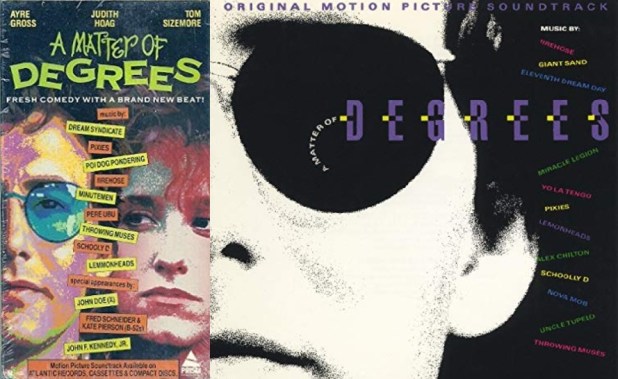
So, the tales of WXOX 90.6 Providence, Rhode Island, in the frames of A Matter of Degrees are near and dear to this DJ’s heart. The new film through 20th Century Fox’s specialty arm, Fox Lorber (Independent Magazinearticle), along with its accompanying soundtrack on Atlantic (the track-listing read like the playlist of one of my airshifts), was heavily promoted in all of the alt-rock mags of the day: Alternative Press, B-Side, CMJ, and Option (good reads!). It was probably even in the alt-section of the mainstream radio trades The Hard Report, FMQB, and Rockpool; it’s been so long, I can’t recall.
The staff of my radio station was stoked. The film was directed by W.T Morgan, who directed the alt-essential concert doc,X—The Unheard Music, and X’s John Doe was starring (later of the radio-connected The Red Right Hand). Fred Schneider and Kate Pierson from the B-52s had roles as DJs alongside Doe, and North Carolina’s hottest college-rock band, Fetchin’ Bones, who just got bumped up to Capitol Records, had a role.
And we were eventually crushed. What we thought was going to be a 1990 college rock radio version of the 1978 progressive rock radio chronicle FM—ended up being Friends: The College Campus Years. Then, we got alt-fucked again, by Cameron Crowe, with Friends: The First Year out of College, aka Singles (1993). Yeah, we got more “radio” with Airheads (1994)—but got more caterwauling cats in the “false grunge” screeches of 4 Non Blondes instead of Throwing Muses and the Breeders. At least Christian Slater’s alt-rock pirate in Pump Up the Volume (1990) cleaned out our Eustachian tubes. And I don’t need any Reality Bites (1994) from Lisa Loeb, either.
Well, at the time, courtesy of our Husker Du and Sonic Youth snobbishness, A Matter of Degrees seemed like a mainstream boondoggle produced by the same “suits” who decided to program songs about frolicking princes, chicks into cornflakes, and creepy, long-haired baritone Dean Martins humming stupid Canadian shite that was giving us A Flock of Seagulls when we wanted the Ramones. But as the VHS box patinas and the tape forecasts snow, I have come to love A Matter of Degrees—and its VHS and CD are a prized part of my collection because: it’s a time capsule that I wished never dissolved into the past.
The Review
A Matter of Degrees, written by Brown University alumni Jack Mason and Randall Poster, we come to find out, wasn’t about a radio station: the radio station served as a backdrop-linking device to a clever, ‘90s version The Graduate (1967), only with The Lemonheads (who ironically cut a cover of “Mrs. Robinson” for an early ‘90’s DVD reissue of the Dustin Hoffman hit) instead of Simon and Garfunkel backing the life-undecided, college campus hippiedom tales of Maxwell Glass (Ayre Gross; House II, Minority Report).
For Max, Providence, Rhode Island, isn’t a place: it’s a state of mind and that “mind” has been rattled by his being accepted into law school (he applied only to the hardest schools so he’d be rejected; he gets accepted to Columbia, the hardest of them all). Then he discovers his cherished campus radio station, which employs his friends Welles Dennard (the incredible Wendell Pierce; USA Network’s Suits, HBO’s The Wire, NBC’s Chicago P.D, Nicolas Cage’s It Could Happen to You) and Scuzz (the amazing-in-his-small-role Tom Gilroy; went onto work with R.E.M’s Michael Stipe and taught at Columbia University) is going to be torn down to make way for a research laboratory backed by a corporation that services the military. And when the station is rebuilt: the free-form format is out.
So, with an Abbie Hoffman-tenacity augmented with coursework titled “Interdisciplinary Approaches to Ethnicity,” Max is going to save the radio station—with arguments invoking the name of infamous ‘80s insider trader Ivan Boesky as a verb: Max speaks ill of the boyfriend of his feisty, Jerry and Elaine-styled best friend, Kate Blum (Judith Hoag; April O’Neill in Teenage Ninja Mutant Turtles, pick a U.S TV series), who runs the radio station: “[Roger] Ivan Boeskied it for them.” Not even their college-dropout/car mechanic roommate, Zeno Stefanos (Tom Sizemore, Zyzzyx Road), who has a propensity to lug car bumpers through the house and make sandwiches by slapping undiluted Campbell’s pea soup between two piece of white bread, can’t get Max off his disillusioned, high sparklehorse: “Remember, women and animals hold up two-thirds of the sky,” Zeno zens. (Now I had my share of Ramdan noodles and peanut butter sandwiches for dinner back in the day, but raw soup sandwiches? I’m glad I didn’t get accepted into Brown.)
“Hey, whatever happened to John Doe? I thought he was in the movie?”
Doe is Peter Downs, the founder of the station who “blew five years in San Francisco recycling the hits like a goddamned monkey” (been there, done that) and returned to his job as the program director of WXOX because, “this is paradise.” Oh, and Peter has a bitch-be-crazy girlfriend, Isabella Allen (Christina Haag), who has Max’s nose wide open. (See what I mean about the Friends-relationship dithering and not enough radio station? Get the Aniston out of here!) In the end, the station and sounds of “Peter Downs and WXOX 90.6 Providence” that Max man-love croons from a shark-toyed bubble bath to a toilet-perched Kate, serves as a plot-character linking device (just like Taj Mahal’s Dix Mayal on WKOK in Outside Ozona).
A Matter of Degrees is a case of “you had to be there.” If you never experienced college campus life and being enamored by the left-of-the-dial “hits” crackling over the airwaves of its tin-can station or a local non-com, you’ll have a lukewarm response to the film. The fun Mason and Poster-penned script reminds me of The Graduate; however, it won’t be in the same classic league as The Graduate when it bounces off your retinas. Your gray matter will populate it as a Singles rip-off—only this film came first. It is, in fact, the first Gen-X, well “grunge,” film in our $5.00 cup-of-coffee flannelled landscape (and you can visit with those films in our “Exploring: 50 Gen-X Grunge Films of the Alt-Rock ’90s” overview.).
Chalk it up to nostalgia fogging my sight; with eyes that see all of my friends from the grunge epoch as I flashback to my views from the glass booth (as I cracked open a new album called Bleach by some band called Nirvana) in the spot-on-miscreant Scuzz, the cucumber-cool Welles, and the rest of the WXOX satellites.
“Rock and roll can save you!” urges Peter Downs.
It did, Peter. More than you will ever know.
Where to get and how to hear the CD soundtrack and see the VHS movie:
While A Matter of Degrees tanked as a theatrical feature (the Sundance crowd shrugged), it blossomed on the international home video marketplace, carrying the titles of Louco Por Rock (Crazy for Rock, Brazil), A tutto rock (Too All, Rock Italy), and in Poland, Radio Maxa (Maximum Radio), or, more accurately, “Radio to the Max.”
As with most of the failed films in the pre-DVD era unceremoniously dumped to VHS, A Matter of Degrees has never been released on DVD—not officially nor as a grey market DVD-R—and there are no online VHS rips. There are no CD rips (of the non-vinyl) soundtrack, but you can listen to this re-creation of the soundtrack I patched together on You Tube. You can also see the soundtrack’s liner notes at Discogs. Multiple copies of the CD soundtrack, the even rarer cassette version, and the VHS can be found on numerous seller sites, eBay in particular. Not finding it won’t be a problem.
Caveat Emptor: John Doe’s incredible theme song for the film, “A Matter of Degrees,” which appears on his debut solo album, Meet Joe Doe (1990; DGC) and the promotional EP single, A Matter of Degrees, does not appear on the soundtrack, which is baffling, considering he’s one of the leads of the film. You can watch John Doe perform the single on the study-helper-for-the-late-night college crowd (good times): The Late Show with David Letterman (there is just something “off” seeing John Doe as a “traditional” lead singer clutching a mic-stand and not wearing a bass). Let the video play through to watch David Letterman’s 1983 clueless-awkward interview with X (really, Dave: alphabet jokes?) as they promote “Breathless,” the soundtrack single to the Richard Geer remake of Francois Truffaut’s film (1960) of the same name. X also covered the ‘60s hit “Wild Thing” for Major League (1989).
As with John Doe: Fetchin’ Bones are in the film—performing their MTV 120 Minutes hit, “Love Crushing,” for a “Save WXOX Benefit” (where John F. Kennedy, Jr. shows up and serenades a girl with an acoustic guitar)—but their song doesn’t appear on the soundtrack. Go figure. And the film is dedicated to D.Boon (backed by Doe’s title-cut song in the film only), the late guitarist-singer of the Minutemen. Why does the post-D.Boon outgrowth of the Minutemen, Firehose, appear on the CD soundtrack, and the Minutemen do not? Double go figure. And don’t bother (poi-dog) pondering how the B-52s got soundtrack skunked. Seriously, this film needed to pull a Dazed and Confused (1993) and release an “Even more . . .” Volume 2 to contain all the great “college rock” in the film. (Oh, hey Kris Erikson, Uncle Tupelo made it onto the soundtrack!)
You can also learn more about Randall Poster’s success as a music supervisor, the art behind movie soundtracks, and his longtime collaborations with director Wes Anderson (2014’s Grand Budapest Hotel) courtesy of these print interviews conducted by WIPO Radio, The AVClub and New Music Express. As it seems there will never be a DVD restoration replete with a commentary track, these interviews are the only way to gain insights on how A Matter of Degrees was and came to be made. (Jim Dunbar, who portrayed DJ Frank Dell, also amassed over 60 credits as a music supervisor, some in the company of Poster.)
In Poster’s post-1990 interview with the alternative music trade NME—New Music Express, he had this say on why he gave up on screenwriting and producing to work exclusively as a music supervisor on films (2012’s Skyfall, 2013’s The Wolf of Wall Street; he won a 2011 Grammy for “Best Compilation Soundtrack” for HBO’s Boardwalk Empire):
“I was always a big music lover, a record collector and an avid movie fan. I got through university studying English Literature, and I found myself without any professional direction. I wrote a screenplay with a friend of mine [Jack Mason] about a college radio station. We did a lot of new songs for it, and we did a record and I just felt that that was really what I wanted to focus on. I wanted to work with great directors, so I figured if I made music my focus, and that would enable me to do [work with great directors; like Wes Anderson].”
Poster also tells us that his college radio love letter was not only filmed in Providence: much of it was shot at Brown University. Poster and Mason were inspired by the college’s campus radio station, WBRU, changeover from a free-form to commercial format in 1985. They wrote the screenplay after graduation. It took them five years, but they got it made. And that’s awesome.
How beloved is A Matter of Degrees? This post at the Radio Survivor blog, written by fellow AMOD fan, Jennifer Waits, proves this cherished time capsule of ‘80s college radio has fans that want, and need, a DVD release of the movie (hint to Kino Lorber!).
Then there’s new fans—of this almost 30 year old movie—like General Manager Sharon Scott of the streaming-community station Art x FM. When she put the new, low-powered community FM (LPFM) outlet in Louisville on the air, she was granted the WXOX-LP call letters. According to Sharon, she didn’t know about A Matter of Degrees or its fictional radio station until well after the station received the call letters. Then, she spotted the movie’s promotional sticker on the door at WRFL and was taken aback that it was the same call letters she had chosen.
It looks like Louisville has found its audio salvation! “WXOX Louisville can save you!”
You can learn more about the new WXOX and Sharon Scott’s fight to save WRVU-FM, Vanderbilt College’s radio station, after students lost access to its terrestrial signal. The Radio Survivor article also provides links to learn more about the history of Brown University’s WBRU.
Peter Downs was right: “Rock ‘n’ Roll Can Save You!”
(And don’t believe the Hype! (1996; full movie/TubiTV) they’re selling!)
Editor’s Note: This review re-ran on December 21, 2020 (with updates), as part of our “John Doe Week” of reviews. You can watch the trailer for A Matter of Degrees on You Tube.
About the Author:You can read the music and film reviews of R.D Francis on Medium and learn more about his work on Facebook. He also writes for B&S Movies.
Day 18 Only on VHS: Watch something on the true psychotronic format
Quentin Tarantino goes off into the dusty, deserted Midwest in this sharply written, existential tale that questions how we deal with regret and loneliness, fate and death at the whims of respected Chicago psychiatrist Alan Defaux, aka The Skokie Ripper (David Paymer; 1981’sThis House Possessed, Rob Reiner’s An American President, Sam Raimi’s Drag Me to Hell), a multistate serial killer who celebrates his exploits over the air of a “superstation” that covers five states surrounding Oklahoma: WKOK 98.7 FM, with DJ Dix Mayal who, in a beef with station manager Floyd Bibbs (Meatloaf; 1992’s Wayne’s World, 1999’s Fight Club), flips the station from country to rhythm and blues (an Oscar-caliber portrayal by American blues icon Taj Mahal; 1972’s Sounder, 1991’s Bill and Ted’s Bogus Journey).
Writer and director J.D Cardone (Thunder Alley; a new review for the Scarecrow Challenge, see Day 16) brings us exquisite character development within a creepy-quirky, well-written dark comedy thriller threaded with multi-storylines. At its core Outside Ozona is a cop vs. criminal tale that reminds of Joel and Ethan Coen’s better-known Fargo (1996) — courtesy of the only “unknown” in the cast: Lucy Webb (1980’s Not Necessary the News sketch comedy show; wife of film co-star Kevin Pollack of Tom Cruise’s A Few Good Men). Webb shines just-as-bright as Frances McDormand’s put-upon law officer, Marge Gunderson, as the serial killing-tracking F.B.I agent Ellen Deene.
There’s not one bad performance in Outside Ozona, which also stars Robert Forester (another Oscar caliber performance; also of 1979’s The Black Hole, 1980’s Alligator, 1997’s Jackie Brown) as Odell Parks, a kind-hearted widowed trucker who’s admired afar by a truck stop waitress played by Swoosie Kurtz (U.S TV’s Mike and Molly), but adores a motor-stranded Native America woman taking her mother to the ocean off the Texas coast to die (and his rig plays a major part in the film’s climax that converges all of the storyline into a harrowing conclusion). Sherilyn Fenn (1986’s The Wraith, 1990’s Crime Zone, 2012’s Bigfoot) and her sister become Defaux’s victims (he bludgeons them with a toilet tank lid at a remote rest stop; he poses Fenn’s body, holding her heart); Kevin Pollack and Penelope Ann Miller (Al Pacino’s Carlito’s Way) are an unemployed circus clown and his exotic dancer-hooker girlfriend reduced to robbing a convenience store and giving lap dances in a dive bar to survive.
And all of their lives converge — outside of Ozona, Texas.
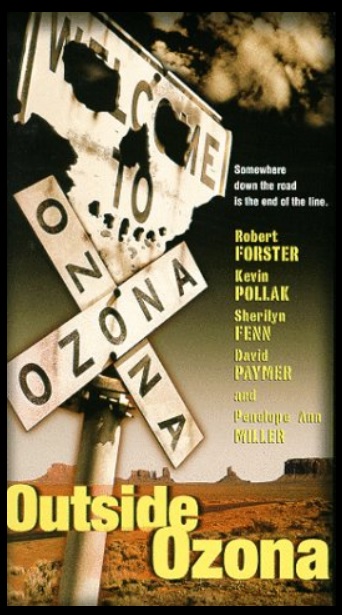
In the pungent backwash of “Tarantinoesque” films made in the wake of Pulp Fiction (B&S Movies wanted to, but never got around to, formulating a “Tarantino Copycat/Ripoff” list during our Once Upon a Time in Hollywood tribute week to his films, but Indie Wire and Uproxx beat us to it — and they go deep, but fail to mention J.S Cardone’s contribution to the Tarantino canons), Outside Ozona is the lone, sweet Texas-to-Oklahoma rose. Yeah, I know Oliver Stone brought us the western-noir that was U-Turn (1997) and Stone is god, but it pales in comparison (to my gray matter) to the film-noir leanings from the mind of J.S Cardone. So, if for only to see Taj Mahal in one of his rare acting roles (he dominates the screen as Dix), seek out Outside Ozona as a POV on Vudu and TraktTV. There’s no free VHS rips, sorry. And, while it has never been released on DVD, you can buy the cool road sign-skull poster.
Why Cardone never formulated a neo-noir buddy flick-sequel centered on Meat Loaf’s station manager and Taj’s DJ (their chemistry is magically electric) . . . what organ wouldn’t I sell to see that film?
Outside Ozona received extensive, foreign video and television distribution with the diverse titles of (most of them are great: but keep “Somewhere in America” and “Radio Station”): El crimen no conoce fronteras (Argentina; Crime Knows No Borders), Um Assassinato na Estrada (Brazil; A Murderer on the Road), Synora thanatou (Greek; Border of Death), Valahol Amerikában (Hungary; Somewhere in America), Radio Killer (Italy), Radiostacja (Poland; Radio Station), Смертельный попутчик (Russia; Death Companion), and Camino del infierno (Spain; Hell Road).
While we’re on the subject of Quentin Tarantino and have your attention: In case you missed our Tarantino week, here’s the list of all the remaining films we reviewed, so you can catch up:
DAY 18. ONLY ON VHS Day: Watch something on true psychotronic format. If you don’t have access to a VCR then watch a movie with a VCR/VHS theme in it.
Thanks to the Found Footage Festival, so many people have gotten the chance to see a lost part of the VHS era — board games that relied on your VCR.
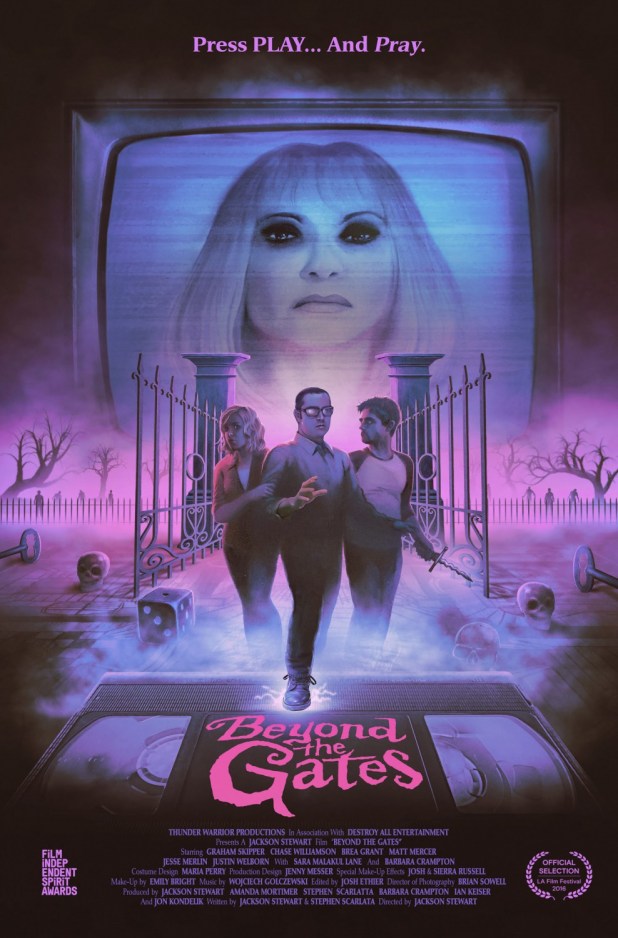
Nightmare was chief amongst those games. Released in 1991, the game took place on The Other Side, a place of six Harbingers who claim authority over a region while dreaming of taking over the entire dark dimension and escape into the human world. When you play, you become one of them — Baron Samedi the zombie, Gevaudan the werewolf, Hellin the poltergeist, Khufu the mummy, Anne de Chantraine the witch or Elizabeth Bathory the vampire — and follow the rules of the Gatekeeper, whose wants to ensure that you don’t escape The Other Side.
The game was part of the Atmosfear series, created in Australia by Phillip Tanner and Brett Clements. It even came back in the 2000’s with two new games released on DVD.
To win the game, each player must use their opponents’ greatest fears against them in order to collect six keys. Over multiple versions and booster tapes, the game stayed more popular in Australia then it did in America, even getting its own music video and Pepsi-branded drinks.
Two brothers, Gordon (Graham Skipper, who wrote and directed Sequence Break) and John Hardesty (Chase Williams, John Dies At the End) have reunited at their father’s video store, sorting through the mountains of unwatched VHS tapes as they prepare to sell it. Dad’s been missing for seven months, Gordon has left town long ago and John’s life is going nowhere.
The next day, after finding a key to their father’s office, they discover a VCR board game entitled Beyond the Gates. The tape is still in the VCR, which means it may be the last thing their father ever watched. The boys play the video and a woman’s face appears. Her name is Evelyn (Barbara Crampton, who also co-produced) and she asks if they’re willing to wager their souls. After a flash of light, the two discover that they’re lost hours of time.
Later that evening, Gordon’s girlfriend Margot (Brea Grant, Halloween II) joins the brothers for another game, which tells them that if they want to save their father, they must play the game and locate the four keys. Soon, the time 3:13 will wake each person up to a TV showing only static.
Inside the box is a receipt for an occult store run by a man named Elric He tells them that they must play the game once it starts. On their way out, John steals a dagger.
As they continue playing, actions in the game world impact real people, like their friend Hank being disemboweled by unseen forces. Even when they try to throw the game away, it soon returns. That’s because they only have two choices left: win the game or die. That said — no one has ever won before.
The game itself becomes a metaphor for the lives the brothers are living, stuck in old empotions and memories of the past. Whether or not they can use that knowledge and escape, well, you’ll have to watch the movie to discover that for yourself.
Day 17 Evil in Broad Daylight: Scary stories aren’t just for the night time
Tracy Keenan Wynn is the gold standard in screenwriting and teleplays. Look at that resume: The Glass House (1972; TV’s Alan Alda, Vic Morrow of Message from Space and Clu Gulager of Hunter’s Blood), the platinum standard of football—and prison movies—The Longest Yard (1974; Burt Reynolds), The Quest (1976; Kurt Russell and Tim Matheson), The Drowning Pool (1975; Paul Newman), and the Peter Yates-directed ocean adventure, The Deep (1977).
And Wynn wrote a film that—if it had been shot and released as a theatrical feature film in the U.S (it was a theatrical in Europe), it would have swept the floors with Oscar nods (even wins) for David Soul, Michael Gross, and Ronnie Cox. So, do yourself a favor: beg, borrow and steal to watch director Dick Lowry kicking ass with the greatest series of continuing-storyline franchises in TV history. There isn’t a theatrical franchise that holds a candle:
In the Line of Duty: A Cop for the Killing (1990)
In the Line of Duty: Manhunt in the Dakotas (1991)
In the Line of Duty: Street War (1992)
In the Line of Duty: Ambush in Waco (1993)
In the Line of Duty: The Price of Vengeance (1994)
In the Line of Duty: Hunt for Justice (1995)
In the Line of Duty: Blaze of Glory (1997)
And, if you need another great football comedy from the man who knows his pigskins: Search out the TV Movie Pigs vs. Freaks (1984) fronted by the stellar character actor, Eugene Roche. Then there’s the teen drug movie Angel Dusted (1981), with the always reliable John Putch (Jaws III, 1983).
I know, “What the hell R.D? Enough with squeezin’ the Charmin over some screenwriter dude. Get back on the tracks and tell us about the movie already.”
I was living in Dade County, Florida, during the time this movie chronicles, and trust me when I tell you: we were scared shitless in broad light to the point that people were afraid to go inside banks. If you saw an armored car (which the antagonists of this film were hitting) in the front of a bank or strip mall, you kept on driving. Back in the undeveloped days of South Florida, a body turning up in The Everglades with two taps to the head or missing limbs was a once a month occurrence. Ted Bundy dumped his bodies down here. In my misguided punk adventures as a bassist, we wrote the songs “Serial Killer Alligator Alley” and “Serial Killer Express.”
Also putting bodies into the Glades were two ex-Army Rangers by the name of Bill Matix (Michael Gross; TV’s Family Ties, Tremors franchise), and Mike Platt (David Soul; TV’s Starsky and Hutch, Magnum Force). They were blatant, cruel, and just didn’t give a fuck: Matix, to get out of his Ohio-based marriage to marry his girlfriend: he murdered his wife, collected the insurance, and moved to Florida. When Platt’s “payday” of fixing and selling pinball machines goes sour, well, the guy who sold the machines regrets it. And their clueless family believes all the mystery “cash” is the spoils of their (fantasy) joint C.I.A. drug-covert ops. “We take out the dealers and the agency lets us keep the money,” Matix the wife-killer tells his love—and not nicely.
Another harrowing scene (criminally cut from the 2005 DVD reissue): When the agents get a jump on Matix and Platt in a stolen gold Monte Carlo bunkered in the Everglades, Mike Platt causally sighs: “Let’s go to work,” as he mounts up his weapon. They’re going to kill more people, and they are just causally “going to work,” like it’s a normal, sane job.
It was on April 11, 1986, when South Florida’s TV and news radio outlets broke from regular programming with a story regarding a bloody shootout in a quiet Miami neighborhood. The drug wars connected to Castro’s Mariel Boat Lift were so bad at the time; everyone assumed it was rival drug gangs.
The images on the news and in the papers the next day told a different story: Two F.B.I agents were dead. There were multiple wounded. Cars were crashed and scattered everywhere, pockmarked with bullets in a scene lifted from a Cirio H. Santiago post-apocalyptic romp. Madix and Platt were adrenaline-drunk and determined to escape the authorities and went the Bonnie and Clyde route—times 10. They would not go down. And if they did, they were taking everyone with them. Watch it for yourself (spoiler alert!).
As I said: The cast on this is Kiss-double platinum: Ronny Cox (Deliverance, 1972) as Bureau Chief Benjamin Grogan, Bruce Greenwood (Commander Christopher Pike in the Star Trek reboots) as Agent Dove, and the supporting actors portraying the rest of the squad—along with their wives—aren’t superfluous; all are fully-character arc’d and your heart sinks when the shootout goes down. And David Soul and Michael Gross—we know them most intimately from their respective TV series and they completely shed those roles and absorb themselves as, what is best described as two serial killers with a bank robbery fetish.
Yes. When it came to the golden age of “Big Three” TV Movies, NBC never disappointed. Ah, but caveat emptor movie collectors: Watch the online VHS rips of the home-taped original/first-run version of the film. The 2005 DVD from Platinum Disc is criminally edited and missing scenes. Why a reissues company would execute any cuts and shorten an already short TV movie at one hour thirty-two minutes insults Wynn’s painstaking scripting in creating sympathetic characters to heighten the impact of the film’s harrowing conclusion:
— A scene of dialogue during an F.B.I beach party that occurs before they all take a group picture with the greenhorn agents they’ve welcomed into the family: Losing this scene diminishes the impact: you know that’s the last they’ll be together.
— A scene in the shooting gallery where Grogan is asked if he’s good with the gun without wearing glasses: It’s a chilling piece of foreshadowing of Grogan’s fate that we know, but he doesn’t.
— A crucial, seat-gripping scene when an agent loses his revolver after drawing it from the holster during the vehicle chase and placing it between his knees. During the subsequent crash, he loses it out the door and is unable to recover it during the gun battle.
So watch the uncut VHS TV-taped rip on You Tube either HERE or HERE. The DVDs are available at Amazon and Barnes and Noble if you want a digital copy for your permanent, home movie collection. This is one time where I’ll support a grey market DVD-R rip of a VHS recording of Lowery’s original 1988 cut.
It has to be mentioned: David Soul had two #1 singles: 1976’s “Don’t Give Up on Us Baby” in the U.S and “Silver Lady” in the U.K. He’s been on the road for years throughout Europe, where’s he’s a respected, sellout solo artist. Definitely check out David in the excellent U.S TV movies (overseas theatricals) The Fifth Missile (1986; full movie/You Tube) and World War III (1982; full movie/Archive.org). If you pick up Mill Creek Entertainment’s Prime Time Crime: The Stephen J. Cannell Collection, you can watch all eight episodes of David’s excellent and criminally cancelled F.B.I procedural, Unsub (1989; the one Stephen J. Cannell produced-TV series that flopped).
About the Author: You can read the music and film reviews of R.D Francis on Medium and learn more about his work on Facebook. He also writes reviews for B&S Movies.
DAY 17. EVIL IN BROAD DAYLIGHT: Scary stories aren’t just for the night time.
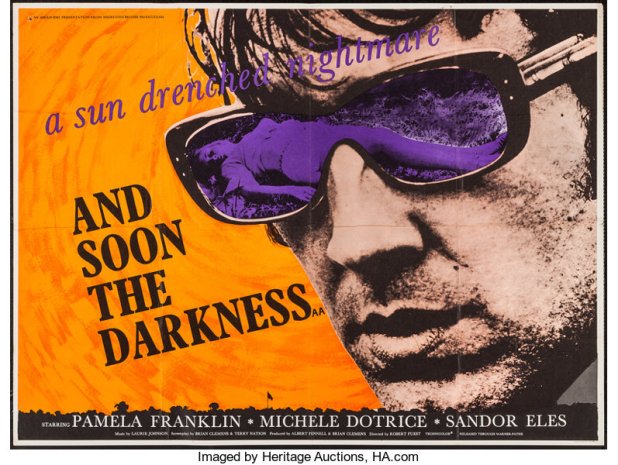
A movie that’s referred to as “a sun-drenched nightmare” on its poster, Robert Fuest’s And Soon the Darkness is nearly forgotten today, which is a real shame. Fuest is probably better remembered for The Abominable Dr. Phibes and Dr. Phibes Rises Again than he is for any other movie, but he also made plenty more, like The Final Programme, The Devil’s Rain! and Revenge of the Stepford Wives to name but a few.
And Soon the Darkness is about a day gone wrong, about being a tourist in a strange land and about how trust isn’t an easy thing to come by. It’s also an incredible film worthy of rediscovery.
Jane (Pamela Franklin, Necromancy, The Legend of Hell House) and Cathy (Michele Dotrice, the wife of The Wicker Man star Edward Woodward who was also in The Blood on Satan’s Claw) are two young nurses from Nottingham. They’ve decided to take a cycling holiday in France.
Jane’s been planning each and every stop on the route while Cathy is more interested in letting life happen. Life ends up being Paul (Sandor Else, Countess Dracula), a handsome man riding a scooter who catches her eye. The girls soon come to an argument and go their separate ways, with Cathy staying behind to sunbathe and perhaps catch up with Paul.
As Jane moves on to the next town, a cafe owner struggles to tell her that she’s in a dangerous area where young girls are often murdered. She decides to go back and find her friend, but she’s gone. A policeman is on the case, but Jane instantly believes that Paul is the murderer, despite him saying that he’s a plain-clothes detective who has taken an interest in the missing girls from this region.
What follows is the sun slowing setting on Jane’s hopes of ever finding her friend again, as she believes that Paul is closing in on her, ready to add her to his list of victims. But was there even a murder? Or is this all in her head?
There are no easy answers in And Soon the Darkness. It was written by Brian Clemens (who wrote See No Evil and Dr. Jekyll and Sister Hyde, as well as writing and directing Captain Kronos – Vampire Hunter) and Terry Nation (The House in Nightmare Park as well as the creator of Dr. Who’s Daleks), who had worked with Fuest on the game-changing British crime show The Avengers.
This was remade in 2010 as And Soon the Darkness with Karl Urban, Amber Heard and Odette Annable. I’ve never seen it, but talk about a lot to live up to. Just the end shot of this movie, cast in a rain that isn’t about to wash away anyone’s pain, is brutal in its quiet intensity.
Day 16 Rock ‘n’ Roll Miscreants: Give some screen time to the punks and/or metal heads(and Lane Caudell gives us a two-fer!)
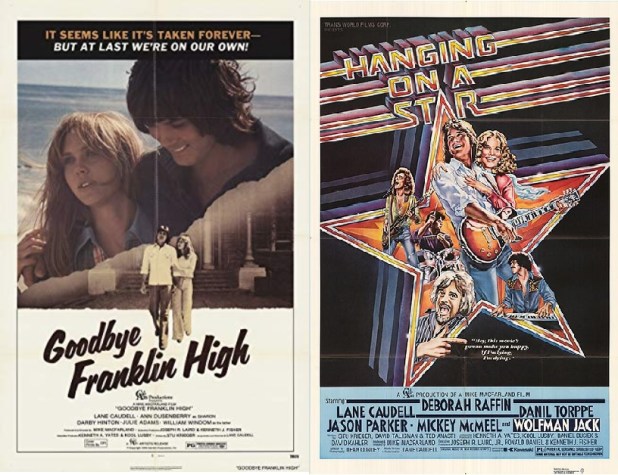
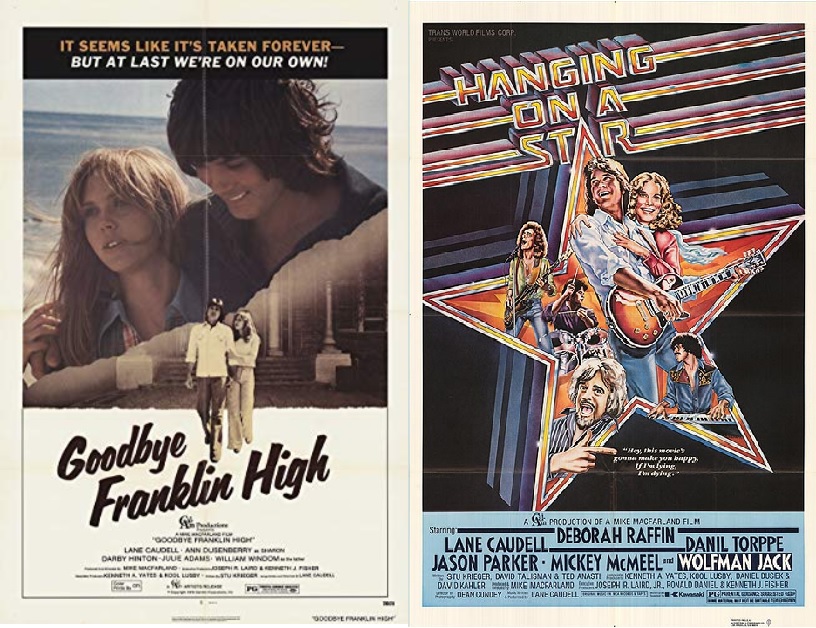
The horror-centric webzine Bloody Disgusting recently posted a story about a gritty, low-budgeted horror film, Getaway Girls (2020), written and directed by Toran Caudell who, as a teen, found success as an actor on the WB Network and as an animated voice artist for the Disney and Nickelodeon Networks. While this writer never watched any of his TV series, I was intrigued to hear a child actor beat the so called “child actor curse” and continued to flourish in the business as an adult. Upon a further Internet-investigation of the film, it’s discovered that Toran Caudell is the son of actor-musician Lane Caudell, he the star of two of the coolest, fondly remembered films of this writer’s ‘80s UHF-TV and video store, rock ‘n’ roll youth: Goodbye, Franklin High and Hanging on a Star.
Thanks to Lane’s son, it marks the first time that old, familiar face from my youth has acted in front of the camera since eschewing the acting world after the 1982-1983 season of the NBC-TV U.S daytime serial, Days of Our Lives. (I know. I know. Yes, I watched DOOL. For reasons lost in the corners of my mind, somehow my sister negotiated “TV rights” after school, so I was stuck watching DOOL andGeneral Hospital. Well, not really. When Diane, your sister’s very cute friend from school, plants herself in front of your TV to watch soap operas . . . teen hormones must make sacrifices. Then Jill Swanson came along. Have mercy!)
A few days after discovering the Bloody Disgusting article, a couch-grazing binge of a few episodes of A&E’s Hoarders inspired a deep dive into the long-forgotten spare bedroom and hallway closets for a belated (and “adult”), much-needed spring cleaning — closets which also hold a now lazily misfiled vinyl music and video tape collection. That domesticated archeological dig uncovered long-forgotten vinyl copies of Lane’s two MCA albums: Hanging on Star and Midnight Hunter, and (which I didn’t even know I did have in the first place) his lone 1975 album with Skyband for RCA.
Dude, it’s a sign. Toran of Malveel is recruiting you for a quest beyond the sun’s horizon. Sharpen your broadsword. Mount ye steed and ride, R.D!
As with Rick Springfield (of the rock bomb Hard to Hold) and Kim Milford (the obscure TV rocker, Song of the Succubus) before him, with Lane’s musical endeavors not bearing financial or chart fruits, he took up acting as a sideline to make financial ends meet. That’s when he met filmmaker Mike MacFarland who served as the Executive Producer on what was to become an exploitation teen-horror film classic: Satan’s Cheerleaders (1977) and Lane, in a support role, made his acting debut. And while Lane didn’t earn a role on TV’s Battlestar Galactica (Rick Springfield got the role), Lane scored the lead role in the early ‘90s TV/foreign theatrical, Star Wars-cum-Conan the Barbarian sci-fi romper, Archer: Fugitive from the Empire.
Under the managerial wing of Cal-Am Productions — which went out of business in a blaze of glory with the 1978 Drive-In slasher and later UK Section 2 Video Nasty (see the B&S Movies’ Section 2 List), The Toolbox Murders(see B&S Movies Exploring: Slahser Remakes List) — and with Mike MacFarland in the director’s chair, Lane made his debut as a leading man in the baseball comedy-drama, Goodbye, Franklin High, and the rock ‘n’ roll follow up, Hanging on a Star. Both films were backed by the Great Lion of Hollywood: MGM Studios.
On the DVD commentary for Satan’s Cheerleaders, director Greydon Clark stated Mike MacFarland offered an additional $25,000 to the production for a producer credit and if Clark would use Lane Caudell in a role, who he was considering for a lead in a film he would direct, which became Goodbye, Franklin High. The extra money improved the film’s production values, allowing Clark to sign a SAG contract and hire recognized SAG actors in John Carradine (Revenge, the sequel to Blood Cult — part of B&S Movies’ 2019 Halloween “Slasher Month,” look for it — andEvils of the Night), Yvonne deCarlo (The Silent Scream, Sam’s “Slasher” review is on the way!), and John Ireland (Incubus and The House of Seven Corpses), along with Charlie Chaplin’s Tony Award-winning acting son, Sydney, and noted TV character actor, Jack Kruschen.
While there are two songs, “One for All and All for One” and “Who You Gonna Love Tonight,” by a female-fronted disco concern known as Sonoma in Satan’s Cheerleaders, it is unknown if Caudell was involved with the production of those songs. Greydon Clark makes no mention of the songs in his commentary or if Caudell assisted on the soundtrack. And while Caudell provided several songs to Goodbye, Franklin High, no official soundtrack or promotional 45-rpm singles were released to radio or retail.
Sadly, today’s nostalgic film critics lump Goodbye, Franklin High with the glut of teen exploitation flicks (that’s a B&S Movies’ Week unto itself, eh, Sam?) haunting drive-Ins in the ‘70s, such as The Pom Pom Girls (1976), The Van (1977), Malibu Beach (1978), and Swap Meet, Van Nuys Blvd., H.O.T.S, and Gas Pump Girls (all 1979). In reality, Goodbye, Franklin High lacks any of those films’ American Graffiti-inspired T&A foolishness to tell a tale with a softer, ABC Afterschool Special-styled storyline (ah, ‘70s kids’ television!) about a young man facing his future: go to college or play pro-ball? The film actually has more in common with one of Sam Elliot’s earliest dramatic film rolls (Road House, Ghost Rider), Lifeguard (1978; search for that incredible film!), itself a coming-of-age drama of dealing with one’s future, than with any of the T&A brethren released during the same period.
Then, Cal-Am Productions (seriously, The Toolbox Murders guys!) in conjunction with MCA Records and MGM Studios, customized a project that would spotlight not only Lane’s acting chops, but his music abilities as well. That film was later to become a U.S UHF-TV and video store classic, Hanging on a Star, a comedic chronicle of “The Jeff Martin Band,” a hot rock band on their way up the charts. In a teen-idol doppelganger: Leif Garrett also starred in a teen drive-In rock flick of his own, Thunder Alley (an Option 3: 2019 Scarecrow Psychotronic Challenge: Day 16 entry!), which made the rounds on cable, UHF-TV, and video store shelves in the ‘80s. Rick Springfield eventually starred in his own, similar rock flick: the critically lambasted Hard to Hold.
Six years after issuing his first solo single in 1972, Lane finally released his first solo album proper: Hanging on a Star. Although several songs from the album also appeared in its companion film, the album was not marketed as an official soundtrack. Sadly, while a well-devised dual marketing plan, neither the album nor the film lit up the charts or box office. The film did find a subsequent, enthusiastic audience on U.S cable television, which led to Lane’s fans — including this writer — to posthumously purchasing copies of the album in the used record store aftermarket — just like we did with Matt Dillion’s film debut, Over the Edge; it’s how we discovered Cheap Trick, Van Halen, the Cars, and the Ramones (and get that Little Feat crap the hell out of here!).
Lane would go onto receive his first starring TV role alongside Jerry Reed in 1979’s Good ‘Ol Boys, a TV movie that served as a series pilot to capitalize on Reed’s then massive popularity stemming from his work on Smokey and the Bandit — and to catch a little nip of that The Dukes of Hazzard moonshine madness. Lane’s next NBC pilot was starring alongside U.S television mainstay William Conrad, loved by audiences for his work as Detective Joe Cannon in Cannon. A cross between Conrad’s two famed TV characters (the other from his later hit series, Jack and the Fatman), the 1980 series would have starred Conrad as ex-L.A police lieutenant, Bill Battles, who takes a job at Hawaii State University as the head of its Campus Police Unit — and as an assistant football coach. Lane, co-starring as the team’s quarterback, would have been the crime-solving side kick in, Battles.
However, courtesy of the success of Star Wars igniting a renewed interest in science fiction and old fashioned sword ‘n’ sorcery action-fantasies, Universal and NBC-TV developed Archer: Fugitive from the Empire, which starred Lane as a prince on a distant planet accused of murdering his father-king; equipped with a magic ‘n’ deadly crossbow, he teamed up with Belinda Bauer (schwing!) as his Princess Leia/Red Sonja for a series of weekly adventures. Known under several other titles in its overseas theatrical distribution, Archer made it to series, but was too costly to produce to justify against its low ratings in the U.S marketplace.
Continuing his relationship with the NBC-TV family, Lane ended his acting career with a one-season recurring role on the highly-rated U.S daytime drama, The Days of Our Lives. Between his work on U.S daytime television and making his return to the big screen in his son Toran’s horror film, Getaway Girls, he became a mover and shaker as a songwriter, music publisher, and session musician in the country music marketplace.
Sadly, Hanging on Star and Goodbye, Franklin High — like this writer’s two cherished Kim Milford rock movies, Song of the Succubus and Rock-a-Die Baby (a Halloween 2019 “Slasher Month” entry, look for it!), haven’t been in reruns on U.S television UHF stations in close to 40 years.
Hanging on a Star made it to VHS tape. In all the years of this writer haunting video stores and the video cut out bins of libraries and vintage vinyl outlets, an official VHS version of Goodbye, Franklin High has yet to appear — although taped-from-broadcast TV clips of the film have appeared on video sharing sites. This writer once owned two used copies of Hanging on a Star: one tape swelled up from moisture and molded-out; the tape of its replacement shredded into pieces inside the VCR. A home-taped version of Goodbye, Franklin High — sandwiched between Wes Craven’s Chiller (starring Michael Beck of The Warriors), Circle of Iron (starring David Carradine and Jeff Cooper), and Over the Edge (starring Matt Dillon) — burnt out into blue-screen mode.
It’s been almost 20 years since I’ve seen either of Lane’s films. It seems that, unlike The Toolbox Murders, both of Lane’s cherished leading roles for Cal-Am Productions seem to be lost — forever. Will we Lane Caudell fans ever see a DVD release of Goodbye, Franklin High or Hanging on a Star? It seems there is hope: A company by the name of Park Circus/Arts Alliance, a film distribution company that deals a classic back catalog of films from the 1970s and 1980s, shows both of Lane’s films in their catalog. Then, during the course of my off-the-rails insane research for my Lane Caudell thesis over on Medium, I discovered screen caps from Goodbye, Franklin Highwith TV transmission watermarks for THIS-TV, a U.S-based free-to-air cable network launched in 2008 and owned in part by MGM Studios — the studio that originally distributed Lane’s films in 1978. Most of the channel’s on-air product is from the MGM vaults.
So we Lane Caudell fans will cross our fingers in the hope that Park Circus and MGM Studio will reissue both films as a double DVD — complete with in-depth interview vignettes featuring Lane and his co-stars, along with commentary tracks from Lane.
And that’s why B&S Movies exists: Courtesy of those retro-digital reissue companies, such as the fine folks at Arrow Video and guys like Massacre Video’s Louis C. Justin and Vinegar Syndrome’s Joe Rubin, preserving those lost ‘70s drive-In and ‘80s VHS home video classics of our glorious misspent youths. Did I just kiss up, that is to say, suck enough digital ass for you guys release Lane’s films in a DVD tribute pack now? Get to the restoration Bat Cave already, Robin!
You never thought you’d learn about the Roger Wilson (Thunder Alley) and Lane Caudell teen-idol connections to the video nasties The Slayer and The Toolbox Murders during the 2019 Scarecrow Psychotronic Challenge, did you? That’s how B&S About Movies rolls.
Lane Caudell’s Music and Films– Playlist
You need more rock? Then check out our “Rock ‘n’ Roll Week” round up of more rock flicks that we’ve reviewed (Plot spoiler: it’ll lead you to a “Rock ‘n’ Roll Week II”!).
About the Author: You can read the music and film reviews of R.D Francis on Medium and learn about his work on Facebook. He also writes for B&S Movies.






 B&S About Movies
You must be logged in to post a comment.