Author’s Note: Yeah, we know you’ve seen them before and know them well. But we’ve got some movie “Easter Eggs” in these reviews. Thanks for revisitingthe classics with the B&S gang, where we coddle the obscure and the forgotten films of the VHS, UHF, and Drive-In yesteryears.
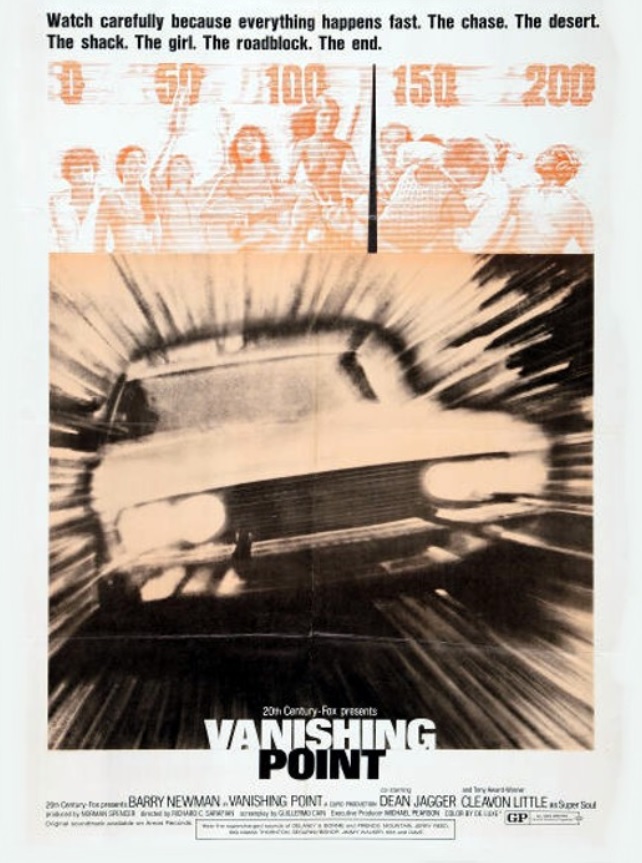
This 20th Century Fox tale reminds a lot of Elektra Glide in Blue, United Artists’ 1973 existential road flick entry about a disgraced biker-cop (Robert Blake) produced-directed by James William Guercio, who managed and performed with the Beach Boys and produced several albums for ’70s pop-meisters Chicago (who appear in the film). We also had Vanishing Point on the short list for “Radio Week,”* thanks to Cleavon Little’s blind DJ. While it was bumped for that week—but it’s prime fodder for “Fast and Furious Week.” Thank god for Dodge Chargers. . . .
Kowalski (Barry Newman) is a Vietnam veteran, disgraced ex-cop and former professional road racer of motorcycles and stock cars. To cope with his personal demons, he lives on the open road as a driver for a car delivery service. Before heading out on his next assignment—transporting a supercharged 1970 Dodge Challenger from Denver to San Francisco—he scores a hit of speed and makes a bet with his drug-pusher that he can make the trip in 15 hours.
As the police follow in hot pursuit, Kowalski becomes a folk hero to the roadside eccentrics and Vietnam-war worn masses, thanks to the on-air updates of the cross country chase by a blind DJ “Supersoul” (Cleavon “The Prince of Darkness” Little of FM) on KOW, an 50,000-watt R&B/Soul station broadcasting across Nevada, Utah and parts of Colorado and California. (Little’s engineer—an unaccredited role—is John Amos of TVs Good Times, but youngins know him for his work in Die Hard 2: Die Harder and Coming to America.) (And, is it just me, or is Outside Ozona a slasher version of Vanishing Point? That’s not critical insult, but a kudos.)
Yeah, we love this movie, but this movie also really wants to be the next Easy Rider, with its replacement of Steppenwolf by way of the equally biker-acceptable Mountain with “Mississippi Queen,” along with the counterculture band Delaney, Bonnie & Friends (see the history of Eric Clapton and Fleetwood Mac), who also appear in the film as a singing group at a religious revival caravan.
There’s no online streams, but Blus, DVDs, and used VHS-tapes are available on Amazon to watch Vanishing Point. . . .
So, we teased you about the two “sequels” to Easy Rider . . . but did you know their was a remake to Vanishing Point? It’s okay. No one does. Join us tomorrow, August 7 at 6 pm, for more tales of the fast and the furious . . . and the vanishing . . . with Vanishing Point ’97.
How much is this film loved? It has die-cast cars!
Author’s Note: Yeah, we know you’ve seen them before and know them well. But we’ve got some movie “Easter Eggs” in these reviews. Thanks for revisitingthe classics with the B&S gang, where we coddle the obscure and the forgotten films of the VHS, UHF, and Drive-In yesteryears.
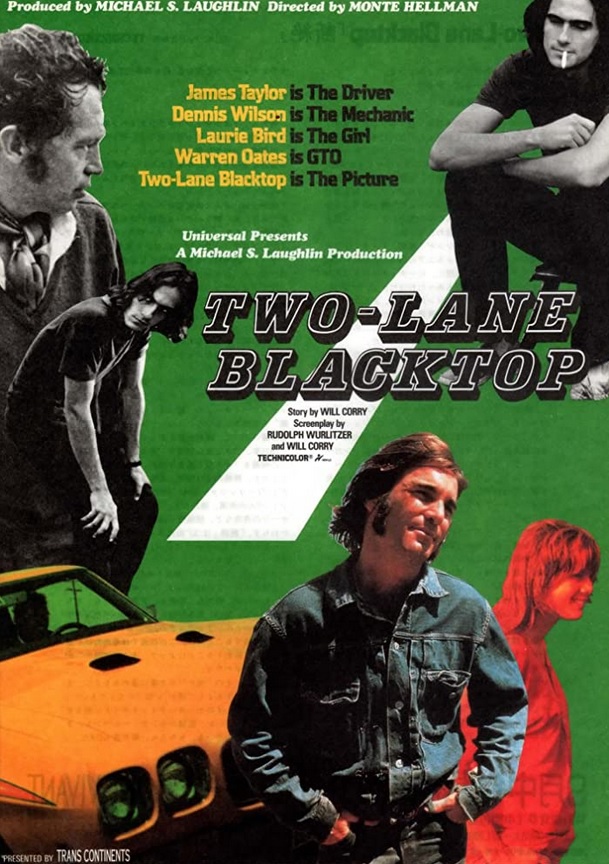
This Universal Studios tale in which the bikes of Easy Rider meet the Dodge Challenger of Vanishing Point was on the short-list for our “Rock ‘n’ Roll Week” tribute (ran Sunday, July 19 to Saturday, July 25) of films as result of ex-Beach Boys drummer Dennis Wilson starring as the “Mechanic” and ‘70s soft rocker James Taylor as the “Driver.”
But wait! There’s those celluloid bonus points, since this is directed by Monte Hellman, who made his directorial debut with Roger Corman’s Beast from Haunted Cave (1959)—a relationship that lasted for several films over fifteen years. And Hellman gave us Silent Night, Deadly Night III: Better Watch Out (another “unwanted sequel,” ala Phil Pitzer’s Easy Rider: The Ride Back, that’s actually better than you think, as result of the Hellman touch), and he executive-produced Reservoir Dogs. So, courtesy of that Corman lineage, Hellman’s not giving you a typical Universal picture. This is an A.I.P-styled romp that’s not for the mainstream cinema folks.
As with Wyatt and Billy’s biker travels, Two-Lane Blacktop is an existential road trip into metaphorical ambiguity—only from inside the cockpit of a Black 1955 Chevy 150. Unlike most major studio buddy-road adventures, this one’s void of exposition to the point of silence: the Chevy’s passengers are perfunctory to the story, operating more like “parts” to the car than actual people.
As the stoic duo travels across country entering impromptu and legalized dragstrip races, they pick up the hitchhiking “Girl” (Laurie Bird, who became Hellman’s girlfriend), meet a homosexual hitchhiker (Harry Dean Stanton, later of Alienand Repo Man), and a New Mexico to Washington D.C. “pink slip” challenge is made by “GTO” (Warren Oates), an insecure braggart who discover a vicarious purpose through the freedom-lives of the Chevy’s “internal parts.”
Regardless of its rock-star casting, neither Wilson nor Taylor provide music to the film and no Easy Rider-styled soundtrack was ever released. The film does, however, features songs by the Doors, Arlo Guthrie, and Kris Kristofferson. Lori Bird, in a James Dean-tragic life, only made three films: two with Hellman, the other being Roger Corman’s Cockfighter (1974; also with Warren Oates), and in Woody Allen’s Annie Hall (1977; as the girlfriend to Paul Simon’s character). Coming to live with Simon’s musical partner, Art Garfunkel, she committing suicide-by-pills in his apartment at the age of 26.
There’s no online streams, but Blus and DVDs (co-issued by Universal through Criterion Collection and Anchor Bay) and used VHS-tapes are to be found on Amazon.
My buddy Eric, as with Easy Rider, takes me to task with this movie as well: “Duke, your idea of “classics” sucks ass,” he tells me. According to him—a car nut, mind you—”nothing happens.” “It’s like watching a stoner version of Seinsuck.” (Sorry, Sam!)
Friends and film, huh? It’s not so bad: chicks and film is worse.
About the Author: You can learn more about the writings of R.D Francis on Facebook. He also writes for B&S About Movies.
UPDATE: Out in the social media ethers, reader Jake Garrett schooled us on this fun car flick fact: The ’55 Chevy in Two-Lane Blacktop is the same car as Bob Falfa’s in American Graffiti. Did you know that? We didn’t. Hey, we’re big enough to admit that we don’t know all of the film trivia out there. Thanks, Jake! See, positive, kind comments on our reviews and messages via our “contact” page, work — and get you plugged in reviews (if you want to be “famous,” that is!).
Author’s Note: Yeah, we know you’ve seen them before and know them well. But we’ve got some movie “Easter Eggs” in these reviews. Thanks for revisiting the classics with the B&S gang, where we coddle the obscure and the forgotten films of the VHS, UHF, and Drive-In yesteryears.
While The Fast and the Furious franchise began as crime caper flicks that transitioned into spy flicks of the xXx variety, there’s no denying Universal Studios’ “big engine” is rooted in the rock ‘n’ hot-roddin’ juvenile delinquency flicks of the ’50 (we have a “Drive-In Friday” night this week covering a few of those films), the biker-centric counterculture flicks of the ’60s, and revin’-car flicks from the ’70s (reviews for a whole bunch o’ them this week!).
For long before the good intentions of Paul Walker’s LAPD officer Brian O’Conner’s law-enforcement soul was drugged with the scent well-weathered leather, hot metal and oil, and the scent of a Mitsubishi’s exhaust (R.I.P., Mr. Peart), Easy Rider was the godfather of them all—and that celluloid patriarch brought forth two sons. . . . And those sons were fruitful and multiplied with the ’70s “big engines” of Dirty Mary, Crazy Larry (also starring Peter Fonda) and Gone in 60 Seconds (no, not that one, the 1974 one!).
In between, there was this cop movie called Bullit that starred some guy named Steve McQueen toolin’ around in a 1968 Mustang Fastback going head-to-head with a 1968 440 Magnum Dodge Charger. And they slipped “The Duke” (of all people) into the cockpit of a souped-up 1973 Pontiac Firebird Trans Am “Green Hornet” in McQ. But we were diggin’ Roy Scheider in his 1973 Pontiac Ventura Sprint in The Seven-Ups. And let us not forget: Producer Philip D’Antoni is the guru of rubber who gave us memorable car chase sequences in not only The Seven-Ups and Bullit, but The French Connection, as well. Then, for a twist, instead of a souped-up muscle car, Robert Blake slipped onto a 1970 Harley touring cycle for the “motorcycle cop” version of Easy Rider: 1973’s Electra Glide in Blue.
Released in 1969, Easy Rider became a counterculture epic that set the pace for the early ‘70s car chase classics to come: Two-Lane Blacktop and Vanishing Point (as well as Electra Glide in Blue)—regardless of the transportation and “mission” of their protagonists’ “trips,” each film equated the open road with freedom of the soul.
Wyatt and Billy (Peter Fonda, who became a biker icon courtesy of Roger Corman’s 1966 biker epic, The Wild Angels, and Dennis Hopper, who was able to get financing for his 1971 ego-boondoggle The Last Movie as result of Columbia Studios raking in $60 million worldwide on a $400,000 budget) embark on a western-without-horses motorcycle trip across America from California to New Orleans for a drug deal (instead of gold prospecting or stage coach robbing). Along the way to make their “big score” they meet up with communal hippies (in lieu of Indians), partake of drugs and sex, and frolic about New Orleans (in lieu of say, Dodge City, Kansas, or Virginia City, Nevada) in a Seinfeldian “a movie about nothing” existence (sorry, Sam; quoting my buddy Eric’s take on the movie)—and it all comes to an end by way of the ubiquitous, hippy-hatin’ rednecks (the Indians got ’em).
Jack Nicholson stars as Wyatt and Billy’s gold-football helmeted sidekick: ACLU lawyer and jail cellmate, George Hanson (the trio first collaborated on The Trip, Roger Corman’s 1967 stoner flick written by Nicholson; who did his own biker flick, 1967’s Rebel Rousers, which was released post-Easy Rider fame, in 1970), music Svengali Phil Spector (The Big T.N.T Show) stars as “The Connection,” and future MTV video queen Toni Basil (“Hey, Mickey!”) also appears in a minor role (she worked with Nicholson on the Monkees’ Head). The soundtrack—inspired by the successful use of pop and rock music for 1967’s The Graduate— features music by Steppenwolf (who also provided music to another psychedelic film, 1969’s Candy), the Band, the Byrds, and Jimi Hendrix.
You can watch this everywhere, pretty much, but it streams on Amazon Prime.
Ah, Easter Eggs: So, did you know Easy Rider was followed forty years later by an unofficial sequel? Two, in fact. It’s okay. No one does. Join us tomorrow at 12 noon and 3 pm for more tales of the fast and the furious . . . with Easy Rider: The Ride Back and Me & Will.
About the Author: You can learn more about the writings of R.D Francis on Facebook. He also writes for B&S About Movies.
“I’m gonna give you an engine low to the ground . . . an extra thick oil pan to cut the wind from underneath you. It’ll give you thirty or forty more horsepower. I’m gonna give you a fuel line that’ll hold an extra gallon of gas. I’m gonna shave half an inch off you and shape you like a bullet. I’ll get you primed, painted and weighed, and you’ll be ready to go out on that racetrack. Hear me? You’re gonna be perfect.” — Harry Hogge, crew chief and car builder
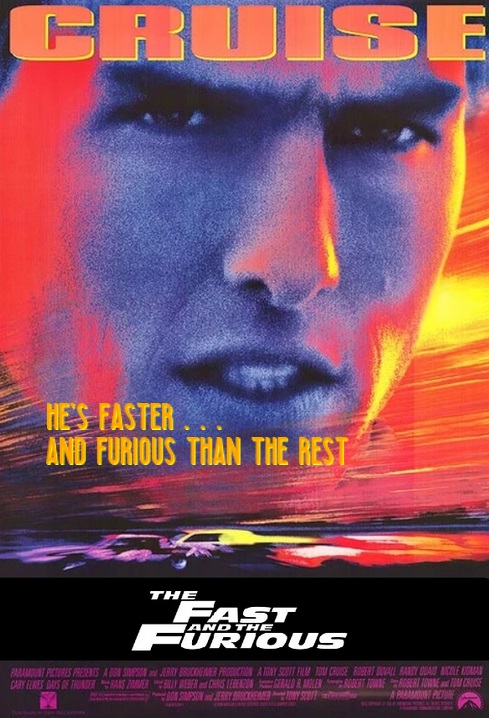
If only Harry had said, instead of, “You’re gonna be perfect,” said, “You’ll be fast and furious.”
What might have been . . .
Mock poster by R.D Francis/F&F logo property of Universal/typeface overlay via Pic Font
Tom Cruise gets respect in this neck of the Allegheny woods. He wanted to be the next Paul Newman. He wanted to become Steve McQueen. And unlike Quentin Tarantino’s Rick Dalton in Once Upon a Time in Hollywood, by golly, Tom Cruise became our generation’s Paul Newman and Steve McQueen. And, as with his idols—car racing enthusiasts who wanted to make their own race car movies—that kid adorned in a pair of Wayfarers that slid across the floor in his socks and into our hearts, wanted to run with the fast and the furious: he wanted to make his own version of Winning and Le Mans. And, and by golly, he did it.
Luckily, for the ticketing-going masses, Tom Cruise reined his “need for speed” (of the four-wheeled variety, anyway) until he broke through and became an official, A-List movie star. For if Cruise would have followed up Risky Business or (to keep it in a “sports” context) All the Right Moves—during the period when he was developing his career and not choosing roles but being cast in roles, like the burgeoning careers of James Caan and James Garner—with a race car flick, he would have been cast in the likes of the lower-budgeted road rallies that were Red Line 7000 and Grand Prix.
And Cruise’s racing endeavors could have been worse.
What if Cruise made a racing flick directly after his first leading man role in Losin’ It (remember in 1983: he made a movie with Shelley Long and Jackie Earle Haley)? We would have gotten the process-shot, rubber burning fiestas that were Fabian and Frankie Avalon’s Fireball 500, The Wild Racers, and Thunder Alley. And thank the celluloid gods of the analog ethers that Cruise didn’t aspire to be a “double threat” and a be singer—and only lip-synched to Bob Seger’s “Old Time Rock ‘n’ Roll”—or we would have ended up with Elvis Presley’s process-shot racing n’ singing extravaganzas Viva Las Vegas, Spinout, and Speedway*. (Oh, man. What if Eddie Murphy—considering his skills as a singer and Elvis mimic—did a remake of Richard Pryor’s 1977 NASCAR race car flick, Greased Lightning?)
“We gotta win this race.”
What might have been . . .
When reflecting on how Cruise turned Mission: Impossible into a franchise: If The Fast and the Furious—the franchise we’re paying tribute to this week—had been developed at Paramount Pictures instead of Universal Studios, would we have laid down our coin for Tom Cruise as an illegal road racer?
And if not that ticket, would we have bought a ticket to see him as Frankenstein?
No, not the Universal monster one. The New World Studios one: Tom Cruise optioned Roger Corman to set up a big-budgeted remake of 1975’s Death Race 2000 at Paramount. Sadly, amid scripting problems and the usual executorial testosterone splashing, the deal fell apart and ended up on the Universal lot. Then end result: Instead of (finally!) a dark, brooding tale about a futuristic transcontinental road race—one that jettisoned Paul Bartel’s hokey-satire of the original—that adhered to the serious, sociopolitical insights of Ib Melchoir’s short story . . . we ended up with a bunch of check-the-screenwriting-boxes trope-prisoners racing around in a circle on an island. And who in the hell let Joan Allen on Terminal Island?
. . . And now the Death Race franchise is four films deep—with a different “Frank” (and actors as Frank) for each subsequent (direct-to-video) film that carries an addendum that the film is a prequel, sidequal, etc. to the first film (and that the first film was actually “prequel,” ugh, to the ’75 original, argh!), as it races further and further and further away from Melchoir’s initial vision. The end result—at least for those of us weaned on the video fringes off the teats of Norman Jewison and Roger Corman: Death Race ‘08 was Rollerball ’02 all over again. Neither were Lays emulsified-potato chips like their superior forefathers: once was enough. And thank the analog lords that the Rollerball reboot wasn’t turned into a direct-to-video franchise. (Can you believe that director John McTiernan went to federal prison for making a false statement to an FBI investigator over illegally wiretapping Rollerball’s producers? He went to prison for Rollerball?)
And that brings us back to the film we’re supposed to be reviewing: Days of Thunder. (I know, Sam. I know. At least there won’t be a Seinfeld reference.)
Come, on now. You’ve seen it. We’ve all seen it. (Yes, even you: the underground, VHS-loving indie purveyor who Facebook-hangs with the B&S About Movies crew on Saturday Nights (at 8 P.M on Groovy Doom: shameless plug) to watch double features about worms and Linda Blair being abused.) And even if you didn’t hit the multiplex, you caught Cruise’s race epic via one of Ted Turner’s endless TNT replays as you couch-surfed and channel-grazed on a lazy, Cheetos-dusted Sunday afternoon. And, if you’re financially well-to-do, you watched Days of Thunder on yer fancy, upper-tiered Showtime or HBO subscriptions—as you couch-surfed and channel-grazed on a lazy, Doritos-crumbed Sunday afternoon. So don’t deny it: you embraced the Cruise like the mainstream-everybody else.
While this Tony Scott-directed and Tom Cruise-produced racing epic is vastly superior to the Caan and Garner romps and the bigger-budgeted Newman and McQueen films in all of its related film disciplines, we basically have the same film: a spunky racer with talent, but too much attitude, aspires for NASCAR fame—and finds romance and competition on the asphalted, gladiatorial oval. (For isn’t this all just Charlton Heston in Ben Hur with cars instead of horse-drawn chariots?)
So, speaking of testosterone splashing: Producers Don Simpson (wrote Aloha, Bobby and Rose, Cannonball) and Jerry Bruckheimer (The Rock, Bad Boys) along with director Tony Scott (Tarantino’s True Romance), and sometimes screenwriter Robert Towne, all went Alpha-male over how to set up shots. Fully-built and ready-to-roll sets were torn down and rebuilt because they “weren’t right.” The hormone and anabolic steroid-stew flowed so deep that the long-idling (sorry) crew members accumulated enough overtime pay to go on vacation for a full four months after filming was completed.
What was the end result?
Crtics pounced on the film for its stock plot, two-dimensional characters, and poorly written dialogue and called it out for being a Top Gun clone, sans planes and sky and lots of cars and asphalt. Roger Ebert, while giving the film three out of four stars, still took the film to task, calling it the Tom Cruise Picture, since it resembled the “10 Point Formula” employed in his previous films The Color of Money and Cocktail (it’s actually “9 Points,” but he came to revise it to include the “Dying Friend” trope). Mind you now, we are talking about Robert Towne here: the guy who wrote The Last Detail, Marathon Man, and friggin’ Chinatown. There’s whole chapters in screenwriting books dedicated to Towne’s brilliance. That’s Ebert for you: he takes no prisoners. (Sigh, I miss you Gene and Roger: you and Dr. Who and The Star Hustler made PBS worthwhile.)
And what did “The Q” think: “Days of Thunder is the movie Grand Prix and Le Mans should have been . . . it has the fun of those early AIP movies.”
And will we ever get a Quentin Tarantino racing epic starring a back-on-top Rick Dalton? We wait with Cheetos-stench bated breath.
Uh, oh.
Sorry, Sam. Actress Kathleen McClellan, aka “Good Naked, Bad Naked” girl from Seinfeld (“The Apology”) kissed Tom Cruise in Days of Thunder. (In the “winner’s circle,” I think; she was once the Skyy Vodka Girl <ahem>, Sam.)
It always comes back to Seinfeld. And Vodka-spiked movie-theme drinks. One Thunder Cruise Lemon Squeeze, comin’ up!
Anytime a film comes down the pipe that’s directed by an ex-rock video director or somehow connected to a musician, Sam passes that flick my way. (Grazie, amico mio.) And if it’s a forgotten, classic flick that I am reviewing for an “Exploring” or “Drive-In Friday” featurette, or a tribute week — such as, for example, reformed porn-turned-rock video director Gregory Dark giving us the radio romp Night Rhythms during our “Radio Week”* — rest assure that review will be music trivia top-heavy (or bottom heavy, as the case may be).
Such is this review for Roger Corman’s Death Race 2050.
Now, I know what you’re thinking: This is a week dedicated to the films — and the rip-offs and the precursors (such as Corman’s own 1954 film, The Fast and the Furious) — to the 21st century Fast & Furious franchise. Death Race is a franchise unto itself. And what does this have to do with rock music? Is this another one of your reviews, R.D, rife with tangents and non-sequiturs that have nothing to do with reviewing the actual film itself?
Yep. Strap on your feedbag.
So, we all know the backstory on how we ended up with 1975’s Death Race 2000, right: How, long before Corman dreamed up the DR: 2050 version, the first “sequel” to Death Race 2000 was actually 1978’s Deathsport. And the reason Corman made either film was because he wanted a “futuristic action sports film”*+ in the drive-ins to take advantage of the publicity surrounding 1975’s Rollerball starring James Caan (oddly enough, of Red Line 7000). And that Corman optioned “The Racer,” a dark, short story by Ib Melchoir about the Transcontinental Road Race (The Angry Red Planet, Robinson Crusoe on Mars, Journey to the Seventh Planet, Planet of Vampires**). And under the satirical thumb of Paul Bartel, stripped away all of the dread that made Rollerball great and, instead, gave us a live-action version of Hanna-Barbera’s ’60s cartoon, The Wacky Racers?
What you may not know: After working with Universal Studios on a deal to license The Fast & the Furious title for their burgeoning action franchise, Corman and Universal came together again as result of the studio also turning Corman’s Death Race 2000 into a theatrical reboot and profitable, direct to home-video franchise. (At one time the project was at Paramount with Tom Cruise producing and starring: we got Days of Thunder, instead.)
The idea for the 2050 sequel came to fruition when an Italian journalist interviewing Corman commented The Hunger Games shared a similar (camp) cinematic style, as well as the social and political themes explored in Death Race 2000. So Corman reached out to Universal, who produced Paul W. S. Anderson’s 2008 remake, with a plan to bring back the dark, sociopolitical satire of the original — and the killing of pedestrians. Universal was on board: the studio co-produced the film that became Death Race 2050 with Corman’s New World for the home video streaming market.
As is the case with most “sequels” (see Escape from New York vs. Escape from L.A., The Evil Dead vs. Evil Dead II: Dead by Dawn, and Phantasm vs. Phantasm II), Corman took no chances and stuck to the architecture of the 1975 film, albeit with higher quality, CGI-enhanced production values.
It’s the year 2050 and America is controlled by the United Corporations of America, a corporate government ruled by The Chairman (a pseudo-Donald Trump well-played by the always awesome Malcolm McDowell; it’s all about the hair). As with the world of Rollerball in the year 2018: the government has devised The Death Race: a violent, bloody road race that runs from Old New York to New Los Angeles as a form of brainwashing entertainment — and as a form of population control: drivers score points for killing pedestrians and any travels stupid enough to be on the road during the game. And the “Jonathan E.” of the game — the half-man half-machine Frankenstein (a very good Manu Bennett, who you know as Azog the Defiler in the Hobbit film trilogy) — is thrust into political intrigue by his rebel spy navigator.
Is it loud . . . but stupid? Is it uber cheesy (more so than the original) . . . but tasty? It is it campy and crazy? Do we get the delight of Yancy Butler instead of the brood of Jennifer Lawrence? Is it as frantically unhinged as anything Allan Arkush, Paul Bartel, and Joe Dante put together for Roger Coman? YES to all! It’s a pure ’70s drive-in exploitation homage to the movies that we love here at B&S About Movies. And we hope to see more from the director. . . .
Okay, now for the rock ‘n’ roll connection we teased earlier:
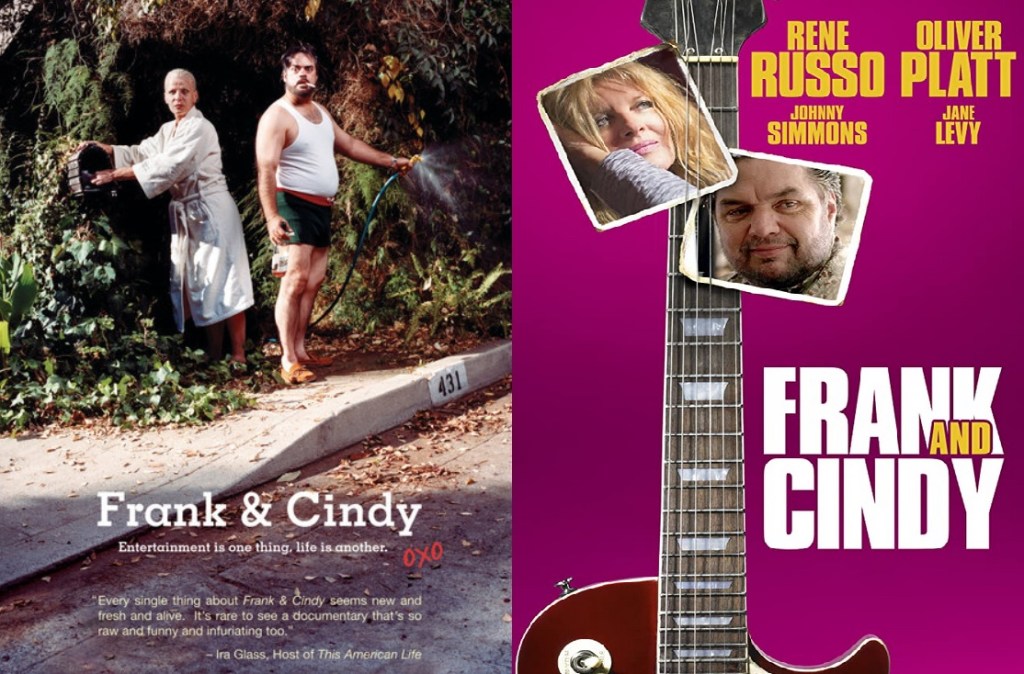
Who did Corman entrust this sequel-cum-reboot to? The step-son of a washed-up, one-hit wonder ’80s musician. A successful editor, cinematographer, and screenwriter with several shorts and documentaries to his credit, G.J. Echternkamp (who also co-starred on ABC-TV’s How to Get Away with Murder), walked away with several “Best Director” awards for his feature film debut, the 2007 documentary Frank & Cindy, that tells the story of his blonde bombshell of a mother and his step-dad, Frank Garcia, an alcoholic, ’80s one-hit wonder musician who, out of love-pity, Cindy lets live in her basement. Frank was the bassist in the band OXO, who scored a 1983 U.S Top 30 hit with “Whirly Girl.”
And based on the success of the documentary, and the successful airing of a documentary of its production on the Showtime docu-series This American Life (Season 1: Episode 4), the story became a 2015 comedy starring Oliver Platt as Frank Garcia and Rene Russo as Cindy.
What’s that? You say you don’t remember “Whirly Girl” or OXO? Well, good for you. You didn’t spend countless hours wasting away in front of MTV.
But perhaps these (embedded) clips from their American Bandstand appearance (Frank is the one in the green one-piece jumpsuit) or their appearance on Solid Gold will warm those analog cockles. And yes, we found a copy of their highly-rotated MTV video. . . .
Oh, and get this: Cynthia Brown and Frank Garcia got jobs — as well as their son, G.J. Echternkamp — working for Roger Corman after he was impressed with the 2007 film. Which leads us back to: Death Race 2050!
And so ends another rock ‘n’ roll celluloid adventure from the analog ethers. Send all of your complaints to Sam. For it was his dreaming up a “Rock ‘n’ Roll Films Week” (that ran Sunday, July 19 to Sunday, July 25) and a “Fast & Furious Week” (now running from Sunday, August 2 to Saturday, August 8) that blessed — or cursed — you with this review.
Sam, you’re an OCD-lovin’ movie packrat, brother. Love ya, man.
About the Author: You can learn more about the writings of R.D Francis on Facebook.He also writes forB&S About Movies.
* Be sure to join us for our “Exploring: Radio Stations on Film” roundup overflowing with links to all of our reviews of movies set inside radio stations.
*+ There’s more “Deadly Game Shows” to be had with our review of Elio Petri’s granddaddy of ’em all: 1965’s The 10 Victim, which includes links to all of the deadly sports films you love.
Before “Racer X,” the 1998 Vibe magazine article that detailed an illegal street racing circuit operating within New York City . . . before Vin Diesel and Paul Walker . . . there was this tale of romance and cops-on-the-case originally known as Crashout, written by Roger Corman.
In a deal similar to the one Corman made with Ron Howard years later on Grand Theft Auto: John Ireland agreed to star only if he could direct. And in nine days on a budget of $50,000, Ireland (The Shape of Things to Come, Incubus) directed his first feature film, Corman had his second producer’s credit (after Monster from the Ocean Floor), and the newly-incorporated American Releasing Corporation (which would become American International Pictures) had their first feature film. For Ireland’s co-star, Corman was able to get a down-and-out Dorothy Malone, who was without talent representation at the time, for an affordable price.
In the pages of his 1990 biography, How I Made a Hundred Movies in Hollywood and Never Lost a Dime, Roger Corman states that producer Neal H. Moritz and Universal Pictures approached him to licensed the title for 2001’s The Fast and the Furious after Moritz learned of Corman’s 1954 film while watching a documentary about American International Pictures. At the time, Moritz toyed with the idea of retaining the Racer X title from the Vibe article, along with the titles of Race Wars and Street Wars. One of Moritz’s rejected titles, Redline, was later used by one of the many F&F rip-offs, a 2007 film starring Tim Matheson and Eddie Griffin. (And another of the knockoffs, 2008’s Street Racer from Asylum Studios, sounds suspiciously like a portmanteau of Mortiz’s others rejected titles.) The deal that got it done: Moritz could have Corman’s title-by-trade: all he had to do was give Corman some stock footage to use in his later productions.
Universal welcomed Corman into the fold again when he got the idea to make his own sequel to 1975’s Death Race 2000. The idea came to fruition when an Italian journalist interviewing Corman commented The Hunger Games shared similar social and political themes explored in Death Race 2000. So Corman reached out to Universal, who produced Paul W. S. Anderson’s 2008 remake, with a plan to bring back the dark, sociopolitical satire of the original — and the killing of pedestrians. Universal was on board: the studio co-produced the film that became Death Race 2050 with Corman’s New World for the home video streaming market.
As you watch Corman’s ’54 car racing drama, you’ll notice the plot bears a striking resemblance to the glut of low-budget indie knockoffs made in the wake of F&F 2001’s success: We have another ne’er-do-well charged with a murder he did not commit and his salvation lies on the quarter mile.
Broken out of jail and on the run, someone recognizes Frank Webster (John Ireland) in a small, roadside coffee shop. To facilitate his escape, he kidnaps a customer, Connie (Dorothy Malone), and hits the road in her white Jaguar sports car. To elude police, and courtesy of Connie’s sleek ride, Frank easily slips into a cross-border sports car race into Mexico. Cops, guns, crashes . . . and love, ensues.
You have a couple of streaming choices. You can watch this on TubiTV or on You Tube HERE and HERE. The quality on all three uploads is about the same, but the Tubi upload carries ads. You can also watch it over on the Internet Archive, which is turning out to be a great repository for hard-to-find and classic films.
About the Author: You can learn more about the writings of R.D Francis on Facebook.He also writes forB&S About Movies.
You know how it is at B&S About Movies: discussing mainstream, Tinseltown-made movies is anathema. So when we started digging into the antecedents of The Fast and the Furious franchise for this tribute week, you know we’re heading to the VHS shelves stocked with the films directed by Daniel Haller (Die Monster, Die, Devil’s Angels, and The Dunwich Horror), William Asher (Johnny Cool and “Beach Movies”), and Richard Rush (Hells Angels on Wheels, Psych-Out, The Savage Seven) that star the actors we care about, i.e., Frankie Avalon (Blood Song), Fabian (Disco Fever, Kiss Daddy Goodbye), Mimsy Farmer (swoon . . . Four Flies on Grey Velvet, The Perfume of the Lady in Black, Autopsy), Annette Funicello, and Diane McBain (Maryjane, The Mini-Skirt Mob, The Delta Factor). So, yeah, we’re going to review Thunder Alley (1967), The Wild Racers (1968) and Fireball 500 (1966) in quick succession. We’d be derelict in our reviewing duties if we didn’t inhale anything with the Corman-AIP stank on it*. (Ditto for Jim Drake’s (Police Academy 4: Citizens On Patrol) 1989 car-crash homage, Speed Zone.)
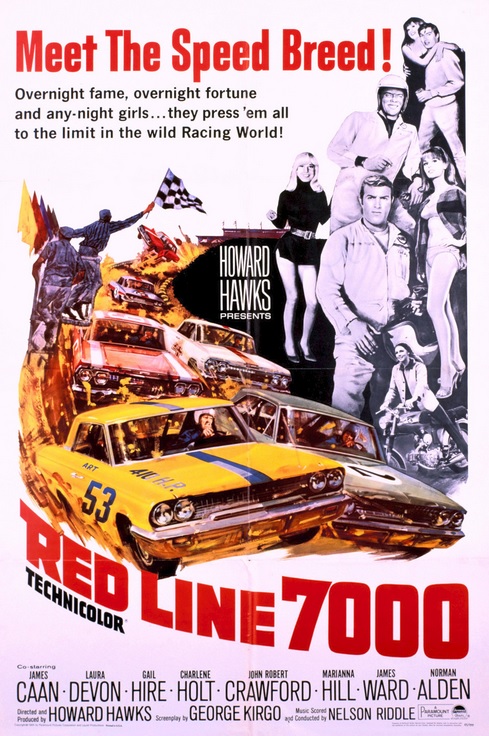
So while this “mainstream” film is directed by Howard Hawks and released by Paramount Pictures, we’re breaking those mainstream-rules since this racing “epic” features an early starring role for James Caan (who did this and the space “epic” Countdown and water “epic” Submarine X-1 . . . on his way to the apoc-epic Rollerball. . . oh, and some mob-movie called The Godfather).
But don’t let Caan’s presence and the iconic name of Howard Hawks fool you: This is pure Elvis-as-a-race car driver-via-process shots tomfoolery, ala Viva Las Vegas (1964), Spinout(1966), and Speedway (1968), without the singing. Hawks should have cast Frankie Avalon and Fabian, and dumped it in Drive-Ins, and called it a day. At least it would have turned a profit, like those abysmal (yet adoring) Elvis race romps.
“We gotta win this race . . . lemonade, that cool, refreshing drink.”
It’s true: The days of Hawks wowing us with the gangster classic Scarface(1932), the war epic Sergeant York (1941), the noir must-see The Big Sleep (1946), his one-two punch oeuvre with John Wayne of Red River (1948) and Rio Bravo (1959) (yeah, we know they also did ’62s Hatari, ’67s El Dorado, and ’70s Rio Lobo), and — the big daddy of sci-fi — The Thing From Another World (1951), were clearly behind him. Critics weren’t kind then, and retro-critics aren’t kind now, to this NASCAR romance-saga — and as someone who watched all of the Hawks-Wayne films with his dad (and loved them): I can honestly say this truly is the weakest film in the Hawks catalog.
In the backwash of Hawks-Paramount Pictures’ production, John Frankenheimer (Birdman of Alcatraz, The Manchurian Candidate, the blimp-disaster Black Sunday) put together the superior Formula One-centric Grand Prix (1966) with James Garner (chronicled in document, The Racing Scene). That Metro-Goldwyn-Mayer film “blew the doors off” Paramount’s Red Line 7000, with a $20 million gross against $9 million, making it one of the Top-Ten grossing films of 1966, which earned a DGA Award for Outstanding Directing in a Feature Film — even though it featured real-life, stock-shot racing footage, just like the Hawks racing drama.
As with Tom Cruise developing his love of car racing into Days of Thunder(1990), Steve McQueen — himself an accomplished racer of Porsches — produced his affection for France’s 24 Hours of Le Mans with Le Mans (1971) for 20th Century Fox. As with Red Line 7000, and unlike Grand Prix, McQueen’s racing epic — even though it filmed all of its racing footage “on-location” during the 1970 Le Mans race — failed at the box office, making less than its $8 million budget. Ditto for Paul Newman who made Winning (1969), his Indy 500-dreamer race romp with James Goldstone (TV movie heaven with Cry Panic and the amusement-disaster Rollercoaster) for Universal.
And what’s our analog god of all things UHF and VHS have to say about all this racing tomfoolery: Quentin Tarantino has stated that he’d “rather saw off his fingers” than sit through Winning, as it was worse than Steve McQueen’s Le Mans. He’s also said that if he was to direct a racing movie (Please do! Don’t let Once Upon a Time In Hollywood be the end?), it wouldn’t be pretentious, like Grand Prix, it would be like Red Line 7000, with it’s soap-opera-everyone-trying-to-sleep-with-everyone-else storyline, but fun — and play like a really great Elvis Presley race movie.
And Quentin loves his cars (in movies) and didn’t miss that Red Line 7000 features the then “new” 1965 Shelby GT-350 speeding on the track and that one of the characters drives a 1965 Cobra Daytona Coupe. In his own Once Up a Time in Hollywood, Quentin broke production protocols and used over 2000 vintage rides in the film: the average film uses between 300 to 500 cars. To that “racing end”: Cliff Booth (Brad Pitt) drove a 1962 Volkswagen Karmann Ghia, Abigail Folger (Samantha Robinson) drove a 1969 Pontiac Firebird, and Tex Watson (Austin Butler) drove a 1959 Ford Galaxie.
So, am I out of line saying that I’m waiting for Humphrey Bogart to crawl out of the cockpit, unzip the flame retardants, and jump into the Holiday Inn sack with Lauren Bacall?
That’s how outdated (even back in the early UHF ’70s) this racing romp feels to me, with the horses traded out for cars and the western wastelands for circular asphalt. And that Nelson Riddle score! Talk about wanting to saw off fingers . . . and ears. Where’s that swingin’ n’ screechin’ Dick Contino (Daddy-O, Girls Town) jazz score when you need it? (The ‘Con bagged Leigh Snowden from The Creature Walks Among Us, so he’s a “cool cat” in my book.)
But that’s the plot, sans the horses and Nevada dirt: everyone is trying to bed everyone else except their own girlfriends, either punching out or trying to kill their romantic rivals. And in between: they race via process shots via stock footage (including several high-profile crashes) filmed at the Atlanta Motor Speedway, Darlington Raceway, Daytona International Speedway, and Riverside International Speedway — A.J Foyt’s violent crash at Riverside earlier in 1965 served as the “death” of Caan’s team mate at Daytona. The “romance” gets so heated that Caan’s Mike Marsh trades paint with Dan McCall (Skip Ward of Ann-Margret’s Kitten with a Whip, Elvis’s Easy Come, Easy Go, and the box-office bomb Myra Breckiridge) and tries to kill him on the track.
On the casting side: George Takei, on his way to where no man has gone before, is Kato, a member of Caan’s pit crew. And no disrespect to the mighty Jonathan E., but how cool would it have been to see Paul Mantee of Paramount’s Robinson Crusoe on Mars (and the Bond rips A Man Called Dagger and That Man Bolt) in Caan’s role (who was also a Paramount contract player)?
Again, it all comes back to the actors we want to see: Paul Mantee. Do you remember Paul on Seinfeld as the Health Inspector busting Poppy for peeing and not washing his hands? And — surely Sam will give me shite — we’re back to my “Six Degrees of Seinfeld” foolishness, again.
Sorry, kids. No freebies. Not even on TubiTV and Vudu. You’ll have to settle for an Amazon Prime VOD.
* Long threatened, we finally rolled out that Roger Corman tribute month to his New World Pictures shingle in March 2023. Clicking through will populate all of those reviews.
About the Author: You can learn more about the writings of R.D Francis on Facebook. He also writes for B&S About Movies.
We’ve mentioned this VHS potboiler in passing during our reviews of Rocktober Blood and Larry Buchanan’sDown on Us (you know how it works: we’ll get to that tidbit, later). Thanks to Sam dreaming up a “Fast and Furious Tribute Week” — and his excavating the Jim Drake 1989 VHS uber-obscurity, Speed Zone — we finally have an excuse to give this grandfather to the The Fast and the Furious franchise a review proper: a fictional film based on the real life problem of “Banzai Runners” speeding along the desert asphalt strip of the I-15 between Los Angeles and Las Vegas.
As you can tell from the box, ubiquitous TV actor Dean Stockwell stars in this direct-to-video romp. But don’t be copywriter-duped. In no way is this comparable to his work in the superior films noted under his name. And while modern audience will recognized Stockwell for his later TV work in the series Quantum Leap, JAG, and SyFy’s Battlestar Galactica reboot, we, the B&S crew, will always remember Stockwell for his work in the Jack Nicholson-starring counterculture flick, Psych-Out (1968), and his starring with Sandra Dee in The Dunwich Horror (1970).
Stockwell’s greatest strength is not only how easily he transitions from TV to film and back again, but how he can take the lead in (and inspire us to rent) a low-budget actioner, then show up in smaller roles in A-List films for Francis Ford Coppola (Gardens of Stone and The Rainmaker), William Freidkin (To Live and Die in L.A.), David Lynch (Dune, Blue Velvet), and Wolfgang Peterson (Air Force One). He is, simply put: Eric Roberts before Eric Roberts. Hell, he’s Bruce Campbell before Bruce Campbell. He’s the good actor you put in a bad movie — and he still gives us his all and “sells the role” to the home video masses.
Banzai Runner, while a commendable attempt to chronicle a factual event wrapped in a fictional tale (as with illegal street racing in The Fast and the Furious), failed in the home video market as result of its ambition-over budget. It became the only feature film writing credit for animation-scripter Phil Harnage, who is a “shooting fish in a barrel” type of writer when it comes to cartoons. You haven’t not seen his art work, which dates all the way back to Bill Cosby’s Fat Albert, along with He-Man and the Masters of the Universe, The Adventures of Super Mario, G.I Joe, The Adventures of Sonic the Hedgehog, and Double Dragon. In the producer and director’s chair is John G. Thomas, whose slight resume gave us not only Banzai Runner, but Dean Stockwell’s brother-in-arms, Michael Parks (Kill Bill: Vol. 1), in Arizona Heat (1988), starring alongside his cop-buddy Denise “Tasha Yar” Crosby (American Satan).
That’s how it goes in the B&S About Movies universe. Not everyone is destined for a television-to-theatrical career.
So Stockwell is Highway Patrolman Billy Baxter. And he’s worn out dealing with the rebel-rousing drunk gamblers on his Nevada stretch of highway between Los Angeles and Las Vegas. But what really pisses him off is that the brass turned down his request to modify his police cruiser so he can keep up with the so called “Banzai Runners”: the unapprehendable, rich elitists who zip by him in their supercharged, high-powered Ferraris and Lamborghinis. Ah, but those speed demons aren’t speeding for kicks: they’re running drugs for Syszek — played by requisite screen villain Billy Drago (Hunter’s Blood, Invasion U.S.A).
Baxter eventually goes “Mad Max” when Syszek kills his brother and orphans his nephew, now in his care. So his mechanic buddy upgrades his cruiser (courtesy of the only other notable actor in the cast, Charles Dierkop, aka Det. Pete Royster from TV’s Police Woman; but remembered best for his work in Angels Hard as They Come, The Hot Box, Messiah of Evil, and Silent Night, Deadly Night). When the brass has enough and strips Baxter of his badge, he’s ripe for DEA recruitment to go undercover in the dark world of the “Banzai Runners” and take his revenge os Syszek. (Have you ever notice villains have cool, Euro-ethnic names with lots of consonants of the w, x, y, z variety? I guess Billy Drago as “Sam Miller” or “Joe Smith” doesn’t “ring true,” does it?)
Oh, by the way: This is the type of film where the cars don’t speed on the roads in real time: they acquire their “speed” in post-production via speeding up the film.
Yes. They’re fast and furious, indeed.
“Hey, wait! What about the trivia about Rocktober Blood and Down on Us?”
Oh, yeah, thanks for reminding me. So, Riba Meryl (passed away in 2007) stars here Donna, one of the film’s minor characters. Part of the Sunset Strip’s ’80s hair-metal scene, she came to co-write the faux-rock epic “Rainbow Eyes” with Sorcery’s Richard Taylor for Rocktober Blood — and was cast aside for fellow Las Vegas transplant Susie Rose Major to vocalize the tune as Lynn Staring. Prior to her second and final acting gig in Bonzai Runner — as result of her session work with Randy Nicklaus and Jerry Riopelle on the film’s never released soundtrack — she portrayed Janis Joplin in the speculative 1984 rock flick, Down on Us.
The soundtrack for Bonzai Runner features songs written and performed by Randy Nicklaus, who’s engineered records for Alias, Blondie, Contraband (aka Michael Schenker), INXS, Motley Crue, Vixen, and Yes; he also placed songs on the soundtracks to Bill & Ted’s Excellent Adventure and The Wraith. Detroit-born Jerry Riopelle and his band members, Joel Goldsmith and Kevin Dukes, have placed songs in projects as diverse as Crystal Heart, Hollywood Hot Tubs, and Paramedics. Sadly, we lost Jerry Riopelle in 2018. Goldsmith scores can be heard in Moon 44, Laserblast, and The Rift, and, most recently in the Stargate TV-universe.
You can watch — the one lone copy — of Banzai Runner for free on You Tube . . . and keep your eyes open for those 50 mph cars film-sped to 200 mph in the Arizona heat. Why yes, you can watch Arizona Heat on You Tube, and here’s the trailer to get you started, if you dare!
Ugh. A great soundtrack, but here’s only one tune isolated from the film on You Tube: “It’s Everything” by Jerry Riopelle. You can listen to more of his work on his You Tube page. There’s also a wealth of Randy Nicklaus’s work on You Tube.
About the Author: You can learn more about the writings of R.D Francis on Facebook.He also writes forB&S About Movies.
Anytime we roll out a review of a Mill Creek box set, we think, “Eh, no one cares.” We couldn’t be more wrong! Our readers love learning about the box sets — and we gain new readers as we see an increase in our site traffic, along with a lot of social media likes and reposts on Twitter and Facebook. So thanks to all of our readers for spreading the word.
Ah, you “heart” B&S About Movies!
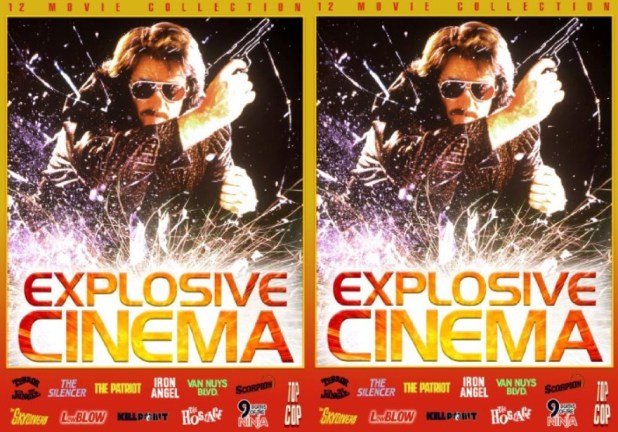
Of course, our past March 2020 exploration (Sunday, March 8, to Saturday, March 14) of the Explosive Cinema pack was no exception.
We’ve been clamoring for a copy of 9 Deaths of the Ninja for our personal collection — since forever. And there it was! Once again: Mill Creek with the VHS-to-Digital assist. Sold! And for that, we say: Oh, god bless ye, ye overlords of the public domain netherworlds of analog delights of thee obscure and thee crappy. For we analog peasants lost in the digital barrens need these movies to assure our survival in the never ending quest to relive our Drive-In, UHF-TV, and VHS entertainment youth.
Also be sure to check our past reviews for Mill Creek’s Pure Terror and Chilling Classics sets . . . and, keeping with our yearly, November tradition of blowing out a Mill Creek box set, we’ll be checking out the 50 films included on their Sci-Fi Invasion set. Would you like to write a review (or reviews) for the films on the set? You can get all of the deets, here.
Oy! We almost forgot: As part of our “Fast and Furious” tribute week, we’re reviewing Mill Creek’s rubber-burnin’ and asphalt-tearin’ Savage Cinema set all this week — from Sunday, August 2, to Saturday, August 8.
Happy watching! And be careful . . . it’s explosive! Tony Tulleners will kick your ass into next week.
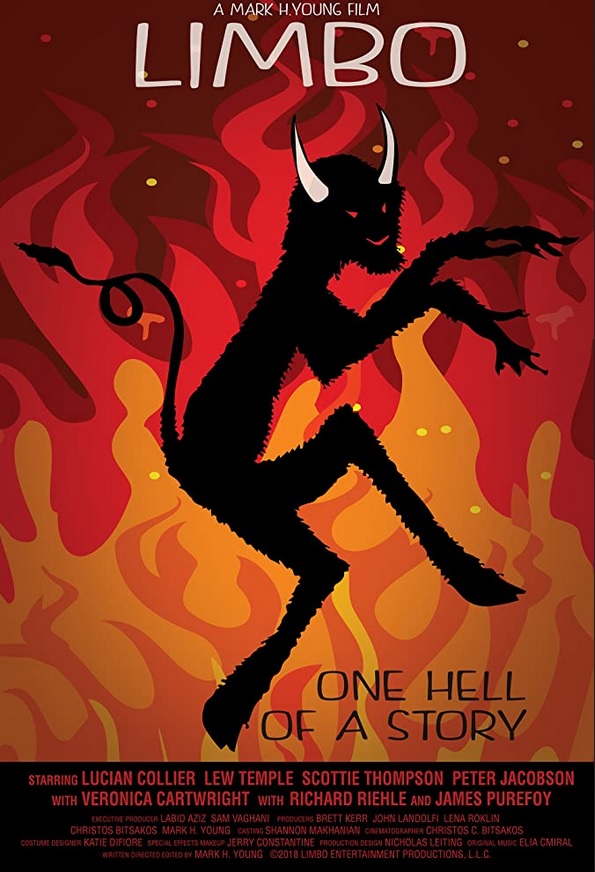
Limbo is a From Dusk Till Dawn-inspired, multi-purpose seedy bar, jailhouse, and court of law that lies somewhere in the ethers between heaven and earth where souls—both good and bad—stand trial to decide their final destination: heaven or hell. Cast into Limbo is Jimmy (Lew Temple), a murderer caught in a cat-and-mouse game between a slick prosecutor (Lucian Charles Collier, aka Stian “Occultus” Johannsen in Lords of Chaos) and an inexperienced defense attorney (ubiquitous TV actress Scottie Thompson). She wants to go for a full pardon . . . but there hasn’t been a “full redemption” in Hell for over 2,000 years . . . and Lucifer doesn’t want this case going to trial and wants it closed.
Casting is everything in an indie film, as familiar names and faces (Veronica Cartwright from Alien, James Purefoy from TV’s The Following, Chad Linberg from CSI: NY and Supernatural) offer encouragement to hit that big red streaming button.
In addition to that supporting cast, we’re treated to a cast headlined by the always reliable Scottie Thompson, who we’ve enjoyed in her guest-starring roles on numerous television series, but most notably for her starring roles in Brotherhood, Trauma, Graceland, The Blacklist, NCIS, 12 Monkeys, and the rebooted MacGyver. You’ll recall Lew Temple from The Walking Dead, and (yes!!) the always awesome Peter Jacobson from his recurring roles in the Law and Order franchises and his starring role in House, but more recently for his starring roles in Ray Donovan, Fear the Walking Dead and NCIS: Los Angeles. Then there’s the elder statesman of thespians, Richard Riehle (!!), who recently lit up our streaming screens in The Invisible Mother.
But even with that cast and their respective resumes, we came for one reason and one reason only: Richard Riehle sports a pair of devil’s horns growing out of his skull. Okay, two reasons: Peter Jacobson has a set growin’ out of his head as well.
Streaming ticket sold.
Director Mark Young has been making films since the late ‘90s—nine in all; Limbo is his tenth film—and while we haven’t reviewed any of his previous films at B&S About Movies, Limbo shows that, if not going back to watch some of his older works, we’re certainly looking forward to his current post-and-pre-production efforts of Rebirth and Lost in Paradise.
You’ll be able to stream or pick up a copy of the DVD of Limbo on August 4. You can keep abreast of developments on the film at the Facebook pages of Alternate Ending Films and Uncork’d Entertainment. You can watch the trailer on Vimeo.
Disclaimer: We were provided a screener by the film’s P.R firm. That has no bearing on our review.
About the Author: You can learn more about the writings of R.D Francis on Facebook.He also writes for B&S About Moviesand publishes on Medium.









 B&S About Movies
You must be logged in to post a comment.