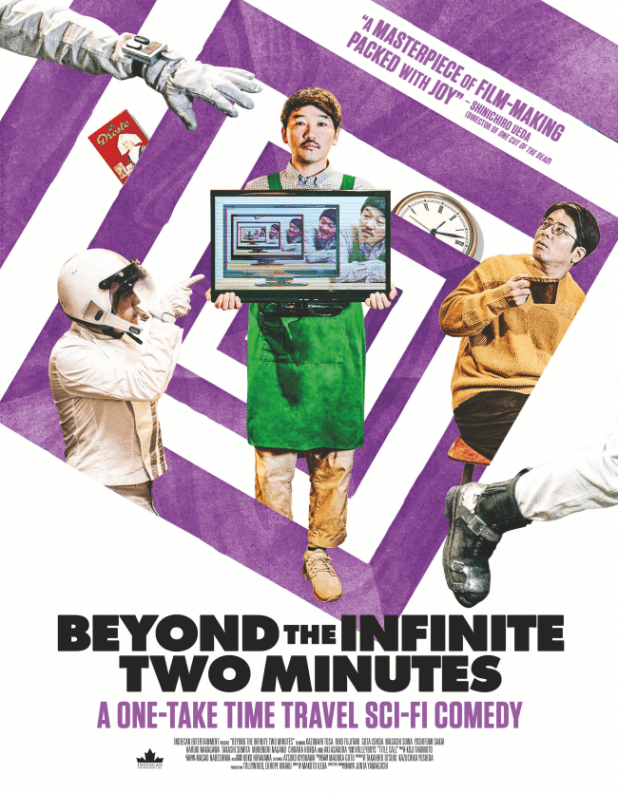
Kato lives above the shop that he owns in Kyoto, Japan and spends whatever time he has left after working playing in a band and thinking of the Megumi, who works at the shop next door. Somehow, in the midst of the ordinary that is his life, Kato learns that the computer screens within his cafe and apartment allow him to receive messages from himself two minutes into the future. Calling this strange experience Time TV, Kato and his friends begin to explore what they can do with this power.
Years ago at San Francisco MoMA, there was an installation that captured moments of time as you walked through it and redisplayed the time that you appeared and interacted with the art, so that it seemed like you were appearing and disappearing at times that didn’t match up to your short term memory. It was incredibly disconcerting and probably what Kato feels like as he shouts messages to multiple versions of himself minutes apart from one another.
Somehow, this movie was made with an iPhone, some Apple TVs and the amazing directing, editing and cinematography of Junta Yamaguchi. This comes from Third Window Film, who also made One Cut of the Dead, and this continues their one cut style, as the film seems to be one continuous shot, which is astounding when you get to the scenes where mirrors extend the future messages into the near-infinite (or at least ten minutes).
This movie absolutely flies through its near 70 minutes but it never feels too fast, never gets boring and gives plenty of time for its characters to display emotion, heart and the joy of discovering something strange and new — pretty much just like any viewer who tracks this down.
Beyond the Infinite Two Minutes debuted this Thursday at Fantastic Fest. When it becomes available for streaming, we’ll make sure to adjust this review so that more people can track it down. You can learn more about this movie at the official site.
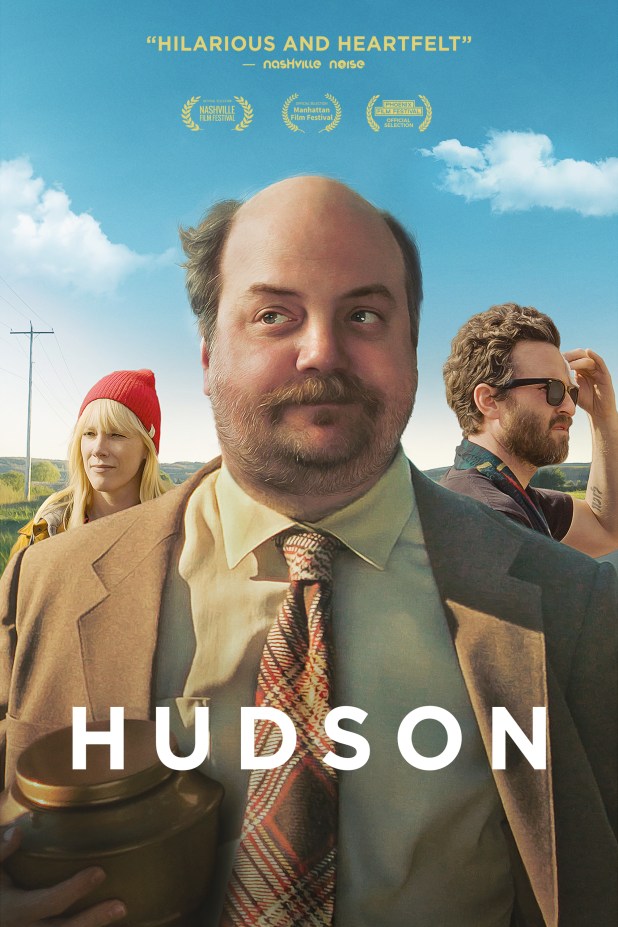
After his mother’s death, Hudson goes on a journey throughout the Hudson Valley to scatter her ashes and perhaps learn a few lessons about life, serve up some imaginary ice cream cones and even get in a few rounds of miniature golf. An accident as a child has left him a timid and reclusive mess of a human being, but he’s charming and ends up showing that he knows way more than those in his life who claim to be adults.
Directed by Sean Daniel Cunningham, who co-wrote the film with star Gregory Lay, who plays Hudson’s cousin Ryan, this movie surprised me because I generally can see through the sentimentality of most films as cheap emotion. Instead, this film has a genuine heart.
There’s a great appearance by Richard Masur — Clark from The Thing — as Hudson’s father, as well as stand-out performances by Lay, Mary Catherine Greenawalt as the hitchhiker Sunrise who comes into their lives and David Neal Levin as the title character.
While the tale in Hudson isn’t something that breaks new ground, it does stand out by the gentle interactions between its characters, the gorgeous way that it was shot and just that it’s so competently made, which seems more and more doesn’t seem to happen in major films, much less smaller efforts.
If you met Hudson in real life, you may be put off by his behavior. But if you stayed with him, gave him a chance and actually listened to him, you’d end up having a richer and fuller life. This film gives you that in much less time and from the comfort of your home.
Hudson is available on Amazon, Apple TV and On Demand from 1091 Pictures.
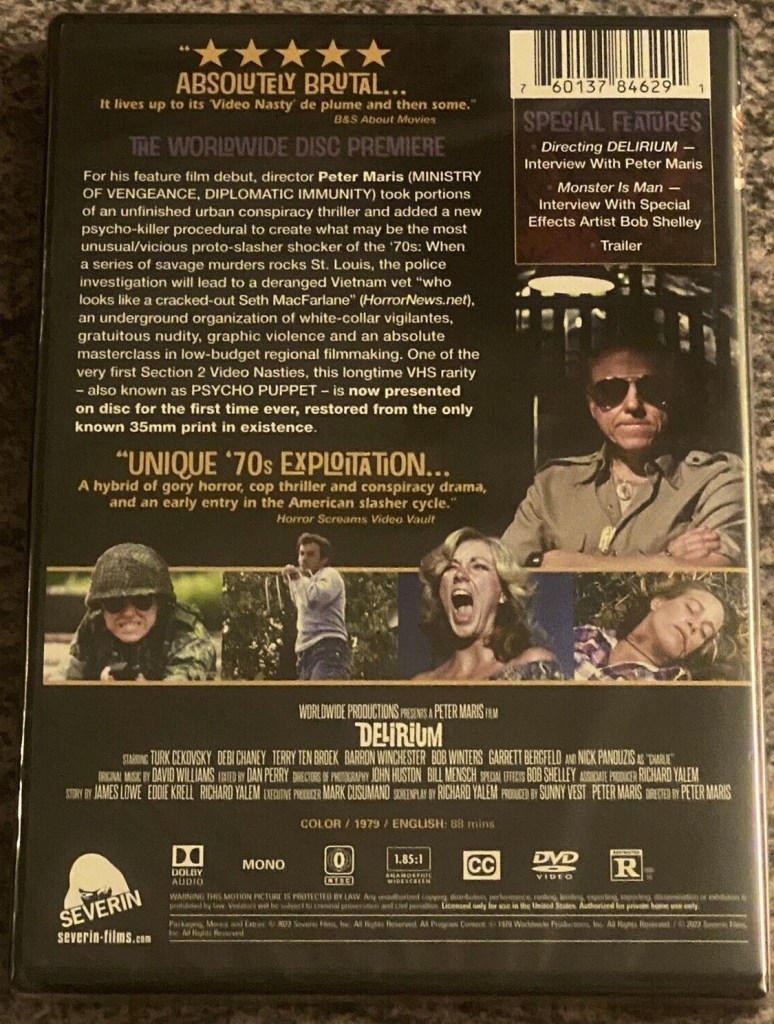
EDITOR’S NOTE, January 2022: We’re excited to share Severin has used a quote from R.D. Francis’s review on the back of the limited-edition slipcaseversionfor their new Blu-ray release of Delirium. They since used the quote for the rear cover on their mass-marketed DVD.
At the time of composing this September 2021 review, we were simply crossing-off another film from our ongoing goal of reviewing all of the British “Video Nasties” of the ’80s (we’ve linked that three-part series at the end of this review). We were unaware that, first, Severin, then 88 Films in the U.K. — who didn’t make their respective, reissue announcements until November and December 2021 — were releasing the upgraded film in January 2022. . . .
So, yes . . . another obscure, mostly forgotten, even unknown in most quarters, 40-year-old film (see our recent — and now, updated — reviews for The Spirits of Jupiter and UFO: Target Earth) crawls out of the analog snows, aka woodwork, and bites us in the ‘ol arse!
DVD imagecourtesy of dcjsalesofficial/eBay.
Okay, so it goes without saying, but we’ll say it, anyway: This isn’t Lamberto Bava’s 1987 film of the same name — at least not in the celluloid confusing lands of the alternate-title U.S. In other parts of the world, that film was known as Le foto di Gioia, aka The Photos of Giola, starring the heart-melting Serena Grandi (Antropophagus), Dame Daria Nicolodi (Shock), and George “Big Ape” Eastman (who we’ve “Explored“).
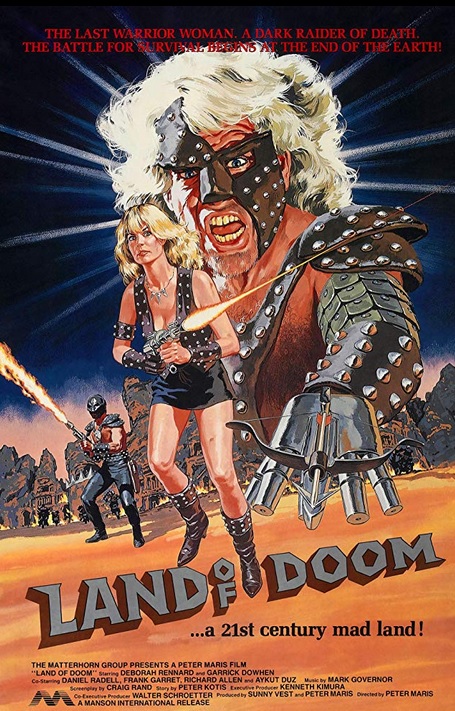
No, this Delirium is the U.K. “Section 2” Video Nasty (see, we are finally getting around to polishing off those reviews, in full*) that served as the feature film debut by producer, writer and director Peter Maris, he who later gave us the cheesy-fun The Road Warrior rip Land of Doom(1985), and the god awful (sorry, Pete, it just is), one-two punch CGI’d ripoff of not only Independence Day, but Species, with the oft-Mill Creek box set-programmed Alien Species (1996). Maris, however, unlike most auteurs whom appeared on “Video Nasty” and bloody “SOV” lists, carved himself a rather prolific, low-budget resume of directing a film roughly once a year, for a total of fifteen films until 2007. As a producer, he also gave us four more: True Blood (1989), Ballistic (1995), the Christian apoc-rocker Raging Angels (1995)(!), and a pretty good neo-cable-noir with The Murder in China Basin (1999).
Okay, so back to the “Video Nasty” that is Delirium.
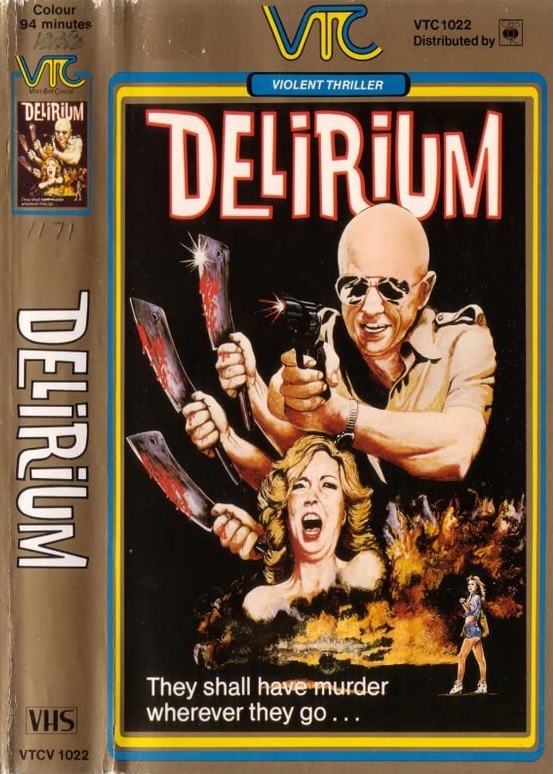
Ah, the VHS I remember. It feels like home. It also aka’d as the cooly-titled Psycho Puppet throughout Europe.
Charlie is your garden variety, Giallo-influnced-by-way-of-John Carpenter psycho trapped in a graphic foreshadowing of the Micheal Douglas-vehicle The Star Chamber (1983). In that film, Douglas becomes part of a secret society of judges who hire hitmen to assassinate criminals who slip through the system. Perhaps your nostalgia miles may recall the James Glickenhaus** written and directed The Exterminator (1980), with Robert Ginty’s war vet barbecue’in criminals with a flame thrower (we’ve since reviewed Part II as part of our “Cannon Month” of reviews). However, as with The Star Chamber, Peter Mavis, was — brilliantly — first.
In a Mavis low-fi world, we have a secret society of community leaders who’ve formed a “vigilante counsel.” Taking the law into their own hands, the committee’s kangaroo court convicts in absentia and murders the convicted. To run their court — and handle the “assassinations” — they hire Charlie: an ex-solider. At first, Chuck mops the streets with efficiency and plausible deniability on part of the counsel. However, as any emotionally damaged Vietnam vet (of the celluloid variety) should: Chuck freaks out and just friggin’ kills everyone — including squeezing in the butchering of innocent, young women: for he side hustles between “assignments” with his serial killer gig.
Delirium — as result of its foreshadowing two, better known, more popular movies, and its crazed, hybrid-amalgamating of Dario Argento with the later action-thrills of John Carpenter (see his earlier Assault on Precinct 13 vs. Halloween) — is an oddly-styled, unusual film that, again, also foreshadows Sylvester Stallone’s own, later Giallo-action hybrids in Cobra, and his less-successful attempt with D-Tox. We can even go as far as mentioning Charles Bronson’s graphic, but not as gruesome as Delirium, Italian Poliziotteschi-Giallo hybrid with 10 to Midnight.
However, unlike the films we’ve mentioned in comparison: Delirium is absolutely brutal in its misogyny (and Stallone had women hanging as hogtied-meat slabs in D-Tox). This movie — not Mavis, mind you — hates women: even more so than Joe Spinell’s head-scalping Frank Zito in William Lustig’s — again, more popular, better known; but Mavis was first — Maniac (1980). Look at the cover: this movie lives up to the “video nasty” de plume and then some, as it decides jamming a pitchfork through a woman’s throat (Pastor Estus Pirkle jammed sharpened bamboo rods into kids’ ear canals, so why not; you’ve never seen If Footmen Tire You, What Will Horses Do?, well, you should*˟) and nail-gunning women to doors is the way to go — then justifies it all with the ol’ “Vietnam flashback” gag (the Gooks made me do it). The vet-flashback gag didn’t work in the earlier (I can’t not believe Peter Mavis wasn’t influenced by it), porn-industry backed The Last Victim/Forced Entry from 1973/1975. Only Mavis’s film is the more skillful of the two. (I keep flashing back — or is that forward — to Will MacMillan’s serial-killer oddball Cards of Death (1986); however cool that SOV’er is, Mavis made the better-quality film).
So, if you have a hankering for a “heavy metal” experience of an uber-weird n’ scuzzy amalgamate of John Carpenter’s Halloween and Sean. S Cunningham’s Friday the 13th — with a soupçon of Death Wish — load ‘er up. And while Cunningham is credited as being more bloody than Carpenter, Mavis out-bloodies Cunningham — by several gallons of Karo n’ food coloring — in this splatter-cum-cop flick.
Two thumbs up and five stars — as far as I am concerned. But what do I know: I’m the guy who likes Cards of Death.
Upon the Blu’s release, Eric Cotenas of DVD Compare dives deep on Delirium — and offers up some insights from Peter Mavis’s commentary and its two vignette supplements: “Directing Delirium” and “Monster Is Man,” the latter offers more insights from Effects Artist Bob Shelley (Moonrunners). Movies and Mania dives even deeper into the Blu, digging up a couple newspaper reviews from 1979, newsprint ads, and alternate VHS covers. Both are great reads for those D.I.Y ’80s fans of yore. Need more technical aspects on the release: Blu-ray.com has you covered.
* Click the images and enjoy all three parts of our “Video Nasties” series.
** Glickenhaus produced Maniac Cop, Frankenhooker, and the Basket Case franchise. He made his writing and directing debut with the Christploitation’er, The Astrologer, aka Suicide Cult.
*˟ We round up the “Christian Gore” of Pastor Pirkle — as well as director Ron Ormond’s lighter, Christian wares — with our review of The Second Coming.
We take a second look at Deliriumas part of our May 2023 tribute to Roger Avery and Quentin Tarantino’s weekly podcast tribute to their days at Manhattan Beach’s Video Archives.
About the Author: You can learn more about the writings of R.D Francis on Facebook.He also writes forB&S About Movies.
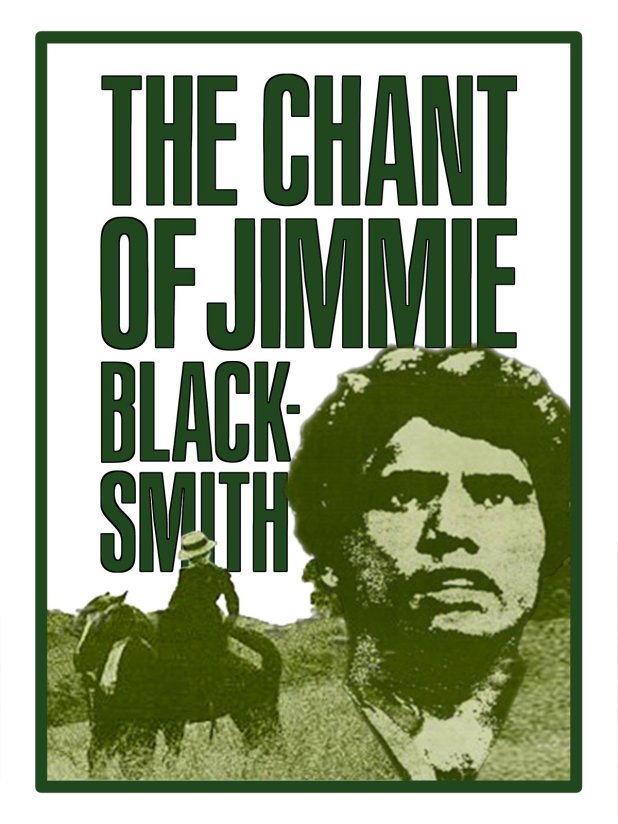
This critically acclaimed Australian film about an aborigine man pushed to the brink somehow ended up as a section 3 video nasty.
Director Fred Schepisi left Australia for a decade after making this movie, directing films like Roxanne, Iceman and Six Degrees of Separation. That’s because even though this movie was a big success, the promotional costs took away the profits, taking Schepsi’s entire monetary investment on the film.
Jimmie Blacksmith (Tom E. Lewis) is the son of an Aboriginal mother and a white father, a fact that brands him as an outcast even though Reverend Neville and his wife Martha attempt to raise him to have better opportunities than society would expect. Of course, when he goes out into the world to work, he’s taken advantage of at every turn, from employees that don’t pay him fairly to others that force him to found up other Aboriginals. Finally, when he gets a decent job on the Newby farm he’s able to bring his girlfriend — already pregnant with another man’s child — as well as two relatives to live with him.
The Newby family soon turns against Jimmie, with even the women telling his girlfriend to take her child and leave him behind. He decides to put a scare into them, but it gets out of hand and nearly every Newby woman and child is hacked to pieces. Jimmie goes on the run but declares war on everyone that has wronged him, seeking out past employers and butchering them.
Yet Jimmie can’t stay on the run forever, not when the entire town — maybe the entire world — wants to see him hung.
Just as much a lesson on racism as it was when it was released, The Chant of Jimmie Blacksmith doesn’t really belong amongst the video nasty cannibals and beasts. But there it remains.
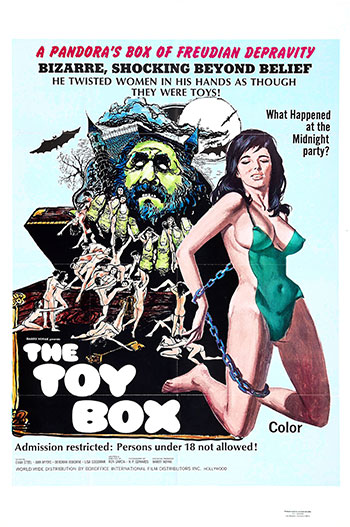
A section 3 video nasty and a production of Harry Novak, this movie should come complete with soap so that you can clean yourself up after the way you feel post-watch. But hey, before we luxuriate in filth, let’s talk about Harry and Boxoffice International Pictures.
Just take a cursory scan through some of the films that Boxoffice brought to the eyes of maniacs like you and me: Kiss Me Quick! in which an alien comes to our planet in search of feminine breeding stock*, the spectacularly named mondo Suburban Pagans, the drinking suburban housewives and their pot-smoking daughters in The Muthers, Jean Rollin’s The Nude Vampire, the Gary Graver-directed Erika’s Hot Summer, redneck trash (a good thing) like Country Cuzzins and Sweet Georgia, the brutal and wonderful Toys Are Not for Children, The Sinful Dwarf, Frankenstein’s Castle of Freaks, Lisa, Rattlers, The Child and so many more. When I first started buying trailer collections, the Something Weird Extra Weird Sampler was where I first saw Harry’s signature swirl onto my screen and then blow my mind with the aberrant junk that he was fostering on the movie buying public.
The actual story of this movie isn’t really a story as much as it’s an opportunity to get single women one handing it and couplings two handing it. So yeah, Ralph has taken Donna to see his crazy uncle again, but first she has to see her man in the boat before putting on a scene before the somehow dead and yet able to speak from beyond the grave uncle. And then this movie makes me wonder, who is this for? Who wants to see fellatio interrupted by stabbing or Uschi Digard have sex with — not in — a bed** or a necrophilia scene that ends with a pitchfork murder? Someone, I guess. As Harry Novak himself once said, “When I was a kid, my Daddy told me, “There’s a buyer for everything.” And I lived to find out that he was right.”
But if you make it through all that freaky 70s not so sexy sex, well, you learn the truth. The fact that Donna is really the uncle who is really an alien who sells human brains as drugs on the planet Arkon and the gifts promised from the toy box are really death as we watch a whole bunch of hippies get trapped inside a death house.
Director and writer Ronald Víctor García started out as an electro-mechanical packaging designer for the Apollo Command Module, the Saturn Stage II Helium Purge System and the Polaris Atomic Submarine Launching Systems before making movies like this. And somehow, some way, he became the director of photography for Twin Peaks and One from the Heart. In fact, he’s still out there today, working as a cinematographer on The Good Fight.
I wouldn’t say that this movie was good, but I will say that I was pretty messed up in a good way by it. It has a great movie somewhere in there and I wished that they had found it.
*Harry had a thing for sexy aliens, producing one of my favorite named movies of all time, 1975’s Wham! Bam! Thank You, Spaceman!
**To be fair, I am a red-blooded male and I am willing to watch Uschi Digard do pretty much whatever she wants to do.
Oh, call it what you will, you ol’ ’80s “Midnight Movie” and VHS-renting road dogs: Mondo Cannibale, CannibalWorld, Cannibals, White Cannibal Queen, A Woman for the Cannibals, or Barbarian Goddess. All we known is that, once again, Jess Franco, casts himself as the patron saint of the video nasty, as he sticks his hands into the boiling native vats and fucks up a genre. While shooting, this soon-to-be U.K.-banned ditty was titled Rio Salvaje, aka Wild River, probably as an ersatz sequel to Umberto Lenzi’s 1972 progenitor, Man from Deep River. As if we’d be duped by a Franco joint.
White Cannibal Queen
Ah, the VHS clamshell sleeve I remember. Heaven.
On the plus side: Franco gives us the always welcomed Al Cliver (The Beyond) and Sabrina Siani (Conquest and The Throne of Fire). According to Franco, he did this movie and fellow cannibal romp Devil Hunter (1980) for the money and had no idea why anyone would enjoy these films. (Is it just me, or does Franco have a lot of those type of films in his career? He said the same thing about his NaziZom rip, Zombie Lake.) Franco also went on record that Sabrina Siani was the worst actress he ever worked with and that her only good quality was her “delectable derrière.”
Whatever, Jess. Pedophilic Pig.
However, to Franco’s credit, he does change it up a bit: Instead of looking for the usual lost tribes or oil, or whatever vegetable or mineral MacGuffin we need to steal from a peaceful native tribe to make a better life for the white man, our civilized man — with one arm, who lost it during the first expedition — returns to the jungle where he lost his family to rescue his now teenage daughter — who’s become the blonde white cannibal queen of the tribe.
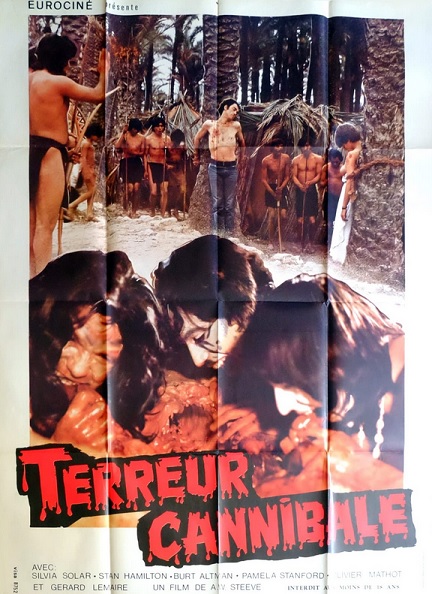
Cannibal Terror
It’s another Jess Franco joint: it’s different, but the same.
Now, don’t let Jess Franco bamboozle you with Cannibal Terror, aka Terreur Cannibale (1981). While Franco penned the script, it’s actually a way-too-late French entry into the genre directed by Alaine Deruelle, and not a repack of White Cannibal Queen, aka Mondo Cannibale. But it does raid that Franco film for stock footage. As result, we see Sabrina Siani, the White Cannibal Queen, while not starring in the film, appearing in a bar scene (oops); several shots of the dancing cannibals from Franco’s film are redux, here; a background actor (said to have a distinctive, Mick Jagger-type face) appears in three roles, here: as two cannibals, a border guard, and a third cannibal eating Al Cliver’s wife; the guitar player at the bar, here, found Al Cliver after he had his arm cut off in White Cannibal Queen (oops).
White Cannibal Queen and Cannibal Terror also share actors Olivier Mathot and Antonio Mayans, both whom have starring roles, as well as porn actress Pamela Stanford, who has a major role in Cannibal Terror, but a support role in White Cannibal Queen by way of stock pillaging. The leading woman change up is Silvia Solar from Umberto Lenzi’s Eyeball(1975).
As far as the “plot” goes in the French remake/ripoff: Two criminals take their kidnapping victim to their partner’s jungle hideaway. The local cannibal tribe hunts them down one by one.
Devil Hunter
Where I have I seen you before? Oy! Another Jess Franco cannibal joint!
And don’t let Jess Franco hornswoggle you with Devil Hunter (1980), aka, Sexo Canibal, The Man Hunter, and Mandingo Manhunter, for he is director Clifford Brown and writer Julius Valery, incognito; his second wife, Lina Romay, co-directed, while his first wife, Nicole Guettard, edited.
And since Devil Hunter was shot back-to-back with White Cannibal Queen, Al Cliver returns in the leading hero role. And Antonio Mayans, from it’s-not-Franco’s-film-but-it-is Cannibal Terror, returns as Cliver’s co-star. The change up, here, is that Ursula Buchfellner, a German model who became Playboy magazine’s “Playmate of the Month” in October 1979, stars as our resident damsel-in-distress. Did you see the Euro-adult comedies Popcorn and Icecream (1979), Cola, Candy, Chololate (1979), and Hot Dogs in Ibiza (1979), and Jess Franco’s women-in-prison romp Hellhole Women, aka Sadomania (1981)? Well, now you know four more Ursula Buchfellner’s films than most (normal) people. Do you feel blessed by B&S?
As far as the “plot” goes, well, it’s pretty much a retread of Cannibal Terror: After the kidnapping by white bandits of a top model/actress (Buchfellner) on a jungle shoot/location scouting trip, an ex-Vietnam vet (Cliver) and his mercenary pal (Mayans) head into the deep jungle of the island nation to rescue her, not only from the kidnappers, but from cannibals who worship a “Devil God.” And (snickering) the “God” is a tall African dude with ping-pong eyes falling out of his head.
And get this: Jess Franco claims the makers of Predator stole their idea from this movie.
Whatever, Mr. Franco. Ye who commits celluloid theft, himself.
Needless to say: All of the stock footage padding from White Cannibal Queen and Cannibal Terror, along with the expected Franco-sleaze, and awful dubbing, is back — to lesser . . . and lesser effect. Wow, Jess, thanks for making White Cannibal Queen look even better than it’s allowed to be. But it does “splatter” nicely to make the U.K.’s “Video Nasties” list, which is the whole reason we’re reviewing this film this week for our “Video Nasties Week.”
So, there you go. Now you’re an educated Euro-cannibal flick consumer in-the-know that Cannibal Terror and Devil Hunter aren’t alternate titles to White Cannibal Queen, but three distinct — as distinct as a Franco joint can be — separate films . . . that are different, but the same. Sorta. Kinda. Oh, Franco!
But you know Franco: He’s a magnificent, maniacal bastard and we love him for it. What would our youth have been without Franco flicks and Venom tunes?
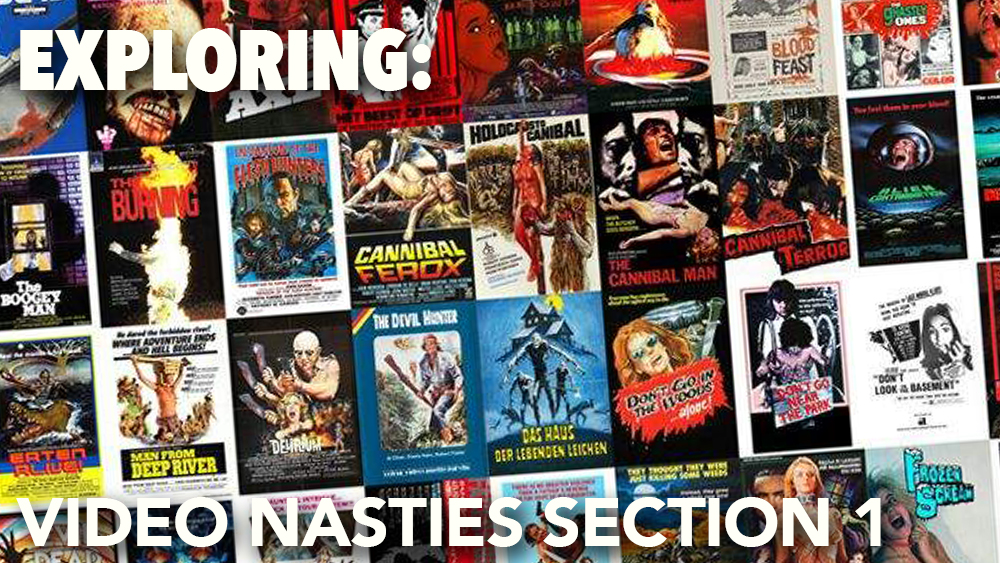
We did a whole week of cannibal films with our “Mangiati Vivi Week” tribute back in February 2018. You can also learn more about the genre with our review of the documentary Me Me Lai Bites Back (2021). And there’s more “nasties” to be found with our “Section 1,” “Section 2,” and “Section 3” explorations.
You can purchase White Cannibal Queen from Blue Underground or watch it as a free-with-ads-stream on Tubi.
You can purchase Cannibal Terror from 88 Films or watch it as a VOD on Amazon Prime.
You can purchase Devil Hunter from Severin Films or watch it as as free-with-ads-stream on Daily Motion.
Update: In January 2023 we rolled out our Jean Rollin-uary month of reviews. If you’re not familiar with Rollin’s works, click through and check them out. Oh, yes! If you do a month of Jean Rollin, you must do a month of Jess Franco! February 2023 was our “Jess Franco Month.”
About the Author: You can read the music and film reviews of R.D Francis on Medium and learn more about his work on Facebook.
As Sam the Bossman pointed out in his review of Cannibal Holocaust: Jungle Holocaust is where Ruggero Deodato cut his teeth on the human flesh eating film — bringing along Me Me Lai (her second of three cannibal flicks; the first was Umberto Lenzi’s Sacrifice!; the final was Lenzi’s Eaten Alive!), Ivan Rassimov (also of Eaten Alive! and The Humanoid) and Massimo Foschi, (the Italian voice of Darth Vader, 1977’s Nine Guests for a Crime) — and pretty much cemented the genre with that film’s 1980 release.
Jungle Holocaust was originally slated to be directed by Umberto Lenzi as a follow up to his cannibal flick progenitor, Man from Deep River (1972). Depending on how you consumed Jungle Holocaust, as an ’80s “Midnight Movie” or home video rental, it’s also known as Ultimo mondo cannibale, aka Last Cannibal World, Cannibal, and The Last Survivor.
Nice deal, Code Red.
So, what can we possibly say — as with our reviews of Night of the Living Dead and Dawn of the Dead — about this film that hasn’t already been said by others, ad nauseam? However, for site prosperity — in our quest to catalog all things “video nasty” (this made it to the U.K.’s “Section 3” list) and “cannibal,” and with this being our “Video Nasties Week” tribute — let’s rip it open.
As in the 1976 King Kong remake (ugh), the greedy search for black gold sets off our horrific chain of events. When two oil prospectors and their team travel to a company outpost on the island of Mindanao in the Philippines, their plane sustains damage from a rough landing. Then they discover the camp abandoned — with rotted human remains.
Then the “ensues” that we expect from cannibal flicks, begins: A team member goes missing. Booby traps — such as a large mace — are tripped. A raft built to escape down river, falls apart. People are separated. People are eaten. “Death Cap” Amanitas are foolishly consumed. People puke. There’s leech-sucking body bathing. There’s civilized human-on-native rape. People are captured, stripped, and forced to eat rotten, raw animal entrails and internal organs. There’s more cooking and consuming of humans. Cobra-venom laced spears fly. Civilized humans take to eating livers. Two men survive. One man dies.
Ah, the ratty cardboard sleeve VHS I remember. Heaven.
While shocking in my “Midnight Movie” days and 5-5-5 VHS-binging weekends with my fellow ne’er-do-well brothers reading all things Circus and Fangoria, revisiting Jungle Holocaust all these years later — and applying my now hipster-critical eye — once you take away the shock value, this really isn’t a very good movie.
Sure, it’s nasty as hell and fucking savage: but that’s all it is. There no real story or characters to latch onto. There’s barely any dialog and what dialog there is, the dub stinks. So it’s just a whole lot of running around in the jungle. There’s no deeper meaning, no takeaway from the film concerning the state of modern man invading lands — as in Werner Herzog’s superior Aguirre, the Wrath of God — that he shouldn’t; the modern vs. native juxtaposition isn’t explored.
But, being the critical hipster hypocrite that I am, I still love it; for it is the sweet smell youth.
Man, being old sucks the offal.
Ronin Flix reissued Jungle Holocaust and it’s sold out, but copies are still available in the online marketplace via other retailers. You can learn more about the Blu-ray’s technical aspects at Blu-ray.com. Sorry, no freebie streams to share. Yeah, there’s some overseas streams, but when it looks sketchy, don’t hyper that link, my friend.
We did a whole week of cannibal films with our “Mangiati Vivi Week” tribute back in February 2018. You can also learn more about the genre with our review of the documentary Me Me Lai Bites Back (2021). And there’s more “nasties” to be found with our “Section 1,” “Section 2,” and “Section 3” explorations.
About the Author: You can read the music and film reviews of R.D Francis on Medium and learn more about his work on Facebook.
EDITOR’S NOTE: During Fantastic Fest, one of my favorite films of all time is getting shown as it should be, on the big screen — The Visitor — which we originally wrote about on September 1, 2017. It will be presented in conjunction with the launch of Mondo’s new book Warped & Faded: Weird Wednesday and the Birth of the American Genre Film Archive, from author Lars Nilsen and editor Kier-La Janisse. Warped & Faded tells the story of the Wild West days of the Weird Wednesday film series and the American Genre Film Archive in the words of the people who were there. You can pre-order the book from Mondo HERE!
In 2013, when the Alamo Drafthouse presented the uncut version of this film for the first time in the United States, they referred to it as an “unforgettable assault on reality.” Those words best describe what is otherwise an indescribable film.
But I’m going to try.
Maybe a recipe will help.
Take Chariots of the Gods, and some of Rosemary’s Mary, then a little bit of The Omen, throw it in a blender and then pour the whole thing down the sink.
No? Maybe a synopsis.
We start in Heaven, or somewhere very much like it, where Franco Nero (the original Django) is one of those space gods that Erich von Däniken wrote about. He tells the bald children who surround him that there was once a war between two aliens, one good and one bad. The bad one — who is either called Sateen or Zathaar — was defeated, but not before he slept with a whole bunch of Earthwomen. Cue the Book of Enoch in the Lost Books of the Bible. Or cue the Scientology myth of Lord Xenu. Or Xemu, because he has two different spellings, too.
Only one child is left — a young girl — and a vast conspiracy wants her mother to have another child — a brother this time — so they can mate. The Christ figure sends John Huston — yes, the director of The Maltese Falcon and The African Queen — and the bald children to a rooftop somewhere in Atlanta to stop this plot. To do that, the children become adult bad men and dance around a lot while Huston walks up and down the stairs to triumphant music. If you think I’m making that last sentence up, you’ve never been blessed with this movie.
Meanwhile, Lance Henriksen (Near Dark, Aliens) is Ted Turner, pretty much. His name is Raymond Armstead and he owns the Atlanta Rebels basketball team that plays at the Omni and is dating Barbara (Joanne Nail, Switchblade Sisters), who of course is the woman who has the seed of the gods inside her. Her daughter Katy is 8 years old and already using her powers to help the Rebels win their games. But that isn’t all the help Raymond is getting. The rich, powerful and ultra-secretive Zathaar cult control the world and are helping his team become winners. All he has to do is marry Barbara, knock her up and let their kids fuck. Hopefully, they have a boy, or Raymond is gonna have to get in the saddle all over again.
Raymond can’t even do that right and the leader of the bad guys, Mel Ferrer(The Antichristand Eaten Alive!) is upset and ready to quit on Raymond. Barbara doesn’t want more kids and certainly doesn’t want another child. But who can blame her? Her daughter is one creepy little girl. Her daughter knows all about the conspiracy and begs her mom to get married so she can have a brother (and this is where, in person, I’d throw in “…to have sex with” but I’d use the f word). How creepy is Katy? Well, she kills a bunch of boys with her mental powers because they make fun of her while she ice skates. And then she accidentally shoots her mother at a birthday party. Yep, it’s as if The Bad Seedmet Carrie!
Then, as all 70’s occult movies must, the stars of Hollywood’s golden age make appearances!
Glenn Ford, the actor, plays a cop that Katy curses out and uses hawks to make wreck his car!
Shelley Winters plays Barbara’s nurse who once had one of the space babies and killed it, but can’t bring herself to kill Katy! According to interviews, Winters really smacked around Paige Conner, the actress who played Katy!
Sam Peckinpah, the director (!), plays an abortionist who removes one of the space babies from Barbara after the conspiracy pays a bunch of things to artificially inseminate her. Turns out Peckinpah had trouble remembering his lines, which is why we never learn that he’s Barabara’s ex-husband! Then is he Katy’s dad? Who knows! His voice is even Peckinpah’s! They had to ADR all of his dialogue.
In response to the abortion, Katy shoves her mom through a fish tank. She also decides to throw her down the stairs, Whatever Happened to Baby Jane?-style. And by throw her down the steps, I mean do it over and over and over again.
Meanwhile, John Huston is still going up and down the stairs. Finally, they HAVE HAD ENOUGH (I like to emphasize that so you get the gist) and sent their John Woo-ian flock of doves to fight the hawks. And meanwhile, Mel Ferrer and all his men show up dead with black marks on their bodies.
And Katy? Well, as Huston tells us, kids can never be evil. She gets her head shaved and goes to space to meet Instellar Jesus Christ. The title comes up as insane music blares.
Writer/director/insane man Michael J. Paradise (Giulio Paradisi) also was in Fellini’s 8 1/2 and La Dolce Vita. What inspired him to this level of cinematic goofiness? He was helped along by Ovidio G. Assonitis, whose resume includes writing Beyond the Door, Madhouse and Forever Emmanuelle before becoming the major stockholder and CEO of Cannon Pictures in 1990. That may explain some. But not all.
I know I often write things like “I don’t have the words to describe this” when I do these reviews — especially after I write a few hundred words all about said subject. But this is one time that that statement is not pure hyperbole. Just watch the trailer and be prepared to lose your grasp on normalcy!
The Visitor defies the logic of good and bad film. It can only be graded on the is it an absolute film, ala Fulci or Jodorowsky. It is something to be experienced. You can watch this movie on Tubi.
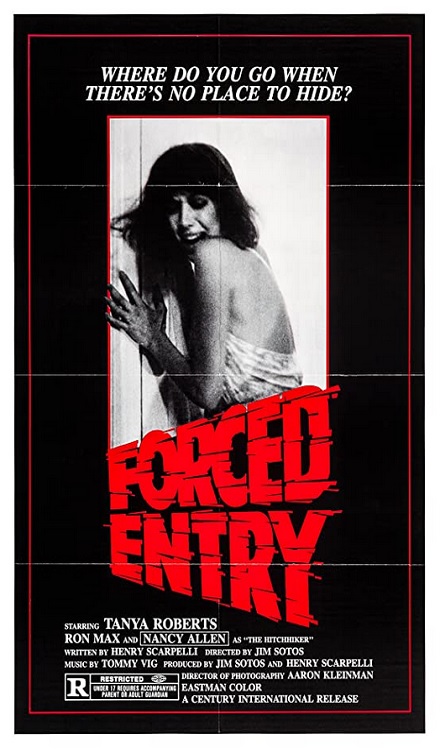
Yeah, we know this 1975 celluloid nasty isn’t officially on the U.K.’s “Video Nasties” three-part section lists that we are covering this week, but this big screen acting debut by Tanya Roberts — a commercialized, mainstream remake of the X-rated adult film/grindhouse’er Forced Entry (1973) — was none the less refused a U.K. cinema certificate in 1982.
That 1982 theatrical release — which also found a home on U.S. screens of the slowly dying drive-in era — came result of Tanya Roberts scoring the biggest roles of her career: ABC-TV’s Charlie’s Angels in 1980 and a theatrical hit with Don Coscarelli’s The Beastmaster (1982). Initially playing to drive-in audiences throughout 1976 under the title of its inspirational predecessor, Forced Entry returned to drive-ins with a post-Halloween slasher marketing make-over. The “madman” adjective in the copy under The Last Victim title was added to carry through the très chic faux-giallo/slasher connection — considering a slasher interpretation of the New York-based Cropsey urban legend, Madman (1982), rolled out on screens beginning in January.
Sadly, in a post-Charlie’s Angels world, the 93-minute original, first released in October 1975, was cut-down to 75-minutes; then to a third-time 72-minute edit in 1982 to pull a PG-rating to further capitalize on Tanya Roberts’s stardom. That cleaner theatrical cut was the result of fellow pin-up Barbie Benton experiencing box-office slasher success with Cannon Films’ Hospital Massacre (1982) released in July. The subsequent home-VHS, while nasty and rough, was “cleaned up” yet again, at 88 minutes — with Tanya’s more violence scenes truncated and Nancy “Robocop” Allen’s violent rape scene excised from all post-1975 versions.
So, who in their right mind would attempt “commercializing” a porn film into a Wes Craven’s The Last House on the Left (1972) cash-in clone?
We’ve dropped Jim Sotos a few times at B&S About Movies, by way of his directing the ’80s slasher Sweet Sixteen (1983) starring Bo Hopkins, and producing the adult film-connected hicksploitation romp Texas Lightning (1981). That “adult” connection comes by way of Adult Video News Hall of Fame filmmaker Gary Graver hired by Sotos as director. Sometime aka’ing as Robert McCallum, Graver made over 130 adult films, such as Amanda By Night, Coed Fever, and Suzie Superstar. One of his flicks, Unthinkable, won the AVN Award for “Best All-Sex Video” in 1985 (meaning it, as did most porns, had no plot).
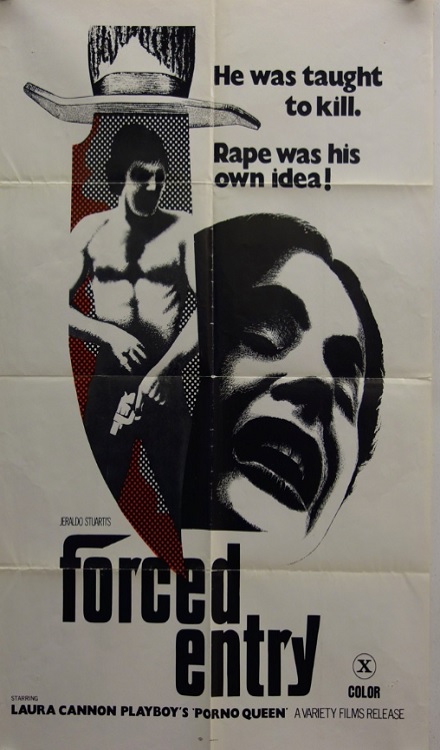
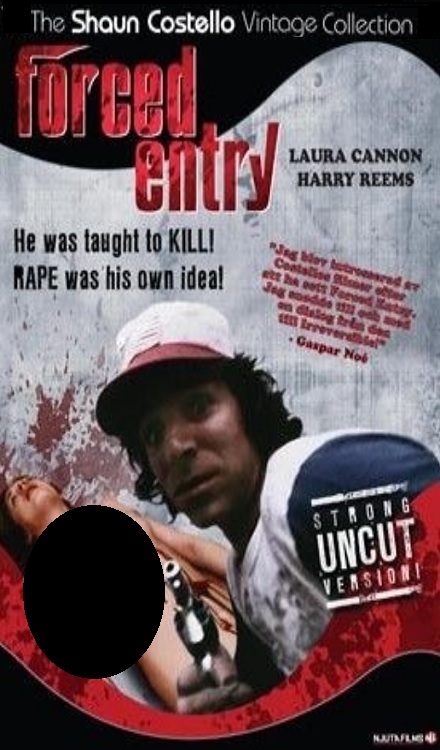
Here, Jim Sotos gives an R-rated makeover to porn purveyor Shaun Costello’s X-rated Forced Entry (1973). Starring adult film superstar Harry Reems, that film also aka’d as The Last Victim during its later behind-the-beaded curtain video shelf life in some quarters. (Costello also moved into the non-porn area and Romero zombiedom with Gamma 693.) For the remake, in place of adult actresses Laura Cannon (star of numerous Playboy loops; aka Laurel Canyon of 1972’s Wrong Way, itself a U.K. “video nasty”), Ruby Runhouse and Nina Fawcett, we get Nancy Allen — in her second film after working with Jack Nicholson in Hal Ashby’s The Last Detail (1973) — and a future Charlie’s Angel, well, not until she got past the likes of Tourist Trap (1979) and the David Winters-directed adult comedy, Racquet (1979).
The Shaun Costello original — his feature film writing and directorial debut after making porn-shorts, aka “loops” — filmed at the hippie loft of Ruby Runhouse and Nina Fawcett who allowed its use for filming as long as they could be in the film. Not only could they not act: they ended up so high on mescaline that their scene took five hours to shoot — and Costello had no choice but to work their drugged-out personas into the plot. Harry Reems — star of the “Golden Age of Porn” blockbusters Deep Throat and The Devil in Miss Jones — has said Forced Entry is the only film he regrets making.
While the Costello original is — as result of its misogynistic ultra-violence that would make even the most discriminating fan of Stanley Kubrick’s A Clockwork Orange (1971) cringe — critically derided, it’s also critically noted as one of the first films to depict a disturbed soldier returning from Vietnam — predating Martin Scorsese’s Travis Bickle in Taxi Driver (1976). It’s also regarded as a pivotal film in the later, giallo-inspired serial killer/slasher genre of the ’80s — predating John Carpenter’s Halloween (1978).
Unfortunately, the film’s pornographic activities overshadowed Costello striving to raise the story and character qualities of adult films, courtesy of his injecting a discourse on the rise of feminism and the independent woman, and the errs of war-mongering and the American military’s reluctance to address post-traumatic stress disorders in returning Vietnam veterans. To carry through his anti-war message, Costello depicted his antagonist with “flashbacks” to his days in Vietnam — via stock war footage cut with new, original footage — while he committed his acts of rape and murder.
If Jim Sotos had waited a couple of years for that post-Carpenter slasher-era to arrive, his remake of Forced Entry as The Last Victim may have been as well remembered as some of the slasher copies it predated, such as William Lustig’s similar — and far superior-made — Maniac (1980).
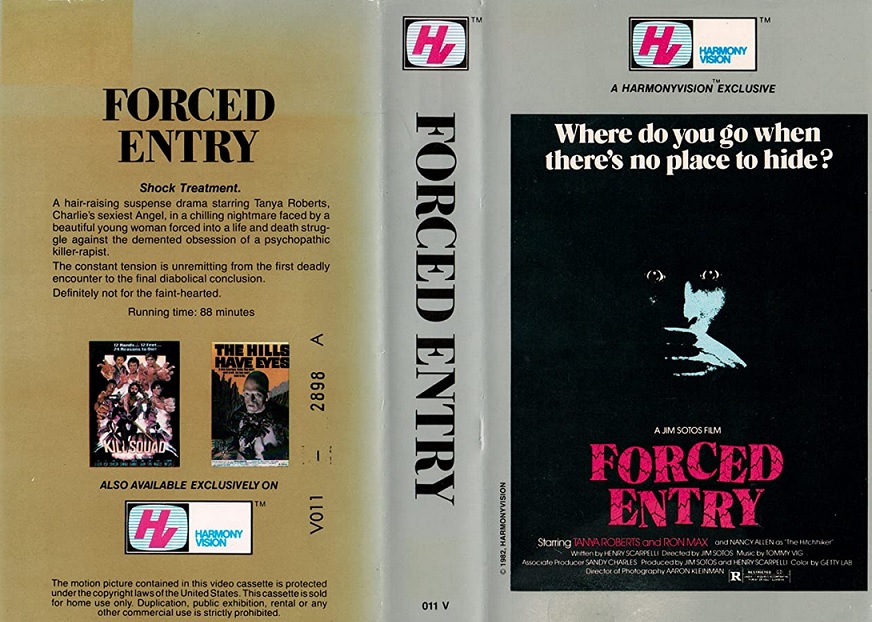
Again, as the video ’80s arrived — and Tanya Roberts star rose courtesy of her working on Charlie’s Angels in 1980 and then-hot Don Coscarelli’s first post-Phantasm movie, The Beastmaster (1982) — Harmony Vision took up the cause and released The Last Victim on VHS in the U.S. via the 88-minute version. The later Dark Force Entertainment Blu-ray released in 2019, which includes both the The Last Victim (75 minutes) and Forced Entry at (72 minutes) drive-in/theatrical-distributed versions, differs from the Harmony VHS version. The infamous wine bottle rape and Nancy Allen’s nude bondage scenes are missing from all of these prints. The 93-minute original has yet to be digitally restored and can only been seen via non-Harmony VHS-imprints.
In the Costello Forced Entry original, Harry Reems, aka Tim Long (again, to shed the porn stigma into mainstream acceptance), stars as a nameless Vietnam war vet who, like Travis Bickle after him, carries on a lonely life at a gas station where lives and works. Unlike most adult films, Costello classes the porn proceedings as he begins the story in media res — courtesy of a non-linear narrative structure indisputably influenced by the Billy Wilder’s classic film noirs Double Indemnity (1944) and Sunset Boulevard (1950): the film begins with detectives at a crime scene with a man shot in the head.
As the story unfolds, we come to learn the vet, through credit card receipts or lost travelers in need of directions, tracks down his victims, peeps at them, then later breaks in to sodomize and rape them — then murder, after he climaxes. Upon a having a psychotic break during one of the rapes (with the aforementioned, real life wigged-out Ruby Runhouse and Nina Fawcett), he commits suicide; the film then — as with the Wilder films before it — returns to the beginning with the sheet-covered body taken away by the police.
Say what you will about adult films of the singular-to-triple X ’70s, but Costello’s Forced Entry, while repugnant in the context of its graphic sex and rape portrayals, should be as highly regarded as the “Golden Age of Porn” classics of Deep Throat, The Devil in Miss Jones, and Behind the Green Door. Costello beat Justin Simmonds and John Howard’s joint post-Halloween effort Spine (1986) in logically cross-pollinating the porn and slasher genres.
(Due the the content, you can only view the trailer for Force Entry (1973) as a You Tube account sign in.)
While the 16mm-shot film is rough — in terms of its overall quality, to the point of being an ’80s SOV — Costello none the less produced an effectively framed, well-made film for $6,200 in two days — and took five months to edit. And the time in the editing suite shows, which is why the film influenced — and he offered a quote to the DVD reissue — Gaspar Noé in the making of his art-house rape-revenge film Irréversible (2002).
As discussed in our review of the recent Australian rape-revenge import, Rage (2021), that film, as did Noé’s, while brutal, is on the respect-level of Takashi Ishii’s Freeze Me (2000). And for as hard as it is for some (most) to watch Gaspar Noé’s non-exploitative Irréversible, and Rage and Freeze Me are analogous in their “hard to watch” moments, Shaun Costello’s Forced Entry harbors that same respect.
Granted, Costello’s 1973 work smacks with the scuzzy aftertaste of its raison d’être in The Last House on the Left (1972), but Costello’s Forced Entry rivals Wes Craven’s effort; Costello’s film is the more powerful, message-driven originator that should be revered and remembered; Meir Zarchi’s later I Spit On Your Grave (1978) is not of that caliber; nor William Freut’s Death Weekend (1976), as both are violence and rape for the sake of exploitative shock value. While undeniably cleaner and non-sexual in nature — and certainly not an influence on filmmaker Joshua Reale’s Necropath (2021) — there’s an undeniable through line from the work of Shaun Costello to Reale’s work. Both are dark, graphic works that intelligently expunge the objective for the subjective to take us into the mind of their antagonists.
Harmony Vision’s ’80s VHS repack of The Last Victim (1976). Notice the Charlie’s Angel’s copywriting-marketing angleand 88-minute run time.Check out this clip for the “Staten Island Scene” with Nancy Allen.
The same enthusiasm can’t be expressed for The Last Victim (1976), which, why still hyper-violent in its original form, is still watered down — and dumbed-down — for gone are Costello’s feminist and post-Vietnam subtexts. So we’re left with a film that’s actually closer to the mindless, rape-revenge sleaze of The Last House on the Left (1972) that the original Forced Entry (1973) copied — but rose to the next level.
In The Last Victim, our nameless maniac war vet of the original isn’t a war vet: Carl — while still a gas station attendant/mechanic — is now the product of a mentally-unstable mother who reveled in child abuse (a plot-point used in Joy “J.N” Houck, Jr.’s sloppy drive-in rip of Alfred Hitchcock’s Psycho with 1969’s Night of Bloody Horror). And the point-of-view changes in the remake. Gone is the subjective storytelling of Costello’s film that took us inside the killer. Sure, we are seeing things from Carl’s point-of-view; however, the “POV” is just a camera angle that gives us no-insights and couldn’t be more non-giallo in style; we simply travel on the road with Carl on the hunt for his station’s female customers that tickled his fancy. His mother screwed him up; he hates women; so he hunts women for rape and murder targets. And he ho-hum chokes, and stabs, and gets creative with beer bottles. The third-act twist, this time — since we’re devoid of the mescaline-stoned hippy chicks that altered the third act of Forced Entry — is Carl falls “in love” with his latest victim, played by Tanya Roberts, who is able to channel her terror against Carl by taking advantage of his “romantic” feelings.
Shaun Costello’s film has originality on its side as it attempted to take the “Golden Age of Porn” from an underground “très chic” image to a wider, commercial respectability; his only stumble was not taking a lesson from Nicolos Roeg’s in pulling the reins on the film’s porn-sexual components. Costello was almost there. Adapting Billy Wilder’s in media res noir-storytelling was inspired; a Roeg-softer, artful touch, as deployed in Don’t Look Now (1973), his mainstream, British Giallo exploration on the psychology of grief and the effects of trauma, would have been — pardon the pun — the cherry on top. (If you’re not familiar with scene: To get past the sensors, Roeg fragmentary softened-the-shock of the then “graphic” depiction of sexual intercourse between Julie Christie and Donald Sutherland post-coitally preparing to go out to a dinner party.)
Meanwhile, Jim Sotos gives us a 15-year-old girl who stops to put air in her bike tire, only to end up as Carl’s latest bondage and rape victim (in lieu of Nancy Allen’s hitchhiker bondage-rape) — with no reason, purpose, or point. If Sotos wanted to copy Craven’s Last House-offensiveness, he succeeded. And if you’ve seen Sotos’s Sweet Sixteen, with its 15-year-old female antagonist on the cusp of 16 picking up men in bars and luring them to a Native America burial ground for a roll in the sticks . . . well, if you wondered how (boring) offensive (and what the deal is with Sotos and 15 year olds) an ’80s slasher can be, that’s your film.
In the end: The Last Victim (1976) is just a slasher flick — a scuzzy hunk of celluloid utterly devoid of any John Carpenter class that’s best forgotten; one that inspires you to seek out William Lustig’s superior Maniac (1980) starring a tour de force Joe Spinell. Sure, you may dismiss the original Forced Entry (1973) as a “porn flick,” but it was a porn flick with a purpose possessed with a sense of style.
* Look for our upcoming reviews (Hey, they’re done!) of Gamma 693 and I Spit on Your Grave as we continue to explore more ’80s “Video Nasties” at B&S About Movies. Click on the images below to read each feature at your leisure.
Update, May 8, 2021: We’ve come to learn that Dark Force Entertainment, via a Facebook press release, will reissue the R-Rated U.S. theatrical version of Forced Entry. This 86-minute version — according to their release — contains about 10 more minutes of nudity and rape than the previous two director-cut versions featured on The Last Victim release from Dark Force.
From the Dark Force release: “One of the most confusing titles ever, we finally figured out the puzzle of this awesome 1976 [1975] movie, which underwent several cuts and both R and PG ratings. We found the original 35mm camera negative to the U.S. theatrical version which, went under the title Forced Entry. It is only missing about 2 minutes that is contained in the VHS release, which was the most complete version of the movie ever released. Confused yet? Don’t be, this movie is DEFINITELY worth the fuss and this will be the best looking and most complete, Hi-Def version available on the market. This release will be dedicated to the memory of [the late] Tanya Roberts. Coming in 2021 from Dark Force.”
According to Dark Force, via this May 8 press release, there are six versions of the Tanya Roberts-version: 1) The original PG-rated THE LAST VICTIM cut (they believe this is the same as THE LAST VICTIM cut on the Dark Force Blu-ray), 2) The Harmony Vision VHS, titled FORCED ENTRY, 3) The Intervision VHS, titled THE LAST VICTIM, 4) The 1981 theatrical version, titled FORCED ENTRY, 5) The 1983 theatrical re-release, titled FORCED ENTRY, 6) The director’s cut of FORCED ENTRY, as released on Dark Force’s first Blu-ray.
Update, again: This is now out on Blu-ray! Learn more with this Dark Force Facebook post.
About the Author: You can learn more about the writings of R.D Francis on Facebook.He also writes for B&S About Movies.
You know, I kind of like something in this movie. Like, I know it’s really bad but there’s something in it — and not just a young Demi Moore — that made me enjoy it. I have no idea what that was, but sometimes a movie just makes you feel like you’re taking a relaxing swim.
Sometime after the bombs got dropped, America is run by a criminal organization called the Merchants. To better control the population — and no, I have no idea how this plan is supposed to work — they get Dr. Paul Dean (Robert Glaudini, whose roles in movies like this and Cutting Classled him to somehow write the play Jack Goes Boating, which became a movie directed by Philip Seymour Hoffman) to create a parasite. Also, because this movie has no plan for what is about to happen, he infects himself to study the parasite, yet is upset when it infects the gang in the small town he finds himself trapped in.
And Demi plays the young lemon grower who helps him.
Actually, I’ve totally figured out why I like this movie. That’s because it cast Cherie Currie (the ex-Runaway who was on a run of scream queen roles between this, The Alchemist and The Twilight Zone: The Movie) as a post-apocalyptic gang member and Cheryl Rainbeaux Smith as a slave girl. And it was made by Charles Band between Crash! and Metalstorm: The Destruction of Jared-Synin a time when he wasn’t yet making puppet movies.
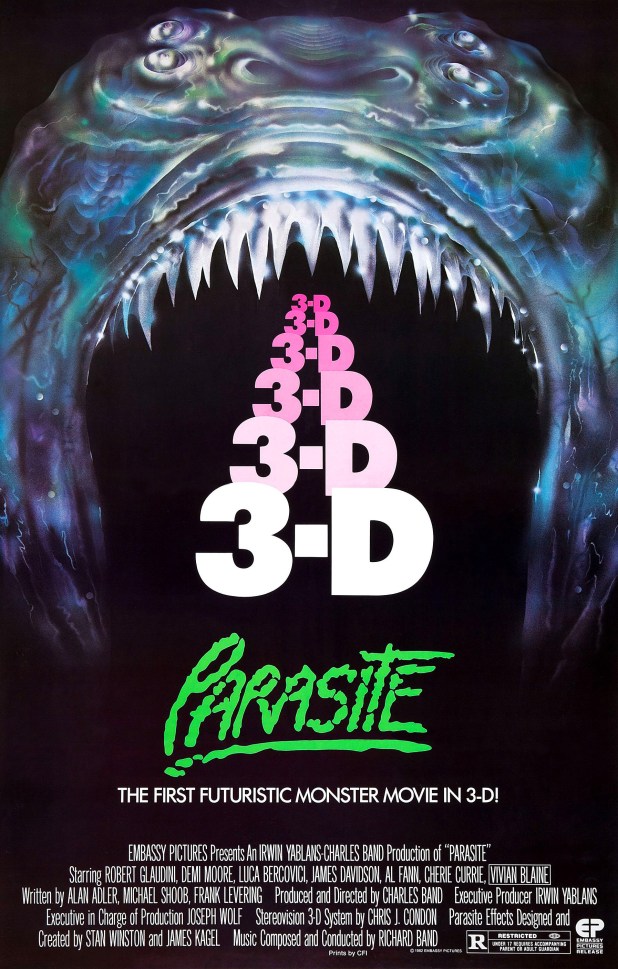
A section 3 video nasty, this was in 3D in its original theatrical run. It owes just as big a debt to Alien as it does to Mad Max.











 B&S About Movies
You must be logged in to post a comment.