Our three-day tribute to Bernard L. Kowalski continues!
Well, even after the abject failure of the intended, sweeping epic that wasn’t Krakatoa: East of Java (reviewed this week), Bernard L. Kowalski was still in the game with this AVCO Embassy-backed adaption of a Harold Robbins (a big deal novelist in the ’60s and ’70s) novel produced by Joseph E. Levine, who brought us the successful box office epics of Zulu and A Bridge Too Far.
The then A-List Alex Cord, Britt Ekland, and Patrick O’Neal, and an up-and-coming Roy Scheider, six years away from his huge, influential shark-based horror movie, star in this then de rigueur Bond-inspired flick. We also get the familiar character actor skills of M. Emmett Walsh and Charles Durning. Why, yes, that is Raul Julia (Eyes of Laura Mars and The Addams Family franchise) in his film debut. (For me: It’ll always be Frankenstein Unbound for my Raul fix.) And if you’re a fan of Danger: Diabolik (1968), and aren’t we all, Britt Ekland was a last minute replacement for that film’s Marisa Mell as Cord’s co-star. But that’s okay, since we got Marisa in Seven Blood-Stained Orchids.
Count Cesare Cardinali (Cord, of Genesis II fame) has the perfect cover for his secret life as a profession mob hitman-for-hire: he’s a famed jet-setting playboy. Of course, as with all of those hitmen before and after him, he decides it’s time to retire and enjoy the spoils — but when you know too much, you’ll have to be “eliminated” as well.
Courtesy of the Bondness-meets-The Godfatherness of it all, there’s lots of (stylized) scenes in casinos and on yachts with Cord and Elkand in Speedos and string bikinis in exotic places like Puerto Rico. Then the tux and dripping-with-jewels gowns are taken off the hangers for the usual New York penthouse sets. And while there’s an Italian connection in here, Puerto Rico doubles for Sicily — when it’s not being “Puerto Rico.”
Stiletto certainly isn’t awful, but the cops-chasing-robbers set-up is all very TV movie flat, which is why this received an early appearance on CBS-TV. And don’t forget: this all comes from the while successful, but cheesy, melodramatic pen of Harold Robbins. If you’ve never read one of his books or seen a movie based on his books (The Betsy, The Lonely Lady), then maybe you know Robbins as result of his being named-dropped by the English new-wave band Squeeze in the lyrics — “a Harold Robbins paperback” — in their song “Pulling Mussels (From The Shell).” Or, since we are all Roger Corman fans around here, you know Harold Robbins by way of Corman’s 1970 post-apocalyptic Gas! – Or- It Became Necessary to Destroy the World in Order to Save It, as a young couple uses a public library’s copies of the successful but critically-derided collected works of Jacqueline Susann (her books became the movies Valley of the Dolls, The Love Machine, and Once Is Not Enough) and Harold Robbins as kindling to keep warm.
Sadly, there’s no online streams to share, but DVDs are easily available, the best versions are from Kino Lorber, who also issued Stiletto on Blu-ray.
About the Author: You can learn more about the writings of R.D Francis on Facebook.He also writes for B&S About Movies.
Editor’s Note: We reviewed this third drive-in feature from television director Bernard Kowalksi on January 6, 2020, just because, no Mill Creek inducement required. We’re bringing it back as part of our three day “Bernard Kowalksi Week” tribute. For when you’re dealing with Bernard Kowalksi, you repost reviews of old to make readers aware of his greatness.
Gene Corman broke into the film industry before his brother Roger, working as an agent before becoming vice president of MCA, representing such clients as Joan Crawford, Fred MacMurray, Richard Conte, Harry Belafonte and Ray Milland.
By the late 50’s, he moved to produce his own films before starting his own producing unit at MGM. and then becoming vice-president of 20th Century Fox Television.
This film is directed by Bernard L. Kowalski, who also created Night of the Blood Beast and Sssssss. It was written by Leo Gordon, who had hundreds of roles as an actor, as well as being the author of movies like The Wasp Woman, The Cry Baby Killer and Hot Car Girl.
Did you know that there are larger than human intelligent leeches that live in the Florida Everglades? Yep. There sure are.
Those leeches love nothing more than dragging human beings down into their underwater caves and slowly feeding off their blood.
Liz Walker (Yvette Vickers, who was Playboy‘s July 1959 Playmate of the Month in a centerfold that was photographed by Russ Meyer; she’s also the girl who starts all the trouble by cheating with the husband of Attack of the 50 Foot Woman) is the first victim. Again, she plays a loose woman who is cheating on her husband, so she and her new man must pay.
Game warden Steve Benton (Ken Clark, who was Dick Malloy in the Agent 077 series of films), his girlfriend Nan Grayson and her doctor father are the heroes here and they deal with the leeches in the way that we all knew they would: they use dynamite to blow them up real good.
So yeah. Giant leeches. Wanton women. Dynamite. Cheap film making.
How cheap? Corman didn’t want to pay the grips the extra money for pushing the camera raft in the water, so at first, the director did it, then his brother and finally Corman himself. The cold water led to Corman getting pneumonia and ending up in the hospital. And yes, that is the same music from Night of the Blood Beast. The exact same music is also in Beast from the Haunted Cave.
This movie had some legs. In 1959, it played a double bill with A Bucket of Blood. Then, a year later, it ran alongside Corman’s brother’s film House of Usher. It was also remade in 2008 by Brett Kelly and written by Jeff O’Brien in a film that starred no one you’ve ever heard of.
You can watch this on Tubi with and without commentary from Mystery Science Theater. It’s in the public domain, so you can also grab it from the Internet Archive and watch it on Amazon Prime.
Editor’s Note: This review previously ran as part of our Mill Creek Pure Terror tribute month on November, 25 2019. It also ran on November 22, 2020, as part of our Mill Creek Sci-Fi Invasion tribute month. It’s time to bring it back as part of our “Bernard Kowalski Week” of reviews in tribute to his directing career.Be sure to click the “Bernard L. Kowalski” tag at the bottom of this review to populate all of his films we reviewed this weekinto oneeasy-to-reference list.
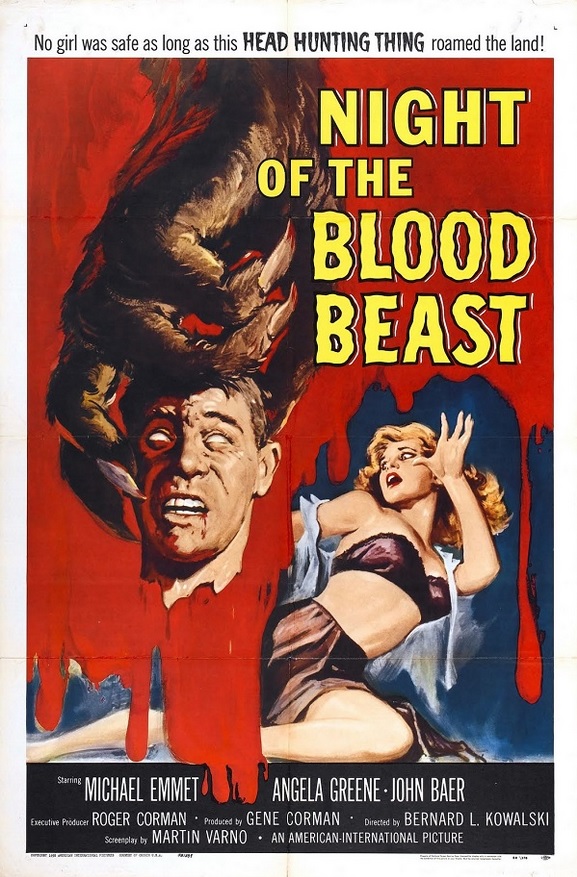
It’s hard to believe this forgotten—and to be honest, not very good—62-minute Roger Corman quickie shot in 1958 for a mere $68,000 over the course of seven days wound up in WGA arbitration, but it did: Writer Martin Varno disputed the writing credit given to Roger’s brother, Gene. Even harder to believe: Harold Jacob Smith, who worked on the film’s rewrites/dialogue doctoring, won an Academy Award for Best Original Screenplay for The Defiant Ones (1958). But, hey, look at what happened to James Cameron (Galaxy of Terror) and Ron Howard (Grand Theft Auto). (By the way: Don’t forget to read my “October 2019 Scarecrow Challenge” review of Ice Cream Man starring Ron’s brother, Clint.)
Damn this 27th galaxy to hell!
Starting out as a screenplay “Creature from Galaxy 27” and influenced
by the Howard Hawks box-office smash, The Thing from Another World
(1951), Night of the Blood Beast tells the story of the return of the
first deep space astronaut—implanted with an alien embryo. Although astronaut
John Corcoran’s body seems “dead,” it maintains a blood pressure and harbors
strange, alien seahorse-like cells his blood stream that grow into a
lizard-like fetus. Then the film goes off into a weird, homosexual subtext with
the alien and Corcoran “protecting” each other.
Ah, a human male as a walking alien-baby incubator? I’ve seen this
before. Well, besides the homosexual subtext, it does sound familiar, doesn’t
it? Well, doesn’t it Dan O’Bannon?
Sadly, while Night of the Blood Beast is clearly an Alien antecedent, the film—because of its low-budget quality further stymied by the amateurish acting of TV series bit-players—goes unmentioned alongside the more formidable Alien precursors of Forbidden Planet, It! The Terror of Beyond Space, Queen of Blood, and, especially, Mario Bava’s Planet of Vampires. Well, doesn’t it, Dan O’ Bannon?
During its initial success, literary critics noted Alien’s
similarities to the Agatha Christie tale, And Then There Were None (1939),
and the short stories “Discord in Scarlet” and “The Black Destroyer” in A.E van
Vogt’s collection, The Voyage of the Space Beagle (1950), which could
have possibly influenced Martin Varno’s storytelling. It certainly did
influence—although he flat out denied it—O’ Bannon’s storytelling: so much so
that 20th Century Fox settled with van Vogt out of court.
Speaking of familiar: B&S readers are familiar with Corman’s house of recycling: Stunt footage from Eat My Dust and Grand Theft Auto turned up in several of his ‘70s hicksploitation films . . . and how many times did we see Battle Beyond the Stars SFX shots reused? Thus, you’ve seen Night of the Blood Beast’s alien costume before: In Teenage Caveman (1958), which wrapped two weeks before Blood Beast began shooting. Some film reviewers describe it as “a bear crossed with a moldy parrot”—and they’re right! Is the costume as bad as Richard “Jaws” Kiel’s The Solarite—with the light bulb eyes—in Phantom Planet (1961)? Yep. And since when does an alien, only by monitoring Earth’s radio broadcasts, develop a dialect worthy of a Royal Shakespearean Company actor? Book this parrot for the CBS Evening News. He should be holding a skull and crying out for Desdemona. “The parrot is ready for his close-up, Mr. DeMille!”
If you need more fun-filled, Roger Corman sci-fi tomfoolery, check out Night of the Blood Beast’s John Baer in Attack of the Giant Leeches (1959) and Ed Nelson in Attack of the Crab Monster (1957).
It freaks me out that I’ve seen all these movies. I don’t know if that makes me cool or just a very sad excuse for a human being. Is my admitting that a trope or a cliche?
Editor’s Note: Welcome to our first review in our three-day “Bernard Kowalski Week” tribute that takes us from 1959 to 1989. If you don’t know his film work, you know his TV work. Kowalski directed multiple episodes of the hit ’80s series Knight Rider, Magnum, P.I., Jake and the Fatman, and the epic (it was for me), Airwolf. Here’s his first movie for Roger Corman.
Oh, be sure to click that “Bernard L. Kowalksi” tag and the end of all of the reviews this week to popular the reviews in one easy-to-use list.Let’s get day one started, shall we!
“She’s hell on wheels . . . and up for any thrill!”
Seems Mr. Screenwriter dipped the pen into the Shakespearian ink; for this is Othello with hot rods.
Duke (Richard Bakalyan; you’ve seen him across his 150 TV credits into the early ’90s) and Freddie (John Brinkley, who’s traveled this rockin’ road before in Hot Rod Rumble, Teenage Doll, and T-Bird Gang) finance their hot roddin’ lifestyle by stealin’ cars n’ strippin’ auto parts for a fence. When they, along with Duke’s girl, Peg (June Kenney, also of Teenage Doll, but also of 1959’sAttack of the Puppet People and Roger Corman’s Sorority Girl), are goaded into a road race by the resident bad-girl, Janice (Jana Lund, also of High School Hellcats with Yvonne Lime, Elvis Presley’s Loving You, and the rock flick classic, Don’t Knock the Rock . . . but since this B&S About Movies: it’s all about Frankenstein 1970 for our Lundness), a motorcycle cop dies. Let the frames and double crosses, blackmailing and betrayals begin, Desdemona.
Oh, almost forgot: Bruno VeSota is in this as Joe Dobbie (seriously). What ’50s and ’60s film wasn’t the Big V in? Yep, there he is in Attack of the Giant Leeches, A Bucket of Blood, and The Wasp Woman . . . but also of the early rock flicks Daddy-O, Rock All Night, and Carnival Rock. It is actors like you that gives our lives at B&S meaning, Mr. VeSota. We bow to you, sir.
And it’s all brought to you by a man whose directing career we’re tributing this week: Bernard Kowalski, who followed this up with Night of the Blood Beast, then his third film, Attack of the Giant Leeches. Before going into business with Roger Corman, Kowalski got in start in television, directing episodes of the ’50s westerns Frontier and Broken Arrow, along with the David Janssen-starring cop drama, Richard Diamond: Private Detective, and the military drama, The Silent Service. Has anyone ever encountered his lost TV Movie pilot for the Peter Graves-starring Las Vegas Beat (1961)? We’d love to see it. You know us and TV Movies around here.
We previously featured Hot Car Girl as part of our weekly “Drive-In Friday” featurette.
About the Author: You can read the music and film reviews of R.D Francis on Medium and learn more about his work on Facebook. He also writes for B&S Movies.
June 22: Junesploitation’s topic of the day — as suggested by F This Movie — is zombies.
Zombies are boring. Let’s face it — the best things that had to be said about them really didn’t escape the 80s. And outside of perhaps Train to Busan, how can you improve upon movies like Dawn of the Dead, Zombi and Return of the Living Dead? People try and well, you have to give them credit for it. But I was really trying to stretch during Junesploitation and find a zombie movie that no one would choose, as well as one that might rekindle my love for these movies.
Released in the U.S. as Revenge of the Dead, Zeder doesn’t go for the Fulci throat — or eyeball — like nearly every zombie movie made in the wake of the Godfather of Gore’s tribute to the living dead.
The film begins in 1956, as a psychic girl named Gabriella is brought to the French mansion of Dr. Meyer. As a test of her abilities, he takes her into his basement where she immediately begins to claw and dig into the dirt, searching for something. Soon, she’s attacked and taken to the hospital and a corpse is discovered that is identified as Paolo Zeder.
Fast forward three decades and change and we meet Stefano (Gabriele Lavia, Inferno, Deep Red, Sleepless), a novelist who has been given the gift of a typewriter by his wife. He starts to investigate the ribbon of the ancient machine and finds a series of letters from Zeder that detail phenomena he called K-Zones, which are places where death does not exist and even those deceased may be reborn.
Our hero soon loses everything — his wife, any semblance of normalcy, his mind — to penetrate the web of conspiracy that surrounds Zeder and the K-Zones. His wife is even murdered by those who want to keep the existence of the undead world a secret, so the film closes with Stefano attempting to bring her back.
Beyond the dependable as always score by Riz Ortolani, there’s a great scene near the end where a tower of video monitors replays the rebirth of the supposedly dead priest Don Luigi Costa arise in grainy glory.
This was written and directed by Pupi Avati, who is still making movies to this day, but is probably best known for House with the Laughing Windows.
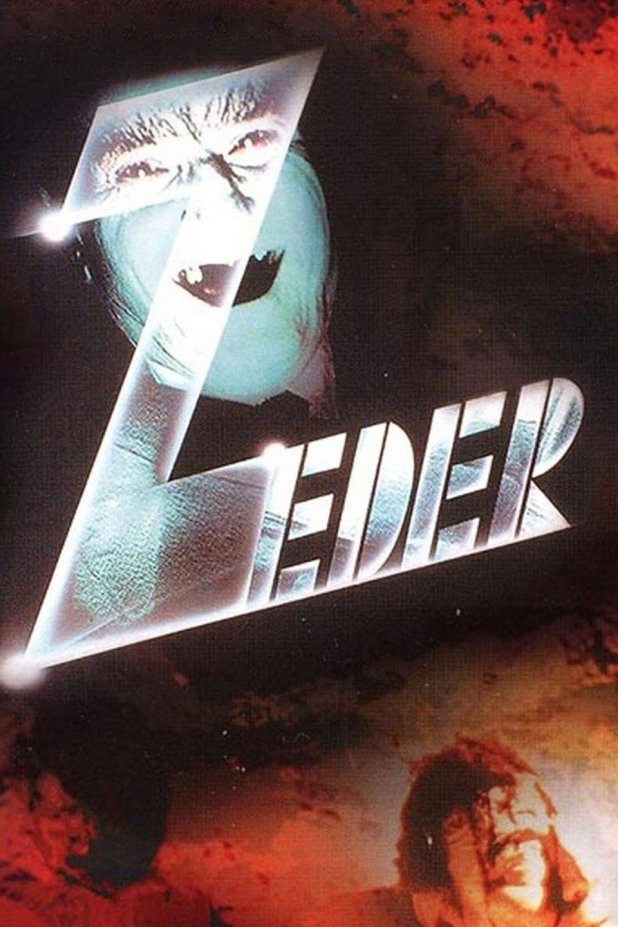
The American VHS art for this — when it was released by Lightning Video — made it seem like this was going to be everything you expect from a zombie film. I’m happy to report that it is not. Instead, it’s a dark mediation on secrets and death.
ABOUT THE AUTHOR: Mark Rochester is a librarian. Mad about movies and books and film soundtracks. His favorite film is The Private Life of Sherlock Holmes.
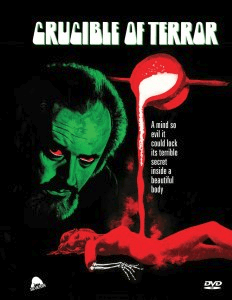
Crucible of Terror is a British horror movie about a crazy, lecherous artist who entombs his favourite models, whilst still alive, in molten bronze. It also has a poorly formed nonsense sub-plot about a haunted yellow kimono and a strange cult thrown in for good measure. Top billed Mike Raven, a British radio DJ who looks a bit like Christopher Lee and here has a wonderful Karloffian lisp, plays the artist and sculptor – and a really enjoyable, scene-stealing performance it is too. When his wimpy son, played by Ronald Lacey (Red Sonja) and art dealer James Bolam (familiar in many 60’s/70’s British tv series such as The Likely Lads) turn up at his studio with their girlfriends to try to persuade Raven to sell him some his art, he turns his pervy charm on the girls, played by Mary Maude (Larraz’s The Uncertain Death) and Beth Morris (Son of Dracula), trying to persuade them to ‘model’ for him. And then people get knocked off, one by one, and the film becomes an enjoyable whodunnit. Raven is the obvious number one suspect, but his crazy wife, who carries her dollies around the house and his creepy best mate, who has a spear collection in his bedroom, are, for obvious reasons, also near the top of our suspects list.
In a bizarre instance of life mimicking art Raven, whose voice was dubbed in his most well-known movie, Hammer’s Lust for a Vampire, actually DID become a sculptor, in a studio in Cornwall, the setting for much of this movie. And a terrific location it is too. Some of the shots around St Agnes; the beach and the crumbling tin mine walls are superb, a nice juxtaposition to the cramped and claustrophobic interior shots, and dark, murky scenes inside the mine tunnels.
Arguably the best bit from the movie is the opening sequence in which Raven ’embalms’ his drugged semi-naked model, played by Burmese actress, and star of numerous cannibal movies, Me Me Lai, who wakes up, her eyes suddenly staring wide in horror, just as the molten bronze is poured over her. Also great fun, especially for giallo fans, are the gruesome murders by an unseen assailant wearing black gloves. This is by no means a classic – it’s a kind of humourless version of Corman’s A Bucket of Blood – the dialogue is weak, and the hurried, muddled ending will probably leave you a bit disappointed, but this is still good fun, and worth watching for Raven’s performance – and to hear his wonderfully ‘fruity’ voice (famously dubbed by Valentine Dyall in Lust for a Vampire).
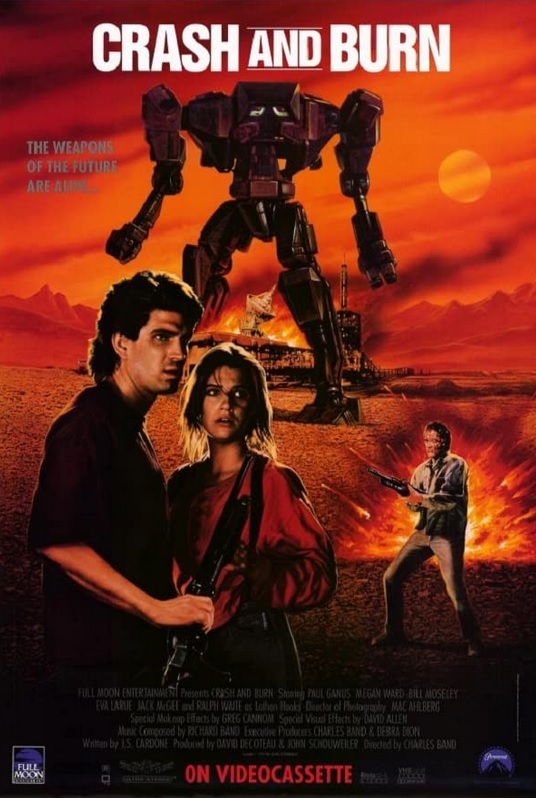
Editor’s Note:Yes, there was, in fact, a (lost) third sequel — and fourth film — in Stuart Gordon’s mecha-verse begun in 1989 with Robot Jox and continued in 1990 with Crash and Burn, then Robot Wars.
Welcome to the world of the Robo Warriors — a review inspired by an anonymous inquiry via our contact form, in response to our reviewing Gordon’s previous robo-flicks. In fact, we also reviewed Future-Kill earlier today, as result of another reader contacting us after our review of Cybernator.
Our readers, God love ’em and the VHS junk they love! See, positive reader vibes via our comments or contact form, works!
Okay, let’s strap on the popcorn buckets and robo jox this mother!
Courtesy of recycledhistory74/eBay
The always-welcomed James Remar, aka Ajax, from, ironically enough, the end-all-be-all of gang films, The Warriors (1987), but you know him for his most recent work as “Peter Gambi” on the CW network’s Black Lightning in the U.S., stars in place of Gary Graham and Don Michael Paul as our troubled, down-and-out mecha-jock.
Paramount British Pictures, the Australian division of American intellectual property holders to the franchise, Paramount Pictures, contracted Australian director Ian Barry (1980’s Chain Reaction starring Steve “Goose” Bisley of Mad Max fame) to helm a script penned by U.S. network TV scribe Michael Berlin (MacGyver, 1985 – 1992) based on Gordon’s films and, as we will come to discover, an old Gordon screenplay.
However, this time, instead of Stuart Gordon or Charles Band behind-the-scenes we have . . . as our executive producer . . . oh, no, not Cirio H. Santiago? Yes, it’s old Uncle C. of so many of the video fringe delights of the apoc variety (The Sisterhood, Stryker, Wheels of Fire) that we love around here amid the B&S About Movies cubicle farm. The web portal Condition Critical, in their never-ending quest to catalog lost, obscure and bizarre VHS and DVDs of the ’80s and ’90s, gathered up all of the video sleeves, god bless ’em, on their Robo Warriors tribute page — and those covers, cover the plot, or lack thereof, in a nutshell, so we don’t have to (and don’t want to). Also known as — ugh, the title-confusing — Robot Jox 3 in some quarters, and released in the overseas markets in 1996, Robo Warriors didn’t hit U.S. home video shelves and cable television platforms until 1998. (This played on the Sci-Fi Channel before the “Ys”? Okay, if you say so.)
As you scrolled our review for Robot Wars, the third film in the series, we discussed Stuart Gordon’s failed plans to follow that 1993 release with Battle Jox — a forth film featuring dinosaur-inspired mechs. Well, as it turns out, that film actually did get made after all, sort of — and this is it. Hey, we are as shocked as you are that this film even exists.
Seriously, did you ever hear of this?
Uno, Dos, Tres . . . Quatro. Well, sort of. . . .
We didn’t, at least not until a reader messaged us about Robo Warriors in the wake of our recent “Apoc Week” reviews for the Gordon-Band mech-verse films. And it seems you, nor anyone in the U.S., did, either. Perhaps we did see this on home video shelves . . . and mistook it as a repack of — or even sequel to — the abysmal Vincent Dawn, aka Bruno Mattei, rip puke-pastiche of Rambo, Robocop, The Terminator, and Predator that is Robowar (1988). Hey, it takes strength to pick up another Mattei film, after having to digest the likes of Shocking Dark, and even more so when it comes to the resume of Reb Brown (Yor, Hunter from the Future, Space Mutiny), so we get it. We really do.
However, from the looks of the film’s IMDb and Letterboxd reviews, Robo Warriors became a popular release in Germany and Russia, with feedback from both users and critics in those countries. Go figure, they love U.S.-based product — even when that U.S. programmer is cheap jack-produced in the Philippines.
So, the dinosaurs, i.e., the lizard angle from Gordon’s Battle Jox concept, carried through into Robo Warriors, as man, in the year 2036 (ugh more timeline confusion, since this takes place before the events in Robot Wars) finds themselves subjugated by the (make-up impressive) Terridax, a humanoid-reptile alien race. And the aliens have their own 120-foot mech — that looks like a exoskeleton dinosaur, natch — to do their dirty work. And James Remar is the last of the Earth’s Robot Jox. And Remar and an (seriously) annoying, tech-savvy kid (aren’t they all in these movies) set off into the jungles — like our ne’er-do-well pilot in Robot Wars, who set off into the desert wastelands with an annoying woman — to find the last battle bot buried in the brush. And come to think of it: Megan Ward’s teen in Crash and Burn was mech-tech savvy, as well. Yeah, so it’s like that: recycle, recycle, recycle . . . and never, ever follow the timeline from the previous film. And pull out the old grandfather-tells-a-story trope (Uh-oh, lazy writing alert! My use of “trope,” not the grandfather plot-device.) to set up the mech-verse.
While the production values, in spite of Uncle Cirio in the mix, are high and it certainly looks like a Dave Allen and Jim Danforth joint, the robots — this time — are by designed by Anna Albrecht (Gremlins, Enemy Mine, later Star Trek: First Contact) and Wanda Peity (Val Kilmer’s Red Planet). Why weren’t the Allen-Danforth bots from the other films repurposed, only Uncle C. knows. The apocalyptic, wasteland scenery comes courtesy of the abandoned Clark Air Base, which served as the U.S. forces’ staging area in the Philippines during World War II and the Vietnam War. James Ramar and his Robo Warriors co-star, James With, aka James Wearing Smith, previously worked together on The Quest (1996), which filmed in Thailand and starred Jean-Claude Van Damme and Roger Moore. Ramar and With also worked together on the Billy Zane-starring The Phantom (1996), which Paramount Studios also produced.
Robo Warriors is a film of a time and place. If you were a kid growing up on the tail end of the fading home video boom in the ’90s and picked this up on VHS, it’ll warm those ol’ VCR cockles — as did Robot Jox, the 1989 original does for myself. And while the dino-robot battle in the jungle opening is pretty impressive and James Remar delivers the thespin’ chops and the SFX are improvement over Robot Wars, but . . . ugh. Credit it to my first-time 2021 eyes watching this, but everything spirals into boredom beyond belief until the last throes of the third act kicks in and the alien vs. human bots start kickin’ some poly-carbon ass. But extra points for going old-school kaiju in ditching the stop-motion or CGI animation or putting two guys in mech-suits swinging, slicing, and blasting each other. Yeah, I dig SFX retro-vibes, but as with the previous two “sequels”: it’s all too little, all too late.
Again, a 10-year old tech-savvy kid hookin’ up with a burnt-out mech-warrior will appeal to the 10-year old kid in you that rented this in 1998, but not to the old bastard (moi) streaming this for the first time in 2021 — in Russian, no less. This is totally meant for kids, but isn’t made for kids, as this is all pretty heavy adult stuff in the frames. And I don’t think seeing this in its original English format will help — not even with my years of Godzilla kaiju experience. And it didn’t: A quick call into my bud, Mikey (whose own vinyl and VHS collection out rivals my own, you bastard), who turns out had a copy in his insane tape collection (“I can’t believe I actually have it,” he says.), solved the problem. So, yeah, I watched Robo Warriors, twice, which was once too many times for me, my Uncle Cirio and Bruno memories, be damned.
So, speaking of the Russian dub I watched: There’s no luck on finding any English VODs or freebie streams for Robo Warriors — and the only upload we could find was a Russian dub (there’s a German dub on the ‘Tube, but without audio and Spanish subtitles), but at least you can check it out for yourself on You Tube. To date, Paramount has never officially released Robo Warriors on DVD. In lieu of a trailer, we found this rip of the film’s opening five minutes (embedded below). Again, it’s impressive. And as the YT poster points out, we’ve not only got Stuart Gordon’s influences here, but pinches from the abysmal Battlefield Earth and the incredible Platoon . . . and I’ll even add Arnold Schwarzenegger’s Predator into the mix. (See, just like Bruno Mattei’s Robowar, get it?) But when it’s a film produced in the Philippines by Cirio H. Santiago, well, would you expect anything more . . . or less . . . than a pseudo-plagiaristic hodgepodge of more successful American films?
Ugh. Multiple trailer embeds biting the dust, again. We give up!Find one on your own!
About the Author: You can learn more about the writings of R.D Francis on Facebook.He also writes for B&S About Movies.
Editor’s Note: As if we don’t have enough movies to review! An anonymous reader confessed their love for this movie and baffled how we never included it as part of our endless apoc-love at B&S About Movies. You know the drill, ye reader: Strap on the popcorn bucket, let’s apoc this mother, Texas-style!
And it just goes to show you: Reviewing VHS junk like Cybernator— a film not reissued on DVD that’s being promoted by a studio shingle, reviewed for the simple passion of the film itself — pays off.In fact, another reader’s suggestion inspired our review of Robo Warriors, posting later today.
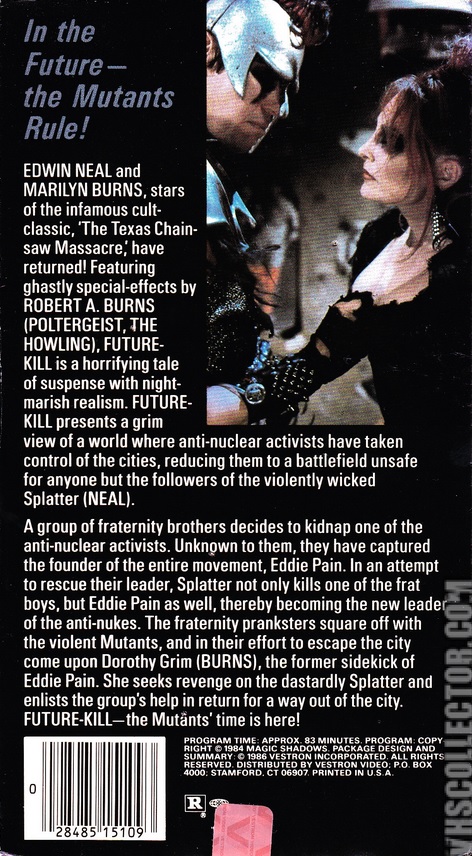
When it comes to the ‘80s video fringe, we not only expect the bizarre—we demand the bizarre. Austin, Texas, filmmaker Ronald W. Moore—in his only feature film writing and directing effort—answered that challenge with a sci-fi black-comedic pastiche of the Italian apocalypse rip-offs of John Carpenter’s Escape from New York and the “snob vs. slobs” rip-offs of Animal House. Only the slobs have been replaced by Reagan-era nuclear punks overlorded by Splatter, a plastic-cum-cardboard Robocop on a Terminator tear.
While it looks ’80s Italian apocalyptic, it’s not. This is a Texas-styled apoc, but not as cool as 2020: Texas Gladiators.
If you’ve watched the nondescript, post-apocalyptic ramblings of City Limits, the punk-rock apoc-drivel of Radioactive Dreams and the rad n’ gnarly post-apoc shenanigans of Night of the Comet, then you’ve traveled these low-budget streets before; streets that—outside of a few techno-trinkets to make the proceedings seem like the future—look just like our present-day streets. And when that “present-day” apocalypse arrives, be it via “The Big One” or by plague or by comet or by whatever nuclear deus ex machina falls from above, the “mutants,” depending on the film’s budget, raid the local S&M leather boutique or Reagan-era Mohawk-and-heavy mascara emporium. And at a reported $250,000 budget, Future-Kill raids the latter retailer to give us gangs of disenfranchised punks—punks who got lost on the set of Enzo G. Castellari’s The Bronx Warriors and Escape from the Bronx while on the way to their background acting gigs for Suburbia and Repo Man. And Lord Cyrus help them if they stumbled onto the set of The Warriors (Future-Kill’s most obvious model), for these MTV video punks won’t stand a chance against the Baseball Furies, the Electric Eliminators, the Gramercy Riffs, and Turnbull AC’s*.
Maybe if Future-Kill were as entertaining as any of those films and not the apoc-swill that is America 3000 and Robot Holocaust (okay, maybe it’s a wee bit better than those two swillers: a wee bit). Maybe if the proceedings were more Wendy O. Williams and the Plasmatics (“Butcher Baby“) and less Dale Bozzio and Missing Persons (“Words“) roamin’ those Austin mean streets and the gangs were more Walter Hill-inspired, Future-Kill could have lived up to its faux H.R Giger packaging. Yeah, at the time, we thought the artwork was a bogus H.R Giger rip-off hawking another R.O.T.O.R artwork-hiding-a-shitty-film scam, so we avoided renting Future-Kill during its VHS heyday.
Then Ronald W. Moore’s apoc-meets-frat comedy boondoggle became connected to Oscar gold.
John Hawkes, one of Future-Kill’s minor support actors, ended up at the 83rd Annual Academy Awards held in 2011 and rubbed elbows with Tom Hanks—who has his own ‘80s VHS debut-acting bone in the closet with He Knows You’re Alone. So, its Texas Chainsaw and H.R Giger faux-connections aside, how can one not want to watch Future-Kill, once learning that one of its actors earned multiple “Best Actor” nominations and awards between 2010 to 2012 for the films Winter’s Bone, Martha Marcy May Marlene, and The Sessions? (Another of John’s early, minor support roles was working with Gregory Hines in the 1994 radio-set thriller, Dead Air.)
However, before the mainstream success of John Hawkes inspiring us to seek out copies of Future-Kill, the truth behind that “bogus” H.R. Giger artwork was finally told in an audio commentary by director/writer Ronald W. Moore and producer/star Edwin Neal—courtesy of a 2006 Subversive Cinema DVD reissue that included reproductions of Giger’s original artwork for the film.
While H.R Giger famously provided production drawings for Alien (as well as 1995’s Species), the Swiss surrealist rebuffed several studio offers to design theatrical one-sheets, including overtures from 20th Century Fox, the studio that brought his work to a mass audience (with an honorable mention to ‘70s prog-rockers Emerson, Lake and Palmer; the band used Giger’s work on their 1973 album Brain Salad Surgery**). So, it’s a shock to discover that the artwork for Future-Kill is, in fact, a real Giger, titled “Future Kill 1,” painted in 1984 specifically for the film.
According to the Alien Explorations, which chronicles the works of Giger, Giger was a fan of Tobe Hooper’s film; since Future-Kill featured two actors from Texas Chainsaw, he agreed to design the poster. At the time, Ronald W. Moore completed filming and was in the editing process when he approached the artist at a Zurich exhibition and begged Giger to design the poster (Giger has stated Moore was in tears at one point)—based on the fact Moore prematurely promised investors a theatrical one-sheet by Giger, so to secure film financing. Now Moore had to pay up, figuratively speaking. Also enticing Giger to design the poster: Giger and Kathy Hogan—the make-up and costume designer who developed Splatter’s bat wing and Mohawk-styled shoulder and helmet armor, which served as the model for Giger’s artwork—came into a sexual relationship.
While Hawkes was only a minor support player, the real “stars” of Future-Kill were Edwin Neal and Marilyn Burns, each who appeared in Texas Chainsaw. However, even with that “star power,” the film still lacked “major stars” and received its limited, regional theatrical release solely based on the fact that “the artist who did Alien” designed the poster (and the film looked nothing like Alien, natch). Also of note: Edwin Neal didn’t “star” in Texas Chainsaw; he had an extended cameo as a self-cutting hitchhiker; meanwhile, Marilyn Burns, who starred in Texas Chainsaw, only has an extended cameo in Future-Kill. The film’s Texas Chainsaw-connection also goes a bit deeper, as Ronald W. Moore got his start in the business as a soundman on Mongrel; the film also served as the lone directing effort by art director Robert A. Burns, who worked in that capacity on The Hills Have Eyes, Don’t Go Near the Park, and The Howling—as well as the The Texas Chainsaw Massacre; Burns was responsible for the “bone furniture” and its related “bone room” scene.
Maybe, if Moore hired Robert A. Burns to work on the set of Future-Kill, we’d have a film that looked as good as those films—and its chief protagonist, Splatter, would have been the Gigeresque biomechanical xenomorph promised and not the low-rent Godfrey Ho wannabe we got; if you’ve seen Ho’s Pacific Rim cyborg romp Robo Vampire (1988), then you understand that analogy to the canons of “Hong Kong’s Ed Wood.” Godfrey Ho, as with ‘60s U.S. drive-in purveyor Al Adamson before him, was infamous for splicing two or three unrelated films into a new product. And, at first watch and without knowing the backstory of Future Kill, it looks as if Ronald W. Moore assembled his own portmanteau poo akin to Night Train to Terror (which is three movies spliced into one) and Evil Town (which is a four-director junkfest rooted in a mid-‘70s horror dumpster-fire called God Bless Dr. Shagetz).
Now, that’s not the case with Future-Kill, but it sure seems like two, unrelated, spliced scripts or unfinished films: one a failed frat-house comedy; the other a failed post-apocalyptic tale. And thanks to the ‘80s frat house hi-jinks and the Philippines-cum-Italian future world we’re watching, we have no idea what the hell is going on or where we are. The “destination,” to paraphrase the lyrics of Missing Persons, is “unknown.”
Oh, Wendy! Are we beyond the valley of 1984? Will extras show up in monkey suits? When does this future-world of Future-Kill take place? What’s the Orwellian masterplan, dag gummit!?
Well, it must be in an alternate universe or timeline or a future stuck in a DeLorean time loop where technology has afforded us the ability to create cyborgs—while everything else looks ‘80s “snobs vs. slobs” comedic. And since we’re on the cheap, our “mutants” aren’t so much nuc-deformed; they’re just a bunch of snotty, Reagan-era punks with an anti-nuclear chip on their shoulders. You know the punk-type: As with my ex, Dawn, she listened to a couple of Black Flag and Dead Kennedy records, went to spoken word concerts by Henry Rollins and Jello Biafra, then raised the flags against Halliburton and rallied about “Blood for Oil” through the puffs of her clove cigarettes, its scented fumes clinging to the fibers of her faded, Hot Topic Clash tee-shirt.
Anyway, in Ronald W. Moore’s future world, those errant punk rock scamps have—in an eerie foreshadow of the sociopolitical upheavals of 2020—formed their own CHOP/CHAZ perimeter in downtown Austin, Texas, as part of an anti-nuclear movement. The most feared of all of the nuc-mutants is Splatter (Texas Chainsaw’s Edwin Neal), the aforementioned Robocop-cum-Terminator, whose radiated mutations have turned him into a metal-and-spiked covered madman.
Okay, so that takes care of the “slobs” portion of the film.
Meanwhile, back on the campus of Faber College in snobby Porkyville, out in the ritzy, unaffected Austin environs, our perpetually partying preppy a-holes live a carefree life of booze, boobs, and pranks where rich parents get them out of their Hunter Bidenesque jams. When one of their pranks risks the shutdown of their frat, our frat-lads are forced to dress “punk” by a rival frat and venture into slobby Punkville to kidnap one of the mutants for an end-all-be-all of all pranks. Of course, they run afoul of the metal-clad n’ spiked Splatter. Oops.
Okay, so begins The Warriors portion of our film.
Once Splatter (our “Luther,” if you will) settles his Alpha-Male dispute (i.e., murder) with Eddie Pain (our “Cyrus,” natch), the anti-nuke movement’s ‘60s-inspired hippie-punk leader (uniting the gangs, natch), our Robonator is off-the-chain with a Termicop chip on his shoulder—and he’s framed our prep-boys (i.e., The Warriors) for Pain’s murder. As our Delta House rejects make their “Escape from Austin,” they save a hot mutant punk chick from pervert cop rape because, well, as usual, when the apocalypse arrives, man’s inner “rape genes” mutate, so as to preserve the species. And preppy boy falls for punky girl. And we hear a few tunes—in the best part of the film—from real life Austin band Max and the Make-Ups (but we wished The Plamastics showed up to do do “Black Leather Monster“) as we (finally) meet Texas Chainsaw’s Marilyn Burns in her under 20-minutes role as Dorothy Grimm, the revenge-seeking girlfriend of Eddie Pain.
Is it a plot-spoiler telling you Splatter dies and the preps Escape from Austin? And it all plays as if Universal ripped this for Judgement Night, their 1993 suburbanites-lost-in-the-underbelly-of-the-mean city starring Emilio Estevez pursued by Denis Leary?
When submitted to the ratings board for its limited, regional theatrical run in and around its native Austin, Future-Kill received an “X” rating for extreme violence. One minor edit was made to secure an “R” rating in the U.S. Meanwhile, across the ocean, while the puritanical purveyors of philth (know your Motorhead) in the U.K. didn’t toss Future-Kill onto their “Video Nasties” list, they forced a title change to Night of the Alien (in other overseas quarters the title Splatter was used) and two-and-half minutes were cut—which eliminated a neck breaking, the killing of Clint (one of the preps), portions of Splatter’s stabbing, a woman’s fondling by Splatter, and Splatter’s sexual encounter with a street girl—all of which were restored on the subsequent DVD released by Subversive Cinema.
You can watch VHS rips of Future-Kill on You Tube HERE and HERE. You can also learn more about the film with this behind the scenes, 30-minute featurette created for the Subversive DVD. The trailers come and go, but we got the TV trailer and the VHS trailer on You Tube.
Oh, we almost forgot about the pinball machine!
More imagines of the machine are at pinside.com/multiple sites.
The infamous Deep Throat pinball machine, custom made by Robert A. Burns, which made its debut in Mongrel, also appears in Future Kill. The history of the game is discussed on the pinside.com message boards, your source for all things pinball. After we posted our October 2020 review of Mongrel, Joe ‘O Donnell, feverishly working on his Rondo Hatton documentary Rondo and Bob, let us know he is no longer in possession of the pinball machine. It was sold to help fund the production of Rondo and Bob and is now with a private collector. The good news is that Rondo and Bob, the story of Robert A. Burns’s fandom of Rondo Hatton, is completed and heading to film festival circuit.
* Oh, the mighty QWERTY’in warriors of the Internet, you gotta love ’em. Jennifer M. Wood, over at Mental Floss, took up the challenge to chronicle all of the street gangs in 1978’s The Warriors in her feature “21 Street Gangs Features in The Warriors.” Nice!
** H.R Giger’s work will be incorporated into the currently-in-development film Karn Evil 9 based on the rock-suite of the same name from Emerson, Lake and Palmer’s rock-opera Brain Salad Surgery.
Be sure to check out our Atomic Dustbin blowout tribute to apoc-films of the ’70s and ’80s. Part 1 will get you started.
Note 1: As always, thanks to Paul Z. over at VHS Collector.com, once again, for the artwork assist. Be sure to check out his reviews for the latest DVD and Blu-ray reissues of our favorite VHS classics at his Analog Archivist You Tube portal.
Note 2: We’ve since received a copy of and reviewed Rondo and Bob.
Note 3: If you have a favorite film that we’ve missed, you’re welcome to let us know via our contact form. We’re always hearing from our many, ever-growing readers and welcome you to join in the fun. We’re united in film! And thanks for thinking of us to review your favorites. We try our best. Keep those suggestions coming. When you’re nice to us, we return the favor!
About the Author: You can read the music and film reviews of R.D Francis on Medium and learn more about his work on Facebook.
Based on H.F. Heard’s 1941 novel A Taste for Honey, this Freddie Francis film — look for an entire week of UK science fiction and horror next week — this movie predates the worries of the 70s killer bees by nearly ten years.
You know, singers don’t just get exhausted today and have to escape from reality. They used to in 1966, Vicki Robbins (Suzanna Leigh, Lust for a Vampire, Son of Dracula) collapses on television and has to go to Seagull Island to get her life back together. Look for a young Ron Wood in the opening number.
Originally adapted from Heard’s novel by Robert Bloch, director Freddie Francis and writer Anthony Marriott worked to improve said script and ended up with a movie that nobody seemed to like. Maybe it’s because there’s no Peter Cushing or Christopher Lee, as audiences expected them in almost every horror movie.
Bloch never saw the completed film, although he was a gentleman in how he felt about Francis, Marriott and Amicus, the studio who produced the film. He did say, however, that the movie “buzzed off into critical oblivion, unwept, unhonoured and unstung.”
If you want to see a movie with plastic bees glued to the faces of thespians, by all means, this would be that film.
We’ve been leading up to this for a whole year — we’re showing two of our favorite movies of forever this week! Make plans to meet us Saturday on the Groovy Doom Facebook page starting at 8 PM East Coast Time.
Bradley Steel Harding will join us to introduce the films, share drink recipes, show you the ad campaign for each movie and then discuss the movies when we come back!
Up first is one of the 70s most amazing movies. Flat out, a complete classic, it’s Messiah of Evil! You can watch it on YouTube.
Here’s the recipe for the cocktail we’ll be enjoying during the movie.
Point Dume Sunset
1 oz. vodka
1.5 oz. coconut rum
1.5 oz. peach schnapps
.5 oz. grenadine
2 oz. orange juice
2 oz. pineapple juice
Maraschino cherries
Fill a glass with ice, then pour in this order: vodka, rum, schnapps.
Pour the grenadine down the side of the glass, so that you get the “sunset” effect.
Then, pour your juices, then add cherries. Then, sit in the sun and wait. And sleep. And dream. Each of us dying slowly in the prison of our minds.
We’re following that with perhaps the strangest movie of the 70s to get a PG rating. And that would be…The Baby! You can watch it on Tubi.














 B&S About Movies
You must be logged in to post a comment.