Blade (1998)

Say what you will about its CGI today, but if we didn’t have 1998’s Blade, we may have no Marvel Cinematic Universe. Let me tell you, there was probably no cooler hero than Wesley Snipes at this point in time. Ah, it’s still pretty rad today.

New Line almost made this movie as a comedy, but after Snipes couldn’t get Black Panther made, he was able to get the main role in this one. To me, the best part of the film is the relationship between Whistler (Kris Kristofferson) and Blade, but I’d still be interested to see what it would have been like if Patrick McGoohan or Marc Singer had taken the role.

As for the main bad guy, Deacon Frost, Jet Li, Mark Wahlberg and Skeet Ulrich were all up for the role, but it belongs to Stephen Dorff. You kind of have to respect a bad guy so evil that he keeps the hero’s mother a vampire for decades.

Actually, all of the vampires are great here, even in the minor roles for Donal Logue, Udo Kier (who has been in the vampire films Blood for DraculaSpermulaDie Einsteiger, Modern Vampires, Shadow of the Vampire, Dracula 3000 and Bloodrayne) and Traci Lords. Director Stephen Norrington (The League of Extraordinary Gentlemen) was supposed to play Morbius the Living Vampire, but the part was cut.

N’Bushe Wright also makes a great partner for our hero as Dr. Karen Jenson, as she works to determine a cure for Blade’s vampirism. But hey — he’s the Daywalker. He pretty much will always be a vampire determined to kill all the others.

How cool is it that Marvel’s first big movie success came from a side character from the 1970’s Marv Wolfman and Gene Colan The Tomb of Dracula series? Sadly, while those creators got a “based on characters created by” credit, they didn’t make any extra money. Such is how comics has always screwed creators.

Near Dark (1987)

Two vampire movies came out in 1987.* One became a celebrated big-budget film that launched the careers of the Coreys and Kiefer Sutherland, with songs that people still sing, shirtless saxophonists and quotable dialogue about why there’s no need for a TV when you have TV Guide. The other movie was in and out of theaters in the time it took to read the last sentence and has stuck in my mind forever since.

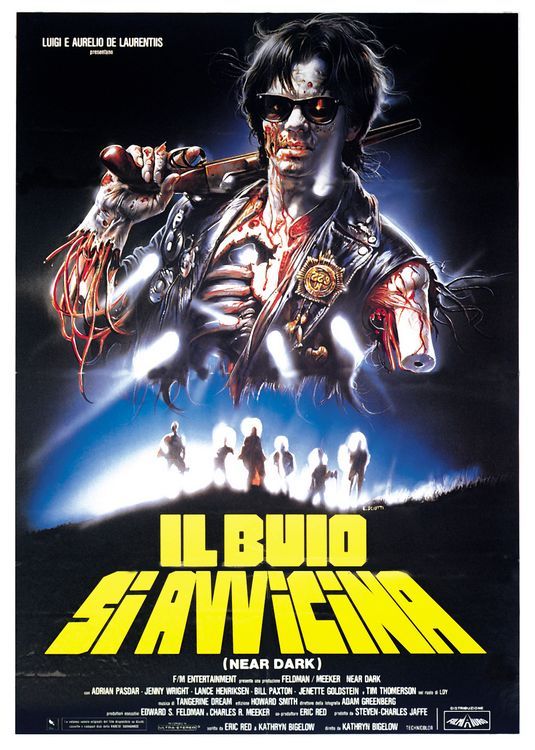
Kathryn Bigelow had never directed a movie before. She was given five days to succeed or be replaced. She wanted to make a Western, but they weren’t popular. So she combined the vampire genre — the word is never mentioned — and hired three of the actors from her future husband James Cameron’s recently completed Aliens, Lance Henriksen, Bill Paxton and Jenette Goldstein.

Caleb Colton (Adrian Pasdar) falls for the mysterious Mae (Jenny Wright, who is another beyond cult horror film that few discuss, I, Madman) but then learns her family — Severen (Paxton), Jesse Hooker (Henriksen), Diamondback (Goldstein) and Homer (Joshua John Miller) — are a roving band of RV driving maniacs given to acts of merciless terror.

The only problem that I’ve ever had with this film is that I have always seen the normal people in the world as the real monsters, despite the hints that Jesse and Severen set the Great Chicago Fire. The blood transfusions that save the beautiful people seem way too easy of a way out of the hell that the gang promises.

Biglow would go on to make the equally well-made Blue Steel. Most of the cast went on to fame, at least in the circles of people who read our site. And if you look close enough, there’s a picture of a torn-apart Severen on my fridge.

If you’d like to learn more about the films scored by the band who gave this movie its unique soundtrack, check out our article Exploring: 10 Tangerine Dream Soundtracks.

*We know that A Return to Salem’s Lot and My Best Friend Is a Vampire also came out in 1987. For the sake of poetic license, we hope you understand why we juxtaposed these two films. Ironically, both movies have a son of The Exorcist star Jason Miller in their casts, with Joshua John Miller is in Near Dark and his half-brother Jason Patric in The Lost Boys.

BONUS: You can hear Becca and Sam discuss this movie on our podcast.

Jugular Wine (1994)

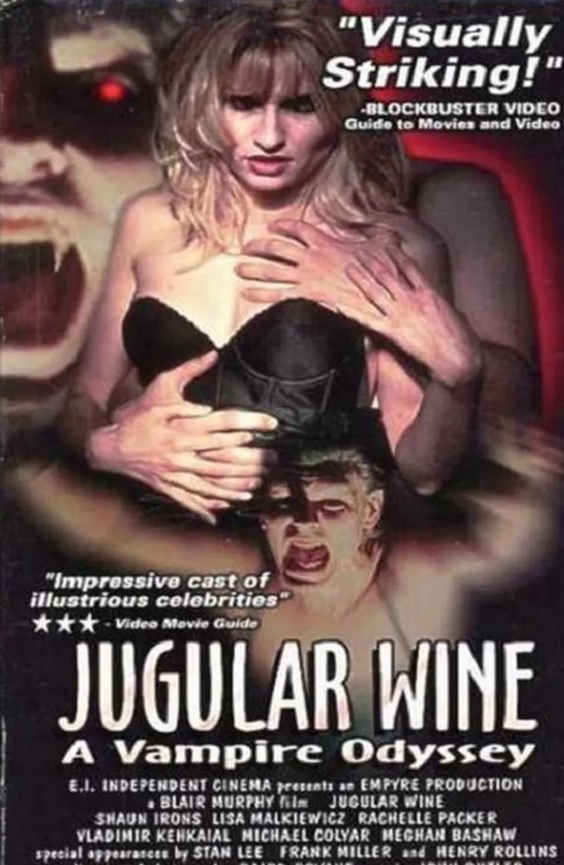
If you ever wanted to see a vampire flick that slaughters Black Flag’s Henry Rollins (playing himself; then at the top of his solo game with The End of Silence and Weight albums) and comic-book icons Stan Lee and Frank Miller (an anthropology professor and a fellow grad student, respectively)—as it quotes the poems of Walt Whitman (remember: the father of the modern vampire genre, Bram Stoker, was a Whitman admirer, and later, pen-pals with the poet)—then this idiosyncratic vampire romp is your goblet of blood.

After several centuries of undead romance, Ms. Dracula needs a new neck in her life, so she decides to fall in love with the food that comes in the form of James Grace, a Philadelphia thesis-working anthropologist in Alaska (he’s on a ship; thus the Whitman quote about “deep waters” and “seas of god”) who becomes the unwitting third side in a gothic love triangle. Why? Because mortal women aren’t exactly banging down the doors of anthropologists . . . so when a several-centuries-old hottie shows up and drops her parka naked-to-go, you don’t did-a-doddle with your rocks and dirt: you go for it. (I would. Undead me, baby.) Well, it’s not that cheesy: Alexandra the Vamp is actually on the run to Alaska, the last earthly sanctuary for vampires as the nights grow shorter—and she’s being hunted by her kind’s eldest, known as Legion.

When the half-vampirized Grace discovers Mr. Dracula, aka Legion, has murdered Alexandra, his new undead-life’s love—as result of her mortal infidelities—he embarks on an Easy Rider meets Phantasm II-inspired sunless odyssey; a hallucinatory roadtrip through America’s underground lands of the undead where he meets an array of fringe-society characters in Los Angeles, Utah, New Orleans, and Philadelphia in his quest for revenge. Then there’s the side plots with Nickadeamous (writer-director Blair Murphy) tracking down Grace—and Grace tracking down Dr. Donna Park, who has the secrets to the mythical Induit creatures that fuel the vampire myth. And that she’s not dead or missing—but a vampire herself, and Grace killed her back on the ship when Nickadeamous attacked him.

One of the most—if not the most—ambitious indie-art house vampire flicks you’ll ever see (if there is such a genre), this vamp’s cross-country ambitions hold up (somewhat) against its aspirations-over-budget, courtesy of its avoiding the graveyard brooding and strip club clichés of most modern vampire flicks, as the protagonist’s search takes him to unconventional, underground-kitschy coffee houses and maybe-a-little-bit-more-conventional goth night clubs (aka, the pretty-cool named Caligari’s Casket that spins F.W Murnau’s 1922 vamp-romp, Nosferatu for “atmosphere”; you know, the place where Henry Rollins hangs out to become fang-chum).

It’s all from the mind of indie writer-director Blair Murphy who self-financed the film through his family’s funeral home business. Is this a case of “. . . if Tommy Wiseau made a vampire flick?” Eh, well . . . while this was made in the early ’90s and shot-on-film, the proceedings look like an ’80s “Big Box” SOV romp, à la (the much better granddaddy of SOV) Blood Cult. (But Jugular Wine isn’t as bad as fellow SOV’ers Spine. Or Things.) And we’re not sure if that’s from cinematic ineptitude, purposeful SOV-homage, or the battered VHS is so washed-out that it looks like an ’80s SOV’er. And what’s the deal with the white grease paint vamps? Again, we’re not sure if that’s special-effect ineptitude (due to cash) or a homage to Herk Harvey 1962 classic-creeper, Carnival of Souls, which, in many ways, Jugular Wine resembles in its self-financed, one-off guerilla filmmaking style. But make no mistake: Carnival of Soul (which should be as revered as George Romeo’s Night of the Living Dead) is the far superior film. Far superior.

While Murphy certainly possessed the same generous self-financing verve as The Room’s auteur, Murphy has a more effective grasp of filmmaking. Sadly, in lieu of his musician and comic-book stunt castings, he should have dug up a few down-on-their-luck B or C-List actors (Eric Roberts was already down to direct-to-video potboilers like Power 98 by this point; he would have been a prefect class-up-this-joint casting) to carry his intelligent script—as the strained overacting, in conjunction with its way-too-long 98-minute running time, make this vamp romp a hard swallow (yuk, yuk, sorry) . . . for you, maybe. But I dig this way more that Tom Cruise’s mainstream fang sporting, so kudos, Mr. Murph!

There’s no PPV-VOD streams or freebie rips of the VHS. And that “Blockbuster” plug on the box art is totally bogus. Across three local Blockbusters, I never one saw a copy of Jugular Wine on their mainstream shelves: this was strictly a 10,001 Monster Video or mom-n-pop rent-n-carry. For you digital hounds: Yeah, there are DVDs in the marketplace, but caveat emptor: they look like grey market burns. (No, they are definitely grey market burns.) For those of you that have never seen Jugular Wine, the best we’ve got is this eight-years post documentary (on You Tube in six-parts) that Murphy strung together in 2002, which features scenes from the film. Apparently, the later-issued DVDs contain the documentary.

Guess what? We found a six-part upload of the “Making Of” featurette.

About the Author: You can learn more about the writings of R.D Francis on Facebook. He also writes for B&S About Movies.

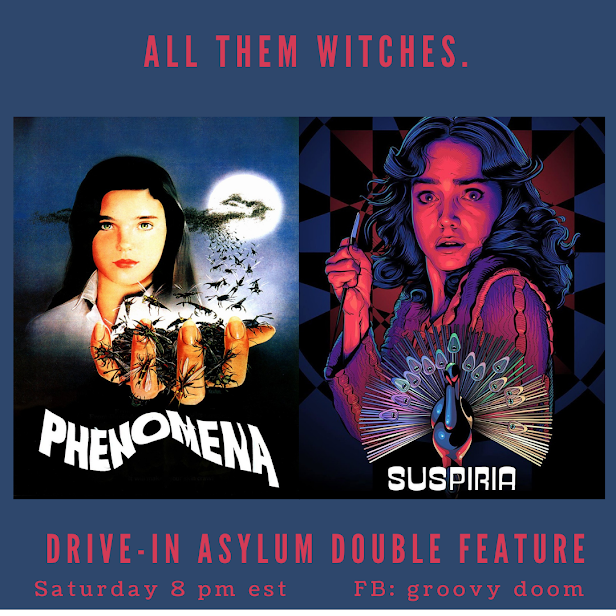
Double Argento on the Drive-In Asylum Double Feature!

We’re unleashing two astounding Argento films on you this Saturday at 8 PM on the Groovy Doom Facebook page.

Up first, Argento’s freakout devoted to orangutans, bug loving teenagers, women with deformed children and, as always, heads getting cut clean off. We could only be talking about Phenomena.

Inga and Jennifer

  • 1/2 oz. 99 Bananas
  • 3 oz. half and half
  • 1/2 oz. coconut rum
  • 1 1/2 oz. orange juice
  • 1/2 tsp. grenadine
  1. Pour all of the ingredients in a shaker and do your thing.
  2. Pour into a glass and enjoy.

We’re following this up with the most perfect of all Argento’s films, Suspiria!

Mother of Sighs

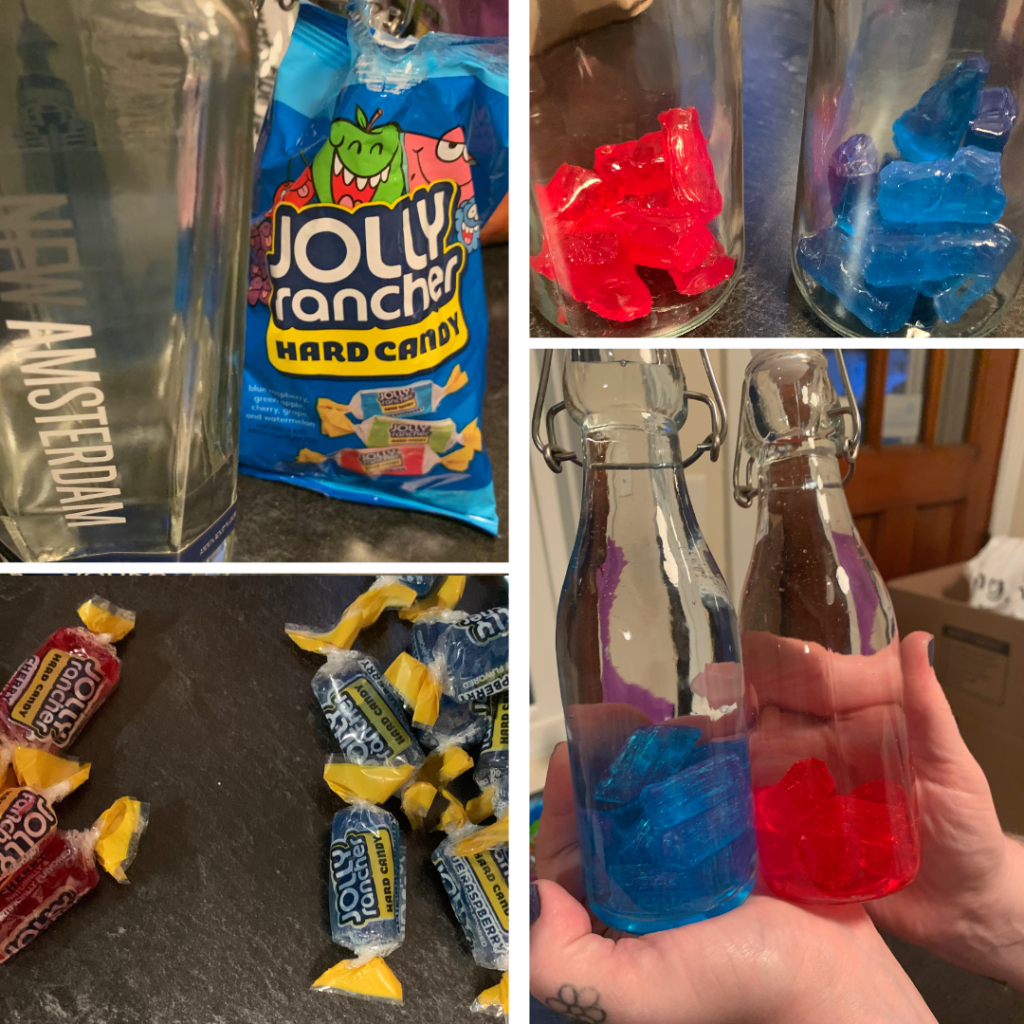
  • Jolly Ranchers (blue or red, come on, we are using the Argento color palette here)
  • Bottle of vodka
  • Sprite

Prep: 

  1. Take 12 Jolly Ranchers and place them in an airtight container like a Mason jar.
  2. Pour in 2 cups of vodka and let sit overnight.
  3. As if by magic — “Susie, do you know anything about… witches?” — they will have dissolved by morning.

Drink recipe:

  1. Use 2 oz. of your Jolly Rancher vodka to 6 oz. of soda (you can also use sparkling water, club soda or ginger ale).
  2. Place in shaker with ice and shake it up.
  3. Serve and enjoy.

I’ve taken some photos of the process to make the infused vodka, which takes just a day. I’m really excited to try this one out.

Here’s where you can watch along!

SuspiriaTubi

PhenomenaTubi, Shudder, Amazon Prime

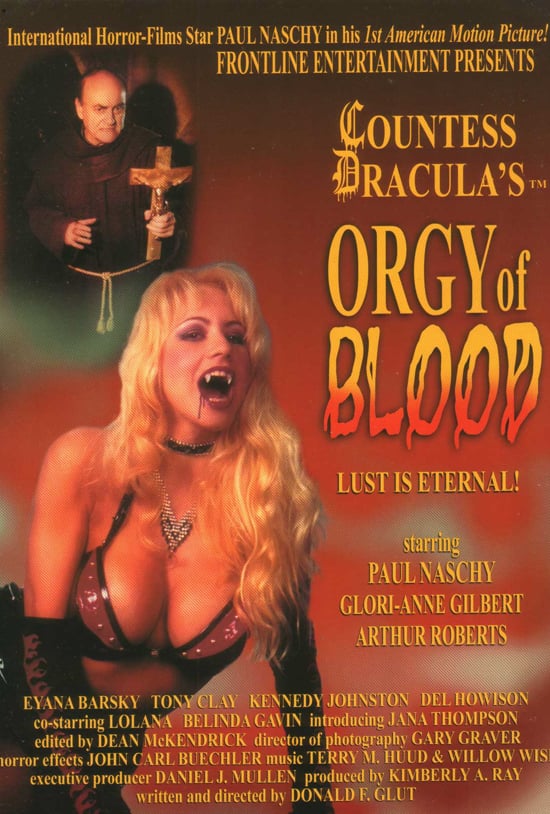
Countess Dracula’s Orgy of Blood (2004)

Way back in 1897, a man named Dumas (Mark Bedell) loses his sister Roxanne (Kennedy Johnson, Tomb of the Werewolf) to the fangs of Diana Ruthven (Gloria Anne-Gilbert, who hosted a series of releases as Morella Ghost Hostess with the Mostest, including House of EvilThe Blood SeekersDisciple of DeathBlood Vision and Terror In the Crypt). Turning to Padre Jacinto (yep, Paul Naschy, in America no less), they use a cross, Holy Water, a Bible and a silver stake to take out Rebecca, Diana and her brother Lord Ruthven (Arthur Roberts, Not of This Earth), which empowers the priest to stay alive until the evil of vampires has been erased from our reality.

That’s right — Paul Naschy in his first American film and…well…it’s a soft-core porn pretty much. Now, the two vamps are after the reincarnation of their lost love — yes, they’re fine despite dying earlier — in a movie written and directed by Donald F. Glut (Tales of Frankenstein).

That’s because Count Dracula (Tony Clay, who has shown up in more than on of Glut’s movies) has sent his daughter Martine (Eyana Barsky) and thrall Renfield (Del Howiso, continuing the role from The Erotic Rites of Countess Dracula, another Glut movie that has William Smith has Dracula) to pull that stake out and find the vampire’s bible.

The big issue is that the silver dagger has cursed Ruthven to never be able to drink human blood, a fact that he learns when he tries to suck the neck of a stripper named Lilith (she’s played by Lolane, who was in plenty of BDSM tease videos with great titles like Criminals Who Use Cholorform!). His sister has none of these worries, so she soon seduces the very same exotic dancer. All manner of sibling rivalry and sapphic shenanigans ensue.

Imagine a sub-par VCA vampire film — at least Ejacula has Lois Ayres, Patricia Kennedy and Rocco Siffredi in it — without the actual penetration and you have this. Never in my wildest dreams did I think that a vampire sex movie would be so boring, which is either me growing up — no, I screamed like a maniac every time Naschy was on screen, all eight minutes worth — and more that this is not a good movie.

If you want to see a much better Naschy vampire movie, check out Count Dracula’s Great Love.

PS: To further throw in some adult film references, Belinda Gavin is in this. She’s better known as Kylie Wyote in X-rated movies. There’s also a girl named Bella Donna who plays a hooker, but she is not Michelle Anne Sinclair, which would be amazing to have her in the same movie as Count Waldemar Daninsky.

Vampire at Midnight (1987)

If Harry Hope, who combined disco and hicksploitation in Smokey and the Judge were here, he’d say” “So why not Spaghetti Westerns and R&B. I can see the tagline now: ‘The first R&B Western . . . Blazing Saddles with a beat to move your feet.’”

“Oh, yeah? Not if I produce it first, Hopie.”

“Harry Tampa? Hey, at least I use my real last name as a screen credit, ‘Mr. Hurwitz.’ Whaddya gonna do, another disco-vampire flick with Nai Bonet?”

“Yeah, Nocturna, Granddaughter of Dracula is the last discoploitation bloodletter I’ve ever do. But I was thinking. . . .”

“A Hope-Tampa Production?”

“Well, more like Tampa-Hope.”

“We’ll compromise: A Double H-Production.”

“Okay, so, what’s the pitch?”

“Dirty Harry Meets Count Dracula.”

“I like it. Sorta like the old Kolchak: The Night Stalker TV movies-series — only with a cop instead of a reporter.”

“You call Christopher Lee. I’ll give Eastwood’s people a ring.”

“You think they’ll do it?

“Tampy, baby. You roped John Carradine into Nocturna. Never give up hope.”

Shame on you, Mr. Distributor! “Adapted to a ‘Stephen King’ style,” indeed.

Okay, so Harry Hope and Harry Tampa didn’t co-produce this Magnum n’ Fangs romp. But Jason Williams did.

Yes. That Jason Williams: Flesh Gordon himself.

Flesh Gordon, their sexploitation, sci-fi porno spoof of Universal Pictures’ 1930 serials, was the first of four films Williams starred in for producer Bill Osco, he the king of the “erotic art film” (aka, porn) that launched the “Golden Age of Porn” (we devle into it with our review of Spine) and unleashed the likes of Linda Lovelace in Deep Throat and Marilyn “Rabid” Chambers in Behind the Green Door. Together, team Osco-Williams also made Alice in Wonderland (1976; a porn-musical), Cop Killers (1977; Williams as a hippie serial killer), and the drive-in T&A romp, Cheerleaders Wild Weekend (1979, aka the less offensive aka The Great American Girl Robbery).

Here, Williams went it alone, with Tom Friedman (who produced the Williams writing-directing efforts Flush, Time Walker (the best-distributed; with Ben Murphy), The Danger Zone, and Zone’s sequels). For their director — in his debut — the Friedman-Williams celluloid collective chose experienced producer Gregory McClatchy (most noted for the 1984 horror documentary Terror in the Aisles) — who didn’t sit behind the lens again until the 2008 TV movie Soccer Mom for, of all networks, The Disney Channel.

As with any grizzled cop romp, Vampire at Midnight is set in Los Angeles as nine victims, over the course of several months, have turned up with the blood drained from their bodies. Of course, the “it bleeds it leads” press have dubbed the vic as “The Vampire Killer.” On the case is our not-so-Dirty Harry: Homicide Detective Roger Sutter (Jason Williams). Clues come by the way of his attractive neighbor-squeeze (natch) Jenny Carleton (Lesley Milne, who quit the business after), a concert pianist under the care of self-help guru-cum-hypnotherapist Victor Radikoff (who worked his way up to guest starring roles on TV’s Murder, She Wrote; then back down again to Texas Vampire Massacre). Is Radikoff a real Transylvania vamp or just a creepy shrink with a blood fetish who, sans fangs, hypnotizes his victims, then slices and drains them?

Is this dull to the point of yawn. Yeah, sorry to say that it is.

Jason Williams isn’t a bad actor. And Gregory McClatchy isn’t a bad director. And Daniel Yarussi (Christopher George’s Graduation Day and Betsy Russell’s (!) Tomboy) isn’t a bad cinematographer. However, when compared against Dirty Harry’s pursuit of “Scorpio” or Charles Bronson’s Leo Kessler’s pursuit of his office equipment repairman-serial killer in 1983’s 10 to Midnight (or, dare I say, Stallone’s pursuit of “The Night Slasher” in 1986’s Cobra), this vamp feast is lost somewhere in the between the Moon and New York City. Perhaps if Cannon Films produced it and J. Lee Thompson directed it, and Eastwood (okay, not Clint, but Michael Dudikoff or Oliver Gruner) and Christopher Lee starred . . . and let’s face it: Lee was already doing junk like Howling II, Honeymoon Academy, Gremlins 2, Curse III, and A Feast at Midnight, so playing a hypnotherapist with a blood jones isn’t exactly a step down for Sire Chris.

Hey . . . you know who would have classed this up: Klaus Kinski as Radikoff. That’s my “Devil’s Advocate” remake of Vampire at Midnight: Michael Dudikoff and Klaus Kinski. Now, THAT’S a vampire vs. copy flick. That would have banked. What? Kinski said go “F” ourselves? Okay, call Angus Scrimm.

What the . . . how can there be NO freebie online rips? You Tube, TubiTv, and The Internet Archive.org . . . have you let us down? VHS copies (on Fox’s Key Video imprint) are hard to find and the DVDs look like grey market rips to these analog-sloshed eyeballs. What? This isn’t in the public domain either, Mill Creek? Denied! So, if you want a copy, look for the DVDs issued by Code Red Releasing under the “Maria’s B-Movie Mayhem” banner, so at least you know that it’s sourced from the master and not some cheap-jack VHS rip. The bonus with the Code Red-version: it offers a commentary track with Jason Williams and Greg McClatchy. The negative: your stuck with WWE star (and singer and actress) Maria Kanellis in wraparound segments as a cut-rate Elvira in Wonder Woman-spandex fitted with a set of plastic fangs.

There’s a couple of VHS-washed out excerpts HERE and HERE to revisit Vampire at Midnight, just another one of those “what might have beens” from the VHS dung heaps lost somewhere beyond the midnight horizons.

About the Author: You can learn more about the writings of R.D Francis on Facebook. He also writes for B&S About Movies.
Beverly Hills Vamp (1989)

Oh, Elke Sommer and Britt Ekland, oh, how I love thee both. Let me count the ways. The way I confuse your German bombshellness and Swedish beauty and mixed up your credits and get a quarter-way into a review and realize that I credited babe Elke — with her also ’90s low-budget horror doppelganger Severed Ties (which was a long ways away from her Baron Blood and Lisa and the Devil days) — for Britt’s vampy role.

Forgive me, Britt, ye of our Roy Ward Baker-Milton Subotsky opuses Asylum (1972) and The Monster Club (1980), for this is your movie. And how did you end up in this knock off of Jim Carrey’s Once Bitten (1985)? Why Fred Olen Ray hired you, ye of the great Terminator-cum-Alien patch job Alienator (1990). Which leads us to wonder: Why didn’t Fred offer you a two-picture deal and give you the role of the Alienator? How perfect that film would be with you — and Ross Hagan and Robert Quarry goin’ — on all “Star Wars” in the OlenVerse.

But wait! Hey, Father Ferraro is Robert Quarry (a long ways away from the Count Yorga days). And look! There’s Michelle Bauer (Witch Academy! Evil Toons! Sorority Babes in the Slime Bowl-o-Rama!, aka adult star Pia Snow!). And what the . . . ubiquitous film “nerd” Eddie Deezen (do we really have to rattle off his resume of B&S favorites) . . . as the hero?

We bow, oh, Lord Olen Ray. We bow before ye for employing Ernest Farino, the writer behind the Sly Stallone rip Terminal Force (1989) and Wizards of the Demon Sword (1991), in giving us this bevy of bloodsucking hookers from Transylvania. Which is a better title, come to think of it . . . but we get it: you needed to get some of that Eddie Murphy Beverly Hills Cop stank on ‘ya . . . or was that Terror in Beverly Hills? Which leads to ask: Why haven’t you and Frank Stallone done a movie, yet? (Fred’s rest on B&S: Biohazard, Dinosaur Island, Wizards of the Demon Sword, Evil Toons, and Beverly Hills Vamp. One day we’ll get to Star Slammer, Cyclone, Deep Space, Evil Spawn, and Hollywood Chainsaw Hookers.)

Watch this scene clip and trailer.

So wow. (The always affable) Eddie Deezen is the “cool” nerd, Kyle (you know, like Anthony Michael Hall’s “Farmer Ted” in Sixteen Candles), the brains of the geek-triad of Brock (Tim Jr., the son of Tim Conway from the The Carol Burnett Show; know your Antenna TV reruns, youngins) and Russell aspire to make a movie. And it turns out Brock’s uncle Aaron (who’s so “hep” he dresses like Sonny Crockett from Miami Vice) is a down-and-out director in Hollywood who can “help” them get their script made.

So to pass the time — in between their big meetings and sightseeing — they visit a call girl service, (i.e., prostitutes, i.e., brothel) managed by Madame Cassandra (Ekland) and her “girls” Jessica, Claudia, and Kristina (Bauer). Of course, the call girl service is a front for a vampire coven. Now Kyle, being the “cool nerd,” has a girlfriend, Molly, and, to be faithful to her, leaves Brock and Russell behind for a night of fun. And they never return. And when Kyle goes to the brothel, whadda know: nobody knows what Kyle is talking about. And Molly flies into Hollywood to help Kyle find his friends — and gets fanged. And when Brock finally shows up, he’s not the same either: yep, he’s been fanged to a pale and clammy complexion. Cue Robert Quarry. His Father Ferraro is the Van Helsing (and priest-aspiring-screenwriter) of this vampy boondoggle (as only Lord Olen Ray can give us) that helps — again, the “hero” — Eddie Deezen defeat Britt Ekland Elke Sommer, damn it, Britt Ekland. Oh, and to get some of that Jim Carrey Once Bitten (1985) stank on the celluloid: we have Balthazar, a gay butler-daylight protector-man servant (just like Clevon Little’s Sebastian) with the “hots” for Eddie Deezen, who confesses he doesn’t think he even likes girls.

So, after that fabulous light-show vamp disintegration (in the clip above) do we really have to tell you this is no Love at First Bite: you remember that George Hamilton vampire-in-modern-New York comedy that cleared near $40 million against a $3 million budget in the summer of 1979? Does this movie need chainsaws and a cult of Egyptian chainsaw-worshipping prostitutes, you know, like Olen Ray’s (last year’s) vamp rom, Hollywood Chainsaw Hookers? And that’s what we have here: the same vamp romp played for camp. Well, both are “campy,” but you get the drift.

Now, amid all of the excessive nudity — surely added to distract our one-track minds from the swing-and-a-miss vaudevillian one-liners endlessly poking holes (sorry) in vampire folklore and vampires movies in general — Olen Ray claims that, amid the bad gags, there’s a socio-“subtext” about practicing safe sex.

Oh, Fred Olen Ray, you scamp. We don’t come to your movies for the social commentary. For ye are the king of all things boobs, blades, and blood, with a (very large) soupçon of aliens and bikinis.

But what I am talking about. I sans all of that ’80s boobs and bikinis tomfoolery of your 158-and-climbing resume for your Christmas movies. Yes, you heard me right: Fred Olen Ray is in the Christmas movie business these days. No more chainsaws. Bring on the enchanted mistletoe and magical snowglobes.

And it’s that time of year where Hallmark is holiday-programming the automation hard drives for — what looks like — a COVID Christmas. (Now that’s an exploitation title, Asylum Studios! Hint!) So, to help you make the list — and we checked it twice — we give you the holiday films resume of the man that went from vamps . . . to Santas.

And for that, we bow to ye, oh, Lord Olen Ray. We bow before ye.

Fred Olen Ray’s Holiday Films Resume

2020
A Royal Christmas Engagement – Director

2019
A Christmas Princess – Director
One Fine Christmas – Writer & Director
Baking Christmas – Director

2018
A Wedding for Christmas – Producer & Director
A Christmas in Royal Fashion – Writer & Director

2016
A Christmas in Vermont – Producer, Writer & Director

2015
A Prince for Christmas – Producer, Writer & Director

2014
Christmas in Palm Springs – Producer & Director

2013
All I Want for Christmas – Producer & Director

2013
Holiday Road Trip – Writer & Director

2012
A Christmas Wedding Date – Producer, Writer & Director

About the Author: You can learn more about the writings of R.D Francis on Facebook. He also writes for B&S About Movies.

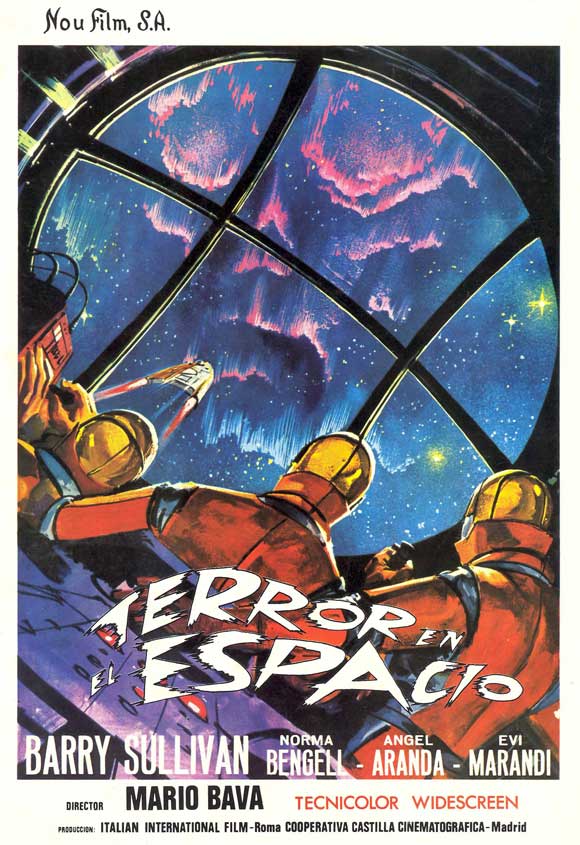
Planet of the Vampires (1965)

American-International Pictures had made some money in the U.S. with Mario Bava’s Black Sunday and Black Sabbath. It just made sene for Samuel Z. Arkoff and James H. Nicholson to gain more control by producing the films themselves instead of just buying the rights.

Working with Italian International Film and Spain’s Castilla Cooperativa Cinematográfica, AIP provided the services of writer Ib Melchior (The Angry Red Planet) to create the American version of this movie, which was based on Renato Pestriniero’s short story “One Night of 21 Hours.”

planet-of-the-vampires-movie-poster-1965-1020430218

This movie was quite literally the Tower of Babel, as each major cast member performed in their respective languages: Barry Sullivan spoke English, Norma Bengell spoke Portuguese, Ángel Aranda Spanish and Evi Marandi Italian. And the low budget would have made a cheap-looking movie with any other director, but Bava was the master of in-camera effects and flooding his sets with color and fog. In a Fangoria article, he would say, “Do you know what that unknown planet was made of? A couple of plastic rocks — yes, two: one and one! — left over from a mythological movie made at Cinecittà! To assist the illusion, I filled the set with smoke.”

When 1979’s Alien came out, those that had been exposed to Bava’s work would let people know that many of the ideas in that film came directly from this modest film with its $200,000 budget — I know Joe Bob, everyone lies about budgets. While Ridley Scott and Dan O’Bannon would claim for years that they had never seen this movie before, the writer would later say, “I stole the giant skeleton from the Planet of the Vampires.”

Want to know how I know those claims are true? From the very start of this film, two large ships — the Galliott and the Argos — in deep space respond to an SOS call and are lured to a planet where alien beings either take their bodies over or murder them. The crew of the Argos instantly begins murdering one another — with only Captain Markary (Sullivan) able to pull his crew out of madness. When they arrive at the other ship, everyone is already dead, including Markary’s brother.

Soon, the bodies of the dead are walking as if alive, the ships are damaged beyond repair, and crew members are getting wiped out (look for a young Ivan Rassimov — later of the giallos The Strange Vice of Mrs. Wardh and All the Colors of the Dark, and the Star Wars clone The Humanoid — as one of them!).

While this film is 55 years old, I have no interest in ruining the ending for you. Instead, I want you to sit and bask in its colorful glow, awash in fog and mystery, with pulpy science fiction heroes running around in fetishy costumes and discovering skeletons that could in no way be human. It is everything that is magic about film.

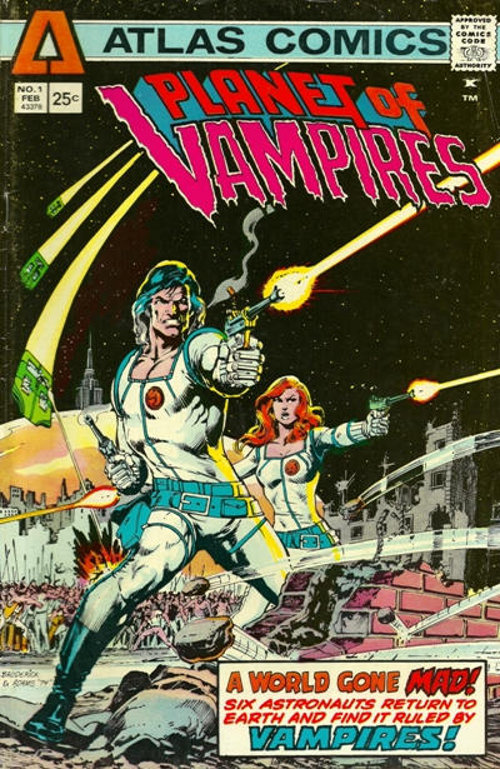
Atlas — the comic company that tried to challenge Marvel and DC in the 1970’s — combined I Am Legend with this film to create the comic Planet of the Vampires. Much like all of their books, it only ran three issues, but the first one boasts a cover with pencils by Pat Broderick with Neal Adams-inks and other issues have great work by Russ Heath. The first issue was also written by future G.I. Joe mastermind Larry Hama. I have no doubt that Atlas did not pay AIP for the rights to this.

— Sam Panico

In 1972 Marvel Comics founder and publisher Martin Goodman left Marvel, selling the company in 1968—a company which he founded in 1939. When Marvel failed to honor Goodman’s retirement agreement to allow his son Chip to run the company, Goodman Sr. created Seaboard Periodicals and the Atlas Comics imprint in June of 1974 to go head-to-head with Marvel.

And by April of 1975—it was all over.

During Seaboard’s ten short months of existence, they published between two to four issues across 31 titles (comics and magazine-periodicals) for a total of 72 issues. In addition to creating original superhero characters, Seaboard attempted to acquire the rights to Japan’s Toho Studios’ stable of monsters, such as Godzilla, along with TV’s then popular Kolchak: The Night Stalker (check out our “Exploring: Dan Curtis” featurette) and a series of pulp-action spy novels.

Another one of Seaboard’s choices for adaptation came courtesy of Charlton Heston’s back-to-back hits with Planet of the Apes (1968; check out out “Ape Week” of reviews of the franchise), The Omega Man (1971) and Soylent Green (1973) (check out our September 2019 “Atomic Dustbin” of Apoc film reviews)—so began the legal processes to acquire the rights to and create a comic book version of Richard Matheson’s I Am Legend.

And Matheson refused.

So Seaboard’s staff of writers and artists came up with their own variant of Matheson’s tale: a hybrid of Planet of the Apes and The Omega Man that also bared a striking similarity to Yul Brenner’s New York-based post-apocalyptic entry: The Ultimate Warrior (1974). And, of course, as Sam pointed out, the writers at Seabord dumped a heaping, radioactive helping of the Master Bava’s Planet of the Vampires into the atomic dustbin for good measure. (You don’t think so? Check out those black leather-yellow piped uniforms in Bava’s film against the white-blue piped uniforms of the Ares IV crew.) And, as with their rips of those 20th Century Fox and Warner Bros.’ apoc properties, Seaboard didn’t pay AIP a dime for the rights.

And while surely John Carpenter was influenced by those four films, an apocalypse film critic can’t help but wonder if Carpenter read those three mid-1975 comic issues of Seaboard’s Planet of Vampires in creating his vision of a dystopian Big Apple for his own game-changing science fiction film: Escape from New York (1981)—all that was missing was The Empire State Building’s use as an architectural spine to support a domed city on the isle of Manhattan.

But at least we got the awesome Michael Sopkiw as Parisfal in 2019: After the Fall of New York out of the deal.

And Sergio Martino didn’t pay AVCO Embassy a dime.

And, as Sam explored, a whole bunch of people ripped off Alien (read a rundown of his reviews of those Alien rips HERE and HERE) . . . which ripped off Planet of Vampires . . . and no one paid Dan O’Bannon a dime. So it all evens out. Bava wins the apoc sweepstakes.

You can watch Bava’s incredible film on Amazon Prime.

— R.D Francis

About the Authors: Sam Panico is the proprietor of B&S About Movies. You can learn more about the writings of R.D Francis on Facebook. He also writes for B&S Movies.

Nightwing (1979)

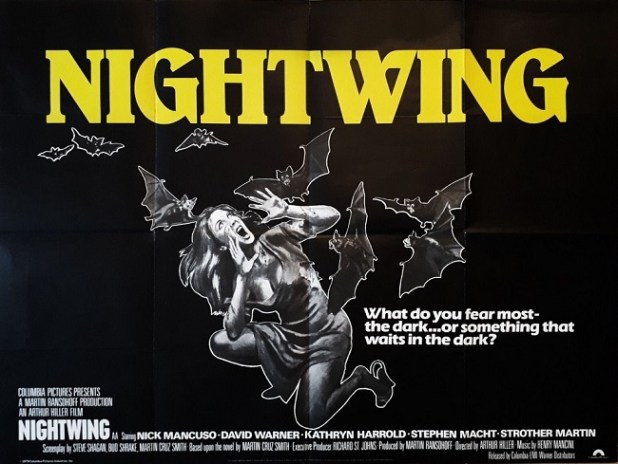
Martin Cruz Smith may be best known for his Arkady Renko books, which start with Gorky Park, but he also wrote the book that this vampire bat movie is based on. It has the tagline “Day belongs to man, but night is theirs!” and is much closer to Jaws than any Dracula film.

Arthur Hiller directed and he was behind plenty of great comedies, like the Gene Wilder and Richard Pryor vehicles Silver Streak and See No Evil, Hear No Evil. He was also the Alan Smithee who directed An Alan Smithee Film: Burn Hollywood Burn and his last film, perhaps ignominiously but hey, we all need to work, was National Lampoon’s Pucked, which starred Jon Bon Jovi.

Youngman Duran (Nick Mancuso) is a deputy on a New Mexico Native American reservation who is investigating a series of cattle mutilations, which seemed to be happening all the time in the 70’s (or maybe all I did was watch In Search Of and horror movies, so perhaps I was more attuned to it happening).

His foster father — a medicine man — reveals that he has conducted a ritual to bring about the end of the world and his body is soon found drained of all its blood. There’s also a tribal council member named Walker Chee (Stephen Macht, who teaches ethics at Harvard) who has found oil and plans to keep it all for himself.

With the help of a British scientist named Phillip Payne (David Warner!) and medical student Anne Dillon (Kathryn Harrold, the only actress I know who has been paired with both Arnold Schwarzenegger (Raw Deal) and Luciano Pavarotti (Yes, Giogio). Strother Martin shows up, too!

This is perhaps the only vampire movie to feature “Lucille” by Kenny Rogers and “Don’t It Make My Brown Eyes Blue” by Crystal Gayle on the soundtrack.

While this movie was destroyed by critics in 1979, it has acquired somewhat of a cult audience ever since. If you’re looking for a slow boil about ecology and the plight of our indigenous peoples that suddenly gets awesome when bats swarm a campfire and an old woman gets set ablaze, good news!

Rockula (1990)

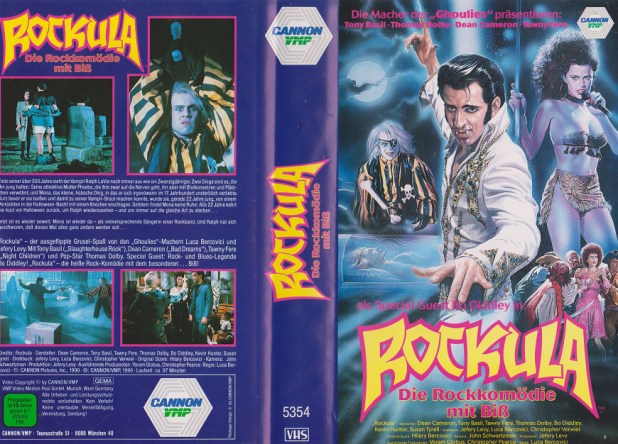
Luca Bercovici was behind The Ghoulies and The Granny as well as this movie, where a 400-year-old vampire named Ralph Lavie (Dean Cameron). He lives alone with his mother Phoebe (Toni Basil!) and is suffering from a curse. It turns out that every time he falls for Mona, she’s killed on Halloween by a pirate with a giant hambone. Now, he plans to stay locked up in his room so that his heart doesn’t get broken again.

Our hero is somehow friends with Bo Diddley and survives getting hit by a car driven by Mona (Tawny Fere), who in this lifetime is a singer managed by her ex-boyfriend Stanley (Thomas Dolby!). Ralph starts a band, called Rockula, falls in love again and has to save his love.

Susan Tyrell shows up as a bartender, which should really be all the reason you need to see this movie. Well, that and the end, where an Elvis-dressed Ralph busts out of a mirror and performs. The song are pretty silly, the story is kind of dumb, but I still found myself enjoying this.

You can get this from Shout! Factory.