Based on the book by Doug Curran, this movie is all about people who have seen UFOs or been abducted, like Betty Hill. It also shows off the Unarius Church, which we’ve happily featured on this site thanks to Children of the Stars.
This is a really even-handed discussion of people that believe that they have a connection with aliens and other planets. None of it is played up as a joke or as too silly or even deadly serious for that matter. It’s just right and a great example of Curtis working as a documentary filmmaker. I would have liked to have seen him do more stuff like this.
Sadly, this is a really hard to find movie. I’ve done the research and found it on YouTube for you.
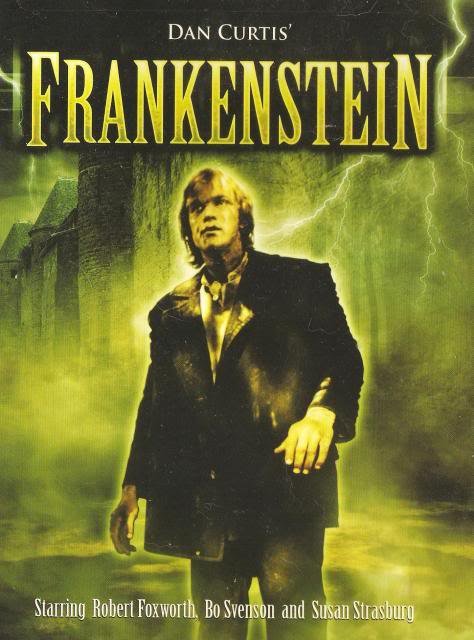
Written by Sam Hall and producer Dan Curtis, this made-for-TV Frankenstein adaption was directed by Glenn Jordan, who would also be in charge of Curtis’ The Picture of Dorian Gray.
Originally airing on January 16, 1973 on ABC, this show was forgotten due to another more expensive TV film, Frankenstein: The True Story.
Robert Foxworth, who was Questor in The Questor Tapes, stars here as Dr. Frankenstein, determined to give life to dead tissue. He’s also in the TV movie The Devil’s Daughter with Johnathan Frid and Shelley Winters.
Bo Svensen makes for a great monster that you both feel for and are afraid of at the appropriate times in the script. He’s joined by Susan Strasberg (Sweet Sixteen), Robert Gentry (Dear Dead Delilah) and Curtis favorite John Karlen (who is in just about every TV movie that Curtis woud produce).
You may or may not like the shot on video look of so many of Curtis’ productions. I personally love them and make me wistful for an era of TV that is long gone.
Yes, a film had to break one of metal’s most enduring bands because, as usual, U.S radio was—and always will be—a day late and dollar short, stumbling behind the times. Sure, there were a few of the still independent progressive FM rock stations—ones not yet gobbled up by corporate America and its damned marketing consultants with their cursed “focus groups” and computerized “McDonald’s of Radio” playlists—that gave a few spins to the pre-Highway to Hell tunes “High Voltage,” “T.N.T.,” and “Whole Lotta Rosie.”
U.S radio eventually caught up with its European counterpart, where AC/DC was already a well-known and respected band, by way of their sixth album, the pretty-hard-to-ignore powerhouse, 1979’s Highway to Hell, featuring the now classic rock radio staple title song. But when the band’s first concert film played as a midnight movie in U.S theatres in the winter months of 1980, their stardom as a premiere heavy metal band in American was sealed.
And we have Tracy Sebastian, aka Billy Eye Harper, the leader of the greatest faux rock band of all time, Head Mistress, to thank for bringing AC/DC to America.
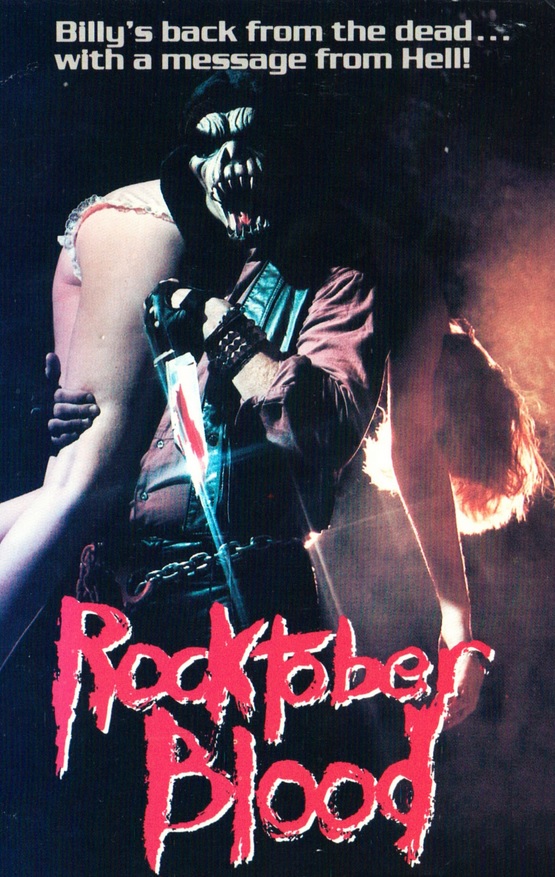
The original theatrical one-sheet.
To hear Ferd Sebastian, the director of Rocktober Blood, tell it in the U.K pages of Hysteria Lives!, his son, Tracy, was on vacation in Paris and seen the French-shot and European-released film that chronicled a December 9, 1979, AC/DC performance during their “Highway to Hell Tour” at the Pavillon de Paris.
Tracy, being a rock ‘n’ roll fanatic, and with his dad in the film business, a light bulb went off: he was adamant Sebastian International Pictures bring the film to America. After taking care of some post-production sound issues with the film and finalizing a distribution deal, the film was released on the U.S midnight movie circuit and, according to Ferd, “we four-walled the theatres and brought the money home every night. Lots of it.” And Warner Bros. took notice and wanted a piece of the action. So the Sebastians cut a deal with Bugs and the gang and made even more money. And it was the funds from the film that broke AC/DC in American that financed the production of our beloved heavy metal horror film featuring the slashin’ n’ singin’ of Billy Eye Harper.
Sadly, AC/DC’s lead singer, Bon Scott, never had a chance to enjoy the film’s success: he died on February 19. 1980, just over two months after filming was completed. Though the film shares its title and artwork, along with a few songs, from AC/DC’s fourth studio album, Let There Be Rock, the movie also includes live versions of songs from their albums from T.N.T., Powerage, and Highway to Hell, their 2nd, 5th, and 6th albums, respectively.
The film spends its first ten minutes with the band backstage, and then the music starts. For those of you not familiar with the pre-Brian Johnson era of the band, this is a chronicle of AC/DC when they were still, essentially, a bar band, only carousing on a larger stage—and sans the stage effects and pyrotechnics they became noted for in their post-Black In Black years. As the music unfolds, interviews conducted with the band two days before the concert are intercut between the songs.
What sets Let There Be Rock apart from other midnight movie concert films of the era: instead of shooting upwards, from a fan’s pit vantage point in front of the stage, as is typical of most concert films, Let There Be Rock is shot from above or on the stage—and is noted as the first concert film that “put the fans on stage” with the band.
The U.K Platinum-selling (50,000 copies) VHS home video version of the film.
The subsequent Warner Bros. DVDs—that ditched the original 1980 artwork (totally bogus!)—are readily available on all of the usual seller sites—even Walmart. But how are there no PPV online streams? Luckily, you can watch a pretty clean rip of the film on Daily Motion.
There was individual track-by-track playlist of the soundtrack on You Tube, sans interviews and backstage scenes, featuring film’s songs in order of their film appearance, but that playlist has since been deleted (par for the You Tube course).
“Live Wire” (T.N.T., 1975) “Shot Down In Flames” (Highway to Hell, 1979) “Hell Ain’t a Bad Place to Be” (Let There Be Rock, 1977) “Sin City” (Powerage, 1978) “Walk All Over You” (Highway to Hell, 1979) “Bad Boy Boogie” (Let There Be Rock, 1977) “The Jack” (T.N.T., 1975) “Highway to Hell” (Highway to Hell, 1979) “Girls Got Rhythm” (Highway to Hell, 1979) “High Voltage” (T.N.T., 1975) “Whole Lotta Rosie” (Let There Be Rock, 1977) “Rocker” (T.N.T., 1975) “Let There Be Rock” (Let There Be Rock, 1977)
In lieu of that deleted playlist, you can watch this version of “Live Wire” from the the film.
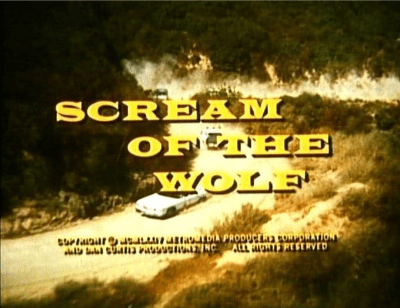
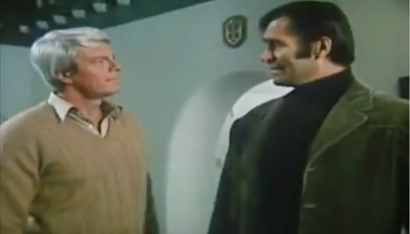
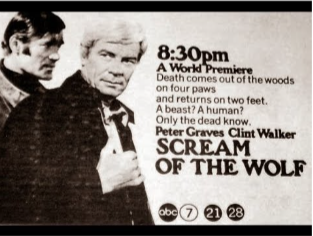
In a sleepy town along the coast of California, an unknown animal begins killing people, beginning with a ‘70s version of Dana Carvey. The local sheriff (All My Children’s Philip Carey) recruits local writer John Wetherby (Peter Graves) who used to earn his living as a big game hunter to help track the animal. Baffled by the presence of both four and two-legged tracks, he approaches his shifty ex-hunting buddy Byron (Clint Walker) for assistance who refuses to cooperate. As more people die, the townsfolk begin to believe there’s a werewolf in their midst.
A few weak red herring characters peppered throughout the story aside, Byron is the prime suspect. Not only was he bitten by a wolf, he has a strange obsession with the exchange of power between predator and prey. He hates John’s new “emasculating” life of leisure and possesses a rather creepy yet swaggering demeanor.
Based on the story The Hunter by David Case, Richard Matheson’s teleplay is better than the average TV movie script. On the surface it appears to be a standard whodunnit supernatural mystery. It was only upon further scrutiny I noticed the anti-hunting message and sexual subtext. Both of the protagonists are professional hunters. One becomes civilized and changes careers. The other sticks with it and grows into a psychopath who masks his feelings for another man through hyper-masculinity and violence.
The sexual tension between John and Byron isn’t just palpable. It’s downright steamy. The long knowing gazes, Byron’s unexplained hatred for John’s girlfriend Sandy (Jo Ann Pflug), the passive aggressive references to their time together alone in the Canadian wilderness and the arm-wrestling match where Byron challenges John, to “last seven minutes” are all very obvious references that Byron just can’t quit John. I kept waiting for them to embrace in a passionate kiss and walk off into the sunset together, carrying their very long rifles at waist height.
Alas, this is a ‘70s TV movie, so their past is never fully revealed. Instead, we get a nice double twist where first Byron fakes his death and pins the werewolf murders. After returning to confront him, Byron reveals himself to John, who assumes he was the werewolf all along. Not even close. In fact, it isn’t a werewolf at all that’s been mutilating people. It’s a German Shepherd, tortured and trained to hunt humans by Byron. Why? To awaken John’s “urge to action” and get him to go off to South America with him on another “hunting trip.” It doesn’t work. After a chase reminiscent of The Most Dangerous Game (1932), heterosexuality wins out. John outsmarts Byron and shoots him with a hidden handgun after a nice bit of dialogue where Byron tells his prey, “You wanted me to stalk you.” and John replies, “Let’s just say I didn’t want you to leave.”
By the time Scream of the Wolf aired, director Dan Curtis was already well-known for working in the horror genre, having made Dark Shadows and The Norliss Tapes. Whether he was aware of the subtext in the teleplay is unclear, but he directs the stalk-attack sequences with his usual skill, and is very unsettling even for a TV movie. As journeymen actors, Graves, Walker, Pflug and Carey are all very good in their respective roles. The musical score is another highlight, with a groovy yet suspenseful theme that’s a combination of Enter the Dragon and Friday the 13th.
While not as well-known as Trilogy of Terror, which arrived the following year, Scream of the Wolf is an overlooked gem that made the rounds on cable about 15 years ago. It’s never been given a proper DVD or Blu-Ray release, but it definitely deserves one. It’s got a good script, plenty of dead bodies, good acting and subtext so subtle it probably flew right over the average ‘70s ABC viewer’s head. Fans of Dan Curtis, or older men arm-wrestling will enjoy it. Did I mention Peter Graves drive a sweet Corvette? The cherry on top.
ABOUT THE AUTHOR: Jim Rex knows plenty about movies and is more than happy to share that knowledge with the world at large.
I been hanging around the Video City Drive-in for a while and although I wouldn’t boast that I’ve seen it all, I would say I seen my fair share. But still, some things surprise me and fans surprise me.
Before we start I want you to know I’m gonna be talking freely about the two films in question and if you haven’t put your eyes on them yet and don’t want them spoilt, then stop reading. I mean, one has been around for dang near forty years and if you haven’t seen it by now you probably ain’t never gonna get around to watching it but still, divert your eyes. Go watch some cat videos. But seriously, stop reading because I’m giving away main plot points and endings; the whole shooting match.
Ok, may the record show that I like remakes. Sure, maybe not every remake that comes down the pike. I find a lot of them to be kind of pointless, but when the higher power of the almighty greenback dictates what gets remade, no fan’s philosophical outlook on the matter, or their love for the original film, means much to the suits up there in Hollywood Town.
When we’re talking about remakes, there are a couple different flavors filmmakers can choose from. Because all remakes aren’t created the same, it stands to reason that some remakes slip by fans or they never realize a new film is a remake. This goes beyond knowing there have been four official film versions of Jack Finney’s The Body Snatchers. It drives me nuts sometimes when fans don’t know their movie history. I don’t mean you have to know every movie ever made, but know some of your history. You need to be aware there’s a dumb little rubber Piranha remake stuck in between Joe Dante’s classic 70’s version and Alexandre Aja’s entertaining modern 3-D remake.
So, I’m about to shoot my mouth off and make a big fat statement some of you might be inclined to react to with a sour, “Jim Rex, you done flipped your lid, son. Your mouth-hole’s making one heck of a racket and you need to shore it up before you get popped.” I’m hoping you might be more inclined to say, “I never did consider that idea quite that way before, Jim Rex. Your mouth-hole’s making a little sense.”
Without further ado, the Video City Court of Law is now in session. In presenting my case I am going to try and use official, judicial sounding words and phrases, most of which I will be too lazy to look up to see if I’m using them correctly. (Abet I do it more than once, but I’m felon pretty good about stating my case today.)
No, ladies and gentlemen, technically I did not go to law school. To the best of my knowledge I never even have driven by a law school. But I did log a couple hundred intense hours watching Perry Mason and Matlock with my Maw-Maw Rex and her friends at the Abilene Convalescent Center, so if anything, I feel pretty good about wrapping all this up within an hour or so, less fifteen minutes for commercials.
Let’s first discuss about all the different types of remakes and figure out what kind we’re chin waggin’ about here. The traditional remake is by someone who loved and/or respected the old movie and then convinces a studio to let them remake it, and they try to add to the story in an attempt to make it better, or update it for modern viewers. Examples would be John Carpenter’s The Thing (1982) and David Cronenberg’s The Fly (1986). Sometimes someone just wants to remake a movie they loved and/or respected, knowing full dang well it won’t be as good as the original but they hope it is at least fun and they do it anyway. These kinds are like Black Christmas (2006) and Sorority Row (2009).
Then, there’s the old sequel-remake, as in, “We made our first movie for seventeen dollars and thirty-three cents and it made millions at the box office. Let’s take all this money the studio gave us for a sequel and just remake it.” Evil Dead 2 (1987) and Phantasm II(1988) are examples of this kind of remake.
Then there’s the “Inspired by” kind of remake. Some people call these “Rip-off,” but these are really two different things. An “Inspired by” uses the nugget of an idea from an earlier film as a launching pad for a new film. Zero Hour! (1957) begat Airplane! (1980), Fantastic Voyage (1966) was the proud papa of Innerspace (1987) and IT! The Terror from Beyond Space (1958) sired Alien (1979). “Inspired by” remakes are usually made with love and respect for the original film. It is not always blatantly obvious what older film the new film is inspired by.
A “Rip-off” remake is usually inspired only by the money an earlier film made. Great White (1982) is certainly a rip-off of Jaws (1975) and Battle Beyond the Stars (1980) is certainly a rip-off of Star Wars (1977). “Rip-off” remakes are usually made with love and respect only for money. It is always blatantly obvious what older film the new film is ripping-off.
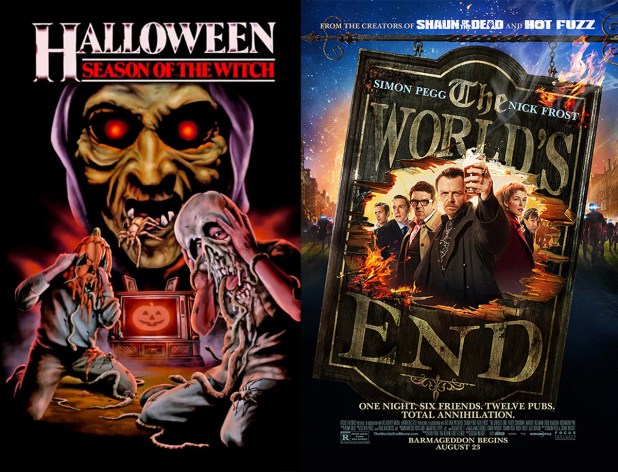
Ladies and gentlemen of the jury, I would now like to take the opportunity to convince you that I absolutely believe, beyond a shadow of reasonable doubt, that Tommy Lee Wallace’s 1982 classic trick or treat flick of witchcraft and robots, Halloween III: Season of the Witch, was remade, quite brilliantly with much respect, as an “Inspired by” type remake by Edgar Wright and Simon Pegg with beer and robots as the chug-a-lug classic The World’s End (2013)!
It feels good to say it out loud. I mean, I been waiting for someone else to notice this forever and say something so I wouldn’t have to, but never once have I ever seen or heard it mentioned. I talk to other fans about it and when I sort of hint around it they look at me like I got gawl-dang lobsters crawling out my ears.
Okie-dokie, the hard part is over, now the easy part. Evidence. I have so much manipulating and speculative and circumstantial evidence it is going to make your head spin. What makes me think Halloween III: Season of the Witch was remade as The World’s End? Please look over at the ABC table of evidence.
Both films take place in small rural towns; Santa Mira in Halloween III and Newton Haven in The World’s End.
Silver Shamrock rules Santa Mira and The Network rules Newton Haven. In fact, these “corporations” coming to these small towns revitalized them.
The Silver Shamrock logo is prominent throughout Santa Mira. The logo for The Network (five lines of varying heights) is prominent throughout Newton Haven.
Both “corporations” resort to shady business practices. (Silver Shamrock mixes modern technology and ancient witchcraft for results while The Network depends on ever-advancing modern technology for results.)
As soon as our heroes in both films roll into town, eyes are on them from everywhere.
The “hero” in both films is a middle-aged alcoholic man. Dan Challis, in Halloween III, is a divorced doctor. Gary King, in The World’s End, is a ne’er-do-well who spends a lot of time with various doctors.
Dan Challis has two kids. Gary King may have a French kid.
Dan Challis learns about Silver Shamrock from the town drunk outside a liquor store. Gary King and his friends learn about The Network from town drunk Basil in a bar.
Dan Challis likes to test his sexual prowess with young girls fresh from the shower. Gary King likes to test his sexual prowess with his friend’s sister in the public restroom.
Dan Challis has a manly mustache. Gary King has a manly Sisters of Mercy tattoo.
Most everyone in Santa Mira is an automaton under the rule of Silver Shamrock CEO Conal Cochran. Most everyone in Newton Haven is an automaton under the rule of The Network.
In both films, the automatons break apart like action figures, with limbs snapping off easily.
In both films, the automatons attack with a stiff arm thrust forward.
In both films, the automatons have super strength, but it is never a match for middle-aged alcoholic heroes.
In both films, the automatons try to act normal but always seem to stick out like a turd in a punchbowl.
In both films, a major character is taken over by the evil “corporations” and transformed into an automaton.
In both films, the major character has been transformed in an attempt to manipulate the actions of the hero. (Ellie tries to make Challis drive into a tree and Oliver tries to deliver Gary and the group to The Network.)
In both films, the automatons squirt brightly colored juice for blood. (Orange in Halloween III and blue in The World’s End.)
Throughout the film, Dan Challis is seen drinking in bars, carrying six-packs and leaving liquor stores. The nature of the pub crawl keeps Gary King drinking throughout the entire movie.
There is a moment in both films where our hero makes a mad dash from one point to another. In neither case do they vomit or pass out with a gut full of alcohol swishing around in them.
Both Halloween III and The World’s End were the third chapters in film trilogies.
Both films include sidekick actors that appeared in all three films. Nancy Loomis was Annie Bracket in the first two Halloween films and then appeared as Linda, Dan’s killer shrew of a wife in Halloween III.Nick Frost was co-star opposite Pegg in the “Cornetto Trilogy,” appearing also in Shaun of the Dead and Hot Fuzz.
Jamie Lee Curtis was in Halloween I andII as Laurie Strode and then “appeared” in Halloween III in voiceovers. She can be heard as a phone operator as well as the voice of the town’s curfew reminder. Bill Nighy was in both Shaun of the Dead and Hot Fuzz in supporting roles and then “appeared” in The World’s End as the voice of The Network. He can be heard first on the phone talking to a character and then as The Network in the climax.
In both films, human characters meet their doom at the hands of automatons after revealing “secrets” about the “corporations.”
In their final moments, both Conal Cochran and The Network give up when they realize they’ve been bested by their human opponents. (Cochran even applauds Challis’s ingenuity. The Network just throws in the towel at King’s stubborn ignorance.)
Finally, the endings are basically identical, with the destruction of the world. I know, I know, it never really shows what happens to all the kiddos on Halloween night, but we know instinctively there is no way Challis saved anyone. You don’t save the world with a belly full of beer. (We also know Universal imposed a “happier” ending than the original cut, wherein the screams of children could be heard in Halloween III’s final fadeout.) The World’s End follows through with its end of the world wrap-up, showing the destruction of the world and what is left of mankind after The Network packs its bags and leaves.
In closing, I will say that Wright and Pegg have shown some serious genre savvy in everything they’ve ever done together, going way back to their Brit TV show Spaced. I don’t think it is too far off to see a connection between these two films and their appreciation for Halloween III.
When boiled down, both movies work as fantasies for middle-aged men everywhere, especially those stuck in a rut who would love the adventure of maybe having to save the world. For Dan Challis it is almost a James Bond scenario where he is escaping the disappointments of his ruined family life and getting to save the world while making it with a young woman who doesn’t seem to notice how long in the tooth old Dan really is. For Gary King, he is returning to a moment in his youth when everything was perfect, and no matter how wonky the night goes, he is able to re-capture and revitalize a part of that wild spirit he left behind when he got old.
Both of these men fought for their worlds bravely, both with bellies full of beer.
Now, ladies and gentlemen, you have the proof before you. It is time to decide for yourownself. I know what I believe.
While not produced or directed by Dan Curtis, this made for TV movie was produced by his company. It was produced by former actor Joseph Stern, Eda Godel Hallinan and Keetje Van Benschoten.
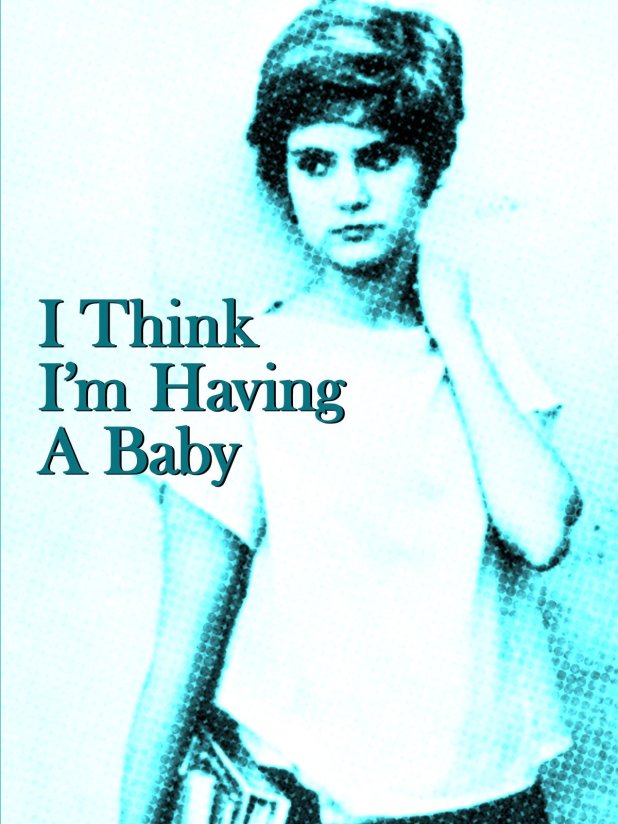
Directed by Arthur Allan Seidelman — yes, the same man who made Hercules In New York — and written by teen fiction writer Blossom Elfman, this is a movie filled with nascent Hollywood talent.
Jennifer Jason Leigh, Helen Hunt, Tracey Gold and Ally Sheedy are all on hand for about 28-minutes in the hopes that you’ll learn to talk out sex before you have it. As Becca told me that she learned, stop fooling around with boys and just get a bunny instead.
You can watch this on Amazon Prime or the YouTube link below.
Dan Curtis may have started his TV career producing golf, but he became known for his horror-related projects throughout the 60’s and 70’s. It all began with Dark Shadows, a daily series that went from gothic romance to downright weirdness and then got even stranger before the end of its five-year run.
This is way too short of a space to get into all of the stories that took part on the show, but let’s summarize them as vampire, ghosts, a Phoenix, a werewolf, Dorian Gray, witches, time travel, reincarnation and even a series of episodes that took much of the cast to a parallel version of its universe, all tied together by lead vampire Barnabas Collins, who didn’t even show up until the show was already on for ten months.
You can still watch it online — beware there are 1,225 episodes — on Amazon Prime, Hulu and Tubi.
As the show was still on the air in 1970, House of Dark Shadowsplayed theaters, an incredibly gory and condensed version of the series. Yes, somehow hours upon hours of stories were all presented in one quick story. That said, the production values are well beyond the daily show and its a fun romp. There was a sequel after the show went off the air, Night of Dark Shadows, which moves away from the series somewhat while still remaining an entertaining — and actually frightening — film.
During Dark Shadows run and after it ended, Curtis began producing and directing a series of TV movies. Best known amongst them are the two movies feature Darren McGavin as Carl Kolchak. The Night Stalker, the first of these films, remained the top-rated made-for-TV movie for decades. Along with a second movie, The Night Strangler, and a TV series that Curtis did not work on, Kolchak influenced The X-Files and remains popular to this day.
There have been rumors of a theatrical movie being made from the original film, directed by Edgar Wright and starring Johnny Depp. It would be Depp’s second Curtis character, following him played Barnabas in the Dark Shadowsreimagining.
Curtis would then make The Norliss Tapes, another attempt at a series where an investigative reporter chases after the occult. Sadly, it wasn’t turned into a series, but the film that resulted is quite good.
If that was all Curtis did, he’d still be remembered. However, there is still more.
Burnt Offerings is an adaption of the Robert Marasco novel with Karen Black, Oliver Reed, Bette Davis and Lee Montgomery at odds with a house ready to devour all of their souls.
Curtis would work with Black again in perhaps one of the 1970’s best known TV movies, Trilogy of Terror. Across three stories, Black would be a seductress, a set of twins and a woman battling an ancient African doll out to kill her. It’s one of the best movies — not just TV movies — ever made and a true landmark of horror. A 1990’s sequel, Trilogy of Terror II, was made and while it’s not as good, it’s still interesting, as is another Curtis’s anthology movie, Dead of Night.
After several more TV movies — The Big Easy, The Long Days of Summer,When Every Day Was the Fourth of July, Curse of the Black Widow — Curtis would embark on two gigantic epic mini-series, 1983’s The Winds of War and 1988’s War and Remembrance. It was one of the few times that Curtis would receive an award for his work, as the first series won an Emmy.
Curtis produced new takes on Dark Shadows in 1991 and 2005, as well as executive producing an abortive — and way too dark and gritty — reboot of Night Stalker in 2005.
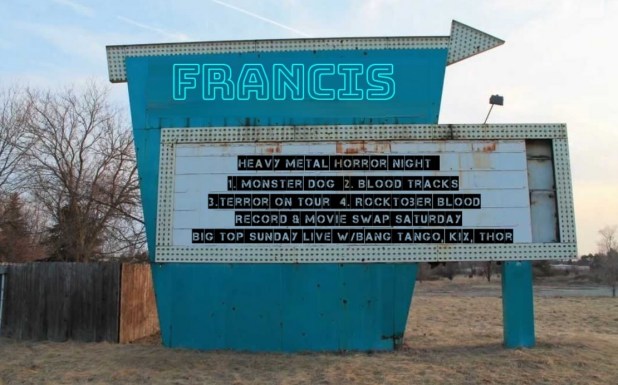
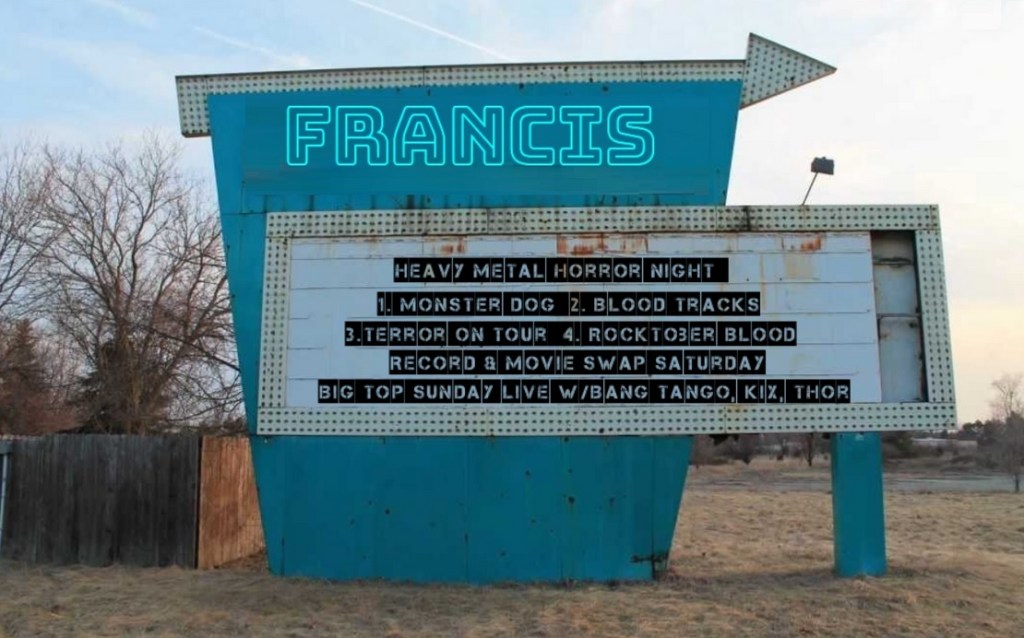
I came to B&S About Movies, the website, after I listened to B&S About Movies, the podcast. And long before I became a writer at B&S About Movies, Sam expressed his love of horror films and heavy metal music with his first “theme week” in 2017: “No False Metal.” So, for this Drive-In Friday, we’ll pay tribute to that first theme week with a “Heavy Metal Horror Night” under the moonlight.
What is “Heavy Metal Horror,” you ask? Is it the same as the “metalsploitation” moniker I’ve seen critics use?
At the same time those direct-to-video “boobs and blades” knock-offs of John Carpenter’s Halloween started flying off the video store shelves, a new form of heavy metal birthed in Britain in the late seventies—dubbed by Sounds magazine as “The New Wave of British Heavy Metal” (NWOBHM).
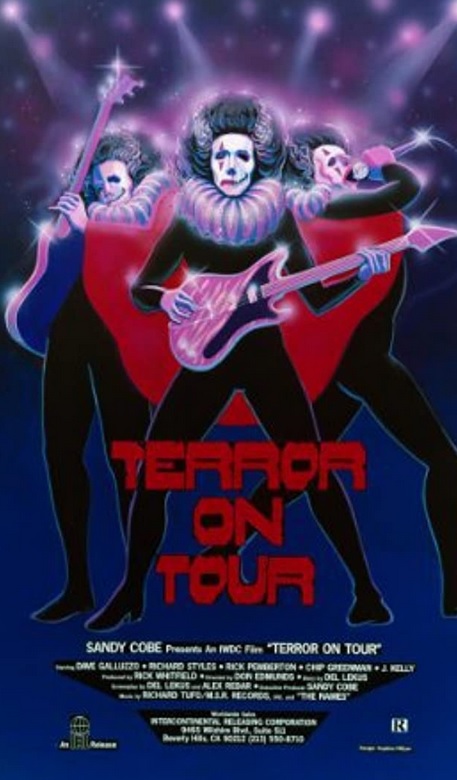
Featuring the violent, religious mania and bloody lyrics composed by the likes of Venom and Iron Maiden, complete with the requisite Satanic imagery on the album covers, slasher films and heavy metal music were a match made in hell: the music coming out of England was, in fact, Giallo musicals. This music-inspired slasher sub-genre even got its own name: metalsploitation, which featured other beloved so-bad-they’re-good bloody analog tales showcasing the exploitive titles of Black Roses, Shock ’em Dead, Terror on Tour, Rock ’n’ Roll Nightmare, and Hard Rock Zombies. The genre peaked—and quickly burnt out—when the major studios took a slice of the metalsploitation pie with 1986’s big-budgeted Trick or Treat.
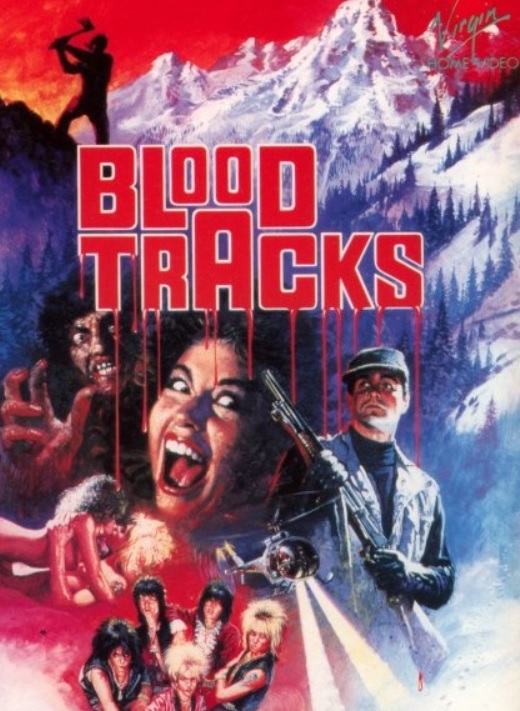
So flash those horns and let’s get the reels a-rollin’ with Monster Dog, Blood Tracks, Terror on Tour, and Rocktober Blood . . . and a surprise wildcard, so I hope you tore that coupon out of the paper to redeem it.
And don’t forget: Movies and Mosquitoes go better with a Pepsi!
The director of this heavy metal werewolf romp is Claudio Fragrasso. We talk about him alot on this site. He made what schlock film critics cite as the “worst sequel of all time”: Troll 2. With Rossella Drudi, Fragrasso co-wrote for Bruno Mattei, the films The Other Hell, Rats: Night of Terror, Robowar, Shocking Dark, and Zombi 3. Then there are the films he co-directed or directed, such as Beyond Darkness, Night Killer, and Scalps.
And this.
So, before Alice Cooper appeared in John Carpenter’s Prince of Darkness and Wayne’s World—and after he made his big screen debut in Sextetteand followed up with a bigger part in Roadie (his best work; alongside Meatloaf) and Sgt. Pepper’s Lonely Hearts Club Band (and you thought Troll 2 was bad)—he was without a recording contract and broke.
So he took this gig, starring as the world-famous Vince Raven, who takes his band to his childhood home for rest, relaxation, and a video shoot—in the remote wilds of Spain, natch. And there’s wild dogs and bad dreams and a hostage crisis and videos for Alice’s tunes “Identity Crisis” and “See Me in the Mirror.”
It’s awful. It’s crazy and it makes no sense. And we love it.
Sam pitches this movie perfectly in his review: The Hills Have Eyes set at a ski-lodge. I’ll take it one step further: Take Alice Cooper’s Monster Dog, remove the werewolf, and insert an axe-wielding maniac.
Yep. Instead of Alice Cooper as Vince Raven, we have another band—in this case, real-life Swedish hair metal band Easy Action, as the faux Solid Gold—going to a remote location to shoot a rock video.
Yep. They’re dispatched by axe, by sword . . . and bye-bye Swedish rockers, for we so wish you were Swiss rocker Krokus.
You can watch the full Movie for free on You Tube.
In our review of 1971’s psycho-slasher Point of Terror, we discussed the resume of trash filmmaker Don Edmonds and his works with Dyanne Thorne. Together, they made two of the ‘70s trashiest Drive-In fests that became ‘80s video rental de rigueur: Ilsa: She Wolf of the SS (1975) and Ilsa, Harem Keeper of the Oil Sheiks (1976).
And this movie needed a dose of Dyanne. Badly.
Anyway, the “terror” is the bargain-basement KISS clone the Clowns, who dress in black leotards, wigs and Phantom of the Opera-styled half-masks. And someone is dressing up as one of the Clowns and killing their fans. And what in the hell is the “Soup Nazi” from Seinfeld doing here? Hey, starting his acting career.
Oh, the Clowns are actually the Rockford, Illinois, band the Names. Yes, they did gigs back in the day with Cheap Trick. And Chip Greenman, the drummer in the Names, sat on the drum kit with the Cheap Trick precursor, Fuse, which featured Rick Nielsen and Tom Peterson. And when Rick and Tom put together a “new band,” Chip turned down their invitation to join, instead signing on the dotted line with the Names.
Chip got to star in this movie as the consolation prize. And he can’t act. And neither can the rest of the Names.
You can watch the full movie for free on You Tube.
Oh, dear lord Satan. How Sam and I (especially me) go on and on about this pinnacle-mixture of heavy metal and horror. Sam did a pretty good job in chronicling the exploits of Billy Eye Harper (review), but I had to go and take another crack at it (review). And then we examined the never-made sequel, Rocktober Blood 2: Billy’s Revenge.
See, we told you we love Billy Eye Harper around here. We even review never-made-movies about him.
The short of it: Billy Eye Harper and his band Head Mistress are recording music for their annual October Rocktober Blood tour and—it seems—Billy has a psychotic break, murders members of his crew, a few record executives, and fails in his attempt to murder his co-vocalist, Lynn Starling.
Of course, as the poster’s tagline teases: Billy returns from the dead to kill—and rock again. The music of Head Mistress (You Tube soundtrack playlist)—provided by the L.A band Sorcery (of Stunt Rock fame)—is excellent, even more so that the actually movie. Oh, and Billy’s “voice” is the late Nigel Benjamin of the post-Mott the Hoople band, Mott.
And did you know that Billy Eye Harper, aka actor Trey Loren, aka Tracy Sebastian, is responsible for bringing AC/DC: Let There Be Rock to the big screen? True story . . . and we’ll get into that with our review on that film, which broke AC/DC in America, tomorrow at 11 AM.
You can watch the full movie for free on You Tube.
How in the hell did Krishna Shah, a double-graduate of Yale and UCLA, come to hook up with E.J Curse of the Gene Simmons-produced L.A. band Silent Rage (and formed Dead Flowers with ex-Guns N’ Roses Gilby Clarke) and ‘80s metal songsmith Paul Sabu to make a movie, about . . . a small time rock band, Holy Moses, who stumbles into a creepy, small town that Adolf Hitler is using to launch the Fourth Reich—all with the help of werewolves, murderous dwarfs, a hot blonde hitchhiker with a penchant for hand chopping, and medieval songs that resurrect the dead? Yeah, I know that’s a run-on sentence, but I need it to describe this . . . movie!
Well, now that we look at this all these years later . . . our educated, filmmaking and critical eye realizes Shah was creating a parody of the metalsploitation genre and all of that Nazi craziness that horror films deployed back in the ’50s and ’60s. So, the reality is: we love Mr. Shah for giving us this movie. It surely sits proudly on my VHS shelf of cherished, used analog ditties.
Trivia Alert: This was shot back-to-back with Krishna Shah’s T&A epic, American Drive-In (1985) . . . and Hard Rock Zombies is the movie playing in the Drive-In of that movie. Oh, and Emily Longstreth from American Drive-In, also starred in the Alien knock-off Star Crystal and the apoc-romp Wired to Kill. And Shah’s co-producer, Sigurjon Sighvatsson, produced Steven Dorff’s grunge flick S.F.W. (1994; reviewed on April 5th, in remembrance of Kurt . . . and thank you, Sig, for I LOVE that grunge delight).
You can watch the full movie for free on You Tube. Hell, ya! The full soundtrack for Hard Rock Zombies is on You Tube, courtesy of Paul Sabu! “Oh, Cassie!”
Don’t forget to hang up the speakers and please use our trash receptacles on the way out. Don’t throw your trash on the grounds. Thank you! And tickets are still available for the Kix, Bang Tango, and Thor show under the Big Top on Sunday. Bring your VHS tapes and albums, as all three bands are doin’ a meet-and-greet after the show.
Now, let’s have Acid Witch take us out with Midnight Movies, their all-covers EP of songs from ’80s heavy metal horror films. Hit it, boys!
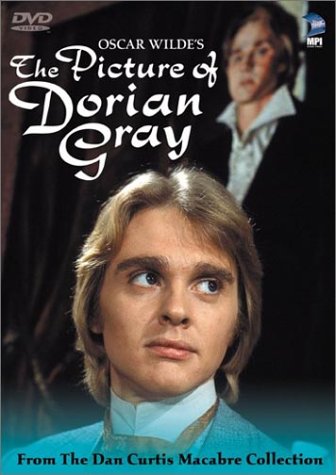
Originally airing on April 22, 1973 on ABC, this Dan Curtis-produced adaption of the Oscar Wilde book was like going back to the Dark Shadows well. After all, Quentin Collins also had a portrait that had kept him immortal. He was born Grant Douglas in 1870 and if you reverse those initials, you get the same ones as Dorian Gray.
It was written by John Tomerlin who was the scribe for the Twilight Zone episode “Number 12 Looks Just Like You” as well as episodes of Thriller. Glenn Jordan directed and you may remember him from the Kim Milford-starring TV movie Song of the Succubus.
Shane Briant (Demons of the Mind, Captain Kronos: Vampire Hunter, Frankenstein and the Monster from Hell, Hawk the Slayer) is the perfect Dorian Gray, at once sure of his actions and the other yearning to escape from his life of sin.
Charles Aidman, who worked for Curtis in The Invasion of Carol Enders and as the narrator of When Every Day Was the Fourth of July, appears, as does William Beckley (Gerard the butler from Dynasty), Nigel Davenport (No Blade of Grass), Vanessa Howard (Some Girls Do), Linda Kelsey (TV’s Lou Grant), a very young Kim Richards (when she wasn’t escaping Witch Mountain or getting shot outside Precinct 13 as a child, she was falling in love with Mr. Gray) and Curtis favorite John Karlen, who played Willie Loomis on Dark Shadows.
This is a mannered take on the story, so don’t expect much excitement. But there are a few really great scenes between Davenport and Briant. It’s worth a watch.
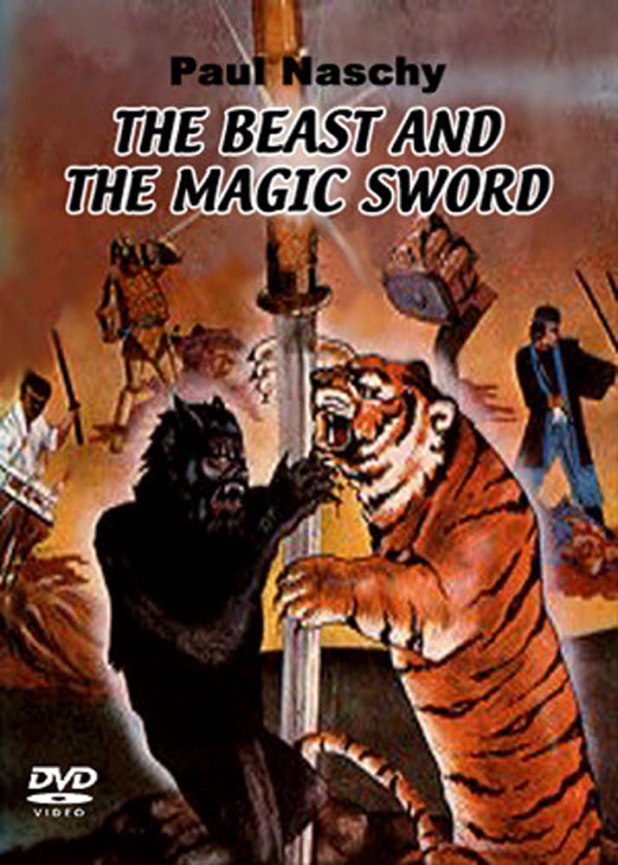
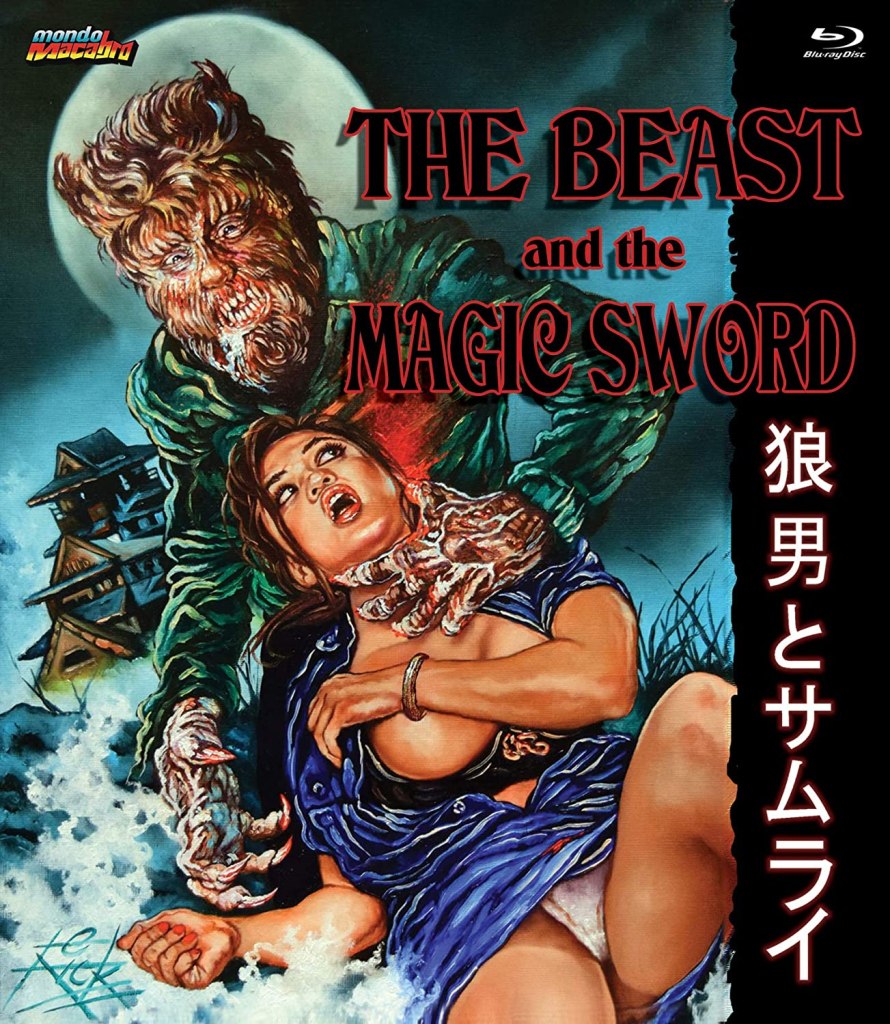
The tenth adventure of Count Waldemar Daninsky — played as always by Paul Naschy — this Spanish/ Japanese co-production was never theatrically shown in any country other than its native Spain. It was never dubbed in English, never released on VHS or even DVD. Now, Mondo Macabro comes to the rescue with a gorgeous blu ray release of a movie that defies any logic and makes me fall in love with werewolf movies all over again.
What do you need to know? Well, Waldemar Daninsky goes to Japan in the hopes of being cured of his lycanthropy. You may wonder, “Why is this movie in the past instead of modern times like most of the other Paul Naschy werewolf movies?”
Stop asking questions and buckle up.
For the first time, you will learn how the Daninsky curse began, way back in the 10th century. Yes, a witch busts in and screams, “All the seventh-born sons will be transformed into beasts! The Daninskys will be a race of murderers! Hated and persecuted FOREVER!” before taking a wolf skull and biting the baby Daninsky through his pregnant mother’s stomach. Centuries later, that baby has grown up and searched the world looking for a cure before coming to Japan.
There, in the studios of Toshiro Mifune, he will battle a samurai played by Japanese actor Shigeru Amachi, as well as a tiger, a witch, ninja and ghost samurai.
How could something this magical happen? Well, Naschy was paid by some Japanese investors to make a series of documentaries on the history of Spain. They also paid for two films — Human Beasts and this movie.
I wish they had given him enough yen to make twenty of these movies.
You can get this directly from Mondo Macabro. Do so now. ASAP.
This first-ever U.S. release is awesome, with a brand new 4K restoration from the original negative, an archival intro by Naschy, a documentary about his werewolf films, new audio commentary by Rod Barnett and Troy Guinn of The Naschycast and a New interview with Gavin Baddeley, author of the book The Frightfest Guide to Werewolf Movies.
If the mail fails at any point, you can also download this from the Internet Archive.







 B&S About Movies
You must be logged in to post a comment.