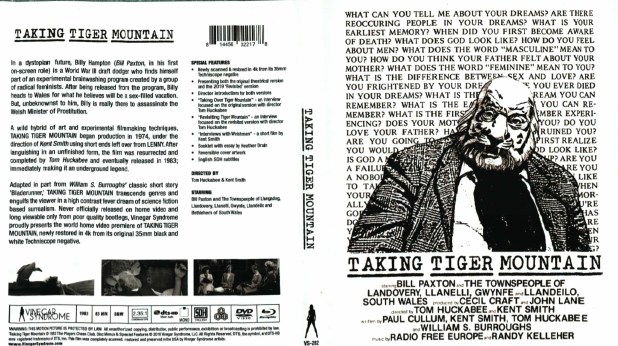
In 1974, nineteen years old Bill Paxton and his friend Kent Smith had some film left over from making the movie Lenny and hit the Morocco “Hippie Trail” to make their own movie. However, they lost their equipment at the Charles de Gaulle Airport where they lost — more like impounded — their equipment and had to pay for it to be released.
That’s what sent Bill and Kent to the UK, where they shot silent footage using locals all around South Wales. The film they made took a decade to see the light of day, but now it is available. And it’s really something else.
Also — the title isn’t a Brian Eno reference. Both this movie and teh musician were inspired by album was inspired by a Chinese revolutionary opera with the same title.
Paxton told Variety that “The original idea was kind of like The Stranger set on the beach. But the story of making the film gets crazier when we get to Wales. We had purchased black-and-white short ends (film stock) from the film Lenny, and we sort of shot things as we came across them. One guy had a Kenyan vulture, so we used that for a scene of eating my entrails. We met some girls and talked them into doing some nude scenes with us. Basically it was a bunch of hippies running around naked. It was all silent, black-and-white footage. Years later, director Tom Huckabee got the rights to some writings of William Burroughs, added an audio track and shot some new footage. So miraculously, he made something out of this, and it did get released. Kind of.”
That’s because in 1975, Smith gave the footage to University of Texas student Tom Huckabee, who based the script on a poem he wrote about the J. Paul Getty kidnapping. Originally, he intended the movie to be a dream about an American waking up a train with no memories before he wanders into a town, has some adventures and dies. But once he assembled the footage, he was unhappy with the results.
That’s how this became a movie about a group of militant feminist scientists who brainwash Paxton and get him to assassinate the Welsh Minister of Prostitution. Throw in some audio recordings of William Burroughs and new footage and the film was briefly distributed by Horizon Films and exhibited In the US by the Landmark theater chain.
Huckabee told Beatdom, “I should mention that I was fairly regularly during this time, maybe once every one or two months, on acid, mushrooms, and baby woodrose seeds… this, added with all the experimental film I was seeing, and avant-garde and erotic and left wing and feminist political literature I was reading, kept my mind open to outré thematic and formal tropes… so, say, if a scene wasn’t working I could always run it upside down and backwards… Also by then I was thoroughly versed in MKUltra brainwashing, psychic warfare, so in that respect I think I was getting a lot of that independently from Burroughs, maybe from the same source he was getting it.”
The constant newspeak throughout the film documenting the fall of American, the overlayering of Burroughs’ words and the bleak black and white footage all contributes to a hallucinogenic and paranoid trip into a post-apocalyptic future that doesn’t appear all that different from our world today — other than New York City being flooded and filled with alligators and sharks.
You can find this movie for free on Archive.org or order it from Vinegar Syndrome. Just be prepared — or excited — to see Bill Paxton’s dong.
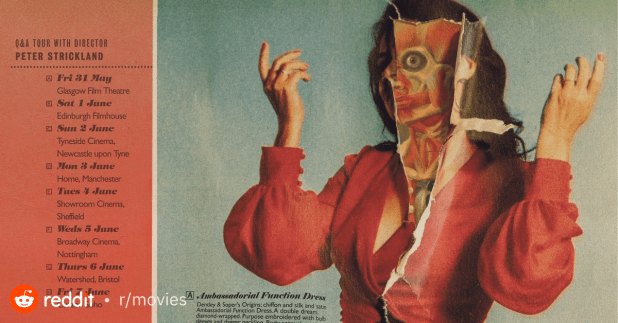
I’ve often discussed the difference between grindhouse and arthouse. That line is quite easy to cross and hard to define at the same time. The films of Peter Strickland are great examples of movies that live between that division. From the revenge film Katalin Varga and the giallo-exploring Berberian Sound Studio to the Jess Franco homage The Duke of Burgundy, he’s taken movie forms that would normally be video nasties in his nome country and made them palatable to a more refined mindset.
Sheila Woodchapel (Marianne Jean-Baptiste, TV’s Without A Trace) is a recently divorced woman whose life is bleak to say the very least. Her son still takes his father’s side and has a new femme fatale girlfriend (Gwendoline Christine, who played Brienne of Tarth on Game of Thrones and Captain Phasma in the recent Star Wars movies) who has taken over their home. At work, her bosses Stash (Julian Barratt from The Mighty Boosh) and Clive constantly asks her to document all her time, how she shakes hands and even how she speaks to her boss’s mistress. And her attempts at finding love are boring at best.
That all changes when she visits Dentley and Soper’s to buy a dress from Miss Luckmoore. Of course, that dress soon begins to make her life even worse, giving her a rash and nearly tearing off her hand when she attempts to wash it. Every time the dress is nearly destroyed, it repairs itself. And then it tries to kill Gwen as she has sex. Finally, as Sheila tries to bring the dress to a charity shop, she’s killed when a mannequin appears in the middle of the road, causing her to crash.
The dress finds its way to washing machine repairman Reg Speaks, who is forced to wear it by his friends. His life is also a nightmare, as he’s in a loveless engagement with Babs and his boss delights in abusing him. Also — for some reason — people love to hear him drone on about washing machine issues, as it makes them go into trances.
It all ends with Reg being fired and then hypnotized by ads for the store’s sale and suffocating from a gas leak. At the very same time, Babs tries to get another dress and realizes that the store is where her dream of getting thinner and dying occurred. The dress catches fire as the store turns into a riot of shoppers.
Land and a mannequin escape into a dumbwaiter, where a dead model, Sheila, Reg, and Babs are all shown sewing their own dresses from their blood, a hell of their own making, while other spaces are shown for more souls. Above this all, a fireman walks through the ruined store only to find the dress has emerged unscathed.
This film feels inspired by the post-giallo supernatural horrors of Argento. But while those strange Italian horrors seem to be able to exist within the absolute film excuse that nothing has to make sense, the shift between story one and two here is so abrupt that it feels as if we’re watching two different films with the same story.
My wife had been anxiously awaiting this film and to say that she was disappointed is an understatement. I’m much more forgiving of movies that want to be important art with something to say while she wants more narrative cohesion. She must love me, because she sat through all of El Topo in a theater, an act which she has later complained of numerous times.
Back to how this all opened. If you go into this hoping for art, you’re going to have to wallow in the miasma of exploitation. And if you want a thrill, you’ll find yourself dealing with an examination of London consumerism in the mid-70’s. I don’t know if this movie can truly sastisfy either audience properly. But hey — it’s another example of A24 knowing exactly how to cut a trailer that makes people want to see a movie that they otherwise probably would have never watched in the first place.
No matter how many years pass . . . and how many copies of this VHS non-starter ended up in the dumpsters behind video stores . . . copies of this film keep coming back at me. Every video store rack I’ve browsed. Every Drive-In swap shop I’ve perused. Every Goodwill and Salvation Army, every pawn shop, and every garage sale I’ve visited. Even the weirdo-halitosis tape guy with a cubicle at the local indoor festival flea market . . . there’s yet another friggin’ copy of Wired to Kill staring back at me. Next to the apoc-swill that is America 3000 and Robot Holocaust this film has to be one of the best-distributed VHS tapes of the video-fringe era. It’s like that copy of Corky Romono (and MacGruber, speaking of SNL schlock) stuck to my shoe that I can’t scrape off.
Oh, what the hell? WTF! You’ve got to be friggin’ kidding me! Noooooo!
There I was, at my public library branch’s annual used book sale . . . and there it is, again. I gave up. I plopped down two quarters. I should have went into the recreation center next door to get off on the old broads jazzercising and buy a faux Dr. Pepper (a Mr. Pibb) instead, take home my 10 cent copy of Herman Hesse’s Demian and April Wine’s Harder Faster on cassette . . . and called it a day.
In an utter lack of budget and scripting with a group of drop outs and flunk outs from the Ed Wood School of Thespian Studies starring as the marauding hoards of 1998 (another “future” that looks like our present, only with a couple of flashing-and-bleeping gadgets), this dropping of celluloid borrows (poorly) from the The Road Warrior and the cute and cuddly sci-fi romp Short Circuit, and the family favorite . . . Home Alone!
The two actors that passed Ed’s class on “Octopus Battles” — our heroes Steve and Rebecca — don’t fare much better on their road to Oscar gold as two teens who suffer at the hands of the ubiquitous punk rock rapist survivors (bossed by Merritt Butrick, who went from Star Trek II: The Wrath of Khan to this in four short years?) of the worldwide plague. Turns our little wheelchair-bound Stevie has a pet robot and is quite the computer and electronics whiz — with a knack for setting booby traps (the Home Alone part) and soups up his chair with gadgets (the Short Circuit part) to battle the crazies (the Road Warrior part).
Does a sorely needed Wez (Vernon Wells) from The Road Warrior come crashing through the wall in a cameo appearance like he did in the über cool sci-fi comedy, Weird Science? (You wish.) Does anyone “pull a Chet” and transform into a pile of poopy-goo?
No, but this tape sure does. Yep, renting from the video fringe is like a pile of poop. You never know badly the post-apoc crouch rot is gonna smell. And any film that tells us with a text scroll — accompanied by an annoying David Sanborn jazz saxophone backing track (ripped off from the jazz trumpeter shtick in 2019: After the Fall of New York) — on how we got here, is the first scent of apoc-crouch rot.
And that’s all I am going to say about that. Well, one more thing: don’t be booby trapped by this gem’s alternate VHS title: Booby Trap . . . uh, oh!
. . . Unwanted Film Trivia Alert . . . Unwanted Film Trivia Alert . . . this is not a drill . . . abort all reading . . . abort all reading . . . log off of B&S Movies . . . this is not a drill . . . too much virtual cyber ink has been giving to this film already . . . abort . . . abort . . .
Emily Longstreth, who stars as Rebecca, worked alongside Johnny Depp in 1985’s Private Resort, was Kate (?) in 1986’s Pretty in Pink (speaking of John Hughes), and appeared in (yes!) the Alien-cum-E.T knock off, Star Crystal (1986). But we lads and lassies slumming on the video fringe best remember Emily for her turn in Krishna Shah’s T&A epic, American Drive-In (1985). (Come on, now. You remember Krishna Shah . . . Hard Rock Zombies? I know! The dude was a double-graduate from Yale and UCLA . . . and he made Hard Rock Zombies!)
And I was shocked . . . SHOCKED to see . . . Kim Milford of Laserblast and Song of the Succubus, who deserved better that this mess — the dude was on Broadway in Hair, Rocky Horror, and Jesus Christ Superstar for Oscar’s sake — as one of the thugs, Rooster (check out my admiration for Kim’s music career on Medium).
As for director Francis Schaeffer: He brought us Headhunter (1988; voodoo murder mayhem in Miami starring the always hot Kay Lenz of White Line Fever, along with Wayne Crawford), Rising Storm (1989; a really dopey post-apoc dropping not worth more of a mention beyond this sentence . . . starring Zach Galligan from Gremlins, Spinal Tap’s June Chadwick from Forbidden World, and more Wayne Crawford . . . which, I dare you, Sam, I dare you, to review Rising Storm), and . . . did you know there’s actually a film based on those ‘80s automotive-suction cup “Baby on Board” signs? Yep, Francis made it: Baby on Board (1992).
Yep. When it comes to the VHS fringes, I am wired in, baby. . . .
Hey, at least this review presented the opportunity to qwerty-in “schlock” and “shtick” as part of one of my reviews. I wonder if the guy who becomes perturbed — and lets us know — when we use the lazy-writing words of “ensues,” “trope,” and “aplomb” will let us know that he has an issue with the use of “schlock” and “shtick” to critique films? And will he ever figure out that we now use those words, and such admittedly schlocky phases such as “all hell breaks/lets loose” in reviews to annoy him? I mean, if you do not like us, why do you keep coming back?
Anyhoos (that’s annoying!), if you must complete your post-apoc shakes, Wired to Kill is on You Tube.
About the Author: You can read the music and film reviews of R.D Francis on Medium and learn more about his work on Facebook. He also writes for B&S Movies.
So much of the animation that aired in the 1970’s came from Japan, like Star Blazers (the Americanized Space Battleship Yamamoto), Speed Racer (Mach GoGoGo) and Battle of the Planets (Science Ninja Team Gatchaman). It had not yet become the cultural force that it is today, with people dressing up and attending conventions. It was just something that was on TV that we all enjoyed.
In the early 1990’s, finding anime wasn’t as simple as it is today. I remember tape traders all having Legend of the Overfiend and other strange fare like Battle Royale High School. As anime grew in popularity in the US, I really checked out. It all seemed like the same shows over and over, to be honest.
That’s why I was surprised by how much I enjoyed Redline.
On the planet Dorothy, our hero “Sweet” JP goes into business for himself during a fixed race, trying for the win. Instead, the gambling bosses blow up his Trans Am 2000 and nearly take him out and ensuring that Sonoshee “Cherry Boy Hunter” McLaren is the winner.
Despite losing his car, the incident pays off JP’s debts and gains him a loyal fanbase that votes him into the galaxy’s most famous race, the Redline. That’s also because people have been dropping out of the race once its location is revealed — Roboworld, a dictatorship run by robots out to hang every single racer.
Imagine Wacky Racers injected with psychedelic drugs, propelled by nitrous and then injected directly into your veins. That’ll give you some small idea of what this film is all about. There’s also a gigantic mutant named Funky Boy and Metalhead, the dapper robotic front running racer, and some true love along the way.
With over 100,000 hand-made drawings and absolutely no CGI whatsoever, Redline spent seven years in production before busting through multiple planned release dates. If you ask me, it was worth every second. It’s a frenetic blast of pure mayhem that reawakened me to the potential I once saw in anime way back in the halcyon days of 1977.
Action International Pictures, also known as West Side Studios, was founded by David Winters, David A. Prior and Peter Yuval in 1986. After Winters was overruled on a casting decision for Thrashin’ — he wanted Johnny Depp and they wanted Josh Brolin — Winters made the professional decision to control all aspects of future projects.
All of this would lead to them producing seventeen movies and distributing forty one more between 1988 and 1994. They often used the same cast and crew in many of the films, such as David Prior and his brother Red, as well as William Zipp as actor, writer, director, producer, and stunt man. They weren’t above getting big stars, either. That is, if you consider Cameron Mitchell a big star, which I completely do.
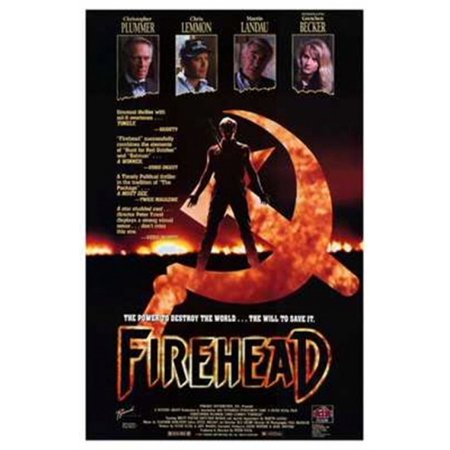
At some point in 1988, a telekinetic Soviet agent known only as Firehead (Brett Porter, Arena) defects to the United States after he refuses to use his abilities against a crowd of protesters. Yet just two years later, he’s blowing up American factories, which brings a chemist (Chris Lemmon, who was on Thunder In Paradise) and an assassin (Gretchen Becker, Maniac Cop 3: Badge of Silence) together to track him down. In the midst of all this, Christopher Plummer shows up as a military man out to use Firehead to take over the world. And Martin Landau? Oh, he should know better. He really should.
If you think you have the gumption to deal with this, well…it’s on Amazon Prime. You’d be better off watching it in RiffTrax form, though.
Remember B&S Movies’ past geographical warnings about staying the hell out of South Africa and keeping your ass in the Philippines, Italy, and Australia for your post-apocalyptic fixes?
Well, add Canada to the list. Be warned, my fellow apoc-rats. The lands of Survival 1990 aren’t across the border from 1990: The Bronx Warriors. If ever a film needed a meeting of the Riders and Tigers, this is the movie.
Also known as Survival Earth in its VHS revival, this canuxploitation dropping that makes the Canux nuc-fest Def Con 4 look like Escape from New York occurs in 1996, ten years after “The Fall,” which refers to the collapse of the world economy and . . . hey, wait a minute . . . 10 years after 1996 is 1986 . . . so why does the title refer to the year of 1990? I know, I know. Don’t overthink the (lack of) plot . . . and math. Which brings us to questioning who made this? Yep, the mathematicians at Emmeritus Productions, the Canadian studio that also made the computer-takes-over-a-hi-tech hi-rise A.I tomfoolery, The Tower, and the inert John Carpenter-porn knock off, Blue Murder.
Duh. You’ve been warned.
Anyway, this shot on video tape for Canadian TV potboiler starts with a stock footage montage of some riots, newspaper articles, nuclear power plants, and politician infighting that fades out under an optical effect informing us the big one dropped. And that’s the end of the special effects for the movie.
The resident “Adam and Eve” survivors living in the wiles of Toronto are John and Miranda, who meander through the woods and talk, talk, talk . . . and read poetry (at least books survived “The Fall”), and goes all philosophical quoting Yeats. And when drippy John isn’t reading poetry, he talks about the good ol’ days of mowing grass, driving his ol’ Honda Civic, and about his dad’s cloning experiments (a major plot twist, don’t forget!).
In addition to a mysterious “creature” shadowing their every move, they meet up with Simon, a soldier of fortune (in run-of-the-mill camo-fatigues off the rack at Bass Pro Shops) who survived the war and becomes their ally. And thank god, because Simon at least has a rifle and a pistol to fight off the mutant-vandals (that aren’t at all “mutant” and look more like raggedy street people) who kill John. Then John’s clone—who’s been spying on them—shows up and rescues Miranda. And they read more poetry and bicker happy ever after. The end.
So if you need to explore the post-nuke wastelands of the Great White North — sans any Snakes or Trashes, or props, or special effects, or sets, or costumes, or action, or plot, or point — then this is your film. This rarity from the video ‘80s — that’s never been issued to DVD or Blu-ray (complete with trailers for the low-budget videotape pot boilers Deadly Pursuit and The Edge) — is on You Tube.
Star Nancy Cser, who played Miranda, received some video-store fame courtesy of the 1986 Canadian soft core skin flick, Perfect Timing, which had plenty of naked women for us horn dogs—and nary a plot. Not that we cared about the plot. For when you have boobies, you need no plot. Wow. We already sat through The Tower. So, sorry, Nancy: no more reviews for you. Some movies are best forgotten.
About the Author: You can read the music and film reviews of R.D Francis on Medium and learn more about his work on Facebook.
Or, as I like to call it: Escape from Nova Scotia, is another caveat emptor from the video ‘80s with another bogus post-apoc film that doesn’t live up to its flashy poster/video box art work. (They never really do, do they?) So, instead of a massive, crashed spaceship (like in the Mark Wahlberg Planet of the Apes remake) you get a dinky geosphere-pod thingy stuck in the dirt (that doesn’t look big enough to house the crew cabin we seen earlier in the film) and there are no decayed skeletons inside space suits sticking out of the arid landscape, either. And no disrespect to the late, Texas-born actor Tim Chaote (Zathrus from TV’s Babylon 5) as Howe . . . but he’s no Snake Plissken or Max Rockatansky.
If ever a film ever needed a shot of Michael Sopkiw and Mark Gregory under the lens of Sergio Martino or, even better, Cirio H. Santiago, this would be the film. At the very least we need a bubblegum chewing and ass kicking Roddy Piper saving the Canadian east coast. Even some Steve Sandor beefcake water-chasing would be welcomed. Yeah, this Nova Scotian hell needs a Frogtown.
Anyway . . . we get Dr. Sheldon Cooper, I mean, Tim Choate, as one of three astronauts, including Jordan (Kate Lynch; Meatballs, Eddie and the Cruisers II: Eddie Lives!), stationed on Nemesis, a top secret, joint Canadian-U.S military nuclear platform in Earth orbit when World War III erupts by “accident” . . . courtesy of a Libyan-stolen cache of cruise missiles shot into Russia (that we learn about via a TV transmission on the spaceship . . . yawn).
Hey, wait a minute, R.D . . . aren’t you confusing this movie with Steve Barkett’s Mad Max vanity project, The Aftermath (1982) . . . the one where an astronaut fights a biker gang led by a villain named (Toe) Cutter who rules the post-nuke wasteland? You know, the one that became a U.K Section 3 video nasty?
Dude, I wish I was . . . at least that movie had the awesome Sid Haig (Galaxy of Terror) to cut through the post-apoc crapola.
Sid Haig? No. Richard Moll from Metalstorm: The Destruction of Jared-Syn starred in The Aftermath.
No, you’re thinking of Survivor(1987) starring Chip Meyer, which has the same ol’ Mad Max-inspired astronaut returning to a slow ‘n’ boring, low-budget apoc-chatty chat world.
Well, anyway . . . in place of Haig and Moll we get our favorite Canadian-American character actor, Maury Chaykin (Jim Sting in WarGames, Sam Tipton in My Cousin Vinny), as a crazed survivalist with a captive school uniform-clad babe in the cellar (Canadian scream queen Lenore Zann of Happy Birthday to Me, Visiting Hours, American Nightmare; the voice of Rogue in X-Men: The Animated Series). But not even Chaykin’s thespian scene chewing can save us from the post-nuke no-action boredom punctuated with lots of chitty-chatter about “radiation zones” and “clean zones” and “terminals” and everyone telling us how the world ended up this way. Yawn.
The film starts off promising enough on the space station and setting up the story during its first 30 minutes . . . it has a decent spacewalk scene . . . the scenes with Howe receiving a ghostly message on the radio from his wife after the war is over and his trying to save a fellow astronaut being yanked through the sand by “something” as they dig themselves out of the wreck are especially chilling. Then the fast forward button on the VCR remote goes into overtime once Gideon (a reference to an Old Testament military leader, really? While you’re at it, why not name the rest of your characters Stryker or Hunter like all the other apoc movies do? Geeze.), the perfectly-coifed Shaun Cassidy clone (Kevin King, Iron Eagle) shows up as the requisite dickhead, ex-military school-army brat who goes all despotic on the poor slobs shuffling around the Scotian woods. Yeah, this film really needs a Sig Haig . . . or a Lee Van Cleef . . . to villain up the joint, not this snot-nose punk kid that needs his ass spanked and sent to his room without supper. Lord Humungous, we beg for your vengeance!
Anyway, it turns out Giddy-boy hacked the space platform and forced the astronauts back to Earth, since they have the technology to help find a “clean zone” to escape the contamination that will wipe out the survivors in two months. (Huh? Well, wait . . . if Giddy the Gimp has the technology to hack a military nuc-platform, then it follows he has the technology to find a way off Nova Scotia . . . oh, never mind. I’m overthinking the plot.) And with that, we get lots of boring Battletruck tomfoolery . . . and talking, talking, and talking . . . and talking, with people babbling in the woods (sans the truck or motorcycles . . . or laser crossbow weapons or Whistler Swords) that they need to get off the isle of Nova Scotia and onto the mainland before a malfunctioning warhead on the crashed platform explodes in sixty hours.
Dear Lord! Will somebody start kicking some ass around here? Snake! Max! Parsifal! Trash! Stryker! Even Paco Queruak would be welcomed! Where are you, guys! We’ll even take the headbanded Chip Meyer from Survivor (yikes, he looks like the lead singer from Canada’s Loverboy!). Someone help these dolts Escape from Nova Scotia, already!
The real pisser of this film: It was made with Canadian Government Tax dollars via what seems to have been some bogus program to encourage film production in the Great White North—at the tune of 1,750,000 Canadian . . . its worldwide gross barely broke a million dollars in box office. Granted, it eventually cleaned up on home video market, but as a Canadian tax payer, I’d be pissed the government taxed my hard earned money for Roger Corman’s benefit.
And another thing: It’s not only CNN that references the Def Con System incorrectly (in defiance of The Donald)—so does this film. In fact, the correct title for this film should be Def Con 1, which means “imminent war” . . . as in the shit has already hit the proverbial apoc-fan and the Earth is about to be burnt to a cinder and ruled by the leather studded, metal-hockey masked Humongous. A Def Con 4 is a picnic in the park, as this Newsy report on the media’s perpetual Def Con faux pas tells us. You got that, kids? Def Con 1 is bad. Def Con 5 is good. And if you don’t . . . well, ‘ol Commander General Jack Beringer is just gonna kick you in the ass until you do! And for god sakes, when you’re trying to be a bad-ass, don’t say your “taking this baby up to Def Con 6,” you’ll only end up looking like a dick.
At least the interjections of Commander USA of Commander USA’s Groovy Movies make Def Con 4 more entertaining. Check it out (complete with the original commercials and promos for USA’s Saturday Nightmares airing of The Intruder Within!) on You Tube. If you’d rather watch it without the Commander USA gibberish, then check out this clean VHS rip uploaded to You Tube. You say you want a better copy for your personal library? In January 2019, Arrow Video released a 2K Restoration from the original 35MM interpostive. The Blu-ray features all new interview vignettes and a color booklet with more behind the scenes information on the film.
You can catch up on the wide array of post-apocalyptic adventures with B&S Movies’ “Atomic Dust Bins” Part 1 and Part 2 featuring 20 mini-reviews of movies you never heard of, along with a “hit list” featuring all of the apoc-flicks we watched for September 2019’s Apoc Month.
About the Author: You can read the music and film reviews of R.D Francis on Medium and learn more about his work on Facebook.
Way back in 1974, William Dale Fries Jr. was working as a creative director for Bozell & Jacobs, an Omaha, Nebraska-based ad agency. He created a Clio Award-winning (the Clios are the Oscars of the ad industry, but perhaps AVN awards would be more appropriate) campaign for Old Home Bread that featured a truck driver named C.W. McCall, which led to a series of songs called “Old Home Filler-Up an’ Keep on a-Truckin’ Café”, “Wolf Creek Pass” and “Black Bear Road.”
Fries wrote the lyrics and sang those songs, while Chip Davis — who would go to dominate your parents’ holidays with Mannheim Steamroller — wrote the music.
Their song “Convoy,” though became a monster. A true crossover, it became the number-one song on both the country and pop charts in the US, number one in Canada and number two in the UK. In fact, it’s such a big song that it’s listed 98th among Rolling Stone’s 100 Greatest Country Songs of All Time.
Please note: McCall is no one hit wonder. The aforementioned “Wolf Creek Pass” hit #40 in 1975. and three others songs — “Old Home Filler-Up an’ Keep on a-Truckin’ Cafe”, “‘Round the World with the Rubber Duck” (the pirate-themed sequel to “Convoy” where the convoy leaves the US and travels around the world, touring the UK, France, West and East Germany, the USSR, Japan and even Australia, where the lyrics “Ah, ten-four, Pig Pen, what’s your twenty? Australia? Mercy sakes, ain’t nothin’ down there but Tasmanian devils and them cue-walla bears” are sung) and “There Won’t Be No Country Music (There Won’t Be No Rock ‘n’ Roll)” — reached the Billboard Hot 100 when things like that really mattered. And to top that off, a dozen McCall songs reached the Billboard’s Hot Country Singles chart.
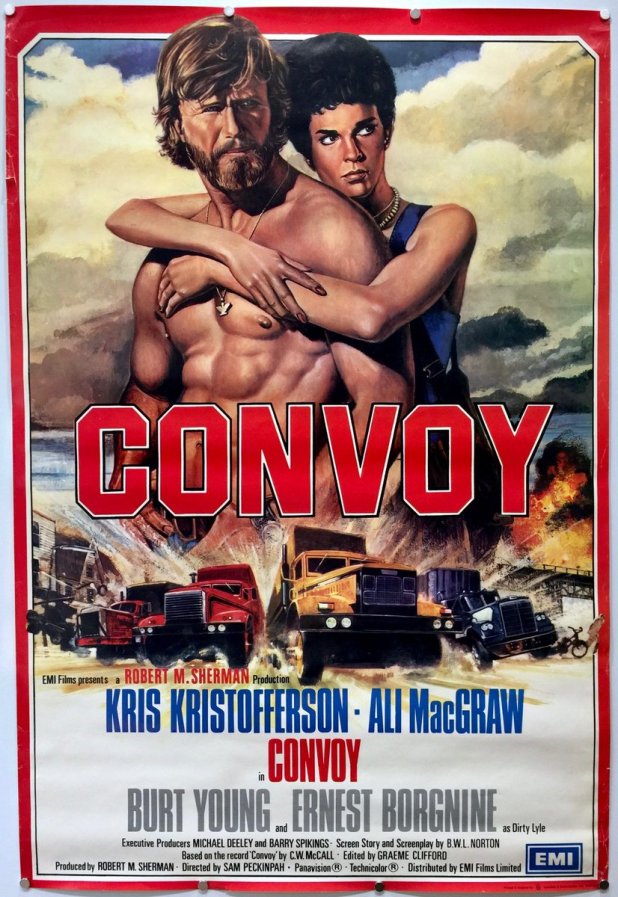
Let me explain one more time how big of a song this was: Sam Peckinpah — yes, the guy who directed The Wild Bunch and Bring Me the Head of Alfredo Garcia and played a drunk in utterly bizarre Ovidio G. Assonitis film The Visitor— made a movie about it. Even stranger, it was the most successful movie of his entire career.
Somwhere in the Arizona desert, truck driver Martin “Rubber Duck” Penwald (Kris Kristofferson, pretty much the most attractive man to ever drive an 18 wheeler) is passed by Melissa (Ali McGraw, a woman able to break the hearts of both Robert Evans and Steve McQueen, but once you see her in this film you’ll say, well, yes, I understand how they could throw caution to the wind and ruin their lives for Ali McGraw; PS — I learned pretty much 99% of my writing style from The Kid Stays In The Picture), a photographer who gets him in trouble with his arch enemy Sheriff “Dirty Lyle” Wallace (Ernest Borgnine, The Devil’s Rain!). It turns out that the Rubber Duck has been pulling his rig into the driveway of Lyle’s wife Violet (Cassie Yates, who we all know and love from Rolling Thunder) if you know what I’m driving at.
Along for the ride are fellow truckers Pig Pen/Love Machine (Burt Young, who I will always love thanks to Amityville II: The Possession) and Spider Mike (Franklyn Ajaye, The ‘Burbs). After a big brawl, Melissa ends up riding with Rubber Duck as Lyle gives chase.
A giant convoy — yes, there has to be one — saves our hero, brought together through the magic of the Citizen’s Band radio. Sure, the National Guard gets involved after the trucks petty much ruin a Texas jail, but everything works out just fine.
During this period of Peckinpah’s life, he was struggling with addictions to alcohol and drugs. Much of the film is actually directed by actor and friend James Coburn, who was originally brought in to serve as second unit director. The movie was made at twice the budget, but still made tons of money at the box office.
However, rumors of increasingly destructive alcohol and cocaine abuse would ruin the director, leading to him making only one movie, The Osterman Weekend, before his death. At one point, the cocktail of blow, quaaludes and vitamin shots that left Peckinpah believing that both Steve McQueen and the Executive Car Leasing Co. were conspiring to murder him.
Speaking of cocaine, Ali MacGraw, who was always uncomfortable in front of the camera, used powder and tequila to perform until she went too far one day on set, which led to her quitting for good.
The soundtrack to this movie is exactly what was playing on my hometown radio station, WFEM in New Castle, in 1978. “Lucille” by Kenny Rogers. “Don’t It Make My Brown Eyes Blue” by Crystal Gayle. “Okie From Muskogee” by Merle Haggard. All it’s missing is the Steckman Memorial death report at 7 AM, with the theme music of BJ Thomas singing “Morning Has Broken” followed by Paul Harvey and it’s exactly the music of my young life. I also realize that that was a joke that literally no one other than me would get, but when you own your own website, you can make obscure jokes about the small power country music FM stations of your youth, too.
Somewhere out there, there’s a print of Peckinpah’s two and a half hour plus director’s cut before the studio took it from him. I would watch that right now.
You know who else must have liked this movie? Tarantino. Stuntman Mike’s hood ornament in Death Proof is the Rubber Duck’s.
Finally, one more moment from my youth.
Saturday afternoon’s belonged to WUAB in Clevaland’s Superhost (the nights belonged to Saturday Night Live and Chilly Billy Cardille’s Chiller Theater). Suprhost was really Marty Sullivan, a floor manager and occasional news anchor at the station who showed monster movies and the Three Stoges every weekend from 1969 to 1989 in a baggy Superman suit with a red nose. He made his own version of “Convoy” that was so popular that it aired every single week, because none of us had VCRs, much less the internet. It might seem silly to you today, dear reader, but having horror movie hosts that would do things this ridiculous created memories that will never go away and bring happy tears to my eyes even as I type this.
The single most difficult hurtle in bringing speculative fiction portrayals of future societies to the big screen is financial: without the backing of a major studio, it’s difficult to create a new world off the racks, whether its clothing, technology, vehicles, or architecture. So while major and mid-level studios can dazzle filmgoers with a future built from scratch in films such Blade Runner (1982) and Escape from New York (1981), the little guy has to make do with what’s available and compromises with a simplified version of the future that pretty much resembles our present—with a few splashes of “futuristic” accoutrements. Jean-Luc Godard’s neo-noir Alphaville, Elio Petri’s pop-art romp The 10th Victim (both 1965), Francois Truffaut’s Fahrenheit 451 (1967), and the American PBS-TV adaptation of Ursula K. LeGuin’s A Lathe of Heaven (1980) are each fine examples of this celluloid ingenuity. Another is Claude Chabrol’s futuristic updating of Germany’s famed “Dr. Mabuse” in Docteur M (1990).
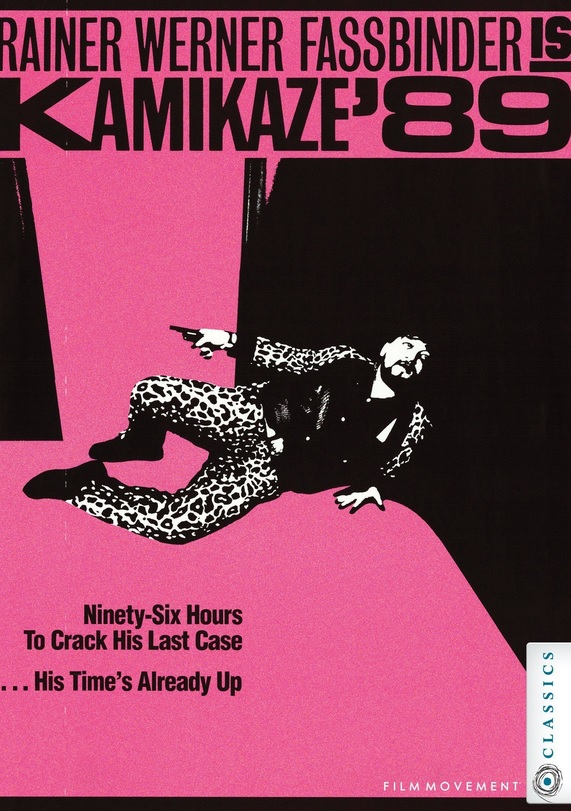
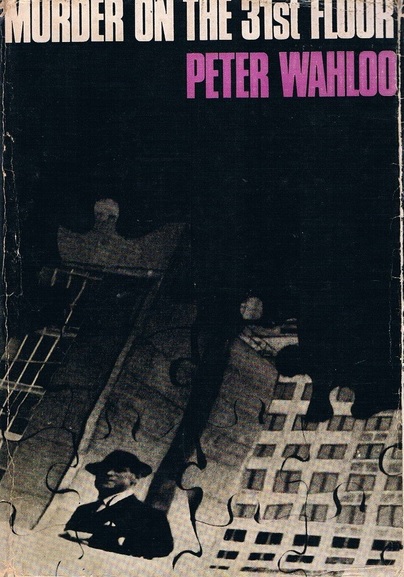
It’s important to understand these economic restraints to the creative process when watching Kamikaze ’89 as the reason for German director (and Fassbinder confidant) Wolf Gremm eschewing the serious-dramatic approaches of the three previous adaptations of Per Wahlöö’s 1964 best-selling, futurist neo-noir novel, Murder on the 31st Floor (twice for Russian TV as a mini-series and TV movie; then as a Hungarian TV movie), instead taking a black comedic, social satire approach that detracts from the novel’s serious sociopolitical and technocratic statements and bears little resemblance to those previous adaptations.
Regardless of its unorthodox approach with its garish character development and set design, Kamikaze ’89 garnered nominations and awards at the 1983 Fantasporto International Film Festival held in Portugal—which honors sci-fi, fantasy and horror films. As result of those festival honors, the film was marketed for an American release; the film subsequently flopped on the U.S art house circuit, grossing less than $25,000 in its initial release (but became a popular U.S VHS rental among sci-fi buffs and Fassbinder disciples).
In the “future” of 1989, Communism has fallen and the happy days of the good ol’ 1940’s—when the Federal Republic of Germany was the world’s dominate economic superpower—has returned. But since this is the “future” on a budget, the country has become a day glow, neon soaked, new-wave dystopia filled with Billy Idols, Boy Georges, and Madonnas prancing around in a low-budget Clockwork Orange-styled society. This is a world where male (female?) assassins dress in black lingerie and matching go-go boots—complete with ski masks and goggles. Women swim wearing leg warmers. Everyone mimics the police force’s logo seen throughout the film—a “thumbs up”—as some type of pseudo “Heil Hitler” salute in greeting each other. This is a world where citizens tool around on three-wheeled choppers, cops wear green crushed-velvet and peppermint-striped blazers, ambulances have six wheels, nurses wear gleaming-white lamé uniforms, and corporation executives make phone calls from Superman telephones (the handset cradles into his cape).
Meandering through this brain dead police-welfare state of citizens blinded by an endless stream of propaganda that proclaims “everything is perfect” is acclaimed German director Rainer Werner Fassbinder. He stars as Jansen, a rogue police lieutenant whose proclivities include a penchant for leopard-print suits and a revolver with a matching leopard-skinned grip. (Why? The film never tells us.) He works out in a gym—in leopard work out sweats—playing a solitary form of badminton-racket ball. He perpetually gulps down bicarbonate soda and relaxes on his lunch breaks in a dentist chair next to a ‘60s jukebox inside his rundown, paint-peeling “Bat Cave,” so to speak. And what’s the message behind the larger-than-life poster of Neil Armstrong on the Moon in his office, and the voice-over moon-transmission chatter between Armstrong and President Richard Nixon that Jensen listens to as he masturbates hip-thrusts into the poster, you ask?
Well, can you tell me the meaning behind the cackling villain-assassin dressed in a dinosaur costume (I think?) behind the driving wheel trying to run Jansen off the road with a car adorned bumper-to-bumper with the pages of comic books—complete with a full-sized Spider-Man plastered on the hood and a Captain America image stuck on the rear window? And what’s the deal with the Reality TV series watched by 99.3% of the population where contestants try to win prizes based on who laughs the longest—and the shows been going on for four days?
Yep. This film is way out there . . . and is only for those who enjoy the terminally weird and are brimming with patience to fulfill their Fassbinder fix—and decipher the hidden meanings, such as Gremm’s endless comic book references. All others are better off watching a Mark Gregory or Michael Sopkiw Italian-future world romp. Or, if you can handle the tomfoolery of Paul Bartel’s Death Race 2000 (1975), perhaps you’ll be able to stick with Kamikaze ’89’s black comedy slant to the bitter end. (It’s interesting to note that Ridley Scott’s similarly themed neo-noir sci-fi romp, Blade Runner, was issued a month prior to Kamikaze ‘89’s release.)
As in the future world of 1975’s Rollerball, Germany’s new totalitarian government-corporation has pacified and dehumanized the citizens through the legalized use of barbiturates and resolved all of the country’s social and political ills. There’s no more pollution. There’s no more murder or suicide (only “accidental death”). Alcohol and gardening (because the seeds are poisoned) are outlawed. But everyone is so miserable, they get drunk anyway . . . and they get locked up and fined . . . and get plastered again. And the wheel goes round and round and it all goes into the corporate coffers. And the rest that don’t get tanked, they garden the illegal seeds and eat the spoils in an act of suicide . . . oh, “accidental death,” so says the corporate edict. Everything is fine. Everyone is laughing on TV, after all.
Yep, you guessed it. Everyone is ignorant to the unhappiness perpetuated by this Soylent Green-inspired government-corporate . . . because the corporate also controls the broadcast and print media and perpetuates a “Group Think” mentality through a nascent forefather to the Internet via a media-soaked culture controlled by the few to manipulate the many. Things have gotten so out of control that Konzernchef, the Trumpian-Rupert Murdock leader of the family-run corporate concern, is immortalized as a villainous superhero, “The Blue Panther,” in a line of comic books published in protest against corporate regime . . . and he loves the attention. (Ack! No “Orange Panther” comments, wise guy!)
It turns out the underground protest comic is the product of a handful of intellectuals that ran the corporation’s Orwellian “cultural department” from the perch of the corporate headquarter’s hidden “31st floor.” Reasoning the corporate is evil, the corporate rogues work for a phantom terrorist group, “Krysmopompas,” to liberate the citizens. When their activities to overthrow the government crescendos with a fake bomb threat that results in the first “real” suicide-murder (of a corporate executive ready to spill the beans that takes a header off the “31st Floor”) in four years, they call in the world’s foremost and successful detective—Jansen—to solve the case. But the family-run corporate—and the in-the-pocket police department—doesn’t want the case solved . . . the world can’t know what going on up on the mysterious “31st Floor.”
Sweden-based crime novelist Per Wahlöö is best known for his series of ten best-selling novels regarding the exploits of Stockholm police detective Martin Beck published between 1965 and 1975. In 1971, one of those books, The Laughing Policeman (an English translation of Den skrattande polisen originally published in 1968) was adapted into the Walter Matthau and Bruce Dern starring film, The Laughing Policeman (1973).
Film Movement Classics honored Kamikaze ’89 with a 2016, 4K restoration issued to Blu-ray. You can watch the full movie for free on TubiTV and enjoy the Edgar Froese (of Tangerine Dream; Thief, Risky Business, and Grand Theft Auto V) soundtrack on You Tube. The 1980 Russian film version—for comparison—is also on You Tube.
The sad post-script to the film: Fassbinder died six weeks before the film was released. As you watch, you can clearly see the heavy and bloated Fassbinder was in poor health and looks much older that his 37 years. The professional momentum Gremm gained from his previous feature, Fabian (1980), being chosen as West Germany’s official submission to the 53rd Academy Awards for Best Foreign Language Film (it wasn’t nominated) was lost. While critically lauded, the box office failure of Kamikaze ’89 on the European circuit lead to it being Wolf Gremm’s last feature film; he then worked strictly in German television.
There are more, budget-inventive German dystopian visions to enjoy in the celluloid frames of the somewhat similar, previously mentioned Docteur M, and the Jupiter-to-Earth psychological adventure, Operation Ganymed.
About the Author: You can read the music and film reviews of R.D Francis on Medium and learn more about his work on Facebook. He also writes for B&S Movies.
After a night of debauchery and depravity gets out of control, Marcus has retreated back to his family home. His solitude is disturbed when his brother asks him to look after his estranged nephew and niece.
Soon, he feels as if a dark force is in the home and that he either has a monster inside him or inside the house waiting to destroy him. As he remains haunted by his deepest fears, Marcus struggles to protect his niece Lily form the beast that lies in wait.
Trevor Long from Ozark stars as Marcus and his brother Owen wrote and directed this film. Andrea Chen, who plays Lily, is fantastic, abe to be both a young girl and a tempting young adult, sometimes in the same scene. If that makes you uncomfortable, that’s the whole point of this film.
You can either see this as an arthouse examination on a man’s mental illness and a taboo relationship that should not be. Or you can see it as a lolita-esque male fantasy that makes those yearnings safe because some Lovecraftian insectoid creature is controlling it all.
Interestingly, Lily makes the most of the moves on her uncle, which again plays into the male fantasy of this film, as we never see a moment from her point of view or from her voice. It’s all certainly interesting — think the way that Possession used horror to show the end of a relationship — but it’s just as troublesome when you realize that if this is all in the untrustworthy narrator’s head.
Seeds is available on DVD and streaming on demand on September 24.
DISCLAIMER: This movie was sent to us by its PR team and that has no bearing on our review.








 B&S About Movies
You must be logged in to post a comment.