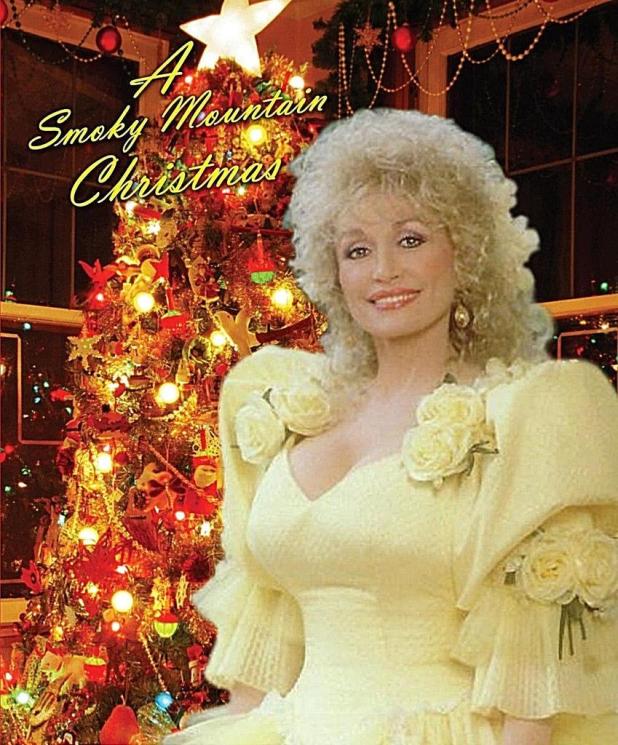
Originally airing on ABC on December 14, 1986, this Henry Winkler-directed made-for-TV movie has pretty much everything you want out of a holiday film: Dolly Parton as a disillusioned country star. Dan Hedaya as a sleazeball. Bo Hopkins as a lawman. David Ackroyd! John Ritter as a judge. A witch! Rance Howard! René Auberjonois! And Lee Majors as Mountain Dan!
This is a completely ridiculous story perfect for the holidays — or to be honest any time — and it gets by because I cannot and will not dislike anything Dolly ever does. I mean, she somehow made it through Rhinestone intact. And the fact that a Christmas movie exists where Dolly is menaced by not just Bo Hopkins, but a witch in love with Bo Hopkins and is saved by Lee Majors, well, I’m beyond all in.
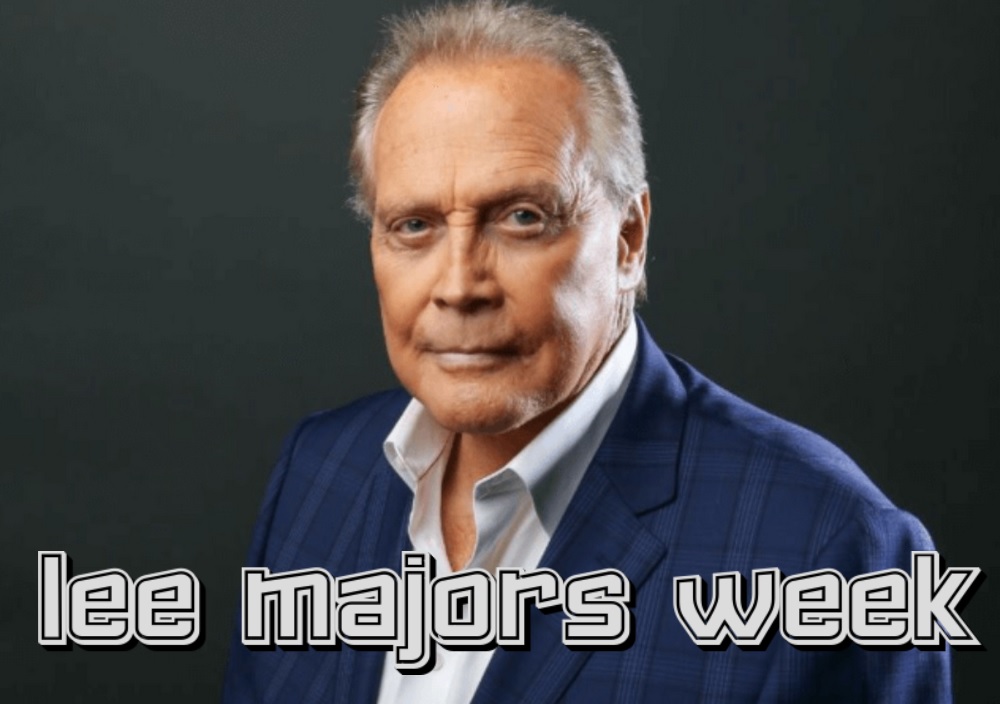
Editor’s Note: We originally ran this review on January 30, 2019, as part of our “Viking Week” of film reviews. We’re rerunning it as part of our “Lee Majors Week” of reviews.
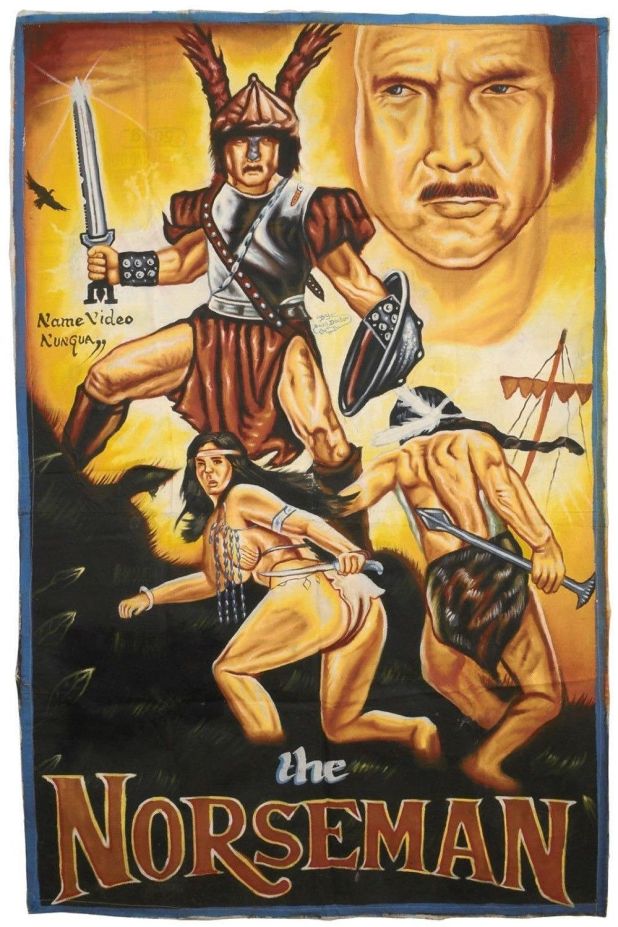
Look, I can hear you laughing. An 11th-century Viking prince — played by Lee Majors of all people — sets sails for North America to find his missing father, who has been captured by Native Americans. Yes, it’s ridiculous. But it’s also directed by Charles B. Pierce, who brought us The Town That Dreaded Sundown, The Bootleggers, and The Legend of Boggy Creek.
Along with Majors, the film also boasts a packed cast: Cornel Wilde (Gargoyles, Sharks’ Treasure), Mel Ferrer, Jack Elam, Christopher Connelly (Hot Dog from 1990: The Bronx Warriors), NFL Hall of Famer Deacon Jones, former Tarzan Denny Miller (always remembered as Carol Brady’s ex-college football star boyfriend, Tank) and Kathleen Freeman (Sister Mary Stigmata from The Blues Brothers). Well, in my world it’s a star-studded cast!
It also features Jimmy Clem as Olif. In addition to being in nearly every one of Pierce’s films, he was also famous for owning and breeding one of the most respected and revered Brahman cattle herds in the world.
The major highlight of this film is the wacky mask that Lee Majors wears, along with his little mustache. It’s really quite breathtaking. Really, this movie is beyond ridiculous and it’s kind of shocking that it ever made it to the screen. That doesn’t mean that I didn’t love it and won’t try to put it on if you ever visit my house, dear reader. It’s the perfect movie to be enjoyed alongside all manner of mind-altering substances!
How did this make it to the big screen? It was a Fawcett-Majors co-production (made the same year as the studio’s Somebody Killed Her Husband starring wife, Farrah) with Charles Pierce and AIP Studios working the distribution; as result, it was Pierce’s first film with a major Hollywood studio. Courtesy of a pretty cool interview with Lee by the AV Club, as he talked about his work on Ash vs. Evil Dead, it’s learned Lee took the deal as result of being paid $500,000 and 10% of the profits — and that it shot in sunny Tampa, Florida. To that end: many of the vikings are played by Tampa Bay Buccaneers. And let’s not forget that Lee was, himself, an ex-high school and college football player, so he had a fun time — as he says in interviews — on this shoot.
Shout! Factory released this movie on a double disk with The Barbarians. You can get it right here.
Many tried to bring this tale of American Airforce pilot and CIA operative Francis Gary Powers to the big screen — an incident that occurred on May 1, 1960. The single-jet engine plane of the title, the U-2, was nicknamed “Dragon Lady” by its maker, Lockheed Aircraft, to work as a high-altitude reconnaissance craft for all-weather intelligence gathering. Flown successfully throughout the late ’50s over China, Cuba, the Soviet Union, and Vietnam, the plane was actually shot down twice: the second time, which resulted in the dealt of pilot Major Rudolf Anderson, Jr., was during the Cuban Missile Crisis in 1962.
Image of ’80s home video VHS repack courtesy of Paul Zamarelli/VHS Collector.com.
In fact, back in 1962, Roger Corman hired Robert Towne (later of Chinatown fame) to whip up a script, I Flew a Spy Plane Over Russia that, thankfully, was never filmed. It took prolific TV producer Charles Fries — who not only brought us the first live-action adaptation of Spiderman (the recut TV pilot became an overseas theatrical hit, reaching #1 in Japan) but also gave us the Star Wars-infused The Martian Chronicles and the witch romp The Initiation of Sarah — to get it on the air on September 29, 1976, for NBC-TV. Fries’s other films? Well, there Cocaine: One Man’s Seduction, Are You In the House Alone?, and Secret Night Caller, just to name a few. He even went theatrical with Amicus’ Tales from the Crypt. Just look at that IMDb page! We could do a month-long tribute on his films alone. And while we haven’t delved deeply into the resume of his Academy Award-winning director (1955’s Marty), Delbert Mann, Mann’s extensive TV resume includes one of the movies we really love around here, the early ’70s possession flick, She Waits.
Lee Majors — Powers’s preferred choice was Martin Sheen! (and Powers had some pull, since this was based on his best-selling paperback, but he lost out to the network) — shot this, his seventh TV movie (including his three, pre-series Steve Austin movies), while working on The Six Million Dollar Man. And while Sheen would be have been wonderful, Lee shines in his role as Powers. Keen eyes of all things ’70s and ’80s TV will notice Noah Berry, Jr. (from TV’s The Rockford Files) as his dad, along with a cast rounded out by Lew Ayers, William Daniels, Nehemiah Persoff, and James Gregory (who worked with Lee on The Big Valley and came to be know for his work on TV’s Barney Miller, but we love him around here for his work as Ursus in Beneath the Planet of the Apes).
You can watch a truncated, 45-minute clip on You Tube.
About the Author: You can learn more about the writings of R.D Francis on Facebook.He also writes for B&S About Movies.
Sure, the IMDB description says, “A young girl and her dog make a daring journey into the wilderness where she discovers the true meaning of nature, sacrifice and life.”
The truth is that this movie feels like it was shot cinéma vérité style, with no one cluing the grandfather that he was in an actual movie as he rants and raves. He also has flashbacks to when he was young and was in a gang that continually yells, “The strength of the wolf is the pack! The strength of the pack is the wolf!”
Also, this is a family-friendly movie that features a young girl nearly dying and a dog being bitten by a snake not just once, but twice and the second time, we know it’s coming which makes seeing a gorgeous animal brought low twice as painful.
Then, after we go through a journey through the desert that feels like we just did it ourselves, the film becomes about a prom and Jean’s date’s sister fixing her up in what should be Pretty Woman style mirth but ends up feeling like the central relationship in Bound if you know what I’m talking about — and as the great man says — and I think you do.
Wait, I can hear you wondering, “Where is Lee Majors?”
He plays a rock.
I’m not joking, Majors is the voice of a Spiritual Stone that ends up fixing everything. I have no idea who wants to see a movie where a young girl nearly loses her dog, goes to the prom, loses her grandfather and there’s a rock with the same voice as Steve Austin.
But man, I’m glad I saw it, because the scene still makes me laugh just remembering it.
You can watch this on Tubi. And you totally should, but you know, do all the drugs first.
William Wyler is the most nominated director in Academy Awards history, as well as the only director in Academy history to direct three Best Picture-winning films (for which he also won Best Director*), for directing thirty-six Oscar-nomimated performers and for being the director of more Best Picture nominees than anyone else.
For his final movie, he decided on a script by Jesse Hill Ford and Stirling Silliphant that was in turn based on Ford’s 1965 novel The Liberation of Lord Byron Jones. While a work of fiction, it was based on an actual event that had happened in Humboldt, Tennessee, where Ford lived. This movie did him no favors in that town**. Silliphant’s life may not have been so turbulent, but he did write The SIlent Flute with Bruce Lee, as well as the film he won an Oscar for writing, In the Heat of the Night.
The titular L.B. Jones (Roscoe Lee Browne) is a wealthy funeral director in Tennessee looking for a lawyer to represent him in his divorce from his much younger wife Emma (Lola Falana), who is having an affair with police officer Willie Joe Worth (Anthony Zerbe) which has left her with child.
The problem is that Jones is black and Worth is white.
Worth begs Emma not to contest the divorce, but she wants to keep living the moneyed life she has become accustomed to. Worth ends up beating her and then works with his partner Stanley Bumpas (Arch Johnson) to arrest Jones after he refuses to drop his case. Yet the man becomes shocked at what he’s done and at how cold Bumpas is as he goes about making the crime look like black-on-black crime.
Worth is willing to goto jail, but the crime is covered up by attorney Oman Hedgepath (Lee J. Cobb), but justice somewhat wins out, as Sonny Boy Mosby (Yaphet Kottot) gets revenge for a beating he endured by killing Bumpas. Hedgepath loses the love of his family, with his nephew Steve (Lee Majors) leaving the firm and taking his wife Nella (Barbara Hershey in one of first roles) away from all of this madness.
There is a major moment in film history here. This film marks the first time that a black man killed a white man on screen in an American movie.It was also the debut of both Falana and Brenda Sykes. And it has blood the color of an Italian horror movie.
*Mrs. Miniver, The Best Years of Our Lives and Ben-Hur.
**Ford dealth with numerous threats, mainly from white residents of Humboldt, when it came to this story and the ensuring movie, as well as his second book,The Feast of St. Barnabas. When black players were barred from the high school football team post-integraton, Ford’s son, the team captain, began to receive death threats of his own. This may be the reason why Ford shot a 19-year-old black soldier, Pvt. George Henry Doaks Jr., when he saw the man’s car in his private driveway and believed he was someone out to hurt his son. In a strange moment of fate, Doaks’ female companion was related to the woman who had served as the basis for this story. He was initially indicted on a charge of first degree murder but, in what could be cruel irony, he benefitted from the same Southern justice he had written against. All along, he claimed that he had fired his rifle and not aimed, hoping to scare off the car. The incident pretty much ruined his life and he never finished another novel. His life took him on a journey from liberal to far right conservative, writing for the USA Today, in which he defended Oliver North and complained about the ACLU. After a book of his letters was published and he went through open heart surgery, he grew depresse and shot himself in 1996.
Well, this TV sci-fi’er really is the whole enchilada when discussing the career of Lee Majors, isn’t it?
Colon’d and suffixed as “The Moon and the Desert” when it aired as a two-part episode during its syndication run (and served as its overseas title in some quarters), we meet Steve Austin, an astronaut that’s made three moon landings. During a test flight crash in a space plane prototype, he looses his right arm, left eye and both legs. His friend and personal physician, Dr. Rudy Wells (played by Marin Balsam, who did not return for the subsequent films or series), recruits Austin for an O.S.O project (O.S.I in the series) overseen by Oliver Spencer (played by Darren McGavin; the character and actor did not return for the subsequent films or series): creating a cyborg through the installation of bionic parts onto a human body. As the reluctant astronaut deals with his new body and recruitment as a government agent (he returned to space in few series episodes), he accepts his first mission to rescue a valuable hostage asset in Saudi Arabia.
The TV movie’s high ratings and overseas success quickly justified the production of two more prefixed U.S. telefilms (again, theatrical features overseas): Wine, Women and War and The Solid Gold Kidnapping. The concept then went to series and ran for five seasons from 1974 to 1978. All three telefilms would be reedited into two-part series episodes for its syndication (with scenes being re-filmed with Martin E. Brooks, who portrayed Rudy Wells in the series, and Richard Anderson, who portrayed O.S.I head Oscar Goldman).
Upon the 1978 dual-demise of The Six Million Dollar Man and its spinoff, The Bionic Woman, Majors returned for three more U.S. telefilms/foreign theatricals: The Return of the Six Million Dollar Man and the Bionic Woman (1987), Bionic Showdown: The Six Million Dollar Man and the Bionic Woman (1989; starring wheelchair-and-bionic Sandra Bullock!), and Bionic Ever After (1994).
Multiple Sites.
It all began back in 1972 when Cyborg, Martin Caidin’s best-seller, was optioned for a film adaptation by Harve Bennett for Universal Pictures — and, at first, the film retained the book’s title. Elements of Caiden’s subsequent sequels of the continuing adventures of Steve Austin — Operation Nuke, High Crystal, and Cyborg IV — while not directly adapted, had various elements worked into the subsequent series. (You can read an in-depth review of the book-to-film translation at ManaPop and get the lowdown on all of the wonderful toys inspired by the series at Toys You Had.)
Bennett’s first choice for the title roll was Monte Markham, who worked on Bennett’s previous sci-fi telefilm, 1972’s The Astronaut. To ease the sting of losing the part due to studio executive interference — in preferring Majors’s more experienced pedigree courtesy of his work in the well-received and highly-rated series The Big Valley and Owen Marshall: Counselor at Law — Markham appeared in two episodes as race-car-driver-turned-into-new-and-improved-cyborg Barney Miller/Hiller: “The Seven Million Dollar Man” and “The Bionic Criminal.”
After the 1978 series cancellation, and prior to their production of the three 1987 to 1994 U.S TV movies, Universal cut another another foreign-only theatrical in 1980 from the two-part 1976 episodes, “The Secret of Bigfoot” and “The Return of Bigfoot.” As with Battlestar Galactica before it, which was also cut into three foreign theatrical sequels, Universal licensed several paperback tie-ins based on the series’ episodes. (You can watch the series version of “Secret” at NBC.com with Part 1 and Part 2, as well as “Return” Part 1 and Part 2.)
During our “Lee Majors Week” review of Starlight One, we named dropped the 1969 Gregory Peck sci-fi’er Marooned. So we should mention that film was also based on Caiden’s 1964 novel of the same name. Buck Rogers in the 25th Century fans may have picked up Caiden’s 1995 Rogers sidequel/adaptation, A Life in the Future, in which Buck was refitted with bionic parts.
A big-budgeted theatrical — not only for Steve Austin, but Colt Seavers’s adventures in The Fall Guy — have been ballyhooed for years, with Mark Wahlberg as Austin. This Screen Rant article from May 2020 wraps up the film’s production history. Lee has stated that, if he’s given a significant part with substance, and not just a cameo walk on, he’s willing to be involved in both productions. So, it’s fingers crossed for Lee!
You can watch the 1973 theatrical cut of The Six Million Dollar Man on the FShareTV platform. In 2010, upon the release of the 40-disc, 100-hour DVD box set of the series (hey, it’s only $239.95!), Lee sat down with Vanity Fair for an extensive interview about the series and its lasting pop culture status.
About the Author: You can learn more about the writings of R.D Francis on Facebook. He also writes for B&S About Movies.
Lionel E. Seigel (who wrote many-a-episodes of The Six Million Dollar Man and The Bionic Woman) provided Lee with his third TV movie leading-man role (after 1970’s The Liberation of L.B Jones). Produced by Paramount Pictures for ABC-TV, this is Lee in one of his rare appearances as a heavy, despicable character (that, in my mind as I review his work this week, it seems he didn’t repeat until 1990’s The Cover Girl Murders for the USA Network). Behind the lens is Jud Taylor, which perks up a Trekkies ears (sorry), for his direction of several episodes of Star Trek: TOS; he also gave us many-a-great TV movie, The Disappearance of Flight 412, in particular.
Robert Conrad (he of our Mill Creek fave, Assassin) and Lee Majors star as Eddie and Larry (Eddie’s the nutjob; Larry’s the misguided ne’er do well) who botch a kidnapping by accidentally killing their victim. So, as a consolation, they kidnap three nuns (Jane Wyatt, Carol Lynley, and Lois Nettleton) stranded on a California desert highway. Lee gets second thoughts when he makes an emotional connection with the Nuns and decides to help them escape the crazed clutches of Eddie.
Yes, that’s the same Carol Lynley from the disaster box office bonanza that was The Poseidon Adventure (and The Shape of Things to Come) and Jane Wyatt was, in fact, Spock’s mom. Also look out for an early role from Gregory Sierra (TV’s Sanford and Son and Barney Miller, but always loved around here as Verger from Beneath the Planet of the Apes!) as the cop on the case.
You can watch the full movie on You Tube. It made it to DVD and overseas TV via a deal between CBS-TV and Paramount Studio in the early 2000s.
About the Author: You can learn more about the writings of R.D Francis on Facebook.He also writes for B&S About Movies.
Based on the Cartoon Network series and directed by Alex Winter — yes, that Alex Winter — Ben 10 Race Against Time is a great live-action version of a kid-friendly series that you may have slept on.
Ben Tennyson has the power of the Omnitrix, which allows him to transform into a multitude of super-powered different characters (for ten minutes at a time) to protect the galaxy, a job his grandfather (Lee Majors!) has done for decades. But now, Eon wants to destroy our her and use the Hands of Armageddon to open a gateway to his home dimension and unleash war upon our planet.
It turns out that Eon is an alternate reality version of Ben gone wrong, one that has learned how to get past the time limit of the Omnitrix. Only four of the powered forms — Diamondhead, Grey Matter, Heatblast and Wildmutt — show up here, but I really enjoyed getting to see a live-action version of a cartoon that I really dig.
Winter would also direct a sequel, Ben 10: Alien Swarm. And hey — Lee Majors is the perfect actor for Max.
You know, it takes some balls to make a sequel to High Noon.
But hey — Elmore Leonard is a heck of a writer and Jerry Jameson made The Bat People and Airport ’77, so he’s OK in my book. And if you’re going to replace Gary Cooper, I guess Lee Majors will do for a TV movie.
Will Kane is now a private citizen and goes back to Hadleyville a year after he threw away at the end of High Noon. Now, the law is J.D. Ward (Pernell Roberts), who allows his deputies to outright terrorize everyone in town and even shoots the horses that Kane came to town to purchase. And now, Ward is hunting down Ben Irons (David Carradine), despite him being an innocent man.
Kane tries to help the wrongly accused man, but can’t save him. Ward attempts to have our hero arrested for aiding a fugitive, but the townspeople turn on him and the local authorities. They reinstate Kane as marshal and he ends up gunning down Ward for resisting arrest.
This film also has some great character actors going for it, like Michael Pataki, M. Emmet Walsh and Tracey Walter AKA Bob the Goon. It was shot at Old Tucson Studio, which was also where The Bells of St. Mary’s, Winchester ’73, Rio Bravo, C.C. & Company, Death Wish, Three Amigos, Tombstone and many more movies were made.
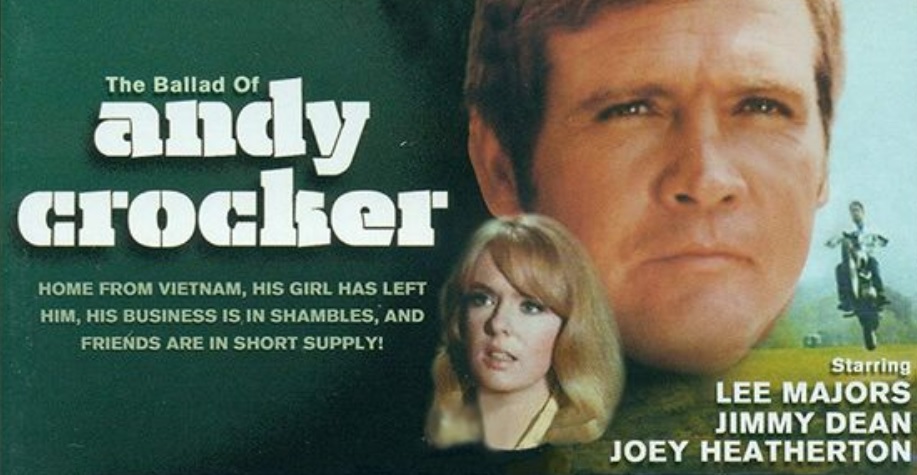
After his 112-episode, 4-year run as Heath Barkley on ABC-TV’s The Big Valley, it was time to see if Lee Majors could carry a feature film. And he did, with this, the screenwriting debut by familiar ’60s and ’70s TV actor Stuart Margolin (we know him best from his support role as Angel Martin, James Garner’s former cell mate, in The Rockford Files). And who’s the director on this? Well, hey, it’s George McCowan — the guy who brought us the nature-run-amuck classic, Frogs and the Canadian Star Wars dropping that is The Shape of Things to Come, as well as a few episodes of the pre-Star Wars venture The Starlost, and too many ’60s and ’70s U.S. TV series to mention.
One of the earliest films — long before the 1979 Oscar Winner, Coming Home — that dealt with the emotional trauma of returning Vietnam veterans, Lee stars as Andy Crocker. He’s a disaffected vet who returns to his Texas hometown to discover his girlfriend was forced into marrying another man, his once successful motorcycle shop is left in ruins, and those he once through were his friends, now turn their backs on him. The campaign against him is led by the town’s queen bee: the mother of his ex-girlfriend.
In addition to this serving as Majors’s film debut, be on the lookout for R&B musician Marvin Gaye (he finished his acting career with Chrome and Hot Leather starring William Smith), country musician and breakfast sausage king Jimmy Dean (who followed up with a role in Diamonds Are Forever), and Righteous Brother Bobby Hatfield, each in their acting debuts. Keen TV eyes and lovers off things character-actor will notice Joe Higgins (from TV’s The Big Valley and The Rifleman, but also Record City and Sixpack Annie!), ’60s six kitten Joey Heatherton (Cry-Baby), longtime Clint Eastwood sidekick and future Commission Gordon Pat Hingle (Rachel, Sweet Rachel), and Agnes Moorehead (TV’s Bewitched, but also of What’s the Matter with Helen? and The Bat!) rounding out the cast.
You can watch The Ballad of Andy Crocker — Stuart Margolin’s screenwriting debut — on You Tube, and watch his latest screenplay, What the Night Can Do, for free on IMDbTV (via your IMDb, Amazon, or Google accounts). We found the original, 1969 trailer to enjoy, as well.
About the Author: You can learn more about the writings of R.D Francis on Facebook.He also writes for B&S About Movies.



 B&S About Movies
You must be logged in to post a comment.