DAY 2: A Horror Film Featuring Non-Avian Dinosaurs and Mezozic Reptiles.
Norbert Moutier also made Ogroff, a shot on video slasher. Moutier was an accountant who contributed to the zines Monster Bis and Le Petit bédéraste du 20e siècle before starting to make his own movies in 1982, often serving as the director, screenwriter, producer and sometimes even acting. He quit accounting and started a comic book and movie store, which really feels like a dream life.
Somehow, he got some of the biggest genre personalities in France to be in his movies, like Howard Vernon, Jean-Pierre Putters, Quélou Parente, Christophe Bier, Christophe Lemaire and Christian Letargat. In this movie, he got Jean Rollin to play Professeur Nolan, the leader of this strange experiment in which secret agents work alongside time travel scientists who are in the past to study dinosaurs. Those secret agents bring a war criminal with them to execute because killing is illegal in the future. They’re using a spaceship to get there and also dumping tons of trash, using our past Earth as a trash pit.
Obviously, everything I knew about time travel is wrong.
Moutier also convinced Tina Aumont (Fellini’s Satyricon, Torso, Arcana) to be in this movie. There’s even a striptease scene without nudity, which seems a strange thing to do when dinosaurs are attacking, but when you meet a cave girl, you just watch and be polite.
As for those dinosaurs, they are often rubbery puppets and other times straight up dinosaur toys moved in stop motion. Keep in mind this movie was made the same year as Jurassic Park. If you thought that Carnosaur was the nadir of dinosaur movies, you’ll look at this and say, “Yes, the tar pit does deeper.”
Most of all, this movie is worth watching because Rollin is in the lead. I can only imagine that he kept talking to Moutier, the auteur, and saying, “You sure we can’t just a lot of fog and have a nude vampire woman look depressed and slowly walk through this scene?”
Also: the entire film was shot with the camera audio, so there’s non-stop hiss all over everything.
EDITOR’S NOTE: This 21st Century Film Corporation movie first was on the site on November 8, 2018. If you want to check out more on the rest of the Death Wish series, click here.
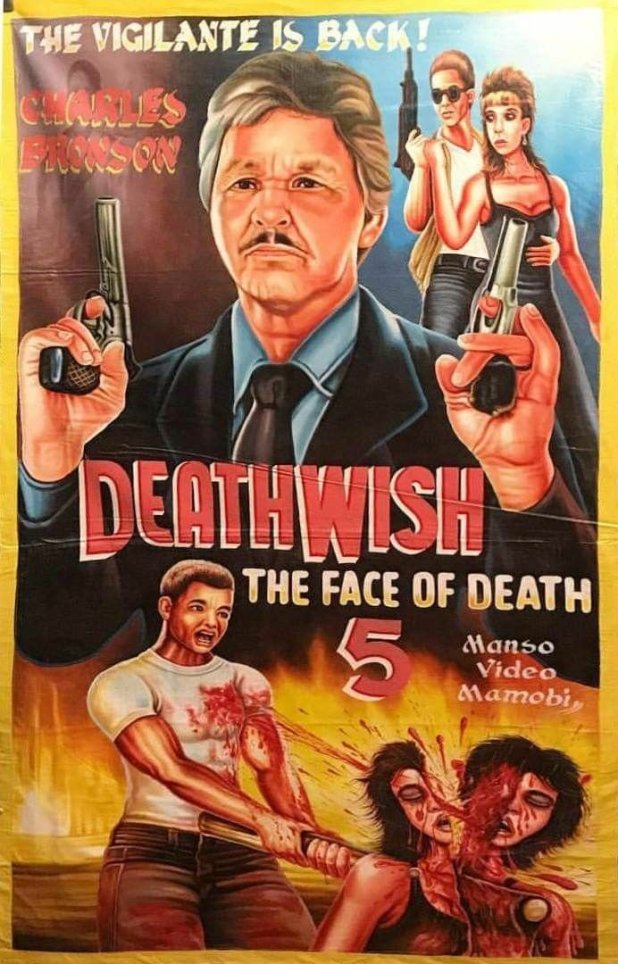
You think Paul Kersey has learned his lesson about love and loss? No way, pal. Now back in New York City in the witness protection program and going by Paul Stewart, he’s keeping a low profile by going to fashion shows with his super hot girlfriend (Lesley-Anne Down) who also has a young daughter named Chelsea who is surely doomed. Come on, everyone. We’ve made it this far. We may as well watch Death Wish 5: The Face of Death.
It turns out that Olivia has been paying protection money to her evil mobster ex-husband Tommy O’Shea, who is Michael Parks! Paul confronts the guy at the fashion show, but one of the villain’s goons shows him his revolver. He tries to do the right thing and brings in a District Attorney.
Paul again proves he has no short or long-term memory by proposing to Olivia, who doesn’t understand what we all have accepted: God hates Paul Kersey like He has never hated another of His creations. Excusing herself to the powder room to piddle in absolute joy after being asked to be the life partner of a man who has personally murdered thousands of scumwads, one of Tommy’s men named Flakes (Robert Joy, Lizard from The Hills Have Eyesand, as my wife would exclaim loudly, Jim from Desperately Seeking Susan) shoves her face so hard into a mirror that she’s disfigured for life. Even surgery won’t fix her face. Such is the life of a woman who gets involved with Paul Kersey.
After meeting two cops, Mickey King (Windom Earle from Twin Peaks!) and Janice Omori, the female cop dies in the very next scene. She must have gotten a little too close to Paul. In the hospital, King tells Kersey not to go back to his old ways. King tells him that he’s been on this case for 16 years. “16 years? That’s a long time to be failing,” replies Kersey.
Even after getting out of the hospital, Olivia still has to deal with the life she’s chosen as more henchmen come after Paul, shooting her in the back and finally ending her suffering. Well, it turns out that Tommy runs all of the police and has taken his daughter back, so Paul goes full on 007 by killing one goon with poisoned cannoli and another with a remote-controlled soccer ball! At this point, this film has gone from boring to right where I want it to be.
What follows is exactly what we want to see: a slasher movie with the righteous Paul going old man nutzoid on every crook there is left, shooting them into sewing machines, slashing their faces with broken bottles and shotgun blasting them into acid baths. At the end, he walks away with his dead fiancee’s daughter, yelling to the cop who couldn’t keep up, “Hey Lieutenant, if you need any help, give me a call.”
After the last three movies coming from Cannon Films, which was in Chapter 11 bankruptcy and under investigation by the U.S. Securities and Exchange Commission, this one comes from Menahem Golan’s new 21st Century Film Corporation. They were having trouble making money and figured that a new Death Wish was going to be a sure-fire hit. Incredibly, for reasons no one is sure about, Bronson and Golan weren’t speaking during the filming, so they’d only communicate through Allan A. Goldstein.
Sadly, the film failed at the box office (but it did fine on home video). Golan planned to continue the film series without Bronson (!) and was planning Death Wish 6: The New Vigilante before 21st Century Film Corporation went bankrupt. This would be Bronson’s last theatrical film, as he was 71 years old as this was being filmed.
Get ready for the adventures of the seaQuest DSV 4600, a deep submergence vehicle of the United Earth Oceans Organization (UEO). The UEO? Well, that group was created in 2018 — in the continuity of this show — after a battle within the Livingston Trench.
Designed by retired naval captain Nathan Bridger (Roy Scheider), the series begins as humanity finds itself out of natural resources and begins to mine the ocean floor. Several gold rush-style mining communities now exist within this unexplored territory and the seaQuest seeks to protect them from other countries and sometimes each other.
Bridger just wanted to stay retired, particularly after his son Robert died in a naval battle and he promised his dying wife that he would never go back to the sea. But you know…they keep bringing pulling him back.
This show debuted to great fanfare, with the first season’s plots all about oceanographic research, environmental issues, politics and the interpersonal relationships of the crew. By the end of the first season, low ratings led to a cliffhanger where Bridger sacrificed the ship to prevent an ecological disaster.
And that’s where things get weird.
When it was decided the show would come back, NBC and Universal moved production from Los Angeles to Orlando, which led Stephanie Beacham, who played Dr. Kristin Westphalen, to leave the show (all of the battles between the producers and network didn’t help either). It’s also why Stacy Haiduk (Lieutenant Commander Katherine Hitchcock) left, but Royce D. Applegate (Chief Manilow Crocker) and John D’Aquino (Lieutenant Benjamin Krieg ) were let go because NBC wanted a younger crew.
The original crew also had Lucas Wolenczak (Jonathan Brandis), Commander Jonathan Ford (Don Franklin), Lieutenant Tim O’Neill (Ted Raimi) and Sensor Chief Miguel Ortiz (Marco Sanchez). They’d be joined by the telepathic Dr. Wendy Smith (Rosalind Allen), weapons officer Lieutenant James Brody (Edward Kerr), genetically engineered gill-breathing Seaman Anthony Piccolo (Michael DeLuise), Lieutenant Lonnie Henderson (Kathy Evison) and Dagwood (Peter DeLuise), a GELF (genetically engineered life form) who served as the ship’s janitor.
Whereas season one often had serious science — and each episode ended with facts from oceanographer Dr. Bob Ballard, the technical advisor for the show, inspiration from Bridger and the man who actually discovered the wrecks of Titanic, Bismarck and Yorktown — other than finding an ancient spaceship, season two had a monster of the week feel to compete for better ratings. Demons, aliens, fire-breathing worms, the god Neptune, time travel, a prehistoric crocodile and so much more was, well, too much for Scheider to handle.
He referred to the new storylines, giving multiple interviews to the Orlando Sentinel where he said the show as “Saturday afternoon 4 o’clock junk for children. Just junk — old, tired, time-warp robot crap” and “…childish trash…I am very bitter about it. I feel betrayed… It’s not even good fantasy. I mean, Star Trek does this stuff much better than we can do it. To me the show is now 21 Jump Street meets Star Dreck.” That 21 Jump Street dig must have been directed at the DeLuise brothers, who were once on that show before joining the cast.
By the end of the second season, it seemed like the show would be canceled — yet again — so the final episode “Splashdown” has the crew being abducted by aliens, then fighting in a civil war that destroys the seaQuest — yet again! — and everyone dead.
And yet the third season happened!
Scheider requested to be released from his contract with NBC but was asked to appear in a few more episodes. Edwin Kerr asked to quit as well and was asked to stay long enough to die in season 3’s “SpinDrift,” while NBC’s scheduling — which contributed to low ratings as the series moved around all the time — caused the episode “Brainlock” to air with his character still alive.
Now, only Jonathan Brandis, Don Franklin and Ted Raimi stayed on, as if the show was a band playing ribfest with hardly any original members left (even Dr. Bob Ballard was gone). Now called seaQuest 2032, the crew arrived ten years back on Earth ten years later, Bridger retired and Michael Ironside came on as Captain Oliver Hudson. He immediately set some boundaries: “You won’t see me fighting any man-eating glowworms, rubber plants, 40-foot crocodiles and I don’t talk to Darwin.”
Oh yeah — Darwin was a talking dolphin voice by the man who is every talking animal, Frank Welker.
Elise Neal also joined the show as Lieutenant J.J. Fredericks as storylines moved more toward corporate greed running the world and political tension. Only 13 episodes aired before finally, the show was done for good.
There were model kits, trading cards, video games and even Playmates action figures (check out this article on seaQuest Vault), but the show always struggled to catch on with viewers, if they could find it.
Going back and watching this again in box set form, it’s fascinating to see how the show changes and struggles for direction in a condensed format. Week by week, it’s not as strange. When binged, it seems absolutely deranged. I’m glad in some way that I wasn’t in love with the show when it aired. It would have broken my heart.
The Mill Creek blu ray box set of seaQuest DSV has every episode of the show, plus new interviews and featurettes with the series creator Rockne S. O’Bannon, as well as the directors and crew. Plus, you get several deleted scenes. Get it from Deep Discount.
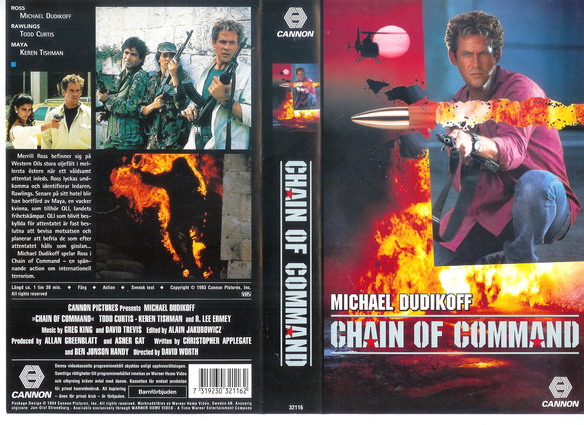
Merrill Ross (Michael Dudikoff) was once a Green Beret but now he’s the employee of an company in the Middle Eastern nation of Qumiri. The company gets attacked, his co-workers are taken hostage and Ross must battle through rebels and the CIA to make sure that his friends get out alive.
The bad guy is Rawlings (Todd Curtis), who you will love as much as you will hate. His permed up hair is astoudning, as is his devotion to his craft, explaining to those he’s torturing or fighting just how he plans on using their nerve endings to kill them. The scene where he explains the pleasure and torture zones to Keren Tishman is just…deranged. In the best of ways.
Meanwhile, R. Lee Ermey is the Texas oil tycoon causing so much of this insanity to happen.
Dudikoff is way against type in this. Smoking, drinking, swearing. But then he mows down twenty people without reloading and you realize, yeah, this is the movie you turned up for.
This is the kind of movie where Dudikoff stabs a dude with a pool cue and the villain responds with, “My mama said there’d be days like this.”
Though Chain of Command was released in other countries in 1994, its U.S. video release wasn’t until January of 1996, making it the final Cannon movie released in America.
Directed by Aaron Norris and written by Ian Rabin, Anthony Ridio and Brent Friedman, this movie beat End of Days to screens by five years and allows viewers to watch Chuck Norris sidekick a demon, which is something I highly love.
Chicago cops Frank Shatter (Chuck Norris) and Calvin Jackson (Calvin Levels, Adventures In Babysitting) have a case that takes them the whole way to Israel where they end up coming up against Satan’s henchman Prosatanos (Christopher Neame), who has been alive since he was stopped by King Richard (David Robb) back during the Crusades and trapped in a tomb under the Earth.
Prosatanos’ scepter was shattered by the King into nine pieces which were sent to nine holy places around the world. Now, Prosatanos must battle Shatter and Jackson for the fate of the world.
You’ll pray to the dark lord by the end of this movie that Jackson is murdered, as he keeps yelling things like “Either that guy is nuttier than a Snickers or there is some real heavy shit going down!”
Also: Frank Shatter is the best Chuck Norris name ever and the fake name I will be using at every restaurant where I must give my name for the rest of my life.
Just the name L.A. AIDS Jabber is going to offend you or make you want to see this or perhaps even both. Originally released as Jabber in the 90s in the most limited of releases — in the thousands and all self-distributed by creator Drew Godderis — this is the story of Jeff (Jason Majik) and what happens when he finds out that the illness that he’s been feeling could very well be a death sentence.
1994 is a very different place than 2022, but then again, is it so different? We’re still dealing with a pandemic that has been politicized, except that when AIDS was unleashed, it was originally thought to be some form of cancer that only impacted homosexual men (shades of the media as monkeypox became this year’s illness) and any stories of straight men or women didn’t appear on the news.
So when Jeff finds out from his doctor that he has HIV, the disease that causes AIDS, he’s certain that this is the end of his world. Then why shouldn’t it be the end of the world for everyone he can take down along the way?
Jeff gets the bright idea to start filing his blood into syringes and tracking down everyone who wronged him, then injecting them with his infernal hemoglobin. And thus we have a shot on video movie — by necessity, as you can learn in my exclusive interview with Drew — that is filled with shock upon shock.
The thing that’s most astounding about this movie is that despite being SOV it doesn’t seem like a low end production. Yeah, it’s sleazy — would you expect a movie with this title to be any other way? — but it also explores the life of the cops on the case as well as what drove Jeff to go for broke. And man, the soundtrack! It sounds amazing!
Back in 2000, Snopesexplored the urban legend that drug addicts were placing their used, HIV-infused needles into pay phone coin slots in order to infect others, as well as another story about AIDS terrorists leaving HIV needles in movie theater seats. Yeah whatever, crazy people of the world. L.A. AIDS Jabber got there first. And of course, it did it better.
Visual Vegenace has put out the first wide release of the movie — available from MVD — since it was self-distributed by director Drew Godderis himself and the blu ray is packed with newly produced bonus features and commentary from the original creators such as:
Director’s Introduction to Movie (2021)
Commentary Track with Director Drew Godderis
Lethal Injection: The Making of L.A. AIDS Jabber with Director Drew Godderis
Bleeding The Pack: An Interview with Lead Actor Jason Majick
L.A. AIDS Jabber – 2021 Locations Visit
Interview with Blood Diner Director Jackie Kong
Growing Up On Set: Justin Godderis
Actress Joy Yurada Interview
Cinematographer Rick Bradach Interview
Interview with Actor Gene Webber
Liner notes by Tony Strauss of Weng’s Chop Magazine
L.A. AIDS Jabber Photo Gallery
Blood Video Fanzine Essay by Billy Burgess
L.A. AIDS Jabber Trailer (2021)
Limited Edition Slipcase — FIRST PRINTING ONLY
Collectible folded mini-poster
“Stick Your Own” VHS stickers
Reversible BR sleeve featuring original VHS art
Visual Vengeance Trailers
For more details on the label and updates on new releases – as well as news on upcoming releases – follow Visual Vengeance on social media – IG, Facebook or twitter
EDITOR’S NOTE: This was originally on the site on December 23, 2021, but now Vinegar Syndrome has a new release that’s been newly scanned & restored in 2K from its 35mm interpositive, complete with a commentary track with film historians Amanda Reyes and Sam Pancake, “Don’t Remake Hitchcock Movies” – an extensive making-of documentary featuring interviews with its cast and crew, “The Silence of the Birds” – an interview with composer Ron Ramin, “The Locations of Birds II” – a locations featurette with production assistant Craig Edwards, a still gallery and reversible cover artwork.
Look, I don’t write these articles to beat up on movies, but this is like shooting dead pigeons in a barrel.
Some facts:
Rather than playing Melanie from Hitchcock’s The Birds, Tippi Hedrin plays Helen, the owner of a local store that knows all about the birds and remembers the events of the original. Why is she a different character? Is she there under witness protection? Did Hedrin only do this movie to get a check for her animal charity? Was this a worse experience than Roar?
This is not the first — or the last — sequel that Rick Rosenthal would make, what with being part of the best Halloween sequel and the worst. He made sure his name was not on this movie, as Alan Smithee is credited.
Why would this movie be made? Was Showtime obsessed with sequels? Is it worth sticking around for the last ten minutes where seagulls go nuts and most of the cast gets killed? Would Hitchcock hate this movie? Did he once give Melanie Griffith a doll of her mother inside a coffin? Am I obsessed by movies that most people know better than to even try to watch?
Yes, yes, yes, yes, yes and forever.
PS: Craig Edwards worked on this movie and shared this amazing article about his time on the set.
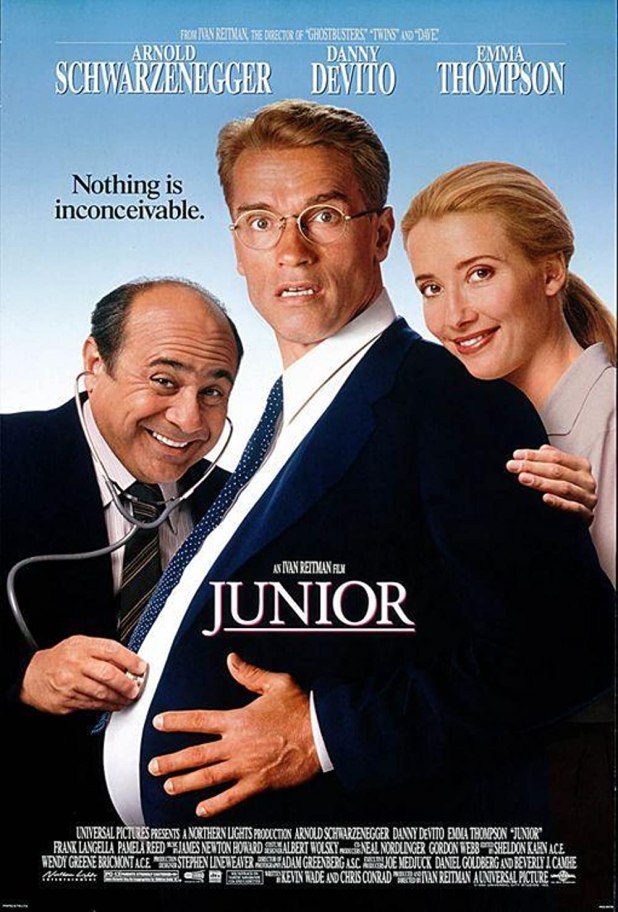
It’s just a decade or so between Arnold Schwarzenegger being a Terminator and him being the world’s first pregnant man, so never let it be said that the man has no range. Teaming with Ivan Reitman again after Twins and Kindergarten Cop, this may not have had the same magic as those films, but it has some moments of fun in it nonetheless.
Research geneticist Dr. Alex Hesse (Schwarzenegger) and Dr. Larry Arbogast (Danny DeVito, teaming again with Arnold) have invented Expectane, a fertility drug that reduces miscarriages. Until the FDA approves it, they can’t test it, so Hesse loses his job and geneticist Dr. Diana Reddin (Emma Thompson) comes on board, which convinces Hesse to try the experiment on himself, using the egg named Junior which unbeknowst to him has been stole from Reddin by Arbogast.
Meanwhile, Arbogast’s ex-wife Angela (Pamela Reed) is having a baby — a member of Aerosmith’s touring company is the father — at the same time as Hesse, who keeps pushing the experiment until he starts showing. The doctor team has to keep their boss Dr. Noah Banes (Frank Langella) from taking the credit for the first male baby, which if it were a thing, there’d be all sorts of birth rights.
Out of the three movies that Arnold made with Reitman, this is his favorite. Or that’s what IMDB says, because I’ve heard the same thing about Kindergarten Cop.
EDITOR’S NOTE: This was first on the site on April 22, 2020.
Harry Tasker (Arnold Schwarzenegger) is living two lives. To his wife (Jamie Lee Curtis) and his daughter (Eliza Dushku), he’s a boring computer salesman. But that’s all a cover for his real job, as an agent of the elite Omega Sector. He’s Bond but perhaps even better, as the opening of the film shows him easily seducing Juno Skinner (Tia Carrerestealingeal important files and escaping a society party by killing everyone in his way.
But what happens when his wife meets someone who could be a spy (Bill Paxton) and starts having an affair?
This is a movie that I’d not watched for some reason and I loved it. Particularly, I enjoyed Charlton Heston as Director Spencer Trilby and Tom Arnold as Tasker’s handler Albert Gibson. The spy action moves quickly, the action is big and bold, yet the love between Curtis and Arnold feels real.
Of course, this movie could never be made today, the way that it goes after Arabic people as terrorists. 1994 feels centuries ago in so many ways.
After September 11, 2001, Cameron decided to not do a sequel. He would say, “Terrorism is no longer something to take as lightly as we did in the first one. I just can’t see it happening given the current world climate.” Curtis would also say, “Terrorists aren’t funny anymore. They never were, but, it was distant enough from our psyche that we could make it funny. It’ll never be funny again. I just think that that is over, that kind of humor is over.”
That said, there remains a rumor that McG will be creating a series adaption for Disney+. For what it’s worth, this movie was based on the French film La Totale!, which didn’t get a sequel either.
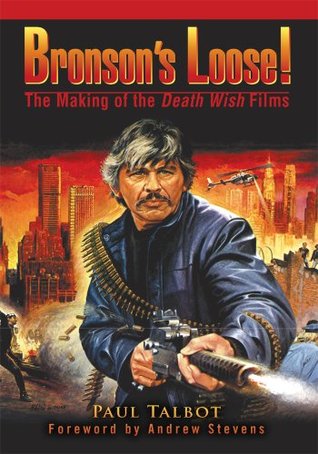
With The Cannon Canon celebrating Bronson Don’t Like May(onnaise) this month, I decided to watch some Bronson and bring back several of his films. Seeing as how I’ve done an entire Death Wish week before, why not just put them all in one review for easy reading?
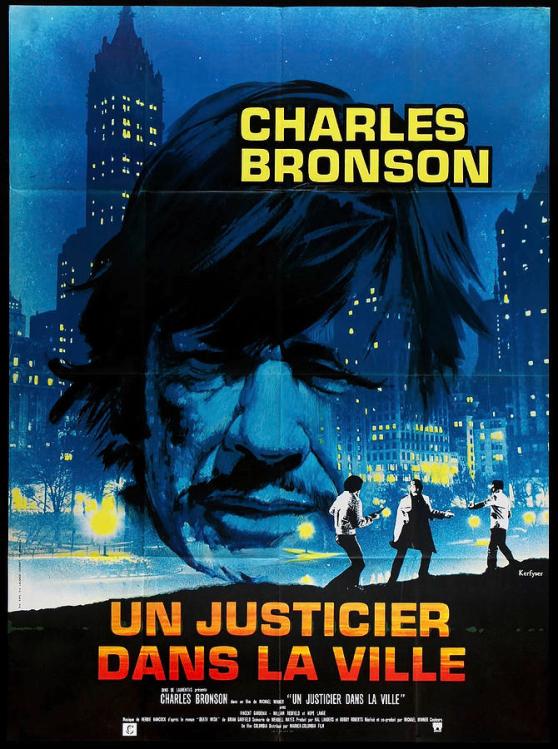
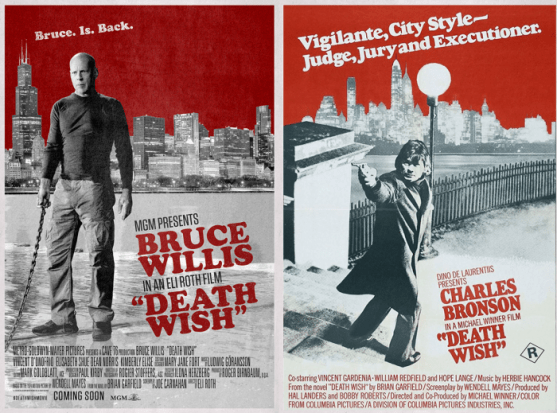
Death Wish (1974): New York City in 1974 must have felt like the end of the world. Based on the 1972 novel by Brian Garfield, Death Wish was the answer. In fact, in many theaters, the audience stood up and cheered as Paul Kersey got his bloody revenge for the crims visited upon him and his family.
The film we’re about to discuss went through many twists and turns as it made its way to the screen. Originally, it ended with the vigilante hero confronting the thugs who attacked his family and them killing him, police detective Ochoa discovering his weapon and deciding to follow in his footsteps. And get this — the first choice to play the lead was Jack Lemmon, with Henry Fonda as Ochoa and Sidney Lumet directing.
Finally, United Artists picked the gritty action veteran Michael Winner to direct. Several studios rejected the film due to its subject matter and the difficulty of casting the lead. Winner wanted Bronson, who he’d worked with in the past, but the actor’s agent hated the message of the film and Bronson felt that the book was about a weak man, someone he would not be playing on film.
Death Wish turned Bronson, who was 53 at the time of its release, into a major star known worldwide. It’s a movie made exactly for its time. Despite its lurid subject matter and dangerous acceptance of its hero’s actions, it’s still a great exploitation film that actually explores the why behind its hero’s actions instead of just setting him loose upon people.
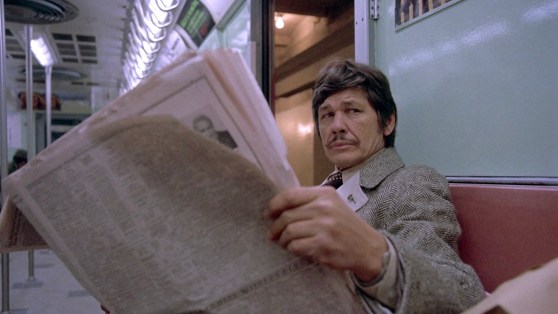
Paul Kersey (Bronson) starts the movie in Hawaii with his wife Joanna. When they return home to the squalid streets of New York City, it’s only days before three thugs — including Jeff Goldblum! — invade their apartment, raping their daughter Carol and bearing Joanna so badly that she dies. Beyond Goldblum in this early role, keep an eye open for Christopher Guest and Olympia Dukakis as cops, as well as Sonia Manzano (Maria from Sesame Street, who was dating director Winner at the time and suggested that Herbie Hancock do the score) and Lawrence Hilton-Jacobs (Freddie “Boom Boom” Washington from TV’s Welcome Back, Kotter) in supporting roles.
As he recovers from his wife’s death, Paul is mugged. He fights back and chases off his attacker and finds new strength from the battle. An architect by trade, Paul heads to Tucson where he helps Ames Jainchill with his residential development project. After work one night, he goes to a gun club with Ames, where we learn how good of a shot Paul is. Turns out he was a conscientious objector and combat medic who was taught marksmanship by his father, but promised his mother he’d never pick up another gun after his dad was killed in a hunting accident. On the way back home, Paul discovers that Ames has given him a gun as a gift.
Now back home, Paul learns from his son-in-law that his daughter is still catatonic and would be better off in a mental hospital. That night, when walking, Paul is mugged again but he has the gun with him. He fights back and kills the mugger, but even that action causes him to grow physically sick. But soon, he’s prowling the mean streets and looking for a fight.
Before long, NYPD detective Lt. Frank Ochoa (Vincent Gardenia) begins investigating the vigilante killings and quickly narrows down his suspect list to Paul. As the manhunt gets closer and closer, Paul finally is caught after passing out from blood loss after a shootout. Instead of arresting him, the NYPD wants the case quietly solved, so they send him off to Chicago. The minute he arrives, he helps a woman who was almost mugged and stares at the criminals with a smile, his fingers in the shape of a gun.
There’s a story which may be apocryphal, but when Michael Winner told Bronson what this film would be about — a man who goes out and shoots muggers — Bronson replied, “I’d like to do that.” Winner said, “The film?” And Bronson replied, “No. Shoot muggers.”
After viewing the film, author Brian Garfield hated how the film advocated vigilantism, so he wrote a sequel called Death Sentence that was made into a movie in 2007 starring Kevin Bacon. No word on whether or not he hated that movie too, as it only keeps a little of the book.
Compared to the heights of mayhem that this series will descend to, this is a retrained meditation of a man facing an increasingly violent world. Stay tuned. Paul Kersey is just getting started.
Death Wish II (1982): Paul Kersey can’t catch a break. Seriously, in this sequel, he goes through the Trials of Job all over again. You think he went through some bad stuff in the first movie? Michael Winner is just getting started putting our vigilante hero through hell on earth.
Paul has taken his daughter Jordan and moved to Los Angeles, where he’s found love again with radio reporter Geri Nichols (Bronson’s wife, Jill Ireland). However, horror and pain is never far from Kersey, so one day at a fair, some punks steal his wallet. He chases one of them down named Jiver down and teaches him a lesson. The gang — Nirvana, Punkcut, Stomper and Cutter (Laurence Fishburne) — find his address in his wallet and pay a visit to his house. They rape his housekeeper Rosario, beat Paul into la la land and steal his daughter (this time played by Robin Sherwood from Tourist Trap). After raping her, she goes even deeper into her depression and jumps out a window, falling to her death and getting impaled like she’s Nikos Karamanlis or Niko Tanopoulos.
Of course, Paul doesn’t need help from the cops. He only needs one thing: to give in to the rage within, to become the vigilante once more. Det. Frank Ochoa is back to chase him one more time, as he’s the only one who can track him.
Soon, Paul is wiping out the gang one by one, his own personal safety and relationship with Geri be damned. This is the first time we discover that Kersey is able to do magical things like make fake IDs with just a Xerox machine and talk his way into anywhere and out of anything. By the end of this film, he’s gone from a man whose life has been destroyed to a walking angel of death willing to do whatever it takes to kill everyone that’s crossed him.
To be as authentic as possible, this movie was shot in the sleaziest parts of Los Angeles, such as the abandoned and crumbling Hollywood Hotel location. Many of the film’s extras were local color who were either hired to play a bit part or just walked over to the set, such as drug addicts, drag queens, Hare Krishnas and bikers. Even crazier, Bronson’s alcoholic brother was a frequent set visitor, constantly asking for money. Bronson wanted to be careful not to give him too much cash so that he wouldn’t be mugged, but that brother was soon found dead, stabbed in the ass.
My favorite part of this was the score, composed by Jimmy Page in his first post-Led Zeppelin musical appearance here by creating the film’s soundtrack. It’s almost surreal to hear his signature guitar tone over Bronson killing rapists.
Death Wish 3 (1985): Paul Kersey is back in New York City, despite being kicked out at the end of the first Death Wish. His Korean War buddy Charley has invited him to ask for help as his East New York apartment building has been under attack by a gang. Paul gets there just in time for his friend to die in his arms and the police arrest him for the murder. Inspector Richard Shriker recognizes him as the vigilante from back in the first movie, so he throws him into a holding cell with the leader of the gang, Manny Fraker (Gavan O’Herlihy, son of Halloween 3: Season of the Witchbad guy par excellence Dan O’Herlihy). After a fistfight ensues, the villain gets released before Paul. If you think that’s the end of all of this, you haven’t been reading our website this week.
Shriker offers our hero a deal: kill all the punks you want, but inform him of any activity so that he can get a big bust and make the news. With that, we’re off and to the races in what is not only the craziest of the Death Wish movies, but perhaps the most bonkers movie you’ll ever see.
Paul moves into his dead friend’s apartment and into a warzone. He makes friends with the other tenants, including World War II vet Bennett Cross (Martin Balsam from Psycho), a kindly old Jewish couple named Mr. and Mrs. Kaprov, a young Hispanic couple named Rodriguez and Maria (a pre-Star Trek: The Next Generation Marina Sirtis who in real life is a Greek girl born in London). There’s even a young kid who continually walks into the path of gunfire. Obviously, this is a neighborhood made for Paul Kersey. It is, as my wife pointed out, Sesame Street where people die horribly.
Paul uses a car as bait for the gang, killing two who break into it. And he saves Maria twice, but the third time, the gang takes her and she soon dies in the hospital, not knowing the most important rule of Death Wish: if you are a woman, stay away from Paul Kersey.
That’s when Paul orders a .475 caliber Wildey Magnum, a gun that has the same muzzle velocity as a .44 Magnum at 1000 yards. This big bore handgun, as Danny Vermin once said, “shoots through schools.” He traps The Giggler by putting his new camera where he knows the criminal can steal it, then he blows him into another dimension with his gigantic handcannon. “I can’t believe they got The Giggler, man,” laments the punk rock gang.
Why this gun? Well, it was Bronson’s personal handgun in real life. According to the gun’s inventor and the film’s technical consultant, Wildey Moore, sales for the Wildey Magnum increase whenever this film airs on TV.
You know who else didn’t get that memo about dating Paul? Public defender Kathryn Davis (Deborah Raffin, The Sentinel), who dates our hero long enough for him to joke that he likes opera and for mohawked punk gang leader Manny to shove the car she is waiting for Paul in toward oncoming traffic, where it explodes in a giant fireball.
Shriker decides that enough is enough and he puts Paul into protective custody. But after the gang blows up Bennett’s taxi garage, the old man tries to use the ancient Browning .30 machine gun that Charley brought back from the war. Sadly, the ancient detective from Psycho is no Roadblock from G.I. Joe and he’s quickly beaten into near death by the gang. Paul is allowed to visit him at the hospital and quickly makes a break to defend his new friends once and for all.
There’s another big machine gun, so Paul and Rodriguez use it to kill every single gangbanger they can before they run out of ammo, just as their neighbors finally come to arms to help them. What follows is what can only be described as sheer orgasmic violence, as hundreds of stunts all happen at the same time. Grenades are thrown from motorcycles. Handgun blasts send people flying through glass windows. Fire is everywhere. And there’s Paul Kersey, walking cooly and doing what he does best: killing punk rock criminals of all colors, races and creeds, including a very young Alex Winter.
Finally, Manny almost kills Paul, but he’s saved by Shriker, who is wounded by the punker but succeeds in shooting him. Kersey calls for an ambulance just as Manny rises, showing his bulletproof vest. In a moment that will live in my mind forever, Paul shoots him dead in the chest with an M72 LAW rocket and sends him flying through the side of the building as his girlfriend (Barbie Wilde, the female Cenobite from Hellraiser) screams in pain, their psychic link obviously broken like Cyclops and Jean Grey on the dark side of the moon. The gang realizes they’re beaten as the cops show up in force, with Kersey simply walking away.
Death Wish 3 is many things, but none of them are subtle. It’s a sledgehammer blow to your sensibilities, a veritable tour of depravity and sadism. It’s also entertaining as hell. Bronson hated Don Jakoby’s (Invaders from Mars, Lifeforce and a frequent collaborator of Dan O’Bannon, with whom he wrote an unproduced script called Pinocchio the Robot that would have featured Lee Marvin as Geppetto!) script and the fact that they turned Paul Kersey into Rambo, but he got $1.5 million for starring in this movie. Frequent rewrites led to Jakoby taking his name off the film and he’s listed as Michael Edmonds.
All told, 74 people die in Death Wish 3, as detailed in this completely amazing article. They are stabbed, shot, run over, set on fire and more. They fall from tall buildings. They are thrown from tall buildings. And there’s a gang that combines all races and creeds — except old people — including white supremacists, punk rockers and lovers of reggae. It is the rainbow coalition of death. There was also a video game that lives up to the violence on screen.
The film also includes a rape scene with the victim played by Sandy Grizzle, who was the girlfriend of director Michael Winner. After they broke up, she reported to London tabloids that this was part of him treating her as a sex slave. Winner sued the News of the World tabloid and won.
Before you scoff at this notion, keep in mind that Winner spent six days filming the rape scene in Death Wish 2, a movie that took from May to July of 1981 to shoot. Also, following the allegations made against Harvey Weinstein in 2017, Winner was accused by three women of demanding they expose their breasts to him. Seeing as how he’s not around to refute the charges, let’s just move on.
Beyond these rumors, Winner was the kind of special individual that almost died from eating dinner — twice. He got the bacterial infection vibrio vulnificus from eating an oyster in Barbados, nearly losing his leg and his life. Then, years later, he’d almost die from food poisoning after eating steak tartare four days in a row. He died in 2013 at the age of 77.
Let’s ignore the gossip on Michael Winner and concentrate on how awesome Death Wish 3 is. Because wow, they literally can’t, don’t — and some folks would say probably shouldn’t — make them like this anymore.
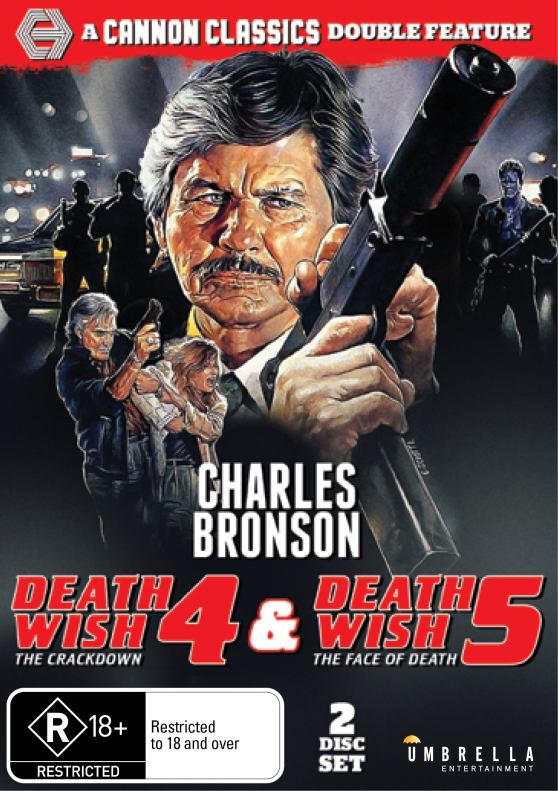
Death Wish 4: The Crackdown (1987): Where do you go after the utter lunacy that is Death Wish 3? Well, you replace Michael Winner with J. Lee Thompson, who was the director for The Guns of Navarone, the original Cape Fear, the slashtastic Happy Birthday to Me and The Reincarnation of Peter Proud amongst many other films. He’d already worked with Bronson on 10 to Midnight, Murphy’s Law and The Evil That Men Do and would also direct Bronson in Messenger of Death and Kinjite: Forbidden Subjects after this movie wrapped. In fact, counting St. Ives, The White Buffalo and Caboblanco, they’d work on seven movies together.
Paul Kersey hasn’t learned anything from the last three movies. He has a new girlfriend, Karen Sheldon (Kay Lenz, The Initiation of Sarah, House) with a teenage daughter named Erica (Dana Barron, the original Audrey from National Lampoon’s Vacation) that you shouldn’t get to know all that well. That’s because — surprise! — she overdoses thanks to her boyfriend and her getting into crack cocaine and doing it an arcade. If you’re shocked that a Death Wish movie would prey upon the worst fears of America’s middle class, then you may have watched the last three films too.
Paul loved that girl like his own daughter, probably because she wanted to be an architect like him and also possibly because he hasn’t yet learned that the moment that he says something like that, tragedy is right around the corner. Honestly, the main message of the Death Wish films is that God hates Paul Kersey, will not allow him to die and will wait until he finds happiness again before visiting upon him great suffering, only for the cycle to repeat.
The night she died, Paul saw Erica smoke a joint with her boyfriend and was already suspecting the young dude, so he follows him back to the arcade the next night. That boyfriend confronts Jojo and Jesse (Tim Russ, Commander Tuvok himself!), two of the dealers who sold them the crack cocaine, and threatens to go to the police. This being a Death Wish film, they kill him pretty much in public. That murder unlocks the ability for Paul to start killing again, so he shoots Jojo and launches his body on to the top of bumper cars, where he’s electrocuted. No one dies in a Death Wish movie without a flourish.
Meanwhile, Paul gets a call from tabloid publisher Nathan White (John P. Ryan from It’s Alive), who knows that he’s the vigilante. His daughter had also become addicted to drugs and died, so he knows what Paul is going through. The storyline becomes pretty much like The Punisher’s first mini-series where The Trust paid for him to wipe out crime, as White funds Paul’s one man war against drugs while his girlfriend starts writing an expose on the two rival gangs in town.
To cut down the budget in this movie, when Paul and Nathan meet in the movie theater, that’s Cannon’s screening room.
One of those gangs is led by Ed Zacharias (Perry Lopez, Creature from the Black Lagoon) and the other is commanded by Jack and Tony Romero. Two LAPD officers, Sid Reiner and Phil Nozaki are also on the case, trying to figure out who killed the drug dealers at the arcade.
This is the first Death Wish film where Paul feels more like an urban James Bond than a fed up war vet. Trust me, he gets even more gadgets in the next one. Here, he uses his skills as a master of disguise — he has none — to dress as a waiter and serve a party at Zacharias’ house. The birthday cake is…man, let me just show you the birthday cake.
After witnessing the drug lord kill one of his guys who stole some cocaine, he’s ordered to help carry out the body. Soon, he’s killing all of that drug dealer’s men, including three guys in an Italian restaurant with a bomb shaped like a wine bottle. Look for a really young Danny Trejo in this scene!
After all that mayhem, Paul also starts wiping out the Romero gang one by one, including breaking onto a drug front and blowing it up with a bomb. Yet Nozaki ends up being on the take for Zacharias and tries to kill our hero and you know how well that works out. Now Paul looks like a cop killer, too.
In the stuntman piece de resistance of this one, the two drug lords are lured into an oil field shootout where Paul kills Zacharius with a high-powered rifle, instigating the fireworks. Nathan comes out to congratulate Paul, but sets him up with a car bomb. It turns out that the Nathan that Paul has met is a third drug lord (!) who set him up to take out all the competition. Then, two fake cops arrest Paul and take him downtown, but they’re really just trying to kill our hero. Again, you know how well that works.
The film ends with Detective Reiner searching for Paul out of revenge for his partner’s murder, the third drug lord kidnapping Paul’s woman and everything coming together in a parking lot and a roller rink where Paul uses an M16 with an equipped M203 grenade launcher to unleash holy hell.
Only the drug lord survives, holding Karen. She tried to escape and gets shot numerous times with a MAC 10 submachine gun. He tries to kill Paul but he’s out of bullets. Paul may be, but he still has a grenade, which he uses to blow the villain up real good.
The film closes with Reiner coming and ordering Paul to surrender and threatening to kill him if he walks away. “Do whatever you have to,” says the old gunfighter as he walks into the sunset.
For all the mayhem and madness throughout this film — keep in mind our hero just used an explosive device to decimate another bad guy just seconds before — this is a poignant ending. But of course, Paul — whether he wanted to use the new last name Kimble he came up with in this film or Kersey — would be back one more time.
Bronson made $4 million for this movie and in my opinion, he should have asked for more.
Death Wish 5: The Face of Death (1994): You think Paul Kersey has learned his lesson about love and loss? No way, pal. Now back in New York City in the witness protection program and going by Paul Stewart, he’s keeping a low profile by going to fashion shows with his super hot girlfriend (Lesley-Anne Down) who also has a young daughter named Chelsea who is surely doomed. Come on, everyone. We’ve made it this far. We may as well watch Death Wish 5: The Face of Death.
It turns out that Olivia has been paying protection money to her evil mobster ex-husband Tommy O’Shea, who is Michael Parks! Paul confronts the guy at the fashion show, but one of the villain’s goons shows him his revolver. He tries to do the right thing and brings in a District Attorney.
Paul again proves he has no short or long-term memory by proposing to Olivia, who doesn’t understand what we all have accepted: God hates Paul Kersey like He has never hated another of His creations. Excusing herself to the powder room to piddle in absolute joy after being asked to be the life partner of a man who has personally murdered thousands of scumwads, one of Tommy’s men named Flakes (Robert Joy, Lizard from The Hills Have Eyesand, as my wife would exclaim loudly, Jim from Desperately Seeking Susan) shoves her face so hard into a mirror that she’s disfigured for life. Even surgery won’t fix her face. Such is the life of a woman who gets involved with Paul Kersey.
After meeting two cops, Mickey King (Windom Earle from Twin Peaks!) and Janice Omori, the female cop dies in the very next scene. She must have gotten a little too close to Paul. In the hospital, King tells Kersey not to go back to his old ways. King tells him that he’s been on this case for 16 years. “16 years? That’s a long time to be failing,” replies Kersey.
Even after getting out of the hospital, Olivia still has to deal with the life she’s chosen as more henchmen come after Paul, shooting her in the back and finally ending her suffering. Well, it turns out that Tommy runs all of the police and has taken his daughter back, so Paul goes full on 007 by killing one goon with poisoned canoli and another with a remote-controlled soccer ball! At this point, this film has gone from boring to right where I want it to be.
What follows is exactly what we want to see: a slasher movie with the righteous Paul going old man nutzoid on every crook there is left, shooting them into sewing machines, slashing their faces with broken bottles and shotgun blasting them into acid baths. At the end, he walks away with his dead fiancee’s daughter, yelling to the cop who couldn’t keep up, “Hey Lieutenant, if you need any help, give me a call.”
After the last three movies coming from Cannon Films, which was in Chapter 11 bankruptcy and under investigation by the U.S. Securities and Exchange Commission, this one comes from Menahem Golan’s new 21st Century Film Corporation. They were having trouble making money and figured that a new Death Wish was going to be a sure-fire hit. Incredibly, for reasons no one is sure about, Bronson and Golan weren’t speaking during the filming, so they’d only communicate through Allan A. Goldstein.
Sadly, the film failed at the box office (but it did fine on home video). Golan planned to continue the film series without Bronson (!) and was planing Death Wish 6: The New Vigilante before 21st Century Film Corporation went bankrupt. This would be Bronson’s last theatrical film, as he was 71 years old as this was being filmed.
Death Wish (2018): Written by Joe Carnahan (writer and director of Smokin’ Aces and the movie version of The A-Team, as well as a member of the Creative Council of Represent.Us, a nonpartisan anti-corruption organization) and directed by Eli Roth (Cabin Fever, The Green Inferno), Death Wish was a movie delayed several times by the rampant mass shootings in our country. It arrives at a time when the debate over guns has reached a fever pitch. That said, one viewing of The Killing of America, made way back in 1982, shows that that argument has been going on almost the entire way back to the original Death Wish series.
Do we need another Death Wish? After all, there were five different movies already. Is there something new that the film can speak to? This one attempts to, with numerous blips of info from various media sources as diverse as Chicago DJ Mancow, memes and the site mediatakeout to hip hop’s Sway in the Morning.
Paul Kersey (Willis) and his wife (Elisabeth Shue) are getting ready to say goodbye to their daughter Jordan before she goes to college. After lunch at a restaurant, a valet looks up their home address on their car after hearing they’ll all be out that night. However, Paul gets called into his job as a trauma surgeon — instead of an architect — leaving his family alone at home. This being Death Wish, I’m certain we can all guess what happens next.
Police Detective Kevin Raines (Dean Norris, Starship Troopers) and Detective Leonore Jackson are the cops in charge of the case, but they aren’t getting anywhere. Jordan remains in a coma while Paul grieves for his dead wife, including trying to stop a mugging which ends up with him being beaten. He debates buying a gun but realizes he’ll have to register it and be videotaped (the film wavers here between gun ownership being too easy and providing the right info).
A patient drops a Glock 17 while Paul tries to save his life and thanks to online videos, Paul learns how to use it. Soon, he’s stopping carjackings and killing drug dealers and has been dubbed the Grim Reaper by the media.
When Paul recognizes his stolen watch on a man’s wrist, he uses that man’s phone to get closer to the men who destroyed his family. One by one, he eliminates them before realizing that his actions have brought his family — daughter Jordan, who has emerged from her coma, and brother Frank (Vincent D’Onofrio) — into the killer’s sights.
Paul then uses his legally purchased weapons to defend his home, the police come after its all over and our hero easily explains that he’s not the Grim Reaper. Free of consequence, he’s able to take his daughter to college in New York City. There, he sees a mugging and stares right at the criminals, making the same finger pistol mannerism that Bronson used at the end of the first Death Wish. Interestingly enough, this is an inversion of the original film’s ending, where Kersey moves from New York City to Chicago.
Seeing as how director Eli Roth loves exploitation films, there are plenty of references, such as Paul telling a criminal that he’s torturing that he’s about. to put them into “the most pain a human can endure before going into cardiac arrest,” a fact discovered by scientists of Unit 731 and chronicled by the movie Men Behind the Sun. That scene also uses the Sorcery song “Sacrifice,” which comes from the film Stunt Rock (Sorcery also played the band Headmistress in Rocktober Blood). And a trivia note just for my wife: the last movie that Elisabeth Shue and Vincent D’Onofrio appeared in together was Adventures in Babysitting, which also takes place in Chicago.
This isn’t a bad film. But there’s no real reason for it to exist as it says nothing new other than being a serviceable action film. It’s been criticized as alt right and racist, but I think any Death Wish film is going to be branded the same way. I thought it was pretty even in its depiction and had plenty of different voices throughout.
Want to know more about Death Wish?
Death Kiss: This 2018 film features Bronson clone Robert Bronzi.
A breakdown of cover versions of Death Wish: From two Turkish remakes to an adult version, there have been plenty of Death Wish ripoffs.
Cellat: The Turkish Death Wish somehow gets parts of the second movie into their story years before it was filmed.










 B&S About Movies
You must be logged in to post a comment.