EDITOR’S NOTE: We originally talked about this somewhat of a sequel to Zombieback on January 8, 2020. You can get this from Vinegar Syndrome or watch it on Tubi. We featured this on our weekly video show, there’s even a cocktail to go with this movie after the words!
Fred Brown comes home from the Vietnam war, finds his wife in bed with a new lover, and goes wild, killing her and both of his parents. As he cleans off his knife, a falcon tears out his left eye and blinds him in the other before he says goodbye to the son he’s spared. Also: it’s the same house from The Beyond!
That’s just the beginning of this film, a movie that I can’t even begin to piece together. Most importantly, I question why Robert Vaughn would have signed on for it. Did he need money this badly?
But don’t get me wrong. This is a 1980’s Filmirage movie with controversy at the heart of who created it. That means that no matter what, I’m going to love it.
There are three different people who could have directed this movie.
Aristide Massaccesi, who you probably would know best as Joe D’Amoto. Most of the crew members believe that he was the director. In an interview in the book Spaghetti Nightmares, he said, “It seemed to me that the most sensible thing was to give the job of directing the dialogues to Michele Soavi’s assistant, Claudio Lattanzi, while I took care of the special effects scenes. In the end, I let Lattanzi sign as the director.” He was also the cinematographer of this movie under his alias Fred Sloniscko, Jr.
Claudio Lattanzi, who assisted Soavi on his documentary film Dario Argento’s World of Horror and was an assistant on his film Stage Fright. D’Amoto, who also produced the latter, offered Lattanzi a chance to direct Killing Birds when Soavi turned down the film as he was about to make The Church with Argento.
The controversy doesn’t stop there, as even who wrote this movie is under suspicion.
Over Christmas of 1986, Claudio Lattanzi wrote a story called Il Cancello Obsoleto about a record producer who invites a rock band to a deserted house to record a tune, without knowing that Nazi soldiers are buried there. This sounds like a combination of Sodoma’s Ghost — which wouldn’t come out until 1988 — and 1989’s Paganini Horror.
D’Amoto asked him to replace the rock band and the Nazis with killer birds, wanting to call the movie Talons. However, Claudio Fragasso and Rossella Drudi claim that the movie was based on their script Artigli, which means…Talons.
The truth is probably that D’Amoto didn’t want his name in too many places, so he just did what he always did — just about everything and either gave people credit or used one of his many names to cover the rest.
Anyways…
Twenty years later, a small group of college seniors, Steve Porter, Mary (Leslie Cumming, Witchery), Paul, Anne (Tara Wendel, who is also in Ghosthouse and Tenebre), Rob, Jennifer (Lin Gathright, who is also in D’Amoto’s Eleven Days, Eleven Nights, Part 2) and a local cop, Brian, are looking for the green billed woodpecker, a rare species which went extinct four years after this movie.
Fred Brown, that man who went wild on his family, gives them plenty of info and they use his old home as a base, but find nothing but a rotting corpse. But then all sorts of even stranger things — odder than a corpse in a truck — happen.
That’s when the kids start dying left and right, like a zombie beating Jennifer to death, Brian being burnt to death, Mary getting killed by a zombie, Rob getting choked by getting his necklace caught in a generator and another zombie getting Paul.
It turns out that Steve is Brown’s son from all those years ago and the dad tells them that the zombies only killed those who were afraid of them. Well, yeah. They’re zombies. Finally, he tells them to leave and we hear him scream. That’s the end!
Charitably, this film is a mess yet I loved nearly every single frame of it. It’s pointless and confusing and even its titles don’t line up, because it’s called Killing Birds–Zombi 5 in Italy and Zombie Flesheaters 4 in the UK.
God bless you, Joe D’Amoto.
BONUS: Here’s the drink!
Zombi Bird
.75 oz. Kraken
.75 oz. secondary rum of your choice
.5 oz. 99 Bananas
.5 oz. lime juice
1.5 oz. pineapple juice
1.5 oz. orange juice
1 tsp. grenadine
Dash of orange bitters
Maraschino cherry
Mint
Combine Kraken, rum, 99 bananas and juices in a shaker filled with ice.
Pour into a glass, then drip in bitters, cherry and finally grenadine to watch the color turn red. Garnish with mint.
When in Denver (well, Fairplay, Colorado), you might as well review another of that city’s homegrown films: more so when you review The Spirits of Jupiter and that film’s James Aerni, who got a VHS marquee position as that film’s crazed sheriff , appears, in his second and final film.
Explosive? Thrills? Not the film I watched.
First, before we get to the Charles Bronson lookalike on the cover, let’s clear up the title: It’s not a rip on the Frank Sinatra-starring Manchurian Candidate (1962), a film which deals with a person, especially a politician, used as a puppet (aka assassin) by an enemy power. The title refers to a geographically overlap of Russia and Northeast China — the homeland of our hero, here.
Okay. That’s settled. Now for the Charles Bronson question: that’s Asian lookalike Bobby Kim.
So, uh, what’s an Asian like Kim doing in a place like Colorado? Well, if you’ve ever enjoyed a Denver Omelette or Denver Sandwich, you know that Chinese railroad cooks served up those egg foo yung-styled dishes for their fellow rail workers that helped built the great Centennial State.
Yes, Kim — and not the Centennial State or James Aerni, both which brought us here in the first place — is the real selling point: for we loved Kim for years from his work in his best known and U.S. successful film, Kill the Ninja (1984). And we also get Bill “Superfoot” Wallace — who debuted in A Force of One (1979) with Chuck Norris, as well as Killpoint (1984) with Leo Fong. As for the rest of the cast: So it goes with most of the SOV and 16-to-35mm blow ups out of Denver: we’re dealing with a gaggle of one-and-gone thespian and auteurs: this time with director Ed Warnick and QWERTY warrior Timothy Stephenson. Eh, what else would you expect from a film first screened locally in 1982 . . . that finally received mass (well, not that mass) distribution via VHS, two years after the fact.
So, when you have the world’s premier Tae Kwon Do master in Kim, and a full-contact world champion in Wallace, what’s not to likey, here?
Well, everything: for it all stinks like those rotted, wet market pangolin carasses that caused the COVID outbreak.
Yeah, this ain’t no Killpoint or a Ron Marchini-Leo Fong joint like Murder in the Orient (1974). But the proceedings sure to have that “kung-fu western” déjà vu stank of the Jackie Chan two-fer of Shanghai Noon and Shanghai Knights — only with none of the charms . . . or acting . . . or action . . . or everything else. And there’s nothing here to warrant an R-rating.
So Joe (Bobby Kim) returns to Colorado after many years to help the man who raised him. That upbringing is the result of the gang murder of Joe’s father, years ago: a murder tied to a lost cache of gold. Now, with his step-dad/guardian murdered, Joe teams with his sister and his fellow, ass-kicking brother to bring the gang to justice — and find the gold. Diego, the main villain’s henchman, of course, joins forces with Joe (hey, just like in Murder in the Orient), after Joe throwing-star decapitates a snake ready to strike Diego.
On the upside, regardless of the film’s discipline failures: Bobby Kim freaks us out with the moves that we came to see. And the supernatural villainy is pretty decent: because, as in any Asian arts films, humans from the Far East have the ability to control the wind and summon after-world warriors (hey, like in John Carpenter’s Big Trouble in Little China).
Ugh, but it’s not enough.
There’s way too many budgetary wide-shots with no reverses, mediums, close ups, etc., which is utterly frustrating. The dubbing is out-of-sync. The racism is out-of-another-time ugly-offensive — even if we are in the old Colorado Wild West. The Mexican accents are worse than the Asian-to-English dubbing. And outside of Kim and Wallace, the thespin’ is tragic and the action is clumsy. So, yes, you’re hitting the big red fast forward button, and backing up, when you see a hit of ass-kicking, a(super)foot.
I dig Bobby Kim. And Kill the Ninja is my ’80s nostalgia, martial arts classic. But this Rocky Mountain Low is a gulch you need to pass as you head on up to Chen Lee’s spaghetti western/kung-fu hybrid with The Fighting Fists of Shanghai Joe (1973) and The Return of Shanghai Joe (1975). At least both of those films have a real — and not a faux — Klaus Kinski thespin’ up the joint with class and style.
Man, that’s enough of this. This is more digital ink than this deserves.
There’s no freebie streams, but this has been remastered-restored (?) to DVD, so Google on, brave QWERTY warrior, if ye must. There’s clips to sample HERE and HERE. You need more low-budget films made in Colorado? Then check out Mind Killer and Night Vision.
About the Author: You can learn more about the writings of R.D Francis on Facebook. He also writes for B&S About Movies.
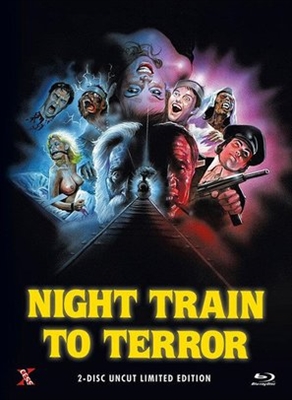
EDITOR’S NOTE: You know, someone else was supposed to write this and didn’t send anything, but we all know that I was fated to write about Night Train to Terror right?
I first shared my thoughts on this film on October 19, 2018 and in Drive-In Asylum #14 which you can buy right here.
This version combines elements of past articles, as well as the full reviews of the films within the movie. My dream is that Vinegar Syndrome releases a box set of this movie — they put out the original blu ray — along with all of the complete films and interviews with the surviving cast and crew. I’d be overjoyed to contribute to this set if it ever happens. This movie continues to obsess me.
I’m planning on a tentative Night Train to Terror zine at some point. Let me know if you’d be interested in reading it or contributing.
For better or worse, there’s never been another movie quite like Night Train to Terror. And how could there be? This isn’t just one movie — it’s three movies in one. None of these movies felt releasable on their own, so much like Spookies or Fright House, those three movies were all shoveled into one furnace, much like how coal powers the engine.
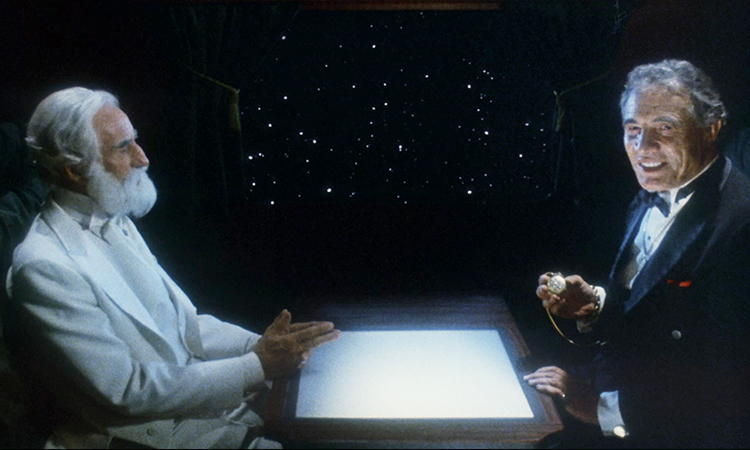
Unlike those films, which just jams the stories together, the stories here are linked by a framing sequence of a band that’s traveling through the night on, well, a night train to terror. All the while, God (Ferdy Mayne, last seen as Count von Krolock from The Fearless Vampire Killers, who felt this movie was so poor that he penned a letter to its director) and Satan (Tony Giorgio, who wasn’t just Bruno Tattaglia in The Godfather but the Playboy Club’s in-house gambling expert. He’s also the sheriff in another film that may possibly melt your mind, the Bigfoot-centric Cry Wilderness) are just a few cars down, debating whether or not the band will live to see their next destination. Meanwhile, the night porter makes faces at the camera years before single camera shows like The Office and Curb Your Enthusiasm made such mugging de rigueur.
Get to know the band. After all, you’re going to see them between each and every story as they repeat the chorus of the song over and over — and over — again. They only take breaks to ask if they can get some hamburgers and beer, only to learn that there’s no food on this train. And that some call it the Heavenly Express and some call it Satan’s Cannonball, but they do guarantee to deliver every passenger to its right “dest…tin…ation!” Obviously, neither of the things people call the train are as good as Night Train to Terror, but that’s a moot point.
To determine the fate of these breakdancing fools — seriously, being in a band with fifty people has to be the worst ever because you split the door money every which way — the Divine Creator and the First of the Fallen decide to watch three different stories, at least one of which was a totally unfinished movie.
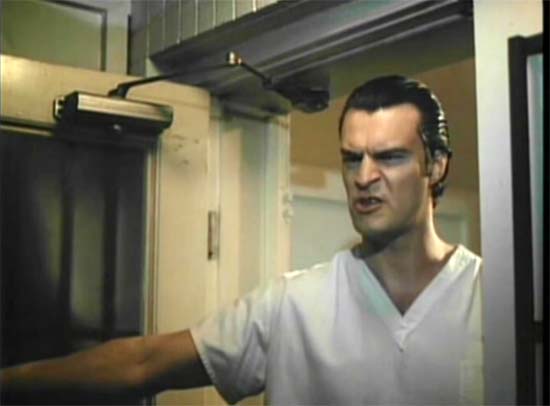
The Case of Harry Billings: John Phillip Law (an angel in Barbarella and forever in my heart Diabolik) has been manipulated into working for the spare body parts black market. You know how it goes, right? This story is packed with nonsensical jump cuts, unnecessary surgery, gratuitous nudity and Richard Moll, who wasn’t even there for most of the scenes, with a double playing most of his action scenes. You can tell because the second version of him has incredibly hairy arms. While this movie wasn’t finished before it was pulled into this film, it was later completed and released on VHS as Scream Your Head Off.
It was also released as Marilyn Alive Behind Bars nearly a decade later. Much like Terror, Sexo Y Brujeria, this movie was partially made years before and then finished a decade or more later. And you’ve seen it before. And the fact that this movie was actually finished makes me overjoyed beyond belief.
So even though this movie was already somewhat released twice — and shot twice, as there were nude and non-nude versions of some scenes — Carr decided to go back, grab Danger: Diabolik star John Philip Law despite the fact that he looks much older than he did in 1981 and make the movie that he always intended to film. For some reason, he also hired Francine York (Secret File: Hollywood) to play Marilyn Monroe. Or maybe she’s just a woman who has been driven mad and believes she’s Norma Jeane Mortenson.
In this longer version, Harry Billings was driving home with his new wife when he got sideswiped and she died, which leads to him sleeping barefoot on her grave. He tries to jump off a bridge on the very same road where this accident happened and gets brought to the asylum of Dr. Brewer and Otto (Richard Moll) to abduct women whose brains will be lobotomized. Some of this new movie is shot on video, some are from the original footage and it’s all strange because characters suddenly become a decade older or younger.
As messy as the chapter within Night Train to Terror is, the full-length story is even more deliriously insane, packed with continuity, time-lapse, sound quality, film to video and just plan weird errors. I also absolutely love that it exists and that it’s even stranger than I thought that it would be.
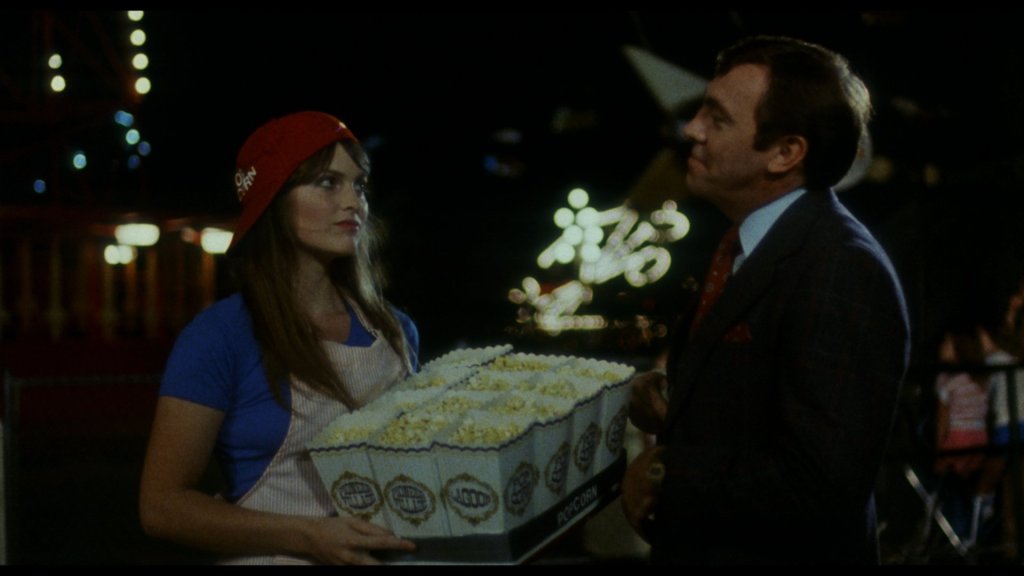
The Case of Gretta Connors: A nice young girl used to work at the carnival. A man visits her booth and pays her to go out with him and before you know it, she’s a porn star. Again, that’s how life goes.
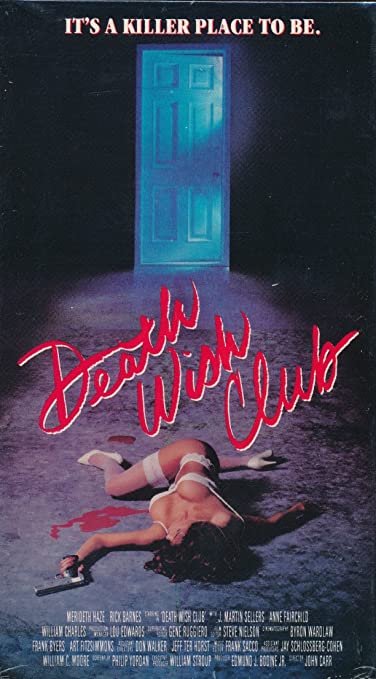
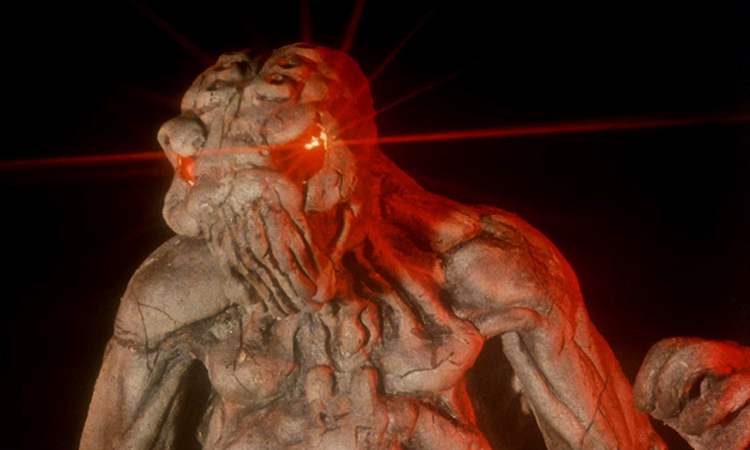
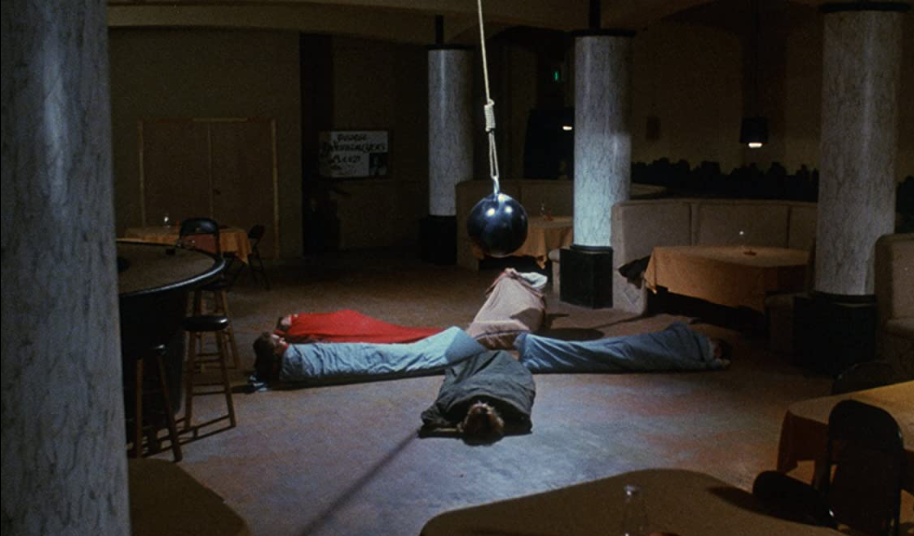
One day, a college guy named Glen (Rick Barnes) sees the girl — Gretta — on a stag loop and falls in love, eventually finding her and starting a relationship, which leads her old Hollywood producer sugar daddy husband to bring him into a suicide club. This club has a baroness and a guy who looks and acts like Jimi Hendrix, all playing games like letting a giant claymation beetle fly around and sting one of them to death or lie in sleeping bags until a giant ball crushes one of them. Back to Jimi — he’s electrocuted as he yells song lyrics.
Again, like the other stories in this film, there’s another long version of the film that has multiple titles: The Dark Side of Love, Carnival of Fools, Gretta or Death Wish Club.
The full film claims that it’s loosely based on Erskine Caldwell’s book Gretta, but this goes so many strange places that I really have no idea if that’s true.
Pre-med student Glen Marshall falls for Gretta (Meridith Haze, who is astounding in this movie and I wished she’d done more than just this role) the first time that he sees her in an adult film. However, she’s owned by George Youngmeyer, her Hollywood producer husband who bought her at the carnival.
The Bloody Pit of Horror believes that this character is pretty much writer Phillip Yordan, who may have never fallen out of love with Cat People actress Simone Simon and just treated the rest of his wives like Youngmeyer.
Now, if you’ll excuse us for a second and hold on to your valuables, the train is going to take a quick detour to explain Phillip Yordan.
Phillip Yordan is the listed writer on nearly a hundred movies, including Dillinger, Detective Story and Broken Lance, a movie he won the Best Original Story Oscar for, despite it being a remake of 1949’s House of Strangers and the fact that he allegedly didn’t write a single word of the actual script.
That’s correct. Some believe that many of the movies he wrote were actually a front for blacklisted writers, who still wanted to make films, giving Yordan all the credit and half the paycheck.
Yordan was literally a factory at one point, writing for nearly every studio even when he wasn’t supposed to because of pesky little things like contracts.
In the late 1950s, Yordan finally got caught. He mixed up two scripts, delivering a Fox script to Warner Brothers and vice versa. Seeing as how he had a deal at Fox, Darryl F. Zanuck threatened to get him blackballed at all the major studios. A few years later, his secretary would claim that she was the real writer of The Rise and Fall of Legs Diamond and things got so bad that Columbia demanded that he have an office on their lot where they could watch him write, guaranteeing that he was the author.
Despite these new rules and heightened surveillance, Yordan was still hustling scripts at other studios. He got caught again and forced to return his paycheck.
This time, he really was told you’ll never eat lunch in this town again.
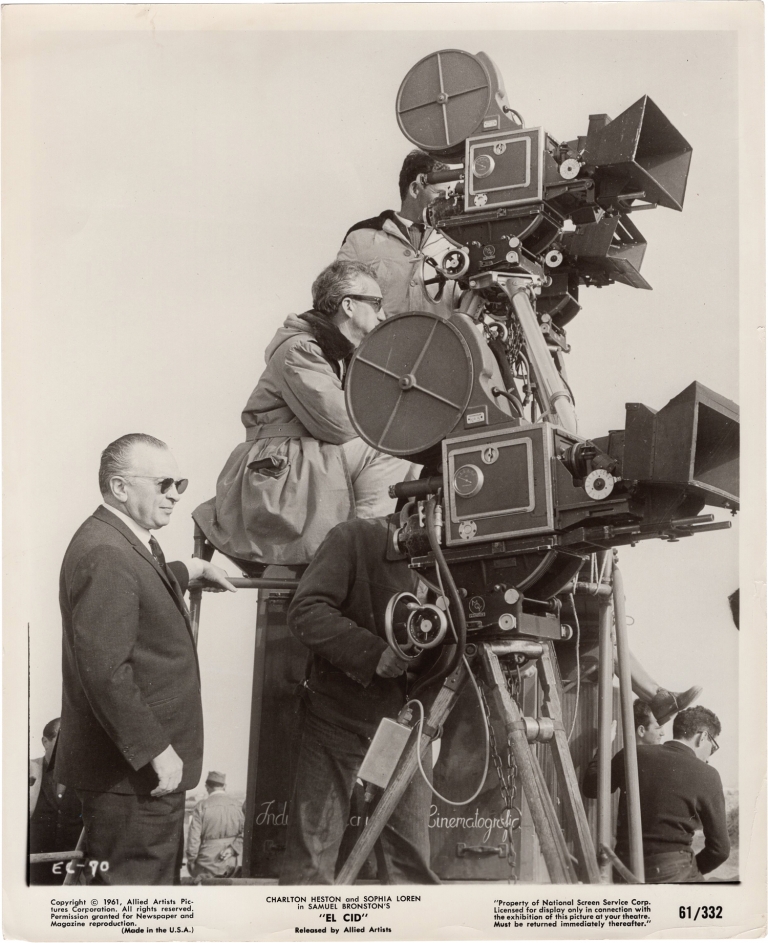
Yordan then showed up in Spain, working for Samuel L. Bronston, using folks like Ray Bradbury, Ben Barzman, Arnaud D’Usseau, Julian Halevy and Bernard Gordon to write scripts. It’s pretty widely accepted that Gordon, not Yordan, wrote The Day of the Triffids, for example.
And yet…
By the mid 60s, Yordan was back in the good graces of Hollywood, a survivor working as a script doctor on movies like Horror Express — also a horror movie set on a train — and Psychomania. At the end of his life, he worked as an adjunct screenwriting instructor at San Diego State University and was writing scripts for movies like The Unholy, Marilyn Alive and Behind Bars(which is also part of Night Train to Terror), Cataclysm (ditto), Cry Wilderness and this movie.
In an article by the FIlm Noir Foundation, “The Phillip Yordan Story,” there’s a very telling sentence: Yordan’s furtive 50-year history in Hollywood is reminiscent of the Hall of Mirrors denouement in The Lady from Shanghai.
Back to Death Wish Club, which was the full story, and goes even deeper.
In the movie, when Glen finally tracks down Gretta, she thinks that she’s a fish and as such won’t leave her bathtub. To solve the issue, Youngmeyer asks Glen to visit, make love to her in front of him and then he’s allowed to take her home. However, he warns her that she’s in the fourth dimension and never explains what that means.
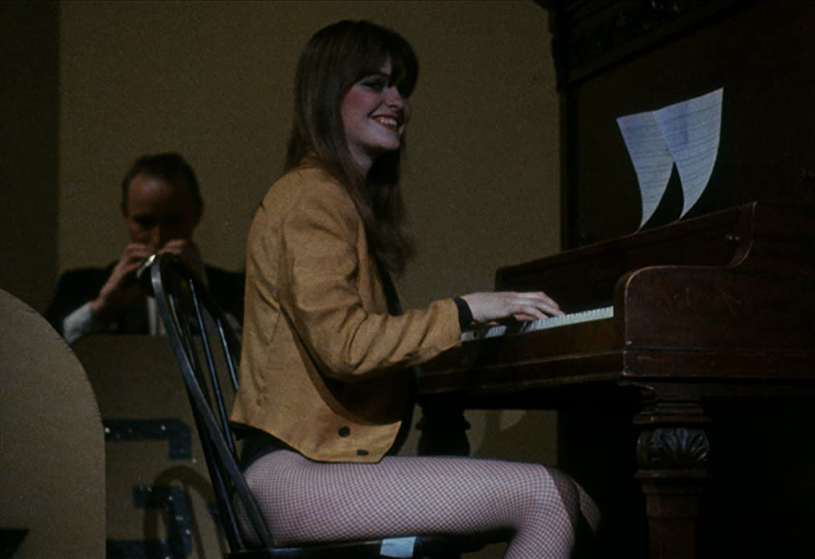
Our protagonist gets more than he bargained for as Gretta turns out to be the kind of sexual dynamo that he’s only read about in the letters pages of men’s magazines. She’s only happy when a man is making love to her. Otherwise, she’s selling your TV set, bringing in a piano and parading in front of your mother naked. She’s a fantasy woman for Glen but removed from the fantasy male gaze of pornography she remains trapped within the role of the fantasy male gaze pornography object which is perfect in ten-minute onanistic blasts — pun intended — but potentially exhausting in real life.
Greta is also turned on by the adrenaline that comes from putting herself in near-death situations, along with a club of others who have survived death. This coterie has some real maniacs, including Federico Libuse, Contessa Pacelli and Prince Flubutu, who we are led to believe is Jimi Hendrix.
After surviving the deadly sting of a claymation Tanzanian winged beetle, Glen decides that no sex is worth all of this. He tries to get back with his normal former girl and back to his normal life but she tells him that there’s no way that he can ever be free from Gretta.
There’s a new problem, though. Gretta has overdosed and is dead. Youngmeyer proves it by taking Glen to her funeral. Lost, our kind of, sort of heroic figure makes his way back to the club where he first saw her playing piano and it turns out that Gretta is still there, but now she has become a he and is now the piano playing noir tough guy Charlie White. She hasn’t left the suicide club either, which means that Glen gets pulled into a contest where they must all survive a homemade electric chair as well as being forced at gunpoint to get in a sleeping bag and be in the path of a deadly multi-ton wrecking ball.
So can our protagonist get the man he’s in love with to become the woman he’s alternatively afraid of and sexually attracted to again? Will he have to break into her wedding The Graduate style and do some kung fu? Why is Gretta glad that Chopin is dead?
Death Wish Club is an astounding piece of moviemaking. It’s very David Lynch without trying to be, which is the best kind of film, a movie that’s near occult-level weird because the people making it were all very damaged or just had no clue how humanity behaves because they came here from a parallel planet where this is how men meet women. It is the very definition of monkeys in a room banging something out and finding nirvana.
Let’s discuss the other Yordan in this.
If you’ve seen this movie, you’ve seen the band that appears between each segment, singing the song “Everybody but You.” The main singer and breakdancer is Byron Yordan, son of Phillip. He also appeared in the Mormon film that most of this same crew made, Savage Journey, as Brigham Young’s second son.
Of the other band members and dancers, only Melanie Montilla (Breakin’ 2: Electric Boogaloo), Richard Sanford (a guest spot on Magnum P.I.), Dina Lee Russo (who sang “Let the Good Times Roll” on the soundtrack of the wrestling documentary Beyond the Mat), Angela Nicoletti (the ex-fiancee of Guns ‘n Roses rhythm guitarist Izzy Stradlin; she appears in the video for “Sweet Child O’Mine” and The Real McCoy, a documentary by Andy McCoy who was the lead guitarist of Hanoi Rocks) and Rick Arbuckle (who worked on the sound of plenty of cartoons like Rugrats and Rocko’s Modern Life).
What’s really amazing is that this song was written by Joe Turano, who just four years later was one of the singers for Disney’s The Little Mermaid.
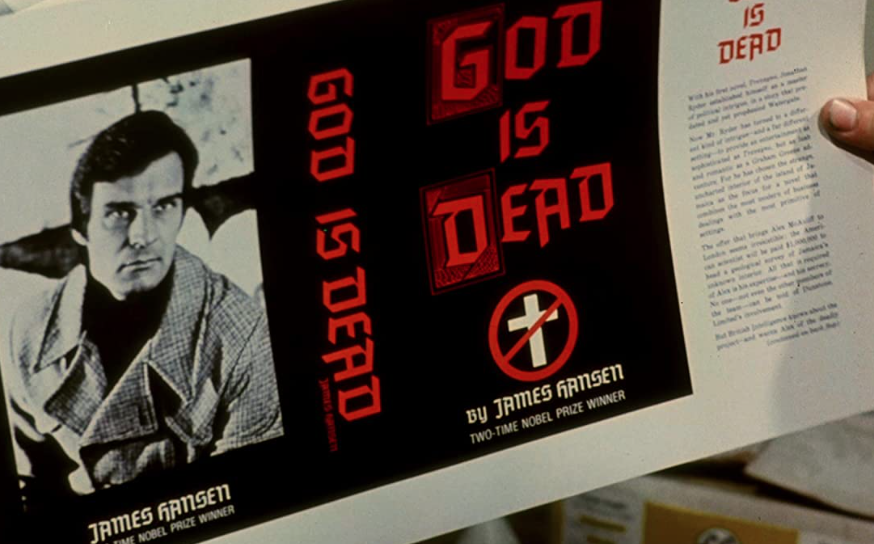
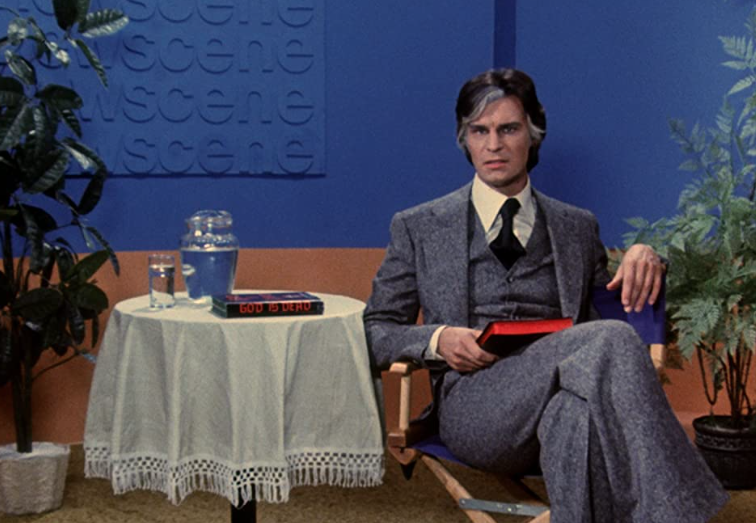
The Case of Claire Hansen: A surgeon battles a demon who was once a Nazi who is also in conflict with a Holocaust survivor who is best friends with Cameron Mitchell. Additionally, the surgeon is married to Richard Moll — back again with a constantly changing hairstyle and color — who inexplicably was awarded the Nobel Prize for writing a book that proves that God is dead.
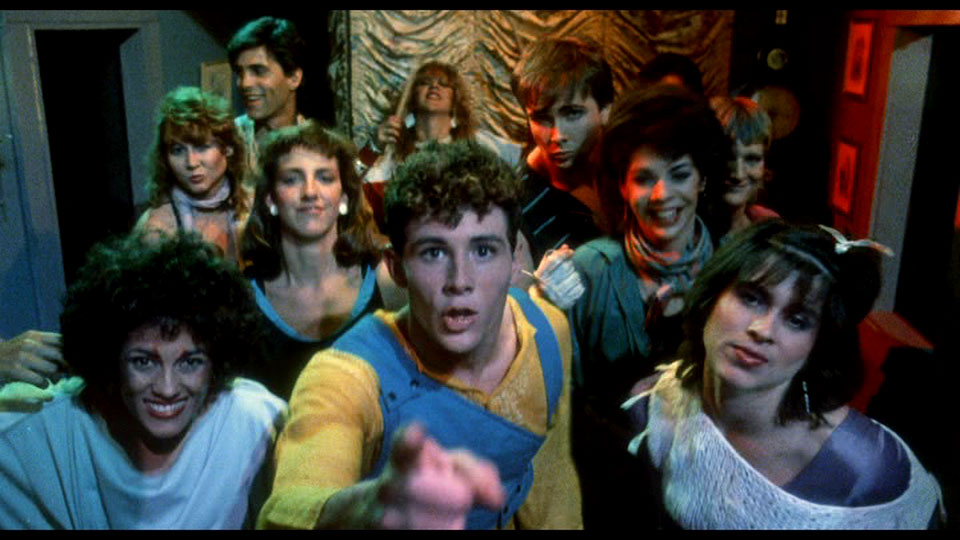
This story has it all, as it has a swinging disco, a magical black man who calls out our heroine for America’s history of racism, more claymation scenes in the place of practical special effects because claymation was the CGI of the past, an ex-priest named Papini who has a 666 tattoo and as much of a 90-minute movie as you can fit into 30.
The full version is The Nightmare Never Ends (alternatively known as Cataclysm and Satan’s Supper). It’s a much larger story than what ends up in Night Train to Terror.
That previously mentioned Nobel Prize-winning author is James Hansen (Richard Moll, who is in this movie twice, as we said before, but also seemingly had a deal to be in nearly every oddball early 80s horror movie like House, Evilspeak, Metalstorm: The Destruction of Jared-Syn, The Sword and the Sorcerer and The Dungeonmaster) and his devoutly Catholic wife is Claire (Faith Clift, who was the wife at the time of Yordan and whose career is made up of films he had something to do with, like Horror Express, Captain Apache, Savage Journey and Cry Wilderness). As the movie begins, they’ve just arrived in Vegas to celebrate his new book and to hopefully escape her nightmares.
Oh yeah — James won Nobel Prize for writing a book that proved that God is dead. Now, he’s planning a TV special to tell the whole story to the whole world. In short, he’s preaching the bad news!.
In Vegas, who puts Claire into a trance and we learn what the real problem is.
Nazis.
That’s right. Every night she dreams of a handsome young officer who kills a room full of other officers and an all-female string orchestra. After the show, Claire invites the magician to dinner after he tells her that a demon is after her. He never makes it — he is killed and a 666 tattoo is left on his scalp.
Meanwhile, Mr. Weiss (Marc Lawrence, another talent who was damaged by the blacklist instead of helped like Yordan; he also directed the incredible Pigs AKA The 13th Pig, Daddy’s Deadly Darling, Horror Farm, Daddy’s Girl, The Strange Exorcism of Lynn Hart, The Strange Love Exorcist and Roadside TortureChamber) is an older gentleman who just so happens to have survived the Holocaust and suddenly sees the man who made his life hell at Auschwitz on a TV program about the New York Ballet.
That man is now the rich Olivier (Robert Bristol) and in case you didn’t put the two stories together, he’s the man inside Claire’s dream.
Weiss is a Nazi hunter, believe it or not, and he calls in his neighbor Lieutenant Stern (Cameron Mitchell, who has been in more movies than there have been movies, but let’s call out Blood and Black Lace as one of the best of his films). They go to the ballet and follow Olivier to his extravagant mansion, all the while Stern tries to convince the old man that this cannot be the man who tormented his childhood. Weiss grabs his Luger and goes to kill Olivier, but an unseen demon kills him and leaves a 666 on his body.
Oh yeah, there’s also a former priest named Papini (Maurice Grandmaison, who plays Brigham Young in Savage Journey and is, you knew it, also in Cry Wilderness) who is now homeless. He spends most of the movie trying to protect James and Claire, even telling her how to kill Olivier.
This is a movie that doesn’t miss any exploitation genre. You get Nazis, tough cops, disco and the occult and then Claire goes to visit a black spiritualist who unexpectedly goes off on a rant, pushing the film toward blaxploitation!
He nearly derails — sorry for the pun — the entire film by just how powerful his performance is, yelling at her: “I am a black man – a (N WORD) in your country. You are a rich woman, I’m sure you have many powerful friends…but they couldn’t help you! You had to seek the help of a (N WORD)!”
Meanwhile, Papini is killed by Ishtar, Olivier’s assistant who we have never seen before. This is the scene for the infamous foreign buyers as it’s the only nudity in the film and perhaps the main generator of blasphemy. This film is actually all blasphemy. If you’re in a metal band, you owe it to yourself to track it down and get samples.
Making this film even more deranged is the fact that nearly single actor in this film either reads their lines in monotone or screams them as loudly as possible — sometimes within the same sentence. The lone exceptions are Richard Moll, who is the best actor in here, and Mitchell, who is the gruffest cop of all time. Strangely enough, Moll used to date Lawrence’s daughter Toni, but when we asked her, she wasn’t sure if she had met the actor yet. I’d say probably not as this was only his second role.
Let me see if I can summarize the ending of this — after Oliver kills everyone else, Claire hits him with her car. She throws the body in the trunk and takes him to surgery, where she and her nephew’s girlfriend give him open heart surgery, complete with blood spraying and puking. Oh yeah, there’s also stabbing and slapping and screaming. And none of it works, because the bad guy wins!
But wait — does this prove that God is alive?
Well, he’s on the train still!
Are you ready to hear the song one more time? Wouldn’t you just love to see the band die in a giant train disaster? Good news — you have your wish granted. Except God has taken their souls up to heaven as we see an animated train choo-chooing up the clouds, where the nameless band will forever sing their song, driving cherubim and seraphim crazy for eternity.
To say Night Train to Terror is a strange movie is to say that I am sort of interested in the films of Joe D’Amato.
How can you not love a movie where Satan is credited as being portrayed by Lu Sifer and God by Himself? That said, if you decide to buy a ticket on this train, prepare to never escape the song that plays throughout. I sometimes go for a few days free of its power and then I start laughing about one of the lines in it, start to sing it and it goes on for hours.
It’s also a movie with no less than five directors:
John Carr had a career that was tied to Yordan. While he wrote the first movies that he directed, like the western The Talisman, The Star Maker, Buster Ladd and Fugitive Lovers, he also made Death Wish Club, Marilyn Alive Behind Bars/Scream Your Head Off, Too Bad About Jack and Dead Girls Don’t Tango — along with “The Case of Harry Billings” and “The Case of Gretta Connors” in this film.
Phillip Marshak, who directed the “The Case of Claire Hansen” segment, started in Hollywood as an assistant for Jerry Lewis and opened Georgie Girl, which was one of the first gay bars in Los Angeles. He also directed several adult films, such as Dracula Sucks, Night Flight, Space Virgins, Intimate Lessons, the bi-sexual western The Savages and Blue Ice, a porn film in which a detective digs up an ancient book with the power to turn any woman into a nymphomaniac that’s wanted by Nazis who survived World War II. He also, of course, directed Cataclysm, which is where “Claire” came from.
Tom McGowan, also credited as a director of the “Claire” chapter, wrote the Russ Meyer movie Cherry, Harry & Raquel! and also directed Savage Journey.
Gregg G. Tallas is also credited for directing parts of “Claire” and is the only person in this production who can claim to be a graduate of Stanislavski’s famous Art Theatre in Moscow. He also directed the Eurospy movies Espionage in Tangiersand Assignment Skybolt.
Jay Schlossberg-Cohen directed the actual “Night Train” segment as well as another movie that you can almost see as a continuation of the same cast and crew from this movie.
Cry Wilderness: A Bigfoot meets E.T. epic of pure maniacal weirdness, it was also written by Yordan and was directed by Schlossberg-Cohen. The origin of this movie is that Visto International Inc., a small theatrical motion picture production and distribution company, produced films in the early 80s magical era of cheaply made independent films.
After having some success with another Bigfoot movie in 1978 that made $4 million off a $150,000 budget (I can’t find any listing of what film that was, as Visto looks to have only made four movies), Visto hired Yordan to write a new bigfoot movie, but then asked him to cut out horror scenes and not have any violence, profanity or sex.
Yordan replied that this would make the movie be about nothing and they replied that that was exactly what they wanted.
It’s also what they got.
This is the kind of movie that demands that you be OK with the fact that Bigfoot can show up and visit young Paul Cooper and warn him that his father will die unless he leaves his fancy school behind and, well, cry wilderness.
It’s also a movie where seasoned outdoorsmen have no idea how to properly handle weapons, continually pointing them directly at people, planting the muzzle of rifles into dirt and even running with their fingers directly on the trigger.
There are also mystical Native Americans, a park ranger who never wears his uniform, raccoons who know how to knock on doors, a child who is obsessed with said raccoons to the point where he allows them to get in the kitchen sink and eat, a bad guy principal who is the worst Xerox of William Daniels ever, a school that’s cool with a student wearing a Bigfoot medallion as part of his uniform and moments where the film goes completely out of focus. Make those numerous moments.
Are you cool with seeing Bigfoot’s zipper? How much b roll footage is too much? And are you ready for earnest country rock and a movie that feels like it was made in 1978, not 1987?
How can you see these movies?
Night Train to Terror: Tubi, Vinegar Syndrome (out of print)
Marilyn Alive Behind Bars: It was released on DVD but is out of print and not streaming
Scream Your Head Off: It was released on VHS but never DVD and is not streaming
Death Wish Club: Tubi, an extra on the Vinegar Syndrome Night Train to Terror blu ray
Cataclysm: This shows up on Mill Creek box sets and you can find it on YouTube
Cry Wildnerness: Tubi, the Netflix MST3K riffed version or a double DVD with In Search of Bigfoot from Vinegar Syndrome
Just remember:
“Daddy’s in the dining room, Sortin’ through the news. Mama’s at the shopping mall, Buyin’ new shoes. Everybody’s got something to do, Everybody but you.
Come on and dance with me, dance with me Everybody’s got something to do, Everybody but you.
Sister’s on the telephone, Gossipin’ again. Junior’s at the arcade, Smokin’ with his friends. Everybody’s got something to do, Everybody but you.”
Thanks to Mike Justice for his help on this article.
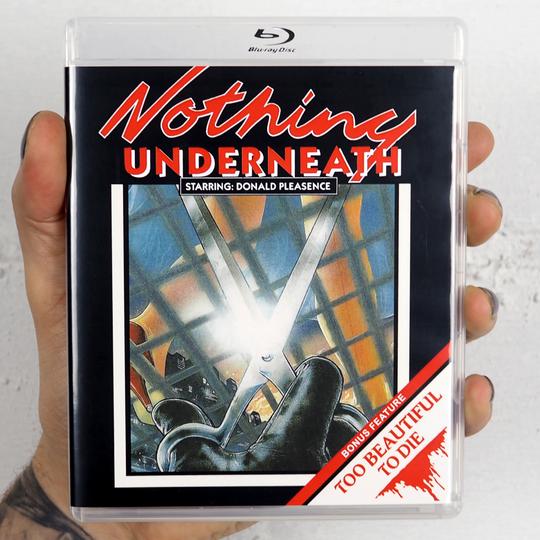
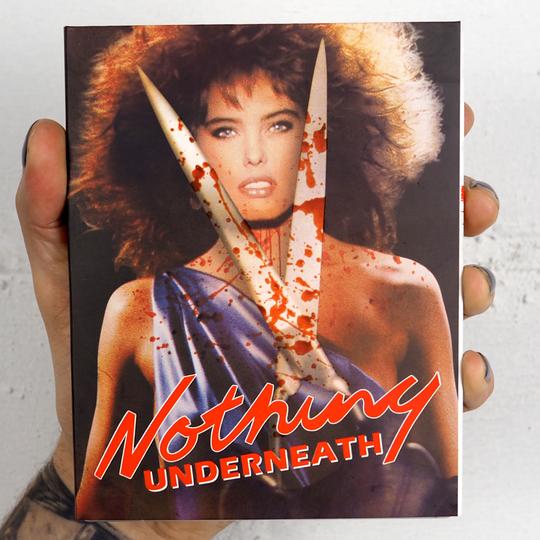
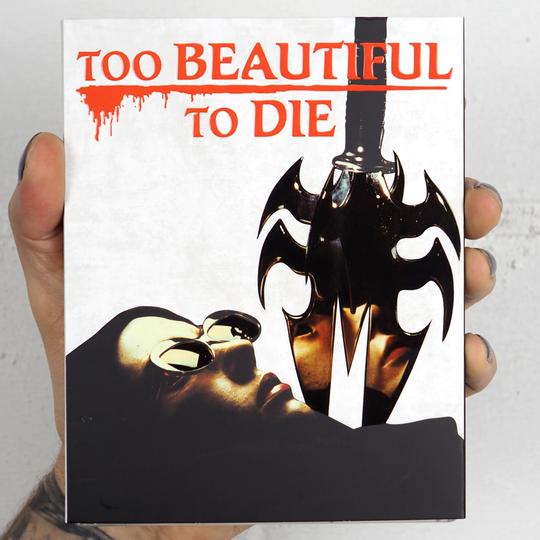
EDITOR’S NOTE: We originally featured Nothing Underneath and Too Beautiful to Die on June 17, 2020 and December 28, 2017. We’re beyond thrilled that Vinegar Syndrome is releasing these on an amazing double blu ray set, as we need more 80s giallo to come out in the U.S.! Here’s to someday getting Obsession: A Taste for Fear in the same format soon!
Vinegar Syndrome has amazingly released both of these films on a double disk set, making them look way more gorgeous than the battered bootlegs I’ve relied on for years. There are two commentary tracks for Nothing Underneath (The Hysteria Continues! and Rachael Nesbit) along with interviews with screenwriters Enrico Vanzina and Franco Ferrini, composer Pino Donaggio and actor Tom Schanley. Too Beautiful to Die has a commentary by Nesbit and an interview with writer/director Dario Piana, as well as storyboards for an alternate ending and deleted scenes.
Nothing Underneath (1985): I really like 1988’s Too Beautiful to Die, a movie that was sold as a sequel to this movie. They don’t have much to do with one another, but when has that ever stopped the Italian exploitation industry?
A serial killer roams the city of Milan, dispatching gorgeous models with the flash of his scissors. Meanwhile, Yellowstone Park ranger Bob Crane senses that his sister needs him, so he flies across the world to interact with the rich and famous. Can he save her? Will he be targeted by the killer? Will Donald Pleasence ever say no to a movie?
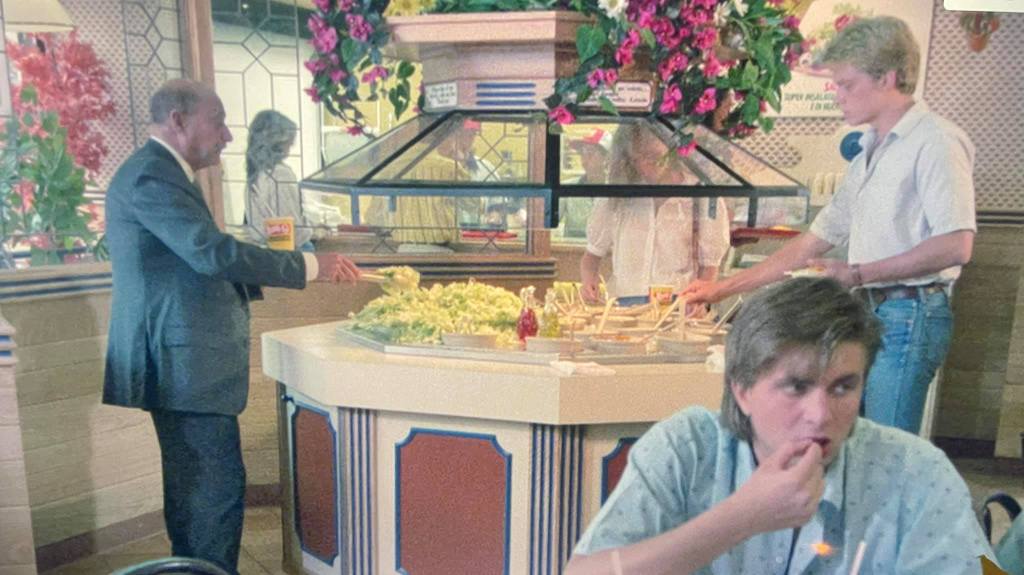
The first time I saw this, I didn’t like it all that much as the sequel is just so strong. But after some rewatches, I’ve come to appreciate it, as this is a movie that features the man who was Loomis eating a meal at the Wendy’s salad bar.
Too Beautiful to Die (1988): I came across this film on YouTube and had no idea what I’d be watching. I’d give it five minutes and then be done with it, I said. And then I realized that the film was nearly over and I’d been quite interested in the proceedings. Life’s funny like that.
Written and directed by Dario Piana, this sequel to Nothing Underneathis the only giallo I’ve seen that has both Huey Lewis and the News and Frankie Goes to Hollywood (you got close, Body Double) on the soundtrack. A major point of the film is that the models are trying to put together a video for Frankie’s “Warriors of the Wasteland!”
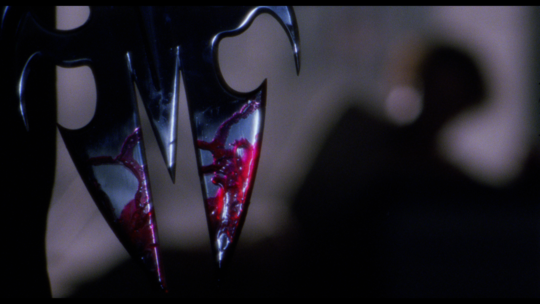
Let me see if I can summarize this one quickly for you. A fashion agency is shooting videos that feel very BDSM and feature really long, intricate daggers. Those models are all prostitutes, except for one, who won’t give in and have sex with an old man in a whirlpool, so everyone rapes and kills her. Her car goes off a cliff, but an autopsy proves that she was shot in the head first. That said — everyone who was there starts getting killed, one by one.
Some of the death scenes are really well shot and the murder weapon is quite insane looking. One of the murders, with a model falling off a large building into water, looks particularly good.
BONUS!
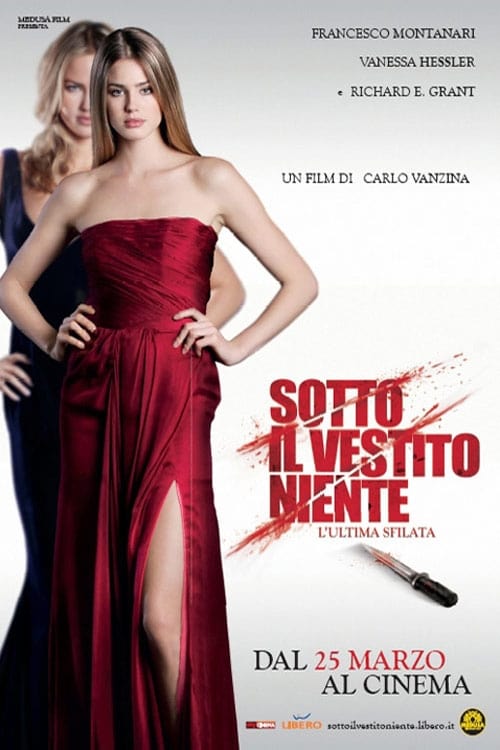
Sotto il vestito niente – L’ultima sfilata (2011): There’s a goofy part of me that loves Nothing Underneath and Too Beautiful to Die because they’re trying to keep the giallo alive in the sad dry years of the mid 80s before everyone realized that they could make money making Basic Instinct and Cinemax After Dark clones because hey, those movies are just giallo with less style and verve.
I have no idea want this other than me, much less greenlit it and gave them the kind of budget that let them shoot all over Europe, have a great look and even get Lady Gaga on the soundtrack. Then again, Too Beautiful had Huey Lewis and the News, Toto and Frankie Goes to Hollywood while Nothing Underneath had Murray Head and Gloria Gaynor, so there you go.
Rest in peace, Carlo Vanzina. You made two fashion gialli and they’re both ridiculous and I love them. Shout out to Dario Piana, who went from making Too Beautiful to directing The Death of Ian Stone and a Lost Boys direct to video sequel. Please come back to giallo and make another movie with a ridiculous sword weapon.
Anyways, let’s get to this one. The first big surprise is that Richard E. Grant is in this. He plays stylist Federico Marinoni, who is enjoying big success at the Milan Fashion Festival along with his partner Max Liverani and their top model Alexandra Larsson. But there ends up being a murder, the wrong people see the bodies and the intrigue begins.
This isn’t part of the Vinegar Syndrome release of the first two films, so I had to get a non-subbed version off a Russian site that had a Soviet translator screaming the dialogue over the Italian soundtrack, which is a very disorienting way to enjoy cinema.
This Ridley Scott movie has always stood out from his other work to me, as it’s quite literally a children’s story about the most archetypical battle between the good of Jack (Tom Cruise) and evil of the Lord of Darkness (Tim Curry).
Much like how the original fairy tales were incredibly dark, this movie is filled with morbid imagery and a villain that may overwhelm viewers, making them love him more than the protagonist.
The death of the unicorn in this film is a moment that many 1980’s children will remember as quite possibly the end of said childhood. The true star of this movie remains Curry, who is absolutely incredible (as always). He spent five and a half hours a day just to get into the makeup, which then needed a full hour of bathing to remove all the adhesive. One day, Curry grew impatient and claustrophobic, removing the makeup and some of his own skin. He was off the film for a week to recover.
Interestingly enough, the European and director’s cut of this film don’t use Tangerine Dream, but instead feature music by Jerry Goldsmith. There was also a Bryan Ferry song, “Is Your Love Strong Enough?” that features Pink Floyd guitarist David Gilmour and a music video for that as well.
If you look in Meg Mucklebones’ swamp and when the unicorn is chained up, you can even spot Pazuzu from The Exorcist. Much like many of Scott’s Blade Runner, this movie wasn’t considered a classic when it was released. But today? It totally is. This Arrow Video limited edition blu ray has, well, everything you ever wanted to see about this movie, including the high definition 1080p versions of the U.S. theatrical cut (a new 2K restoration from original materials including a 4K scan of the original negative) and the director’s cut.
The U.S. version has commentary by Paul M. Sammon, author of Ridley Scott: The Making of His Movies, a reconstructed isolated score by Tangerine Dream, an isolated music and effects track, a featurette on the making of the film, a feature that compares the versions of the film, The Directors: Ridley Scott and the Bryan Ferry video “IIs Your Love Strong Enough?” The director’s cut has a Ridley Scott commentary, a documentary on the making of the movie, a promotional feature, alternate and deleted scenes, storyboards, screenplays, trailers, TV commercials and a stills gallery.
You also get an illustrated perfect-bound book with new writing by Nicholas Clement and Kat Ellinger, as well as archive materials including production notes and a 2002 interview with Charles de Lauzirika about the restoration of the director’s cut. Then there’s a large double-sided poster with newly commissioned artwork by Neil Davies and original theatrical artwork by John Alvin, glossy full-color portraits of the cast photographed by Annie Leibovitz, six double-sided postcard-sized lobby card reproductions and a reversible sleeve featuring the Davies and Alvin art.
If you love Legend, you need to get this set from MVD or Diabolik DVD.
Michael J. Murphy made some berserk movies. I mean, Invitation to Hell is something. And this is perhaps stranger, made after Murphy got screwed over on the profits for that movie and Last Night and put 400 pounds worth of cash into this one, in which director Alistair Bailey is fired from a project by notorious VHS distributor William King, who is using his footage and not paying him. That means that Bailey feels entirely justified in wearing the disguise from the movie and filming his own sequel in which all the murder is real.
The depression that the director goes into also makes him watch too many movies — I feel attacked — and that means that we get a possession film, a post-apocalyptic movie, a zombie film and several more ripoffs including a very close to Naschy werewolf film, as well as a killer willing to see dogs on fire to prove a point. It’s also the rare slasher that has a killer that uses a gun, which is interesting.
I mean, this is a movie that starts with a man tearing his own face off and has a secretary willing to screw her boss over to the point that her new boyfriend kills him. And I realize that these shot on Super 8 wonders aren’t great, but man, they have heart. And intestines. And eyeballs.
5. REEKING HAVOC: Sewer dwellers making a mess of things up on the surface.
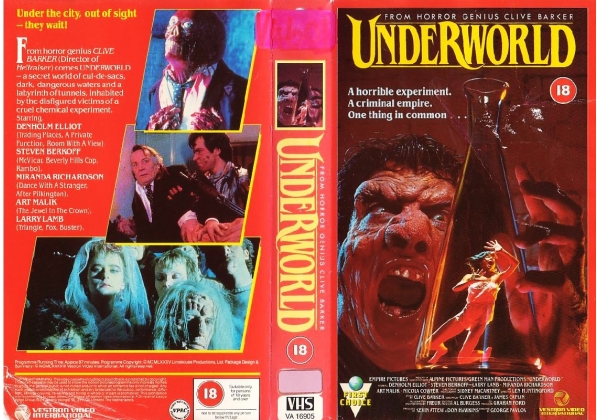
The synthpop band Freur did the music for this, but they ended up getting better known when they took the name of this movie as their own: Underworld.
They’re not the only famous people who are part of this movie — also called Transmutations — that nobody really talks about. Clive Barker — yes, that Clive Barker — wrote the story and co-wrote the script with James Caplin. As for the lead, it’s Denholm Elliott — yes, Marcus Brody — as Dr. Savary, a doctor who has created a mind-controlling drug that he uses to keep an army of deformed sewer dwellers under his command. And the main reason, beyond Barker, that I chose this as my underground sewer movie? It has both Miranda Richardson and Ingrid Pitt in it!
But when Savary abducts high class hooker Nicole (Nicole Cowper, who went below the crust again for 1988’s Journey to the Center of the Earth) from her brothel, businessman Hugo Motherskille (Steven Berkoff, Octopussy) gets her former lover Roy Bain (Larry Lamb) on the case. Meanwhile, all these proto-Nightbreed creatures are doing monster cocaine to stay alive.
So how did this weirdo movie ever happen? George Pavlou wanted to direct a movie (he’d also direct another early Barker script, Rawhead Rex). Barker wanted to write one, so he put together a mash-up of mobsters, monsters, film noir and horror. The money people wanted something else, so they got it rewritten and Barker washed his hands of the whole thing. And then Vestron Video released it as Transmutations.
It looks great though! 1985 great, all blue color and billowy dresses and face paint and movie punk and you know, who cares if it’s kind of silly? Monsters in sewers kidnapping prostitutes who can enter your dreams with the power they get from magical powder? Sounds kind of wonderful, when you think of it.
3. HIGH SPIRITS: Tickle your funny bones with a side splitter, a gut buster, a real scream. Go on, laugh your head off!
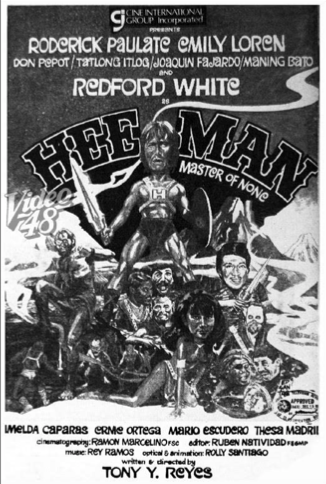
Getting to theaters — at least in the Phillipines — two years before the Cannon Masters of the Universe, Hee-Man: Master of None is based more on the Filmation cartoon series than any other incarnation of the Eternia mythos. Yes, that’s right, there are multiple continuities to keep track of if you love He-Man.
But this isn’t He-Man and Prince Adam. This is Hee-Man and Herman.
Herman grew up not knowing that he was a prince destined to save the planet from his enemies. Now, guided by Bato, he seeks King Artuz and Queen Guadalupe to discover his real origin and to battle the forces of evil led by Black Tengko.
You shouldn’t expect too much in the way of effects. Actually, you shouldn’t expect much of this to even look like the toys or the cartoon. This is one of those things best experienced as a cultural oddity and a way to thank the universe for continuing to throw strange things our way.
Director Tony Y. Reyes created quite a few of these pop culture parodies, incuding Bobo Cop, Sheman: Mistress of the Universe, Super Mouse and the Roborats, Alyas Batman and Robin and Goosebusters. As of 2019, he was still directing.
For some reason, people have seized on the Letterboxd entry for this to log the Aziz Ansari show Master of None. Come on people. Do the work and watch a He-Man ripoff that has cardboard weapons. Your life will be better for it.
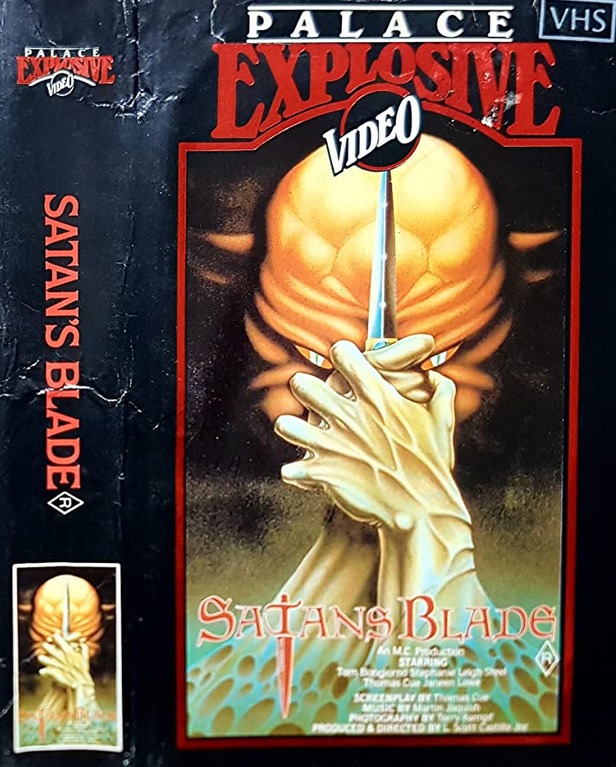
Yeah, I know Satan’s Blade was shot on 35mm, but this “SOV Week” is all about the brick and mortar nostalgia of the video store ’80s. So, if it walks like an SOV and quacks like an SOV and has a cheesy, Combat-cum-Scrapnel Records-styled cover — film stocks, be damned — it’s an SOV in my analog-pumpin’ heart.
Yeah, Satan’s Blade is rife with that ol’ brick and mortar, mom n’ pop stores nostalgia that I constantly lament about at B&S About Movies . . . so I don’t care if Satan’s Blade is an ultra-low-budget rip on the first two Friday the 13th films, as say some critics. Me? I see The Evil Dead crossed with a crime caper gone bad, in the frames.
You too, huh? We’re both thinking of, even though it wasn’t made yet, Scarecrows (1988). As I said in that review, as I re-watched Scarecrows all those years later, I couldn’t help but think Quintin Tarantino and Robert Rodriquez watched it back in the day — and it bled into their formulating From Dusk Till Dawn, which flips-its-script from an action caper to a vampire flick. Well, I think Q n’ R are fans of Satan’s Blade, too, with its script-flip from a crime caper to a faux-Jason armed with a haunted blade, gone wild.
Look, all I know is that my youth was filled with King Diamond, Slayer, and Saxon albums — and pretty much anything came down the Combat/Shrapnel pipeline. Those were the days that the soundtrack — with some much-needed, added adjustments — of River’s Edge spun in my car. And I had just bought copies of the new albums by Hallows Eve and Heathen. And I rented the crap out of any and all SOV horrors that I could get my hands on and I just rented a copy of L. Scott Castillo Jr.’s lone film.
Yeah, Satan’s Blade is that nasty tapeworm lodged in the cockles of my analog heart, pumpin’ through my celluloid veins like a vinyl selection from the Metal Blade Records catalog: forever.
Load the friggin’ tape!
Ah, the VHS I remember. It feels like — a clamshell box — home.
A pair of female bank robbers make off with $50,000 after they kill two bank tellers in cold blood (a female Seth and Richie Gecko, natch). They lay low at a snowy mountain cabin, waiting for their third partner to split the spoils. But, as is the case in any noir: greed ensues. And double crosses. And everyone ends up dead. Two by their own hands. The third . . . by an unseen force.
Something is in that cabin . . . of the “Jason, Jason, Jason, kill, kill, kill,” variety.
That “something” is a local legend about a murderous mountain man who comes from the bottom of the lake by the cabin.
Doh!
Cue the dopey vacationers who rented the cabin at the wrong time: two married couples celebrating the law school graduation of one of them — and a group of nubile college girls with a friend mourning the death of her father. Of course, sex — which always stirs these heavy mental, shiny-implement lovers — ensues, with the proceedings getting down to the ol’ “final girl,” Stephanie — who comes to discover the town Sheriff is behind the murders, as he wanted the money from the robbery hidden in the cabin.
Is the Sheriff really possessed by the Satan’s Blade — a knife that is also a talisman?
Look, I love this movie. I don’t care of how “derivative” the plot is critically analyzed by the other.
Satan’s Blade is an up-against-an-ultra-low-budget slasher, which — for moi — only enhances its eerie vibes, and I dig that the music is synth-Carpenter cheesy. Sure, the story is slight, so there’s a bit much in the expositional prattling-padding department, with lots of driving and walking (but not as much driving as in Rock ‘n’ Roll Nightmare, thank god). Sure, this Castillo jam isn’t as gory as a Vim Wink shot-on-video joint or off its GBH nut, but then, what SOVs are?
At least the acting is better than in most SOVs, not that everyone is on-point; there’s some woefully strained thespin’ afoot. I also dig the amped-up film noir of it all, filled with whodunits, double-crossings, and red-herring flip-floppin’ twists. In addition, L. Scott Castillo Jr. — apparently made this for one-million dollars — who was probably hoping to strike Raimi Midnight Movie gold, ain’t exactly Raimi-inventive, but he still knows his way around a 35mm camera. So while — in my eyes — Satan’s Blade has that ol’ SOV stank on it, technically, it’s not an SOV; but it’s surely closer to, but better than, a 16mm Don Dohler (Fiend) joint (which I lump into my SOV-dom with Satan’s Blade).
Yeah, I love this movie.
Double featuring Satan’s Blade with a Doug Ulrich and Al Dargo’s joint (Snuff Kill will get you started) just feels right. Toss down a John Howard and Justin Simonds (Spine) chaser, for a triple. . . .
Ugh. Satan’s Blade also makes me feel old; now I am missing my ol’ video stores with their 5-5-5 membership cards. So I hate you, Castillo. But I love yahs, just the same.
And so it goes. . . .
Courtesy of the ongoing efforts of VHS Legacy — doing the Lord’s work (yuk, yuk) — you can watch Satan’s Blade on You Tube. You can also learn more about the Arrow Video reissue — an incredible transfer, by the way (working in 35mm paid off, L. Scott) — with an “Arrow Story” video uploaded to You Tube. The reissue caveats on Satan’s Blade, run at the different times of 79, 82, and 83 minutes, so shop accordingly. Olive Films released their hard presses in the United States in 2015 on Blu-ray, while Arrow Films released their DVD/Blue combo in the United Kingdom in 2016.
About the Author: You can read the music and film reviews of R.D Francis on Medium and learn more about his work on Facebook.
It is “films” such as Blue Murder that give our beloved SOV ’80s a bad reputation because, as with the lesson in apoc-tedium that is Survival: 1990 (yes, made by Emmeritus Productions, the Canadian studio that also made this; as well as the computer-takes-over-a-skyscraper romp, The Tower), this inert John Carpenter knock off is just another mismarketed Canadian TV movie, a chunk of celluloid with the unmitigated, analog gall to dovetail its fast-forwarding poo-stank alongside our cherished, rightful SOV classics of Boardinghouse (1982), Blődaren (1983), Copperhead (1983), Black Devil Doll from Hell (1984), Sledgehammer (1983), Truth or Dare (1985), and Spine (1986). Now, as we ramble n’ praddle our SOV love, there’s a caveat: Not all were shot-on-video. Some of these VHS oddities (such as Truth or Dare) critically lumped in the SOV category were shot on 16 mm and released on video — and if it’s released in a direct-to-video format for exclusive, off-the-beaten Blockbuster Video path distribution at mom ‘n pop video stores, then it’s an SOV. Got it?
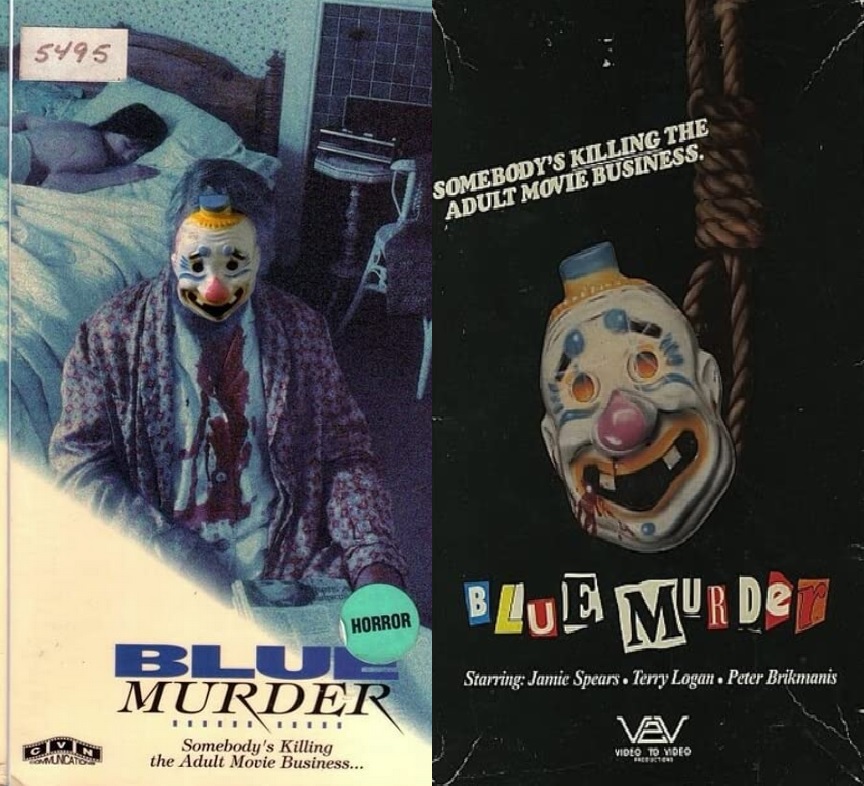
Two covers, twice the Underoos stinkeroos.
You’ve been caveated, ye dear reader, for there is nothing worse than a shot-on-video Canadian TV movie (that gives those old Dan Curtis shot-on-video ’70s TV movies a bad name) masquerading as a legitimate “made for the home video market” slasher of the superior Christopher Lewis Blood Cult (1985) variety. So let’s unpack this loaded baby diaper. And don’t let the emptor hit you in the ass on the way out when you see this grindhouse aka’ing in the VHS marketplace as The Porn Murders. And if you’re wondering what the “Blue Murder” title means, well, Google “blue movies” to find that bit of marketing brilliance.
Don’t be Trans World Entertainment duped: The Clown Murders is another stinkeroo from 1976 reissued in the video ’80s (not) starring John Candy, as directed by Martyn Burke of The Last Chase fame. Oh, yeah . . . John also made an early appearance in 1978’s The Silent Partner.
Now, you’d think with a movie with a killer adorned in a dime store, plastic-elastic Clown mask hacking up porn filmmakers and actresses — leaving them with a clown-mask calling card on their faces — we’d end up with some serious shower-after-watching sleaze n’ gore. Well, we could have — if the “Roger Corman of Canadian,” William Fruet of Death Weekend (1976) fame, was at the bow of the U.S.S Argento. Or Shaun Costello of Forced Entry (1973) fame was second mate. Or Jim Sotos of that film’s remake The Last Victim (1975) was swabbin’ the decks, ye matey. Maybe if real-life porn makers Justin Simonds and John Howard of Spine fame were in the galley.
Be we digress, again.
So, to solve the crimes, the old “hard-nose homicide cop” and “intrepid crime reporter” trope (neither are hard-nosed nor intrepid, natch) spools from the master to slave sprocket as we see our killer clown fire a gun . . . then cut to the body falling to the floor. And this goes on for eight more bloodless killings — nary a boob in sight via POV Italian black-leather gloved hands clutching a silencer. Remember how Billy Eye Harper killed all of those people in Rocktober Blood (1984) — off camera? Yeah, it’s like that. Only there’s no Sorcery tunes aka’in as Head Mistress rockers to ease the boredom.
“Sexy, slick and bloodthristy — with an amazing surprise ending.” — CVN Communications copywriter hornswogglin’
Oh, speaking of music: There’s an opening credits-glam rock theme, “Blue Murder,” but it’s not by the band of the same name Carmine Appice put together with John Sykes of Whitesnake and Tony Franklin of the Firm because, well, Carmine was too busy with King Kobra tunes masquerading as Damien-written tunes for Black Roses (1988) rockers. There’s another sappy-as-sentimental-ass love song “Madly in Like with You,” that’s not by Girlschool — and both songs should have been ditched for Kim McAuliffe and company’s “Screaming Blue Murder” and “Don’t Call it Love.”
“Okay, R.D. Enough with the ’80s heavy metal memories. Get back to the movie.”
Okay, well, the real band in the movie is known as One Life to Live. And don’t bother, as we already researched those never-was Cannuck non-rockers and there’s nary a QWERTY-character of web-Intel. But we do know that they’re not one of “Canada’s Top 20 Greatest Bands” . . . but Nickelback and Bare Naked Ladies? Oh, Canada, what the hell. Thank god Four Non-Blondes aren’t from the Great White North . . . but April Wine, is.
Hey, maybe if our killer dressed like a kitchen worker and had a beef with Entenmann’s and killed pastry chefs and left Jelly Roll calling cards. Then add in a couple Girlschool tunes — and (real life) porn actresses in schoolgirl outfits instead of friggin’ one-piece bathing suits with feather boas — and we’d be onto a sticky-sweet something.
I know, back to the movie . . . with the only online clip available . . . from Turkish TV. Yes, this made it across the ocean into Turkey.
So, eh . . . “The Porno Killer” is on the loose and attempts to harangue Dan Blake, our resourceful crime reporter, into covering his exploits . . . or more will die. So Dan consults with Lt. Rossey, his homoerotic-implied buddy-boy (e.g., the sitting-on-the-toilet-while-I-take-bubble-bath conversation) to sift through the so-not-giallo red herrings of mobster-cum-porn producers battling for each other’s 3/4-inch tape territory and corrupt cops on-the-porn take. Then there’s the one-eyed henchman and houseboys in the mansions and on the yachts of the porn producers. And don’t forget the Catholic Priest with a psychology degree explaining why someone would don a clown mask and hot-wire bombs to beds and wine bottles. (No joke: there’s bomb-wired libations.) There’s not even one of the 24th letters of the alphabet here, let alone three; but there’s a whole lot of Zzzzzz that take us to that “amazing” twist ending. . . .
Alas, the only “twist” we care about: Is the Jamie Spears starring here — in his only acting role as our intrepid reporter Dan Blake — really the father of Britney and Jamie Lynn Spears? The Magic 8-Balls of the web say, “YES” — but there’s nothing amid the web-myriad of Spears digital ephemera that states that fact. And I’m looking at both Jamie-stills and I’m not seeing the resemblance between the actor and the dad. If it is Brit’s pop — eh, is it — no wonder this was his only movie and he leeched off his daughters, aka he’s awful at acting. Really awful. And wouldn’t it have been funnier — and this film needed a dash of comedy, if anything — if the football jersey Danny-boy perpetually wears throughout the film was number “69” (yuk-yuk) instead of 66? Ah, but “66” is the numeric code for spooning . . . which makes Danny’s downward stare and Lt. Rossey’s leg hike in the tub even more distributing . . . jokes about sexually denied spherical objects in one of the three primary colors between violet and green, be damned.
“Oops, I’m lookin’ again.”
The name of Charles Wiener — considering the material — is no joke: he’s a real person who, after this writing and directing debut — wrote a Canadian not-Police Academy ripoff Recruits (1986) that only has the presence of Jon-Mikl Thor (Zombie Nightmare) to recommend it, as well as writing and directing the-Police Academy-set-inside-a-fire station-ripoff Fireballs (1989). Did you see Wiener’s Animal House-cum-Porky’s inversion, Screwball Hotel(1988)? Neither did we . . . DOH! We did? But if you’re a martial arts completionist and need a Canadian not-starring Jean-Claude Van Damme rip, there’s Wiener’s third and final directing effort, Dragon Hunt (1990), for your shelf. (No, I will not review the dogger that is Dragon Hunt, for I’ve choked down enough wieners for one day.)
Hmmmm. This sounds like another B&S About Movies gauntlet drop. But Sam never answered the Robert Clouse Gymkata (1985) challenge, so my Dragon Hunt throw down to complete the Wiener catalogin’ at B&S is for naught.
Okay, time for a nice cup of Green Tea and a slice of Entenmann’s Pound Cake, hold the crappy-ass Van Hagar not-a-pastry ode. Excuse me, could you pass a spoon? You’re lookin’ mighty fine in that numero “66” jersey, big fella.
Fork me, R.D. out.
About the Author: You can read the music and film reviews of R.D Francis on Medium and learn more about his work on Facebook.







 This Arrow Video limited edition blu ray has, well, everything you ever wanted to see about this movie, including the high definition 1080p versions of the U.S. theatrical cut (a new 2K restoration from original materials including a 4K scan of the original negative) and the director’s cut.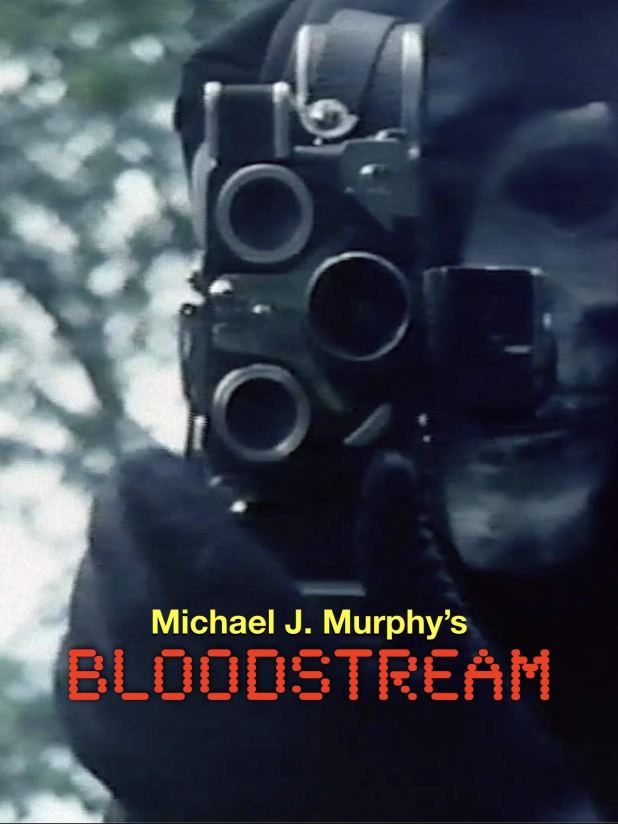


 B&S About Movies
You must be logged in to post a comment.