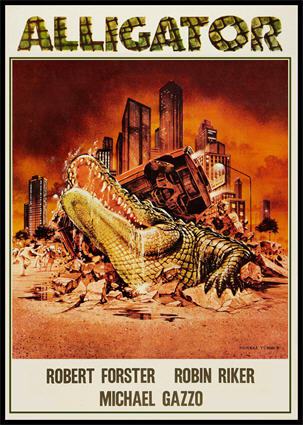
Alligator (1980)

There are moments in horror movies where even the most jaded of us can be upset at a visual or idea. In Alligator, there’s plenty to be disgusted by, but for me, the dead dogs being floated down a sewer were the closest I’ve come to being grossed out by a film in some time!

Somewhere in Florida, a young girl watches as an alligator nearly devours a man at a tourist trap. So of course, she asks to have an alligator of her own. Ramon the alligator and the young girl live happily together, as he becomes her best friend. But her drunk father comes home and flushes him down the toilet. It’s these kinds of beginnings that lead to animal massacres like we’ve about to watch. Fathers, don’t flush your daughter’s animals down the commode, I implore you!

Years later, a lab is working on a growth formula intended to make livestock bigger. So puppies are, of course, needed for the experiments. The discarded puppies end up in the sewer and Ramon is there, having survived for over a decade. Now, those dead puppies have turned Ramon into a 36-foot long monster who can’t stop eating.

David Madison (Robert Forster, The Black Hole) is on the case, along with his gravel throated boss Chief Clark (Michael V. Gazzo, who wrote A Hatful of Rain and almost won a Best Supporting Oscar for his acting in The Godfather Part 2) and reptile expert Marisa Kendall. Coincidentally, Marisa turns out to be Ramon’s childhood owner! What are the odds, you may ask? What are the odds indeed.

Turns out that nearly all of David’s partners die, a fact that comes true when Kelly (Perry Lang, The Hearse) gets torn apart while they’re in the sewers. No one believes David that there’s an alligator. And Slade (Dean Jagger, who was in King Creole with Elvis, a film written by the above mentioned Gazzo) is going to make sure that it stays that way, because his company is working on the hormones that have made Ramon into a monster.

That all changes when tabloid reporter Thomas Kemp takes photos of Ramon eating him, Yep, he makes the front page at the cost of his own life. Everyone is hunting the monster, even if David can’t catch him and gets suspended. But Ramon is on the prowl and soon kills a cop and then a young boy at a party. Even big game hunter Colonel Brock (Henry Silva, MegaforceEscape from the Bronx) can’t handle the gator and dies. The cops screw up again and Ramon goes wild at a wedding at the mayor’s (Jack Carter, The Glove and Catskil in Heartbeeps, because he was a Catskills comedian) house. The mayor, Slade and the groom, who was the lab guy conducting the experiments, all become apertifs for Ramon, who is wedding crashing like a champ. Chomp? Champ.

Finally, Marisa and David remember how Jaws ended and blow Ramon up real good, just in time for another baby alligator to get flushed down the toilet.

Lewis Teague (Cat’s EyeCujo) directed this from a script by John Sayles (PiranhaBattle Beyond the StarsThe Howling) that is filled with strange humor, like the first victim, a sewer worker, being named Ed Norton. Quentin Tarantino was inspired by this movie and Robert Forester is in Jackie Brown because of that fact.

This is a film that isn’t afraid to show you plenty of chewed up body parts. Or dead dogs. Nope, it’s going to go for your throat like it’s titular beast.

Some claim that this Ideal Toy game was based on the movie, but I’ve seen no evidence. It does line up well with the Jaws tie-n game that they made. Which would make sense, because Alligator also recycled Jaws‘ theme music along the way!

MESSED UP AND MUSICAL: Can’t Stop the Music (1980)

This movie — and Xandau — are why the Razzies exist, awards that celebrate the worst in movies. It’s the only movie that Nancy Walker — Rhoda’s mom and the Bounty paper towel lady — ever directed. It’s Bruce Jenner’s film debut. And I don’t care what anyone says, I love it in spite of everything bad you can say about it.

You can see why the movie happened. Producer Allan Carr was riding high off the success of Grease. Disco had finally hit the mainstream with Saturday Night Fever. And there was probably so much coke going around that everyone had a constant nasal drip. The time was ripe for what people had been clamoring for: the origin story of the Village People.

Wait — what?

The Village People — you probably know the words to YMCA — were created by Jacques Morali and Henri Belolo. While in New York, Morali attended a costume ball at the Greenwich Village gay disco “Les Mouches.” There, he was taken by all of the macho male stereotypes that he saw in the room and thought — this could be a music act, with each member being a different gay fantasy. Soon, they were signed to Casablanca Records, where their songs “San Francisco (You Got Me),” “Macho Man” and “In the Navy” played in clubs all over the world.

The truth is that the Village People were all one person at first: Victor Willis. Once the album became a hit, Morali and Belolo quickly put out an ad that said: “Macho Types Wanted: Must Dance And Have A Moustache.” From that big success to the time this movie was ready to come out, disco was just about dead, a fact that Carr had foreseen, changing the title from the original Discoland–Where The Music Never Ends! 

So what’s it really all about? Jack Morell (Steve Guttenberg, Police Academy) — named for Jacques Morali, of course — wants to be a composer. But for now, he’s DJing at Saddle Tramps, a disco. His roommate, Samanta Simpson (Valerie Perrine, Superman) is a newly retired supermodel. He writes her a song and everyone loves it, so she uses all of her connections to get him a deal. Her ex-boyfriend Steve Waits of Marrakech Records — get it, Casablanca Records? — wants her back, so he agrees to listen to a demo.

However, Jack’s vocals pretty much suck. So she recruits all of her fabulous friends, like waiter Felipe Rose — the Indian! And model David “Scar” Hodo — the Construction Worker! Randy Jones needs dinner, so he joins up as the Cowboy! We almost have formed Voltron…I mean, the Village People!

We’re treated to a solo song by David the Construction Worker called “I Love You to Death” where he fantasizes about all of the women who will be chasing him once he’s popular. When this scene played in San Francisco, supposedly movie screens were decimated with eggs.

Meanwhile, Samantha’s former agent (Tammy Grimes, who is one of the commercial stars in The Stuff) wants her back in the modeling business and orders her secretary Lulu to make it happen. Somehow, Ron White (Jenner), a tax lawyer, gets mugged on his way to delivering a cake to Sam’s sister, but then Lulu gives Jack drugs, then Ray Simpson — the Cop! — shows up and the four sing the song “Magic Night.” It’s all too much for Ron, who runs away.

The next day, Ron and Sam get back together and hook up. Now that he has a reason to help, he offers his office for further auditions, where we meet Glenn Hughes — the Leatherman! — and Alex Briley — the G.I.! — who finally form the full version of the group. Blink and you’ll miss W.A.S.P. frontman Blackie Lawless trying out! Finally, Ron’s boss Richard says (Russell Nype, who is also in The Stuff) that their company shouldn’t have anything to do with the group, so Ron quits the firm.

The band then goes to the YMCA to rehearse, which leads to a musical number for the song of the same name. If you’re looking to see plenty of naked men in a PG movie, well, here you go! I won’t judge! Marrakech offers too little money for their contract, so the gang decides to throw a party to raise some funds.

Seriously: this is the most raw dong I have ever seen in a non-porno movie.

Samantha agrees to model again for a milk commercial, as long as the Village People can be there, too. The TV spot — with six small boys dressed as the band — starts with Samantha pouring them milk and turning into the song “Milkshake.” Of course, the milk company balks at this. I’ve been in advertising for some time. I can only imagine the meeting where they showed this video to them and the blank stares turning into faces filled with pure rage.

Norma White (Barbara Rush, It Came From Outer Space) decides to help and invites the guys to be part of her fundraiser. Sam lures Steve to the show by suggesting they can canoodle, so Ron dumps her. Meanwhile, on Steve’s jet, Jack and his mother Helen (June Havoc, sister of Gypsy Rose Lee!) win the record company owner over and the Village People are signed!

Everything works out just fine. Ron and Sam get back together. He gets his old job offered back. And following a song by Morali’s other band The Richie Family, the Village People finally unite for “Can’t Stop the Music.”

If only reality had been so kind. After all, the infamous Disco Demolition Night in Chicago, the evening most people claim was the death knell for disco in the United States, happened two weeks into filming.

Even with a TV special — Allan Carr’s Magic Night — featuring Hugh Hefner and Cher, along with a new Village People song Ready for the 80’s! that was cut from the film, it was to prime America for a movie that by the time it was filmed no one really wanted to see.

Oh man, the lyrics to that song:

I’m ready for the eighties things look positive
I’m ready and I’ve got a lot of love to give
There’s hope in every heart and love on ev’ey face
The eighties promise everything is just gonna be great

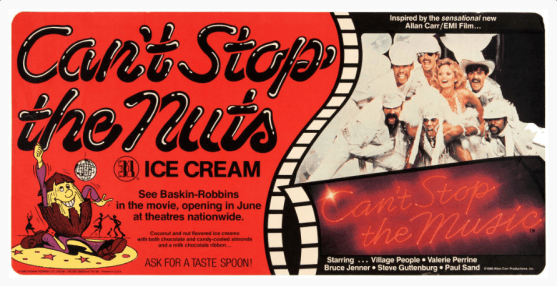
But hey — Baskin Robbins had a flavor made for the film. Can’t Stop the Nuts was offered for the whole summer of 1980. Think I made this up? Nope. I have evidence.

It’s also one of the first appearances of Ray Simpson as the Policeman. The previously mentioned Victor Willis, the original lead singer, quit the group during pre-production. Turns out he wanted to let everyone know he was the straightman of the group and had insisted that his wife, the soon to be divorced and renamed Phylicia Rashad, be written into the film as his girlfriend. Her role in the film ended up being played by Sammy Davis Jr.’s wife Altovise Davis.

Even crazier was that filming in New York was constantly delayed by protestors who were upset about the film Cruising. Many of them thought that this film was that film, so they protested against the wrong movie!

The film failed. Disco died. But why are we talking about this all thirty-some years later? Simple: disco never really went away. And neither did the Village People. Victor Willis is even back in the group, after years of fighting. Sure, there are two different Village People bands touring. But people love them. They’re a part of our culture, even if this movie is pretty much forgotten (outside of Australia, where it’s a New Year’s Eve tradition).

If you want to see it for yourself, Amazon Prime has it for your viewing pleasure. I also want to inform you for some reason this movie is 2 hours and 3 minutes long. I have no idea why it has to be so long. Plan your evening accordingly.

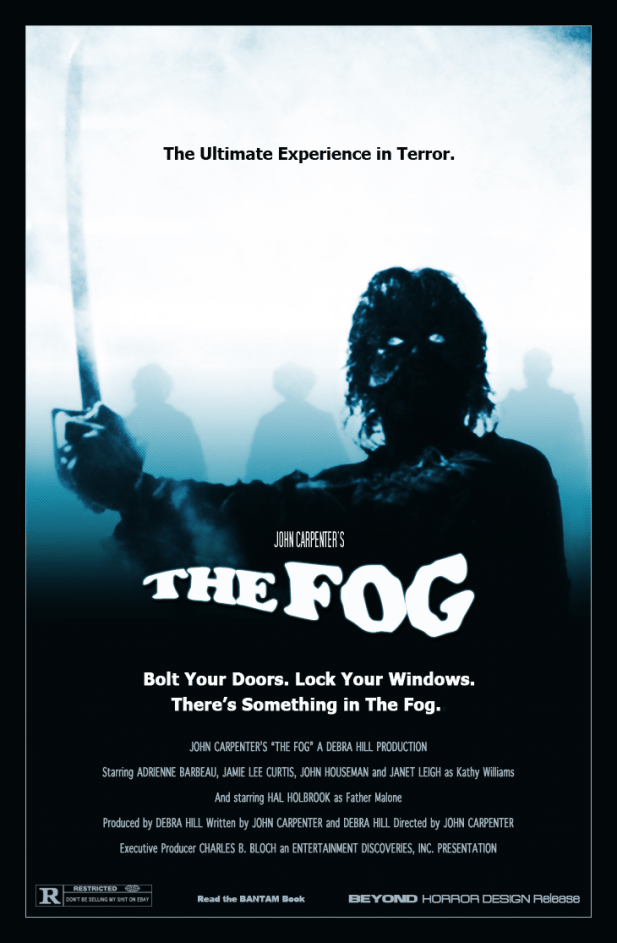
The Fog (1980)

Today is the 138th anniversary of the founding of Antonio Bay, CA.  I see no better time to tell you about one of my favorite movies, which comes from that fictional town.

As the town is about to celebrate its 100th anniversary, the stroke of midnight brings chaos. It all starts with an old sailor (John Houseman, in a scene shot after the initial filming was done to add more of an overall scary feel) freaking some kids out with the tale of the Elizabeth Dane. At the same time, Father Malone (Hal Holbrook, adding some star power) drunkenly finds his grandfather’s diary from a century ago, when the founders of the town deliberately sank and plundered a ship full of lepers in order to build the town and the church.

Things get even crazier when a fog rolls in, bringing back the ghost of the Elizabeth Dane and its crew members, who kill the entire ship full of men. And then there’s Nick Castle (Tom Atkins!), who finds a young hitchhiker named Elizabeth Solley (Jamie Lee Curtis!). And oh yeah, DJ Stevie Wayne (Adrienne Barbeau!) is given a piece of the Elizabeth Dane by her son. The entire town flips out overnight, with windows breaking, car alarms going off and dogs barking at the sea.

It doesn’t get any better the next day. The driftwood that Stevie was given mysteriously changes words from DANE to 6 MUST DIE and leaks all over her equipment, making a tape player read part of “The Rime of the Ancient Mariner.”  Nick and Elizabeth seek out his missing fishermen friend and find the body of Nick Baxter with his eyes torn out. It gets worse. The corpse gets off a table and tries to attack her before carving out the number 3. And Kathy Williams (Jamie Lee’s mom Janet Leigh!) chooses to ignore the priest’s warnings that everyone is doomed while worrying about her husband being lost at sea.

Local weatherman Dan (Charles Cyphers from Halloween) has been flirting with Stevie the whole time, but he gets attacked by the fog in a scene that feels like it was lit by Mario Bava. And the fog rolls toward her and her home, where Nick saves her son at the last minute. Finally, the crew of the Elizabeth Dane comes into the town’s church, seeking the gold cross made from their stolen riches. Blake (special effects master Rob Bottin), their leader, grabs it as the crew disappears.

At the end, the priest wonders why they didn’t take him when they promised to kill six. He doesn’t wonder long as the fog rolls back in and he’s beheaded.

This was the first movie Carpenter would direct after Halloween and was inspired by The Trollenberg Terror, a movie where monsters hid in the cloud. It also had a real-life moment that spurred it forward — when promoting Assault on Precinct 13 with his then-girlfriend, producer Debra Hill, Carpenter noticed a strange fog move quickly past Stonehenge.

This was part one of Carpenter’s two-picture deal with AVCO-Embassy (Escape from New York would be the next movie) and was a low budget film with a $1 million dollar budget. That said, Carpenter and Dean Cundey shot it in the anamorphic 2.35:1 format, so it looks amazing. The scenery b-roll that plays as the fog grows closer looks otherworldly and anywhere but California. It’s gorgeous. 

After viewing the rough cut, Carpenter felt that the film was terrible and didn’t work. He added the campfire scene at the beginning and several new scenes while reshooting others to be more horror and gore-filled. The budget only went up $100,000, but nearly one-third of the film was reshot.

The Fog is packed with references to other films. Charles Cyphers’ character is named for screenwriter Dan O’Bannon, who made Dark Star with Carpenter. Tom Atkins’ character, Nick Castle, is named for the actor who played Michael Myers in Halloween (he’d later co-write Escape from New York and direct The Last Starfighter), the babysitter’s name is taken from Richard Kobritz, the producer of Carpenter’s TV movie Someone’s Watching Me! And George “Buck” Flower plays Tommy Wallace, named for Carpenter’s art director and the future director of Halloween 3: Season of the Witch and the original It TV movie.

There’s more! John Houseman’s character is named after horror writer Arthur Machen, an Arkham Reef is mentioned as a shoutout to Lovecraft and the town’s coroner is Dr. Phibes. Bodega Bay, the setting of The Birds, is also mentioned.

There’s some great acting in here, particularly the speech Atkins gives about his father almost dying on the ocean. And Barbeau is great as she channels famous New York City DJ Alison Steele, The Nightbird. And Carpenter is in the film as the assistant Bennett who is named after a friend from USC, Bennett Tramer. If that name sounds familiar, Carpenter also used it for Laurie Strode’s potential love interest (and victim of mistaken identity in Halloween 2) Ben Tramer in Halloween. Even Stevie’s car is a reference to another film Carpenter loves: it’s a Volkswagen Thing (her last line, “Look for the fog,” echoes the last line in that movie’s “Watch the skies”).

At one point, John Carpenter mentioned creating an anthology series for TV that would have The Fog create supernatural events in other cities before connective ties to the original film would be shown. Sadly, this series never happened and in 2005, a remake was produced. The less said about that, the better.

Looking for a copy? You mean you don’t already own this? You can grab the limited edition steelbook from Shout! Factory or watch it on Shudder. It’s better than any horror movie that’ll come out this year. Maybe even any year.

Feed Shark

WATCH THE SERIES: Friday the 13th part 1

At this point, this is the longest that we’ve ever gone without a Friday the 13th film since the break between Jason Goes to Hell and Jason X in 1993 and 2001. But at one point, these movies owned the box office, with one nearly every summer from 1980-1989. Why did people love them so much? And what were they all about? That’s why we’re here.
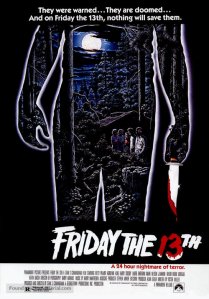
Friday the 13th (1980)

After the success of John Carpenter’s Halloween, every studio wanted a piece of the horror pie, which to this point had been exploitation fodder. Paramount Pictures was first. Sure, critics salvaged the film, but after $40 million in profit, no one really cared.

Produced and directed by Sean S. Cunningham (Last House on the Left), this movie was envisioned as a roller coaster ride. The script came from Victor Miller, a soap opera scribe. And spoilers — but this movie doesn’t even really have Jason in it!

The movie starts in the summer of 1958 at Camp Crystal Lake, where two counselors sneak off and have sex before being killed. This sets up one of the many rules of slasher films: never fuck in the woods.

The camp closes for 21 years, but on Friday, June 13, 1979, that’s all about to change. That said, no one in the town wants it to happen. When Annie Phillips arrives in town, everyone treats her strangely or acts like Crazy Ralph (Walt Gorney, who shows up in the next film and was the narrator for Friday the 13th Part VII: The New Blood). She lasts for about five minutes, as she gets killed after her third hitchhike of the day. I’d say this is more of a warning against hitching in the late 1970s than I would serial killers in the woods.

The other counselors — Jack (Kevin Bacon!), Ned, Bill (Harry Crosby III, son of Bing), Marcie, Alice and Brenda (Laurie Bartram, The House of Seven Corpses) — and owner Steve Christy all show up to get the camp ready. This is where you’ll notice just how different fashion is. Becca and I have seen this live several times in a theater now and everyone laughs as soon as Steve shows up in his short shorts and bandana.
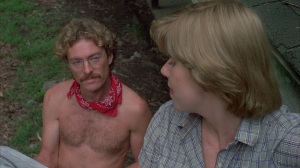
Ned is killed pretty quickly, then Jack is killed with an arrow and Marcie takes an axe to the face. Brenda is murdered as she responds to the voice of a child. Steve gets killed on the way to camp. Before you know it, Alice and Bill are the only ones left, but Bill lasts pretty much seconds. Then we have another future slasher trope: every body is discovered, hung like trophies.

Now, we have our Final Girl: Alice, who ends up meeting Mrs. Vorhees, who tells the tale of how her son Jason drowned and the horrible counselors who allowed it to happen. Much like the giallo/pre-slasher film Torso, the movie now focuses on the battle between Alice and the real killer. Alice ends up beheading her and sleeping in a canoe. As the police arrive, she has a dream that Jason rises from the water to kill her. This scene wasn’t in the script, but special effects king Tom Savini thought a Carrie-like ending would be more powerful.

Another way that the film pays sort of homage to Italian filmmaking is in the snake scene. It was another Savini idea after an experience he had in his own cabin during filming. The snake in the scene? Totally real, including its on-screen death — someone alert Bruno Mattei!

Some trivia: the film was shot just outside Lou Reed’s farm. The rock star performed for the cast and even hung out with them! Sweet Jason?

To me, the film works because of how great Betsy Palmer is as Jason’s mom. It’s a fine film, but nowhere near the excesses that the series would grow into. This was also the start of critics really hating on slasher films. Gene Siskel was so upset about Betsy Palmer being in the film that he published her address in his column and encouraged people to write her and protest. Of course, he published the wrong address.
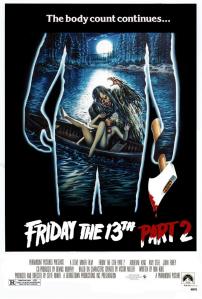
Friday the 13th Part 2 (1981()

Of course, there was going to be a sequel. Sean S. Cunningham refused to direct it because he was against the studio plan to bring Jason back from the dead. He said that it was too stupid and would never work. Hmm.

Beyond a plan to be an anthology of stories on Friday the 13th (which sounds a lot like the plans for Halloween), another thought was that Alice would be a reoccurring hero in this series, continually facing off against Jason again and again in sequel after sequel (again, think Halloween and Laurie Strode). Sadly, after was stalked by a fan, she said she wanted out (she even stayed out of acting for a long time).

That’s why this movie starts with her death. I always wondered why this happens, because it invalidates all of the emotional investment that you put into the last film!

So of course, everyone decides that re-opening Crystal Lake would be a great idea. We’ve got Ginny (Amy Steel, April Fool’s Day), Sandra, Jeff, Scott, Terry, Mark, Vickie and Ted, who sit around a campfire and listen to the legend of Jason. Even Crazy Ralph from the last movie shows up to warn everyone before getting killed.

Here’s my problem with this sequel: it rips a lot off. Jason doesn’t have his trademark hockey mask, so he steals the look of the Phantom of The Town that Dreaded Sundown. And then there’s the issue of taking two murders shot for shot from Mario Bava’s A Bay of Blood. A machete to the face and a couple stabbed together by a spear? Attention director Steve Miner: Bava did it first and better. Miner would go on to direct Halloween H20, so his sins are many.

Just like Shakespeare, everyone dies. Except Ginny. She discovers Jason’s altar to his dead mother and ends up stabbing him in the should with a machete. And then the movie does another shock ending, making you think Jason survived. He, of course, did not. Or he did. You know how these things go.

My question is: Did Jason rise from the dead? Or was he alive in the forest all these years? And how did he learn how to use a telephone? Let’s just stop asking questions.

Friday the 13th Part III 3D (1982)

With Amy Steel uninterested in returning to the series, the filmmakers had to reboot and figure out what made Jason tick. And that ticking was a hockey mask — three movies into the series. The original plan was that Ginny would be confined to a psychiatric hospital and he would track her down, then murder the staff and other patients at the hospital. If this sounds kind of like Halloween 2 to you, well surprise. This is not a movie series known for its originality.

He starts the film by killing a store owner and his wife just for clothes. Then, he goes after the friends of Chris Higgins: Debbie (Tracie Savage, who played the younger Lizzie in the awesome made-for-TV movie The Legend of Lizzie Borden), Andy, Shelley, Vera (Catherine Parks, Weekend at Bernie’s), Rick, Chuck and Chili. They run afoul of bikers Ali, Fox and Loco, who follow them back to their vacation home.

Jason starts killing quick, but he’s already mentally scarred Chris, as she survived an attack from him two years ago. This has left her with serious trauma and an inability to enjoy intimacy (which, come to think of it, comes in handy in these movies).

Jason takes the mask from the dead body of prankster Shelley and it’s on, with speargun bolts to the eye, heads chopped in half with machetes, knives through chests, electrocutions, hot pokers impaling stoners and even someone’s skull getting crushed by Jason’s supernaturally powerful hands.

Of course, it ends up with Final Girl Chris against Jason, who she kills by hitting him in the head with an ax before falling asleep on a canoe and having a nightmare of Jason killing her. It’s OK. Don’t worry. We see that all is right in the world and the killer’s body is at the bottom of the lake.

Here’s some trivia: To prevent the film’s plot being leaked (I could tell you the plot in less than a sentence, so this seems like bullshit), the production used the David Bowie song “Crystal Japan” as the title of the movie. They’d use Bowie songs as working titles during several of the other films.

There is a ton of footage that was cut from the film so that it didn’t get an X rating. And there’s an alternate ending where Chris dreams that Jason decapitates her. None of these things make this a better movie.

Whew! We made it through three Friday the 13th movies. Let’s take a little break and then we’ll be back in a bit with three more!
Revenge of the Stepford Wives (1980)

Ira Levin’s 1972 novel, The Stepford Wives, and the 1975 movie that was based on it are both cultural phenomena. Even the phrase “Stepford wife” has entered into our lexicon. So why did things have to stop after one movie? Luckily, NBC aired this sequel on October 12, 1980.

Whereas the original Stepford wives were androids, the new ones are controlled by drugs and hypnosis. That’s why the town of Stepford has the lowest divorce and crime rate in the U.S. And it’s also what brings reporter Kaye Foster (Shannon Gless, TV’s Cagney and Lacey) to town.

The town is against outsiders, who enjoy the quiet surroundings they live in. And oh yeah, the fact that others than 4 sirens a day to tell them to take their pills, they don’t have to tell their wives to do anything. They’ve become the perfect wives — complaint in all ways.

Kaye meets two other outsiders, Megan Brady (Julie Kavner, Marge Simpson!) and her policeman husband, the dim-witted Andy (Don Johnson, singer of “Heartbeat.” Oh yeah and Miami ViceA Boy and His Dog and The Magic Garden of Stanley Sweetheart). Unlike the other women in town, Megan is sarcastic (and near caustic at times) to her husband. She becomes Kay’s research assistant.

The Stepford Men’s Association, run by Dale “Diz” Coba (The Andromeda Strain), is in charge of town. They even send Barbara Parkinson (Audra Lindley, Mrs. Roper from Three’s Company) to run her down with her car. Afterward, all she can do is repeat the same words and appears to be controlled.

Meanwhile, Wally the hotel manager (Mason Adams, God Told Me To) confesses that he wants to leave his wife but can’t. She’s been programmed to be someone he no longer wants her to be.

Meanwhile, Andy gets the job with the Stepford Police and we see his wife got through the Stepford process. Soon, she’s wearing a frilly dress, as well as cooking and cleaning with no complaint. As long as she takes her pills and doesn’t drink, all will be well. Kaye sneaks in to watch their initiation ritual and barely escapes with her life.

Kaye then frees Megan by boozing her up. They try to use Wally to escape town, but even though they had already planned on him betraying them, they are still caught. Kaye manages to get a gun and hold Diz at gunpoint while Megan continually rings the siren. As the Stepford Wives overdose on pills, they become violent and attack their men.

Andy returns to help save the day as the women of the town push Diz off a balcony and tear him to pieces as Kaye leaves.

This was directed by Robert Fuest, who also brought us The Abominable Dr. PhibesDr. Phibes Rises Again and The Devil’s Rain! It’s not a bad effort, but a lot of his quirkier touches are absent.  Genre vet James MacKrell also shows up (he played Lew Landers in both Gremlins and The Howling).

One of my issues with this movie — and any of the Stepford stores — is that it’s a really simplistic view on feminism. At the risk of mansplaining, I think that women can choose wherever they want to be — in the workforce, at home raising a family, not raising a family, doing all of the above. Or none! By placing the battle between liberated career women and drones who only exist to cook and clean, these stories simplify the very complicated battle of the sexes.

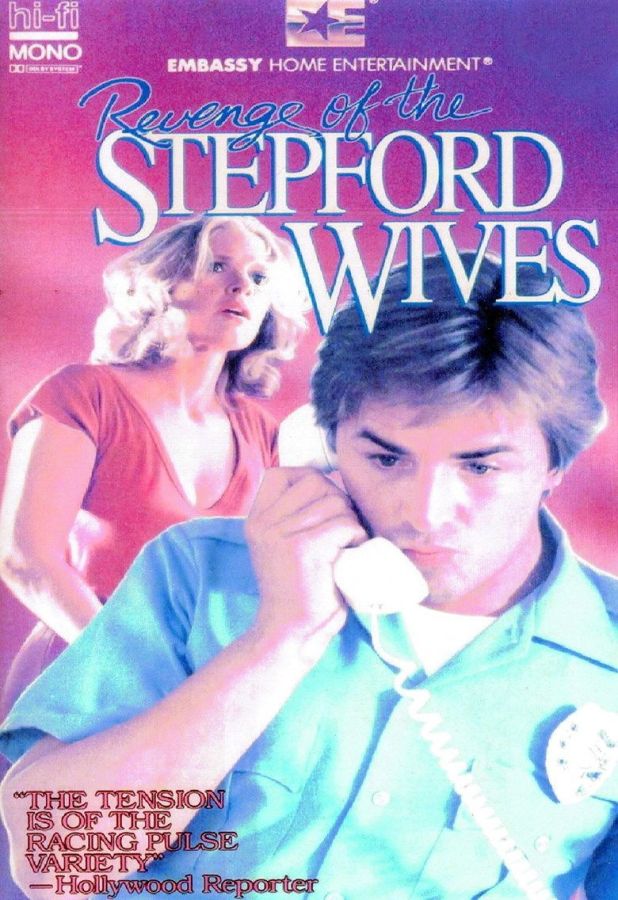
That doesn’t mean I didn’t enjoy this, though! It has some great tension throughout and makes me miss when movies like this would air regularly. This was released on VHS in the 1980’s after Don Johnson’s Miami Vice fame and even retitled Terror in New York when released internationally. In fact, the version I watched on YouTube has a really poor computer graphics title for this that is just dubbed in!

Like most TV movies, this has not been released on DVD. You can find it on the grey market or, as mentioned above, YouTube.

By the way, check out this awesome art for the film by Johnny Pahlsson!


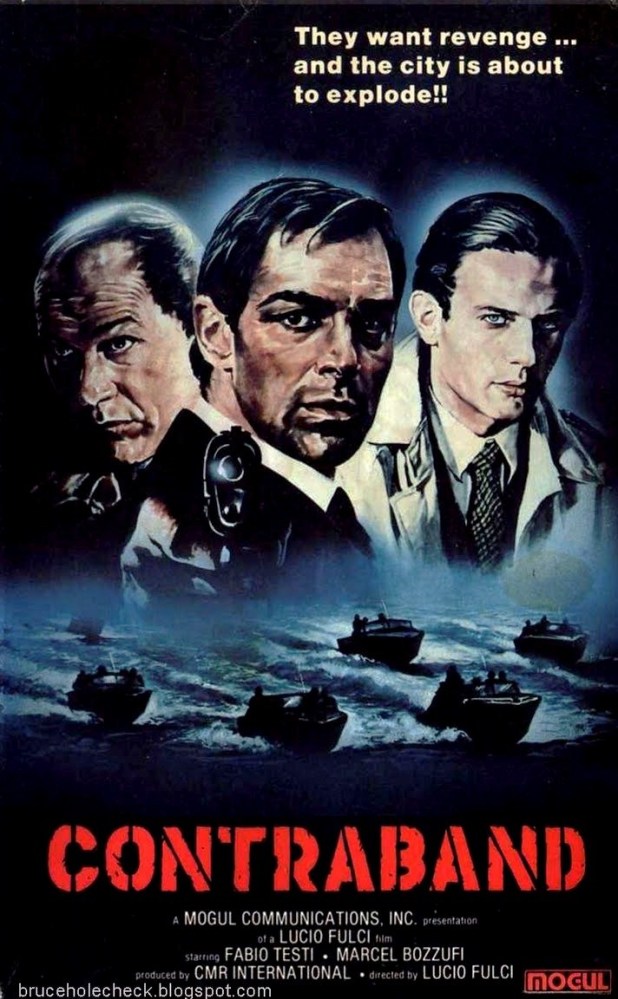
FULCI WEEK: Contraband (1980)

Imagine Fulci making a cop movie. Imagine that the budget ran out two weeks in. Imagine that real mobsters paid for the film, asking for a title change and for more violence (like Fulci was going to say no). Don’t imagine. All of these things are wonderfully true and make Contraband such a weird addition to your Fulci collection.

Luca Di Angelo smuggles near Naples with his brother Mickey. They have a close call with the police and suspect a rival gangster, Scherino, of turning them in. After sharing their concerns with their boss Perlante, one of Mickey’s prize horses is killed and a fake police roadblock leads to Fulci paying homage (or straight up ripping off, depending on your perspective) to the scene where Sonny dies in The Godfather. Luca escapes death while his brother is not so lucky. Despite warnings that he should leave town, he has a speedboat funeral for his brother and vows revenge. Breaking into Scherino’s house, he almost kills the man before running into his henchmen. He gets his ass kicked, but his life is spared after the boss tells him he had no part in the death of his brother.

Adele, Luca’s wife, wants him to forget this life. But he’s in deep after discovering that a vicious French criminal named The Marsigliese is responsible. We meet this criminal during a drug deal, where he responds to a bad batch of heroin by burning a woman’s face with a blowtorch. If you haven’t realized that you are watching a Lucio Fulci movie, this would be the point in the film where you realize that fact.

The Marsigliese starts killing all of the Mafia leaders so that he can become the sole boss of Naples. Even Perlante is nearly killed, only being saved by the fact that his chief capo was having sex with his mistress and triggered a bomb under the bed. After a meeting between Luca, Perlante and The Marsigliese, where they discuss working together, Luca warns his fellow smugglers that if the French boss has his way, there will be more drugs, more overdoses and more problems — with less money for all of them.

The police are using all of the intercine battling to round up smugglers, but Scherino saves Luca and suggests they work together. They meet at Perlante’s house, but Luca smells The Marsigliese’s cologne. That’s when gunmen bust in and shoot everyone but Luca, who escapes by crashing through a window. Scherino is mortally wounded, but not before shooting Perlante in the neck, killing him.

Again, in case you wonder who directed this film, The Marsigliese kidnaps Adele and demands Luca turn over his smuggling operation over the phone…and then plays him the sounds of our hero’s wife being beaten and gang-raped. Luca unites all of the retired mob bosses and old guard bosses, who are sick of hearing about the Frenchman taking over. They take out most of his men and Luca guns him down in a garbage-strewn alley in a scene packed with blood spraying everywhere.

Adele and rescued and Morrone, the leader of the old school mob guys, tells the police that he has no idea who Luca is.

Contraband was made as Fulci was starting to claim his gore crown. It’s his only crime movie, but it’s not a bad effort. And if you’re looking for his trademark tics, as you’ve read above, this film is full of them. It has way more blood and guts than any film of this type and subverts the genre it should be in, so it’s quite similar to how Fulci treated sword and sorcery with Conquest. This may not be one of his best-known films, but it’s worth checking out. You can find it on Amazon Prime.

A funny postscript: I tried ordering this film three times, with the first two attempts netting me two blu rays of the 2012 Mark Wahlberg film, Contraband. Therefore, when you look at my DVD collection and wonder, “Why does Sam have a Mark Wahlberg movie?” just know that I got it for free. Twice.

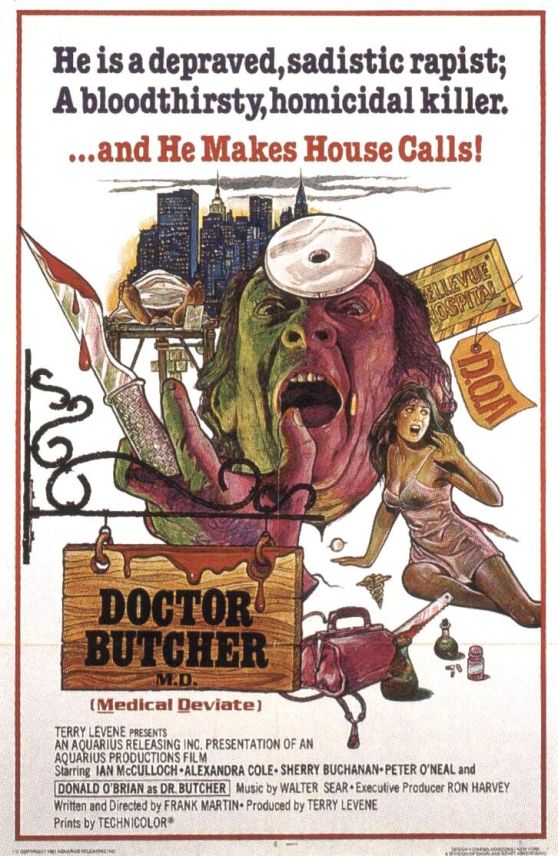
MANGIATI VIVI: Dr. Butcher, M.D. (1980)

Also known as Zombi Holocaust, the American version of this film features a sequence from an unfinished film called Tales That’ll Tear Your Heart Out, a different music score and some edits for pacing. It’s also got a much better title: Doctor Butcher, M.D. (Medical Deviate). And let me warn you right here and now. This is a film that takes no prisoners. It’s everything horrible about horror films, the kind of Satanic panic nightmare that your clergyman warned you about. It is vile, reprehensible garbage. And it’s entertaining as hell.

New York City in the late 70’s is a bad place to be. Even in the hospitals, a maniac is caught cutting off body parts and escaping with them. All the higher ups want to keep the story out of the paper, but morgue assistant and anthropology exert Lori (Alexandra Delli Colli, New York Ripper — imagine having those two movies on your IMDB history!) grew up in the Moluccan islands, where the cannibal came from. Let’s forget what a coincidence this is and just savor the madness that is to follow. As soon as she learns the truth, a journalist named Susan (Sherry Buchanan, Escape from Galaxy 3, Tentacles) breaks into her place. And right after she kicks her out, her ceremonial dagger gets stolen! How could this happen!? And how coincidental — again — that a killer who works in the same hospital as Lori would steal it, get caught and give chase before falling to his death from a rooftop (and magically turn into a mannequin before crashing to the pavement)?

Maybe Lori’s hospital isn’t that unique because this is happening all over town, all with hospital workers baring the same tattoo. Dr. Pete Chandler (Ian McCulloch, Zombi, Contamination), Lori’s anthropologist friend, suggest that she join him and his friend Pete on a trip to the islands. And oh yeah — Pete’s girlfriend is Susan, in another coincidence. God only plays dice in Italian zombie films.

Once they arrive, they meet Dr. Obrero (Donald O’Brien, Ghosthouse, Emanuelle and the Last Cannibals), who warns them that the natives are more like wild animals and will not take kindly to strangers. To prove his point, one of them leaves a maggot-ridden severed head in Lori’s room. At this point, any sane person would just go home. But then, we would not have a movie. Obrero sends Moloko, his assistant along with them on their journey. Is it weird that he has the same name as the island?

Within minutes of the running time of the film, all of the party’s guides and porters are dead, other than Moloko. Soon, George and Susan are raw meat and the rest of the party seem like they are soon to be dinner, too. That’s when zombies attack, sending the cannibals off into the jungle. And strangely, Dr. Obrero gets to them faster than they expected with help.

Let me spoil this one for you — Dr. Obrero is Dr. Butcher. He got the natives to rediscover their cannibal ways and they provide him with the raw material that he needs to create his zombies. He uses them for experiments, moving science forward as he works on the same set as Fulci’s Zombi. He’s a decent fellow, though. He lets the natives keep the scalps, after all.

After killing a zombie with a boat motor, Chandler breaks into the doctor’s office, where he is transplanting Susan’s brain, who is bald because, you know, they took her scalp. Also, she’s still alive. The doctor takes Chandler captive and Lori is taken by the cannibals, who the natives see as some kind of god. You know, blonde hair and white skin and all that. They paint her with flowers as if she were Goldie Hawn on Laugh-In and she lies in a body shape on the altar that looks like the tattoos we saw earlier. Somehow, again through total coincidence, she fits perfectly into the impression.

Lori uses her power over the cannibals to attack the doctor and his zombies, freeing Chandler and allowing them to head back to civilization. Where, you know, they’ll both get over this with no issues at all.

The ad campaign for this film, such as the stolen image of Salvador Dali and lurid copy on the poster, push this movie into a transgressive art experience. And that’s before the Butchermobile hit the road. A rented truck with posters plastered on every side that dripped blood, it cruised the streets of downtown New York City promising that Dr. Butcher, M.D. could deliver an experience that other lesser films could not.

You can learn all of this and more with Severin’s jam-packed blu ray release. From interviews with Aquarius Releasing’s Terry Levene, the men who drove the Butchermobile, Ian McCulloch and Sherry Buchanan to a tour of today’s Times Square, you could almost make the case that the extras are worth a release of their own. Throw in two versions of the film — both the American cut and the original Zombie Holocaust Italian version — and you have a release that simply cannot be beat.

If you ever watched a movie and wondered, “I wish that people got eaten and torn to bits every twenty seconds while loony synth music played,” I have some good news for you. Your horrifying prayers will be answered by this movie.

You can also enjoy High Rising Productions’ Calum Waddell’s documentary Eaten Alive! The Rise and Fall of the Italian Cannibal Film (2015), which is featured on the Grindhouse Releasing Blu-ray for Cannibal Ferox in the U.S. and the U.K. Blu-ray for Zombi Holocaust by 88 Films. Our much adored Umberto Lenzi, Ruggero Deodato, Sergio Martino, along with actress Me Me Lai offer their genre insights for the documentary.

You can watch this movie as Zombie Holocaust on Shudder. Maybe don’t eat dinner while you’re watching it.

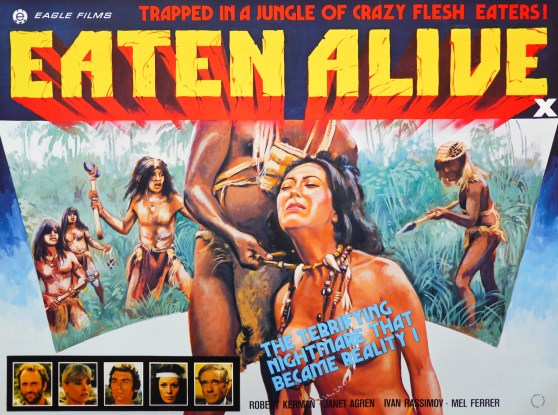
MANGIATI VIVI: Eaten Alive! (1980)

What happens when you throw assassins in New York City, cannibals in the jungle and a Jim Jones-like cult leader into a big pot and set it to boil? You get Eaten Alive!

Sheila (Janet Agren, City of the Living Dead, Hands of Steel) is searching for her sister, Diana (Paola Senatore, Emanuelle in America)who has disappeared in the jungle. She hires Mark (Robert Kerman, Cannibal Holocaust) to help her find her way through the jungle. Oh yeah — and there are killers in the city using blowdarts. That doesn’t matter so much once we’re in the jungle.

When they find Diana — after being chased by cannibals — they learn that she has joined the cult of Jonas (Ivan Rassimov, everyone cheer when he shows up to make this movie awesome), who abuses, murders, manipulates and mindfucks everyone and anyone he gets close to. Seriously, the minute Jonas shows up, this film goes off the rails. First, he burns a man on a funeral pyre and then orders his wife Mowara (Me Me Lai, who thanks to appearances in this film, Last Cannibal World and Man from Deep River is pretty much to this genre as Edwich Fenech, Barbara Bouchet or Nieves Navaro are to giallo)to be ritually raped. Then, he hypnotizes Sheila and takes her on an altar using a snake phallus covered in venom and blood (yep, really).

Jonas preaches the Book of Isiah and pretty much owns everyone he can get his hands on, but Mowara, Sheila, Mark and Diana all attempt to escape. Diana and Mowara are overtaken by cannibals, with Diana graphically devoured while her sister and Mark watch helplessly. A helicopter arrives at the last minute to save them while the film goes into full exploitation mode, with the cult killing themselves ala Jonestown, leaving only one female survivor.

Oh man, I forgot! Mel Ferrer (The Visitor, Nightmare City) shows up as a professor!

Director Umberto Lenzi knows how to make a down and dirty film. He also knows how to keep it entertaining. Just witness other films he’s done like Ghosthouse! Plus, he’s the master of recycling, as this film re-uses the crocodile death and a woman being eaten from his 1972 film Sacrifice! (also starring Rassimov and Me Me Lai), Me Me Lai’s death from Ruggero Deodato’s Jungle Holocaust and a castration, a monkey being devoured and a man being eaten by a crocodile from Sergio Martino’s Slave of the Cannibal God. You could say he…cannibalized those movies! Sorry.

Again, keep in mind that these are rough films. They’re nearly indefensible, to be honest. I kind of wish the story of Jonas and his cult was more of the movie, with less of the cannibals. But you know, I can’t send notes back to Lenzi with a time machine or anything!

You can find this at Severin, who just put out an insanely detailed reissue, along with alternate slipcases, t-shirts and a Lenzi enamel pin! You can also watch it on Shudder.

PS – Amazingly, it wasn’t until I read this review that I learned that Eaten Alive was three different movies — Jungle Holocaust, The Man from Deep River and Mountain of the Cannibal God (look for that in a few days!)  — along with some Jim Jones thrown in.

MANGIATI VIVI: Cannibal Holocaust (1980)

Cannibal Holocaust has always been a movie that by reputation that I’ve avoided. It’s been tagged as “the one that goes all the way” and has been banned in over fifty countries. And it isn’t every movie that gets confiscated ten days after its premiere with the director arrested and charged with obscenity.

By January 1981, thanks to the French magazine Photo, authorities believed that the deaths in the film were indeed real, playing into the urban legend of the snuff film. The charges against director Ruggero Deodato (The House on the Edge of the Park, Raiders of Atlantis) now included murder.

The problem was that the actors playing the film crew had been paid for an entire year to disappear. That way, the public would believe that the “found footage” in the film was indeed real snuff footage. Sometimes, a PR idea works too well. Deodato had to gather three of the actors and explain how the film was simply a horror movie and the effects, even the grisly impaling scene near the close of the film, were fake. He even provided imagery of the actress in that scene joking around after the filming.

Deodato also explained in court how the impalement scene was faked: a bicycle seat was attached to the end of a pole, upon which the actress sat. She then had the rest of the pole in her mouth and looked up to complete the effect. Deodato also gave the court photos of the girl interacting with the crew after the scene had been filmed.

The murder charges were dropped, but the roughest part of the film — animal cruelty — remain. Today, Deodato condemns his past actions, in which six animal deaths appear onscreen. This mixture of the real — animals — and unreal — humans — lends itself to the frightening fact that it’s nearly impossible to separate what is fact and fiction here. I’m not justifying it. In fact, I hate that these scenes are in the movie, because I find them completely unnecessary to the plot. The film would be just as rough and brutal without them. The same message of man’s inhumanity to man, despite civilization, would remain. 

Let’s get into it. And again, let me warn you. This movie is not pretty.

An American film crew that was filming the indigenous tribes of the Amazon rainforests has disappeared. They are Alan, the director; his girlfriend, Faye; and the cameramen, Jack and Mark. Deodato cast these roles with inexperienced actors from the Actors Studio in New York City. They’d be able to speak English, as he saw the film having an international scope. And they were unknown, which would help when it came to the legitimacy of the snuff angle. However, Mark (Luca Giorgio Barbareschi) and Faye (Francesca Ciardi) were cast so that the film because they were Italian speakers (to ensure that the film would be recognized as being covered by Italian law).

Harold Monroe (Robert Kerman who was also in Eaten Alive! and several pornographic films under his stage name, R. Bolla) is an anthropologist at New York University who agrees to lead a rescue team. Through his adventures, he meets the Yacumo tribe and learns that the documentary crew caused create hostility amongst the native population. Heading deeper into the “green inferno” (the original name for the film, as well as the title of Eli Roth’s 2015 film), he encounters two warring tribes, the Ya̧nomamö and the Shamatari. They encounter a group of Shamatari warriors and follow them to a riverbank, where they save a smaller group of Ya̧nomamö from death. The Ya̧nomamö invite Monroe and his team back to their village

In gratitude for saving the Ya̧nomamö, the elders incite Monroe and his team back to their village. To gain their trust, Munroe bathes nude in a riverbank with the female natives. They then take him to a shrine filled with the rotting bodies of the original crew. He trades his tape recorder for the film that Alan captured. The elders only have one final request: he must dine with them and consume human flesh.

We return to civilization. New York City to be precise. The network execs at the Pan American Broadcasting System want Monroe to host a broadcast of the recovered footage, but he wants to watch it to be sure. Watching Alan’s last documentary, The Last Road to Hell, he watches executions and violence in several war-torn countries, only to later learn that much of this footage was staged. Deodato came up with this angle while discussing the way the Italian media shared news coverage of the Red Brigades. He felt that the reports were sensationalistic, decrying violence while promoting it. He also felt that there was no way they could have obtained their footage without staging the camera angles.

Monroe then watches the real footage. This is the part of Cannibal Holocaust that I would endorse — that it deliberately plays with the way that we consume media, forcing the viewer to rewind and rewatch. Every time that we feel that we’ve escaped the horrors of the jungle, we are doomed to return, to see the real story beneath the gloss, the gore behind the smiles.

A crew follows the friends and family of the dead documentarians. We learn banal moments of their lives, see that even their own wives and fathers hated them. There’s a really strange moment where a nun is interviewed while children look completely horrified to have strangers in their midst. This footage is just as unsettling as the gore on a much more emotional level.

The real truth? The documentary crew were worse than anything they’s find in the Amazon. The crew burned down the set, not another tribe. He’s seen the footage and demands that it never be aired, but the higher-ups refuse.

That’s when Munroe pulls out his trump card: the unedited footage, which only he has seen. The men attack and rape a native girl, despite Faye’s protests. They find that same girl impaled on a wooden pole in punishment for the loss of her virginity. The Ya̧nomamö return to get revenge for the girl, hitting Jack with a spear, at which point Alan shoots him so that his cameras can record the natives eating him). Faye is captured and Alan debates saving her, but decides that he would rather have the footage of her being raped, beaten and beheaded. Finally, the natives find Mark and Allen as the camera drops to the floor, revealing Alan’s blood covered face.

Then, and only then, do the executives demand that the film be destroyed. The end credits try and play into the snuff angle one more time: “Projectionist John Kiroy was given a two-month suspended jail sentence and fined $10,000 for illegal appropriation of film material. We know that he received $250,000 for that same footage.”

Supposedly, this is a reference to another inspiration Deodato had, as an Italian network was putting together a real documentary about a real crew who was lost in the real Amazon and its real cannibals. The documentary, showing incidents he depicted in the film, was destroyed after its discovery. An Italian cable network claimed it had a copy and was going to show it uncut. It never showed the film, but supposedly their copy of the original was screened by a distributor (John Kiroy?) for Deodato. This sounds like the kind of stories that Rosemary’s Baby producer William Castle cooked up after the film was made.

Stories like that seem to be a trend when you discuss Cannibal Holocaust.

Like the actor who played Alan, Carl Gabriel Yorke, who claimed that Francesca Diardi, who played Faye, wanted to skip rehearsal and actually have sex. She claims that their love scene in the film was actual sex and that they were off-screen lovers. I’ve also heard that she objected to the film’s sexual content and wouldn’t bare her breasts until Deodato dragged her off set and screamed at her.

Or that the actor who played Miguel lost his father the day they shot the discovery of the shrine. Production stopped so that he could attend the funeral, but in that scene, when he cries, those are real tears.

If you read the stories online about the actual making of the film, it’s hard to tell where the false camera crew’s antics and the real moviemaker’s begin and end.

In an interview on the Grindhouse Releasing DVD of the film, Yorke says that the set had “a level of cruelty unknown to me.” Kerman claims that Deodato had no remorse and that they’d get into long arguments throughout the shoot, with the actor claiming that the director was sadistic to people who couldn’t answer back to him. He also walked off the set, refusing to be part of the animal cruelty.

Even the pay was messed up. Yorke was paid less than promised and in Columbian pesos, no less, before threatening to quit. And the native extras are said to have gone unpaid.

Another question in my head: How much of this film was inspired by Gualtiero Jacopetti and his cycle of mondo films, like Mondo Cane, Africa Addio and Goodbye Uncle Tom. I think Deodato tips his hand toward this influence by using the music of Italian composer Riz Ortolani, whose song “More” was featured in Mondo Cane (it was nominated for an Academy Award for Best Original Song in 1963). Ortolani’s soundtrack is, well, the best part of the film. The opening song is gorgeous and lush, with only a subtle hint that all will not be well.

It’s hard to truly believe in the “who are the real animals” narrative when it seems like Deodato learned none of those lessons for himself. Still, I feel that films should challenge you and push you and make you think. I wouldn’t recommend this film. I’m not upset that I watched it. But I know how people are about having their sensibilities threatened and this is a film that will bleed, puke and piss all over them before eating the remains.

Nevertheless, if you want to watch it for yourself, you can always find it right here on Shudder.

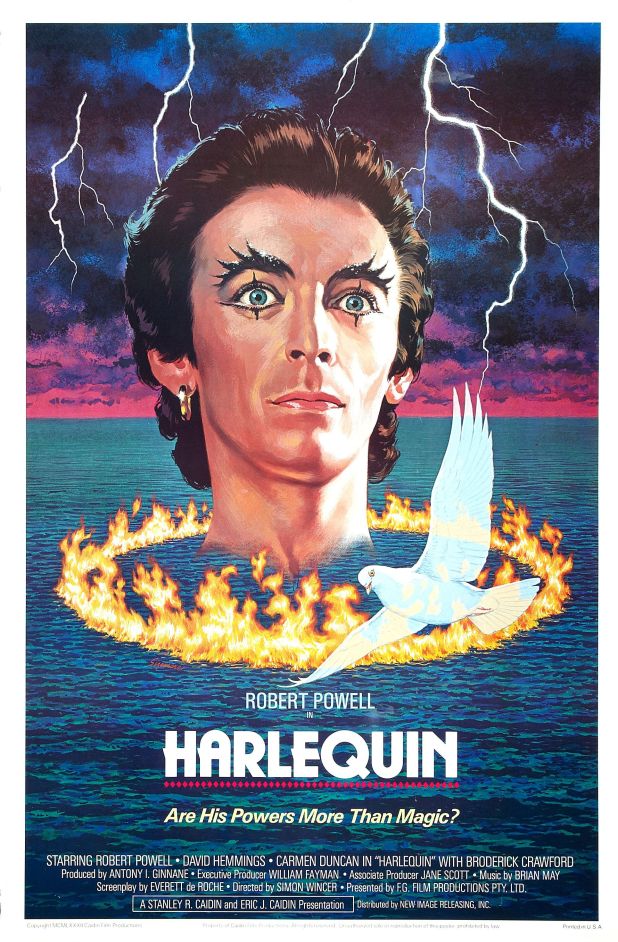
Harlequin (1980)

The great part of this site is that I’ve discovered so many movies that I’d never experience otherwise. Like this one, that I found searching through Ronin Flix. I had absolutely no idea what to expect and I was rewarded with a well made, yet incredibly strange film.

Senator Nick Rast (David Hemmings, Blowup, Barbarella, Deep Red) has a son, Alex, with leukemia and a loveless marriage to his wife, Sandy (Carmen Duncan, Turkey Shoot). In fact, a doctor goes as far to tell them that they should just let their son die as the film begins.

At a birthday party, Alex meets a clown who makes him smile. That clown ends up being Gregory Wolfe (Robert Powell, AsylumThe Asphyx), a faith healer in the mold of Rasputin (hint: the name Rast is tsar backward). The more time he spends with Alex, the better the child feels. Sandy also falls in love with Wolfe, despite the fact that he does some insane feats, like holding Alex over a cliff to make him come to grips with death.

Meanwhile, the senator is controlled by Doc Wheelan (Broderick Crawford, All the King’s Men and you know the rules when it comes to Old Hollywood actors) and he warns him that Wolfe isn’t what he seems and could be a danger to his family.

Also called Dark ForcesHarlequin was to originally star David Bowie as Wolfe and Orson Welles as Doc Wheelan. Director Simon Wincer has quite the strange directorial history, with films like Free WillyThe Phantom (the Smash Evil! version), plenty of episodes of The Young Indiana Jones ChroniclesCrocodile Dundee in Los Angeles and NASCAR: The IMAX Experience.

If you know the story of Rasputin, this film follows it, with Wheelan’s men killing Wolfe over and over again, but the results of meeting the Harlequin make Rast reconsider his life as his son takes over the mantle that Wolfe leaves behind.

This is seriously one odd movie, but Powell’s performance (and frequent costume changes) make it something truly special. It feels like more viewings will unearth more hidden meanings, but upon watching it once, I’m hooked.

Again — as seems to be a theme this week — this film should have a bigger cult than it does. Then again, the Alamo Drafthouse programming team shared it as one of their 2017 discoveries, so perhaps more folks will start sharing their love of this film. Has anyone reading this seen it?

UPDATE: You can watch this on Shudder.