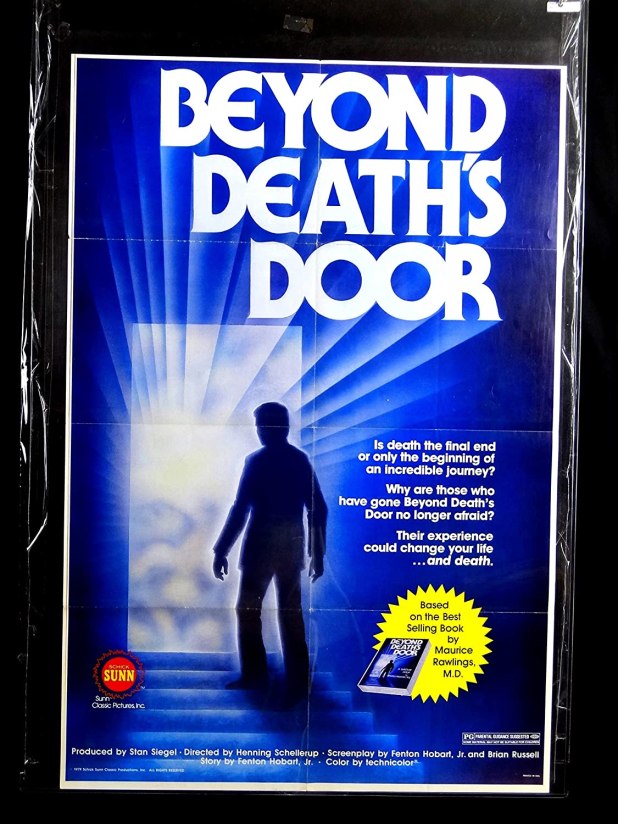
The follow-up to Beyond and Back, Beyond Death’s Door has our friends at Sunn Classics — or Sunn or Schick Sunn or whatever you choose to call them — taking the book by Maurice Rawlings, the parts about reincarnation and Duncan MacDougall’s 21 grams experiment from that movie and then going their own way with a narrative tale about death and redemption.
As written by Fenton Hobart Jr. and directed by perennial Sunn director Henning Scellerup, the man who is also known as adult director Hans Christian, this is a moralizing portmanteau about exactly what happens when death takes people. For some, like the stabbing victim that starts the story, they wake up, tell you what heaven looks like and dies again. And for others, like the pimp (Taurean Blacque from Hill Street Blues) it means becoming a ghost and floating over the operator table to yell, “I’m up here lookin’ down at all you cats!” There’s a skiier, a construction worker — whose ghost makes it to a disco — and one wonders if the rest of the Village People could have been in this as well.
It’s pretty amazing to watch these movies, knowing that the Utah-based Sunn was way ahead of their time. The shows that litter basic cable now all owe them so much.
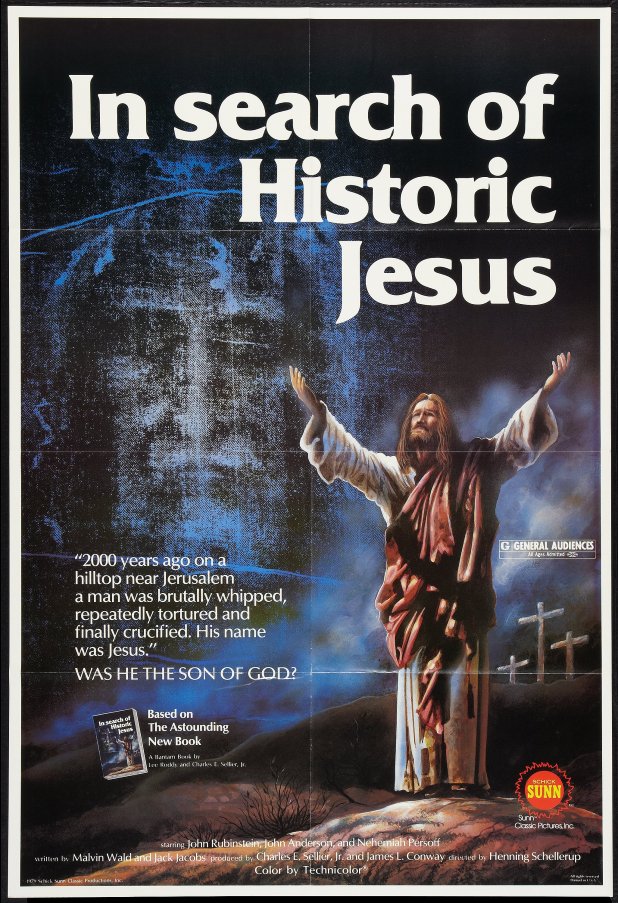
This late-in-the-game documentary for the studio — In Search of Historical Jesus and The President Must Die are the only two after this — is directed by Charles E. Sellier Jr., who produced a whole bunch of religious-themed films over his career and oh yeah directed Silent Night Deadly Night.
While the relaxing voice of Brad Crandall is presiding over this, as he does nearly all Sunn’s films, this isn’t your typical one of their films that picks a topic and then throws crackpot theories at you until you’re dizzy. No, this is a mixtape of disasters, including the crash of the Hindenburg, earthquakes, an auto race crash at LeMans in which 82 fans get killed, a hurricane, Mt. Etna erupting. a tornado, a dam collapse, the sinking of the Andrea Doria, explosions in Galveston and the Joelma building fire in Brazil, which totally goes Faces of Death and shows people leaping to their doom and uncovered bodies that have burned.
That said, the majority of this film is given to descriptions of how these issues could have been stopped. But come on, Sunn, or Sunn Classics, or Schick Sunn Classics or whatever you want to be called. We come here for theories about aliens and reincarnation. Don’t give us disasters!
Sunn Classic Pictures — also known as Sunn International Pictures, Schick Sunn Classic Pictures, and Taft International Pictures — was a Utah-based indepedent distributor of films. Its founder, Rayland Jensen began his new company under the auspices of the Schick Razor Company.
The Sunn website* is astounding. While it’s no longer active — you can check it out at the Internet Archive — it claims that Jensen developed “four walling” movies** by buying theater space, covering it with ads (all four walls, get it?) and then selling their own tickets. I’m sure Kroger Babb and all forty of his thieves would have something to say about that.
Unlike the grindhouse hucksters who sold skin, sin and violence, Sunn realized that there was exploitation money to be made from working-class families “who rarely went to the movies more than twice a year.” Sunn did their research, connecting with these families and making G rated films that they could enjoy. Or be educated by. Or at least buy tickets to.
Sunn’s films are either family fare like their series The Life and Times of Grizzly Adams, paranormal and historical explorations that predate what’s on cable today like The Mysterious Monsters, The Outer Space Connection and The Lincoln Conspiracy or films that try to show the scientific reasons for God existing (this movie, Beyond and Back and In Search of Noah’s Ark).
Director Henning Schellerup has the kind of bio that we celebrate around here, because as Hans Christian he made Night Pleasures, Tomboy (not the Crown International one), Loose Times at Ridley High, Dr. Carstair’s 1869 Love-Root Elixir and Three Shades of Flesh, all while also making Sweet Jesus, Preacherman, the Sunn TV versions of The Time Machine and The Legend of Sleepy Hollow, and worked camera or was the cinematographer on everything from Suburban Commando, Death Race 2000, Halloween 4: The Return of Michael Myers and A Nightmare On Elm Street to Berserker, Silent Night Deadly Night, The Annihilators and Kiss of the Tarantula.
So yeah. The perfect guy*** to tell the story of the Son of God.
John Rubinstein, who would go on to play Daniel Webster on Netflix’s Sabrina and Einstein of DC’s Legends of Tomorrow, plays Jesus. Another prophet — just called Prophet 1 in the credits — is Royal Dano! And there are also appearances by John Anderson (who Lincoln in Sunn’s The Lincoln Conspiracy), Annette Charles (Cha Cha from Grease), Anthony De Longis (Blade from Masters of the Universe) and actress turned conservative pundit Morgan Brittany.
Unlike the Bible, Jesus has the power to calm down tigers.
Somehow, this movie is also The Search for the Shroud of Turin at the same time, as if the folks at Sunn thought, “Is there enough story in this Jesus to last for 90 minutes?”
If there is a God and if there is a Jesus and if there is a Heaven, it’s going to be sitting here on my couch watching these Sunn docs all day and screaming at the TV.
*I mean, Reb Brown is on their board of directors.
**Sunn Classic Pictures would rent theaters for a two-week period, yet only claim they were there for a week. The initial period would clain “One Week Only” when on the seventhd ay, the one where God would have rested, Synn would say “Final Day” before changing out the marquee to read “Held Over” on Monday.
***Also, Charles E. Sellier Jr., whose IMDB bio brags that he was “founder and president of Grizzly Adams Productions, Inc., was an acclaimed producer, writer and director in the independent film industry. Sellier skillfully pioneered market testing and “four-walling”–renting a theater to show his films, thereby enabling him to keep all the profits for himself–garnered him the distinction of having more pictures in the Top 50 independent grossers than any other independent producer in the 1970s” and that Orson Welles once told him, “Young man, you are light-years ahead of the rest of the industry,” was one of the writers. Yes, the same man who directed Silent Night Deadly Nightwas one of the writers who wrote this. Not to be outdone, but one of the other scribes was Malvin Wald, who wrote Jess Franco’s Venus In Furs. You know what Jesus said to the Pharisees when they saw him associating with sinners. “It is not the healthy who need a doctor, but the sick. I have not come to call the righteous, but sinners.”
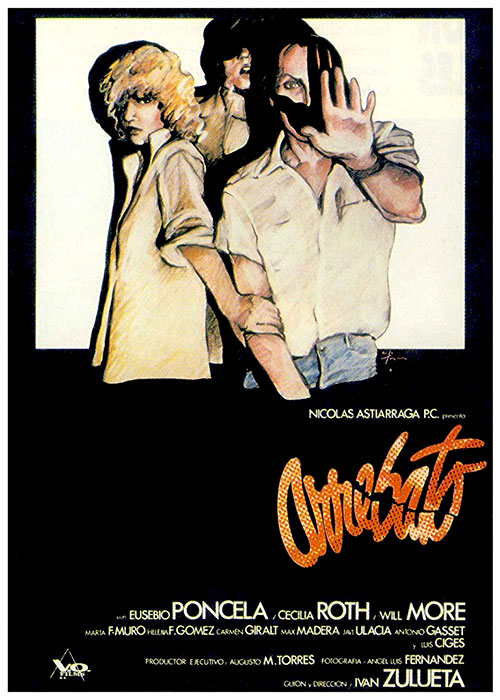
José Sirgado (Eusebio Poncela, The Cannibal Man) is a frustrated horror film director who is addicted to heroin and his relationship with Ana (Cecilia Roth, who was in several Almodóvar movies). The cousin of an ex-girlfriend — someone he only met twice — sends him a package that contains a cassette, a reel of film and the key to his apartment. Those moments were integral to the man’s life, as the first time they met, José discussed film with him, watched his home movies and then sent him an interval timer so that he could explore time-lapse photography.
The second time, José had brought Ana and somehow, Pedro had a doll that belonged to her in childhood. As they listen to the tape that he’s given them, he describes how his camera started turning itself on by itself and filming him while he slept. As time goes on, red frames show up and he is not in those images. He has started to disappear overnight, but if he does not film himself, he starts to go into withdrawal. Even more interesting, those red moments of film leave him in a state of rapture.
He asked his cousin Marta — José’s ex-girlfriend — to watch him while he sleeps to see what the red moments mean. She disappears as the film turns to red.
A film about addiction made by a man who was using heroin throughout, Arrebato (Rapture) is an astounding piece of filmmaking that is rarely discussed in the U.S. Director Iván Zulueta is mainly known for his poster designs for the films of Pedro Almodóvar*, but spent most of the 80’s hidden away, dealing with his addiction, before directing some television work that feels very much like David Lynch in the best of ways.
A Spanish architect had funded this film, but the film was difficult to film and release, as it was too strange for audiences at the time. Actually, it may be too weird for them now, a meditation on the nature of being obsessed with image and working toward perfection as being the same thing as a needle in your veins.
Pedro’s footage within the movie is indicative of the style of movies that Zulueta was best known for, combining filmed images of scenery with music — think Koyaanisqatsi — filled with vast hidden meaning. As Pedro says, they are filled with “occult rhythms.”
By the end of the film, José has been invited to experience the same red addiction and gladly complies. I understand — finding the perfect movie, chasing the high of a new discovery and then worrying that there won’t be anything that magical or weird again — that’s the smack that I can’t stop injecting into my eyes and brain.
*He also dubbed one of the female voices in this movie.
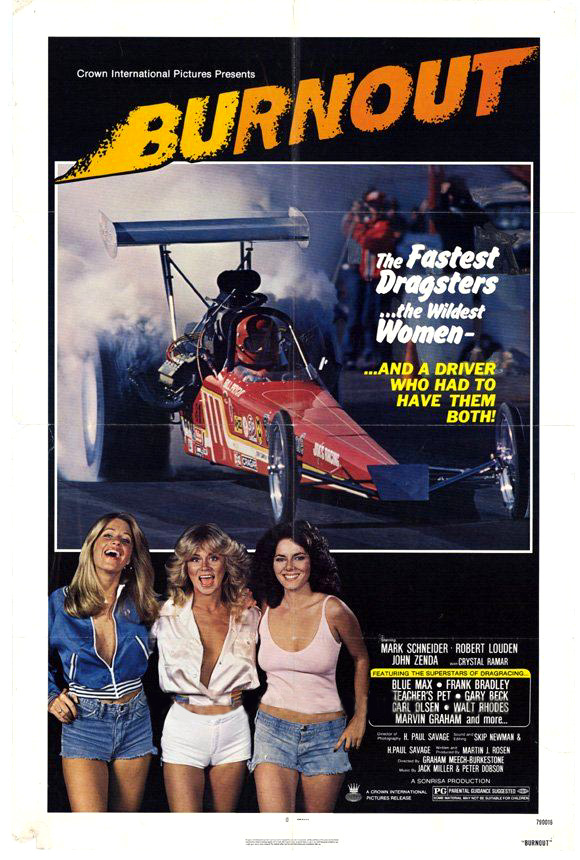
Editor’s Note: This review originally ran on August 2, 2020, as part of our reviews for Mill Creek’s Savage Cinema 12-Movie collection. We’re bringing it back as part of Mill Creek’s B-Movie Blast 50-Film pack. Faux-Charlie’s Angels that look like they’re out of a The Dukes of Hazzard crossover episode . . . and rails? We ain’t hatin’! Program it, Mill Creek!
The Mill Creek Savage Cinema box set has twelve movies, some with great looking pictures, others that have been battered beyond belief. If you’re not a snob, you’ll find something enjoyable on this. I know I did! I started with this film, one of the few drag racing movies that I’ve ever watched.
If you know anything about drag racing — and I sure don’t — this movie is filled with the stars of the 70’s. That’d be Don Garlits, Marvin Graham, Gary Beck, Don Prudhomme, Raymond Beadle, Tony Nancy and Shirley “Cha Cha” Muldowny, the only name I know because the movie Heart Like a Wheel is all about her. Shirley is great because she’s super outspoken, claiming that Jamie Lee Curtis should have played her instead of Bonnie Bedelia, who she called a “snot.”
I actually looked up other drag racing films — just to see if there were any other than these two examples. There are! They would be Funny Car Summer, Seven-Second Love Affair, Drag Racer, Wheels of Fire, Fast Company (directed by David Cronenberg!), Right On Track, More American Graffiti and Snake and Mongoose. If you’re now thinking, “I bet B&S About Movies is going to do a theme drag racing week,” you know us oh so well. We did, sort of: check out our “Drive-In Friday: Drag Racing ’70s Doc Night.”
Scott (Mark Schneider, Supervan) wants to be a drag racer. His dad doesn’t want him to be one. Soon, they learn that they can bond by being part of the sport. Scott is also incredibly hard to like. And there’s the movie.
Director Graham Meech-Burkestone only made this one movie. But man, he was all over the place in Hollywood, doing Oliver Reed’s hair for Burnt Offeringsand makeup for Day of the Animals, The Manitou and The Exterminator.
“This picture is dedicated to the men and women in drag racing — they are all winners,” says the credits. Nope. This movie is dedicated to my Letterboxd Crown International list. Someday, somehow, I’m going to get 100% that thing.
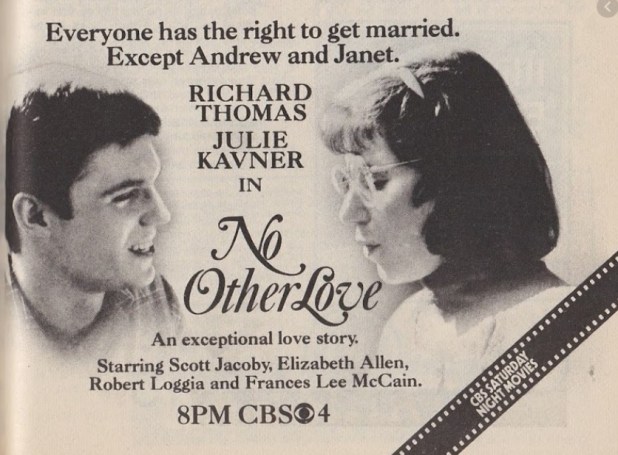
Before The Other Sister, there was this movie, which has Richard Thomas (John-Boy from The Waltons* to some, Shad in Battle Beyond the Stars to me) and Julie Kavner (Marge Simpson!) as mentally challenged adults who want to get married, despite the protests of her parents, who are played by Elizabeth Allen (who often played in game shows as a couple with Charles Nelson Reilly) and Robert Loggia.
To confirm that yes, this is a TV movie, there is an appearance by Scott Jacoby. Billy Drago also shows up, which pleases me to no end.
Director Richard Pierce would go on to direct Steve Martin in Leap of Faith and, perhaps infamously, Richard Gere and Kim Basinger in No Mercy.
This is a film from another era, a time when people with mental handicaps were kept hidden and lived sheltered existences that supposed that they were barely human beings. Thankfully, times have changed.
*Fans of The Waltons will be interested to know that both versions of John-Boy are in this. Thomas played the role from 1972-1977, while Robert Wightman — who took over the role of the titular slasher in Stepfather 3 — assumed the part from 1979 to 1981.
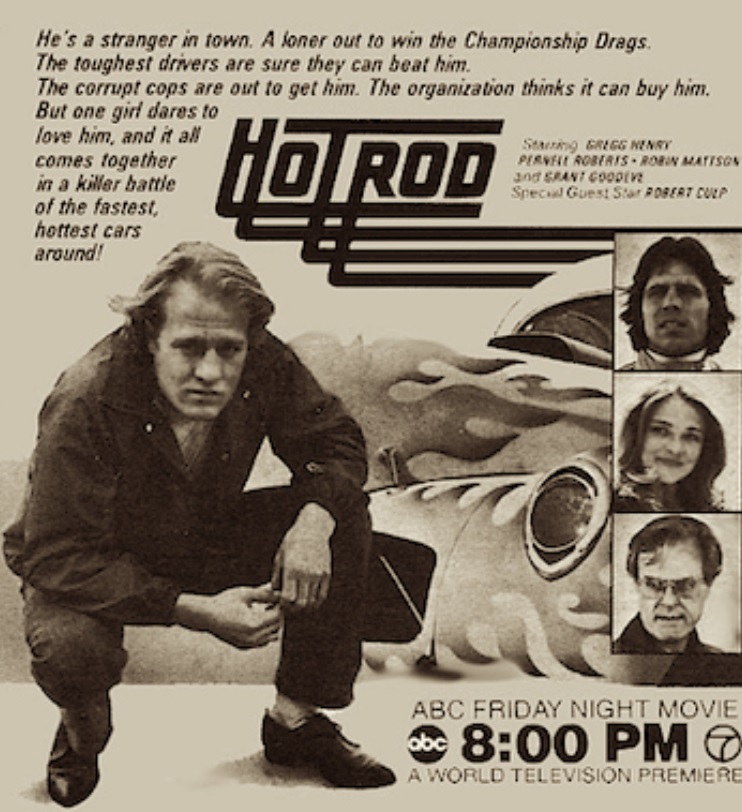
Burt Reynolds created a cottage industry with Smokey and the Bandit . . . and with the “Big Three” television networks still in the movie business, they wanted a slice (or is that a wad of tobacco spit?) of that good ol’ boy pie.
So we get the always-welcomed Greg Henry (The Patriot), Robert Culp (of the Fast and Furious precursor — and also awesome TV movie — The Gladitor), Grant Goodeve (who replaced Mark Hamill in TV’s Eight is Enough when Hamill got Star Wars), Robin Mattson (TV movie Return to Macon County and the long-running daytime drama General Hospital), and Pernell Roberts (TV’s Bonanza and Trapper John, M.D.).
For once, the theatrical one-sheet, well, the “splashy” TV Guide ad says it all. For he came to town on a horse (hot rod) with no name — and you ain’t gonna win against “The Bandit,” there Sheriff Buford T.
And it’s all brought to you by the Roger Corman-raised George Armitage (ah, no wonder this is so goooood), who gave us Gas-s-s-s, Private Duty Nurses, Night Call Nurses, and Darktown Strutters . . . and the we-still-haven’t reviewed Kris Kristofferson and Jan-Michael Vincent epic, Vigilante Force. Oh, and as part of our upcoming “John Doe Week” (no, not flicks about unidentified dead bodies, wise ass — it’s a tribute to the acting career of the leader of the Los Angeles punk band, X), we review Pure County, a film which he co-wrote.
Oh, man . . . forget Farrah. It was Robin Mattson torn out of a magazine and scotch-taped to my teen bedroom wall, alongside those Roger De Coster and Don “The Snake” Prudhomme mag spreads. And don’t forget the Runaways ripped out of a CREEM mag. Good times. Sigh, Robin . . . competing with Sandy West for my heart.
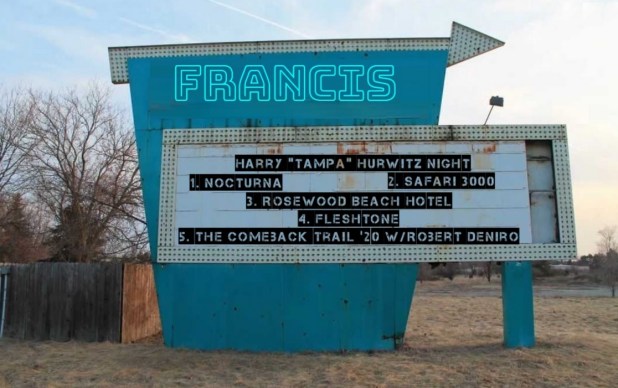
A toast! Let’s raise those waxed cups n’ strawed A&W Root Beers to Harry “Tampa” Hurwitz and his return to the big screen with Robert De Niro starring in the remake of Harry’s 1982 feature, The Comeback Trail.
Prior to his tenure as a screenwriter, director and producer, the New York born and raised Hurwitz worked as a professor of film and drawing at several New York institutions, including a prestigious tenure at New York University.
That’s what I get for hiring a high school kid to do the sign. Eh, you get what you $5.00-buck-an-hour pay for, right? Know your “rose” suffixes, kid.
He made his debut as a filmmaker with 1970’s critically-acclaimed The Projectionist — a film noted as the acting debut for a then unknown comedian named Rodney Dangerfield — in a tale about a lonely projectionist (Chuck McCann) who imagines himself in the films he shows. Hurwitz also translated his life-long love of Charlie Chaplin in the 1972 sophomore effort, The Eternal Tramp.
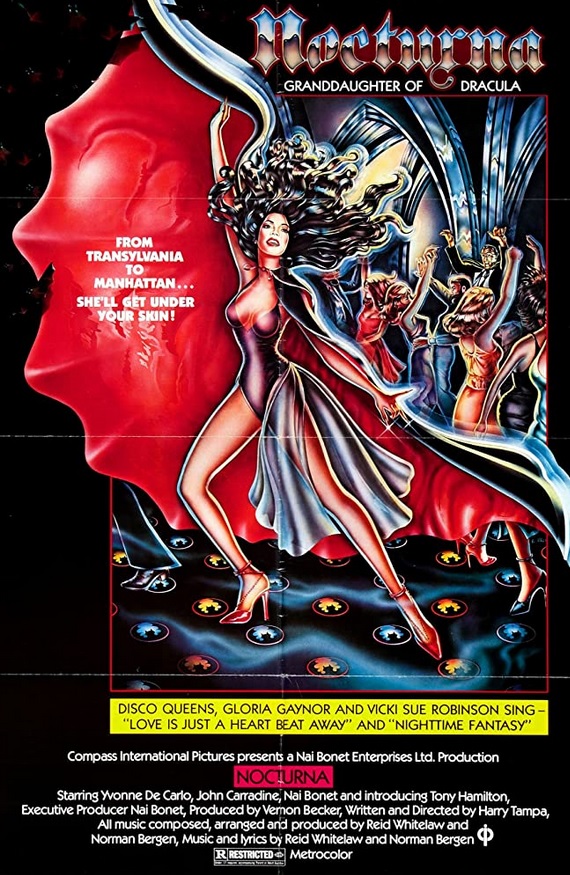
While his films would see distribution with major studios, such as MGM/United Artists (Safari 3000), and major-independents, such as Almi Pictures, a division of Carolco (The Rosebud Beach Hotel), and Compass International (Nocturna), Hurwitz produced and directed 12 pictures, 9 of which he wrote, independently.
His resume features two films produced with a pre-Empire Studios Charles Band: the late ’70s sexploitation pieces Fairy Tales and Auditions. Hurwitz also wrote and directed 1972’s Richard, a social parody on President Richard M. Nixon. He re-teamed with his lifelong friend Chuck McCann in 1982’s The Comeback Trail, a somewhat semi-autobiographical tale about two independent film executives against-the-odds in producing a western with a washed-up cowboy star.
“Rose” BLANK And the $50 response is . . . “Is a Rose” The$150 response is . . . “Wood” And the $500 response . . . “Bud”
What the hell? Napoleon Solo? Well, it was either Match Game . . . or do a film with Harry. Oh, shite . . . say it ain’t so, Solo! The “comeback trail” isn’t paved with Harry Hurwitz films, Mr. Vaughn. Just ask Christopher Lee. . . .
Repeating the semi-documentary cinéma vérité style of 1978’s Auditions, Hurwitz also concocted 1989’s That’s Adequate; a Spinal Tapish tale about a troubled film studio that features an eclectic cast of comedians with Sinbad, Richard Lewis, and Rick Overton alongside a starbound Bruce Willis, Maureen “Marsha Brady” McCormick as a Space Princess, Robert Vaughn as Adolf Hitler (which is “funny” to fringe movie fans, when we remember Vaughn starred in 1978’s The Lucifer Complex), Susan “Laurie Partridge” Dey as a Southern Belle, and Robert Downey, Jr. as Albert Einstein. (Seriously: the film is that crazy.)
Harry’s most significant screen credit was working as one of the five screenwriters on a tale about the 1939 production of The Wizard of Oz, the 1981 Chevy Chase-starring Under the Rainbow for Warner Bros.-Orion Pictures. And we can’t forget Harry dipping his toes in the Blaxploitation pool as a producer with 1983’s The Big Score starring Richard Roundtree and the late John Saxon*.
Harry “Tampa” Hurwitz passed away on September 21, 1995, at the young age of 57 from heart failure while awaiting a heart transplant at the U.C.L.A Medical Center. This Drive-In Friday is for you, Harry. May your films live on for a new generation of video fringe enthusiasts. And they do!
In the ultimate show of respect to Harry’s imagination, on November 13, 2020**, the remake of The Comeback Trail, starring the Oscar acting elite of Robert De Niro, Morgan Freeman, and Tommy Lee Jones, was realized by writer-director George Gallo of Bad Boys fame.
Way to go, Harry!
Now, Mr. Gallo . . . about that Safari 3000 remake. . . .
What do you get when you go into business with a noted Las Vegas belly dancer who appeared on TV’s The Beverly Hillbillies . . . then cast Lily Munster, a B-Movie Dracula, and a couple of on-their-way-down ’70s disco stars — and negotiate a deal with MCA Records to release a disco-flavored soundtrack double album to promote the movie?
You get a Harry Tampa box-office boondoggle with John Carradine making back dick jokes. Can Countess Dracula turn her gay singer crush, straight? Do we care?
And to think the Compass International — a studio that had a worldwide hit on their hands with their debut release, John Carpenter’s Halloween — backed this vampire hookers romp. But they also made Roller Boogie, Tourist Trap, Blood Beach, and Hell Night . . . so you know where this disco Dracula romp is heading. Flushing is required.
What do you get when you go into business with United Artists and convince them a Smokey and the Bandit ripoff set on the African tundra will work?
You get a Harry Tampa box-office boondoggle with Christopher Lee frolicking with baboons and the guy who voiced the CP3O knockoff in Luigi Cozzi’s Starcrash. Does the fact that David Carradine is behind the wheel giving us some serious Death Race 2000 and Cannonball vibes save this VHSflotsam? No. And we wished ol’ Dave got off a couple of his dad’s bad dick jokes from Nocturna to compensate for the fact that Stockard Channing’s comedic timing makes the monkeys look good.
Intermission! With the stars of our next feature on tonight’s program! Let the tight pants and smoke wash over you!
What do you get when you contractually flim-flam cinema’s requisite Count, an ex-Runaway, a B-Movie apoc anti-hero, a washed up Tom Hanks TV sidekick, and wardrobe left overs from Glen Larson’s crap-ass Buck Rogers remake for TV?
You get a Harry Tampa ripoff of Bob Clark’s Porky‘s set in a South Beach Miami hotel. Do the adult film actresses working as topless bell hops for Madam Bobbi Flekman from Spinal Tap’s management team seducing Paco Querak from Hands of Steel save it? Do the cut-rate AOR-synth soundtrack ditties from Cherie Currie save it? No. And we wished Christopher Lee stuck to his original plan of torching the joint for the insurance money.
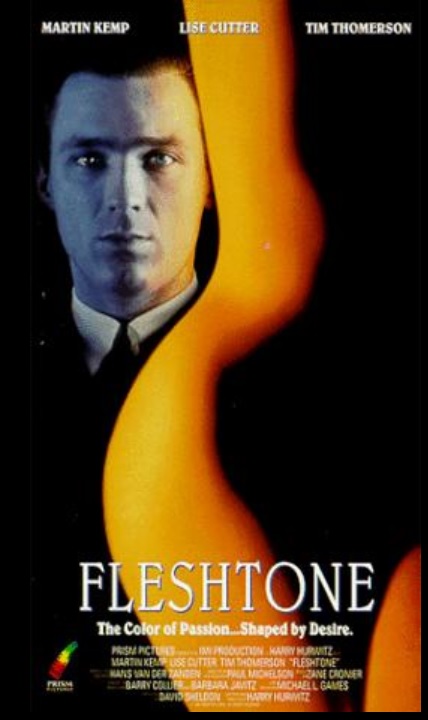
Movie 4: Fleshtone(1994)
What do you get when Harry Tampa answers paid cable’s call for “after hours” erotic thriller programming fodder for the wee-lads who can’t get dates on Saturday nights?
You get the bassist from the bane of our New Wave existence — Spandau Ballet — as a struggling painter twisting down a soft-core film noir spiral in this final, bitter sweet Harry “Tampa” Hurwitz’s effort completed a year before his death.
Truth be told, Martin Kemp, who been in the acting game in the U.K. since the ’70s before finding fame as a MTV favorite, is pretty decent here (he was in Sugar Town with John Doe and Michael Des Barres) as the noir schlub who can’t stay away from dangerous women who enjoy erotic sex games. And it’s nice to see Tim Thomerson (yep, the one and only Jack Deth from Trancers) on top of the marquee in this who-killed-her potboiler.
Do the adult film actresses that Harry likes to cast for that extra titillation-inspiration and lesbian sex scenes helping? Does the fact that the singularly-named Daniella also starred in Anal Maidens 3 and Assy 2 exciting you? How about those exotic Jo-Berg, South Africa locations?
Eh, a little . . . but in reality, this is probably the best of Harry’s films, courtesy of Kemp and Thomerson giving the material some class, and ’80s U.S. TV actress Lise Cutter isn’t so bad, but she’s not leaving the direct-to-video realms any time soon.
Yes! You Tube comes through in the clutch! You can enjoy Harry’s final film on You Tube. You can watch the other films on tonight’s program via the links in those reviews.
* We honored the career of the late John Saxon with our “Exploring: John Saxon” featurette.
**The Comeback Trail premiered at the 43rd Mill Valley Film Festival on October 12, 2020. It was initially scheduled to be theatrically released in the United States on November 13, 2020. However, due to the affects of COVID on theaters, Cloudburst Entertainment has pushed the release date to sometime in 2021.
About the Author: You can learn more about the writings of R.D Francis on Facebook.He also writes for B&S About Moviesand publishes on Medium.
From Terminal City Ricochet with Jello Biafra to Beverly Hills, 90210 with Luke Perry? From the science fiction/horror musical Big Meat Eater featuring the soft-shoe of “Baghdad Boogie” to the historical drama Samuel Lount? Drag racing through the eyes of David Cronenberg? Children’s programming?
Welcome to the eclectic career of Phil Savath.
Phil Savath, born December 28, 1946, was an American-born Canadian film and television writer and producer. He was most noted as a two-time Genie Award nominee for Best Screenplay, with nominations for Original Screenplay at the 4th Genie Awards in 1983 for Big Meat Eater and Adapted Screenplay at the 10th Genie Awards in 1989 for The Outside Chance of Maximilian Glick. (The Genies are the Academy of Canadian Cinema and Television’s equivalent of the Oscars.)
Savath started his career in television in the late ‘70s as the co-creator and star of the CBC Television children’s comedy series Homemade TV and Range Ryder and the Calgary Kid, and then made his theatrical debut with David Cronenberg’s Fast Company.
Fans of FOX-TV’s Beverly Hills, 90210 know him for the dozen episodes he wrote for that post-Brat Back series, as well as the oft-aired HBO favorite, The Outside Chance of Maximilian Glick, which was turned into a short-lived TV series, Max Glick. He also wrote the Canadian hockey drama Net Worth (1995) and developed the Canadian TV series African Skies (1992) about a bi-racial teen friendship in post-Apartheid South Africa. As a producer, before his death in 2004, he produced the late ‘90s series These Arms of Mine, along with the TV Movies White Lies, Little Criminals, and Liar, Liar: Between Father and Daughter.
The influence of this Phil Savath-penned script on the career of David Cronenberg can’t be denied.
The first of Cronenberg’s feature films for which Cronenberg did not originate the screenplay, he was hired by the producers to direct. It was on Fast Company that Cronenberg developed long-time working relationships with cinematographer Mark Irwin, art director Carol Spier, sound editor Bryan Day, and film editor Ronald Sanders — each worked on Cronenberg’s later films. Actor Nicholas Campbell, who plays William Smith’s young protégé, also went on to appear in Cronenberg’s The Brood, The Dead Zone, and Naked Lunch. Sadly, Fast Company also serves as final release for Claudia Jennings (‘Gator Bait), who died in a car wreck several months after this drag racing drama’s release.
Take one part Ed Wood’s Plan Nine from Outer Space, one part Paul Bartel’s Eating Raoul, and one part Richard O’Brien’s The Rocky Horror Picture Show and vigorously shake in your “intentionally bad cult films” tumbler, and serve: We’ve got a mad butcher, a murdered mayor, and aliens who reanimate the mayor to assist in the harvesting of a rare, radioactive fuel deposit beneath the butcher shop. Oh, and there’s song and dance numbers (which you can enjoy during our intermission).
And those Great White Northeners “got it,” since Phil Savath and his co-writers Laurence Keane and Chris Windsor received Canada’s Oscar equivalent — a Genie Awards’ nod — for Best Original Screenplay in 1983. While Windsor never made another film, Keane and Savath continued onward and upward . . . and what could Phil possibly write as a follow-up feature? It’s not what you’d think.
Intermission! Courtesy of the Phil Savath-penned “Baghdad Boogie.”
Back to the show!
Movie 3: Samuel Lount (1985)
The man who gave us Big Meat Eater . . . wrote this? He did.
A historical drama set during the Upper Canada Rebellion of 1837, the film stars very familiar Canadian TV and film character actor R. H. Thomson (I remember him from the cable-played Escape from Iran: The Canadian Caper and The Terry Fox Story, as well as lots of American TV series) as Samuel Lount, an organizer of the rebellion who was ultimately convicted of treason and executed in 1838.
Receiving a limited theatrical run before debuting on Canadian television, it made its U.S debut on HBO and Showtime. While not winning any awards, it received five 7th Genie Awards’ nods for Best Actor, Best Cinematography, Best Costuming, Best Editing, and Best Sound Editing.
Yes, this powerful, fact-based drama is — in fact — from the pen of the man who gave us a film backed by a soundtrack performed by Alternative Tentancles bands. Yes, that’s right. Phil Savath worked with Jello Biafra. But Phil wrote “Baghdad Boogie” and incorporated “Heat Seeking Missile,” a song that would give Spinal Tap pause, into a movie — so what’s really shocking you at this point?
So, Phil did a pretty good job with the sci-fi horror parody Big Meat Eater, so he took a crack at parodying the post-apoc sci-fi craze of the ’80s with this dystopian-political intrique romp. It’s the story of a media entrepreneur who weasels his way into the mayorship of Terminal City and manipulates the populace through television, with their ensuing addictions to consumerism lining his pockets.
Oh, and the good mayor’s Chief Social Peace Enforcement Officer? Jello Biafra of the Dead Kennedys.
Yeah, it’s a must watch.
About the Author: You can learn more about the writings of R.D Francis on Facebook.He also writes for B&S About Movies.
DAY 15. HELL ON FOUR WHEELS: Must involve characters in wheelchairs.
Also known as Killers Die Hard and Gun Fighter, the title of this movie pretty much tells you the main reason to watch this movie.
It’s really about a crime boss named D’Angelo (Lloyd Bochner, The Lonely Lady), who is smuggling drugs inside cigars, because that seems like the best way to move plenty of product inside the smallest delivery mechanisms possible. One of his smugglers is a student named Ken Wilson (Luke Halpin, who was on Flipper — and stay tuned for why that’s important), who one night gets in an argument with his girlfriend Tina and ends up accidentally killing her. D’Angelo’s men make it look like an overdose, which would be enough in any other reality to get Ken away with it, but Tina’s brother is Andy (pro wrestler Ron Slinker, who helped train The Rock, gave RVD his name and was the stepfather of Dennis “Mideon” Knight), a cop on the drug enforcement squad.
The real excitement of this movie comes in when we meet Mr. No Legs himself. He’s played by Ted Vollrath, a Lancaster, PA native and U.S. Marine veteran who lost his legs after thirteen years after surviving a mortar shell explosion during the Korean War. Despite what some would see a set-back, Ted still became a karate Grand Master and acquired black belts in several disciplines of the martial arts. In 1971, he founded the Martial Arts for the Handicapable Incorporated. He pretty much makes this movie with his extended fight sequences and gimmick-laden wheelchair.
If you don’t think Mr. No Legs isn’t cool enough, how about the fact that he hangs with a guy named Lou, who is played by Rance Howard (Smokey Bites the Dust), the father of Clint and Ron?
Somehow, this movie was able to round up plenty of old movie stars — who one presumes all moved to Tampa, Florida where it was made — including former husband of Shirley Temple John Agar, Richard Jaeckel and Templeton Fox, while also finding plenty of martial artists, including Jim Kelly from Enter the Dragon and a smaller version of him named Tiny Kelly.
Speaking of Florida, this movie feels grimy and sweaty. Much like other Sunshine State scumtastic blasts of insanity like Satan’s Children, the films of Bill Grefé and My Brother Has Bad Dreams, everyone in this movie doesn’t look like anyone you’d see in a Hollywood big budget film. Even the character actors in it have moved on to leading man status just for being in this with them. There are several scenes in bars where nearly every person looks meaner and more dangerous than the next. It feels like murder, sex or murder after sex could happen at any minute.
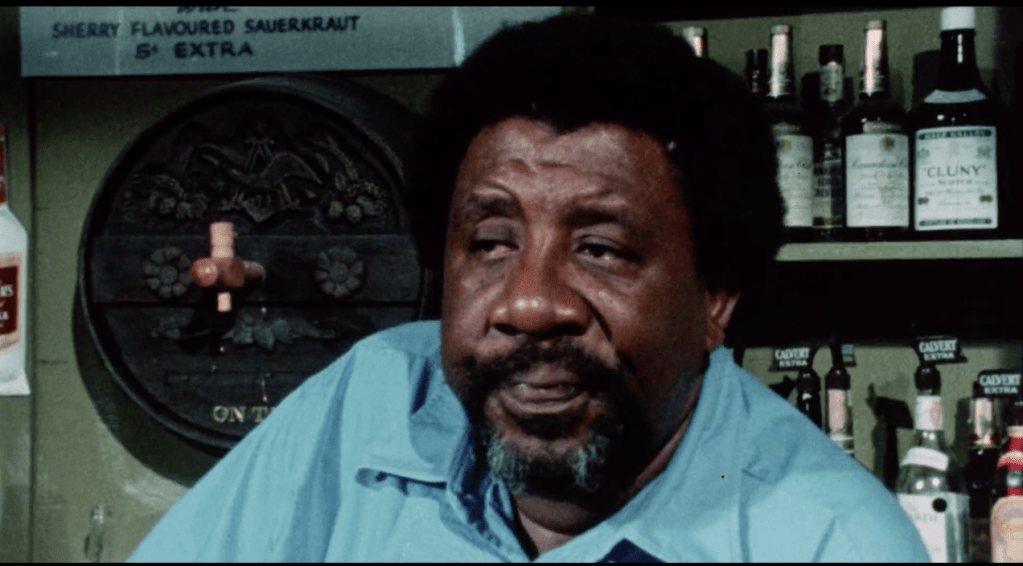
Sherry flavored sauerkraut. Really.
There are plenty of fights, like one between women who have smashed beer bottles and knives that ends up with nearly everyone in the bar dead and another where a Stingray Corvette faces off with a maniac with a sword. But the real standout is any time Mr. No Legs is on screen, whether he’s firing a throwing star out of his chair, shotgun blasting folks or diving into a pool to kill off two henchmen sent to dispatch him.
That said, there’s plenty of padding, like the band Miracle playing in a club and a ten-minute car chase that ends up smashing into a wall of ice that has a bad guy only loosely tied to the rest of the story. As I grow older, however, I admire these non-sequitur moments, as one looks at old wallpaper in a house that is otherwise completely modern.
Oh yeah — Flipper. Mr. No Legs was directed by Ricou Browning and written by Jack Cowden, who previously created that family-friendly TV series. Cowden also wrote Island Claws and ended up as the script supervisor on Band of the Hand, The New Kids and Police Academy 5: Assignment Miami Beach. And yes, that’s the very same Ricou Browning that was in the suit as The Creature from the Black Lagoon and was the second unit director on Thunderball*).
But man, the real star of all of this is greasy and flopsweat laden Florida.
You can get this from Massacre Video, whose new release has a brand new 2K restoration from an extremely rare French print.
*Browning and Cowden would also work together on Island Claws and Police Academy 5. I also never knew that Browning did second unit on Caddyshack.








 B&S About Movies
You must be logged in to post a comment.