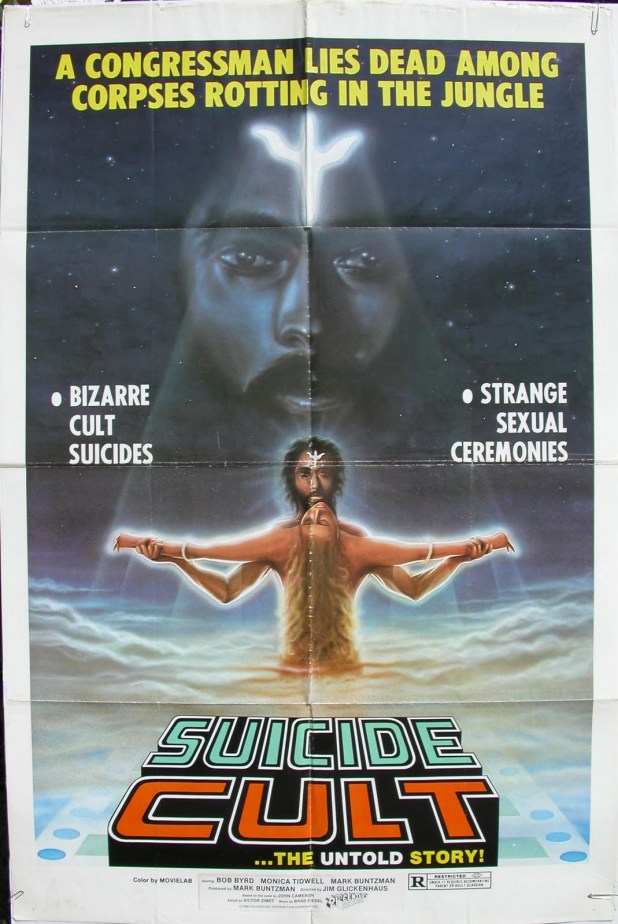
EDITOR’S NOTE: I love this movie so much. So much that I have a pull quote on the back of the Severin blu ray. 21st Century re-released this in 1980 and their poster says “a congressman lies rotting in the corpses of the jungle” which totally is to remind you of Jonestown, adding even more scum to this already somewhat odd movie. This was first on the site on August 2, 2017.
Whenever someone asks — and they often do — “What’s the craziest movie you’ve ever seen?” I usually respond with Suicide Cult. I’ve never had to pick my jaw off the floor more, as watching it felt like the little people I am certain live in my TV were putting on a magical play just for me, using the things I love best. The 1970s. Carnivals. Satanism. Biorhythms. Astrology. Government conspiracies. Religion. This is one film that honestly has it all — and then some.
Man, let me see if I can sum it up:
A government organization called INTERZOD, led by Alexei Abernal, uses technology and astrology to discover threats to the world. One of them is the cult leader Kajerste, who is wanted for crimes in three different countries. And how do they find these people? By determining their individual zodiacal potential for response to environmental situations and stimuli, that’s how.
The movie smash cuts into a ton of locations and ideas within the first ten minutes, spinning your head, before we meet Alexei’s wife, Kate (Monica Tidwell, the November 1973 Playboy Playmate of the Month who was the first Playmate to be younger than Playboy magazine itself), who sees her adviser Mother Bogarde, surely based on Madame Blavatsky. The young girl is possessed, so she must be stripped and put in a robe. Alright — we also learn that she doesn’t even know her own birthday or may have had it changed at Alexei’s command. Seems he’s a crazy husband — he has security watching her, she isn’t allowed to leave all that often, he doesn’t introduce her to anyone and he lies about what he does. They’ve been married for five months and haven’t had sex! But it turns out that she might be the new Virgin Mary, which makes perfect sense once you start watching this. Turns out she even had an Immaculate Conception at one point and gave her baby to the Catholic Church.
Now, INTERZOD wants to kill off Kajerste with tranquilizers and videotapes and doubles and the help of a Congressman — who gets killed by the cult and this movie came out three years before Jonestown, so imagine. In fact, the cult wipes everyone out and everyone else close to Kate.
But hold on…I want to warn you now. This movie is pretty much all talk about religion and the zodiac. It introduces some insane ideas that could be awesome and then does absolutely nothing about it. In fact, just when it seems like there might be some resolution to the film’s many plots, it just ends with no resolution!
Can a film be both boring and not boring all at the same time, packed with ideas but so frustrating because you wish you could see the movie that it could have been? Oh yes, that would be Suicide Cult. It’s a movie that could have only been made in 1975. I wonder, if you take enough mind-altering substances, will this film make sense? I am willing to go into a sensory deprivation tank with just this film to find out, Ken Russell directing me.
This film is also called The Astrologer, but there’s another film with the same title that could be even stranger. Made by director, producer, psychic to the stars and actor Craig Denney, it’s a movie about an astrologer who goes on an adventure to find jewels, then becomes a major star so big that he makes a movie about himself called The Astrologer that he watches within the film The Astrologer, then he goes into diamond smuggling, finance and killing people. The entire soundtrack was stolen from the Moody Blues, who get credited for the film! And it’s only been released on VHS and played once on the CBS Late Movie but it’s out there on the web and well worth hunting for.
People also ask me, what movies are you excited about this summer? I always answer, “NONE OF THEM!” Not when bursts of pure unknown crazy can still be unearthed from four decades in the past about psychic killers or astrologers who become giant stars that murder people! I beg you Hollywood! Let maniacs take over your films again!
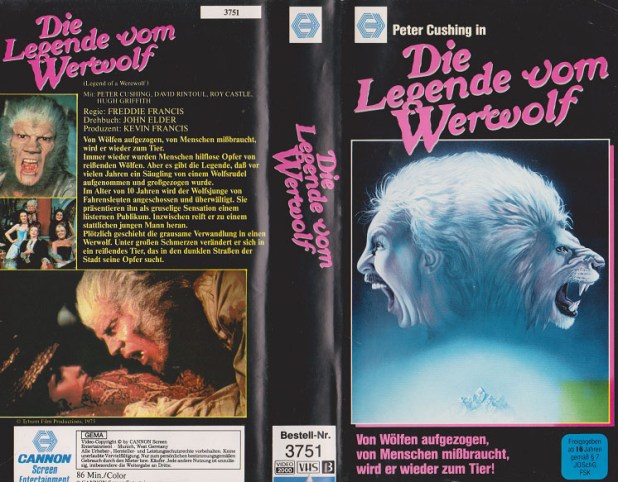
EDITOR’S NOTE: Legend of the Werewolf was not produced by Cannon. It was, however, released on video in Germany by Cannon Screen Entertainment.
No matter what you think of this movie, you have to give it up for the poster. This is truly one of my all-time favorite movie posters of all time, one that punches you in the face and says, “You’re gonna watch this werewolf movie!”
It has a different origin story than a normal werewolf film, as here Russian werewolves kill a man who has just watched his wife die in childbirth and then raise the dead parents’ son to become a human wolf.
He’s known as Etoile the Wolf Boy in the circus, but soon loses his lupine look until the full moon rises. When that does — and he kills a member of the traveling carnival — he goes on the run.
This is really the sad tale of a wolf boy — a wolf young adult, I guess — who falls in love with a courtesan with a heart of gold who keeps on entertaining her clients, who soon get devoured by said wolf young adult.
Enter Professor Paul Cataflanque (Peter Cushing). He’s a forensic pathologist, who quickly figures out that a wolf is behind all the murders. And seeing how Etoile now takes care of the wolves in the zoo, he’s going to have to deal with putting every one of them to sleep under the orders of the police.
There’s no way he isn’t going to turn into a werewolf and kill just about everyone, right?
Legend of the Werewolf is one of seven Tyburn Film Productions, a studio that tried to fill the void felt after Hammer stopped producing new movies. Their other films include The Ghoul, Tales That Witness Madness, Persecution, Sherlock Holmes and the Masks of Death, Murder Elite and Peter Cushing: A One-Way Ticket to Hollywood.
Directed by Freddie Francis, this was written by Anthony Hinds under his pseudonym John Elder. Under that name, he also wrote Hammer’s werewolf film The Curse of the Werewolf as well as Frankenstein Created Woman, Scars of Dracula, The Reptile and many more.
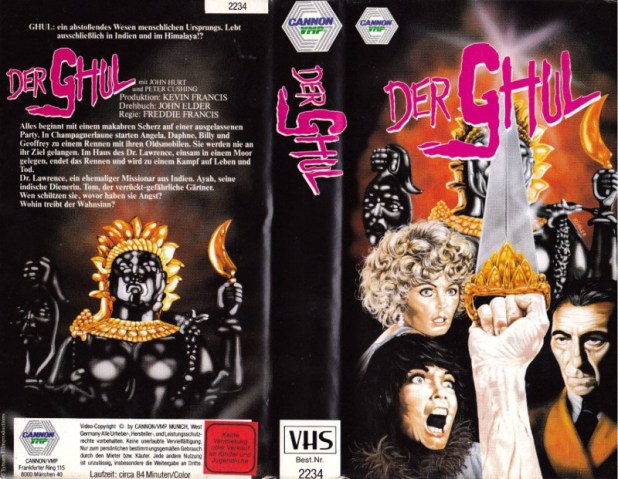
EDITOR’S NOTE: The Ghoul was not produced by Cannon. It’s a Tyburn Film Productions movie. It was, however, released on video VHS in Germany by Cannon/VMP.
Tyburn didn’t make all that many movies. In their attempt to be Hammer after that studio stopped making movies, they put out seven films: Legend of the Werewolf, Tales That Witness Madness, Persecution, Sherlock Holmes and the Masks of Death, Murder Elite, Peter Cushing: A One-Way Ticket to Hollywood and this film.
Dr. Lawrence (Peter Cushing) was once a man of faith but now he’s hiding inside a rural country estate, keeping his son away from the world, the son who learned how to be a cannibal as Lawrence did missionary work there.
While Cushing’s wife died in 1971, by all accounts he never got over it. According to co-star Veronica Carlson, director Freddie Francis made Cushing do multiple takes during the scene where he talks about his love for his late wife, an experience that caused the actor, cast and crew to be reduced to tears. This feels like a Wiliam Castle BS story, however, as Francis would have already known this, having directed Cushing as Arthur Grimsdyke in Tales from the Crypt, a movie during which Cushing suggested that he speak to a photo of his recently deceased wife Violet Helene Beck.
Writer Anthony Hinds has just as much a pedigree for British horror as Francis and Cushing, having written The Brides of Dracule, The Curse of the Werewolf, The Reptile, Frankenstein Created Woman, Scars of Dracula, Taste the Blood of Dracula and Night Creatures. He wrote this using his John Elder name.
Veronica Carlson stars as the final girl of sorts, Daphne Wells Hunter. She also came from Hammer films like Dracula Has Risen from the Grave and The Horror of Frankenstein. John Hurt shows up as a frightening handyman, Gwen Watford as Ayah the Indian servant, Alexandra Bastedo (The Blood Spattered Bride) as Daphne’s friend Angela and Ian McCulloch is on hand years before he would challenge the bloodiest cinema Italy could create.
In the U.S., this was released as Night of the Ghoul and The Thing in the Attic. If the setting seems familiar, the movie was set in the 1920s because the sets of The Great Gatsby were still standing at Pinewood Studios.
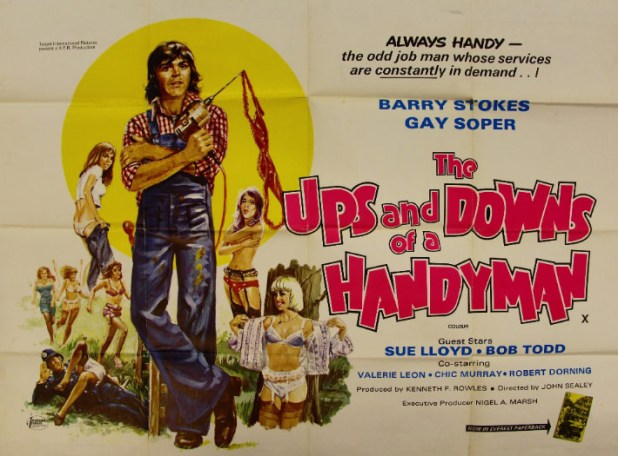
Barry Stokes is in two kinds of movies: sex comedies and out there horror. On one hand, we have Norman J. Warren’s Outer Touch and the 1983 Fanny Hill. On the other, we have Norman J. Warren’s Prey, The Corruption of Chris Miller and bit parts in Hawk the Slayer and Enemy Mine.
Also going by the titles Confessions of a Handyman, Confessions of an Odd-Job Man and The HappyHousewives, this movie has Stokes play Bob, the hot young fixer upper of the village of Sodding Chipbury. Despite being married to Maisie (Gay Soper), he finds his way into the beds of nearly every other woman in town.
If you ever watched The Benny Hill Show, you’ll recognize Bob’s antagonist in this movie, Squire Bullsworthy. He’s played by Bob Todd, who was always the butt of Hill’s jokes. Helli Louise, one of Hill’s Angels, also shows up.
Another cast member worth checking out is Valerie Leon, who was known as the “English Raquel Welch.” She was in six Carry On films as well as two Bond movies, The Spy Who Loved Me and Never Say Never Again. She was also a reincarnated Egyptian queen in Hammer’s Blood from the Mummy’s Tomb. And hey! There’s Ava Cadell, Ava from the Andy Sidaris films!
While not connected to the Confessions of series (Confessions of a Window Cleaner, Confessions of a Pop Performer, Confessions of a Driving Instructor and Confessions from a Holiday Camp) — outside of the alternate title — this feels much like those movies. This was, however, intended to become its own series with a sequel being planned titled Ups and Downs of a Soccer Star.
EDITOR’S NOTE: This is the third time this movie has been on the site, but it fits into the second Cannon month as they released it across the county. This last appeared on November 27, 2020.
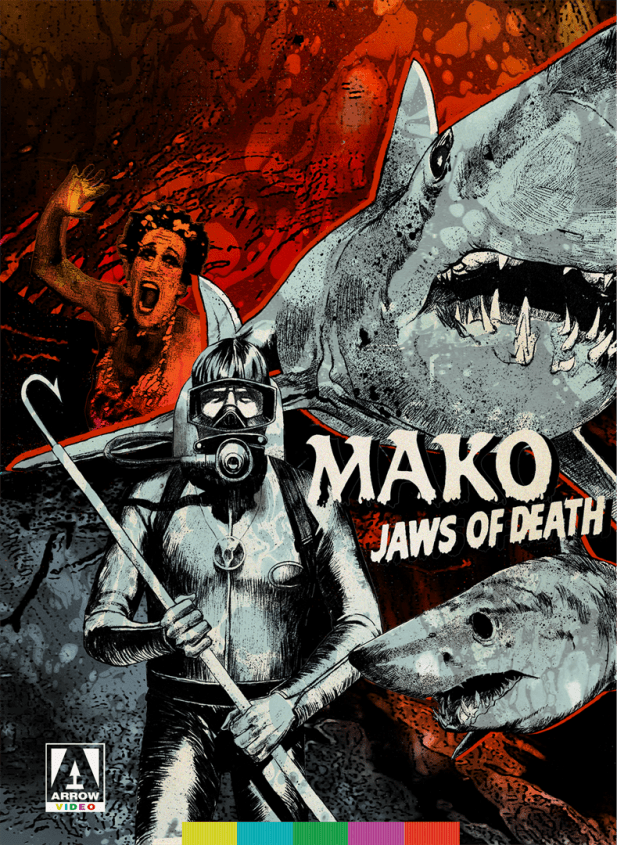
The Florida-based director William Grefe has brought many swamp-tinged bits of exploitation goodness — or badness — to the screen, such as Alligator Alley, The Wild Rebels, The Hooked Generation and so many more. As one of the first films made to take advantage of the shark craze in the way of Spielberg’s success, this film’s sympathetic view of sharks as victims is a pretty unique take on the genre.
Marine salvager Sonny Stein (Richard Jaeckel, who pretty much had a one-man war against nature with him battling bats in Chosen Survivors, bears in Grizzly and, well, any and all beasts with a chip on their shoulder in Day of the Animals) is given a medallion that allows him to communicate with sharks. He becomes increasingly disconnected from humanity — easy to do, everyone in this movie is scum — and uses his sharks to take out those who go against his beliefs.
One of those people is an incredibly chubby club owner who is using high-frequency sound to train his sharks, as well as kind of pimping out his wife Karen (Jennifer Bishop, Bigfoot) to get Sonny on their side. Have you ever seen a movie where strippers have been trained to swim with sharks? Who would want to see that? This movie provides the what, if not the why.
Another is a shady shark researcher that murders a shark and her pups. You will stare unbelieving at the screen while Jaeckel overly emotes as he clutches a dead baby shark in his mitts. Oh yeah — Harold “Oddjob” Sakata is also in this.
The stunt footage is pretty amazing and even gets a mention before the movie even begins. Other than the weird premise and a few good scenes, you can nap through most of this and not feel bad.
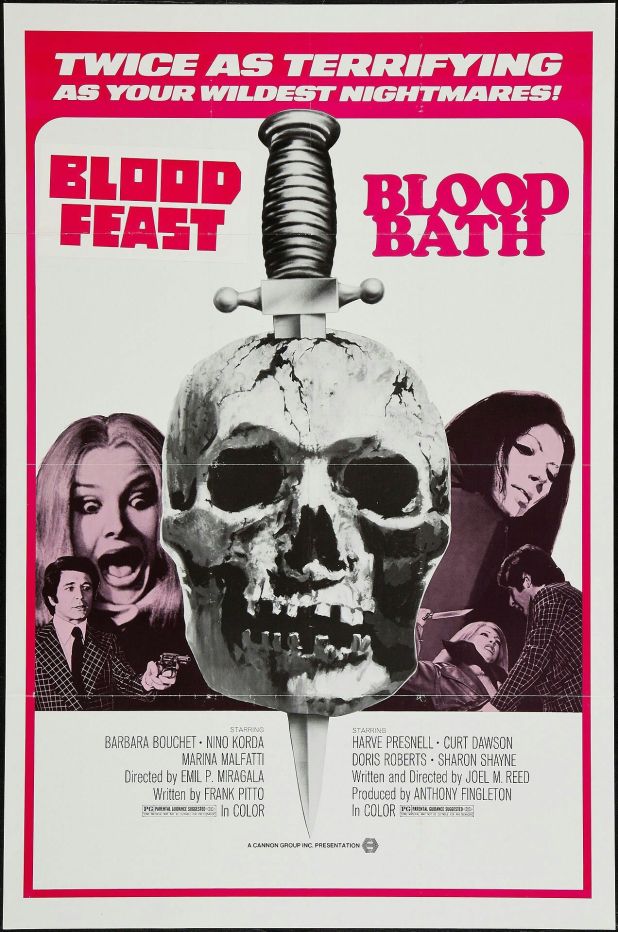
EDITOR’S NOTE: This isn’t the Herschell Gordon Lewis movie. No, instead the Dewey-Friedland Cannon released The Red Queen Kills Seven Times under this title. This originally appeared on the site on August 24, 2017.
Emilio P. Miraglia followed up The Night Evelyn Came Out of Her Grave with this giallo freakout — starring the magnificent Barbara Bouchet (Don’t Torture a Duckling) — that combines gothic horror with the high fashion we’ve come to expect from early 70’s Italian horror.
A curse haunts the Wildenbrück family once every 100 years — two sisters have always become the Red and Black Queen, feuding until one of them dies. Then, the survivor is haunted by sixth deaths, with the final death — the seventh death, referenced in the title, being the surviving sister. Kitty (Bouchet) and Evelyn are the next two sisters to be so cursed, battling even in childhood, stabbing each other’s dolls with daggers.
These catfights have continued for years, ending when Kitty, now a fashion designer, accidentally takes it too far when she battles Evelyn. Third sister Franziska (Marina Malfatti, The Night Evelyn Came Out of Her Grave, All the Colors of the Dark) and her husband hide Evelyn’s body while Kitty pretends that her sister has gone to America.
All is well and good until the Red Queen rises, wearing a red cape and white mask, killing all of Kitty’s co-workers at Springes Fashions with the same dagger that was once used to slice up baby dolls. But is it really Evelyn, back from the dead (Emilio P. Miraglia sure liked Evelyn’s that rose from the dead)? Or something much more down to earth?
Miraglia only directed six films, with this being his last one. There are some moments in here that aspire toward art, like the Red Queen chasing Kitty through her dreams, ending in a long hallway run and her superimposed form attacking like a ghost. And the film flirts between the gothic castle era of Italian horror and the fashionista giallo look — all while containing plenty of deep red gore and plenty of skin, courtesy of a 20-year-old Sybil Danning (Howling II, Battle Beyond the Stars, Young Lady Chatterley 2). It’s not always art, but sometimes, it totally is. There are the requisite twists and turns of the genre, along with some really regrettable moments — like when a character goes from rapist to rescuer across two scenes and an ending where the hero and heroine both need saving.
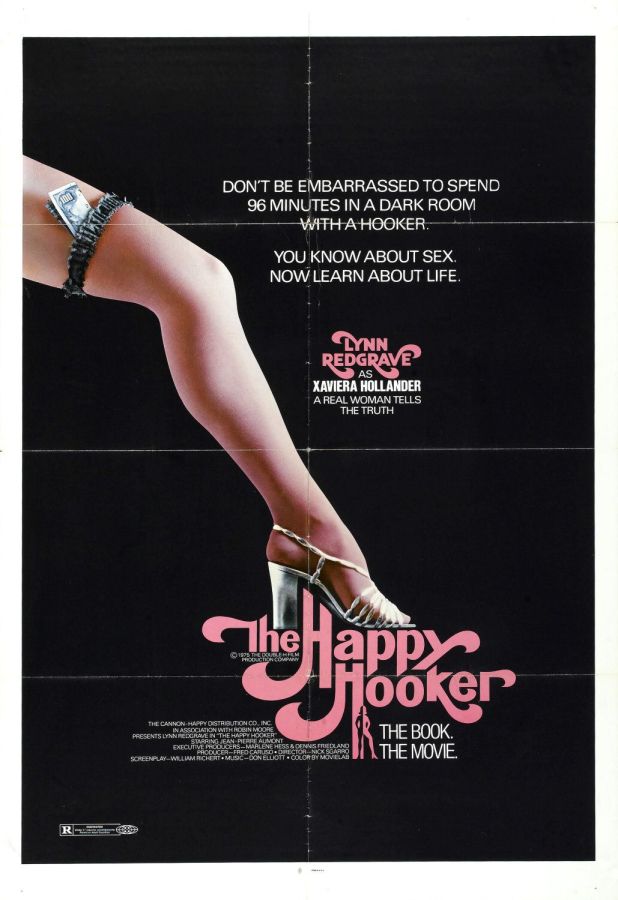
Xaviera de Vries was born in Surabaya in the Japanese-occupied Dutch East Indies to a Dutch Jewish doctor and a mother of French and German descent. She somehow went from growing up in a Japanese-run internment camp to becoming a $1,000 a night call girl ($7,800 in today’s money) in New York City, running the biggest brother in the city the Vertical Whorehouse and being deported after being arrested in 1971.
That year, Robin Moore took Hollander’s dictations, came up with the title The Happy Hooker and Yvonne Dunleavy either transcribed the book or wrote it outright. Whatever the truth is, it sold 20 million copies and led to this movie.
Lynn Redgrave plays Xaviera and we follow her from her marriage to a henpecked man named Carl (Nicholas Pryor) to being the biggest madam in town before a corrupt cop — who once trying to assault her — busts her. And that cop is played by Richard Lynch.
Directed by Nicholas Sgarro (who mainly worked in TV) and written by William Richert (who wrote and directed Winter Kills), this movie has a title that promises shock and never really gets all that sleazy. This movie got beaten to the screen by a movie that does have that, 1974’s The Life and Times of Xaviera Hollander, which has an introduction by Hollander and has Samantha McLaren, Karen Stacy and John Holmes in its cast.
This does, however, have Vincent Schiavelli as a john.
Autopsy (1975): Armando Crispino really only did two horror films, 1972’s The Dead Are Aliveand this 1975 giallo, which is a shame, as this is a pretty decent entry in the genre. Known in Italy as Macchie Solari (Sunspots), it does indeed feature sunspot footage from space before we see any major murders. And if you’re looking for a movie packed with autopsy footage, good news. It totally lives up to its title.
Simona Sana (Mimsy Farmer, who is also in Argento’s Four Flies on Grey Velvet and The Perfume of the Lady in Black) is a pathology student who is trying to work on a theory about suicides, one that’s disputed by a young priest, Father Paul, whose sister — Simona’s dad’s latest fling — has recently killed herself. It turns out there’s been a whole series of self-killings which are being blamed on, you guessed it, sunspots.
I mean, what can you say about a movie that starts with several of said suicides, like sliced wrists, a self-induced car explosion and a man machine gunning his kids before turning the gun on himself? Obviously, this is a rather grisly affair, with real corpse photos spread — quite literally — throughout the film.
In between all of the gore, corpse penises, two bodies falling to their deaths and crime museums, there’s also Ray Lovelock (The Living Dead at Manchester Morgue) as Simona’s boyfriend, an out there Morricone score and a heroine who hallucinates that the dead are coming back to life.
The plot gets pretty convoluted, but if you’re on this site, you obviously appreciate films like this and will get past it. This is an Italian 70’s murder movie, though, so if you get easily upset about the way men behave, well, be forewarned.
Murder Mansion (1972): Originally released as La Mansion de la Niebla (The Mansion in the Fog) and also known as Murder Mansion, this Spanish/Italian film fuses old school haunted house horror with the then new school form of the giallo.
The plot concerns a variety of people drawn to a house in the fog, so the original title was pretty much correct. There are plenty of European stars to enjoy, like Ida Galli, who also uses the name Evelyn Stewart and appeared in Fulci’s The Psychic as well as The Sweet Body of Deborah. And hey, there’s Analía Gadé from The Fox with the Velvet Tail. Hello, George Rigaud, from All the Colors of the Dark and The Case of the Bloody Iris! They’re all here in a movie that seems to make little or no sense and then gets even more bonkers as time goes on.
There’s a history of vampires in the house, the previous owner was a witch and hey — this is starting to feel like an adult version of Scooby Doo with better-looking ladies. That’s not a bad thing. But if you’ve never watched a badly dubbed giallo-esque film before, don’t expect any of this to make a lick of sense.
Crazy Desires of a Murderer (1977): Sure, that’s a pretty lurid title — the Italian title I vizi morbosi di una governante translates as Morbid Vices of a Housekeeper — and trust me, this lives up to it, what with an older woman using a mentally challenged man and a teenager sexually — not at the same time! — and then a game of charades which is mostly people yelling out the names of films while everyone else gropes one another.
There are more than a lot of camera zooms in here, as well as bad sartorial choices and even worse life ones. When Ileana and her bunch of hip friends — their words not mine — gather at a gothic castle owned by a wheelchair-bound older relative of one of the girls, things get pervy, weird and murder, just as you’d expect.
If you are a hip friend or have hip friends (at which point that makes you a hip friend), then you should take this warning: do not go to hang out in gothic castles. Nothing, in my movie — not life — experience says that things will go well.
Meanwhile, two of these with it pals are using Chinese treasures to smuggle heroin — as you do — while Elsa the party girl ends up with both of her eyes torn out, just like Ileana’s mother had done to her by a relative who has lost his mind and is possibly prowling the catacombs of the castle.
This would be the last film that Filippo Walter Ratti would direct. You may have seen his other movies, including Mondo Erotico, Operation White Shark and Night of the Damned. Screenwriter Ambrogio Molteni also wrote the two Black Emanuelle movies, as well as Yellow Emanuelle, Sister Emanuelle and Violence in a Women’s Prison.
All of the movies in this set have been newly scanned and restored in 2k from their 35mm original camera negative. Plus, you get extras like a theatrical introduction with director Armando Crispino and a feature on his career, as well as interviews with actresses Ida Galli and actor Giuseppe Colombo. As always, there are also trailers and image galleries. Get it from Vinegar Syndrome.
ABOUT THE AUTHOR: A.C. Nicholas, who has a sketchy background and hails from parts unknown in Western Pennsylvania, was once a drive-in theater projectionist and disk jockey, Currently, in addition to being a writer, editor, podcaster, and voice-over artist, he contributes to Drive-In Asylum. His first article, “Grindhouse Memories Across the U.S.A.,” was published in issue #23. He’s also written “I Was a Teenage Drive-in Projectionist” and “Emanuelle in Disney World and Other Weird Tales of a Trash Film Lover” for upcoming issues.
Quick. Name a movie written by the late, great Saturday Night Live and National Lampoon writer Michael O’Donoghue and the late, great Saturday Night Live writer and creator of the cult TV show Square Pegs Anne Beatts, starring John Belushi, Bill Murray, Christopher Guest, and Brian Doyle-Murray. (No, it’s not Nothing Lasts Forever, the famous “lost” Bill Murray film produced by Lorne Michaels and written and directed by Tom Schiller.)
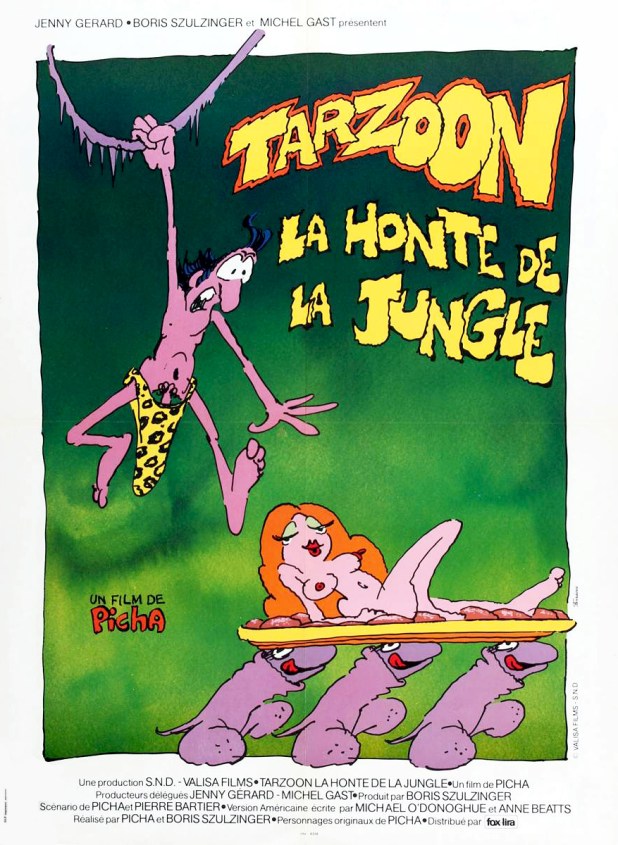
Give up? It’s the American version of La Honte de La Jungle, re-titled for the American market as Tarzoon, Shame of the Jungle and later just Shame of the Jungle. (In the UK, it’s known as Jungle Burger). Whatever its title, it’s a dirty French/Belgian animated film, with the English-language version written and voice acted by all those SNL folks.
But why have I never seen nor heard of this thing, a John Belushi/Bill Murray film, you ask? Good question. I’ll get to it. But first, some details about the film itself. Made back in the heyday of adult animated films like Fritz the Cat, The Nine Lives of Fritz the Cat, and Down and Dirty Duck, Shame of the Jungle, to stick with its final U.S. title, is a twisted, adult version of Tarzan. We have Tarzoon, renamed “Shame” after the Edgar Rice Burroughs estate cried foul, along with “June” and a masturbating monkey living in the “bush” of Africa. (Yeah, the movie’s humor goes there—and I just did too.) Evil queen Bazonga wants to take over the world tomorrow, but unfortunately, she’s bald. Along with her beauticians, who are conjoined twins, she hatches a plan to kidnap June and scalp her for her long, flowing locks.
And it gets smuttier and nuttier from there with an army of human-sized penises bouncing along on their testicles, animals having sex, humans having sex, a racist depiction of African natives, a stereotypical British explorer, and Shame, our hero, meeting one “Craig Baker from Champagne-Urbana,” a drunken frat boy with “69” on his shirt, voiced by John Belushi. If you watch the end credits, Belushi is uniquely credited as having “created and performed” the character.
So now you’re asking, what manner of insanity is this, and who created it? Well, it’s the work of celebrated Belgian animator Picha, a/k/a Jean-Paul Walravens. Picha’s animation has that fun, exaggerated 70s look (if you remember the “Keep on Trucking” bumper stickers, you’ll get the idea) in pastel color. Or maybe it was just the washed-out print I saw. In spots, there are some reused backgrounds, not unlike the economy measures taken by Saturday morning cartoons back in the day. (And let’s not forget about all the kinky cartoon sex.) But overall, the film looks good.
The humor starts low (the “bush” joke) and never rises above sniggering middle-school playground stuff, but you know what? It’s mostly funny, if you like the lowest of lowbrow humor, and it doesn’t wear too thin throughout the short run time. That run time, by the way, is debatable. The gray-market versions that I’ve found online all run about 68 minutes, though I’ve seen reports of 71- and 85-minute run times.
The voice actors acquit themselves well to the dubbing script by O’Donoghue and Beatts, with the coup being that the U.S. post-production team got Johnny Weismuller, Jr., son of the legendary original Tarzan, (Johnny Sr. was born in Windber, in my vicinage of Western Pennsylvania, of all places) to play Shame. Another notable, Adolph Caesar, the booming voice of many 70s trailers, including Dawn of the Dead, is also in the cast. But you’ll be hard pressed to identify the voices of the SNL folks, who have small parts. All, that is, except for Belushi. As mentioned, he wrote his college-kid part himself, and he’s a highlight of the film, especially when he goes off on a drunken tangent about the film The Silver Chalice with Jack Palance.
But back to the burning question: Why is this movie unknown to even the most ardent Belushi and SNL fans? I think the answer is that it was released by International Harmony, a company set-up by the great Stuart S. Shapiro, who created the legendary USA Network series Night Flight. While Shapiro’s work on that show was brilliant, his efforts as a movie distributor were far less successful. He made money with Tunnel Vision, an early sketch comedy, but his company was also the original distributor of the ill-fated Effects, the brilliant, low-budget Pittsburgh horror film. It played only a few theaters in 1980 and disappeared without a trace for decades, the victim of no marketing and bookings due to International Harmony’s financial troubles. It seems Shame of the Jungle was plagued by even more distribution problems. First, there was the copyright issue. So the film had to be retitled and perhaps re-looped. And it initially received an X-rating.
I read where Shapiro said that even though the film was pornographic, he didn’t recall any problems importing it into the U.S. It was later cut to get an “R” rating–hence, the different reported run-times—and it played a few places, mainly at midnight showings. Many sources report that it first played in the U.S. in 1979—indeed, there’s a New York Times review from September 14, 1979–but I distinctly recall midnight showings of the X-rated Tarzoon version in Virginia when I was at the University of Richmond, circa 1978. And while later it made it to VHS, it’s never had an official DVD or Blu-ray release in North America. (It’s part of a Picha Blu-ray box set in Europe.) You can find it on YouTube and the Internet Archive in what I’m going to assume is the cut, R-rated version (but I can’t be sure),
So now you know the name of the lost SNL feature film. It’s a “shame” this film isn’t more widely available (keeping with the film’s low humor, I couldn’t resist the pun). If enough people read this review, see the VHS rip, and convince a company like Vinegar Syndrome to find it, we can all enjoy an oddity that has been lost to the sands of time. I sure hope that happens. Shame of the Jungle, by any name, is worth it.
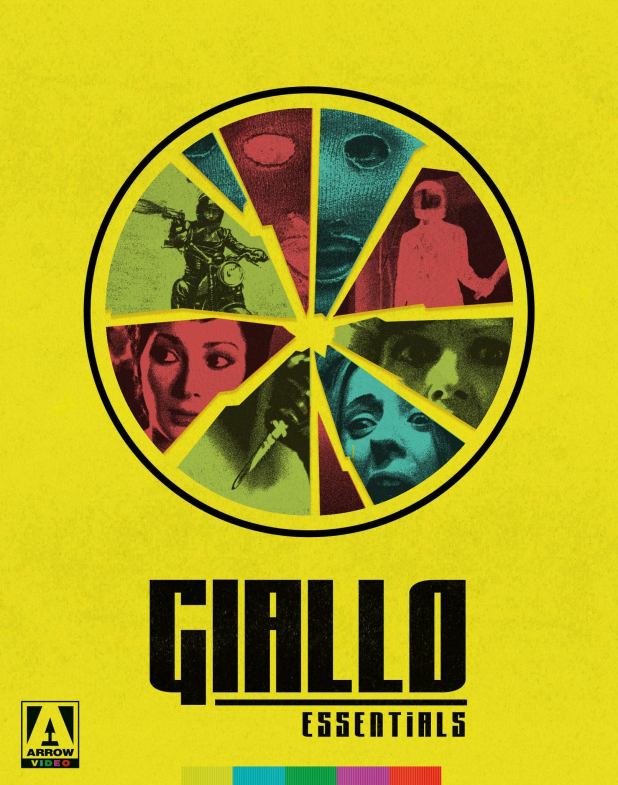
Arrow Video continues its exploration of Italian cult cinema with a second volume of Giallo Essentials that has three fashion, murder and psychosexual madness-filled films.
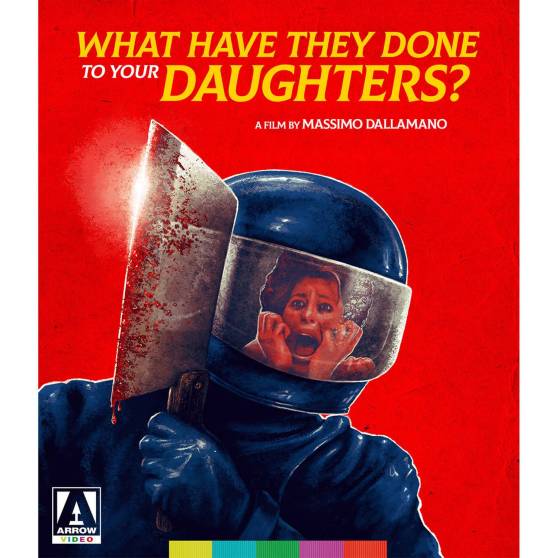
What Have They Done to Your Daughters? (1974): By 1974, the giallo was waning and the poliziottesco was starting to win over the Italian box office. This offering is a hybrid of both — unlike many giallo, the police are not presented as ineffectual or non-essential. Instead, they’re followed for most of the film.
Massimo Dallamano (The Night Child) made What Have You Done to Solange?, a giallo that exists outside of the Argento archetype. He’d follow it with this rougher and much darker — somehow that’s possible! — semi-sequel.
Deputy Attorney Vittoria Stori (Giovanna Ralli, The Mercenary, Sex with a Smile) is a rarity in giallo. She’s a woman in command of the police and never presented as a victim. She’s in charge of the murder investigation of Sylvia Polvesi (Sherry Buchanan, Dr. Butcher M.D.).
Found hanging in an attic, her suicide is anything but, as Inspectors Silvestri (Claudio Casinelli, Murder Rock, Hercules) and Valentini (Mario Adorf, Short Night of Glass Dolls) soon discover. And oh yeah — there’s soon a leather jacketed biker using a meat cleaver to gorily off his or her victims. And a peeping tom, too! And teenage prostitution! And Farley Granger, showing up to class up the proceedings!
Obviously, the look of the killer in this movie would influence a movie that has no interest in classing up the giallo — Strip Nude for Your Killer — and an American movie that gets so close to a giallo but is missing the murderous set pieces — Night School.
It’s a shame that Dallamano died in a car accident at the somewhat young age of 59. As the cinematographer for Leone’s A Fistful of Dollars and For a Few Dollars More, he certainly had an eye for action and movement, as evidenced by the hallway chase scene in this film that seems as steady as, well, a Steadi-Cam shot (it isn’t!).
The Giallo Files site compared this movie to an episode of Law and Order. That’s an apt comparison. It’s a good movie to introduce someone to the genre with, as while it has some twists and turns, it doesn’t descend into plot hole jumping or an abundance of red herrings as some films of this genre.
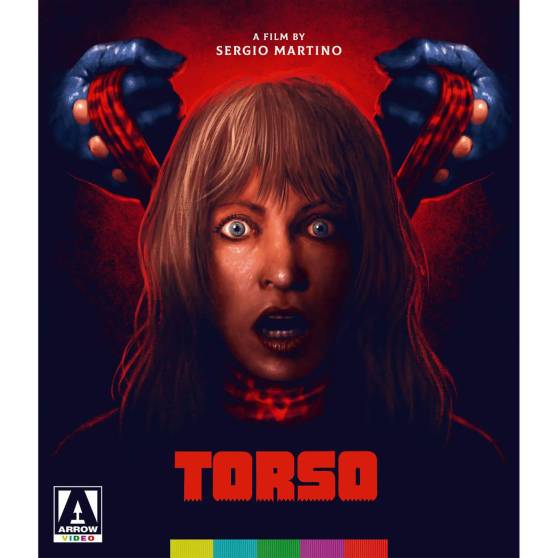
Torso (1973): Torso is such a simple title. I’d rather call this film by its Italian name: I Corpi Presentano Tracce di Violenza Carnale, or The Bodies Bear Traces of Carnal Violence. Either way, it was directed by Sergio Martino and features none of the cast that he had come to use in his past films like George Hilton, Ivan Rassimov or Edwige Fenech.
It does, however, star Brtish actress Suzy Kendall, who played the lead role of Julia in Dario Argento’s seminal The Bird with the Crystal Plumage. She’s so associated with giallo that she appeared as the main character’s mother in 2012’s ode to the genre, Berberian Sound Studio.
This is a film that wastes no time being strange. Or salacious. A photographer is shooting a soft focus lovemaking session between three women amongst creepy, eyeless baby dolls. By the time we register what is happening, we’re now in a classroom, where swooping pans and zooms refer us to the main cast of the film as we overhear a lecture and later a discussion about Pietro Perugino’s painting of Saint Sebastian. Did he believe in God? Or was he just trying to sell sentimentality? Could an atheist find himself able to translate religion to those with faith?
We cut to a couple making out in a car as a figure stalks them through the eye of the camera, making us complicit in the act of the killer. Quick cuts reveal the white-masked face of this maniac. The man runs after him while the girl doesn’t even care that they had a voyeur watching. As she waits for him to return to the car, but grows impatient. The headlights of the car cast her shadow large across the columns of a bridge. And their light is quickly extinguished by black-gloved hands. The camerawork here is really striking, keeping us watching for the killer, as we’re no longer behind his eyes. His attack is swift and ruthless, juxtaposed against the images of fingers penetrating the eyes of a doll.
The art professor (John Richardson, Black Sunday, The Church) and Jane (Kendall) meet by chance at a church where she challenges him to change his views on Perugino. As she returns from their somewhat romantic afternoon, Jane spies her friend Carol arguing in the car with a man who she believes is married.
Meanwhile, ladies of the evening walk the street, ending up with Stefano, a student who has been stalking Julie. He has trouble performing and the prostitute he’s with tells him that all the men with hang-ups always come her way. That said — even if he’s queer, he better pay the money. He flips out and attacks her, but she makes her escape.
We’re then taken to a hippy party that looks like it’s taking place inside Edward Lionheart’s Theater of Blood. There’s weed, there are acoustic guitars, there are bongos, there are dudes with neckerchiefs, there are motorcycles. Truly, there’s something for everyone. But after leading on two men, Carol just walks out into the mud. They try and chase her, but she makes her escape into the foggy night. We hear her footsteps through the swamp as she walks, exhausted and covered in mud. What better time for our white-masked killer to return? We see glimpses of him through the fog and then he is gone. Whereas in past films Martino ignored the murder scenes instead of story, here the violence is extended, placing the killer and his actions in full view. After killing the girl, he rubs mud all over her body before stabbing her eyes — again intercut with the baby doll imagery. Her blood leaks into the mud as the score dies down.
This scene really feels like what the first two Friday the 13th movies were trying to achieve, but of course several years before they were made.
A police detective is in front of the art class, showing images not of art, but of the crime scene. A piece of cloth has been found under the fingernails of one of the murdered students, Flo. And that same scarf was found on Carol’s body. It’s their duty to report seeing anyone who wore this scarf to the police, who want to cooperate with the students who normally riot and throw rocks at them.
Two of the men in the class — Peter and George — were the last two people to be seen with Carol, the ones who she turned down at the party. Meanwhile, Stefano continues to stalk Jane. The music in this film is so forward-leaning — tones play when the killer shows or during moments of tension.
A man calls Daniela and tells her that if she ever tells where she saw the red and black scarf, she’s dead. Fearing for her life, she tells her uncle, who lends his country home to her and her friends so that they can get away from the city while the killer is at large.
Oh yeah — I forgot the pervy scarf salesman, who the police are leaning on. Right after talking to the police inspector, he calls someone and asks for money to buy his silence. Whoever it is, they bought the scarf from him and wouldn’t want anyone else to know. They’ll also get out of town and head to the country. Coincidence? I think not!
Stefano is all over Dani, telling her that he needs her. She wants nothing to do with him. When she stares at him, she remembers seeing him wear the red scarf. She escapes — slamming the door in his face. She tells Jane that she remembers seeing him wear the scarf — and never again — the day Flo died. The whole time, the creepy uncle is watching the two girls. Jane offers to speak to Stefano, then meet the girls at the vacation home.
The street vendor is flush with cash, creeping along in the dark. A car starts to follow him. We see the black-gloved hands again as the car hits its victim again and again, bright red gore pouring all over the screen.
Jane goes to speak to Stefano, finding only strange baby dolls and letters to Dani asking her to love him and remember the promise that she made as a little girl. Jane is surprised by Stefano’s grandmother, who tells her that he left town.
The other girls are asleep on the train as someone watches them. A strange man enters their train car and sits down.
The camerawork in this movie feels as predatory as the perverts and killers that exist within it. Speaking of pervs, when the girls arrive in the countryside, the local men pretty much lose their minds, particularly over Ursula (Carla Brait, the man wrestling dancer from The Case of the Bloody Iris). She and Katia make out as a peeping tom watches, only for the killer to show up and off the leering man. There’s an amazing scene of the killer dumping the pervert into a well, shot underwater and staring upward as the body falls toward the lens.
Man, every man in this movie is scum. They’re either frightened boys or perverts wanting one chance to knock up a woman or scarred from past sexual encounters. None of them are positive, as even the uncle who gives Dani the villa seems way too interested in her. Every man is a predator at worst and a leering pervert at best.
Jane hurts her ankle when she gets overly excited about breakfast. A doctor arrives — the mysterious man from the train — and he gives her a pill, which knocks her out.
The girls go sunbathing while Jane recovers. Dani thinks she sees Stefano — complete with the red scarf — watching them. They return home and drink champagne, which Jane uses to wash down her sleeping pills.
A few minutes later, the door rings. It’s Stefano — the girls all scream — but he’s dead — the girls scream again — and the killer is behind him, holding the red scarf — now scream even louder! Instead of showing us the murders, Martino switches form, cutting to a ringing bell and Stefano being buried.
Jane wakes up, asking where her breakfast is. She’s obviously slept late as a result of the pills. She walks around the apartment, looking for Dani, Ursula and Katia, only to find a mess. Tossed chairs, bottles of beer and every single one of her friends murdered. Suzy Kendall is amazing in this scene, caught between fear and nausea. Unlike so many wooden giallo performances, she’s actually believable.
She hides as the killer comes back, forced to stay quiet and watch as he saws her friends into pieces. Even the ordinary world routine of the milkman arriving cannot stop the butchering of her friends, with her trapped just feet away.
This final act is completely unexpected, as up until now, the film had played by the rules of the giallo, the large number of victims versus a large number of red herrings.
In fact, this film is so packed with red herrings, even the cast had no idea who the killer was. Martino wouldn’t tell them who it was, so each of the actresses had her own theory as to who the killer was. And in the original script, the killer survived.
Now, instead of that traditional giallo structure as I mentioned above, it is the last survivor — a near prototype for the final girl — against a killer. Throw in that Julie can’t move well due to her leg and Martino has set up quite the suspenseful coda.
Trapped in the house, Julie tries to signal with a mirror, using Morse code. But it totally misses the heroic doctor’s sight. He places a call, but it doesn’t seem like it’s to Julie. She looks out the window and sees the killer coming back.
It turns out that the killer was the professor, who saw a childhood friend die trying to reach for a doll. He compares the other kills to dolls, with only Julie as a flesh and blood person. Everyone else was a bitch or played games with him or blackmailed him. He hacked Ursula and Katia to pieces like dolls as a result. Dani saw him. Carol may have seen him. And he killed Stefano when he saw him in the village. Death, he says, is the best keeper of secrets and then he sees Julie as a doll and tries to hang her. She’s saved at the last second by the doctor.
They battle into a farmhouse, across the yard and to a similar rock where we saw the younger professor watch his friend die. We hear a screen and have no idea who has been killed — but luckily for Jane, the doctor survives. He discusses that whether fate or providence had kept him in town, where he could save her. Perhaps it was written in the stars. Julie replies that Franz, the professor, would have been a realist and called it a necessity. Franz is dead and the dreamers live on.
The more times that I’ve watched this film, the more that I appreciate it and how it flips the genre conventions on their head and moves toward more of a slasher, with many of the giallo elements feeling tacked on somewhat to stay within the expected pieces of the form. A real clue that it’s really a slasher? The killings are more important than who the killer is.
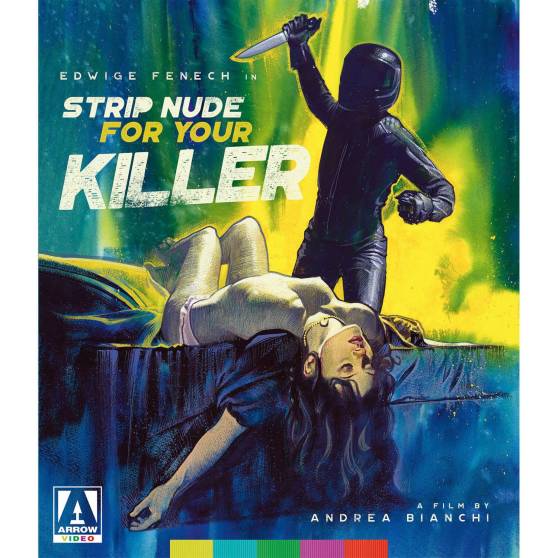
Strip Nude for Your Killer(1975): When a movie starts with a fashion model dying during a back alley abortion and it being covered up as a drowning, all before the opening credits, you know that you’re in for something demented. When you realize that the film was written and directed by Andrea Bianchi, who brought us Burial Ground, then you’re either going to run screaming or sit down and pay attention.
The doctor who performed the operation is killed by a motorcycle suit wearing maniac, but nobody at the Albatross Modeling Agency cares. All Carlo, the head photographer, cares about is using his modeling connections to pick up women. That’s how he meets Lucia (Femi Benussi, Hatchet for the Honeymoon), who he takes from the steam room to the modeling agency.
Magda (Edwige Fenech looking better than I’ve ever seen her look in any movie ever) is jealous, so she surprises Carlo with some black lace and they begin an affair. We then see a photo of the main agency members, like Mario, Magda, Carlo, Stefano, Dorris, Maurizio and his wife, and the owner of the studio Gisella. There’s one other person in the photo — Evelyn, who we saw die in the beginning.
Mario heads home and the killer shows up. When their helmet is removed, Mario knows the killer. But it’s too late. He’s dead now. The killer takes the photo so that he or she has a checklist of who to kill.
So then there’s Mauirizio, who is cheating on his wife with a prostitute. He takes her on a crazy ride through the streets and then takes her back to his place, when he begs and threatens her life before she suddenly wants to have sex with him — because you know, that’s how things worked in the 1970s — before he lasts all of a minute and starts embracing his blow up doll. Honestly, what the fuck? Of course, he’s killed right afterward. Good riddance.
Carlo later witnesses Gisella being murdered and even photographs the attack, but he’s hurt in a hit and run accident. While he’s recovering, Magda develops the film but the killer ruins the negatives.
After killing Doris and Stefano, the murder tries to kill Carlo and Magda, but the killer is knocked down the stairs. So who is it? New model Patrizia — Evelyn’s sister — who blames him for her sister’s death. However, she dies before she can tell the police of his involvement.
The movie ends with Carlo playing around by mock choking Magda before initiating anal sex with her, as she tells him not to, in a scene meant as comedy but lost in translation and the fact that forty plus-year-old giallo could never anticipate the #metoo movement.
Seriously, the title of this film pretty much says it all. It’s the most nudity I’ve ever seen in a movie. And it’s pretty much one of the most lurid I’ve seen, too. I have no idea if Bianchi intended this as a comedy, but it certainly feels like one.
It’s almost amazing that a movie with this much nudity and mayhem moves at such a glacial pace. It felt like the first hour of the film was the entire running time! Even worse, this movie is pretty much wall to wall misogyny. I know, I know, that’s the majority of giallo, but here it feels so overwhelming and so alien when seen with today’s eyes. I mean, should I be shocked that a movie called Strip Nude for Your Killer is so sexist?
Arrow Video’s Giallo Essentials: Yellow Edition has 2K restorations from the original negatives for all three films, as well as rigid box packaging with new artwork by Haunt Love in windowed Giallo Essentials slipcover.
What Have They Done to Your Daughters? has commentary by giallo expert Troy Howarth, a video essay by Kat Ellinger, interviews with Stelvio Cipriani and Antonio Siciliano, unused footage, alternate English opening titles, the Italian theatrical trailer and an image gallery.
Torso has two versions of the film, the original 94-minute Italian cut and the 90-minute English cut. It also has commentary critic by Kat Ellinger, interviews with Sergio Martino, Luc Merenda, Mikel J. Koven, Ernesto Gastaldi and Federica Martino, daughter of Sergio Martino. There’s also an option to view the film with the alternate US opening title sequence, as well as the Italian and English theatrical trailers.
Strip Nude for Your Killer has commentary by Adrian J. Smith and David Flint, a video essay by Kat Ellinger on Edwige Fenech, interviews with Nino Castelnuevo, Erna Schurer, Daniele Sangiorgi and Tino Polenghi, two versions of the opening scene, the original Italian and English theatrical trailers and an image gallery.



 B&S About Movies
You must be logged in to post a comment.