Santo contra los Asesinos de Otros Mundos (1973)

Four people have been killed and three of them were very important people. Of all the detectives that Mexico can call, Santo seems like the best pick. The bad guys want $10 million in 24 hours, but with the man in the silver mask looking for them, perhaps the cops are right to not negotiate with maniacs.

It turns out that the killer is a blob, which means that Santo has faced nearly every great movie monster of the past and has now moved into the modern era. But now he has to content with a bad guy who forces him to battle numerous men in gladiator matches before revealing that he has moon rocks that he is growing into creatures willing to do his bidding. Let’s give it up for Santo in this one because he goes all Indiana Jones and instead of a long fight, he just grabs a machine gun and blows away a bunch of henchmen.

Let me go back and break down that scene again. Santo is forced to battle bad guy after bad guy in a room that looks like it has fake stars and one of them has a flamethrower. I don’t know why anyone makes movies any longer when we have movies like this that give you that scene and then remember that the film is really about a blob. That blob not only attacks innocents, it also eats one of the major bad guys and a villain’s girlfriend.

Don’t get too excited about that blob. It really looks like several people under a sheet, which makes me so much happier than any special effect could. I also enjoy a bad guy who makes all of his men wear neckbands that gas them if they screw up.

Director Rubén Galindo also made Santo vs. the She-Wolves which flirts with gothic horror inside the world of the man with the silver mask. It’s great.

El Santo y La Tigresa (1973)

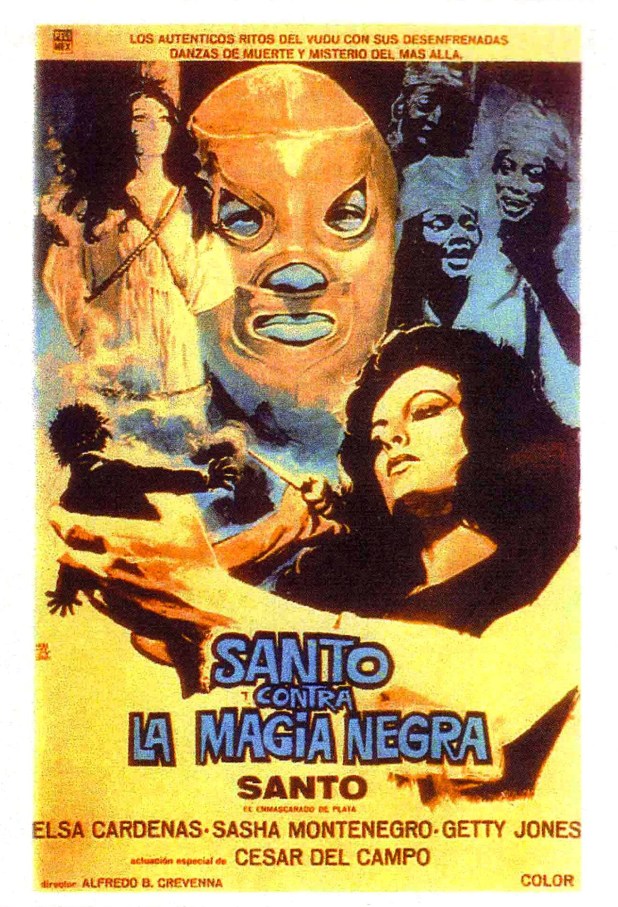
Also known as Santo y el águila real and The Royal Eagle, this movie puts Santo into a strange situation. He gets a call for help from Irma “La Tigresa” Morales (Irma Serrano*, known as La Tigresa de la Canción Ranchera (The Tigress of Ranchera Music) and the star of another movie made in 1973, La Tigresa, in which was directed by one member of this movie’s directing team, Alfredo B. Crevenna**). Her father and brother have already been killed for their land and she fears that she’s next on the list of the evil Manuel Villafuerte.

Santo is able to work his way into any genre and this time, he’s in a combination western and an exploration of the simple village people of Mexico. And these non-city folk seemingly love nothing more than the senseless slaughter of animals, as this movie features a flashback in which we see Irma’s brother go off a cliff on a horse that is completely real, as well as an honest-to-goodness cockfight. She also shoots a rabbit for real to show Santo her marksmanship abilities and then, after Santo’s wine gets drugged, he tests the poison out of a kitten. Later, La Tigresa’s protective eagle La Serrana is placed in a bag and smashed numerous times into a wall, yet somehow survives.

Who was under that silver mask, Ruggero Deodato?

Somehow, this movie also has numerous musical numbers, dancing scenes and a dungeon full of humanity malformed by incest, including an evil hunchback, who all beat the heck out of Santo before he starts giving back body drops to dudes into the hard dirt.

All Santo movies are wild on some level, but this one is one of the oddest ones. Santo is barely even the star of his own movie, standing back so La Tigresa can be tecnico Tura Satana and win over all of our hearts.

*Irma is amazing in this, fighting dudes with her fists and a bullwhip, boasting through song and owning her own cock — for fighting, you little raincoater. In real life, she bought her own theater where she put on highly erotic shows like her take on Emile Zola’s Nanå. In 1977, she collaborated with Jodorowsky to perform the stage play Lucrecia Borgia. They fought throughout and both ended up putting on their own version of the show.

She also put on plays like A Lady Without Camelias, Oh … Calcutta, Yocasta Reina, The Cross-legged War and A calzón amarrado, which was based on her controversial biography as well a series of adults-only midnight plays Emanuele LIVEJail for GirlsVampira! (Emanuele de ultratumba) and Carmen.

La Tigresa is a controversial figure, as she was jailed by Guadalupe Borja, the First Lady of Mexico, for traveling to Los Pinos, the presidential residence, and singing to President Gustavo Díaz Ordaz. It would be more than thirty years before Irma owned up to the affair, defending his honor and saying that she was not the person who ordered him to attack the students in the 1968 massacre of Tlatelolco.

She won a senate race in her home state of Chiapas and a few years later, went to jail for brandishing a gun and threatening to kill an ex-tenant. She’s still alive at 87 and one assumes has lived an insane life.

**René Cardona Jr. is the other half of the directing duo.
And Now the Screaming Starts! (1973)

Based on the 1970 novella Fengriffen by David Case, this Ray Ward Baker (AsylumA Night to RememberThe Vault of Horror) is a rare non-anthology Amicus film.

After moving to her fiancé Charles Fengriffen’s family estate, Catherine (Stephanie Beacham, Dynasty) keeps seeing an undead man with a birthmarked face, no eyes and a severed right hand. In fact, a spirit goes so far as to assault her on her wedding night. So imagine how she feels when she meets a woodsman who lives on the grounds. He has the same birthmark as her horrible dreams.

Anyone that answers her questions about all of these strange happenings is killed immediately — by axe, by severed hand, by throwing down the stairs, bye bye.

Charles believes that his wife is mentally ill, but since she is with his child, he calls for Dr. Pope (Peter Cushing), who gets close to the truth before the hand shows up again and kills his witness. That’s when Charles reveals that his grandfather (Herbert Lom!) once assaulted his servant Silas’ wife and sliced off that man’s hand as punishment for trying to get revenge. The child grew up to be the woodsman, whose father Silas cursed the Fengriffen family. The next virgin bride to enter their home — Catherine — would be attacked by a ghost, her decency taken and her child possessed. Anyone who tries to help her will die.

The end of this movie is completely deranged. The baby is born looking exactly like Catherine’s vision — no eyes, the birthmark and missing a hand — so Charles shoots the woodsman in both eyes before digging up Silas and tearing his corpse apart.

This film was shot in Oakley Court, which you may recognize from several Hammer films and The Rocky Horror Picture Show. Today, it’s a luxury hotel.

One more fact: producer Max Rosenberg attempted to use the title I Have No Mouth and I Must Scream, which is a Harlan Ellison book. How quickly do you think Harlan ran to court to stop him?

You have so many options to watch this! It’s on Tubi, Shudder and available from Severin.

The Creeping Flesh (1973)

Directed by Freddie Francis* for Tigon, this film is a thrilling collaboration that pairs the iconic Christopher Lee and Peter Cushing. It’s a gem from the end of the era of British gothic horror, and despite its occasional silliness, such as Cushing holding a gigantic prehistoric finger that appears as sexualized as it gets, I find every moment of this film utterly captivating.

Cushing is Prof. Emmanuel Hildern, a scientist who discovers a colossal skeleton — Anunnaki alert — that is older than other skeletons in the area yet much more advanced. He hopes that this finding will win him the Richter Prize, but that award looks like it’s going to be won by his brother John (Lee), who has been looking after Emmanuel’s institutionalized wife for years. He plans to use his study of his brother’s wife to win that award and refuses to pay for the professor’s skeleton-finding trips.

Whatever this skeleton is, legend says that it was a monster that feared rain—maybe because the Great Flood wiped out the other Nephilim—and that it could grow skin when it came into contact with water.

Hildern has a theory that if evil itself—the skeleton—can be a living being, then it can be biologically contained and treated like a disease. He created a serum that can stop evil using cells from the skeleton’s fleshy finger. After testing the drug on a monkey with good results, Emmanuel also immunizes his daughter Penelope, who may have inherited her mother’s mental illness.

Of course, the next day, the monkey has gone wild, and now we have Penelope dancing on tables and slashing sailors. Soon, James finds out about the serum, kidnaps his niece and steals the skeleton. The skeleton gets exposed to the rain and becomes, well, a pretty goofy-looking monster that I can’t help but completely fall head over heels for.

The ending of this movie is a masterstroke, leaving the door wide open for interpretation. You can see it as Lee’s character denying that his brother is related to him to save his reputation or that Emmanuel was never a doctor at all but just another patient. If that’s true, then who really took his finger in revenge? Does the monster exist? It’s a thought-provoking conclusion that will keep you pondering long after the credits roll.

You can watch this on Tubi.

*Don Sharp, who also made Psychomania, was the original director before Francis was hired to replace him.

Sssssss (1973)

Oh man, this movie. I can’t even believe some of the things that happen in it, to be perfectly honest with you. It’s another PG-rated 1973 movie — hello, The Baby — that is absolutely berserk.

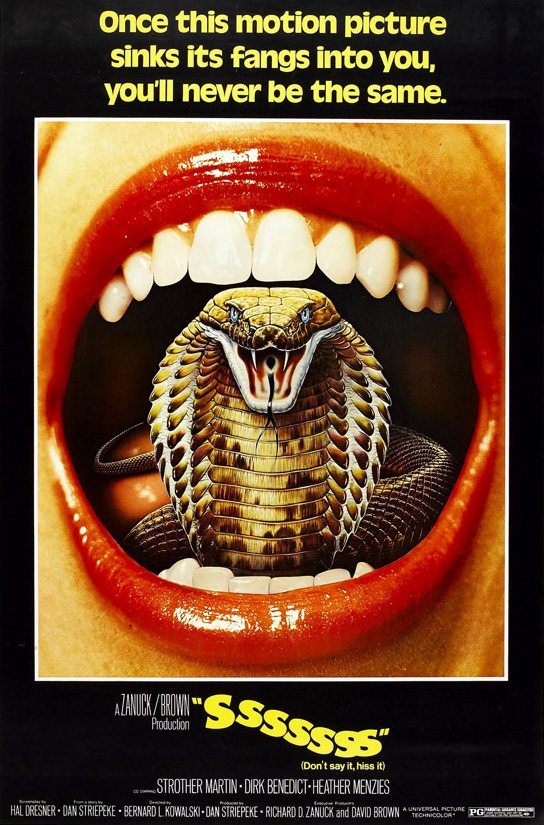
Directed by Bernard L. Kowalski and written by Hal Dresner (Zorro the Gay Blade) and Daniel C. Striepeke (who also produced this film and did the creative makeup design*; he also did makeup work on everything from Planet of the Apes and Beyond the Valley of the Dolls to Myra BreckinridgeJaws the Revenge and Can’t Stop the Music before doing make-up for several Tom Hanks-starring movies), Sssssss tells the story of Dr. Carl Stoner (Strother Martin), a man who we first meet as he sells a mysterious creature to a carnival.

Beyond being a herpetologist, Dr. Carl has gone completely and utterly crazy, believing that man is about to undergo an ecological apocalypse and would be better served if we all became amphibians. He brings on David Blake (Dirk Benedict) as his assistant, slowly injecting him with medications that he claims will make him immune to snake bites. Obviously, Blake is a moron because such a vaccination does not exist**. He is not so dumb that he doesn’t instantly start pining for Dr. Carl’s daughter Kristina (Heather Menzies, who was Louisa in The Sound of Music and would appear nude in Playboy the very same year this was made in a pictorial all so creatively titled “Tender Trapp”).

And before you know it, David is having wild Keir Dullea dreams of reptiles when he isn’t turning green. The doctor keeps feeding people to snakes and sending snakes to kill people in showers and one wonders, how has he gotten away with all of these shenanigans in such a small town for so long? Also, the end of this movie is completely off the rails — and the movie is never normal, not for a second, so for it to get weirder is an accomplishment — when David transforms into a king cobra and battles a mongoose before the cops come in blasting with shotguns.

I kind of adore this movie because at once it’s a movie that has an incredibly scholarly take on snakes and how they actually operate while also being a movie with numerous sideshow scenes and two people — the other is Tim McGraw the Snake Man who is played by Noble Craig, a Vietnam vet who lost lose both of his legs, his right arm and most of the sight in his right eye and used that handicap to become a living special effect in movies like this, Poltergeist II, the remake of The BlobBride of the Re-AnimatorA Nightmare on Elm Street 5: The Dream Child and Big Trouble In Little China — are transformed into snake men.

In case you think that this movie was safe to make, the venomous king cobras in it were not defanged. Instead, they were kept at their full potency and milked of their venom every day.

This movie has some great alternate titles, like O Homem-Cobra (The Snake Man) in Brazil, SSSSKobra and Ssssnake in Finland — and Sssssnake Kobra in Germany — as well as Ssssilbido de Muerte (Whisper of Death) in Mexico and Hissssss and SSSSnake in the U.S.

Honestly, drop what you’re doing and watch this movie right now.

*The actual effects are by John Chambers, who created Spock’s ears, and Nick Marcellino.

**I take that back. My research has show that there is a rattlesnake vaccine, so there you go.

Ron Marchini Week Wrap Up!

Phew. We did it! Twelve Ron Marchini films in two days. You know the drill! Yee-haw, let’s round ’em up!

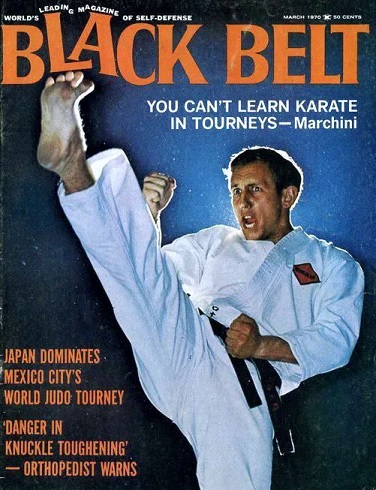
Born in California and rising through the U.S. Army’s ranks to become a drill sergeant, in his civilian life, Ron Marchini earned the distinction as the best defensive fighter in the U.S.; by 1972, he was ranked the third best fighter in the country. Upon winning several worldwide tournaments, and with Robert Clouse’s directing success igniting a worldwide martial arts film craze with Enter the Dragon (1973), the South Asian film industry beckoned.

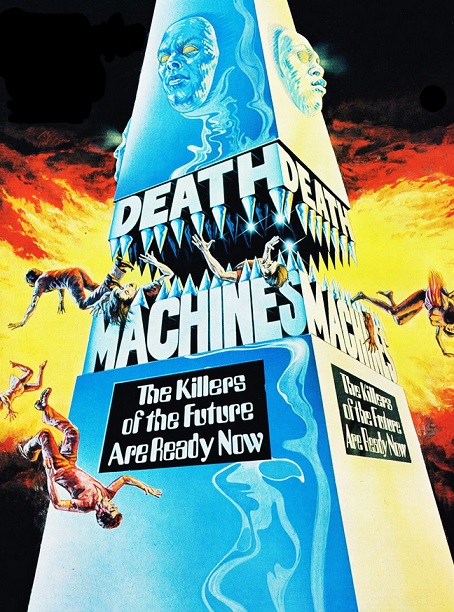
After making his debut in 1974’s Murder in the Orient, Marchini began a long friendship with filmmaker Paul Kyriazi, who directed Ron in his next film, the epic Death Machines, then later, in the first of Ron’s two appearances as post-apoc law officer John Travis, in Omega Cop.

Ron also began a long friendship with Leo Fong (Kill Point) after their co-staring in Murder in the Orient; after his retirement from the film industry — after making eleven dramatic-action films and one documentary — Ron concentrated on training and writing martial arts books with Leo, as well as becoming a go-to arts teacher. Today, he’s a successful California almond farmer.

In the annals of martial arts tournaments, Marchini is remembered as Chuck Norris’s first tournament win (The May 1964 Takayuki Kubota’s All-Stars Tournament in Los Angeles, California) by defeating Marchini by a half a point. Another of Chuck’s old opponents, Tony Tullener, who beat Norris in the ring three times, pursued his own acting career with the William Riead-directed Scorpion.

You can learn more about Ron Marchini with his biography at USAdojo.com. An interview at The Action Elite, with Ron’s friend and Death Machines director Paul Kyriazi, also offers deeper insights.

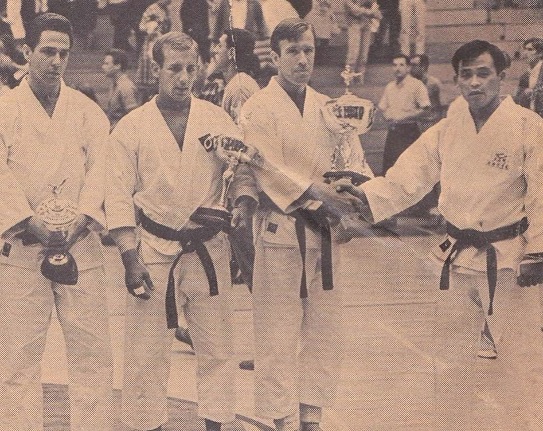
Ron, second from right, with Chuck Norris, shaking hands, 1965. Courtesy of Ken Osbourne/Facebook.
Courtesy of USADojo.com.

The Flicks!

The Reviews!

New Gladiators (1973)
Murder in the Orient (1974)
Death Machines (1976)
Dragon’s Quest (1983)
Ninja Warriors (1985)
Forgotten Warrior (1986)
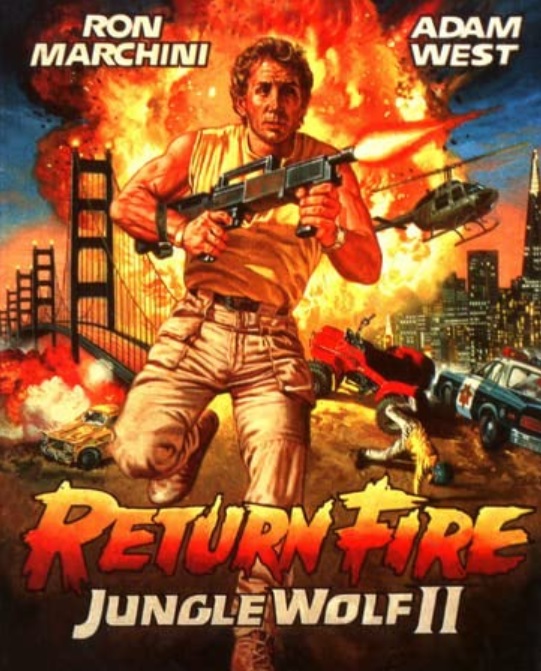
Jungle Wolf (1986)
Return Fire (1988)
Arctic Warriors (1989)
Omega Cop (1990)
Karate Cop (1991)
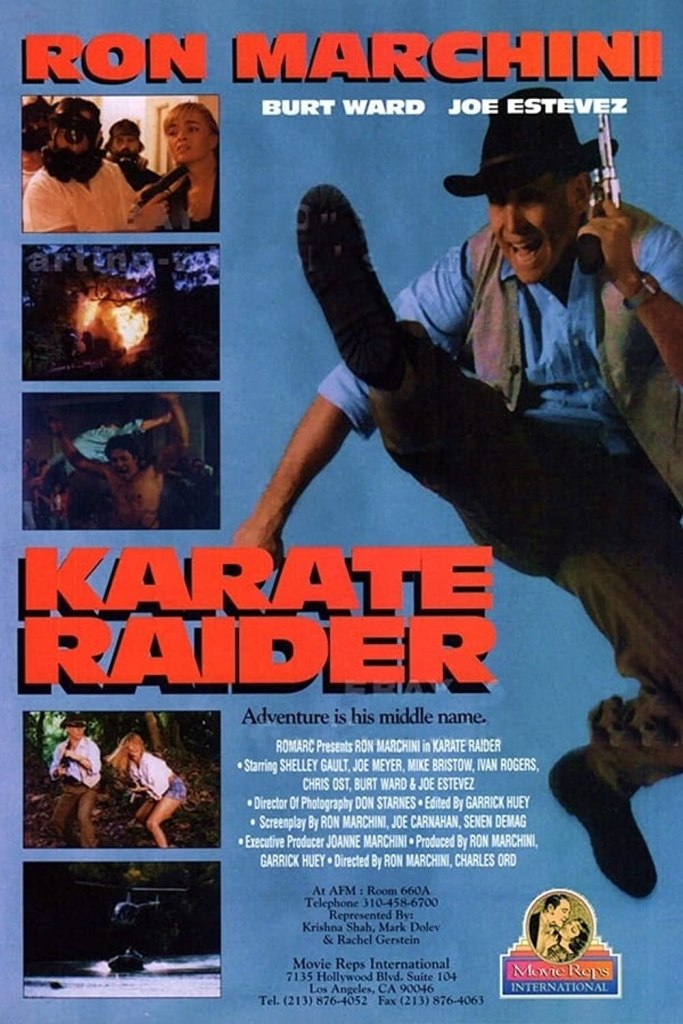
Karate Raider (1995)

Black tee-shirt image courtesy of Spreadshirt. Art work/text by B&S About Movies.

We love ya, Ron!

About the Review Authors: Sam Panico is the founder, Chief Cook and Bottle Washer, and editor-in-chief of B&S About Movies. You can visit him on Lettebox’d and Twitter. R.D Francis is the grease bit scrubber, dumpster pad technician, and staff writer at B&S About Movies. You can visit him on Facebook.


New Gladiators (1973)

During these past two days, we’ve reviewed the films of martial artist Ron Marchini — from his 1974 debut in Murder in the Orient with Leo Fong, and up through to his eleventh and final film, 1995’s Karate Raider, aka Jungle Wolf 3 (in some quarters), which he also directed. But Ron has one more film, a twelfth film — a documentary released prior to his feature film debut, known as New Gladiators (now Elvis Presley Gladiators in its digital reissue format).

New Gladiators was a film that was believed a myth; a film mentioned in passing in the many tomes on Elvis Presley and martial arts history books; a film that Elvis produced — but no one ever saw. It was believed the 16mm-shot film was an unfinished project, the reels lost amid the many legal skirmishes after Elvis’s death in August 1977.

Image courtesy of ElvisDVDCollector.com from the 2009 DVD reissue.

At the time, with Bruce Lee’s Enter the Dragon igniting a new, worldwide interest in karate, the film’s concept of chronicling the world tour of the U.S. Karate team — a team which starred Ron Marchini — was presented to Elvis’s karate instructor, Ed Parker. Initially, Elvis, who bankrolled the production, was to serve as the film’s host and narrator. But due to his Las Vegas entertainment commitments and ongoing medical issues, he was only able to make a brief appearance in the film for a practice and demonstration session.

In addition to Ron Marchini, keen eyes will notice Professional Karate Association middleweight champ Bill “Superfoot” Wallace, who made his acting debut as “Sparks” in A Force of One (1979) with Chuck Norris and co-starred alongside Jackie Chan as “Benny Garucci” in The Protector (1985); he also made a brief appearance in Leo Fong’s Killpoint (1984). During the course of the film, Elvis is part of a ceremony when Wallace is promoted from a 3rd to 4th Degree Black Belt. You’ll also notice Benny Urquidez, who, among his many film credits, is best remembered for his role as assassin “Felix La PuBelle” in John Cusack’s Grosse Pointe Blank. But since these past two days were in tribute to the film and acting career of Ron Marchini, we have to call out his spotlight bout with German champ Geert Lemmens in the film.

From the film: Elvis with his longtime friend and “Memphis Mafia” member, Red West.

Contrary to opinion, Elvis did not write or direct the film, and was only a producer in the financial sense of the word. The film was shot by cinematographer Allen Daviau, who would go on to earn five Oscar nominations as “Best Cinematographer” (E.T the Extra-Terrestrial, The Color Purple, Empire of the Sun, Avalon, and Bugsy). Producer and editor Isaac Florentine became a director in his own right, with the Undisputed franchise, and his most recent film, Seized (2020), stars Kickboxing Champ Scott Adkins.

The film was discovered amid other Elvis personal items stored in a West Hollywood, California, storage facility in 2001; the 16mm footage was restored and released in August 2002 to commemorate the 25th anniversary of his death. It has since been reissued — with more Elvis karate footage not related to the original film — in 2009. DVDs of New Gladiators — as well as many of Elvis’s other films — can be purchased direct at Elvis DVD Collector. Several extended clips can be enjoyed on You Tube.

Thanks for joining us for our two-day tribute to the films of Ron Marchini. Stream ’em and enjoy!

Mystery solved! The Norris-Marchini fight we’ve pondered these past two days, did happen, in 1965. That’s Ron, second from left, then Chuck, shaking hands. Courtesy Ken Osbourne/Facebook.

About the Author: You can learn more about the writings of R.D Francis on Facebook. He also writes for B&S About Movies.

No, the Case Is Happily Resolved (1973)

Between the giallo and the poliziotteschi, No, the Case Is Happily Resolved is all about what happens when a rich man gets away with murder. After all, the eyewitness won’t even testify, so the actual killer claims that the witness is the murderer and that he saw it all.

Professor Eduardo Ranieri (Riccardo Cucciolla, Rabid Dogs) made eye contact with common man Fabio Santamaria (Enzo Cerusico, The Dead Are Alive) after killing a woman with a metal bar. The poor man decides that going to the police isn’t worth the effort and how it would tear his life apart, so he just goes home to his wife (Martine Brochard).

Only reporter Giuseppe Ferdinando Giannoli (Enrico Maria Salerno, the brother of the director and also Inspector Morosini in The Bird with the Crystal Plumage) thinks that something is wrong, but in Italy, as in the U.S., the system is not made to protect the innocent. It’s there to protect those that can afford it.

The film’s distributors wanted a more upbeat ending than the ambiguous one that the director (who also made Savage Three, which is also in the Arrow Video Years of Lead set) preferred.

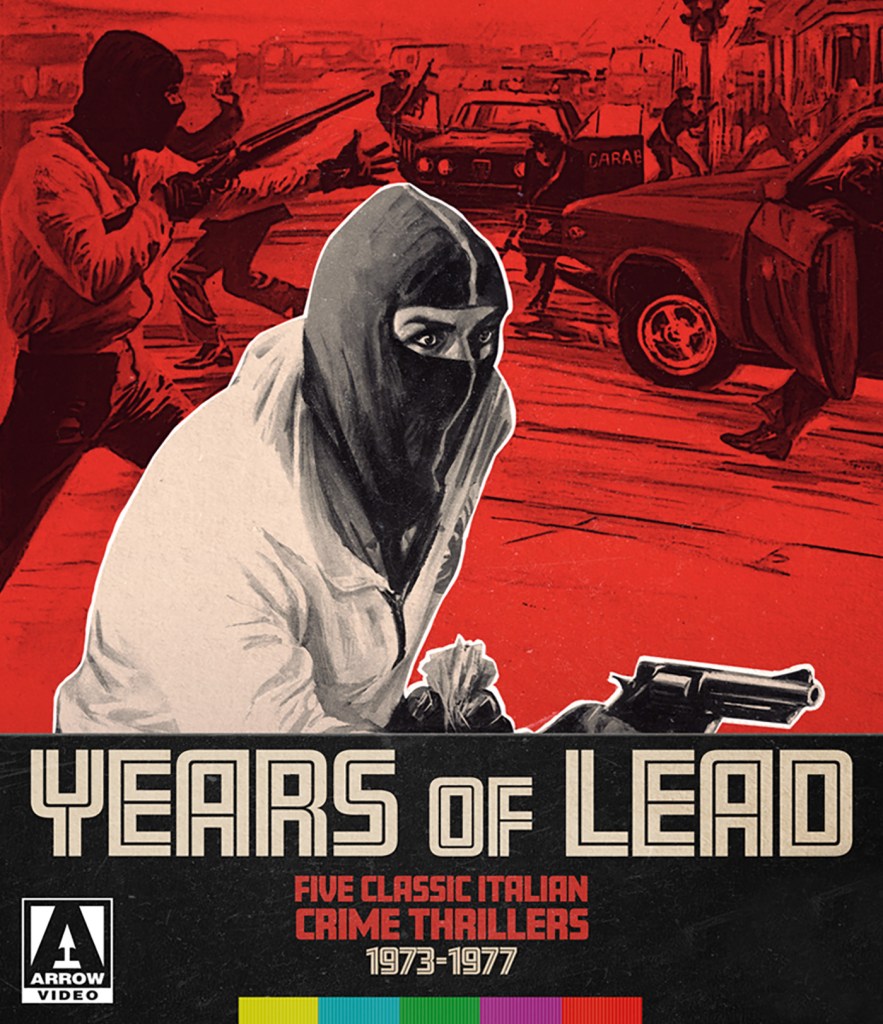
Savage Three is one of five movies on Arrow Video’s Years of Lead: Five Classic Italian Crime Thrillers 1973-1977. These films are great examples of the Italian poliziotteschi genre and the set includes high def versions of this movie, Savage ThreeColt 38 Special Squad, Like Rabid Dogsand Highway Racer. There’s also an interview with director Vittorio Salerno and this movie’s alternate ending. You can get it from MVD.

The Amusement Park (1973)

Originally produced in 1973 and re-discovered and restored in 2017, The Amusement Park was commissioned by the Lutheran Society, which had commissioned it as an educational film about elder abuse and ageism. However, they had issues with the content of the film and it wasn’t seen until 2019 (and now it’s running on Shudder).

People seem to be falling over themselves to proclaim this a lost classic and a definitive artistic statement instead of what it really is — an interesting curio from a director who has a celebrated run of films. It has more interest to Pittsburghers yearning to see West View Park one more time, as well as celebrate the weird fact that a film about an amusement park being used to show the perils of ageism would soon be destroyed for retail stores and now is a mainly empty parking lot where a K-Mart once stood.

In fact, I once did a marketing survey at a beer distributor out there and the bubbly account expert I was working with asked an older man if he drank Iron City Beer. He answered, “Oh, I used to. My friends and I all used to drink Iron City.” She asked back, “Why don’t they drink it anymore?” The reply still haunts me as much as her horrified reaction amused me: “Oh, honey. All of my friends are dead.”

The lead in this, Lincoln Maazel, would play Tata Cuda in Romero’s best-realized film — in my opinion — Martin. Other than him, most of the cast are volunteers and not professionals. This — and the reasons for the making of this movie — make it unfair to rate against Romero’s other films.

Go into this with the intent to see a curiosity and the opportunity to see lost parts of Western Pennsylvania. That’s really what it is, not a lost film per se. It feels very much like the parts of Romero’s films I dislike, like There’s Always Vanilla and, well, everything after Creepshow. But as someone who respects the director as someone who helped create modern horror and put Pittsburgh on the map (well, until he didn’t film Land of the Dead here, but sour grapes and that was probably more due to the city’s film office no longer offering tax breaks), this was still worth watching. I just kind of refuse to blindly accept any artists’ work as universal genius, even people whose work I adore such as Argento, Fulci and, yes, George Romero.

Also, as a denouement, this RogerEbert.com review makes it sound like Romero was living hand to mouth until Dawn of the Dead was made. To wit: “Broke and hungry, he shot low-budget features in the early ’70s and directed eight episodes of a sports documentary series called “The Winners,” profiling the likes of OJ Simpson and Reggie Jackson at the height of their popularity.” Now, I wasn’t around and can’t speak to that, but Romero was shooting tons of commercial work for companies like Calgon, got movies made and The Winners was a pretty big show. I’ve spent twenty-five years or more in Pittsburgh’s marketing community and know that directors back then — from other people in the industry and those with similar roles — were working steadily and hardly starving. Perhaps artistically he was hungry, but this review makes Romero’s life into a great tragedy when I see it as a success. Then again, this same review refers to “Rob Zombie’s marvelously outré Americana” as an actual thing, so there you go.

That said — even after pretty much saying I didn’t enjoy this — I recommend supporting The George A. Romero Foundation and their mission of preserving and promoting Romero’s legacy, as well as creativity within the horror genre and independent filmmaking in general. Here’s hoping that they can help us discover new heroes and not just comb through the past for bits and pieces of what once was, or Romero’s message in The Amusement Park truly will be lost.

Drag Racing Week: Wheels on Fire (1973)

Image Courtesy of Vectezzy.
Image courtesy of Letterboxd.

Wheels On Fire is a classic motor sports documentary — and also one of the most obscure and hard-to-find (as you can see, it’s even impossible to find a decent image of the theatrical one-sheet). But not in the land of Oz, since this was filmed in Liverpool, Sydney. This one kicks ass because of — before there were web-cam and fiber optics — has the first ever “race cam” strapped onto the drag car, which takes you behind the wheel at speeds above 300 kilometers (miles in the States) per hour.

Again, this one is near impossible to track down on VHS and DVD — and the DVDs are grey market VHS-rips. And there’s no trailer or clips. But if you have a family or friend connection in Australia, or you’ll willing to search that country’s online marketplace, you may get lucky finding hard and digital copies to purchase or stream.

And caveat emptor: Do not confuse Wheels On Fire from Australia with the U.S. drag racing documentary Wheels of Fire (1972).

We previous featured this film as part of our weekly “Drive-In Friday” feature.

About the Author: You can learn more about the writings of R.D Francis on Facebook. He also writes for B&S About Movies.