SALEM HORROR FEST: The Hitcher (1986)

EDITOR’S NOTE: This movie was watched as part of Salem Horror Fest. You can still get a weekend pass for weekend two. Single tickets are also available. Here’s the program of what’s playing.

When I first saw The Hitcher, I was probably 14 years old and saw it as a straight-ahead story of violence on the highway. I probably cheered at the end when Jim Halsey (C. Thomas Howell) blew a hole into John Ryder (Rutger Hauer). But age and the miles wear on every man and now when I watch it, it does more than make me raise my fist in the air and shout. It makes me ruminate on the journeys life has taken me and how I’d rather be launched through a window and blasted down a hillside than live a slow, tedious and quiet death.

Halsey starts the film with the kind of confidence that someone at the end of their teens has. He picks up Ryder, who immediately confides to him that he’s killed someone else. But he says something else. Something we don’t expect. “I want you to stop me.”

That’s the whole point of this film. Ryder will transform Halsey into the empty man he is, whether through attrition or forcing him to blast him into oblivion. This road only goes one way.

What does it take to get Halsey to realize this isn’t a nightmare, but reality? Of course, it’s easy to think that this could all be a dream, in the same way that long stretches of drives with no one speaking seem to be visions that last and last. Sometimes, I wonder if I’m still driving and every moment up until here, up until this realization, is just me imagining my life and any moment now, I’m going to wake up with my fiancee asleep next to me.

For our hero, it takes seeing trucks plow into truck stops, station wagons filled with the blood of all American families and the typical movie love interest torn in half by two semis.

Halsey is stripped of his identity, not just because his license and keys — let’s face, the manhood of most red-blooded boys — have been taken away. Everything he may have believed was true — the goodness of giving someone a ride when they need it, that love can conquer fear, even that the role models and lawmakers that society sets up can protect us against one lone man who isn’t just unafraid to die but willingly chases it — is a lie.

Not even suicide can save our hero.

So who is at fault for all the crimes that come out of this spree? If Halsey just shot Ryder in the truck, while Nash (Jennifer Jason Lee, looking like the gorgeous girl who surely will survive all of this madness, right?) is tied between it and another, life would be different.

Look, when a killer says, “I want you to stop me,” you listen.

Eric Red wrote this story while traveling across America, wondering about the lyrics to The Doors “Riders On the Storm.” Pretty simple, really: “If ya give this man a ride, sweet memory will die. Killer on the road, yeah.”

Critics hated it. Both Siskel and Ebert gave it zero out of four stars, with Ebert even decrying the film by saying, “I could see that the film was meant as an allegory, not a documentary. But on its own terms, this movie is diseased and corrupt. I would have admired it more if it had found the courage to acknowledge the real relationship it was portraying between Howell and Rutger, but no: It prefers to disguise itself as a violent thriller, and on that level it is reprehensible.”

Whatever.

The end of this film, as Halsey stands against the sunset and smokes as we process what has just happened just attacks the viewer. The credits just stand there as we feel no celebration or victory. Maybe not even relief, because while it seems like this is over, there’s no way it is over.

The fact that this movie spawned a sequel and a Michael Bay remake are two things that I have added to the many things that I have tried to forget so that I can keep on living my life*. Kind of like how director Robert Harmon makes the Jesse Stone TV movies for Tom Selleck now instead of getting to create more movies like this (that said, I’ve heard good things about They, a movie he did with Wes Craven and I kind of don’t mind his Van Damme film Nowhere to Run). Red would move on to write a few other films that break the mold and are on my list of favorite films: Near Dark and Blue Steel.

The last thing that this movie makes me feel is loss. Rutger Hauer is such an essential part of my film nerd stable of actors, someone who always makes a movie way better than it seems like it will be just by his presence. Nighthawks is so intense because of him. Films like Wanted Dead or AliveThe Blood of Heroesand Buffy the Vampire Slayer (with Hauer getting to finally play the vampire lord that Anne Rice, who always wanted him as Lestat, saw him in) are actually great because of Hauer. And Blade Runner means nothing without him as Roy Batty.

Hauer astounded the stunt people in this movie, pulling off the car stunts by himself. And he also intimidated Howell, scaring him even when they weren’t acting. He even knocked out a tooth when he flew through the windshield himself. There is no one who could have played this character quite so well and stayed with me so long after the film was over.**

*The fact that René Cardona III made a Mexican version of this called Sendero Mortal does give me the energy to keep on living.  I’d also like to recommend the absolutely insane Umberto Lenzi in America  Hitcher In the Dark, which makes me wish that more Italian directors made their own versions of The Hitcher.

**Hauer said in his autobiography, All Those Moments, that Elliott “was so scary when he came in to audition that Edward S. Feldman was afraid to go out to his car afterward.”
SALEM HORROR FEST: Bakeneko: A Vengeful Spirit (1968)

EDITOR’S NOTE: This movie was watched as part of Salem Horror Fest. You can still get a weekend pass for weekend two. Single tickets are also available. Here’s the program of what’s playing.

Held in conjunction with the Miskatonic Institute of Horror Studies’ presentation of Alexandra West’s multimedia lecture The Cat Came Back: Feline Familiars in the Horror Genre, the new 2K restoration of Bakeneko: A Vengeful Spirit screened this weekend at Salem Horror Fest.

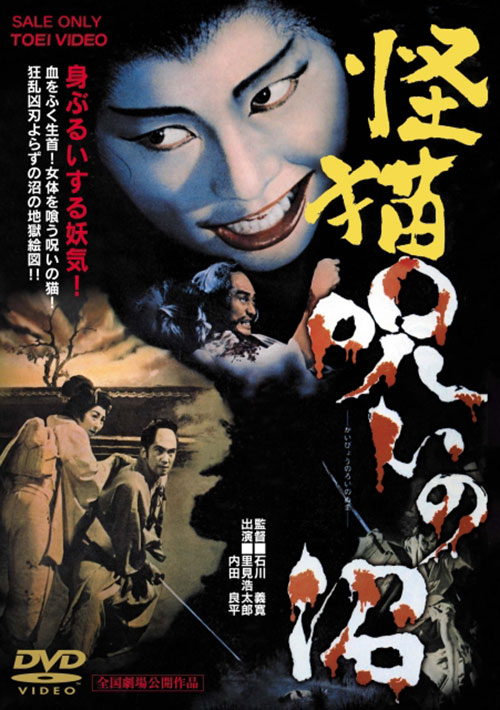
Also known as Ghost Cat of the Cursed Pond, this explains what happens when Nabeshima Naoshige murders Ryuzoji Takafusa in an attempt to get his land, his power and his wife Lady Takafusa, who would rather drown herself and her cat familiar in a swamp than suffer underneath this man. Also: Takafusa is killed by being sealed up in clay.

Years later, Naoshige has learned nothing and tries to assault another woman, Yukiji (Kyoko Mikage), then claims that he will behead her entire family if she doesn’t leave her fiancee Yuki Jonosuke (Kotaro Satomi) for him. The young lovers are faced with a horrible choice before they find Lady Takafusa’s cat mud-caked cat on the shore. It has not forgotten the past and is thirsty for blood and ready to take revenge for the lives stolen by the rich and powerful. You get what you ask for when you anger the spirits of the swamp during the festival meant to appease them. As Yukiji and Yuki die in the swamp, the cat drinks deep of their plasma and sets into motion its horrific reprisal.

Soon, one of the many wives of Naoshige, Lady Hyuga (Machiko Yashiro) has clawed hands — yes, like a cat — and is feasting on the many severed arms of her victims.

Director and writer Yoshihiro Ishikawa covers this film in inky darkness and by the end, unleashes severed arms crawling for the dead, beheadings, psychotic freakouts and the entire family of Noashige paying for his behavior. Ishikawa also directed The Ghost Cat of Otama Pond and wrote Mansion of the Ghost Cat if you need more Kaibyo — ghost cat — films. There’s also KuronekoBlind Woman’s Curse and Hausu.

This one has a truly hateable villain, doomed heroines and that ghost cat whose eyes cast a shadow across everything in this film. A magical exploration of myth and cinema; one that I can’t wait to watch again when Severin releases it this year.

SALEM HORROR FEST: Satan Wants You (2023)

EDITOR’S NOTE: This movie was watched as part of Salem Horror Fest. You can still get a weekend pass for weekend two. Single tickets are also available. Here’s the program of what’s playing.

At the height of sheer Q-Anon craziness — I think probably when a shaman in red, white and blue facepaint led an army of people into government buildings, and people defecated on the walls, maybe — people were grasping for straws and pearls and wondering, “How could this happen?”

I’m here to tell you that this has always been here.

In the 1980s, high school me was the same as old me. I was always in black, with long hair, and I only cared about music, movies and studying weird things. As such, I was brought into the Core Group, a team of teachers led by an occult expert cop who studied which students could be worshipping Satan. This group was led by my godmother.

The Satanic Panic wasn’t started by Michelle Remembers, but it felt like it was. The union of Canadian psychiatrist Lawrence Pazder and his psychiatric patient (and eventual wife, but we’ll get to that) Michelle Smith. In the mid-70s, while treating Michelle for depression due to a miscarriage, she confessed to him that she knew that something horrible had happened to her and could not recall what it was. Using hypnosis, Michelle was soon screaming for 25 minutes non-stop and speaking in the voice she had as a child. 14 months and 600 hours later, a conspiracy was found: Michelle’s mother and other citizens in Victoria were members of a worldwide Church of Satan.

At one point, Michelle was part of a ritual that lasted 81 days that Satan himself showed up for, and during that time, she was tortured, raped, witnessed others get killed and was covered with the blood of murdered babies until St. Michael the Archangel, Mary and Jesus appeared, healing all of her scars and blocking all of her memories of the years of Satanic desecration of her body and soul.

None of these stories were challenged, even a decade after, when Michelle and Laurel Rose Willson, who wrote Satan’s Underground about being a breeder for Satanists and having two of her children killed in snuff films, were on Oprah Winfrey and at no moment did Oprah challenge either of them, in 1989. The year, I was repeatedly questioned and challenged and told that I was giving my soul to Satan.

I was a white kid from a small town, and in no way have I ever dealt with racism, sexism, transism or any isms in any other way again. This experience, however, showed me a small, tiny glimpse into what it’s like to know you’re right and everyone is sure you’re wrong based on no facts at all.

By the 80s, Pazder was an occult expert, consulting in the McMartin preschool trial and appearing on a 20/20 segment called “The Devil Worshippers” that stoked the flames of the Satanic Panic. That report claimed that movies like The GodsendThe IncubusAmityville II: The Possession, Exorcist II: The HereticThe ExorcistThe Omen and Omen 2 allowed people to visualize and be inspired by the devil. This aired in prime time on ABC, a major cable network. They also refer to The Satanic Witch as a book filled with evil rites. And then, of course, heavy metal. As Anton LaVey was in his era of not speaking to the media, this also has footage taken from Satanis.

As part of the Cult Crime Impact Network, Pazder got into business working with police groups and consulting on Satanic ritual abuse, while lawyers used his book while doing cases, and social workers used Michelle Remembers as their training manual.

According to NPR host Ari Shapiro, “One reason these fictions were so appealing was that they gave people a sense of purpose. They had a mission – to defend the innocent.”

This is what’s happening today. It’s why trans people are grooming children, why Democrats are eating babies, and why elections are being seen as conspiracies. Because the truth — the idea that things happen randomly for no reason — is less frightening than Satanism or Q-Anon.

Man, did I digress?

In Satan Wants You, filmmakers Sean Horlor and Steve J. Adams explore the history of Michelle Remembers and what most people don’t know, such as how Pazder and Smith left their families to be together and how the book was debunked. It would be one thing if their sessions led to a book and some press, but it would be another if they kicked off an entire movement.

The directors have stated: ““This is the first time that Michelle’s sister, Larry’s ex-wife, and Larry’s daughter have gone on the record to tell their side of this story. This was a once-in-a-lifetime opportunity to combine all these stories together to reveal the true origins of the Satanic Panic and show how they connect to the Pizzagate and QAnon conspiracies of today.”

This movie must be seen, even if we’ve entered a time when feelings matter more than facts. But did facts ever matter?

This film also found an anonymous source sending Michelle’s actual tapes, which have never been heard until now.

I don’t discount that she went through some trauma. Yet, how many lives were destroyed along the way?

The sad fact is that no one has learned anything. That same refrain of “protecting the children” exists today. And yes, that’s a noble endeavor. But as someone who grew up in a town of 7,500 people that had more than one Catholic priest abusing children in the last fifteen years of my life, Often, the abuser is someone the abuser has known and trusts.

Just like a worldwide Satanic network — paging Maury Terry and The Family, a book that lost a court case to the Process Church over false claims — and a public ritual lasting 81 days seems complicated to swallow, so do all the claims of the far right today.

Back when I was a kid getting grilled over my slasher movie magazines and love of Danzig, I figured, “Well, someday soon, all of these close-minded people will die off, and we can get past racism, and we can learn how to be more open-minded together.” But now, everyone is close-minded. No one seemingly wants to learn. And this movie is a great teaching tool — it’s a must-see, an intense documentary worthy of rewatching — because it happened before, and yes, it’s going on all over again. The message may have shifted, but it’s still the message.

And it’s still wrong.

SALEM HORROR FEST: Demons (1985)

EDITOR’S NOTE: This movie was watched as part of Salem Horror Fest.

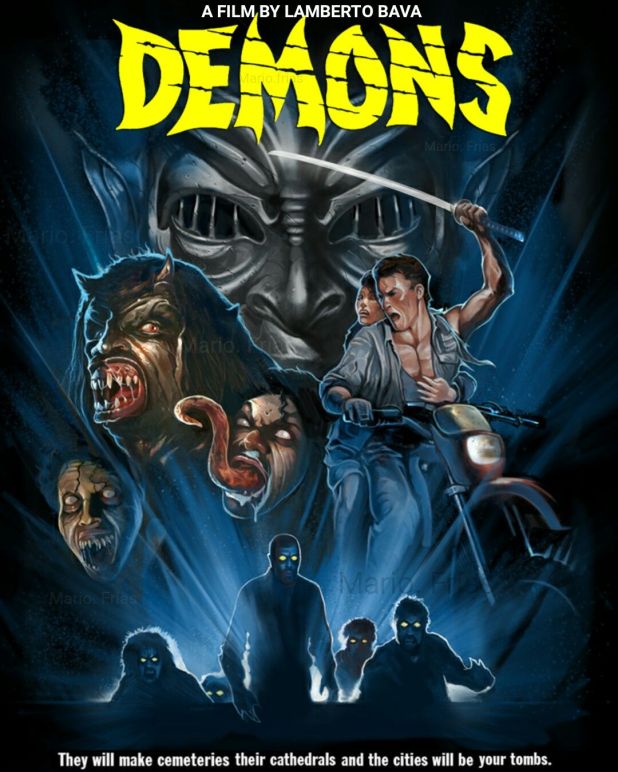
They will make cemeteries their cathedrals and the cities will be your tombs. With that line, you know that what you’re about to watch better be the most mind-blowing horror film possible. Good news — Demons is all of that and then some, the kind of movie that has everything that I watch movies for.

I can’t be silent or still while it runs, growing more excited by every moment. It is the perfect synthesis of 1980’s gore and heavy metal, presented with no characterization or character growth whatsoever. It’s also the most awesome movie you will ever watch.

https://www.youtube.com/watch?v=6HkHDrRa8R4?

This is an all-star film, if you consider Italian 80’s horror creators to be all-stars. There’s Lamberto Bava directing and doing special effects, Dario Argento producing, a script written by Bava, Argento, Franco Ferrini (Once Upon a Time in AmericaPhenomena) and Dardano Sacchetti (every single Italian horror film that was ever awesome…a short list includes A Bay of BloodShockThe Beyond1990: The Bronx WarriorsBlastfighterHands of Steel and so many more), and assistant directing and acting from Michele Soavi.

The movie starts on the Berlin subway, where Cheryl is pursued by a silver masked man (Soavi) who hands her tickets to see a movie at the Metropol. She brings along her friend Kathy (Paola Cozzo from A Cat in the Brain and Demonia) and they soon meet two boys, George (Urbano Barberini, Gor, Opera) and Ken.

The masked man has brought all manner of folks to the theater: a blind man and his daughter and some interesting couples, including a boyfriend and girlfriend, an older married one and Tony the pimp and his girls, one of whom is Shocking Dark‘s Geretta Giancarlo. As they wait for the movie to begin, a steel mask in the lobby scratches her.

The movie that unspools — a slasher about teenagers who disturb the final resting place of Nostradamus — also has that very same steel mask. When it touches anyone in the movie, they turn murderous. At the very same time, one of the prostitutes scratches herself in the bathroom and her face erupts into pus and reveals a demon. From here on out, the movie becomes one long action sequence, as the other prostitute transforms into a demon in front of the entire audience.

Meanwhile, four punks do cocaine in a Coke can and break in, releasing a demon into the city as the rest of the movie audience attempt to escape and are killed one by one. Only George and Cheryl survive, as our hero uses a sword and motorcycle to attack the demons before a helicopter crashes through the roof. But then the masked man attacks them!

I’m not going to ruin the rest of the movie, only to say that even the credits offer no safety in the world of Demons. And oh yeah — Giovanni Frezza (Bob from House by the Cemetery) shows up!

Look for Argento’s daughter Fiore as Angela and Ingrid the usherette is played by Nicoletta Elmi, who was the baron’s daughter in Andy Warhol’s Frankensteinas well as appearing in Baron BloodA Bay of Blood and Who Saw Her Die?

This is but the first of a series of movies with the title Demons. I can’t do justice to the twists and turns of how that all works. Instead, I turn to the master, Joe Bob Briggs.

Demons is ridiculous. Pure goop and gore mixed with power chords, samurai swords, punk rockers and even a Billy Idol song which had to blow the budget. It also looks gorgeous — filled with practical effects, gorgeous film stock and amazing colors, no doubt the influence of Bava’s father. The scene where the yellow-eyed demons emerge from the blue blackness is everything horror movies should be.

This doesn’t just have my highest recommendation. It earns my scorn if you haven’t seen it yet!

Want to know way too much about this movie and everything connected to it?

Check out this article and the video I created: So what’s up with all the Demons sequels?

SALEM HORROR FEST: Stag (2022)

EDITOR’S NOTE: This movie was watched as part of Salem Horror Fest. You can still get a weekend pass for weekend two. Single tickets are also available. Here’s the program of what’s playing.

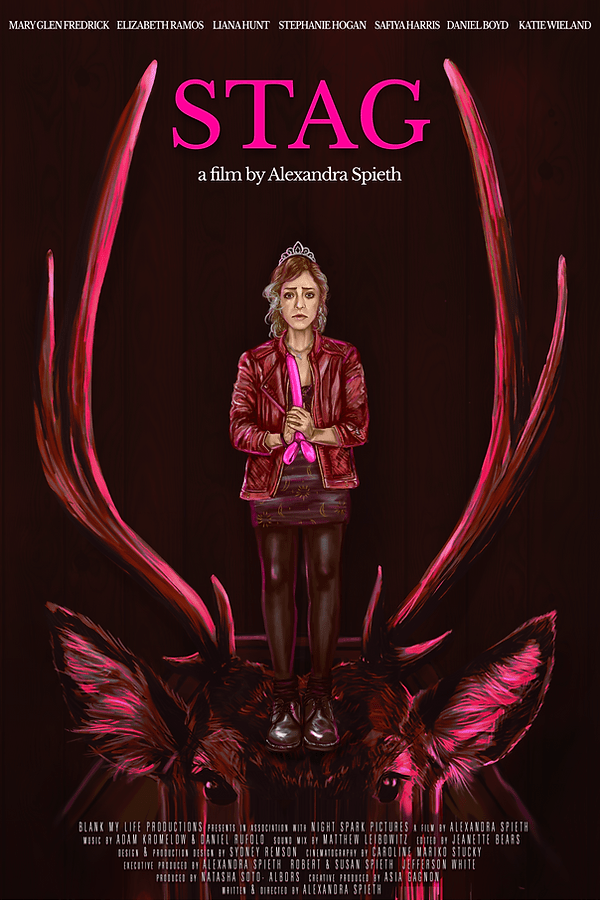
Directed and written by Alexandra Spieth, Stag is about Jenny (Mary Glen Fredrick) and her attempts to reconnect with her former best friend Mandy (Elizabeth Ramos) during a bachelorette party at a seemingly haunted campground.

What drove these friends apart? Why does Jenny have such difficulty connecting with anyone? Why are the religious beliefs of sisters Constance (Katie Wieland) and Casey (Stephanie Hogan) just so strange? Is this what it’s really like when women get together?

We can all feel for Jenny. Her only anchor in this unfamiliar territory is Mandy. There’s something unspoken that drove them in two directions yet there’s still some love between them. Yet as everyone else’s motivations are so unclear at best and malevolent at worst, it makes me glad that I skipped that bachelor party weekend I was supposed to go to last month.

What the film misses in proper lighting and color balance — the outside footage nearly washes out the movie at times — it makes up for it in writing and acting. A better budget would have done wonders, but let’s just forget that. Let’s concentrate on a movie that takes a great elevator speech — “What if Bridesmaids and Midsommer had mimosas?” — and delivers something special.

SALEM HORROR FEST: Candyman (1992)

EDITOR’S NOTE: This movie was watched as part of Salem Horror Fest. You can still get a weekend pass for weekend two. Single tickets are also available. Here’s the program of what’s playing.

I was just discussing slasher movies and their lack of blackness with one of my friends last week and we struggled to come up with many movies where there was a black killer. Sure, there’s Snoop Dogg’s turn in Bones, which is pretty much a remix of J.D.’s Revenge. Then we remembered — Candyman.

Bernard Rose has directed some really interesting films, like 1988’s dark fantasy of growing up Paperhouse. He was also behind the videos for Frankie Goes to Hollywood’s “Relax” and “Welcome to the Pleasuredome” before he met with Clive Barker, expressing interest in adapting the story “The Forbidden.”

While the original story is more of an examination of the British class system, Rose moved his story to the inner city of Chicago, where he could better focus on the racial, social and cultural divides of America. Some of its story was inspired by journalist Steve Bogira’s articles about the murder of Ruthie Mae McCoy in Chicago’s Abbot Homes housing project. In particular, the detail that she was murdered by someone who entered her apartment through the opening behind her medicine cabinet becomes an integral part of this story.

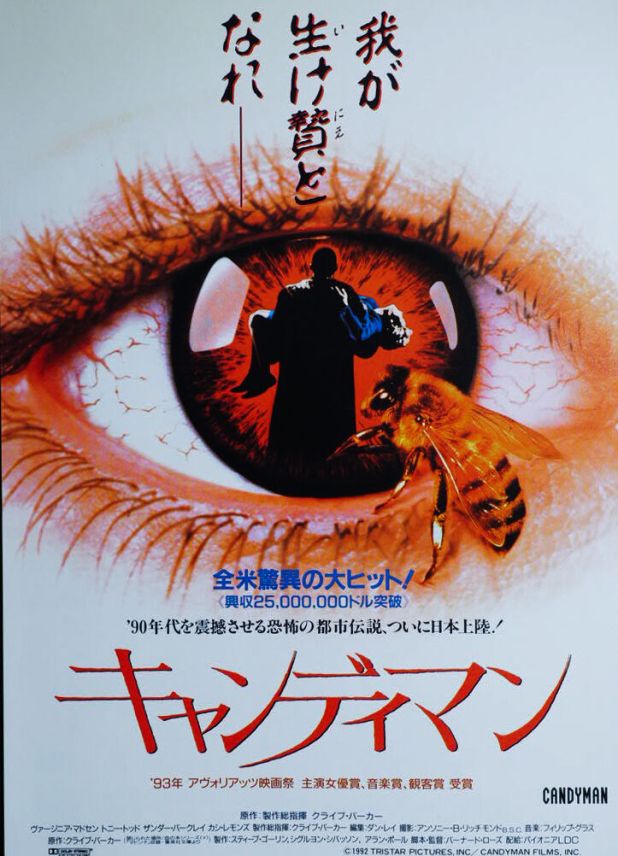
Amazingly, Eddie Murphy was the original choice for the titular role, but he was too expensive for the production. Enter Tony Todd. He told IGN that despite fears of being typecast, “I’ve always wanted to find my own personal Phantom of the Opera.” As he was concerned about the threat of being stung by the numerous bees he would contend with, he negotiated a bonus of $1,000 for every sting he suffered during filming. He’s a smart man — he ended up earning an extra $23,000.

Not to name drop, but I had the honor of working with Todd when he came to Pittsburgh to inaugurate the Pittsburgh Public Theater with a performance of August Wilson’s King Hedley II. I’d written a radio commercial promoting it and instead of struggling with a casting agency to discover the right voice, I inquired if Todd would be willing to do the recording session. He was happy to promote the play, as he’d acted in the same play on Broadway. However, the PPT had one condition.

I was told, “No matter what, please do not mention that horror movie he was in.”

I replied, “Do you mean The Crow or the remake of Night of the Living Dead?” Nobody got the joke.

So cut to me standing on the sidewalk of Liberty Avenue, waiting outside Todd’s hotel. Talk about nerve-wracking. Suddenly, he was ten feet away from me, his six foot five-inch frame even more imposing in person.

“Do we have time for a salad? I’m dying for a salad.”

Not the first thing you’d expect to come out of Candyman’s mouth.

Literally we were ten feet down the street, on the way to a restaurant when someone jumped in his way and started yelling “Candyman! Candyman! Candyman!” He laughed a jovial chuckle, signed a quick autograph and I said, “They told me you hated that movie and I shouldn’t mention it.”

He smiled and said, “Look, the first one is great. The second one isn’t bad. The third one? You gotta put your kids’ in college. I’m always happy to talk about a movie that let me live the life I live today.”

Of all the moments in my professional career, there is truly nothing quite like closing your eyes and hearing Tony Todd’s deep voice intone your words.

Thanks for indulging me. Back to Candyman.

Helen Lyle (Virginia Madsen) is a Chicago graduate student researching urban legends. She learns of the Candyman, a demon that appears whenever you say his name five times into a mirror, at which point he’ll stab you with the hook where his right hand once was. This tale is remarkably similar to the story of Mary Black from my rural hometown of Ellwood City, PA.

She begins to investigate the murder of Ruthie Jean, a resident of the Cabrini-Green housing project who two cleaning ladies believe was killed by the Candyman. She’s not alone — 25 other people have been killed in similar fashion.

That night, Helen and her friend Bernadette Walsh (Kasi Lemmons, who was in Silence of the Lambs and would go on to direct The Caveman’s Valentine) do the ritual, saying Candyman’s name into a mirror. Nothing happens.

As Helen begins her thesis: Candyman is a way to cope with the despair that Chicago’s  African-Americans feel as they struggle to survive in the projects. A professor shares the story of Candyman’s origins, which begin with him as the son of a slave who would soon become free and known for mass-producing shoes. He grew up free and became an artist of some fame before marrying a white woman in 1890; however, her racist father hired a lynch mob that cut off his artistic hand, replaced it with a hook and smeared him with honey. The stings of bees nearly killed him before he was burned alive and his ashes scattered across he fields where the Cabrini-Green now exists.

As part of her study of the legend, Helen meets Anne-Marie McCoy (Vanessa A. Williams, Melrose Place) and a young boy named Jake, who tells her the story of a young boy who was castrated by the Candyman. Helen is attacked by someone when she visits the scene of the crime but her attacker is human. He’s arrested based on her testimony and the world thinks Candyman is gone.

That night, as Helen is getting into her car, the real Candyman appears. She’s made people think his legend isn’t true and now innocent blood must be spilled so that he may survive. Helen wakes up in Anne-Marie’s apartment, covered in blood. The dog has been beheaded and her son is missing, so she attacks Helen, who is arrested by the police.

At each turn, Candyman comes closer and closer to ending Helen’s life as he snuffs out the existence of everyone around her. After she’s committed for a month, a psychologist interviews her to see if she’s fit for trial as she’s suspected in the death of her best friend Bernadette. She offers to summon Candyman to the unbelieving doctor who is soon dead at the hands of the so-called urban legend. I love this scene, as the formerly disbelieving protagonist of this tale has willingly given in to the unreality that her world has become. As for her husband Trevor, he doesn’t care at all — he’s taken up with one of his students in her absence.

Helen runs to Cabrini-Green where she discovers murals depicting the lynching of the human being who would become the Candyman. He appears and tells her to surrender to save the life of the child, offering her immortality as he opens his jacket, revealing an open ribcage filled with bees. He believes that Helen is truly his lover Caroline Sullivan, reincarnated and ready to become immortal at his side.

Candyman promises to release the child if Helen helps him incite more fear, but he decides that instead, he will set the entire project on fire. She saves Anthony by shoving the monster into the flames of a bonfire before it takes her life too. The residents of the apartment building all attend her funeral, throwing numerous flowers and finally Candyman’s hook into her grave.

At the end, Trevor must face both grief and guilt in the mirror, where he says her name five times. As he turns, his wife has appeared, along with Candyman’s hook. As we return to the projects, the graffiti of Candyman has been replaced by a woman with her hair on fire. Helen has now become part of the immortal world of folklore.

The music for this film comes from minimalist composer Philip Glass, who was upset that the film came off as a low budget slasher. However, he told Variety in 2014, “It has become a classic, so I still make money from that score, get checks every year.”

Madsen is really amazing in this film and used hypnosis and a trigger word to make her even more frightened for her scenes with Todd. However, this process was too much for her so she didn’t use it for the entire movie. The two actors also took ballroom dancing classes together to create an element of romance between their characters.

SALEM HORROR FEST: Woodlands Dark and Days Bewitched: A History of Folk Horror(2021)

EDITOR’S NOTE: This movie was watched as part of Salem Horror Fest. You can still get a weekend pass for weekend two. Single tickets are also available. Here’s the program of what’s playing.

If you have even a passing interest in the world of folk horror, Kier-La Janisse’s exhaustive exploration — which clocks in at 3 hours and 14 minutes and could have been a thousand more if I had my way — is the film of a lifetime. The ‘unholy trinity’ that launched this trend on to screens — Michael Reeves’ Witchfinder General, Piers Haggard’s Blood on Satan’s Claw and Robin Hardy’s The Wicker Man — are not just names, but significant milestones in the history of folk horror. This movie is quite literally the last word in what folk horror is, what it means and how it’s still part of the world of cinema today, perhaps more than ever before.

With more than fifty significant names in the world of horror and horror writing — everyone from Amanda Reyes, Piers Haggard, Adam Scovell, Jeremy Dyson Samm Deighan, Kat Ellinger, Robert Eggars, Ian Oglivy, Kevin Kölsch, Dennis Widmyer and around forty more voices appear with great insights — there’s never been a more well-rounded approach to tackling a movie genre within a genre. This feels like the kind of film that I’ll be coming back to again and again.

Beyond the expected anchors of the genre, I was so excited to see lesser-known films get their due, like Alison’s Birthday (which is on the gigantic All the Haunts Be Ours box set that Severin is releasing), beDevilDark AugustEyes of Fire (also being released by Severin), Grim Prarie TalesLemora (which seemingly has footage from the mysterious blu ray of the film that never materialized) and Zeder.

This is the kind of material you want to pause, write down, make notes on, and keep updating your Letterboxd while watching it. This isn’t just a movie about films. This is a true celebration of the magical wonder hidden within the flickering image, an exploration of a genre of all the dark old things and a journey through how each country documents the unknown through their media.

There aren’t enough stars in the firmament out of ten to rate this one. You can preorder this film from Severin now or watch it on Shudder. You can also visit the film’s official site.

Thanks to the fantastic Letterboxd list Films mentioned in “Woodlands Dark and Days Bewitched: A History of Folk Horror by Jon Ursenbach, here’s a list of the films as well as links to reviews of them that we’ve done on our site.

SALEM HORROR FEST: The Blood On Satan’s Claw (1971)

EDITOR’S NOTE: This movie was watched as part of Salem Horror Fest. You can still get a weekend pass for weekend two. Single tickets are also available. Here’s the program of what’s playing.

In his BBC documentary series A History of Horror, Mark Gatiss referred to this film, along with Witchfinder General and The Wicker Man, as the prime example of a short-lived subgenre he called folk horror.

https://www.youtube.com/watch?v=2RMySPyhMUY?

It’s directed by Piers Haggard, who also was behind The Quatermass ConclusionThe Fiendish Plot of Dr. Fu Manchu and Venom. He’s also the great-great-nephew of H. Rider Haggard, the creator of Allan Quartermain.

Robert Wynne-Simmons was hired to write the story, which was inspired by the modern-day Manson Family and Mary Bell child murders.

In the early 18th century, Ralph Gower (Barry Andrews, Dracula Has Risen from His Grave) uncovers a one-eyed skill covered with fur while plowing his fields. He asks the judge (Patrick Wymark, Dr. Syn, Alias the Scarecrow) to look at it, but it’s gone missing, and his fears are ridiculous.

Peter Edmonton brings his fiancee, Rosalind Barton (Tamara Ustinov, Blood from the Mummy’s Tomb), to meet his aunt, Mistress Banham. Banham disapproves of the coupling and demands that Rosalind sleep in an attic room. After screaming throughout the night, she soon gets ill, and the judge commits her. As she’s led away, Peter discovers she has a claw instead of a hand.

Claws show up all over this — hidden in fields to be found by children and attacking Peter inside the cursed room, causing him to sever his hand. The judge leaves behind the town for London but promises to return. He places Squire Middleton (James Hayter, The 39 Steps) in charge.

One of the children who found the claw, Mark, is lured out by his classmates and killed in a ritual game by the leader of a new cult, Angel Blake (Linda Hayden, MadhouseQueen Kong). She even tries to seduce Fallowfield (Anthony Ainley, the Master from Dr. Who) and tells him that Mark had the devil inside him, which needed to be cut out. Her group also has a Black Mass inside a ruined church where they attack Mark’s sister Cathy (Wendy Padbury, companion Zoe on Dr. Who). They ritualistically assault and murder her before tearing the fur from her skin.

Of course, it’s not long before all hell quite literally breaks loose, with insane children raising Satan himself from the Great Beyond and Ralph growing fur on his leg, marking him for death. This movie is…well, there’s nothing else quite like it. I can see why it had a limited audience for years; it’s so dark and unforgiving.

“It never made much money,” said Haggard. “It wasn’t a hit. From the very beginning, it had a minority appeal. A few people absolutely loved it, but the audiences didn’t turn out for it.”

While Satan’s Skin was the original title, you must give it to American International Pictures’ Samuel Z. Arkoff, who created the film’s title.

SALEM HORROR FEST: Morgiana (1972)

EDITOR’S NOTE: This movie was watched as part of Salem Horror Fest. You can still get a weekend pass for weekend two. Single tickets are also available. Here’s the program of what’s playing.

Juraj Herz is most often associated with the Czechoslovak New Wave and his 1969 film The Cremator. A Holocaust survivor who had sixty of his family die in the camps, he was a self-taught director who gravitated toward horror while also keeping his eye toward fairy tales. He commented once that dark humor was a form of expression and he believed that even serious films should be laughed at.

Based on Alexander Grin’s Jessie and Morgiana, this film explores the hatred between two sisters, Klara and Viktoria, both played by Iva Janžurová. Yes, their father may have given all of his fortune to Klara, but Viktoria is left with a small castle of her own. But the final push toward the overwhelming resentment  Viktoria feels is when her sister falls for the man she loves, Lieutenant Marek.

That’s when she begins to work alongside Otylie, a gypsy sorceress, to create a poison that no one will ever discover has killed her sister. As Klara grows ill, Otylie takes advantage and begins to blackmail Viktoria, who responds by literally casting her into the sea.

And while Klara is always clad in white and seemingly the damsel in distress, her sister is forever in black but worse, unable to escape not only the guilt and shame, but even the ghost of Otylie who will never leave her even in death.

So who is Morgiana? Why, she’s the cat. A cat so essential that she has her own point of view shots throughout the film.

The write-up for this film promises that the poison given to Klara open her mind to “kaleidoscopic hallucinations” and that is, if anything, less hyperbole than it should be. This movie practically explodes and delivers a cosmic freakout filled with ancient Tarot cards, distorted lenses and a deluge of only the fanciest of clothes (the hat budget on this movie had to be excessive), the most extravagant of makeup and filled with sonic fury, delivered by Lubos Fiser, who also composed the music for Valerie and Her Week of Wonders.

This movie is drugs and I want to overdose.

SALEM HORROR FEST: The Ninth Heart (1979)

EDITOR’S NOTE: This movie was watched as part of Salem Horror Fest. You can still get a weekend pass for weekend two. Single tickets are also available. Here’s the program of what’s playing.

Deváté srdce is about a student named Martin who has volunteered to seek out the cure for Princess Adriana, who has been knocked down and out by a mysterious illness. But the truth is that it’s no sickness. Instead, the magician Andlobrandini has enchanted her as part of his plan which involves creating a magic potion to return his youth from the blood of nine children’s hearts.

Directed by Juraj Herz, who wrote the story with Josef Hanzlík, everything in this feels handmade, down to the poster by surrealist painter, writer and ceramicist Eva Švankmajerová. This was shot at the same time as Herz’s Beauty and the Beast in an attempt to save on costs and is a fairy tale created in modern times that in no way feels unlike the tales we were told at bedtime.

By literally capturing the young hearts of the young men who have come to save Adrianna, Andlobrandini  seeks to take their vitality and become hale and hearty anew. Unlike them, Martin has no love for the princess. Instead, the Grand Duke (Premysi Koci) allows him to take on this mission instead of sending him and the street circus people he has fallen in with to jail, most especially Toncka (Anna Malova), the daughter of a puppeteer.

Joined by the Grand Duke’s jester (František Filipovský) and wearing a cloak of invisibility, the two men go across the River Styx to the Grand Duke’s former alchemist’s — yes, Andlobrandini — dark and foreboding castle, a place filled with corpses, innumerable candles, a swinging sun and danger around every turn. It’s gorgeous and perhaps the greatest love within this film is for the art of moviemaking itself.