This is the fourth year I’ve participated in the F This Movie! month-long event.
For those of you new to Junesploitation, here’s how it works: each day of the month has its own theme, and you’re supposed to watch a movie that ties into that theme. How you interpret the connection is entirely up to you, which means if you have no interest in exploitation or genre movies that’s ok and you can still join in!
This is the second episode of three that will break down every movie that I watched. It’s a long one!
June 20: Junesploitation’s topic of the day — as suggested by F This Movie— is Blacksploitation! We’re excited to tackle a different genre every day, so check back and see what’s next.
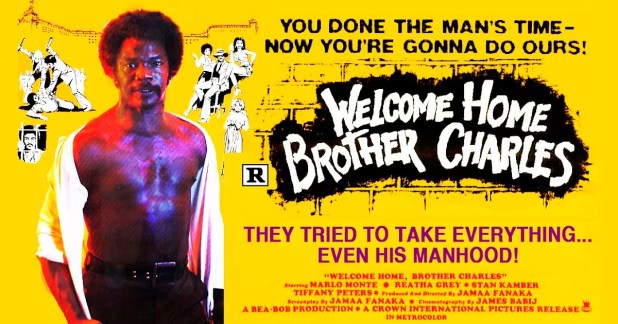
Born Walter Gordon, Jamaa Fanaka was one of the leading directors of the L.A. Rebellion film movement, a new generation of young African and African-American filmmakers who studied at the UCLA Film School in the late-1960s to the late-1980s. They created a new form of black cinema that was an alternative to Hollywood. Fanaka was, however, “very much fascinated by Hollywood and averse to the contentious ideological and artistic discussions that were fundamental to the formation of the school.”
Independently produced, written, directed and edited by Fanaka as an undergraduate project at UCLA that took seventeen months of weekends, all of his savings and some of his parent’s as well, Fanaka’s advisors at the school told him to not even try a feature film as his class project. He ended up creating one that won a national theatrical distribution deal with Crown International Pictures. The director would complete his thesis film, Emma Mae, and Penitentiary while still in college.
Sure, it was re-released on video as Soul Vengeance but this movie isn’t the typical blacksploitation movie, despite beginning with its hero Charles (Marlo Monte) being arrested by corrupt white police and nearly castrated. When he’s released, all Charles wants to do is forget the past. He wants to move past the life of crime he once led. He can’t even have Twyla (Jackie Ziegler), the girl he loves, who is now the woman of his former best friend, N.D. (Jake Carter).
Sounds like a typical blacksploitation movie and I promised you that it wasn’t.
That’s because while Charles was in prison, he was experimented on, like Luke Cage in Marvel Comics, but instead of getting skin knives and that bullets can’t touch, he gets a murderous and prehensile penis. Seriously, it’s feet, not just inches long. It’s the kind of penis that frightens the white male establishment way more than the typical African American member, because when he’s not using it to seduce the white wives of the cop who tried to slice off his prick, Officer Harry Freeman (Ben Bigelow), as well as the prosecutor and judge who set him up. He’s also strangling those men with it, which has to be the worst way for a straight white racist man to die.
Despite trying to find some form of comfort with Carmen (Reatha Grey), prison has destroyed Charles. And what he’s done to Freeman’s wife (Tiffany Peters) has ruined that cop, as if he needed any help, telling his wife that she’s contaminated. That’s because even before he gained his monstrous member, Charles was cucking the law. And that’s why Freeman tried to take a knife to our hero while he was in handcuffs. I have no idea why he’s stayed married, as one evening he wakes her up by choking her back into oblivion and she looks him in the eye and snarls, “You think you’re a man? You didn’t even have the guts to destroy the object of your humiliation. Me!”
Also, maybe I didn’t mention it, but his new penis — who would do this experiment, what was it for and why would they be authorized? — can hypnotize white women.
I love that this movie exists, that it has sloppy moments where we just watch people dancing in the streets in footage that had to be just the camera running and capturing what these small Los Angeles neighborhoods used to be like. As wild as this movie gets, it only hints at just how far Fanaka would push reality with the Penitentiary series.
June 19: Junesploitation’s topic of the day — as suggested by F This Movie— is 80s Horror! We’re excited to tackle a different genre every day, so check back and see what’s next.
I’ve made a real 180 on Lamberto Bava. Maybe it’s because the first of his movies that I watched was Devilfish. I should have really started with Macabre, A Blade In the Dark or any of his TV movies and then I’d feel a lot different. And years ago, I unfairly compared him with his father instead of allowing him to be judged on his own merit.
I am sorry, John Old Jr.
The Prince of Terror has never been released in the U.S. on VHS, DVD or blu ray. That’s a shame.
It pulls the Body Double fake out as soon as it starts, as you get the jump scare of a woman — Magda (Marina Viro) — escaping an RV only to see her boyfriend drown in a swamp and become an inflated zombie and begin stalking her through a swamp.
This isn’t happening.
Instead, it’s the set of director Vincent Omen’s (Tomas Arana, The Church) latest movie. He hates the script from his longtime writer Paul Hilary (David Brandon, who was the director in Stage Fright so dumb that he let his cast stay in the theater where a killing machine was hiding), so he gets him fired before heading out to play golf. While he’s hitting the front 9, he’s interviewed by a reporter (Virginia Bryant, The Barbarians) who asks him about the rumors that he’s much older than 37 and his public perception as the “Prince of Darkness.”
He holds up one of his golf balls, which has 666 on it. Obviously, he’s into this personna.
After he finishes playing, he goes home to his wife Betty (Carole Andre, Yor Hunter from the Future), daughter Susan (Joyce Pitti) and dog Demon. Yes, he is definitely into this demonic side. That evening, he and his lovely spouse are supposed to join his producer (Pascal Druant) and Magda for dinner. And then, golf balls explode into their home, sinister phone calls start and end only when the phone lines are severed and their cute little dog is killed — by having his fur removed and then he’s just thrown in the garbage — because this is an Italian movie. Then, a bald killer with a huge knife (Ulisse Miniverni) appears.
By the end of the movie, Omen gets shot, his wife gets her leg ensnared in a bear trap and his daughter gets buried alive in the basement. Plus, the toilet flushes blood and the security guard is replaced with a robot. It’s an all over the place plan from Paul the writer and actor Eddie Felson– the bald monster — who both want to get back at Vincent.
Special effects maestro Sergio Stivaletti got a workout here, as when Vincent gets his revenge, he starts attacking people with golf balls, including one that blows up a man’s wrist and another that goes Fulci and blows up an eyeball. There’s also a good Simon Boswell score.
I wonder how much of this story was writer Dardano Sacchetti getting his scripting revenge on former friend and co-creator Lucio Fulci. That scene where he’s accused of stealing ideas and it becomes obvious that Omen has no ideas of his own, as well as a bloody script emerging from a toilet, seem to lead one to feel that way. It’s fun in a TV movie way — I love this era of Italian TV movie horror — but it certainly doesn’t aspire to the heights that Fulci reached.
This is part of a series of movies that aired on Italian TV as Alta tensione. The other episodes are L’uomo che non voleva morire, in which a man is near death in a hospital and trying to recall how he got there; Il gioko, a story of a teacher thinking her students murdered the instructor she has replaced and the giallo Testimone oculare. All were directed by Lamberto Bava.
I hope that American boutique labels follow the lead of Cauldron Films and release movies like this and the House of series that they just put out instead of just releasing the same movies in new formats. There is so much out there!
June 18: Junesploitation’s topic of the day — as suggested by F This Movie— is Gangsters! We’re excited to tackle a different genre every day, so check back and see what’s next.
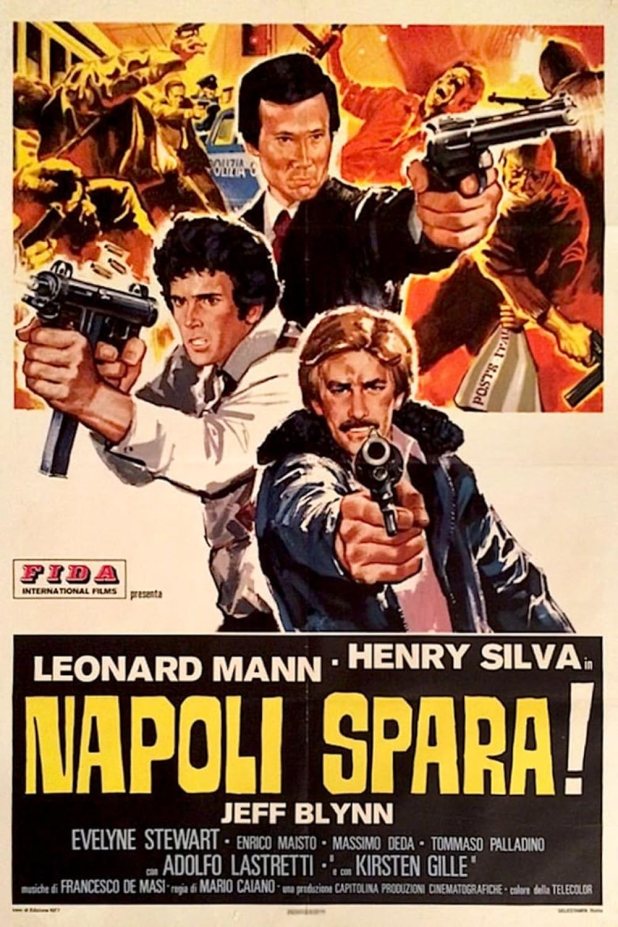
Weapons of Death comes from the Commissioner Betti (Violent Rome, Violent Naples and Special Cop in Action) cinematic universe as a spin off of the character Gennarino (Massimo Deda). Betti is also in this, except now he’s played by Leonard Mann instead of Maurizio Merli. And now, in the place of Umberto Lenzi, there’s Mario Caiano (Nightmare Castle) in charge of the show.
The villain is the main reason to watch this. Henry Silva is always absolutely perfect and here he’s as awesome as you’d hoped as a hit man named Santoro. He has the protection of crime boss Don Alfredo (Tino Bianchi). He’s able to train so many people to do robberies and murders that he puts not just Belli job in jeopardy, but his reputation. That’s because the one time that Santoro gets a gun on him, he lets the policeman live, telling him, “You go your way and I’ll go mine.” That’s how smart he is, as he gets more out of not killing Betti as he would have shooting him.
At the same time, the other crime families all begin to hate Santoro for how out of control he is — one of his major crimes has masked men running wild in the streets, shooting people and kicking women in the stomach — and they try to rub him out.
This movie lives up to the poliziotteschi madness that its fans want, as it has kids turned into young gangsters, a motorcycle rider getting beheaded and a man being castrated in prison. Also, Ida Galli. Or Evelyn Stewart. You know, whatever name you prefer. And it looks out of control because a lot of this was filmed without permits, closing streets or even informing the crowds of people in some of the scenes that they were filming. Instead, they had the camera inside a box on a truck. Italy, I will always love you.
June 18: Junesploitation’s topic of the day — as suggested by F This Movie— is Gangsters! We’re excited to tackle a different genre every day, so check back and see what’s next.
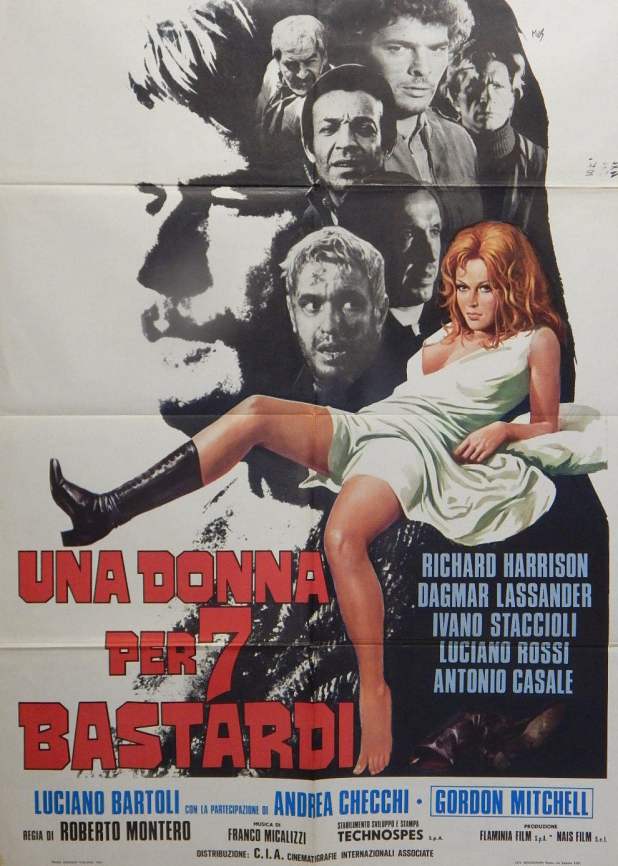
Gordon (Gordon Mitchell) and Carl (Antonio Casale) have taken a stack of gold, moved to the middle of nowhere and hide their fortune in a wooden shack. No one bothers them, because they have a stranglehold on the small town’s alcohol sales, marking it up and getting everyone blissfully wasted. However, a crippled man (Richard Harrison, who came up with the idea) has come to town and everyone that has something to hide is about to get exposed.
Everyone in this small silver mining town is horrible. I mean it, there are murderers, child molesters, thieves and more. And in the middle of them all, playing their arousal off one another is the gorgeous and unsatisfied Rita (Dagmar Lassander). She loves every moment of the worked up chaos that she unleashes.
The town could be a Western one for all we know, save the modern truck, the clothing and the bottles and bottles of J&B. There’s so much J&B here that you wonder how many black gloved killers are here for a convention of psychosexual degenerate switchblade aficionados. Also, Ms. Lassander protects herself with a broken bottle of J&B which is as sexy as you think.
Everything is filthy. Everyone feels like they’re just waiting to die. Or kill you. It’s like Bad Day at Black Rock mixed with the Italian West’s ability to keep remaking Yojimbo and then ripping off the rip off, but you accept it and love it because it’s Italy.
June 17: Junesploitation’s topic of the day — as suggested by F This Movie— is Lucio Fulci! We’re excited to tackle a different genre every day, so check back and see what’s next.
When writers cover Italian exploitation film genres, often the concentration is on horror, cannibal movies, mondos, Westerns, giallo. Anything but musicarello, which are jukebox musicals inspired by Elvis’ Jailhouse Rock and Love Me Tender. The movie that really broke this filone — a small stream, so to speak, that flows from the larger river of Italian cinema — was Go, Johnny, Go!, which was directed by Paul Landres and starred Jimmy Clanton, Chuck Berry, Ritchie Valens and Eddie Cochran. Released in Italy as Vai, Johnny vai!, it had sequences filmed just for the Italian market with singer Adriano Celentano opening and closing the movie.
In a pre-MTV world, musicarello featured young singers in the main roles — like Gianni Morandi, Al Bano, Mal Ryder, Tony Renis, Adriano Celentano, Bobby Solo, Orietta Berti, Little Tony, and more — as they performed songs from their latest albums.
As you may expect, several of the same directors who excelled in other Italian genres made their own music movies, including Bruno Corbucci (Questo pazzo, pazzo mondo della canzone), Ferdinando Baldi (Rita of the West), Ruggero Deodato (Donne… botte e bersaglieri), Duccio Tessari (one of the founders of the Italian Western, he made Per amore… per magia…) and the unholy team of Antonio Margheriti and Renato Polselli (Io Ti Amo).
Yet the originator of native Italian-made musicarello is the very same man who most in America only know as the Godfather of Gore. Yes, Lucio Fulci made Ragazzi del Juke-Box and the second example of the genre, Urlatori alla Sbarra (Howlers In the Dock).
Wikipedia says that the musicarello is a mix between “fotoromanzi (photo comics or fumetti), traditional comedy, hit songs and tentative references to tensions between generations.” This is before the Days of Lead and radicalized political moments that would make up much of the late 1960s and 1970s in Italy. And as the genre gets older, generational revolt wouldn’t be something studios wanted to sell to, particularly as the music in this genre was no longer being directed toward young people. Think how the American-International Pictures beach movies seem so dated in just a few years versus movies that Hollywood was releasing by the end of the 60s and early 70s.
A company that makes blue jeans has to rethink their image because of a group called the Teddy Boys, young men and women who love American rock ‘n roll. The leaders of this music-loving group of kids are Joe Il Rosso (Joe Sentieri, whose biggest song was “Uno dei tanti,” which was translated by Leiber and Stoller and recorded by several English-speaking artists as I (Who Have Nothing); he appears in several films, including The Most Beautiful Wife with Ornella Muti), Mina (Mina, Italy’s best-selling music artist of all time; known as the “Queen of Screamers” and the “Tigress of Cremona;” she was banned from TV and radio due to her relationship with married actor Corrado Pani and out of wedlock pregnancy. She was so famous and beloved that this ban ended in a year despite her songs being about religion, sex and one of her favorite things, smoking. Her look was so alien to Italian audiences — shaved eyebrows, dyed blonde hair and fragrant sex appeal — which makes Mina look as cool in 2024 as she did in 1960) and Adriano (Adriano Celentano, who introduced rock ‘n roll to Italy with songs like “24.000 baci”, “Il tuo bacio è come un rock”, and “Si è spento il Sole;” he’s in Fulci’s first music movie as well as a singer in La Dolce Vita. His daughter Rosalinda is best-known for playing Satan in The Passion of teh Christ).
The jeans company wants the kids to improve their image and do good deeds, yet their remain suspicious of them. While this is happening, Joe falls in love with Giulia (Elke Sommer, Baron Blood) — and can you blame him? — whose father Giomarelli (Mario Carotenuto) runs the TV network and wants these rockers off television and to stop influencing other young folks.
Thanks to Italo Cinema, I can report there are nearly twenty songs in this:
Joe Sentieri: “Let’s Go,” “Moto Rock, ” “Millions of Scintille” and “Don’t Talk:
Mina: “I Know Why,” “Nessuno,” “Whisky” and “Tintarella di Luna”
Adriano Celentano: “Rock Matto,” “Blue Jeans Rock,” “Nikita Rock,” “Impressive for You” and Your Cheek is Like a Rock
Chet Baker: “Arrdividerci”
Brunetta: “Precipito” and “Beby Rock”
Umberto Bindi: “Odio”
Gianni Meccia: “Delicate soldiers”
Corrado Lojacono: “Carin”
I Brutos:” I, Blue Devil”
You may look through that list and be somewhat amazed that Chet Baker is in it. The “Prince of Cool” was seen by Hollywood as a potential movie star but the promise of his early career was marred by a life filled with drug addiction. That comes up in this movie, as he is often sleeping — and often, yes, he really was nodding off — and it’s turned into a comedic plot point.
This is also the first film appearance of model — and the only woman fashion designed Valentino ever loved — Marilù Tolo. She’s also in one of my all-time favorite Italian Westerns, Django Kill… If You Live, Shoot!
Fulci co-wrote this with Giovanni Addessi (who would later write and produce Web of the Spider) and Vittorio Vighi (I Maniaci!). Yet his closest collaborator was Piero Vivarelli, who is listed as screenwriter and assistant director. Vivarelli — according to previously cited Italo Cinema — “had been working for radio stations since the 1950s and from the 1960s onwards was editor of the music magazine Big, for which he always wrote the editorials himself and which was regularly devoured by young people looking for good music. Vivarelli’s opinion carried weight; whoever he thought was good could become famous, but whoever he ignored was ignored by the audience.”
Vivarelli lived a wild life. In addition to his music influence, he directed comic book adaptions Avenger Xand Satanik, wrote Django and later in his career wrote the story for D’Amato’s Emauelle In Bangkok and the lunatic Emanuelle In America. Besides that, he was the only foreigner other than Che Guevara to have his membership card for the Cuban Communist Party signed by Fidel Castro.
Working together with cinematographer Gianni Di Venanzo (who would go on to shoot 8 1/2, The 10th Victim and Juliet of the Spirits before dying way too young) , Fulci and Vivarelli created a new visual template for how young audiences saw music that would be adapted by Scopitones and music videos.
Not to be a broken record, but Fulci remains, as ever, so much more than his horror movies.
June 17: Junesploitation’s topic of the day — as suggested by F This Movie— is Lucio Fulci! We’re excited to tackle a different genre every day, so check back and see what’s next.
I was reading through Letterboxd reviews the other day and I saw someone mention in a Fulci horror film that there was a humorous moment that they didn’t enjoy but that made sense because Fulci wasn’t known for making comedies.
Of the 57 movies Lucio Fulci directed that are listed on Letterboxd, 16 are comedies.
Anyways…
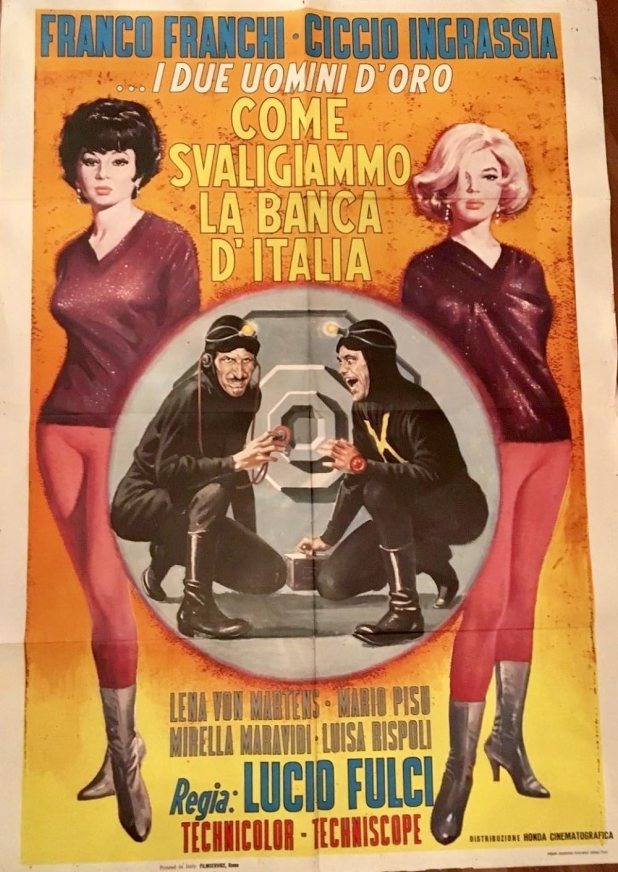
Like many of his comedy films (thirteen, in case you were guessing), this stars the team of Franco Franchi and Ciccio Ingrassia. As always, they play two Sicilian morons. Franco is completely deranged and uses his body and wild face to try and communicate in the loudest ways possible while Ciccio is the mustache-having bully who thinks he’s the more intelligent of the duo but is quite dumb.
In this movie, they have an older brother who is such an incredible thief that he is known as the Master. Paolo (Maro Pisu) wants his brothers to stop being criminals so that they don’t lead the police to him, so he sets them up with money, homes and girlfriends. Yet the two are so annoying that they can never keep these women and way too dumb to not want to be criminals like their brother.
Then Paolo meets two singers, Marilina (Lena von Martens, Operation Counterspy) and Rosalina (Mirella Maravidi, Requiescant, Terror-Creatures from the Grave) who are totally gorgeous and just as insipid as his siblings. He sets them up and leaves the country to hire experts to pull off his most daring and final heist, robbing the Bank of Italy.
The problem is that the ladies are gangsters and want the brothers to show just how good they are at being crooks and pull off their brother’s plan before he gets back.
A heist film that is a comedic version of Seven Golden Men, this even finds Franco and Ciccio dressing up as Diabolik to rob a safe. Plus, you get appearances by Solvi Stubing (Strip Nude for Your Killer), Kitty Swan (House of 1,000 Dolls), Maria Luisa Rispoli (Kriminal) and Adriana Ambesi (Fangs of the Living Dead).
I have to confess that I hated the movies of Franchi and Ingrassia when I first watched them but now find them charming. Maybe it was Argento discussing. how great they are in an interview I saw with him or it could be that I had to learn how to appreciate their basic humor. However I got here, I laughed several times while watching this and loved the space age sets and opening super thief action.
June 16: Junesploitation’s topic of the day — as suggested by F This Movie— is Bruceploitation! We’re excited to tackle a different genre every day, so check back and see what’s next.
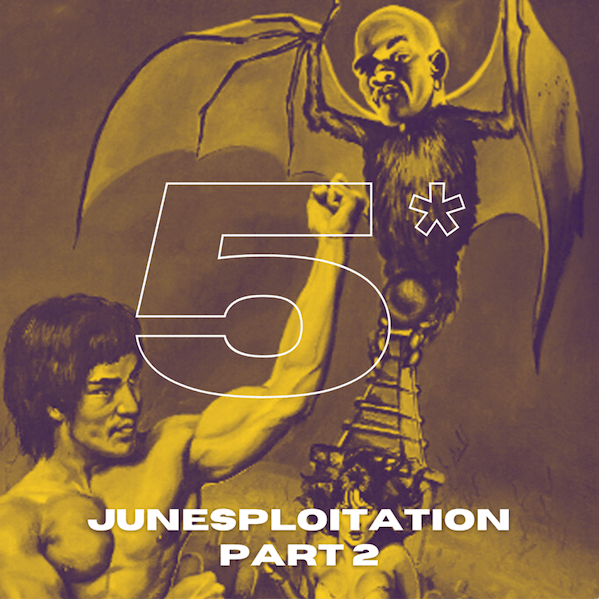
Originally a South Korean movie called Amelika bangmungaeg (also called Visitor of America), this was released in the U.S. by Aquarius Releasing with new dubbing, an incredibly insane poster of Bruce Lee emerging from a grave to defend a half nude woman and battle a flying bat baby as well as a new beginning filmed in the U.S. where lighting strikes the grave of Bruce Lee, who soon emerges, ready to fight. In an amazing display of absolute lunacy, that’s it. No more Bruce Lee.
No, instead, we follow Wong Han (Jun Chong, a judo master who used the name Bruce K. L. Lea; he’s the founder of the World United Martial Arts Organization (WUMAO); has trained Lorenzo Lamas, Sam J. Jones, Phillip and Simon Rhee, and Heather Graham; he also shows up in L.A. Street Fighters, Silent Assassins and Street Soldiers) as he makes his way to America to try and learn who killed his brother Han Ji-Hyeok.
Also: It appears that Wong’s brother died by jumping off his apartment building and is being incinerated in the furnace of the same building, which ends with Wong scooping up all the burned bones and placed them around his neck, along with a photo of the deceased and wandering the streets looking for answers. He’s then attacked by a man in black, who he defeats and kills, which leads to his arrest.
Wong is bailed out by a rich man named Scott Lee and asked to find a woman named Susan (Deborah Dutch, Deep Jaws, 976-EVIL II), who ends up being a waitress. Why Lee hired him is a mystery because he’s shown that he has no idea how to find the killers of his brother, so it’s not like they had a precedent for his detective skills. Anyways, he decides to help Susan and teaches her martial arts so quickly that she can fight nearly as well as him in mere days. She soon informs our hero that she learned from her job in Lee’s Turkish bathhouse that five men were involved in the death of his brother: the black man Wong has already battled, as well as a white man, a Japanese fighter, a Mexican and a cowboy. Seeing as how there are about 4 million people in Los Angeles, this won’t be easy to find them. Then again, he didn’t find the killers yet and did find Susan, so he’s batting .500 which would get you in the hall of fame.
Then, our hero goes to a Christmas parade. Why? So the people there can look directly at the camera and the filmmakers could shoot this without permits. Our hero is a strange guy, one who won’t sleep in Susan’s house for moral reasons, so she buys him an RV to sleep in outside her house.
Anyways, the cowboy is the last alive, killing the other killers before Wong and that means that our hero and he will have to battle one on one. He fights like a pro wrestler, which I can appreciate, and then we learn that maybe Wong’s brother is still alive as nearly everyone else dies. Yes, our hero can’t even protect the woman who helps him, choosing to do a fancy flying kick instead of just disarming the bad guy.
Directed by Lee Doo-yong and written by Hong Ji-Un, this movie is really something else. It’s not good and yet I loved every moment. I kept thinking about the trailer and the poster and how they had to have led people to say, “Bruce Lee versus the black angel of death? How can I not watch this?”
June 15: Junesploitation’s topic of the day — as suggested by F This Movie— is Free Space! We’re excited to tackle a different genre every day, so check back and see what’s next.
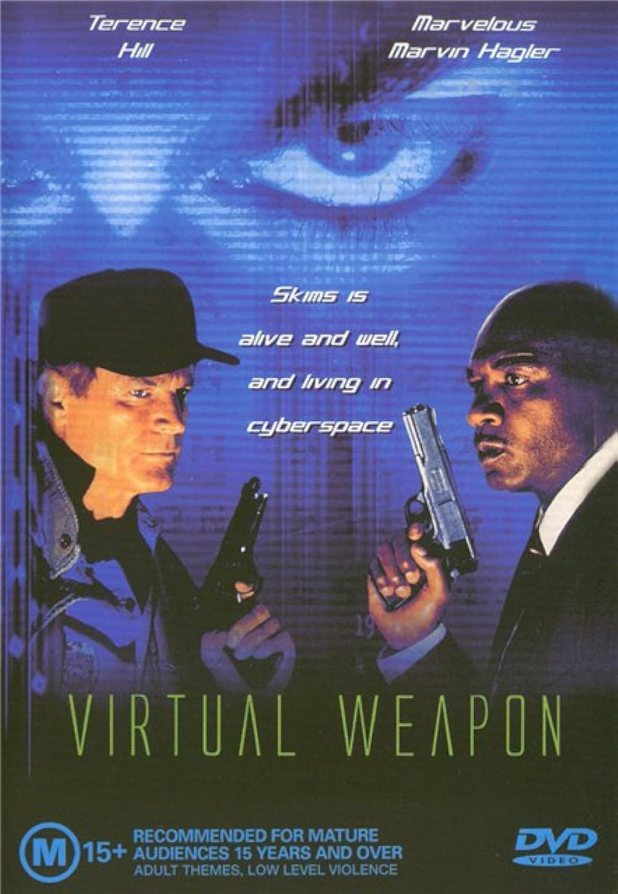
I approached this movie with a strange and melancholic blend of joy and sadness. Joy because it’s everything I love about movies: Italian maniacs let loose in Miami making a movie that at once combines Lethal Weapon, Ghost Dad and Tron while being shot on film in the very late for the Italian exploitation film industry year of 1997. Even better, it has the high concept of combining Terence Hill and “Marvelous” Marvin Hagler as buddy cops.
The cheerlessness comes from the fact that this is at the end. This is the last movie that Antonio Margheriti (Anthony M. Dawson in America) would direct, the last that Bruno Corbucci would write and really the event horizon of an era of films that I love with all my heart.
Yet in this bubble of time, you still get Margheriti combining actual car chases with the practical miniature effects that you hope for in his movies. The explosions are as big as they can be. And sure, maybe Terence Hill is thinking about better days alongside Bud Spencer. Perhaps Marvin Hagler is probably remembering when he fought world middleweight champ Alan Minter, who said, “No black man is going to take my title.” Then he hit him so many times so quickly that he opened four gigantic wounds on the champ’s face and Hagler won his first title as the fans in Wembley Arena launched beer bottles his way. How did he end up here in Miami trying to tell jokes and being in his fourth movie for these wacky Italians?* And was Margheriti dreaming of filming cobwebbed staircases being navigated by a candelabra-wielding Barbara Steele?
No matter. Here they are in Miami and a movie needs to be made.
Skims (Hill) is an ex-cop turned computer salesman who comes back to Miami to see his old cop friend Mike Davis (Hagler). But we know why he’s in town. He’s undercover, investigating a microchip stealing plot. He’s also excited to reconnect with former cop — and the widow of his partner — Chelo (Giselle Blondet) and bond with her tech-loving daughter Lily (Jennifer Martinez).
Our hero finally tracks down the villain behind all of the drama in this, a man named Abel Van Axel (Stephen Edward, who showed up in three episodes of Miami Vice), who goes by the even cooler — if unnecessary — name of Mr. X. What is he, the final boss of a Konami beat ’em up?
Despite being informed that Skims is the greatest cop of all time, he gets blown up real good and dies. We even see his funeral. I’m shocked they didn’t run the credits.
Except that Skims has somehow survived and shows up on Lily’s computer, looking like Trinity by way of Automan, fighting dinosaurs and transforming like he’s fueled by Energon. His power set is beyond crazy here, even moreso than the goofball abilities Hill had in my beloved Super Fuzz. He can be invisible unless someone tells him they love him, he can travel through telephone lines and is now a hologram, which is explained as “the result of modern technology and Biblical faith.”
Of course the bad guys pay and Skims carries around the bad guy’s gun, turning it on him, and everyone is all smiles by the end. Even me, as I watch the credits and try not to think that it’s over, it’s over, all the rainbows in the sky start to weep, then say goodbye. Apologies to Roy Orbison, obviously.
The best thing in this whole movie is that Skims forgets that he’s just been killed by techno gangsters and real estate lords and decides to screw around with his fellow cops while they’re lifting weights, playing ghost reindeer games with them like he’s Super Fuzz — “He’s a super snooper. Really super trooper. A wonder cop a one like you never saw.” — and I could watch a 90-minute movie of these antics.
You may ask, who else is in the cast? Well, who isn’t? This is the last movie of Richard Liberty, who unites the decades of Romero films by playing Artie in The Crazies and Dr. Matt “Frankenstein” Logan in Day of the Dead. He plays Captain Holmes. The old lady who pulls out a gigantic handgun and fires it at criminals is Florance McGee, who was also a senior citizen in Super Fuzz and was Phoebe Russell in Empire of the Ants. Tommy Lane was a stuntman who was in Shaft and Ganja and Hess along with playing the trumpet and flugelhorn. Wikipedia thinks that he’s the same Tommy Lane who was in the Rock ‘n’ Roll RPMs with Mike Davis. He wasn’t.
There’s also Roger Callard (Conan the Librarian from UHF), Edoardo Margheriti (who would go from doing effects on Yor Hunter from the Future to being a second unit director for Hudson Hawk) and a lot of folks who were in Florida-based productions such as Wild Things and B.L. Stryker.
Beyond Corbucci, this was written by Terence’s son Jess and executive producer Ferdie Pacheco. It was the only movie that Ferdie ever wrote or produced. He was better known as the personal physician and cornerman for Muhammad Ali. He left Ali’s team in 1977 when after Ali won against Earnie Shavers, he felt that the post-fight physical showed that the boxer was falling to pieces. In the book Muhammed Ali: His Life and Times, Pacheco said, “The New York State Athletic Commission gave me a report that showed Ali’s kidneys were falling apart. I wrote to Angelo Dundee, Ali’s trainer, his wife and Ali himself. I got nothing back in response. That’s when I decided enough is enough.” When they reunited in 2002 and Ali was suffering from Parkinson’s, The Greatest told The Fight Doctor “You was right.”
This also has one of my favorite things about Italian movies going for it: absolutely strange alternate titles. I get Virtual Weapon as it tells you that this is a Mel and Danny ripoff with a tech twist and the French title Cyberflic means Cybercop. But then the Japanese title is Point of Dead, which is a great title that says nothing. Germany got Zwei Fäuste für Miami (Two Fists for Miami), Hungary the very metal Én vagyok a fegyver (I Am the Gun) which spoils the ending of the movie and Italy had Potenza virtuale (Virtual Power).
I always worry that I am going to run out of Italian movies to obsess over but so far, I keep finding new things to write over a thousand words about.
*In case you wondered, Indio and Indio 2 for Margheriti, as well as Across Red Nights for Maurizio Bonuglia.
June 14: Junesploitation’s topic of the day — as suggested by F This Movie— is Beach! We’re excited to tackle a different genre every day, so check back and see what’s next.
John D. MacDonald had several of his books turned into movies. The Executioners was filmed twice as Cape Fear, Soft Touch inspired Man-Trap, plus the novels Darker Than Amber, The Girl, the Gold Watch & Everything, Condominium and A Flash of Green were all made into movies. Even this story was turned into two TV movies with the second starring Virginia Madsen as Linda.
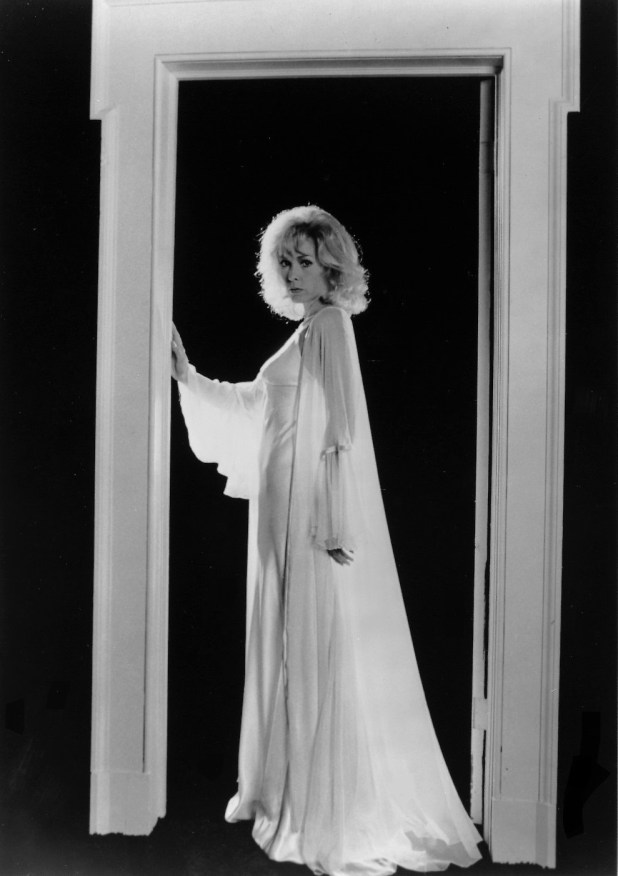
Linda Reston (Stella Stevens) has a bad marriage with Paul (Ed Nelson, The Devil’s Partner), who is daydreaming of leaving her when she suddenly shoots their friend Anne Braden (Mary-Robin Redd) and turns the gun on Anne’s husband Jeff (John Saxon!) while at the beach. Paul calls the cops and when they arrive, Jeff is alive and the twosome accuses Paul of killing Anne.
As you can tell right away, Linda and Jeff are working together to get rid of their spouses and make a new life for themselves. Luckily, Marshall Journeyman (John McIntire, who replaced both Ward Bond on Wagon Train and Charles Bickford on The Virginian when both of those actors died), an elder lawyer, takes on his case and starts to investigate Linda and Jeff.
Paul sneaks out of his cell and soon learns that his wife has been conspiring with Jeff, which leads Journeyman to get the cops in on a scam to call her and try and get a confession. She’s too tough but man, Jeff folds right away. She tells him he’s spineless and also informs her now ex-husband that she won’t be in jail long.
Stella Stevens is quite wonderful in this. She’s so cold and has everything figured out but yet as she laments, she’s never been able to find a man who isn’t spineless. Her husband can’t even bury a dead animal without having a nervous breakdown and her lover gets her arrested for murder. I’d love a sequel where we learn how she takes over prison.


 B&S About Movies