El monstruo de los volcanes (1963)

Volcan Popocatepetl (Smoking Mountain in Aztec) is just miles away from Mexico City and has been erupting for the entire last week (as I write this it’s June of 2022) giving off up to 36 steam and gas emissions a day.

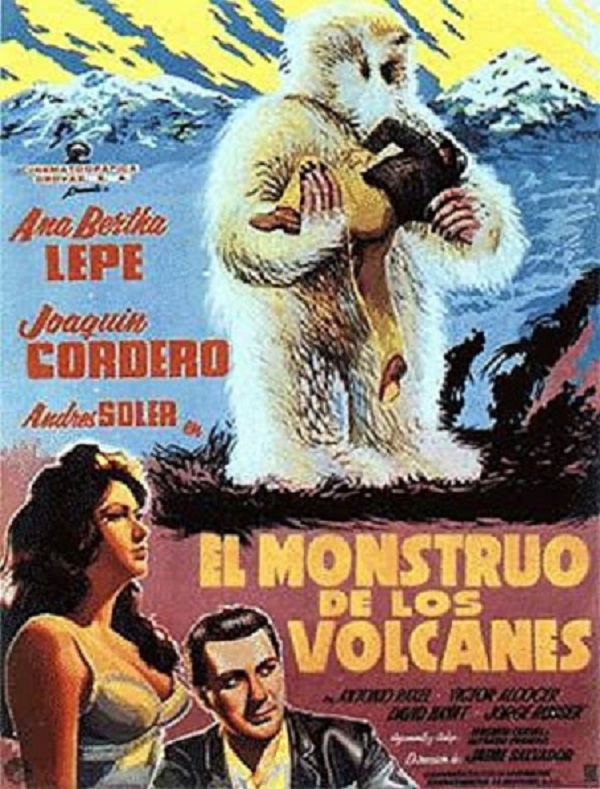
Why would you try to build an elevated train across a volcanic mountain? Is it any wonder that there have been numerous incidents that have led to lost lives as the corporate bosses demand more progress? The workers believe that these murders are being caused by the treasure guardian of the ancient Aztec leader Montezuma. A gigantic man, covered in white fur, with a face like that of an owl and enough strength that it can tear men apart.

Directed by Jaime Salvador and written by Federico Curiel (Arañas InfernalesLas Momias de Guanajuato) and Alfredo Ruanova (El Pueblo Fantasma), this movie marks the first time I’ve seen a fluffy white sasquatch on film. It’s also the initial time — and this is more shocking — that the bigfoot has the power to obscure men’s minds.

The entire creative team would return to the very same story in a few months by making the sequel, El terrible gigante de las nieves.

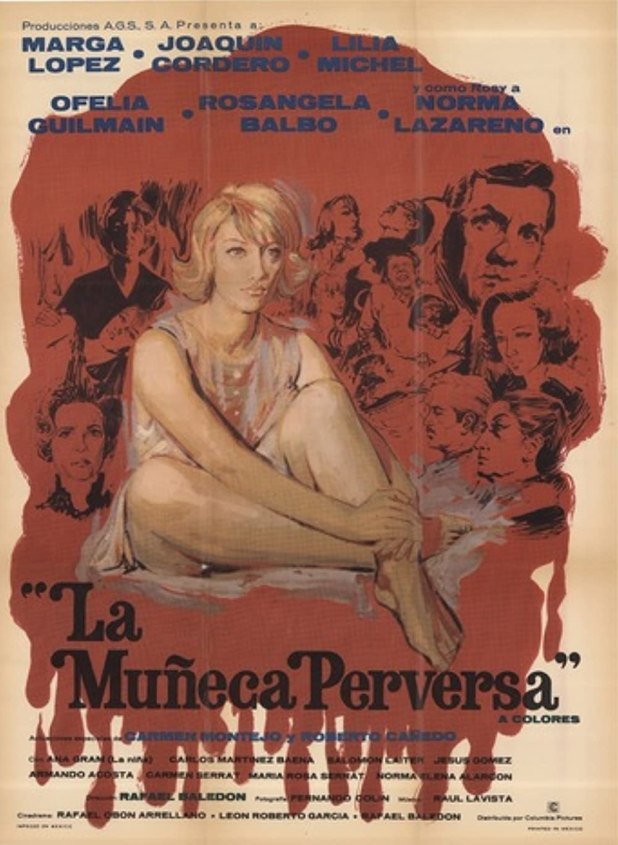
La muñeca perversa (1969)

The Montenegros have real problems. Their matriarch has just died and moments after the funeral, her daughter Leticia announces that she believes that someone in the family poisoned her. Meanwhile, one of her son’s wives has escaped a mental asylum — a place she landed in because she killed the gardener with pruning shears and was led into alcoholism by the dead woman never accepting her and her own daughter Rosi de Ella, who in turn paid for them via sexual favors. 

Seriously, if you like the psychobiddy genre, Perverse Doll has so many female family members that are constantly on the verge of absolute mania and have absolutely no issue with going completely berserk (Berserk!) any time and every time.

Amongst all of them, Rosi is the worst, because despite looking like an angel, she’s the one who killed the gardener and put the murder weapon right into her mother’s hand, just like she did the bottle. Who would you believe? The alcoholic screaming covered in blood or the perfect child upset that her mother has lost her mind?

As the men of the house go out to attend the autopsy — where they learn that yes, grandmother was poisoned — Rosi goes on a rampage, pruning the family tree of every other woman. It wasn’t enough to push an aunt down the steps years ago and confine her to a wheelchair. Now, she must orchestrate a lamp and have it fall down on her. Milk is poisoned. Bathtubs become murder weapons. And only the youngest female, Luisita, escapes.

Of course, in every EC Comics story there has to come an ironic ending. It arrives here as the institutionalized mother returns home. Driven mad by abuse within the hospital, she arrives back at the family abode ready to burn it all down while everyone watches.

Perverse Doll is like a soap opera given license to just wipe out all of its characters. The closest Mexican movie that I can find to it — despite it having more supernatural touches — is Poison for the Fairies, another film that ends with an apocalyptic inferno.

You can watch this on Tubi.

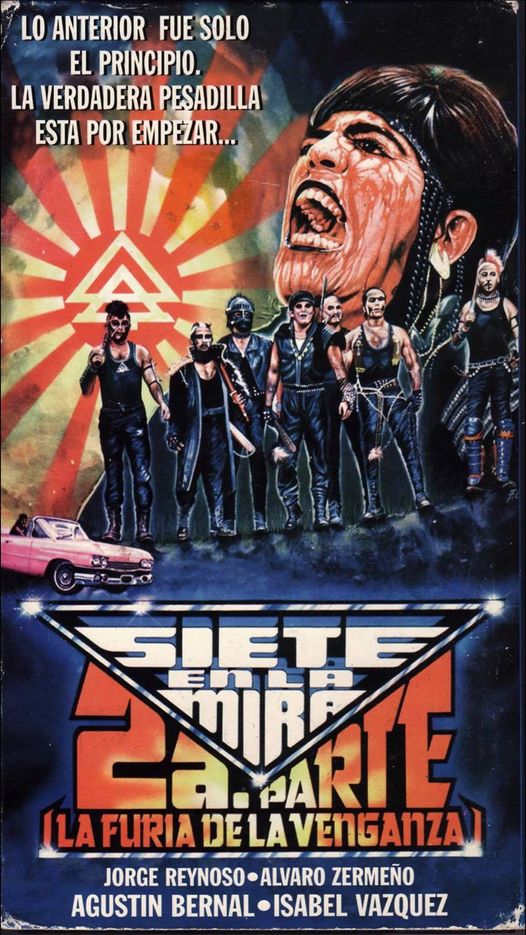
Siete En La Mira 2 : La Furia De La Venganza (1986)

In the years since Siete En La Mira, both of the lawmen who stopped the Zulu gang haved died and the only surviving member of that gang — Judas (Jorge Reynoso, who was Vikingo in the first movie) — wants his brother Vikingo’s ashes. And oh yeah — revenge.

This sequel takes a step — a wonderful step — away from reality to give us a world where long white haired witches rule city dumps, where chainsaws and hot lead decimate innocent human bodies and where two men must live up to the legacies of their brothers — Humberto (Alvaro Zermeño) is the only surviving cop brother of the first movie’s heroes while Judas must live up to the wild crimes of his outlaw brother.

There’s also a moment where a hostage pushes a gang member too far and gets her nose sliced off with garden scissors and sprays blood all over the screen in a moment that shocked even me. That’s later topped by a gang member hiding in a water tank, which gets shot with a Bo and Luke Duke style explosive arrow and blood rains from a lacerated sky.

Movie punks, exploitation violence, mean mountain men who just want to be left alone and violence, fucking violence. What’s not to like? They made at least four of these and as far as I’m concerned, they could make a new one every single day.

You can watch this on YouTube.

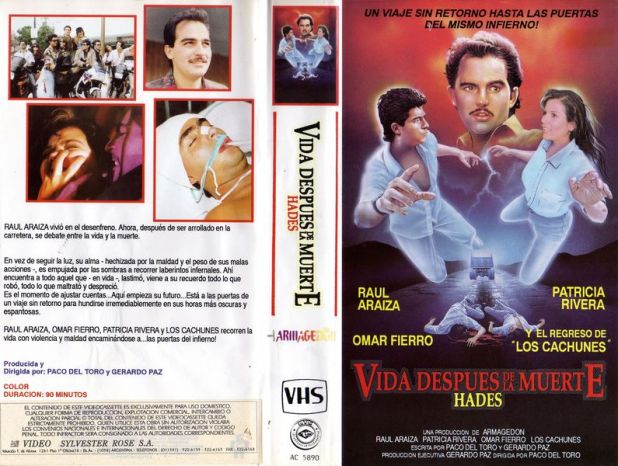
Hades, Vida Después de la Muerte (1993)

Carlos and Adriana have an arguement and as they yell at one another in the middle of a highway, they both get killed by a truck. 

That’s it, roll the credits and turn on the lights.

No, but really, Adriana dies instantly and goes to Heaven because for the most part she was a good person. But Carlos, well, he was a horrible person as we soon see and he’s trapped on Earth in a Jacob’s Escalera situation. Oh yeah — he’s also chased by demons.

By the end of this movie, you’ll want Carlos to burn. I mean, he steals from grocery stores, assaults a girl who is shopping there, uses Adriana to play a prank on the bisexual Pablo that goes so badly that the victim throws himself out a window,

We soon learn that Adriana has become a good Christian woman thanks to a man named Esteben — no, not the one from Evilspeak — who helps her find the right way to live. She tries to save Carlos and that’s what leads the story back to the beginning with him denying God, her getting out of the truck, him following her and them both getting flattened into bloody tortilas.

So yeah — while Adriana goes through the Pearly Gates, Carlos is in Hell, tormented by Pablo who is in Hell because of his life choices and suicidal nature — so yeah, this movie is completely unconcerned with being as offensive as it gets — and the woman that he raped. Because you know, she deserves to be in Hell too.

Director Paco del Toro made a few other Christian movies and also the movie Pink which is about a gay couple adopting a child. The first IMDB review that I read said that it was “an absolute disgrace to humanity.”

According to Toro, he wanted to defend the right of adopted children to grow up with a father and a mother, yet so many people saw that as promoting homophobia, which got that movie banned from Cinemex and Netflix.

This movie never played on either.

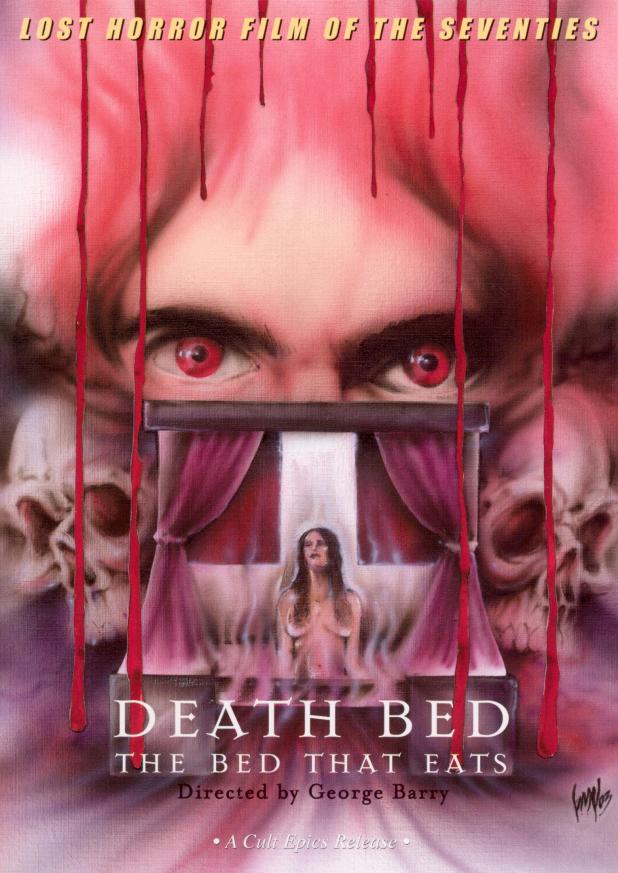
JUNESPOLITATION 2022: Death Bed: The Bed That Eats (1977)

June 20: Junesploitation’s topic of the day — as suggested by F This Movie— is regional horror! We’re excited to tackle a different genre every day, so check back and see what’s next.

When I first saw Death Bed in the wild — 1989, I think, and at a Uni-Mart convenience store back in those magical days when every single retailer was renting VHS — I know that I wasn’t ready for it. I remember a friend showing me and laughing about it, saying that it had to be bad. I had not yet arrived at the place where I believe that there is no such thing as so bad it’s good. Today, I don’t feel right laughing at a movie because of its faults. I’d rather celebrate them and enjoy how happy they make me.

I’m glad I waited to watch this movie.

There’s no reason why Death Bed is as good as it is. It was shot between 1972 and 1977 for $30,000 around the Gar Wood mansion on Keelson Island in Detroit. Built in 1924 by designer, industrialist, inventor of the hydraulic lift and the modern garbage truck, and champion speedboat racer GarWood, this 43-room mansion had — at one time — the world’s largest pipe organ and a basement swimming pool. By the late 60s, it was a counter-culture commune thanks to Mark Hoover, who moved into the mansion after 15 years of it being vacant. He threw rent parties where the house band Stonefront would often jam with Joe Cocker, Van Morrison, Johnny and Edgar Winter, Rick Derringer and Leon Russell. By the next decade, a riotous party by the Outlaws Motorcycle Club, a drug bust and a lightning strike-assisted fire destroyed what was left of the once impressive manor.

Anyways, how do we get a bed that eats people?

Centuries ago, a demon fell in love with a woman and created the bed upon which they would consummate their love. Yet human bodies weren’t made for demonic lovemaking and she died, causing him to weep tears of blood which gave life to the bed. Every ten years, the demon awakens and the bed is able to satisfy its hunger by eating a human. Only one person — artist Aubrey Beardsley — has been spared, if you can call it that, by being trapped forever inside a painting that must watch the bed forever.

Beardsley is, of course, a real artist who was a leading figure in the aesthetic movement along with Oscar Wilde and James McNeill Whistler. He was also a significant member of the Art Nouveau despite dying at just 25 years old from tuberculosis. He would once say, “I have one aim—the grotesque. If I am not grotesque, I am nothing.” He was also rumored to have father a stillborn child with his sister, which there’s no proof of, but there is plenty of evidence of his genius work as an erotic artist. His work is so incendiary that it was still causing raids and obscenity charges seventy years after his death.

Wait — this is a regional horror movie?

The story is broken into meals for the bed, such as Breakfast, a time when a young couple trespasses into the mansion and use the bed for their own desires. As they start their horizontal dance, the bed does what it does and devours them as the artist makes fun of it. In response, the bed telekinetically tears the house apart and blows my mind mere minutes into this movie.

Three women discover the bed: Suzan (Julie Ritter, who went on to become a composer), Diane (Demene Hall) and Sharon (Rosa Luxemburg). Minutes after disrobing on the cursed mattress, Suzan is swallowed in the Lunch part of the story, soon to be followed by Diane. Only Sharon survives because her eyes remind the bed of the woman whose death created it. She’s also saved in the Dinner chapter by her brother, whose hands are eaten when he tries to stab the bed. He sits there, his flesh and blood digits replaced with crumbling skeletal fingers.

Finally, as the demon goes back to sleep, the artist reaches out to the mind of Suzan and helps her complete a ritual that will destroy the bed. It teleports it from its room and revives the dead mother of the bed at the cost of Suzan’s life. The mother and Suzan’s brother immediately do what you think they should — have sex on the evil bed — which sets it on fire and allows the artist to die.

Me telling you all of this should in no way spoil anything for you in a movie where we watch amber liquid dissolve body parts, a bed eat an apple, an orgy turn into an orgy of death and strange voiceovers in the place of dialogue. It’s also a movie where a bed drinks Pepto Bismol.

Creator George Barry — originally only his name was on the film — didn’t even release the movie other than showing it to a Los Angeles-based distributor to hopefully release the film on VHS in the UK. The distributor offered to pay Barry $1000 for a VHS release if he could supply them with a print of the film, complete with credits. Those credits would have cost $3000, so Barry declined and got his print back.

That’s how a British VHS label called Portland got the film, which they released as a bootleg. I have no idea how a copy ended up in a gas station in a southwestern PA mill town. Yet another mystery!

Somehow, Barry was making this movie in the woods at the same time as Royal Oak, MI — they shared the same hometown — horror icon Sam Raimi was making Within the Woods, which was the proof of concept for Evil Dead.

In 2014, Gwenyfar Rohler and Jock Brandis (who was a gaffer, did special effects and played the minister; he also worked on Serial MomBlue Velvet and four Cronenberg movies) created a two-act play that starts with how the movie was made and then has an on-stage adaption of the movie.

Barry sadly never made another movie and opened a bookstore instead.

What he did create is an absolutely deranged piece of film that would in no way pass through a Hollywood so-called idea factory. That’s why regional horror is such a vast resource, a place where anything can happen, plot is fluid and magic is everywhere.

Here’s one more insane Michigan regional classic to check out: The Carrier.

You can download this film at the Internet Archive.
Cazador de demonios (1983)

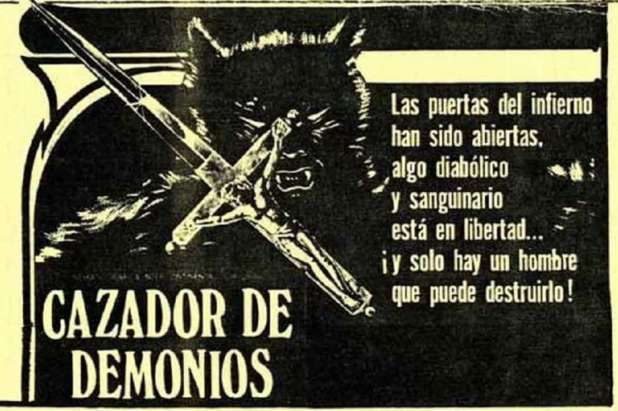
Horrific murders are happening every night in a small rural Mexican village — heads are ripped off their necks, arms are ripped off and bodies are destroyed — and may be the work of an ancient legend known as the Nahual. Sheriff Aguilar (Roberto Montiel) and Dr. José Luis (Rafael Sánchez Navarro) hope to keep their town safe, but as Mexican Dr. Loomis might say, “¡La muerte ha llegado a tu pueblito!

The moral of the story? Never murder a shaman. I mean, the guy was slicing a chicken in half and dripping its blood all over a farmer’s pregnant wife like he was in that Danzig video for “Mother” that MTV only played once and Bob Larson lost his mind over. And when his wife’s baby is stillborn, I guess you can see why the guy went nuts.

Extra points to Padre Martin (Tito Junco), who takes all of the church’s silver and gets it turned into ammunition. Someone has to do something, right? He also has this amazing blast of dialogue:

Dr. José Luis: Who’s that?

Padre Martín: Asmodeus. Leviathan. Beelzebub. Call him as you like.

Dr. José Luis: Satan?

Padre Martín: Lord of darkness, prince of shadows, king of hell and of the black side of the Universe.

José Luis: You talk about him as if you had a lot of respect for him.

Padre Martín: Satan has to be respected, son. He’s a very powerful being, and infinitely cruel.

There’s also that moment that happens in all Mexican Satanic movies where God has had enough of this and decides that all the antics have to come to a stop. It happens here when a throwing knife has a crucifix of light appear on it before it flies toward the demon. You’ve had your fun, Satan. Now let’s wrap this up.

Misterios de ultratumba (1959)

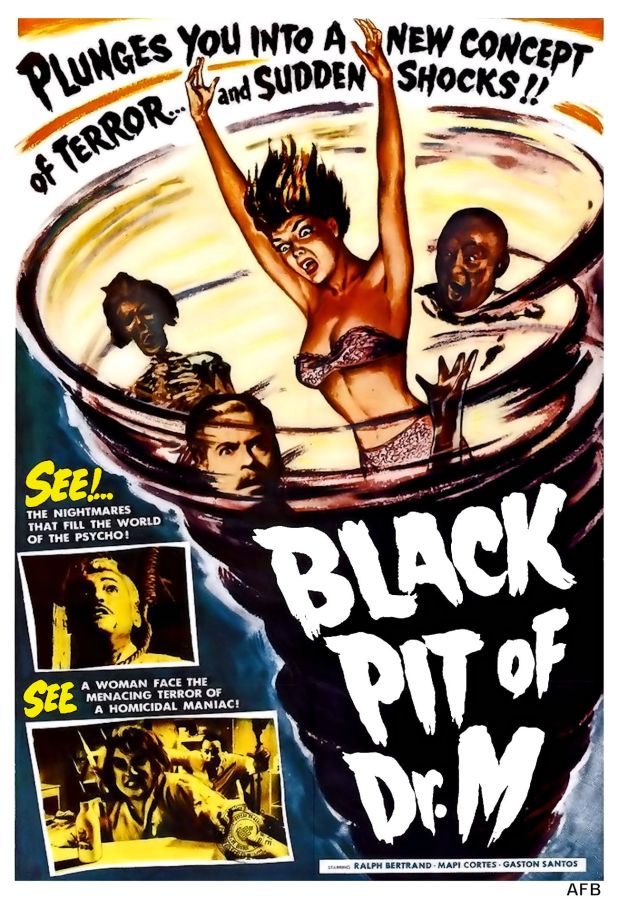
Released as The Black Pit of Dr. M in the U.S., this movie explores man’s fascination with what comes after this world.

Dr. Mazali (Rafael Bertrand) and Dr. Jacinto Aldama (Antonio Raxel) make a bet with one another: whoever dies first will return to tell the other what happens after death. Aldama goes first and appears to Mazali during a seance, telling him that within three months, he will know everything about the afterlife.

Aldama’s ghost leads Patricia (Mapita Cortés) — also his daughter, but that’s a spoiler — to the insane asylum Mazali leads. The older doctor falls for her, but she and an intern named Eduardo (Gastón Santos) are in love. He also lets another inmate out of her cell and she instantly burns an orderly with acid right to the face. She’s murdered, Mazali takes the fall and heads to the gallows, proving that he will indeed soon know the afterlife.

While most early Mexican horror repeats the Universal horror movies and most Americans only know lucha movies to be the rest of the genre output from south of the border, the truth is that there are moments of sheer gothic dread for those willing to look. I’d definitely recommend this movie — the opening with the mental patients filling the frame is harrowing and a man rises from his grave in an incredibly unsettling fashion — as well as Hasta el Viento Tiene Miedo.

This was dubbed into English at one point, but that print is believed to be lost.

You can watch this on YouTube.


El Castillo de los Monstruos (1958)

Everyone is in love with Beatriz (Evangelina Elizondo). Like the goofy El Clavillazo (Antonio Espino, Conquistador de la Luna) and the sinister Dr. Sputnik. The latter uses hypnosis to convince her that she’s really Galatea and his lover, while the former has to make his way into the mad scientist’s castle and do battle with the Frankenstein’s Monster-like butler, a werewolf, a gillman, a strange caveman kept behind bars and a vampire played by German Robles, who was usually a very serious vampire in movies like El Vampiro and the Nostradamus series.

The monsters in this movie are all dispatched in some interesting ways and mostly by accident. The gillman gets turned into a fish, the caveman chokes out the wolfman, the hunchback shoots the mad scientist who stabs him before he expires, the modern Prometheus electrocutes himself which doesn’t seem possible but maybe I’m basing that on Japanese Frankenstein being able to absorb electricity, the mummy gets eaten up by alligators and the vampire forgets that the sun rises.

Julián Soler also directed Pánico, Santo vs. Blue Demon in Atlantis and El Hombre y La Bestia. Producciones Sotomayor, who produced this movie, also made the similar movies  Santo and Blue Demon Against The Monsters and Ship of Monsters, two films that I love with every chamber of my heart.

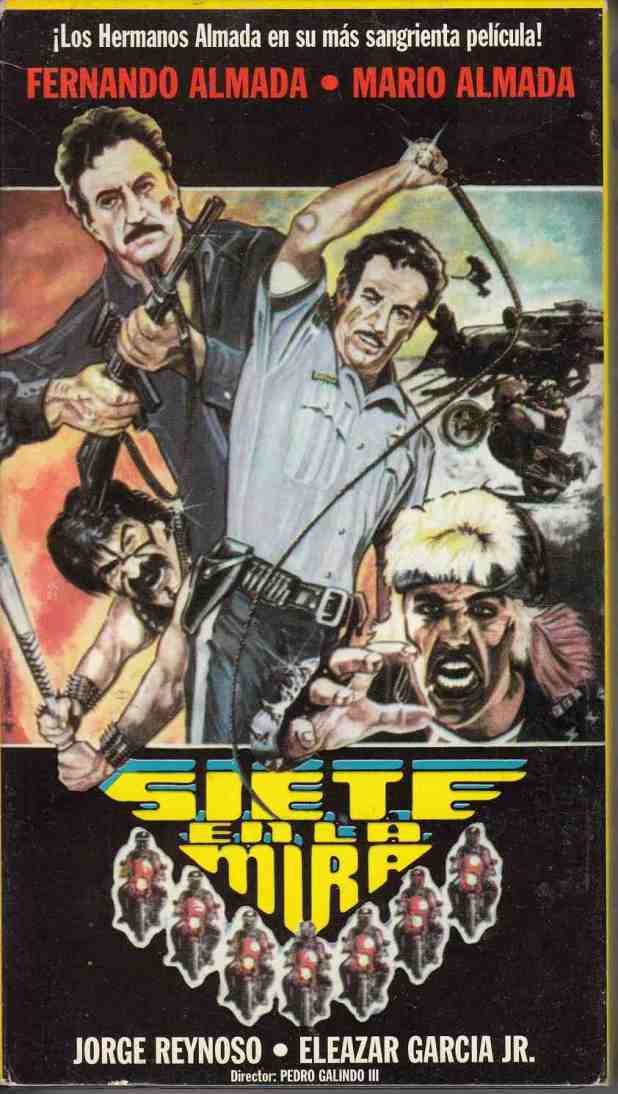
Siete en la mira (1984)

Seven In Sight was directed by Pedro Galindo III, who also made some other great movies you should track down right now like Vacaciones de Terror 2La Muerte del Chacal and Trampa Infernal. It was written by Carlos Valdemar, who has 200 scripting IMDB credits like Zindy the Swamp Boy and Cyclone, and Gilberto de Anda who has a hundred and was the man who write Mi Fantasma y Yo and Tijuana Jones.

It’s pretty much a western but instead of a ruthless gang that has just come into town on horseback, they all have facepaint and mohawks and ride motorcycles and I’m in love with this. The sheriff (Mario Almada, who made a million or more movies where he appears on the cover brandishing a gun) tries to treat Vikingo and his Zulu gang like human beings and tells them to just keep moving. They don’t — one of them assaults and accidentally kills a woman — so one of the deputies steals a gun from a mechanic, kills the suspect and doesn’t let on that he just led an innocent man to jail. The bikers demand justice and take a bar and a school — I mean, what else is important in a Texas border town? — and threaten to kill everyone unless they get their hands on the mechanic. And then the townspeople go nuts and demand the death of the bikers. It falls to the sheriff and his brother Marcos (played by Mario’s brother Fernando) to beat, shoot and bullwhip this gang seemingly from a post-apocalyptic future into the ground.

Intrepidos Punks and its sequel La Venganza de los Punks are obviously better versions of this same story, but just like how seven different Mexican regions offer different twists on food that all just called Mexican food north of the border, this has notes and flavors worth experiencing and savoring, like a scene where a hostage is introduced to steel fan blades face first.

The next movie gets even wilder, but there’s lots to like here.

You can watch this on YouTube.

El jinete sin cabeza (1957)

Chano Urueta’s (El Baron del TerrorThe Headless Horseman is that most rare of all mixed genres, the horror western, a story of a secret brotherhood of skull-masked and long-robed killers who rule the farms with a bony hand until the Zorro-esque hero called El Jinete– with a mask that makes him look headless — stands up to them.

This movie is outright odd as it has musical numbers out of nowhere, something that happens often in older Mexican horror movies as often as they do in Bollywood films.

It’s also part of a series of films, preceded by El Tigre Enmascarado and followed by La Marca de Satanás and La Cabeza de Pancho Villa. It’s the kind of movie where a handsome man can start a song in a jail cell and instantly his mariachi bands can appear and help him do the song but not escape his bars.