ABOUT THE AUTHOR: Melanie Novak writes about the Golden Age of Hollywood, infusing her weekly movie reviews with history, gossip, and the glamour of the studio era. You can read her reviews at www.melanienovak.com and follow her on Instagram @novak_melanie or Twitter @MelanieANovak.
Every fiction writer has experienced the moment when a character takes over a story in a way the author never suspected—or intended. I’d bet this is what happened during the filming of This Gun for Hire. Like any good writer, director Frank Tuttle knew that when a character muscles his or her way into the spotlight, it’s wisest to get out of the way and hand over the reins.
While Robert Preston gets top male billing, Alan Ladd (with an “introducing” credit) runs away with the picture. Ladd stars as Raven, a hitman with a soul. Though he executes his work—and his revenge—with a single-minded ruthlessness, he has soft spots for disabled children, cats, and one Ellen Graham, a woman who shows him kindness but not pity when she’s pulled by circumstances into his revenge plot.
Veronica Lake plays Ellen, and though she’s supposed to be over the moon to marry Preston’s cop Michael Crane, the screen sizzles when she’s with Raven. The chemistry was so apparent to Paramount that it put Lake and Ladd together in three more films after Gun, including Ladd’s first top billed role in The Glass Key (1942).
Based on Graham Greene’s 1936 novel, the plot revolves around Raven’s thirst for revenge when Willard Gates pays him for a hit with marked money and tries to have him executed. The man behind the money is the real villain, as he’s selling chemical compounds to Japan to make bombs that will be used against the United States in the ongoing war.
Ellen, a magician and singer in Gates’ nightclub, is pulled into the plot when a senator asks her to spy on Gates and find the man at the top in the name of national security. When Gates sees Ellen and Raven together on a train, he believes they are working together when their meeting was pure chance.
When Ellen is in danger, her boyfriend Michael is ineffectual, but Raven comes to the rescue. She then becomes his hostage, and they spend a night in an abandoned railroad car. Despite his affection for a stray cat, he strangles it to keep its meowing from giving away their position to the searching cops, and Ellen gets the message—he likes her, but everyone is ultimately expendable to his revenge mission.
Even so, the heat radiates off them both.
She convinces him to put finding the truth about the chemical compound and doing his duty to the country above his revenge, but in the end he gets both, though he dies in the effort.
Ellen goes off to marry her upstanding-but-lackluster boyfriend, but I can’t help thinking she’ll soon tire of darning his socks and cooking his dinner.
An early film noir, and a great film for fans of Lake, Ladd, or Graham Greene.
If you love poor Robert Preston, you’re better off catching him with Joel McCrea and Barbara Stanwyck in 1939’s Union Pacific.
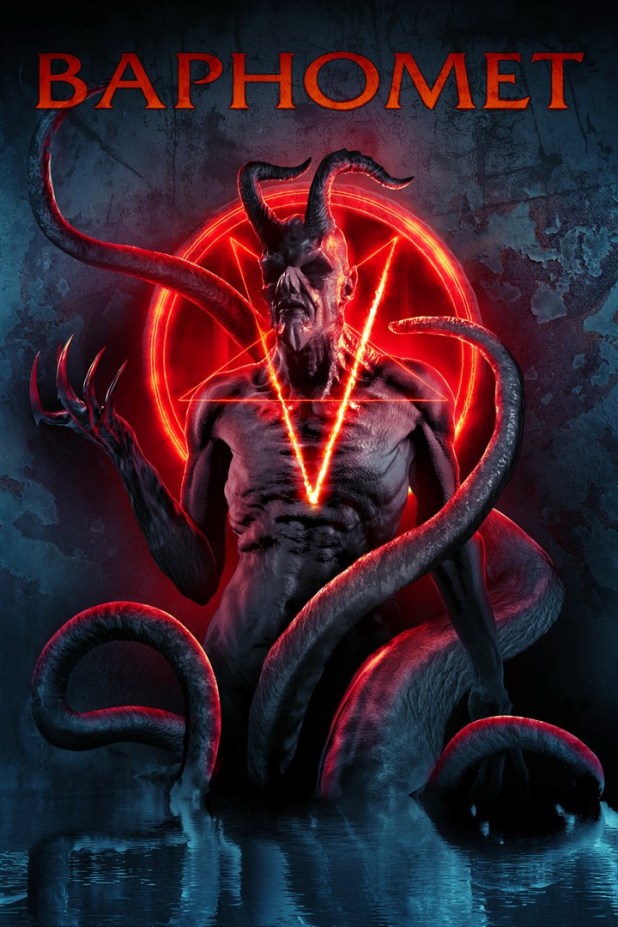
The Richardson family have a home that a Satanic cult wants. When real estate offers don’t work, leader Henrik Brnadr (Giovanni Lombardo Radice, House on the Edge of the Park, Stagefright, Cannibal Ferox and the reason I watched this movie) decrees that his followers make the lives of our protagonists difficult. So difficult, in fact, that they have to turn to magic. And to researcher Lon Carlson, who is played by Cradle of Filth’s Dani Filth via Facetime.
You know how some movies are full of talking and nothing happens? This is not one of those movies, instead packing 72 minutes with dead birds, snakes, cursed wells, demons, naked women being sacrificed and no small amount of gore.
And you know what? It’s ridiculous in the best of ways, a movie that promises a demon on the cover, delivers a demon and also gifts you with the heads of occultists getting blown up real good. Sometimes, that’s all you need.
Strip clubs are, by and large, incredibly boring places. Take it from someone who may have nearly married a dancer and who was also with someone for a long time who covered them. They’re only exciting if you’re drunk, have money and no access to women. Well, unless they’re the club in the movie, Strip-O-Sauraus, which has giant dinosaurs in the parking lot. That’s kinda cool, right?
Crystal is played by Erin Brown, she was born Erin DeWright but may be better known as Misty Mundae. You may also recognize Teresa as Julian Wells, but she’s also appeared as Suzy McCoppin in movies like Fist of the Warrior and has covered nightlife and sexuality for several magazines, TV shows and websites. Trix is Erika Smith, who has a ton of credits but perhaps the best is Van Helsing in The Sexy Adventures of Van Helsing, which I had no idea was a thing.
There’s a weed deal gone wrong at the club and all the cockroaches become bloodthirsty vampire cockroaches, which isn’t good at all, and it gets worse when Crystal gets bit by one of them.
So yeah, maybe this club is a little more exciting than somewhere like Cheerleaders on a cold January night in Pittsburgh.
Here’s to Brett Piper, still making movies (well, this is from 2004, but he’s still directing stuff like Outpost Earth and doing effects for Shark Encounters of the Third Kind).
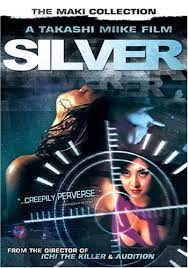
Jun Shirogane’s entire family was murdered by criminals while she was at a karate tournament, which makes her the perfect first member of the Japanese secret police branch known as the Fear of God, getting the secret identity of Jun Silver and becoming a pro wrestler. Are you shocked that I loved this movie or surprised that it came from Takeshi Miike?
The first mission to stop Mistress Nancy Otori, who likes to tie up bank presidents and abuse them and then blackmail them, but when she two-times a member of the Viper’s Nest, Silver gets the info she needs and is able to complete her mission.
If you love 1990s Japanese women’s pro wrestling, Shinobu Kandori and Rumi Kazama — who formed Ladies Legend Pro-Wrestling — play themselves in this movie. This is also based on the manga by Hisao Maki, who also created Bodyguard Kiba and WARU, as well as the writer for the wrestling-related Lone Tiger, which has Richard Lynch as a promoter, and a man trying to find the man who killed his tiger mask-wearing wrestling father, which is funny, because Maki was the brother of Ikki Kajiwara, who created Champion Joe and more importantly, Tiger Mask, a character so famous that there’s still a real-life version who is a member of the New Japan Pro Wrestling roster.
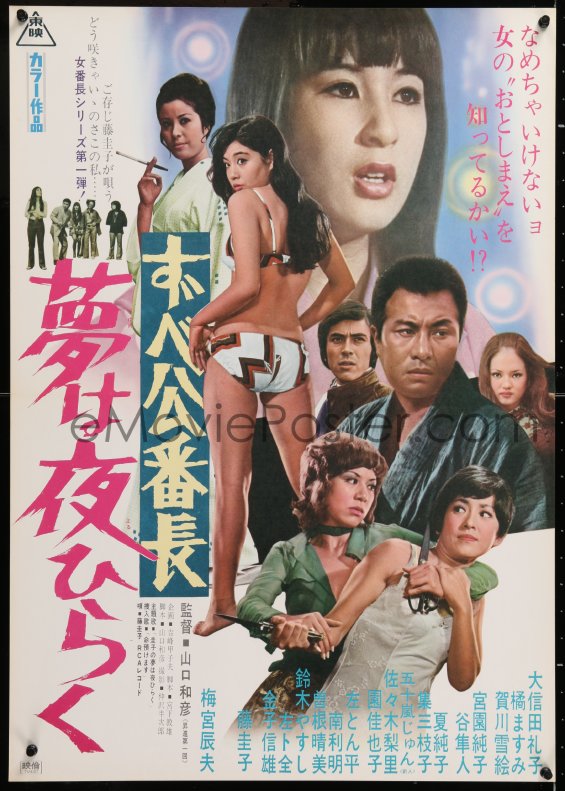
The first movie in the Delinquent Girl Boss series — perhaps not to be confused with 1970’s Stray Cat Rock: Delinquent Girl Boss* — this Kazuhiko Yamaguchi (Sister Street Fighter, Wolfguy: Enraged Lycanthrope) film introduces Rika Kageyama (Reiko Ôshida), the titular girl boss who will appear in a series of four movies.
We find Rika graduating from reform school and supposedly being ready for a bright and cheerful life, putting the crimes of her youth behind her, but would a Japanese Pinky Violence film be interesting at all if Riku stayed on the straight and narrow path?
After a job at a laundry ends with the owner attempting to force himself on her and his wife blaming the victim, Riku gets a job at a hostess club. The Yakuza is trying to muscle in on this place, so she must come to the rescue of the other girls that work there, even if she has to put her own virtue on the line to do so.
While this film doesn’t go to the depraved depths of many Pinky Violence films, it also displays the juxtaposition at the heart of so many films in this genre: it puts its heroines in danger tinged with sexual violence, but it also presents them as capable characters who have agency and stand with one another against the abusive men in their universe. At the same time that these films invite you to watch what happens, it reminds you that you are just as wrong as any of the men who treat these women so horribly.
*Toei made the same series and the band Golden Half shows up in this, playing the same “Yellow Cherry” song that they rocked out in Stray Cat Rock: Sex Hunter.
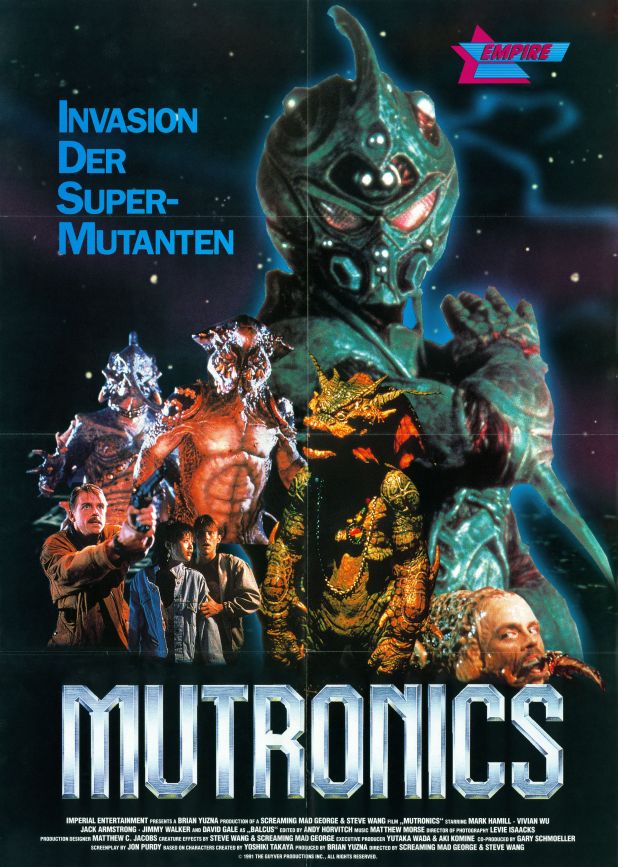
How weird was it when The Guyver just randomly showed up in my local video store, unannounced, bringing Japan weirdness into my 19-year-old movie rental obsession life?
When Dr. Tetsu Segawa steals the Guyver unit from the villainous company he’s been working for, his daughter’s boyfriend Sean accidentally finds it, puts it in his backpack and has it fuse with his body after he’s attacked by a street gang. That makes him a marked man by Fulton Balcus (David Gale) and his gang of Zoanoid mutants, which includes Lisker (Michael Berryman), M.C. Striker (Jimmie Walker) and Weber (Spice Williams-Crosby).
Directed by Screaming Mad George and Steve Wang, this movie has some of the wildest effects I’ve ever seen, full body suits that still look great thirty years after I first watched this. I’m also still surprised that Mark Hamill is in this, while not as surprised that Jeffrey Combs and Linnea Quigley are in this.
Based loosely on the Yoshiki Takaya manga, this takes a lot of liberties with its inspiration, but for someone in the very landlocked small Western Pennsylvania town that I grew up in, finding this on the shelves of Prime Time Video was like some kind of magic, bringing something I thought I would never see to a place that I thought I would never get out of.
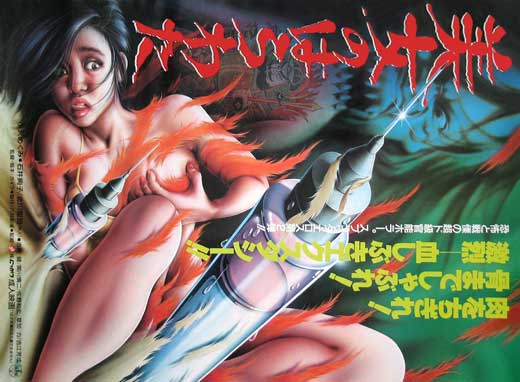
Entrails of a BeautifulWoman is the sequel to Entrails of a Virgin and was directed and written by Kazuo “Gaira” Komizu, who also made the family-friendly movies Guzoo: The Thing Forsaken by God – Part I and Rabbit sex: Joshigakusei shûdan bôkôjiken.
After a young woman is used and abused by the Yakuza — and her sister is treated to the same horrific fate — she tells her story to a psychologist before committing suicide. But then that same psychologist tries to get revenge, only to also find herself facing the same end before she’s dismembered and buried along with the body of another criminal.
Somehow, thanks to gory Japanese scumbag fate, their bodies melt together and become a dual sexed zombie that treats the criminals the same way that they were treated, whether by violence or, well, look this movie is going to go places that movies like Incubusonly hint at, making that movie look like a film you can watch with your parents by comparison.
If someone offers you the drug Angel Rain, just say no.
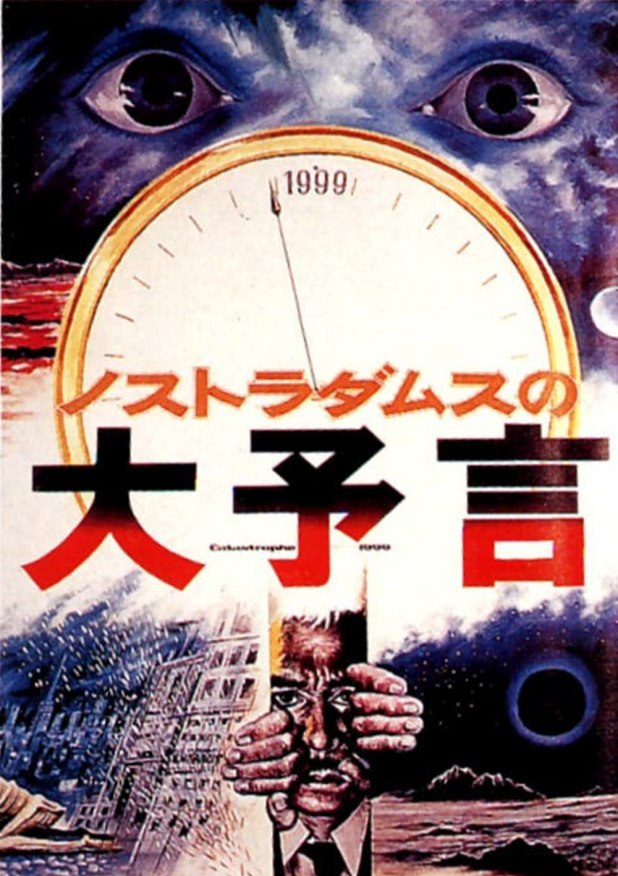
In 1969, Tsutomy “Ben” Goto was writing for women’s magazines and watching the moon landing. That’s when he remembered reading about man walking on the lunar surface in the quatrains of Nostradamus*.
Michel de Nostredame was a French astrologer and physician, but also a seer who wrote Les Prophéties, a collection of 942 quatrains — a poetic stanza made up of four lines with one having alternate rhymes — that allegedly predicting future events. Worrying about being arrested and tortured in the Inquisition, Nostradamus obscuring the meaning of his prophecies by using word games and a mixture of other languages such as Greek, Italian, Latin and Provençal.
At the time, people thought Nostradamus was either evil, fake or insane. After all, if he was so good at predicting the future, why didn’t he predict that he’d suffer from the gout? He did have one admirer. Queen Catherine believed in him so much that she made him Counselor and Physician-in-Ordinary to her son, King Charles IX.
The Japan of 1974 was gripped in pre-millennial tension that one has to assume was exacerbated that they alone had had two examples of nuclear fire dropped on their country in the past century and here we were, on the precipice of an even more frightening future. Goto’s books were perfect for the country’s insecurity and vulnerability.
This is also when the idea of 1999 started worrying people. After all, a major disaster was coming in the last year of the millennium, even though the millennium didn’t really end until 2000. The book said that Japan would suffer an oil crisis, a trade war with America, a devalued yen, the rise and fall of real estate in Tokyo, volcanos and earthquakes.
By Predictions of Nostradamus: Middle-East Chapter in 1991, Goto had written seven books on the subject (he eventually wrote ten), he had sold 5.4 million books, even if critics said that his work was “Nostre-damasu,” which uses the Japanese word damasu, which means to deceive**.
Meanwhile, Toho was nearing the end of Godzilla’s Heisei era and was looking for something new to get moviegoers into the theater. They’d already followed Hollywood’s disaster movie template to make Japan Sinks, which was the most popular movie in the country in 1973 and 1974, making double what its closest competitor did. It was so successful that Roger Corman and New World Pictures bought the rights, threw in Lorne Greene and released it as Tidal Wave.
For this movie, Toho took a glance at a book written by Shinya Nishimaru, general manager of the Food General Office within the Ministry of Agriculture and Forestry, and Goto that saw a dismal future, filled with no food and an environment that began to turn against humanity.
Written by Yoshimitsu Banno, who also made the apocalyptic Godzilla vs. Hedorah, and Toshio Masuda, who directed Tora! Tora! Tora! about Japanese and American naval conflict, as well as Be Forever Yamato, which is an anime that has a Japanese battleship rise into space, along with help from Toshio Yasumi (The Last War) in just ten days, this movie points to the dual scope and economy of Toho.
Scope: It’s the end of everything, so it was shot on all of Toho’s visual effects soundstages***.
Economy: It features footage from The Last War and Tokyo Sinks, while its destruction was recycled again as destructive scenes in The Return of Godzilla and Deathquake.
In the Japanese cut — oh man, there are six versions — the movie gets started in 1853, as Genta Nishiyama begins preaching the prophecies of Nostradamus before he begins to preach that Japan will end its isolation. Killed for heresy, his children hide the book and his family continues to tell of the prophecies, like a World War II descendant who is interrogated about the defeat of the Axis.
Let’s smash cut to 1999. Dr. Ryogen Nishiyama has been analyzing all manner of bio-phenomena, like large mutant bugs, kids getting psychic powers from drinking zinc-heavy water and ice showing up in Hawaii. Trust me, this movie is decades ahead of Don’t Look Up and a million trillion times more entertaining, as no one believes that natural disasters are about to be unleashed and things like nuclear clouds in New Guinea will create giant leeches, bats that feel like they came out of A Lizard In a Woman’s Skin and cannibalism.
There’s also an incredibly dark scene where a fisherman, realizing that the oceans will never sustain life again, realizes that his life has no purpose, so he walks into the waves to die as his sons fight to save him.
From catastrophe both large — SST jets exploding over Japan and unleashing the full power of a hole in the ozone layer and snow in the Middle East — to small — dying family members of the central cast making the end of the world personal, this movie takes a downbeat turn quickly, but somehow, this is all set to a score that can only be described as transcendent. Or paradoxical. Or great.
In between all of this death and destruction, we learn that the young people have decided to take their fates into their own hands. As they take tons of drugs, they draw lots and sacrifice themselves by climbing into the sails of boats, dressed in kabuki makeup, crashing into one another. They also line up on motorcycles and one after another jump into oblivion and the dead sea, all set to guitar-driven fuzz rock.
By the end, nuclear war has broken out and our planet is a desert where mutant humans still kill one another, learning nothing.
Then, as if Bobby Ewing had just finished his shower, we learn that this has all been a speech that Dr. Nishiyama was giving to the Japanese Diet. The film ends with this credit:
The story you have just seen was a work of fiction. The events it portrayed, however, may take place in our world. It’s up to you to take action to ensure these events do not come to pass…
A Japanese version of Prophecies of Nostradamus played Japanese-language theaters in the U.S. in 1979 and 1980, while UPA acquired the rights to distribute the film on home video and television. The American version, The Last Days of Planet Earth, was released on VHS and laserdisc in 1995 by Paramount.
There are a ton of differences, with much of the gorier moments taken out like the cannibals eating one of the scientists, the flesh falling off the arm of a zombified man, an American voice-over for the regatta of death, nuclear missiles being launched, the mutants and a human biting into a snake — amongst many other excised scenes and narration changes.
While available for release in the U.S., it’s doubtful that the full movie will ever be seen here outside of bootlegs (shh — I have one with six different cuts of the movie****). The cannibal scenes and the mutant battle were cut everywhere outside of Japan and as of 1980, those scenes don’t appear in Japan outside of a bootleg — released by a Toho employee — of a canceled VHS and laserdisc release in 1988.
The film was cut down from 114 to 90 minutes thanks to all of the edits.
Sadly, the sequel Prophecies of Nostradamus II: The Great King of Terrorwas never made, a movie in which Goto analog Tsutomu Goto would try to reach out to the spirit of Nostradamus to save the world. Toho did make Nosutoradamusu: Sen ritsu no keiji in 1994.
*Century 9, Quatrain 65: “He will come to go into the corner of Luna, where he will be captured and put in a strange land. The unripe fruits will be the subject of great scandal. Great blame, to one great praise.”
**Thanks to Japan Today for this fact. They also shared an amazing article about Ryo Tatsuki, a manga artist who published The future as I see it, in which she predicted that “around 2020, an unknown virus will appear, reaching its peak in April; it will then vanish but reappear 10 years late,” as well as the deaths of Freddie Mercury and Princess Diana. Obviously, Nostre-damasu will never die.
***During filming, a pyrotechnical accident caused a fire that burned down part of the main visual effects soundstage, an apocalyptic event all its own that destroyed many of the costumes and props from earlier Toho films, including the original Mogera costume from The Mysterians.
In the near future — 20XX? — every girl between the ages of 14 and 16 years old begins to experience NDH — Near Death Happiness — a period of immense joy before dying and becoming a Stacy, or a zombie, which must be chopped into pieces in a process called Repeat-Kill by the garbage truck driving Romero Repeat-Kill Troops, so you know exactly where this film’s tongue is at.
Loved ones are also the only people legally allowed to Repeat-KIll a Stacy and they’re being marketed to by companies who make a chainsaw that fits right on your hand, the Blues Campbell’s Right Hand 2.
This movie has way more heart than I thought it would. It also has barrels full of body parts.
Director Naoyuki Tomomatsu also made Kyûketsu Shôjo tai Shôjo Furanken (Vampire Girl vs. Frankenstein Girl) and Kimi Wa Zonbi Ni Koishiteru (Bite Me If You Love Me), as well as Scissorpenis and Future Century Amazons, which I just watched and umm…yeah. It’s something.
Also known as Blue Christmas, this movie is somehow way ahead of its time, as UFO abductees return to Japan with blue blood, which upsets everyone else because, well, do racist people really need a reason? And this also has a deeper story inside it, a remembrance of at least 17 Japanese citizens that were taken by the North Korean government.
Maybe it’s the time I’m watching this in — then again, you could have felt the same way at the start of AIDS or in how Japan and Korea view one another — but this is hitting too close to home. Reporters struggling to reveal the truth, lovers on opposite sides of a conflict united only by their hearts, human lives reduced to blood and organs under the scalpel, prejudice and feelings presiding over facts.
Director Kihachi Okamoto was drafted during the last years of World War II, into the very worst fighting, and was alone among his friends in that he survived. Most of his films have a very cynical edge, even his gangster films and it’s wild that this movie is from Toho.
There’s also the professor who broke this story, why he disappeared and where all the blue blood people are going. As for the UFOs, unlike most other Toho science fiction, they’re never seen.
Sure, this is long at 133 minutes, but it’s so strange, nearly shot like a parody yet dark in its tone. The closest thing I can compare it to is either Eyes Behind the Stars or Footprints on the Moon, but neither is anything like this. To be honest, the end of this has stuck with me for some time and this feels like another strange film that I’ll have to go back and watch several times.





 B&S About Movies
You must be logged in to post a comment.