Written and directed by Roland Emmerich as his thesis at the Hochschule für Fernsehen und Film München (HFF), this movie cost about $740,000 to make, while the average student at the school spent $12,000 on their thesis movies. But hey, how many of them got to make Independence Day?
In 1997, peace has come to the world. Except for, well, the chance that World War 3 could break out at any moment and the satellite that Billy Hayes is working on could be the weather control instrument of Earth’s last war.
It’s basically like most of his other movies — people yell at each other — without the benefit of a huge special effects budget. That said, I bet the other students absolutely hated when he walked up on the day of showing student films and was like, “Oh, you made a movie about the sad and noble trials of man? I made a popcorn movie!”
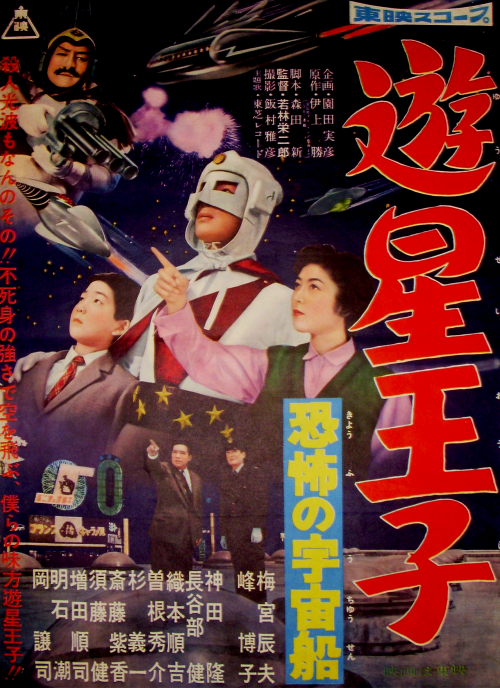
Planet Prince was a 1958 Japanese tokusatsu made by Toei Films that was made in the wake of the success of Super Giant (Starman in the U.S.) that went from a 49 episode TV series to two theatrical movies — Planet Prince and Planet Prince: The Terrifying Spaceship — released one week apart.
Prince of Space is both of those movies smashed together, edited and dubbed into English. His enemy, the Ambassador Phantom of the Silver Planet, has been renamed Dictator Phantom of the Planet Krankor. To make things even goofier, the American translation of our hero’s real name — Waku-san — is Wally. Hey everyone! Here’s Wally to save the world!
The Dictator Phantom is really pretty great. He looks like a chicken masked Darth Vader and is given to saying things like, “Come on out or we’re gonna kill some children!” and “I will arrive tomorrow night at precisely eight o’clock. At that time I shall make my wishes known to you. You will obey them…or die! Have a pleasant night’s sleep!”
Editor’s Note: We previously reviewed Mission Stardust as part of its inclusion on Mill Creek’s Sci-Fi Invasion 50-film pack — the set also includes its even weirder, 1966 cousin, Mission Hydra, which we also re-reviewed with a new take, earlier today at 9 am.
Known in Italy as 4…3…2…1…Morte (aka, “Death”), this Primo Zeglio-directed science fiction movie is based on the German book series Perry Rhodan by K.H. Scheer and Walter Ernsting. Hugely successful throughout Europe and the Soviet Union, but relatively unknown in the U.S., the pulpy Rhodan paperbacks have been produced since 1961; as of 2021, 3000-plus, 66-page booklets and 850-plus spinoff novels have been produced. George Lucas named-dropped the books, saying that the American translations served as one of his inspirations alongside Flash Gordon (which he wanted to adapt, but couldn’t get the rights) in creating the adventures of Luke Skywalker and influenced the design of his verse’s spaceships.
As for Primo Zeglio, his directing career was not as successful — certainly not an Italian filmmaker we name drop in the B&S About Movies offices often; in fact, this is the only film of his that we’ve watched and reviewed — even after our month-long “Spaghetti Westerns Week” blowout. However, Zeglio is certainly a competent filmmaker and revered in his homeland for his spaghetti westerns, of which he made four: The Man of the Cursed Valley (1964) with Ty Hardin (another American TV hopeful from ABC-TV’s western Bronco, hoping for some Eastwood-buzz), Two Violent Men, with Spain’s George Martin (1964), The Relentless Four (1965; no not Kinski’s The Ruthless Four; different flick) with Adam West (again, no Eastwood upwind there for Batman), and Killer Adios (aka Killer Goodbye, aka Winchester) with Spain’s Peter Lee Lawrence (1968) (he was in Eastwood’s ’65 spaghetti western For a Few Dollars More); the film ended his 18- directing credit and 20-writing credit career. During those spaghetti romps, Zeglio produced his fair share of pirate and sword and sandal romps, the most notable being Revenge of the Pirates (1951), Captain Phantom, (1954), Morgan the Pirate (1960), and Sword of the Conqueror (1961).
In need of radioactive material that can be more powerful than uranium, Major Perry Rhodan (American-Canadian actor Lang Jeffries, whose career started with the ’50s American rock ‘n’ roll flick, Don’t Knock the Twist, and transition into a wealth of Italian sword and sandal, spaghetti westerns, and war movies) leads the four-man crew of the Stardust for the Earth’s first moon mission — and come to discover its populated, led by the platinum blonde-wigged Commander Thora of a crashed Arkonide spaceship (Swedish actress Essy Persson from the Vincent Price-starrer Cry of the Banshee, released by AIP in 1970) and her robot crew. Rhodan and his crew team with the Arkonides to rescue Crest (John Karlsen, later of Michele Soavi’s The Church) dying from leukemia, for which there is a cure on Earth. When our intrepid space travelers shuttle to Earth with Crest, Rhodan deals with a crewman’s betrayal in helping an international crime lord steal, not only the newly discovered radioactive material, but obtaining Arkonide technology by kidnapping Thora.
The caveats are afoot, as we’re only on the moon for little than half of the film; the remainder of the film is spent on Earth in the African desert (like it’s from a completely different film) with the evil Earthlings and the Arkonides in battle. The very pop-artish, dinky-but-effective effects were created, in part, by Antonino Margheriti, who designed the spaceships; the metal-octopus-cum-jelly fish alien ship (more like diving bell with octo-legs) is impressive (they are, in fact, original to the film and not cut in from any Russian space flicks, as some believe; and not as far as I can tell); Margheriti, of course, had his own series of Italian space operas beginning with Assignment Outer Space and his “Gamma One” series.
Fans of the Perry Rhodan book series, in their reviews of Mission Stardust, say it has very little to do with the first three Rhodan novels it purports to adapt. If you’re a fan of Star Trek: TOS and other ’60s-mod Italian sci-fi romps, there’s something here for you to nostalgia nosh your little VHS-cum-UHF lovin’ heart on; however, those weened in a post 2001: A Space Odyssey world, with the “realism” of films such as Silent Running, will have some MST3k-styled commentary fun with your friends as this moon romp unfolds.
Zeglio’s lone space romp is out there in a few different formats — and Mill Creek carries the shortest, U.S. version at 79-minutes. The original Euro-theatrical runs 94 minutes, there are also international 92 and 86 minutes prints that edit out the racer (e.g., sexual innuendos and suggestive) scenes. And while this was released in 1967 overseas, it came to be release in 1968 in the U.S. By that point, 20th Century Fox’s Planet of the Apes and MGM’s 2001: A Space Odyssey were released, along with Warner Bros. and Columbia Pictures’ technically accurate “first men on the moon” dramas Countdown and Marooned. The days of Margheriti’s “Gamma One” quartet and The Green Slime, also released in 1968, along with the Darren McGavin and Nick Adams-starring Mission Mars, were dated before they even hit the theaters.
There’s numerous uploads of Mission Stardust, but give this You Tube version a spin. Sadly, the U.S. public domain versions are missing the “futuristic” opening credits theme music. So don’t be duped by the uploaders who embedded their own, jokey music to the film. You can rent a cleaner, commercial-free version at Amazon Prime, which runs the 94-minute print, dubbed. Oh, and if you need to see another crazy, ’60s mod Italian space flick with Earthlings helping stranded aliens, then check out 2+5 Mission Hydra. We implore you: Watch the weird cousin to Mission Stardust that is 2+5 Mission Hydra, please. It’ll change your life.
Hey, You Tube comes through! Here’s the missing theme song, “Seli,” composed by Marcello Giombini:
Be sure to look for my reviews of 2+5 Mission Hydra and Mission Mars, as our “Space Week” tribute of reviews continues all of this week.
About the Author: You can learn more about the writings of R.D Francis on Facebook. He also writes for B&S About Movies and publishes music reviews and short stories on Medium.
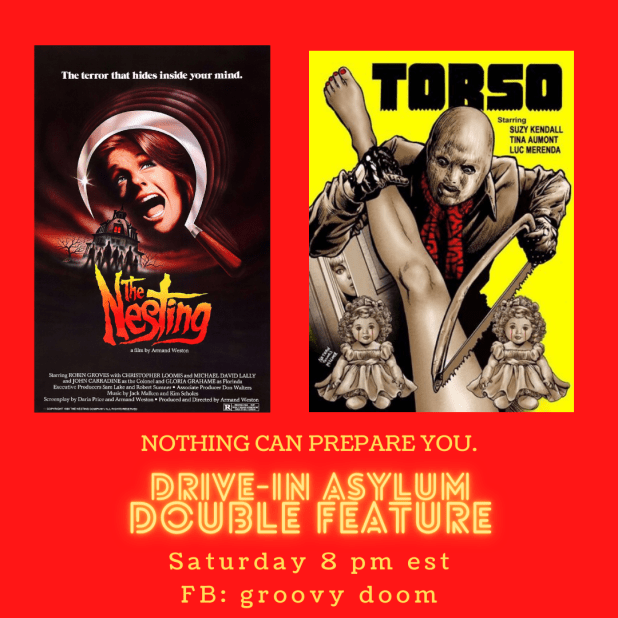
This week, prepare to go criminally insane with two out there freakouts! You can join us on the Groovy Doom Facebook page starting at 8 PM East Coast Time.
Editor’s Note: We previously reviewed the later, Star Pilot cut of this 1966 Italian space opera as part of its inclusion on Mill Creek’s Sci-Fi Invasion 50-film pack. The set also includes its equally-weird space cousin, Mission Stardust, which we are also re-reviewing with an all new, expanded take, today at 12 noon.
Even without Mill Creek box-setting both Primo Zeglio’s Mission Stardust (1968) and this, Pietro Francisci’s Italian space opera — which dropped into the international marketplaces between 1966 to 1968 as Mission Hydra and Destination: Planet Hydra (1968, of course, being the year of our Kurbick) — we’d still watch and review these two movies back-to-back, since they complement each other so well. And they’re practically the same film — plot wise, at least — as you’ll come to see.
The ’60s one-sheet.
The most amazing aspect in watching Mission Hydra is how much Italian production values — as least in the sci-fi genre — hadn’t changed much from their Forbidden Planet (released by MGM in 1956) influences from the ’50s to the Lucasian late ’70s. Don’t believe us? Then give a watch to the Star Wars droppings that are Luigi’s Cozzi’s Starcrash and Aldo Lado’s The Humanoid (1978 and 1979, respectively) and you’ll understand the analogy. In fact: You’d swear the costumes from Mission Hydra languished in mothballs for ten years, only to be pulled out of the closet for both films (especially The Humanoid). It was for that very reason that Hydra-whatever-it’s-titled, was dubbed into English and dumped into the post-Lucasian marketplace (I saw it at my local duplex) to capitalize on Star Wars in the fall of 1977: the year when ANYTHING mentioned in the pages of Starlog magazine got our $3.25 at the ticket window.
To “Americanize” those ripoff-proceedings: we got the somewhat “familiar” title change, while most of the verse-dialog was ripped from TV’s Star Trek — which hadn’t yet made its way to Italy (Star Trek first aired in September 1966; Mission Hydra screened in Italy in October 1966) — so you’ll end up hearing lots of references to “Star Fleet,” “Warp Drive,” and “Impulse Drive.” But even with the Bechdel test costumes fails of the Roddenberrian-verse, you’d never see Communications Officer Uhura and Yeoman Janice Rand wearing the sexy vinyl-fishnet numbers of the Hydra’s female crew.
If there was ever a film that’s a celluloid mystery, it’s Mission Hydra. What was its plot? Was it meant as a Flash Gordon homage? To This Island Earth or It Came From Outer Space (plot similarities in all three). Was it meant to be an outer space “James Bond” spy flick: or was that the “plot” we got in 1977 once the opportunistic chop shop scoundrels at Monarch Releasing Corporation got a hold of it? Sadly, here, in the U.S., we’ll never see the original version of Pietro Francisci’s vision (unless you’re a Blu-ray hound), as the running times across its various theatrical, VHS, DVD, and UHF-TV re-releases over the years, are all over the place, with running times of 80, 84, 89, 90, and 92 minutes.
Yep! It’s another (cheapjack DVD) the-cover-art-is-better-than-the-movie epic from Italy.
As this ungodly mess of Star Pilot unfurled on theater and Drive-In screens in 1977, we, the sci-fi loving kids weened on UHF-TV’s galactic wonders, knew we were duped from the get: too late, they got our money, so we pushed through it. And, as we got older, and needed a desperate-doze of nostalgia to easy our grown-up pains, we rented the Star Pilot VHS for some MST3k retro-laughs as we called out the obvious Cormanesque SFX stock footage raiding of Toho’s space epics Gorath (1962) andInvasion of the Astro Monster (1965; starring Nick Adams, who also stared in 1968’s even-space sloppier no-it’s-not-2001: A Space Odyssey, Mission Mars) . . . but I’d swear I saw bits of Toho’s old 20,000 Leagues Under the Sea rip-off, 1963’s Atragon, which Toho rebooted/remade — to cash in on Star Wars, natch — as 1977’s The War in Space. But I digress.
For most sci-fi lovers, the first time they saw that Toho footage was when it was cut into the started-in-1967-and-released-in-1972 mess (of the ever-changing-spaceships) that was The Doomsday Machine. So, which came first: the chicken or the egg, or the egg or the shell? Did Monarch go direct to the Toho source — or did they get their Toho stock from The Doomsday Machine (yeah, they did the latter). Well, what we do know: that is definitely Casey Kasem (The Incredible 2-Headed Transplant) as an Air Force flight controller (sans his voice, natch) cut from that film, appearing with the Italians. And since no one saw The Doomsday Machine until 1972, obviously, it’s not part of the original 1966 release. And since most didn’t see the Toho space operas, Monarch thought they had us duped.
Oh, you scamps in Monarch’s executive suites: how wrong you were.
So, is there a plot? Well, of course there is. Well . . . not really. We think it goes like this . . . and, why yes, it is practically the same humans-help-aliens plot from Mission Stardust. See, we told you it goes great with Star Pilot!
Aliens (spandex-suited Gumbys, natch) from the constellation Hydra crash-land on the Mediterranean Sea island of Sardinia, west of Italy (and those Gumby-guys in hibernation are robots). There, Professor Solmi (Roland Lesaffre, who went from Georges Lampins’s Crime and Punishment in 1956, to this?), a prominent, greying scientist, along with his brunette-goddess daughter Luisa (Leontine May-Snell, of the 1971 western-spaghetti Dig Your Grave, Friend . . . Sabata’s Coming), and he-man lab tech Paolo (Mario Novelli? Tango from our fave ’80s apoc-romp Rome 2072: The New Warriors?) meet the aliens.
The bogus, late ’70s “Star Wars” theatrical repack.
Fashion Sidebar: We need to mention that Luisa starts out in tight mod-pants and a turtleneck sweater (perfect for island cave exploration), then changes into a chiffon skirt and heels for spaceship weightlessness, and then into the alien’s boob-augmented, leather/vinyl-fishnet wares. And truth be told: Overall, in spite of the budget fails, the costumes are stellar. For the big “space walk” scene (check out the wire-hung swinging stars), the Hydraian’s black-vinyl space suits fitted with exterior hoses and wires, reminds of Harvey Keitel’s suit in Saturn 3. But unlike Keitel, the Hydraians don’t need no stinkin’ (costly) helmets, just some hoses up the nose.
Okay, that’s settled. Back to the story.
The Earthly-trio are ordered to the island to investigate its increased radiation levels — from the alien ship that no one knows is there, get it? Then an earthquake hits. (Caused by the aliens? Don’t care.) And an alien craft is discovered in the newly opened cavern (and it takes 20 minutes of out-of-date, ’60s-era film to get there). Then a pair of Asian spies take the Professor and gang hostage — with the goal of stealing the “secret weapon,” i.e., the spaceship. Then everyone is taken hostage by the Hydraians, led by Kaena/Phena (Leonora Ruffo; uber-hot with her flame-haired and fishnet-bodysuit wares) and Belsy (Kirk Morris), who use the Earthlings as slave labor to repair their ship. (Ruffo went from Fellini’s I Vitelloni in 1953 and broke our UHF-hearts in the title role of Francisci’s 1952 bible-epic, The Queen of Sheba — to this. Morris was a sword-and-sandals vet from Hercules in the Valley of Woe (1961), and a bunch of Maciste, Hercules, and Samson movies.) And once the ship is repaired, the Hydraians renege on the deal and take the Earthlings with them anyway, you know, because we are fascinating creatures and they want to examine our “genetic materials.” And the humans mutiny. And the ensuing chaos causes the Hyrdaian ship to hurl, lost in space.
Movie Math Sidebar: Now, do you “get” the film’s original title: Three Earth scientists, two Asian spies, equals five. Then, two aliens, minus their robots, equals two: 2+5 Mission Hydra. I know, movie math hurts my head, too.
Okay, that’s settled. Back to the story.
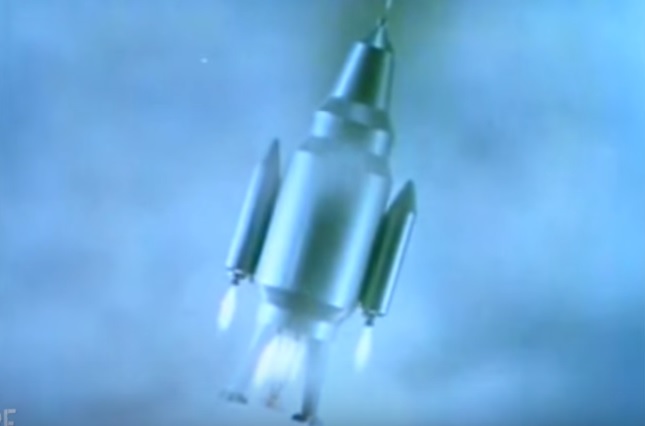
Now, for all of that footage from The Doomsday Machine: Right in the middle of it all: plop goes the spaceship footage at the 50-minute mark. But why? This is why: No, this SFX-shot is not clipped from the Rocky Jones theatrical feature Beyond the Moon (1954) (also on the Mill Creek Sci-Fi Invasion set): this footage is original to Mission Hydra.
Have a cup ‘o joe . . . to go!
Could the Hydra ship be any more 1950s? No way this thermos-and-candle sticks space cruiser (a coffee pot with squirt of silver paint, perhaps) can pass muster in the 1977 Lucas-verse. So, cut in the Toho footage. Why? Again . . . remember the Asian spies on the island of Sardinia that started the film? It’s all about the continuity. (And lack thereof.)
Anyway, while traveling to Hydra, our not-so-magnificent 7 (Wouldn’t have Seven for Hydra been a better title, in lieu of dropping math symbols?) encounter a skeletal pair of astronauts in a ship from Earth’s future (the best effect of the movie, even with the astro-motorcycle helmets/image). Or are they from Hydra’s past? (Don’t care.) And tapping into that dead ship’s computer, they realize the ship is from Earth’s past, which is now their future, and they’ve been hurled into the future-future? Or Hydra’s . . . argh! Oh, and “the past” is actually the Gorath footage — the footage that didn’t make it into The Doomsday Machine that Monarch cut into their new, 1977 version of the film — of the Earth destroyed by earthquake and title waves (that’s actually better than the rest of the movie it supports) to show the folly of man. (Or Hydra . . . argh!)
So, well, at least, we sort of know what happened to Bobby Van’s and Ruta Lee’s Danny and Dr. Marion Turner from The Doomsday Machine . . . we think, as they were left drifting homeless, in the open-ended never-sequel space. (Or was it Denny Miller’s Col. Don Price, who also appear via the stock footage? Don’t care. But I’d care if they’d worked in Mike “B.J Hunnicutt” Ferrell from M*A*S*H, with his big “press conference” scene.) So, now what do we do: Return to Earth or onward to Hydra? Uh, oh. Going to Hyrda was a bad idea: it’s an abandoned, contaminated wasteland and the populace left to find another planet to live on. (What, Earthlings are descendants of Hyrda’s past? Future . . . movie math . . . and time travel . . . what the frack, this is worse than a Battlestar Galactica episode. Where’s Hector and Vector? We need rhyme and reason!)
Poor Bobby Van (left) with Ray Bolger (from The Wizard of Oz): From The Doomsday Machine to vaudeville robots in the BSG-verse. And you thought the cast of Mission Hydra has it bad.
See. A mess. And you thought Escape from Galaxy 3 was a cut-n-paste death-penalty crime to cinema. Well, guess what? Star Pilot is worse. Oddly enough, not much has changed from Mission Hydra in 1966 to Christopher Lee and Robert Vaughn’s Canadian Star Wars dropping that is Starship Invasions in 1977. Yeah, it’s the same ol’ cardboard spaceship sets and the same ol’ “Gumby” aliens. Except. . . .
The space gorillas.
Yes, we can’t forget the space gorillas that now populate the wastelands of Hydra. Are they from Toho’s Kaiju-cum-Apes romps Godzilla vs. Mechagodzilla (1974) and Terror of Mechagodzilla (1975)? No, but with all of the post-Lucasian, Monarch Studio hodgepodge cutting from films released after Mission Hydra‘s original 1966 release, why they hell not? Were the apes even original to Pietro Francisci’s vision? Did he (or the film’s backers, more likely), inspired by the pre-production of Pierre Boulle’s 1963 French novel La Planète des Singes as Planet of the Apes (1968), decide (or forced by producers) to toss in some apes? Seriously. Out of nowhere — right in the middle of an Earth woman and Hydra male hook up, and with no explanation — the nuclear war on Hydra spawned an ape-ruling class. At least we think so. Monarch’s chop job is so bonkers, anything is possible.
Oh, and who caused it all? Murdu, played by requisite Italian-peplum actor Gordon “The Bronze Giant” Mitchell, barking orders from the beyond (in a quickie-Eric Roberts name-on-the-box dupe doing, what seems, a John Carradine-cut-in-from-a-whole-other-picture role). What a career, Gordo! From Atlas Against the Cyclops and The Giant of Metropolis (both 1961), and a bundle of spaghetti westerns, Giallos, and yes, even a Filipino post-apoc with SFX Retailiator.
Gordon Mitchell? MOVIE SIGN!
And who brought this pre-Star Wars dropping to us that we were lead to believe was post-Star Wars dropping?
Well, yeah, Monarch Studios, sure.
But we really can’t blame director Pietro Francisci, who was behind the best-known ’50s peplums Herculesand Hercules Unchained starring the best-known Herc, Steve Reeves. Peter started out making good films, with the likes of I Met You in Naples (1946) and the really great (IMO) historical drama Attila (1954) produced by Dino De Laurentiis (Barbarella, Danger: Diabolik and 500 more films, like Death Wish and Flash Gordon) starring Anthony Quinn and Sophia Loren (and . . . it was written, in part, by Primo Zeglio from Mission Stardust!). However, it seems Pietro Francisci, obviously disappointed with the end result — his 1966 end result and not the 1977 end result — didn’t make another movie until the sword-and-sorcery slapdash Sinbad and the Caliph of Bagdad (1973), which is just as inept-bad as the film that caused him to retire in the first place. And that ended Pete’s career.
Look, if you’re a fan of Antonio Margheriti’s War of the Planets (from his four-part “Gamma One Series”) and Mario Bava’s (even better!) Planet of the Vampires (both 1965), there’s something here for you to watch. Even better (Or is it worse?): If you’re a fan of Alfonso Brescia’s five-film “Pasta Wars” SFX-verse (We Are! Check out our “Drive-In Friday: Pasta Wars with Alfonso Brescia” featurette.), then there’s something here for you to watch.
And you can watch Star Pilot, lost in the wilds of the public domain, on You Tube HERE and HERE, and it’s the U.S. 1:20:00/80-minute version, in case you’re wondering. (And we wonder what wonders are held in those missing 12 minutes of footage — and more, if you consider the several minutes taken out to add in the unrelated footage from The Doomsday Machine.)
If you’d like own it on a DVD or Blu-ray outside of the Mill Creek set, the 89-minute version was issued on Blu-ray — under the original 2+5 Missione Hydra title — by RareVideo in 2020 in a new HD transfer (with both the 1966 original and bogus 1977 artwork). (Again, don’t forget about the five versions running at 80, 84, 89, 90, and 92-minutes; as far as we can tell, the 89-minute version is the 1966 cut issued outside of Italy — remember that the other versions added in footage and took out footage to add in the footage from The Doomsday Machine, got it?) Under the Star Pilot title — that is, the 1977 80-minute theatrical; the version that’s also part of the Mill Creek set — was paired with the equally abysmal Battle Beyond the Sun — as a two-fer in 2000. In 2018, Retromedia issued a two-fer DVD with (the awful) King of Kong Island (1968/1977) — and RM, thank you, cut out all of The Doomsday Machine tomfoolery.
And speaking of movie math and numbers: Did I just drop 2,300-plus words on this? Hey, I was shooting for 2,500, so I actually came up short. Consider yourself blessed.
About the Author: You can learn more about the writings of R.D Francis on Facebook. He also writes for B&S About Movies.
This film tells the story of three survivors of forced marriage in America. Fraidy Reiss is an ultra-Orthodox Jewish teen from Brooklyn who was coerced into marrying an abusive man. Meanwhile, in Michigan, Nina Van Harn’s Christian father forced her to marry a man he chose for her. And in California, Sara Tasneem was just fifteen when she was kidnapped by her father and forced to marry a 28-year-old man.
Even today, forced marriage cuts across state lines, ages, religions and social strata. Even worse, they are occurring legally across the United States every day.
In November 2019, Kate Ryan Brewer presented a TEDx Omaha talk on the subject of forced and child marriage in the United States and recently spoke at the 65th U.N. Commission on the Status of Women. Knots is her first feature film.
This is an eye-opener of a film and proves that no matter how far we feel society has progressed, we still have so much more work to do.
Knots: A Forced Marriage Story will be released via The Laemmle both theatrically and on their digital platform on May 7 followed by a wider digital release on June 4.
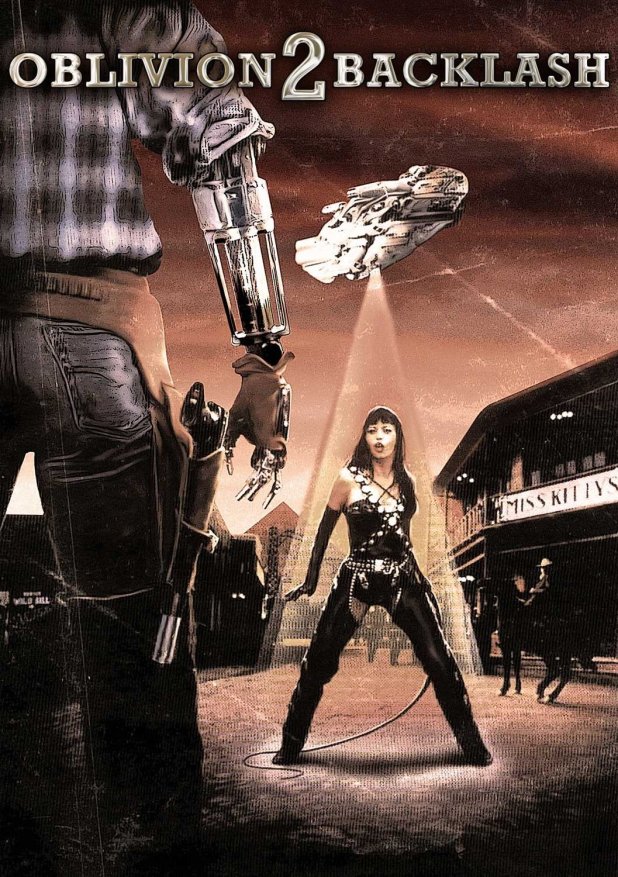
Written by comic and Star Trek writer Peter David and the sequel to 1994’s Oblivion, this Full Moon movie has a great cast, I’ll give it that much. There’s Andrew Divoff coming back as Jaggar, along with Musetta Vander as Lash, Richard Joseph Paul as Marshal Zack Stone, Jackie Swanson as Mattie Chase, Rock ‘n Roll Hall of Fame member Isaac Hayes as Buster, Julie Newman as Miss Kitty (simultaneously a Batman and Gunsmoke reference), Twin Peaks giant Carel Struycken as Gaunt, George Takei as Doc Valentine and Romanian singer Nadine Voindrouh as Josephine.
There’s a new bad guy in town, however. Sweeney, a British dandy who is the deadliest bounty hunter in the universe (played by Rex Manning, err, Maxwell Caulfield) has come to Oblivion to bring Lash to justice. This character originally appeared in David’s DC run of the Star Trek comic book.
While this was shot at the same time as the original, troubles between Full Moon and Paramount Pictures led to this movie being delayed. As this was the end of the studios working together, the third movie in the Oblivion series was canceled.
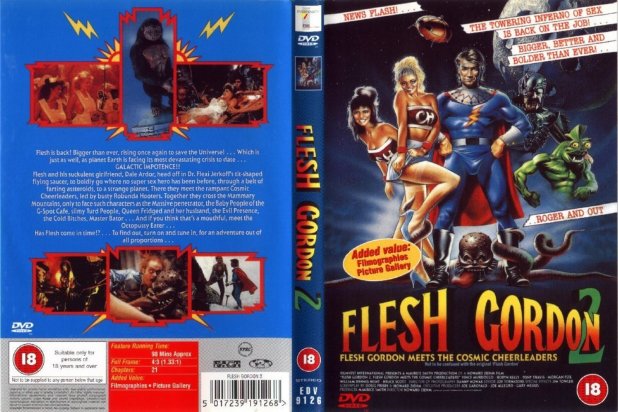
I really kind of love the original Flesh Gordon, but the 1990 sequel — with only William Dennis Hunt returning from the original cast — is scatological and insipid, which are usually two things I like. Yet by the end of the movie, I felt like I was constantly looking to see how much time was left.
Flesh (Canadian kickboxer Vince Murdocco) is kidnapped by a group of cheerleaders — hey, the title tells the truth! — from the Strange Planet. During a basketball game, their men were made impotent by the Evil Presence, who is coming to Earth to take Flesh’s penis for his own.
Director Howard Ziehm came back to make this one, but the second time is not charming.
Former Miss World Canada and Playboy Playmate of the Month for December 1990 Morgan Fox plays Robunda Hooters, which should explain the level of humor in this movie. I’ve said that Flesh Gordon felt like Mad Magazine. Well, this one is barely Crazy or National Lampoon in its last sad years.
It does have Melissa Mounds as Bazonga Bomber, which is really the only time this movie has ever made me giggle.
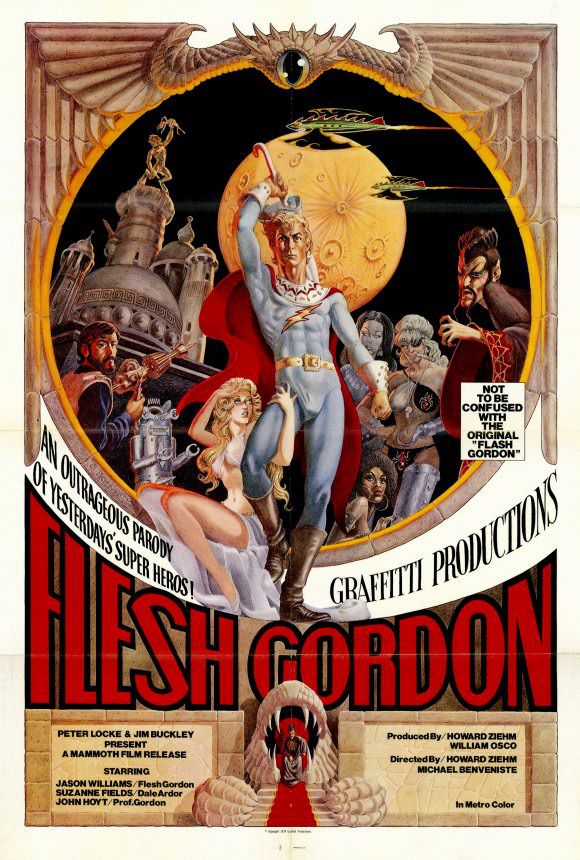
Shot in 1971 for around $470,000, producers Bill Osco (who produced one of the films that brought about the Golden Age of adult films, Mona, as well as three Jackie Kong movies, The Being, Night Patrol and The Underachievers), Walter R. Cichy and Howard Ziehm (who directed this movie) held out in the hopes that a big studio would release this movie. Maybe they should have waited until Star Wars came out and really got people into science fiction!
The film was made with a mix of adult industry people, special effects talent like Mike Minor (the first two Star Trek movies, as well as The Man Who Saw Tomorrow. The Beastmasterand Remo Williams: The Adventure Begins), Greg Jein (1941), Jim Danforth (whose name is backward in the credits; he worked with Harryhausen on a number of films), Dave Allen (Equinox, pretty much all of Full Moon’s effects for their early films) and Rick Baker (do you need to know what he’s worked on?) and science fiction fans like Bjo Trimble, Tom Reamy, George Barr and Cornelius Cole III.
Originally featuring both straight and gay hardcore penetration, this footage was surrendered to the L.A. vice squad to avoid a charge of pandering. There was also a legal challenge from Universal Studios, who claimed — and was pretty much correct — that the movie completely copied the first chapter of the Flash Gordon serial. The filmmakers added a text scroll claiming that the movie was a parody and included “not to be confused with the original Flash Gordon” in all of the advertising for the film.
The FX guys hated the porn producers so much by the end of the shoot that they held film of the effects until they were paid (Dave Allen insisted on being paid in cash every day) and they were not listed in the credits of the film.
Professor Gordon (John Hoyt, When Worlds Collide) learns that sex rays are being fired at our planet and one of them hits the aircraft that his son, Flesh Gordon (Jason Williams, who would go on to make Time Walker) and Dale Ardor (Suzanne Fields, the daughter of a Mormon bishop who appeared in more than sixty adult films before this), are inside. They end up having sex and parachuting into the lab of Flexi Jerkoff (Joseph Hudgins) who takes them to the planet Porno to stop the sex rays.
They are soon attacked by Emperor Wang (William Dennis Hunt, who would be the only person to reprise their role in the sequel) and his Penisauruses. After a lengthy orgy, they are all sentenced to die, except for Dale, who will be married to Wang. Flash is saved by Queen Amora (Nora Wieternik), but their ship is shot down.
Flash and Jerkoff both survive, however, and almost stop Dale and Wang’s wedding when it is invaded by the lesbian armies of Chief Nellie (Candy Samples!), who tries to keep the Earthwoman for her sapphic soldier squad. Help arrives in the form of Prince Precious (Mycle Brandy) of the Forest Kingdom before a living idol kidnaps Dale, but luckily, the good guys win in the end. Oh yeah — that’s Craig T. Nelson as the voice of the Great God Porno, who was called Nesuahyrrah by the animators (Harryhausen backward).
This movie is pretty dumb and I say that in the most affectionate way possible. It’s like a Mad Magazine parody except, you know, people are naked for most of it. It’s the kind of film that’s made for 16 year olds who totally shouldn’t be seeing it (and obviously will find a way to see it).
“The thing that hath been, it is that which shall be; and that which is done is that which shall be done: and there is no new thing under the sun.” — Solomon, Ecclesiastes 1:9
“Plus ça change, plus c’est la même chose.” — French critic, journalist and novelist Jean-Baptiste Alphonse Karr
Whoa, ye Richard D. Zanuck and Jerry Bruckheimer: for both ye were begat by Solomon and Karr. For when one studio or producer puts a film into production, another will put their own Ecclesiastian version into production. And the Byrdian “turn, turn, turn” of those film sprockets were burnin’ the same ol’ sunny bulb down upon the same ol’ celluloid long before the dual gunfights at the O.K Corral with 1993’s Tombstone and 1994’s Wyatt Earp . . . and when Dreamsworks/Paramount and Touchstone/Buena Vista went to battle with their respective, 1998 God-brings-destruction-on-the-world romps Deep Impact (released in May) and Armageddon (July) (which continues to rain upon the Earth with the recent Greenland and its cheapjack clone Asteroid-a-Geddon) . . . and when 2013 was the year of our battle with the terrorist-attack-on-the-White House epics Olympus Has Fallen vs. White House Down . . . and, since we are in a sci-fi mood: the Lucasian vs. Glen Larceny slugfest of 1978, with the Battlestar Galactica set adrift in the Akkadese Maelstrom — that’s what you get for trying to make the Kessel Run, Glen, baby.
Karr was right: The more things change, the more they stay the same.
And the familiar tale of this production by veteran B-Movie and “poverty row” purveyor Monogram Pictures — The Asylum studios of the 1950s, if you will — starring Cameron Mitchell (who went from this to, ironically, the Battlestar Galactica-clone Space Mutiny), begins with producer George Pal.
Pal purchased the rights to Robert Heinlein’s 1947 short story Rocket Ship Galileo (Heinlein’s work was also behind 1953’s Project Moonbase). With Heinlein serving as one of the film’s three screenwriters, it was turned into Destination Moon (1950). Pal’s first foray into sci-fi was the better remembered and more influential When World’s Collide (1951) (Paramount’s been trying to remake it for years), H.G Wells’ The War of the Worlds (1953), (remade, twice: Tom Cruise and The Asylum, natch), and the more scientifically accurate, but less remembered, Conquest of Space (1955) (that has no remake plans) (and you’re darn tootin’ Stanley Kubrick watched Conquest of Space; watch this You Tube comparison).
Well, studio chief Robert Lippert — whose Lippert Pictures would give us the failed, chauvinistic “matriarchy in space” romp that would be Project Moonbase (again, from a Heinlein book/script) — wasn’t letting George Pal one-up him. So Lippert rushed his own “first men on the moon” picture into production — and, as planned, beat Pal into theaters with Rocketship X-M (1950). While not as dry-to-boring as Destination Moon, Lippert’s copy is still talky and rife with scientific boondoggles in its tale of Lloyd Bridges (Oy! It’s Commander Cain from Mission Galactica: The Cylon Attack) in command of Earth’s first mission to the moon — that’s driven off course to Mars by an asteroid storm.
Imaginative, but ultimately undone by its cash-in cheapness to ripoff Rocketship X-M (which, again, hit the big screens first and ripped off Destination Moon), Monogram’s Flight to Mars concerns Mitchell’s philandering commander-in-charge of the Earth’s first (five-manned; four men and one woman) mission to Mars. Ol’ Cam’s the kind of leader that, sensing tension between the husband and wife engineering team on the trip, makes a command decision that flirting with the wife — in front of her man — is the right course of action. Batten down the hatches, this trip is gonna be a bumpy ride.
On Mars, our quintet meets the war-torn Martians forced to live in vast, underground cities (courtesy of pretty decent matte paintings; not Lucasian-stellar, but nice), who, regardless of their superior technology, need to steal our rocket design (because they’re tapped out of “Corium”), so as to launch an invasion to escape their dying world. And, in the grand tradition of ’50s sci-fi films — and the ’60s, such as the Italian romps 2+5 Mission Hydra and Mission Stardust — Earthmen and alien chicks (and vise versa) must have an interstellar romance. So, Marquerite Chapman’s Alita (her most notable roles were in 1952’s Bloodhounds of Broadway and, with Marilyn Monroe, in 1955’s The Seven Year Itch), a Martian babe who heads the resistance underground, betrays her people when she falls for Mitchell’s Col. Steve Abbott. No, wait. Col. Steve is hookin’ up with Carol the Engineer; Alita’s hookin’ up with Carol’s soon-to-be-ex (if Mitchell gets his wish), Dr. Jim Barker.
Hot damn!Cam scores on Barsoom. Someone tell Larry Buchanan that Mars doesn’t need women and save Tommy Kirk the trip.
Okay . . . let’s put the flight recorder on hold for a moment, Flash. Let’s review the “romance,” i.e., the philandering, and cosmic chauvinism.
Flight to Mars is the type of film where:
Although a woman is intelligent enough to engineer a rocket and is the only one qualified to monitor its systems, when she gets to Mars, her first question to her Martian hosts is “Where’s the kitchen?” and express amazement that “Mars is a woman’s paradise” because all food preparation is done in a lab and dish washing is done by machine. “Mars, I love you,” says the female rocket scientist.
Women are still objects of another crew member’s ogling and flirting, even though her husband/fiancée is also on board — and the woman reciprocates the pass because, even though the man is a pig, the woman is still a Jezebel that tempted the man to be a pig in the first place.
A woman, while sorta-kinda of cheating on her husband in the lab with another crew member, gets jealous when her husband tries to hook up with a Martian chick because, women are Rachel Green-styled emotional basketcases who love to instigate love triangles, only to leave tables and rooms in a huff.
Oh, and when women board a rocket, no flight suit or pressure suit is required: but they do need to wear a below-the-knee skirt, stockings, and heels. Just strap in, forget the helmet, freshen the lipstick, and hit ignition. Per aspera ad astra, sweet cheeks; for a kitchen awaits you on the angry red planet.
Now, if you’re keeping track of your classic sci-fi: Martian women falling for Earthmen dates back to Alexei Tolystoy’s novel Aelita (Ah, okay, you removed the “e,” eh, Monogram?), which was silent-film adapted in 1924 by Yakov Protazanov as Aelita, Queen of Mars (one the earliest, full-length science fiction films regarding space travel), and concerns a totalitarian Mars overthrown by Queen Aelita and her Earth-man lover. In fact, the true source material behind Monogram’s space opera isn’t Rocketship X-M or Destination Moon: the source is the English-dubbed and edited version known as Aelita: Revolt of the Robots, released in 1929. Yes, the ill-remembered Flight to Mars is a remake . . . and a ripoff . . . in one fell spin of the celluloid sprocket. And you thought The Asylum invented the Glen Larceny business model, first, huh?
So, that’s three films Monogram’s clipped . . . and 2+5 Mission Hydra and Mission Stardust, in turn, clipped them. And the women — both terrestrial and celestial — and as in The Angry Red Planet (the ultimate in creepy astronaut-leering adventure), Gog, King Dinosaur, and the aforementioned Project Moonbase — are Bechdel-tested into interstellar dust in all of them. At least Mission Mars (released in the Year of our Kubrick, 1968) had the good sense to keep the woe-is-me women on Earth and give us the good ol’ (goofy) non-human monster-aliens. (Dishwashers on Mars? Women are free from cooking and cleaning? Obviously, screenwriter Arthur Strawn — of 1935’s The Black Room starring Boris Karloff — from had matriarchal issues.)
We’re not in a spec of original space anymore, Toto! Wait, Auntie Em? This all looks familiar . . . beyond the script . . . wait, it is the same!
As with Roger Corman laying down the big bucks to produce his Star Wars cash-in, Battle Beyond the Stars, then reusing that film’s sets (and footage) in Forbidden World*, Galaxy of Terror*, and Space Raiders (yes, and Android and Star Slammer!), Robert L. Lippert maximized his bucks; he rented out the sets, props, and sound effects from Rocketship X-M to Monogram. While it’s not a “green movie” as Cat-Women of the Moon, these Mars proceedings are definitely a hue of bluish-green (or yellowish green?). Sure, Monogram redressed things a bit to make us think it’s all different, but it’s not. Well, outside of the fact that Rocketship X-M was shot in black-and-white and starts off to the moon and ends up on Mars, while Flight to Mars is shot in color and went to Mars as planned.
The UHF-TV highlights of director Lesley Selander’s 40-year and 145-plus film career include — for you ol’ black-and-white horror hounds, The Vampire’s Ghost (1945), War Paint (1955; with Robert “Unsolved Mysteries” Stack), and Fort Yuma (1955; with Peter “Mission: Impossible” Graves”; he went to the Red Planet himself with 1952’s Red Planet Mars).
You can watch Flight to Mars on YouTube while your woman heads to the kitchen to make you a sandwich. And be sure to pour a Dr. Pepper, babe.










 B&S About Movies
You must be logged in to post a comment.