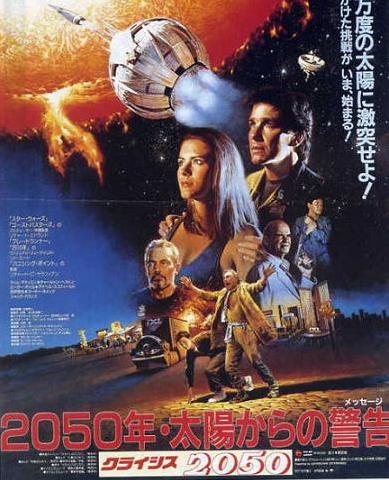
How did Solar Crisis — which cost $50 million dollars — disappear from the cultural zeitgeist?
This was not a small movie. While credited to Alan Smithee, the director is truly Richard C. Sarafian, who made Vanishing Point and Lolly-Madonna XXX. The cast includes Tim Matheson, Peter Boyle, Jack Palance, Michael Berryman, Paul Williams — as a talking bomb! — and Charleton Heston. It had a crew that included Russell Carpenter, the cinematographer of Titanic, and Syd Mead (Blade Runner) as production designer.
Hell, one of the investors was Nippon Steel, announced that they would be opening a theme park of the movie.
Thirty years later, no one remembers this movie.
The story could be some of the reason. Steve Kelso (Matheson) — the son of Admiral “Skeet” Kelso (Heston) and father of Mike (Corin Nemec) — plans on dropping a sentient bomb named Freddy — yes, just like Dark Star — with the voice of Paul Williams onto the sun to stop a solar flare and inspire Danny Boyle.
At the same time, Arnold Teague (Boyle) believes that there’s money to be made and tries to stop the mission. There’s also Mike trying to get to his dad, helped byJack Palance, who as always makes the absolute most out of a role.
The filmmakers went so far as to hire scientist Richard J. Terrile — a Voyager scientist who discovered several moons of Saturn, Uranus and Neptune — served as a technical advisor for the film. When he tried to tell them that sending a spaceship into the sun just wasn’t scientific, he was told to try to figure ot how to make it plausible.
I have no idea how anyone thought that an American film version of Takeshi Kawata’s novel Crisis: Year 2050 was going to make money off a budget that big, but blockbusters are a weird business. When the film didn’t do well in Japan, the producers reshot scenes for America and Sarafian took his name off the movie. Additional scenes were directed by Arthur Marks, who also was behind Bonnie’s Kids, Detroit 9000, Linda Lovelace for Presidentand J.D.’s Revenge.
There’s also a scene where Charlton Heston shouts at Tim Matheson, “Hold it, dammit! You tell me you love me before you leave this room!” That makes up for this multi-million dollar bomb looking no better than a direct-to-video release and lodges this magnificent failure directly into my head and heart.
David wanted to be a football player before an injury. Now he’s in love with a nurse named Shona and the concerts and disco he’s running – with his buddies Scot and John — have all been to impress her. After a few successes, our hero decides to go all in on a hugely ambitious Iron Maiden show. However, to make that happen, he has to throw in with a gangster named Fergie, which means that the biggest show of his life may just be his last one.
This film is based on truth, as the early years of Dave Mclean’s life in the music business really did have him promote a Maiden show at Dundee’s Caird Hall on June 12, 1980. For Maiden fans, they opened with “Sanctuary.”
This is Mclean’s first movie as a writer, director and producer. He brought plenty of American grunge and punk bands to the UK, including Nirvana, Mudhoney, The Smashing Pumpkins and Green Day before managing Placebo.
He’s to be forgiven for making his film look, feel and play a lot like Trainspotting, because both films cover a lot of the same ground. It does have a good soundtrack going for it, including Saxon, Hawkwind, Dead Kennedys, The View, Placebo and, of course, Iron Maiden.
You can learn more about this movie on the official Facebook page. It’s available on demand on multiple streaming services.
“Give me a film where Armageddon meets Alien, kid. — A cigar-chompin’ B-Movie executive to British special make-up effects designer Gary J. Tunnicliffe looking to make his break as a director
After binge-watching all of the Battlestar Galactica: TOS and Six Million Dollar Man series two–parters on NBC.com (as I prepared to review those series’ TV movie installments for our “Space Week” tribute), I couldn’t help but revisit what is one of my favorite (of many) Prism Entertainment ditties made for the Sci-Fi Channel (during their pre-“Y” days) — with all of the film’s totally awesome junk science tomfoolery of creating atmosphere and gravity on rogue moons. Obviously, someone in the Prism cubicles watched the epic, Steve Austin two-parter “Dark Side of the Moon” (Season 5), with our favorite cyborg “jumping the shark” by pushing the moon back into its proper orbit with a nuclear explosive device. (Junk science is great when you’re a kid, but a groan-enduing, mixed bag of Daggit dung and feldercarb when you’re a post-VHS codger lost in a digital world.)
So, our best estimation amid the B&S About Movies’ cubicles: Alien Resurrection (1997) went into production and the major studio asteroid-disaster battle of ’98 between Armageddon and Deep Impact was readying for theaters. And we can’t help but wonder if Creature (1985), William Malone’s Ridley Scott’s Alien meets Peter Hyman’s Outland (1981) redux, was pinched along the way?
Then there’s the marketing. Oh, you gotta love the marketing on this one.
It’s bad enough when a studio rips 20th Century Fox, Touchstone Pictures, Paramount Pictures, and Trans World Entertainment in one fell celluloid swoop — along with every other ’80s Italian Alien ripoff* — but Prism’s distribution network decided to evoke a few more films to convince those doubting, overseas Thomases. You can easily pick up on the films clipped with the foreign theatrical-television-home video titles of Spacegate, Spacetrek, The Last Predator (!), and the-what-the-hell-why-not grey-market title of Armageddon II. Some of the more unique titles are: Asteroid Mystery (Russia), The Fossil (Greece), From the Abyss of Space (Italy), The Prisoner of the Moon (Canada/France), and Terror Moon (Germany).
Regardless of the myriad of questions in the originality department and its you-swear-that’s-recycled-sets from Roger Corman’s Battle Beyond the Stars/Galaxy of Terror clone-verse — even with its against-the-budget CGI absent from its fellow ’80s antecedental ripoffs — Within the Rock is actually a pretty fun watch courtesy of its smart scripting (all of the chemical compounds, explosives, and mining tech-speak seems well-researched and convinced me) and direction from a debuting in-both-departments Gary J. Tunnicliffe. Gary’s over 100 effects (and writing) credits include the Dracula 2000, Hellraiser, and Return of the Living Dead franchises, My Bloody Valentine 3D, and Drive Angry; to that end, he’s also brought us top-notch against-the-budget production design.
So, what “clones” are attacking here?
In the future-history of 2019 (Did you miss the Rollerball championship game between Houston vs. New York?), we not only get a Xerox’d Xenomorph XX121 (The Creature from the Black Lagoon-inspired, caked-in-mud-cum-oatmeal ancient demon imprisoned by an alien race**), we also get a crew of the same old corporation-paranoid, slovenly, greedy types with overactive libidos. And, just to make this a little bit the same, but different: the mining crew of Galileo’s Child, instead of drilling in explosives, they’ll plant rockets. But why send a bunch of miscreant, malcontent miners and not NASA-trained astronauts? Are you not following along, dear B&S readers? We’re more into evoking Armageddon than Deep Impact, here. And if those miners fail? Hey, there’s no time for any last minute, Liv Tyler glycerine tear-inducing heroics: NASA will send a crew to blow up the rouge moon, aka Son of Galileo, with a couple of shuttle-launched rocks, criminal miners be damned. See, this isn’t the same, its different: a moon instead of asteroid.
Oh, yeah. The junk science. Apparently, in the future-history of 2019, the Russians developed technologies that can reproduce Earth atmosphere and gravity “walls” on astronomical bodies. Too bad those same Ruskies were unable to advance man beyond floppy discs technology. Where’s Snake Plissken with those 1997-era, mission-critical audio cassette tapes when you need them the most? And dig that Atari 2019 gaming system!
So, after we slog through the expected carbon-copy character development — rife with horny sex innuendos — the mission shifts from a Bruce Willis-dupe into a William Malone-trip as the miners discover a bone-filled alien sarcophagus — and, like many o’ Transylvania Counts before it, the skeletal remains regenerate when exposed to blood oxygen (speaking of classic horror villains: the cast name drops The Mummy). Then, we’re off into the Shaw Brothers’ British-shot Alien ode known as Inseminoid, with one of the miners going off the deep end, adding to alien slaughterhouse rock.
See? It’s an awesome popcorn bucket full ‘o fun for the low-budget, sci-fi guilty teen inside your still VHS-loving adult. I love this movie: it’s a pure ’80s VHS-retro tale o’ yore, just like Mr. Corman used to make.
While there’s no production or crew connections (in the music department) to William Malone’s eleven years earlier, best-of-the-Alien-clones . . . the musical déjà vus are obvious. As we discussed in our review of Creature: Trans World Entertainment (not the retail company of the same name that operates mall-based entertainment chains), was defunct by 1989. And those intellectual properties, in turn, came under MGM Studios’ tutelage after the Great Lion purchased Orion Pictures. So, it seems MGM may have sold off Malone’s score as stock scoring for other films. (Amazingly, no South African sci-fi production pulled a Space Mutiny and stock-footage raped Malone’s Creature.)
As for Le Monde and 360 Entertainment, the Canadian production companies that worked with U.S.-based Prism Entertainment on Within the Rock (that played as an R-rated theatrical in the Great White North): both companies were defunct by 1998. They made one other film that same year: the 1997-released Ravager starring Yancy Butler, a déjà va space romp about another group of space miners, natch, who — in lieu of an alien — stumble into a forgotten, infectious bio-weapons depot (so, Wolfgang Petersen’s Outbreak meets Ridley Scott’s Aliens). And, you guessed it: the Corman work ethic of waste-not-want-not recycling (and on-the-cheap CGI instead of in-camera, blue-screen modeling) across all departments is in play. And that’s more than likely, since James D. Deck, who served as the Unit Production Manager and 1st A.D. on Within the Rock, made his screenwriting and directing debut with the impossible-to-find-a-copy Ravager.
If you’re one who pays attention to opening title card and edits credits . . . and you’re wondering if that’s the same actors we know as Robert Patrick (Terminator 2: Judgement Day) and Scott McGinnis (Joysticks and Thunder Alley) in the producer’s chairs, your VHS-analog centers deceive you not: they’re one in the same (McGinnis also produced Ravager). And would you believe Pacific Rim junkmeister Cirio H. Santiago (who we love at B&S!) would be at the center of this Alien clone’s Venn Diagram? It’s true: Barbara Patrick, starring here as the Ripleyesque chemical-explosives expert Samantha “Nuke em” Rogers, was once known as Barbara Hooper, the star of Cirio’s Filipino post-apoc slopper The Sisterhood; while working for Cirio, she come to meet her future husband, Robert, who began his career with Cirio on Future Hunters. And you might have noticed Duane Whitaker (Maynard from Pulp Fiction) as one of the miners; he worked with Barbara Patrick on his self-penned Elvis homage, Eddie Presley. So this is an all-in-the-family shoot if there ever was one: and we dig it (mining humor!).
Oh, you reissue scamps!
The fine folks at Mill Creek Entertainment make Within the Rock easy to own as part of its “Fright Fest” 12-pack issued in 2005 and 2012. It’s also part of a Mill Creek triple-feature pack with a Phantom of the Opera remake and The Fear 2. If you’d prefer a single flick-issue, you can pick up Image Entertainment’s 1999 pressing. Why Within the Rock — considering the producers synergy — wasn’t public domain double-packed with Ravager by Mill Creek is anyone’s guess. But if you can’t wait for your order to arrive, then you can stream Within the Rock for free on You Tube. Unlike its sister film, the harder-to-find Ravager ran as a home video-only release in the U.S. and is not currently available on any streaming platforms. Anyway you get it, this is a fun flick! You go, Gary!
** You can check out Gary J. Tunnicliffe’s impressive alien-head design — complete with multiple servos, movable jaw motion, eye blinks, breath bladders — up close at You Props.com.
About the Author: You can read the music and film reviews of R.D Francis on Medium and learn more about his work on Facebook.
Editor’s Note: To commemorate the 42nd anniversary of the cancellation of the original Battlestar Galactica TV series in April 1978, we’re taking a look back at the two telefilms culled from the series — Mission Galactica: The Cylon Attack and Conquest of the Earth — for our “Space Week” tribute this week.
As I revisited my used VHS tape of this third Battlestar Galactica feature film cobbling from the TV series — after Mission Galactica: The Cylon Attack — my analog-kid memories time tripped to spending summers with my crazy Uncle Al (Bradley), the king of Italian schlock cinema; he who ripped the space opera torch from the hand of George Lucas and stumbled across the finish line to give us not one — but five (Yes, Sam, five. Not four. End of story!) — Star Wars ripoffs, faux flicks that we love so much amid the B&S worker bee cubicles, we dedicated one of our “Drive-In Friday” featurettes to Alfonso Brescia’s Pasta Wars oeuvre.
For if David Winter’s Space Mutiny is the South African equivalent of Turkey’s Dünyayi Kurtaran Adam, then Conquest of the Earth is Star Odyssey, Uncle Al’s response to George Lucas’s The Empire Strikes Back. For Glen Larson, with his Roger Cormanesque cheap ‘n shamless footage, prop, and costume recycling from his own BSG television franchise — as well as his Buck Rogers in the 25th Century axis (and Universal’s Earthquake and The Six Million Dollar Man*˟, and Irwin Allen’s The Towering Inferno, to boot!) — is a graduate of the Pasta Wars School of Science Fiction Film. (Hey, that prop from Quantum Leap looks like . . . oh, never mind.) Do you remember the time when Adalberto “Bitto” Albertini, he of the 1975 Italian soft-core sexploitation “classic” Black Emanuelle, pilfered Luigi Cozzi’s Starcrash to create Escape from Galaxy 3? Remember how Roger Corman endlessly recycled Battle Beyond the Stars to make the Star Wars droppings* that are Galaxy of Terror, Space Raiders, and Forbidden World (which also pillaged Galaxy)?
Yeah, it’s like that — and more. So much for TV network executives giving credence to viewer write-in campaigns.
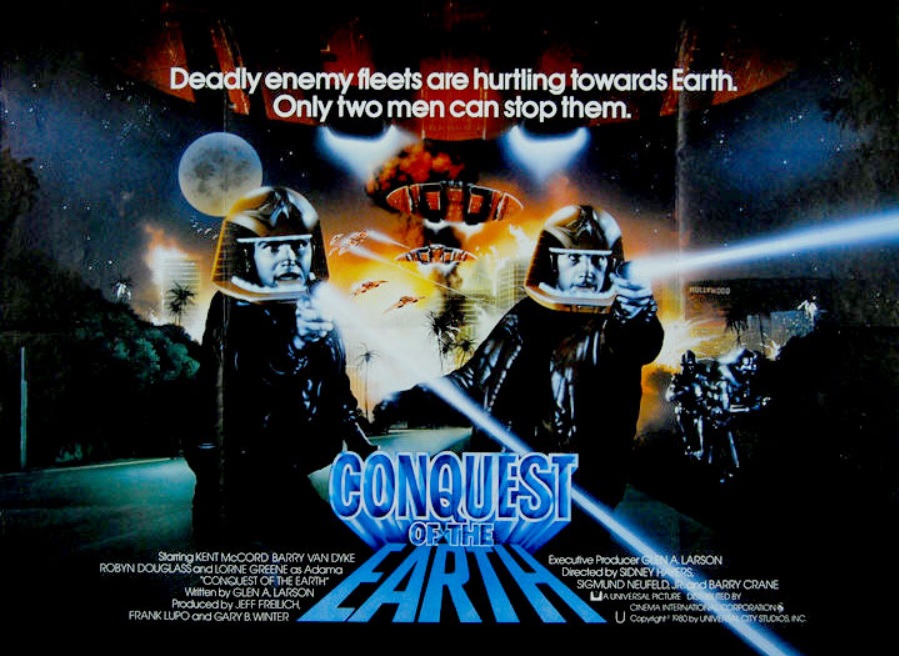
Foreign theatrical one-sheet/various sites.
Set 30 years after the initial series’ final, 24th episode, “The Hand of God,” in the spinoff series, Galactica: 1980, the famed Battlestar finally reaches Earth — only to discover the planet’s technology is unable to defend itself against the Cylons. Centered around the characters of Commander Adama, the now “Colonel” Boomer (replacing Tigh), Apollo, Starbuck and Baltar, the new series would be concerned with Baltar (atoned and now serving as the President of the Council of the Twelve) stealing a time travel ship to altar Earth’s history, so its technology would advance in the present day to the Colonial-Cylon level. At that point, the series would have a weekly “Time Mission,” with Apollo and Starbuck sent into the past to bring back Baltar — who would always, somehow, slip their grasp — and undo his changes to history.
Now, if you know your Glen A. Larson productions, you’ll recognize this time travel concept — slightly tweaked — also served as plot fodder for his more successful, later series Quantum Leap, which ran for five seasons from 1989 to 1993.
But I digress.
The VHS version/multiple sites.
So, as the new spinoff series developed during pre-production, Richard Hatch and Dirk Benedict were soon out — and replaced by TV actors Kent McCord (TV’s Adam-12; you youngins may have seen it on Cozi-TV) and Barry Van Dyke (Diagnosis: Murder on the old n’ stuffy Hallmark Channel alongside those The Golden Girls reruns). They would star as Galactician descendants Troy (Boxey all grown up!) and Dillon: the new (and not improved) Apollo and Starbuck (or Luke Skywalker and Han Solo, if you will). Ann Lockhart’s character of Sheba was also out (who, in turn, was the replacement for Jane Seymour who departed her role as Apollo’s love interest and fellow warrior, Serena); she was replaced by Robyn Douglass (the 10-speed racing romance Breaking Away) as earthling Jamie Hamilton, a network news reporter, who assists the Colonials. Also out was the great John Colicos as Baltar; now the “evil” of the show would be portrayed by the equally awesome Richard Lynch (Ground Rules) as Xavier, a high-ranking Colonial officer who defies Adama’s orders to send the fleet into deep space, away from Earth, and steals the time ship.
Of course, Xavier chose to time trip to 1940’s Nazi Germany, since the German wehrmacht was the “most technologically advanced society” in the world at the time. (Ugh, more costume department pillaging-on-the-cheap with the space Nazis from BSG: TOS‘s “Experiment in Terra”). However, after the airing of the three-part pilot “Galactica Discovers Earth,” the network deemed the time travel aspect too expensive to maintain on a weekly basis; it was nixed to concentrate on a more cost-effective “present-day Earth” setting — complete with Troy and Dillon on new mission: integrating a gaggle of (annoying) Colonial children who, courtesy of their being born in space, have developed superpowers in Earth’s gravity. (By the Lords of Kobol, noooo!) And . . . did you know that, when you time travel, your clothing turns snow white? Well, it does when you need to reuse those all-white Colonial Warrior suits from “War of the Gods,” themselves reused in “Experiment in Terra,” collecting dust in the bowels of Universal’s wardrobe department**.
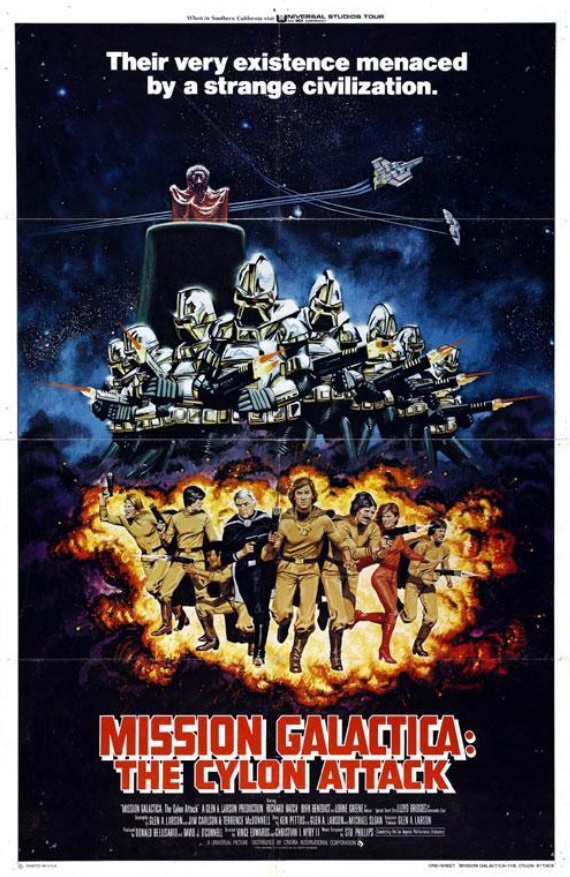
Upon the 10-episode failure of the rebooted series, Universal, to maximize the profits on their investment (the initial Battlestar Galactica pilot cost $20 million to produce; another $20-plus million was spent on the series episodes at one million each), requested Glen Larson recut the series as 14 feature films that would play as theatrical features, TV movies, and home video rentals in the overseas marketplace. The first was Mission Galactica: The Cylon Attack, which was cobbled, in part, from the original series’ “The Living Legend” story arc starring Lloyd Bridges as Commander Cain. The second film (know as Galactica III in some quarters) is the subject of this review: Conquest of the Earth, which was cobbled together from the three-part pilot “Galactica Discovers Earth,” along with footage from the season’s two-parter “The Night the Cylons Landed,” and (to work Baltar and Lucifer into the plot) the old BSG: TOS episode, “The Young Lords.”
Needless to say, there’s a lot of dialog looping afoot, with Lorne Greene, John Colicos, and Jonathan Harris helping stitch together the new, alternate timeline of this theatrical release. And the Dr. Zee character is dubbed as well, so as to explain away why two actors — Robbie Rist (yes, little Cousin Oliver from The Brady Bunch) and James Patrick Stuart (a pisser as failed rocker Perry on CBS-TVs Still Standing; yes he was on Supernatural) — portrayed Doctor Zee; turns out, they’re genetic brothers: Dr. Zee and Dr. Zen! And, thanks to creative editing and (bad) dubbing . . . we have a budding romance between earthling Jamie Hamilton and her space prince, Dillon — a romance absent from the U.S. series.
Just wow. The U.S. series installments were bad enough. But this? Cousin Oliver, flying bikes, humanoid Cylons! Oh, my!
At least the faux sequel Mission Galactica: The Cylon Attack has Lloyd Bridges to distract us from the mismatched scenes and dubbing (most noticeably by on-the-cheap union-rate voice actors and not the original stars). But this overcooked Pasta pot mess . . . not even the presence of requisite baddy Richard Lynch (but a good guy in Steel*˟ ) — against the dry-as-toast thespin’ from our heroes Troy and Dillon — can save it. No, not even those flying Colonial motorbikes! Frack, forget the bikes. For when you have Cousin Oliver bossing Commander Adama, you’re waist-deep in gooey feldercarb.
Starlog #34 (May 1980) that broke the news. Notice, they didn’t push the bikes, but Robyn Douglass, to perk up us young lads/group photo Amazon.
Oh, yeah. The humanoid Cylons.
So, the Cylons were busy on the Base Stars those past 30-years. Not only have they developed a new and improved Raider — with glowing red wings and an expanded, five-manned cockpit — they’ve developed human-looking counterparts! And Andromus, the main Cylon-human hybrid baddie that Troy and Dillion must contend with on Earth, is portrayed by Roger Davis, who you know for his two year, 120-plus episode run as Charles Delaware Tate on TV’s Dark Shadows, as Jeff Clark in the House of Dark Shadows theatrical film, the scuzzy redneck romp, Nashville Girl, and pre-Smokey and the Bandit romp, Flash and the Firecat. It’s bad enough John Colicos was stuck wearing a Cylon Warrior headpiece, like an errant Darth Vader, in “Fire In Space” (” . . . burn, Galactica, burn. You’re finished Adama!”), but wow, sticking Roger in that ridiculous Ed Woodian pointed-silver headgear. There’s got to be a better way to make buck as an actor.
But, hey, at least it gave Ronald D. Moore plenty of fodder to reboot BSG 2004, with his human-Cyclons and glowing-eye Raiders, so ABC-TV greenlighting Galactica: 1980 wasn’t a total loss. And for ditching the space scouts, we thank you, Ron.
Kumbaya, Oh, Lords of Kobol. Kumbaya.
But I digress.
In today’s digital realms, when you access Galactica: 1980 (which was a spinoff series) episodes at NBC.com, it’s cobbled under the Battlestar Galactica banner as “Season 2,” which is now 8 episodes, instead of its original 10 installments. And what we knew as the three-part Galactica Discovers Earth” story arc is now the extended (53 minutes vs. the usual 45 to 47 minutes) single-episode “Conquest of the Earth,” with all of the time travel plotting, the Nazis, the all-white time travel suits, and earthling Jamie Hamilton’s integration into the Colonial society, excised. But, what the frack . . . the bikes . . . and those damn kids . . . are still with us. And the now, second online episode is actually the old, first installment the abysmal two-parter, “The Super Scouts,” which was actually the fourth and fifth episodes . . . oh, never mind, it’s all just feldercarb at this point.
** There’s more recycling from the Universal-Glen A. Larson universe to be had in the frames of Harry “Tampa” Hurwitz’s The Rosebud Beach Hotel. The Currie sisters, Cherie and Marie (know your Joan Jett and the Runaways history), rock out wearing the same jumpsuits Markie Post (NBC-TV’s Night Court) wore during her season one guest stint as Joella Cameron on Buck Rogers in the 25th Century (the 1979 two-parter “The Plot to Kill a City” if you’re interested). As it turns out, the Universal Studios’ wardrobe department made two suits for the episode — and were shocked to re-discover the matching wares, when fitting the Currie sisters for the film. For nothing goes to waste in the Larson-verse. In fact . . . I recall seeing the all-white Colonial, angel-cum-time travels uniforms in another, non-Larson movie. Or was it a TV series? Ugh. By the Lords! What was it?
Editor’s Note: The original Battlestar Galactica series that debuted on ABC-TV on September 17, 1978, was cancelled on April 29, 1979. As part of our “Space Week” tribute this week — which was inspired by our most recent “TV Week” tribute in April — we’re reflecting back on the 42nd anniversary of the show’s cancellation with a look at the two overseas theatrical films culled from the series: Mission Galactica: The Cylon Attack and Conquest of the Earth. We’ll also take a look at the additional twelve telefilms culled from the series’ episodes in this review.
Even at its cheesiest and lowest of budgets, the production values of ’70s and ’80s American telefilms and TV series rivaled most Asian and European productions. Thus, many of the TV movies and series-pilot films reviewed at B&S About Movies — such as The Six Million Dollar Man (1973)* — became theatrical features in the overseas markets.
In Britain, the series UFO and Space: 1999 became Invasion: UFO and Destination Moonbase Alpha, while the 1973 Canadian TV production The Starlost was rebooted with a series of films beginning with The Starlost: The Beginning. In addition, two-part episodes of popular U.S. series — such as the Season 5 episodes of The Six Million Dollar Man (1976), “The Secret of Bigfoot” and “The Return of Bigfoot” — were cut into foreign theatricals. And those U.S. TV productions became significant box office hits that turned their actors — however brief — into “movie stars.” Just ask American TV actors Nicholas Hammond and Reb Brown, both who became overseas stars as result of their respective, short-lived Marvel/CBS-TV series, The Amazing Spiderman (1977; Columbia Pictures) and Captain America (1979; Universal Pictures), being cut into blockbuster theatrical films (each reached #1 in Japan). And Lou Ferrigno, thanks to those The Incredible Hulk series-to-films reduxes, he did alright and carved out a decent overseas theatrical career with Hercules, The Adventures of Hercules, The Seven Magnificent Gladiators, and Desert Warrior.
Overseas theatrical one-sheet/multiple sites.
While us post-Star Wars lads n’ lassies were mesmerized by the initial Battlestar Galactica TV movie/theatrical in 1978 (recut into the syndicated three-episode arc, “Saga of a Star World”), we quickly grew weary of the subsequent ABC-TV series, as its blatant stock footage recycling from the initial film — with very little, new SFX shots produced — bored us pretty quickly. And, as the ratings dipped each week as result, the stories and the effects only got cheesier and cheaper, and repeated and recycled, which only led to more boredom.
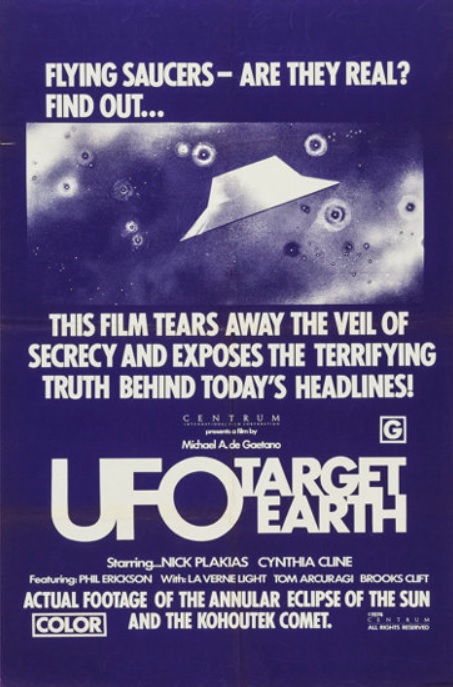
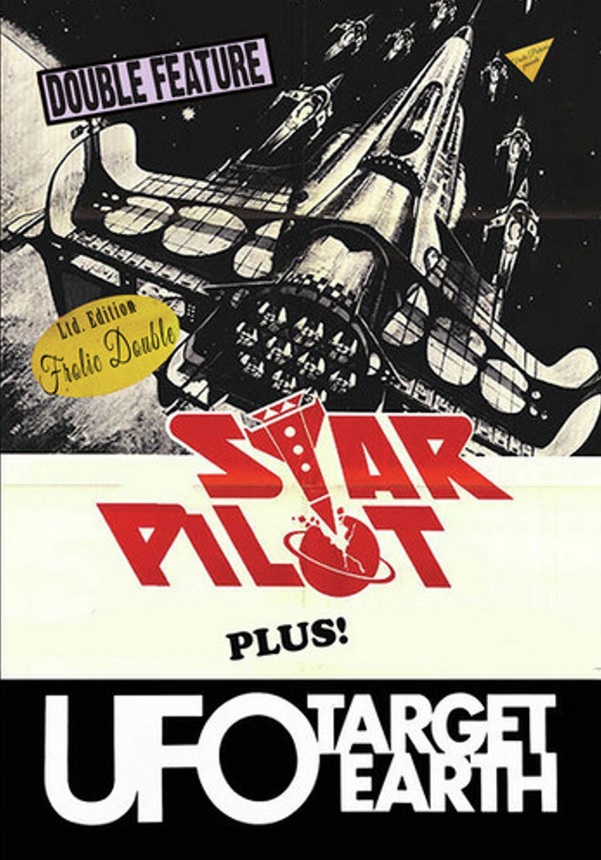
Oh, man. My Star Wars Fever and the Boogie-Woogie Battlestar Galactica Flu was so bad . . . I even made the drive to see the late ’70s theatrical repacks of Star Pilot (1977), aka the decade-old reboot of Mission Hydra: 2+5 (1966), and UFO Target Earth (1974). Yeah, I got punked for my hard-earned lawn money. But I digress. . . .
When the series was cancelled after one season, the reason given was that the ratings didn’t justify the reported production cost of one million dollars per episode. One million? Seriously? And how many times did we see those same SFX shots of the barrel-rolling vipers to screen left and a Cylon Raider flying into screen right before it was blasted into space dust? And did you, Mr. Producer, not think we wouldn’t notice the Terran shuttle in “Greetings From Earth” was a stock shot from (the even more god awful) Buck Rogers in the 25th Century? And the ol’ “space Nazis” trope from Star Trek from over decade ago, really?
The epitome of Star Wars droppings.
So, uh, if the series wasn’t cancelled, would Adama and friends encounter a “gangster world” and a “gladiator world” in quick succession? And why not, you’d already stuck us with “western world” (“The Lost Warrior”) and “knight world” (“The Young Lords”) episodes. Did you learn nothing from the stock prop room and wardrobe adventures of the Starship Enterprise, Mr. Producer? What was next, retreading the Star Trek episodes with Starbuck forced into an arena battle by aliens with a Gorn? How about Starbuck and Apollo flying through a space anomaly that spits out their evil doubles — and giving Apollo a beard and Starbuck a Sulu face scar? And why not? BSG’s sister series, Buck Rogers, became a Star Trek pastiche with Hawk as Spock, Buck as Kirk, and Wilma as Uhura in its second — and final — season. And what was the friggin’ deal with Boxey and the Daggit skirting the Battlestar’s security protocols every week?
British newspaper theatrical advertisement via multiple sites.
Ugh. So, yeah, of course many of us wee lads abandoned the show halfway through its 24-episode run (17 original episodes of the series were made, five were two-part shows). Sure, the first two episodes (4 and 5) that ran as “The Lost Planet of the Gods” were certainly up to the standards of the initial movie, but things got a bit dopey by the time of “The Gun on Ice Planet Zero” (8 and 9) with its clone buffoonery. And again, the single-night episodes in between the two-parters, with their even dopier western and knights of the round table tropes, were worse (by the Lords of Kobol . . . Fred Astaire, are you frackin’ kidding?).
Ultimately, the series failure — a series that we all wanted to succeed — was the result of corporate greed; a greed that also resulted in the creation and failure of Buck Rogers, natch, for rival network NBC. (Today, the once ABC-aired series is now the property of NBC-Universal. You can watch BSG: TOS online at NBC.com.)
The initial plan was to rollout BSG (as with Buck Rogers) across 1978 as four annual, miniseries sequels to the three-hour (3-part) pilot film. The other planned films were “Lost Planet of the Gods (4-5),” “The Gun on Ice Planet Zero (8-9),” and “War of the Gods (15-16)” — the aforementioned space Nazis mess that was “Greetings from Earth (19-20)” was developed later, when ABC-TV decided it wanted to go to a weekly series. That decision, in turn, not only strained the show’s budget (and resulted in raiding the prop and costume departments and the stock shot boondoggling), but left the writers scrambling for quickie episodes to fill out the series (thus the western, knight, and Nazi tropes). It also resulted in the three mini-series suffering cuts to fit into a two-part, hour-long format.
And that brings us to the source material behind the series’ finest hour courtesy of a story arc and characters (Lloyd Bridges on his A-Game as Commander Cain) that rivaled the initial TV movie pilot — an arc that, like the two-part “Greetings from Earth,” was developed as result of going-to-series. (An honorable mention goes to Patrick MacNee as Count Iblis in “War of the Gods.”) For the overseas folks in the U.K., continental Europe, and Japan, what we enjoyed as “The Living Legend,” they enjoyed as Mission Galactica: The Cylon Attack. And while our overseas sci-fi brethren didn’t know any better at the time — to get the BSG: TOS DVD set and watch TV the version of “The Living Legend” instead — we sure did.
Frack me!Washed up vaudevillians Bobby Van and Ray Bolger embarrassing themselves — and doing their part to get BSG cancelled — as Hector and Vector in “Greeting from Earth.” Again, frack me.
Why? Because this overseas theatrical cut is a load of feldercarb; the broadcast version is better (even more so with the DVD series pack, instead of its syndicated commercial run).
It’s one thing to add footage to the two 40-minute episodes to create a theatrical-length piece, but the editors on this daggit-dung decided to take out the Cylon attack footage from “Living Legend” and replace it with attack footage from “Fire In Space (14).” Why not use both scenes? Why take out the romantic triangle subplot between Starbuck, Cassiopeia, and Cain? And really, you went all the way back to the clearing of the space mines scene from “Saga of a Star World” to beef up the film? And yes, that’s footage from The Towering Inferno in there. (And footage from Earthquake shows up in Galactica: 1980, natch.) And, in addition to the plot holes, character’s hairstyles change without reason. And character voices change. And Sheba — remember, the whole purpose of the “Living Legend” arc was to add her character to the cast — is mostly left on the cutting room floor. It’s a frackin’ editorial and continuity mess.
While you may be able to find used copies of the VHS (which were eventually made available in the U.S.) in the online marketplace, beware of the DVD reissues — even the region-free presses — which do not play on U.S. decks (or computers). Another problem: the DVD runs five-minutes shorter than the VHS (at 103 min. vs. 108 min.). Why cut those five minutes? Why are scenes — such as the Cylon fuel depot attack — truncated, missing dialog and plot explanations? And why the different sound effects for the Vipers and Raiders?
And speaking of the series-cancelled-and-returned second season Galactica: 1980: Our overseas brethren known the three-part “Galactica Discovers Earth” pilot as the third, official Battlestar Galactica film, Conquest of the Earth (1980), aka Galactica III, in some Euro-countries, Japan, and Australia.
Ah, but did you know there were 12 more BSG films issued after the three theatrical features? And no . . . Space Mutiny isn’t one of them!
A ripoff of a ripoff. Frack you, Mr. Lucas.
In 1988, this frackin’ South-African pile of daggit dung was added to the BSG-verse, an abomination that makes the Universal telefilm hodgepodges look like Oscar winners. Oh, feldercarb, it makes Dünyayi Kurtaran Adam, aka Turkish Star Wars, look like a statuette recipient. So, frack you, Action International Pictures*˟, for manipulating those foreign copyright loopholes and giving us an Ed Woodian Star Wars that you should have titled Battlestar 9 from Outer Space.
But I digress, again.
As with the aforementioned UFO, Space: 1999, and The Starlost finding a new, overseas life as theatrical, television, and home video features: After Conquest of the Earth, the third and final BSG foreign theatrical film, and prior to the syndication of the series’ 24 episode-installments, Universal Pictures edited the BSG series episodes to create 14 telefilms (two went theatrical, natch) for foreign distribution in 1981. (It’s said that some local U.S. UHF stations aired the TV movie versions of the series. I never saw them myself during their original 1981 run and only on VHS after the fact.) As you can see from the pairings of the vastly different episodes, these movies — as with Mission Galactica: The Cylon Attack — also suffer continuity and editorial faux pas. The highlights — well, the worst of the films (depending on personal opinions) — are:
Experiment in Terra: An edit of “Experiment in Terra” (22) cut with content from Galactica: 1980‘s best episode, “The Return of Starbuck” (2.10), along with a chunk of “Saga of a Star World (1.1). But we do get a pretty cool, never-before-seen prologue explanation from Commander Adama about the Cylons — learned from Adama’s Galactica logbook discovered floating in space by an Earth astronaut.
Murder in Space: An edit of “Murder on the Rising Star” (18) with scenes from “The Young Lords” (11).
Space Prison: An edit of “The Man with Nine Lives” (17) and “Baltar’s Escape” (21).
Phantom in Space: An edit of “The Lost Warrior” (6) and “The Hand of God” (24).
Space Casanova: A combination of “Take the Celestra” (23) and “The Long Patrol” (7).
Curse of the Cylons: A hodgepodge of “Fire in Space” (14) with scenes from “The Magnificent Warriors” (10).
The rest are based on their multi-episode series counterparts:
Saga of a Star World: An all-new, third edit of the series that differs from the three-part syndicated series installments and the overseas/U.S. theatrical release.
Lost Planet of the Gods: Features restored scenes cut from the series version.
The Gun on Ice Planet Zero: Features restored scene cut from the series version.
The Living Legend: This is the third version of the Commander Cain tale, after the initial series episodes and the Mission Galactica: The Cylon Attack theatrical repack.
War of the Gods: After “The Living Legend,” the second best episodes of the series, again, thanks to Patrick MacNee’s turn as Count Iblis.
Greetings from Earth: The absolute worst episodes of the series. And even the makers knew: they (thankfully) deleted the abysmal vaudeville soft-shoe routine by the plastic-headed/white-faced robots Hector and Vector.
Conquest of the Earth: An all-new, third edit of the Galactica: 1980, aka BSG Season 2, three-part pilot arc “Galactica Discovers Earth,” which also includes footage from the season’s two-parter “The Night the Cylons Landed.” And look out for Baltar and Lucifer in this version — bought in from the old BSG: TOS episode, “The Young Lords.”
The theatrical one-sheet for the third Battlestar Galactica overseas feature film.
Each of these telefilms are given their own, unique open and closing credits, along with new scenes (both newly shot and leftovers not used) and alternate, unused SFX shots. Outside of watching these movies, U.S. audiences seen most of these scenes as deleted outtakes included as “bonus features” on the BSG DVD/Blu-ray box sets of the series. But be on the lookout for plenty of Universal stock footage pillaging throughout, such as the Fembot footage from The Six Million Dollar Man timeline being incorporated.
While the always-the-pro Lorne Greene performed a number of voice-overs for these movies by providing narration to help link the unrelated episodes flow, Dirk Benedict, Herbert Jefferson, Jr., John Colicos, Patrick MacNee, and Jonathan Harris also pitched in with voice-overs and dialog loops. Richard Hatch opted out of the project (it seems he was pissed over the Galactica: 1980 mess) and another actor — that sounds nothing like him — looped his lines (and it’s as a bad as it sounds). (Don’t forget: Later on, Hatch was pissed that Universal passed on his Galactica novels and film reboot*).
Starlog #39 (Oct. 1980) that gave us a rundown on the upcoming Galactica movies.I wish I still had my Starlogs. Damn you, adulthood.Image courtesy of the Starlog Internet Archive Project.
But truth be told: Even with their faux pas, these hodgepodge films are a fun watch for two reason: First, for the inventiveness of the screenwriters in somehow creating continuity between such varied episodes. They were certainly up against it, kudos to them! Second, these series-to-film repacks exist in a universe unto themselves — outside of the original series’ plotting — with their “alternate” timeline. Again, it’s fun to compare the series to the films and (as a screenwriter myself) be fascinated by the creative process to maximum Universal’s bottom line.
Sadly, unless you’re able to track down any VHS taped-from-TV or VHS home video repacks (foreign or domestic), these telefilms are lost to the cathode ray snows of yore. Fans of the original series have been clamoring for DVD and Blu-ray box sets of these movies for years, myself as well, as I’ve only seen half of them as result of discovering their used VHS-versions years after the fact. As for Mission Galactica: The Cylon Attack: we found four extended scenes (one in German) on You Tube (posted below) from the film for you to enjoy that gives the story arc from beginning to end.
Uh, oh. Here come the black boxes of death. One video down. The others will probably follow suit.
The blogspot site, The 100the Planet (which helped in our research and memory jogging; so grazie, fellow warrior), did an absolutely magnificent job watching all 14 films and breaking down their respective plots. So, if you’re a die-hard fan of the original BSG series, it’s a great read. And we also thank BattlestarWiki.org for their assistance in preparing this review. And don’t forget, we went Star Wars crazy with our month-long review of the films (over 50!) that inspired — and were inspired by — Star Wars with our Exploring: Before Star Wars and Exploring: After Star Wars featurettes.
* Be sure to check out week-long tribute to the film career of Lee Majors! All the review links — and more — can be found with our “Lee Major Week Wrap Up” featurette.
** Did you know Richard Hatch made his Galactica: The Second Coming pitch film with low-budget, direct-to-video auteur Dennis Devine sidekick Jay Woelfel? True story. Check out our “Drive-In Friday: Dennis Devine Night” to learn more.
*˟ We kid. We love David A. Prior, David Winters and Peter Yuval’s AIP films around here. Why do you think we reviewed The Silencer and Firehead (just to name a few) in the B&S offices?
About the Author: You can learn more about the writings of R.D Francis on Facebook.He also writes for B&S About Movies.
Why is it that we’ll remember the “bad” science fiction films and forget the, well, they’re not exactly “good,” but the better-made ones? Why do we nostalgically pour our celluloid vinegars over the likes of The Astounding She-Monster, Cat-Women of the Moon, and Fire Maidens from Outer Space, yet forget an imaginative and well-made flick from the Woolner Brothers, like Mutiny in Outer Space?
Maybe it’s because I forever have Mutiny in Outer Space jammed in my mental VCR as result of enjoying it as part of a childhood, Saturday afternoon UHF-TV double bill with Space Probe Taurus (1965) — and that both starred my childhood crush, Lydia Limpit, the sidekick to Batman’s nemesis, The Bookworm: the heart-weeping Francine York.
As for the rest who forgot — or never heard of — this humans-battle-aliens-in-space romp: you know the brothers Lawrence and Bernard oeuvre better than you realize. Like most of the Corman-quickie styled filmmakers of the time, the Woolner’s started out as Drive-In theater owners, and then began financing low-budget B-studios to fill their screens. Of course, the Woolner’s hedged the smart bet and backed the never-lost-a-dime-on-a-movie (well, except for 1974’s Cockfighter) Corman on the films Swamp Women and the teen-juvie romp, Teenage Doll. Junk cinema fans will remember the brothers’ third film, Attack of the 50 Foot Woman, the best; Italian horror hounds remember Larry and Bernie best for giving U.S. popcorn noshers Antonio Margheriti’s Castle of Blood, the Christopher Lee-starring Castle of the Living Dead, and, the big kahuna of giallo, Mario Bava’s Blood and Black Lace (all 1964). And in the grand tradition of remembering the bad: there’s the film (IMO) that slides in nicely after Fire Maidens from Outer Space in the annals of awful, MST3k-styled sci-fi from the ’50s (and ’60s): The Human Duplicators (1965), a film that gets its wistful positraction from the fact the film’s android-making villain is portrayed by future Bond villain Richard “Jaws” Kiel. If not for ol’ Jaws. . . .
And that brings us to the Woolner’s second foray into the sci-fi genre (their third and last was Antonio Margheriti’s Bond knock off, Operation Goldman, aka Lightning Bolt in the U.S.), which they filmed in six days for $90,000 in March of 1964. Released as an undercard to The Human Duplicators, MiOS was also directed by Hugo Grimaldi. After MiOS, Grimaldi’s only other writing credit is Gigantis, the Fire Monster; he also supervised the U.S. dubs on First Spaceship on Venus, aka Germany’s Der schweigende Stern, and Giorgio Ferroni’s pseudo-Giallo, Mill of the Stone Woman.
While a quickie undercard production, screenwriter Arthur C. Pierce did his research and developed a sci-fi smart script (forgetting, of course, that he cheapjacked the sci-fi classics that are The Day the Earth Stood Still and The Time Machine with the later, not-so-classic The Cosmic Man and Beyond the Time Barrier*, respectively; he also wrote and produced the $140,000 The Human Duplicators) based on the (now inaccurate) science of the time and had his astronauts, while battling an alien fungus (and keeping the romance to a minimum), deal with the prolonged effects of travel and life in space. In addition, leads Dolores Faith (debuted in 1961’s The Phantom Planet and starred in The Human Duplicators), Richard Garland (really steps it up from his past work in 1957’s Attack of the Crab Monster), Francine York (who would later tickle our hormones in Ted V. Mikel’s The Doll Squad), and Harold Lloyd, Jr. (Frankenstein’s Daughter) are, for a B-Movie quickie, very good in their roles.
Now, before you think that’s (furry) octopus tentacles on the one-sheet, it’s actually plant tendrils, in a tale that foreshadows what we’d see in 1968 with the Antonio Margheriti-influenced The Green Slime — which had blood-drinking asteroid slime instead of plants. And the plants, here, don’t transmutate into sentient — and very goofy — red-eyed tentacled humanoids.
We’re not Italian plant-based monsters from the Moon. We’re Asian green slime monsters!
At first, the film began as Space Station X (after Space Station SS X-7, the rotating station of the film), then the more sensational Invasion from the Moon (since the plants came from an ice cave on the Moon), but since Grimaldi and Pierce pinched from 1954’s The Caine Mutiny (since the station’s commander cracks under pressure), why not? Voila (or is that “ecco” in Italian), the film hit theaters as Mutiny in Outer Space. And there’s no doubt to the pinching of two of the ’50s biggest alien-versus-human romps: The Thing (1951) andIt! The Terror from Beyond Space (1958). But there’s an even bigger, obscure pinch: the overly talky, dry and boring Space Master X-7 (1958). That Ed Woodian romp of the Plan 9 variety concerns itself with a fungus unleashed from an Earth-returned space probe — only that alien is metallic “space rust” and not a plant. Or slime. And it gets loose on jet liner — as it would multiple times, some 60 years later in more than a few flicks from The Asylum (that I don’t feel like looking up). Oh, and you know what: the commander in the Kubrick-inspiring Conquest of Space (1955), which, itself, probably pinched from The Caine Mutiny, cracks under the pressure and jeopardizes the station, as well.
But still . . . with all of those plot pinches (and stock footage-set pinches, which we will get into), which I hadn’t a clue of when I was a UHF-weaned kid, Mutiny in Outer Space is still pretty good and a lot of fun.
In the future-verse of 1990: Two astronauts collect geological samples from an ice cave on the moon. Shortly after returning to the station, one of them collapses. It’s discovered he has a fever-inducing welt on his leg that spreads into a fungus across his body — a fungus from the ice caves.
The upside to this Moon romp is that, unlike the other interstellar-matriarchal fails of the ’50s and ’60s that we’ve discussed this week (and during our January 2021 tribute week to those films, such as 1953’s Project Moonbase) Mutiny in Outer Space puts several strong women to the forefront: the two leads with the most screen time being Lt. Connie Engstrom (Pamela Curran; Elvis’s Girl Happy) as the station’s communications chief, and Dr. Faith Montaine as a civilian biochemist who oversees science operations.
Yeah . . . we still have the horny male astronauts, and the ubiquitous flirting, and a scene in the station’s bio-lab with an astronaut flirting with his buddy’s girl; and her fretting about hairdo-fixing for her astro-hunk’s return. (Could you imagine Ripley gaga for Dallas or a Bret-Lambert hook up?) Of course, while these girls are smart and resourceful, they (an absolutely, sci-fi ’50s plot-point must) go all damsel-in-distress hysterical when the plants-hit-the-fan. Oh, and there’s the meteor shower that hits-the-fan. And the shower results in an ice-core splitting open. Now the furry plant tendrils (that would have looked great in color instead of washy-wash black and white) are everywhere. And the station’s commander cracks. And since guns were outlawed in space, the only thing to fight with is good ol’ he-man brawn and hormone-fueled ingenuity. The final solution has to do with creating a shield to cut off the solar heat that feeds the plants. Oy!
See, I told you. It may be pinchy n’ cheap, but wow . . . Mutiny in Outer Space just keep the Murphy Law-antics comin’ at ya, and at a decent pace helped by tight edits and seamless integration of its stock footage.
What ultimately stopped Mutiny in Outer Space from achieving classic status: While the top-billed The Human Duplicators was shot in color — as result of the budget in producing the station and plant effects and sets — there were no funds left to shoot in color. Thus, we ended up with a film that has the feel of ’50s space flick (the same folly that befell the equally well-done Space Station Taurus, also released in 1965), when it was actually in production around the same time Stanley Kubrick began pre-production in 1965 on his sci-if game changer: 2001: A Space Odyssey — issued a mere three years later, in 1968. In the end, the Woolner’s boondoggled it, didn’t they? The $140,000 (IMO) wasted on The Human Duplicators should have been budgeted for MiOS, so as to make one solid, indie studio, A-styled picture to be remembered, instead of two forgotten flicks . . . flicks that lead a guy like me to spend a whole day writing a review that, maybe, a dozen people, if I’m lucky, will ultimately end up reading.
And so goes the life of a digital movie critic. Well, at least I got to use “tendrils” in a sentence. I believe that’s a first for my reviews.
It’s reported Mutiny in Outer Space is an Italian-American co-production, which is incorrect. The film was produced, in full, with an all U.S. cast, at Producers Studios on Melrose Avenue, in Los Angeles (the studio has hosted everything, from the 1944 film noir Double Indemnity to 1976’s Assault on Precinct 13). Remembering the Woolner’s worked with Antonio Margheriti on Castle of Blood and Lightning Bolt: there’s your “Italian connection,” which is result of the Woolner’s clipping footage (and possibly costumes, but more likely just astronaut footage; the numerical-letter uniform designations give it away) from Margheriti’s 1960 space romp, Assignment: Outer Space. And if the sets are familiar, that’s because they’re from another 1965 production on the Producers Studios sound stages: Space Probe Taurus. (We could easily do a B&S tribute week to all of the Drive-In and UHF-TV ditties produced at the studio.)
Don’t believe me? Compare the trailers for yourself. Both films even have romance-in-the-botany lab scenes, complete with the male astronauts making dumb plant jokes in a dorky-flirt that’d give Ross Geller pause:
You can watch a nice rip of Mutiny in Outer Space on You Tube. If I had the money and influence of J.J. Abrams, I’d do for MiOS what he did for Phantasm: restore it — in color, natch. It’s a classic. Oh, and since we’re talking about them: You can watch Assignment: Outer Space on You Tube and Space Probe Taurus on You Tube, and compare. Yep, we also found a (muddy) copy of Space Master X-7 on Archive.org and The Human Duplicators on Daily Motion.
* While junk, I’ll always have a warmed-up VCR for Beyond the Time Barrier as result of its UHF-TV double-billing with Creation of the Humanoids, itself a precursor to Blade Runner in the same way Mario Bava’s Planet of the Vampires foreshadows Alien.
About the Author: You can learn more about the writings of R.D Francis on Facebook. He also writes for B&S About Movies.
EnfantTerrible is the story of filmmaker Rainer Werner Fassbinder, who dreams of making movies about the cold-hearted, archaic Federal German society whole achieving the love and respect of the outsiders of society. As he rises to become among the most important directors in Europe, his body and mind decline and he dies an early death.
Director Oskar Roehler and writer Klaus Richter have a tough task on their hands: how to take the unlikable and caustic hero and make him someone we want to learn more about and care for. Oliver Masucci, who has the lead, is easily able to take on this task, as he’s played someone even more unlikable — Adolf Hitler himself — in the 2015 comedy Look Who’s Back.
It’s to the filmmakers credit that they did not shy from controversy. However, when the material is well-known, that’s usually not a worry. I loved the play-within-a-movie conceit of this, as so many of us only associate Fassbinder with film.
Enfant Terrible is currently playing theaters these theaters:
May 7 – LA for Laemmle NoHo (physical)
May 14 – Laemmle (virtual) includes New York
May 14 – Cleveland Cinematheque
May 14 – VIFF Film Society Vancouver
May 20 – San Diego FilmOut
May 28 – New Orleans, Zeitgeist Film Center (Physical)
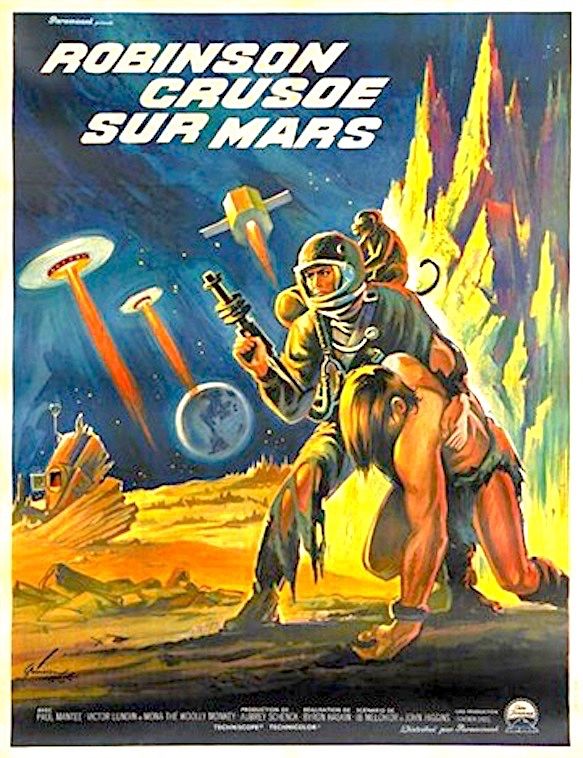
Yet, what fun! Byron Haskins, who also made The War of the Worlds, was obviously having the time of his life and had a budget and crew talented enough to take the Daniel Defoe’s classic novel and transport it to space.
Commander Christopher “Kit” Draper, USN (Paul Mantee, The Manitou) and Colonel Dan McReady, USAF (Adam West!) reach the Marsin their spaceship and within moments, the future Batman is dead and Kit is lost on the Red Planet.
Speaking of Batman, Victor Lundin, who plays the alien slave that Kit names Friday, was the Octopus on that show. He also played the first Klingon the crew of the Enterprise ever met on Star Trek. When Lundin did science fiction conventions, he would often sing, and he even wrote a song about this movie called “Robinson Crusoe on Mars.” Thanks to Yeah, Flik! for posting this.
There’s also a monkey named Mona along for the trip.
A sequel Robinson Crusoe in the Invisible Galaxy was planned and the actors thought that this movie would make their careers. It did not, as Paramount barely distributed the movie and the reviews were not kind.
Even stranger, screenwriter Ib Melchior and Victor Lundin collaborated on a script called Columbus of the Stars after this movie. They showed it to Paramount and soon enough, Star Trek came out. That said, this story feels very urban legend, as Desilu produced the original series.
There’s also a scene where the monkey is clearly taking a dump, so keep your eyes open for that!
Have you ever wished that a bunch of Category 3 Hong Kong maniacs would make their own Terminator mixed with RoboCopmovie and fill it with gore, sleaze and utter craziness? Good news! That movie is Robotrix!
Under the name Chien-Ming Lu, this film’s director Jamie Luk appeared in Lady Exterminator, Crippled Avengers and many more films. This is the first movie of his I’ve seen but definitely not the last as it’s packed with sheer maniacal ridiculousness.
Cast member Vincent Lyn told Richard Myers — in the book Great Martial Arts Movies: From Bruce Lee to Jackie Chan — and More — “Now that was one wild shoot. The cast and crew were all over the place and you were lucky to find out what you were doing before the cameras rolled. I spent more time laughing on the set than anything else.”
This is the kind of movie that features full-frontal male and female nudity, as well as numerous murder scenes with beheadings and a wire work martial arts battle between cyborgs.
Oh man, so what is it about anyways?
A mad scientist named Ryuichi Sakamoto (Chung Lin transfers his mind into a robot (former WKA champion Billy Chow, who did not show his dong in Fist of Legend), which frees him to do pretty much everything he’s always wanted to, like kidnapping an Arabic businessman and killing his bodyguard, Selena Lin (Chikako Aoyama).
A non-mad scientist named Dr. Sara (Hui Hsiao-dan) transfers Selena’s mind from her dead body into a cyborg named Eve-27. She rejoins the police force, bringing along the doctor’s robotic assistant Ann (Amy Yip). They’re soon on the trail of Sakamoto, who is leaving behind dead prostitutes pretty much everywhere he goes.
Sadly, I was hoping that Amy Yip and Chikako Aoyama would end up punishing the villain for the way he has treated women the entire movie, but nope. The Shiek ends up taking care of him. Other than that, this movie is filled with a disregard for human life — a scene where the evil cyborg repeatedly runs over the chubby comedic relief and then the cops shoot him hundreds of times before he laughs and runs over their friend’s dead body is my favorite part — and the cinematic equivalent of eating ten bags of Takis. Or Fritos. Or Doritos. You know what I’m saying!
A woman is admitted into a hospital for emergency surgery, but then awakens trapped in a bizarre medical facility where patients are treated like lab rats, mutilated over and over again, then healed by doctors, as if they were in some afterlife version of Men Behind the Sun. Is this heaven? It is hell? Or is it somewhere in between?
Director Peter Daskaloff also made Girls After Dark and Sex and the Single Alien, while writer Matt Toronto was the writer and director of Face 2 Face. They’ve put together a tense film that really leads one to question the answers to the fate of its characters. Yet without giving anything away, the ending feels like a cop-out after the film has painted itself into a corner. Ah well, you can’t expect everything, right?
Probably the best-known actor in this movie would be Ashlynn Yennie, who you may recognize as Jenny, the rear section in The Human Centipede. Louis Mandylor, who was in the My Big Fat Greek Wedding series as Nick Portokalos is also in this. He was also the sheriff in Rambo: Last Blood. In fact, there are plenty of Greek actors in the cast.
Antidote is available on demand and on DVD from Uncork’d Entertainment.










 B&S About Movies
You must be logged in to post a comment.