“In the Year 2022 we made contact . . . too bad.” — When copywriters know it’s all crap and just give up
So, what do you get when you cross Ridley Scott’s Alien with Robert Aldrich’s 1967 war classic The Dirty Dozen? Oh, and what the hell, a little pinch from Escape from New York can’t hurt. Oh, and let’s pinch Hal (and fem and porn ’em up a bit) from 2001: A Space Odysseywhile we are at it. And since we can’t afford to pay twelve actors, we’ll get a dirty quartet. And the budget can swing a Lando Calrissian for a bargain and a song.
Saddle up, boys! Let’s make a movie! Yee-haw!
VHS image courtesy of ronniejamesdiode/eBayand trailer courtesy of You Tube. . . if it’s not deleted by now.
Commander Skyler (a sadly slumming Billy Dee Williams) offers four convicts (lead by the deserves-better-than-this Maxwell Caulfield) doing life at Earth’s New Alcatraz Maximum Security Prison the chance to have their sentences commuted for a “routine space salvage” mission. Of course, it’s all on a “need to know,” natch, and what they don’t know is that Captain Dorman (Jeff Conway, really hitting rock bottom) of the U.S.S. Holly became addicted to a virtual reality program run by the ship’s computer and he killed everyone on board.
Oh, and, in the grand tradition of Space Mutiny (yes, this movie also has a wealth of “rail kills”), Jeff’s space freighter interiors’ shoot-out was shot in the back of a wholesale warehouse (when you see the concrete floors and floor-to-ceiling metal shelves, you’ll see what we mean). Eh, why not. Let’s shoot inside a factory, too, since all of those pipes and valves look like the ship’s “engineering section.” Yeah, just tack up those corrugated metal sheets over there . . . and wire up some tube lights over there . . . hot glue some scrap metal and nobby-thingys over there. . . . Dude, where’s all of those leftover sets from Roger Corman’s Battle Beyond the Starswhen you need ’em? I mean, what the hell, Rog? You lent them out to Fred Olen Ray to make Star Slammer in 1994. (Oh, guess what . . . Alien Intruder was, in fact, shot inside an old Oscar Mayer meat processing plant in Los Angeles. So, there you go!)
My space ship has a first name . . .
Anyhoo, Commander Skyler, his four convicts, and their “Mother,” aka, a Postironic “Model 4” Android, hop on board the U.S.S. Presley and head off into deep space for the “dreaded G-Sector” . . . and, what the hell? We’re in the Wild, Wild West, then a reenactment of Casablanca, and then an old ’50s biker flick? Huh? Maxwell Caulfield is running in a pair of Speedos, riding a surf board, and taking soft-porn showers with a beach bunny? And why is ex-model-turned-actress Tracy Scoggins in all of these scenes, smoking? (Oh, and if the western scenes look familiar, that’s because it’s the same sets from CBS-TV’s Dr. Quinn, Medicine Woman on the Paramount Ranch back lot.)
Oh, I get it . . . to help the crew cope with the stress of long space flights, they bed down in virtual reality simulators to live out their fantasies. Of course, the computer’s VR-self is Ariel, a seductress in the form of . . . yep, Tracy Scoggins (of the ABC-TV prime time soaps Dynasty and The Colbys; Captain Elizabeth Lochley during the final season of Babylon 5 in 1998). And, before you know it, the crew is at each other’s throats for her skin-tight, red-dressed affections. Oh, I get it . . . Ariel is actually an “alien organism-cum-virus” that exists in the “dreaded G-Sector” and reprograms any invading ship’s computer to kill everyone on board.
We think.
What the frack is this feldergarb? No, we can’t blame this on Battlestar Galactica or Buck Rogers in the 25th Century (both which actually look better than this space romp, if you can believe that). No, we’re blaming this on Star Trek: The Next Generation, courtesy of that show’s Holodeck tomfoolery. But, you know what? As bad as it all is, Alien Intruder has a Space Mutiny-like fan base (and if you’ve seen that space ditty, you know what we mean); it’s fun to watch because the actors, while down on their luck, are giving it their everything. One fan, who runs the You Tube page bmoviereviews, went as far as to isolate several choice action sequences and dialog vignettes:
And it’s all courtesy of PM Entertainment, who brought us Anna Nicole Smith in all of her action hero bad-assness in Skyscraper (1996). If you need a heavy fix of movies starring Wings Hauser, Erik Estrada, Dan Haggerty, Traci Lords, Lorenzo Lamas, Sam Jones, and even more films starring Maxwell Caulfield, as well as William Forsythe, Micheal Ironside, and Jeff Fahey — basically all of the actors we love here at B&S About Movies — then look no further than the defunct PM Entertainment imprint (1989 – 2002). You can read up on the studio at their extensive Wikipage.
Now, if those clips and the trailer don’t do it for ya, you can free-stream Alien Intruder in its entirety on You Tube. And when you have a chance to see an alien Tracy Scoggins take a bubble bath, how can you not?
About the Author: You can learn more about the writings of R.D Francis on Facebook.He also writes for B&S About Movies.
If you’ve surfed around our little ol’ slice of the web for a time, you know us QWERTY-bangin’ fools of the B&S About Movies cubicle farm in good ol’ Allegheny County love our regional and SOV filmmakers. Be it Don Dohler (The Alien Factor, Nightbeast) or Brett Piper (Queen Crab) — and regardless what the mainstream audience thinks of those filmmakers — we run the banners on-high for those ambitious, up-against-the-budget self-made auteurs. Our extensive reviews for such shoe-string produced, regional ditties as Richmond, Virginia’s Rock ‘N’ Roll Hotel, Providence, Rhode Island’s It’s a Complex World, Atlanta, Georgia’s Evil in the Woods, and SOV’ers like John Howard’s Spine, Christopher Lewis’s Blood Cult, and Blair Murphy’s Jugular Wine, are evidence of that fact. Now we’re adding — it’s about frackin’ time — William J. Murray’s Primal Scream to the list. However, unlike most regional and SOV films, which take the more cost-effective shot-in-the-woods horror route, Murray, along with his writing partner Dan Smeddy, upped the game by deciding to honor their sci-fi idol, Ridley Scott.
Yes. I said Ridley Scott. On a shoe-string budget.
It took guts, four sets of balls, and helleva lotta misguided hootspa. And we love Murray and his crew of intrepid, novice dreamers for it. Call Primal Scream dime-store. Call it inept. But the in-camera miniatures, space suits and plastic-cum-cardboard set designs work and the just-staring-out, unknown cast sells the Murray-Smeddy sci-noir verse with class. As with Tommy Wiseau’s years later The Room: Primal Scream displays a lot of heart and you can’t help but enjoy the ride.
The Primal Scream VHS released in 1988 by Magnum Entertainment that I remember/images courtesy of cassiescottagets/eBay.
Beginning its production in 1981 and starting its two-year stop-start production process in 1983 under the title Hellfire — and shot, not on 16mm or video, but in 35mm — this Blade Runner-cum-Alien-inspired future world set in a Chinatown-styled 1997 concerns the discovery Hellfire, a new, highly volatile energy source mined on Saturn’s moons (for a pinch of Peter Hyams’s Outland from 1981). The mining operation leads to the usual sociopolitical bickering between a Weyland-inspired multinational corporate and interplanetary ecologists, as well corporations vying for a piece of the “green new deal.” Who cares if Hellfire earned its name by igniting human flesh and boiling internal body parts into goo. Hey, it’s “clean energy,” so says John Kerry, and it’s everywhere in space. So mine it!
When the controversy over Hellfire results in the brutal murder of a high-ranking Thesaurus corporate executive, Caitlin Foster (Julie Miller), his femme fatale sister (uh, oh), hires the Philip-Marlowe-inspired Corby McHale (Ken McGregor; yeah, he was in X-Men and Prom Night IV, but we remember him best for Ed Hunt’s The Brain), a burnt-out private investigator slumming in what’s left of Atlantic City, New Jersey, to sort out who’s behind the sabotage of the Hellfire project (foretelling Moon 44, Roland Emmerich’s own Ridley Scott-inspired film noir). Along the way, McHale picks up a spunky sidekick in the form of Lt. Sam Keller (Sharon Mason). Part of the interstellar corporate intrigue is Charlie Waxman, a seedy local bookie (Mickey Shaughnessy in his final film role; yes, he was in the classics From Here to Eternity and Jailhouse Rock, but this writer remembers ol’ Mickey best for his first sci-fi bow in the Stanley Kubrickian forefather, 1955’s Conquest of Space).
Impressive! I’m convinced.
When it came time to take advantage of the Blu-ray format to give Primal Scream a well-deserved, proper digital reissue in 2018, William J. Murray set forth to create the 45-minute making-of documentary Made a Movie, Lived to Tell, which is included on the Code Red Blu-ray reissue. The Blus are also easily available on Amazon, but analog purists (moi) can still find used VHS copies on eBay. (It took a few years of diving the discount bins of a couple-dozen home video store close outs before I had my own, beat-to-hell copy for my personal collection.) You can learn more about Primal Scream and its accompanying documentary at its official Facebook page and Dark Force Entertainment Facebook. If you’re into caveat emptor’in your Blus before you buy, you can get the technical specs at Blu-Ray.com.
What I love about this Primal Scream reissue is that William J. Murray, unlike Philip Cook’s low-budgeted similar space romp Beyond the Rising Moon (1987; equally-enjoyed and reviewed this week), stuck to his original vision and didn’t add any years-after-the-fact CGI patches. The 2018 Blu is the same movie we enjoyed in 1988 on VHS — only in a crisp and clean restoration.
If you’re into passionate, low-budget sci-fi, be sure to check out our reviews for not only Beyond the Rising Moon, but Ares 11, Space Trucker Bruce, and Monty Light’s recent offering, Space. And Primal Scream is a great addition to your sci-fi digital library.
Here’s the film’s trailer and the revised-reissue trailer because, well, you know how temperamental the video embed elves are.
About the Author: You can learn more about the writings of R.D Francis on Facebook.He also writes forB&S About Movies.
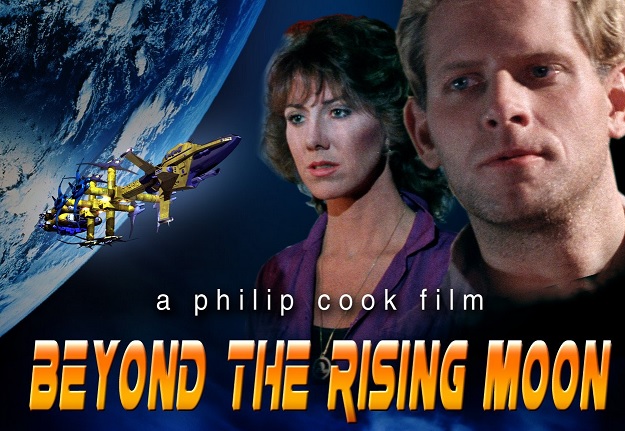
It all began in the mid-’80s when independent Virginia filmmaker Philip Cook produced his first feature film — for a reported $8,000. Known as Pentan, after the film’s title character, his low-budgeted effort saw a limited, regional theatrical distribution as Beyond the Rising Moon in 1987. By the mid-’90s, before the Sci-Fi Channel added the double-Ys, the film played under the cable title — with a little CGI revamping — as Star Quest: Beyond the Rising Moon in 1995. Then, with the advent of the DVD age and digital streaming, Cook, who was never satisfied with the end product, re-edited the film — with a second batch of then, more-current CGI effects — and reissued the film as Outerworld in 2007 for Amazon Prime and Netflix streaming (and Cook changed out the soundtrack of the original cut). The subsequent DVD-release includes the 1995 cut of Star Quest: Beyond the Rising Moon, along with a 15-minute “making of” featurette, a 10-minute deleted scenes reel, and art galleries tracing the film’s production.
If you read our recent reviews for Ares 11, Space Trucker Bruce, and Monty Light’s recent offering, Space, you know we love our inventive, up-against-the-budget “in space” flicks. And, as with those films, considering Cook completed the first version on a limited budget, the models and miniatures he designed, and the costumes and the “worlds” he created are a lot of fun to watch. The acting, while everyone is certainly giving the best to their abilities (they’re “underplaying” too much), is not a lot of fun to watch. It’s not awful, but we’re not exactly getting Sigourney Weaver and Harrison Ford with our leads.
In a world where Aliens meets Star Wars — with pinches of Blade Runner (and foretells Roland Emmerich’s later Moon 44), we meet Pentan (Tracy Davis, in her acting debut; vanished from the biz shortly after), an Earth-made, genetically-engineered female cyborg used by a Weyland-styled corporation to clean up their galactic messes. Designed without emotions, she finally comes to develop a conscious and wants out. The “out” comes in form of her newest assignment: track down the location of a crashed alien ship. Since the technology is worth millions, Pentan decides to double cross her employer and sell the technology on the open market. So, in order for our faux-Replicant Ripley to pull off this space caper, she needs a “Han Solo” as a partner: he comes in the form of Brickman (Hans Bachmann, in his acting debut, vanished from the biz shortly after), a desperate space rogue with a price on his head and a ship-for-hire.
The mid-90s VHS. Thanks, Paul!
In the end: The practical effects, matte paintings, blue screens and plate shots (there were no large sets; actors were “processed” into miniatures), and spaceship miniatures produced in 1987 as Beyond the Rising Moon, is the best version of the film. While more money was spent — just over $120,000 — on the subsequent 1995 and 2007 reissues, the CGI didn’t make the galactic proceedings any better. And while the CGI is weak, it doesn’t mesh well with the practical effects and makes those ’80s-era effects look ever more dated than they are. This was the same problem many of us has with George Lucas’s constant re-tweaking of his initial Star Wars trilogy, in his attempt to have his first trilogy meshed with the new trilogy. The once acceptable, late ’80s miniatures from the Gerry Anderson Space: 1999-verse of Cook’s vision simply do not mesh with 21st century CGI. So, in our opinion, it’s ’87 theatrical over the ’95 Sci-Fi Channel version — and both of those version over the 2007 streaming version.
If you’ve exposed yourself to a lot of ’80s VHS-era sci-fi movies (such as moi), the production levels of Beyond the Rising Moon may evoke memories of New World Pictures’ better-known, 1986 direct-to-video feature, Star Crystal*. While that weak Alien-cum-E.T hybrid may have had the touch-of-Corman to its credit (but a still-strained cast of first-time-and-soon-gone actors), it makes Philip Cook’s efforts even more impressive. A little bit more money and more-established actors at his disposal, Cook’s debut could have risen to the level of William Malone’s Creature, which goes down as one of the best Alien-clones.
Yeah, I dig this movie. As an actor myself, I’d would have enjoyed working on this film.
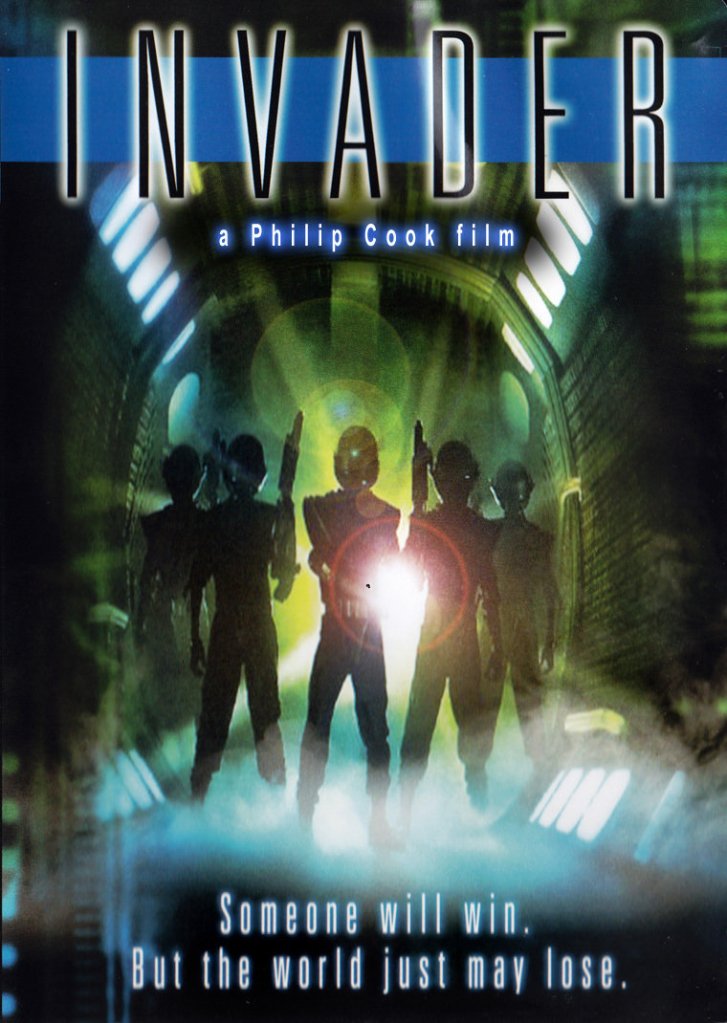
While you can watch the later versions on streaming platforms, stick with this superior 1987 version — and be impressed by its creativity and ingenuity — that we found on You Tube. You can learn more about the film’s production and check out stills on Philip Cook’s official website for Eagle Films. While there, you can learn more about his other sci-fi films, Invader (1992) and Despiser (2003).
* We’ve never gotten around to giving Star Crystal a full review proper, but we do discuss it in passing as part of our “A Whole Bunch of Alien Rip-Offs” and “Ten Movies that Ripped-Off Alien” featurettes. Also don’t forget our “Movies in Outer Space” tribute of more films to enjoy. . . . Never say never . . . when a film gets stuck in your head! We finally gave Star Crystal a review proper, it’s coming up at 6 PM this evening.
You can now watch the Outerworld cut of Beyond the Rising Moon, as well as Cook’s follow up, Invader, on Tubi — which we finally reviewed proper as part of our “Cannon Month” tribute of reviews. The same goes for Despiser on Tubi — which we reviewed as part of our January 2023, two-week “SOV Week” tribute.
About the Author: You can learn more about the writings of R.D Francis on Facebook.He also writes for B&S About Movies.
Remember Scared to Death? That monster suit movie may not have moved many folks, but producer Jack F. Murphy loved the creature in it so much he wanted to make another movie about it. Original director William Malone had moved on — some sources say he was making Creature, but that was in 1985 — so George Elanjian Jr. (who had had a career in reality TV before there was reality TV, directing That’s Incredible!, Candid Camera and Real Stories of the Highway Patrol) came on board.
Charitably, this movie is a mess, but it’s anchored by Re-Animator bad guy David Gale who absolutely takes huge bites out of the scenery every single time he shows up.
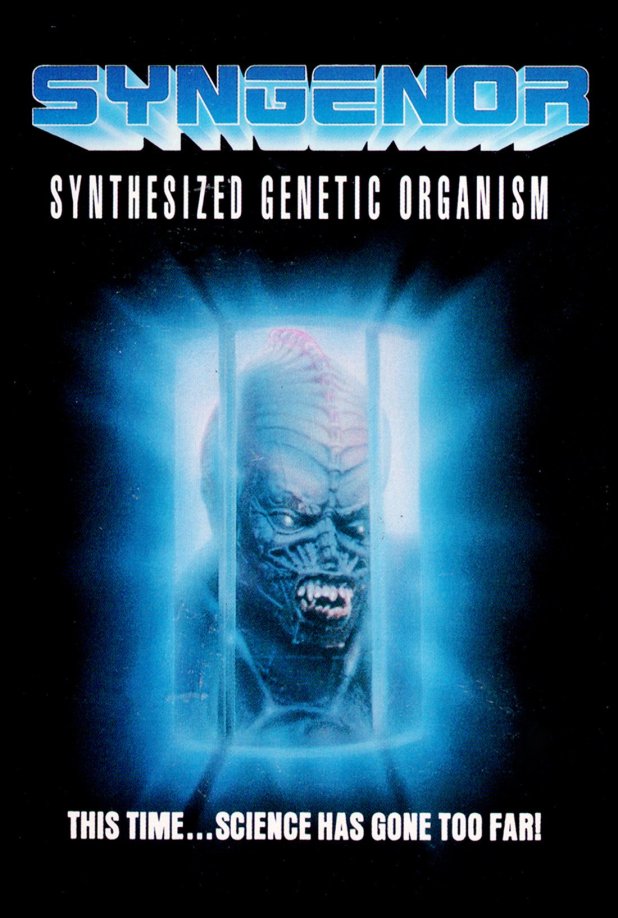
Norton Cyberdyne builds high-tech military technology and their latest superweapon is Syngenor (SYNthesized GENetic ORganism), a Giger-ish creature made for deployment in the Middle East. These scientists are so smart that they made an unkillable creature that can continually lay eggs and reproduce, making more invincible slimy monsters.
Their headquarters is really Los Angeles’ Ambassador Hotel and the lab is just a kitchen with sheets all over everything. And one of the two writers of this movie, Brent V. Friedman, would go on to also create the scripts for Hollywood Hot Tubs 2: Educating Crystal and Mortal Kombat Annihilation. If you think the latter is bad, you should see where he got started.
I have no idea why Vinegar Syndrome hasn’t released this yet. You haven’t lived until you see Gale get on his knees to suck off a female employee’s finger or kill all of his employees while wearing a bunny mask. This is his movie, so don’t you ever forget it.
With blight ravaging New York City in the 1970s, groups like the Young Lords and Black Panthers fought for radical change in their communities. Through the leadership of Dr. Mutulu Shakur, the stepfather of Tupac, one of the activities of these groups was to create the first acupuncture detoxification program in the United States.
Seen as “radical harm reduction,” this acupuncture program was a revolutionary act toward the government programs that transfixed the lives of black and brown communities throughout the South Bronx.
While the legacy of the program has long been maintained by the residents of the Bronx and Upper Manhattan, those that created it have suffered from decades of state-sanctioned persecution.
Dope is Death explains how the acupuncture clinic rose to prominence and continues in the present day, despite dealing with funding challenges.
Director Mia Donovan has also made Inside Lara Roxx, the story of adult star Lara Roxx, who went from the adult industry to an HIV infection and a psychiatric ward in Montreal all before the movie even begins, and Deprogrammed, which is all about the anti-cult crusade of Ted “Black Lightning” Patrick.
She takes on really interesting stories and somehow makes them even more intriguing through the way that they are made. For this film, she worked with Sofi Langis, who has directed several VICE features and Texas: women and guns, a love story.
At once a history lesson on how groups like the Black Panthers tried to instigate massive and sweeping change while also explaining the heroin epidemic in the South Bronx, Dope Is Death is a frank indictment of how governments use drugs to oppress communities and how their myriad intelligence organizations seek to discredit anyone that attempts to make a difference.
So, yeah. Roger Corman made Battle Beyond the Stars, then recycled the sets, the models, the costumers, and the effects shots into Galaxy of Terror, Forbidden World, and Space Raiders, then lent it all out to Fred Olen Ray to make Star Slammer (1986). Sadly, ol’ Roger didn’t loan it all out to Silver Star Film Company . . . uh, oh . . . not the same Philippine purveyors of all manner of ’80s post-apoc and Rambo ripoffs by the likes of Jun Gallardo and Teddy Chiu? They actually tried to do a Star Wars-cum-Alien knockoff?
Yes. It’s true. Teddy Chiu’s — aka Page, aka Ted Johnson, aka Irvin Johnson (you know the aka-drill with Philippine auteurs) — Silver Star Films made the Kessel Run with director Carribou Seto, aka David Hue, aka David Huey (his credit for Hyper Space).
Oh, man. A Philippine Star Wars? Roll the tape!
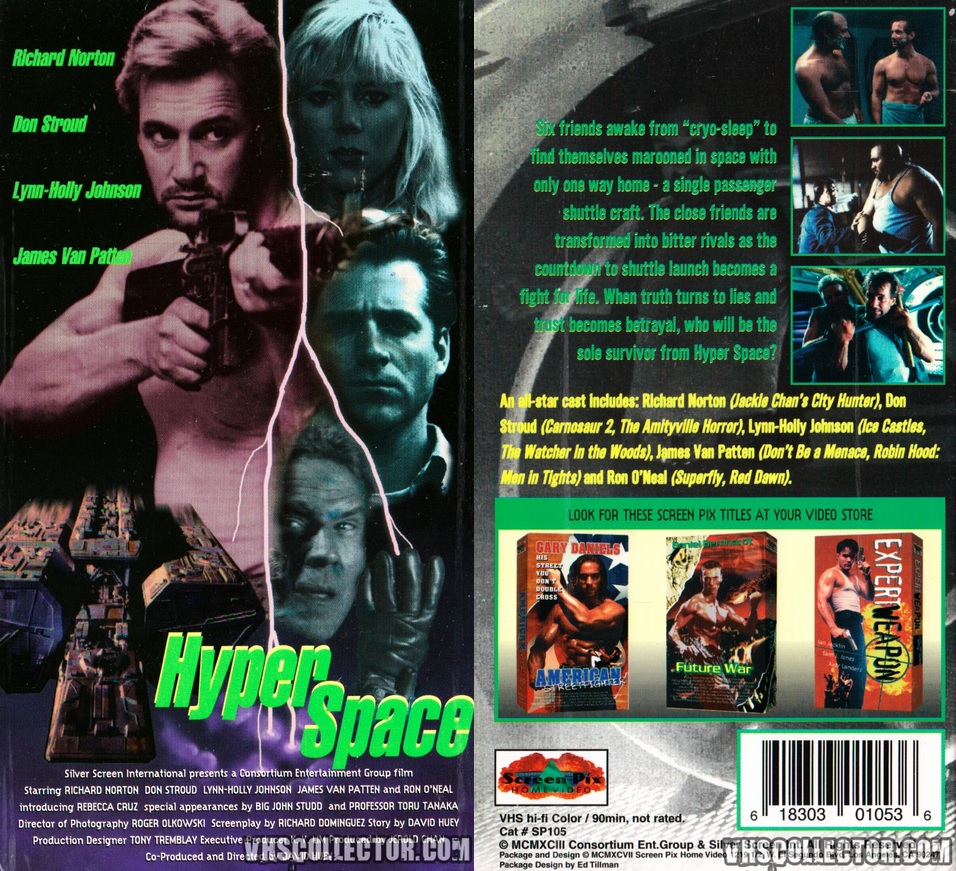
Thanks, Paul! We can always count on you for a clean JPEG of an obscure VHS cover.
So . . . as in the Ridley Scott-James Cameron-verse, and as in William Malone’s superior, four years earlier rip, Creature (1985), space is run by a ne’er-do-well corporation in the 21st Century who sends out Dark Star-styled crews in long-range vessels to — instead of blowing unstable planets to harbinger colonization — dispose of Earth’s chemical pollution and nuclear waste into “hyper space,” otherwise known as “The Black Forest.”
Well, wouldn’t you know it, the ship malfunctions and wakes the crew out of their cryo-sleep and they realize they’ve drifted off course . . . and a fuel leak leaves them marooned in deep space . . . and the shuttle craft that can save them can only hold two passengers, aka “the life boat.” So, in between the Alien and Dark Star pinching, we’re also pinching ol’ Uncle Al Hitchcock’s Lifeboat, which, if you’ve been following along with our reviews during our May “Space Week,” got the Alien-remake treatment in 1981 and again in 1993 (yep, reviews are coming this week). And, wait a sec . . . since this is an an outer space “eco-message” film, we better toss Silent Running on the list. Of course, since everyone is turning on each other for those coveted shuttle seats, John Huston’s The Treasure of the Sierra Madre is tossed into the narrative mix.
Of course, while we love ’em: Lynn Holly Johnson ain’t no Tallulah Bankhead and Don Stroud ain’t no Humphrey Bogart. Oh, man . . . the careers this way-over-their-heads Philippine star mess destroys: Richard Norton (Equalizer 2000), Don Stroud (The Amityville Horror), and no, say it ain’t so Ron O’Neal . . . you were Superfly . . . Superfly! And Lynn? Yeah, you did The Sisterhood for Cirio H. Santiago back in 1988, but . . . oh, never mind. And for the wrestling fans — were talking at you, Paul Andolina of Wrestling With Film — we’ve got Big John Studd and Professor Toru Tanaka. And yes, that is a Van Patten brother, but not the one who portrayed Tom Roberts in Rock ‘n’ Roll High School, that was Vince; we get James, here. Basically, it’s all of the actors that we get jazzed about at B&S About Movies . . . and it just hurts to see them desperate and scrounging for paychecks from Silver Star Film Company tackling, of all things, the Scott-Cameron-Lucas-verse.
Seriously. It breaks your heart. You just want to invite them all over to your house for the Thanksgiving weekend and put one of mom’s home cooked meals in their stomachs and embarrass them with your knowledge — and library — of their film careers.
The marketing and running times on Hyper Space are all over the place, with the initial U.S. VHS-versions running at 90 minutes. Then there’s two more versions: one at 81 minutes (with all of the nudity cut) and 87 minute-versions (that leave the nudity and cut the violence). Originally released in 1989, Hyper Space has been popping up in the foreign marketplace over the years as grey market DVD-Rs with the bogus “copyright” years of 1993, 1998, 1999, 2017, and 2019 under the titles Space Rangers, Space Rangers: Hyperspace, Black Forest: The Rage in Space, Black Forrest, and The Rage in Space. Oh, and don’t mix up the 1989 Philippine one with the somewhat coveted, North Carolina-shot Star Wars spoof Gremloids (1984) — which also goes by the the alternate title of Hyperspace (all one word) — written and directed by Todd Durham, who gave us the hugely successful Hotel Transylvania animated franchise.
Sadly, even with all of the grey market DVD reissues, there are no online streams nor a VHS rip of Hyper Space to share, leaving this bottom-of-the-barrel knockoff of a Corman-light Alien knockoff truly lost to the ages.
About the Author: You can learn more about the writings of R.D Francis on Facebook. He also writes for B&S About Movies.
Author’s Note: Please note this is a film review that addresses the creative art of filmmaking only, which attempts to help the viewer reach an understanding regarding the creative development of its subject-film genre. This review is not a political dissertation in support of or in contradiction of any sociopolitical belief system (we get into Fascism and Nazism, here) and is not intended to incense any reader regarding social or free speech/opinion issues. This review was written as an affectionate tribute to our “Space Week” theme of films set in outer space.
Yes, we know this film is loved in some quarters. . . .
Ode toBattlestar Beverly Hills, aka Melrose Place in Space, aka Space: 90210
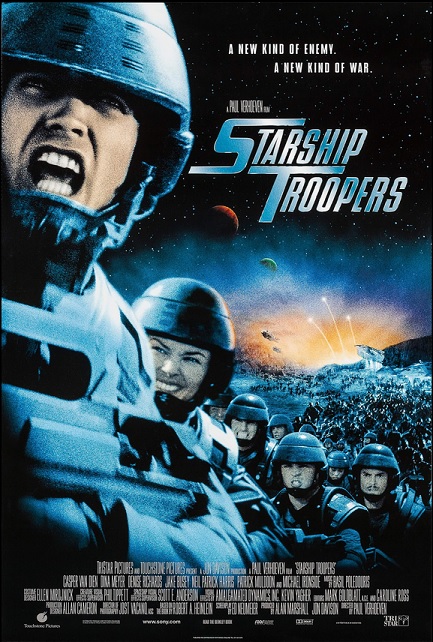
Oh, how much do I hate ye; Starship Troopers? Let me count the ways. For the depth and breadth and height that I cherish Escape from New York, My said hatred is thrust upon Escape from LA; That is how much I hate ye. Oh, ye wooden, California pretty girls and fancy boys in space; For how much I love Don Coscarelli’s Phantasm Is how much I also hate Phantasm II; For that is how much I hate you, ye faux-fascist star troopers In your hockey-plastic, Buck Rogers wears.
Is it your driftwood acting? Is it your unconvincing CGI on a multi-million budget? Is it Casper Van Diem’s soap opera sheen; For did he think he’d get a Tom-like cruise, Onward to A-List stardom in his feature film debut? Is it that the sheer force of Michael Ironside And the amazing-in-every-film Clancy Brown Can’t erase the perpetual goofy-gaze of Denise Richards (“I want to be a pilot!”) Or the macho, toothy-mugging of Jake Busey? And forget not the thespin’ boondoggles of Dr. Doogie.
Frack! This movie sucks the feldercarb off Doc Brown’s flux capacitor. I need a shot of tranya, Commader Balok. Fesarius-me the hell out of this mess of Klendathuian space crap.
Well, looks like we’ve got a Battlefield Earth II sequel.
I love how the Wikipage on Starship Troopers—as with the Wikipage for Alien that tries, and fails, to hide the multiple film and literary plagiarism lawsuits against that film—tries to hides the fact (via multiple edits) that Melrose Place in Space began its production history as a totally unrelated, outright ripoff of Robert A. Heinlein’s late ‘50s classic novel, Starship Troopers, known as Bug Hunt at Outpost Nine. Now, the updated Wikipage tells us that the film adaptation of Heinlein’s novel jettisoned his superior (common sense) title for the dumb, exploitive-cum-ripoff title of Bug Hunt at Outpost Nine.
(That’s as awful a title as Dan O’Bannon’s original title for Alien: Star Beast; a title that he blindly fought to keep (he thought “Alien” was stupid) for his remake (no, it wasn’t, he claims) of It! The Terror from Beyond Space and ripoff (no, it wasn’t; he never saw it, he claims) of Planet of the Vampires. Right, Dan. And Sam Raimi never saw Equinox, either. And even O’Bannon’s title was a clip: it was the title of a 1954 Heinlein novel.)
Uh, wrong, A-List studio digital content managers stacking the digital Wiki-decks.
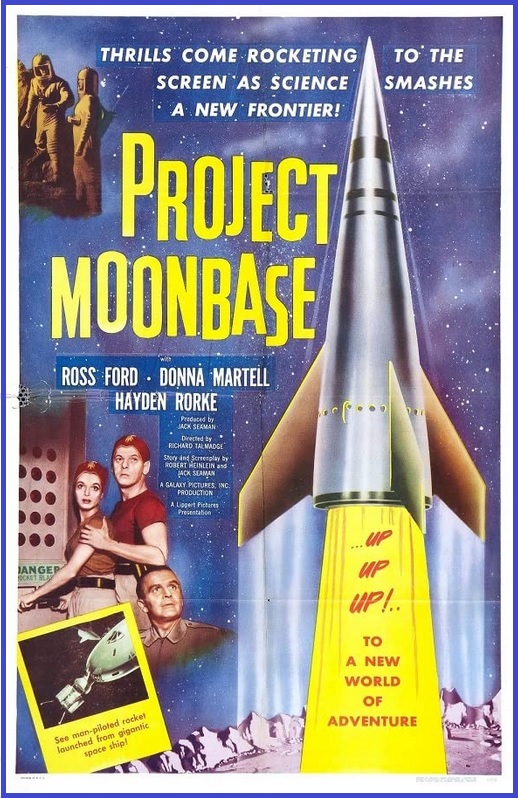
The script for Bug Hunt at Outpost Nine was already in the production cue, and then—when the similarities to Heinlein’s book came to light, a rush was made (probably to stave off the eventual, Harlan Ellison-inspired lawsuit against James Cameron’s The Terminator, natch) to license Heinlein’s novel—purely for the title, while pinching some character and location names from the book, so as to make us think we were getting a Heinlein adaption (another Heinlein book-to-film was 1953’s Project Moonbase). (Man, this is as awful as all of those bogus Philip K. Dick adaptations that don’t resemble his books.)
Paul Verhoeven—who wowed us with RoboCop and Total Recall (speaking of Phil K.), shocked us with Basic Instinct, and made us groan with Showgirls—was certainly well-intentioned with Starship Troopers. He is, in fact, a superior filmmaker, and his pre-stardom films Soldier of Orange, The Fourth Man and Flesh and Blood are proof of that fact (see all three, do it). But then he had to go and toss out Heinlein’s novel and stick to the inane Bughunt script: Starship Troopers is Starship Trooper in name only.
Films, like novels, are subjective. And many read Heinlein’s novel as racist-offensive; that it was pro-fascism and pro-militarism, with a desire that the world should supplant democracy for nationalism; that the only way to solve the world’s problems—real or imagined, or to institute your version of “right”—is by dispensing a large-scaled Wehrmacht. And to that end: Verhoeven decided to infuse a blatantly exaggerated anti-propaganda and anti-conformist message, which, again, was the point of his extraterrestrial “big bug movie’: a critique of America’s military. (Yeah, right. America’s military is the force that needs to be taken to critique-task. Insert my eye-roll, here.)
My read—big surprise—of Heinlein’s novel is different: I don’t see it as “pro” anything: I read it as anti-everything. In my read—wholly against Verhoeven’s tongue-in-cheek celluloid interpretation—is that Heinlein’s point is that a fascist way of doing things doesn’t work. Nationalism will not work. In fact, I read Starship Troopers as a novelistic precursor to ‘70s nazisploitation: films misconstrued as glorying Nazism (and a mere post-review of one of those films gets you suspended-to-banned from social media platforms). To say that Heinlein’s Starship Troopers is pro-fascism is to say Pier Paolo Pasolini’s Salo, or 120 Days of Sodom is pro-fascism and glorifies Nazism.
And that assumption on Pasolini’s masterpiece couldn’t be more wrong.
Yeah. I’d rather jump aboard this starship.
Uh, no thanks: deboarding.
As we discussed in our review of Naomi Holwill’sFascism on a Thread: The Strange Story of Nazisploitation Cinema (2020), a brilliant document on that unpleasant genre of film, Pasolini’s wasn’t (as was Verhoeven, in my opinion) using Nazism or Fascism as theatrical window dressing (do un-dumb the fact that ST was just a stupid f’in, big alien bugs movie). Salo, or the 120 Days of Sodom was a societal mirror forced into our face. American comedian Lenny Bruce wasn’t “filthy” for the sake of filth: the ‘60s world was smut-ridden; he simply made us—forced us—to look at society in its true form, as a warning for us to change the err of our ways before society was lost (and the ways we behave on social media these days, we’re already lost). And Pasolini’s film was, too, a horrifying lesson of the absolute corruption of power, a power-corruption in the same vein that Otakar Vavra’s Witchhammer (1970) addressed the issue.
And that’s what Robert Heinlein’s Starship Troopers is to me: a lesson on the absolute corruption of power; that man, unchecked, would be so maniacal in his dominance that—when of Oliver Cromwell runs out of witches, Hernán Cortés runs out of Aztecs, the Mayans are wiped off the Earth, the last and American Indians are reservation-stockpiled, and when there is no gold at the end of Gonzalo Pizarro’s El Dorado-rainbow (a crazed dominance explored in Werner Herzog’s 1972 film, Aguirre, the Wrath of God)—man will conquer bugs . . . and squash them, well, like bugs, for domain and wealth.
No. Heinlein (IMO) is not comparing Jews or Negros to bugs; saying those peoples are lower than bugs and need to be exterminated like bugs (dear lord, don’t people read?). Heinlein’s pondering: When does it end. When is enough, enough. Is there an end to all your survey. What will man do when there is no one left to conquer and to subjugate?
Heinlein’s books were, in fact, an education on the value of racial equality and the importance of racial tolerance—not stamping out other races and religions for the superiority of another race or political system. It’s a book against what we know today as “cancel culture.”
How can Michael Ironside read the book and be a fan of the book, and then, reportedly, chastise Verhoeven for “making a fascist film” while on set? Maybe if Verhoeven actually read the book that he, reportedly, disliked, he would have realized the book was already a parody; that a biting sociopolitical statement laid inside its pages. So, Paul, we didn’t need a cast of thirty-something, shiny, happy pretty teenagers, along with bogus internet-social media feed inserts (based on Nazi propaganda films, ugh, who cares), to tell me: fascism: bad. The message was already there inside the book, Hollywood.
Then, there’s the muddled plot—and the utterly annoying-to-wooden, perpetually goofy-toothy “I want to be a pilot” grin (all I kept thinking of was Hermey the Elf from the ‘60s TV holiday special Rudolph the Red Nosed Reindeer, with his “I want to be a dentist” wishes) of Melrose Place tenant Lt. Carmen Ibanez. She’s in a high school (?), romance with John “Johnny” Rico. She puts military junk in his head, to the chagrin of his parents, who don’t like her, and convinces Johnny that, to impress her, he needs to join up and “be a citizen.” Then she—because he’s on the military fast track to pilot-dom (and smarter than the 35% math-scoring Johnny)—reciprocates the flirts of Lt. Zander Barcalow (Patrick Muldoon; the only one up to the Ironside-Brown challenge) to the point the love-triangle she instigates inspires fisticuffs between her two suitors. (That’s so very Ross-teasing-Rachel Green of you, Carmen.)
Wanted: Carmen Ibanez: 12 million counts of murder.
Then, Carmen gets her “I want to be a pilot” wish! And while she’s on third shift—in lone charge of the helm of a multi-billion dollar starship and the lives of a hundreds-strong crew (and in-defense of the Earth, mind you)—Melrose-babe decides it’s proper military etiquette to have a little coffee clutch with Zander on the bridge. And while she’s hoping to have a little post-Starbucks Zander-in-the-uniform-pant, she misses the warning for a bug-asteroid coming out of Jupiter hyperspace—which was the whole point of the ship’s stationary orbit: asteroid patrol. And the asteroid rips away the ship’s communications array. And there’s no way to warn Earth. And her hometown of Buenos Aires is wiped off the face of the Earth by said bug-oid. And 12 million people are dead because Lt. Ibanez decided two-timing Johnny (who she subsequently dumps via hard-disk mail—again with the “I want to be a pilot” lamenting) with Zander over coffee-to-sex was more important than monitoring the helm. Of course, the logical thing to do is to promote Ibanez to Captain—and give her first chair, which was Xander’s old job (I think he died, or something). And, wasn’t it established that the spacecruisers have hyperdrives? So, if communications are out, why not hyperdrive back to Earth—ahead of the asteroid? And, in the opening scenes, didn’t one of the faux-propaganda films clearly show a space cannon obliterating an almost-ready-to-hit-Earth asteroid? Arrgh!
Is there a deeper message about Manifest Destiny and American Imperialism in the frames? Is this a plight of the American Indian allegory? Nope. Ol’ Capser just likes killing big creatures and blowing up stuff. There could have been a message . . . but welcome to your A-List “tent pole” summer of cinema.
Step aside, sweety. Men be killin’ intergalactic dinosaurs, here.
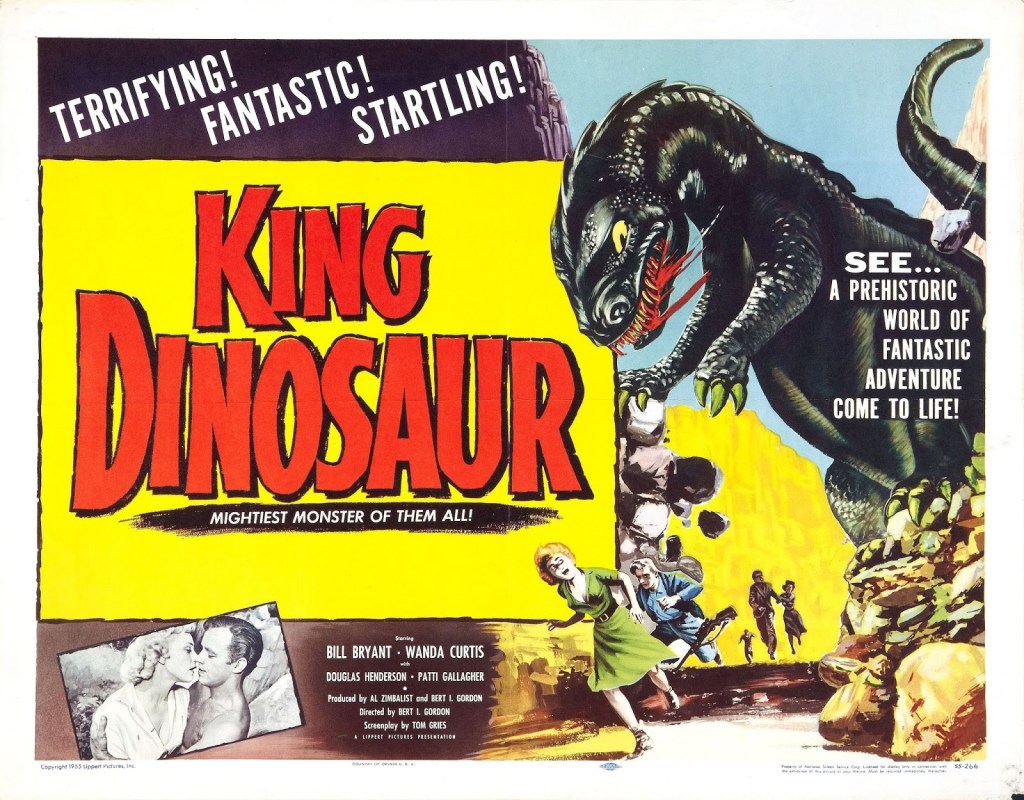
What is it with women-in-space flicks? It’s the ’50s Bechdel-fails all over again with the likes of Project Moonbase and Gog and King Dinosaur! Why can’t the women be smart and moral? Why must they be vapid, sex-driven, teasing jezebels? We need more Ripleys and Lamberts and less spandex-William Deerings and Lt. Ibanezes in sci-fi, I declare!
Argh! I thought the plot holes and dumb character motivations from BSG: TOS were feldegarb (more so after Lt. Sheba, daughter of Cain showed up). And I thought Wing Commander (1999)—with Freddy Prinze, Jr.’s pretty-boy-amid-the-awful-CGI-stars—was daggit dung. Low-budget epics like Convict 762 (reviewed this week, look for it) and Space Mutiny have an excuse for their bad CGI and dumb characters and Bechdel-fails, as it’s a par-for-the-course that I expect and accept. But multi-million dollar A-List films like Starship Troopers—and Escape from L.A. (don’t get me started)—do not get that pass. They just do not, as I will not accept the “nuff said” logic that Starship Troopers “is a great movie” simply because Denise Richards and Dina Meyer are board as eye candy for the hormone-infused teens in the audience (and the he-man characters in the film).
By the Kobol Lords, I hate this movie. And I could surely count more ways (like the stupid-as-ass, backflipping faux-XFL football game; recruits handover paper induction forms to a behind-the-desk clerk using a rubber-notary stamp . . . in the friggin’ 23rd century: why not have recruits micro-chipped and hand-scanned, for example) . . . but that’d be like kickin’ a sick daggit when it’s down.
And besides, it’s time for lunch . . . as I read Sam the Bossman’s love for this movie with his October 2018 review. I hope I can keep my lunch down.
About the Author: You can learn more about the writings of R.D Francis on Facebook. He also writes for B&S About Movies.
From theEditor’s Desk, 2022: This article began as a single review for Convict 762, as part of our May 2021 “Movies in Outer Space Week” tribute to the 1977 anniversary release of Star Wars.
We’ve since watched screenwriter J. Reifel’s three other films: Timelock, The Apocalypse, and Dark Planet as all four films went into simultaneous production for EGM Film International—with Charles Band’s Moonstone-imprint dual-distributing each on home video and cable television. As result of the four films’ production synergy—as well as their production-recycling of sets, costumes, and effects—we’re now providing a brief overview of Reifel-EGM’s other three films. Yeah, they’re the same, but different.
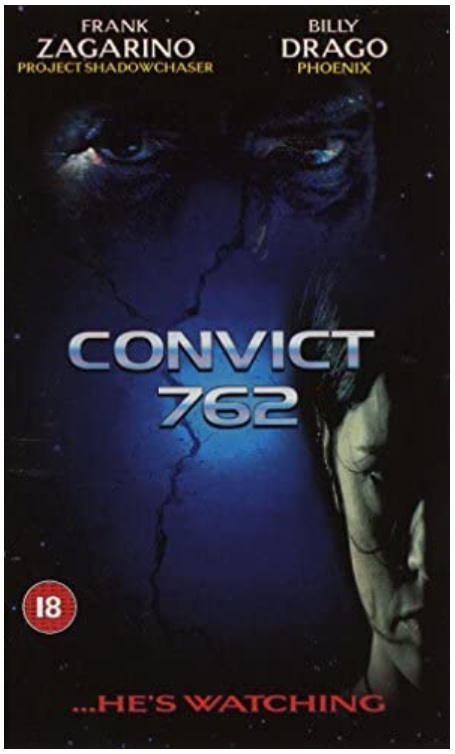
The late, requisite screen baddie Billy Drago—best known for his breakout role in Clint Eastwood’s Palerider (1985)—brought me here. Billy Drago—of Chuck Norris’s Invasion U.S.A. (1985) and Hero and the Terror (1988)—kept me watching. And Billy Drago—who made Hunter’s Blood (1986) watchable and Banzai Runner (1987) bearable—made me take the journalistic plunge on Convict 762, so as to put another one of Drago’s film’s on the B&S site—out of admiration and respect to the dynasty that is Count Drago.
Another name amid the credits of Convict 762 you’ll recall is Luca Bercovici (who will always remind me as Dennis Christopher’s faux-brother), a writer, director, an actor who—across his 60-plus acting and ten-plus writing and directing credits, we don’t mention enough on this site, outside of his appearance in Space Raiders (1983) and his writing and directing Rockula (1990). We’ve never gotten around (and probably won’t) to reviewing his writing and directing debut of the Gremlins-cum-Critters rip Ghoulies (1985), which turned into a four-part franchise.
Where’s Vin?
Then, with Josh Whedon reactivating the Alien franchise in 1997 with the series’ fourth entry, Alien: Resurrection, Luca decide, for his sixth directing effort, he would direct the fourth—and final—screenplay of the once prolific, low-budget scribe J. Reifel. Reifel saw four of his sci-fi scripts go into simultaneous production in 1996 for EGM Film International (The Shadowchaser franchise and 1998’s Outside Ozona), with Timelock, The Apocalypse, and Dark Planet for Charles Band’s Moonstone-imprint for dual-distribution on home video and the Sci-Fi Channel (in the days before the double-“y”).
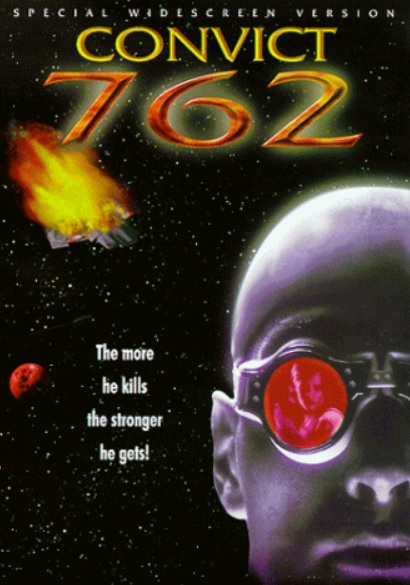
Now, because of Michael York starring, I’ve seen (and don’t remember because it wasn’t very good) Reifel’s Dark Planet. And sadly, if not for the retro-UHF channel Comet running Convict 762 this past January 2021, I never would have sought it out on Tubi to watch. And, even with the presence of Billy Drago, I’ll soon forget this film once it publishes and is lost amid the 1,000s of other reviews at B&S About Movies. And speaking of distribution and Charles Band’s marketing tomfoolery: In the wake of the success of David Twohy’s Pitch Black (2000), Moonstone reissued Convict 762 to home video with a Riddick-esque cover. But be not ye duped, oh, star explorer, for this ain’t a Riddick romp, not by a long shot.
Don’t fall for the dick faux Riddick.
However, not all is weak tea with this direct-to-video potboiler: Convict 762 has its strong points beyond Billy Drago’s presence. And those strengths come in the form of the stellar, Cormanesque up-against-the-budget production design led by art director Ron Mason (who’s work you know these days for The Avengers and Guardians of the Galaxy franchise). Kudos also goes out to set designers Denise Dowden (who vanished from the business) and Ann Shea, who ended up at CBS-TV (to work on several of their long-running series, including The Big Bang Theory). Tip o’ the hats as well to costume designer Wendy Benbrook, who’s still at it with FX-TV (most recently working on You’re the Worst). Courtesy of that behind-the-scenes-team’s collective efforts, Convict 762, again, taking into consideration it’s a low-budget product touched by the hand of Charles Band, looks really good. That is, until the CGI spaceships and exteriors (really bad, like Escape from L.A. bad) rear their ugly head, and then the rest of the cast chokes-on-screen in comparison to the thespin’ excellence of the always-making-chicken salad-out-of-chicken-shite Count Drago.
At the risk of insulting the still-(for the most part)-at-it actresses: Having been down more horror and sci-fi rabbit holes than the average VHS-rental dog, I’ve seen more than my fair share of low-budget B-renters starring reformed porn actress of the Traci Lords and alias-starring Michelle Bauer, aka Pia Snow, variety. Hey, it’s par for the course when you celluloid-mainline too many Fred Olen Ray and David DeCoteau movies. So, when I see a cast of unknown names like Shae D’lyn (still at the game on Orange is the New Black and Boardwalk Empire; a 96-episode run on U.S. TV’s Dharma & Greg) and Tawye Fere (from Rockula?), well, what would you think? So, I deserve a Bechdel pass on this one.
The truth is: If Lords and Bauer—who have more than proven their B-acting chops over the years—along with Linnea Quigley and Brinke Stevens, were on board as the all-female crew of the star cruiser Alexandria, this film would be so much more awesome for it. For with films like this: you must ditch the unknowns for a full-on-familiar exploitation cast—or the film simply will not work. (And this film, ultimately, does not.) On the other hand: Roger Corman hired both Jim Wynorski and Fred Olen Ray to co-create Dinosaur Island (to get more mileage out his expensive Carnosaurfootage) and that film works because, not only of their B-Movie triumvirate pedigree, but because they hired reformed adult actresses Michelle Bauer, Becky LeBeau, Deborah Dutch, and Toni Naples—which is why more have seen that film instead of this one.
At first, the idea of a crew of Ripleys and Lamberts sounds like a great idea. Until the script Bechdels-off-the-rails into a 1950s sci-fi throwback (Project Moonbase) (and I know that is NOT the film’s intention), with bits about women—even behind the command of a starship, mind you—are still bad drivers who get lost in asteroid fields because they can’t read star maps (and I thought Denise Richards’s character in 1997’s Starship Troopers was badly written; yeah, we’re giving that a new take, this week, for “Space Week”). (At least Bercovici keeps them in Nostromo-wears and out of the skimpy-wears.) Oh, and the gals forgot to get gas (or plasma, or atomic-somethings) poured into the drive-tanks. But, in the ladies’ defense: asteroid damage forced them to jettison fuel to save the ship from exploding (or something). Luckily, a penal colony (ugh, and we cue David Fincher’s Aliens 3, again) on the only-populated planet in the system is their lone option for repair and refueling. And it’s there that they meet Jason Vorhees and The Terminator, uh, I mean Mannix and Vigo. (Uh, yes, the very-similar Jason-in-space flick, Jason X, showed up in 2001—and Ron Mason worked on that film’s artistic team.)
Mannix (Drago) and Vigo (Frank Zargarino of the aforementioned Shadowchaser franchise and a few Philippine knockoffs, most notably the Mark Gregory classic Ten Zan: The Ultimate Mission) both claim to be the last prison guard and last prisoner survivors of an inmate uprising that resulted in the deaths of everyone on the colony (and one of them is an android-cum-cyborg). Now, in the tradition of the last-two-men-standing-in-mistaken-identity-to-the-danger-of-a-group-of-bad-decision-making-ne’er do wells . . . I know I’ve seen this before . . . and I can’t place it. (Damn it! Was it a ‘60s Star Trek episode?) So, I’ll just say it pinched (reminds me) from the 1986 Rutger Hauer and C. Thomas Howell actioner The Hitcher, where Hauer’s psycho leads others to believe Howell’s the serial killer. And whoever the serial is, here (the script, to its credit, does keep us guessing), they Jason-cum-Xenomorph-offed the Alex’s entire crew—sans Shannon Sturges, here as Commander Nile. Now, Nile could be a Ripley, but she has so much caked-on make-up and hair product (thus, the my-bad porn assumption) that the rugged-Alien ass-kicker the character aspires to be, is lost. (Sturges guested on several TV series; she retired in 2014.)
In addition to the Alien (sans the Xenos, natch) and The Hitcher, you’ll see a bit of The Thing (running through a dark complex contemplating ‘who is who”). What you won’t see: decent acting. What you will see: sharp, inventive set design and cinematography that isn’t exactly competing with its big-budget inspirations (but it’s pretty damn close), but it all certainly looks (way) better that the worst (and even the best) of ‘80s episodes of Battlestar Galactica. It’s just too bad the women-nauts of the Alex are more William Deering eye candy than kick-ass sexy Ripleys. (Ugh. Do not get me started on Glen Larceny’s Buck Rogers series.)
In the end: Convict 762 is for Luca Bercovici curio-seekers and Billy Drago completists only. And we expect and accept bad CGI—and poorly portrayed and scripted characters—with films like these: we do not except or accept it with A-List junk like Escape from L.A.(1996) (what were you thinking, Pam Grier?).
You can watch a free-with-ads-stream on Tubi while Moonstone Entertainment offers the trailer on their You Tube channel.
Timelock (1996)
Logline: It’s the 23rd century, and the world’s most dangerous criminal has taken over the maximum security prison on asteroid Alpha 4. Caught in the middle are a petty thief and a prison transport pilot.
Timelock is your basic “space prison” shenanigans romp—one that pinches unabashed from Aliens and Aliens 3, as well as Peter Hyams’s Outland, and every other “peril in space” romp set at a remote penal colony or terraforming facility during the video ’80s.
Timelock feels like it was made ten years too late—or released ten years too late, like a late ’70s, Alfonzo Brescia Star Wars rip—and works better in a binge-watching session alongside other ’80s Alien knockoffs, such as Roger Corman’s Forbidden World (1982; scripted by Jim Wynorski, natch), William Malone’s better Creature (1985), and Roland Emmerich’s even better Moon 44 (1990)—more so than John Carpenter’s Escape from L.A. (1996), which more than likely is Timelock’s raison d’être. Needless to say, while each are serviceable in slicing through the Brother-typed cheese, ex-Bond Girl Maryam d’Ado ain’t no Ripley and the always likable Arye Gross (A Matter of Degrees; even when space-grunged up) ain’t no Plissken.
Timelock appears on the U.S.-based, retro-UHF-TV channel Comet from time to time—sometimes double-featured with Convict 762. You can also watch Timelock on Tubi and Moonstone Entertainment offers the trailer on You Tube.
The Apocalypse (1996)
Logline: A salvage pilot and a bartender-wannabe space jockey go against a crazed computer programmer and the head of a criminal gang who have equipped a spaceship with nuclear warheads and plan to crash it into Earth.
This time out: Sandra Bernhard (TV’s Roseanne; The King of Comedy, Bruce Willis’s Hudson Hawk) takes the Maryam d’Ado role while Cameron Dye (Valley Girl) takes the Ayre Gross role—and Frank Zagarino’s back from Timelock as the same-but-different villain. Well, he’s “back,” here, since The Apocalypse was released, first. Yep. Sandra Bernhard’s J.T Wayne is even less a Sigourney Weaver as she brings on her best bad-ass sneer under space helmets during spacewalks as she endlessly fires ammo rounds aboard her ersatz Nostromo.
Anyway, the “apocalypse” is brought on by a chick named Goad (Laura San Giacomo of TV’s Just Shoot Me!, Sex, Lies, and Videotape): a mad computer genius who loads a space cruiser with with explosives and Solarium, an unstable fuel source, on an Earth-collision course. Frank Zagarino is Vendler, J.T. double-crossing lover and crew member who wants the Solarium honey hole for himself. Dye is Lennon: our bartending-errant “Han Solo” who steps in the fight between the salvagers and terrorist hijackers.
Look, if you need a film with Shakespeare computer-access quotes as passwords and Jack Nicholson-inspired villains spouting lines about pigs and hairy chins from children’s nursery rhymes, then this is your movie. Oh, by the way: the miniatures and platework is actually better, here, than in the next film. . . .
Moonstone Entertainment offers the trailer on their You Tube portal and they stream the film on Tubi.
Dark Planet (1997)
Logline: When a habitable planet is discovered in orbit around a star on the far side of a wormhole, the Earth’s two warring factions form an alliance to save the human race.
So, you’ve made it through Timelock and The Apocalypse. Can you make it through this third film—on your way to Convict 762?
Oh, you just have to! Why?
Because Albert Magnoli, of Prince’s Purple Rain (1984) and Sly Stallone’s Tango & Cash (1989) directs Paul Mercurio from the critically-lauded Strictly Ballroom (1992) and the critically-lambasted Dan Aykroyd turd, Exit to Eden (1994). And who in their right mind passes on any Michael York movie—from Logan’s Run to The Omega Code, baby! No one.
In fact, Micheal York’s ersatz interstellar Hitler, here, isn’t that far removed from his evil Anti-Christ turn in that TBN apoc’er, as he sets the Babylon 5-cum-Firefly-ripoff events in motion. Paul Mercurio is Hawke: our put-upon Snake Plissken pressed into service by the pseudo-Nazi uniformed York who overlords the genetically-engineered humans known as Alphans—but this ain’t no Aldous Huxley Brave New World joint by a long shot.
Remember how Snake was the “only man for the job” because he successfully flew the Gullfire over Leningrad? Well, the now-in-prison war profiteering Hawke is the only man to successfully navigate a wormhole. My longtime celebrity crush, Harley Jane Kozak (Arachnophobia), is our Princess Leia-Ripley amalgamate working with the scruffy nerf herder that is Hawk. Yep, the always welcomed character-actor Ed Ross from good ‘ol Pittsburgh (Red Heat) is villaining the joint as B-actress extraordinaire Maria Ford is the resident android joining in the double-crossing intrigue beyond the wormhole. Hey, there’s Frank Zagarino, back for another villainous turn.
As with the other three films in this ersatz series: Every shot in Dark Planet (the worst of the quartet) is underlit, but for atmosphere or to hide the production’s shortcomings, we ask? Then the proceedings only get worse once those in-camera miniatures (it’s not “bad CGI” as oft complained) zip around the awful wormhole platework.
Oy! The bane of my sci-fi youth, Buck Rogers in the 25th Century, is looking pretty good to me now. And it’s hard to believe this was made in 1996 and not 1986. Sure, it’s better than an Alfonzo Brescia Star Wars rip, but what direct-to-video star romp in Alien‘s back wash, isn’t? And you know what’s crazy? For as much as the direct-to-video/cable Alien-rip, Within the Rock (1996) looks like it’s part of the EGM Film International sci-verse . . . it’s not! And that film actually isn’t that bad.
You can watch the trailer on Moonstone’s You Tube portal while Tubi offers a free-with-ads stream.
Wrapping it up: On a star-rating system between 1 to 10, I’d give these 5 1/2 stars, each. You’ve watched worse . . . Star Crash, The Humanoid, Escape from Galaxy III, anyone? Oops! There’s Space Chase daring you to load ‘er up.
All the drive-in, TV movie, and direct-to-video sci-fi you can handle: DO IT!
About the Author: You can learn more about the writings of R.D Francis on Facebook. He also writes for B&S About Movies.
“I am now switching over to my helmet microphone. Now I am tuning on my invisible electromatic ray screen, which forms a protective shield our faces, and I will continue my commentary through my mirco-tape recorder.” — Dr. David Ruskin, with some expositional technobabble
Image courtesy of Chunky Vintage & Antiques/eBay
Okay, so the good doctor Ruskin explained away the lack of face shields on the ISO crews’ helmets. But how to explain away the astronauts strapping themselves down onto vinyl cushion tube-webbed folding-chaise lounge lawn chairs C-clamped to the walls? Or a world where they can invent visorless helmets (did Glen Larson see this for BSG’s Egyptian-helmets) and, as the plot unfolds, magnetic-deflecting meteor technology, but uses backyard lawn chairs for G-Force space flight?
It’s true: the crew cockpit is dressed with a lawn chairs. And the rocket’s flames are a piece of cellophane fluttering against a fan. But what did you expect from David Bradley, the writer/director who gave us the Mill Creek public domain ditty that is The Madmen of Mandoras (1963), aka They Saved Hitler’s Brain (1968)? And to think Bradley started his career with adaptions of Ibsen’s Peer Gynt (1941) and Shakespeare’s Julius Caesar (1950), both starring his high school chum, Charlton Heston (later of Planet of the Apes!).
Yep. From Heston to spaceship lawn chairs: only in the B&S-verse.
Now, you’re probably wondering: A major studio project from Columbia Pictures propped-out with lawn chairs and visorless helmets? And hey . . . why are some of the sets and props familiar?
Watch the trailer — and the hair brushing — on You Tube.
Well, that’s because 12 to the Moon was an independent production by Bradley at California Studios, later known as Producers Studios, Inc., on Melrose Avenue in Los Angeles — the same studio where another forgotten sci-fi cheapy, Mutiny in Outer Space (1965; look for our review, this week), was filmed. (The studio has since reincorporated as Raleigh Studios; learn more about the studio and other backlots and ranches at Retroweb.tv.) In need of a B-flick to double-bill with their recently-acquired Ishiro Honda-directed (1954’s Godzilla and 1965’s Rodan) Battle in Outer Space (1959) for Toho Studios, Columbia slapped their title card on Bradley’s film. After coming and going relatively quickly from Drive-Ins, Bradley’s lone star-romp received its widest exposure as result of Columbia, via its TV-arm, Screen Gems, distributing the film as part of their “X” syndication horror/sci-fi package that ran until the mid-‘70s on U.S. UHF stations.
Yeah, there’s nothing quite like the Soviets launching Sputnik in October 1957 to inspire quickie-junk sci-fi features—fully equipped with lawn chairs and faux-future plastic-swivel chairs at the control panels.
However, even with the lawn chairs and added-after-the-fact exposition to explain away the helmet snafu, the special effects—once the film hits the moon—with its “heat vents” peppering the weird lunarscape, is pretty good. And the production had the sense to rent (or could afford) official air force pressure suits and helmets (the visors removed because the actors couldn’t breathe and it distorted their photographic images). Sadly, there wasn’t enough money to shoot in color, which succeeds in making 12 to the Moon look ten years older than it is, when screened alongside Toho’s shot-in-color space flick (which is a loose sequel to 1957’s The Mysterians). In addition, we’re given an intelligent script from the scribe behind Val Lewton’s classics Cat People (1942) and (okay, a lesser not-so-classic) The Seventh Victim (1943): DeWitt Bodeen, who’s backed by producer Fred Gebhardt; he’s responsible for The Phantom Planet (which starred Delores Faith from Mutiny in Outer Space) (and there’s your déjà vu sets, thanks, Fred).
The ISO, the International Space Order, is formed for the purpose of the internationalization of the moon and comes to send its first manned mission (commanded by Ken Clark of Attack of the Giant Leeches fame and manned by Francis X. Bushman and Anthony Dexter from Gebhardt’s The Phantom Planet). The international crew of Lunar Eagle 1 comprises of 12 scientific specialists from around the world: 10 men and two women (and we’re introduced to the entire crew through a lengthy expositional voiceover as they board the rocket). Are the woman (Norwegian and Japanese) matriarchal-strong? Eh, a little. Could you imagine Ripley sitting in front of a mirror brushing her hair? Or Lambert, during a course correction, losing her balance and falling into—and to the pleasure of—Kane’s arms? Or Parker walking in on a showering-undressed Ripley or Lambert—and making a “This ain’t the Waldorf” joke? Well, that all happens here. It has to: for this isn’t Space: 1999, this is Space: 1950.
Those Bechdel test fails aside, we get a bit of insightful, sociopolitical tensions among a crew that still feels the sting of the Holocaust and Earth’s racist and warring past, with the good Dr. Oroloff bragging about mother Russia’s scientific wonders getting them into space in the first place, and the Polish Dr. Ruskin coming to the defense of Israel and the rights of Jews. Meanwhile, the German Dr. Heinrich hides his own dark past: his father was a Nazi death camp commander. Oh, and the French dude is an underground communist sympathizer out to sabotage the trip. (See? Pretty heavy, cold war plot fodder for a cheapy.)
Once on the Moon, it’s time to disengage the ol’ magnetic ray screens on the helmets and partake of the conveniently “air-filled caves.” Hey, Norway’s Dr. Ingrid Bomark and Turkey’s Dr. Hamid need to have that deep, passionate kiss, right? Why? Again: Space: 1950. Of course, the Moon, according to the hopeful—and greedy “science” of the day—is encrusted with diamonds, gold, and other sparkly minerals. But they also discover the moon is filled with flesh-eating, lava-like liquids that discourage excavations. And there are pockets of “lunar quicksand” at every turn!
Then the dastardly “Great Coordinator of the Moon” taps into the ship’s computers and prints out a message warning the crew to leave the moon at once. But first, the Moonites must study the Bomark-Hamid hook up to learn what love is . . . and please leave the two cats from the lab behind, because they’ve grown fascinated with Earth felines. Do the Moonites have cans of Sheba and bags of Meow Mix with Vitaburst Tender Centers? Don’t know: for this is a plot-holed world of invisible face shields, Zero-G lawnchairs, and feline-loving, invisible Moon people.
So, do the Earthlings head the warnings by leaving the Moonites in peace and all is moon lava under the ice cave bridge?
Nope.
The Moonies send a giant, freezing cloud to encase the North American continent in ice. So a plan is devised—that the French Communist dude tries to thwart—to drop atomic matter into a Mexican volcano, so as to trigger a massive, atmospheric heat surge that will thaw the U.S. (See? Sots of plot-twists for a cheapy.)
Alas! Impressed by the crew’s valiant efforts to save the human race (it was all a test, after all), the Moonites will spare Earth and will allow them to return with open arms (or whatever appendages disembodied, cat-loving moon aliens have). (I feel bad for the cats. How will the Moonites pet the cats? Cats need human—or humanoid—contact, after all.)
See? And you thought the plots of The Asylum’s recent Earth-faces-extinction flicks Astreroid-a-Geddon, Collision Moon, and Meteor Moon were far-fetched. For the more flights we make to the Moon or Mars, the more those trips stay the same. And you can take the trip with the 12 to the Moon on You Tube.
About the Author: You can learn more about the writings of R.D Francis on Facebook.He also writes for B&S About Movies.
There are nine Super Giant films and all of them were brought to the U.S. by Medallion Films, who turned them into four movies. This story would be The Artificial Satellite and the Destruction of Humanity and The Spaceship and the Clash of the Artificial Satellite combined to make one longer film. So basically, this would be the fifth and sixth parts of the story. If you want to get caught up, you’ll need to check out Atomic Rulers of the World and Invaders from Space. When you finish this one, you can get the rest of the story in Evil Brain from Outer Space.
Starman is a human-like being created from the strongest steel by the Peace Council of the Emerald Planet. He’s been sent to our planet to protect us from the Sapphire Galaxy, who are blowing up the Himalayans. To make their plan move quicker, they kidnap Dr. Yamanaka and his family and force him to use his spaceship — yes, he just so happens to have a spaceship — to decimate the Earth.
Strangely enough, this movie has a death star and a weapon that destroys planets. I mean, Star Wars would never steal anything from a Japanese movie, right?














 B&S About Movies
You must be logged in to post a comment.