Star Wars Droppings: Galaxina (1980)

As long as you don’t go into William Sachs’s (The Incredible Melting Man) intentional sci-fi homage that tips its hat to Star Trek: TOS, Star Wars and Alien expecting a “naughty” Spaceballs-styled parody, you might get a few The Ice Pirates-like chuckles. However, regardless of the presence of its adult-centerfold star, don’t expect a variation of the sci-fi porn parody Flesh Gordon (1972). If you’re into porn films that take out the sex and leave in those films’ bad dialog and worse acting: this is your movie. If you’re okay with special effects of the low-budget, Dark Star (1974) variety: this is your movie.

In place of John Candy and Rick Moranis efficiently camping up the joint, and instead of Mel Brooks and Dom DeLuise bringing great bits with the mystical Jew, Yogurt, and the truly icky, Pizza the Hut, we get ‘60s American comedian Avery Schreiber bumbling around as . . . Captain Cornelius Butt. Yes, Captain Butt: it’s like that.

And the homages run deep, so keep those eyes open. Keen sci-fi buffs will appreciate the tribute to the film’s distributor, Crown International Pictures (The Crater Lake Monster) with the crew watching a clip of the 1960 Eastern-Bloc sci-film film, The First Spaceship on Venus, which was a CIP release in the United States.

As far for the “plot”: In the year 3008, Playboy Playmate Dorothy Stratton (who was murdered by her husband-manager shortly after) is the sexy android-computer on the Infinity, an Intergalactic Space Police cruiser—that’s lost in the same lame, special effects galaxy as Battle Beyond the Stars. On their way home after an extended tour of duty, they’re reassigned to journey to the alien world of Altar One to find The Blue Star, a mystical gem that holds unlimited power. Along the way, as they save the galaxy, the crew of the Infinity visits a space brothel of alien women and tussle with a gang that worships Harley-Davidson motorcycles. And will pilot Sgt. Thor (Steven Macht of Nightwing, The Monster Squad, Stephen King’s Graveyard Shift, and the Trancers film series) and Galaxina find true human-robot love?

If there was ever a Star Wars rip that reached the end of the Kessel Run, only to have Boba Fett carbon-frost its ass: this is that movie. This isn’t 2001: A Space Sex Comedy. It’s too “clean” and not “naughty” enough to titillate.

Star Wars: Episode IX – The Rise of Skywalker was released theatrically on December 20 in the United States.

About the Author: You can read the music and film reviews of R.D Francis on Medium and learn more about his work on Facebook. He also writes for B&S Movies.

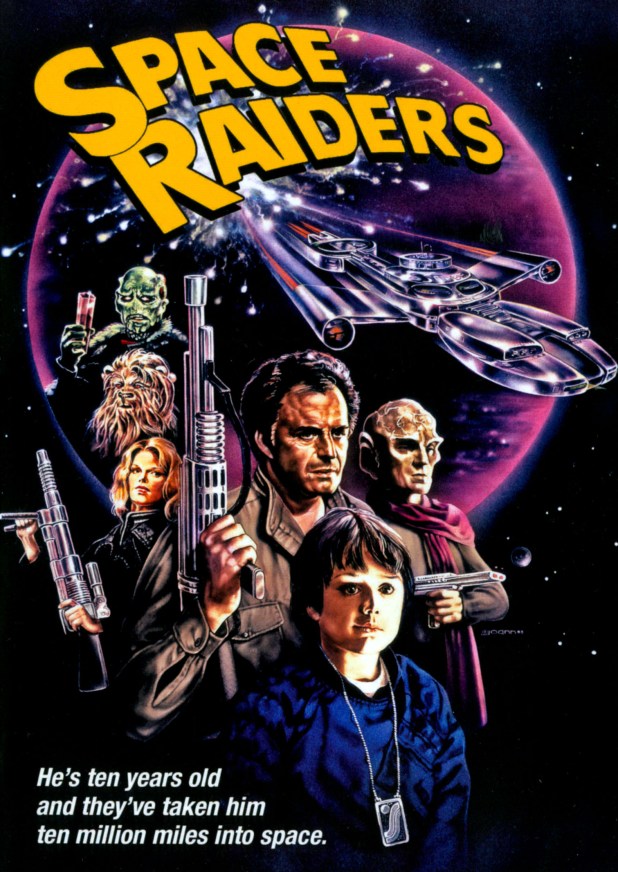
Star Wars Droppings: Space Raiders (1983)

Space Raiders AKA Star Child was directed by Howard R. Cohen (Saturday the 14thSaturday the 14th Strikes Back and the scripts for Unholy RollersDeathstalkerStrykerBarbarian Queen and The Young Nurses) and produced by Roger Corman as part of his new Millennium’s films, where he also produced Love Letters, Screwballs, and Suburbia.

If you think you’ve seen the spaceships and special effects and heard the James Horner music before, it’s all taken from two other Corman films: Battle Beyond the Stars and Humanoids from the Deep

Captain C.F. “Hawk” Hawkens (Vince Edwards, TV’s Ben Casey) is a space pirate who was once in the Space Service, hired to steal a freighter from The Company. A ten-year-old boy named Peter (David Mendenhall, Over the Top) — annoying us in a Battlestar Galactica Boxey sort of way — stows away with the pirates and goes on adventures with them.

Luca Bercovici, the director of Rockula and Ghoulies, appears in this film as Ace. Dick Miller shows up and that’s always a welcome thing. And hey that’s William Boyett — Sergeant William MacDonald from Adam-12.

Not content to rip off only Star Wars, the end of this movie 100% comes from Shane. So there’s that. I’ve never understood why people loved putting annoying kids into science fiction films (“Boxey Syndrome”) in the hopes that kids would find someone to identify with, when all we wanted was to be the adults. Oh well. But at least we got the chance to speak Howard R. Cohen’s and Sylvester Stallone’s names in the same sentence.

You can watch this for free on Amazon Prime.

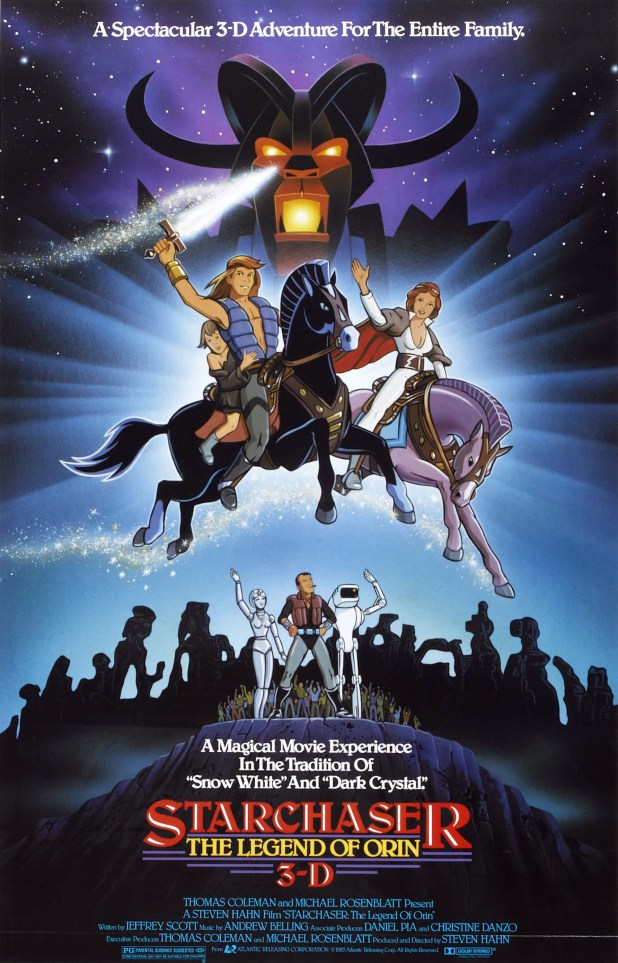
Star Wars Droppings: Starchaser: The Legend of Orin (1985)

Starchaser: The Legend of Orin was one of the first animated movies to mix traditional and computer animation, as well as one of the first to be released in 3D (although the Australian comedy Abra Cadabra was released first). The New York Times referred to this movie as “such a brazen rip-off of George Lucas’s Star Wars that you might think lawyers would have been called in.”

On the planet Trinia, human slaves have lived underground for thousands of years mining crystals for the god Zygon and his robot soldiers, who in no way are Cylons. Orin, our hero, finds the hilt of a jeweled sword in the rocks, telling him that there is a universe beyond these mines that he must discover.

This leads to adventures through the mines and to the surface of the planet, where Man-Droids attack and the hilt reveals an invisible sword before Dagg Dibrimi — who is basically the Han Solo of this piece — saves our hero.

Thus follows all manner of adventures where Orin boards the Starchaser, the ship of Dagg, and saves his people from the mines and uses his new mystical powers to heal blind people before the spirits inside the sword tell him that he can join them — if he wants — in something in no way related to the Force.

Anthony De Longis (Zygon) would later appear in Masters of the Universe as Blade, Skeletor’s henchman.

The Force in this film is called Kha-Khan, which is actually the name given to a high-honored member of the Church of Scientology, or roughly the equivalent of a saint in the Catholic Church. I’m not certain if this was a sneaky way to get people into being clear or not.

Director Steven Hahn would go on to direct the cartoons for the Dino-Riders toys and writer Jeffrey Scott would write for all manner of animated series like Mega ManTeenage Mutant Ninja TurtlesDuck TalesHulk Hogan’s Rock ‘n’ Wrestling and the TV special Christmas Comes to PacLand.

In 2012, it was announced that Rilean Pictures had acquired the rights to develop this movie into a live-action film. No further news has happened since then.

Exploring: ’80s Comedies

ABOUT THE AUTHOR: Robert Freese has been a staff writer for Videoscope Magazine since 1998. He also contributes to Drive-in Asylum

Film scholars are forever writing about the 1980’s horror movie scene. I won’t lie. It was an awesome time. But it was an awesome time for all kinds of movies.

A little exploration quickly proves that the ‘80s were a banner decade for comedy movies as well, of all types. Comedies of the era moved in the same exact trajectory the horror movies were following, building on past successful films and constantly pushing the envelope of what had been done further. (Many of the people who made these comedies, both in front of and behind the camera, worked concurrently in the horror genre throughout the decade as well. The high school screamers in the slasher movies were the same party-hearty kids in the comedies.)

What I’ve tried to do is nail down these movies into a specific comedy subgenre and show where they may have originated. (One box office blockbuster begets numerous, sometimes seemingly countless, imitators.) In trying to categorize these movies, I realized many combine various different comedy subgenre plot points simultaneously. There’s a thin line between a Teen Sex Comedy and a Snobs vs. Slobs Comedy, but within my attempt to define flicks, I placed them in the categories I felt they best fit. Any number of my selections can easily be questioned and rationalized for inclusion in a different category, I’m sure. My intent is to simply try and show the diversity of these comedy movies from my favorite decade showed.

I hope I get you curious enough about some of these movies and you seek them out. I believe all are available on some format of home video, analog or digital. 

80s

Snobs vs Slobs/ Loveable Losers/ Men Behaving Badly

Although a good number of 80’s comedies concern some clash with authority, the movies we’re talking about can be seen as “David and Goliath” tales. These movies have been around forever, but they were given a new life at the end of the ‘70s with the one-two punch success of National Lampoon’s Animal House (1978) and Meatballs (1979). These movies earned astronomical amounts of money back when movie tickets were about two dollars and fifty cents. National Lampoon genius and Animal House co-writer Doug Kenny barreled into the ‘80s with a film that is possibly one of the most quoted movies of all time, the ultimate Snobs vs Slobs movie, Caddyshack (1980). As the decade moved forward, plenty of slackers and losers raged against the establishment in films like Mad Magazine’s Up the Academy (1980), Stripes (1981), the video game-inspired Joy Sticks (1983) and D.C. Cab (1983). When 1984 rolled around, there was a renaissance of sorts of lovable losers bucking authority. Early in the year Warner Brothers had a surprise hit with Police Academy (1984), which provided the new template for what misfits could do when they put their super powers together. Later that summer, 20th Century Fox released Tom Hanks’ finest film to date,  the ultimate lovable losers/men behaving badly movie, Bachelor Party (1984). For as big a success as it was, they outdid it with their next comedy hit, Revenge of the Nerds (1984) the same summer. 1984 was the year for misfits, geeks and dweebs. This subgenre also includes any film wherein the misfit heroes have to deal with insurmountable circumstances to win at some contest against the crooked authority figures, such as Savage Steve Holland’s hilarious One Crazy Summer (1986), which ends with one such boat race where our heroes try to save grandma’s house from evil and corrupt land developers.

Caddyshack (1980)/ Gas (1981)/ Lunch Wagon (1981)/ Stripes (1981)/ The Beach Girls (1982)/ Splitz (1982)/ D. C. Cab (1983)/ Easy Money (1983)/ Get Crazy (1983)/ Joy Sticks (1983)/Bachelor Party (1984)/ Hot Dog…The Movie (1984)/ Oddballs (1984)/ Police Academy (1984)/ Revenge of the Nerds (1984)/ Snowballin’ (1984)/ Up the Creek (1984)/Weekend Pass (1984)/Beer (1985)/ Moving Violations (1985)/ My Chauffeur (1984)/ Real Genius (1985)/ Stitches (1985)/ Tomboy (1985)/ Back to School (1986)/ Hamburger the Motion Picture (1986)/ Happy Hour (1986)/ Jocks (1986)/ One Crazy Summer (1986)/ Playing for Keeps (1986)/ Recruits (1986)/ Wimps (1986)/ Party Camp (1987)/ Summer School (1987)/ How I Got into College (1989)/ Weekend at Bernie’s (1989) 

Sex Comedies/ Teen Sex Comedies

After the Snobs vs Slobs subgenre, the next popular and most common comedy subgenre of the ‘80s is the Sex Comedies/Teen Sex Comedies, or what I’ve always referred to as the “Everybody gets laid” movies. Sex comedies have been around as long as cinema itself but by the ‘70s, sex in cinema experienced new-found freedoms with skin on screen. By the ‘80s, these movies had figured out their money-making formula. The Teen Sex Comedies’ popularity mirrors that of the other popular cinema craze that started in the early ‘80s, the slasher movie. Slasher movies were a horror off-shoot that usually revolved around teen sex and hijinks that ultimately resulted in death, usually in a glorious manner. The Teen Sex Comedies cut out the death and added more skin. With that in mind, Friday the 13th (1980) was to slasher movies what Porky’s (1981) was to Teen Sex Comedies. Bob Clark’s mix of raunchy humor and sweet nostalgia for growing up in Florida during the ‘50s was a runaway success. It was so popular they could not make a sequel fast enough so the following year they just re-released it. With Porky’s, the die was cast. Sex comedies were even cheaper to make than slashers movies, and as long as all the people in them were pretty to look at, they made money. The list of these titles seemed endless and their popularity seemed destined to last forever, but they eventually dried up, as late night pay cable channels started programming more raunchy shows to attract the same crowd. (Teen Sex Comedies experienced a major resurgence in 1999 with the release of American Pie and one or two still get made every now and again.) These movies also often work as wish-fulfillment or fantasy tales, at times dealing with secret potions, supernatural themes or, literally, deals with the devil. Movies appearing on this list use these plot points as a way to engage in sex with the opposite sex. 

Pick Up Summer (1980)/ Goin’ All the Way (1981)/ Porky’s (1981)/ Private Lessons (1981)/ Waitress! (1981) Fast Times at Ridgemont High (1982)/ The Last American Virgin (1982)/ Let’s Do It! (1982)/ Pink Motel (1982)/ Zapped (1982)/ Class (1983)/ The First Turn-On! (1983)/ Losing It (1983)/ My Tutor (1983)/ Porky’s II: The Next Day (1983)/ Private School (1983)/ Screwballs (1983)/ Spring Break (1983)/ Blame it on Rio (1984)/ Delta Pi /Mugsy’s Girls (1984)/ Hardbodies (1984)/ Hollywood Hot Tubs (1984)/ Joy of Sex (1984)/ The Party Animal (1984)/ Preppies (1984)/ The Rosebud Beach Hotel (1984)/ Where the Boys Are ’84 (1984)/ Cave Girl (1985)/ The First Turn On (1985)/ Fraternity Vacation (1985)/ Hot Chili (1985)/ Hot Resort (1985)/ Loose Screws (1985)/ Mischief (1985)/ Paradise Motel (1985)/ School Spirit (1985)/ Screen Test (1985)/  Takin it Off (1985)/ The Malibu Bikini Shop (1986)/ Separate Vacations (1986)/ Sex Appeal (1986)/ Stewardess School (1986)/ Beach Fever (1987)/ Party Favors (1987)/ Takin’ It All Off (1987)/ Beach Balls (1988)/ Fast Food (1989)/ Summer Jobs (1989) 

The Parody/ Spoof/ Send-up/ Take-off

These movies live or die based on an audiences’ familiarity with whatever subject is being roasted. They can be an acquired taste, since the broad, rapid fire delivery of nonstop sight gags and nonsense jokes are not everybody’s cup of laughs. The team of Jim Abraham and David and Jerry Zucker skewered the popular 70’s trend of disaster movies in general and the 1957 food-poisoning-on-an-airplane thriller Zero Hour! specifically with their smash hit Airplane! (1980). This joke-a-second spoof proved fertile ground for low brow hijinks and opened the flood gates for parodies that are still being made today. The ZAZ team returned with the spy movie/beach movie/Elvis movie send-up Top Secret (1984) and then The Naked Gun (1988), which was the big screen adaptation of their short lived television show Police Squad! (1982). All manner of movie genres were spoofed over the decade, but the one genre that really took to the parody/spoof format was the horror genre, creating an almost sub-category of spoof slasher and horror parodies. Horror spoofs flooded screens big and small throughout the decade and included Student Bodies (1981), Jekyll & Hyde…Together Again (1982), Wacko (1983), Transylvania 6-5000 (1985), Hollywood Chainsaw Hookers (1988) and Lobster Man from Mars (1988), to name a few. This subgenre of horror parody/spoof got a second life in the early 2000’s. Many of the parody-spoofs had an appearance by Leslie Nielson, who re-created himself with his deadpan, stoic performance in Airplane! His career got a second life in comedy, after many decades of playing heavies and bad guys. It is interesting to note that the spoof premise also helped morph into what today is referred to as the “mockumentary,” the spoof documentary. The fascinating This is Spinal Tap (1984) is still the best and every mockumentary since owes its existence to this one film. 

Airplane! (1980)/ Dr. Heckyl and Mr. Hype (1980)/ Full Moon High (1981)/Saturday the 14th (1981)/Student Bodies (1981)/Airplane II: The Sequel (1982)/ Young Doctors in Love (1982)/ Hysterical (1983)/ Jekyll & Hyde…Together Again (1982)/ National Lampoon’s Class Reunion (1982)/ Wacko (1983)/ Bloodbath in the House of Death (1984)/ Johnny Dangerously (1984)/ This is Spinal Tap (1984)/ Top Secret (1984)/ Rustlers’ Rhapsody (1985)/ Transylvania 6-5000 (1985)/ When Nature Calls (1985)/ Back to the Beach (1987)/ Spaceballs (1987)/  Elvira- Mistress of the Dark (1988)/ Hollywood Chainsaw Hookers (1988)/ I’m Gonna Git You Sucka (1988)/ Return of the Killer Tomatoes (1988)/ Lobster Man from Mars (1989)/ Transylvania Twist (1989)

The Hustle/ The Con/ The Fake I.D.

The premise for The Hustle/Con comedies usually concerns a fast-thinking protagonist in some dire situation who needs to be someone else to get out of said situation. Movies of this nature have been around for decades, most centering on con men types trying to take advantage of some poor mark or an ill-begotten fortuitous situation. Sometimes it is a situation of mistaken identity or someone taking on a number of personas to get out of comedic situations. After the dawn of Saturday Night Live and that first batch of Not Ready for Prime Time Players trickled into Hollywood, The Hustle/Con type comedies were recharged and redefined. First up to bat from SNL was Dan Aykroyd in Doctor Detroit (1983), the quintessential Hustle/Con comedy. By day Dan plays an uptight college professor but at night transforms into a crazy haired, metal gloved pimp to keep four pimpless hookers safe from harm. During the movie’s finale he has two simultaneous engagements at a swanky hotel where he must divide his time between a formal dinner for the college and the annual Player’s Ball, respectively. It’s madcap comedy of the highest degree. Later in ’83 Aykroyd returned for a different kind of con, swapping lives with a street smart Eddie Murphy in Trading Places (1983). Murphy went on to perfect the Fake I.D. comedy schtick in Beverly Hills Cop (1984), wherein he plays fast-talking Axel Foley, a Detroit cop who uses his wits, and oft times transforms into different characters to collect information, to solve the murder of his friend. Chevy Chase played a similar type private eye in Fletch (1985), depending on costumes and disguises to collect the clues he needed to solve cases. SCTV alumni John Candy and Eugene Levy played security guards that did a little dress up in Armed and Dangerous (1986). There is plenty deception in high school  and one of the best of the high school set Hustle/Con movies ever made is 1987’s Can’t Buy Me Love. Unpopular Ronald Miller (played by Patrick Dempsey) gets popular girl Cindy Mancini (played by Amanda Peterson) out of trouble in exchange for her pretending to like him so he can move up the social ladder of high school, dump his nerd friends and infiltrate the circle of popular kids. It works amazingly well until it all comes crashing down around him. After that, the student body questions the motives of everyone, and if anyone seems to be trying to take advantage of someone else, they accuse them of trying to play another “Ronnie Miller Scam.” I know many who still use this phrase today. “Man! The two for one cans of corn are sold out, and now I have to buy the expensive canned corn! This is a Ronnie Miller Scam!” 

Night Shift (1982)/ Tootsie (1982)/ Doctor Detroit (1983)/ Trading Places (1983)/ Beverly Hills Cop (1984)/ Making the Grade (1984)/ Oh, God! You Devil (1984)/ Fletch (1985)/ Just One of the Guys (1985)/ Volunteers (1985)/ Armed and Dangerous (1986)/ Three Amigos! (1986)/ Can’t Buy Me Love (1987)/ Hiding Out (1987)/ The Secret of My Success (1987)/ Dirty Rotten Scoundrels (1988)/ Tapeheads (1988)

Wish Fulfillment/ Fantasy/ Time Travel/ Body Swap

The premise for these comedies revolves around, usually, the granting of a wish, the using of a potion, the gaining of some extra sensory power, two people swapping bodies or sharing one body or personality or a straight up time jump from one place in time to the other. Wish Fulfillment comedies straddle the fence, as it can be similar to the Snobs vs Slobs and Sex Comedies. Many of the Wish Fulfillment movies are very blue collar based, with regular people like you and me getting a moment to shine, or just following through with some crazy plan to get on top. Three housewives strike back at the system with an elaborate plan to heist money from a giveaway at the mall in How to Beat the High Cost of Living (1980). A newly appointed executive bucks the system when he has to go back to his hometown to shut down the local brewery in Take This Job and Shove It (1981). Steve Martin and Lily Tomlin share the same body in the still pretty funny All of Me (1984). 1985 was a huge year for Michael J. Fox. First he traveled back to the fifties to change his family’s future and make sure his parents smooched at the big “Enchantment Under the Sea” dance in Back to the Future, and then he transformed into a better basketballer through lycanthropy in Teen Wolf. 50’s greaser Lewis Smith died in a chicken run then spent some time in purgatory before being sent back to earth to redeem himself and help a nerd kid be cool in the delightful The Heavenly Kid (1985). Robin Williams gets a do-over for losing the big high school game years later in The Best of Times (1986). Finally, Andrew McCarthy finds love when a department story dummy comes to magical life in Mannequin (1987), a film whose premise was well mined decades earlier as plenty of horny department store mannequins came to life during the era of the Nudie Cuties. 

How to Beat the High Cost of Living (1980)/ Take This Job and Shove It (1981)/ All of Me (1984)/ Back to the Future (1985)/ The Heavenly Kid (1985)/ Teen Wolf (1985)/ Weird Science (1985)/ The Best of Times (1986)/ Peggy Sue Got Married (1986)/ Hello Again! (1987)/ Hunk (1987)/ Like Father, Like Son (1987)/ Mannequin (1987)/ 18 Again! (1988)/ Heathers (1988)/ Vice Versa (1988)/ Back to the Future Part II (1989)

Screwball Comedies 

Screwball Comedies came about in the early 30’s and were a mainstay of popular cinema through the 40’s. Most subscribed to the “Comedy of Errors” plot, where stories revolved around characters in love and they face a number of crazy, calculated misinterpretations and misunderstandings. By the ‘70s, the Three’s Company sitcom pretty much mined this premise each week for all it was worth. The ‘80s were full of these types of comedies and an army of loveable scamps faced these “love and bad luck” challenges. 1985 was a big year for screwball comedies. Secret Admirer’s thin premise hinged on a love letter that made it into the hands of all the wrong people and shenanigans ensued. Summer Rental saw John Candy trying to get away from the rigors of daily life and nearly losing his mind during his beach vacation with his family. John Cusack is a loveable ne’er do well who decides to snuff himself after his girlfriend breaks up with him in Better Off Dead. 1986’s The Money Pit tests the relationship of Tom Hanks and Shelly Long while they renovate their dream house from Hell, and Charles Grodin takes his family on a cut-rate island getaway in the “kind-of-funny-if-you-like-Charles-Grodin” Last Resort. 

Hardly Working (1980)/ The Nude Bomb (1980)/ Arthur (1981)/ Modern Problems (1981)/ Better Off Dead (1985)/ Brewster’s Millions (1985)/ Clue (1985)/ Secret Admirer (1985)/ Summer Rental (1985)/ The Boss’s Wife (1986)/ Last Resort (1986)/ The Money Pit (1986)/ The Great Outdoors (1988)/ Screwball Hotel (1988)/ The Wrong Guys (1988)

Comedic (Mis) Adventures

Comedic (Mis) Adventure movies usually begin at Point A, and then are all over the map trying to get to Point B. Some never get to Point B, skipping it entirely and landing on Point Q. These movies are shenanigan and hijinks driven and usually build to loud, obnoxious finales. One of the best is still the often-quoted classic The Blues Brothers (1980), which ends in an earthshattering finale that has nearly every law enforcement agency in Illinois, as well as a group of irate Illinois Nazis, converging on the State Tax Accessors Office in Chicago trying to nab Jake and Elwood Blues (played by John Belushi and Dan Aykroyd). In 1983, the National Lampoon brand got a much needed boost with their road comedy National Lampoon’s Vacation. SCTV characters Bob and Doug McKenzie (played by Rick Moranis and Dave Thomas) went on a journey of deception, adventure and tainted beer in The Adventures of Bob & Doug McKenzie: Strange Brew (1983). The Comedic (Mis)Adventure movies have mashed with other genres  many times, delivering such diversity as They Call Me Bruce (1982- Kung-Fu), Yellowbeard (1983- Pirates) and Ice Pirates (1984- science fiction).

The Blues Brothers (1980)/ Galaxina (1980)/ Smokey and the Bandit II (1980)/ Bustin’ Loose (1981)/ Cannonball Run (1981)/ Condorman (1981)/ They Call Me Bruce (1982)/ Tag: The Assassination Game (1982)/ Strange Brew (1983)/ Yellowbeard (1983)/ Vacation (1983)/ Ice Pirates (1984)/ The Lost Empire (1984)/ Gotcha (1985)/ Into the Night (1985)/ Lost in America (1985)/ My Science Project (1985)/ Pee-Wee’s Big Adventure (1985)/ Spies Like Us (1985)/ After Hours (1986)/ Free Ride (1986)/ Adventures in Babysitting (1987)/ Hot Pursuit (1987)/ Innerspace (1987)/ Raising Arizona (1987)/ Terminal Exposure (1987)/ Three For the Road (1987)/ Midnight Run (1988)/ The Night Before (1988)

Sketch, Skits & Anthologies

Comedy based skit anthology movies thrived throughout the ‘70s. Movies like The Groove Tube (1975) and Kentucky Fried Movie (1977) delighted audiences on scattershot plotlines made for little money. Also, sketch/skit comedy shows were prominent on television with programs like Rowan and Martin’s Laugh-in (1968-1973), The Carol Burnett Show (1967-1978), The Muppet Show (1976-1981), as well as SCTV (1976-1984) and Saturday Night Live (1975-2019). By the ‘80s, the reliable format seemed to have run out of steam. The first big movie made with the skit comedy structure was a studio picture made for enough money to finance 50 Groove Tube sequels, Mel Brooks’ History of the World Part I (1981). It was one nonstop madcap comedic vignette after another. (“Hitler on Ice” is still a highlight.) In 1981, National Lampoon’s Movie Madness spoofed self-help films, soap operas and police procedural shows. It was touted as “National Lampoon’s first film since Animal House!” It sat on the shelf for a year before finally seeing release in 1982 and failing miserably at the box office. 1983’s Flicks wasn’t released until 1987. It is a comedic homage to the Saturday matinees of yesteryear. It hasn’t been seen since its release on VHS over thirty years ago. The format got a major re-fresh, especially if you were looking for some raunchy laughs similar to the films from the ‘70s with 1987’s Amazon Women on the Moon. The decade ended with another winner that has attained major cult status over the years, “Weird Al” Yankovic’s insane UHF (1989), a gag-a-second send-up of the public access UHF days of the boob tube. (Three decades later and I still run across people who quote from the “Conan the Librarian” and “Spatula City” skits.) I think it is worth noting that a small bit of Sketch/Skit DNA be credited to the current “Mocumentary” films, which are direct descendants of the Parody Spoof Comedies. The structure of many “Mocumentary” films follow a similar Sketch/Skit format, with a number of interwoven vignettes, all on the same subject, telling one story rather than various.

Mel Brooks’ History of the World Part I (1981)/ National Lampoon’s Movie Madness (1981)/ It Came From Hollywood (1982)/ Flicks (1983)/ Monty Python’s The Meaning of Life (1983)/ Amazon Women from the Moon (1987)/ UHF (1989)

Horror Comedies/ Gore Comedies/ Yech! for Yuks!

Not to be confused with the Horror Parody/Spoof movies, Horror Comedies are movies that play their scares for chuckles instead of screams and land more sure footedly in the horror genre rather than comedy. In the beginning of the decade, the Horror Comedy actually did a good job juggling honest scares with honest laughs with such films as An American Werewolf in London (1981), The Howling (1981) and The Return of the Living Dead (1985). By decade’s end, the monsters were pretty much the butt of the joke in Return of the Living Dead Part II (1987) and CHUD II: Bud the CHUD (1988). The Horror Comedies have always been hit or miss depending on your sense of humor, but every now and again a pretty good one comes along like I Was A Teenage Zombie (1987) or Lucky Stiff (1989- a cannibal comedy directed by Anthony Perkins). Also, in the mid-80’s, Gore Comedies were big. In the spirit of the early gore movies by Herschell Gordon Lewis, The Toxic Avenger (1984), Blood Diner (1987) and movies of their ilk offered over the top gore gross-outs for laughs.

An American Werewolf in London (1981)/ Slumber Party Massacre (1982)/ Microwave Massacre (1983)/ Ghoulies (1984)/ Gremlins (1984)/ The Toxic Avenger (1984)/ Return of the Living Dead (1985)/ Re-Animator (1985)/ The Stuff (1985)/ Class of Nuke ‘em High (1986)/ Evil Laugh (1986)/ House (1986)/ Psychos in Love (1986)/  Terror Vision (1986)/ Troll (1986)/ The Texas Chainsaw Massacre Part 2 (1986)/ Vamp (1986)/ Bad Taste (1987)/ Blood Diner (1987)/ Doom Asylum (1987)/ I Was A Teenage Zombie (1987)/ Return of the Living Dead Part 2 (1987)/ Street Trash (1987)/ CHUD II: Bud the CHUD (1988)/ Dead Heat (1988)/ Scared Stiff (1988)/ Vampire’s Kiss (1988)/ Blood Salvage (1989)/ Cutting Class (1989)/ Lucky Stiff (1989)/ Parents (1989)

Bizzaro/ Cult/ Weird

Bizzaro Comedies tend to be head scratchers. Some of them see it as their mission to offend everyone watching while others you watch and watch and by movie’s end you have no idea what you just saw.  Many are experimental, made to challenge an audience. Most work best as a midnight movie experience; with a rambunctious audience where the on screen weirdness works more on the collective audience as opposed to trying to watch it alone on the couch. Richard Elfman’s Forbidden Zone (1980) is a perfect example of this comedy subgenre, as well as just about anything made by John Waters. (Back during the video store days, Waters’ films were almost always found in the Comedy section of the shop, but many rental outlets eventually created a Cult Movie section because of Waters’ and similar movies.)  Al Adamson’s family film Carnival Magic (1982) probably wouldn’t be included here if the chimpanzee in the film didn’t start talking for no good reason. (Seriously!) Dan Aykroyd and John Belushi played against type for the upside-down tale of suburban torture Neighbors (1981). I don’t even know how to describe Going Berserk (1983), a very strange film featuring John Candy and Eugene Levy doing very strange things. Paranoia in the suburbs makes everyone in a cul-de-sac lose their minds in the trippy, sometimes nightmarish The ‘Burbs (1989). Finally, for a bit of meta-weirdness, Penn & Teller Get Killed (1989) feature the shock magicians as themselves, appearing on a late night talk show and wishing out loud that it would be fun if someone was trying to kill them. This premise plays out as a psycho fan takes their request to heart and stalks them. It’s got lots of weird twists and turns, but it is exactly what you’d expect from P&T.

Forbidden Zone (1980)/ Neighbors (1981)/ Polyester (1981)/ Carnival Magic (1982)/ Eating Raoul (1982)/ Going Berserk (1983)/ Nothing Lasts Forever (1984)/ Repo Man (1984)/ Surf II (1984)/ The ‘Burbs (1989)/ Penn & Teller Get Killed (1989)

Brave New World (1980): NBC-TV’s other “Star Wars”

This is a big week for Star Wars fans, courtesy of the nationwide premiere of Star Wars: Episode IX – The Rise of Skywalker and with Alden Ehrenreich from Solo: A Star Wars Story cast in the lead as John the Savage in Universal Studios’ third adaptation of Aldous Huxley’s 1932 dystopian novel.

Watch the trailer.

Set to premiere in 2020, the Universal co-production with Steven Spielberg’s Amblin Television, unlike Universal’s first two TV movie productions, is being produced as a weekly series. Initially developed for NBC-TV’s SyFy Channel imprint in 2015, the production moved to NBC’s USA Network division. As of September 2019, the currently in-production series is slated to air on the conglomerate’s recently launched online streaming service, Peacock.

Their second, previous version released in 1998 as an 87-minute telefilm starring Peter Gallagher (While You Were Sleeping, NBC-TV’s Law and Order: SVU) and Leonard Nimoy (Star Trek, Baffled!) was derided by critics and sci-fi fans as being “bland” and “boring” and inferior to the 1980 version. The poor reviews are attributed to its script being a greatly abridged version that was “loosely based” on Huxley’s concepts and not a straight adaptation of the novel. (In another Star Wars twist: the 1998 version also starred mainstay U.S Television actor Kristoffer Tabori as John the Savage, who later provided voice work on several Star Wars video games. Under his directorial name, K. T. Donaldson, Tabori helmed the SyFy Channel’s “mockbuster” of Cowboys vs. Aliens: 2009’s High Plains Invaders.)

In the wake of the Star Wars-inspired sci-fi revival sweeping the film and television industries, NBC-TV took another swing of the light saber with their first version of Huxley’s novel that aired on March 7, 1980—a mere three months after their British-produced adaptation of Ray Bradbury’s The Martian Chronicles aired in January.

Keep in mind that Universal—the studio that brought you ABC-TV’s Battlestar Galactica and NBC-TV’s Buck Rogers in the 25th Century—backed this adaptation, so don’t expect a big-budget Blade Runner (1982) dystopia. While BNW ‘80 captures the spirit of Huxley’s novel and maintains its dark, pessimistic tone, and runs long enough to go deeply into the book’s themes, plot and dialog (unlike BNW ’98), it’s undone by its low-budgeted sets and costumes. Thus, you feel like you’re watching a two-part episode of arc of NBC-TV’s cartoonish Buck Rogers in the 25th Century—the same problem that plagued The Martian Chronicles.

Since this was a TV project, NBC stuck with what they knew and hired Pittsburgh-born actor Burt Brinckerhoff, better known for his extensive TV directing resume, which included multiple Emmy Awards for the 1977 to 1982 dramatic series, Lou Grant. The scribe hired to wrangle Huxley’s 300 page-plus sociopolitical lesson into a three-hour film was Doran William Cannon, who penned the original scripts for the the “so bad it’s good” psychedelic all-star comedy Skidoo (1968) and the equally experimental oddball, Brewster McCloud (1970).

Set 600 years in the future, Keir Dullea (2001: A Space Odyssey and the early-‘70s Canadian TV series, and eventual film series, The Starlost) heads the cast as Thomas Grahmbell, the “Director of Hatcheries” who genetically engineers civilians for a well-ordered society. To assure everyone maintains the status quo, citizens are required to ingest mood-controlling drugs, have “sex without love,” and real-life pregnancies are banned. The dissidents to this humanless new order are the free-thinking poet Heimholtz Watson (Dick Anthony Williams; the Blaxploitation classics The Mack and Slaughter’s Big Rip-Off), the bookish oddball Bernard Marx (Bud Cort from Brewster McCloud and the equally quirky favorite, 1970’s Harold and Maude), an old-world “primitive” John the Savage (Kristoffer Tabori), and Linda Lysenko (Julie Cobb; Star Trek: TOS “By Any Other Name” and TV’s Charles In Charge)—who becomes a criminal of the state for having a natural child birth. 

Originally intended to air as a two-part, four hour mini-series (including commercials), at the last minute NBC ordered a series of cuts to pare down the film into a one night, three-hour movie, which means a half-hour of continuity-losing logic was excised from the film. However, when it premiered in the U.K on the BBC later that year, it ran in its original, full-length two-part format. So keep those two versions in mind if you decide to purchase a copy for your home library (you’ll want the BBC version). And caveat emptor those grey-market DVD-Rs with laser-printed covers flooding the online marketplace.

So, are the critics and fans right? Is Brave New World ’98 inferior to the 1980 version? You can watch the full NBC-TV 1980 version on You Tube and let us know what you think here on the site or over on our Facebook page.

And save us the aisle seat on Friday. May the Force be with you!

Star Wars: Episode IX – The Rise of Skywalker will be released theatrically on December 20 in the United States.

About the Author: You can read the music and film reviews of R.D Francis on Medium and learn more about his work on Facebook. He also writes for B&S Movies.

Star Wars: The Rise of Skywalker (2019)

Three movies into the final part of what is being called the Skywalker Saga and I have to confess: worse than not knowing anything about these new characters — Poe Dameron, Finn and Rey — I honestly don’t care about them. They’re ciphers that we only know the barest of things about. Why does Finn have such an affinity for his friends? Why should we care a lick about Poe when he’s proven to be too headstrong and willing to leave people behind, yet has nothing redeeming to make up for it? And Rey has every single skill of the Jedi near-instantly, almost a way too perfect character to be true.

Don’t tell me I have to read the other books or watch the shows or do my research. Don’t tell me that the old films in the Star Wars saga didn’t come out as often or perhaps we cared too much about them. I sat — well, slept, I’ll be perfectly honest — through this too loud and too much installment and I have to tell you my most honest review: Yeah, alright.

I don’t go to blockbusters to walk away saying, “Yeah, alright.”

Obviously, everything after this will contain massive spoilers. You have been warned.

The first critical error the film makes is by telling us that a secret message has caused a stir in the galaxy: the Emperor is alive. You know, instead of a scroll, perhaps this event — probably the most important thing that’s happened in all three of these post Return of the Jedi films, could have been shown to us so we could grasp just how mindblowing it is. Nope. It’s in words on the screen. The dead speak! This is lazy filmmaking.

Kylo Ren (Adam Driver, who isn’t howling in a bar or eating ass in this one) obtains a Sith Wayfinder device and travels to the planet Exegol, where the Emperor is recharging. It turns out that everything evil in the past few films has come from Palpatine, including Snoke who is just a clone. Snoke is the most infuriating character in these films, another character who really has no motivation and no reason to exist other than being yet another Star Wars villain set up to be an undefeatable villain only to, you know, by cut in half. See: Darth Maul, General Grievous, Count Dooku.

So the Emperor does what has never been done before. He just plain conjures up a million or so Star Destroyers on a planet that has constant darkness and lightning. He tells Kylo to find Rey, who is studying to be a Jedi with General Leia Organa Solo (Carrie Fisher), who is more Force-sensitive than a Jedi, you know, until this movie, which has a CGI cut scene that looks like, well, a video game cut scene that shows her training with Luke and realizing that she’s going to die and not complete her journey but someone else will. Because man, Star Wars is kind of like Catholicism for people who’d rather have Carlos Casteneda instead of John the Baptist.

There’s also a spy in the First Order, a subplot that changes nothing in the film other than to remind you that General Hux and Ben Solo probably had a tempestuous affair at one point and there’s a thin line between love and hate.

Rey, Poe, Finn, Chewbacca, BB-8 and C-3PO head out for Passanna to meet Lando Calrissian while R2-D2 stays with Leia in a military base. Soon, Kylo Ben Solo and the Knights of Ren show up just as Rey discovers a Sith dagger than C-3PO’s programming forbids him to read. Why? Is it because he was built by Anakin Skywalker? Nah — it’s just another dangling “We’re going to kill off another beloved character” tease and even when they wipe out the golden droid’s memory, it comes back so quickly and easily, you wonder why they even teased this moment of sadness.

I also have no idea why the Knights of Ren are important other than they will make cool looking toys and fat dudes will dress like them and bump into me at conventions.

Speaking of teasing the death of a major character — Rey uses Force Lightning to accidentally kill Chewbacca, who died way back in the book Vector Prime before the books were no longer part of the real Universe. But yeah, Chewbacca survives anyway. Seriously, they should have called this movie Star Wars: Let’s Fuck with Chewbacca. The dude gets tortured, stripped, Rey uses his gun, one of his best friends dies and oh yeah, he had to be in this movie.

Zorii Bliss (Keri Russell, who did Felicity with J.J. Abrams) is in this too. She’s a masked smuggler who had something of a relationship at one point with Poe but they never kissed, which is pretty much par for Star Wars romance. She is not Zam Wesell, so don’t get that confused. Honestly, her scene about wanting to leave behind the planet Kijimi is about as emotionally resonant as this movie gets.

Turns out that Chewbacca is still alive, so there’s a failed rescue mission on a Star Destroyer that leads to a nice scene where Rey and Kylo have a lightsaber battle between their two worlds. That’s when we learn that Rey is Palpatine’s granddaughter, who tried to King Herrod her as a child, as he feared her power.

So hey, why don’t we go back to Endor. Do we have to? Yes, we do. That’s where we meet a whole bunch of other Stormtroopers who got tired of missing every shot and took off their suits and became dudes who ride yaks. Their leader, Jannah, is not Enfys Nest from Solo: A Star Wars Story, despite similar animal mounts and markings. She and Finn quickly become friends but there’s not even a hint of romance.

Also: remember when Rose Tico was such a big deal in the last movie? Yeah, neither do the filmmakers.

There’s a cool scene where the second Death Star is in the giant black waves of Endor and Kylo and Rey have another lightsaber battle. Remember when lightsaber battles were rad and you couldn’t wait for them, way back before Yoda zipped all around doing backflips and suddenly, you wondered how and why lightsabers could be boring? Yeah.

Man, anyways, Leia dies reaching out through the Force to her son, who gets impaled by Rey but then healed by her before she runs to the Emperor’s world to kill the old man, because you know, that’s what he wants. He came back from the dead so the child he sent away because he feared she would kill him can kill him. Motivations are super important in Star Wars.

Nearly everyone who Hasbro will sell to idiots like me dies. Star Wars has a fetish for hands getting chopped off, British accents, wipe transitions and killing off fat spaceship pilots.

Luckily, Rey and Kylo fight back, but then we learn another motivation for the Emperor: he wanted to leech their youth and become strong again. So, if Rey had just killed him, did this second plan even matter? Well, he’s every Sith and Rey ends up being every Jedi and they battle and she ends up killing him. However, because she turns his Force lightning against him, she isn’t killing him like he wanted and this killing is OK because Star Wars.

We end up back on Tatooine where Rey goes to hide the last two lightsabers and claim the name of Skywalker. Then we see Leia looking like the Virgin Mary and Luke looking like some dude who’d go to a comic convention to meet Mark Hamill as ghosts.

Question: Remember when it was a big deal that Qui-Gon Jinn didn’t turn into a Force spirit and disappear and we were gonna get answers on that one? Yeah. Well, both Leia — not a Jedi — and Kylo Ben Solo disappear when they die. Of course, he kisses Rey first. And his dad shows up and calls back the “I know” line because this movie is fan service from frame one, bringing back holo chess when it’s not sledgehammering plot points and deus ex machine into your feeble brainstem.

This movie is a lot like sugary cereal. Sugary cereal is real good, except for how you feel sick after eating multiple bowls.

Also: I kind of hate that new green robot D-O who literally talks like a Donald Trump tweet, saying “Sad!” when a scene is upsetting. We get it. We know it’s sad. You don’t have to tell us.

The movie also feels like one that should pause and flash: CHECK THIS SHIT OUT! Like the tie-fighter parked next to an x-wing. We get it. We get the symbolism. Or when Wedge Antilles shows up, that kind of stuff is only for dudes like me that knew the names and call signs of every pilot. And yes, Wedge is Red Two. I was also a virgin until well into my twenties, thank you very much.

So what did I like about the movie? I dug those yak creatures that they rode on the deck of the Star Destroyers and yes, I know they’re called orbaks but I’m going to keep on calling them yaks. And I adored Lando basically picking up Jannah and saying, “Let’s find out where you’re from.” You know he’s making her crosseyed in the back of the Millennium Falcon right now while Nien Nunb wonders why there’s a sock on the door. I also liked the little dude named Babu Frik who wiped out C-3PO’s mind. And I kinda dug the kintsugi look of Kylo Ren’s new mask.

Yeah, it was also nice that we saw the first same sex kiss in Star Wars between Commander D’acy and an unnamed character that will surely get a name and a Hasbro San Diego Comic-Con two-pack release that will sell for many times the original price on eBay.

Look — I’m not going to tell you what to like and be a gatekeeper. Love what you love, enjoy what you enjoy and spend your money where you want. That said, I spent a good chunk of my life loving Star Wars and know more about Dengar than many of the extended family members. I know — and care — next to nothing about anything in this film. There are people who are going to go see it a few hundred times and get the sugar rush that this film is and love it because it’s Star Wars. Again, being a fan of the saga is a lot like being Catholic — you know the motions, you go through them but after a while, you question why you just don’t feel the same after Mass.

I certainly didn’t hate this movie. But I certainly didn’t like it. A movie that costs this much and has this much behind it should inspire more reaction than this. I want to feel something, I want my eyes to well up with emotion and I want to feel like I’ve witnessed modern mythology. Instead, I feel like I just sat in a chair for two and a half hours and watched some bad fan fiction come to life.

But hey — if you liked it, good for you. Maybe I’m the problem.

CREDIT WHERE IT’S DUE: Keri Russel was in JJ’s Felicity. Jennifer Garner was in JJ’s Alias. Jim Sloss, who loves both of these things and people, set me straight.

Star Wars Droppings: Hanger 18 (1980)

A long time ago, on a theatre screen far, far away . . . Sylvia and Gerry Anderson transitioned from children’s marionette-science fiction into adult live-action programming. . . .

If you’ve channel surfed across the retro-cable channels MeTV or Antenna TV (or the early days of the ‘80s cable “Superstations” TBS, WGN, and WOR) you’ve see the reruns of NBC-TV’s highly-rated, family-friendly nature drama The Life and Times of Grizzly Adams starring Dan Haggerty. The program was the first foray by the big screen documentarian purveyor, Sunn Classic Pictures, into the live-action world.

Watch the trailer.

Back in the days before the advent of the multi-channel universe created by cable television, our then “free TV” entertainment world consisted of the “big three networks” of ABC, NBC, and CBS—four if you count public television broadcaster PBS—and a smattering of local UHF channels. And there was only so much airtime on PBS and Saturday and Sunday morning commercial television for nature and documentary programming.

And that’s where Sunn Classic Pictures comes in.

Today’s retro-critics label the defunct studio as the producer of “awful, big screen documentaries.” However, back in the day, Sunn cleaned up at the box office with a series of G-rated nature documentaries and investigative conspiracy films, such as In Search of Noah’s Ark and The Lincoln Conspiracy, along with their big screen adaptations of the best-selling books by ancient astronaut and biblical theorists. If there was a corner of the Earth to be “investigated” and a “conspiracy” to be uncovered, Sunn Classic Pictures was on the case.

Then Sir Lew Grade’s ITC Productions, who backed Sylvia and Gerry Anderson’s kid-oriented forays into sci-fi with Thunderbirds, UFO, and Space: 1999, had a box office hit with what is now the gold standard of sci-fi conspiracy films: 1978’s Capricorn One. (And they had a huge flop with Saturn 3.)

. . . And without some guy named George Lucas and his kooky space opera homage to Flash Gordon, there’d be no Capricorn One.

. . . So with a bunch of conspiracy experience and one live-action TV series under their belt, Sunn decided to make the Kessel Run to Star Wars gold.

. . . To say Sunn Classic Pictures couldn’t make the jump to light speed is an understatement.

Robert Vaughn? You should know better. Yeah, you did okay with Roger Corman’s Battle Beyond the Stars, but didn’t you get sucked into the extraterrestrial boondoggle that was Starship Invasions (1977)? And Darren McGavin? Did you forget about Firebird 2015 AD? And Pamela Bellwood, Gary Collins, James Hampton, Steven Keats . . . Joseph Campanella? You’re all respected and dependable guest actors from all of our favorite TV series and TV movies of the ‘70s? What in the hell are you doing here?

While films such as Hanger 18 captivate old, VHS-era sci-fi ‘n’ horror dogs with youthful nostalgia, the new, youthful fans of the latest editions to the CGI-clogged Star Wars universe will see Hangar 18 for what it truly is: just another bad Star Wars (and Close Encounters of the Third Kind) knockoff that fails to live up to the promises of its far superior poster. No, it ain’t no Laserblast . . . but it ain’t no Capricorn One, either.

A certainly well-cast and acted film (that pre-dates the popular FOX-TV series The X Files), Hanger 18 is, nevertheless, a tedious foray into a so-called “based on a true case” sci-fi thriller about a government cover up—with the always charming Darren McGavin repeating his Kolchak The Night Stalker role—concerning a UFO incident aboard the Space Shuttle. That space accident, in turn, exposes the “truth” about an alien landing and extraterrestrial corpses hidden in the infamous “Hanger 18.”

So, if you can relate to those long ago days of sitting in front of the TV with a bowl of mac ‘n’ cheese with cut-up hotdogs while you watched an endless analog-stream of awful sci-fi movies on your local UHF channels, then you’ll love Hangar 18.

But caveat emptor those syndicated and VHS-reissue attempts to breathe new life into Hanger 18 with the alternate titles of Space Connection and Invasion Force: both with “new” scenes (that add nothing to already unbelievable plotting) and an “alternate” ending (that’s even more ludicrously head scratching than the theatrical ending).

How much do we love this movie? Check out Sam’s July review from last year.

And as for those of you nurtured on the latest crop of post-‘80s Star Wars CGI-fests: you’ve been warned. You can watch the full movie on You Tube.

***

Star Wars: Episode IX – The Rise of Skywalker will be released theatrically on December 20 in the United States.

About the Author: You can read the music and film reviews of R.D Francis on Medium and learn more about his work on Facebook. He also writes for B&S Movies.

NBC-TV’s “Star Wars”: The Martian Chronicles (1980)

With the second Star Wars sequel, The Empire Strikes Back, due in theatres in May, NBC-TV premiered their “Star Wars” in January. While elaborate and well-acted, this ultimately technically unconvincing, sci-fi mini-series was produced by former Amicus Productions’ founder Milton Subotsky for his newly formed Sword & Sorcery Productions. Playing more like an actionless, philosophical story-arc of the British-syndicated Space: 1999 TV series than it did 20th Century Fox’s Star Wars, this three-episode mini-series ran just over four hours at a total of 291 minutes, while the uncut VHS and DVD versions run just over five hours at 320 minutes.

Rock Hudson serves as the commander of the first manned expeditions and colonies on Mars—inhabited by his co-stars of Roddy McDowall (The Planet of the Apes), Darren McGavin (Firebird 2015 A.D, Hanger 18), Barry Morse (of the not-H.G Wells adaptation of The Shape of Things to Come and Space: 1999, aka the theatrical Destination Moonbase Alpha), Bernadette Peters (George Amitage’s Vigilante Force, 1976), Fritz Weaver (Jaws of Satan), Maria Schell (Maya the shape-shifter from Space: 1999), and Nicholas Hammond (TV’s original Spider-Man).

The three episodes each running 97 minutes (1 hour 37 minutes), without commercials, are:

The Expeditions: Episode 1: January 27, 1980

A joint NASA-NATO force sends three manned “Zeus” missions (on Saturn Vs, natch; as with the Star Wars-inspired Capricorn One and Operation Ganymed) to the Red Planet in the years 1999 and 2000—each which meet with failure at the hands of Martians. A third mission in 2001 soon discovers Earth accidentally killed off the last remaining Martians with a strain of chickenpox accidently brought from Earth by the first two crews.

The Settlers: Episode 2: January 28, 1980

A 2004 return to the Red Planet with a fleet of spaceships begins Earth’s colonization efforts—and Earth-bred greed and corruption slowly destroys the colonies. Meanwhile, back on Earth, nuclear war is imminent: Congress cuts the space exploration budget to fuel the war effort and the colonies are forced to evacuate.

The Martians: Episode 3: January 29, 1980

By 2006, Earth is a wasteland—with only a few scattered humans remaining on Mars. With both civilizations destroyed and Earth the less inhabitable of the two, the last remnants of Martians and Earthlings learn to co-exist in the ruins of Mars.

Watch the trailer.

To direct his Star Wars knockoff of the Ray Bradbury 1950 short-story collection scripted by Richard Matheson (of the 1954 novel I Am Legend), Subotsky hired Michael Anderson, he of the Star Wars inspirer, The Dam Busters (1956), and the Star Wars-inspired, Logan’s Run (1976) (along with Doc Savage: The Man of Bronze, Orca, Second Time Lucky, and a 1956 version of George Orwell’s 1984).

Ray Bradbury—as were U.S. TV viewers—was ultimately disappointed with the final product, displeased that Matheson’s script deviated significantly from novel’s plot regarding the history of Earthmen’s life on Mars from the first landing of Viking 1 in July 1976 and up through March 2007. When the creator of the source material calls the subsequent film, “just boring,” you know you have problems.

Is Ray Bradbury right? You can watch the full, first episode on You Tube.

Star Wars: Episode IX – The Rise of Skywalker will be released theatrically on December 20 in the United States.

About the Author: You can read the music and film reviews of R.D Francis on Medium and learn more about his work on Facebook. He also writes for B&S Movies.

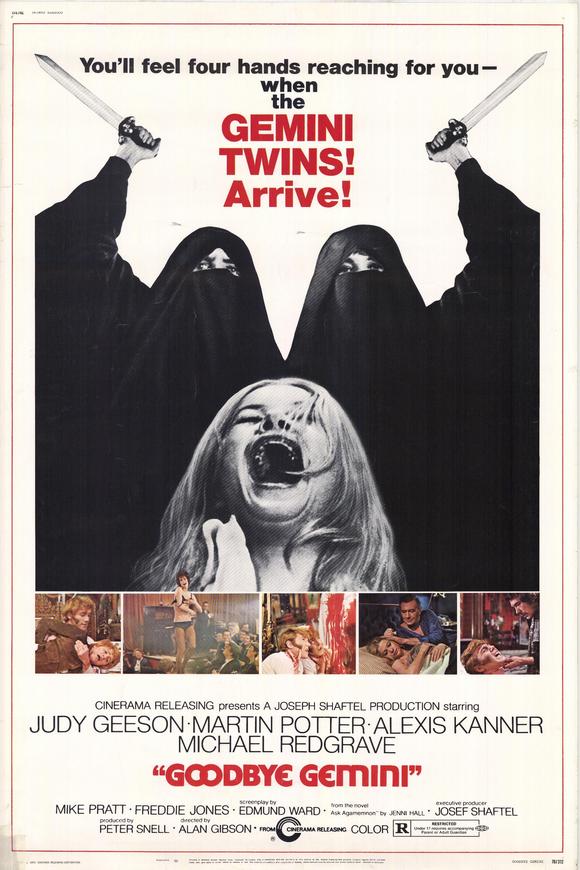
Goodbye Gemini (1970)

Alan Gibson may have been born in Canada, but he’s more known for his British horror films, which include Dracula A.D. 1972 and The Satanic Rites of Dracula.

Goodbye Gemini was based on the book Ask Agamemnon by Jenni Hall. The book differs in that it is written in the style of a Greek tragedy, with Agmemnon coming to life and interacting with Jacki, who has amnesia and sees the story unfold in less linear fashion.

The film is way more about the incestuous relationship between Jacki and Julian, which angered conservative groups who were already enraged about the excesses of pop culture at the end of the 1960’s.

This film and Freddie Francis’ Mumsy, Nanny, Sonny and Girly were targeted by the conservative press, which resulting in protests and theaters that refused to show either film. While they weren’t on the list of video nasties, the scandal that came in the wake of these two films was definitely a precusor to their era.

Jacki (Judy Geeson, fresh off To Sir, With Love) and Julian (Martin Potter, fresh off Fellini’s Satyricon) are twins on break from university who have entered London’s party scene, accompanied by Jacki’s teddy bear Agamemnon. The twins see the stuffed toy as a father figure and often speak to him as if he were a real person.

The twosome eventually connect with Clive (Alexis Kanner, The Prisoner), a pimp who knows the wealthy and well-connected. He’s on teh make for Jacki with his kind of, sort of girlfriend Denise wants Julian. However, Julian sees he and his sister as two sides of one hive mind and believes that incest is the natural next stage in their closeness.

Clive, on the other hand, is hiding from a huge debt within the house of the twins. In order to get the money, Clive drugs Julian and has two of his transgender prostitutes molest the twin while the pimp takes photos for blackmail. Denise confesses this plan to Jacki, telling her that Clive has done this in the past and has gone so far as to sell men into sexual slavery.

Jacki soon comforts Julian, telling him that their relationship has not changed. She helps him escape this issue by tricking Clive. It starts when they bet him that he can’t tell them apart. They dress their room into an altar for their bear and dress in ceremonial robes. As the pimp awakens, they repeatedly stab him, which leads to Agamemnon being cut in half. This causes her to have a nervous breakdown.

As an amnesiac Jacki recovers at the home of parliament member James Harrington-Smith (Sir Michael Redgrave, father of Vanessa and Lynn, in one of his last roles), the police go on a manhunt for the twins. Between James not wanting to be connected to the scandal and the twins increasingly fragile grasp on reality, there’s no way that this story can end happily.

You should check this movie out for yourself. You can get it from Ronin Flix.

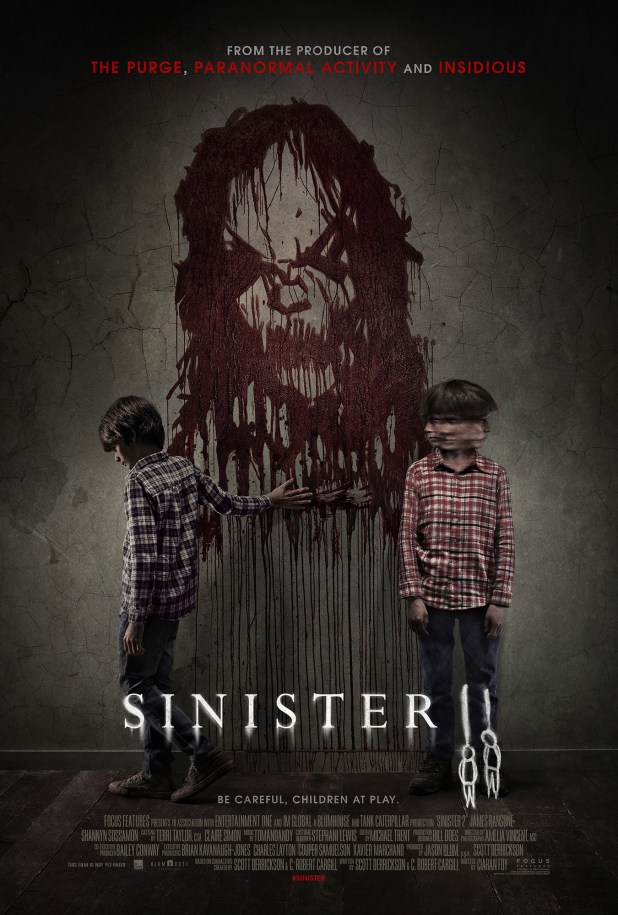
Sinister 2 (2015)

Sinister 2 is a rare breed — a sequel that I enjoy more than the film that proceeded it. Ciaran Foy directed it from a script that was co-written by the original film’s writer and director, Scott Derrickson. James Ransome is the only character that returns as Deputy So & So.

The movie starts with one of those Super 8 films from the original, as a family is hung like scarecrows before being burned alive. It’s a nightmare in the mind of nine-year-old Dylan, who is on the run from his abusive father, along with his mom (Shannyn Sossamon, A Knight’s Tale) and twin brother Zach.

Each night, Dylan is visited by a gang of ghostly children led by Milo. They make him watch all manner of horrifying movies where alligators devour families and rats eat their way through parents’ stomachs.

The deputy is now a private detective on the trail of the murders from the first film, including the Oswalt family. He figures out that an abandoned farmhouse is the first of the homes infected, so he heads out to burn it to the ground, before learning that Dylan and his family are living inside it.

The deputy falls for Dylan’s mom and also is given a ham radio that once belonged to occult investigator Professor Jonas, who has disappeared. The radio came from a Norweigan family that was killed in 1973. There’s a recording of the family where a young girl yells about Bughuul.

That boogieman is now targeting Zach, not Dylan, using his jealousy and the abusive nature of his father to destroy the family. When his birth father kidnaps them all, he takes advantage and crucifies them in a cornfield, setting his father ablaze. Only after the deputy destroys the haunted camera does the carnage stop, with Bughuul arriving to destroy the young boy.

If only the film ended there. The jump scare at the end where Bughuul appears in the deputy’s motel room feels out of character and a cheap way to milk a sequel out of this idea, but hey — what do you expect?

That said, this movie has even more haunted Super 8 films — well, these ones are shot on 16mm stock — and some pretty decent attempts at frightening its audience. It’s also pretty much a cover version of Children of the Corn. I prefer how the original film was more enigmatic about Bughuul and his motivations, but this movie really amps up the intensity. I saw it at a drive-in, which is quite possibly the best way to see an escapist horror film, right?