“The gravitation field is accelerating the meteor shower!” “We’ve lost the orbital shield!” “Invert the signal flow on the flux capacitor!” “Launch all deus ex machina techno-weapons!” — Techno-babble as only The Asylum can shuckster
Truth: we weren’t going to review this film. But after reviewing the ludicrous fun of the recently-released Asteroid-a-Geddon and discovering the newly-released Meteor Moon on our cable system’s PPV channels, we figured we might as well polish off The Asylum’s Deep Impact-cum-Armageddon Earth-is-jeopardy-and-only-sexy n’ buff-scientists-can-save-us trifecta. In fact, this is the perfect film to review for our “Matriarchy in Space Week” as The Asylum-verse is saved by a woman.
Well, have you ever watched a PBS-TV episode of Nova? The brainiacs on those shows are always more Giorgio A. Tsoukalos unkempt-flabby than Gerald Butler GQ-ripped. But it’s not The Asylum’s fault. And it’s not first-time screenwriter Joe Roche’s or director Matthew Boda’s bad, either: they’re just a pair of struggling actor n’ crew dudes making a buck on The Asylum manufacturing line, hired to assemble a mockbuster following the Gerard Butler-disaster epic template cast forth in Geostorm (China’s The Wandering Earth is the better film) and Greenland (which actually isn’t that bad). Look, no one’s dropping $7.99 streaming fees to see Leonard Hoffstedder sucking back on inhalers, doubled over on zero-gravity toilets, battling both lactose-irritable bowls and meteors; meanwhile, below deck, at the controls of the Blackhole-deus ex machina Generator, Mission Specialist Howard “Fruit Loop” Wolowitz wants to screw Kate Watson’s cargo-camping hot pants-bottomed (What, no “Daisy Dukes” were available?) meteoricist: the Earth’s fate be damned. And no, Dr. Kothropali, Becca Buckalew isn’t interested in your whiny insecurities, either. Turn your telescope back to the stars, your perv.
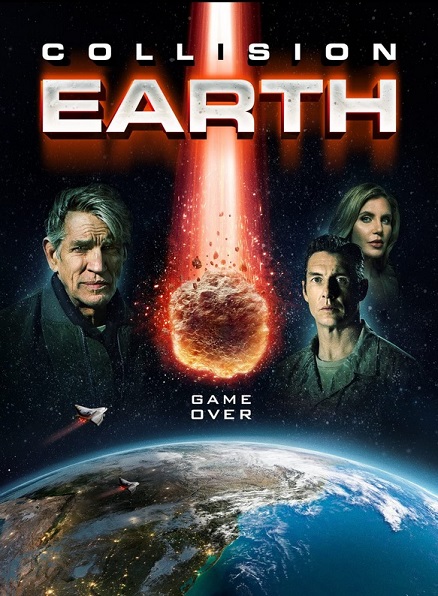
When The Asylum gives only the very best in SFX; Image courtesy of mkdltkrs/eBay.
So, if you’ve navigated the stars of The Asylum-verse, you know Collision Earth is one of those films that stars-a-bunch-of-first-time-actors-you-never-heard-of and _____________. In Meteor Moon, it was Dominique Swain in the stand-here-on-the-same-spot-on-this-set-for-the-whole-movie role to get a “name” on the box; this time it’s Eric Roberts (this time in military fatigues and back from Asteroid-a-Geddon) to bark orders and make all the other cardboard-hysterical, techno-babbling thespians look even worse than they really are at the craft. (Plot spoiler: It takes 30 minutes to achieve our Eric-ness; in another 30, Eric’s dead via his falling into a cavernous CGI-fire.)
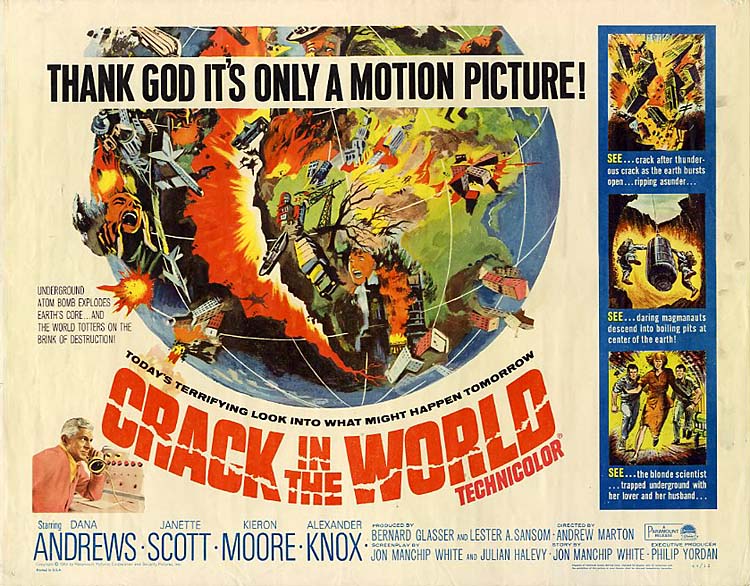
Before The Asylum: Where it all began . . . with Paramount’s 1965’s Crack in the World.
So, Collision Earth is another one of those movies where the Earth has clusters of nuclear warhead-armed satellites and phalanx after phalanx of perpetually launch-ready rockets — and we still can’t stop the wrath of Lucifer’s Hammer (the best-selling, award-winning 1977 novel by Larry Niven that started this unintentional mess in the first place). And, like Greenland, this Asylum-romp is just that: a fiction survival romp set on Earth with less Deep Impact-in-space shenanigans and more about how-do-the-bunkered-humans-cope-with-the-meteor-aftermath of the Panic in Year Zero! (1962) variety. When it comes to effects: Collision Earth is a budget-strained film void of in-camera effects traded out for After Effects-overlays of the Colorforms play-set variety.
Oh, and this is a film where our camping shorty-shorts n’ boots-and-ankle socks babe with a tummy tie-off on her flannel shirt hops into a Lockheed F-35 Lightning to electro-fry the meteor to oblivion. We’ll forgive that the actual jet CGI’d is a Boeing F-18 Super Hornet — and the cockpit isn’t accurate to either jet — because women in space rock our world.
You’ve seen better. But you’ve also seen a lot worst in The Asylum-verse . . . or any Roger Corman AIP-verse, for that matter. Hey, it’s better than Rocket Attack, U.S.A. and King Dinosaur, so there’s that going for it. And the women — sans the wardrobe snafus — are Bechdel test-strong, so double bonus, for this ain’t no Cat-Women of the Moon. Collision Earth is currently available as a PPV on U.S. cable systems and as a VOD on multiple streaming platforms.
About the Author: You can learn more about the writings of R.D Francis on Facebook. He also writes for B&S About Movies and publish music reviews and short stories on Medium.
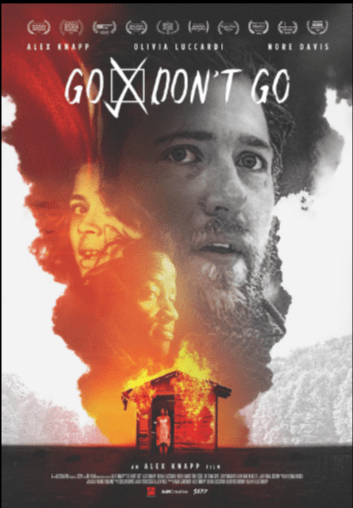
Director, writer and star Alex Knapp has created the story of Adam, the last man on Earth, who daily follows the same routine, obsessively checking off the boxes for what he needs to do, before discovering that he might not be alone.
A post-apocalyptic paranoid love story, Adam finds himself obsessed with K. (Olivia Luccardi, Channel Zero: Butcher’s Block), a woman who he once loved or who exists only in his mind. He begins to wonder if the wasteland he’s living in is real or in his head as well.
Who is stocking the shelves at the end of all things? Why does the water and utilities work in Adam’s apartment? Why are the go/don’t go boxes everywhere he visits? Why does the bowling alley still work? These are the kinds of questions that this movie will leave you with, beyond the metaphysical ones of why are we here and are we experiencing the correct reality?
This movie follows Justin McConnell (Lifechanger) over five years in his life and career as an independent filmmaker, as he continually asks himself, “How does an indie filmmaker survive in the current film business?”
Beyond the story of McConnell, this has plenty of quotes and advice from an army of filmmakers, actors and others behind the scenes, including Guillermo del Toro, Mick Garris, Paul Schrader, Lloyd Kaufman, George Romero, Brian Yuzna, Larry Cohen, Tom Holland, John McNaughton, Uwe Boll, Sid Haig, Jenn Wexler, Don Mancini, Frank Henenlotter, Charles Band, Tom Savini, Richard Stanley, Dean Cundey and so many more.
This is more than just a documentary. It feels like an essential watch for anyone thinking about making a film. With so many of the films that we watch, we only see the end results on screen. There is so much more that we will never know and work we can’t imagine, which makes me think more about how I write when I discuss these films. No matter how down and dirty some movies are, they are someone’s labor of love.
You can learn more at the official site. This is available on demand from Gravitas in the U.S. and Indiecan Entertainment in Canada, and will be released on blu ray from Arrow Video for the UK, Ireland, Australia, New Zealand and Canada, where they will release it on blu ray.
Some people get excited about the latest Marvel or DC movie. Others can’t wait for the next Star Wars. But when it comes to the movies that I look forward to, they’re often ones that slip under the radar. My goal is to change that under the radar status of this movie.
From the moment I saw the first trailer for this, I knew I was in for something special. After all, director Steven Kostanski was behind Manborgand The Void, one of my favorite movies of the past few years.
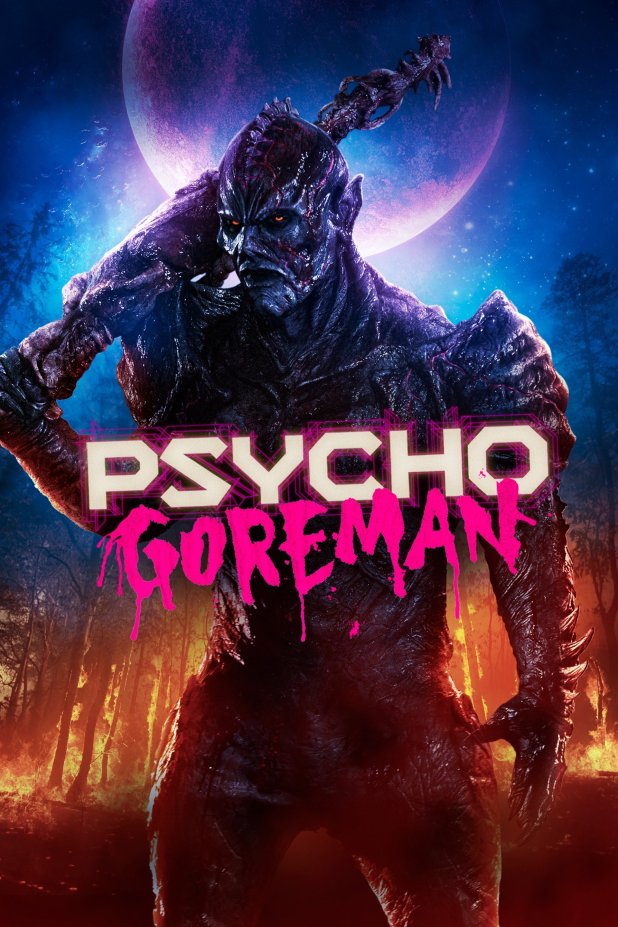
Now, he’s created Psycho Goreman, a movie that takes the energy and over the top gore of the straight to video era without wallowing in nostalgia. Basically, this is a movie for kids that no kid should see but they should totally see, a film that reminds me of the thrill from being the only kid in class who had seen The Pit and The Gate. This movie is packed with practical effects, singalong montages, brutal battle scenes, so many monsters and the best gore I’ve seen in years.
I smiled throughout this entire film. If someone made a movie just for me, this would be it.
The Arch Duke of Nightmares — the being who will one day be known as Psycho Goreman — has been exiled to Earth in the wake of a battle between his armies of evil and the the Templars, a religious sect out to purify the galaxy which just might be — spoiler warning — worse than the destroyer of worlds that has been exiled to Earth.
The Gigax Council — led by Pandora, the Prime Templar Crusader (Kristen MacCulloch) and made up of Kortex (Matt Kennedy, who directed The Editor and Father’s Day), H.I.S.S. (which stands for Hyperion Isolde Sepintine Sorceress), Dr. Meganoid, Tube-Man ), Star Stryker 77, Allan and the Judicator — have defeated the most evil creature to ever walk any planet and separated him from the jewel that gives him his power.
Meanwhile, down on our doomed mudball, Luke (Owen Myre) and Mimi (Nita-Josee Hanna), a brother and his bully of a sister, have found the crystal that controls the beast and have renamed him Psycho Goreman. Played by Matthew Ninaber with the voice of Steven Vlahos, he’s a perfect mash-up of Oderus Urungus and Pinhead, yet completely and utterly original.
Despite assuring the kids numerous times that he will kill them, Luke and Mimi take a break from playing their invented ball game to walk their monster around the neighborhood, watching as he decimates the police, murders some thugs and transforms their friend Alastair (Scout Flint) into a gigantic walking brain.
However, it doesn’t take long for the past to come calling, as PG uses his blood to call for his old troops — the Paladins Obsidian — to come take him away from all of this. They are Queen Obelisk, the royal matriarch to the Cemetarium Collective, a twisted sect of interstellar necromancer berserkers (yeah, this movie is exactly that awesome); Witchmaster, a sinister sorcerer from the distant Tokusatsu* system ; Cassius 3000, the golden swordsman that not even PG trusts (Conor Sweeney, who wrote The Editor); Death Trapper, a living cauldron filled with the bodies of those it has already murdered and Darkraiser — who much like Starscream once did to Megatron — has taken the command position when PG was sent down to Earth,
Through all this, the kid’s parents, played by Timothy Paul McCarthy and Alexis Kara Hancey — try to stay lazy or keep it all together respectively.
Imagine a world where instead of E.T., Gertie and Elliot ended up getting the Darkness from Legend. That will give you some small idea of what this movie is all about and yet it has one major conceit: perhaps Mimi is a bigger monster than every practical effect monster in this gore-drenched epic.
The Astron-6 crew has made some pretty great films. This is the highest achievement I’ve seen from any of them, presenting a fully built world full of creatures that I want to see in a million sequels. I’m fully ready to buy tons of action figures and t-shirts of every single monster in this movie and you will be too.
For a creature whose entire existence is built on death and destruction, Psycho Goreman has a heart. Sure, he learns how to harness the power of love to probably kill every single being on our planet, but he also learns how to play drums and the love of a little girl — not like that’ll save any of us.
It’s nice to have your high expectations exceeded. I’m more than an advocate for this movie. I’m an apostle.
You can learn more on the official Facebook, Twitter and Instagram pages. This comes out on demand on January 21. Be ready for it.
*Of course, this is the Japanese word for special filming, which is often used to describe movies like Godzilla.
“I don’t know why some people suffer through drought longer than others, but the rain always comes eventually. And when it does, the desperate, barren, thirsty earth quenches itself in a way that the lush, green earth could never imagine or understand. And I have to live in this tension because that is where the fire is.” — A bit of wisdom from Ed (William Russ)
The streaming verse is rife with first-time (mostly indie) writers and directors. And some are better than others. And this debut proves that Cindy Jansen is one of the some and not of the other. Remember when Patti Jenkins blew us away with the expertly crafted Monster, her 2003 writing and directing debut? And Jenkins’s debut was, while highly regarded, also consumer derided. And so is Jansen’s debut. But that derision has nothing to do with Jansen being a female filmmaker in a male-driven Hollywood. Film is (it should be) sexless-subjective and, regardless of a filmmaker’s Final Draft and Canon Red skills (which Jansen has in spades), some films resonate and some do not with the today’s streaming masses.
And if you want to guarantee — regardless of a filmmaker’s sex — derision from a mass audience: tell your story with a non-linear narrative: for flashbacks, hallucinations, time jumps, the metaphorical and analogies, and long-running narratives with multiple storylines crafted by an ensemble cast (and god forbid, voice overs of a character’s thoughts) will irradiate a streamer to the point of rehashing how much they hated Charlie Kaufman’s Adaptation and Eternal Sunshine of the Spotless Mind. And for as many people that enjoyed Bryan Singer’s The Usual Suspects and Quentin Tarantino’s Pulp Fiction and, most recently Once Upon a Time . . . In Hollywood, those (excellent, IMO) films have their detractors.
And so it goes. Where the film sprocket spins, no one knows.
When it comes to screenwriting, I’m of the Linda Aronson School of Non-Linear Storytelling — provided that formatting choice is not some esoteric, bells and whistles flight-of-fancy of the “look what I can do” variety and it services the character and the story (and in the case of Chasing the Rain, it does). (And why, can novels be non-linear and become best-sellers, but when a screenplay is non-linear, it’s a box office death knell? “It’s not ‘cinematic,'” they say.) At heart, man is a non-linear creature. Sure, as we objectively view the people around us, they’re moving forward, linearly. But when we consider the subjective side of man, internally rests his true essence. Man is a creature whose mental and emotional states are constantly multitasking. While you’re at your job, you’re flashing forward about your family responsibilities later that evening. While you’re with your family, you’re flashing forward about tomorrow’s job meeting or flashing back to the latest episode with that fellow, troublesome employee. Then there’s the sights, the aromas, the things people around us do or say that inspires one to reflect on a past moment. We daydream about the future-possible and the impossible. Then we snap back to the present. Non-linear is reality. Non-linear is real life. The external, objective adventures of John McClane and Martin Riggs, while surely entertaining, aren’t reality.
Thus, when a film like Chasing the Rain — with a non-linear and faith-based message to boot — flows down the digital pipeline, not everyone is jumpin’ aboard that gospel train to a cinematic transcendence. A film that addresses the concepts of freewill and ponders the philosophical: Are the world’s pains, one’s personal afflictions, and disease a test of faith sent by God or are those pains a jovial punishment sent by Lucifer to torture man?, isn’t floating the bag in everyone’s tea cup.
Well, I love my green tea. So pour it, Cindy.
Eric (Matt Lanter) is a soft-spoken and well-intentioned, yet spiritually-stumbling photographer on a volunteer mission project with a clean water organization assisting the citizens of an arid, poverty-stricken Kenyan village. When he returns to the States after his mission-of-good, he discovers he’s afflicted with a debilitating illness. Already fragile in accepting the good fortunes of his life, Eric’s life begins to unravel (again) as he questions why such suffering is bestowed upon some more than others.
We need not subscribe to Christianity or a belief system in any god to book ourselves a seat on the self-pitying, self-righteous freight train of pain to a spiritual Las Vegas where everyone is fearing and loathing; a city of sin where most are not blessed with baptismal waters of redemption, but with spiritually-destroying baptisms of fire. Chasing the Rain, regardless of its spiritual themes, is an authentic story concerned with how one copes in a dysfunctional family and with life-defining moments — be it the good, the bad, or the ugly. And when it comes to authenticity vs. hyper-reality in film, I always err to the side of quenching my celluloid thirsts from the pools of the authentic. Even when the waters go uncomfortably dark.
Sometimes, it’s all about that opening shot, yes, of a dung beetle: Come into being.
We’ve enjoy the work of Matt Lanter since the early 2000s courtesy of his work as Brody Mitchum on NBC-TV’s Heroes and as Liam Court on Fox-TV’s 90210. Lucasheads know Lanter as the voice of Anakin Skywalker in the Star Wars animated universe, as well as the animated voice of Aquaman in the DC-verse and a wide array of characters in the Spiderman-verse. William Russ has been on our TVs and silver screens since the late ’70s, but us youngins of the ’80s remember him best in his seven-year run as dad Alan Matthews on the sitcom Boy Meets World. The same goes for Cindy Pickett, who you may remember for her starring role as Dr. Carol Novino on NBC-TV’s hospital drama St. Elsewhere — and too many TV series and films to mention. I was also very pleased to see the matured, stellar child actor Hallee Hirsh — who totally creeped us out as Jenny Brandt, a pubescent-serial killer on TV’s Law and Order in “Killerz” (1999) — still in the business and effective as ever on-camera. If you were a fan (like moi) of NBC-TV’s E.R. or JAG, you’ll recognize Hirsh for her recurring roles on those series as Rachel Greene (Anthony Edwards was her dad!) and Mattie Johnson. It’s great to see these four, wonderful actors with starring roles in an expertly crafted to film to remind us why, anytime we see their name, we watch the film or TV episode. Their presence certainly served as my enticement to stream.
The real joy of the casting process for Chasing the Rain is that it allows for the (new) discovery of under-the-radar TV actor Eric Tiede as Stu, Eric’s best friend and roommate. Working his way through guest starring TV roles the last ten years on such top-rated network series as NCIS, Castle, and Major Crimes, Tiede brings an award-winning (or at the very least, a supporting actor nomination) nuance to a character that starts out as, what seems a selfish, throwaway party dude, only to transform into more than just a roommate. Tiede’s an actor’s actor that, as with his co-stars, is now an actor who, the next time I see his name on a project, I’ll stream it for his performance.
Speaking of streaming: When it comes to first time or unknown indie filmmakers, I’m of the belief that brevity is best; that, when it comes to a first time or more developed, but unknown filmmaker, their discovery is better served with a more commercially palpable 80-minute running time — and that even 90-minutes pushes a movie watcher’s willingness to dedicate their time to an unknown’s work. But hard media is dead and oh so ’90s; current media consumption is all about streaming, and so many indie filmmakers — sans studio backing with those pesky no-you-can’t-do-that executives holding the purse strings — have a tendency to be a bit weak in their abilities to step back and separate themselves from their work to make those hard, editing choices. However, with Cindy Jansen’s debut — courtesy of a well-reached and thought-provoking script, stellar cinematography from Lon Stratton (Standing the the Shadows of Motown), and solid acting from all quarters, this is a time where no streamer should have any apprehensions at this film’s one hour fifty three-minute running time. Chasing the Rain is one of those unique indie-streaming instances where every frame, every shot, is absolutely essential to the story and deserves to be on the screen.
Chasing the Rain is a beautiful, perfect industry calling card that leaves one wanting more from Cindy Jansen. Hopefully, the executive of Tinseltown will feel the same — and give her free reign to see her vision through.
You can keep abreast with the latest on Chasing the Rain courtesy of Indie Rights Films and at the film’s official Facebook page. You can learn more about the film and its creators courtesy of an extended interview conducted by Bonnie Laufer Krebs on her You Tube page. Courtesy of Shock Ya!, film journalist Karen Bernardello also discusses Cindy Jansen’s destiny in becoming a reluctant, first time director.
You can hit the big red streaming button for Chasing the Rain on Amazon Prime. As of February 2021, you can now enjoy Cindy Jansen’s debut film as a free with-ads stream on your favorite digital device on TubiTV.
About the Author: You can learn more about the writings of R.D Francis on Facebook.He also writes for B&S About Moviesand publishes short stories and music reviews on Medium.
Disclaimer: We did not receive a review request for this film. We discovered the trailer on social media, were intrigued by the film, and requested a screener. We truly enjoyed the film.
The reviews on this feature film writing and directing debut by Disney wildlife documentarian David Fowler have been of the middling-to-hated variety. And I must admit that, after my first watch, I didn’t care for Welcome to the Circle either — and since I couldn’t find a positive in the film, I wasn’t going to write this review.
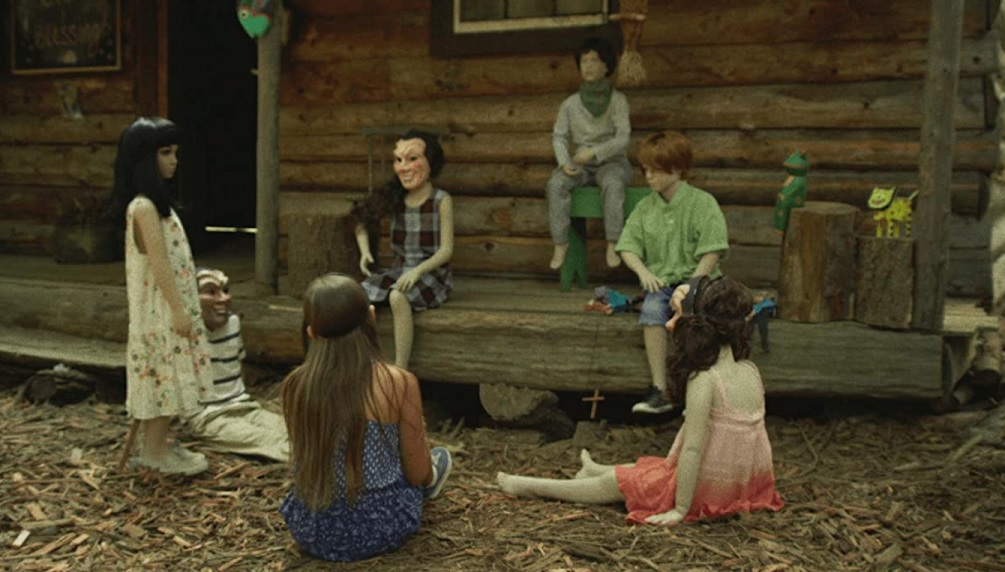
But obviously, there’s something happening here — or you wouldn’t be reading this — in the Don Coscarelli-mindfuck frames that I just couldn’t put my finger on my first go-around. For this film’s raison d’etre isn’t flying Chinese cuisinart harmony balls: it’s mannequins and masks and fucked up human-strung marionettes. And it wasn’t until Sam, our Mix Master General of the Movie-themed Drink Blender, rolled out another “Giallo Week” of even deeper Italian and Spanish obscurities*, and my sitting down for a two-day Nazisplotiation binge as I geared up for my review of Naomi Holwill’s everything-you-wanted-to-know-but-were-afraid-to-ask genre document Fascism on a Thread: The Strange Story of Nazisploitation Cinema, that the celluloid memory centers of my analog cortex streamed across the synapses in hallucinatory harmony.
There are just some movies that require a second run through the digital sprocket rollers. The FUBAR’d world of Welcome to the Circle is one of those films.
He’s a-pickin’ and I’m a-grinnin’: Just sum backwoods pseudo–giallo fun with the kids.
Now Giallo and Nazisploitation films may not — at all — be at the ambiguity-open-to-your-interpretation roots of Fowler’s retro-madness, but somewhere along the line, between the feel-good Disney docs, he’s ingested his share of films from both genres and they somehow bled into his Final Draft QWERTY-ing.
We’ve got the mannequin and mask creepiness of Mario Bava’s Lisa and the Devil and Umberto Lenzi’s Spasmo. There’s Coscarelli’s they-don’t-make-any-sense surrealistic nightmares of the Phantasm franchise. There’s Bigas Luna’s snail-slithering corkscrews of Anguish. There’s the haunting of Herk Harvey’s Carnival of Souls with his mannequin-like souls in their undead waltz. There’s the twisted, pseudo-Nazi ideology that makes no sense to anyone but its we-can-do-whatever-we-want followers. Then there’s those narrative time jumps (which seems to annoy the streamer-critics the most) where you don’t know if the character’s insane, trapped in a dream, or the owls are hootin’ down at the Ambrose Bierce bridge of reincarnation sighs.
A cult victim has to learn to swim on their own: Pseudo–Giallo WTFs with masked mannequins and dirt scuba-diving.
As the film begins, we meet Greg, a father who takes Samantha, his young daughter, on a bonding camping trip; they’re subsequently attacked by a bear. However, amid the film’s unfurling ambiguity and surrealism, one questions if the bear attack was even real — and if the attack was, instead, in human form, since cults need children to nurture.
Greg comes to wake in the warming bosom of The Circle, a backwoods cult led by a Matthew, a white-suited Ron L. Hubbard-type that deals in philosophical, circular logic: reasoning that means nothing to know one but the cult’s members — whose numbers are dwindling.
And here’s where those mannequins and masks come in . . . and time starts a-jumpin’.
As Samatha’s assimilated into the cult, she’s obsessed with wearing a happy-face mask given to her by the cult’s flower-child rhetoric-spewing handmaidens Sky and Lotus Cloud. In fact, anytime someone is absorbed into the cult — by their own will or by force — they “personality” is replaced by a doppelganger mask. And as the cult numbers dwindle — by escape or death (we think) — they’re replaced by doppelganger mannequins that, (again, we think; keeping with the film’s circular mindfuckery), represents the lost, human soul . . . or the zombie-like autonomic nature of man . . . and your own mindfuck opinions, may vary.
Also pulled into the time loops and identity shifts is Grady, a professional cult deprogrammer hired by a husband and sister-in-law to abduct the cult’s third hippy-handmaiden, Rebekah.
Then there’s the right-back-where-you-started multi-dimensional travel and whacked-out hallucinations of the Tallman “Space Gate” variety that occur in the rural lair-shack of perpetually reincarnating Percy Stephens, an evil Baron Munchausen-styled world adventurer — (cursed to?) a lair that, you always end up where you left. As with Rudolf Enich Raspe’s literary hero, Percy’s a master sportsman, world-class deep sea navy diver, and world traveler (and master B.S. artist) whose life experiences led to his creation of The Circle, a supernatural cult with twisted moral standards. (Luckily, Percy wasn’t a product of Nazi Germany — but he did subjugate some African natives along the way, at least according to the creepy, morphing black and white wall photos hung around the compound, and per everyone’s Ringu-jittery mindbending flashbacks — or this backwoods camp would be a backwoods Nazi-prison farm with Sploitation-atrocities o’ plenty.)
Does young Samantha escape and is Rebekah rescued? Yep. But Rebekah’s got a shite-eating-grin on her face as Samantha fans the pages of the self-made book, “The Adventures of Percy Stephens.” So, will The Circle, continue?
All in all, I’m glad I gave Welcome to the Circle a well-deserved second watch. And it’s well worth your streaming it the first time. But hey, we’re the guys who loved The Invisible Mother, She’s Allergic to Cats, and Under the Silver Lake — that almost everybody else hated and didn’t see. So what do us film reviewing schlemiels and schlimazels of Hasenpfeffer Incorporated in the backwoods of Allegheny County know? We’d tell you that the Giallo cycle was misunderstood by mainstream Americana, with the genre’s mixtures of murder, the supernatural, Entomology, and junk sciences (and, in The Circle’s case: junk philosophy) wrongly critiqued as “style over substance” and “lacking in narrative logic.” And you’d say, “Poppycock.”
And that’s your loss, for you just missed out on a great introduction to a new voice in horror with this debut work from David Fowler.
After a making its streaming debut in October 2020 on various online platforms, Welcome to the Circle makes its January 2021 debut as a free-with-ads stream on Tubi. You can learn more about the film at Artsploitation Films and follow the film at its official Facebook page.
* In June of last year, we had our first, month-long Giallo blowout, which we recapped with our “Exploring: Giallo” featurette with review links to over 50 films. Yep, the blood runs Tallman-yellow in our veins. And there’s nothing like starting off a New Year with Giallos; you can catch up on our reviews with our three-part “Giallo Week Wrap Ups”: Recap 1, Recap 2. and Recap 3.
Disclaimer: We did not receive a review request from the director or a P.R firm. We discovered this film on our own and we truly enjoyed the film.
About the Author: You can learn more about the writings of R.D Francis on Facebook.He also writes for B&S About Movies and publish music reviews and short stories on Medium.
After a workplace shooting puts alcoholic Marcy (Siobhan Williams, Welcome to Marwen) on leave, she travels to see her sister in California. Yet halfway there, she decides to stop for a couple of days at the Bright Hill Road Boarding House, where she loses touch with reality and confronts her past.
Marcy may be clinging to sobrietry, but Mrs. Inman (Agam Darshi) leaves wine for her every night and the other tenant, Owen (Michael Eklund), may be pushing her further into the mistakes of her past. You know, I’ve said it before and I’ll say it again, if you black out and wake up in front of a deserted looking boarding house, don’t stay there.
This was directed by Robert Cuffley, who also made Chokeslam, from a script by Susie Moloney.
Bright Hill Road is available on DVD and on demand from Uncork’d Entertainment.
Author’s Note: Due to the controversial subject matter of this film, please note this is a film review that addresses the creative art of filmmaking only. This review is not a political dissertation in support of or in contradiction of any sociopolitical belief system and is not intended to incense any reader regarding social or free speech/opinion issues. This review was written to expose a documentary film that attempts to help the viewer reach an understanding regarding the creative development of its subject-film genre.
Filmmaker Naomi Holwill is one of us. She’s a film dork at heart and, like most of us, isn’t content with just watching a film; her fascination runs deeper. She read all of the film books and watched all of the DVD supplements and listened to the commentary tracks, like us. She needed to know what made Spanish filmmaker Jorge Grau and Italian purveyors Luigi Cozzi, Lucio Fulci, and Sergio Martino tick. She wanted to know why the Emmanuelle franchise became a phenomenon.
And she became a filmmaker that is everywhere . . . and nowhere. She’s the dark lady of cinema.
If you’re a cult cinema aficionado of all things Spanish and Italian and horror and sci-fi — chances are you’ve watched more than several of her 150-plus feature-length documentaries and featurettes (as a producer, editor, and director) from her Scotland-based High Rising Productions that, since 2009, is responsible for producing a wide array of supplements for internationally-released Blu-ray and DVD reissues of most of your favorite films from the ’60s through the ’80s.
You want to know more about the influences of Norman Jewison’s Rollerball*? She’s gave us the feature-length documentary supplement From Rollerball to Rome (2020) (which needs its own, separate release). You want to know more about seventies sex symbol Me Me Lai, one of the very first British-Asian pin-ups? Naomi Holwill was the first filmmaker to tell Lai’s story with the acclaimed Me Me Lai Bites Back (2018). And the list goes on and on: Norman J. Warren’s directing career**, Cannibal films, Giallo films, Blaxsploitation, Roger Corman, Jack Hill, George Romero, Slashers, Italian Zombies, and Italian Exorcism films. Since 2009, Naomi Holwill, along with her High Rising partner Calum Waddell, have left no filmmaker, actor, director, or genre stone from our beloved Drive-In ’70s and VHS ’80s unturned.
It was only a matter of time until High Rising Productions — with Waddell as writer and Holwill as director — would tackle the taboo sub-genre of exploitation and sexploitation films (and women-in-prison flicks) known as Nazisploitation: films dealing with World War II-era Nazi’s — both men and women — behaving very, very badly in concentration camps; films churned out in quick succession in the 1970s upon the box-office success of Don Edmonds (Terror on Tour) Ilsa: She Wolf of the SS (1975) starring Dyanne Thorne (Point of Terror).
Courtesy of the documentary’s inclusion on The Beast in Heat, the Blu-ray serves Dyanne Thorne’s final on-camera appearance.
Severin Films contracted Rising High to produce Fascism on a Thread, a feature-length documentary on the genre for inclusion on its May 2019 Blu-ray edition of Paolo Solvay’s The Beast in Heat (aka La Bestia in Calore, aka SS Hell Camp). Included are interviews with genre stars Dyanne “Ilsa” Thorne and Malissa “Elsa” Longo, along with the genre filmmakers Mariano Caiano (Nazi Love Camp 27), Liliana Cavani (The Night Porter), Sergio Garrone (SS Experiment Love Camp, SS Camp 5: Women’s Hell), Bruno Mattei (Private House of the SS, Women’s Camp 119) and Rino Di Silvestro (Deported Women on the SS Special Section). Other filmmakers and films examined are Tinto Brass’s Salon Kitty, Last Orgy of the Third Reich by Cesare Canevari, Alain Payet’s Love Train for the SS, and the more serious and better-made (but the most grotesque-watch of them all), Salo, or the 120 Days of Sodom by Pier Paolo’s Pasolini.
Granted, most Nazisploitation films are admittedly more sensationalistic, but when it comes to Pasolini’s inclusion in the genre, you’re dealing with a film that isn’t using Nazism or Fascism as window dressing. Salo, the 120 Days of Sodom is a masterwork in the horrifying lessons of the absolute corruption of power in the same vein that Otakar Vavra’s Witchhammer (1970) controversially addressed the issue, a film that, itself, was bastardized with a quick succession of scandalous “Witch Trail” films, such as the West German-produced Mark of the Devil, aka Witches Tortured til They Bleed (1970), its sequel Mark of the Devil II, aka Witches Are Violated and Tortured to Death (1973), and the more reserved, Gothic-slanted AIP film that inspired the production of those films: Michael Reeves’s Witchfinder General, aka The Conqueror Worm (1968). Paul Naschy’s “theme” on the corruption of wealthy libertines, in his pseudo-zombie film, The People Who Own the Dark (1975), also has a connection to Pasolini’s art-horror film statement regarding Italy’s fascist state — and their complicity in the rise of Nazism.
While brutally squeamish — but not gratuitous: there’s a point to it all, really — Salo and these works are inspired by the infamous, power mad, pre-Nazisploitation exploits of the Marquis de Sade; which was the question asked by Naschy: “What if the Marquis de Sade existed in the nuclear, Cold War-era of the 1970s?” And that theme — which also adds a message about man’s obsession with beauty and youth — prevails in Fruit Chan’s nerve-inducing masterpiece, Dumplings (2004). These films may not be for the puritanical or faint of heart, but they are statements on how far one will steep into the Seven Deadly Sin for their own personal gain that need to be told. However, that message — and any sociopolitical connotations — is lost in most Nazisploitation films (the worst offenders being Lee Frost’s 1969 knockoff, Love Camp 7, and Garrone’s 1976 romp, SS Experiment Love Camp), so you’ve been forewarned.
When it comes to a quintessential encapsulation of the derided ’70s Drive-In genre that later became an ’80s VHS-based “video nasty” genre, Fascism on a Thread is it. If you’re a film dork that needs to know more and, as with our friend Mike “McBeardo” McPadden*˟, you’re on a quest to consume every Nazisploitation and Italian cannibal film ever made, Naomi Holwill’s directorial effort is a perfect introduction to exploring the genre as you wrap your head around “why” it ever existed in the first place.
After being offered on Amazon Prime as a separate-from-the-Blu stream from The Beast in Heat, you can now watch Fascism on a Thread for the first time as a free-with-ads stream courtesy of TubiTV. We’ve also since reviewed Naomi Holwill’s exploration of the Italian cannibal genre with Me Me Lai Bites Back (2021).
There’s also several fan-complied compilation lists to help you navigate through the genre’s films on the IMDb and Letterboxd. Other films of the genre we’ve reviewed are Achtung! The Desert Tigers (1977) and Gestapo’s Last Orgy (1977), along with the ’80s zombie variants of Shock Waves (1977), Gamma 693 (1981), and Zombie Lake (1981). Then there’s the rape-revenge inversion of Mad Foxes (1981). If you’re in a NaziZom binge-mood and want to see a few of the genre’s predecessors, you can check out They Saved Hitler’s Brain (1964) and its fellow Nazi scientist-cum-world-conquest villains in She Demons (1958), The Flesh Eaters (1964), and Flesh Feast (1970). To a lesser extent, there’s the Nazi we-never-see ghosts of Death Ship (1980).
Click through the images for the reviews.
* We did our own month-long examination of all of those post-apoc Rollerball offsprings with our two-part “Atomic Dustin” and our three-part “Fucked Up Futures” examinations — both features offer review links to over 100 films of every Italian and Philippine end-of-the-world romp you can imagine — and beyond.
*˟ We had the pleasure of interviewing Mike “McBeardo” McPadden in April 2019, upon the release of Teen Movie Hell: A Crucible of Coming-of-Age Comedies from Animal House to Zapped!, his latest filmpedia follow up to Heavy Metal Movies.
Disclaimer: We did not receive a review request from the director or a P.R firm. We discovered this film on our own and we truly enjoyed the film. And thanks for making this one of our most-successful posts with over 650-hits since January! We hope you enjoyed the film as much as we did!
About the Author: You can learn more about the writings of R.D Francis on Facebook. He also writes for B&S About Movies and publish music reviews and short stories on Medium.
This film “probes the fundamental moral, environmental and nutritional quandaries we face in raising and eating animals. In this film project, we focus our lens on the largest and perhaps most maligned of farmed animals, the cow.”
Seriously, I never thought that I’d watch or even like a documentary all about why meat production makes sense, but this is well put together.
Yet this film presents an intriguing case study: in the push to create a more heart-healthy — and therefore, more highly-processed — diet, we may be destroying entire ecosystems and even human health thanks to the food that is supposed to make us feel better.
Nick Offerman — who played Ron Swanson on Parks and Recreation, a character who was nearly devoted to the consumption of meat — is the narrator for this story, which takes us from how we got here to how some of America’s farmers are trying to change the narrative by increasing biodiversity, improving soil health and raising high quality, nutrient-dense protein, all while fighting to preserve the family farms of our nation.
Interested in learning more? Or are you someone that subscribes to why being a vegan is healthier? Either way, beginning January 5, the film will be available in the US on iTunes, Vudu, Googleplay, Amazon, DirecTV, Dish Network and iNDEMAND. You can learn more on the film’s official site.
With Hotel for Dogs, Diary of a Wimpy Kid and Percy Jackson: Sea of Monsters, Thor Freudenthal established himself as a strong director for effects-driven kid movies. Now, Words On Bathroom Walls takes his verve for imaginative effects and applies them to a story for older teens and young adults.
Based on the novel of the same name by Julia Walton, this is the story of Adam Petrizelli (Charlie Plummer), a schizophrenic student trying to make it through life.
Expelled halfway through his senior year following a psychotic break while in chemistry class, Adam is diagnosed with a mental illness and sent to a Catholic academy to finish out his term. He knows that he won’t fit in and just hopes that he can keep his illness a secret and make it to culinary school while avoiding his mother’s new boyfriend Paul (the always great Walton Goggins).
The film does an admirable job of translating Adam’s mental illness via special effects and personifying the voices within his head. He worries that his life will always be one of hiding until he meets Maya (Taylor Russell), who inspires him to open his heart and not be defined by his condition.
Lobo Sebastian, who plays the Bodyguard inside Adam’s visions, was also in Ghosts of Marsand played Lil Joker in Next Friday. Plus, it’s always great to see Andy Garcia in films, here as a priest who helps our protagonist.
Words on Bathroom Walls is available on blu ray, DVD and on demand from Lionsgate, who were nice enough to send us a copy to review.




















 B&S About Movies
You must be logged in to post a comment.