Cross of the Seven Jewels (1987)

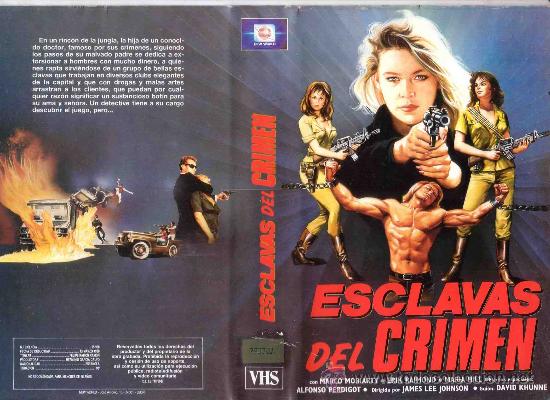
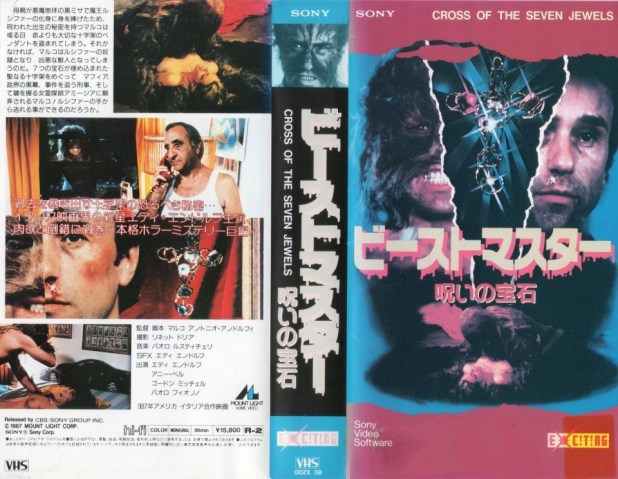
Directed by, written by and starring Marco Antonio Andolfi — who also did the special effects — who claims he based this on comic books, plays and his real life, which really says a lot I guess. Eight years later, he took all this footage, re-edited it and threw in some footage he stole from The Serpent and the Rainbow like a good Italian filmmaker and called the film that ensured Talisman.

Marco Sartori (Andolfi) is wearing a huge cross with seven jewels — everyone cheer for the title reference — that gets turn off by some motorcycle criminals, which was what really happened to Andolfi and inspired this. Well, he needs that cross because without it, he turns into a weresomething, by which I mean that he’s nearly naked, except for a furry bikini and mask.

A mob boss (George Ardisson, who was once Secret Agent 3S3 and Thesus in Bava’s Hercules in the Haunted World) explains how he can get the cross back and lets one of his best girls, Maria (Annie Belle, who was in D’Amato’s Absurd and L’alcova) come along.

There’s also a fortune teller named Madame Amnesia played by former Miss World Zaira Zoccheddu, as well as Satanic cult that is whipping women and having sex because that’s how you raise the prince of all things evil from his slumber and sure, he looks like Chewbacca, but come on, he’s also the father — maybe? — of our hero. He at least did his mom and if I were a bad guy, I’d definitely say that out loud to get under a werewolf’s skin. Or fur.

Also, Gordon Mitchell leads the Black Mass and really, that’s enough to get me to spend $40 on this whenever Severin gets around to putting it out on blu ray.

Child of Peach (1987)

There are movies that blow your mind and then there are movies that make you wonder if you’ve been experiencing reality properly. I use the term movie drugs on here pretty often.

Welcome to the black tar heroin of movie drugs.

Chung-Hsing Chao was an actor who’d been in movies like  Buddha’s Palm and Dragon FistHeroic Rivals and Born Invicible, as well as a stunt coordinator for Snake in the Eagle’s Shadow IIThe Miracle Fighters and Magnificent 7 Kung Fu Kids. He also directed this movie along with Chun-Liang Chen. These are simple facts.

They can’t explain to you what you’re about to see.

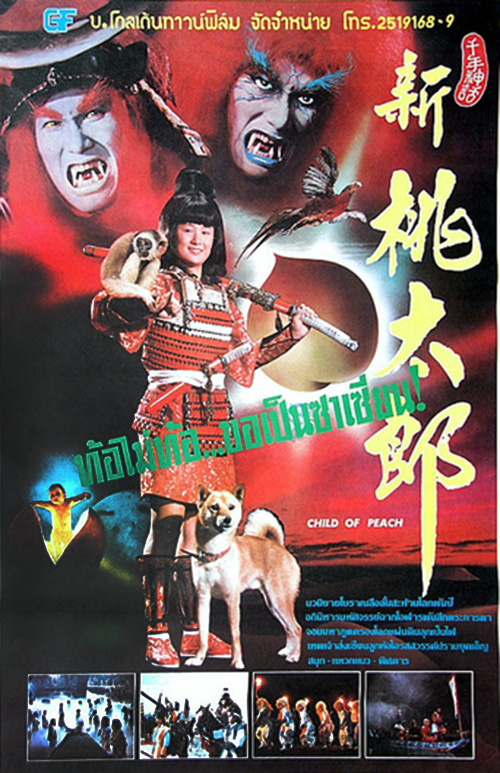
The first of the Taiwanese Peach Kid trilogy — along with Magic of Spell and Magic Warriors — the movie adapts the Japanese legend of Momotaro, a hero born from a giant peach who battles demons with his animal friends, not unlike Yokai Monsters: Spook Warfare.

Again all facts.

So how about this? Imagine if Superman’s parents found him inside a piece of fruit and name him Peach Kid and raise him to be a good person, which means fighting King Devil, the man who has wanted him dead since he was a baby. But also keep in mind that Superman’s parents are an old married couple and are constantly battling one another in a war of words, more like a real married couple than the comic book unreality.

Also imagine that movies for kids can be filled with incredible degrees of violence and profanity while still telling a positive lesson. Where monkeys peeing is the height of comedy — it is — and speaking of animals, our hero can team up with Tiny Dog, Tiny Monkey, Tiny Cock and Knight Melon to fight evil, which takes the form of a witch and her army of miniature 80s hair metal dudes.

There’s also a peach-based robot, a Sun Sword, demon dismemberment, stunts that look way to painful to have not been, incredible fights, wire work, a demonic mutant shark getting definned and so much more.

Really, these kinds of movies need to be experienced in what I refer to as analog moments, where you stop taking notes and just let the high overtake you. This is high level strangeness from Taiwan, a country very much unlike our own, made decades ago and unconcerned with looking or feeling or acting like any movie that’s come before or since. Shut off that part of your mind that says that this is alien, that this is silly, that this is a goofy martial arts movie and you can see how fake the effects are. Pretend you’re a child again. Pretend you’re a cosmic being. Pretend that the world can be this good, if even for the running time of this film.

You can watch this on YouTube.

Goodnight, God Bless (1987)

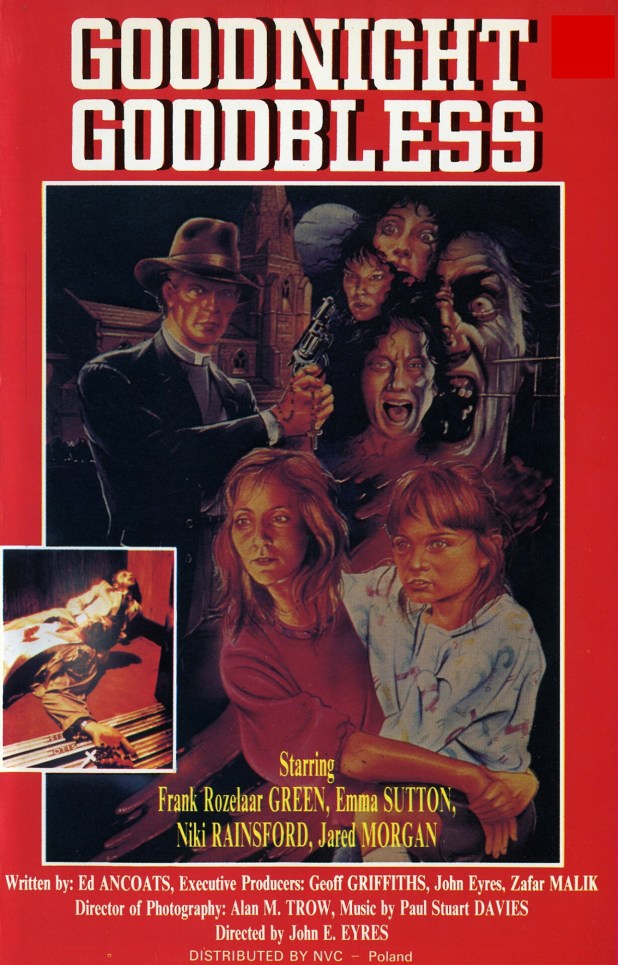
Also known as Lucifer, this movie has a killer that even the police start to realize may have an actual mission from Satan himself. He starts with a schoolyard massacre and then comes after the only survivor, Mandy, who is being protected by the police. It’s pretty shocking, to be perfectly honest, to see a priest stab a woman and then just open fire on a playground packed with small children. You don’t see that in many — any — slashers.

Sadly, this movie never gets better or stranger or remains as shockingly original as that first scene. The cop falls for Mandy’s mom, they go on a bird watching vacation and the priest just keeps killing people when he isn’t stalking our little child protagonist.

The killer priest is a great idea and so underused. So maybe instead of this one — spoiler warning — you could watch Seven Bloodstained OrchidsSilver BulletDon’t Torture a DucklingCity of the Living DeadTo the Devil a DaughterProm Night IV: Deliver Us From Evil and Happy Hell Night.

Philippine War Week II: Eye of the Eagle (1987)

If you joined us for our “Philippine War Week I” and made it though this second and final week, you know the production drill of these films. Nick Nicholson, Steve Rogers, Jim Moss, Mike Monty and Vic Dias all “star” here — and with the added incentive of Robert Patrick, yes that one: the T-1000 one.

What? No tigers? Nope, Rocky III wasn’t until ’82.

Everyone has to start somewhere and Patrick debuts, here, as Cpl. Johnny Ransom for this Cirio H. Santiago faux-Stallone romp. Patrick also starred for Cirio in the Max Mad rip, Equalizer 2000. Then Patrick became a defacto “star” in The Raiders of the Lost Ark rip, Future Hunters — by way of Cirio cutting in footage from Equalizer 2000. Or that may be the other way around: Patrick ended up in Equalizer 2000 by of way hunks of his Future Hunter work being cut in. You know how it goes in the Philippine editing suites of Silver Star Productions.

It’s been critiqued that Cirio’s Killer Instinct (1989), aka Behind Enemy Lines, which also stars Patrick, is a sequel to Eye of the Eagle; it’s not: the only throughline is that Patrick’s character is also named Johnny Ransom — and for no particular reason. But all of the war footage certainly looks the same, because it is — and is par for the course when it comes to the recycling war coffers of the Philippine Rambo Consortium.

Adding to the confusion: Eye of the Eagle is also known as The Lost Command. And Battlefield Vietnam. And Killer Instinct, aka Behind Enemy Lines, is also known as Eye of the Eagle 2: Inside the Enemy, and as Killed in Action (instead of Missing in Action IV to evoke a little Chuck Norris). And Last Stand at Lang Mei (1989) — which has nothing to do with the other two films, outside of Cirio H. Santiago directing them — is known as Eye of the Eagle III.

We give up. Is one a sequel to the other? We really don’t care.

Patrick also starred in another 1987 film, Warlords from Hell, that is believed to be another Cirio cut n’ paste joint: it’s not. That’s actually a trashy action flick about American bikers taking on a Mexican drug cartel that shot in the U.S. and was directed by Clark Henderson; he’s known for his behind-the-scenes production work on Roger Corman’s Forbidden World and Space Raiders, Cirio’s Wheels of Fire, and major U.S. films such as Sky Captain and the World of Tomorrow and The Cider House Rules.

And now, back to our program of Eye of the Eagle. The first one.

All of the usual, endless barrage of (stock footage) gun battles and over-the-top explosions ensues as Sgt. Rick Stratton (Brett Baxter Clark, who got his start in Tom Hanks’s Bachelor Party and the teensploitation romp Malibu Express; he also appears the Filipino war flick, Delta Force Commando), along with Cpl. Johnny Ransom (Patrick), set off with their “Eagle” squad to stop a band of U.S. renegades known as “The Lost Command” terrorizing South Vietnam. Stratton also has a side hussle: avenge the murder of his brother by the renegades. One of the missions Stratton and Ransom need to pull off is a train hijacking — and yes, those are shots of an electric model train. Hey, Silver Star productions can’t afford tanks or planes — only ones cut in from other films — so why did you think they could afford more than a model train and one real rail car to shoot on? Is there a mouthy, know-it-all pesky female photo journalist to get them into scrapes? Ah, you know your Philippine war flicks better than we thought.

You can enjoy the awful sound and jumpy edits and bad-everything-else-we-love on You Tube.

Of course we dug up Eye of the Eagle II and Eye of the Eagle III for you, both on You Tube. Sorry, that is actually kind of mean of us. Eh, you know you wanna watch ’em.

About the Author: You can learn more about the writings of R.D Francis on Facebook. He also writes for B&S About Movies.

Philippine War Week II: Mission Terminate (1987)

We come here, not to bury Philippine Namsplotation films, but to praise Richard Norton. That’s right, kids: it’s another B&S About Movies film-geek fandom joint.

Aussie actor Richard Norton got his start in Chuck Norris’s The Octagon (1980) and Forced Vengeance (1982), contributing to multiple episodes of CBS-TV’s Walker, Texas Ranger, starring in Robert Clouse’s Force: Five (1981) and Gymkata (1985), and with Michael Dudikoff in American Ninja (1985). And do we really have to remind you that Richard Norton starred as Slade in the great Cirio H. Santiago’s Philippine post-apoc’er Equalizer 2000 (1987)? Well, now you know: Richard Norton is right up there with Mark Gregory, Michael Sopkiw, and Daniel Greene on the B&S About Movies A-Team.

While we haven’t seen all of Richard’s almost 70-and-climbing credits, we’ve seen most of them. And some are great — like the films we’ve mentioned — while others are not so great. There’s not another actor that’s more hard working, who was stuck in some questionable projects over the years, who started out as a bodyguard to the Rolling Stones and personal trainer to Mick Jagger. We reviewed his most recent effort, if you’re interested: the 2021 Australian crime-thriller, Rage.

See. The fanboy section of the review has ended. That didn’t hurt. Back to the movie . . . and to hell.

Also known as Return of the Kickfighter, the plot concerns, you guessed it: more corrupt American soldiers on a war-profiteering tear, democratic freedom on the Indonesia mainlands, be damned.

So, to the chagrin of their Vietnamese guide (Asian Martial Arts mainstay and Brucesploitation star Bruce Le), a U.S. marine unit raids a Vietnam village — for a gold stash — and they kill the villagers.

Yes. Of course, we “flash forward” ten years. Haven’t you been paying attention at all this week? That “flashback” set up is how all of that old ’70s war footage is clipped into the film, so as to up the production values.

Well, eh, actually . . . this time, it’s 15 years. And someone is murdering the members of the unit — one by one. And the chicken shit leader of that raid, now a high-ranking officer with a cushy government desk job with the Pentagon, needs to clean up the mess. So, with a little lie there and half-truth there, he sends in the only man for the job (again?): Pentagon black-ops agent Major Brad Cooper, aka the man we came to see, Richard Norton. But Cooper gets wise pretty quick and figures his Pentagon boss, Col. Ryan, committed the atrocity all those years ago. So Cooper is sidelined from the mission. But Cooper goes rogue. And his “mission” objective changes.

He meets Quan Niehn, the Vietnamese guide from 15 years ago. Turns out, Quan and his brother nursed an injured Ninja Master hurt in that raid back to health and, in payment, the Master taught the brothers the ways of the Ninja. Then the brothers went “Cain and Able,” with Quan to the good Vietnamese side and his brother to the evil Viet Cong side. And the plot twist is that we think Quan is killing the members of the unit, but it’s really his evil brother — the leader of a secret, Mountain stronghold terrorist boot camp. So, once Quan and Cooper make nice, Coop calls in his old Queen’s Cobras unit to kick the evil brother’s ass. The firefights and explosions and bodies plowed down by more bullets than John Rambo and John Matrix can handle, ensues.

What makes this work is the martial arts, something Sly and Arnie couldn’t bring to the table. The Return of the Kickfigther handle is clearly the more effectively, descriptive title, with Bruce Le (1978’s Return of the Red Tiger and Enter the Game of Death) and Hong Kong action star Dick Wei (1978’s Five Deadly Venoms and 1980’s Claws of the Eagle) mixing it up with Richard Norton — who keeps his Australian accent on-camera (a HUGE difference in quality for this film against most we’ve reviewed this week), which is explained away as being an “All American” since he was trained by the American military.

Ugh. The full movie was uploaded when we made the schedule — now it’s gone. Well, you can at least watch this “Kill Count” montage and eight minute fight scene (embedded above) between Richard Norton and Bruce Le on You Tube. Director Anthony Maharaj, here in his debut, got his start as a screenwriter with the Philippine war flick Final Mission (reviewed this week; look for it) and the post-apoc’er Future Hunters for Cirio H. Santiago. Maharaj and Norton worked on a second Indonesian war flick, Not Another Mistake (1989) — no, we didn’t review that one, this week. You can’t do ’em all.

About the Author: You can learn more about the writings of R.D Francis on Facebook. He also writes for B&S About Movies.

Philippine War Week II: Platoon the Warriors (1987)

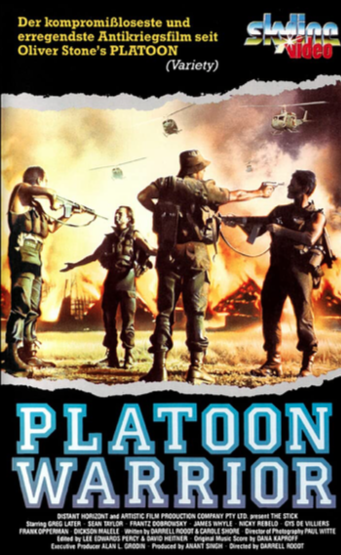
Take the 1984 Filipino movie Diegong Bayong, get some footage from Hong Kong, throw it in a blender and boom, you have Platoon Warrior or Platoon the Warriors and yes, if you’re wondering if this has something to do with Godfrey Ho of course it does.

Jack Barlow (Anthony Alonzo) has lost his son, father and mother to a gang who puts the cherry on the top of the Death Wish cosplay sundae by assaulting his daughter.  And that would be the Diegong Bayong parts, as he gets one gang to kill another gang which seems, well, nothing like either PlatoonThe Warriors or anything Death Wish.

There’s also a two and a half minute love scene from that movie repurposed, remixed and reused here and — of all things — set to Kraftwerk.

Somehow, this trailer is a billion times better than the actual movie.

This movie is also not the Michael Dudikoff vehicle Platoon Leader.

It’s…man Godfrey Ho and his crew are wild because this is such a puzzle of so many things jammed together that I have no idea what I’m to get out of it. I was expecting an 80s jungle film and I got something else but then it went back to the jungle.

Look, in the Philippines, they make spaghetti with banana ketchup and cut up hot dogs and that makes more sense than what I just watched.

You can watch this on Tubi.

Philippine War Week II: Top Mission (1987)

So, before we get into this Godfrey Ho joint, let’s clear up the title confusion: Do not confuse this with the ex-The Dukes of Hazzard John Schneider bomb that was Cocaine Wars (1985), which became known as Top Mission in the overseas markets. And don’t confuse this Godfrey Ho joint with another of Ho’s chop shop joints, Top Team Force (1989), which is a film about the Hong Kong mafia that also aka’d the marketplace as Top Mission Exterminator.

So, before we get into this Godfrey Ho joint, let’s clear up the stock footage confusion: Most of the nifty action comes from William Mayo’s third feature film, Diablo Force (1986). Where the rest of the footage comes from . . . well, probably two to three more films that we can’t track down . . . forever lost in the vaults of Tomas Tang’s Filmark International Studios and K.Y Lim’s Silver Star Productions.

Oh, we should mention that Uncle G is deploying the name of Henry Lee for this run through the jungle. Okay, that’s all settled. Let’s load ‘er up!

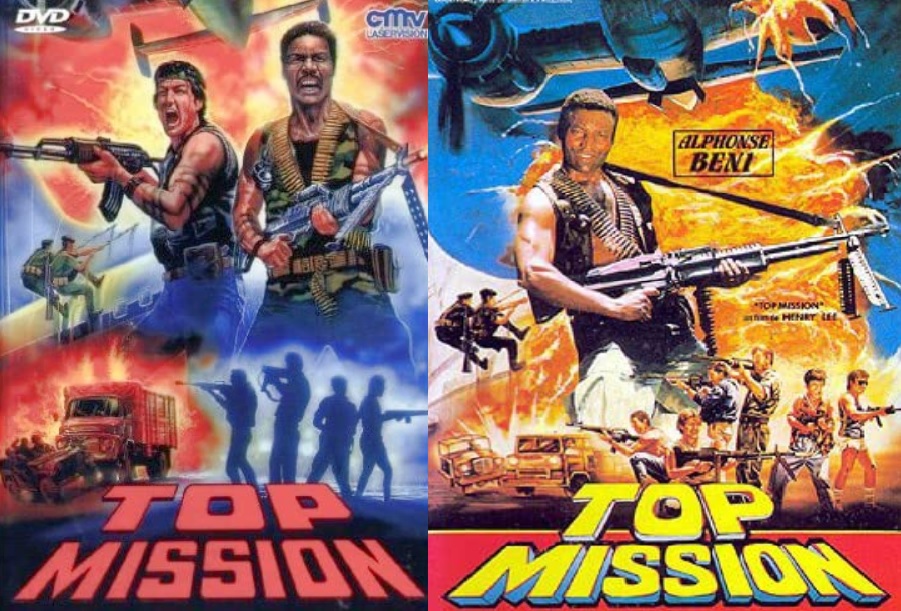
Two covers. Twice the junk.

The leading lad here is Cameroon-born African actor Alphonse Beni, who made his mark in the international VHS marketplace with his vanity set piece, Cameroon Connection (1985; with Bruce Le), and Richard Harrison’s like-minded piece, Three Men on Fire (1986). Beni is one half of a biracial C.I.A duo (the other is the one-and-gone Kurt Eberhard) — both complete with ninja warrior skills — sent into the jungles to rescue a professor, who has developed a laser weapon. He’s been kidnapped by a fellow, rogue C.I.A agent who’s set up his own terrorist organization. Along the way there’s a plane hijacking, a couple of double crosses, bad dubbing, a jailbreak, bad editing, and a showdown inside a music club.

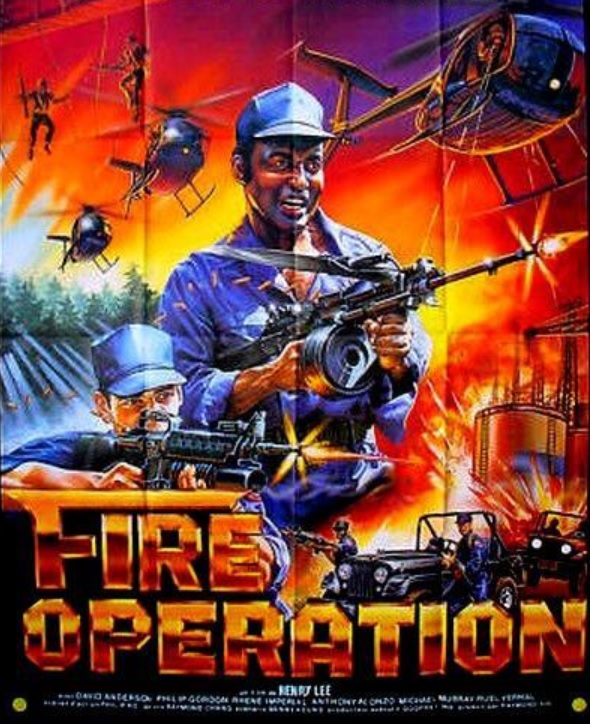
Adding to the Steenbeck reels of confusion: The same year Top Mission was released, Alphonse Beni also starred in Ho’s Fire Operation (1987) and Phillip Gordon (Strike Commando, The Siege of Firebase Gloria, Battle Rats, Kill Zone are a few of his 20-plus credits), who starred in Top Mission, co-stars, once again, with Beni.

Now, we can’t find any jungle Intel that states Fire Operation is an alternate title to Top Mission or if one is a recut-reimage of the other (see Ho’s analog chop socky of Devil’s Dynamite vs. Robo Vampire). But we’ll lay down our pesos on the green felts of a back-room Manila gambling joint that Beni never signed on for a film called Fire Operation and footage from Three Men on Fire and Ninja: Silent Assassin (1987), as well as Top Mission, is how Beni came to “star” in that Godfrey Ho production . . . where ninjas are so skilled, they, apparently, can be air-dropped into chopper blades!

Top Mission . . . incognito?

You can figure it all out with the full film of Top Mission and the trailer for Fire Operation on You Tube.

About the Author: You can learn more about the writings of R.D Francis on Facebook. He also writes for B&S About Movies.

Philippine War Week II: Super Platoon (1987)

This Godfrey Ho Philippine Namsploitationer to cash in on all things John Rambo is actually a pre-John Rambo Hong Kong action-joint known as Black Warrior by Tomas Tang. Tang, by way of his Filmark International Studios, is a name you see oft-mentioned on Ho’s end product since a lot of Tang’s stuff, such as Devil’s Dynamite, ended up as a reedited Ho joint, such as Robo Vampire. In fact, you could dedicate an entire WordPress site just on the wealth of Ho-cum-Tang flicks. Adding to the bola ng katituhan is the fact this also slopped through the VHS marketplace as a sequel to Jungle Rats, aka Jungle Rats 2: Black Warrior. And since the covers are the same, well, now you know from whence all of that stock footage for Jungle Rats, came. Where’s Romano “Rom” Kristoff? Well, he’s not, here. . . .

Compare to Jungle Rats and be amazed!

As in Jungle Rats: we have another reconnaissance team assigned to trek through the jungle borders to rescue a group of soldiers and a couple of American Red-Cross civilians — civies acting as double-agents feeding Intel to the military — taken captive and imprisoned by the Vietcong. Yes, as in several of these movies: the soldiers’ jungle guide is . . . a woman . . . and all of the usual stock footage bridges and hut explosions, ensues . . . as no plot or character, develops.

Apparently, one by the name of “Glenn Clegg” wrote this tumpok ng tae, but I’m pagsusugal’in my pesos that an anglicized, expatriated American actress Sally Nicholls (aka Nichols) script-cobbled (Mission War Flame) this one for Godfrey Ho — who is here, depending on the VHS print you see, as “Christ/Chris Hannah” to “direct” this mess. Who are actors Barry Hyman, Kevin Brooks, and Rachel Sheen: your guess is as good as ours.

If you can figure it all out on You Tube and let us know, thanks! But to help you out . . . no, Platoon Warriors is, in fact, a completely different Philippine-made warsploitationer. And the Michael Dudikoff vehicle Platoon Leader — which we didn’t get to this week — is another completely different film. Well, except for the recycled war footage. . . .

When you can’t evoke Sly Stallone, there’s always Oliver Stone.

About the Author: You can learn more about the writings of R.D Francis on Facebook. He also writes for B&S About Movies.

Philippine War Week II: Mission War Flame (1987)

Godfrey Ho. He’s Joe Livingstone. He’s Willie Palmer. He’s Charles Lee. And here, he is Bruce Lambert behind the camera and Eric Coleman behind the typewriter. You’ll also notice the name of Sally Nicholls credited for “dialog” on many of Godfrey’s films. Well, someone had to thread together Ho’s piecemeal efforts into coherency. And she’s a real person, not an alias — an actress whose work dates back to the ’60s with Lon Chaney, Jr. And you’ll notice notable Hong Kong action star Tao Chiang — 187 credits strong since 1968, with his most recent film, Yang Jingyu, out in 2019 — starring here.

Now, we have to note — taking into account that acting in Philippine cinema is like checking into the Eagles Hotel California: once you sign on the dotted line, you never leave the industry. Especially on the line with Silver Star Films, for they will keep recycling that footage into movie after movie after movie.

So, when you begin dissecting Ho and Chiang’s joint resume, going back to The Deadly Silver Ninja (1978), Ninja Thunderbolt (1984), and Fatal Command (1986) — for nineteen films total, prior to the making of Mission War Flame — you begin to wonder how many of these films did Tao Chiang actually “act” in and how many was he “spliced into” for proxy-stardom? And how much of those films — as well as Mission War Flame — did Godfrey Ho actually shoot. Just look at that opening artillery-filled prologue. A Godfrey Ho production employing all of those extras — and artillery cannons? Nope. Not buying it: it’s from another film. But what film: that is the question. Nothing here looks like it was originally shot, sans some linking materials, but even that is questionable. And all of the footage looks like it’s from 1977 — or earlier — than the 1987 release date of the film.

So, that stock Vietnam war film footage has run the villagers from their jungle mountain enclave. Now we are into the Ho-shot footage — we think — with a bunch of Americans in non-military camouflage lined up to spout some dubbed dialog as they prepare for a mission, aka “the war flamers” of the film. One of our soldiers lets us know, “I am not afraid of anything. Not even war itself.”

Forward! March!

Now we have some Asian actors — probably from another film, as well — as they mount up for the U.S. soldiers’ attack, that is, “the footage” from the other film.

Now, with a third batch of mismatched footage, we’re meeting the family of Paul, a young Vietnamese doctor recruited — against his family’s objections — into a U.S. Marine-backed military force that will go up against the Viet Cong — from that previous batch of spliced-in film — that took over a hill and ran off those villagers. In fact, it’s not just Paul. Apparently, you can just be walking down a dirt road with your girlfriend and you’re “recruited” into the fighting force. Here’s your papers. Report for duty. You’re helping us take back that hill.

Oh, and there’s the tanks that finally appear at the end. Trust us. Godfrey Ho didn’t rent any tanks and it’s from another film.

The “human drama” comes from the fact that Paul and the other recruits love the glory of fighting for their country. Paul’s wife calls him a “monster,” you know, just like with the “Return from ‘Nam” movies made in America. And this is where the B&S About Movies editorial board allows us to drop “ensues” into the review. Only, nothing ensues . . . as this has none of the all-out action assault of most of the other “Philippines War Week” entries we’ve covered this week and back in August during our first tribute to Philippines war flicks.

Ah, but Godfrey comes through in the end. Paul and the two other saps that got recruited into the fight, struggle to raise the American flag on the recaptured hill — only to die in a hail of sniper fire. Now, that would be a heartbreaking ending in another film. Here, the “message,” if any, about the cost of war, and honor, and glory, is lost. For this is just plain bad — and criminal — that this patch job of obscure South Asian films from the ’70s was marketed in the backwash of First Blood and Commando. There’s not even martial arts to wow us. Just a whole lot of “uggghs” and “aihyaaaahs” as bodies fall under hails of squibs.

There’s no trailer to share because, for there to be a trailer, there needs to be a “story” to cut into a trailer with a narrative arc to tell you what the film is about in the first place. But we did find a copy of Mission War Flames on You Tube — but more for you to fast forward through than actually watch. But we know you’re a celluloid masochist . . . Aihyaaaaah!

About the Author: You can learn more about the writings of R.D Francis on Facebook. He also writes for B&S About Movies.

Lady Beware (1987)

There are a small number of movies in the subgenre that I invented and I don’t know who has to approve it. They are known as Yinzer Giallo. These are movies made in Pittsburgh that must follow these rules. We will test Lady Beware against them.

First off, is it a Giallo?

Has there been a murder, or is the lead character a fish out of water being stalked by someone and exposed to threats of psychosexual violence?

Yes: Katya Yarno (Diane Lane, making her second Pittsburgh/Western PA film appearance, as I always consider Ladies and Gentlemen, The Fabulous Stains as taking place somewhere in the Pennsylvania rust belt called Charlestown here, which is the same town as Slap Shot, so I guess it’s Altoona) is a fashion designer who has gotten the most desirable of all Steel City fashion jobs. She’s a window dresser at Horne’s.

Jennifer Woytek

A quick note: Horne’s was a regional department store chain based in Pittsburgh that, at its height, had twelve locations. The best known was downtown — it’s now offices for Highmark — on Penn Avenue and Stanwix Street. It was a seven-story department store with a famous Christmas tree still lit as part of Pittsburgh’s Light Up Night. You can also see another Horne in Dawn of the Dead, which inspired the character of Ben Joseph Horne on Twin Peaks, as co-creator Mark Snow went to Carnegie Mellon.

Other than creating the window displays for their rival store, Kaufmann’s—which leads to the yinzer term for minding your business, “Does Hornes tell Kaufmann’s their business?”—having this job would have been the job in 1987.

Anyways…

Katya is a small-town girl in a big city, which is funny because Pittsburgh is the smallest city. That said, her window dressings are pretty sexual and filled with allusions to BDSM, which leads to Jack Price, a married and obsessive maniac, starting to stalk her and call her with incredibly sexually depraved phone calls.

So, while there’s no murder or black gloves, there’s plenty of stalking. Katya may not feel guilty for her window scenes, but numerous men outside are positively scandalized and probably ran up to St. Mary of Mercy on Stanwix for absolution.

A Yinzer Giallo aside: Much like Rome, the kinda sorta birthplace by way of England and then Germany for the main Giallo form, the large number of Italian — and Italian — immigrants to Western Pennsylvania makes Catholicism and its morals central to growing up here for many people.

Is there high fashion, beautiful people and abundant nudity?

There’s a ton of fashion in this. The costumes were designed by Patricia Field, who would be much better known for creating the clothes for The Devil Wears Prada and Sex and the City, a job she got after impressing Sarah Jessica Parker years before in the movie Miami Rhapsody.

As for the nudity, the one scene in which Lane is nude was supposedly taken while she was unaware.

Director Karen Arthur (The Mafu Cage) told the Los Angeles Times, “Some distributors asked for more sex, so they took outtakes of Diane Lane standing there naked and incorporated them into the film. To me, that that’s exploitative. They printed up negatives where I never said print. I, as a female director, would never exploit a woman’s body and use it as a turn-on.”

The director nearly removed her name from the movie but didn’t think it was fair to the actors, who couldn’t remove their names and do an Alan Smithee.

To be a Pittsburgh Giallo, the film must accomplish all of the above — when possible — and also:

Be true to its Pittsburgh roots, meaning that the movie must be filmed here while speaking directly to the experience of growing up in the city.

This is true because this movie could have made up any store and chose Horne’s. Now, we can debate the industrial loft that Katya lives in—maybe it’s in the Strip District—but the fact that she has a bathtub in the middle of the room is very actual to the stylistic ideal of the Pittsburgh toilet, which is just a toilet in the basement with no walls, sitting there for very unprivate moments.

If filmed here, it must reference Pittsburgh and not have the city stand in for another town.

Executive producer Lawrence Mortoff had produced the 1984 Nastassja Kinski-starring Maria’s Lovers in Pittsburgh, so he brought the movie to the City of Bridges, getting 28 shooting days, mainly in Dahntahn and the North Side.

It must feel authentic, which helps several films on this list as they are movies with moments that only make sense when you’re a lifelong Pittsburgher.

True to 1987, Pittsburgh Magazine shows up to report on the windows. And while there are few Steelers jerseys and bottles of Iron City, Katya does go on a date to the Grand Concourse, which, other than LeMont, would have been one of the better places for a date back in the late 1980s.

Speaking of Pittsburgh, look for locals like Chef Don Brockett (who appeared on Mr. Roger’s Neighborhood and was legally bound to appear in every movie made in Pittsburgh, as he does in Silence of the Lambs and Flashdance), Steel City stage legend Bingo O’Malley, and Audrey Roth (Mr. Roger’s friend Miss Paulifficate) in this.

Verdict: Yinzer Giallo

Sadly, this movie escaped its director, who had worked on it since the late 70s. In the same Los Angeles Times article, Arthur said that the movie had “100 homes, 17 drafts, and eight writers” while being upset by the film’s production team at Scotti Brothers: “The purse-holders are men, and they attempted to make Lady Beware into a violent picture. I’m not interested in making a picture where a woman gets beat up. I want to show how a lady deals with this kind of insidious violence. A policeman can’t help.”

Starting with the success of Leif Garrett — their record label also had James Brown in the late 80s, Felony, Survivor and “Weird Al” Yankovic — Scotti Brothers moved into movies and TV — they were involved in the production and distribution of Baywatch — and made the films The ResurrectedEddie and the Cruisers II: Eddie Lives!Eye of the Tiger (well, that makes sense seeing who was on the label), In the Shadow of Kilimanjaro, He’s My Girl, Stealing HeavenThe Iron Triangle and Death of a Soldier.

Who is to blame? One of three Scotti brothers who produced this, Tony, would play Tony Polar in Valley of the Dolls; I don’t see any gossip about him. As for Mortoff, in addition to producing movies in nearly every genre, he directed one film, 1993’s Deadly Exposure. None of these things point to anyone, but regardless of who was to blame, Cotter Smith’s performance was cut down — he’d return to Pittsburgh to be in the series Mindhunter — and all of Viveca Lindfors’ parts were cut. She’d also come back to be in Creepshow and North of Pittsburgh.

However, this heavy-handed interference made the film confusing. And, look, Giallo can already be hard to understand.

It’s a shame because Lady Beware does have some moments where you can see that it has the hope of being a great film. The close — using mannequins to attack the male aggressor — suggests a more heroic female Maniac, which is an interesting turn.