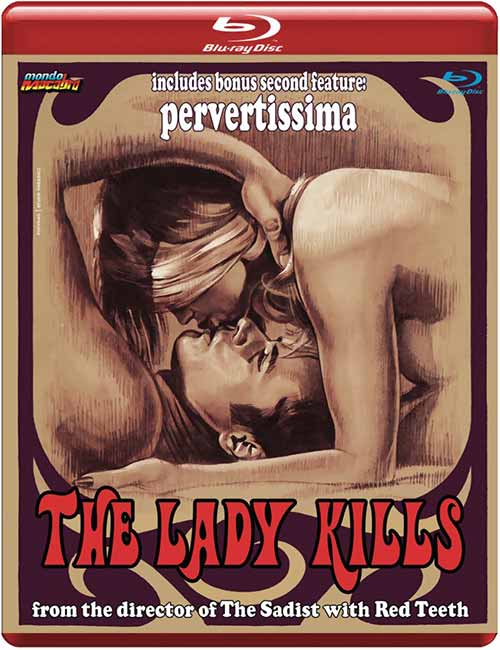
Françoise Frémond (Carole Lebel, Two Weeks In September, The Golden Claws of the Cat Girl) is killing her way across Europe, leaving horrible men’s dead bodies behind. Keep in mind this movie was made before Ms. 45 or I Spit On Your Grave or even Thriller: A Cruel Pictureand offers a similar blast of female revenge violence set to a psych-rock freakout soundtrack.
After a pop-art style assault by several men, Françoise spends the rest of this film tracking each of them down and killing them all in various ways. There’s also high fashion, the aforementioned swinging electric jazz and nudity that juxtaposes the feminist revenge narrative because at heart, this is still an exploitation movie.
You can get this — along with Pervertissima, which was also made by director Jean-Louis van Belle — from the amazing folks at Mondo Macabro, who were kind enough to send us the blu ray for review and understanding enough to know that it won’t impact our review.
Beyond the new 2K transfer for both movies, you’ll also get a “Who is Jean Louis Van Belle?” documentary featurette and introductions for each film by Belgian film expert Christophe Bier. This film is a must-have, as it has never been remastered, restored and available on home video anywhere in the world ever before.
March 2022 Announcement: Severin Films has released a Blu-ray of Nosferatu in Venice — scanned in 2k from the original negative — which serves as the unofficial sequel to Werner Herzog’s Nosferatu. In addition to cast and crew interviews, the Blu also features the 80-minute documentary, Creation is Violent – Anecdotes From Kinski’s Final Years.
Severin has since released the documentary as an independent stream on the free-with-ads Tubi service.
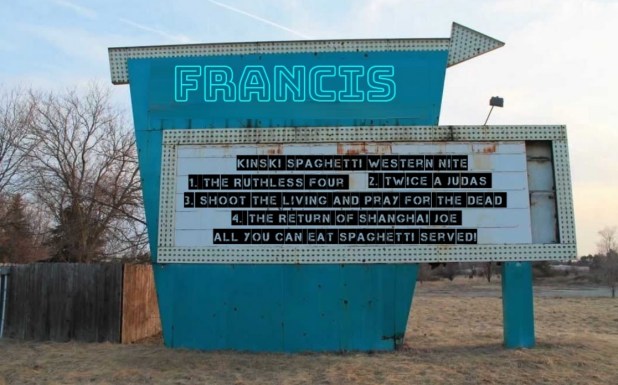
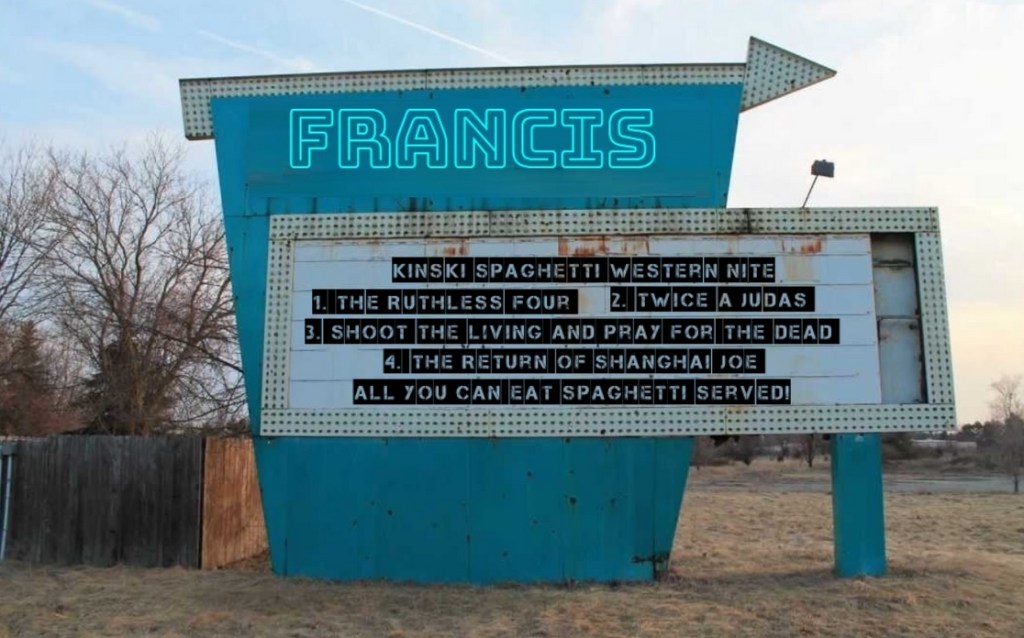
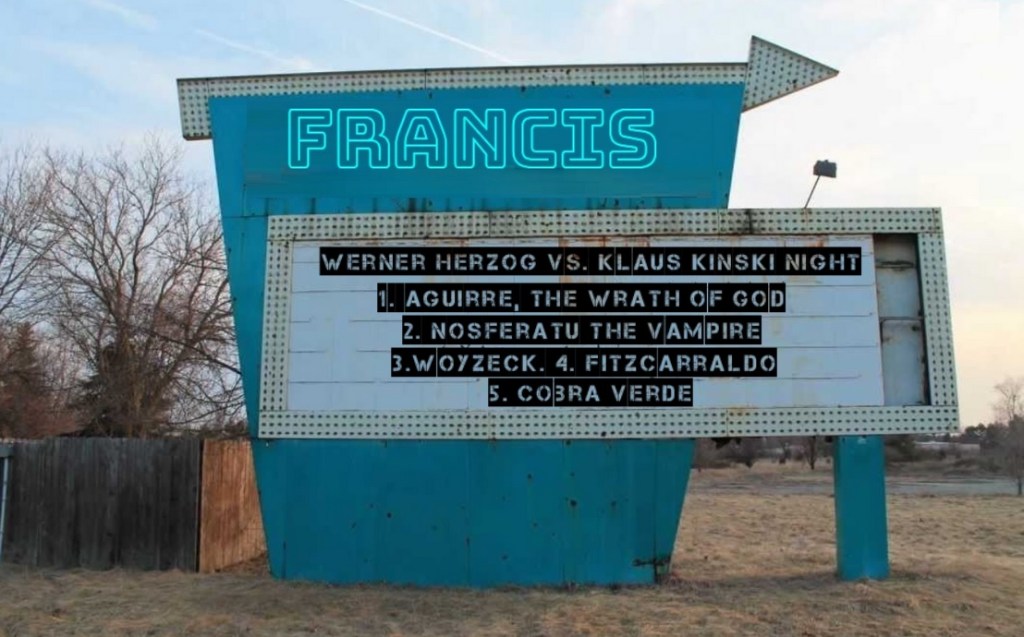
So Sam came up with a “Spaghetti Westerns Week” (running from Sunday, August 16 to Saturday, August 22) . . . and me, with my Klaus Kinski-mania . . . well, it’s time for another “Drive-In Friday” salute to Klaus as we follow up our June “Drive In-Friday” tribute to the five-film oeuvre of Kinski with Werner Herzog.
Yes, we’ll supply the Parmesan.
Klaus made his first jump into the Western-pasta pot in 1965 as Juan Wild, the hunchback member of El Indio’s (Gian Maria Volonte) in Sergio Leone’s For a Few Dollars More. Kinski then appeared in A Bullet for the General (1967; also starring Gian Maria Volonte), and Man, Pride & Vengeance (1967; starring Franco Nero).
As with Kinski’s oeuvre in other genres: I’ve seen some of Kinski’s westerns (the ones featured tonight), but not all of them (and probably never will), but seen most of them courtesy of the long since gone VHS grey market purveyor VSOM: Video Search of Miami, which excelled in making overseas films available in the U.S.
When it comes to these films, in terms of quality in cinematography . . . well, each try but none succeed in exceeding — or even matching — Sergio Leone’s filmmaking style displayed in the Dollars Trilogy of A Fistful of Dollars (1964), For a Few Dollars More (1965), and The Good, the Bad and the Ugly (1966). So, if you know those Clint Eastwood-starring films, well, there’s really not much critical analysis to be had with Klaus Kinski’s inversion of the genre. Just know you’re getting serviceable copies of Clint’s films and if you’re a Kinski fan — such as myself — you’ll want to spend your time watching them. All others will probably pass because, if you’ve seen one spaghetti western, you’ve seen ’em all. Between the one-sheets, my gibber-jabber about the films, and the trailers, you’ll figure it all out. The main goal, here, is to make you aware of and guide you through Mr. Kinski’s “spaghetti years” before he became a go-to actor for Werner Herzog.
Alrighty then! Let’s pop those RC Colas and ride, meho!The riches of the lands South of the Border await us!
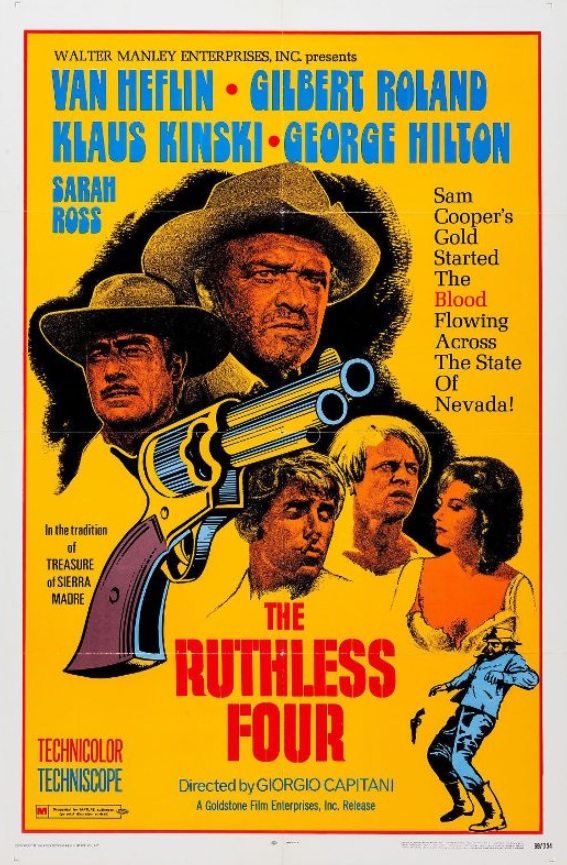
Movie 1: The Ruthless Four (1968)
Known in its homeland as Ognuno per sé (aka, Everyone for Himself) — and in West Germany as Das Gold von Sam Cooper (aka, The Gold from Sam Cooper) — Kinski co-stars with Best Supporting Actor Oscar winner Van Heflin (1942’s Johnny Eager), who wowed then little tykes (like myself) roasting under the black & white’s cathode ray glow of Pittsburgh’s WIIC Channel 11 with his roles in the iconic westerns Shane (1953), 3:10 to Yuma (1957), and Gunman’s Walk (1958).
By the turn of the ’60s, Heflin’s star — along with his Gunman’s Walk co-star, Tab Hunter (1988’s Grotesque with Linda Blair) — had fallen, but there was a huge market for American actors in Italian cinema. So Heflin made his first film there, Tempest (1959) and, along with Tab, was billed under Gary Cooper and Rita Hayworth in They Came to Cordura (1959).
The title — and alternate titles — of this one pretty much says it all: Four men embark on a suicide mission for a fortune in gold from a mine owned by Nevada prospector Sam Cooper (Van Heflin). Always the heavy, Kinski is one of the greedy four, Brent the Blonde, a faux-preacher with blood on his hands . . . and one more body means nothing to him.
Up next for Kinski: 1968’s If You Meet Sartana . . . Pray for Your Death. He also worked on the sequel, I Am Sartana, Your Angel of Death (1969). (Sartana was, of course, Gianni Garko, that ‘ol space scoundrel Dirk Laramie from Star Odyssey.)
You can watch The Ruthless Four on You Tube. There’s also a stream on TubiTV.
Movie 2: They Were Called Graveyard, aka Twice a Judas (1968)
Antonio Sabato (Escape from the Bronx and War of the Robots) stars in this film noir-inspired Spaghetti Western as Luke Barrett, a cowboy who regains consciousness with bullet-grazed head wound in the middle of the desert . . . next to a dead man — and a lone rifle with the word “Dingus” carved in its stock. Sabato gathers clues along the way to discover that a hired gunman is out to get him . . . and that he himself was a gun hired to kill Dingus. Yep: You guessed it: Kinski is Dingus and he’s out for blood.
Kinski also worked on Sergio Corbucci’s pasta-western, The Great Silence in the same year.
You can watch They Were Called Graveyard on You Tube.
After working with Antonio Margheriti (1966’s Lightning Bolt) on the western And God Said to Cain (1970), Klaus Kinski received top-billing in this desert noir that Quentin Tarantino* ranked as his 16th personal “Top 20 favorite Spaghetti Westerns.”
Kinksi stars as Dan Hogan, an ex-Ku Klux Klan member leading a gang of bank robbers on the run with $100,000 in gold bars. Hogan’s dark past comes back to haunt him in the form of John Webb (Paolo Casella, who also co-starred with Kinski in the 1970 western, The Beast, and the next film on tonight’s program: 1975’s The Return of Shanghai Joe), a stranger who killed the gang’s guide into Mexico and wants half of their gold for safe passage. And all of their blood. So he really wants all of the gold.
Klaus also starred in the westerns Adios Compañeros, Black Killer, Coffin Full of Dollars, His Name was King, and Vengeance Is a Dish Served Cold that same year. Next up for Kinski: 1972’s A Noose is Waiting for You Trinity.
You can watch Shoot the Living and Pray for the Dying on You Tube.
The film noir-influence of Kinski’s previous pasta-westerns takes a turn into the then hot Kung-Fu genre — courtesy of Japanese-born martial artist Chen Lee (aka, Cheen Lie, playing a Chinese man here). As result of its martial arts plot, this also appeared on several ’70s Drive-In double and triple-bills, alongside more traditional Asian-action imports, as The Dragon Strikes Back (to trick you into thinking you’re seeing a Bruce Lee movie).
In the first film, 1973’s (My Name is) Shanghai Joe (aka, The Fighting Fists Of Shanghai Joe), Kinski was Scalper Jack. In the sequel, Kinski is his usual, sinister self as new character, Pat Barnes: a town boss whose stranglehold over a dusty, desert town runs afoul of Shanghai Joe (actually an uncover U.S. Federal Marshal), who’s assisted by a smooth-talking traveling medicine show man he saved from Barnes’s bully boys.
* Back in July 2019, we had a “Quentin Tarantino Week” of reviews to celebrate the release of Once Upon a Time in Hollywood. Be sure to visit our “Exploring: The 8 Films of Quentin Tarantino’s Rolling Thunder Pictures” featurette that includes the links to all of our week’s reviews and examinations of the films that influenced Quentin’s work.
We’ve reviewed a LOT of Kinski’s films — and we run ’em all down with our second drive-in feature spotlighting his career. Check ’em out!
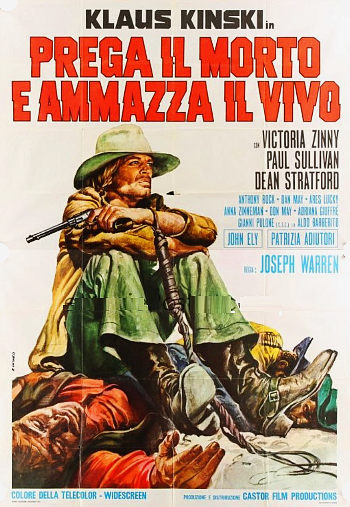
This movie has so many titles — Pray to Kill and Return Alive, To Kill a Jackal and Renegade Gun — but I went with the one closest to the original Italian title (Prega il Morto e Ammazza il Vivo).
It’s directed by Giuseppe Vari, who brings something artistic to every movie beyond just straight exploitation. As Joseph Warren, he made the giallo Who Killed the Prosecutor and Why? He also a very early zombie movie, 1963’s peblum War of the Zombies, as well as Urban Warriors and Sister Emanuelle, in which Laura “Black Emanuelle” Gemser renounces her sexual sins and becomes a nun until a spoiled rich girl (Mónica Zanchi) reawakens her lust just in time for an escaped murderer (Gabriele Tinti, husband to Gemser) to hide out amongst the nuns. Whew!
Dan Hogan (Klaus Kinski) and his gang have made off with $10,000 from a stagecoach and are due to meet at a saloon on the Mexican border. As the men wait for his girlfriend to bring their money to them, they encounter John Webb, who has killed the man who was to be their guide to Mexico. He asks for half the money to take them, but in truth, he’s wanted to pay back Hogan for years.
Writer Adriano Bolzoni (A Fistful of Dollars, Minnesota Clay, The Mercenary, Your Vice Is a Locked Room and Only I Have the Key) infused this movie with a film noir edge, with Kinski’s character making his first appearance is similar to Edward G. Robinson’s first appearance in Key Largo.
Seeing as how this is number sixteen on Quentin Tarantino’s top twenty Italian Westerns of all-time list, it’s not a stretch to say that this movie directly inspired The Hateful Eight.
You can watch this on YouTube.
Don’t forget! We did a Klaus Kinski spaghetti westerns blowout for a “Drive-In Friday” featurette that runs down the mad German’s entire shoot ’em up resume. Join us, won’t you? We give full reviews — with a different insight to Shoot the Living — and new reviews to The Ruthless Four and Twice a Judas.
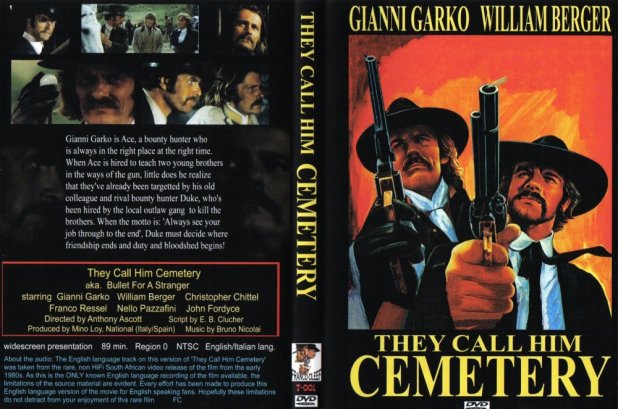
John (Chris Chittell, The Wild Geese and the long-running UK soap opera Emmerdale) and George McIntire have run into some trouble with a gang. They have no way of surviving until a mysterious stranger named Cemetery (Gianni Garko, Sartana himself!) rolls into town to help them against the baddies, who then hire his nemesis Ace (William Berger).
If you listen to the Bruno Nicolai theme and it sounds familiar, that’s because it was used in the game Red Dead Revolver.
We’ve discussed before that Edoardo Mulargia made movies called Cjamango, Shango and Don’t Wait, Django… Shoot! As you can read, he really, really liked Django.
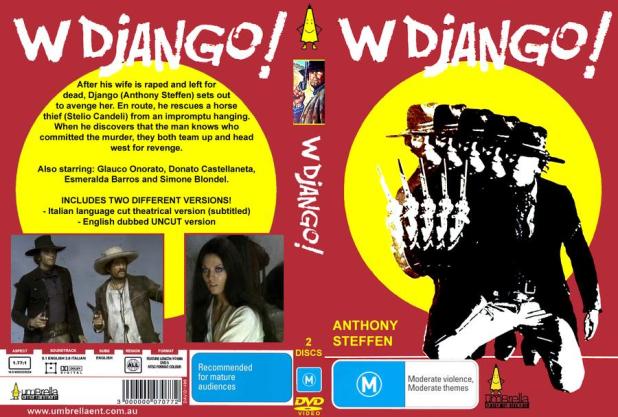
This time, Andrew Steffan takes the role, tracking down and killing the men who killed his wife. He’s helped by a horse thief named Carranza (Glauco Onorato, who was mostly known for his dubbing work). Of course, that criminal may not be telling all he knows about the night Django’s old lady went down.
This one is also known as A Man Called Django! and Viva! Django, a fact that I learned as I made it a minute into each of those films before realizing that I had already seen this movie.
While this is also called Viva Django!, don’t confuse it with the 1968 Ferdinando Baldi film, which was originally intended to star Franco Nero, but has Terence Hill in it (he’s listed as Django, Joe Cassidy and Trinity in the SWDB) and George Eastman as one of the men who must pay.
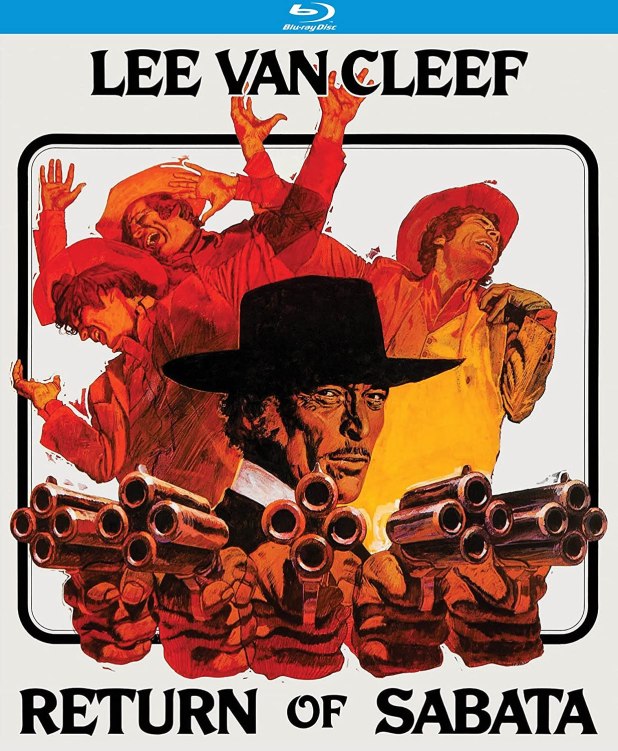
Back for the third film, Lee Van Cleef is Sabata again in a movie known in Italy as È Tornato Sabata … Haichiusoun’altraVolta (Sabata is Back … You’re Finished Again). Now, our hero is working for a traveling carnival as a trickshot. However, when he runs into an old war acquaintance who owes him $5,000, well…people get shot.
Sabata ends up fighting an entire town that puts a tax on everything he loves — gambling, drinking and prostitution. Ignazio Spalla plays another friend, this time named Bronco, and Aldo Canti plays an acrobat who aids our black-wearing protagonist.
As his theme song says, “If you wanna get money and if you wanna get rich and if you wanna get life, you gotta be a son of a…” And so Sabata is. That same song also refers to him as a nine-fingered man. That’s actually true, as Van Cleef lost a large portion of his middle finger while building a playhouse for his daughter.
Director Gianfranco Parolini would go on to make God’s Gun and Yeti: Giant of the 20th Century, a movie that I definitely need to get to.
This movie ended up in The Fifty Worst Films Of All Time by Harry Medved with Randy Dreyfuss. Over the years, I’ve come to love so many of the movies in this book, including Airport 75, The Ambushers, Godzilla vs. Hedorah, The Last Movie, Robot Monster, The Omen, The Story of Mankind and Valley of the Dolls.
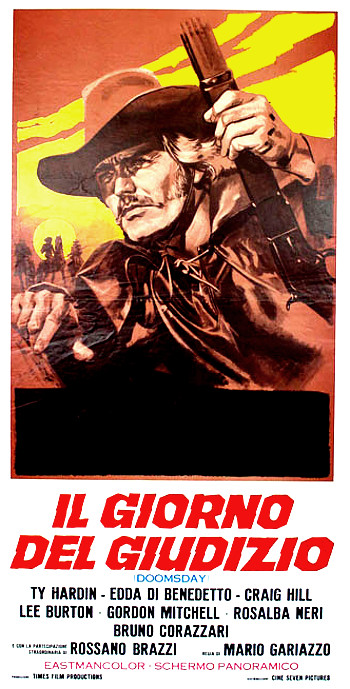
I love spaghetti westerns, something about them has intrigued me since first viewing The Good, the Bad and the Ugly. I go through spurts where I watch a slew of them and then get a bit burnt out or my viewing interests take a huge leap in another direction for a while. I spend hours sometimes going through Amazon Prime’s catalog and looking for spaghetti westerns and I came across Day of Judgement.
Day of Judgement from 1971 is about a yankee soldier who returns to find his homestead destroyed and his son and wife murdered. All that is left in the rubble is a small tin windup drummer. He sets to carve a vengeful path through those that perpetrated the heinous act. Each man he encounters is met with the strange noise of the tin drummer and told to make their play when the drummer stops.
Ty Hardin plays the stranger who comes into town and starts paying the gravedigger and undertaker to keep digging and making coffins until he tells them to stop. It’s a violent western with typical tropes, the stranger coming to town to seek vengeance, a sheriff that may or may not be on the up and up and plenty of bullets flying throughout its runtime. It has a few small moments of nudity as well which may interest some folks. I like that the sheriff is pretty much sleeping with prostitutes the entire movie and saying he’s trying to find the man who is killing all the folks.
It’s a decent little Italian western with its most notable feature being that it lifts Ennio Morricone’s score from Hellbenders and drops it into this film. I think the drummer is enough of a gimmick to keep those looking for something to watch in this genre interested in it. I was drawn in by the soundtrack which I was vaguely familiar with as I bought a few volumes of the spaghetti western Cds that compile themes and main titles from spaghetti westerns. I’ve yet to see Hellbenders but I do plan on watching it soon. I think those who are looking for decent time with a western will find much to like about Day of Judgement especially the gravedigger who constantly warns everyone that judgment day is upon the town.
So, did you know . . . sandwiched between the ‘60s original and Phil Pitzer’s 2012 revisiting, Easy Rider: The Ride Back, there was another unofficial “sequel” to Easy Rider, which concentrates on a search for the famed Captain America chopper that appeared in Easy Rider? Never heard of it? It’s okay. No one did.
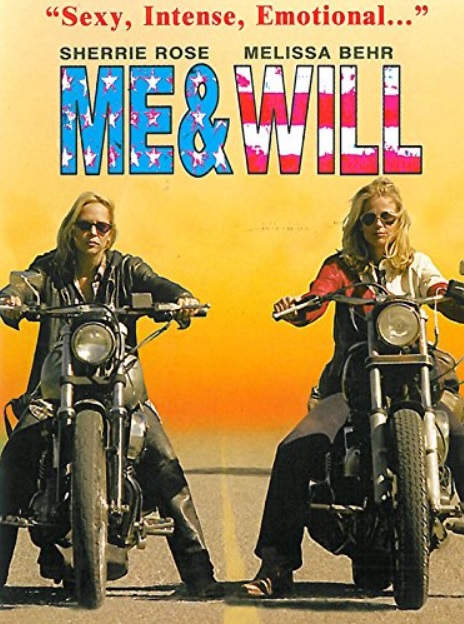
Be it an unintentional sequel or a loose remake—with a Thelma and Louise twist—of the counter-culture classic Easy Rider, there’s definitely a dash of another late 60’s cinematic classic, Midnight Cowboy, in these engine revs written and directed by its stars, Sherri Rose and Melissa Behr. (Another Easy Rider-inspired biker-epic, the better known Roadside Prophets, made in the early 90’s with John Doe, the bassist and singer from X, and a Beastie Boy, may even come to mind as the story unfolds.)
Told from the point of view of Jane (the “me”), a hard-living aspiring writer, she meets an equally burnt-out artist-cum-party girl named Will in an L.A. drug rehab clinic. After watching a late-night showing of Easy Rider on TV, Jane (Sherri Rose, American Rickshaw) and Will (Melissa Behr, aka “Doll Chick” from Bad Channels and its sequel, Dollman vs. Demonic Toys) decide to make like Wyatt and Billy and break out of rehab to embark on a trip to find the legendary chopper ridden by Peter Fonda—which is rumored to still exist in the city of Willsall, Montana.
As the road trip unfolds, Jane and Will meet the usual cross section of bikers, hippies, burnt-out garage mechanics, psycho waitresses, abused women, and abusive cops—as well as the rock bands Space Age Playboys (yes! Kory Clarke and Warrior Soul!) and Keanu Reeves’s band Dogstar. (I played Dogstar on the radio and went to their shows back in the ’90s; they were a solid indie, alt-rock band and not the “actor-gimmick” they were smarmy-labeled.)
What helps this lost bikers-searching-for-their-souls flick is the cast featuring those actors we care about at B&S About Movies: Seymour Cassel (Trees Lounge), M. Emmet Walsh (Escape from the Planet of the Apes), Steve Railsback (Lifeforce), and Grace Zabriskie (Galaxy of Terror). (Oh, shite: she was also George’s mother-in-law on Seinfeld. Sorry, Sam.) And keep your eyes open for Johnny Whitworth (Empire Records), William E. Wirth (The Lost Boys), and Tracy Lords (Shock ’em Dead).
Oh, and Jane’s boyfriend, Fast Eddie, is Patrick Dempsey (the ’80s cable comedy-classic Can’t Buy Me Love and “McDreamy” from TV’s Grey’s Anatomy). Of course, when Grey’s Anatomy became a ratings juggernaut—and as with Katherine Hegyl’s equally unknown 2006’s Zyzzyx Road—the DVD reissues of Me & Will feature Dempsey front and center—with Rose and Behr kicked to the curb.
In addition to the ‘Playboys and Dogstar appearing on the soundtrack, there’s music by Dwight Yoakam, Josh Clayton, formerly from School of Fish (remembered for their ’90s hit, “Three Strange Days”), in addition to classic tracks by the Doors and a solo-bound Mick Jagger. Matt Sorum of the Cult/Guns n’ Roses scored the film—with a guitar-style that almost leaves it feeling like a Tangerine Dream-scored film (Thiefcomes to mind, IMO), sans the synths and moogs.
To dismiss Me & Will as a vanity-driven “female Easy Rider” and to be alpha-male ruffled by its “female empowerment” message is a chauvinistic disservice to Sherri Rose and Melissa Behr’s efforts to dissuade the film from disintegrating into a hail of bullets of a gone-wrong crime caper, ala the somewhat similar Don Johnson and Mickey Rourke buddy-biker action flick, Harley Davidson and the Marlboro Man (1991).
Me & Will is a gallant effort; a heart-felt, solid indie-film and Rose and Behr certainly deserved better than their exploitation resumes allow. And kudos to Columbia Pictures giving their blessings and not having the proceedings degrade into the legalese haze of Phil Pitzer’s not-as-bad-as-they-say Easy Rider homage. You can watch Me & Will as a free-with-ads stream on TubiTv or without ads on You Tube.
So, as with Phil Pitzer’s Easy Rider: The Ride Black: Me & Will is an alright effort. So do Sherri Rose and Melissa Behr a solid and support indie film by streaming the ad-stream version on TubiTV, will ya? Other films starring Sherri we’ve reviewed for you to check out include Cy Warrior, Relentless Justice, and Summer Job.
About the Author: You can learn more about the writings of R.D Francis on Facebook. He also writes for B&S About Movies.
So . . . did you you know Easy Rider was followed forty years later by an unofficial sequel? It’s okay. No one does. . . .
The existential subtext and counterculture viewpoints (somewhat) of the original are lost . . . somewhere on a dusty, Baja road in this “sequel” (also working as a prequel) that explores the family history of Peter Fonda’s character Wyatt “Captain America” Williams through the eyes of his older brother, Morgan: a pot-distributing, Vietnam war deserter and custom jewelry-designer (specializing in Maltese crosses; not for the reasons you think, the eventual reveal is a clever trick-of-the-script) living in luxurious solitude on the Pacific coast of Mexico.
The drama and struggles center around Morgan’s cycle-lovin’ family friend, West Coast (Jeff Fahey of The Lawnmower Man, Psycho III), Williams sister Shane (Sheree J. Wilson of TV’s Dallas and as Alex Cahill on Walker, Texas Ranger; she also produces), and her wealthy-hubby (Michael Nouri of Flashdance) as it flashes to and fro from the 1940s to the present, concerned with Wyatt’s brother, Morgan (Phil Pitzer) visiting his dying, disapproving father. So, along with West as his “Billy,” Morgan mounts Wyatt’s Captain American chopper, which he recovered back in ’69 and restored, slaps on his brother’s old leathers, and takes a “ride back” to bury those family demons.
Of course, when it comes to making a sequel, the smart bet is to file legal actions against Bob Rafelson and Bert Schneider, the producers of the original through their Raybert Productions (the force behind The Monkees TV series), to block them from reclaiming their expired film rights. And don’t bring back any of the original’s cast or crew. And cavet those emptor for the ol’ home video bait n’ switch: courtesy of the flashing-back-and-forth, Fahey, Wilson, and Nouri are the marquee-stars, but only here as supporting characters. This show belongs to Phil Pitzer and Chris Engen (as the young, troubled third-brother Virgil; who despite his bigger role, is bumped off the marquee).
So goes this vanity-vision by producer and screenwriter Phil Pitzer, a former lawyer who, with a desire to enter the film industry with a bang, manipulated legal loopholes to get sequel rights. His co-writer and director, Dustin Rikert, fared better: his names pops up as a producer and director on a slew of telefilms broadcast on the Hallmark, Lifetime, and Syfy channels. Their Easy Rider part deux was initially completed in 2009 and appears in filmpedias with that release date; however, by the time it went through the festival circuits and film markets for distribution, it was formally released in 2012.
So, is Easy Rider: The Ride Back the most-unwanted-not-a-sequel since the days of Halloween III: Season of the Witch (which I really like) or House II: The Second Story (which I didn’t) or House III: The Horror Show (which I did, because well, it’s a friggin’ Lance Henriksen and Brion James movie)? And is stuffy ol’ Leonard Maltin—who hates everything the B&S About Movies crew likes—justified in calling the Pitzer’s effort “a staggeringly bad, cash-in bomb,” solely based on Pitzer’s clandestine legal maneuvers?
Uncanny: “Fonda 2009” image courtesy of Glenn Francis of Pacific Pro Digital/Wikipedia. “Pitzer 2010″ image courtesy of Zimbio.
Eh, well . . . to Pitzer’s credit: He does, as you can see, resemble Fonda, so it lends to the credibility that he’s Wyatt’s brother, as well as “being” Wyatt in flashbacks that lend to the film-to-film continuity. All of the bikes (especially Wyatt’s chopper reproduction) and time-period designs (props, costumes, cars, etc.) are correct, the Korean war sequences are well-shot, and the cinematography by Brian Lataille (videos for Incubus and Linkin Park), while not up to the László Kovács-standard in the original, is pretty solid. And yes, as with any indie, flick: there’s a few strained thepsin’ moments. So, while it’s not exactly Easy Rider, Pitzer’s effort is not a Tommy Wiseau (or Neal Breen) biker joint as some threaders and reviews claim. No, it’s definitely not “The Room on wheels” as some have said.
While the flashbacks and bike-riding interludes of Morgan’s and West Coast’s contemplations (most in voice overs as majestic “post-card moments” unfold) about life, e.g., homelessness and hunger, ecology, the meaning of patriotism and true freedom, make the film seem a bit longer than its 90-minute running time, Pitzer nonetheless crafted well-rounded characters for his actors to sink their thespin’ teeth into. He also developed a compelling “history” for an initially ambiguous, metaphorical-drifting character. So kudos to Pitzer for giving a structured “focus” to a film that was admittedly an “out of focus,” scriptless-improv in the first place (that Fonda and Hopper openly admitted in interviews).
And besides: I always enjoy seeing senior actors (e.g., the recently-released Nana’s Secret Recipe) given meaty roles and, to that end: Newell Alexander (who’s career goes back to the ’70s TV series Barnaby Jones and Battlestar Galactica ’79, The Kentucky Fried Movie; he also appeared in Walker, Texas Ranger with Sheree) and Ron Howard’s pop, Rance (The Andy Griffith Show, Grand Theft Auto, and Cotton Candy) are both excellent in their roles as Poppa Williams and his ol’ hog-riding Korean War war buddy, so much so, you’d like to see more of them in the film.
All in all, despite Leonard Maltin and the Internet hoards of war, Easy Rider: The Ride Back it’s not as Wiseauian bad as they’ll lead you to believe. (The same arguement we had with our review of Jeremy Saville’s radio dramedy, Loqueesha). And for those who have stated Phil Pitzer “thankfully, has never made another movie” and “hasn’t made another movie since”: Phil produced the upcoming Cannes Without a Plan (2021), the third writing-directing effort from Julie Simone Robb (NBC-TV’s Homicide: Life on the Street) that also stars Pitzer’s The Ride Back cast member, Jodie Fisher (of Charles Band’s Blood Dolls).
Courtesy of a new distribution deal with retro-imprint Kino Loeber, Easy Rider: The Ride Back is available worldwide as 2019-issued Blu and DVD and VOD stream on Amazon Prime and You Tube Movies. Yeah, you’ll find that errant You Tube freebie (you know you look there and TubiTV first before you buy), but do Phil Pitzer a solid and support indie film, will ya? Pay for it, okay?
Like Kowalski said in Vanishing Point: “Fuck the man!” Keep on making movies, Phil. You’re alright, kid. . . .
So, did you know . . . sandwiched between the ‘60s original and Phil Pitzer’s 2012 revisiting, Easy Rider: The Ride Back, there was another unofficial “sequel,” which concentrates on a search for the famed Captain America chopper that appeared in Easy Rider? Never heard of it? It’s okay. No one did. Join us at 3 pm for more tales from the fast and the furious . . . with Me & Will.
About the Author: You can learn more about the writings of R.D Francis on Facebook.He also writes forB&S About Movies.
Author’s Note: Yeah, we know you’ve seen them before and know them well. But we’ve got some movie “Easter Eggs” in these reviews. Thanks for revisitingthe classics with the B&S gang, where we coddle the obscure and the forgotten films of the VHS, UHF, and Drive-In yesteryears.
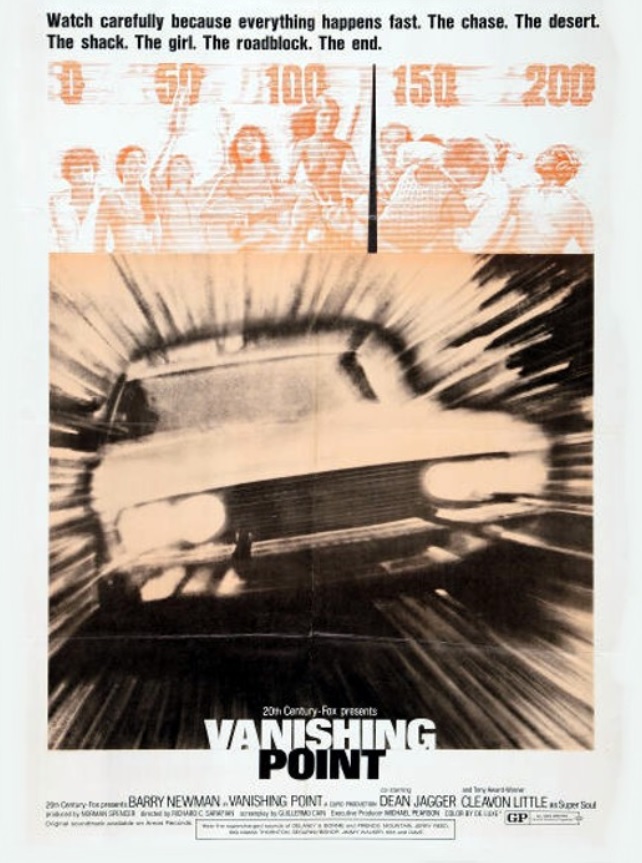
This 20th Century Fox tale reminds a lot of Elektra Glide in Blue, United Artists’ 1973 existential road flick entry about a disgraced biker-cop (Robert Blake) produced-directed by James William Guercio, who managed and performed with the Beach Boys and produced several albums for ’70s pop-meisters Chicago (who appear in the film). We also had Vanishing Point on the short list for “Radio Week,”* thanks to Cleavon Little’s blind DJ. While it was bumped for that week—but it’s prime fodder for “Fast and Furious Week.” Thank god for Dodge Chargers. . . .
Kowalski (Barry Newman) is a Vietnam veteran, disgraced ex-cop and former professional road racer of motorcycles and stock cars. To cope with his personal demons, he lives on the open road as a driver for a car delivery service. Before heading out on his next assignment—transporting a supercharged 1970 Dodge Challenger from Denver to San Francisco—he scores a hit of speed and makes a bet with his drug-pusher that he can make the trip in 15 hours.
As the police follow in hot pursuit, Kowalski becomes a folk hero to the roadside eccentrics and Vietnam-war worn masses, thanks to the on-air updates of the cross country chase by a blind DJ “Supersoul” (Cleavon “The Prince of Darkness” Little of FM) on KOW, an 50,000-watt R&B/Soul station broadcasting across Nevada, Utah and parts of Colorado and California. (Little’s engineer—an unaccredited role—is John Amos of TVs Good Times, but youngins know him for his work in Die Hard 2: Die Harder and Coming to America.) (And, is it just me, or is Outside Ozona a slasher version of Vanishing Point? That’s not critical insult, but a kudos.)
Yeah, we love this movie, but this movie also really wants to be the next Easy Rider, with its replacement of Steppenwolf by way of the equally biker-acceptable Mountain with “Mississippi Queen,” along with the counterculture band Delaney, Bonnie & Friends (see the history of Eric Clapton and Fleetwood Mac), who also appear in the film as a singing group at a religious revival caravan.
There’s no online streams, but Blus, DVDs, and used VHS-tapes are available on Amazon to watch Vanishing Point. . . .
So, we teased you about the two “sequels” to Easy Rider . . . but did you know their was a remake to Vanishing Point? It’s okay. No one does. Join us tomorrow, August 7 at 6 pm, for more tales of the fast and the furious . . . and the vanishing . . . with Vanishing Point ’97.
How much is this film loved? It has die-cast cars!






 B&S About Movies
You must be logged in to post a comment.