The Point! was the sixth studio album by Harry Nilsson, as well as this film, which was directed by Fred Wolf, who would go on to help make the Teenage Mutant Ninja Turtle cartoon and the TV special Free to Be You and Me.
Yes, the creative force behind Son of Dracula helped make a cartoon and it’s exactly what you’d want it to be.
Originally airing as The ABC Movie of the Week on February 2, 1971, this film first featured Dustin Hoffman in a framing sequence. Hoffman would only allow his voice to be used for the initial airing, so his part is dubbed by Alan Barzman. On some releases, Ringo Starr and Alan Thicke did this part.
It tells the story of round-headed Oblio (Mike Lookinland from The Brady Bunch) who wears a pointed hat to fit in. However, once the king’s son knocks his hat off after being bested in a game of Triangle Toss, Oblio is kicked out.
Our hero and his dog Arrow are sent to the Pointless Forrest, where they somehow learn that even things that don’t have a point really have a point, in spite of themselves. They tell everyone this news and the king’s son knocks off Oblio’s hat again to reveal that he now has a point at the very same time that everyone loses theirs.
In 1977, a stage version of The Point! played in London, with Monkees members and Nilsson friends Davy Jones and Micky Dolenz appearing.
You can get this from MVD and watch it on Tubi. It’s worth watching and appreciating, perhaps even more today than it was in 1971.
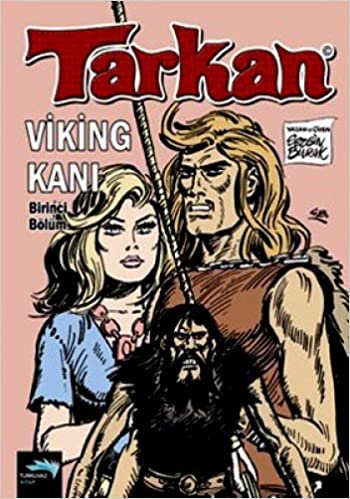
Tarkan and the Vikings is the fifth in the series of seven films that tell the story of Tarkan, who seems at continual war with Vikings. Created by Sezgin Burak in 1967, Tarkan is rare in Turkish cinema in that he is not a remake, a remix or a rip-off. Instead, the Hunnish warrior and his wolf companion Kurt appear in their own movies which only slightly echo the Italian sword and sandal films, but are reflected through the low budget and high concept world of Turkish cinema.
The Vikings are, of course, beyond evil. They sacrifice virgins and worship an octopus god who — mercifully — emerges from the deep to menace our hero. Kartal Tibet would play Tarkan in five movies and he’s the exact action hero you want in this kaleidoscopic 74-minute blast directly to your brain. The villains do more than just shoot him in the back twice. They kill his dog. He swears to his dog’s son that he will have his horrible and bloody revenge. And oh yes — he will.
This wouldn’t be a Turkish film without the pilfered music, here being Strauss’ “Also Sprach Zarathustra” and at least one John Barry song. Seriously, I think Turkish filmmakers liked Barry more than even their British counterparts!
Eva Bender shows up in three of the Tarkan films and you’ll wish that she was in every movie that you’ve ever seen. While she plays the evil Gosha in Tarkan and the Golden Medallion and Tarkan and the Silver Saddle, here she’s Ursula, the leader of the rebellion against the Vikings.
Much like all Turkish films, the bad guys are quite literally the worst bad people you’ve ever seen with no redeeming qualities. They feed people to their pet hawks, they throw innocent women onto trampolines (yes, really) and literally throw kids in the air and slice at them with axes (double yes, really). Lotus (Seher Seniz) is a dragon lady so sinister that she does a striptease belly dance with throwing knives as our hero hangs perilously over a pit of snakes. Just writing about this scene makes me want to go back and watch this all over again.
You will learn much from this piece of art, but most importantly, you will walk away learning that Vikings chose to wear lots of pinks and purples.
You can download this from the Internet Archive or watch it on YouTube.
The second part of the Bloodthirsty trilogy — three unrelated Toho-produced vampire movies all directed by Michio Yamamoto — Lake of Dracula shares the Hammer-inspired look of the other two films, looking as gorgeous as only Technicolor-hued skies can make happen. It transplants the gothic feel of British horror squarely into teh Far East with style.
When she was five, Akiko had a nightmare of losing her dog inside a crumbling mansion until she watched a vampire (Shin Kishida, Godzilla vs. Mechagodzilla) drain the blood of a woman. Now an adult, she finds herself back in the grip of that very same vampire, as he arrives in a white coffin, fully prepared to finally claim her.
He starts by taking her friend Kusaku and sister Natsuko as his thralls. As Doctor Takashi Saki has become involved in the case, he saves her as her sister expires in the sunlight of a beach, begging for her corpse to be burned so that she may never return. However, they take her to the morgue where she rises again from the dead, now a full vampire ready to help her new master take her sister once and for all.
If you watched this in Japan, the vampires all disintegrate at the end of this movie. When it was edited for American television, they just fade away.
Countess Elisabeth Nádasdy (Ingrid Pitt!) discovers that her sex drive and youth come back when she bathes in the blood of virgins. Luckily, she has her long-time lover Captain Dobi (Nigel Green) and her maid Julie to steal away local girls so that she may bathe in their blood, which really does wonders for the skin.
Based on Countess Erzsebet Báthory, this film sees Countess Elisabeth Nádasdy bring her own looks back at the expense of Captain Dobi’s manhood and the lives of many young women.
In order to marry young Lieutenant Imre Toth, she even imprisons her own daughter Ilona (Lesley-Anne Down!) and impersonates her. But like all good things, this can’t last, as even virgin sacrifices only serve to de-age Countess Dracula for less and less time. The drugs work, but they have a shelf life too.
Pitt was proud of her performance in this film — the role was originally to be played by Diana Rigg — but quite displeased that she’d be dubbed.
If you like your vampires curvaceous and cuckolding, this is definitely the movie for you. Between this and The Vampire Lovers, established Pitt as the vampire woman of the early 70’s. You can understand that despite all her wanton ways exactly why Dobi keeps doing more and more for her.
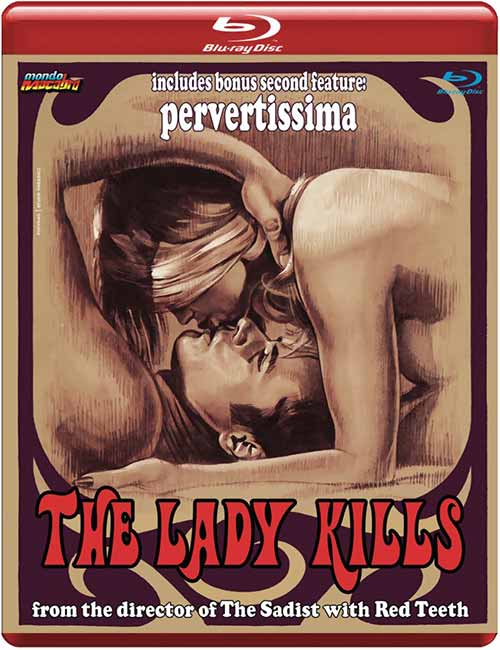
Françoise Frémond (Carole Lebel, Two Weeks In September, The Golden Claws of the Cat Girl) is killing her way across Europe, leaving horrible men’s dead bodies behind. Keep in mind this movie was made before Ms. 45 or I Spit On Your Grave or even Thriller: A Cruel Pictureand offers a similar blast of female revenge violence set to a psych-rock freakout soundtrack.
After a pop-art style assault by several men, Françoise spends the rest of this film tracking each of them down and killing them all in various ways. There’s also high fashion, the aforementioned swinging electric jazz and nudity that juxtaposes the feminist revenge narrative because at heart, this is still an exploitation movie.
You can get this — along with Pervertissima, which was also made by director Jean-Louis van Belle — from the amazing folks at Mondo Macabro, who were kind enough to send us the blu ray for review and understanding enough to know that it won’t impact our review.
Beyond the new 2K transfer for both movies, you’ll also get a “Who is Jean Louis Van Belle?” documentary featurette and introductions for each film by Belgian film expert Christophe Bier. This film is a must-have, as it has never been remastered, restored and available on home video anywhere in the world ever before.
March 2022 Announcement: Severin Films has released a Blu-ray of Nosferatu in Venice — scanned in 2k from the original negative — which serves as the unofficial sequel to Werner Herzog’s Nosferatu. In addition to cast and crew interviews, the Blu also features the 80-minute documentary, Creation is Violent – Anecdotes From Kinski’s Final Years.
Severin has since released the documentary as an independent stream on the free-with-ads Tubi service.
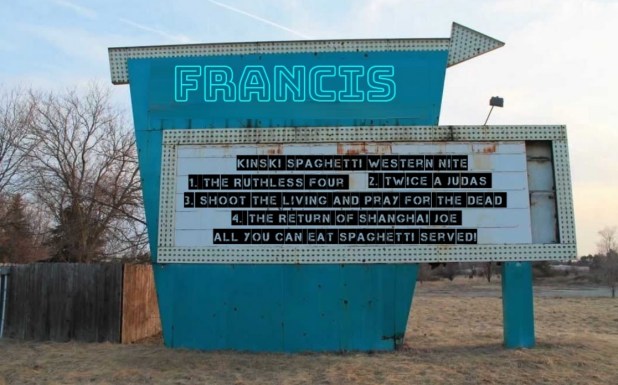
So Sam came up with a “Spaghetti Westerns Week” (running from Sunday, August 16 to Saturday, August 22) . . . and me, with my Klaus Kinski-mania . . . well, it’s time for another “Drive-In Friday” salute to Klaus as we follow up our June “Drive In-Friday” tribute to the five-film oeuvre of Kinski with Werner Herzog.
Yes, we’ll supply the Parmesan.
Klaus made his first jump into the Western-pasta pot in 1965 as Juan Wild, the hunchback member of El Indio’s (Gian Maria Volonte) in Sergio Leone’s For a Few Dollars More. Kinski then appeared in A Bullet for the General (1967; also starring Gian Maria Volonte), and Man, Pride & Vengeance (1967; starring Franco Nero).
As with Kinski’s oeuvre in other genres: I’ve seen some of Kinski’s westerns (the ones featured tonight), but not all of them (and probably never will), but seen most of them courtesy of the long since gone VHS grey market purveyor VSOM: Video Search of Miami, which excelled in making overseas films available in the U.S.
When it comes to these films, in terms of quality in cinematography . . . well, each try but none succeed in exceeding — or even matching — Sergio Leone’s filmmaking style displayed in the Dollars Trilogy of A Fistful of Dollars (1964), For a Few Dollars More (1965), and The Good, the Bad and the Ugly (1966). So, if you know those Clint Eastwood-starring films, well, there’s really not much critical analysis to be had with Klaus Kinski’s inversion of the genre. Just know you’re getting serviceable copies of Clint’s films and if you’re a Kinski fan — such as myself — you’ll want to spend your time watching them. All others will probably pass because, if you’ve seen one spaghetti western, you’ve seen ’em all. Between the one-sheets, my gibber-jabber about the films, and the trailers, you’ll figure it all out. The main goal, here, is to make you aware of and guide you through Mr. Kinski’s “spaghetti years” before he became a go-to actor for Werner Herzog.
Alrighty then! Let’s pop those RC Colas and ride, meho!The riches of the lands South of the Border await us!
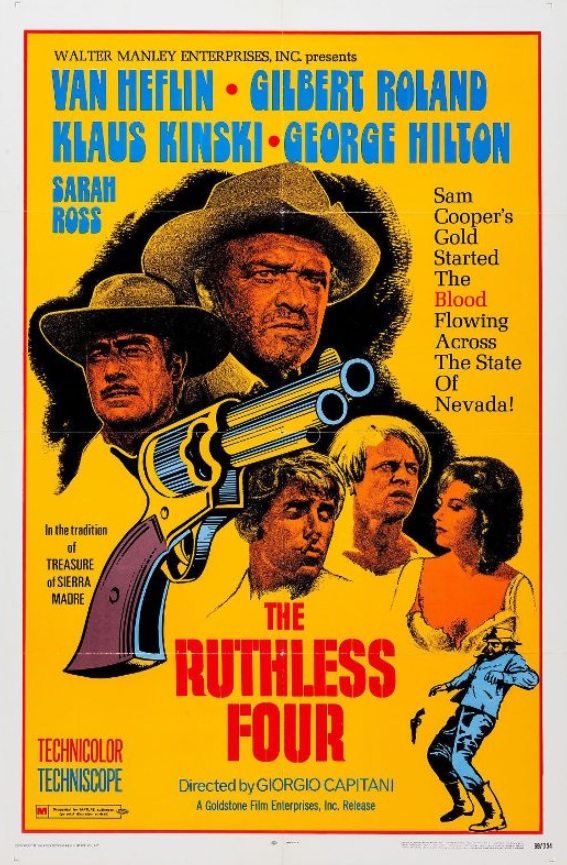
Movie 1: The Ruthless Four (1968)
Known in its homeland as Ognuno per sé (aka, Everyone for Himself) — and in West Germany as Das Gold von Sam Cooper (aka, The Gold from Sam Cooper) — Kinski co-stars with Best Supporting Actor Oscar winner Van Heflin (1942’s Johnny Eager), who wowed then little tykes (like myself) roasting under the black & white’s cathode ray glow of Pittsburgh’s WIIC Channel 11 with his roles in the iconic westerns Shane (1953), 3:10 to Yuma (1957), and Gunman’s Walk (1958).
By the turn of the ’60s, Heflin’s star — along with his Gunman’s Walk co-star, Tab Hunter (1988’s Grotesque with Linda Blair) — had fallen, but there was a huge market for American actors in Italian cinema. So Heflin made his first film there, Tempest (1959) and, along with Tab, was billed under Gary Cooper and Rita Hayworth in They Came to Cordura (1959).
The title — and alternate titles — of this one pretty much says it all: Four men embark on a suicide mission for a fortune in gold from a mine owned by Nevada prospector Sam Cooper (Van Heflin). Always the heavy, Kinski is one of the greedy four, Brent the Blonde, a faux-preacher with blood on his hands . . . and one more body means nothing to him.
Up next for Kinski: 1968’s If You Meet Sartana . . . Pray for Your Death. He also worked on the sequel, I Am Sartana, Your Angel of Death (1969). (Sartana was, of course, Gianni Garko, that ‘ol space scoundrel Dirk Laramie from Star Odyssey.)
You can watch The Ruthless Four on You Tube. There’s also a stream on TubiTV.
Movie 2: They Were Called Graveyard, aka Twice a Judas (1968)
Antonio Sabato (Escape from the Bronx and War of the Robots) stars in this film noir-inspired Spaghetti Western as Luke Barrett, a cowboy who regains consciousness with bullet-grazed head wound in the middle of the desert . . . next to a dead man — and a lone rifle with the word “Dingus” carved in its stock. Sabato gathers clues along the way to discover that a hired gunman is out to get him . . . and that he himself was a gun hired to kill Dingus. Yep: You guessed it: Kinski is Dingus and he’s out for blood.
Kinski also worked on Sergio Corbucci’s pasta-western, The Great Silence in the same year.
You can watch They Were Called Graveyard on You Tube.
After working with Antonio Margheriti (1966’s Lightning Bolt) on the western And God Said to Cain (1970), Klaus Kinski received top-billing in this desert noir that Quentin Tarantino* ranked as his 16th personal “Top 20 favorite Spaghetti Westerns.”
Kinksi stars as Dan Hogan, an ex-Ku Klux Klan member leading a gang of bank robbers on the run with $100,000 in gold bars. Hogan’s dark past comes back to haunt him in the form of John Webb (Paolo Casella, who also co-starred with Kinski in the 1970 western, The Beast, and the next film on tonight’s program: 1975’s The Return of Shanghai Joe), a stranger who killed the gang’s guide into Mexico and wants half of their gold for safe passage. And all of their blood. So he really wants all of the gold.
Klaus also starred in the westerns Adios Compañeros, Black Killer, Coffin Full of Dollars, His Name was King, and Vengeance Is a Dish Served Cold that same year. Next up for Kinski: 1972’s A Noose is Waiting for You Trinity.
You can watch Shoot the Living and Pray for the Dying on You Tube.
The film noir-influence of Kinski’s previous pasta-westerns takes a turn into the then hot Kung-Fu genre — courtesy of Japanese-born martial artist Chen Lee (aka, Cheen Lie, playing a Chinese man here). As result of its martial arts plot, this also appeared on several ’70s Drive-In double and triple-bills, alongside more traditional Asian-action imports, as The Dragon Strikes Back (to trick you into thinking you’re seeing a Bruce Lee movie).
In the first film, 1973’s (My Name is) Shanghai Joe (aka, The Fighting Fists Of Shanghai Joe), Kinski was Scalper Jack. In the sequel, Kinski is his usual, sinister self as new character, Pat Barnes: a town boss whose stranglehold over a dusty, desert town runs afoul of Shanghai Joe (actually an uncover U.S. Federal Marshal), who’s assisted by a smooth-talking traveling medicine show man he saved from Barnes’s bully boys.
* Back in July 2019, we had a “Quentin Tarantino Week” of reviews to celebrate the release of Once Upon a Time in Hollywood. Be sure to visit our “Exploring: The 8 Films of Quentin Tarantino’s Rolling Thunder Pictures” featurette that includes the links to all of our week’s reviews and examinations of the films that influenced Quentin’s work.
We’ve reviewed a LOT of Kinski’s films — and we run ’em all down with our second drive-in feature spotlighting his career. Check ’em out!
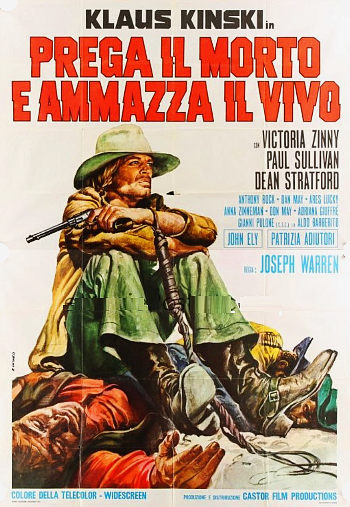
This movie has so many titles — Pray to Kill and Return Alive, To Kill a Jackal and Renegade Gun — but I went with the one closest to the original Italian title (Prega il Morto e Ammazza il Vivo).
It’s directed by Giuseppe Vari, who brings something artistic to every movie beyond just straight exploitation. As Joseph Warren, he made the giallo Who Killed the Prosecutor and Why? He also a very early zombie movie, 1963’s peblum War of the Zombies, as well as Urban Warriors and Sister Emanuelle, in which Laura “Black Emanuelle” Gemser renounces her sexual sins and becomes a nun until a spoiled rich girl (Mónica Zanchi) reawakens her lust just in time for an escaped murderer (Gabriele Tinti, husband to Gemser) to hide out amongst the nuns. Whew!
Dan Hogan (Klaus Kinski) and his gang have made off with $10,000 from a stagecoach and are due to meet at a saloon on the Mexican border. As the men wait for his girlfriend to bring their money to them, they encounter John Webb, who has killed the man who was to be their guide to Mexico. He asks for half the money to take them, but in truth, he’s wanted to pay back Hogan for years.
Writer Adriano Bolzoni (A Fistful of Dollars, Minnesota Clay, The Mercenary, Your Vice Is a Locked Room and Only I Have the Key) infused this movie with a film noir edge, with Kinski’s character making his first appearance is similar to Edward G. Robinson’s first appearance in Key Largo.
Seeing as how this is number sixteen on Quentin Tarantino’s top twenty Italian Westerns of all-time list, it’s not a stretch to say that this movie directly inspired The Hateful Eight.
You can watch this on YouTube.
Don’t forget! We did a Klaus Kinski spaghetti westerns blowout for a “Drive-In Friday” featurette that runs down the mad German’s entire shoot ’em up resume. Join us, won’t you? We give full reviews — with a different insight to Shoot the Living — and new reviews to The Ruthless Four and Twice a Judas.
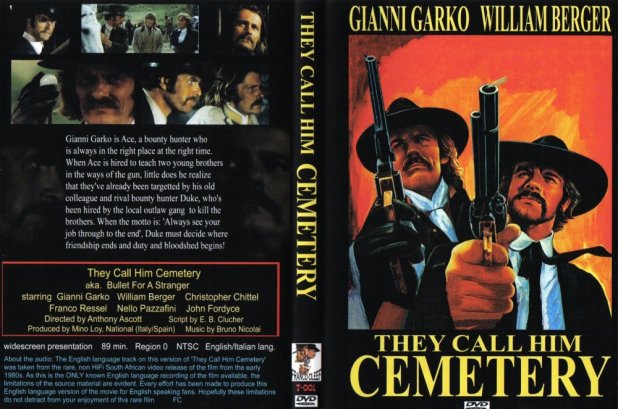
John (Chris Chittell, The Wild Geese and the long-running UK soap opera Emmerdale) and George McIntire have run into some trouble with a gang. They have no way of surviving until a mysterious stranger named Cemetery (Gianni Garko, Sartana himself!) rolls into town to help them against the baddies, who then hire his nemesis Ace (William Berger).
If you listen to the Bruno Nicolai theme and it sounds familiar, that’s because it was used in the game Red Dead Revolver.
We’ve discussed before that Edoardo Mulargia made movies called Cjamango, Shango and Don’t Wait, Django… Shoot! As you can read, he really, really liked Django.
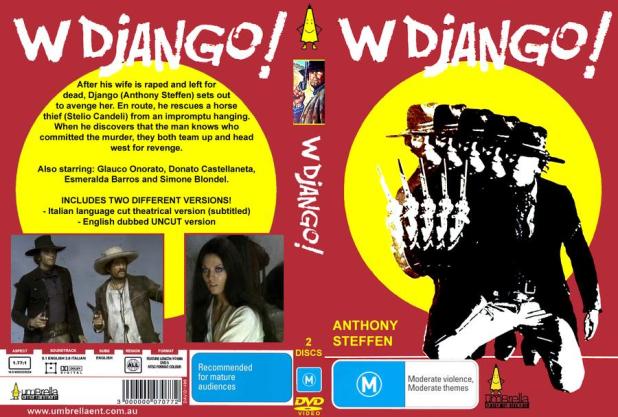
This time, Andrew Steffan takes the role, tracking down and killing the men who killed his wife. He’s helped by a horse thief named Carranza (Glauco Onorato, who was mostly known for his dubbing work). Of course, that criminal may not be telling all he knows about the night Django’s old lady went down.
This one is also known as A Man Called Django! and Viva! Django, a fact that I learned as I made it a minute into each of those films before realizing that I had already seen this movie.
While this is also called Viva Django!, don’t confuse it with the 1968 Ferdinando Baldi film, which was originally intended to star Franco Nero, but has Terence Hill in it (he’s listed as Django, Joe Cassidy and Trinity in the SWDB) and George Eastman as one of the men who must pay.
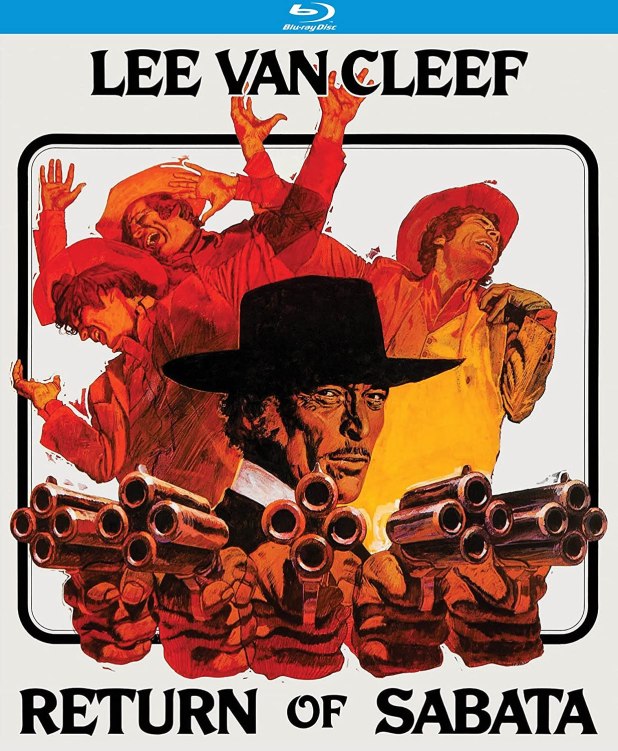
Back for the third film, Lee Van Cleef is Sabata again in a movie known in Italy as È Tornato Sabata … Haichiusoun’altraVolta (Sabata is Back … You’re Finished Again). Now, our hero is working for a traveling carnival as a trickshot. However, when he runs into an old war acquaintance who owes him $5,000, well…people get shot.
Sabata ends up fighting an entire town that puts a tax on everything he loves — gambling, drinking and prostitution. Ignazio Spalla plays another friend, this time named Bronco, and Aldo Canti plays an acrobat who aids our black-wearing protagonist.
As his theme song says, “If you wanna get money and if you wanna get rich and if you wanna get life, you gotta be a son of a…” And so Sabata is. That same song also refers to him as a nine-fingered man. That’s actually true, as Van Cleef lost a large portion of his middle finger while building a playhouse for his daughter.
Director Gianfranco Parolini would go on to make God’s Gun and Yeti: Giant of the 20th Century, a movie that I definitely need to get to.
This movie ended up in The Fifty Worst Films Of All Time by Harry Medved with Randy Dreyfuss. Over the years, I’ve come to love so many of the movies in this book, including Airport 75, The Ambushers, Godzilla vs. Hedorah, The Last Movie, Robot Monster, The Omen, The Story of Mankind and Valley of the Dolls.






 B&S About Movies
You must be logged in to post a comment.